Alexander Best: Earth Day poems / “Poema al Agua” para El Día de La Tierra
Posted: April 22, 2015 Filed under: Alexander Best, English, Spanish, ZP Translator: Lidia García Garay | Tags: Poems for Earth Day Comments Off on Alexander Best: Earth Day poems / “Poema al Agua” para El Día de La Tierra
Handmade Poem
.
One way
Right way
Lost and pounding
.
Treasure
Shovel
Message
Bottle
.
Plastic
Bagful
Urgent
Bubble
.
Soilmouth
Steepdrink
Skypit
Hovel
.
Un-way
Our way
Human foundling
.
Mousepad
Chisel
Boulder
Nipple
.
Clayclod
Seedhusk
Grounded
People
.
Yucca
Maize and
Grains
Astounding
.
Cellphone
Oatmeal
Idealogjam
.
Slowburn
Brainsmoke
Concrete
Feed me
.
Juice of
Grasses
Miles of
Malls and
.
Micro
Chip off
Old block
– Heed me!
.
(September 2010)
. . .
Water Sonnet
.
My love and I go down to the well
With buckets at our waists,
and dip the vessels in, refresh ourselves,
Then give we chase…
.
The sparkling drench is ours,
Extravagance of simple choice.
We swallow all, we surge and runneth over
By such device.
.
And liquid Time a-rushing flows,
And tolls the bell for me,
And us – where did our children go?
Could we abandoned be?
.
My love and I went down to the well
And turned our buckets over;
And sat upon them;
Sighed and waited
– waited, sighed –
Forever.
.
(September 2010)
. . .
Poema al Agua
.
Mi amada y yo, vamos al pozo
Con cántaros a la cintura,
Los metemos al agua, nos refrescamos y
luego correteamos…
.
El líquido brillante que nos empapa es nuestro,
una extravagancia fácil de escoger;
nos la tomamos, resurgimos y
nos dejamos atropellar por tal método.
.
Y el Tiempo líquido corre y nos toca la campana
¿Y vosotros— adónde fueron vuestros hijos?
¿Hemos sido abandonados tal vez?
.
Mi amada y yo fuimos al pozo,
Pusimos nuestros cántaros boca abajo
y nos sentamos en ellos;
Suspiramos y esperamos – esperamos, suspiramos
Para siempre.
.
Traducción al español: Lidia García Garay
. . .
ZP Editor’s note:
I wrote the two poems above at the request of Kate Castelo, a friend who lives in Vancouver. She was involved in a climate-change awareness initiative in British Columbia in the autumn of 2010, and “engaged” poetry reflecting on global development, pollution, and natural resource use/abuse, was sought by the organizers. The Kyoto Protocol was much in the news five years ago, and every issue is still current and of great concern. My second poem (“Water Sonnet”) I composed in a lovely traditional metre which contrasts all the more with the poem’s theme: Canada’s longstanding cultural tradition of taking Water for granted. My translation mentor, Lidia García Garay, kindly created a Spanish version of the poem…
.
The Kyoto Protocol is an international treaty extending the 1992 United Nations Framework Convention on Climate Change (UNFCCC) that commits State Parties to reduce greenhouse gas emissions, based on the premise that A. Global Warming does exist, and that B. Man-made CO2 Emissions have caused it.
The Protocol was adopted in Kyoto, Japan, in December of 1997, and entered into force in February of 2005. There are currently 192 Parties (Canada withdrew, effective December 2012) to the Protocol. The Kyoto Protocol implemented the objective of the UNFCCC to fight global warming by reducing greenhouse gas concentrations in the atmosphere to “a level that would prevent dangerous anthropogenic interference with the climate system” (Article 2). It is based on the principle of common but differentiated responsibilities: it puts the obligation to reduce current emissions on developed countries on the basis that they are historically responsible for the current levels of greenhouse gases in the atmosphere.
Negotiations were held in Lima in 2014 to agree on a post-Kyoto legal framework that would obligate all major polluters to pay for CO2 emissions. China, India, and the United States have all signaled that they will not ratify any treaty that will commit them legally to reduce CO2 emissions.
. . .
Other Earth Day features at Zócalo Poets:
https://zocalopoets.com/category/guest-editors-2/duane-taylor/
.
https://zocalopoets.com/category/poets-poetas/maurice-kenny/
.
https://zocalopoets.com/category/poets-poetas/rita-joe/
.
“Earth Day” poems: Japanese poets on Nature – and Human Nature
. . . . .
William Henry Davies: “Tormentas”
Posted: April 21, 2015 Filed under: English, Spanish, ZP Translator: Alexander Best | Tags: Poemas para Abril: el mes de lluvia Comments Off on William Henry Davies: “Tormentas”
William Henry Davies (1871-1940)
Thunderstorms
.
My mind has thunderstorms,
That brood for heavy hours;
Until they rain me words,
My thoughts are drooping flowers
And sulking, silent birds.
.
Yet come, dark thunderstorms,
And brood your heavy hours;
For when you rain me words,
My thoughts are dancing flowers
And joyful, singing birds.
. . .
Tormentas
.
Agarra mi mente a las tormentas
que se inquietan para horas pesadas.
Hasta que me “llueven” con palabras,
Mis ideas son flores caídas o
Bichos mudos y hoscos.
.
Pero acérquense, tormentas oscuras,
Para inquietarse esas horas arduas…
Porque cuando me “llueven” con palabras,
Vienen ideas florecientes que bailan, y
Pájaros dichosos que cantan.
. . . . .
Paul Verlaine: “It rains in my heart”
Posted: April 21, 2015 Filed under: English, French, Portuguese, Spanish | Tags: Poemas para Abril: el mes de lluvia Comments Off on Paul Verlaine: “It rains in my heart”
Paul Verlaine (1844-1916)
Il pleure dans mon coeur
.
Il pleure dans mon coeur
Comme il pleut sur la ville;
Quelle est cette langueur
Qui pénètre mon coeur?
.
Ô bruit doux de la pluie
Par terre et sur les toits!
Pour un coeur qui s’ennuie,
Ô le chant de la pluie!
.
Il pleure sans raison
Dans ce coeur qui s’écoeure.
Quoi! nulle trahison ?…
Ce deuil est sans raison.
.
C’est bien la pire peine
De ne savoir pourquoi
Sans amour et sans haine
Mon coeur a tant de peine!
. . .
Paul Verlaine
Llora en mi corazón
(Traducción del francés al español: Carmen Morales y Claude DuBois)
.
Llora en mi corazón
como llueve en la ciudad;
¿qué languidez es ésa
que penetra en mi corazón?
.
¡Oh, ruido suave de la lluvia
en la tierra y en los tejados!
Para un corazón que se aburre
¡el canto de la lluvia!
.
Llueve sin razón
en este corazón que se revuelve.
¡Qué! ¿Ninguna traición?…
Ese luto es sin razón.
.
¡Es pues la peor pena
no saber por qué,
sin amor y sin odio,
mi corazón siente tanta pena!
. . .
Paul Verlaine
Chora em meu coração
(Tradução de Amélia Pais)
.
Chora em meu coração
Como chove na cidade:
Que lassidão é esta
Que invade meu coração?
.
Oh doce rumor da chuva
Na terra e nos telhados!
Num coração que se enfada
Oh o canto da chuva!
.
Chora sem razão
Neste coração exausto.
O quê! nenhuma traição ?…
Este luto é sem razão.
.
E é bem a dor maior
A de não saber porquê
Sem amor e sem rancor
Meu coração tanto dói!
. . .
Paul Verlaine (1844-1896)
It Rains in My Heart
.
It rains in my heart
As it rains on the town,
What languor so dark
That it soaks to my heart?
.
Oh, sweet sound of the rain
On the earth and the rooves!
For the dull heart again,
Oh, the song of the rain!
.
It rains for no reason
In this heart lacking heart.
What? And no treason?
It’s grief without reason!
.
By far the worst pain,
Without hatred or love,
Yet no way to explain
Why my heart feels such pain!
. . . . .
El Día del Aborigen Americano – en inglés: Michelle Obama / April 19th: The Day of The Indian of The Americas: A speech by Michelle Obama
Posted: April 19, 2015 Filed under: English Comments Off on El Día del Aborigen Americano – en inglés: Michelle Obama / April 19th: The Day of The Indian of The Americas: A speech by Michelle Obama
Prepared Remarks by First Lady Michelle Obama for The White House Convening on Creating Opportunity for Native Youth [edited for length]:
Washington, D.C., U.S.A.
April 8th, 2015
.
Good morning, everyone, and welcome to the White House. We are so thrilled to have you here today for our “Generation Indigenous” convening…
.
And as for T.C…there really are no words to express how proud I am of this young man, and how impressed I am by his courage, determination and maturity. Barack and I were blown away by T.C. and by the other young people we met when we visited T.C.’s tribe, the Standing Rock Sioux Nation, last June. And I want to start off today by telling you a little bit about that visit…
It began when we arrived in North Dakota, and as we left the airport where we’d landed, we looked around, and all we could see was flat, empty land. There were almost no signs of typical community life, no police stations, no community or business centers, no malls, no doctor’s offices, no churches, just flat, empty land.
Eventually, we pulled up to a little community with a cluster of houses, a few buildings, and a tiny school – and that was the town of Cannon Ball, North Dakota, which is part of the Standing Rock Sioux Nation. And at that school a small group of young people gathered in a classroom, anxiously but quietly waiting to meet with the President and the First Lady.
These teens were the best and brightest – hand-selected for this meeting – and after we all introduced ourselves, they shared their stories.
One young woman was in foster care because of substance abuse in her household. She talked about how hard it was to be separated from her five siblings. One young man had spent his high school years homeless, crashing on the sofa of his friends, even for a period living in the local community center. Another young man had gotten himself into college, but when he got there, he had trouble choosing the right classes; he realized that he’d never been taught how to properly write an essay; and when family problems arose back home, he struggled to balance all the stress and eventually had to drop out.
And just about every kid in that room had lost at least one friend or family member to drug or alcohol-related problems, or to preventable illnesses like heart disease, or to suicide. In fact, two of the girls went back and forth for several minutes trying to remember how many students in their freshman class had committed suicide – the number was either four or five…this is out of a class of 70.
Just sit with that for a minute: four or five kids out of a class of 70, taking their own lives.
So these are the challenges these kids are facing. This is the landscape of their lives.
But somehow – and this is what truly blew us away – somehow, in the face of all this hardship and all these tragedies, these kids haven’t given up. They are still fighting to find a way forward, for themselves and for their community.
After losing her classmates to suicide, one young woman started volunteering at a youth program to help other kids who were struggling. One young man told us that when his family was struggling he fended for himself for years, sleeping on friends’ couches until he was old enough to become a firefighter.
And that young man who had to leave college? Well, when he got back home, he discovered that his family problems were worse than he had thought. He found that his stepmother was on drugs and his four younger brothers were wandering the streets alone in the middle of the night. So, at the age of 19, he stepped in and took over – and now, he’s back in college while raising four children all by himself.
And then there’s T.C.
He was the last young person to speak that day, and after telling us his story – how he was raised by a single father, how he’s lost so many people he loves, how his family struggles to get by – he then said to my husband “I know you face a lot as President of the United States, and I want to sing an encouragement song for all of us to keep going.”
After everything these young people had endured, T.C. wanted to sing a song for us.
So if you have any doubt about the urgency or the value of investing in this community, I want you to just think about T.C. and all those other young people I met in Standing Rock, North and South Dakota. I want you to think about both the magnitude of their struggles and the deep reservoirs of strength and resilience that they draw on every day to face those struggles.
And, most of all, I want you to remember that supporting these young people isn’t just a nice thing to do, and it isn’t just a smart investment in their future, it is a solemn obligation that we as a nation have incurred.
You see, we need to be very clear about where the challenges in this community first started…
Folks in Indian Country didn’t just wake up one day with addiction problems. Poverty and violence didn’t just randomly happen to this community. These issues are the result of a long history of systematic discrimination and abuse.
Let me offer just a few examples from our past, starting with how, back in 1830, we passed a law removing Native Americans from their homes and forcibly re-locating them to barren lands out west. The Trail of Tears was part of this process. Then we began separating children from their families and sending them to boarding schools designed to strip them of all traces of their culture, language and history. And then our government started issuing what were known as “Civilization Regulations” – regulations that outlawed Indian religions, ceremonies and practices – so we literally made their culture illegal.
Given this history, we shouldn’t be surprised at the challenges that kids in Indian Country are facing today. And we should never forget that we played a role in this. Make no mistake about it – we own this.
And we can’t just invest a million here and a million there, or come up with some five-year or ten-year plan, and think we’re going to make a real impact. This is truly about nation-building, and it will require fresh thinking and a massive infusion of resources over generations. That’s right, not just years – but generations.
But remember: we are talking about a small group of young people, so while the investment needs to be deep, this challenge is not overwhelming, especially given everything we have to work with. I mean, given what these folks have endured, the fact that their culture has survived at all is nothing short of a miracle.
And, like many of you, I have witnessed the power of that culture…
I saw it at the Pow Wow that my husband and I attended during our visit to Standing Rock. And with each stomping foot – with each song, each dance – I could feel the heartbeat that is still pounding away in Indian Country. And I could feel it in the energy and ambition of those young people who are so hungry for any chance to learn, any chance to broaden their horizons.
We all need to work together to invest deeply – and for the long-term – in these young people, both those who are living in their tribal communities (like T.C.), and those living in urban areas across this country. These kids have so much promise – and we need to ensure that they have every tool, every opportunity they need to fulfill that promise.
I want to thank you for coming here today to learn more about “Generation Indigenous” and how you can help. And I look forward to seeing the extraordinary impact that all of you all will have in the years ahead.
Thank you so much – and God bless.
. . .
http://genindigenous.com/
.
. . . . .
A Sioux Prayer (1887)
(Translation into English: Chief Yellow Lark)
.
Oh Great Spirit, whose voice I hear in the winds,
whose breath gives life to the world,
Hear me!
I come to you as one of your many children;
I am small and weak;
I need your strength and wisdom.
.
May I walk in beauty.
Make my eyes ever behold the red and purple sunset.
Make my hands respect the things you have made,
and that my ears be sharp to your voice.
Make me wise so that I may know the things you have taught your children:
the lessons you have written in every leaf and rock.
.
Make me strong; not to be superior to my brothers, but to fight my greatest enemy: myself.
Make me ever ready to come to you with straight eyes,
So that when life fades as the fading sunset,
May my spirit come to you without shame.
. . .
Biographical information about Yellow Lark from Agathos Dorea (David Hunnicutt):
“Yellow Lark, a Lakota Sioux Chief, wrote the lamentation [prayer, above] in the midst of severe persecution by U.S. 7th Cavalry soldiers during the division and segregation of the indigenous tribes who were, at that time, inhabiting the southwestern portion of what is now South Dakota. Unable to come to a peaceful resolution, the years-long ordeal ended with the epic massacre that took place at Wounded Knee (1890) where three hundred Lakota Sioux men, women and children were executed by U.S. soldiers when they refused to be relocated to the Pine Ridge Reservation.
Yellow Lark’s lament was a divine plea to let peace and understanding prevail – even in the midst of severe persecution. Peaceful until the end, Chief Yellow Lark remains an iconic figure among the Lakota Sioux peoples to this very day.
Sadly, Wounded Knee still remains in the midst of the storm. With the average family income hovering near $12,000 annually, and an unemployment rate exceeding 80%, Wounded Knee is located in the poorest county in the United States of America.”
. . .
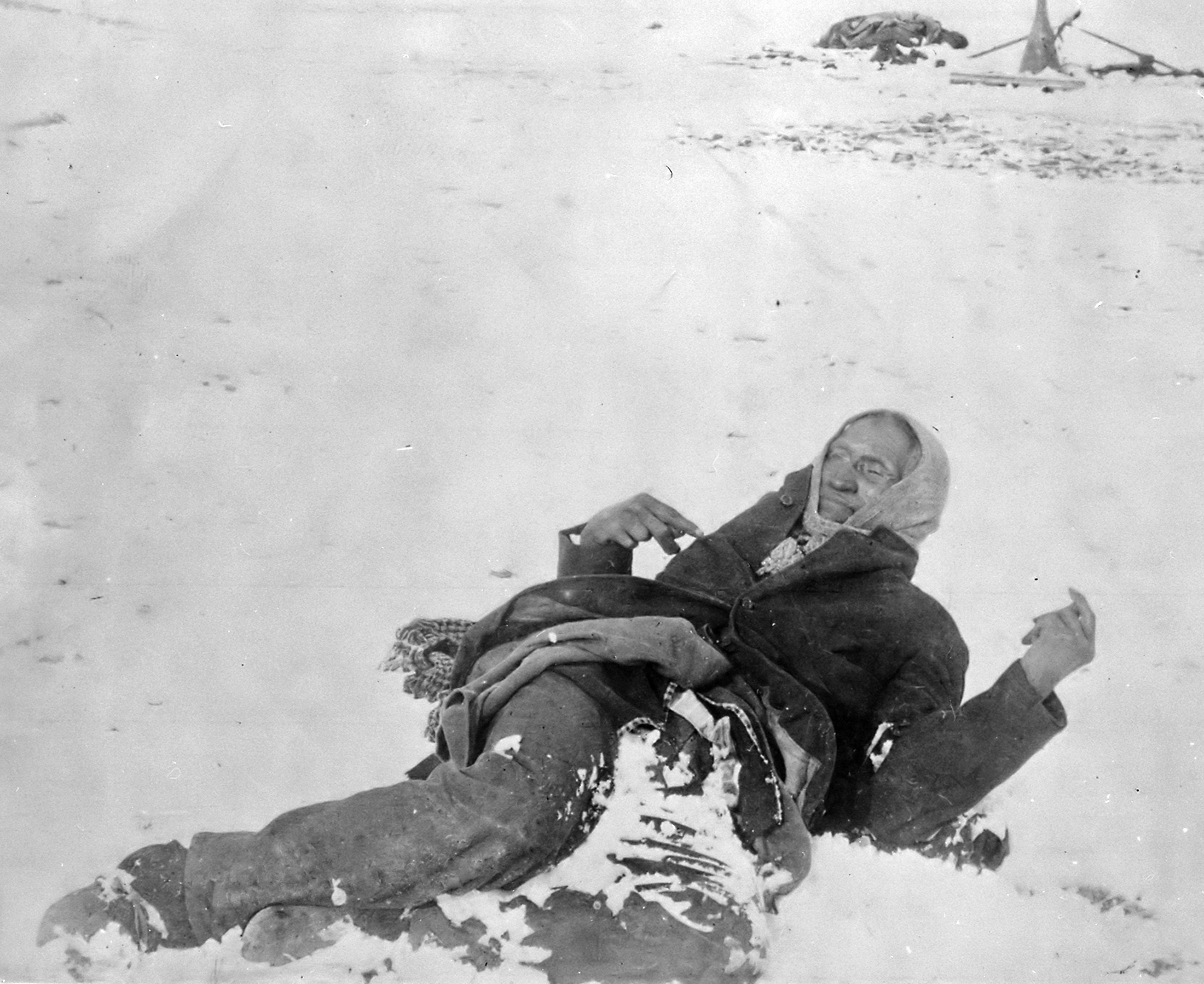
Spotted Elk lying dead after The Battle of Wounded Knee_December 1890

1891 Portrait of General L.W. Colby of Nebraska State Troops, holding baby girl Zintkala Nuni (Little Lost Bird), found on the Wounded Knee battlefield_This photograph is part of the long official history of the sentimentalization of Native genocide in the U.S.A.
. . .
Other songs/poems featured at ZP:
.
El Día del Indio Americano: unos poemas en guaraní y una reflexión sobre el lenguaje paraguayo
. . . . .
“Aquí viene la lluvia de nuevo” (letras de Los Eurythmics)
Posted: April 16, 2015 Filed under: Spanish | Tags: Poemas para Abril: el mes de lluvia Comments Off on “Aquí viene la lluvia de nuevo” (letras de Los Eurythmics)
Los Eurythmics (Annie Lennox / David A. Stewart)
“Here Comes The Rain Again” (1983)
“Aquí viene la lluvia de nuevo” (traducción de Nick Bondless, San Salvador, El Salvador)
.
Aquí viene la lluvia de nuevo,
cayendo sobre mi cabeza como un recuerdo,
cayendo sobre mí como una nueva emoción…
Quiero caminar con el viento abierto,
quiero caminar como lo hacen los amantes,
quiero zambullirme en tu oceano
– ¿está lloviendo contigo?
.
Entonces, baby,
háblame, como lo hacen los amantes;
camina conmigo
como lo hacen los amantes;
háblame, ¡como lo hacen los amantes!
.
Aquí viene la lluvia otra vez,
lloviendo en mi cabeza como una tragedia,
desgarrando mi separación como una nueva emoción
oooooh, oooooh ooh ah…
.
Quiero respirar en el viento abierto,
quiero besar como lo hacen los amantes,
quiero zambullirme en tu oceano
– ¿está lloviendo, también, contigo?
.
Entonces, baby,
háblame como lo hacen los amantes;
camina conmigo
como lo hacen los amantes;
háblame, ¡como lo hacen los amantes!
. . . . .
Ya viene la lluvia: Langston Hughes, Sara Teasdale, Robert Creeley
Posted: April 15, 2015 Filed under: English, Langston Hughes, Robert Creeley, Sara Teasdale, Spanish, ZP Translator: Alexander Best Comments Off on Ya viene la lluvia: Langston Hughes, Sara Teasdale, Robert Creeley
Langston Hughes (1902-1967)
April Rain Song
.
Let the rain kiss you
Let the rain beat upon your head with silver liquid drops
Let the rain sing you a lullaby
The rain makes still pools on the sidewalk
The rain makes running pools in the gutter
The rain plays a little sleep song on our roof at night
And I love the rain.
. . .
Canto de la Lluvia en Abril
.
Que la lluvia te bese;
Que la lluvia golpee sobre tu cabeza, con gotas de líquido plateado;
Que la lluvia te cante un arrorró…
Hace la lluvia charcos quietos en la banqueta;
Hace charcos fluidos en la alcantarilla.
Canta las noches un pequeño canto de tranquilidad en nuestro techo.
Y me encanta la lluvia.
. . .
Sara Teasdale (1884-1933)
Spring Rain
.
I thought I had forgotten,
But it all came back again
Tonight with the first spring thunder
In a rush of rain.
.
I remembered a darkened doorway
Where we stood while the storm swept by,
Thunder gripping the earth
And lightning scrawled on the sky.
.
The passing motor buses swayed,
For the street was a river of rain,
Lashed into little golden waves
In the lamp light’s stain.
.
With the wild spring rain and thunder
My heart was wild and gay;
Your eyes said more to me that night
Than your lips would ever say. . . .
.
I thought I had forgotten,
But it all came back again,
Tonight with the first spring thunder
In a rush of rain.
. . .
Lluvia de Primavera
.
Yo pensaba que yo había olvidado…
Pero me regresaron los pensamientos
– esta noche, con el primer trueno de la primavera,
en un torrente.
.
Me acordé un portal oscuro
donde nos quedamos mientras barría con todo la tormenta,
el trueno agarrando la tierra
y el relámpago garabateado sobre el cielo.
.
Los camiones pasandos se bamboleaban
porque la calle era un río de lluvia,
azotado en alas doradas
bajo de la farola.
.
Era salvaje y alegre mi corazón,
con la lluvia y trueno loco de la primavera;
Y tus ojos me dijeron más en esa noche,
más que nunca hayan dicho tus labios…
.
Yo pensaba que yo había olvidado…
Pero me regresaron los pensamientos
– esta noche, con el primer trueno de la primavera,
en un torrente.
. . .
Robert Creeley (1926-2005)
The Rain
.
All night the sound had
come back again,
and again falls
this quiet, persistent rain.
.
What am I to myself
that must be remembered,
insisted upon
so often? Is it
.
that never the ease,
even the hardness,
of rain falling
will have for me
.
something other than this,
something not so insistent –
am I to be locked in this
final uneasiness?
.
Love, if you love me,
lie next to me.
Be for me, like rain,
the getting out
.
of the tiredness, the fatuousness, the semi-
lust of intentional indifference.
Be wet
with a decent happiness.
. . .
La Lluvia
.
Durante la noche el sonido había vuelto,
y de nuevo está cayendo esta lluvia silenciosa – y persistente.
.
¿Qué soy, a mi mismo, que se debe ser recordado, insistido – tan frecuentemente?
.
Es que el alivio, aún la dureza, de la lluvia que cae, nunca tendrá para mí algo otro que ésto:
algo no tan insistente; ¿encerraré en esta ansiedad final?
.
Querida, si me amas pues échate por mi lado.
Sé, para mí, como la lluvia:
la expulsión de cansancio, de necedad, de la semi-lujuria de un pasotismo deliberado.
Sé mojida con una dicha digna.
. . . . .
He is Risen! An Orthodox Easter Sunday Carol + “Easter in April” by Marina Tsvetaeva
Posted: April 12, 2015 Filed under: English, Russian | Tags: Easter Sunday poems Comments Off on He is Risen! An Orthodox Easter Sunday Carol + “Easter in April” by Marina Tsvetaeva
Traditional Russian Easter Carol (translated into English)
.
Easter eggs, Easter eggs,
Give to him that begs!
For Christ the Lord is arisen.
.
To the poor, an open door,
something give you from your store!
For Christ the Lord is arisen.
.
Those who hoard, can’t afford,
moth and rust be their reward!
For Christ the Lord is arisen.
.
Those who love freely give,
long and well may they live!
For Christ the Lord is arisen.
.
Eastertide, like a bride,
comes, and will not be denied.
For Christ the Lord is arisen!

Marina Tsvetaeva (1892-1941)
Easter in April (1910)
.
Eggs on a plate warmed the soul with delight,
And ringing of bells.
What is more radiant than Easter in April,
People, pray tell?
.
Rays are caressing the grass, from the street
Phrases and words…
Quietly I wander from porch to the barn,
Measuring boards.
Waves of Easter ringing, external dawn,
Like a glow in the sky,
Sound of our neighbours’ gramophone
Bitterly cries,
From the kitchen it follows in an endlessly woeful
Harmonica’s sound.
Much has gone on, oh yes, much has gone on;
The past: fall down!
.
No, I won’t get any help from eggs on a dish!
It’s late, and gone are the rays…
What is more hopeless than Easter in April,
People, please say?
. . .
МАРИНА ЦВЕТАЕВА
ПАСХА В АПРЕЛЕ
.
Звон колокольный и яйца на блюде.
Радостью душу согрели.
Что лучезарней,скажите мне,люди,
Пасхи в апреле?
.
Травку ласкают лучи,дорогая,
С улицы фраз отголоски…
Тихо брожу от крыльца до сарая,
Меряю доски.
В небе,какзарево,внешняя зорька,
Волны пасхального звона…
Вот у соседей заплакал так горько
Звук граммофона.
Вторят ему бесконечно-уныло
Взвизги гармоники с кухни…
Многое было,ах,многое было…
Прошлое рухни!
.
Нет,не помогут и яйца на блюде!
Поздно…Лучи догорели…
Что безнадежней,скажите мне,люди,
Пасхи в апреле?
. . .
. . . . .
Estaciones del corazón: “Chaparrones de abril”
Posted: April 9, 2015 Filed under: Alexander Best, Spanish Comments Off on Estaciones del corazón: “Chaparrones de abril”
Chaparrones de abril (09 abril 2015)
.
Bien. Llega la primavera, después de este invierno de un largo exorbitante.
Y está lloviendo – mucha lluvia, aunque queda frío el tiempo.
Pronto veramos nuestra primera verdura, ¿no?
Y es lo mismo en el corazón…
Ahora comprendo esa certeza en el fondo de mi alma:
que el Amor sobrevive, en su poder – su energía dinámica;
y que aparece, súbitamente, de su sueño invernal.
Baja duro la lluvia, y lo requiere el corazón; está sediento mi ser.
El Amor debe crecer: siendo vivo – grande-simple – es su solo motivo.
. . .
April Showers (09-04-2015)
.
Well…
Spring’s arriving, after a winter of such exorbitant length.
And it’s raining, how it’s raining!, even though the temperature’s still chilly.
Soon we’ll be seeing our first green, right?
And it’s the same in our heart…
Now I understand that faith in the deep of me – my soul:
that Love survives in all its power, in all its dynamic force;
and that It appears again – so suddenly – from its winter dream-sleep.
The rain falls hard, and that’s what the heart requires; my whole being thirsts.
Love wants to grow: to feel alive – grand and simple – is its sole reason.
. . .
.
Alexander Best: Once Haikus: “Deshielo en Enero” / Eleven Haiku: “Mid-Winter Thaw”
.
. . . . .
Billie Holiday: Centenario de su nacimiento: Canciones distintivas / Centenary of Her Birth: Signature Songs
Posted: April 7, 2015 Filed under: English, Spanish | Tags: Billie Holiday: Centenario de su nacimiento, Billie Holiday: Centenary of her birth Comments Off on Billie Holiday: Centenario de su nacimiento: Canciones distintivas / Centenary of Her Birth: Signature Songs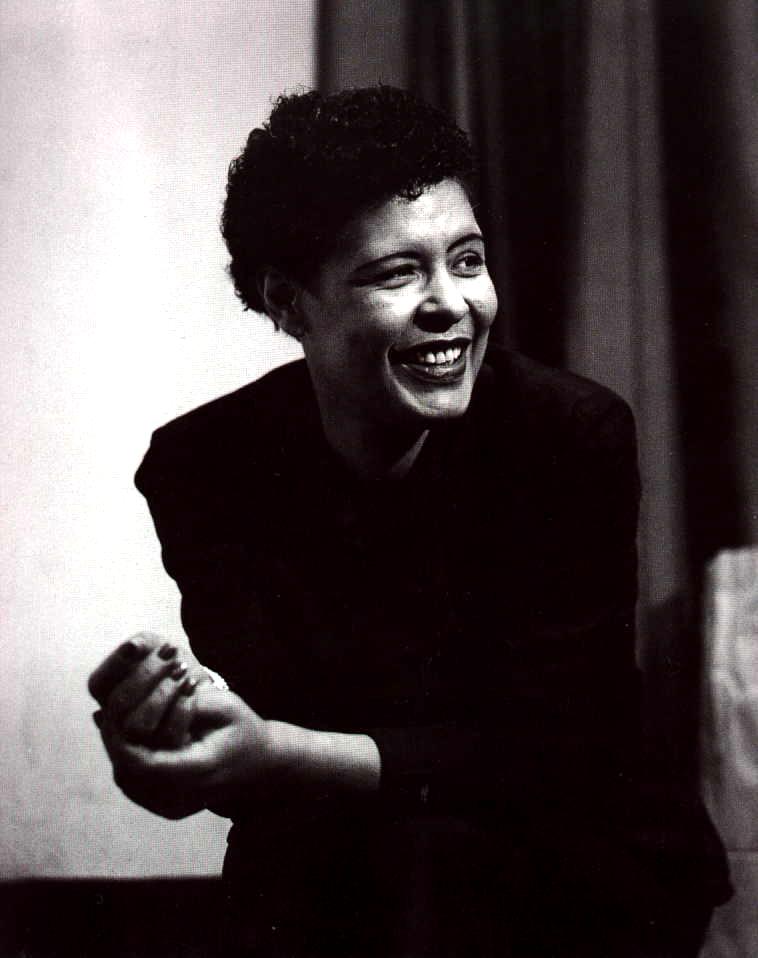
Billie Holiday, seen here at the age of 40, in a 1955 photograph_With her ground-breaking recordings from 1935 through the early 40s, Billie revolutionized how popular songs could be sung. Her voice “led” the musicians, by holding back or leaping forth, and she sang like one of the instruments, solo-ing among them, and riffing off them. The sorry details of her life do not detract from the magnificence of her musicality: a perfect, inventive rhythm; the fresh transformation of mundane lyrics; a subtle vocal balancing of sprightliness and profundity. Perhaps the greatest singer of the 20th century!
Billie Holiday: (born April 7th, 1915, died 1959)
.
“What A Little Moonlight Can Do” (1935)
.
Oo-oo-oo, what a little moonlight can do-oo-oo
Oo-oo-oo, what a little moonlight can do to you…
You’re in love, your hearts a-fluttering all day long, you only stutter ’cause your poor tongue
Just will not utter the words ‘I Love You’.
.
Oo-oo-oo, what a little moonlight can do-oo-oo,
Wait a while till a little moonbeam comes peepin’ through…
You’ll get bored,
You cant resist him,
And all you’ll say,
When you have kissed him, is
Oo-oo-oo, what a little moonlight can do!
. . .
“Did I Remember?” (1936)
.
Did I remember to tell you I adore you?
And that I am living for you alone?
Did I remember to say I’m lost without you,
And just how mad about you I’ve grown?
You were in my arms,
And that was all I knew;
We were alone, we two –
What did I say to you?
Did I remember to tell you I adore you?
And pray, forevermore, you’ll be mine!
. . .
“Travelin’ All Alone” (1937)
.
I’m so weary and all alone,
Feet are tired like heavy stone,
Travelin’, travelin’, all alone.
.
Who will see and who will care
’bout this load that I must bear?
Travelin’, travelin’, all alone.
.
Prayers are said to heaven above,
’bout my burdens,woes and love;
Head bowed down with misery,
Nothing now appeals to me…
Travelin’, travelin’,
All alone!
.
Give me just another day,
There’s one thing I want to say:
Friends are well when all is gold;
Leave you always when you’re old –
Travelin’, travelin’, all alone!
. . .
¡Qué luz de la luna puede hacer!
.
Ooh, ooh, ooh
¡Qué luz de la luna puede hacer!
Ooh, ooh, ooh
¡Qué luz de la luna puede hacer para usted!
Está en el amor
De su corazón revoloteando todo el día
Sólo tartamudeo hacer que su lengua pobre
Simplemente no pronunciar las palabras
‘Te quiero’…
Ooh, ooh, ooh
¡Qué luz de la luna puede hacer!
Espera un poco
Hasta que un rayo de luna poco viene espiar a través de
Él se aburre
No se le puede resistir
Todo lo que dicen
Cuando haya besado a él es:
Ooh, ooh, ooh…¡Qué luz de la luna puede hacer!
. . .
¿Me acordé de decirte que te adoro?
.
¿Me acordé de decirte que te adoro?
¿Y que estoy viviendo por ti solo?
Recuerdo que tenía que decir
Estoy perdido sin ti
Y cómo loco por ti he crecido…
Estaba en mis brazos
Y eso fue todo lo que sabía…
Estábamos solos, nosotros dos ,
¿Qué le digo a usted?
¿Me acordé de decirte que te adoro?
¡Y rezar para siempre que serás mía!
. . .
Vagabundeando Solo
.
Estoy tan cansada y sola
Pies cansados, como piedra pesada…
Viajando – vagabundeando – sin ayuda.
¿Qué se ve y la que le importe,
Combate de esta carga que debe soportar?
Viajando – vagabundeando – completamente sola.
Se elevan plegarias al cielo por encima de mis cargas, problemas – y el amor;
La cabeza inclinada hacia abajo con la miseria –
¡No hay nada ahora que me atrae!
Viajando – vagabundeando – yo sola.
Dame un día más,
Hay una cosa que quiero decir:
Los amigos son así, cuando todo es de oro –
y deje siempre cuando usted es viejo…
Viajando – vagabundeando – sola.
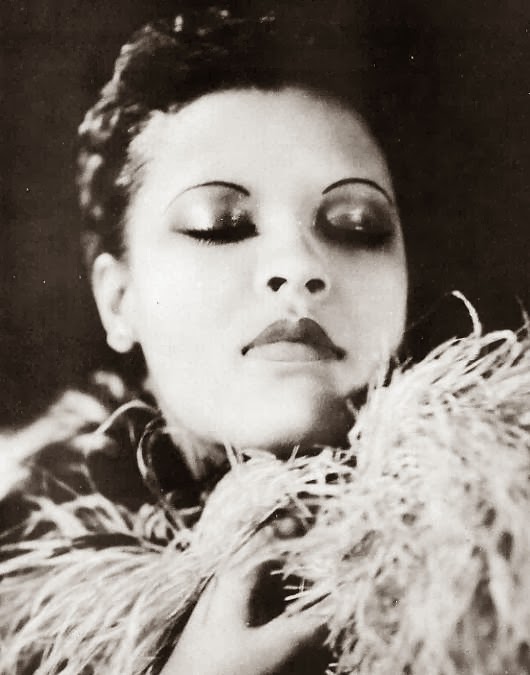
Billie Holiday in 1935_age 20
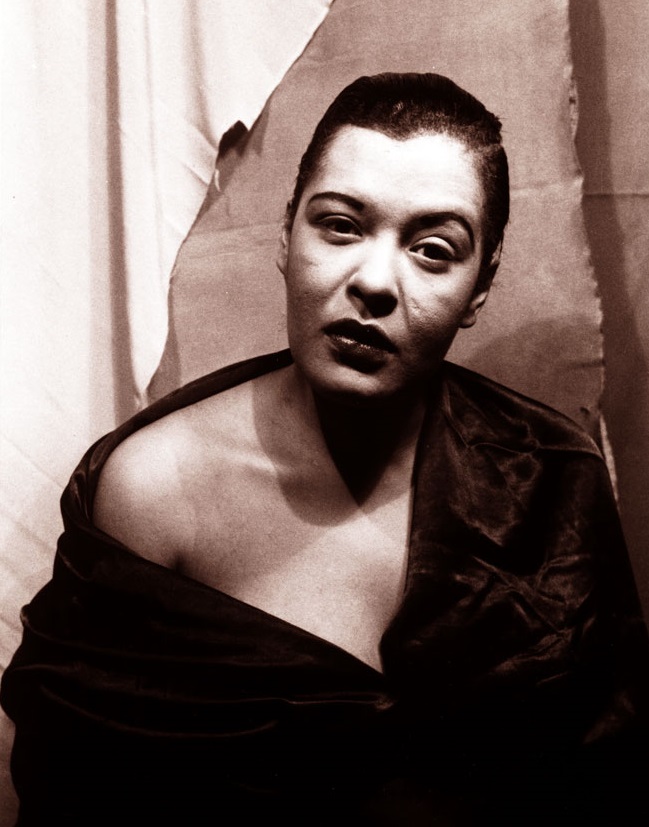
Billie Holiday in 1949_age 34
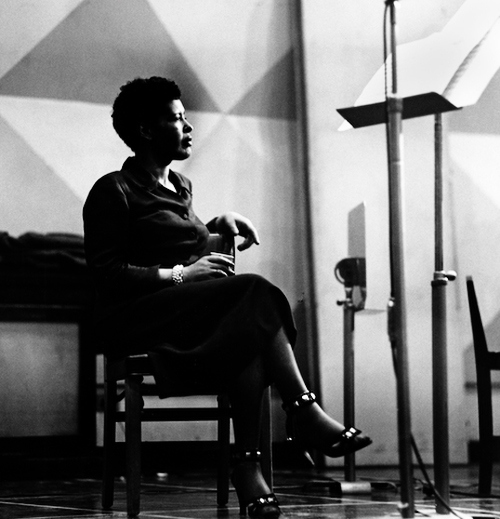
Billie Holiday in 1955_age 40
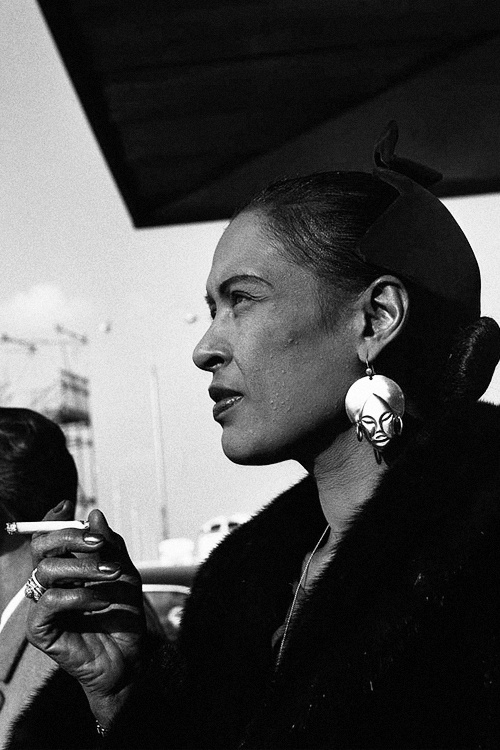
Billy Holiday in 1958_Orly airport, Paris
“Me, Myself, and I” (1937)
.
Me, myself and I
Are all in love with you;
We all think you’re wonderful,
We do.
.
Me, myself and I
Have just one point of view;
We’re convinced
There’s no one else like you.
.
It can’t be denied, dear,
You brought the sun to us;
We’d be satisfied, dear,
If you’d belong to one of us.
.
So if you pass me by,
Three hearts will break in two,
‘Cause me, myself and I
Are all in love with you!
. . .
“You Go To My Head” (1938)
.
You go to my head
And you linger like a haunting refrain,
And I find you spinning ’round in my brain
Like the bubbles in a glass of champagne.
You go to my head
Like a sip of sparkling burgundy brew,
And I find the very mention of you
Like the kicker in a julep or two.
The thrill of the thought that you might give a thought to my plea
Casts a spell over me.
Still, I say to myself: Get a hold of yourself, can’t you see that it never can be?!
You go to my head
With a smile that makes my temperature rise,
Like a summer with a thousand Julys,
You intoxicate my soul with your eyes.
Though I’m certain that this heart of mine
Hasn’t a ghost of a chance in this crazy romance…
You go to my head!
You go to my head!
. . .
“Fine and Mellow” (1939)
.
My man don’t love me,
Treats me oh so mean.
My man he don’t love me,
Treats me awful mean.
He’s the lowest man
That I’ve ever seen!
.
He wears high draped pants
(Stripes are really yellow).
He wears high draped pants
(Stripes are really yellow).
But when he starts in to love me,
He’s so fine and mellow…
.
Love will make you drink and gamble,
Make you stay out all night long.
Love will make you drink and gamble,
Make you stay out all night long.
Love will make you do things
That you know is wrong!
.
But if you treat me right, baby,
I’ll stay home everyday.
Just treat me right, baby,
I’ll stay home night and day.
But you’re so mean to me, baby,
I know you’re gonna drive me away!
.
Love is just like a faucet,
It turns off and on.
Love is like a faucet,
It turns off and on.
Sometimes when you think it’s on, baby,
It has turned off – and gone!
. . .
Yo, y Me, y Yo Mismo
.
Yo, y me, y yo mismo,
Estamos todos enamorados de ti;
Nosotros todos pensamos que eres maravilloso,
De veras.
.
Yo mismo, y me, y yo,
Tenemos un solo punto de vista:
Convencidos que no hay nadie como tú.
.
No se puede negarlo, querido,
Que nos trajiste el sol; y
Estaríamos satisfechos, querido,
Si pertenecerás a uno de nosotros.
Así que…si me pasas por alto
Tres corazones se romperán en dos,
¡Porque Yo, y Me, y Yo Mismo,
Estamos todos enamorados de ti!
. . .
Te llevo en mi pensamiento
.
Te llevo en mi pensamiento…
Que resuena como un estribillo inolvidable
Y te encuentro rodando alrededor
en mi cerebro –
Al igual que las burbujas en una copa de champán.
.
Te llevo en mi pensamiento…
Como un sorbo de cerveza brillante color burdeos,
Y me encuentro con la sola mención de que
Al igual que el subidón de un trago o dos.
.
La emoción del pensamiento
puede darte una idea
A mi súplica, lanzas un hechizo sobre mí
Aún así me digo a mí mismo
Tengo que ponerme en contacto contigo,
¡No ves que no puede ser!
.
Te llevo en mi pensamiento…con una sonrisa
hace que mi temperatura aumente,
igual que un verano con mil julios,
embriagas mi alma con los ojos…
.
Aunque estoy seguro de que este corazón mío
no tiene ni una remota posibilidad
en este romance loco – aún…
tú vas hacía mi cabeza , tu vas hacía mi cabeza…
. . .
Fino y Suave
.
Mi hombre no me quieres…
Ah, me trata tan malo.
Mi hombre no me ama,
Me trata horrible…
Él es el hombre más bajo
Que he visto alguna vez.
.
Lleva pantalones de alta recortada
(Las rayas son realmente amarillas)…
Lleva pantalones de alta recortada
(Las rayas son realmente amarillas)…
Pero cuando empiece en que me ame,
¡Es tan fino y suave!
.
El amor te hará beber y jugar,
Que su estancia fuera toda la noche repetir largo,
El amor te hará beber y jugar,
Que su estancia fuera toda la noche repetir largo…
El amor te hará hacer cosas
Que sabe que está mal…
.
Pero si me trata bien, bebé,
Me quedaré en casa todos los días…
Solo me trata bien, bebé,
Me quedaré en casa – noche y día.
Pero eres tan malo, mi bebé, pues
Sé que me vas a alejar.
.
El amor es como la llave del agua,
Que se apaga y enciende…
El amor es como la llave del agua,
Que se apaga y enciende…
A veces, cuando cree que se enciende,
pues no – se ha apagado y se ha ido.
. . . . .
Poemas para Pascua: Machado, Alarcón, Calderón de la Barca
Posted: April 5, 2015 Filed under: English, Spanish | Tags: Poemas para Domingo de Pascua Comments Off on Poemas para Pascua: Machado, Alarcón, Calderón de la Barca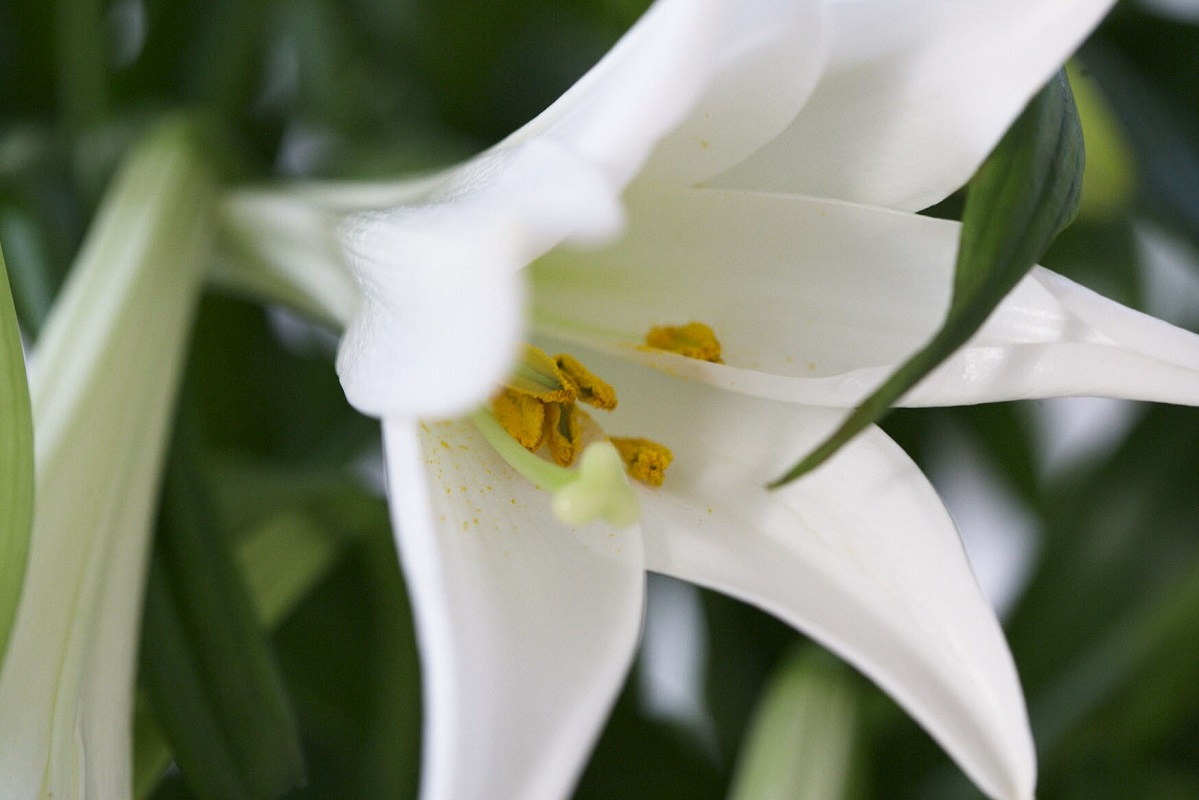
Antonio Machado (1875-1939)
Pascua de Resurrección (1912)
.
Mirad: el arco de la vida traza
el iris sobre el campo que verdea.
Buscad vuestros amores, doncellitas,
donde brota la fuente de la piedra.
En donde el agua ríe y sueña y pasa,
allí el romance del amor se cuenta.
¿No han de mirar un día, en vuestros brazos,
atónitos, el sol de primavera,
ojos que vienen a la luz cerrados,
y que al partirse de la vida ciegan?
¿No beberán un día en vuestros senos
los que mañana labrarán la tierra?
¡Oh, celebrad este domingo claro,
madrecitas en flor, vuestras entrañas nuevas!.
Gozad esta sonrisa de vuestra ruda madre.
Ya sus hermosos nidos habitan las cigüeñas,
y escriben en las torres sus blancos garabatos.
Como esmeraldas lucen los musgos de las peñas.
Entre los robles muerden
los negros toros la menuda hierba,
y el pastor que apacienta los merinos
su pardo sayo en la montaña deja.
. . .
Easter of Resurrection
.
Look: the arc of life traces
a rainbow on the greening fields.
Seek your loves, young maidens,
where the spring emerges from rock.
Where water laughs and dreams and flows,
that’s where love’s ballad is sung.
Eyes born closed to light,
held in your arms will gaze one day,
astonished, at spring sun,
eyes that will grow blind as they depart from life.
Won’t there drink, one day, at your breast
those who will work the earth tomorrow?
Oh, celebrate this bright Sunday
young mothers in flower, new life within you!
Bask in the smile from your earthly mother.
The storks are already settled in their beautiful nests
and they scribble on the towers in their white scrawl.
Mosses on the peaks gleam like emeralds.
Between the oaks, black bulls
graze on sparse grass,
and the shepherd tending his sheep
leaves his brown cape on the mountainside.
.
(Translation: Mary G. Berg & Dennis Maloney)
.
Easter of Resurrection is a poem from Machado’s first collection, Campos de Castilla (Fields of Castile), published in 1912.
. . .
Abel Alarcón (1881-1954)
Pascua
.
Elevó, adusto, el sacerdote anciano
de ácimo pan la nítida blancura;
trazo el signo de un símbolo su mano
y consumo la mística figura.
.
Plegose en el altar velo liviano
Y ante el pueblo, en beatifica postura,
Fulguró el sol flamante y soberano
De la enorme custodia, su hermosura.
.
Un torrente de luz bañó las naves;
Hubo explosión de gloria en el himnario;
Surgieron del armonio notas graves;
.
Cuando entre el humo undívago del ascua
Del coro voló un ave al campanario,
La campana mayor repicó a pascua.
. . .
Pedro Calderón de la Barca (1600-1681)
¿Qué quieres?
.
¿Qué quiero, mi Jesús?…Quiero quererte,
quiero cuanto hay en mí del todo darte
sin tener más placer que el agradarte,
sin tener más temor que el ofenderte.
.
Quiero olvidarlo todo y conocerte,
quiero dejarlo todo por buscarte,
quiero perderlo todo por hallarte,
quiero ignorarlo todo por saberte.
.
Quiero, amable Jesús, abismarme
en ese dulce hueco de tu herida,
y en sus divinas llamas abrasarme.
Quiero, por fin, en Ti transfigurarme,
morir a mí, para vivir tu vida,
perderme en Ti, Jesús, y no encontrarme.
. . .
More Easter Sunday poems / Otros poemas para el Domingo de Pascuas:
https://zocalopoets.com/tag/easter-sunday-poems/
. . . . .
 Zócalo Poets