Poemas para o Dia Mundial de Combate à AIDS / Poemas para el Día Mundial de la Lucha contra el SIDA / Poems for World AIDS Day / Poèmes pour la Journée mondiale de lutte contre le SIDA
Posted: December 1, 2013 Filed under: English, French, Portuguese, Spanish, World AIDS Day: 25th Anniversary Poems in 4 Languages | Tags: World AIDS Day: 25th Anniversary: Poems Comments Off on Poemas para o Dia Mundial de Combate à AIDS / Poemas para el Día Mundial de la Lucha contra el SIDA / Poems for World AIDS Day / Poèmes pour la Journée mondiale de lutte contre le SIDA . . .
. . .
“Não ser amado é uma simples desventura; a verdadeira desgraça é não saber amar.” (Albert Camus)
.
“No ser amado es una simple desventura;
la verdadera desgracia es no saber amar.” (Albert Camus)
.
“To be unloved is merely misfortune; the true tragedy is in not loving.” (Albert Camus)
.
“Il y a seulement de la malchance à n’être pas aimé; il y a du malheur à ne point aimer.” (Albert Camus)
. . .
Liduina Felipe M. Fernandes (Mossoró, Brasil)
“Dia de Celebrar a Vida todos os dias”
.
1º de dezembro – dia de comemorar
O Dia Mundial de Combate à AIDS
Para que todos possam espalhar
Que a melhor solução
É sempre a informação
Educação e prevenção.
Dia de celebrar a vida.
Dia de socializar conhecimentos,
Respeitar, e não discriminar
Pois a vida pede dignidade,
Solidariedade e qualidade
E não apenas quantidade.
Dia de compreender que não basta falar
É preciso garantir condições para que a vida
Se possa resgatar e preservar.
Dia de gritar que direitos sociais legais
Carecem de aplicação no dia-a-dia,
Pois se forem “leis de papel”
Onde estará a garantia
De que tudo que foi escrito
É sinônimo real de cidadania?
1º de dezembro – dia de refletir
Que todo dia é dia de viver e de lutar
Pelo direito à vida,
Pelo respeito à saúde,
Pela consciência individual e coletiva
Para que todos, sem discriminação,
Respeitando as diferenças, possam desfrutar
De melhores dias sem AIDS.
E todas as armas violentas biológicas e “fabricadas”
Que nada mais fazem do que vidas, desrespeitar e ceifar.
1º de dezembro – dia de lembrar
De que todos os dias devemos, a vida, celebrar!
. . .
Maria do Rosário Lino (Brasil)
“Saudação à Vida” (2000)
.
Era um médico
e peregrinava
pelos templos
do mundo
onde a natureza
humana
lhe pedia ajuda.
.
Percorrendo aldeias
miseráveis
transportava
sua profissão
como um sacerdócio
onde o ócio
não havia.
.
Perplexo,
combatia
a mortandade social
que estagnava
as possibilidades
de nascedouros.
.
Paz e saúde
a toda a gente
era sua passagem
pelas cidadelas
e sua mensagem
era a superação
das mazelas
como produto
de uma fé
que se prova,
bebendo em pé,
no copo
da força de vontade.
Saciedade, nunca!
.
É preciso
epidemizar
o bem estar
de todos,
do café da manhã
ao jantar,
do deitar-se
ao levantar,
quando então
se pronunciará
a morte da decadência
ao bem da ciência
e um dia,
com a sapiência
e muita sorte,
a decadência
da morte.
. . .
Rui de Noronha (Maputo, Moçambique, 1909 – 1943)
“Mulher”
.
Chamam-te linda, chamam-te formosa,
Chamam-te bela, chamam-te gentil…
A rosa é linda, é bela, é graciosa,
Porém a tua graça é mais subtil.
.
A onda que na praia, sinuosa,
A areia enfeita com encantos mil,
Não tem a graça, a curva luminosa
Das linhas do teu corpo, amor e ardil.
.
Chamam-te linda, encantadora ou bela;
Da tua graça é pálida aguarela
Todo o nome que o mundo à graça der.
.
Pergunto a Deus o nome que hei-de dar-te,
E Deus responde em mim, por toda parte:
Não chames bela – Chama-lhe Mulher!
. . .
Rui de Noronha
“Amar”
.
Amar é um prazer, se nós amamos
Alguém que pode amar-nos e nos ama.
Amar é um prazer, se por nós chama
Continuamente alguém que nós chamamos.
.
Então a vida inteira a rir levamos,
O mesmo fogo ardente nos inflama,
E os ideais da vida, o bem, a fama,
Mãos dadas pelo mundo procuramos.
.
No encapelado mar desta existência,
O amor é compassiva indulgência
A culpa original dos nosso pais.
.
Que resta ao homem, suprimido o amor?
Buscar a morte p’ra fugir a dor,
Tristeza, indiferença – e nada mais.

New York Times, July 3rd,1981: First newspaper publication of an indirect reference to what would later come to be known as Acquired Immune Deficiency Syndrome or AIDS_Medical correspondent Lawrence K. Altman’s article about Kaposi’s Sarcoma – which can be a cancer of opportunity for someone with a severely weakened immune system – was buried on p.20. GRID (Gay-related immunodeficiency disease) – as the unknown disease was called in the first year – was emerging in the USA between 1981-1982, and was largely associated with white, gay men in San Francisco and New York…

…Meanwhile, in two African nations, another part of the same medical story was developing… Slim Disease – so called because people’s bodies just wasted away – appeared in 1982 in Tanzania and in the Rakai District of Uganda bordering Lake Victoria, and was debilitating mostly heterosexual men and women. By October 1985, in an issue of the British peer-reviewed medical journal, The Lancet,
Dr. David Serwadda of the Makerere Medical School in Kampala would publish with his team an article entitled: “Slim Disease: a new disease in Uganda and its association with HTLV-III infection”. Soon after, researchers on opposite continents understood that those different early names – whether GRID or SLIM – were, in fact, describing one disease: AIDS. Image shown here: a Ministry of Health public poster, Zimbabwe,1989

“Fight AIDS! We need healthcare and research, not bigotry!.” A 1985 demonstration in front of New York City Hall as a City Council committee considered legislation to bar pupils and teachers with the AIDS virus from public schools_photograph by Rick Maiman_By the end of 1981, 159 cases of the mysterious new disease had been reported in the USA. By 1985, 15,527 cases of AIDS had been reported, with 12,529 deaths. Ten years later, in 1995, it was 513,486 cases and 319,849 deaths, making AIDS the leading cause of death for Americans ages 25 to 44.
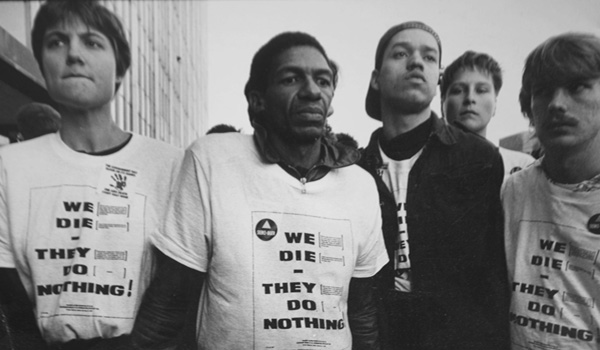
ACT UP_AIDS Coalition to Unleash Power_was founded in 1987 by a group of gay men. Seen here, a demonstration at the Food and Drug Administration in Washington, D.C._1988_photograph © Donna Binder

Poster aimed at helping people get past their fear of knowledge about HIV_USA, around 1990

Tanzanian safe sex poster drawn by Father Bernard Joinet_The Fleet of Hope in the Flood of AIDS_A rubber lifeboat is the metaphor for condoms_1994
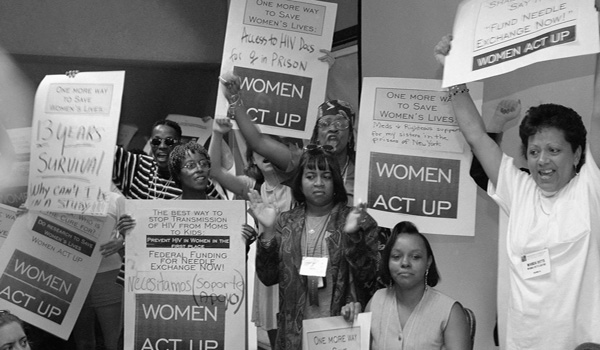
Members of ACT UP protest during a session of the National Conference on Women and HIV being held in Pasadena, California_1997_Associated Press photo
. . .
Jaime Gil de Biedma (1929-1990, Barcelona, España – fallecido por el SIDA)
“Mañana de ayer, de hoy”
.
Es la lluvia sobre el mar.
En la abierta ventana,
contemplándola, descansas
la sien en el cristal.
.
Imagen de unos segundos,
quieto en el contraluz
tu cuerpo distinto, aún
de la noche desnudo.
.
Y te vuelves hacia mí,
sonriéndome. Yo pienso
en cómo ha pasado el tiempo,
y te recuerdo así.
. . .
S. Luz Teresa nació en San Jerónimo, Guerrero, México. En 1986 necesitó una cirugía, en la cual requirió de transfusiones –siendo alguna de éstas las que le causó su infección por VIH. Falleció en 1996.
S. Luz Teresa
“¡Auxilio!”
.
¡Auxilio! Se me está acabando el oxígeno, tengo SIDA,
soy un enfermo de SIDA
quiero gritarlo
para poder vivir en paz
y saber con quién cuento
y quién me rechazará.
¡Silencio! ¡Cállate!
Habla más bajo que te pueden oír
y me callo y me resigno
no por mí, por mi familia
porque la gente insensata
que, lamentablemente,
es mucha todavía,
por el simple hecho de saber
que conviven con una persona
como yo, los señalaría
¡me ahoga esta miseria!
¿Por qué a ellos que son
los únicos prudentes?
¡Maldición!
¿Cuándo aprenderán a distinguir
qué es lo que vale de la vida?
¿Cuándo aprenderán
a respetar el silencio?
¿Cuándo dejarán de cuestionarse
si estás o no infectado?
¿Cuándo cambiarán el morbo
por comprensión o cariño?
¿Cuándo?
¿Cuándo sabrán ser amigos?
Espero que no sea dentro de
mucho tiempo.
Porque si esto sucediera,
nadie más tendría que mentir
y ocultar su mal,
nos haría ciudadanos de nuevo,
nos cuidaríamos mutuamente,
porque como nosotros estamos
mucho más conscientes
de cuan dura
es nuestra enfermedad
quisiéramos que nadie
más sufriera
esta larga agonía,
igual que nuestras familias
y nuestros doctores,
aquellos que sabiendo la verdad
nos tocan, nos cuidan
y nos quieren
y no se infectan
y hacen que nos sintamos bien
y nos alientan a que,
por encima de nuestros problemas,
tracemos nuevas metas,
que en ocasiones
estemos contentos,
que no nos impacientemos
y que no olvidemos del todo
nuestra capacidad de amar.
No, no les estoy pidiendo amor,
seria una propuesta absurda,
sólo les pido comprensión
y eso es mucho más sencillo
soy un enfermo de SIDA
que simplemente,
quiere vivir en paz.
. . .
Jordi Demarto (España)
“No te duermas” (2005)
.
Cuando mi cuerpo invadiste
No fui capaz de evitar,
Sentirme sucio, muy triste
Hasta me hiciste llorar.
.
¿Qué será ahora de mi vida,
Mis proyectos de futuro?
Ahora tenía el SIDA.
Fue un golpe tan fuerte y duro.
.
Más tarde ya comprendí
“Gracias a la información”
Que mi vida no acababa
– No moriría mañana,
deshuesado y sin razón.
.
Sentí la fuerza de un oso,
Y hasta ganas de volar,
cada año un lazo rojo
nos ayuda a no olvidar.
.
Que la guerra sigue en pie,
Que esta guerra ha de acabar,
En todos los continentes
“y sin África olvidar”.
.
Que la vida no se acaba,
Que no hay que dejarse vencer
Por un virus despiadado
Que hoy no podemos vencer.
.
Sigamos luchando en la vida
Sin confiar en la suerte.
¡No te quedes ahí sentado!
¡No des tu tiempo a la muerte!
. . .
Arjona Delia (Argentina)
“Lucha contra el SIDA” (2011)
.
El cuerpo se daña en agonía,
pierden la esperanza y valentía,
lágrimas, sollozos y lamentos,
acerca la muerte día a día.
.
Cuida tu vida y la de los demás,
del virus letal, cruel enfermedad,
que te lo trasmiten al amar,
cuando no te saben cuidar.
.
Lucha, no te des por vencido,
si la herida te hace sangrar
yo te ofrezco mi mano para andar,
en mi corazón tendrás lugar.
.
No temas, aprende sobre el sida,
la ignorancia es la que contamina,
la mejor defensa es la prevención,
y contar con buena información.
.
http://www.arjonadelia.blogspot.com
. . .
Craig G. Harris (Black gay poet, U.S.A., died in 1991 of complications from AIDS)
“Alive after his passion” (for Elias)
.
green mangos
with salt and
vinegar,
hearts of palm
and holy ghosts
make me
speak in
tongues
with garlic breath,
dance to unheard
beats,
fall beneath your
holy temple,
inhaling grey
incense dust,
writhing in
shed snake skins,
purified in the
flame,
wrapped
in unspeakable
joy.
.
(1987)
.
Phillis Levin (New York City)
“What the Intern Saw” (1988)
.
I
He saw a face swollen beyond ugliness
Of one who just a year ago
Was Adonis
Practicing routines of rapture.
.
A boy who could appear
To dodge the touch of time,
Immortal or immune –
A patient in a gown,
Almost gone.
II
In the beautiful school of medicine
He read about human suffering,
A long horrible drama
Until the screen of anaesthesia
And penicillin’s manna.
.
But now, in myriad sheets
Of storefront glass refracting evening’s
Razor blue, in a land of the freely
Estranged from the dead, he meets
That face – and fear seizes his body.
III
His feet have carried him to bed.
He thinks he must be getting old
To so revise
His nature and his plan.
.
He shuts his eyes
And in his sleep he sees a gleaming bar,
The shore of pain.
It isn’t far.
People live there.
. . .
Adam Johnson (Gay U.K. poet, 1965-1993, died of complications from AIDS)
“December 1989”
.
The nascent winter turns
Each root into a nail,
And in the West there burns
A sun morbid and pale.
.
Now, from the city bars
We drift, into a cool
Gymnasium of stars –
The drunkard and the fool:
.
Into the night we go,
Finding our separate ways –
The darkness fraught with snow,
The leaves falling like days.
. . .
Clovis S. Palmer (Jamaica/Australia)
“Guilt”
.
Whoi! Mother, father, mi baby – gone
Whoi! Sister, brother, mi uncle – gone
Whoi! Daughter, mi son, mi family – gone
Whoi! What stain have I bestowed?
.
She held her son, the flesh melted from his bones,
Tears streamed down her cheeks, like raindrops down the window screen.
Unexplainable, undeniable, but beneath the ground he must go
– Singing, mourning, cries of pain –
Who next will suffer this dreadful stain?
.
The sunset kisses the Blue Mountain range,
Darkness covers the Kingston plains.
Tomorrow we shall start again –
Who next will suffer this dreadful stain?
.
The sun seeps over the Caribbean Sea,
Today my brother I shall not see.
Like the petals from roses – gone too soon –
Red ribbons I left on his tomb.
. . .
“HIV/AIDS is defined by people: their complex lives, their bravery, their fear, their sadness, their need, their laughter, their inconsistencies – basically, their rich humanity. These people taught me how to write about hope, and the beauty in the ordinariness of all of our lives.” (Kwame Dawes)
.
Kwame Dawes (born 1962, Ghana – raised in Jamaica)
“Coffee Break”
[This 2008 poem was inspired by caregiver John Marzouca of Jamaica]
.
It was Christmastime,
the balloons needed blowing,
and so in the evening
we sat together to blow
balloons and tell jokes,
and the cool air off the hills
made me think of coffee,
so I said, “Coffee would be nice,”
and he said, “Yes, coffee
would be nice,” and smiled
as his thin fingers pulled
the balloons from the plastic bags;
so I went for coffee,
and it takes a few minutes
to make the coffee
and I did not know
if he wanted cow’s milk
or condensed milk,
and when I came out
to ask him, he was gone,
just like that, in the time
it took me to think,
cow’s milk or condensed;
the balloons sat lightly
on his still lap.
.
“Coffee Break” © Kwame Dawes
.
. . .
Kwame Dawes
“Cleaning”
[This 2008 poem was inspired by Dr. Peter Figueroa of Jamaica]
.
After a while, you don’t bother
with the brief and the pajamas;
you leave him on the sheet,
make him shit himself, then
shift over to the other side
until I can come, lift up
the body, wipe his bottom
with a soft cotton cloth, bundle
up the sheet with two more
in the corner, straighten
out the plastic over the mattress—
sometimes you have to wipe
it, too, then put a towel
under him until the other
sheet dry, and all the time,
you don’t say a word,
you don’t ask for nothing.
You let your hand brush
against your father’s back
and pray his dignity will last
another day. This is how
a man must care for his father;
quiet, casual, and steady.
.
“Cleaning” © Kwame Dawes
.

Kenya_poster encouraging Safe Sex_1990s

Poster from Morocco promoting safe sex_The Arabic reads: Tradition does not rhyme with Prevention.

Safe sex poster from Cuba_The Spanish reads: Enjoy Life, Avoid AIDS._How do I show that I love you? (With a flower AND a condom.)
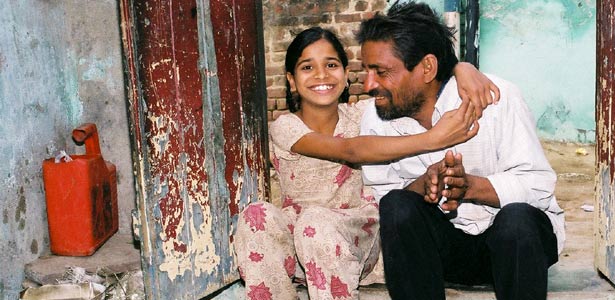
A schoolteacher fired after testing HIV-positive is embraced by his daughter_India_2004_photograph by W. Phillips

A Haitian woman takes the opportunity to be tested for HIV_Haiti_2007_photograph © Thony Belizaire

South African women reminding passing motorists that condom use drastically reduces the spread of HIV_2009
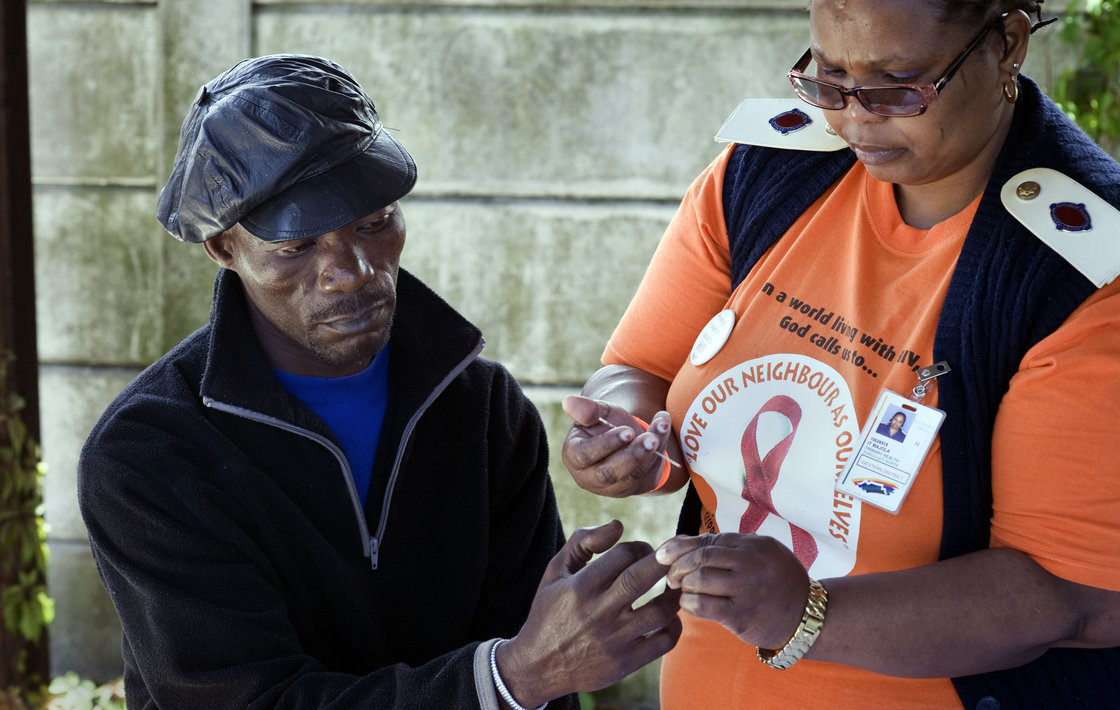
At a roadside HIV-testing table near Cape Town, South Africa, a nurse tests a man’s blood_2012_photograph by Rodger Bosch_While South Africa has the highest percentage worldwide of people living with HIV – about 6 million in a nation of 53 million – it also has the world’s largest treatment programme using Anti-Retroviral drugs distributed from several thousand health clinics.

South African Archbishop Emeritus Desmond Tutu has been a vigorous campaigner for access to treatment for TB, HIV and AIDS; he has also publicly promoted condom use for disease prevention, a most forward-looking approach for a Man of the Church.

HIV-positive activists at a rally in India

The International Medical Corps organized an advice and training programme for women at Mera Kachori Afghan Refugee Camp in Pakistan_December 2012

Fight HIV not People with HIV! Activist with banner outside the Russian Embassy in New York City_2013

In Guandong, China, some bold HIV-related policy decisions will come into play. In the wake of concerted advocacy efforts the ban on HIV-positive teachers in the classroom will be lifted_June 2013
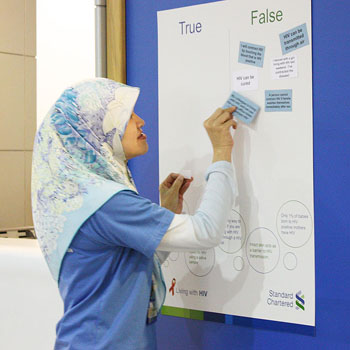
Standard Chartered Bank in Brunei Darussalam on the island of Borneo conducted a Living With HIV morning huddle with its staff. True or False statement cards were used to test staff’s knowledge of HIV facts_October 2013

Melbourne, Australia, November 30th 2013_World AIDS Day event
. . .
“This is my dedication and tribute to my patients who live with HIV. I will never be the same because of the way you have touched me, seeing how you continue to move forward every day in this society – with its preconceptions and misbeliefs.” [Paula V. Reid, April 2013]
.
Paula V. Reid (Nurse, North Carolina, U.S.A.)
“The Unique Woman”
.
Hello, I am special just like you.
Why should anyone feel differently?
Is it because I may be
a drug abuser,
a prostitute,
a homeless person,
or do you believe I’m a nobody?
Have you ever thought I could be
your mother,
your sister,
your friend?
Would that make a difference?
But in the whole scheme of things, does it really matter?
Because the most important issue is
I am a woman that needs your help.
Are you in a position to give me that help?
I need to be loved.
I need to be cherished.
I need to be cared for.
I face extraordinary challenges every day
and many times face them alone.
Some women have children,
spouses and loved ones to care for.
Where do I get the strength
and energy to keep going?
Don’t I need compassion?
That is why I am the unique woman.
I hear you talk about me in the hallway and stairwells.
“I have to see that HIV lady down the hall.”
“Oh boy, I am the next one up for an HIV case.”
Treat me the way you would want to be treated.
That is what I ask of you.
Don’t ask me: “How did you get it?”
unless it is relevant to my care for that day.
When I cry, cry with me.
When I laugh, laugh with me.
Then, when I am alone it won’t be so bad.
My walk is hard and the road is tough,
but with your help it could be gentler.
I am reaching out to you.
. . .
Rory Kilalea / ‘Murungu’ (Zimbabwe)
“Prayer”
.
I do not know how to pray.
I only know how to talk
at you, God.
As a stillness supreme
evading my eyes,
avoiding my ears.
Yet I know You are there.
It is only the reflection I miss.
. . .
Senator Ihenyen (Nigeria)
“Is It Because…”
…you did not kiss my hand
like you used to
when with so much love in my eyes
I held it up to your lips
beaming with the crystals in my heart –
Is it because I now have HIV?
When you poured the red wine into the glasses
you did not hold yours to my waiting lips
like you used to
so that – as transparent as the two glasses –
we could see the colours in our hearts –
Is it because I now have HIV –
Or because you never really loved me?
.
(2013)
. . .
Senator Ihenyen (Nigeria)
“Stranger in the Mirror
of My Life”
.
Before me is a mirror
a mirror beside my bed
away from the sun
burning brightly outside the window-blinds
in my darksome room.
For a moment
before the mirror
I stand to see the face of the victim
whose result returned a death sentence
after a test,
and another test, and yet another,
but they kept coming back
one and the same
like the torrent of tears that keep returning to your eyes
when the heart remains wet with worries
Wavering worries of one’s life walking away from the door,
as the wall clock thcks unrestrained, untouched, unconcerned,
like the footsteps of the world moving on,
unaffected, unmoved, unstirred.
In the mirror
I found a face
a certain face too afraid to look at me.
The face of a stranger –
a strange face sketched in the shadows of my unlit room,
against the fiery fingers of the sun flicking the window-blinds on a fateful morning
to irradiate my day.
I know this face hiding in the mirror isn’t me –
It couldn’t be me!
I looked straight into her eyes,
and it was then she looked back at me –
petrified, she crept back into the closet of her life.
I walk slowly and gently towards her,
and the stranger suddenly steps closer and closer towards me.
And when my feet froze on the floor
Upon the freezing fear that gripped me,
the stranger in the mirror suddenly startles – faint-hearted, intimidated –
this stranger is not me,
No, not me!
She is just a shadow –
the shadow of someone too locked-up in her closet to open up to me.
She is a stranger too steeped in shame to stand up to herself
and say:
“I’m Hannah,
I’m HIV-positive –
but see how beautiful life could be
when I open the window-blinds in my heart
and let the rays of the sun
overshadow the stranger in the mirror of my life.”
.
(2013)
.
“Is It Because…” and “Stranger in the Mirror of My Life” © Senator Ihenyen
From his just-released 2013 e-book Stranger in the Mirror of My Life: Poems for Everyone Affected by HIV/AIDS
. . .
“[The poem below] came as result of belonging to what is sometimes called a “sero-discordant couple” – one partner HIV-negative, the other positive. It’s not a difference easy to negotiate, as perhaps the poem makes clear. Early on, my new lover offered me the choice to avoid commitment, citing his condition; but I chose instead to go forward with the relationship – a decision I don’t regret. I believe that medical research will find a fully satisfactory treatment for HIV and that this epidemic will come to an end. When that happens – what joy it will bring.” (Alfred Corn)
.
Alfred Corn (born 1943, Georgia, U.S.A.)
“To a Lover who is HIV-positive” (2002)
.
Grief; and a hope
that springs from your intention
to forward projects as assertive
or lasting as flesh ever upholds.
.
Love; and a fear
that the so far implacable
cunning of a virus will smuggle away
substantial warmth, the face, the response
telling us who we are and might be.
.
Guilt; and bewilderment
that, through no special virtue of mine
or fault of yours, a shadowed affliction
overlooked me and settled on you. As if
all, always, got what was theirs.
.
Anger; and knowledge
that our venture won’t be joined
in perfect safety. Still, it’s better odds
than the risk of not feeling much at all.
Until you see yourself well in them,
Love, keep looking in my eyes.
. . .
Mike Kwambo (Nairobi, Kenya)
“Positive”
.
Positive…
the status of my HIV.
Negative…
your attitude towards me.
Nonchalant…
is how I choose to be.
Pretenders…
you allegedly sympathize with me.
True colours…
you show them when I turn my back.
Pity…
I surely do not need it right now.
Life…
I am full of it and I am living>
Understanding…
I have a condition, like anyone else.
Positive…
the status of my attitude.
Determination…
is filled inside of me.
Oh yes…
I have the will to live.
I am positive…
in every aspect
of the word!
.
(2009)
. . .
Tikum Mbah Azonga (Le Cameroun)
“Venez vous voir (La séropositivité n`est pas la mort)”
.
Si vous êtes séropositif, mon ami,
Ne désesperez pas
Surtout pas!
Venez nous voir même en catinimi.
.
Nous sommes là pour vous tous
Les activités de conseil –
Pour les amis comme vous au conseil,
C`est notre affaire de toujours.
.
Venez nous voir en toute confidentialité –
Nos sessions de counseling se font en douceur.
Vous n`est pas seul car d`autres sont venus sans rancoeur
Et sont partis satisfaits et pleins de vitalité.
.
(2009)
. . .
Tikum Mbah Azonga (Le Cameroun)
“Les confidences d’une mère (La transmission mère-enfant)”
.
Je m`appelle Marthe.
Je suis mère de trois enfants
Dont le dernier a huit mois,
Les trois autres – que Dieu soit loué!
Ont trois, cinq et sept ans –
Je me suis fait dépister a chaque grossesse.
.
Dieu merci, tout a été négative,
Mais si j`avais été testé positive
J`aurais suivi les conseils du médicin,
J`aurais pris des médicaments
Pour ne pas contaminer mon bébé.
.
Avais-je peur du test? Jamais!
Car il y a le counseling.
Alors, si vous êtes enceinte
Comme moi, faîtes
–vous dépister protéger votre bébé.
.
(2009)
. . .
Alassane Ndiaye (Sénégal)
“Sous Le Soleil De L’Amour”
.
Notre premier baiser
A cette saveur lactée
Ce parfum de rose
Aux vapeurs poivrées
.
Et tes lévres douces
Et fermes comme la chaire
Fraiche d’une pomme
Croustillantes comme le pain nouveau
Embrassent ma bouche
Suscitant le désir coupable
.
Tu es une étoile qui chaque jour
Brille dans le ciel trouble de mon existence
Un soleil qui transperce le voile sombre de mon esprit
Une source où s’abreuvent les âmes en peine
– Je t’aime.
.
(2000)
.
. . .
Ibrahim Coulibaly (Côte d’Ivoire)
“Ton Sourire et Ta Voix”
.
Mon regard dans le vent
Je vois dans le ciel sourire ta beauté
Qui fait voyager mon esprit
Dans le train merveilleux de ton charme.
En moi luit la lumière du bonheur
Car ta voix d’or
Ta voix aux mille couleurs
Fait couler sur moi des mélodies de miel.
L’harmonie de ton corps est un tableau
Que jamais ne pourra effacer la force des mots.
Si j’étais une larme dans tes yeux
Jusque sur tes lèvres je coulerai
Si une larme dans mes yeux tu étais
Jamais je ne pleurerais
De peur de te perdre.
.
(2013)
. . . . .
Poèmes sur l’Amitié pour la Journée mondiale de lutte contre le SIDA – Poems of Friendship for World AIDS Day
Posted: December 1, 2013 Filed under: Emmanuel W. Védrine, English, French | Tags: Poems of Friendship for World AIDS Day 2013 Comments Off on Poèmes sur l’Amitié pour la Journée mondiale de lutte contre le SIDA – Poems of Friendship for World AIDS Day
Emmanuel W. Védrine (Haïti)
.
I want you to know there is
Someone who’s thinking of you,
Someone who wants to help you
Along the way,
Someone who can take your problems away,
Someone who wants to be with you
When the sun is shining
And when there is rain.
I want you to know there is
Someone who won’t let you down,
Someone who will care for you,
Someone you can talk to,
Someone who will make your days brighter
And who will make you feel happier.
I want you to know
This person is me,
Someone who
Thinks about you.
. . .
Emmanuel W. Védrine (Haiti)
.
Je veux que tu saches
Qu’il y a quelqu’un qui pense à toi,
Quelqu’un qui veut t’aider
Au long de la route.
Quelqu’un qui veut solutionner tes problèmes,
Quelqu’un qui veut être avec toi
Quand le soleil brille
Et quand le temps est à la pluie.
Je veux que saches
Qu’il y a quelqu’un
Qui ne te laissera pas toute seule,
Quelqu’un avec qui
Tu peux parler avec aisance
Et tu seras contente,
Contente plus que jamais.
C’est bien moi,
Quelqu’un qui pense à toi.
.
(Traduction du créole haïtien – French translation from the original Creole)
. . .
Emmanuel W. Védrine
“Who are you?”
.
Who are you? You know who you are.
Is it the way you appear in other people’s eyes
That tells you who you are?
Is it what they say about you
That tells you who you are?
.
Sometimes I laugh and I laugh
When someone is taken for what that person is not.
How many mistakes do we make when we judge people?
You can see what a person is on the outside
But not what they have in their heart.
.
Who are you? Is it society that tells you who you are?
How do you see society?
What can you do to change the world?
Is it your passport that tells you who you are?
Tell me who you are, then each of us can bring
A stone for the reconstruction of the world.
. . .
Emmanuel W. Védrine
.
Qui êtes vous? Vous savez qui vous êtes.
Le regard des autres vous dit-il
Qui vous êtes?
Ce qu’ils disent à votre propos vous dit-il
Qui vous êtes?
.
Parfois je ris et je ris
Quand quelqu’un est pris pour ce qu’il n’est pas.
Combien d’erreurs sont faites à juger autrui?
Ce qui se voit est l’apparence;
Le contenu du coeur est invisible.
.
Qui êtes vous? La société dit-elle qui vous êtes?
Comment percevez-vous la société?
Que pouvez vous faire pour changer le monde?
Votre passeport détermine-t-il qui vous êtes?
Dites-moi qui vous êtes et alors chacun de nous peut apporter
Une pierre à la reconstruction du monde.
.
(Traduction du créole haïtien – French translation from the original Creole)
. . . . .
Les femmes-poètes africaines “griotent” de la Poésie, de l’Amour, du Néant – et de la Jupe / African women poets sing, proclaim, and advise about Poetry, about Love, The Void – and Skirts
Posted: October 1, 2013 Filed under: English, French | Tags: Femmes-Poètes Africaines Comments Off on Les femmes-poètes africaines “griotent” de la Poésie, de l’Amour, du Néant – et de la Jupe / African women poets sing, proclaim, and advise about Poetry, about Love, The Void – and Skirts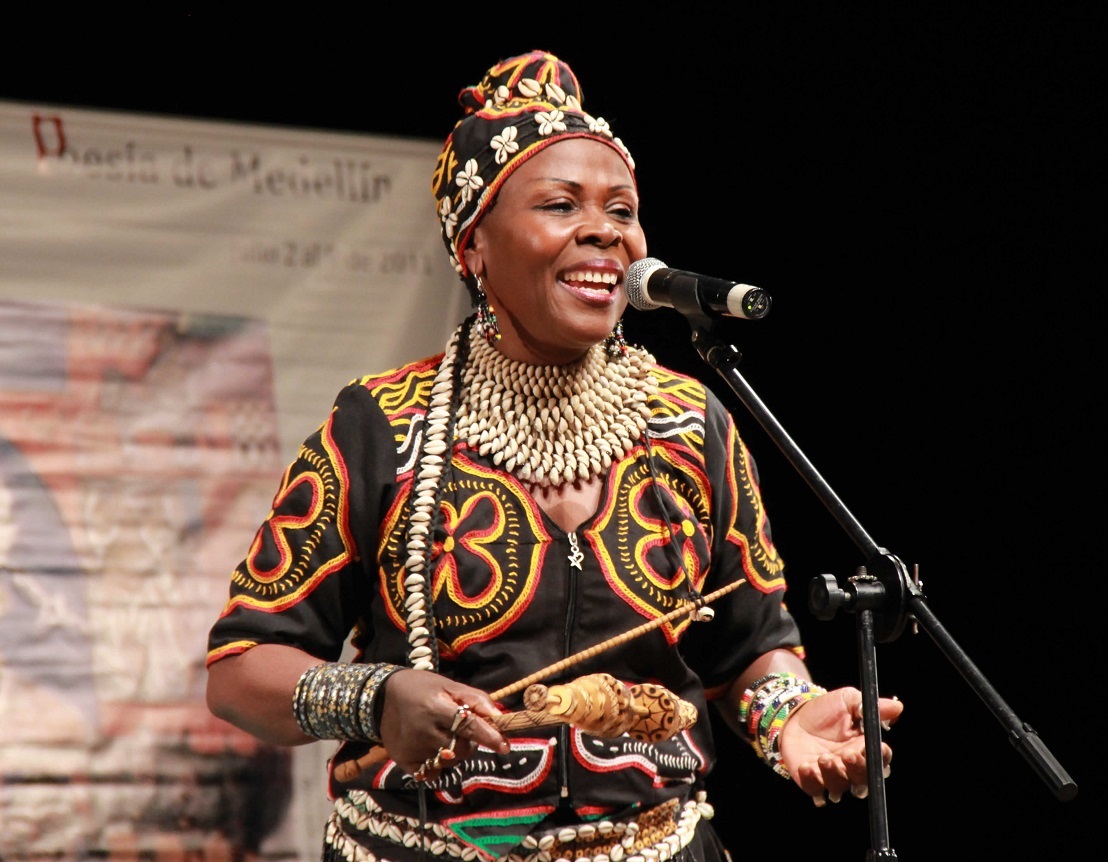 ZP_Werewere Liking reciting at the Festival Internacional de Poesía de Medellín in Colombia_2011
.
Assamala Amoi (born 1960, Paris / Abidjan, Ivory Coast)
“If you could”
.
If you could leave when work was done
Like the sun at the end of its day;
If you could arrive like the day and the night
At an hour chosen by the seasons;
If you could hear the farewells like the tree
Listens to the song of the migrating bird
– who would dread departures, returns and death?
. . .
“Si on pouvait”
.
Si on pouvait s’en aller à la fin de son ouvrage
Comme le soleil au terme de sa course;
Si on pouvait arriver comme le jour et la nuit
A l’heure choisie par les saisons;
Si on pouvait entendre les adieux comme l’arbre
Ecoute le chant de l’oiseau qui le quitte
Qui craindrait les départs, les retours et la mort?
. . .
Dominique Aguessy (born 1937, Benin)
“The poem seeks its own way”
.
The poem seeks its own way
Nestled in the parchment’s heart
Elegantly inscribed
By a sure and decided hand
While ideas wait to be set free
By the force of the poet
Expecting she will intercede
Bringing them alive
Without an excess of prejudice
Will she choose simplicity,
Or more exuberance, more spontaneity
Or still more circumspection?
From the madness of colours
To the vertigo of flavours
From the combinations of archipelagos
Drafting the sensual structures
The sap of the words sows images
Multiple trials bear witness
Disclosing the singular essence
Of eternal idle wandering.
. . .
“Le poème poursuit son chemin”
.
Le poème poursuit son chemin
Niché au coeur du parchemin
Elégamment buriné
D’une main ferme et décidée
Tandis que les idées
Attendent d’être délivrées
Par la vertu de l’aède
Espèrent qu’il intercède
Les amène à la vie
Sans trop de parti pris
Optera-t-il pour la simplicité,
Davantage d’exubérance, de spontanéité
Ou plus encore de retenue?
De la folie des couleurs
Au vertige des saveurs
Des combinaisons d’archipels
Ebauchent des structures sensuelles
La sève des mots ensemence les images
De multiples essais rendent témoignage
Dévoile l’essence originelle
De vagabondages sempiternels.
. . .
“When sudden passion comes”
.
When sudden passion comes
There is no age of reason
There is no future to protect
There are no inquisitors to mislead.
.
Who dares to touch it is stung
Who comes near it is consumed
Who speaks of it becomes ignorant
Who says nothing is reborn.
. . .
“Quand survient la passion”
.
Quand survient la passion
Il n’est pas d’âge de raison
Ni de futur à préserver
D’inquisiteurs à déjouer
.
Qui s’y frotte s’y pique
Qui s’en approche s’y consume
Qui en disserte l’ignore
Qui se tait en renaît.
. . .
Fatou Ndiaye Sow (1956-2004, Senegal)
“On the Threshold of Nothingness”
.
In this vampire world,
Here I am filled with my exile.
Let me rediscover
The Original Baobab
Where the Ancestor sleeps
In the deep murmur
Of his original solitude.
Let my eyes gleam
With a myriad of suns,
Voyaging across time and space without shores
And dissolving into faith the cries of anguish
And fishing for glimmers of hope
In the purple horizon of dusk
To ennoble rapacious humanity
Executioner or victim
In search of a distant star
Distant
Hidden behind doors of silence
Inside the Universe of hope
Let me decipher
At the foot of the Original Baobab
The message of my cowrie shells
Where I read
That every epoch lives its drama
Every people their suffering
But that before the doors of Nothingness
Each one PAUSES and THINKS.
. . .
“Au seuil du néant”
.
Dans ce monde vampire,
Me voilà remplie de mon exil.
Laissez-moi redécouvrir
Le Baobab Originel
Où dort l’Aïeul
Dans la rumeur profonde
De sa solitude première.
Laissez mon oeil éclaté
De myriades de soleils,
Voyager dans l’espace-temps sans rivages
Et dissoudre dans la foi les râles de l’angoisse,
Et pêcher des éclats d’espoir
Dans l’horizon pourpre du couchant
Pour ennoblir le rapace humain
Bourreau ou victime
A la recherche d’une étoile lointaine
Lointaine
Cachée aux portes du silence.
Dans l’Univers de l’espérance
Laissez-moi déchiffrer
Au pied du Baobab Originel
Le message de mes cauris,
Où je lis
Que chaque époque vit son drame
Chaque peuple ses souffrances
Mais qu’aux portes du Néant
Chacun S’ARRÊTE et PENSE.
. . .
Clémentine Nzuji (born 1944, Tshofa, Zaïre/Democratic Republic of Congo)
“It’s not my fault…”
.
It’s not my fault
If no one understands me
If I must
Express myself in
An absurd language
.
The trees also
and the winds
the flowers
and the waters
Express themselves in their own way
Strange to human beings
.
Take me as a tree
as wind
as flower
or as water
If you want to understand me.
. . .
“Ce n’est pas ma faute…”
.
Ce n’est pas ma faute
Si personne ne me comprend
Si j’ai
Pour m’exprimer
Un langage absurde
.
Les arbres aussi
les vents
les fleurs
et les eaux
S’expriment à leur manière
Etrange pour les humains
.
Prenez-moi pour arbre
pour vent
pour fleur
ou pour eau
Si vous voulez me comprendre.
. . .
Hortense Mayaba (born 1959, Djougou, Benin)
“When Life Ends”
.
A life ends
Another begins
We are the descendents
Of our dead
Each family keeps their own
Every being keeps their lineage
Our sleep makes them live again
In us they are reborn each night
Wearing our tattered clothes
Moving with our limbs
Walking often in our shadows
Drunk with our desires
And vanishing with our waking
When Life Ends!
. . .
“Quand la vie s’éteint”
.
Une vie s’éteint
Une autre renaît
Nous sommes les descendants
De nos morts
Chaque famille conserve les siens
Chaque être conserve sa lignée
Notre sommeil les fait revivre
Ils renaissent chaque nuit en nous
S’habillent de nos guenilles
Se mouvant de nos membres
Marchant souvent dans nos ombres
S’enivrant de nos désirs
Et s’évanouissant en nos réveils.
Quand la vie s’éteint!
. . .
“The Great Eye of the Good Lord”
.
I tried to find
Where the moon came from,
That princess
The colour of silver
.
I wanted to understand
Where the moon went,
That princess
Who lights up the sky
.
I tried to discover
Who commands the moon,
That princess
Of Africa’s nights
.
At last I understood
What the moon was,
That princess of the sky –
She is the Great Eye of the Good Lord.
. . .
“Le gros oeil du Bon Dieu”
.
J’ai cherché à savoir
D’où venait la lune,
Cette princesse
Couleur d’argent
.
J’ai voulu comprendre
Où allait la lune,
Cette princesse
Qui illumine le ciel
.
J’ai tenté de découvrir
Qui commandait à la lune,
Cette princesse
Des nuits d’Afrique
.
J’ai enfin compris
Ce qu’était la lune,
Cette princesse du ciel –
C’est le gros oeil du Bon Dieu.
. . .
Werewere Liking (born 1950, Cameroon)
“To Be Able”
.
There are words like a balm
They sweeten and leave a taste of mint
There are gazes like the wool of a lamb
They enfold and warm like a caress
There are smiles like full moons
They enlighten with intimacy
.
To be able!
Able to look
Able to discover
Able to predict
Able to feel
And be happy!
.
There are intoxicating promiscuities
And soft touches like caresses of sunlight
Furtive and discrete and exciting
They leave a taste of anticipation!
.
To be able
Able to feel
And be happy!
.
There are alarming caresses
That leave one on guard
And there are names that foretell fate
And phrases like decrees.
.
To be able to discover
To be able
And be happy!
.
There are faces like proverbs
Enigmatic and symbolic
They call up wisdom
Because life is the future
And the future is you
.
Ah, to be able
Able to predict
And be happy!
.
There are marvelous beauties
Present and numerous there
Under the nose there before our eyes
.
To be able
Ah, able to look
Yes, able to see
Because to see is to understand
That love
That happiness
Is as true
And as near
As your being here.
. . .
“Pouvoir”
.
Il est des mots comme des baumes
Ils adoucissent et laissent un goût de menthe
Il est des regards comme de la laine d’agneau
Ils enveloppent et réchauffent dans la caresse
Il est des sourires comme des pleines lunes
Ils illuminent avec intimité
.
Pouvoir!
Pouvoir regarder
Pouvoir déceler
Pouvoir deviner
Pouvoir sentir
Et être heureux!
.
Il est des promiscuités enivrantes
Et des frôlements comme des caresses de soleil
Furtives et discrètes et excitantes
Elles laissent un goût d’attente!
.
Pouvoir
Pouvoir sentir
Et être heureux!
.
Il est des caresses alarmantes
Qui laissent sur le qui-vive!
Il est des noms qui augurent du destin
Et des phrases comme des décrets.
.
Pouvoir déceler
Pouvoir
Et être heureux!
.
Il est des visages comme des proverbes
Enigmatiques et symboliques
Ils appellent à la sagesse
Parce que la vie c’est l’avenir
Et que l’avenir c’est toi
.
Ah, pouvoir
Pouvoir deviner
Et être heureux!
.
Il est beautés merveilleuses
Présentes et nombreuses là
Sur le nez là sous nos yeux
.
Pouvoir
Ah, pouvoir regarder
Oui pouvoir voir
Car voir c’est comprendre
Que l’amour
Que le bonheur
C’est aussi vrai
Et aussi près
Que tu es là.
. . .
Monique Ilboudo (born 1959, Burkina Faso)
“Skirts”
.
I don’t like skirts
Not short ones
Not long ones
Not straight ones
Not pleated ones
.
I don’t like skirts
The short ones show me
The long ones slow me
The straight ones smother me
The pleated ones oppress me
.
I don’t like skirts
Pretty or ugly
Red or green
Short or long
Straight or pleated
.
I don’t like skirts
Except if they’re culottes…
But the long pleated skirt
That’s the worst of all!
I don’t like skirts.
 ZP_Monique Ilboudo_2012
“Les jupes”
.
J’aime pas les jupes
Ni les courtes
Ni les longues
Ni les droites
Ni les plissées
.
J’aime pas les jupes
Les courtes m’exhibent
Les longues m’entravent
Les droites m’étouffent
Les plissées m’encombrent
.
J’aime pas les jupes
Belles ou laides
Rouges ou vertes
Courtes ou longues
Droites ou plissées
.
J’aime pas les jupes
Sauf si elles sont culottes…
Mais la jupe-longue-plissée
C’est la pire de toutes!
J’aime pas les jupes.
. . .
Nafissatou Dia Diouf (born 1973, Senegal)
“Tell Me…”
.
If what you have to say
Is not as beautiful as silence
Then, say nothing
Because nothing is more beautiful
Than your mouth half-open
On a hanging word
.
Tell me the unspeakable
Tell me the unname-able
Tell me with words
That will melt into nothingness
As soon as you speak them
.
Tell me what is on the other side of the mirror
Behind your eyes without silvering
Tell me your life, tell me your dreams
Tell me your grief and also your hopes
And I will live them with you
.
In the world of silence and rustling silk
Of velvet gazes and quilted caresses
Now, everything has been said
Or almost
So hussssssssh……
. . .
“Dis-moi…”
.
Si ce que tu as à dire
N’est pas aussi beau que le silence
Alors, tais-toi
Car il n’y a rien de plus beau
Que ta bouche entrouverte
Sur une parole arrêtée
.
Dis-moi l’indicible
Dis-moi l’innommable
Dis-le moi avec les mots
Qui se fondront dans le vide
Aussitôt prononcés
.
Dis-moi ce qu’il y a de l’autre côté du miroir
Derrière tes yeux sans tain
Dis-moi ta vie, dis-moi tes rêves
Dis-moi tes peines et tes espoirs aussi
Et je les vivrai avec toi
.
Dans un monde de silence et de soie crissante
De regards veloutés et de caresses ouatées
A présent, tout a été dit
Ou presque
Alors chuuuuuuuut……
. . . . .
Traductions en anglais / Translations from French into English – droit d’auteur © Professeure Janis A. Mayes. Tous les poèmes – droit de chaque auteur © the respective poetesses
. . . . .
Véronique Tadjo: “Cocodrilo” / “Crocodile”
Posted: August 27, 2013 Filed under: English, French, Spanish, Véronique Tadjo, ZP Translator: Alexander Best Comments Off on Véronique Tadjo: “Cocodrilo” / “Crocodile”
Véronique Tadjo (nacido en 1955, Paris/Abidjan, Costa de Marfil)
“Cocodrilo”
.
No es la vida fácil ser un cocodrilo
especialmente si no quiere ser un cocodrilo
El coco que usted puede ver – en la página opuesta* –
no es feliz en su
piel de coco
Era su preferencia
ser diferente
Habría preferido
llamar la atención de
Los niños
y jugar con ellos
Platicar con sus padres
Dar paseos
por la aldea
Excepto, excepto, excepto…
.
Cada vez que sale del agua
Los pescadores
tiran lanzas
Los niños
huyen
Las muchachas
abandonan sus jarros
.
Su vida es
una vida
de soledad y de la pena
Vida sin cuate y sin cariño,
sin ningún lugar a visitar
.
En todas partes – Desconocidos
.
Ese cocodrilo
Vegetariano
Un cocodrilo
y bueno para nada
Un cocodrilo
que se siente un
Horror sagrado de la sangre
.
Por favor:
Escríbale,
Escríbale a:
Cocodrilo Amable,
Caleta número 3,
Cuenca del Rio Níger.
.
*La versión original en francés presenta un dibujo hecho por Señora Tadjo.
.
Traducción en español: Alexander Best
. . .
Véronique Tadjo (née en 1955, Paris/Abidjan, Côte d’Ivoire)
“Crocodile”
.
Ce n’est pas facile d’être un crocodile
Surtout si on na’a pas envie
D’être un crocodile
Celui que vous voyez
Sur la page opposée
N’est pas bien
Dans sa peau
De croco
il aurait aimé
Etre different
Il aurait aimé
Attirer
Les enfants
Jouer
Avec eux
Converser
avec les parents
Se balader
Dans
Le village
Mais, mais, mais
.
Quand il sort
De l’eau
Les pêcheurs
Lancent des sagaies
Les gamins
Détalent
Les jeunes filles
Abandonnent leurs canaris
.
Sa vie
Est une vie
De solitude
Et de tristesse
.
Sans ami
Sans caresse
Nulle part
Où aller
.
Partout –
Etranger
.
Un crocodile
Crocodile
Végétarien
Et bon à rien
Qui a
Une sainte horreur
Du sang
.
S’il vous plaît
Ecrivez,
Ecrivez à:
Gentil Crocodile,
Baie Numéro 3,
Fleuve Niger.
. . .
Véronique Tadjo (born 1955, Paris/Abidjan, Ivory Coast)
“Crocodile”
.
It’s not easy to be a crocodile
Especially if you don’t want
To be a crocodile
The one you see
On the opposite page*
Is not happy
in his croc’s
Skin
He would have liked
To be different
He would have liked
To attract
Children
Play
with them
Talk
With their parents
Walk around
in the village
But, but, but
.
When he comes out
Of the water
Fisherman
Throw spears
Children
Take off
Young girls
Abandon their water jugs
.
His life
Is a life
Of solitude
And sadness
.
Without a friend
Without affection
Nowhere
To go
.
Everywhere
Strangers
.
A Crocodile
Vegetarian
Crocodile
And good for nothing
Who has
A holy horror
Of blood
.
Please
Write,
Write to:
Nice Crocodile,
Bay Number 3,
Niger River.
.
*The original French-language version of this poem featured a drawing by Tadjo herself of a crocodile.
. . . . .
Three Poets from Chad, DRCongo and Ivory Coast: “…so that the poem that has forever haunted my steps survives” / Trois poètes du Tchad, de la RDCongo et de la Côte d’Ivoire: “…pour la survie du poème qui hante mes pas depuis toujours”
Posted: July 25, 2013 Filed under: English, French Comments Off on Three Poets from Chad, DRCongo and Ivory Coast: “…so that the poem that has forever haunted my steps survives” / Trois poètes du Tchad, de la RDCongo et de la Côte d’Ivoire: “…pour la survie du poème qui hante mes pas depuis toujours” ZP_A Baobab tree in South Africa during the dry season when they shed their leaves. Traditionally, the ancient, ruggéd Baobab has served as an informal community meeting place where elders tell stories, the town crier announces startling news, and where conflicts may be resolved through public debate under the invisible eye of the ancestors_Un arbre Baobab Za pendant la saison sèche en Afrique du Sud
.
Three Poets from Chad, DRCongo and Ivory Coast:
“…so that the poem that has forever haunted my steps survives” /
Trois poètes du Tchad, de la RDCongo et de la Côte d’Ivoire:
“…pour la survie du poème qui hante mes pas depuis toujours”
. . .
Traductions en anglais / Translations from French into English – droit d’auteur / © Patrick Williamson
Tous les poèmes – droit de chaque auteur / © the respective poets
. . .
Nimrod Bena Djangrang (born 1959, Chad)
“The Cry of the Bird”
(for Daniel Bourdanné)
.
I wanted to be overcome with silence
I abandoned the woman I love
I closed myself to the bird of hope
That invited me to climb the branches
Of the tree, my double
I created havoc in the space of my garden
I opened up my lands
I found the air that circulates between the panes
Pleasant. I was happy
To be my life’s witch doctor
When the evening rolled out its ghosts
The bird in me awoke again
Its cry spread anguish
In the heart of my kingdom.
. . .
“Le Cri de l’Oiseau”
(à Daniel Bourdanné)
.
J’ai voulu m’enivrer de silence
J’ai délaissé la femme aimée
Je me suis fermé à l’oiseau de l’espoir
Qui m’invitait à gravir les branches
De l’arbre, mon double
J’ai saccagé l’espace de mon jardin
J’ai ouvert mes terroirs
J’ai trouvé agréable l’air qui circule
Entre les vitres. Je me suis rejoui
D’être le sorcier de ma vie
Alors que le soir déroulait ses spectres
L’oiseau en moi de nouveau s’est éveillé
Son cri diffusait l’angoisse
Au sein de mon royaume.
. . .
Kama Sywor Kamanda (born 1952, Democratic Republic of Congo)
“In the Silence of Hearts”
.
Now you are queen of my kingdom of dreams!
Woman, I am lost in your darkest night
Without a guiding star!
Carried away by your everchanging soul
As on an infinite sea,
I am drowning in the light of your desires:
Your love of its sensual pleasures transfigured me,
And I distanced my life from the shores of solitude.
It is softness in my heart
Nourished by the blood of lovers!
The fears on the flanks of wind are ripening,
I pray for heaven
To protect your life from all suffering,
And the force of love to safeguard your freedom
Wherever honour
Is a requirement of election.
I will cross gulfs of bitterness
To accede to the sun of your pleasure,
And I will attain the highest summits of your slopes
So that the river of all tenderness will flow down
Broadening as it courses its way.
. . .
“Dans le Silence des Coeurs”
.
Te voici reine de mon royaume des rêves!
Je me sens, ô femme, perdu en ta profonde nuit
En l’absence de l’étoile du voyageur!
Emporté dans les mouvances de ton âme
Comme dans une mer infinie,
Je me suis noyé dans la lumière de tes desirs:
Ton amour de ses voluptés, m’a transfiguré,
Et j’ai éloigné ma vie des rivages de la solitude.
C’est une douceur dans mon coeur
Nourri du sang des amants!
Les peurs mûrissantes sur les flancs du vent,
Je prie pour que le ciel
Préserve ta vie de toute souffrance,
Et que la force de l’amour sauvegarde ta liberté
Sur toutes les terres où l’honneur
Est une exigence d’election.
Je traverserai les gouffres de l’amertume
Pour accéder au soleil de ta jouissance,
Et j’atteindrai les plus hauts sommets de tes versants
En mesure que s’en ira en s’élargissant
Le fleuve de toutes les tendresses.
. . .
“Haunted Houses”
.
Now we have our doubts to cry over.
When identities and years
Become lost in the sands,
Our depressed towns
Smell of roses
Placed on tombstones.
Our houses, haunted
By long periods of solitude
Open up to waves of love,
As abundant as the sea of farewells.
Bitter offerings
People the spheres of our ambitions.
We seek our roots
Like others seek hidden truths.
. . .
“Maisons Hantées”
.
Maintenant, nous avons nos doutes pour pleurer.
Quand les identités et les années
Se perdent dans le sable,
Nos villes moroses
Se parfument de roses
Déposées sur les tombes.
Nos maisons hantées
Par de longues solitudes
S’ouvrent aux vagues de l’amour,
Aussi abondantes qu’une mer des adieux.
Les offrandes amères
Peuplent les sphères de nos ambitions.
Nous cherchons nos racines
Comme d’autres des vérités cachées.
. . .
Suzanne Tanella Boni (born 1954, Ivory Coast)
“Gorée Baobab Island” (four poems)
.
perhaps happiness is so far away
invisible among the tamarind leaves
when my hand brushes the fruit
to share them with spirits laughing at man’s
cruelty to man
.
perhaps the hope in my eyes drags
the future in clouds of dust where I seek
sparks and the dignity of condemned souls
.
when the horizon in the early hours
creates images and silhouettes between sun and sea
you are not here to see my eyes
where you have never seen the humour of the world
. . .
with the blessing of the island’s
invisible inhabitants I become alive again
.
as your look is not a poem
but the vast sea that pours infinite pages
at my feet
. . .
here too I drank at the source
words covered with mildew
like walls oozing all the sorrows
carved on the doors of time
.
I drank the life source
that gives us memory and the capped path
of days to come
I lost count of the mouthfuls of elixir I drank
so that the poem
that has forever haunted my steps survives
.
tomorrow I will return
to hear you talk to me
again of you and me
. . .
here too the sheets where history snoozed
are white and empty
.
the covers of time alone
are green like the last word in the world
when the wind howls
day and night at the gates of chaos
.
then I wrap myself in the words of your look faraway
beyond the sea that separates us infinitely.
 ZP_photographie par Finbarr O’Reilly, Reuters_L’île de Gorée est célèbre pour La Maison des Esclaves et La porte du Voyage sans Retour, d’où partaient pour l’ultime voyage les esclaves acheminés vers les plantations d’Amérique. Gorée Island, just off the coast from Dakar, Senegal, is famous for the 18th-century House of Slaves with its “portal of sorrow” or “door of no return” which faces the westward Atlantic Ocean where ships with their “human cargo” sailed for the slave-fueled coffee, cotton and sugar plantations of The Americas. It is this symbolic “door of no return” which Suzanne Tanella Boni calls the gates of chaos or la porte du chaos (in the French original of her poem).
.
“Gorée Île Baobab” (quatre poèmes)
.
peut-être le bonheur est-il si loin
invisible dans les feuilles de tamarinier
quand ma main effleure les fruits
à partager avec les génies riant des cruautés
faites à l’homme par l’homme
.
peut-être l’espérance dans mes yeux traîne-t-elle
l’avenir en nuages de poussières où je cherche
étincelles et dignité des âmes en sursis
.
quand l’horizon au petit matin
dessine images et silhouettes entre soleil et mer
tu n’es pas là pour voir mes yeux
où tu n’a jamais vu l’humeur du monde
. . .
avec la bénédiction des habitants
invisibles de l’île ici je revis
car ton regard n’est pas un poème
mais toute la mer qui coule à mes pieds
des pages infinies
. . .
ici aussi j’ai bu à la source
des mots couverts de moisissures
comme murs suintant de tous les malheurs
gravés aux portes du temps
.
j’ai bu la source vive
qui nous donne mémoire et chemin majuscule
des jours à venir
j’ai bu je ne sais combien de gorgées élixir
“…pour la survie du poème
qui hante mes pas depuis toujours”
.
demain je reviendrai
entendre ta voix qui me parle
encore de toi et de moi
. . .
ici aussi les draps où l’histoire fait la sieste
sont blancs et vides
.
seule la couverture du temps
est verte comme dernière parole du monde
quand le vent tourbillonne
nuit et jour à la porte du chaos
.
alors je m’enroule dans les mots de ton regard horizon
par-delà la mer nous séparant infiniment.
. . . . .
Jane Kenyon: “Laissons venir le soir” / “Let Evening Come”
Posted: July 24, 2013 Filed under: English, French, Jane Kenyon Comments Off on Jane Kenyon: “Laissons venir le soir” / “Let Evening Come”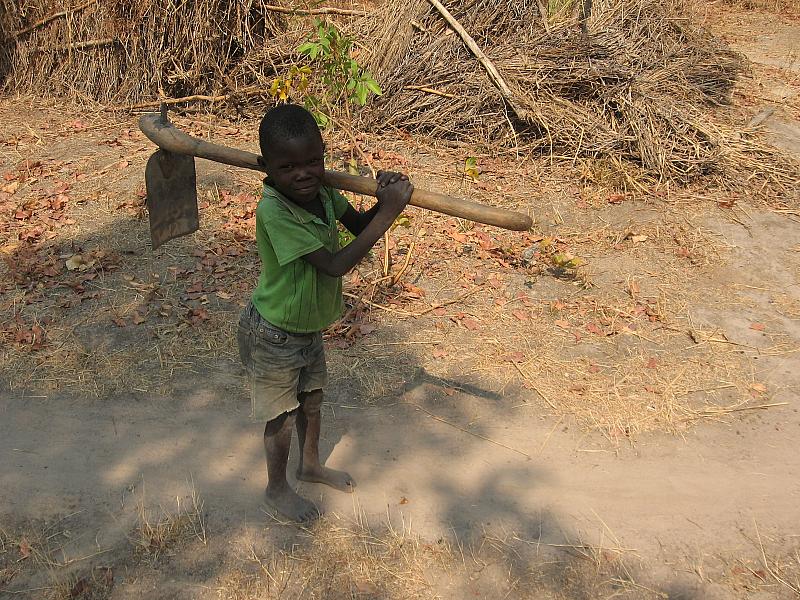 ZP_Garçonnet avec une binette_La Zambie_Little boy with hoe_Zambia_photograph © Boldt
.
Jane Kenyon(1947-1995)
“Laissons venir le soir”
.
Laissez la lumière de fin de journée
briller à travers les interstices de la grange,
pendant que le soleil descend, bougeant sur les bottes de paille.
Laissez le grillon craqueter
comme une femme prend ses aiguilles
et ses fils. Laissez venir le soir.
Laissez la rosée recueillie sur la houe abandonnée
dans les grandes herbes. Laissez les étoiles apparaître
et la lune divulguer sa corne d’argent.
Laissez le renard revenir à sa tanière de sable.
Laissez le vent s’éteindre. Laissez le hangar
aller vers le noir intérieur . Laissons venir le soir..
Pour la bouteille dans le fossé, à la pelle
dans d’avoine, pour l’air dans les poumons
Laissons venir le soir.
Qu’il vienne, comme il le fera, et n’aies
pas peur. Dieu ne nous laisse pas sans
consolation, laissons venir le soir.
. . .
Jane Kenyon (1947-1995)
“Let Evening Come”
.
Let the light of late afternoon
shine through chinks in the barn, moving
up the bales as the sun moves down.
.
Let the cricket take up chafing
as a woman takes up her needles
and her yarn. Let evening come.
.
Let dew collect on the hoe abandoned
in long grass. Let the stars appear
and the moon disclose her silver horn.
.
Let the fox go back to its sandy den.
Let the wind die down. Let the shed
go black inside. Let evening come.
.
To the bottle in the ditch, to the scoop
in the oats, to air in the lung
let evening come.
.
Let it come, as it will, and don’t
be afraid. God does not leave us
comfortless, so let evening come.
. . .
Traduction en français: “ReChab”
Voyez également son site poetique “art et tique et pique” – http://ecritscrisdotcom.wordpress.com
. . . . .
Les femmes-poètes africaines “griotent” de la Femme et de l’Enfant / African women poets sing, proclaim, and advise about Women and Children
Posted: July 19, 2013 Filed under: English, French | Tags: Femmes-Poètes Africaines Comments Off on Les femmes-poètes africaines “griotent” de la Femme et de l’Enfant / African women poets sing, proclaim, and advise about Women and Children
Les femmes-poètes africaines “griotent” de la Femme et de l’Enfant / African women poets sing, proclaim, and advise about Women and Children
. . .
Berthe-Evelyne Agbo (born 1949, Benin)
“My baby doll”
.
My heart so flooded with joy
Dissolves
At the sight
Of your adorable little face.
.
You’re sleeping, little marvel
In your cloth of green embroidery
Your delicately hemmed eyelashes
Resting on your little round cheeks.
.
From the depth of your sleep
You feel my presence;
You woke up, little kitten
And quickly started the game again.
.
So I watch you wiggling,
Ignoring me in your crib,
Arching your back
And yawning out loud.
.
You talk, you raise your arms
You stretch out in your bed.
That’s it: your head lifted
You look at me astonished.
.
Will you pick me up? your squinting eyes ask
Or, will you watch me a while longer?
Will I have to cry first
Before you understand?
.
And my mother’s heart breaks
At the sight of your falling tears
And I hurry to hold you,
You, so warm and stirring with innocence.
.
That’s it: you’re in my arms, cuddled
You babble and caress my cheek.
With a tender touch I turn you in my arms
I hug you, you talk to me.
.
And my heart is flooded with joy.
. . .
“Ma poupée”
.
Mon coeur chavire de joie,
Tant il fond
A la vue
De ton minois adorable.
.
Tu dors, petite merveille,
Dans tes draps brodés au fil vert,
Tes cils délicatement ourlés,
Posés sur tes joues rondelettes.
.
Du fond de ton sommeil,
tu as senti ma présence;
Tu t’es éveillée, petite chatte,
Et au jeu aussitôt tu t’es mise.
.
Et je te regarde te trémousser
Dans ton berceau, ignorant mon regard,
Tu fais le dos rond
Et tu bâilles à grand bruit.
.
Tu parles, tu lèves les bras
Tu t’étires dans ton lit.
Ça y est: ta tête s’est dressée
Et tu me regardes, étonnée.
.
Vas-tu me prendre? me disent tes yeux bridés,
Ou vas-tu m’observer encore longtemps?
Me faut-il crier d’abord
Avant que tu ne comprennes?
.
Et mon coeur de mère sanglote
A la vue de tes larmes apparues,
Et je me précipite pour te prendres,
Tant tu es chaude et émouvante de candeur.
.
Ça y est: tu es dans mes bras, blottie,
Et déjà tu babilles et me caresses la joue.
Mes bras, d’une caresse, t’entourent,
Je t’embrasses, tu me parles,
.
Et mon coeur chavire de joie.
. . .
Edwige Araba Aplogan (born 1955, Benin)
“The Child”
.
Child from above
Child from below
Child of forgotten desire
Child of love and mystery
Round child, mad child
Wolf Child
Tortured Child
The child of a newfound dream
.
Of a tomorrow that is coming
for you
for us
for them
.
A tight embrace
Flame
Desire
.
We will ride across deserts
from one adventure to another
from red earth to blue dunes
from fortresses torn from silence
.
We will take over the shore of clear water
from war steps into dance steps
from songs of love and hope
Of life snatched
From the void of the present.
. . .
“L’enfant”
.
L’enfant d’en haut
L’enfant d’en bas
L’enfant du désir oublié
L’enfant d’amour et de mystère
L’enfant boule, l’enfant fou
L’enfant loup
L’enfant torture
L’enfant d’un rêve retrouvé
.
D’un demain qui s’annonce
pour vous
pour nous
pour eux
.
Une étreinte
Flamme
Désir
.
Nous chevaucherons les déserts
d’aventures en aventures
des terres rouges aux dunes bleues
des forteresses arrachées au silence
.
Nous prendrons la rive d’eau claire
de pas de guerre en pas de danse
de chants d’amour et d’espérance
De vie arrachée
à la béance du présent.
. . .
Aminata Athié (born 1960, Senegal)
“A Seller of Women”
.
Have you passed by my stall? The seller of women is a man who
knows how to show off his merchandise. You should see him
do his thing or better still hear him: He puts on a show, almost
like magic, a little bit the con-man but terribly charming…In
fact, his pitch was so persuasive that a mob of people hurried to
gather around him. You would have seen the crowd packed in
there. Even I tried to stop, but I was in a hurry…And besides, I
could not myself be a buyer, since you had to have a good pair of
moustaches. As for the merchandise, I am not a lover of antiques:
the piece is so strange that I would risk losing my Pulaar…
Besides, I don’t even know anymore which side of the market his
stall is on. If you were to ask certain people…
.
Sister Soul
White Goose
My dove
My sweet Grave
.
Call her by every name
sweet names, names
of honey, butter, flour
.
names of things to eat
names of things to caress
names of things to trample
Call her by every name
.
The Woman is good to possess
The Woman, pride of the house
.
You must have a woman
She was an angel, the woman
Paradise is paved with good women
.
A woman-heater for winter
Woman-table for the living room
A woman air-conditioner for summer nights
Woman-seed for rainy seasons
.
Cotton-cloth woman
Lemonade-woman
Pomade-woman for bad skin
.
Call her by every name
.
The dry composed candidate
.
Stubborn-statuette woman
Chatterbox-woman
Leech-plump-woman
Hell-on-wheels woman
.
Slap-woman
Talisman-woman
Stallion-woman
.
Call her by every name
.
The woman, good to display
The woman, jewel of the house
.
They come in all shapes
There is one for every taste
.
Golden woman
Gilded woman
Woman-body
Woman-cowry
.
And even a bad-luck woman
And even fossil-woman
.
The Woman, good to console
The Woman, household rubbish
.
I sell the woman, an object
of premium necessity
.
You must have a woman
She was made from the mire – woman
.
She eats
She drinks
She sleeps
Woman is scared
Madame adorns herself
Woman weeps
.
Woman of length
Woman of breadth
Woman of depth.
“Marchand de Femmes”
.
Etes-vous déjà passé près de mon étal? Le marchand de femmes
est un homme qui sait vanter sa marchandise. Il faut le voir
à l’oeuvre ou plutôt l’écouter: cela tient du spectacle, un peu
comme la magie, un tantinet charlatan mais terriblement
charmeur…En effet, la réclame était si persuasive que bientôt
un tas de gens se pressaient de son côté. Il fallait voir la foule
agglutinée…Moi-même, j’ai tenté de faire un crochet mais
comme j’étais pressée.
…Et puis, cela ne devrait pas me concerner côté acheteur, il
fallait une bonne paire de moustaches. Quant à la marchandise,
je ne suis pas amatrice d’antiquité: le produit est si curieux que
je risque d’y perdre mon…pular! D’ailleurs, je ne sais même
plus de quel côté du marché il tient son étal. Si vous demandiez
à certains…
.
Ame soeur
Oie blanche
Ma colombe
ma douce tombe
.
Appelez-la de tous les noms
de noms doux, de noms
sucrés-miel, beurre, farine
.
des noms de choses à manger
des noms de choses à caresser
des noms de choses à fouler aux pieds
Appelez-la de tous les noms
.
La femme est bonne à posséder
La femme, un orgueil de la maison
.
Il faut avoir une femme
C’était un ange, la femme
Le paradis pavé de bonnes femmes
.
Femme-chauffage pour l’hiver
Femme-console pour ton salon
Femme-climatiseur pour nuits d’été
Femme-semence pour l’hivernage
.
Femme-cotonnade
Femme-limonade
Femme-pommade pour peaux malades
.
Appelez-la de tous les noms
.
La candidate-aride-impavide
.
Femme-statuette-têtue
Femme-à-la-langue-trop-pendue
Femme-sangsue-dodue
Femme-enfer-de-fer
.
Femme-taloche
Femme-talisman
Femme-étalon
.
Appelez-la de tous les noms
.
La femme, bonne à exhiber
La femme, bijou de la maison
.
Il y en a de toutes les formes
Vous en avez pour tous les goûts
.
Femme d’or
Femme dorure
Femme-corps
Femme-cauris
.
Et même la femme-mauvais sort
et même la femme fossile
.
La femme, bonne à consoler
La femme, rebut de la maison
.
Je vends la femme, objet
de première nécessité
.
Il faut avoir une femme
C’était de la fange la femme
.
Elle mange
Elle boit
Elle dort
La femme a peur
Madame se pare
La femme pleure
.
Femme en long
Femme en large
Femme en profondeur.
. . .
Monique Ilboudo (born 1959, Burkina Faso)
“Closed for Inventory”
.
There is nothing to sell today
No smile
No sweet word
No sour word
No sweet and sour word
I am closed
Closed for inventory
.
I am not buying anything today
No crazy laugh
No sweet talk
No sour talk
No sweet and sour talk
I am closed
Closed for inventory
.
The entire store will be inspected today
The empty shelves
The full shelves
The half-full shelves
Everything will be dusted
Everything will be checked
Everything will be rechecked
Everything will be counted
.
Everything will be weighed on a scale
Nothing will be ignored
On the left tray the assets
On the right tray the liabilities
.
Tomorrow if everything isn’t up for grabs
If some energy is left for selling
If she finds her wholeness again
The store will be open again – maybe.
But today there is nothing for sale
Nothing to buy, nothing to grab.
I am closed,
Closed for inventory.
 “Fermée pour inventaire”
.
Il n’y a rien à vendre aujourd’hui
Ni sourire
Ni mot doux
Ni mot aigre
Ni mot aigre-doux
Je suis fermée
Fermée pour inventaire
.
Je n’achète rien aujourd’hui
Ni fou rire
Ni échange de propos doux
Ni échange de propos aigres
Ni échange de propos aigre-doux
Je suis fermée
Fermée pour inventaire
.
Toute la boutique sera visitée aujourd’hui
Les rayons vides
Les rayons pleins
Les rayons à moitié vides
Les rayons à moitié pleins
Tout sera épousseté
Tout sera vu
Tout sera revu
Tout sera compté
Sur une balance tout sera pesé
Rien ne sera lésé
Sur le plateau gauche l’actif
Sur le plateau droit le passif
.
Demain si tout n’est pas à prendre
S’il reste de l’énergie à vendre
Si elle retrouve son bien-être
La boutique rouvrira peut-être
Mais aujourd’hui il n’y a rien à vendre
Rien à acheter rien à prendre
Je suis fermée
Fermée pour inventaire.
. . .
Irène Assiba d’Almeida (born 1945, Senegal)
“Waves of Pleasure”
.
You will never know
The profound joy
Of a woman
Satisfied
In the innermost depth of her body
After the tender touch
Of her lover
.
Dizzy in ecstasy
Her waist beads
Become song
Swaying with desire
Her whole body
Shivering
Rising over undreamed mountains
Arched with pleasure
She is soon
A sea becalmed
Still drifting
Her “little death” still sumptuously alive
After, long after sleep
After, long after awakeniing
.
You will never know
The profound joy
Of a woman
Satisfied
In the innermost depth of her body
After the tender touch
Of her lover.
. . .
“Vagues de plaisir”
.
Tu ne sauras jamais
La joie profonde
De la femme
Satisfaite
Au tréfonds de son corps
Après la tendre caresse
De l’amant
.
Dans le vertige de l’extase
Ser perles aux reins
Deviennent chanson
Ondoyante de désir
Tout son corps
Devient frisson
Hissée sur des sommets insoupçonnés
Arc-boutée de plaisir
Elle est bientôt
Mer étale
Et même dans l’abandon
Sa ‘petite mort’ reste somptueusement vivante
Après, bien après le sommeil
Après, bien après le réveil
.
Tu ne sauras jamais
La joie profonde
De la femme
Satisfaite
Au tréfonds de son corps
Après la tendre caresse
De l’amant.
. . .
Marie Claire Dati (born 1955, Cameroon)
“Jubilation”
.
The Good Lord made me a woman
A silken feather soothing life
Spicy islands drunken escape
A tangerine woman, a fruit-juice woman
Woman a tear, woman a pout
And a savannah and a spring and a bamboo and colours
That fall silent in a single hymn
While a hundred moving fires a thousand lights
Bathe the choruses of the miracle world
.
Woman! Nothing. But Woman, the Good Lord made me
Everything
Firefly of the volcanoes infernal rosebush
Melody in the night of the wanderer
Avowing angelic serenades woman
Fireworks woman
Woman doe of a virile prestige
Woman hope of children
Woman arranger of time
And a savannah and a spring and a bamboo and colours
That melt into the peacful sky of my soul
Tasting of the voluptuous spasms
That my heart, O Grace, speechless with plenitude
Adores in the secret of endless joy.
. . .
“Jubilation”
.
Le Bon Dieu m’a faite femme
Plume de soie berce vie
Piquantes îles évasion ivresse
Femme mandarine, femme jus de fruits
Femme une larme femme une moue
Et savane et printemps et bambou et couleurs
Se taisent en un hymne unique
Quand cent feux fluides mille lumières
Baignent le monde à miracle les choeurs.
.
Femme! Rien. Mais Femme, le Bon Dieu m’a faite
Tout
Luciole des volcans rosier infernal
Mélodie dans la nuit du promeneur
Femme aveux des sérénades d’anges
Femme feu d’artifice
Femme biche du prestige viril
Femme espérance des enfants
Femme ordre du temps
Et savane et printemps et bambou et couleurs
Se scellent en un ciel de paix dans mon âme
Goûtant aux spasmes voluptueux
Que mon coeur, ô grâce, muet de plénitude
Dans le secret des joies sans borne, adore.
. . .
Madeleine de Lallé (born 1955, Burkina Faso)
“Man”
.
When I came of age
And tradition dictated I should marry
My father took me aside one evening
And confided this to me:
“When you can listen to a man
Insult you without saying a word
And without being upset
Then come and tell me you are getting married:
Man is a feeble being
Who cannot admit he is so.
When he becomes angry
His ears withdraw
From the mouth that reasons with him.
Let him say what he wants to say,
And caress him where you can.
When he calms down and
Comes back to your arms
Embrace him as if he is your prize,
Soothe him as best you can
– He recognizes the mother in you.
And that makes him feel like a man.”
. . .
“L’homme”
.
Quand j’eus l’âge de raison,
Et que la coutume voulut que je me marie,
Mon père me retint un soir
Et me confia ceci:
“Quand tu pourras écouter un homme
T’insulter sans mot dire,
Et sans t’émouvoir,
Viens alors me dire que tu te maries:
L’homme est un être faible
Qui n’admet pas qu’on le lui montre.
Quand il se met en colère,
Ses oreilles s’éloignent
De la bouche qui le raisonne.
Laisse-le dire ce qu’il veut,
Et caresse-le où tu peux.
Quand il se calmera et
Qu’il reviendra dans tes bras,
Serre-le comme ton bien,
Berce-le comme il faut.
Il reconnaît alors en toi la mère.
Et c’est ainsi qu’il se sent homme.”
. . .
Ndèye Coumba Mbengue Diakhaté (1924-2001, Senegal)
“Seasons of Life”
.
That morning she stepped out as if she were flying
Her boubou* of muslin was spread out like wings!
Her feet barely touched the ground:
Because, finally, that morning she was to be married.
.
At noontime, she was walking steadily, quickly ahead
Her boubou of cotton was clinging with sweat
The children, the housework and her husband waited
For a mother, a wife, what turmoil in a house!
.
In the evening she set off, heavy on her feet
Her faded boubou made her look even more stooped.
The worry, the torture, and the years had passed;
Then the grown children had left her.
.
In the night she kept watch near the dying fire
Like her husband, the old man, had done one evening.
Alone in the world! In the night telling her beads
And the hours that follow each other foretelling the end.
.
*boubou – a large dress resembling a tunic or caftan

“Saisons de la vie”
.
Elle allait ce matin, on eût dit qu’elle volait;
Son boubou de mousseline lui faisait comme des ailes!
Ses pieds si légers effleuraient le sentier:
Car enfin ce matin elle allait se marier.
.
Elle marchait ce midi d’un pas ferme et pressé;
Son boubou de coton, de sueur lui collait;
Les enfants, le ménage, et son homme qui attend:
Pour une mère, une épouse, quel tracas qu’une maison!
.
Elle partait dans le soir, en pesant sur ses pas;
Son boubou délavé la faisait plus voûtée:
Les soucis, les tortures, et les ans ont passé;
Les enfants à leur tour, une fois grands, l’ont quittée.
.
Elle veillait dans la nuit, près du feu qui se meurt,
Comme un soir l’avait fait son vieil homme de mari.
Seule au monde! Dans le noir, égrenant son chapelet,
Et les heures qui se suivent, annonçant la dernière.
. . .
“Griot of My Race”
.
I am the griot of my race
Poet, troubadour
I loudly sing of my race, my blood
That proclaims who I am
.
I am…ebony wood
Not consumed by the slow fire of lies
I am…the red laterite of the fierce blood of my ancestors.
I am…the virgin wilderness
The kingdom of howling monkeys
.
Not the Negre from troubled neighbourhoods
Relegated to fetid mire, the clinging soot
There, in the grey city, that crushes, that kills.
.
I am…the one you ignore
The sunlight without illusion, not the hypocritical neon.
I am…the calm moonlight, complicit in nocturnal love games
I am the blood that gallops, rearing with impatience
In the maze of my arteries
I am the one you ignore
I spit on your vile spirit.
.
And watch how I break the chains
And the lie of silence
That you hurled at me.
. . .
“Griot de ma race”
.
Je suis le griot de ma race:
Poète, troubadour;
Je chante très haut ma race, mon sang,
Qui clame qui je suis.
.
Je suis…bois d’ébène,
Que ne consume le feu lent du mensonge.
Je suis…la latérite rouge du sang farouche de mes ancêtres.
Je suis…la brousse inviolée,
Royaume des singes hurleurs
.
Pas le Nègre des bas quartiers,
Relégué dans la fange fétide, la suie qui colle;
Là-bas, dans la ville grise, qui accable, qui tue.
.
Je suis…qui tu ignores:
Soleil sans leurre; pas le néon hypocrite.
Je suis…le clair de lune serein, complice des ébats nocturnes
Je suis le sang qui galope, se cabre d’impatience
Dans le dédale de mes artères.
Je suis qui tu ignores.
Je crache sur l’esprit immonde.
.
Et voici que je romps les chaînes,
Et le silence menteur
Que tu jetas sur moi.
. . .
Cécile-Ivelyse Diamonéka (born 1940, Congo)
“For Karim”
.
I saw him
Forgotten by everyone
Including me
I saw him
On the highway
Hoping to be crushed into it
And melt into nothingness
Everyone
Cried as one:
He is lost! He is done!
Good for prison
For life in prison
And the rest of us, well-off
By the tens and hundreds,
We had seen in him the essential evil
Delinquent
Habitual criminal
Murderer
And no-one said
A little love
A little sunshing
A little chance for happiness
Like all the children on Earth.
We fled from him as from the fatal plague
Of Oran…
Still, by the light of the moon,
We cried out together
We love children!
Long live The Year of the Child!

“A Karim”
.
Je l’ai vu
Moi aussi
Oublié de tous
Je l’ai vu
Sur le macadam
Comptant s’y faire broyer
Et s’y fondre dans le néant
Tout le monde
D’un seul cri:
Il est perdu! Il est fini!
Bon pour la prison
La prison à vie
Et nous tous, bien portants
A dix, à cent
Nous avons vu en lui le mal en être
Déliquant
Récidiviste
Assassin
Et personne n’a dit:
Un peu d’amour
Un peu de soleil
Une chance de bonheur
Comme tous les enfants de la Terre
Nous l’avons fui en peste mortelle
D’Oran
Pourtant, au clair de lune
Nous avons crié en choeur:
Nous aimons les enfants!
Vive l’Année de l’Enfant!
. . .
Colette Houéto (born 1939, Benin)
“Women, Tell Us”
(For women of all races)
.
Unspeakable silence
Imcomprehensible speech
From all these women
Meeting one day at the conference
Of our commonality.
.
Women, tell us
You who know
The water, the air and the wind
The naked hearts
For you who desire
The flame of a candle.
Why space and repose
Don’t have the same feeling
In the pathways of your bodies.
Tell us, you who give
The beginning and the longing
The pleasure and the essence
Why from our freedoms
The night is born
.
And here it is that the silence alienated for so long
Seizes speech in the name of a manifesto
Of all women
Rising
.
Why why do you demand
Artificial paradises, men!
Well then, listen
One last time
Like the wretched
Of the earth
Our hearts are filled with your treason
Exasperated by your beautiful vileness
By your fugitive “I love yous”
Tired of the clever architecture
Of your piecemeal speeches.
We are coming now at dawn
To propose a new pact.
.
Let us be the artisans of Renaissance
Of newborn Common Knowledge
And of Recognition
Today as one
Let us cheer with our watery eyes
The fragrant dance of
Our cactus flowers
Let us go
Let us find again the familiar ways
Of our streets
Of our fields
Of our factory pavements
Let us intertwine our hands our thoughts
Our doubts our intuitions
And our affirmed desires.
Then on the wet grasses
Beneath the blossoming
Cailcidrat trees of our valleys
Let us reclaim time
And re-create the history
Of our future works
With the living milk of the seed
And the patience of the roots of light.
. . .
“Dites-nous, femmes”
(A toutes les races de femmes)
.
Silence inexprimable,
Parole indéchiffrable
De toutes ces femmes
Un jour rencontrées au confluent
Du partage.
.
Dites-nous femmes
Qui savez
L’eau, l’air et le vent
Les coeurs mis à nu
Pour vous qui voulez
La flamme d’une chandelle
Pourquoi l’espace et le repos
N’ont pas le même goût
Sur les sentiers de votre corps
Dites-nous vous qui donnez
L’origine et la faim
Le plaisir et l’essence
Pourquoi nos libertés
Enfantent la nuit.
.
Et voici que le silence longtemps aliéné
Prend la parole au nom du manifeste
De toutes les femmes
Debout
.
Pourquoi pourquoi demandez-vous
Hommes des paradis artificiels
Et bien écoutez donc
Une dernière fois
Semblables aux parias
De la terre
Nos coeurs gorgés de vos trahisons
Exaspérés du bel immonde
De vos “je t’aime” fugitifs
Las des architectures sournoises
De vos discours en miettes
Viennent au point du jour maintenant
Proposer un nouveau pacte.
.
Soyons les artisans de Renaissance
De Co-naissance
Et de Reconnaissance
Ensemble aujourd’hui
Saluons d’un même regard mouillé
La danse parfumée des fleurs
De nos cactus
Partons
Retrouvons les parcours familiers
De nos rues
De nos champs
De nos trottoirs d’usines
Echangeons nos mains nos pensées
Nos doutes nos intuitions
Et nos désirs assumés
Puis sur les herbes humides
Sous les frondaisons épanouies
Des Caïlcédrats de nos vallées
Apprivoisons le temps
Et recréons l’histoire
De nos oeuvres d’avenir
Avec la sève vive de la graine
Et la patience des racines de lumière.
. . .
Werewere Liking (born 1950, Cameroon)
“Lend me your Body”
.
He said to her:
Lend me your body, mother of life,
Let it be a covering, a shield
Against the coldness of my solitude,
Against my fragility, my timidity,
Against the fear that slows my action.
.
Lend me your body, woman of my life,
Your body like a pedestal, like a costume,
And I will perform my acts of life –
Like my seed in the space of your loins
– my acts for you – like a beautiful dance.
.
Lend me your body with your heart that inflames me,
Your heart that implicates me, that calls to my soul
Do not deny it – I can no longer sleep with your cries of silence.
Lend me your body that walks as if dancing,
Say Yes – and let life become a rhythm to us.
. . .
“Prête-moi ton corps”
.
Il lui avait dit:
Prête-moi ton corps, mère de la vie
Comme une couverture, un bouclier
Contre le froid de ma solitude
Contre ma fragilité, ma timidité
Contre la peur qui me freine l’activité.
.
Prête-moi ton corps, femme de ma vie
Ton corps comme un socle, un habit
Et je poserai mes actes dans la vie
Comme au creux de tes reins ma semence
Mes actes pour toi, comme une belle danse.
.
Prête-moi ton corps avec ton coeur qui m’enflamme
Ton coeur qui m’implique, qui en appelle à mon âme
Ne le nie pas, je ne dors plus des cris de ton silence
Prête-moi ton corps qui marche comme on danse
Dis-moi Oui, et que la vie nous devienne une cadence.
. . .
Fatou Sonko (Senegal)
“My favourite Toy”
.
My doll of yesterday is now real
She is as alive as I am
Pretty baby breathing health
Your tranquility disquiets me
Your tears sadden me
Your laughter relieves me
My favourite toy
Your joy engrosses me
I love when your feet row through the joyful air
The moving of your small rose hands turns your bath
Ecstatic
Your miniscule nose represents your innocence
Your are all gentleness when you sleep with your fists closed
Your whole body is life in miniature.
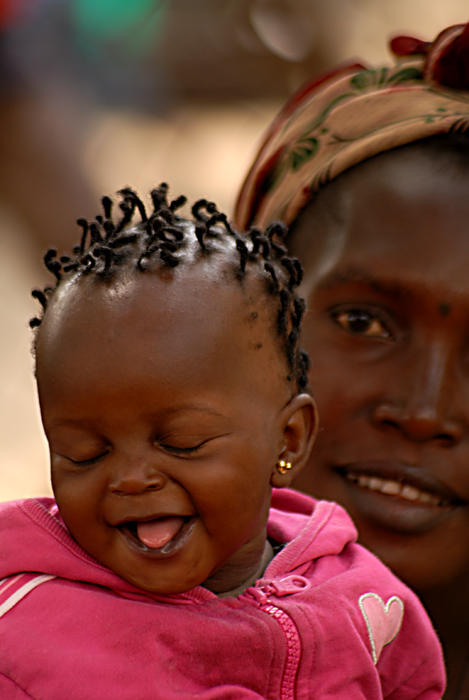
“Mon jouet préféré”
.
Ma poupée d’hier est devenue réelle
Elle est aussi vivante que moi
Joli bébé respirant la santé
Ta tranquillité m’inquiète
Tes pleurs m’attristent
Tes rires me soulagent
Mon jouet préféré
Ta joie me préoccupe
J’aime quand tes pieds rament l’air rempli d’allégresse
Le mouvement de tes petites mains roses rend ton bain
Euphorique
Ton nez minuscule symbolise ton innocence
Tu es tout doux quand tu dors les poings fermés
Ton corps tout entier est la vie en miniature.
. . .
Fatou Ndiaye Sow (1956-2004, Senegal)
“Lullaby”
.
Ey Sama Neene Tutti! *
If you dry your tears
I will sing you a song
Of the wonders of the Universe
Ey Sama Neene
If you dry your tears
I will carry you in a pagne
Woven out of sun rays
Ey Sama Neene
If you dry your tears
I will give you a bouquet of stars
To find again your smile at dawn
Ey Sama Neene!
Aayoo Beyo Beyo
Aayoo…
.
* “Hush, my little baby!”
. . .
“Berceuse”
.
Eye Sama Néné Touty!
Si tu sèches tes larmes
Je te ferai un berceau
Des merveilles de l’Univers
Eye Sama Néné
Si tu sèches tes larmes
Je te porterai dans un pagne
Tissé de rayons de soleil
Eye Sama Néné
Si tu sèches tes larmes
Je t’offrirai un bouquet d’étoiles
Pour retrouver ton sourire aurore
Eye Sama Néné!
Ayo Béyo Béyo
Ayo…
. . .
Orthense Tiendrébéogo (Guinea)
“I would like to be a Griot”
.
I would like to be a griot,
To make words dance,
Modulate them on my tongue,
And make them slip across my lips;
Recapture them in the air,
To melt them again, explode them,
Polish them, caress them and make them soar.
.
I would like to be a griot, and with a loud voice
Smash the silence of the night,
Hammer on the sleeping conscience,
Shake off the obscuring veils,
Open a fissure
That would let the light escape
And keep the eyes awake.
.
I do not want to be the griot
Of the King, the Strong, the Rich,
Nor of any Power…
.
I would like to be a griot,
To be involved
Only in what fashions a human being.
. . .
“Je voudrais étre griot”
.
Je voudrais être griot,
Pour faire danser les mots,
Les moduler sur ma langue,
Et les faire glisser sur me lèvres;
Les reprendre dans l’air,
Pour les refondre, les éclater,
Les polir, les caresser et les faire voler.
.
Je voudrais être griot, et d’une voix forte
Rompre le silence de la nuit,
Marteler les consciences endormies,
Secouer les voiles obscurcissants,
Créer une fissure
Qui laisse passer la lumière,
Et maintenir les yeux éveillés.
.
Je ne voudrais être griot
Ni du Roi, ni du Fort, ni du Riche,
D’aucune Puissance…
.
Je voudrais être griot,
Pour ne m’intéresser
Qu’à ce qui construit l’homme.
. . . . .
Photographs:
Femme de la Gambie_Gambian woman
Fabric vendor_Lagos, Nigeria
South African woman_photograph © Steve Evans
Father with his toddler
Two Nigerian children_photograph © G. K. Sholanke
Mother with her toddler
. . . . .
Traductions en anglais / Translations from French into English – droit d’auteur © Professeure Janis A. Mayes. Tous les poèmes – droit de chaque auteur © the respective poetesses
. . . . .
“Je m’en vais…me retrouver”: Quatre Poètes Africains – et une Martiniquaise
Posted: July 8, 2013 Filed under: French | Tags: Poètes africains Comments Off on “Je m’en vais…me retrouver”: Quatre Poètes Africains – et une Martiniquaise
Ozoua Soyinka (Poétesse martiniquaise)
“Afrique, douceur musicale”
.
Comment puis-je rester insensible
À la musique de la terre mère,
À la musique de mes racines?
Elle est bienfaisante et mélodieuse
Ses accords sont harmonie et symphonie à mon coeur
Je me sens revivre
Revivre et renaître à la fois.
Je frémis jusqu’au fond de mes tripes,
Je vibre à l’écoute de ses paroles,
Paroles non comprises pourtant.
Elle me parle et me touche profondément
M’apportant quelques instants de bonheur.
Que je n’oublierai jamais.
. . .
“Belle, ô belle africaine”
.
Je te vois belle ô belle Africaine
Onduler sous ton pagne
Marchant d’un pas leste
Courant presque
Où vas-tu?
.
Mais où vas-tu donc?
Je m’en vais vers mon village
Le village de mes aïeux
Je m’en vais m’imprégner
De ma culture, de mon histoire.
.
Je m’en vais écouter les anciens
M’instruire de leur savoir et de leur sagesse
Je m’en vais manger le foufou et le foutou
Je m’en vais par les sentiers
Retrouver ce qu’il y a
De plus profond en moi.
Je m’en vais…
Me retrouver.

Thierry Manirambona (Burundais, né en 1982 au Rwanda)
“De mon tamtam”
.
de mon tamtam, je fais la guerre aux fausses couches:
un souvenir abortif d’une bague incolore
qui, pendant des épopées de chagrin,
enfermait prisonnière toute une vie de femme
dans des tourments sans fin:
les fausses couches
des flammes qui s’éteignent à petites flammes
des batailles de mémoires
contre des obsessions immobiles
un essaim longtemps enfermé dans une ruche empoisonnée
un essaim qui s’affranchit et se dresse en totem de délivrance.
. . .
Toussaint Kafarhire Murhula (né en 1973, République Démocratique du Congo)
“De l’autre côté du mur”
.
De l’autre côté du mur,
Mon passé, ma religion, mes dieux!
De l’autre côté du mur
Mon histoire niée; annihilée
Prisonnier du présent,
Bâtard culturel,
Orphelin
.
De l’autre côté du mur,
Plus des contes chantés
Les saisons immémoriales ont fané
Le mur géant de l’imaginaire accepté
Se dresse infranchissable!
Ceux qui ont tenté de l’escalader
Embrasser de vue l’horizon de la liberté
Sont tous tombés de vertige,
Mort nette,
suicide!
.
Le passé noir est un trou béant
Ne regardez plus du côté du mur
Sortilèges et malédictions l’entourent
.
Pourtant de l’autre côté du mur,
Irresistible attraction des couleurs
Des odeurs et des senteurs sauvages
De l’autre côté du mur
Mon identité niée m’appelle,
Et me rappelle,
C’est aussi l’autre Afrique
Que je dois inventer avec fierté.
Viviane Lamarlère (née en 1956, Côte d’Ivoire)
“Tombée du jour à Yaoundé”
.
Quand mon entendre allait
aux patiences du ciel,
fruitées, blanches, qui luttent
je sentais,
de vert en vert emportant les collines
en peur, le temps glisser.
Quelques enfants riaient sous l’odeur encore vive
qui remontait la rue
épices métissées
orages étouffés.
.
Toutes proches
des voix baignées dans l’eau de tombe.
.
À l’heure dite,
la nuit comme une écharde subite.
.
Plus lents alors les bruits,
plus sourds les gestes ouvrant d’ombre
un temple surgi des arbres.
.
Paroles étirées
comme des berges sombres
.
Les heures nous renonçaient.
. . .
Amadou Elimane Kane (Sénégal)
“Cité Africaine de la Renaissance”
.
Je songe à la Renaissance
Debout comme un ciel perlé de soleil
Dans l’allée des flamboyants
Frissonnant dans l’espérance
Regardant ces enfants à mes enfants
Si je songe au passé
O mémoire, souviens-toi
Ta lumière arrive
Un nouveau jour va venir
Et ce sera l’espérance
Ô mémoire, souviens-toi
Que j’appartiens
Au continent des flamboyants
De la Renaissance!
. . . . .
© Tous les droits des auteurs de ces textes sont réservés.
Nous remerciions à ELISABETH SPRINGATE pour ses photographies du festival de la musique panafricaine à Toronto, Canada – Afrofest (7 juillet 2013).
. . . . .
Melvin Dixon as translator: a handful of “love letter” poems by Léopold Sédar Senghor
Posted: June 18, 2013 Filed under: English, French, Léopold Sédar Senghor Comments Off on Melvin Dixon as translator: a handful of “love letter” poems by Léopold Sédar Senghor Melvin Dixon in 1988_photograph from the collection of the New York Public Library
.
Léopold Sédar Senghor (1906 – 2001)
“What are you doing?”
.
“What are you doing? What are you thinking about? And of whom?”
This is your question and yours alone.
.
Nothing is more melodious than the one-hundred-metre runner
Whose arms and long legs are pistons of polished olive.
.
Nothing is more solid than the nude bust in the triangular
Harmony of Kaya-Magan flashing his thunderous charm.
.
If I swim like a dolphin in the South Wind,
If I walk in the sand like a dromedary, it is for you.
.
I am not the king of Ghana, or a hundred-metre runner.
Then will you still write to me, “What are you doing?”…
.
For I am not thinking – my eyes drink the blue rhythmically –
Except of you, like the wild black duck with the white belly.
. . .
“Que fais tu?”
.
“Que fais tu? A quoi penses-tu? A qui?”
C’est ta question et ta question.
Rien n’est plus mélodieux que le coureur de cent mètres
Que les bras et les jambes longues, comme les pistons d’olive polis.
.
Rien n’est plus stable que le buste nu, triangle harmonie du Kaya-Magan
Et décochant le charme de sa foudre.
.
Si je nage comme le dauphin, debout le Vent du Sud
C’est pour toi si je marche dans le sable, comme le dromadaire.
.
Je ne suis pas roi du Ghana, ni coureur de cent mètres.
Or tu ne m’écriras plus “Que fais tu?”…
.
Car je ne pense pas, mes yeux boivent le bleu, rythmiques
Sinon à toi, comme le noir canard sauvage au ventre blanc.
. . .
“Your letter on the bed”
.
Your letter on the bed and under the fragrant lamp,
Blue as the new shirt the young man smooths out as he hums,
Like the sky and sea, and my dream your letter.
And the sea has its salt, and air has milk, bread, rice,
I mean its salt. Life contains its sap and the earth
Its meaning. God’s meaning and movements.
Without your letter, life would not be life,
Your lips, my salt and sun, my fresh air and my snow.
. . .
“Ta lettre sur le drap”
.
Ta lettre sur le drap, sous la lampe odorante
Bleue comme la chemise neuve que lisse le jeune homme
En chantonnant, comme le ciel et la mer et mon rêve
Ta letter. Et la mer a son sel, et l’air le lait le pain le riz,
Je dis son sel.
La vie contient sa sève, et la terre son sens
Le sens de Dieu et son mouvement.
Ta lettre sans quoi la vie ne serait pas vie
Tes lèvres mon sel mon soleil, mon air frais et ma neige.
. . .
“My greeting”
.
My greeting is like a clear wing
To tell you this:
At the end of the first sleep, after reading your letter,
In the shadows and swamps, at the bottom of the poto-poto of anguish
And impasse, in the rolling stream of my dead dreams,
Like heads of children in the lost River,
I had only three choices: work, debauchery, or suicide.
.
I chose a fourth, to drink your eyes as I remember them
The golden sun on the white dew, my tender lawn.
.
Guess why I don’t know why.
. . .
“Mon salut”
.
Mon salut comme une aile claire
Pour te dire ceci:
A la fin du premier sommeil, après ta lettre, dans la ténèbre et le poto-poto
Au fond des fondrières des angoisses des impasses, dans le courant roulant
Des rêves morts, comme des têtes d’enfants le Fleuve perdu
Je n’avais que trois choix: le travail la débauche ou le suicide.
.
J’ai choisi quatrième, de boire tes yeux souvenir
Soleil d’or sur la rosée blanche, mon gazon tendre.
.
Devine pourquoi je ne sais pourquoi.
. . .
“The new sun greets me”
.
The new sun greets me on my bed,
The light of your letter and all the morning sounds,
The metallic cries of blackbirds, the gonolek bells,
Your smile on the lawn, on the splendid dew.
.
In the innocent light thousands of dragonflies
And crickets, like huge bees with golden-black wings
And like helicopters turning gracefully and calmly
On the limpid beach, the gold and black Tramiae basilares,
I say the dance of the princesses of Mali.
.
Here I am looking for you on the trail of tiger cats
Your scent always your scent, more exalting than the smell
Of lilies lifting from the bush humming with thorns.
Your fragrant neck guides me, your scent aroused by Africa
When my shepherd feet trample the wild mint.
At the end of the test and the season, at the bottom
Of the gulf, God! may I find again your voice
And your fragrance of vibrating light.
. . .
“Le salut du jeune soleil”
.
Le salut du jeune soleil
Sur mon lit, la lumière de ta lettre
Tous les bruits que fusent du matin
Les cris métalliques des merles, les clochettes des gonoleks
Ton sourire sur le gazon, sur la rosée splendide.
.
Dans la lumière innocente, des milliers de libellules
Des frisselants, comme de grandes abeilles d’or ailes noires
Et comme des hélicoptères aux virages de grâce et de douceur
Sur la plage limpide, or et noir les Tramiae basilares
Je dis la danse des princesses du Mali.
.
Me voici à ta quête, sur le sentier des chats-tigres.
Ton parfum toujours ton parfum, de la brousse bourdonnant des buissons
Plus exaltant que l’odeur du lys dans sa surrection.
Me guide ta gorge odorante, ton parfum levé par l’Afrique
Quand sous mes pieds de berger, je foule les menthes sauvages.
Au bout de l’épreuve et de la saison, au fond du gouffre
Dieu! que je te retrouve, retrouve ta voix, ta fragrance de lumière vibrante.
.
Kaya-Magan – one of the emperor’s titles in an old dynasty of Mali
poto-poto – “mud”, in the Wolof language
gonolek – a bird common to Senegal
. . . . .
The above poems first appeared in Senghor’s Lettres d’Hivernage (Letters in the Season of Hivernage), published in 1972. They were written during brief quiet moments alone by a busy middle-aged man who was the first President of the new Republic of Senegal (1960 to 1980) but who’d also been a poet in print since 1945 (Chants d’Ombre/Shadow Songs). The poems are addressed to Senghor’s second wife, Colette Hubert; the couple was often apart for weeks at a time.
.
Melvin Dixon (1950 to 1992) was an American novelist, poet, and Literature professor. He translated from French into English the bulk of Senghor’s poetic oeuvre, including “lost” poems, and this work was published in 1991 as The Collected Poetry by Léopold Sédar Senghor. Justin A. Joyce and Dwight A. McBride, editors of A Melvin Dixon Critical Reader (2006), have written of Dixon: “Over the course of his brief career he became an important critical voice for African-American scholarship as well as a widely read chronicler of the African-American gay experience.” They also noted Dixon’s ability to “synthesize criticism, activism, and art.” His poetry collections included Change of Territory (1983) and Love’s Instruments (1995, posthumous) and his novels: Trouble the Water (1989) and Vanishing Rooms (1990).
In his Introduction to his volume of Senghor’s Collected Poetry Dixon writes: “Translating Senghor has provided an opportunity for me to bring together much of what I have learned over the years about francophone literature and how my own poetry has been inspired in part by the geography and history of Senegal.”
. . . . .
Nous connaissons le secret de la petite épinette / We know the secret of the little spruce: poèmes d’une Aînée Crie / poems of a Cree Elder
Posted: June 1, 2013 Filed under: English, French, Margaret Sam-Cromarty Comments Off on Nous connaissons le secret de la petite épinette / We know the secret of the little spruce: poèmes d’une Aînée Crie / poems of a Cree Elder.
Margaret Sam-Cromarty (née à l’île Fort George, La baie James, Québec, 1936)
“Un étranger très élégant”
.
Un jour, dans un village nordique,
tout le monde se préparait
en vue du départ
pour la chasse printanière.
Vers le début de la soirée,
les enfants en train de jouer ont commencé à crier:
“Nous voyons venir un étranger.
Il est bien habillé.”
.
En effet, l’étranger était saisissant.
Personne ne semblait le connaître.
Les jeunes filles tournaient autour de lui…
les mouches aussi.
.
On l’invita à l’intérieur de la tente.
La chaleur du feu de camp
mit l’étranger mal à l’aise.
Tout le monde se demandait pourquoi.
.
Souriant aux jeunes filles,
il sortit prendre l’air.
Une mauvaise odeur flottait derrière lui
et les mouches lui bourdonnaient tout autour.
.
Les jeunes filles voulaient qu’il reste
mais il est parti comme il était venu.
Bientôt il disparut,
laissant les jeunes filles à leur tristesse.
.
L’une d’entre elles suivit ses traces
qui la menèrent à un tas de fumier.
La chaleur avait fait fondre l’étranger.
Les mouches bourdonnaient et chantaient:
“Merde et vielles guenilles,
merde et vielles guenilles,
s’étaient changées en homme!”
. . .
“The Handsome Stranger”
.
Once in a northern village
people were making ready
to move away
for the spring hunt.
.
Now it was towards evening
when children at play began to shout
“We see a stranger coming.
He is smartly dressed.”
Indeed the stranger was striking.
No one seemed to know him.
The young girls hung around him.
So did the flies.
.
He was invited inside the tent.
The heat from the campfire
made the stranger uncomfortable.
Everyone wondered why.
.
Smiling at the girls
he went outside for the air.
The stranger left a wave of smell
and buzzing flies behind.
.
The young girls wanted him to stay
but he left the way he came.
Soon he disappeared,
leaving the girls sad.
.
One of them followed his tracks
until they led to manure.
He had melted from the heat.
Flies buzzing around sang:
“Shit and old rags,
shit and old rags,
turned himself into a man.”
. . .
“Un garçon”
.
Des cheveux noirs comme du jais
qu’il avait de naissance,
Des yeux noirs
qui brillaient d’un amour chaleureux.
.
De mains fines,
de bonnes mains de musicien.
Ce garçon a découvert
que grandir était douloureux.
.
Il préférait attraper des grenouilles,
taquiner sa soeur,
serrer ses bras
autour de sa mère.
.
Il a grandi,
aussi grand qu’un arbre.
Une personne gentille,
ce garçon qui est le mien!
. . .
“Boy”
.
His jet black hair
he had from birth
His dark eyes
flashed loving warmth
.
His fine shaped hands
right for a musician
This boy who found
Growing up a pain
.
He’d rather catch frogs
tease his sister
Throw his arms
around his mother
.
He has grown
tall as a tree
A gentle person
this boy of mine
. . .
“Une fille”
.
Une fille aux yeux noirs et brillants,
au sourire doux et timide,
à la peau fine cuivrée,
qui n’a pas besoin du soleil d’été.
.
Elle avait
de longs cheveux d’ébène.
Plusieurs étaient d’accord:
elle était belle.
.
C’était le vent.
C’était le ciel.
C’était ma fille…
Mary.
. . .
“Girl”
.
A girl her dark eyes bright
Her smile shy and sweet
Her fine copper skin
needs no summer sun
.
She was blessed
with long raven hair
many agreed
she was fair
.
She was wind
She was sky
She was my daughter
Mary
. . .
“Maman”
.
Une mère
passe à travers
les rejets, les dépressions,
la solitude et les critiques.
.
C’est une femme courageuse
douée d’un humour fin.
Une créature qu’on appelle
Maman.
. . .
“Mother”
.
A mother
goes through
rejections, depressions
.
Loneliness and criticism
.
A courageous woman
with gentle humour,
a creature known as
Mother
. . .
“Maris et Femmes”
.
Le mari est le ciel
et la femme le nuage.
.
Parfois le ciel
apporte le vent
et le nuage une pluie rafraîchissante.
.
Parfois les nuages
se regroupent
et apportent orages et vents.
Maris et femmes font de même.
.
Maris et femmes dérivent séparément
comme les nuages le font parfois.
Mais au milieu de nuages gris,
jaillit le ciel bleu clair.
.
Comme les nuages se rassemblent
pour former le temps,
ainsi font maris et femmes
pour mener leurs vies.
.
Les anneaux autour du soleil
nous rappellent le mauvais temps.
Les anneaux du mari et de la femme
scellent un amour infini.
. . .
“Husbands and Wives”
.
Husband is the sky
a wife the cloud
.
Sometimes the sky
brings wind,
the cloud a refreshing rain
.
Sometimes the clouds
form to gather
It brings storms and winds
Husbands and wives do the same
.
Husbands and wives drift apart
like clouds sometimes do
But between the greyish clouds
burst bright blue skies
.
As the clouds come to gather
to create our weather
So do husbands and wives
carry on with their lives
.
The rings around the sun
remind us of bad weather
The rings of husbands and wives
shield a love forever
. . .
“La gentillesse”
.
La gentillesse, c’est faire cuire de la banic,
mélanger la farine et la levure.
Il faut y mettre de l’eau.
.
Pour faire une bonne banic,
on y ajoute de l’huile.
Dans nos vies,
on a besoin de la gentillesse.
.
La gentillesse est comme les graines.
Beaucoup se perdent.
Pas de graine,
Pas de gentillesse.
. . .
“Kindness”
.
Kindness is baking bannock
blending flour, baking powder
It’s natural to put water
.
A good bannock
oil is added
In our lives
kindness is needed
.
Kindness is like grain
many are lost
without grain
without kindness
. . .
“La Paix”
.
Trouvez la paix dans le silence,
le silence qui règne ici.
Le vent froid
purifie la terre.
.
La splendeur.
Il n’y a pas de terreur.
Des tiges de plantes séchées se tiennent
bien droites.
.
Écoutez le vent impétueux.
Regardez les sentiers blancs, les grands cercles,
la rivière tranquille,
le ciel, bon et puissant.
. . .
“Peace”
.
Find peace in silence
Silence it reigns here
The cold wind
Purifies the land
.
The splendour
There is no terror
Stalks of dried plants stand
upright
.
Hear the rushing wind
See the white paths, the wide circles
A quiet river,
the sky, bold and good.
. . . . .
Quelques pensées de la poétesse:
Mon père et ma mère étaient des Cris. Ils vivaient à la baie James. C’est là que je suis née, dans le village de l’île Fort George, où la rivière La Grande se jette dans la baie James. J’ai appris à parler et à écrire l’anglais. Les Cris sont des chasseurs et des trappeurs…Nous comprenons les animaux et les oiseaux…Nous connaissons le secret de la petite épinette…Et nous écoutons nos frères et soeurs comme nos Aînés nous l’ont enseigné… (Maintenant) nous vivons à Chisasibi… Et c’est aussi là que grandissent nos petits-enfants… Dans ma mémoire vibre encore le village de Fort George, un village qui n’a pas été inondé ni abandonné et qui est plein de Cris joyeux. C’est de cette façon que je veux me rappeler l’île de Fort George…
Some thoughts from the poet:
My father and mother were Cree. Their home was James Bay in Northern Québec. This is where I was born, at a Cree village of Fort George Island, where the La Grande River empties into James Bay. I was taught to speak and write English. My people, the Crees, are hunters and trappers… We understand the animals and birds… We know the secret of the little spruce… And we hear our brothers and sisters the way our Elders taught us… (We) now live in a town called Chisasibi… Our grandchildren are growing up in Chisasibi… In my memory stands a Cree village of Fort George not flooded or abandoned but full of happy Crees… It’s the way I would like to remember Fort George Island…
.
Editor’s note: Chisasibi or ᒋᓴᓯᐱ in Cree syllabics (meaning Great River) is a town created by the Québec government to relocate Crees who were forced from their James Bay watershed lands (including Fort George Island) because of damming/redirecting of tributary rivers flowing into the La Grande River as part of Hydro-Québec’s James Bay Project which began in the 1970s and continues into the present day.
. . . . .
 Zócalo Poets