Poetry for Earth Day: “And I’ve been waiting long for an earth song”: Poems about Nature and Human Nature
Posted: April 22, 2016 Filed under: Arna Bontemps, English, Helene Johnson, Jessie Redmon Fauset, Langston Hughes | Tags: Poems about Nature and Human Nature Comments Off on Poetry for Earth Day: “And I’ve been waiting long for an earth song”: Poems about Nature and Human Nature

Milkweed and bumblebee_Ward’s Island, Toronto
…..
Langston Hughes (1902-1967)
Earth Song
.
It’s an earth song ––
And I’ve been waiting long
For an earth song.
It’s a spring song!
I’ve been waiting long
For a spring song:
Strong as the bursting of young buds.
Strong as the shoots of a new plant,
Strong as the coming of the first child
From its mother’s womb ––
An earth song!
A body song!
A spring song!
And I’ve been waiting long
For an earth song.
. . .
Helene Johnson (1906-1995)
Metamorphism
.
Is this the sea?
This calm emotionless bosom,
Serene as the heart of a converted Magdalene ––
Or this?
This lisping, lulling murmur of soft waters
Kissing a white beached shore with tremulous lips;
Blue rivulets of sky gurgling deliciously
O’er pale smooth-stones ––
This too?
This sudden birth of unrestrained splendour,
Tugging with turbulent force at Neptune’s leash;
This passionate abandon,
This strange tempestuous soliloquy of Nature,
All these –– the sea?
. . .
Jessie Redmon Fauset (1882-1961)
Rondeau
.
When April’s here and meadows wide
Once more with spring’s sweet growths are pied,
I close each book, drop each pursuit,
And past the brook, no longer mute,
I joyous roam the countryside.
Look, here the violets shy abide
And there the mating robins hide –
How keen my senses, how acute,
When April’s here.
.
And list! down where the shimmering tide
Hard by that farthest hill doth glide,
Rise faint streams from shepherd’s flute,
Pan’s pipes and Berecynthian lute.
Each sight, each sound fresh joys provide
When April’s here.
. . .
Remica L. Bingham (born Phoenix, Arizona)
The Ritual of Season
.
1. Autumn
.
The candles we burned each monsoon night in August
stained the wooden holders that kept them in place.
As storm beat mauve to night and night beat mauve to damp morning,
we extinguished fire and bore the day like a crown.
.
II. Winter
.
dogged air nipped our faces
as we lay in formation
along the stiff ground – the young tribe
athirst
waiting mouths open
longing for snow
.
daily the heavens held back their glory
and we swept angels
into hard earth –
donning the silt of adobe wings
mocking the sun
damning her
.
III. Spring
.
The swollen hum, circadian rhythm,
displaced cockcrow, heralded dawn.
.
We toured the tan flatland, the ages
marked in furrowed caverns –
empty, cactus-ridden – sacred
secret paintings the only life
left on cave drawn walls.
.
Noon day, come high sun and oasis,
the headland showed her fury.
Dust would flare and we’d call it devil –
sheathing our faces, yielding to copper
coating our skin.
.
IV. Summer
.
Under desert sun, road became wavering river.
The shimmer of heat, salamander swift, crossed
the burning middle of July.
.
When the moon, large as ancestry, conquered the sky,
our weapons were bare feet and laughter –
a porchswing vigil staving off the day.
. . .
Shara McCallum (born 1972)
The Spider Speaks
.
No choice but to spin,
the life given.
.
Mother warned me
I would wake one dawn
.
to a sun no longer yellow,
to an expanse of blue,
.
no proper word
to name it. Weaving
.
the patterned threads
of my life, each day
.
another web and the next.
If instead I could carve
.
my message in stone,
would it mean more?
.
I have only this form
to give. When the last
.
silvery strand leaves
my belly, I will see
.
what colour the sun
has become.

Arna Bontemps (1902-1973)
Prodigal
.
I shall come back when dogwood flowers are going
And passing drakes are honking toward the south
With eager necks, I shall come back knowing
The old unanswered question on your mouth.
.
When frost is on the manzonita shoots
And dogwoods at the spring are turning brown,
There between the interlacing roots
With folded arms I shall at last go down.
. . .
Ed Roberson (born 1939)
Urban Nature
.
Neither New Hampshire nor Midwestern farm,
nor the summer home in some Hamptons garden
thing, not that Nature, not a satori
-al leisure come to terms peel by peel, not that core
whiff of beauty as the spirit. Just a street
pocket park, clean of any smells, simple quiet ––
simple quiet not the same as no birds sing,
definitely not the dead of no birds sing:
.
The bus stop posture in the interval
of nothing coming, a not quite here running
sound underground, sidewalk’s grate vibrationless
in open voice, sweet berries ripen in the street
hawk’s kiosks. The orange is being flown in
this very moment picked of its origin.
. . .
C.S. Giscombe (born 1950)
Nature Boy
.
Air over the place partially occupied by crows going places every evening; the extent unseen from sidewalk or porch but obvious, because of the noise, even from a distance. Noise glosses – harsh, shrill, a wild card. Sundown’s a place for the eye, crows alongside that. Talk’s a rough ride, to me, what with the temptation to out-talk. At best long term memory’s the same cranky argument – changeless, not a tête-à-tête – over distance: to me, the category animals excludes birds, the plain-jane ones and birds of passage, both.To me, song’s even more ambiguous – chant itself, the place of connection and association. It’s birdless, bereft. I’m impartial, anhedonic. I’m lucky about distance but I would be remiss if I didn’t hesitate over image before going on.
. . .
Clarence Major (born 1936)
Water USA
.
america, tom sawyer, is bigger
than your swim
hole. You meant, the union, water-
falls, one waterfall
a path near, from which you
jump, folklore, holding
your nose. a chemical change
takes place as you pollute
the water i drink. as your
jet lands, crashing my
environment. tom sawyer can’t hold
all the dead bodies upright
nor get anything
out of a lecture on control
systems. and bigger
thomas didn’t have an even
chance to study chemistry
. . .
Ishmael Reed (born 1938)
Points of View
.
the pioneers and the indians
disagree about a lot of things,
for example, the pioneer says that
when you meet a bear in the woods
you should yell at him and if that
doesn’t work you should fell him.
the indians say that you should
whisper to him softly and call him by
loving nicknames.
no one’s bothered to ask the bear
what he thinks.
. . .
Carl Phillips (born 1959)
The Cure
.
The tree stood dying – dying slowly, in the usual manner
of trees, slowly, but not without its clusters of spring leaves
taking shape again, already. The limbs that held them tossed,
.
shifted, the light fell as it does, through them, though it
sometimes looked as if the light were being shaken, as if
by the branches – the light, like leaves, had it been autumn,
.
scattering down: singly, in fistfuls. Nothing about it to do
with happiness, or glamour. Not sadness either. That much
I could see, finally. I could see, and want to see. The tree
.
was itself, its branches were branches, shaking, they shook
in the wind like possibility, like impatient escorts bored with
their own restlessness, like hooves in the wake of desire, in
.
the wake of the dream of it, and like the branches they were.
A sound in the branches like that of luck when it turns, or is
luck itself a fixed thing, around which I myself turn or don’t,
.
I remember asking – meaning to ask. Where had I been, for
what felt like forever? Where was I? The tree was itself, and
dying; it resembled, with each scattering of light, all the more
.
persuasively the kind of argument that can at last let go of them,
all the lovely-enough particulars that, for a time, adorned it:
force is force. The tree was itself. The light fell here and there,
.
through it. Like history. No –– history doesn’t fall, we fall
through history, the tree is history, I remember thinking, trying
not to think it, as I lay exhausted down in its crippled shadow.
. . .
Frank X. Walker (born 1961)
Homeopathic
.
The unripe cherry tomatoes, miniature red chili peppers
and small burst of sweet basil and sage in the urban garden
just outside the window on our third floor fire escape
might not yield more than seasoning for a single meal
.
or two, but it works wonders as a natural analgesic
and a way past the monotony of bricks and concrete,
the hum of the neighbour’s TV, back to the secret garden
we planted on railroad property when I was just a boy.
.
I peer into the window, searching for that look on mamma’s face,
when she kicked off her shoes, dug her toes into dirt
teeming with corn, greens, potatoes, onions, cabbage and beets;
bit into the flesh of a ripe tomato, then passed it down the row.
.
Enjoying our own fruit, we let the juice run down our chins,
leaving a trail of tiny seeds to harvest on hungry days like these.
. . .
Tim Seibles (born 1955)
Fearless
(for Moombi)
.
Good to see the green world
undiscouraged, the green fire
bounding back every spring, and beyond
the tyranny of thumbs, the weeds
and other co-conspiring green genes
ganging up, breaking in,
despite small shears and kill-mowers,
ground gougers, seed-eaters.
Here they comes, sudden as graffiti
.
not there and then there ––
naked, unhumble, unrequitedly green ––
growing as if they would be trees
on any unmanned patch of earth,
any sidewalk cracked, crooning
between ties on lonesome railroad tracks.
And moss, the shyest green citizen
anywhere, tiptoeing the trunk
in the damp shade of an oak.
.
Clear a quick swatch of dirt
and come back sooner than later
to find the green friends moved in:
their pitched tents, the first bright
leaves hitched to the sun, new roots
tuning the subterranean flavours,
chlorophyll setting a feast of light.
.
Is it possible –– to be so glad?
The shoots rising in spite of every plot
against them. Every chemical stupidity,
every burned field, every better
home & garden finally overrun
by the green will, the green greenness
of green things growing greener.
The mad Earth publishing
her many million murmuring
unsaids. Look
.
how the shade pours
from the big branches – the ground,
the good ground, pubic
and sweet. The trees – who
are they? Their stillness, that
long silence, the never
running away.
. . .
Marilyn Nelson (born 1946)
Last Talk with Jim Hardwick
(a “found” poem)
.
When I die I will live again.
By nature I am a conserver.
I have found Nature
to be a conserver, too.
Nothing is wasted
or permanently lost
in Nature. Things
change their form,
but they do not cease
to exist. After
I leave this world
I do not believe I am through.
God would be a bigger fool
than even a man
if He did not conserve
the human soul,
which seems to be
the most important thing
He has yet done in the universe.
When you get your grip
on the last rung of the ladder
and look over the wall
as I am now doing,
you don’t need their proofs:
You see.
You know
you will not die.
. . .
Ross Gay (born 1974)
Thank You
.
If you find yourself half naked
and barefoot in the frosty grass, hearing,
again, the earth’s great, sonorous moan that says
you are the air of the now and gone, that says
all you love will turn to dust,
and will meet you there, do not
raise your fist. Do not raise
your small voice against it. And do not
take cover. Instead, curl your toes
into the grass, watch the cloud
ascending from your lips. Walk
through the garden’s dormant splendour.
Say only, thank you.
Thank you.
. . . . .
Langston Hughes: poemas del poemario “Montaje de un Sueño Diferido” (1951)
Posted: February 1, 2016 Filed under: A FEW FAVOURITES / UNA MUESTRA DE FAVORITOS, English, English: Black Canadian / American, Langston Hughes, Langston Hughes: poemas del poemario "Montaje de un Sueño Diferido" (1951), Spanish, ZP Translator: Alexander Best | Tags: Black History Month poems, El Mes de la Historia Afroamericana Comments Off on Langston Hughes: poemas del poemario “Montaje de un Sueño Diferido” (1951)
Una selección de poemas del poemario Montage of a Dream Deferred (Montaje de un Sueño Diferido) (1951) por Langston Hughes (nacido 1 de febrero de 1902 / muerto 22 de mayo de 1967). Versiones españoles (enero de 2016): Alexander Best
. . .
Necesidad
.
¿El trabajo?
Yo, no tengo que trabajar.
No tengo que hacer nada
sino
comer, beber, permanecer negro – y morir.
Este viejo cuartito amueblado es
tan pequeño que
aun no puedo azotar un gato sin pillar el pelaje en mi boca.
Y la casera es tan anciana que sus rasgos desdibujan juntos;
¡y sabe el Señor que ella puede cobrarme de más a mí – eso es seguro!
(Entonces…éso es el motivo por que estimo que debo trabajar – después de todo.)
. . .
“Necessity”
.
Work?
I don’t have to work.
I don’t have to do nothing
but eat, drink, stay black, and die.
This little old furnished room’s
so small I can’t whip a cat
without getting fur in my mouth
and my landlady’s so old
her features is all run together
and God knows she sure can overcharge –
which is why I reckon I does
have to work after all.
. . .
Pregunta número 2
.
Dijo la señora:
¿Puedes hacer lo que no puede hacer
mi otro hombre – ? Y éso es:
¡Quiéreme, papi,
y aliméntame también!
.
Figurita
.
¡Be-bop!
. . .
“Question (2)”
.
Said the lady, Can you do
what my other man can’t do –
that is
love me, daddy –
and feed me, too?
.
Figurine
.
De-dop!
. . .
‘Bugui’ despreocupado
.
Abajo en el contrabajo
caminando andando
al firme tiempo
– como pies marchandos.
.
Abajo en el contrabajo
menearse fácil
– el revolcón como me gusta en mi alma.
.
< Riffs, manchas, descansos.>
.
¡Eh, mamacita! – ¿has oído lo que digo?
Despreocupado, yo lo impulso – ¡en mi cama!
. . .
“Easy Boogie”
.
Down in the bass
That steady beat
Walking walking walking
Like marching feet.
.
Down in the bass
That easy roll,
Rolling like I like it
In my soul.
.
Riffs, smears, breaks.
.
Hey, Lawdy, Mama!
Do you hear what I said?
Easy like I rock it
In my bed!
. . .
Las 3 de la mañana en el café…
.
Agentes de policía de la vicebrigada,
con ojos agotados y sádicos – divisando a los maricones.
Degenerados, dice alguna gente.
.
Pero Dios – o la Naturaleza – o alguien – les hizo en esa forma.
¿Una policía – o una Lesbiana – allá?
¿Dónde?
. . .
“Café: 3 a.m.”
.
Detectives from the vice squad
with weary sadistic eyes
spotting fairies.
Degenerates,
some folks say.
.
But God, Nature,
or somebody
made them that way.
Police lady or Lesbian
over there?
Where?
. . .
Calle número 125 (en Harlem)
.
Rostro como una barra de chocolate,
lleno de nueces – y dulce.
.
Cara como una calabaza de Hallowe’en,
y adentro una candela.
.
Rostro como una loncha de sandía
– y una sonrisa tan amplia.
. . .
“125th Street”
.
Face like a chocolate bar
full of nuts and sweet.
.
Face like a jack-o’-lantern,
candle inside.
.
Face like a slice of melon,
grin that wide.
. . .
Los blues en el alba
.
No oso empezar con algunos pensamientos
en las primeras horas del día
– no, no oso pensar en ese momento.
Si yo piense algo de pensamiento mientras estoy en cama,
esos pensamientos romperían mi cabeza
– pues, las mañanas: no oso empezar a pensar.
.
No oso recordar en el alba, no – nunca en el alba.
Porque, si yo evocara el día antes,
no me levantaría nunca más
– pues, las mañanas: no oso recordar.
. . .
“Blues at Dawn”
.
I don’t dare start thinking in the morning.
I don’t dare start thinking in the morning.
If I thought thoughts in bed,
Them thoughts would bust my head –
So I don’t dare start thinking in the morning.
.
I don’t dare remember in the morning
Don’t dare remember in the morning.
If I recall the day before,
I wouldn’t get up no more –
So I don’t dare remember in the morning.
. . .
El vecino
.
En el sur él se colocaba él mismo en la escalera de entrada – y miraba el sol pasando…
Aquí en Harlem, cuando está completo su trabajo – él se coloca en un bar con una cerveza.
Parece más alto que es, y más jóven que no es.
Parece su piel más oscura que es, también – y él es más listo que muestra su rostro.
No es listo, ese vato es un bufón tonto.
Aw, no es eso tampoco – es un buen tipo, salvo que platica demasiado.
A decir verdad es un cuate estupendo – pero cuando toma el vaso, bebe rápido.
A veces no bebe.
Es cierto, sólo deja estar allí su vaso – nada más.
. . .
“Neighbour”
.
Down home
he sets on a stoop
and watches the sun go by.
In Harlem
when his work is done
he sets in a bar with a beer.
He looks taller than he is
and younger than he ain’t.
He looks darker than he is, too.
And he’s smarter than he looks –
He ain’t smart.
That cat’s a fool.
Naw, he ain’t neither.
He’s a good man,
except that he talks too much.
In fact, he’s a great cat.
But when he drinks,
he drinks fast.
Sometimes
he don’t drink.
True,
he just
lets his glass
set there.
. . .
La hora punta en el metropolitano
.
Mezclados,
nuestro aliento, nuestro olor.
Tan cerca – nosotros, negros y blancos;
ningún espacio para el temor.
. . .
“Subway Rush Hour”
.
Mingled
breath and smell
so close
mingled
black and white
so near
no room for fear.
. . .
Hermanos
.
Somos parientes – tú y yo;
tú del Caribe,
yo de Kentucky.
.
Familiar – tú y yo;
tú de África,
yo de los EE.UU.
.
Hermanos somos – tú y yo.
. . .
“Brothers”
.
We’re related – you and I,
You from the West Indies,
I from Kentucky.
.
Kinsmen – you and I,
You from Africa,
I from U.S.A.
.
Brothers – you and I.
. . .
Astilla
.
Rimas pequeñas corrientes
y una tonadilla ordinária
pueden ser casi peligrosas
como una astilla de la luna.
Una tonadilla ordinária
con unas pequeñas rimas corrientes
pueden ser navaja – a veces –
a la garganta de un hombre.
. . .
“Sliver”
.
Cheap little rhymes
A cheap little tune
Are sometimes as dangerous
As a sliver of the moon.
A cheap little tune
To cheap little rhymes
Can cut a man’s
Throat sometimes.
. . .
Consejo
.
Mi gente, les digo a ustedes:
el Nacimiento es duro
y la Muerte es miserable – así que
agarren ustedes mismos algo de Amor
entre aquellos dos.
. . .
“Advice”
.
Folks, I’m telling you:
Birthing is hard
And Dying is mean,
So get yourself
Some loving in between.
. . .
Lema
.
Lo juego muy tranquilo esta vida – y me gusta toda la jerga.
Es la razón que aún estoy vivo.
.
Mi lema,
como estoy viviendo, descubriendo, es:
dar amor-tomar amor y
vivir-y-dejar-vivir.
. . .
“Motto”
.
I play it cool
And dig all jive.
That’s the reason
I stay alive.
.
My motto,
As I live and learn,
Is:
Dig And Be Dug
In Return.
. . .
No hemos incluido los dos poemas más famosos del poemario Montaje de un Sueño Diferido: Tarea para el segundo curso de inglés (“Theme for English B”) y “Harlem (2)”, más conocido por una frase extraída de su primera línea: Un Sueño Diferido (A Dream Deferred).
.
https://zocalopoets.com/2013/02/01/langston-hughes-tarea-para-el-segundo-curso-de-ingles-theme-for-english-b-translated-into-spanish-by-oscar-paul-castro/
.
https://zocalopoets.com/2011/09/26/un-sueno-diferido-langston-hughes/
. . . . .
Langston Hughes: poèmes de la Renaissance de Harlem
Posted: February 1, 2016 Filed under: English, French, Langston Hughes | Tags: Black History Month poems, Le mois de l'histoire des noirs, Poésie de la Renaissance de Harlem Comments Off on Langston Hughes: poèmes de la Renaissance de Harlem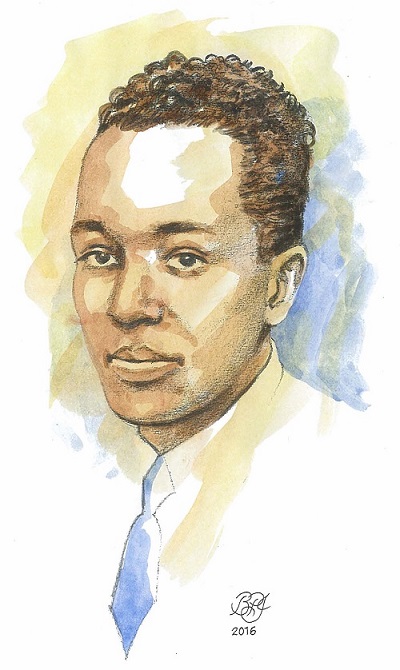
Portrait de Langston Hughes par Bruce Patrick Jones_graphite et aquarelle_2016
Langston Hughes (le 1er février 1902 – mai 1967: poète, écrivain, et dramaturge noir-américain)
Le Nègre parle des fleuves (1921)
(The Negro speaks of rivers)
.
J’ai connu des fleuves
J’ai connu des fleuves anciens comme le monde et plus vieux
que le flux du sang humain dans les veines humaines.
.
Mon âme est devenue aussi profonde que les fleuves.
.
Je me suis baigné dans l’Euphrate quand les aubes étaient neuves.
J’ai bâti ma hutte près du Congo et il a bercé mon sommeil.
J’ai contemplé le Nil et au-dessus j’ai construit les pyramides.
J’ai entendu le chant du Mississipi quand Abe Lincoln descendit
à la Nouvelle-Orléans, et j’ai vu ses nappes boueuses transfigurées
en or au soleil couchant.
.
J’ai connu des fleuves:
Fleuves anciens et ténébreux.
.
Mon âme est devenue aussi profonde que les fleuves.
. . .
Moi aussi, je chante l’Amérique (1926)
(Epilogue: I, Too)
.
Moi aussi, je chante l’Amérique.
.
Je suis le frère à la peau sombre.
Ils m’envoient manger à la cuisine
Quand il vient du monde.
Mais je ris,
Et mange bien,
Et prends des forces.
.
Demain
Je me mettrai à table
Quand il viendra du monde
Personne n’osera
Me dire
Alors
«Mange à la cuisine».
.
De plus, ils verront comme je suis beau
Et ils auront honte…
.
Moi aussi, je suis l’Amérique.
. . .
Le Blues du Désespoir (1926)
(The Weary Blues)
.
Fredonnant un air syncopé et nonchalant,
Balançant d’avant en arrière avec son chant moelleux,
J’écoutais un Nègre jouer.
En descendant la Lenox Avenue l’autre nuit
A la lueur pâle et maussade d’une vieille lampe à gaz
Il se balançait indolent…
Il se balançait indolent…
Pour jouer cet air, ce Blues du Désespoir.
Avec ses mains d’ébène sur chaque touche d’ivoire
Il amenait son pauvre piano à pleurer sa mélodie.
O Blues !
Se balançant sur son tabouret bancal
Il jouait cet air triste et rugueux comme un fou,
Tendre Blues !
Jailli de l’âme d’un Noir
O Blues !
.
D’une voix profonde au timbre mélancolique
J’écoutais ce Nègre chanter, ce vieux piano pleurer –
« J’n’ai personne en ce monde,
J’n’ai personne à part moi.
J’veux en finir avec les soucis
J’veux mettre mes tracas au rancart. »
Tamp, tamp, tamp ; faisait son pied sur le plancher.
Il joua quelques accords et continua de chanter –
« J’ai le Blues du Désespoir
Rien ne peut me satisfaire.
J’n’aurai plus de joie
Et je voudrais être mort. »
Et tard dans la nuit il fredonnait cet air.
Les étoiles disparurent et la lune à son tour.
Le chanteur s’arrêta de jouer et rentra dormir
Tandis que dans sa tête le Blues du Désespoir résonnait.
Il dormit comme un roc ou comme un homme qui serait mort.
. . .
Nègre (1922) (Negro)
.
Je suis un Nègre :
Noir comme la nuit est noire,
Noir comme les profondeurs de mon Afrique.
.
J’ai été un esclave :
César m’a dit de tenir ses escaliers propres.
J’ai ciré les bottes de Washington.
.
J’ai été ouvrier :
Sous ma main les pyramides se sont dressées.
J’ai fait le mortier du Woolworth Building.
.
J’ai été un chanteur :
Tout au long du chemin de l’Afrique à la Géorgie
J’ai porté mes chants de tristesse.
J’ai créé le ragtime.
.
Je suis un Nègre :
Les Belges m’ont coupé les mains au Congo.
On me lynche toujours au Mississipi.
.
Je suis un Nègre :
Noir comme la nuit est noire
Noir comme les profondeurs de mon Afrique.
. . .
Les poèmes originals, en anglais:
.
The Negro Speaks of Rivers
.
I’ve known rivers:
I’ve known rivers ancient as the world and older than the
flow of human blood in human veins.
.
My soul has grown deep like the rivers.
.
I bathed in the Euphrates when dawns were young.
I built my hut near the Congo and it lulled me to sleep.
I looked upon the Nile and raised the pyramids above it.
I heard the singing of the Mississippi when Abe Lincoln
went down to New Orleans, and I’ve seen its muddy
bosom turn all golden in the sunset.
.
I’ve known rivers:
Ancient, dusky rivers.
.
My soul has grown deep like the rivers.
. . .
Epilogue: I, too
.
I, too, sing America.
.
I am the darker brother.
They send me to eat in the kitchen
When company comes,
But I laugh,
And eat well,
And grow strong.
.
Tomorrow,
I’ll be at the table
When company comes.
Nobody’ll dare
Say to me,
“Eat in the kitchen,”
Then.
.
Besides,
They’ll see how beautiful I am
And be ashamed—
.
I, too, am America.
. . .
The Weary Blues
.
Droning a drowsy syncopated tune,
Rocking back and forth to a mellow croon,
I heard a Negro play.
Down on Lenox Avenue the other night
By the pale dull pallor of an old gas light
He did a lazy sway . . .
He did a lazy sway . . .
To the tune o’ those Weary Blues.
With his ebony hands on each ivory key
He made that poor piano moan with melody.
O Blues!
Swaying to and fro on his rickety stool
He played that sad raggy tune like a musical fool.
Sweet Blues!
Coming from a black man’s soul.
O Blues!
In a deep song voice with a melancholy tone
I heard that Negro sing, that old piano moan—
“Ain’t got nobody in all this world,
Ain’t got nobody but ma self.
I’s gwine to quit ma frownin’
And put ma troubles on the shelf.”
.
Thump, thump, thump, went his foot on the floor.
He played a few chords then he sang some more—
“I got the Weary Blues
And I can’t be satisfied.
Got the Weary Blues
And can’t be satisfied—
I ain’t happy no mo’
And I wish that I had died.”
And far into the night he crooned that tune.
The stars went out and so did the moon.
The singer stopped playing and went to bed
While the Weary Blues echoed through his head.
He slept like a rock or a man that’s dead.
. . .
Negro
.
I am a Negro:
Black as the night is black,
Black like the depths of my Africa.
.
I’ve been a slave:
Caesar told me to keep his door-steps clean.
I brushed the boots of Washington.
.
I’ve been a worker:
Under my hand the pyramids arose.
I made mortar for the Woolworth Building.
.
I’ve been a singer:
All the way from Africa to Georgia
I carried my sorrow songs.
I made ragtime.
.
I’ve been a victim:
The Belgians cut off my hands in the Congo.
They lynch me still in Mississippi.
.
I am a Negro:
Black as the night is black,
Black like the depths of my Africa.
. . . . .
Ya viene la lluvia: Langston Hughes, Sara Teasdale, Robert Creeley
Posted: April 15, 2015 Filed under: English, Langston Hughes, Robert Creeley, Sara Teasdale, Spanish, ZP Translator: Alexander Best Comments Off on Ya viene la lluvia: Langston Hughes, Sara Teasdale, Robert Creeley
Langston Hughes (1902-1967)
April Rain Song
.
Let the rain kiss you
Let the rain beat upon your head with silver liquid drops
Let the rain sing you a lullaby
The rain makes still pools on the sidewalk
The rain makes running pools in the gutter
The rain plays a little sleep song on our roof at night
And I love the rain.
. . .
Canto de la Lluvia en Abril
.
Que la lluvia te bese;
Que la lluvia golpee sobre tu cabeza, con gotas de líquido plateado;
Que la lluvia te cante un arrorró…
Hace la lluvia charcos quietos en la banqueta;
Hace charcos fluidos en la alcantarilla.
Canta las noches un pequeño canto de tranquilidad en nuestro techo.
Y me encanta la lluvia.
. . .
Sara Teasdale (1884-1933)
Spring Rain
.
I thought I had forgotten,
But it all came back again
Tonight with the first spring thunder
In a rush of rain.
.
I remembered a darkened doorway
Where we stood while the storm swept by,
Thunder gripping the earth
And lightning scrawled on the sky.
.
The passing motor buses swayed,
For the street was a river of rain,
Lashed into little golden waves
In the lamp light’s stain.
.
With the wild spring rain and thunder
My heart was wild and gay;
Your eyes said more to me that night
Than your lips would ever say. . . .
.
I thought I had forgotten,
But it all came back again,
Tonight with the first spring thunder
In a rush of rain.
. . .
Lluvia de Primavera
.
Yo pensaba que yo había olvidado…
Pero me regresaron los pensamientos
– esta noche, con el primer trueno de la primavera,
en un torrente.
.
Me acordé un portal oscuro
donde nos quedamos mientras barría con todo la tormenta,
el trueno agarrando la tierra
y el relámpago garabateado sobre el cielo.
.
Los camiones pasandos se bamboleaban
porque la calle era un río de lluvia,
azotado en alas doradas
bajo de la farola.
.
Era salvaje y alegre mi corazón,
con la lluvia y trueno loco de la primavera;
Y tus ojos me dijeron más en esa noche,
más que nunca hayan dicho tus labios…
.
Yo pensaba que yo había olvidado…
Pero me regresaron los pensamientos
– esta noche, con el primer trueno de la primavera,
en un torrente.
. . .
Robert Creeley (1926-2005)
The Rain
.
All night the sound had
come back again,
and again falls
this quiet, persistent rain.
.
What am I to myself
that must be remembered,
insisted upon
so often? Is it
.
that never the ease,
even the hardness,
of rain falling
will have for me
.
something other than this,
something not so insistent –
am I to be locked in this
final uneasiness?
.
Love, if you love me,
lie next to me.
Be for me, like rain,
the getting out
.
of the tiredness, the fatuousness, the semi-
lust of intentional indifference.
Be wet
with a decent happiness.
. . .
La Lluvia
.
Durante la noche el sonido había vuelto,
y de nuevo está cayendo esta lluvia silenciosa – y persistente.
.
¿Qué soy, a mi mismo, que se debe ser recordado, insistido – tan frecuentemente?
.
Es que el alivio, aún la dureza, de la lluvia que cae, nunca tendrá para mí algo otro que ésto:
algo no tan insistente; ¿encerraré en esta ansiedad final?
.
Querida, si me amas pues échate por mi lado.
Sé, para mí, como la lluvia:
la expulsión de cansancio, de necedad, de la semi-lujuria de un pasotismo deliberado.
Sé mojida con una dicha digna.
. . . . .
Mildred K. Barya: Birmingham Postcard and The Promised Land
Posted: February 28, 2015 Filed under: 7 GUEST EDITORS, English, Langston Hughes, Mildred K. Barya | Tags: Black History Month Comments Off on Mildred K. Barya: Birmingham Postcard and The Promised Land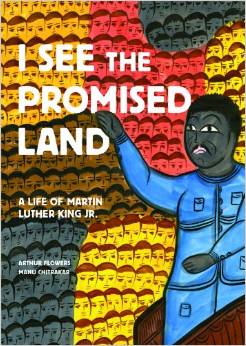
Mildred K. Barya
Birmingham Postcard and The Promised Land
.
After eleven months in Birmingham, Alabama, I left for Denver, Colorado. I was excited about my new teaching and studying life in Denver, but also sad to be leaving a place that had been home to me in every sense of the word. I wondered if I would ever find the same generosity.
The moment I arrived in Birmingham, I was received with love, a welcome dinner, laughter, and in a matter of hours I felt at home. Love continued throughout my stay. Within two weeks I found an apartment—with help from my new friends and fellow teachers—moved in and was told to make a list of whatever item I needed. Within twenty-four hours my house was filled with every lovely thing—a beautiful brown couch, an orange armchair that became my favorite relaxing seat, got me floating gently into pleasantness, leaving all tiredness behind. I was also given a computer table and chair, a dining table complete with four chairs, a brand new bed and mattress, and everything that I needed for the kitchen: plates, glasses, cups, kettle, pots, pans, and utensils.
I felt lifted up, light, fluid, melted by all that love; I wondered what I had done to deserve such care and compassion. I had simply showed up, and the residents had done what they thought was theirs to do; for them hospitality was second nature. Humbled and eased into comfort, it was not hard to enjoy my job.
.
In my short teaching career, I had thought it was okay to like students, be friendly and helpful, but also to maintain a respectable distance. My students at Alabama School of Fine Arts changed all that. It was love or nothing. Bonding. Knowing that I was from Uganda, they were keen to introduce Southern cooking to me. Before I knew it we were having buffets in class: collard greens cooked Southern style, shrimp, ham, chicken, grits…And never did any one of them falter in their assignments or fail to submit work on time. Their stories were delightful, wonderfully crafted, heartfelt and compelling.
.
When it was time for my departure, all I could think of was my students’ warmth and laughter, intelligence and humor; their remarkable poems and stories; their honesty, enthusiasm, and trust. I was aware by then that most of them had shared with me truths and concerns they wouldn’t have revealed to others. They had sensed that I would understand and help. They transformed me, giving me the best alive experiences.
.
The month of February was especially packed with activities that involved marches, visits to the Civil Rights Museum, (just a few blocks away from the school), and, opposite the museum, the 16th Street Baptist Church where four young girls had died in a bomb explosion during the peak of the Civil Rights Movement. I was glad to witness the 50th Anniversary celebrations at the church in 2013, and to chat with the “babies” who had been a year old during those turbulent times of the 1960s, and who were now mature men and women. I wondered how much they remembered, and if a lot had changed after all.
.
On a Sunday, in that baptist church with its red cushioned chairs, I sat in the chair that had welcomed Martin Luther King, Jr., and I listened to the energetic, soulful singing, feeling transported to a time in the past, a time before I was even conceived. I felt one with history, the present, and the future. Everything flowed seamlessly back and forth, there was no boundary separating the three. I had to pinch myself to know where I was and was not. In that moment I understood the impression of liminal spaces, when the curtain wall cracks just enough to let in a little light for one to perceive briefly another lifetime. I looked into the mosaic glass window (now restored) that had splintered as the bomb exploded that September day in 1963, claiming those four young girls. I glanced around me and wondered how I came to be so lucky to be in the past and present at the same time. I said a prayer for little girls who are still growing and don’t know the terrible times that befell those who came before them. I prayed for the little boys too, that amongst them we might have as many Kings as seashells on the shore.
.
The Civil Rights Museum taught me about what got “left out” in school. I learnt the true meaning of struggle; that revolutions whose time has come can never be extinguished; that the past is vital and breathing in the hearts of all who care; that the fruits of today are the pains of yesterday. And when I set my eyes to the Vulcan, the world’s largest cast-iron statue – now 110 years old and still watching over the city – I realized that the god of forge and the goddess of fire are precisely what all men, women, and children need, and that that was what Birmingham had given me.
Back in class we ended the 2013 commemorations with two poems by Langston Hughes, Daybreak in Alabama and Birmingham Sunday, which we read out loud.
But the most wholesome tribute to Martin Luther King Jr. and his legacy is Arthur Flowers’ book: I See The Promised Land, published by Tara Books in 2010. An extraordinary graphic version of King’s life, it beckons the reader to sit down and listen to a good story “replete with the Will of the Gods, with Fate and Destiny and The Human Condition.” Arthur, being a hoodoo Lord of the Delta, a Memphis native, strings out the narrative with griot rhythms and an invocation to Legba to open the gate. The story is riveting, and the book stands out as a distinctive collaboration with Manu Chitrakar and Guglielmo Rossi. Chitrakar’s free-floating images are rich with color and texture, deeply steeped in the Patua scroll-painting tradition of Bengal, India. Flowing in and out of the text, they are the perfect complement to the narrative. I See The Promised Land is a book everyone should read, an essential addition to any art or biography collection.
. . .
Langston Hughes (1902-1967)
Daybreak in Alabama
.
When I get to be a composer
I’m gonna write me some music about
Daybreak in Alabama
And I’m gonna put the purtiest songs in it
Rising out of the ground like a swamp mist
And falling out of heaven like soft dew.
I’m gonna put some tall tall trees in it
And the scent of pine needles
And the smell of red clay after rain
And long red necks
And poppy colored faces
And big brown arms
And the field daisy eyes
Of black and white black white black people
And I’m gonna put white hands
And black hands and brown and yellow hands
And red clay earth hands in it
Touching everybody with kind fingers
And touching each other natural as dew
In that dawn of music when I
Get to be a composer
And write about daybreak
In Alabama.
. . .
Birmingham Sunday
(September 15th, 1963)
.
Four little girls
Who went to Sunday School that day
And never came back home at all–
But left instead
Their blood upon the wall
With spattered flesh
And bloodied Sunday dresses
Scorched by dynamite that
China made aeons ago
Did not know what China made
Before China was ever Red at all
Would ever redden with their blood
This Birmingham-on-Sunday wall.
Four tiny little girls
Who left their blood upon that wall,
In little graves today await:
The dynamite that might ignite
The ancient fuse of Dragon Kings
Whose tomorrow sings a hymn
The missionaries never taught
In Christian Sunday School
To implement the Golden Rule.
Four little girls
Might be awakened someday soon
By songs upon the breeze
As yet unfelt among
Magnolia trees.
. . . . .
To read more essay-and-poem features by Mildred K. Barya at Zócalo Poets, click on her name under “Guest Editors” in the right-hand column…
Great Women Jazz Instrumentalists + “Jazz” poems by Langston Hughes and Jayne Cortez
Posted: February 18, 2015 Filed under: English, Jayne Cortez, Langston Hughes | Tags: Black History Month Comments Off on Great Women Jazz Instrumentalists + “Jazz” poems by Langston Hughes and Jayne Cortez
Mary Lou Williams: jazz pianist, composer, arranger_1910 to 1981
Langston Hughes (1902-1967)
Juke Box Love Song
.
I could take the Harlem night
and wrap around you,
Take the neon lights and make a crown,
Take the Lenox Avenue buses,
Taxis, subways;
And for your love song tone their rumble down.
Take Harlem’s heartbeat,
Make a drumbeat,
Put it on a record, let it whirl;
And while we listen to it play,
Dance with you till day…
Dance with you, my sweet brown Harlem girl.

Clora Bryant, born 1927, playing trumpet in this 1954 photo
Langston Hughes
Life is Fine
.
I went down to the river,
I set down on the bank.
I tried to think but couldn’t,
So I jumped in and sank.
I came up once and hollered!
I came up twice and cried!
If that water hadn’t a-been so cold
I might’ve sunk and died.
But it was Cold in that water! It was cold!
.
I took the elevator
Sixteen floors above the ground.
I thought about my baby
And thought I would jump down.
.
I stood there and I hollered!
I stood there and I cried!
If it hadn’t a-been so high
I might’ve jumped and died.
But it was High up there! It was high!
.
So since I’m still here livin’,
I guess I will live on.
I could’ve died for love–
But for livin’ I was born
.
Though you may hear me holler,
And you may see me cry–
I’ll be dogged, sweet baby,
If you gonna see me die.
Life is fine! Fine as wine! Life is fine!
. . .
Langston Hughes
Dream Variations
.
To fling my arms wide
In some place of the sun,
To whirl and to dance
Till the white day is done.
Then rest at cool evening
Beneath a tall tree
While night comes on gently,
Dark like me:
That is my dream!
.
To fling my arms wide
In the face of the sun,
Dance! Whirl! Whirl!
Till the quick day is done.
Rest at pale evening,
A tall, slim tree,
Night coming tenderly –
Black like me.

Dorothy Donegan_multi-style pianist, 1922 to 1998, shown here in 1989_photograph © Paul Bergen
Jayne Cortez (born Sallie Jayne Richardson, 1934-2012)
I am New York City
.
i am new york city
here is my brain of hot sauce
my tobacco teeth my
mattress of bedbug tongue
legs aparthand on chin
war on the roofinsults
pointed fingerspushcarts
my contraceptives all
look at my pelvis blushing
.
i am new york city of blood
police and fried pies
i rub my docks red with grenadine
and jelly madness in a flow of tokay
my huge skull of pigeons
my seance of peeping toms
my plaited ovaries excuse me
this is my grime my thigh of
steelspoons and toothpicks
i imitate no one
.
i am new york city
of the brown spit and soft tomatoes
give me my confetti of flesh
my marquee of false nipples
my sideshow of open beaks
in my nose of soot
in my ox bled eyes
in my ear of Saturday night specials
.
i eat ha ha hee hee and ho ho
i am new york city
never change never sleep never melt
my shoes are incognito
cadavers grow from my goatee
look i sparkle with shit with wishbones
my nickname is glue-me
.
take my face of stink bombs
my star spangled banner of hot dogs
take my beer can junta
my reptilian ass of footprints
and approach me through life
approach me through death
approach me through my widow’s peak
through my split ends my
asthmatic laughapproach me
through my wash rag
half anklehalf elbow
massage me with your camphor tears
salute the patina and concrete
of my rat tail wig
face upface downpiss
into the bite of our handshake
.
i am new york city
my skillet-head friend
my fat-bellied comrade
citizens
break wind with me
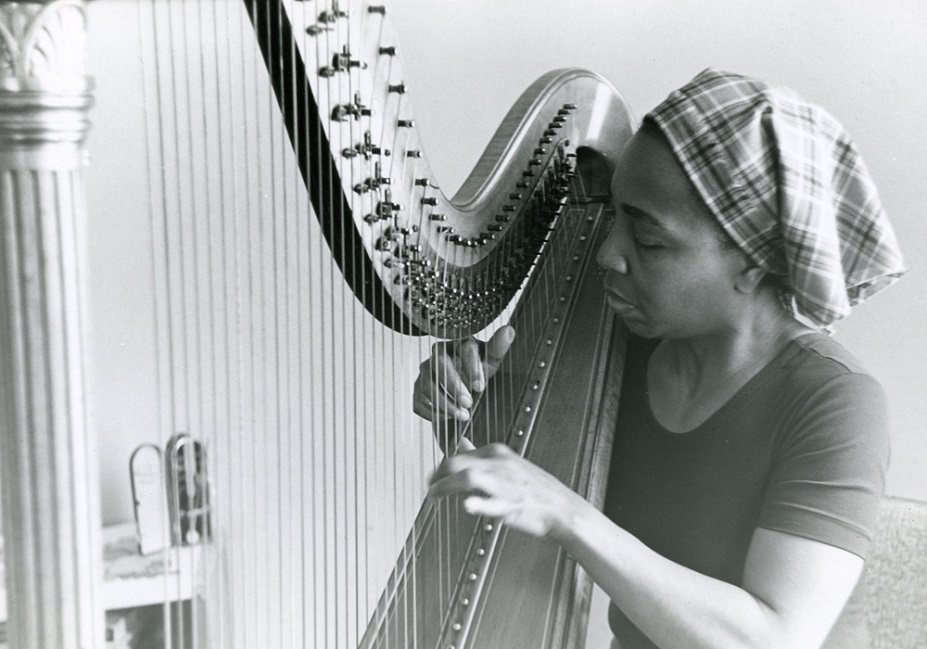
Dorothy Ashby, Jazz harpist and composer_1930 to 1986
Jayne Cortez
Make Ifa
.
MAKE IFA MAKE IFA MAKE IFA IFA IFA
In sanctified chalk
of my silver painted soot
In criss-crossing whelps
of my black belching smoke
In brass masking bones
of my bass droning moans
in hub cap bellow
of my hammer tap blow
In steel stance screech
of my zumbified flames
In electrified mouth
of my citified fumes
In bellified groan
of my countrified pound
In compulsivefied conga
of my soca moka jumbi
MAKE IFA MAKE IFA MAKE IFA IFA IFA
In eye popping punta
of my heat sucking sap
In cyclonic slobber
of my consultation pan
In snap jam combustion
of my banjoistic thumb
In sparkola flare
of my hoodoristic scream
In punched out ijuba
of my fire catching groove
In fungified funk
of my sambafied shakes
In amplified dents
of my petrified honks
In ping ponging bombs
of my scarified gongs
MAKE IFA MAKE IFA MAKE IFA IFA IFA
. . .
Editor’s Note: Ifa = a system of divination developed by the Yoruba of
Nigeria, based on the interpretation of cowrie shells tossed on a tray.
. . . . .
Amiri Baraka and Langston Hughes: “Throw jesus out yr mind” / “Goodbye, Christ”
Posted: February 1, 2013 Filed under: Amiri Baraka, English, English: Black Canadian / American, Langston Hughes | Tags: Black History Month poems Comments Off on Amiri Baraka and Langston Hughes: “Throw jesus out yr mind” / “Goodbye, Christ”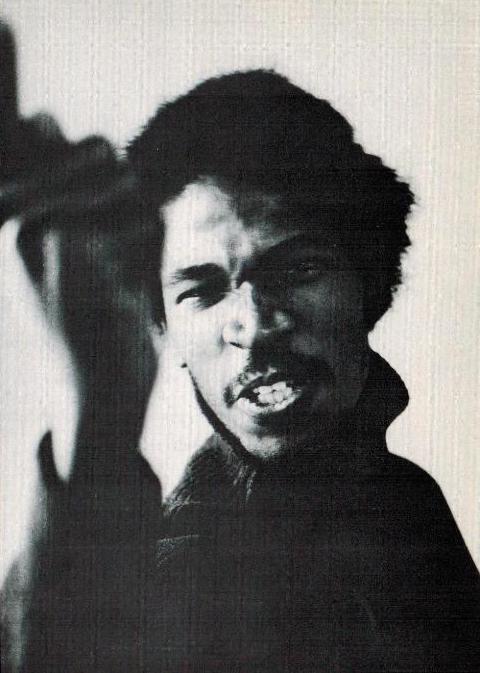
ZP_photograph by Fundi_Billy Abernathy_from the 1970 Imamu Amiri Baraka book In Our Terribleness
Amiri Baraka (born 1934, Newark, New Jersey, U.S.A.)
“When We’ll Worship Jesus”
(written after 1970, published in Baraka’s poetry collection “Hard Facts”, 1975)
.
We’ll worship Jesus
When Jesus do
Something
When jesus blow up
the white house
or blast nixon down
when jesus turn out congress
or bust general motors to
yard bird motors
jesus we’ll worship jesus
when jesus get down
when jesus get out his yellow lincoln
w/the built in cross stain glass
window & box w/black peoples
enemies we’ll worship jesus when
he get bad enough to at least scare
somebody – cops not afraid
of jesus
pushers not afraid
of jesus, capitalists racists
imperialists not afraid
of jesus shit they makin money
off jesus
we’ll worship jesus when mao
do, when toure does
when the cross replaces Nkrumah’s
star
Jesus need to hurt some a our
enemies, then we’ll check him
out, all that screaming and hollering
& wallering and moaning talkin bout
jesus, jesus, in a red
check velvet vine + 8 in.heels
jesus pinky finger
got a goose egg ruby
which actual bleeds
jesus at the Apollo
doin splits and helpin
nixon trick niggers
jesus w/his one eyed self
tongue kissing johnny carson
up the behind
jesus need to be busted
jesus need to be thrown down and whipped
till something better happen
jesus aint did nothin for us
but kept us turned toward the
sky (him and his boy allah
too, need to be checkd out!)
we’ll worship jesus when he get a boat load of ak-47s
and some dynamite
and blow up abernathy robotin
for gulf
jesus need to be busted
we ain’t gonna worship nobody
but niggers getting up off
the ground
not gon worship jesus
unless he just a tricked up
nigger somebody named
outside his race
need to worship yo self fo
you worship jesus
need to bust jesus ( + check
out his spooky brother
allah while you heavy
on the case
cause we ain gon worship jesus
we aint gon worship
jesus
not till he do something
not till he help us
not till the world get changed
and he ain, jesus ain, he cant change the world
we can change the world
we can struggle against the forces of backwardness, we can
change the world
we can struggle against our selves, our slowness, our connection
with
the oppressor, the very cultural aggression which binds us to
our enemies
as their slaves.
we can change the world
we aint gonna worship jesus cause jesus dont exist
xcept in song and story except in ritual and dance, except in
slum stained
tears or trillion dollar opulence stretching back in history, the
history
of the oppression of the human mind
we worship the strength in us
we worship our selves
we worship the light in us
we worship the warmth in us
we worship the world
we worship the love in us
we worship our selves
we worship nature
We worship ourselves
we worship the life in us, and science, and knowledge, and
transformation
of the visible world
but we aint gonna worship no jesus
we aint gonna legitimize the witches and devils and spooks and
hobgoblins
the sensuous lies of the rulers to keep us chained to fantasy and
illusion
sing about life, not jesus
sing about revolution, not no jesus
stop singing about jesus,
sing about creation, our creation, the life of the world and
fantastic
nature how we struggle to transform it, but dont victimize our
selves by
distorting the world
stop moanin about jesus, stop sweatin and crying and stompin
and dyin for jesus
unless thats the name of the army we building to force the land
finally to
change hands. And lets not call that jesus, get a quick
consensus, on that,
lets damn sure not call that black fire muscle
no invisible psychic dungeon
no gentle vision strait jacket, lets call that peoples army, or
wapenduzi or
simba
wachanga, but we not gon call it jesus, and not gon worship
jesus, throw
jesus out yr mind. Build the new world out of reality, and new
vision
we come to find out what there is of the world
to understand what there is here in the world!
to visualize change, and force it.
we worship revolution
. . . . .
Langston Hughes (1902-1967)
“Goodbye, Christ” (published in “The Negro Worker” Socialist journal, Nov.-Dec. 1932)
.
Listen, Christ,
You did alright in your day, I reckon –
But that day’s gone now.
They ghosted you up a swell story, too,
Called it Bible –
But it’s dead now.
The popes and the preachers’ve
Made too much money from it.
They’ve sold you too many
.
Kings, generals, robbers, and killers –
Even to the Tzar and the Cossacks,
Even to Rockefeller’s Church,
Even to “The Saturday Evening Post”.
You ain’t no good no more.
They’ve pawned you
Till you’ve done wore out.
.
Goodbye,
Christ Jesus Lord God Jehova,
Beat it on away from here now.
Make way for a new guy with no religion at all –
a real guy named
Marx Communist Lenin Peasant Stalin Worker ME –
I said, ME!
.
Go ahead on now,
You’re getting in the way of things, Lord.
And please take Saint Gandhi with you when you go,
And Saint Pope Pius,
And Saint Aimee McPherson,
And big black Saint Becton
Of the Consecrated Dime.
And step on the gas, Christ!
Move!
.
Don’t be so slow about movin’!
The world is mine from now on –
And nobody’s gonna sell ME
To a king, or a general,
Or a millionaire.
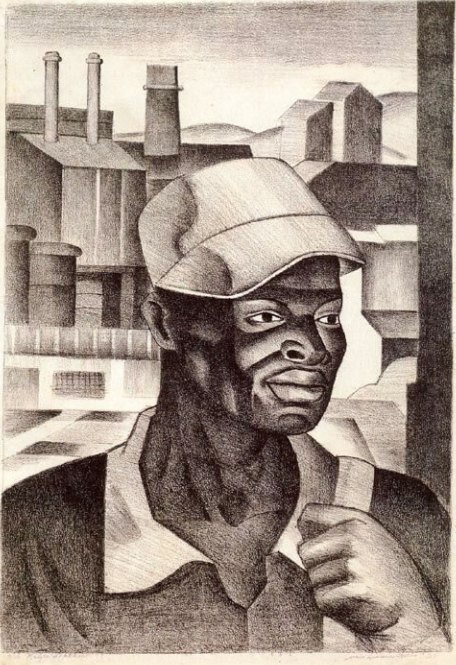
ZP_Negro Worker_1938 lithograph by James Lescesne Wells
Langston Hughes
“A Christian Country” (Feb. 1931)
.
God slumbers in a back alley
With a gin bottle in His hand.
Come on, God, get up and fight
Like a man.
. . .
Langston Hughes
“Tired” (Feb. 1931)
.
I am so tired of waiting,
Aren’t you?
For the world to become good
And beautiful and kind.
Let us take a knife
And cut the world in two –
And see what worms are eating
At the rind.
. . .
Langston Hughes
“Bitter Brew” (1967, published posthumously)
.
Whittle me down
To a strong thin reed
With a piercing tip
To match my need.
.
Spin me out
To a tensile wire
To derrick the stones
Of my problems higher.
.
Then simmer me slow
In the freedom cup
Till only an essence
Is left to sup.
.
May that essence be
The black poison of me
To give the white bellies
The third degree.
.
Concocted by history
Brewed by fate –
A bitter concentrate
Of hate.
. . . . .
It may seem curious to place Langston Hughes on the same page with Amiri Baraka yet these two strikingly different poets do intersect. Both wrote passionate and angry poems about Jesus Christ – about belief in Jesus Christ – during periods when each was exploring elements of one of those other great world religions: Socialism/Communism.
.
Though the life lived by Hughes appears to have been more conservative and/or Bohemian-Establishment than Baraka’s, Hughes’ conventional rhyming verse poetry shows real guts. The poem “Goodbye, Christ” haunted Hughes, being re-printed and circulated by zealously orthodox American Christians , becoming a thorn that pierced Hughes’ side from 1940 onward when the FBI put the poet under surveillance for alleged Communist activity. He was denounced as a communist by a U.S. senator in 1948 and was subpoena’d in 1953 to appear before Senator Joseph McCarthy’s subcommittee on subversive “un-American” activities. It “exonerated” him because it couldn’t link him to anyone juicy to nail. Though Hughes had been involved in Leftist politics – his “turning” came after a trip to Haiti in 1931 (followed by visits to Moscow in 1932-33 and Spain in 1937) – he was never a member of any Socialist or Communist party organization.
.
We have included what is believed to be one of the last poems Langston Hughes wrote before he died in 1967: “Bitter Brew”. In miniature it quick-sketches the emotional and psychological geography for the new-angry Black America that an up-and-coming LeRoi Jones/Amiri Baraka would map out in greater detail…
. . . . .
Langston Hughes: “Montage of a Dream Deferred”
Posted: February 1, 2013 Filed under: English, English: Black Canadian / American, Langston Hughes | Tags: Black History Month poems Comments Off on Langston Hughes: “Montage of a Dream Deferred”
Langston Hughes (born February 1st 1902, died 1967)
“Montage of a Dream Deferred” (1951): a selection of poems
.
“Children’s Rhymes”
.
When I was a chile we used to play,
“One – two – buckle my shoe!”
and things like that. But now, Lord,
listen at them little varmints!
.
By what sends
the white kids
I ain’t sent:
I know I can’t
be President.
.
There is two thousand children
In this block, I do believe!
.
What don’t bug
them white kids
sure bugs me:
We knows everybody
ain’t free!
.
Some of these young ones is cert’ly bad –
One batted a hard ball right through my window
And my gold fish et the glass.
.
What’s written down
for white folks
ain’t for us a-tall:
“Liberty And Justice –
Huh – For All.”
.
Oop-pop-a-da!
Skee! Daddle-de-do!
Be-bop!
.
Salt’ peanuts!
.
De-dop!
. . .
“Necessity”
.
Work?
I don’t have to work.
I don’t have to do nothing
but eat, drink, stay black, and die.
This little old furnished room’s
so small I can’t whip a cat
without getting fur in my mouth
and my landlady’s so old
her features is all run together
and God knows she sure can overcharge –
which is why I reckon I does
have to work after all.
. . .
“Question (2)”
.
Said the lady, Can you do
what my other man can’t do –
that is
love me, daddy –
and feed me, too?
.
Figurine
.
De-dop!
. . .
“Easy Boogie”
.
Down in the bass
That steady beat
Walking walking walking
Like marching feet.
.
Down in the bass
That easy roll,
Rolling like I like it
In my soul.
.
Riffs, smears, breaks.
.
Hey, Lawdy, Mama!
Do you hear what I said?
Easy like I rock it
In my bed!
. . .
“What? So Soon!”
.
I believe my old lady’s
pregnant again!
Fate must have
some kind of trickeration
to populate the
cllud nation!
Comment against Lamp Post
You call it fate?
Figurette
De-daddle-dy!
De-dop!
. . .
“Tomorrow”
.
Tomorrow may be
a thousand years off:
TWO DIMES AND A NICKEL ONLY
Says this particular
cigarette machine.
.
Others take a quarter straight.
.
Some dawns
wait.
. . .
“Café: 3 a.m.”
.
Detectives from the vice squad
with weary sadistic eyes
spotting fairies.
Degenerates,
some folks say.
.
But God, Nature,
or somebody
made them that way.
Police lady or Lesbian
over there?
Where?
. . .
“125th Street”
.
Face like a chocolate bar
full of nuts and sweet.
.
Face like a jack-o’-lantern,
candle inside.
.
Face like a slice of melon,
grin that wide.
. . .
“Up-Beat”
.
In the gutter
boys who try
might meet girls
on the fly
as out of the gutter
girls who will
may meet boys
copping a thrill
while from the gutter
both can rise:
But it requires
Plenty eyes.

“Mystery”
.
When a chile gets to be thirteen
and ain’t seen Christ yet,
she needs to set on de moaner’s bench
night and day.
.
Jesus, lover of my soul!
.
Hail, Mary, mother of God!
.
Let me to thy bosom fly!
.
Amen! Hallelujah!
.
Swing low, sweet chariot,
Coming for to carry me home.
.
Sunday morning where the rhythm flows,
How old nobody knows –
yet old as mystery,
older than creed,
basic and wondering
and lost as my need.
.
Eli, eli!
Te deum!
Mahomet!
Christ!
.
Father Bishop, Effendi, Mother Horne,
Father Divine, a Rabbi black
as black was born,
a jack-leg preacher, a Ph.D.
.
The mystery
and the darkness
and the song
and me.
. . .
“Nightmare Boogie”
.
I had a dream
and I could see
a million faces
black as me!
A nightmare dream:
Quicker than light
All them faces
Turned dead white!
Boogie-woogie,
Rolling bass,
Whirling treble
Of cat-gut lace.
. . .
“Blues at Dawn”
.
I don’t dare start thinking in the morning.
I don’t dare start thinking in the morning.
If I thought thoughts in bed,
Them thoughts would bust my head –
So I don’t dare start thinking in the morning.
.
I don’t dare remember in the morning
Don’t dare remember in the morning.
If I recall the day before,
I wouldn’t get up no more –
So I don’t dare remember in the morning.
. . .
“Neighbour”
.
Down home
he sets on a stoop
and watches the sun go by.
In Harlem
when his work is done
he sets in a bar with a beer.
He looks taller than he is
and younger than he ain’t.
He looks darker than he is, too.
And he’s smarter than he looks,
He ain’t smart.
That cat’s a fool.
Naw, he ain’t neither.
He’s a good man,
except that he talks too much.
In fact, he’s a great cat.
But when he drinks,
he drinks fast.
Sometimes
he don’t drink.
True,
he just
lets his glass
set there.
. . .
“Subway Rush Hour”
.
Mingled
breath and smell
so close
mingled
black and white
so near
no room for fear.
. . .
“Brothers”
.
We’re related – you and I,
You from the West Indies,
I from Kentucky.
.
Kinsmen – you and I,
You from Africa,
I from U.S.A.
.
Brothers – you and I.
. . .
“Sliver”
.
Cheap little rhymes
A cheap little tune
Are sometimes as dangerous
As a sliver of the moon.
A cheap little tune
To cheap little rhymes
Can cut a man’s
Throat sometimes.
. . .
“Hope (2)”
.
He rose up on his dying bed
and asked for fish.
His wife looked it up in her dream book
and played it.
. . .
“Harlem (2)”
.
What happens to a dream deferred?
.
Does it dry up
like a raisin in the sun?
Or fester like a sore –
and then run?
Does it stink like rotten meat?
Or crust and sugar over –
like a syrupy sweet?
.
Maybe it just sags
like a heavy load.
.
Or does it explode?
. . .
“Letter”
.
Dear Mama,
Time I pay rent and get my food
and laundry I don’t have much left
but here is five dollars for you
to show you I still appreciates you.
My girl-friend send her love and say
she hopes to lay eyes on you sometime in life.
Mama, it has been raining cats and dogs up
here. Well, that is all so I will close.
You son baby
Respectably as ever,
Joe
. . .
“Motto”
.
I play it cool
And dig all jive.
That’s the reason
I stay alive.
.
My motto,
As I live and learn,
Is:
Dig And Be Dug
In Return.
. . . . .
From Hughes’ introduction to his 1951 collection “Montage of a Dream Deferred”:
“In terms of current Afro-American popular music and the sources from which it has progressed – jazz, ragtime, swing, blues, boogie-woogie, and be-bop – this poem on contemporary Harlem, like be-bop, is marked by conflicting changes, sudden nuances, sharp and impudent interjections, broken rhythms, and passages sometimes in the manner of the jam session, sometimes the popular song, punctuated by the riffs, runs, breaks, and distortions of the music of a community in transition.”

Editor’s note:
Langston Hughes’ poems “Theme for English B” and “Advice” – both of which were included in his publication of “Montage of a Dream Deferred” – are featured in separate Hughes’ posts on Zócalo Poets.
. . . . .
“Montage of a Dream Deferred”- from The Collected Poems of Langston Hughes, edited by Arnold Rampersad, with David Roessel, 1994
All poems © The Estate of Langston Hughes
Langston Hughes: “Tarea para el segundo curso de inglés” / “Theme for English B”, translated into Spanish by Óscar Paúl Castro
Posted: February 1, 2013 Filed under: English, Langston Hughes, Spanish | Tags: Black History Month poems Comments Off on Langston Hughes: “Tarea para el segundo curso de inglés” / “Theme for English B”, translated into Spanish by Óscar Paúl Castro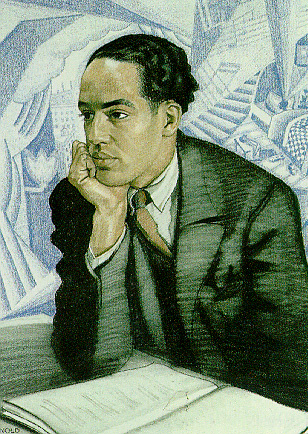
ZP_Langston Hughes_pastel drawing by Winold Reiss
Langston Hughes (1 febrero 1902 – 1967)
“Tarea para el segundo curso de inglés”
.
El profesor nos dijo:
Pueden irse a casa.
Esta noche escribirán una página:
que lo que escriban venga de ustedes,
así expresarán algo auténtico.
.
Me pregunto si es así de simple.
Tengo veintidós años, soy de color, nací en Winston-Salem.
Ahí asistí a la escuela, después en Durham, después aquí.
La Universidad está sobre la colina, dominando Harlem.
Soy el único estudiante de color en la clase.
Las escaleras que descienden por la colina desembocan en Harlem:
después de atravesar un parque, cruzar la calle san Nicolás,
la Octava Avenida, la Séptima, llego hasta el edificio “Y”
― la YMCA de Harlem Branch ― donde tomo el elevador,
entro en mi cuarto, me siento y escribo esta página:
.
Para ti no debe ser fácil poder identificar lo que es auténtico, tampoco lo es
para mí a esta edad: veintidós años. Supongo, sin embargo, que en todo
lo que siento, veo y escucho, Harlem, te escucho a ti:
te escucho, me escuchas; tú y yo ―juntos― estamos en esta página.
(También escucho a Nueva York) ¿Quién eres―Quién soy?
Bien: me gusta comer, dormir, beber, estar enamorado.
Me gusta trabajar, leer, me gusta aprender, e intentar comprender el sentido de la vida.
Quisiera una pipa como regalo de Navidad,
quizás unos discos: Bessie, bebop, o Bach.
Supongo que el hecho de ser negro no significa que me gusten
cosas distintas a las que les gustan a personas de otras razas.
¿En esta página que escribo se notará mi color?
Ciertamente ―siendo lo que soy― no será una página en blanco.
Y sin embargo
será parte de usted, maestro.
Usted es blanco,
y aun así es parte de mí, como yo soy parte de usted.
Eso significa ser americano.
Quizá usted no quiera ser parte de mí a veces.
Y en ocasiones yo no quiero ser parte de usted.
Pero, indudablemente, ambos somos parte del otro.
Yo aprendo de usted,
y supongo que usted aprende de mí:
aun cuando usted es mayor ―y blanco―
y, de alguna forma, más libre.
.
Está es mi tarea del Segundo Curso de Inglés.
(1951)
. . .
Langston Hughes (born February 1st 1902, died 1967)
“Theme for English B”
.
The instructor said,
Go home and write
a page tonight.
And let that page come out of you –
Then, it will be true.
.
I wonder if it’s that simple?
I am twenty-two, coloured, born in Winston-Salem.
I went to school there, then Durham, then here
to this college on the hill above Harlem.
I am the only coloured student in my class.
The steps from the hill lead down into Harlem
through a park, then I cross St. Nicholas,
Eighth Avenue, Seventh, and I come to the Y,
the Harlem Branch Y, where I take the elevator
up to my room, sit down, and write this page:
.
It’s not easy to know what is true for you or me
at twenty-two, my age. But I guess I’m what
I feel and see and hear, Harlem, I hear you:
hear you, hear me – we two – you, me, talk on this page.
(I hear New York too.) Me – who?
Well, I like to eat, sleep, drink, and be in love.
I like to work, read, learn, and understand life.
I like a pipe for a Christmas present,
or records – Bessie, bop, or Bach.
I guess being coloured doesn’t make me not like
the same things other folks like who are other races.
So will my page be coloured that I write?
Being me, it will not be white.
But it will be
a part of you, instructor.
You are white –
yet a part of me, as I am a part of you.
That’s American.
Sometimes perhaps you don’t want to be a part of me.
Nor do I often want to be a part of you.
But we are, that’s true!
As I learn from you,
I guess you learn from me –
although you’re older – and white –
and somewhat more free.
.
This is my page for English B.
(1951)
. . .
Traducción en español © Óscar Paúl Castro (nace 1979, Culiacán, México)
Óscar Paúl Castro, un poeta y traductor, es licenciado en Lengua y Literatura Hispánicas por la Universidad Autónoma de Sinaloa.
. . . . .
Love poems, Blues poems – from The Harlem Renaissance
Posted: February 1, 2013 Filed under: English, English: Black Canadian / American, Langston Hughes, Love poems and Blues poems – from The Harlem Renaissance | Tags: Black History Month poems Comments Off on Love poems, Blues poems – from The Harlem Renaissance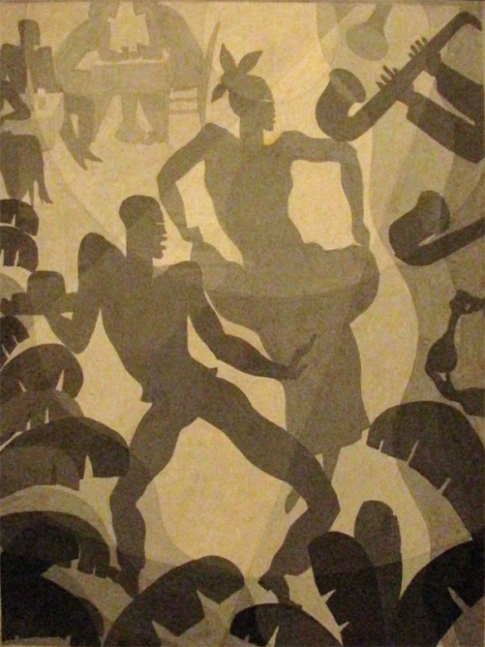
ZP_Dance_by Aaron Douglas 1899-1979
Love poems, Blues poems – from The Harlem Renaissance:
Langston Hughes verses composed between 1924 and 1930:
. . .
“Subway Face”
.
That I have been looking
For you all my life
Does not matter to you.
You do not know.
.
You never knew.
Nor did I.
Now you take the Harlem train uptown;
I take a local down.
(1924)
. . .
“Poem (2)” (To F. S.)
.
I loved my friend.
He went away from me.
There’s nothing more to say.
The poem ends,
Soft as it began –
I loved my friend.
(1925)
. . .
“Better”
.
Better in the quiet night
To sit and cry alone
Than rest my head on another’s shoulder
After you have gone.
.
Better, in the brilliant day,
Filled with sun and noise,
To listen to no song at all
Than hear another voice.
. . .
“Poem (4)” (To the Black Beloved)
.
Ah,
My black one,
Thou art not beautiful
Yet thou hast
A loveliness
Surpassing beauty.
.
Oh,
My black one,
Thou art not good
Yet thou hast
A purity
Surpassing goodness.
.
Ah,
My black one,
Thou art not luminous
Yet an altar of jewels,
An altar of shimmering jewels,
Would pale in the light
Of thy darkness,
Pale in the light
Of thy nightness.
. . .
“The Ring”
.
Love is the master of the ring
And life a circus tent.
What is this silly song you sing?
Love is the master of the ring.
.
I am afraid!
Afraid of Love
And of Love’s bitter whip!
Afraid,
Afraid of Love
And Love’s sharp, stinging whip.
.
What is this silly song you sing?
Love is the master of the ring.
(1926)
. . .
“Ma Man”
.
When ma man looks at me
He knocks me off ma feet.
When ma man looks at me
He knocks me off ma feet.
He’s got those ‘lectric-shockin’ eyes an’
De way he shocks me sho is sweet.
.
He kin play a banjo.
Lordy, he kin plunk, plunk, plunk.
He kin play a banjo.
I mean plunk, plunk…plunk, plunk.
He plays good when he’s sober
An’ better, better, better when he’s drunk.
.
Eagle-rockin’,
Daddy, eagle-rock with me.
Eagle rockin’,
Come an’ eagle-rock with me.
Honey baby,
Eagle-rockish as I kin be!
. . .
“Lament over Love”
.
I hope my child’ll
Never love a man.
I say I hope my child’ll
Never love a man.
Love can hurt you
Mo’n anything else can.
.
I’m goin’ down to the river
An’ I ain’t goin’ there to swim;
Down to the river,
Ain’t goin’ there to swim.
My true love’s left me
And I’m goin’ there to think about him.
.
Love is like whiskey,
Love is like red, red wine.
Love is like whiskey,
Like sweet red wine.
If you want to be happy
You got to love all the time.
.
I’m goin’ up in a tower
Tall as a tree is tall,
Up in a tower
Tall as a tree is tall.
Gonna think about my man –
And let my fool-self fall.
(1926)
. . .
“Dressed Up”
.
I had ma clothes cleaned
Just like new.
I put ’em on but
I still feels blue.
.
I bought a new hat,
Sho is fine,
But I wish I had back that
Old gal o’ mine.
.
I got new shoes –
They don’t hurt ma feet,
But I ain’t got nobody
For to call me sweet.
. . .
“To a Little Lover-Lass, Dead”
.
She
Who searched for lovers
In the night
Has gone the quiet way
Into the still,
Dark land of death
Beyond the rim of day.
.
Now like a little lonely waif
She walks
An endless street
And gives her kiss to nothingness.
Would God his lips were sweet!
. . .
“Harlem Night Song”
.
Come,
Let us roam the night together
Singing.
.
I love you.
Across
The Harlem roof-tops
Moon is shining.
Night sky is blue.
Stars are great drops
Of golden dew.
.
Down the street
A band is playing.
.
I love you.
.
Come,
Let us roam the night together
Singing.
. . .
“Passing Love”
.
Because you are to me a song
I must not sing you over-long.
.
Because you are to me a prayer
I cannot say you everywhere.
.
Because you are to me a rose –
You will not stay when summer goes.
(1927)
. . .
“Desire”
.
Desire to us
Was like a double death,
Swift dying
Of our mingled breath,
Evaporation
Of an unknown strange perfume
Between us quickly
In a naked
Room.
. . .
“Dreamer”
.
I take my dreams
And make of them a bronze vase,
And a wide round fountain
With a beautiful statue in its centre,
And a song with a broken heart,
And I ask you:
Do you understand my dreams?
Sometimes you say you do
And sometimes you say you don’t.
Either way
It doesn’t matter.
I continue to dream.
(1927)
. . .
“Lover’s Return”
.
My old time daddy
Came back home last night.
His face was pale and
His eyes didn’t look just right.
.
He says, “Mary, I’m
Comin’ home to you –
So sick and lonesome
I don’t know what to do.”
.
Oh, men treats women
Just like a pair o’ shoes –
You kicks ’em round and
Does ’em like you choose.
.
I looked at my daddy –
Lawd! and I wanted to cry.
He looked so thin –
Lawd! that I wanted to cry.
But the devil told me:
Damn a lover
Come home to die!
(1928)
. . .
“Hurt”
.
Who cares
About the hurt in your heart?
.
Make a song like this
for a jazz band to play:
Nobody cares.
Nobody cares.
Make a song like that
From your lips.
Nobody cares.
. . .
“Spring for Lovers”
.
Desire weaves its fantasy of dreams,
And all the world becomes a garden close
In which we wander, you and I together,
Believing in the symbol of the rose,
Believing only in the heart’s bright flower –
Forgetting – flowers wither in an hour.
(1930)
. . .
“Rent-Party Shout: For a Lady Dancer”
.
Whip it to a jelly!
Too bad Jim!
Mamie’s got ma man –
An’ I can’t find him.
Shake that thing! O!
Shake it slow!
That man I love is
Mean an’ low.
Pistol an’ razor!
Razor an’ gun!
If I sees man man he’d
Better run –
For I’ll shoot him in de shoulder,
Else I’ll cut him down,
Cause I knows I can find him
When he’s in de ground –
Then can’t no other women
Have him layin’ round.
So play it, Mr. Nappy!
Yo’ music’s fine!
I’m gonna kill that
Man o’ mine!
(1930)
. . . . .
In the manner of all great poets Langston Hughes (February 1st, 1902 – 1967) wrote love poems (and love-blues poems), using the voices and perspectives of both Man and Woman. In addition to such art, Hughes’ homosexuality, real though undisclosed during his lifetime, probably was responsible for the subtle and highly-original poet’s voice he employed for three of the poems included here: Subway Face, Poem (2), and Desire. Hughes was among a wealth of black migrants born in The South or the Mid-West who gravitated toward Harlem in New York City from about 1920 onward. Along with Countee Cullen, Zora Neale Hurston, Wallace Thurman and many others, Hughes became part of The Harlem Renaissance, that great-gorgeous fresh-flowering of Black-American culture.
. . . . .
 Zócalo Poets