Alexander Best: Once Haikus: “Deshielo en Enero” / Eleven Haiku: “Mid-Winter Thaw”
Posted: January 15, 2014 Filed under: Alexander Best, English, Spanish | Tags: Haiku written in English, Haikus escritos en español Comments Off on Alexander Best: Once Haikus: “Deshielo en Enero” / Eleven Haiku: “Mid-Winter Thaw”
Alexander Best
Once Haikus: “Deshielo en Enero” / Eleven Haiku: “Mid-Winter Thaw”
.
– 22
Pues + 7 grados
Días bipolares
.
– 22
Then suddenly it’s + 7
Winter mood swing
.
¡Odio el enero cuándo me da un ambiente de abril!
.
7 degrees celsius?
Winter, don’t die.
Snow is my state of mind.
.
Diamantes de sal
Hielo – Lluvia
Banqueta Torontoniense
.
Rough-diamond rock-salt
Sheets of ice – with rivulets
Toronto sidewalk
.
Navidad
– ¡ido!
Mente d’enero
¿Me quiero a mí mismo?
.
Half way through Winter
Dead Christmas trees and dog poop
Spring stink in the air
.
Ay, Invierno se va
¿Dónde están mis tormentas de nieve?
.
January thaw
Winter beauty turns ugly
Snowstorms, where are you?
.
Luna – ¿Sonrisa,
Rodaja de sandía?
¡No llega Verano!
.
Moon – half frozen smile –
Or slice of watermelon?
Don’t want Summer now!
.
Nubes moviendos
Sol – un disco pálido
Días peores
.
Sun – a pale grey disc
Clouds beetle across the sky
These days are the worst
.
El Enojo camina
Soy de hielo
Calle ciega
.
January days
Rarely I answer my cell
Why am I angry?
.
Pájaro “Sitta”
Dándalo vuelta
Soy feliz de nuevo
.
Nasal-voiced “Nuthatch”
Comical upside-down bird
Briefly I’m happy
.
Fumo mi puro
Ojos de un mapache
Noche d’enero
.
Smoking my cigar
Raccoon eyes gazing at me
January night
.
Hielo + Calor
Sentimientos complejos
El Amor crece
.
Mid-Winter warm spell
Complexity of feelings
Love grows by degrees
.
 .
.
[ Dice el canadiense: “No comas la nieve amarilla.” :-<> ]
Nota del poeta/editor:
Escribí estos veintidós haikus en los dos idiomas “hombro a hombro” – cada par está emparentado pero no hay traducciones; hice once poemas originales en español y once poemas originales en inglés. Intenté seguir (casi) las normas rudimentarias del haiku japonés:
Diecisiete sílabas en tres líneas divididas en 5-7-5
Usar una palabra de estación o una referencia estacional
Siempre escribir en tiempo presente de “aquí” y “ahora”
Un elemento sorprendente en la tercera línea
. . .
Poet’s/editor’s note:
I wrote these twenty-two Haiku “side by side” in Spanish and in English. They are not translations from one another though each “pair” is closely related in theme. I have tried to follow (mostly) the basic rules from Japanese Haiku:
17 syllables in 3 lines, divided 5-7-5
Use a Season word or a seasonal reference
Always write in the present tense – the Here and Now
A surprise element in line 3
. . . . .
“Sulijuk” – “It is true”: the drawings of Annie Pootoogook
Posted: January 9, 2014 Filed under: English, IMAGES | Tags: Contemporary Inuit Women Artists Comments Off on “Sulijuk” – “It is true”: the drawings of Annie Pootoogook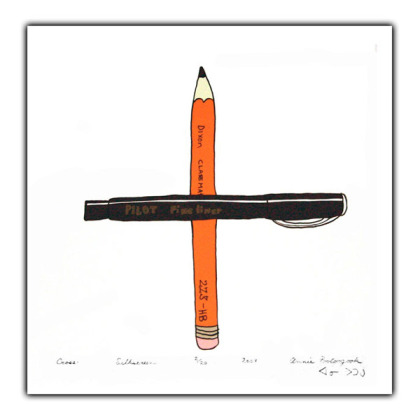
Annie Pootoogook_Cross_2007
Annie Pootoogook, born in 1969 in Cape Dorset, North West Territories – now Kinngait, Nunavut – began drawing at the age of 28, through the encouragement of the West Baffin Eskimo Cooperative. In 2006, she won Canada’s $50,000 Sobey Art Award, presented to artists age 39 or younger who have exhibited in Canada during the previous 18 months. In 2007 Pootoogook had drawings and lithographs at the 2007 Biennale de Montréal and also at the Basel Art Fair and Documenta 12 in Kassel, Germany.
.
Pootoogook’s drawings are often in a style / with subject matter outside of traditional Inuit visual artistic style / subject matter. We are very far from The Enchanted Owl when we look at a Pootoogook drawing. “Modern” technology – video games, TV – are frankly present, even while boredom may also be evident in her human figures. The artist’s drawing technique of carefully outlining shapes in black then filling them in with solid colour is perhaps even more “traditional”, more “handmade” than most Inuit prints of the last two generations; and her subject matter is the opposite: no fantastic birds but her bra, her eyeglasses; no nostalgic Creation myth depicting Sedna, the goddess of the sea, rather a memory of Pootoogook herself smashing bottles against a wall.
.
An Artist may show many aspects of Life – both the real and the unreal, the ideal and the unvarnished truth. And anyway, such words refer to an interconnected reality that makes Existence “full up” with Being. That’s why Pootoogook’s drawings have validity – without belittling what had become a narrow genre in Inuit art i.e.the depiction of remembered “traditional ways” of daily life plus endless charming and fanciful Arctic animals. By the time Annie Pootoogook was born (1969) most Inuit in the Canadian Arctic had been forceably re-settled into permanent communities through a methodical programme of the federal government with the RCMP; they were living in pre-fabricated houses, and their former nomadic way of life – following the caribou herds and living in summer encampments then igloos – was gone in a mere two generations. While hunger ceased the Inuit were no longer self-sufficient yet neither were they integrated; the “violence” of such cultural upheaval is still being felt in 2014. Pootoogook’s drawings of domestic abuse and “boozing” tell this unpretty truth – and yet there is gentleness and humour in her work too, plus a straightforward and unsensational point of view about sometimes depressing circumstances.
.
After winning the Sobey prize Pootoogook moved from Baffin Island down to Ottawa. She went “outside” – as some Northerners say. By all accounts her life in The South has been up and down – yet she has not given up drawing. Annie Pootoogook is the daughter of artists – mother Napachie and father Eegyvudluk Pootoogook – and the granddaughter of Pitseolak Ashoona (1904-1983), one of the original generation of Inuit women illustrators/printmakers. Her uncle, Kananginak Pootoogook (1935-2010), was a sculptor and printmaker, and was instrumental in the creation of the West Baffin Eskimo Cooperative in the 1950s. So: Creativity is in Annie Pootoogook’s blood; we will be hearing from her again.
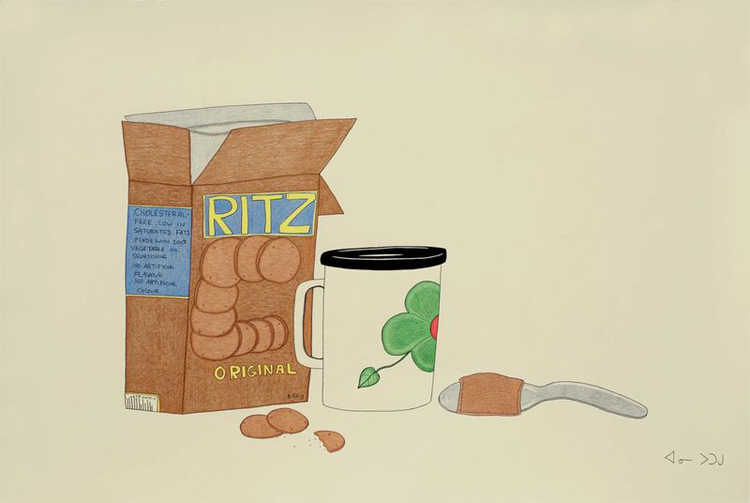
Annie Pootoogook_Ritz Crackers_2004
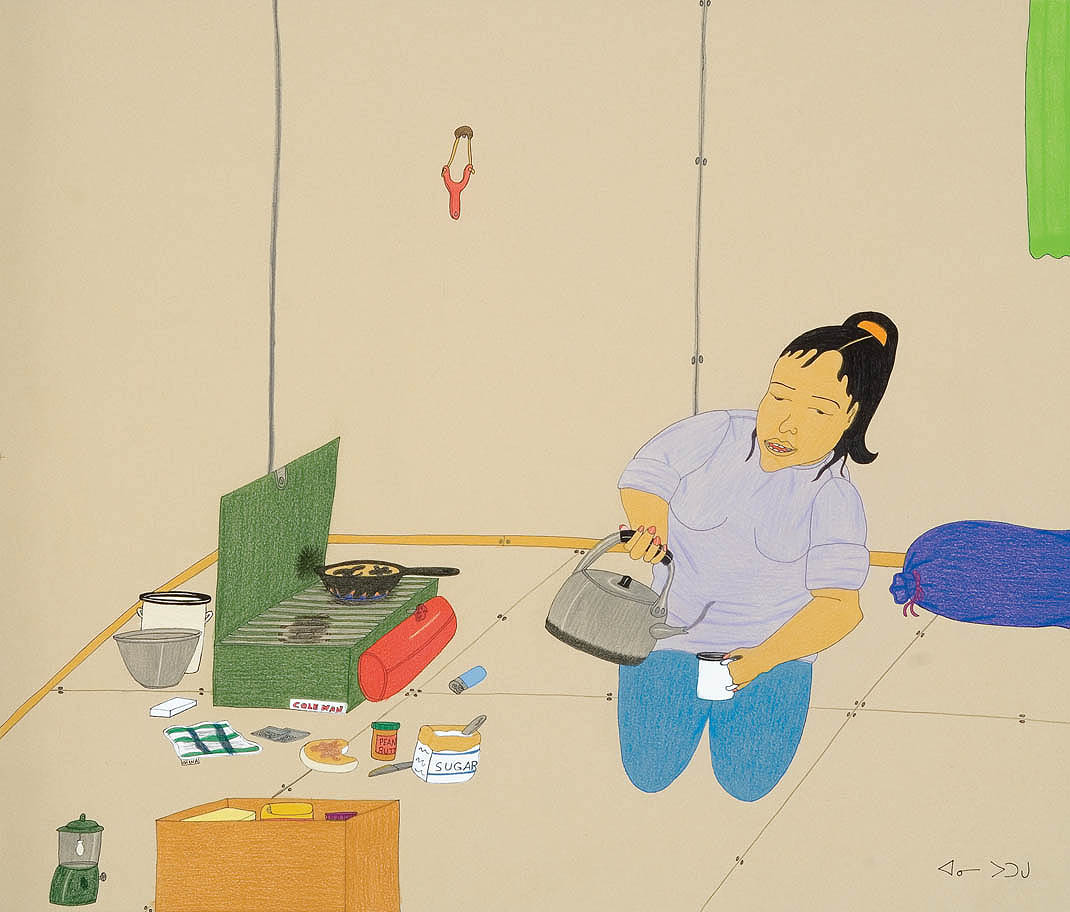
Annie Pootoogook_Woman Making Tea_wax crayon, graphite, felt- tip pen_2006
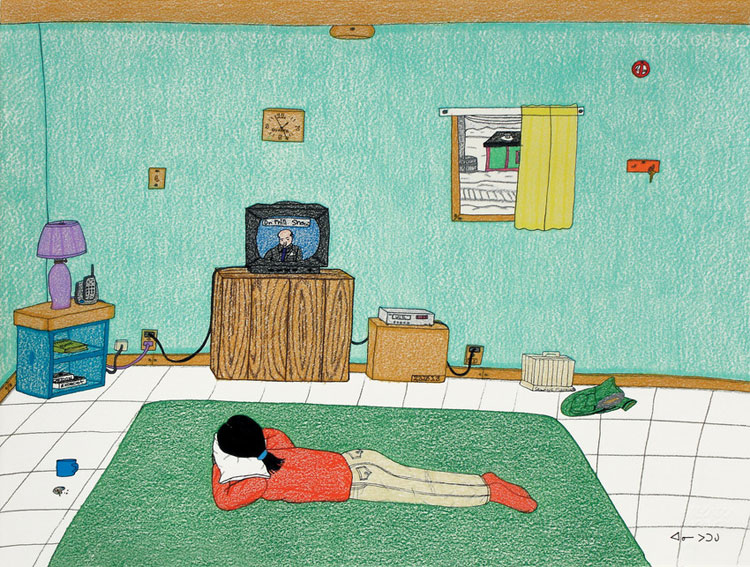
Annie Pootoogook_Dr. Phil_2006

Annie Pootoogook_Memory of My Life_Breaking Bottles_ink and pencil crayon on paper_2002
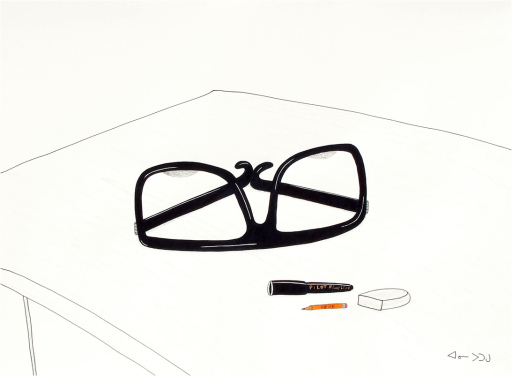
Annie Pootoogook_Glasses, pen, pencil, eraser_2006
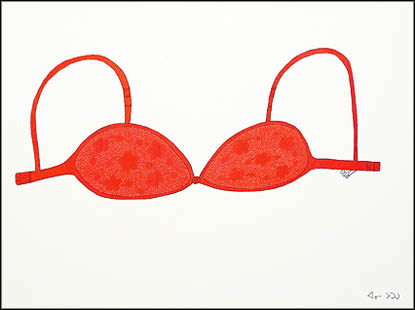
Annie Pootoogook_Red Bra
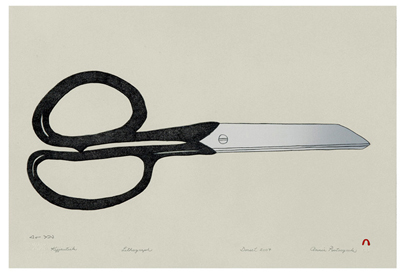
Annie Pootoogook_Scissors_Lithograph_2007
. . . . .
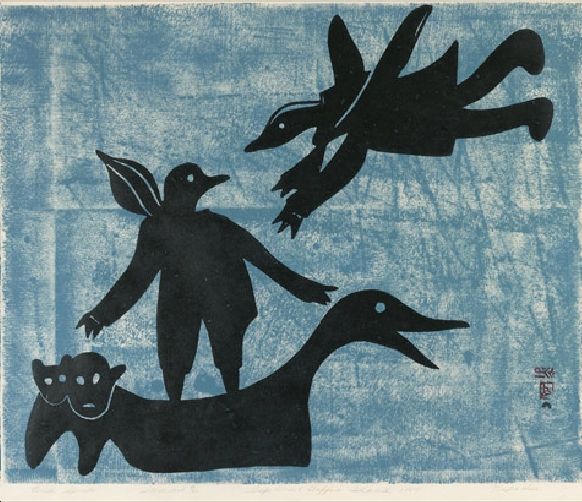
Napatchie Pootoogook_Bird Spirits_stonecut_1960
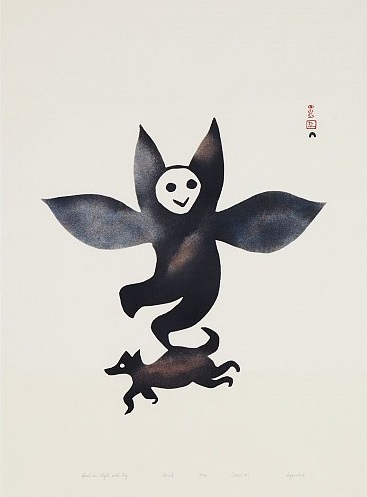
Eegyvudluk Pootoogook_Spirit in Flight with Dog_Stonecut_1961
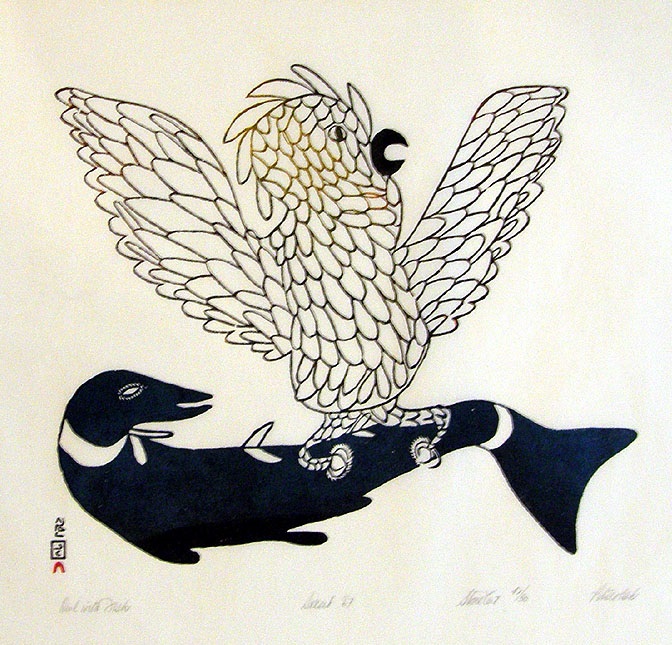
Pitseolak Ashoona_Owl with Fish_stonecut_1968
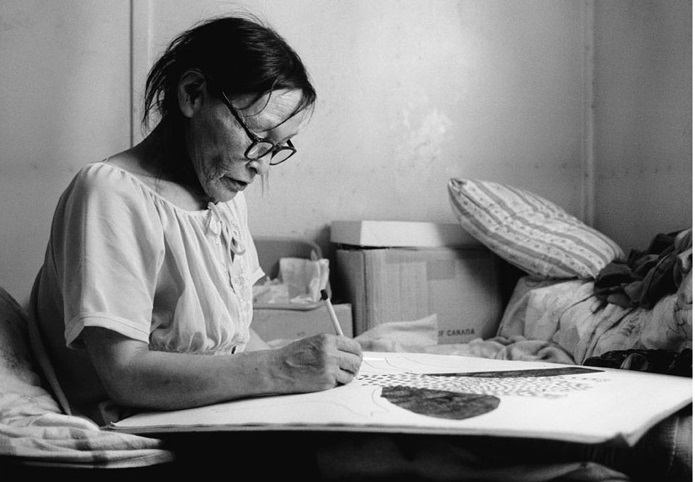
Pitseolak Ashoona at work on a drawing in 1971_photograph by John Reeves
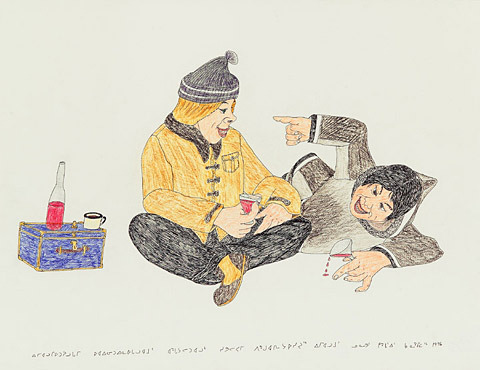
Kananginak Pootoogook_White man and Inuk_Drinking_1996

Annie Pootoogook outside the Rideau Centre in Ottawa making a drawing with coloured pencils_Summer of 2012_photograph by Alexei Kintero
ᕿᓐᓄᐊᔪᐊᖅ ᐋᓯᕙᒃ / Kenojuak Ashevak: Inuit Artist Pioneer
Posted: January 8, 2014 Filed under: English, IMAGES, Inuktitut Comments Off on ᕿᓐᓄᐊᔪᐊᖅ ᐋᓯᕙᒃ / Kenojuak Ashevak: Inuit Artist Pioneer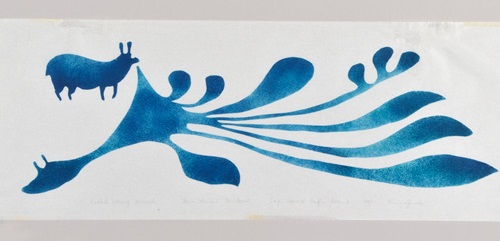
Kenojuak_Rabbit Eating Seaweed_1959
ᕿᓐᓄᐊᔪᐊᖅ ᐋᓯᕙᒃ (1927-2013)
Kenojuak Ashevak was born in 1927 at the Inuit camp of Ikirasaq on Baffin Island in the North West Territories of Canada. She died exactly one year ago today – January 8th – and we are honouring her now, one year later, because ZP did not ‘post’ during the month of January 2013.
.
One of the first women to make drawings in Cape Dorset during the 1950s, Kenojuak used graphite, coloured pencils and felt-tip pens. With the assistance of Inuit art promoter James Houston, Kenojuak made the transition to soapstone-cut print-making. Her first such print dates from 1959 and is called Rabbit Eating Seaweed. It is based on a needle-work and appliqué design she had made on a sealskin bag. Kenojuak would draw freely, with confidence in line and form, then would have her drawings transferred/cut into the print stones by one of the stone-cutters at the new West Baffin Eskimo Co-operative Workshop (“Senlavik”) which started up in 1959. After the stone-cutter had completed his incisions she would then apply one or two colours of inks to the printing surface. Sometimes the strong arms of Eegyvudluk Pootoogook would help apply the right paper-upon-stone pressure to complete the print. Kenojuak’s The Enchanted Owl, from 1960, is one of the most famous Canadian artworks internationally – instantly recognizable and emblematic of the 1960s and an “Idea” of The North.
.
Kenojuak was married three times and bore eleven children by her first husband, a hunter named Johnniebo Ashevak (1923-1972). At the time of her death from lung cancer in 2013, she was living in a wood-frame house in Kinngait (formerly Cape Dorset), Nunavut. A cheerful personality, Kenojuak was always humble about her artistic success, and thankful for the “gift” of her talent.
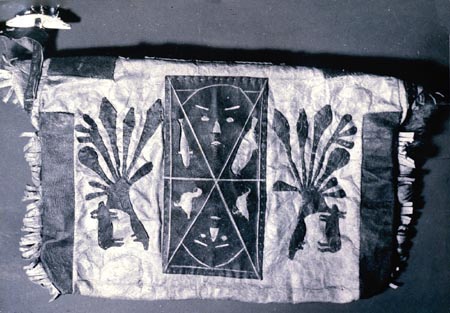
The sealskin bag made by Kenojuak in 1958 and from which she drew the inspiration for her first print_Rabbit Eating Seaweed
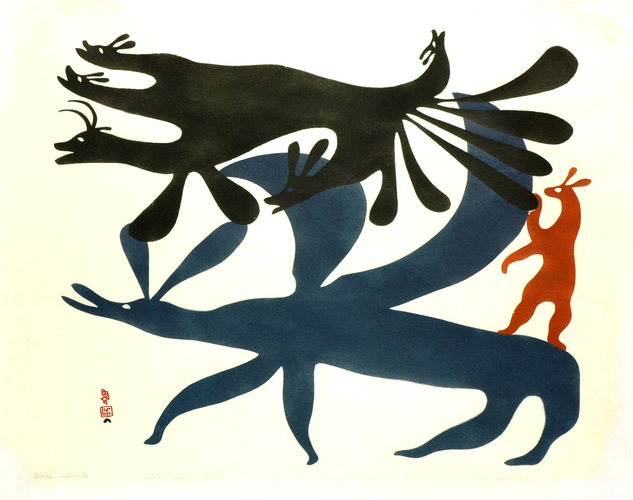
Kenojuak_Hare Spirits_sealskin stencil_1960
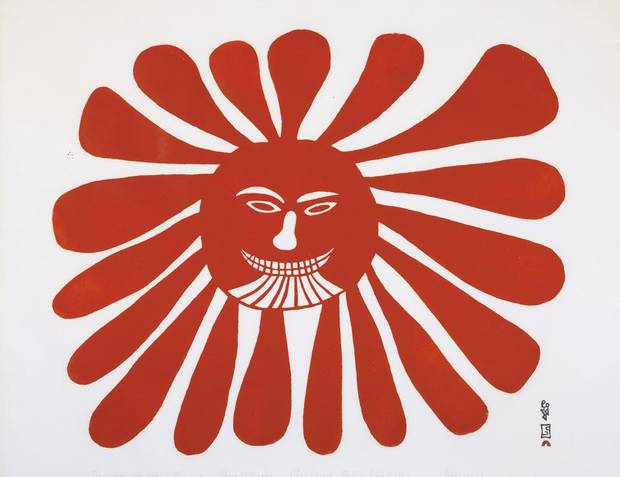
Kenojuak_The Woman who lives in the Sun_1960
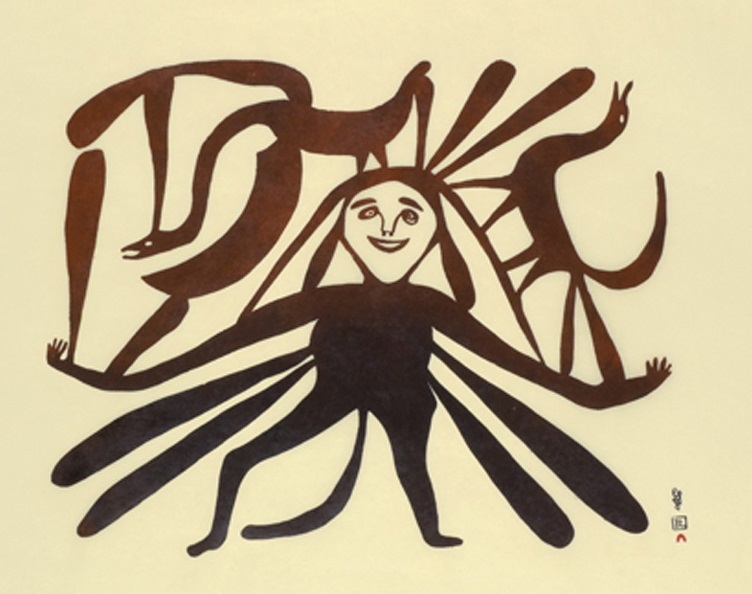
Kenojuak_Mother Earth_1961
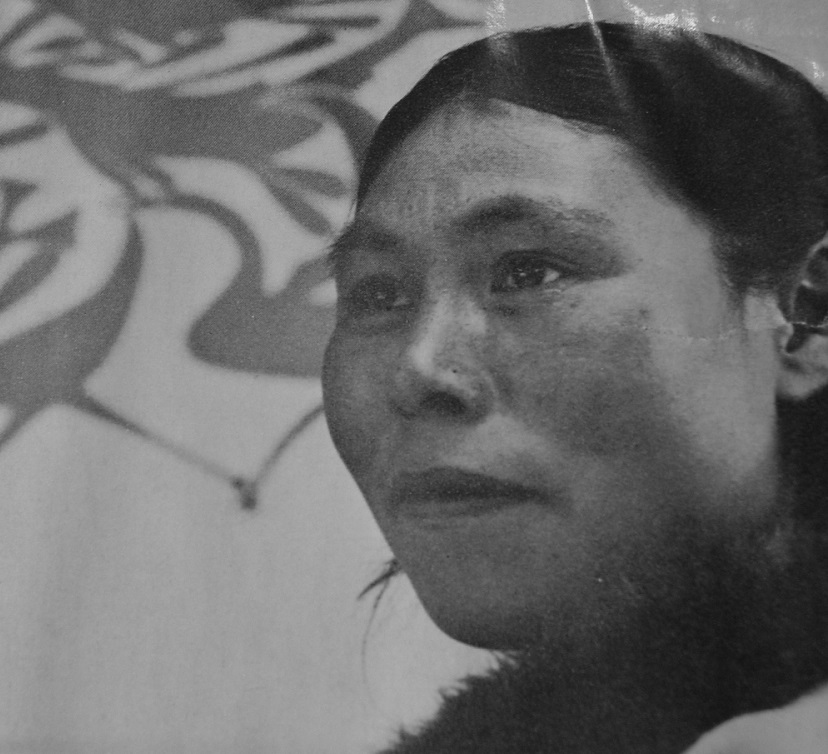
Kenojuak photographed in 1963 in front of one of her prints
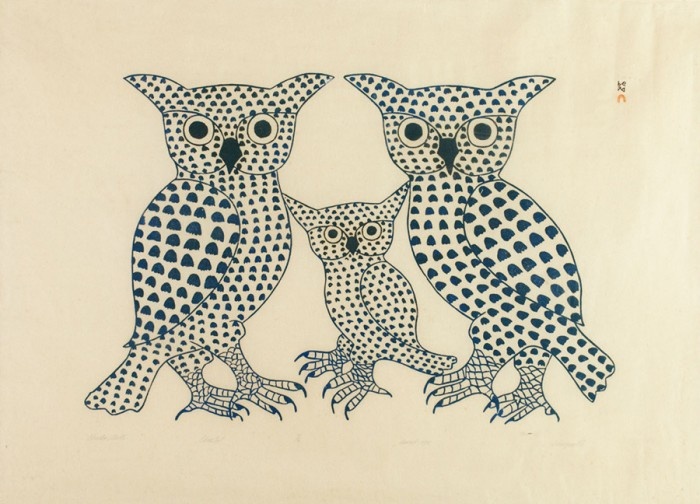
Kenojuak_Winter Birds_1975
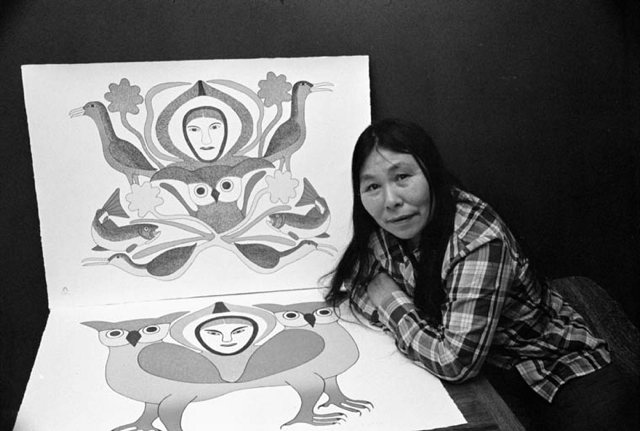
Kenojuak in 1980
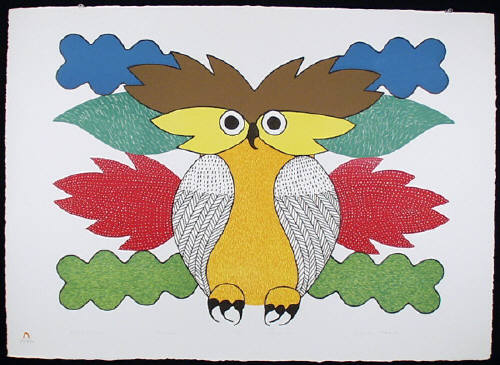
Kenojuak_Spirit of the Owl_lithograph_1980
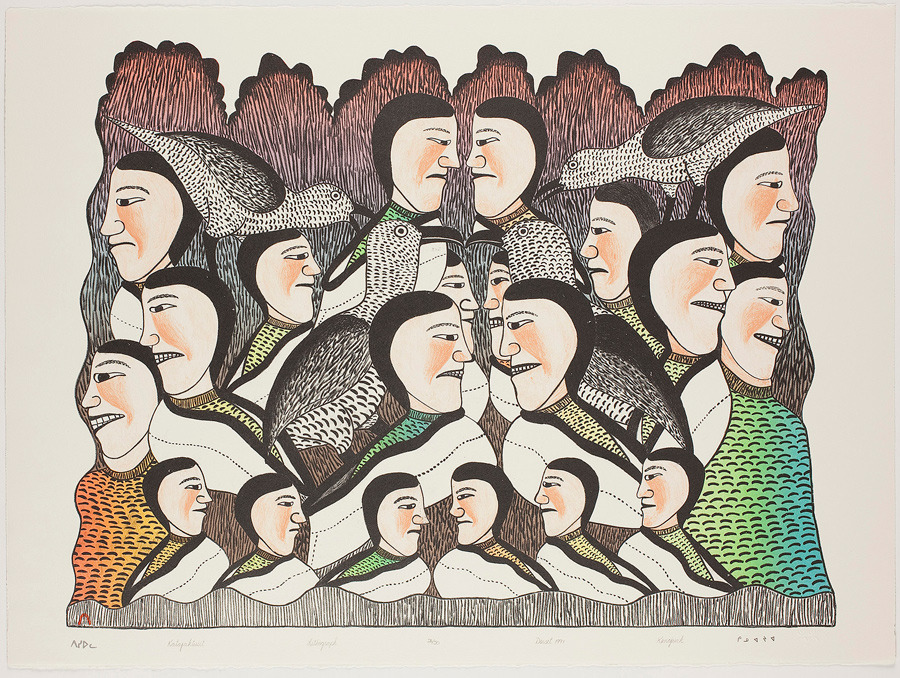
Kenojuak_Katajaktuiit_Throat Singers Gathering_1991
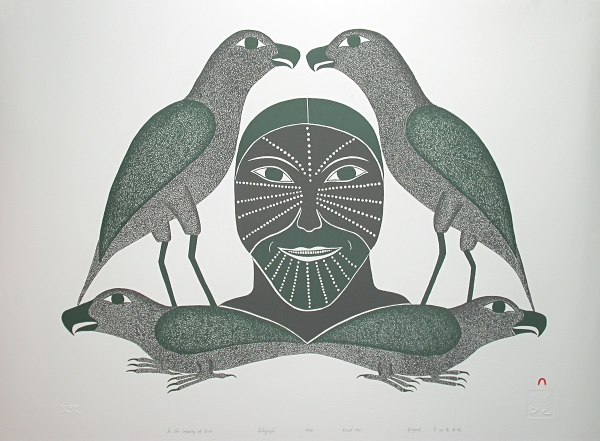
Kenojuak_In the company of birds_lithograph_1996
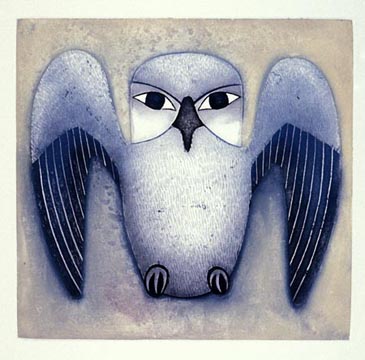
Kenojuak_Silver Owl_aquatint_1999
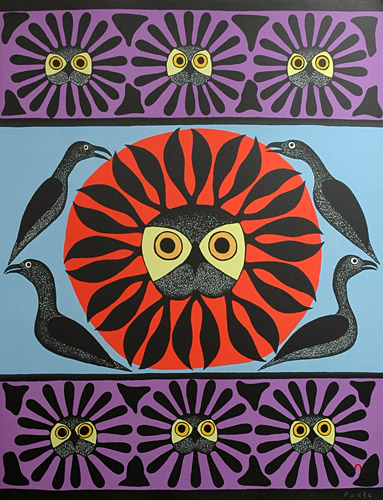
Kenojuak_Owl’s Treasure_2002
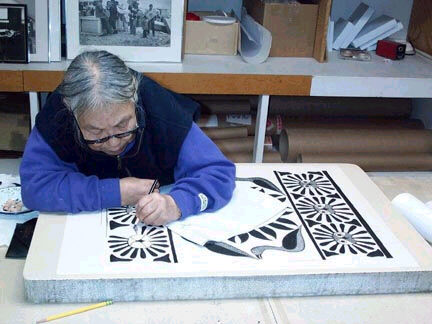
Kenojuak at work on Owl’s Treasure in 2002
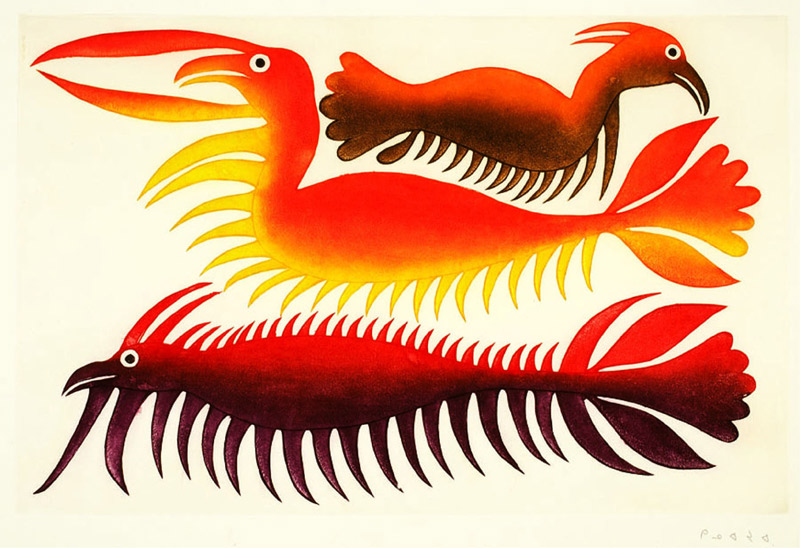
Kenojuak_Submerged Spirits_etching and aquatint_2002
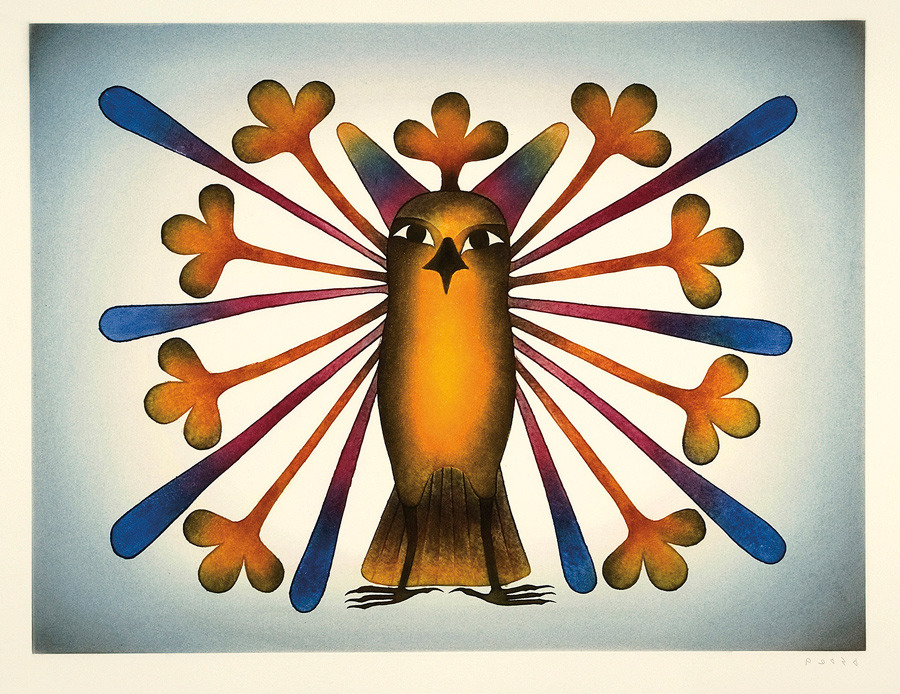
Kenojuak_Grande Dame_2009
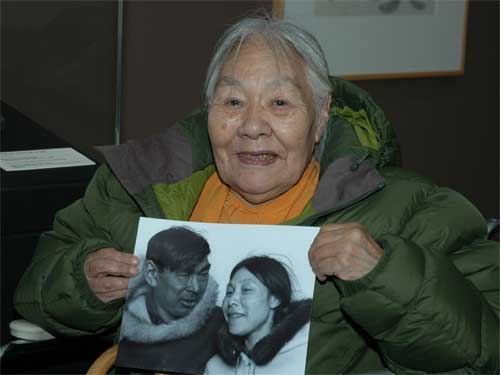
Kenojuak in 2009, holding a 1968 photograph of herself with husband Johnniebo Ashevak
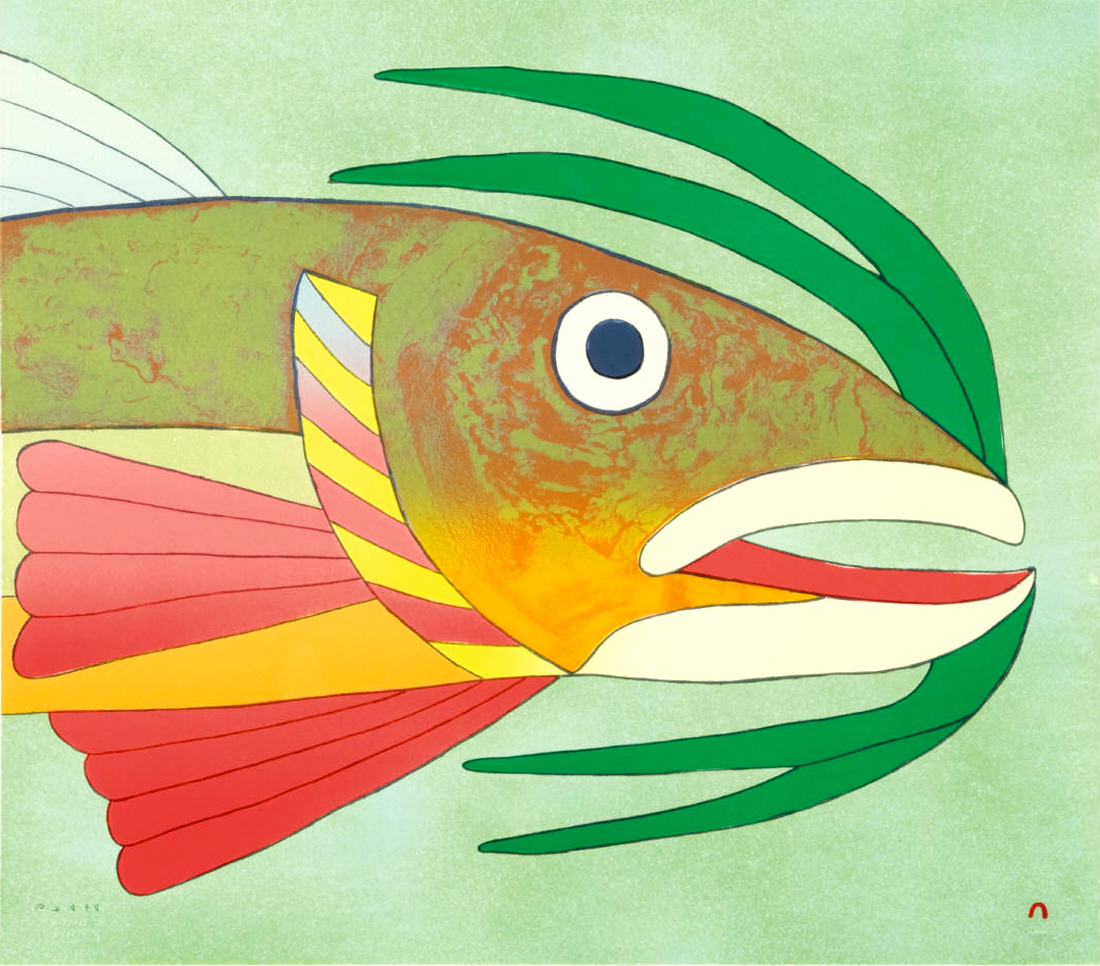
Kenojuak_Iridescent Char_lithograph_2009
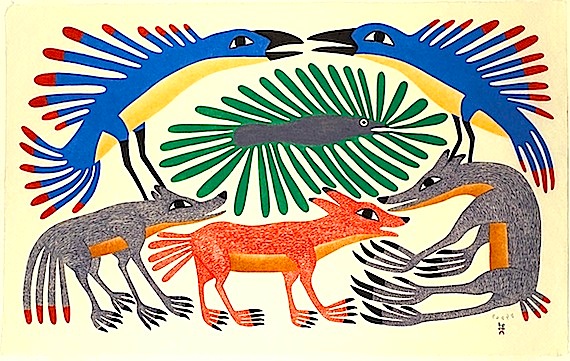
Kenojuak_Six-part Harmony_2011
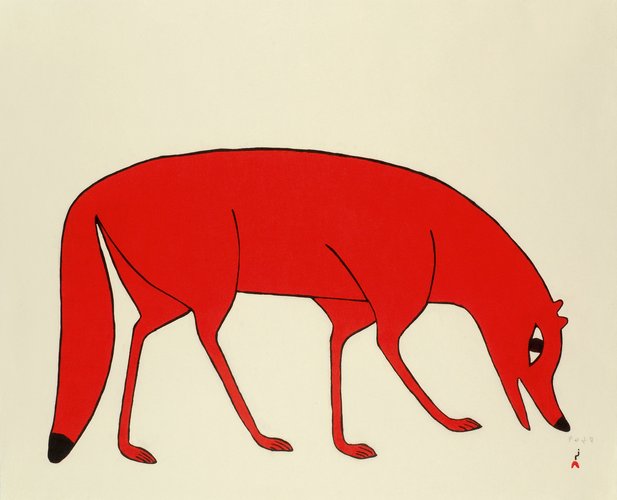
Kenojuak_Red Fox_stonecut_2012
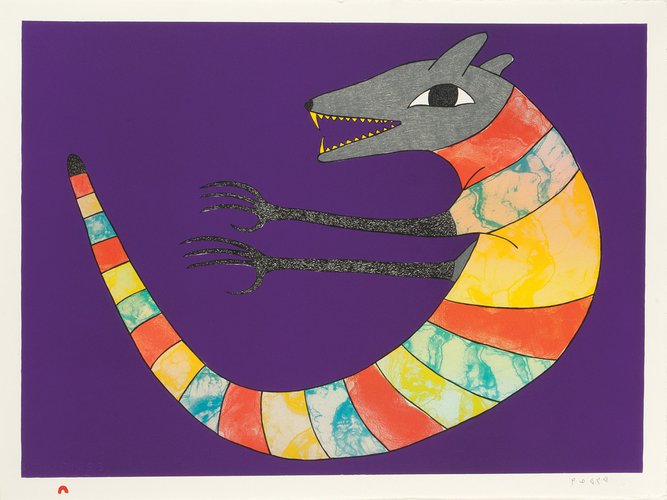
Kenojuak_Serpentine Wolf_lithograph_2013
. . . . .
Elyas Mulu Kiros: “Bonito y Sabroso”, “Winter Blues” and “Genuine Street”
Posted: January 7, 2014 Filed under: Elyas Mulu Kiros, English Comments Off on Elyas Mulu Kiros: “Bonito y Sabroso”, “Winter Blues” and “Genuine Street”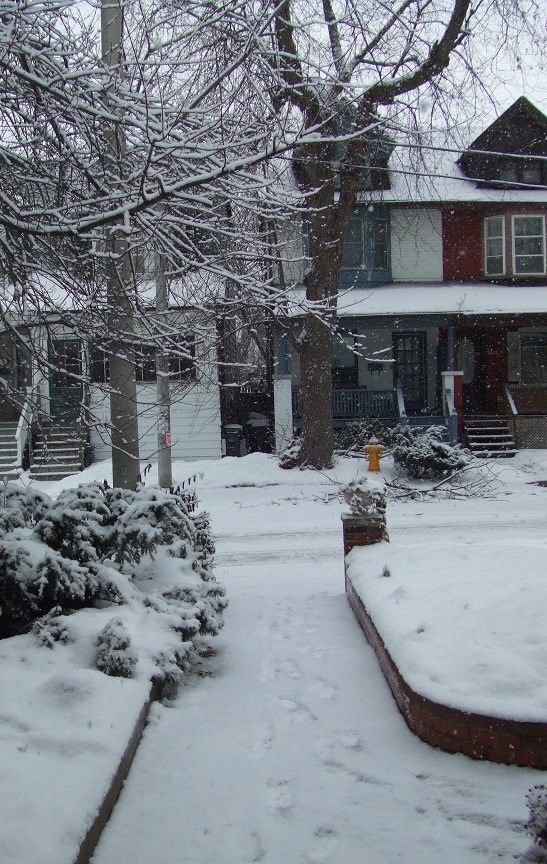
Elyas Mulu Kiros
“I just want to say…” (Winter Blues)
.
“I am by the window:
Observing rapid snowflakes falling,
On the concrete
Outside this cold apartment,
Without sticking.
.
I just want to say
That the view makes me think
Of the days and nights
We used to spend cuddling
To keep each other warm;
But that is now a memory
I keep, locked in a room,
Deep inside this melancholic heart.
.
Dear, I may have contributed more
to your unhappiness and less
to your joy, but I just want to say
You always have a special place
in my heart—
Whether you believe me or not.
I mean it.”
.
After writing that letter
On a mental paper,
He folded the paper
And then put it in a mental envelope—
Only to mail it to a mental fire
That burned it before
He picked a real pen and paper.
.
He then just played Winter Blues,
Waiting for inspiration.
. . .
“Bonito y Sabroso”
.
Sometimes life may be just so so
But it is also bonito and sabroso.
Look at it through young eyes.
Should you believe not this:
Sometimes life may be dull and tart
But it is also beautiful and sweet.
Feel it with a young state of mind.
Should it grow old, embittered?
Never stop learning – Continue balancing.
. . .
“Genuine Street”
.
Let you & I meet
half-way on Genuine Street.
Only then may we create a space
that may help us
reshape or challenge
our fixed or biased
self-other-awareness.
.
Otherwise, if we just wait
for the other to come meet us
in our comfort zone
and expect him or her to change,
then we must not be genuine
or serious.
. . .
All poems © 2013 Elyas Mulu Kiros
. . .
Elyas Mulu Kiros is an Ethiopian poet living in New York City. He writes in English and in Amharic. He keeps a WordPress site called Kweschn: Horn of Africa and Beyond. http://kweschn.wordpress.com/
. . . . .
Rubén Darío: Los Tres Reyes Magos / The Three Wise Kings
Posted: January 6, 2014 Filed under: English, Rubén Darío, Spanish | Tags: Rubén Darío Comments Off on Rubén Darío: Los Tres Reyes Magos / The Three Wise Kings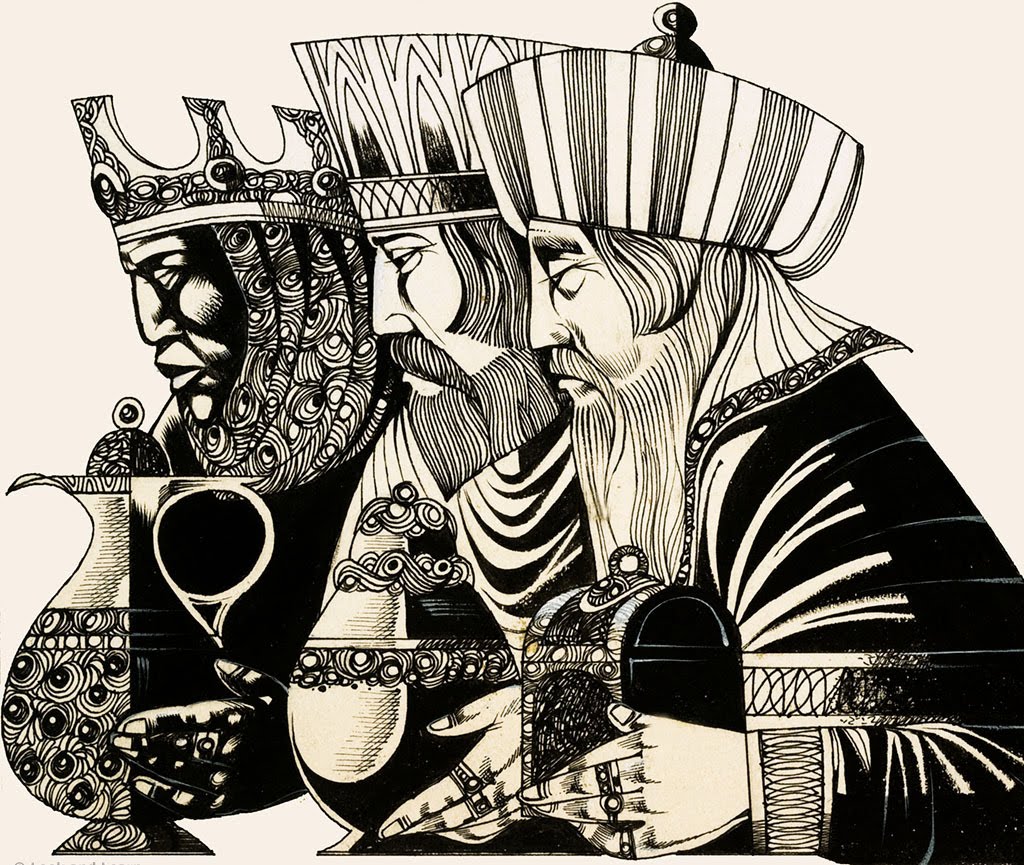
Rubén Darío (Nicaragua, 1867-1916)
Los Tres Reyes Magos
.
Yo soy Gaspar. Aquí traigo el incienso.
Vengo a decir: La vida es pura y bella.
Existe Dios. El amor es inmenso.
¡Todo lo sé por la divina Estrella!
.
Yo soy Melchor. La mirra aroma todo.
Existe Dios. Él es la luz del día.
La blanca flor tiene sus pies en lodo.
¡Y en el placer hay la melancolía!
.
Yo soy Baltasar. Traigo el oro. Aseguro
que existe Dios. Él es el grande y fuerte.
Todo lo sé por el lucero puro
que brilla en la diadema de la Muerte.
.
Gaspar, Melchor y Baltasar, callaos.
Triunfa el Amor, y a su fiesta os convida.
¡Cristo resurge, hace la luz del caos
y tiene la corona de la Vida!
. . .
Rubén Darío
(Nicaraguan poet and founder of the “Modernismo” literary movement, 1867-1916)
The Three Wise Kings
.
My name is Kaspar. I the incense bear.
The glimmer of the Star has made me wise.
I say that love is vaster than the skies.
God exists. And Life is pure and fair.
.
My name is Melchior. And my myrrh scents all.
There is a God. He is the light of the morn.
And the fairest blossoms from dust are born,
And joy is shadowed by a melancholic pall.
.
My name is Balthazar. I bring a wreath
Of Orient gold, my gift. I come to say
That God does exist. I know all this by the ray
Of starry light upon the crown of Death.
.
Balthazar, Melchior, Kaspar – be all ye still.
Love triumphs and has bid you to His feast.
Radiance fills the chaos void, and night has ceased:
Wearing Life’s crown, Christ comes to work His Will!
.
English translation by Nicaraguan poet Salomon de la Selva
Versión inglés por Salomon de la Selva (poeta nicaragüense)
. . . . .
Poema para Epifanía: “El Viaje de los Reyes Magos” / Poem for Epiphany: “The Journey of The Magi”: T.S. Eliot
Posted: January 6, 2014 Filed under: English, Spanish, T. S. Eliot Comments Off on Poema para Epifanía: “El Viaje de los Reyes Magos” / Poem for Epiphany: “The Journey of The Magi”: T.S. Eliot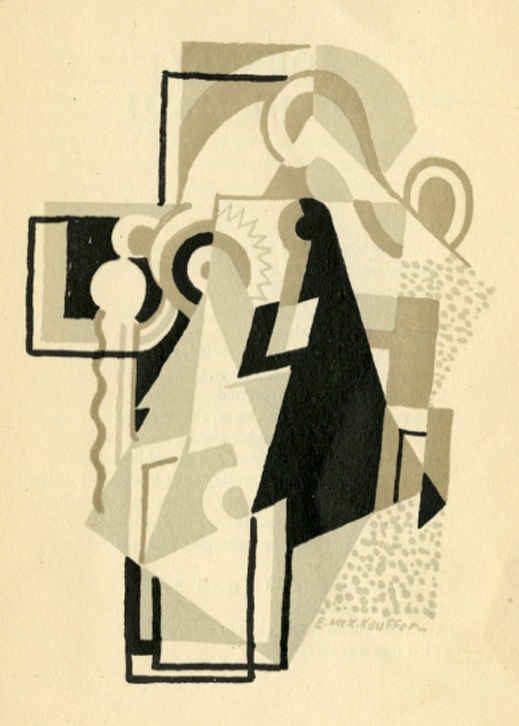
ZP_Ilustración por Edward McKnight Stauffer de la edición 1927 del poema_Edward McKnight Stauffer’s illustration for the original 1927 edition of Eliot’s poem
Thomas Stearns Eliot (T.S.Eliot) (1888-1965)
“El Viaje de los Reyes Magos” (1927)
.
“Fue una partida fría, justamente
La época peor del año para un viaje,
Y un largo viaje como el nuestro:
Los caminos ruinosos y los climas punzantes,
La verdadera muerte del invierno.”
Y los camellos se llagaban,
Las patas lastimadas, refractarios,
Se echaban en la nieve derretida.
Sentíamos a veces la añoranza
De los palacios en verano
Sobre suaves laderas, las terrazas,
Y las chicas sedosas trayendo los refrescos.
Luego, los camelleros con sus protestas y blasfemias,
Que huían, o pedían licores y mujeres,
Y en la noche los fuegos se apagaban,
Y no encontrábamos refugios, y eran
Hostiles las ciudades, desconfiados los pueblos
Y las aldeas sucias, todos recargando los precios:
Fueron días difíciles. Al fin,
Preferimos viajar toda la noche,
Durmiendo a ratos,
Con las voces cantando en nuestro oído,
Diciéndonos que todo, todo era una locura.
.
Luego, al alba, bajamos hasta un valle templado,
Húmedo, al pie de la línea de nieve, fragante de espesura,
Con un torrente y un molino de agua que batía la sombra con sus aspas,
Y tres árboles solos contra un cielo cercano.
Y un viejo caballo blanco huyó al galope sobre la pradera.
Después llegamos a una fonda que encima del dintel tenía hojas de parra,
Por una puerta abierta seis manos que jugaban a los dados por monedas de plata
Y unos pies que pateaban unos odres vacíos.
Pero no había información, y continuamos
Y así llegamos al anochecer, encontrando el lugar
En el momento justo… Fue (me podrían decir) satisfactorio.
.
Todo esto fue hace mucho, lo recuerdo,
Y lo haría de nuevo, pero aclarando antes,
Esto aclarando,
Esto: ¿fuimos guiados
Durante todo ese camino para
Un Nacimiento o una Muerte?
Hubo, por cierto, un Nacimiento,
No hay dudas, lo pudimos comprobar.
Yo había visto nacimientos y muertes,
Pero había pensado que eran algo distinto;
Este otro Nacimiento para nosotros fue
Una agonía ardua y amarga, como la Muerte, nuestra muerte.
Regresamos así a nuestros países, a nuestros Reinos,
Pero ya no hubo paz para nosotros,
Aquí en los viejos usos, con un pueblo
De extraños aferrados a sus dioses.
Yo querría morir con otra muerte.
.
© 1997 Versión de Pablo Anadón (poeta/traductor argentino)
. . .
Thomas Stearns Eliot (T.S.Eliot) (1888-1965)
“The Journey Of The Magi” (1927)
.
‘A cold coming we had of it,
Just the worst time of the year
For a journey, and such a long journey:
The ways deep and the weather sharp,
The very dead of winter.’
And the camels galled, sorefooted, refractory,
Lying down in the melting snow.
There were times we regretted
The summer palaces on slopes, the terraces,
And the silken girls bringing sherbet.
Then the camel men cursing and grumbling
and running away, and wanting their liquor and women,
And the night-fires going out, and the lack of shelters,
And the cities hostile and the towns unfriendly
And the villages dirty and charging high prices:
A hard time we had of it.
At the end we preferred to travel all night,
Sleeping in snatches,
With the voices singing in our ears, saying
That this was all folly.
.
Then at dawn we came down to a temperate valley,
Wet, below the snow line, smelling of vegetation;
With a running stream and a water-mill beating the darkness,
And three trees on the low sky,
And an old white horse galloped away in the meadow.
Then we came to a tavern with vine-leaves over the lintel,
Six hands at an open door dicing for pieces of silver,
And feet kicking the empty wine-skins.
But there was no information, and so we continued
And arriving at evening, not a moment too soon
Finding the place; it was (you might say) satisfactory.
.
All this was a long time ago, I remember,
And I would do it again, but set down
This, set down
This: Were we led all that way for
Birth or Death? There was a Birth, certainly
We had evidence and no doubt. I had seen birth and death,
But had thought they were different; this Birth was
Hard and bitter agony for us, like Death, our death.
We returned to our places, these Kingdoms,
But no longer at ease here, in the old dispensation,
With an alien people clutching their gods.
I should be glad of another death.
. . . . .
C Рождеством – C новым годом! Борис Пастернак стихи / Two poems for Russian Christmas and New Year: Boris Pasternak
Posted: January 6, 2014 Filed under: Boris Pasternak, English, Russian Comments Off on C Рождеством – C новым годом! Борис Пастернак стихи / Two poems for Russian Christmas and New Year: Boris Pasternak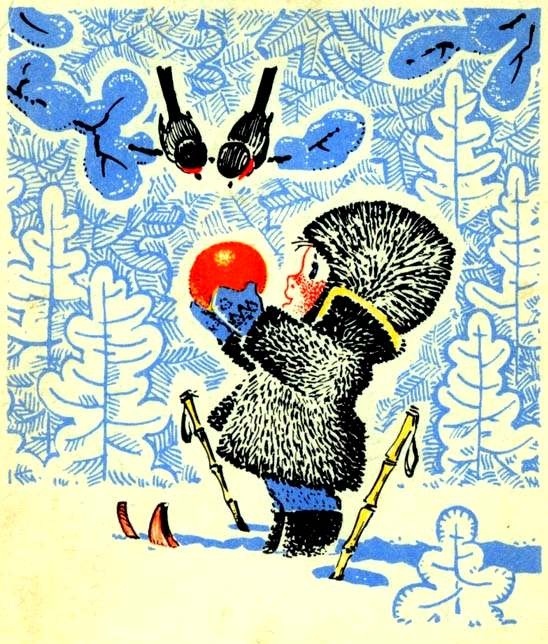
Soviet-era Christmas greeting card from 1960
Boris Pasternak (1890-1960)
“Snow is falling”
.
Snow is falling, snow is falling.
Geranium flowers reach
for the blizzard’s small white stars
past the window’s edge.
.
Snow is falling, all is lost,
the whole world’s streaming past:
the flight of steps on the back stairs,
the corner where roads cross.
.
Snow is falling: snow is falling,
not snowflakes stealing down,
Sky parachutes to earth instead,
in his worn dressing gown.
.
As if he’s playing hide-and-seek,
across the upper landings,
a mad thing, slowly sneaks,
Sky creeps down from the attic.
.
It’s all because life won’t wait,
before you know, it’s Christmas here.
And look, in a minute,
suddenly it’s New Year.
.
Snow is falling, deeper – deeper.
Maybe, with that same stride
in that same tempo,
with that same languor,
Time’s going by?
.
Year after year, perhaps,
passing, as snow’s falling,
like words in a poem?
Snow’s falling: snow’s falling.
Snow is falling, all is lost –
the whitened passers-by,
leaves’ startled showing,
the corners where roads cross.
. . .
Борис Пастернак (1890-1960)
Снег идет
.
Снег идет, снег идет.
К белым звездочкам в буране
Тянутся цветы герани
За оконный переплет.
Снег идет, и все в смятеньи,
Bсе пускается в полет,
Черной лестницы ступени,
Перекрестка поворот.
Снег идет, снег идет,
Словно падают не хлопья,
А в заплатанном салопе
Сходит наземь небосвод.
Словно с видом чудака,
С верхней лестничной площадки,
Крадучись, играя в прятки,
Сходит небо с чердака.
Потому что жизнь не ждет.
Не оглянешься и святки.
Только промежуток краткий,
Смотришь, там и новый год.
Снег идет, густой-густой.
В ногу с ним, стопами теми,
В том же темпе, с ленью той
Или с той же быстротой,
Может быть, проходит время?
Может быть, за годом год
Следуют, как снег идет,
Или как слова в поэме?
Снег идет, снег идет,
Снег идет, и все в смятеньи:
Убеленный пешеход,
Удивленные растенья,
Перекрестка поворот.
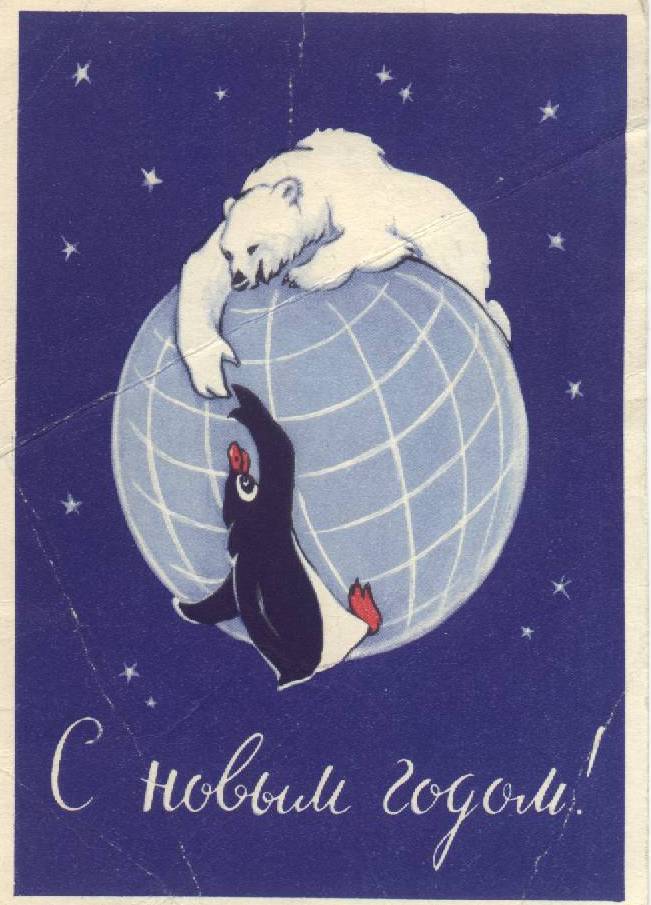
Soviet-era Happy New Year holiday card_The two “Poles” meet and greet.
“Winter Sky”
.
Ice-chips plucked whole from the smoke,
the past week’s stars all frozen in flight,
Head over heels the skater’s club goes,
clinking its rink with the peal of night.
.
Step slow, slower, slow-er, skater,
pride carving its trace as you race by.
each turn’s a constellation cut there,
scratched by a skate in Norway’s sky.
.
The air is fettered in frozen iron.
Oh, skaters! There – it’s all the same,
that, like snake’s eyes set in ivory,
night’s on earth, a domino game:
.
that moon, a numb hound’s tongue
is there, frozen tight: that mouths like
the forgers of coins – are stung,
filled with lava of breathtaking ice.
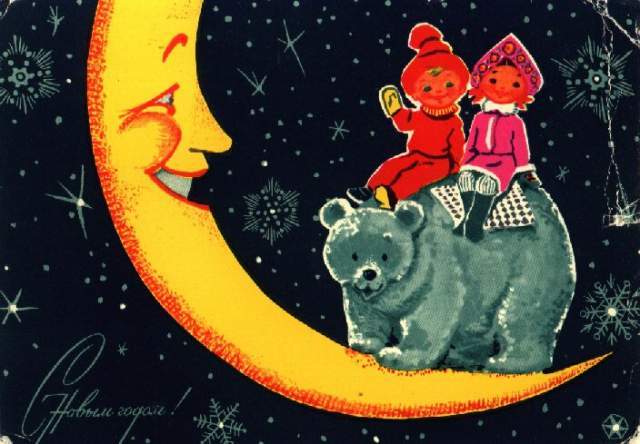
Vintage New Year’s greeting card_USSR_1950s
Зимнее небо
.
Цельною льдиной из дымности вынут
Ставший с неделю звездный поток.
Клуб конькобежцев вверху опрокинут:
Чокается со звонкою ночью каток.
.
Реже-реже-ре-же ступай, конькобежец,
В беге ссекая шаг свысока.
На повороте созвездьем врежется
В небо Норвегии скрежет конька.
.
Воздух окован мерзлым железом.
О конькобежцы! Там — все равно,
Что, как глаза со змеиным разрезом,
Ночь на земле, и как кость домино;
.
Что языком обомлевшей легавой
Месяц к скобе примерзает; что рты,
Как у фальшивомонетчиков, — лавой
Дух захватившего льда налиты.
. . . . .
Jesucristo, el Gran Chamán: las pinturas de Norval Morrisseau, el mejor pintor canadiense del siglo XX / Jesus Christ, the Shaman: the paintings of Norval Morrisseau, Canada’s greatest painter of the 20th century
Posted: December 25, 2013 Filed under: English, IMAGES, Jesucristo el Gran Chamán: las pinturas de Norval Morrisseau / Jesus Christ the Shaman: the paintings of Norval Morrisseau, Spanish | Tags: ᐅᓴᐘᐱᑯᐱᓀᓯ, Norval Morrisseau Comments Off on Jesucristo, el Gran Chamán: las pinturas de Norval Morrisseau, el mejor pintor canadiense del siglo XX / Jesus Christ, the Shaman: the paintings of Norval Morrisseau, Canada’s greatest painter of the 20th century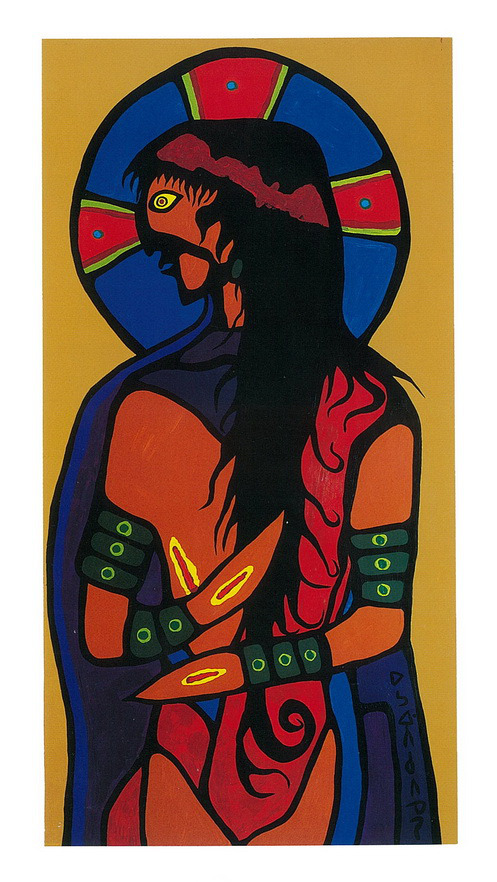
Norval Morrisseau_Jesucristo el Indio_Indian Jesus Christ_1974

Norval Morrisseau_El Infante Jesús_Escena de Natividad_Detalle_The Infant Jesus_Nativity Scene_Detail_acrylic on canvas_1972
Sólo es que mis pinturas te recordan que eres Indio. En algún lugar, dentro, somos todos Indios. Entonces ahora cuando me hago amigo de tí, estoy intentando suscitar en tí el ser Indio – para que creerás en Todo como Sagrado.
(Norval Morrisseau / ᐅᓴᐘᐱᑯᐱᓀᓯ 1932-2007)
.
My paintings only remind you that you’re an Indian. Inside somewhere, we’re all Indians. So now, when I befriend you, I’m trying to get the best Indian, bring out the Indianness in you, to make you think Everything Is Sacred.
(Norval Morrisseau / ᐅᓴᐘᐱᑯᐱᓀᓯ 1932-2007)

Norval Morrisseau_Transformación de un Chamán con Osos _Shaman Transforming with Bears_1986
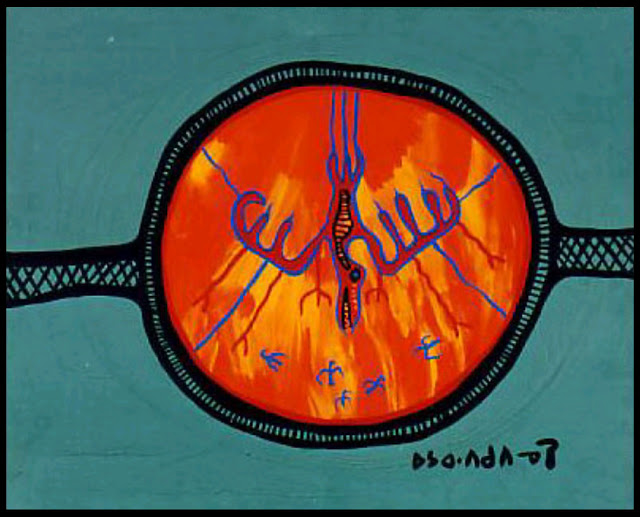
Norval Morrisseau_Pájaro de Trueno y Golondrinas_Thunderbird and Swallows
Desde siempre estoy atraído por las pinturas religiosas, pero únicamente aquellas que tienen una naturaleza mística y supernatural – por ejemplo, la escultura de Santa Teresa por Bernini. Me da “vibraciones” – cuando cierro los ojos puedo sentirlas. Eso es gran Arte – y provoca en mí un hormigueo sexual. También occurre con San Sebastián. Pero es la figura del Jesucristo que es, para mí, la figura dominante. Así que por eso Cristo es El Gran Chamán – El Mejor. Así que por eso ciertas visiones religiosas son tan complejas y difícil explicar a la gente. Pues cuando miras mis pinturas estás mirando mis “visiones” – lo que sea que sean.
.
I have always been attracted to religious paintings, but only the ones that had that mystical or supernatural quality in them, especially Saint Teresa by Bernini. Just looking at Saint Teresa I get vibrations from it. I can close my eyes and feel them. That’s great art, and it brings on that tingling sexual feeling. Other saints, like Saint Sebastian, do that as well. But the Christ figure was always the one that was dominant for me.That’s why I say that Christ to me is still The Greatest Shaman, and that is why some religious visions are so complex – and so very hard to explain to people. So whenever you’re looking at my pictures, you are looking at my visions – whatever they may be.
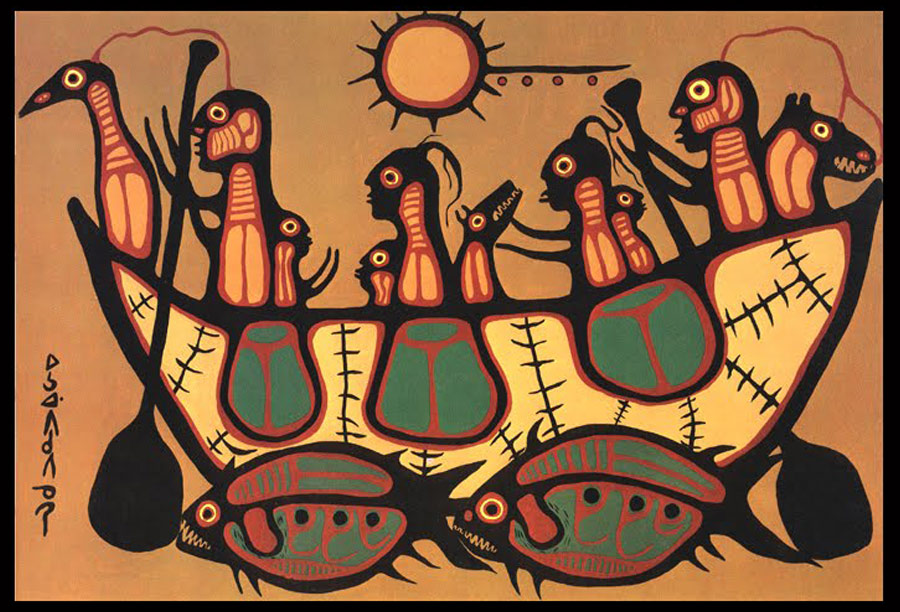
Norval Morrisseau_Desplazamiento_La Gran Inundación_Migration_The Great Flood_1973

Norval Morrisseau_Madre y Bebé_Mother and Child_1969
Nosotros – los Nativos – creen en este dicho: Nuestro Dios es Nativo. Y es La Gran Deidad de los Cinco Planos. Somos “ni pro ni contra”, hablamos ni del Cristo ni de Dios. Decimos: Déjalo estar. Seguimos el Espíritu en su Paso Interior del Alma vía actitudes y atenciones. Recuerda: Estamos en una Escuela Grande…y El Maestro Interior nos enseña Experiencia – durante muchas Vidas.
.
We Natives believe in the following saying: Our God is Native. The Great Deity of the Five Planes is So. We are neither for nor against. We speak not of Christ nor of God. We say: Let them be. We follow the Spirit on its Inward Journey of Soul through attitudes and attentions. Remember: We are all in a Big School and the Inner Master teaches us Experience – over many Lifetimes!
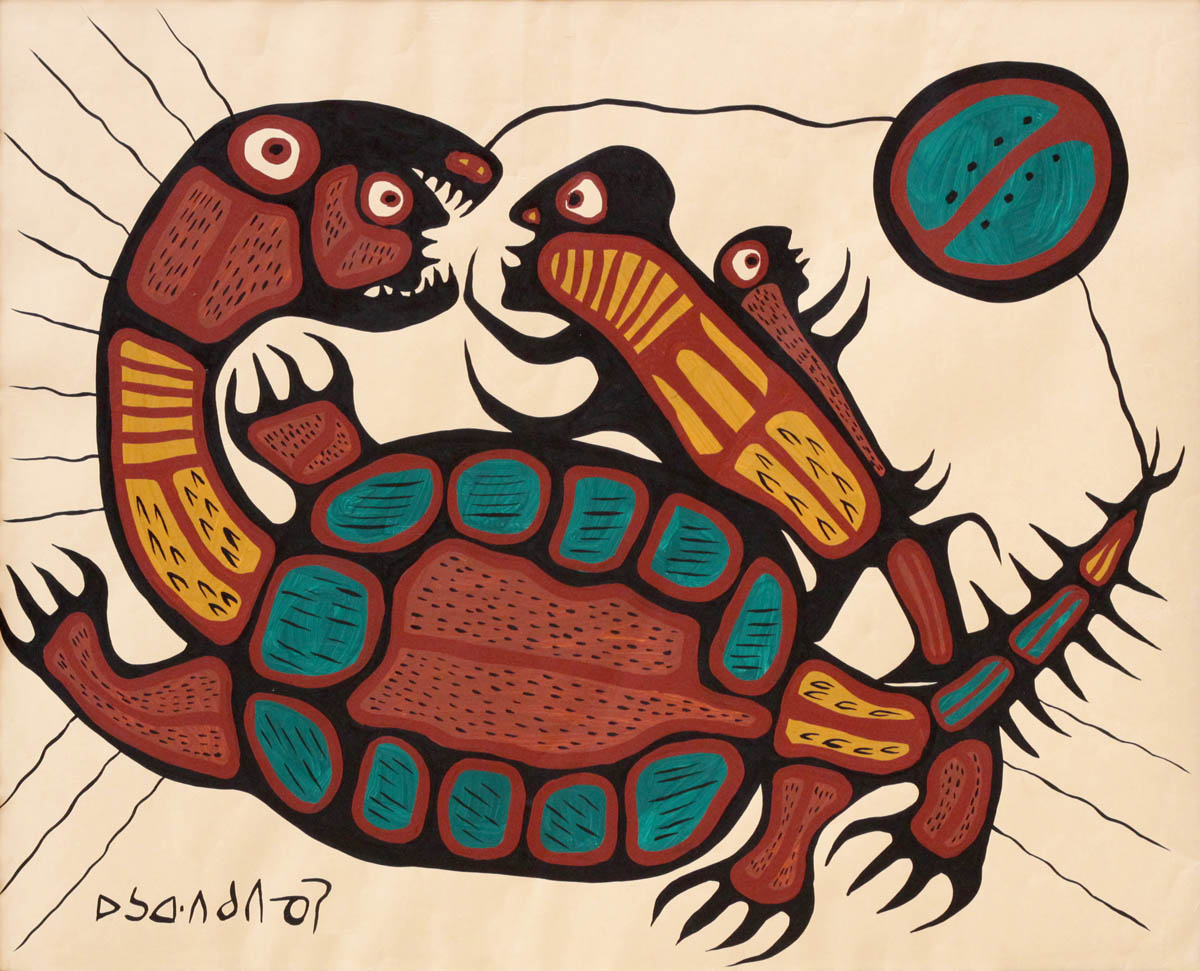
Norval Morrisseau_Creación _Creation_1970

Norval Morrisseau_Retrato del Artista como el Jesucristo_Portrait of the Artist as Jesus Christ_1966

Norval Morrisseau_Autoretrato devorado por demonios_Selfportrait devoured by demons_1964
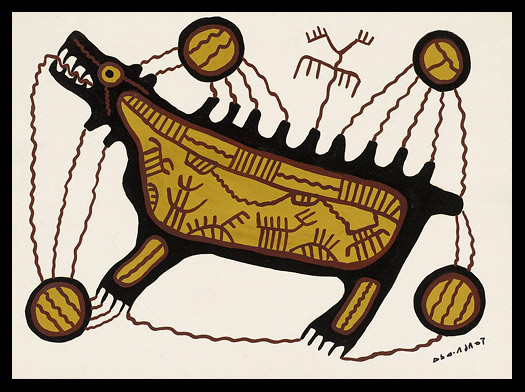
Norval Morrisseau_Oso sagrado del Midawiin Ojibwa_Ojibwa Midawiin Sacred Bear_circa 1962
. . . . .
“Di Gud Nyuuz bout Jiizas…” / El Nacimiento de Jesús / Jezi te fèt lavil Betleyèm / Jesus’ Birth in Bethlehem: Matyu 2:1-11 / Mateo 2:1-11 / Matye 2:1-11 / Matthew 2:1-11
Posted: December 24, 2013 Filed under: Creole / Kréyòl, English, English: Jamaican Patois, English: Middle English, Spanish Comments Off on “Di Gud Nyuuz bout Jiizas…” / El Nacimiento de Jesús / Jezi te fèt lavil Betleyèm / Jesus’ Birth in Bethlehem: Matyu 2:1-11 / Mateo 2:1-11 / Matye 2:1-11 / Matthew 2:1-11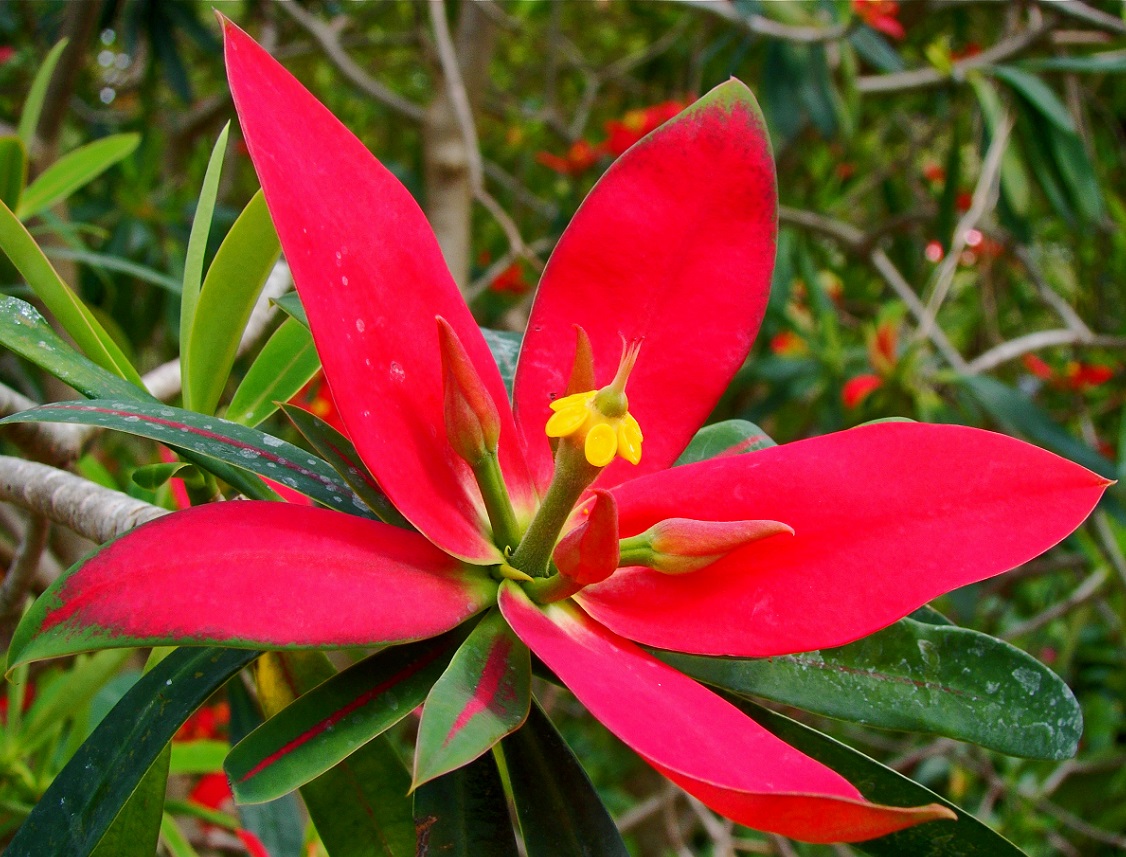
Jamaican Poinsettia, also known as Euphorbia punicea
An excerpt from Matthew’s telling of the Nativity story – presented here in four languages…
. . .
John Wycliffe Bible, printed in 1395, written in “Middle English”: Matthew 2:1-11
Therfor whanne Jhesus was borun in Bethleem of Juda, in the daies of king Eroude, lo! astromyenes camen fro the eest to Jerusalem, and seiden, Where is he, that is borun king of Jewis? for we han seyn his sterre in the eest, and we comen to worschipe him. But king Eroude herde, and was trublid, and al Jerusalem with hym. And he gaderide to gidre alle the prynces of prestis, and scribis of the puple, and enqueride of hem, where Crist shulde be borun. And thei seiden to hym, In Bethleem of Juda; for so it is writun bi a profete, And thou, Bethleem, the lond of Juda, art not the leest among the prynces of Juda; for of thee a duyk schal go out, that schal gouerne my puple of Israel. Thanne Eroude clepide pryueli the astromyens, and lernyde bisili of hem the tyme of the sterre that apperide to hem. And he sente hem in to Bethleem, and seide, Go ye, and axe ye bisili of the child, and whanne yee han foundun, telle ye it to me, that Y also come, and worschipe hym. And whanne thei hadden herd the kyng, thei wenten forth. And lo! the sterre, that thei siyen in the eest, wente bifore hem, til it cam, and stood aboue, where the child was. And thei siyen the sterre, and ioyeden with a ful greet ioye. And thei entriden in to the hous, and founden the child with Marie, his modir; and thei felden doun, and worschipiden him. And whanne thei hadden openyd her tresouris, thei offryden to hym yiftis, gold, encense, and myrre.
. . .
King James Version, 1611: Matthew 2: 1-11
2:1 Now when Jesus was born
in Bethlehem of Judaea in the days of Herod the king,
behold, there came wise men from the east to Jerusalem,
2:2 Saying, Where is He that is born King of the Jews?
for we have seen His Star in the east, and are come to worship Him. 2:3 When Herod the king had heard these things, he was troubled, and all Jerusalem with him. 2:4 And when he had gathered all the chief priests and scribes of the people together, he demanded of them where Christ should be born. 2:5 And they said unto him, In Bethlehem of Judaea: for thus it is written by the prophet, 2:6 And thou Bethlehem, in the land of Juda, art not the least among the princes of Juda: for out of thee shall come a Governor, that shall rule My people Israel. 2:7 Then Herod, when he had privily called the wise men, inquired of them diligently what time the Star appeared. 2:8 And he sent them to Bethlehem, and said, Go and search diligently for the young Child; and when ye have found Him, bring me word again, that I may come and worship Him also. 2:9 When they had heard the king, they departed; and, lo, the Star, which they saw in the east, went before them, till it came and stood over where the young Child was.
2:10 When they saw the Star, they rejoiced with exceeding great joy. 2:11 And when they were come into the house, they saw the young Child with Mary His mother, and fell down, and worshipped Him: and when they had opened their treasures, they presented unto Him gifts; gold, and frankincense, and myrrh.
. . .
Antigua Versión de Casidoro de Reina, 1569: Mateo 2: 1-11
2:1 Cuando Jesús nació en Belén de Judea en días del rey Herodes, vinieron del oriente a Jerusalén unos magos,
2:2 diciendo: ¿Dónde está el rey de los judíos, que ha nacido? Porque su estrella hemos visto en el oriente, y venimos a adorarle.
2:3 Oyendo esto, el rey Herodes se turbó, y toda Jerusalén con él.
2:4 Y convocados todos los principales sacerdotes, y los escribas del pueblo, les preguntó dónde había de nacer el Cristo
2:5 Ellos le dijeron: En Belén de Judea; porque así está escrito por el profeta:
2:6 Y tú, Belén, de la tierra de Judá,
No eres la más pequeña entre los príncipes de Judá;
Porque de ti saldrá un guiador,
Que apacentará a mi pueblo Israel.
2:7 Entonces Herodes, llamando en secreto a los magos, indagó de ellos diligentemente el tiempo de la aparición de la estrella;
2:8 y enviándolos a Belén, dijo: Id allá y averiguad con diligencia acerca del niño; y cuando le halléis, hacédmelo saber, para que yo también vaya y le adore.
2:9 Ellos, habiendo oído al rey, se fueron; y he aquí la estrella que habían visto en el oriente iba delante de ellos, hasta que llegando, se detuvo sobre donde estaba el niño.
2:10 Y al ver la estrella, se regocijaron con muy grande gozo.
2:11 Y al entrar en la casa, vieron al niño con su madre María, y postrándose, lo adoraron; y abriendo sus tesoros, le ofrecieron presentes: oro, incienso y mirra.
. . .
Bible Kréyòl ayisyen/Haitian Creole Bible: Matye 2:1-11
2:1 Jezi te fèt lavil Betleyèm nan peyi Jide, sou tan wa Ewòd. Apre li te fèt, kèk nèg save ki konn etidye zetwal yo soti nan peyi solèy leve, yo rive lavil Jerizalèm.
2:2 Yo t’ap mande: Kote wa jwif ki fenk fèt la? Nou wè zetwal li parèt depi nan peyi nou an, nou vin adore li.
2:3 Lè wa Ewòd pran nouvèl la, sa te boulvèse tèt li. Sa te boulvèse tout moun lavil Jerizalèm yo tou.
2:4 Ewòd reyini tout chèf prèt yo ansanm ak direktè lalwa yo ki t’ap dirije pèp jwif la. Li mande yo: Ki kote Kris la gen pou l’ fèt?
2:5 Yo reponn li: Se lavil Betleyèm nan peyi Jide li gen pou l’ fèt. Paske, men sa pwofèt la te ekri:
2:6 Ou menm, Betleyèm, ki bati sou tè Jida a, pawòl sèten: se pa ou ki pi piti nan tout lavil peyi Jida yo. Paske, gen yon chèf ki gen pou soti lakay ou. Se li menm ki va kondi moun Izrayèl yo, pèp mwen an.
2:7 Se konsa, Ewòd fè nèg save yo vin jwenn li an kachèt. Li mande yo kilè egzakteman zetwal la te parèt.
2:8 Apre sa, li voye yo ale Betleyèm. Li di yo: Ale non! Chache konnen tout bagay sou ti pitit la. Lè n’a jwenn li, fè m’ konnen pou m’ sa kapab al adore l’, mwen menm tou.
2:9 Apre wa a te fin di yo sa, nèg save yo pati. Lè sa a, zetwal yo te wè nan peyi solèy leve a parèt devan yo ankò. Li t’ap mache devan yo. Zetwal la kontinye konsa jouk li rive sou tèt kay kote ti pitit la te ye a. Epi l’ rete.
2:10 Lè yo te wè zetwal la, yo pa t’ manke kontan.
2:11 Yo antre nan kay la, yo wè ti pitit la ansanm ak Mari, manman li. Yo mete ajenou devan l’, yo adore l’. Apre sa, yo louvri sak yo, yo ba li anpil kado: te gen lò, lansan ak lami.
. . .
Jamiekan Patwa (Jamaican Patois) New Testament, 2012: Matyu 2:1-11
2 Jiizas did baan iina Betliyem, wan toun iina Judiya. Dem taim de, a Erad did a king iina Judiya. Nou, iina dem siem taim de, som waiz man fram di Iis said did kom a Jeruusilem an a aks, 2 “We di pikni de we baan di ada die, we fi kom ton king fi di Juu piipl dem? Wi si im staar iina di Iis, we shuo se im baan, an wi kom fi shuo im nof rispek.” 3 Nou wen King Erad ier dis ya, dis bada bada im ed, an it bada uol iip a piipl iina Je- ruusilem tu. 4 Erad kaal evribadi tugeda iina wan miitn — aal a di ed priis an di man dem we tiich Muoziz Laa — an im aks dem a wich paat di Krais — di king we Gad pramis, fi baan. 5 Dem ansa se, “Iina Betliyem, kaaz a dat di prafit did rait dong: 6 ‘An yu Betliyem we iina Judiya, wen yu luk pan aal di ada toun dem we a liid, yu no wot no les dan dem — yu op de mongks di tap-a-tap toun dem; kaaz a fram outa yu wan liida a-go kom we a-go protek an liid mi piipl dem we iina Izrel.’ ” 7 Den Erad sen kaal di waiz man dem fi kom kom chek im anda di kwaiyat, an fain out fram dem a wa taim dem did si di staar. 8 Im sen dem go a Betliyem an se, “Gwaan go luk fi di pikni. Luk gud gud, an wen unu fain im, kom tel mi, so mi kyan go shuo im nof rispek tu.” 9 Afta dem don lisn di king, dem lef go we. Az dem a go bout dem bizniz so, no di sed staar we dem did si iina di Iis said kom bak agen! It galang infronta dem til it riich wich paat di pikni did de, an a uova de-so it tap. 10 Wen dem did si di staar agen dem glad-bag bos! 11 Dem kom iina di ous an si di pikni wid im mada, Mieri, an dem go dong pan dem nii an priez im. Dem tek out di prezent we dem did bring, an gi di pikni — guol, frang- kinsens an mor.
. . . . .
El villancico jamaicano más popular: “Hijo-muchacho de María” por Jester Joseph Hairston / The most popular Christmas carol associated with Jamaica: “Mary’s Boy Child” by Jester Joseph Hairston
Posted: December 24, 2013 Filed under: English, Spanish | Tags: Christmas carols and songs Comments Off on El villancico jamaicano más popular: “Hijo-muchacho de María” por Jester Joseph Hairston / The most popular Christmas carol associated with Jamaica: “Mary’s Boy Child” by Jester Joseph Hairston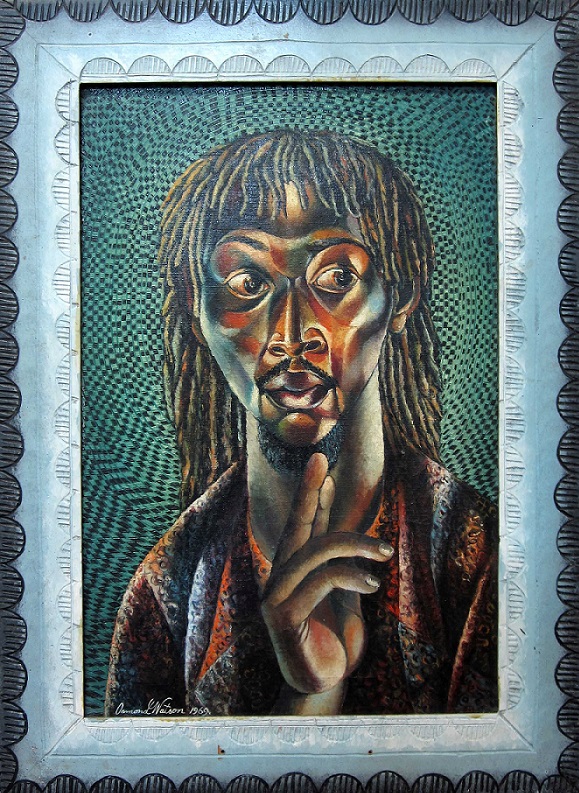
Peace and Love by Jamaican painter Osmond Watson_1969_Paz y Amor por el pintor jamaicano Osmond Watson_1969
. . .
“Hijo de María muchacho”
(compositor: Jester Joseph Hairston (1901-2000) / cantado por Harry Belafonte en 1956)
.
Hace mucho tiempo en Belén
Así que la Biblia dice
Hijo de María muchacho – Jesucristo –
Nació el Día de Navidad.
.
Oye, oye – los ángeles cantan
Un nuevo Rey ha nacido hoy
Y el hombre vivirá para siempre
Para el Día de Navidad.
.
Mientras que los pastores vieron a su rebaño durante la noche
Y ver una brillante nueva estrella
Y escuchar a un coro cantar
La música parece venir de lejos.
.
Y José y su esposa María
Vamos a Belén aquella noche
Y no hay lugar para encontrar transmitidas por ella hijo
No es una habitación solo estaba a la vista.
.
Escucha, ahora escucha a los ángeles cantar
Un nuevo Rey nacido hoy
Y el hombre vivirá para siempre
Por el Día de Navidad.
.
Poco a poco, encontramos un pequeño rincón
En un establo abandonado todo
Y en un pesebre frío y oscuro
Niño de María nació.
.
Escucha, ahora escucha a los ángeles cantar
Un nuevo Rey nacido hoy
Y el hombre vivirá para siempre
Por el Día de Navidad.
. . .
“Mary’s Boy Child”
(Jester Joseph Hairston (1901-2000), composer / as sung by Harry Belafonte in 1956)
.
Long time ago in Bethlehem, so the Holy Bible say,
Mary’s boy child Jesus Christ was born on Christmas Day.
Hark, now hear the angels sing, a new King born today,
And we will live for evermore because of Christmas Day.
Trumpets sound and angels sing, listen to what they say:
That we will live for evermore because of Christmas Day.
While shepherds watched their flocks by night,
them see a bright new shining star,
them hear a choir sing, the music seem to come from afar.
Now Joseph and his wife, Mary, come to Bethlehem that night,
them found no place to born she Child, not a single room was in sight.
By and by them find a little nook in a stable all forlorn,
And in a manger cold and dark, Mary’s little boy was born.
Long time ago in Bethlehem, so the Holy Bible say,
Mary’s boy child Jesus Christ was born on Christmas Day!
. . . . .
 Zócalo Poets