Mon Pays – c’est l’Hiver ! “Québécitude” in song
Posted: December 22, 2011 Filed under: English, French, Gilles Vigneault, Translator's Whimsy: Song Lyrics / Extravagancia del traductor: Letras de canciones traducidas por Alexander Best, ZP Translator: Alexander Best Comments Off on Mon Pays – c’est l’Hiver ! “Québécitude” in song
MY COUNTRY
My country’s not a country, it’s winter,
my garden’s not a garden, it’s a vast plain,
my road is no road – it’s the snow !
My country’s not a country – it’s winter !
A ceremony all in white
where snow marries wind,
in this blizzard-land
my father built a house
and I’m going to honour
his ways, his example…
My guest room will be where
you return, season by season
and you’ll build too – right beside it.
My country’s not a country, it’s winter,
My refrain’s no refrain, it’s a gust of wind,
My house isn’t mine – it’s the winter-chill’s !
My country’s not a country – it’s winter !
All around my solitary land
I cry out before the silence,
to everyone on earth:
My house is yours, too.
Inside four walls of ice
with time and space
I make the fire, and a place
for People of the Horizon
– and these people are of my people.
My country’s not a country, it’s winter,
my garden’s not a garden, it’s the vast plain,
my road is no road – it’s the snow !
My country’s not a country – it’s winter !
My country’s no country but the contrary
of country – neither land nor nation,
my song’s not a song – it’s my life !
And for you I wish to master these winters !
_____
MON PAYS
Mon pays ce n’est pas un pays, c’est l’hiver
Mon jardin ce n’est pas un jardin, c’est la plaine
Mon chemin ce n’est pas un chemin, c’est la neige
Mon pays ce n’est pas un pays, c’est l’hiver.
Dans la blanche cérémonie où la neige au vent se marie
Dans ce pays de poudrerie mon père a fait bâtir maison
Et je m’en vais être fidèle à sa manière à son modèle
La chambre d’amis sera telle qu’on viendra des autres saisons
pour se bâtir à côté d’elle.
Mon pays ce n’est pas un pays, c’est l’hiver
Mon refrain ce n’est pas un refrain, c’est rafale
Ma maison ce n’est pas ma maison, c’est froidure
Mon pays ce n’est pas un pays, c’est l’hiver.
De ce grand pays solitaire je crie avant que de me taire
A tous les hommes de la terre ma maison c’est votre maison
Entre mes quatre murs de glace je mets mon temps et mon espace
À préparer le feu, la place pour les humains de l’horizon
Et les humains sont de ma race.
Mon pays ce n’est pas un pays, c’est l’hiver
Mon jardin ce n’est pas un jardin, c’est la plaine
Mon chemin ce n’est pas un chemin, c’est la neige
Mon pays ce n’est pas un pays, c’est l’hiver.
Mon pays ce n’est pas un pays, c’est l’envers
D’un pays qui n’était ni pays ni patrie
Ma chanson ce n’est pas une chanson, c’est ma vie
C’est pour toi que je veux posséder mes hivers.
_____
Gilles Vigneault (born 1928) wrote “Mon Pays” for a 1965 NFB film,
La neige a fondu sur la Manicouagan. This new folk song became an
instant classic – emblematic for Québec’s growing nationalist movement.
Editor’s note:
Almost two generations later the song does show its age, for the Canadian
essential-ideal of The Great White North – intrinsic to Canadians outside of
Québec as well – holds less sway in our collective identity. Too, “Mon Pays”
is dated in that it captures the spirit of an isolated – if friendly – culture:
not the rumbling, restless Québec of the 1960s. Rather the lyrics might well
describe a People more remote in time – the Far-North Inuit of the 19th-century.
Still, if there has been a place in Canada where winter is embraced and
not merely borne, it is Québec, where coureurs de bois and habitants
were the first of Canada’s White arrivals to adapt the Naskapi/Montagnais
Native People’s’ inventions – toboggans and snowshoes – to daily use both
practical and recreational.
And Québec leads the nation for Winter fun – not drear – with many jovial
outdoor festivals and an entrenched culture of open-air ice-skating parties !
_____
Translation from French into English: Alexander Best
Hanukkah Poems: Light the Candle !
Posted: December 20, 2011 Filed under: English | Tags: Hanukkah poems Comments Off on Hanukkah Poems: Light the Candle !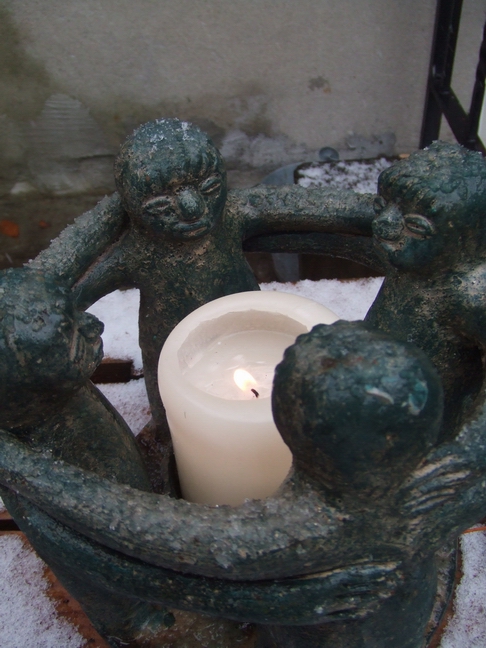
Mark Strand (born 1934)
“The Coming of Light”
Even this late it happens:
the coming of love, the coming of light.
You wake and the candles are lit as if by themselves,
stars gather, dreams pour into your pillows,
sending up warm bouquets of air.
Even this late the bones of the body shine
and tomorrow’s dust flares into breath.
_____
Aileen Fisher (1906-2002)
“Light the Festive Candles”
Light the first of eight tonight—
the farthest candle to the right.
Light the first and second, too,
when tomorrow’s day is through.
Then light three, and then light four—
every dusk one candle more
Till all eight burn bright and high,
honouring a day gone by
When the Temple was restored,
rescued from the Syrian lord,
And an eight-day feast proclaimed—
The Festival of Lights—well named
To celebrate the joyous day
when we regained the right to pray
to our own God in our own way.
_____
Canciones sefardíes de la Turquía
Posted: December 20, 2011 Filed under: Ladino/Judeoespañol, Spanish Comments Off on Canciones sefardíes de la Turquía_____
Canciones sefardíes de la Turquía (2009)
en el idioma judeoespañol:
ג’ודיאו-איספאניול
Sephardic songs from Turkey (2009)
in Ladino (Judeo-Spanish)
* * *
Avram Avinu / Abraham our Father
Kuando el rey Nimrod al kampo saliya
Mirava en el cielo la esteriya
Vide luz santa en la cuderiya
Ke aviya de naser Avram Avinu.
Avram Avinu
Padre kerido
Padre bendiço
Luz de Israel
La mujer de terah kedo prenyada
De diya el ediya él le preguntava
De ke teneş la kara tan demudada
Eya ya saviya el bien ke teniya.
Avram Avinu
Padre kerido
Padre bendiço
Luz de Israel
* * *
Irme Kero Madre / Mother, I want to go
to Jerusalem
Ir me kero madre a Yeruşalayim
A pizar las yervas i artarme d’eyas
En él me arrimo yo
En él m’afiguro yo
Él es senyor de todo’l mundo.
A Yeruşalayim lo veyo d’enfrente
Pedri ayi mis ijos i paryentes
En él me arrimo yo
En él m’afiguro yo
Él es senyor de todo’l mundo.
יהודה עמיחי / Yehuda Amichai : “The two of us together and each one alone”
Posted: December 19, 2011 Filed under: English, Hebrew, Yehuda Amichai Comments Off on יהודה עמיחי / Yehuda Amichai : “The two of us together and each one alone”יהודה עמיחי
שנינו ביחד וכל אחד לחוד
ילדה שלי, עוד קיץ עבר
ואבי לא בא ללונה פארק.
הנדנדות מוסיפות לנוד.
שנינו ביחד וכל אחד לחוד.
אופק הים מאבד ספינותיו –
קשה לשמר על משהו עכשיו.
מאחורי ההר חכו הלוחמים.
כמה זקוקים אנו לרחמים.
שנינו ביחד וכל אחד לחוד.
ירח מנסר את העבים לשניים –
בואי ונצא לאהבת בינים.
רק שנינו נאהב לפני המחנות.
אולי אפשר עוד הכל לשנות.
שנינו ביחד וכל אחד לחוד.
אהבתי הפכה אותי כנראה
כים מלוח לטפות מתוקות של יורה;
אני מובא אליך לאט ונופל.
קבליני. אין לנו מלאך גואל.
כי שנינו ביחד .כל אחד לחוד.
_____
Look, sweetie, one more summer’s turned dark
And my dad hasn’t come to the amusement park.
The swings keep swinging on their own.
The two of us together and each one alone.
The horizon loses its ships off the shore.
Hard to hold on to a thing anymore.
The fighters waited behind the hill.
How much we need of mercy still !
The two of us together and each one alone.
The moon is sawing the clouds in two.
Let hand-to-hand love bring me against you.
We alone will make love where the two camps fight.
Perhaps we can still make everything right.
The two of us together and each one alone.
As the first sweet rain was once salt sea
So, it would seem, has my love changed me.
I am brought to you slowly, and fall. My dear,
Receive me. No angel redeems us here.
Because the two of us are together. Each is alone.
_____
Yehuda Amichai (1924 – 2000) was one of
the first poets to compose in colloquial Hebrew.
Written in 1955, this simple, complex poem
makes reference to lease contracts:
“the two of us together and each one alone” – direct
from Hebrew and equivalent to the English legal
phrase “both jointly and severally” — which we
can now read as the Palestinian-Israeli land
struggle. The poem also draws upon a popular Israeli
children’s song of the 1950s:
“Daddy, come, let’s go to the Amusement Park !”
_____
We are grateful to A. Z. Foreman for his translation
of the above poem from Hebrew into English.
Visit his website: poemsintranslation.blogspot.com
О́сип Мандельшта́м / Osip Mandelstam: “Maddening cherry brandy”
Posted: December 15, 2011 Filed under: English, Osip Mandelstam, Russian Comments Off on О́сип Мандельшта́м / Osip Mandelstam: “Maddening cherry brandy”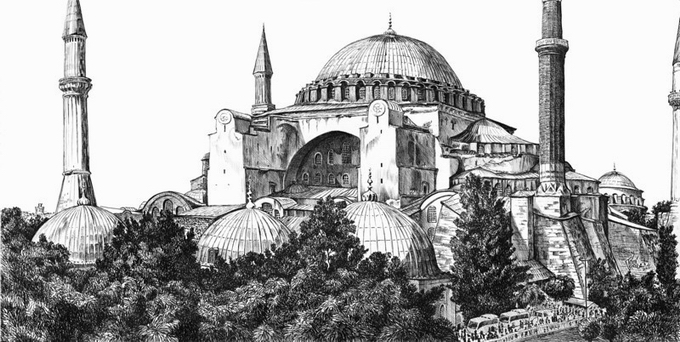
Hagia Sophia
Hagia Sophia: it was at this place
The Lord ordained that peoples and Caesars halt.
Your dome is, in a witness’s phrase,
As if hung by a chain from heaven’s vault.
And when Ephesian Diana allowed the looting
Of a hundred and seven green marble columns
For alien gods, it proved for ages yet to come
A monument to Justinian.
But what was it your generous builder meant
When he laid down apses and exhedrae,
As great his spirit as his intent,
Indicating to them east and west?
And bathing in the world, the shrine inspires awe,
Its forty windows are a celebration of light;
On the dome’s supporting vaults, the four
Archangels cause the most delight.
And the wisdom of his hemispherical dome
Shall outlive peoples, outlast the ages still to come,
While the full-voiced sobbing of the Seraphim
Shall not let its darkened gilding dim.
1912
_____
Ленинград
Я вернулся в мой город, знакомый до слез,
До прожилок, до детских припухлых желез.


Ты вернулся сюда, так глотай же скорей
Рыбий жир ленинградских речных фонарей,


Узнавай же скорее декабрьский денек,
Где к зловещему дегтю подмешан желток.


Петербург! я еще не хочу умирать!
У тебя телефонов моих номера.


Петербург! У меня еще есть адреса,
По которым найду мертвецов голоса.


Я на лестнице черной живу, и в висок
Ударяет мне вырванный с мясом звонок,


И всю ночь напролет жду гостей дорогих,
Шевеля кандалами цепочек дверных.


1930
Leningrad
I returned to my city, familiar as tears,
As veins, as mumps from childhood years.
You’ve returned here, so swallow as quick as you can
The cod-liver oil of Leningrad’s riverside lamps.
Recognize when you can December’s brief day:
Egg yolk folded into its ominous tar.
Petersburg, I don’t yet want to die:
You have the numbers of my telephones.
Petersburg, I have addresses still
Where I can raise the voices of the dead.
I live on the backstairs and the doorbell buzz
Strikes me in the temple and tears at my flesh.
And all night long I await those dear guests of yours,
Rattling, like manacles, the chains on the doors.
1930
_____
Я скажу тебе с
последней прямотой…
"Mа Vоiх аigrе еt fаussе..."
Paul Verlaine


Я скажу тебе с последней
Прямотой:
Все лишь бредни, шерри-бренди,
Ангел мой.


Там где эллину сияла
Красота,
Мне из черных дыр зияла
Срамота.


Греки сбондили Елену
По волнам,
Ну а мне - соленой пеной
По губам.


По губам меня помажет
Пустота,
Строгий кукиш мне покажет
Нищета.


Ой-ли, так-ли, дуй-ли, вей-ли,
Все равно.
Ангел Мэри, пей коктейли,
Дуй вино!


Я скажу тебе с последней
Прямотой:
Все лишь бредни, шерри-бренди,
Ангел мой.


1931
I’ll tell you bluntly…
"Mа Vоiх аigrе еt fаussе..."
(My sour, false Voice...)
Рaul Verlaine
I’ll tell you bluntly
One last time:
It’s only maddening cherry brandy,
Angel mine.
Where the Greeks saw just their raped
Beauty’s fame,
Through black holes at me there gaped
Nought but shame.
But the Greeks hauled Helen home
In their ships.
Here a smudge of salty foam
Flecks my lips.
What rubs my lips and leaves no trace?
— Vacancy.
What thrusts a V-sign in my face?
— Vagrancy.
Quickly, wholly, or slowly as a snail,
All the same,
Mary, angel, drink your cocktail,
Down your wine.
I’ll tell you bluntly
One last time:
It’s only maddening cherry brandy,
Angel mine.
1931
_____
Osip Mandelstam (1891-1938) was from a Polish-Jewish
family and grew up in St.Petersburg (later Leningrad), Russia.
His first poems appeared in 1913, and, after The Revolution
and Stalin’s increasing tendency toward totalitarianism,
Mandelstam made no effort to hide his non-conformist views.
Seized at a Moscow reading in 1934, he was banished from “the
big cities”. During The Great Purge of 1937, accused of
anti-Soviet views, he was arrested again and died en route to a
Gulag camp in Siberia.
Translations from Russian into English: Bernard Meares
_____
Oración a La Virgen de Guadalupe: José Valdez
Posted: December 12, 2011 Filed under: English, José Valdez, Spanish, ZP Translator: Alexander Best | Tags: Oración a La Virgen de Guadalupe, Prayer to Our Lady of Guadalupe Comments Off on Oración a La Virgen de Guadalupe: José Valdez
Oración a La Virgen de Guadalupe
por José Valdez (México)
“A mi Virgen de Guadalupe”
.
Necesito tu ayuda
me siento perdido
mis ojos se nublan
no encuentro el camino
tú que eres buena
y muy milagrosa
te pido, morena,
muchísimas cosas
pido por la gente
que quiero yo tanto
que siempre se encuentren
bajo de tu manto
pido me des fuerzas
que encuentre el camino
y que me protejas
con tu manto fino
eres muy hermosa
linda virgencita
pareces una rosa
que nunca se marchita
con solo mirarte
me llenas de paz
con solo tocarte
la vida me das
me inspiras confianza
y mucha ternura
me das esperanzas
y también dulzura
esa verde manta
que cubre tu cabeza
te hace ver más santa
y llena de pureza
ese resplandor
que a ti te rodea
es un bello sol
que nunca te quema
esos lindos ojos
parecen dos diamantes
y tu vestido rojo
te hace ver radiante
sé que tú me quieres
yo siempre lo supe
por eso, para mí, eres
Mi Virgen de Guadalupe.
*
“To my Virgin of Guadalupe”
.
I need your help
I am lost
my eyes cloud over
I cannot find the path,
you who are good
so very miraculous
I ask of you, morena,
very very many things
I ask for those people that I love so,
that always they may find themselves
blanketed within your cloak,
I ask that you may give me strength
that I might find the way
and that you may protect me
within your fine cloak,
you are most beautiful
lovely dear Virgin
you seem like a rose
that never wilts
I merely gaze upon you
and you fill me with peace
I touch you, merely,
and you give me life,
you inspire trust in me
and much tender feeling,
hope you give me,
gentleness too,
that green scarf
that covers your head
makes you look most saintly
and full of purity,
that dazzling gleam
surrounding you
is a beautiful sun
that never burns,
those lovely eyes
are as two diamonds,
and your red robe
makes you radiant,
I know that you love me,
always I knew it,
and, for that reason, for me, you are
My Virgin of Guadalupe.
*
We thank Mr. Valdez for his
poem from the heart honouring
Our Lady of Guadalupe on this
her feast day, December 12th.
Translation from Spanish into English:
Alexander Best
*
¡Tlazocamati, Tonantzin! / Thank You, Sacred Mother!
Posted: December 12, 2011 Filed under: English, Náhuatl, Spanish, ZP Translator: Alexander Best Comments Off on ¡Tlazocamati, Tonantzin! / Thank You, Sacred Mother!
Poema de Nezahualcóyotl
(1402-1472, Rey nahua/mexica de Texcoco)
“Tonantzin”
Tonantzin;
icuac nehuatl nimiquiz
xinechtoca notlecuilco
ihuan quemman ticchihuaz
motlaxcal xinechchoquili.
Ihuan tla aca mitztlatlaniz
Tonantzin. Tleica tichoca?
Xicnanquili; in cuahuitl xoxochuic
ihuan in poctli nechchoctia.
*
“Madrecita”
Madrecita;
cuando yo muera
entiérrame junto a tu hoguera
y cuando hagas tortillas
llora por mí
y si alguien te pregunta
Madrecita ¿Por qué lloras?
Responde; Es que la leña que está verde
y es el humo que me hace llorar.
*
“Sacred Mother”
Little Mother,
when I die
bury me next to your cooking fire
and when you make tortillas
cry for me
and if anyone asks you:
Sacred Mother, why do you cry?
Tell them: It’s only that the fire-wood’s green
and the smoke hurts my eyes…
*
Nican mopohua (“Here is recounted…”): December 9th, 1531
Posted: December 9, 2011 Filed under: English, Náhuatl | Tags: Juan Diego Cuauhtlatoatzin Comments Off on Nican mopohua (“Here is recounted…”): December 9th, 1531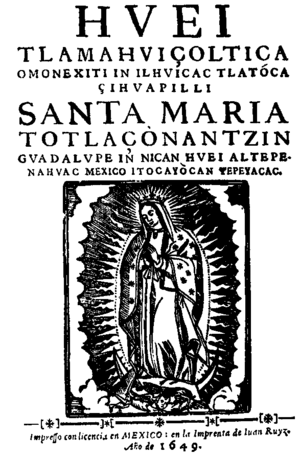
…..Auh in acico in inahuac tepetzintli in itocayocan Tepeyacac,
ye tlatlalchipahua…..
*
Concac in icpac tepetzintli cuicoa, yuhquin nepapan tlazototome cuica;
cacahuani in intozqui, iuhquin quinananquilia tepetl, huel cenca teyolquima,
tehuellamachti in incuic; quicenpanahuia in coyoltotl in tzinitzcan ihuan in
occequin tlazototome ic cuica…..
*
“Canin ye nica? Canin ye ninotta? Cuix ye oncan in quitotehuaque huehuetque
tachtohuan tococolhuan, in xochitlalpan in tonacatlalpan,
cuix ye oncan ilhuicatlalpan?”…..
*
In oyuhceuhtiquiz in cuicatl, inomocactimoman in yeequicaqui
hualnotzalo inicpac tepetzintli, quilhuia: “Juantzin, Juan Diegotzin”…..
*
Auh in ye acitiuh in icpac tepetzintli, in ye oquimottili ce Cihuapilli
oncanmoquetzinoticac, quihualmonochili inic onyaz in inahuactzinco…..
*
Auh in tetl, in texcalli in ic itech moquetza, inic quimina…..
*
Auh in mizquitl, in nopalli ihuan occequin nepapan xiuhtotontin
oncan mochichihuani yuhquin quetzaliztli. Yuhqui in teoxihuitl in
iatlapalio neci. Auh in icuauhyo, in ihuitzyo, in iahuayo yuhqui in
cozticteocuitlatl in pepetlaca…..
*
Quimolhuili: “Tlaxiccaqui noxocoyotl Juantzin, campa in timohuica?”
*
Auh in yehuatl quimonanquilili: “Notecuiyoé, Cihuapillé, Nochpochtziné!
Ca ompa nonaciz mochantzinco México-Tlatilolco,
nocontepotztoca in Teyotl…..”
_____ * _____ * _____
…..And as he drew near the little hill called Tepeyac
it was beginning to dawn…..
*
He heard singing on the little hill, like the song of many precious birds;
when their voices would stop, it was as if the hill were answering them;
extremely soft and delightful; their songs exceeded the songs of the
coyoltotl and the tzinitzcan and other precious birds…..
*
“Where am I? Where do I find myself? Is it possible that I am in the
place our ancient ancestors, our grandparents, told about, in the
land of the flowers, in the land of corn, of our flesh, of our sustenance,
possibly in the land of heaven?”…..
*
And then when the singing suddenly stopped, when it could no longer
be heard, he heard someone calling him, from the top of the hill, someone
was saying to him: “Juan, Dearest Juan Diego”…..
*
And when he reached the top of the hill, a Maiden who was standing there,
who spoke to him, who called to him to come close to her…..
*
And the stone, the crag on which she stood, seemed to be giving out rays…..
*
And the mesquites and nopales and the other little plants that are up there
seemed like emeralds. Their leaves, like turquoise. And their trunks, their
thorns, their prickles, were shining like gold…..
*
She said to him, “Listen, my dearest-and-youngest son, Juan,
Where are you going?”
*
And he answered her: “My Lady, my Queen, my Beloved Maiden!
I am going as far as your little house in Mexico-Tlatilolco,
to follow the things of God…..”
* * * * *
On December 9th, 1531, Juan Diego Cuauhtlatoatzin (1474-1548)
encountered a radiant native-Mexican woman at Tepayac Hill
(site of a former temple to the Aztec Earth-Mother goddess Tonantzin).
He knew her to be Santa María Totlaconantzin – Mary, Our
Precious Mother – and she spoke to him in his own language – Náhuatl.
*
Tepayac is now the location of the largest shrine in Latin America –
La Basílica de Nuestra Señora de Guadalupe / The Basilica of
Our Lady of Guadalupe – the name by which Juan Diego’s
Virgin Mary is known in México today…
Popularly, she is also called The Mother of All México.
Juan Diego was canonized by Pope John Paul II in 2002.
*
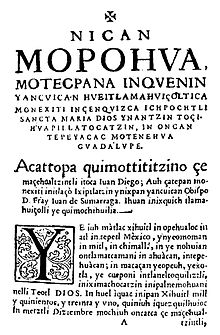
The above text – in the original Náhuatl (language of the Aztecs)
plus English translation by D. K. Jordan – is taken from
Nican mopohua (“Here is recounted…”)
by Antonio Valeriano (1556), and is the first chapter in the
written telling of the miraculous life of Juan Diego Cuauhtlatoatzin.
Valeriano was a native-Mexican scholar in three languages
– his birth-language, Náhuatl, plus Spanish and Latin.
Nican mopohua forms part of a larger volume,
Huei tlamahuiçoltica (“The Great Happening”),
published by Luis Laso de la Vega in 1649. The book is a
crucial Náhuatl text from the 16th and 17th centuries
– a period of immense trauma during which a new race
– el Mestizo – and a new nationality – Mexican – were being forged.
Rin Ishigaki: “Myself: a far-off island”
Posted: December 8, 2011 Filed under: English, Japanese, Rin Ishigaki Comments Off on Rin Ishigaki: “Myself: a far-off island”_____
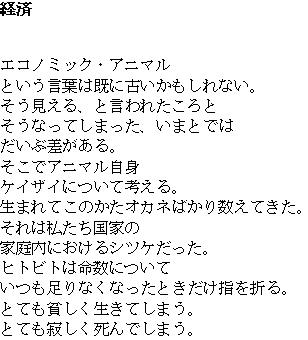
The Economy
The phrase ‘economic animal’
I suppose is already fairly old.
Quite a gap exists between
The time when they said we seem that way
And now when we are that way.
Now then we economic animals
Will think about the economy.
From the time that I was born I’ve just been counting money.
That was what we were taught in the home
By the state.
People only count the time they have left
When it has started to run out.
We live terribly impoverished lives.
We die terribly lonely deaths.
(1987)
_____
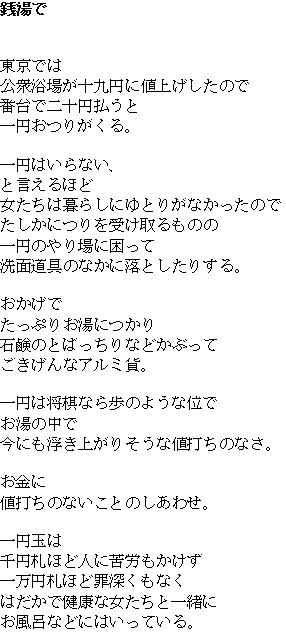
At the Bathhouse
In Tokyo
At the public bathhouse the price went up to 19 yen and so
When you pay 20 yen at the counter
You get one yen change.
Women have no leeway in their lives
To be able to say that
They don’t need one yen
And so though they certainly accept the change
They have no place to put it
And drop it in between their washing things.
Thanks to that
The happy aluminium coins
Soak to their fill in hot water
And are splashed with soap.
One yen coins have the status of chess pawns
So worthless that they’re likely to bob up even now
In the hot water.
What a blessing to be of no value
In monetary terms.
A one yen coin
Does not distress people in the way a 1,000 yen note does
Is not as sinful as a 10,000 yen note
The one yen coin in the bath
With healthy naked women.
(1968)
_____
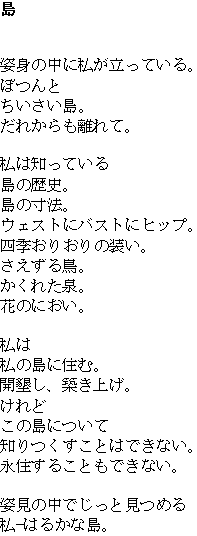
Island
I am standing in a large mirror.
A solitary
Small island.
Separated from everyone.
I know
The history of the island.
The dimensions of the island.
Waist, bust and hips.
Seasonal dress.
The singing of birds.
The hidden spring.
The flower’s fragrance.
As for me
I live on the island.
I have cultivated it, built it.
Yet
It is impossible to know
Everything about the island.
Impossible to take up permanent residence.
In the mirror staring at
Myself: A far-off island.
(2004)
_____
Rin Ishigaki (Ishigaki Rin in Japanese name-order)
was born in Tokyo in 1920 and died in 2004.
She worked for four decades as a bank clerk, kept
house, cooked, and cared for ageing parents.
Her first book of poems was published in 1959.
Without pretension or preciousness, her poems
are well-liked by people who might normally
steer clear of poetry!
These are thoughtful statements about ordinary life
– written in simple, straightforward Japanese –
and are sometimes used to teach the language to children,
as well as to foreign students.
_____
Translations from Japanese:
Leith Morton
Ishigaki’s original three Japanese poems are featured below.
_____
Inuo Taguchi: “Morning Discussion”
Posted: December 8, 2011 Filed under: English, Inuo Taguchi, Japanese Comments Off on Inuo Taguchi: “Morning Discussion”_____
Inuo Taguchi
MORNING DISCUSSION
I had a strange dream.
An airplane –
it doesn’t fall straight down
but crashes horizontally.
“Don’t ask me how.
It happened in my dream.”
Now, in this ‘modern’ world
it’s common for vertical things to change into horizontal.
So it’s nothing to make a fuss about
that a plane should crash horizontally.
“Why are you making such a big deal out of it?
Nonsense is commonsense nowadays.”
Don’t worry. If you tip over you glass, wine will spill out.
If you let go of a knife, it’ll fall straight down.
Our world, as ever,
obeys divine providence.
What doesn’t obey it is your dream and –
“No, don’t turn on the television.
It’s never told us good stories. It never will.”
I am listening to the morning discussion half-heartedly,
for I only want to think about poetry.
But my thoughts suddenly turn to the grasslands of
Kharakhorum.
There, too, are things that should be floating in air
floating in air?
There, too, is what should be falling falling?
Do things never crash horizontally?
Is what should be landing landing
and what should be ascending ascending?
Suddenly I feel like confirming it
and begin to be restless.
The soul begins slowly spiraling.
A kitchen kettle
begins honking like a horn.
*
from: Hush-a-bye
(2004)
Translation from Japanese:
William I. Elliott and Kazuo Kawamura
The original Japanese poem is featured below.
_____

_____
Inuo Taguchi was born in 1967 in Tokyo, Japan. His pen-
name, Inuo, means Dog-Man. He began to write poetry
in his early twenties and his first book came out in 1995.
He has been described as having a “self-less voice” as a poet,
meaning he is off to the side, even out of the “story”
– and often his poems are little stories.
At festivals he reads his poems aloud – usually barefoot.
His poems have been translated into Turkish – among a bunch
of languages.
He muses: “I feel that poetry must strive to open giant
air holes in human consciousness.”
 Zócalo Poets