John Douglas Thompson as Joe Mott in Eugene O’Neill’s “The Iceman Cometh”
Posted: February 4, 2015 Filed under: English | Tags: Black History Month Comments Off on John Douglas Thompson as Joe Mott in Eugene O’Neill’s “The Iceman Cometh”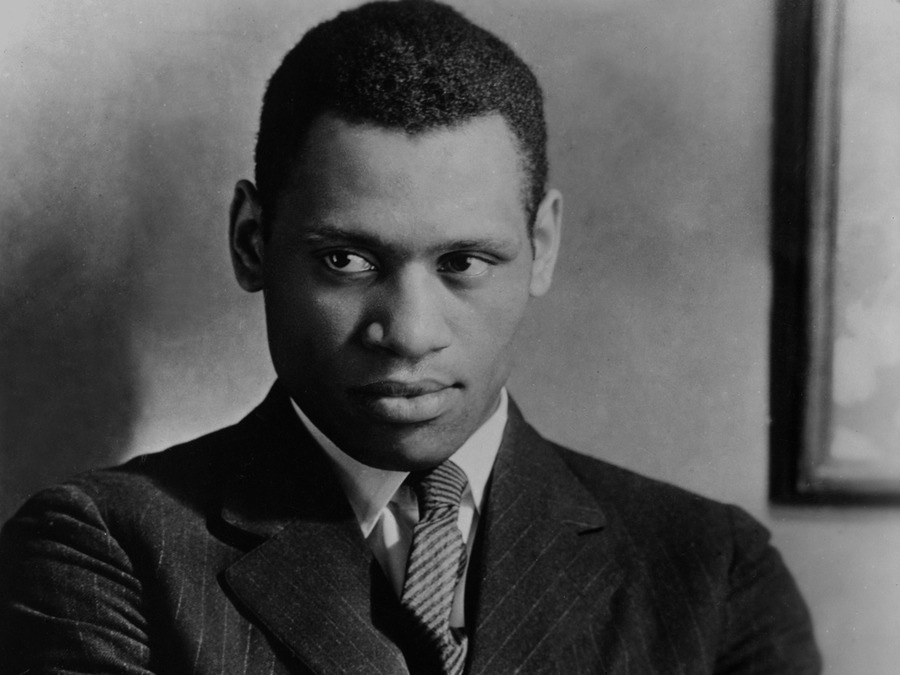
Paul Robeson (1898-1976), photographed about 1924, at the time he was starring in Eugene ONeill’s All God’s Chillun Got Wings
Q & A with John Douglas Thompson, who plays Joe Mott in Eugene O’Neill’s The Iceman Cometh…
An interview by J. Kelly Nestruck, in Toronto’s The Globe & Mail newspaper, February 3rd, 2015:
. . .
The Goodman Theatre’s 2012 production of The Iceman Cometh had one of the most exceptional ensembles in recent stage history. Stratford Festival regulars Brian Dennehy and Stephen Ouimette performed alongside Tony-winner Nathan Lane in director Robert Falls’ painterly production of Eugene O’Neill’s classic 1939 drama about alcoholics chasing pipe dreams in a New York saloon.
.
Less well known to Canadians is their co-star John Douglas Thompson – even though the 51-year-old stage actor grew up on this side of the border. Thompson was stunning as Joe Mott, a former gambling-house operator “whose gentle good humour masks a volcanic rage at a life warped by racism,” according to New York Times critic Charles Isherwood.
In advance of the Iceman remount at the prestigious Brooklyn Academy of Music this month, The Globe and Mail’s theatre critic spoke over the phone with Thompson – who, according to The New Yorker, is “regarded by some as the best classical actor in America.”
.
J. Kelly Nestruck:
I went to Chicago three years ago because I wanted to see Ouimette, Lane and Dennehy. I didn’t know you – and I just loved your Joe Mott. Then I looked you up on Wikipedia and it said you were “Canadian-American”.
.
John Douglas Thompson:
Well, I was born in Bath, England, to Jamaican parents, and we moved, when I was a little boy, to Canada. I lived in Montreal from the age of two to 12, then moved to the U.S. So a lot of people say I’m Canadian-American. I’m more Jamaican-American, though I’ve settled on African-American.
.
Did that time in Montreal have an impact on you at all?
.
I have a lot of fond memories of living in Montreal – and the Montreal Canadiens. I was a big, big hockey fan – and my brother and I played a lot of hockey. My mom would always take us to the Stanley Cup parades: Yvan Cournoyer, Ken Dryden.…
.
The Times’s Ben Brantley has called you “one of the most compelling classical stage actors of his generation” – and scholar James Shapiro called you “the best American actor in Shakespeare, hands down.” I was hoping you might say Canada played a role in that.
.
I’ve got to come up to Canada and do some Shakespeare… I’ve had some inquiries from the people at Stratford. The only complication has been my schedule. I hear such great things about that company from Brian Dennehy. And I was in a production of Julius Caesar with Colm Feore (and some guy named Denzel Washington!) on Broadway – and he spoke highly of it too.
.
I thought this Iceman ensemble was extraordinary; I was gripped for the full 4 1/2 hours. Are you glad to have a second chance to play this character in this company?
.
It’s great to get a second opportunity to explore these amazing characters – who all had some kind of relationship with O’Neill. I did a lot of research into Joe Mott – and the real guy was Joe Smith [O’Neill’s roommate and drinking buddy] … I’m always conscious when I’m working on Joe Mott to pay homage to Smith.
.
I read somewhere that O’Neill modeled both Brutus Jones in the 1920s’ The Emperor Jones and Joe Mott on Smith. You’ve played both roles now.
.
The Emperor Jones had the first African-American lead role on the American stage – and I’d venture to say perhaps on the world stage. O’Neill wrote this black character – the protagonist of a play – that was not going to be played by a white man in “blackface”. It was a huge statement. Many of the white actors of the Provincetown Players [MacDougal Street in NYC] wanted to do it because it’s such a great role. And O’Neill said no: It has to be a black actor.
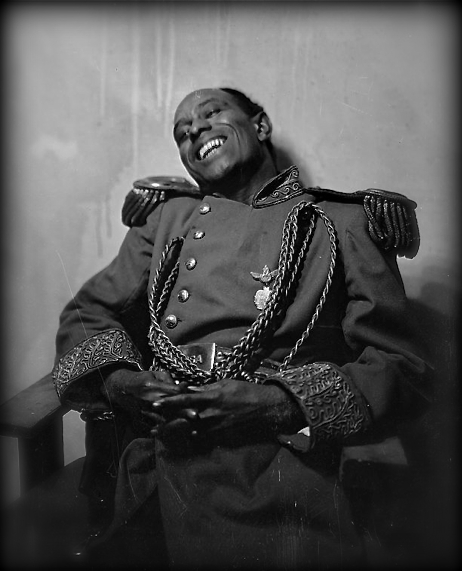
Charles Sidney Gilpin (1878 – 1930), seen in this photograph as Brutus Jones in the 1920 premiere of Eugene ONeill’s The Emperor Jones
.
O’Neill had black characters in his early one-act plays that were maybe one-dimensional or superficial or stereotypical. Then he wrote these major characters – Brutus Jones and Joe Mott. Do you see a progression?
.
Each of these characters from Brutus Jones to Jim Harris [in 1924’s All God’s Chillun Got Wings] to Joe Mott are all advancements on one another. I think someone from the outside looking in, without having done the research, might say these aren’t really strong black characters. If you look further, you find O’Neill had a great deal of respect for these characters that he wrote and was really looking to integrate American theatre. Nobody else was writing black characters at the time, certainly of the size and scope and complexity … Joe Mott to me is like an August Wilson character.
.
It’s still hard to find white playwrights today who will incorporate significant black characters – though now there’s that whole conversation about whether it’s their story to tell.
.
The time that O’Neill did it, it was such a bold move – now, you’re right, we have this argument: Who’s writing this character, who has the “agency” to write these characters? I know in New York, there’s a lot of new, younger black playwrights writing these characters and saying these characters are the terrain of black writers. But I think that any writer with sensitivity, empathy and understanding of humanity can write these characters, certainly as O’Neill has proved.

John Douglas Thompson
The Iceman Cometh is at BAM in Brooklyn, N.Y., from Feb. 5th to March 15th, 2015.
. . . . .
William Peyton Hubbard: Toronto’s first Black alderman
Posted: February 2, 2015 Filed under: English | Tags: Black History Month: Toronto Comments Off on William Peyton Hubbard: Toronto’s first Black alderman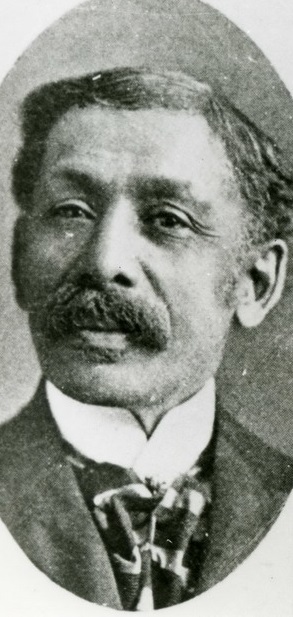
ZP reprints today an article by Kevin Plummer, a civic historian for “Torontoist” on-line, dating from February 2009:
.
Last year, a local resident discovered that the historical plaque near 660 Broadview Avenue—erected thirty years ago by the Toronto Historical Board to honour William Peyton Hubbard, Toronto’s first Black municipal politician—was damaged. He returned the pieces to Heritage Toronto, who unveiled a replacement marker this week for students at Montcrest School. Over the years, Hubbard has been commemorated in public ceremony, newspaper retrospectives, a biography, and now a second historical plaque.
.
Hubbard’s story offers insight into the ways the lives of prominent citizens can become entangled with the politics of commemoration; and there is a common narrative shared among them all…
William Peyton Hubbard was born in Toronto, Ontario, Canada, in 1842.
The Canadian-born son of a Virginian freed slave, Hubbard worked for sixteen years as a cake baker after graduating from the Toronto Model School. He then became a cab driver. As he was driving one wintry night, he saved another cab from plummeting into the Don River. A friendship blossomed between Hubbard and the grateful occupant of that cab – it was newspaperman George Brown. Brown encouraged him to seek elected office at the age of 51, and though Hubbard was narrowly defeated in the municipal election of 1893, still he had made a strong impression with the public and the press. In 1894, he was elected alderman – his first of fourteen consecutive (and fifteen total) terms in office. Over the course of his career, Hubbard served also on the Board of Control from 1898, and even as acting mayor on more than one occasion.
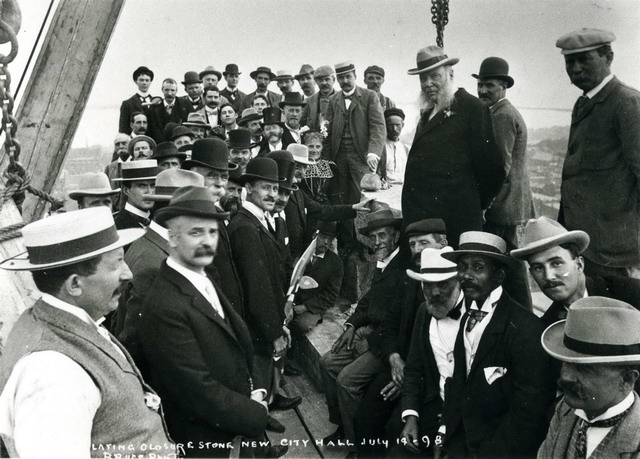
City of Toronto Archives_photograph from July of 1898_On the roof of Old_then the New_City Hall at Queen and Bay_William Peyton Hubbard is third from right in the bottom row.
Now, in the 21st century, there is always pressure exerted for public commemorations. As Thomas Symons, chair of the Canadian Historic Sites and Monuments Board back in 1997, said: “Heritage is…the aspirations of the people who made it, and, one might add, the aspirations of the people who have chosen to preserve it.” Often this becomes an act that celebrates more than engaging critiques or controversies surrounding historical questions. Looking at a few instances of public commemoration of William Peyton Hubbard—each of which highlights different points of emphasis—we can see how each reveals, or obscures, various aspects of his character; and so we gain a fuller picture of the man.
.
The November 1913 retirement ceremony for William Peyton Hubbard’s life in politics was suitably grandiose. A portrait of Hubbard, painted by W.A. Sherwood, was unveiled. It now hangs in the office of a senior policy advisor – after years on the wall of City Hall’s Committee Room One. With mayors and aldermen past and present in attendance, speeches praised Hubbard’s many political achievements. A conservative, Hubbard brought passion and a keen business sense to public life. As a reformer, he also fought against corruption in government departments, and against the misconduct of government officials.
Although he was quiet and calm in private, Hubbard was a powerful public speaker, whom colleagues dubbed the “Cicero of the Council.” While he attacked anyone verbally – colleagues included – who was guilty of misconduct, Hubbard always did his research to ensure that the evidence supported his accusations. An outspoken nature, and frank honesty—which made for good newspaper copy, too — ensured that Hubbard developed a positive relationship with the press, and this lasted his entire life.
In 1898 he was appointed to the Board of Control, a powerful four-member cabinet that advised the mayor and monitored municipal spending. His pressures for democratic reforms were partly responsible for getting that body elected by citizens at large rather than being appointed by city councillors. For his efforts, Hubbard was re-elected to the Board of Control until 1908 by ever-increasing electoral margins—even topping the polls with 15,035 votes in 1906. He also served on a wide variety of commissions and committees, and assumed leadership roles in the Union of Canadian Municipalities and the Ontario Municipal Association.
.
Hubbard’s long-time stance in favour of municipal ownership of utilities thrust him to the forefront of one of the biggest (and bitterest) debates of the early twentieth century: whether hydro-electric power ought to be developed and operated by private interests or under public control. Working with Adam Beck and the Ontario Hydro-Electric Power Commission, Hubbard eventually secured the legislation necessary to allow Toronto to operate a public electrical grid. Ironically, his tireless efforts towards this cause took him away from his other aldermanic duties, leading to his electoral defeat in 1908. Adam Beck, later knighted for his part in promoting public electric power, even made a surprise appearance at Hubbard’s retirement celebration in 1913—for Hubbard had returned to office in 1913 before retiring to attend to his ailing wife. Beck praised Hubbard as indispensable to the success of the new publicly-owned electric power system.
.
In recalling Hubbard’s achievements in public office up until retirement, newspaper accounts made no mention at all of his race.
This is odd, because readers were certainly well aware of Hubbard’s skin colour, and newspapers hadn’t shied away from it previously. In fact, on occasions when they disagreed with his politics, newspapers sometimes exaggerated his racial features. On other occasions, the press pointed to Hubbard’s success as evidence that racial prejudice was not a problem in forward-thinking Toronto. In 1913, journalistic blindness to this context downplaying why Hubbard achieving what he did when he did is all the more remarkable.
.
Although genuine concern for Toronto’s Black community existed in in the city, that sentiment could also be paternalistic. As York University’s Dr. Wilson Head has said: Blacks “were seen as people who belonged here, but not to be gotten too close to.” In Hubbard’s time, Toronto’s pioneer Black population hardly constituted an economic or political force. The population of this community—concentrated in Ward Three—was tiny, and had little to offer to potential political allies as a voting bloc, according to Keith S. Henry in Black Politics in Toronto Since World War I (published in 1981). On the other hand, a sparse population meant that this community was not seen as threatening to the dominant social order. Hubbard was therefore deftly able to chart his own individual course through the social politics of the day, buoyed by his father’s philosophy of Self-Improvement. He cultivated connections to the social establishment during his youth at the highly respected Toronto Model School, and through his life-long attendance at St. George’s Anglican Church on John Street. And so, for most of his career, Hubbard represented Ward Four—not Ward Three as one might expect—which was inhabited by an affluent (and almost exclusively white) population of professionals and intellectuals. Reports of his 1913 retirement therefore obscure Hubbard’s agility in surmounting the inequities of the age faced by the larger Black community.
.
By the time Hubbard was commemorated with a historical plaque in 1979, a number of newspaper articles had re-interpreted his story through the prism of Multiculturalism. The plaque’s text re-assessed him as “a champion of the rights of various minorities.” Lorraine Hubbard, then-VP of the Ontario Black History Society, argued that as “somebody who was quite visible from the norm,” Hubbard “got involved in issues that no-one else had touched before, issues that no-one else would go near because they were afraid that these were unpopular at the time.” Hubbard’s forty-year involvement with the House of Industry charity certainly attests to his social conscience, but there are only a handful of occasions on record when he actively pressed for minority rights in the council chambers. In placing such emphasis on this aspect of Hubbard’s life, the 1979 plaque and Against All Odds (1986)—the biography written by Stephen L. Hubbard, his great-great-grandson—do not place Hubbard into the broader critical context of Black politics in Toronto.
.
In a review of Hubbard’s biography for the Canadian Historical Review in December 1988, historian James W. St. G. Walker notes that Hubbard “saw himself as an able and respected municipal politician, not as a representative of, or an example to, the Black community.” Despite being a member of Black community organizations such as the Home Service Association and the Musical and Literary Society of Toronto, Hubbard rarely spoke about race, even in private correspondence.
Walker continues: “Hubbard himself never confronted the intriguing contradiction between his personal acceptance and the limitations imposed on most Canadian Blacks.” In a rare instance of such reflection, he noted to his close friend, (and the first Canadian-born Black doctor), Dr. Anderson Ruffin Abbott (1837-1913): “I have always felt that I am a representative of a race hitherto despised, but, given fair opportunity, would be able to command esteem.”
Author Henry recounts in detail how the demographics of Toronto’s Black community changed substantially after the First World War, with a large influx of immigrants from the British West Indies, plus migrant workers from the United States. Even the most skilled and educated of this growing population found themselves locked out of professional careers. With a different experience and political perspective, the newer arrivals, according to Henry, were critical of the traditional, native-born Old Line families. Hubbard and Abbott, it was thought, were too conservative. Writing in A History of Blacks in Canada (1981), Walker adds that even when Hubbard was serving as acting mayor, Toronto Blacks were barred from many restaurants and hotels.
.
These critical perspectives take not an ounce away from Hubbard’s many achievements.
But, given how outspoken he was about countless other political issues, his silence on matters of race is all the more deafening. It adds texture to his character, and to our historical understanding of him. Hubbard’s case also illustrates how public commemorations – especially those erected to mark a “first” pioneer who did not always act as we imagine he should have acted – can place our own present-day burdens on those who defined themselves according to their own personal principles, convictions, and foibles. As celebrations of our past, plaques—like the one unveiled this week near the grand house at 660 Broadview where Hubbard resided until his death on April 13, 1935—play an essential role. They connect us to the past by illuminating the characters or events our streets, parks, and community centres are named for. But since they are not intended to give the whole story, they can act only as a jumping off point, enticing us to explore further, and to try to fill in the blank spaces, contradictions, and controversies of our city’s history.
. . . . .
Nicomedes Santa Cruz: “Congo”
Posted: February 1, 2015 Filed under: Nicomedes Santa Cruz, Spanish | Tags: El Mes de la Historia Afroamericana Comments Off on Nicomedes Santa Cruz: “Congo”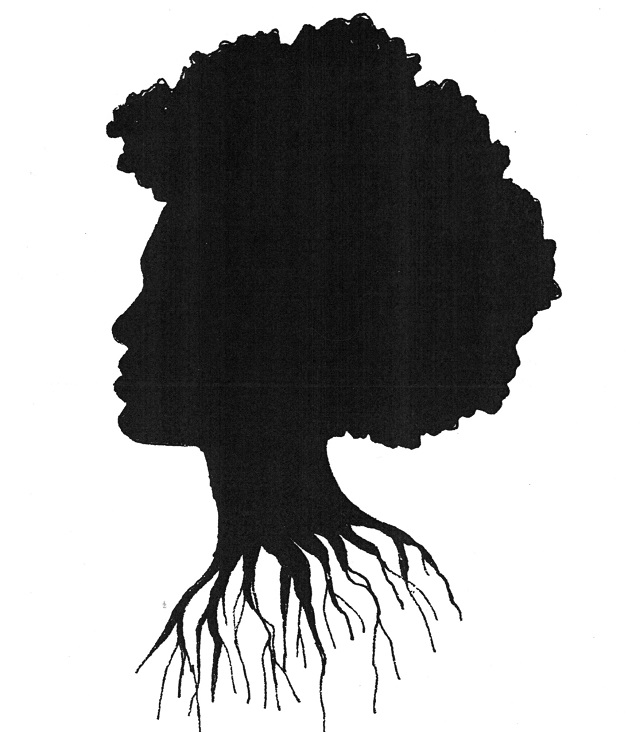
Nicomedes Santa Cruz (1925-1992, poeta afroperuano)
Congo (para Patrice Lumumba)
.
Mi madre parió un negrito
al divorciarse de su hombre,
es congo, congo, conguito,
Y Congo tiene por nombre.
.
Todos piden que camine
y lo parieron ayer.
Otros, que se elimine
sin acabar de nacer…
.
¡Ay Congo,
Yo sí me opongo!
.
El mundo te mira absorto
por tu nacimiento obscuro.
Te consideran aborto
por tu gatear inseguro.
.
¡Ay Congo,
Cuánto rezongo!
.
Yo he visto blancos nacer
en condiciones iguales,
y sus tropiezos de ayer
se consideran normales.
.
Mi Congo, congolesito
que Congo tiene por nombre,
hoy día es sólo un negrito
mañana será un gran hombre:
A las Montañas Mitumba
llegará su altiva frente,
Y el caudaloso Luaba
Tendrá en sanguíneo torrente.
.
¡Sí Congo,
Y no supongo!
.
África ha sido la madre
que pariera en un camastro
Al niño Congo, sin padre,
Que no desea padastro.
.
¡África, tierra sin frío,
madre de mi obscuridad;
cada amanecer ansío,
cada amanecer ansío,
cada amanecer ansío
tu completa libertad!
. . . . .
Other poems by Nicomedes Santa Cruz / Otros poemas por Nicomedes Santa Cruz: https://zocalopoets.com/2012/02/12/nicomedes-santa-cruz-black-rhythms-of-peru-ritmos-negros-del-peru/
.
Bruce Patrick Jones: Silueta de La Mujer como El Árbol con Raíces
Donald Willard Moore and the Negro Citizenship Association: Changing Canada’s immigration policy for the better
Posted: February 1, 2015 Filed under: English | Tags: Black History Month in Canada Comments Off on Donald Willard Moore and the Negro Citizenship Association: Changing Canada’s immigration policy for the better
Railway clips from the Grand Trunk Railroad / Canadian National Railroad line between Quebec and Ontario, the tracks that brought Donald Willard Moore from Montreal to Toronto…
Donald Willard Moore and the Negro Citizenship Association
. . .
Excerpt from the Negro Citizenship Association’s 1954 brief to Canada’s Ministry of Citizenship and Immigration:
The Immigration Act since 1923 seems to have been purposely written and revised to deny equal immigration status to those areas of the Commonwealth where coloured peoples constitute a large part of the population. This is done by creating a rigid definition of British Subject: ‘British subjects by birth or by naturalization in the United Kingdom, Australia, New Zealand or the Union of South Africa and citizens of Ireland.’ This definition excludes from the category of ‘British subject’ those who are in all other senses British subjects, but who come from such areas as the British West Indies, Bermuda, British Guiana, Ceylon, India, Pakistan, Africa, etc…Our delegation claims this definition of British subject is discriminatory and dangerous.
.
Donald Willard Moore (1891-1994) was a community leader and civil-rights activist who fought to change Canada’s exclusionary immigration laws.
Moore was born at Lodge Hill in St. Michael’s Parish, Barbados, in November of 1891. His parents were Charles Alexander Moore, a cabinetmaker and member of the Barbados Harbour Police Force, and Ruth Elizabeth Moore.
.
At the age of 21, Moore left his family and emigrated to the U.S.A., but soon left New York City for Montreal. He found work with the Canadian Pacific Railway as a sleeping car porter and his job brought him to Toronto. Moore earned enough to enrol in The Dominion Business College at 357 College Street, where he completed the courses necessary to allow him to register in the dentistry programme at Dalhousie University in Halifax in 1918.
.
A lengthy bout of tuberculosis brought an end to Moore’s formal education and his hopes of becoming a dentist. In need of money, he took a job as a tailor, a trade he had learned in Barbados. In 1920, Moore began working at Occidental Cleaners and Dyers, located at 318 Spadina Avenue between St. Patrick Street (now Dundas Street West) and St. Andrew Street. Eventually he was able to purchase the business.
Moore’s store was a gathering place for the West Indian community. It was there that the Toronto branch of Marcus Garvey’s Universal Negro Improvement Association was established, as well as the West Indian and Progressive Association and the West Indian Trading Association. Moore would continue to operate his business in various locations until his retirement in 1975.
.
In 1951, Moore founded what came to be known as the Negro Citizenship Association, a social and humanitarian organization with the motto “Dedicated to the promotion of a better Canadian citizen.” The association’s aim was to challenge the systematic denial of black West Indians seeking legal entry into Canada, and to bring an end to the incarceration of individuals who were awaiting either deportation or decisions on deportation order appeals.
.
In April of 1954 Moore led a delegation to Ottawa, which included 34 representatives from the Negro Citizenship Association as well as unions, labour councils, and community organizations. They presented a brief to Canada’s Minister of Citizenship and Immigration, Walter E. Harris.
The brief drew public attention to Canada’s discriminatory immigration laws, which were denying equal immigration status to non-white British subjects, described the impact of those laws, and made specific recommendations for change.
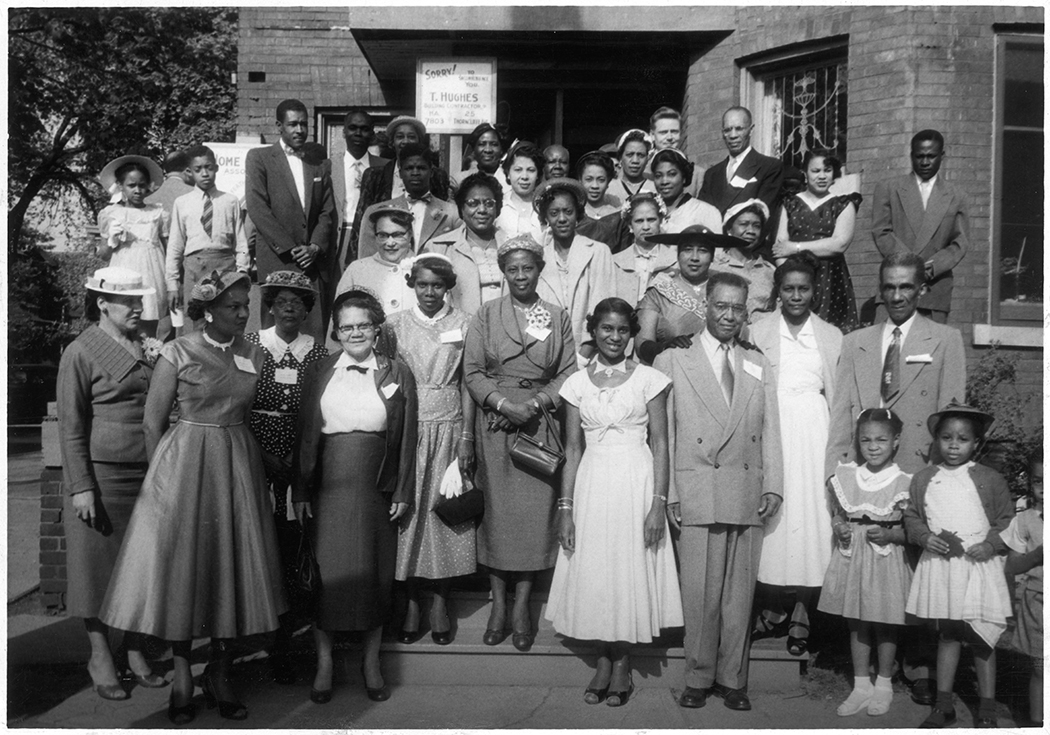
1954 photograph of Negro Citizenship Association Reception Tea_Donald Moore is in the back row third in from the right.
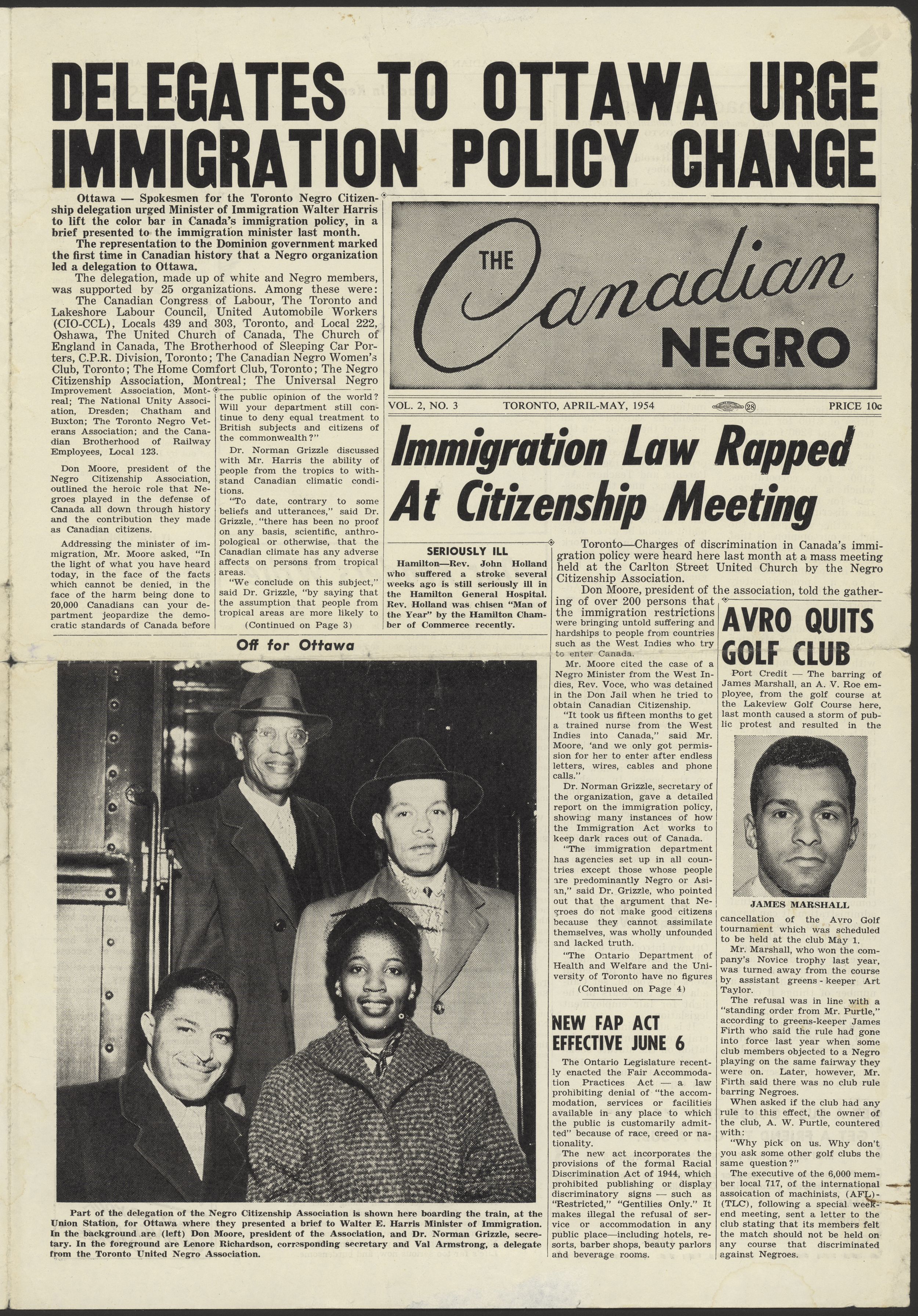
The Canadian Negro newspaper_April 1954
This landmark brief – the fact-gathering and presentation of which were spearheaded by Donald Moore – led to a subsequent relaxation of immigration laws, and opened the door for West Indian nurses and domestics to find employment in Canada. By 1955, Moore’s work with the governments of Jamaica, Barbados, and Canada enabled domestics to gain permanent residency after one year of work.
.
In 1956, Moore and two other members of the Negro Citizenship Association purchased a 12-room house on Cecil Street and converted it into a recreation centre for the West Indian community called Donavalon Centre.
In addition to serving as the home of the United Negro Improvement Association and the Toronto Negro Citizenship Association, the Donavalon Centre offered a range of activities and services, including dances, teas, Sunday programmes, insurance for its members, and the publication of a quarterly newsletter.
.
Moore retired from business and public life in 1975, and in his later years became an avid gardener. An award-winning member of the North York Horticultural Society, he cultivated a beautifully landscaped garden and lush greenhouse at his home on Drewry Avenue, a house he built himself not long after purchasing the undeveloped two-acre lot back in 1942.
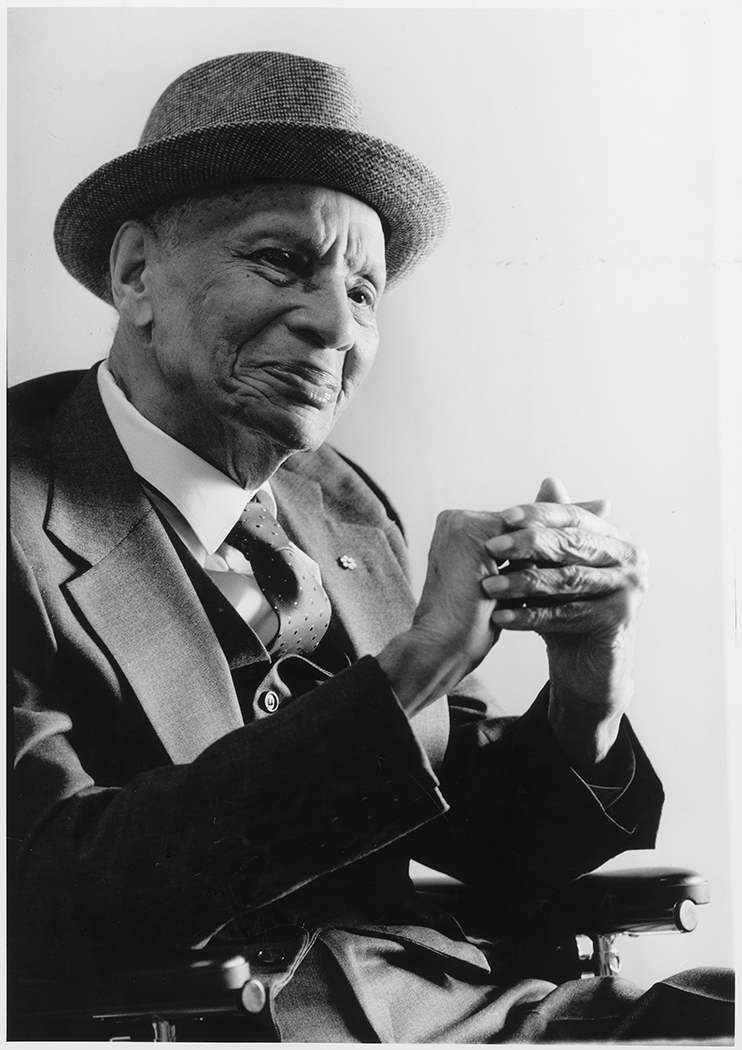
Donald Willard Moore (1891-1994)_photographed in 1992 by Andrew Stawicki
Moore was the recipient of several awards for his major contributions to the West Indian community and thereby to Canadian society. They included: the City of Toronto Award of Merit (1982), the Ontario Bicentennial Medal (1984), the Harry Jerome Award of Merit (1984), the Barbados Service Medal (1986), the Ontario Ministry of Citizenship award (1987), the Order of Ontario (1988), and the Order of Canada (1990).
In August 1994, Donald Moore died in his sleep at the age of 102. He is buried at Sanctuary Park Cemetery in Etobicoke. He had been married to his wife Kay for close to 30 years, and had one son Desmond, and three stepchildren: Karlene, Lawson, and Betty.
. . .
Biographical information about Donald Willard Moore was obtained from the City of Toronto Archives – Many Thanks!
. . . . .
“When I strolled along the cracked streets”: excerpts from Young Voices 2014: The Magazine of Teen Writing and Visual Art in Toronto
Posted: December 31, 2014 Filed under: English | Tags: Poems by Teenagers Comments Off on “When I strolled along the cracked streets”: excerpts from Young Voices 2014: The Magazine of Teen Writing and Visual Art in Toronto
“When I strolled along the cracked streets”: excerpts from Young Voices 2014: The Magazine of Teen Writing and Visual Art in Toronto
.
Samin Ali (age 17)
The Poetic Instinct
.
Sonnets do not simply
appear like leaves on
plants growing from
store-bought seeds
because my pen, it bleeds
when I am injured,
battle-worn and weary.
.
My pen, it drains
on a page
all my bottled rage
and pain from battle wounds
till the only mementoes of
agony I felt
are the scars I left behind.
.
For as I compose,
the ink, it flows
from an ocean
of one part suffering
and two parts creativity
that otherwise lies frozen
and dormant
but deep
So
deep
it puts to shame
the Marianas Trench.
. . .
Natasha Zaman Anita (age 16)
Puzzle
.
I am a puzzle
Completed
With all my pieces
Only to be taken apart
.
I am a puzzle
Wanting to be accepted
Wanting to be trusted
Wanting to be loved
.
I am a puzzle
So
I give you a piece of me
And another
And another
And another
.
Here – take my corners,
My middles,
And my sides
– Take my everything
.
Until
In the end
I am nothing more than
A mere puzzle piece
– Completely imcomplete
.
But,
You,
You throw them away…
You throw away all my pieces,
All of me…
Now I am
Fragmented, foolish, fragile
.
Don’t worry, though,
You wouldn’t be the first one…
.
I’ll pick myself up
Bit by bit
Little by little
.
All the pieces
All the pieces
All the pieces
Of me
.
And finally
I am whole
– Or at least
For the time being
.
For I am a puzzle
Completed
Only to be taken apart
Once again.
. . .
Aneeqa Tahsin (age 13)
Love Confessions of an Idiosyncratic Nerd
.
The night was young,
only 13.7 billion years old,
when I strolled along the cracked streets
lined with the wrinkles of an old man,
as the skies shed tears from above.
They called me the Ring Around Saturn,
spinning words as particles of ice and dust…
My whole universe –
the stars, planets, galaxies, nebulas, quasars –
stood still,
like the mere seconds before a hurricane,
or the moment before The Big Bang,
when everything was packed into
an infinitesimally small, massively dense speck.
– Then I met you…
And my whole universe
underwent an enormous increase
in its rate of expansion,
forming a soup of primitive particles…
I met you
on one of the 274.92 starry nights
of the 365.26 days
of nothingness,
when I sat alone
befriended by dusty textbooks
and Darwin’s theories
.
when I found sense
only in Einstein
and reciting the ‘periodic table’…
.
The moment I met you
our worlds crashed together,
not resulting in titanic collisions
but twinkling, like stars,
through the layers of the atmosphere.
Like radiation,
you penetrated through my skin,
watched my veins branch like fractals.
I was baffled
by the apparent gravitational anomaly
that drew me to you…
.
Your eyes were emeralds
rescued from the depths of the Amazon,
but like black holes
as I found myself lost in them,
wary of what lay beneath…
Would I be facing a wall of fire,
or nothing to be stretched into eternity?
I could measure the exact frequency
of your voice
when you spoke my name,
but couldn’t explain what it had to do
with the number of beats my heart produced….
Your smile,
like the curve of the moon;
a laugh with enough energy
to light up the world.
I was like a chrysalis
bound by years of silence,
just a scar on the face of humanity…
My thoughts were in the stars,
unable to turn into constellations…
But you unravelled me,
and I am now a ‘Danaus plexippus’,
a butterfly…
Free, I found you
like I’m Christopher Columbus,
and you – The New World.
.
Allow me to say:
You were every bit as fascinating
as the view through a microscope!
Each day brought new understanding
of You,
and the knowledge
that there is still far more to discover.
You traced my heart,
drew a map to my soul.
We were planets travelling
in well-determined orbits,
forever in the past – forever in the future.
.
We spent 274.92 starry nights
searching for Cassiopeia,
and counting stars
the way you counted my freckles
– all 113 of them –
(don’t think I never tried)…
365.26 days of nothing
turned into 365.26 days of something!
.
It is said: when you stand
at the horizon of a black hole,
one minute there
equals a thousand years on Earth.
And that is precisely how I felt with you.
Together we fit like Pangaea,
but I suppose even Pangaea
broke away once upon a time,
as smiles turned into scowls
that stretched into eternity…
.
We are planets
knocked out of their orbits
by something other than gravity.
Running after you
was like chasing after clouds,
even cirrocumulus and cirrostratus,
as my breath caught too many times…
.
Nimbostratus clouds
wept with me
as I spent the remaining
90 starless nights
devoted to storm clouds
and snow,
pondering what happened…
Nary a theory…
Pull up a chair…
Maya Watson (age 18)
The Moon’s Song / La chanson de la Lune
.
the fat moon swallows
the yellowing day; her belly abloom
with stolen light & she moans & the city’s night bleeds
from her black bassoon (the raccoon’s
hysterical laughter sweetly serenading
the groan of sirens)
.
marooned cigarettes & their owners shoot
red ashes glowing starly as plump streetlamps ooze
gloom around themselves, sculpting their goddess in navy blue,
& the couples croon
comme est la beauté de la Lune!
the tattoo of lifeblood beaten in 3/4 time on aching chests
comme est la beauté de la Lune!
& sweetly the moon’s night song can be found in closed rooms.
. . .
Aloysius Wong (age 15)
Immortal
.
Immortal
I am
not.
I, along with you, will
disappear.
pain and sorrow
endure in our stead.
our sacrifices
are forgotten and cast aside.
money, power and fame
outlast the grave.
but kindness, love and truth
won’t matter when we die.
our faults and fears
surely surpassed, no matter how slowly.
yet our courage and our strengths cry out,
as they fade simply away.
our sins
live on in the generations that follow us, who forget
the Will and the Way.
.
and what more is true:
.
you and I
never could defeat
Death
*
(Read “Immortal” now from bottom to top.)
. . .
Special Thanks to Ken Sparling and Toronto Public Library’s “Young Voices” Editorial Board!
. . . . .
Kwanzaa poems: Asomfwaa, Sonia Dixon
Posted: December 27, 2014 Filed under: English | Tags: Kwanzaa poems Comments Off on Kwanzaa poems: Asomfwaa, Sonia Dixon
Asomfwaa
Brother/Sister/Siblings: Kwanzaa
.
It was after I looked upon a forest, that I now understand what a family is…
Each tree drops a seed that every tree looks after, until that seed becomes a tree – like its aunts and uncles.
“Brother” and “Sister,” words for “Siblings,” mean:
“As you will look after my child, I will look after yours.” At least in our African tradition.
One of the worst tricks of our adopted culture is that we think that in ancestry
We are Brothers and Sisters,
rather than in concern for descendants
We are Brothers and Sisters.
Thus, I ask whether we have any Brotherhoods or Sisterhoods. What are the two?
Will those who call me Brother look after my child?
Do you, reader, look after the child of others?
If not, will you call another a Sibling?
I am grateful to the ancestors for allowing me the wisdom to
put meaning behind my appellations.
And I promise to my African Blood Siblings, that I will, to my ability,
Be a Brother to you All!
. . .
Sonia Dixon
A poem of Unity: Kwanzaa, Day 1
.
Here we are on distant shores,
Searching for love ones lost,
Knowing their pain and suffering
Was an ocean of love lost.
Can’t you see the sun is shining
Bringing energies of love?
Come, my people, unite together;
Wake up, stand up, be the love for all!
The bells are ringing – it is time
To answer the call of one.
Get together, my brothers and sisters,
It’s time you must unite as one.
Unite, unite – it’s time, it’s time,
You must unite as one.
Hold together, brothers and sisters,
It’s time to unite as one!
. . .
https://zocalopoets.com/2012/12/26/kwanzaa-yenu-iwe-na-heri-harambee-happy-kwanzaa-lets-all-pull-together/
. . . . .
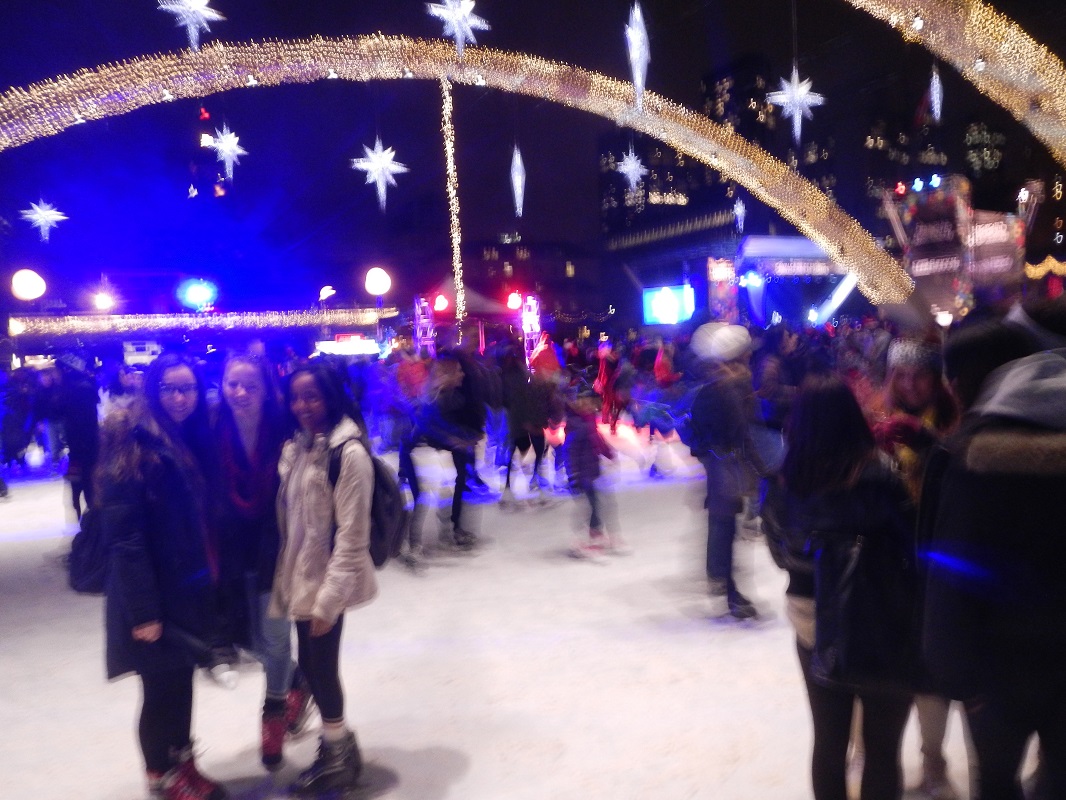
Gozo del Invierno: George du Maurier y el Patinaje
Posted: December 24, 2014 Filed under: IMAGES, Spanish, ZP Translator: Alexander Best Comments Off on Gozo del Invierno: George du Maurier y el Patinaje George du Maurier (1834-1896)
Rincomania (1875)
.
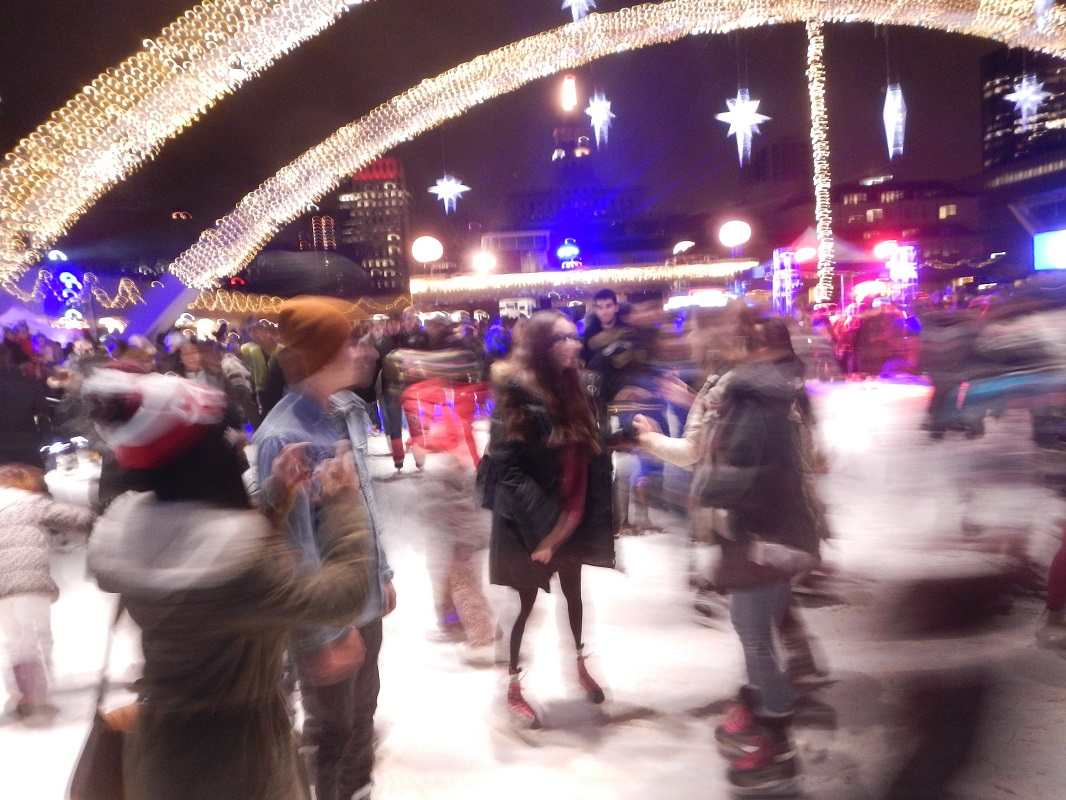
Friends of the fleeting skate, behold in this
A Rincomaniac’s dream of earthly bliss,
Sketched by the frantic pen of one who thinks
That Heaven is paved with everlasting rinks
Where Cherubs sweep forever and a day,
Smooth tepid ice that never melts away,
While graceful, gay, good-natured Lovers blend,
To Endless tune, in circles without End.



George du Maurier (1834-1896)
Manía de patinaje (1875)
.
Amigos del patín fugaz,
contemplen el sueño de extásis terrenal
del “maniático de la pista de hielo”,
bosquejado por la pluma frenética de un hombre que cree
que el Cielo está pavimentado con pistas perpetuas
donde vuelan querubines por siempre jamás,
hielo liso y tibio pero nunca se derretirá,
mientras Amantes graciosos, vistosos y simpáticos combinan
a la Tonada infinita, en círculos sin Fin.

Poema de un recuerdo especial navideño / A special “Christmas memory” poem…
Posted: December 24, 2014 Filed under: English, Rita Bouvier, Spanish, ZP Translator: Alexander Best Comments Off on Poema de un recuerdo especial navideño / A special “Christmas memory” poem…
Rita Bouvier (1950, Sakitawak, Saskatchewan, Canadá)
A veces me percato llorando – al momento más raro…
.
A veces me percato llorando – al momento más raro…
.
Una voz inesperada – mon oncle André / de mi tío Andrés –
llamándome la mañana de Navidad para darme “mejores deseos”.
.
Y soy, de nuevo, esa pequeña niña
andando por el lago congelado
con su abuelo,
para chequear las trampas ha colocado,
en esta escarcha, bajo una luna explotando sobre las isletas envolventes…
.
La escarcha está mordiendo,
y él me hace señas para caminar en la sombra de tu cuerpo
radiante.
.
Pronto asegura que nos encontraremos en el medio del matorral,
y levantaremos una fogata
para calentar nuestros cuerpos.
. . .
Rita Bouvier (born 1950, Sakitawak, Saskatchewan)
Sometimes I Find Myself Weeping At The Oddest Moment
.
Sometimes I find myself
weeping
at the oddest moment
An unexpected voice
mon oncle André
calling Christmas Day
wishing me
a Merry Christmas
And I am
that little girl
walking across the lake
with her grandfather
to check on the snares
and traps he has set
in this frost
exploding moon
in surrounding islands
The frost is biting
and he motions I walk
in the shade
of his warm body
Soon he claims
we will be
in the thick of brush
and we will make a fire
to warm our bodies.
. . .
From Blueberry Clouds © 1999 Rita Bouvier
. . . . .
Roberto Carlos: Estás tan linda
Posted: December 24, 2014 Filed under: Spanish | Tags: El Nacimiento de Jesús Comments Off on Roberto Carlos: Estás tan linda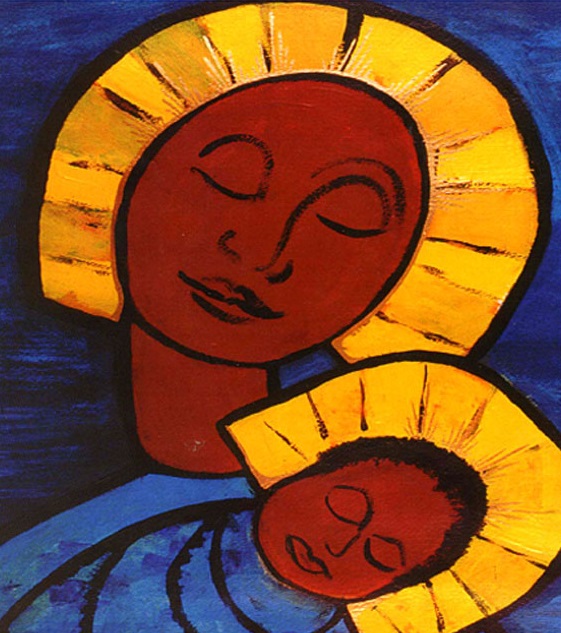
Madre María y el Bebé Jesús
Roberto Carlos (nacido 1941, cantante y compositor brasileño)
Estás tan linda
.
Tú viniste sonriendo
No sé bien de donde
Con aire tan puro
De quien del futuro de esperar
La sonrisa encontrar.
.
Tu vestido sin curvas
Tus sueños guardando
Yo sigo pensando
Que el día que llegue será
Sólo felicidad.
.
No sé quién eres tú
Ni cual tu origen es
Tan sólo sé que
Luces linda esperando un bebé, esperando un bebé.
Espero que haya sido con mucho amor
Quien sea que fue
Él te vea también que luces linda esperando un bebé.
.
Tus deseos serán todos satisfechos
Lo importante es que tú sepas esperar
Tu voz ensaya la canción que un día
Muchas veces con ternura cantarás.
.
Y tú vives pensado que nombre tendrá
El amor que de tu propio amor va nacer
Y ese amor…que en tus brazos tendrás.
.
No sé quién eres tú
Ni cual tu origen es
Tan sólo sé que
Luces linda esperando un bebé, esperando un bebé.
Espero que haya sido con mucho amor
Quien sea que fue
Él te vea también que luces linda
esperando un bebé…
. . . . .
 Zócalo Poets