Kaiso to Soca: a brief history of Calypso music
Posted: February 8, 2016 Filed under: English | Tags: Black History Month: Calypso music Comments Off on Kaiso to Soca: a brief history of Calypso music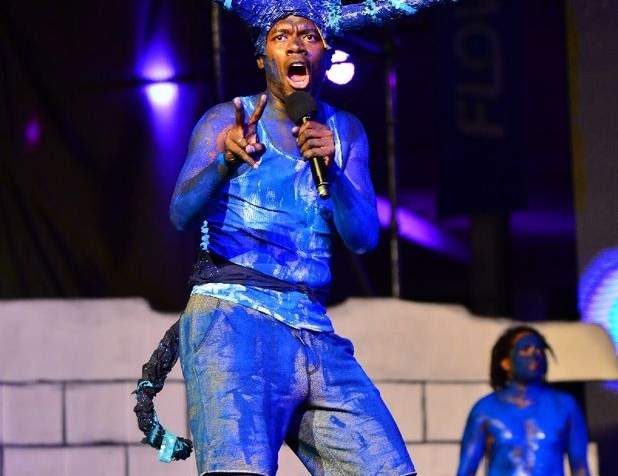
Devon Seale, the 2016 Trinidad Carnival Calypso Monarch, seen performing on Dimanche Gras, February 7th, 2016_photograph by Stephan Doobay for Trinidad Express
CALYPSO: a Brief History
by Philip W. Scher
. . .
CALYPSO is a style of Caribbean music associated with the nation of Trinidad, and is linked to the annual celebration of the pre-Lenten Carnival. The music, as well as the name itself, has a myriad of roots, and although there is no general agreement as to the origin of the term, there are references in Trinidadian newspapers of the nineteenth century to cariso and kaiso, both song forms characterized by the performance of extemporaneous, satirical lyrics. The term kaiso, which was shouted to encourage or praise successful singers, is considered a possible source for the word calypso, and indeed is still used instead of calypso. The cariso is only one of many song forms to emerge from the colonial era in Trinidad. Creole slaves and free Africans contributed a variety of songs and dances, including the bel air (derived from both African and French sources), the juba, the bamboula, the calinda (both a martial art and a song style), and the lavway (a road chant performed during Carnival processions). Combined with these forms were British ballads, French folk songs, Venezuelan string music, and other types of Creole West-Indian songs. As new musical forms were created or introduced to the island—American jazz, Venezuelan paseos, and ultimately such diverse forms as Hindi film music, reggae and dancehall, soul, and rhythm and blues—they were incorporated into Calypso.
.
Trinidad was “opened” by Spain to French colonists first in the later part of the eighteenth century. The French dominated the cultural life of the island up to and even beyond the English conquest in 1797. The French imported their pre-Lenten festival of Carnival, and much of the earliest carnival music was sung in Creole or Patois. During the nineteenth century, English culture, language, and religion increased in importance and influence, and many of the folk musical styles gradually changed from French Creole to English. As the English extended their hegemony over the island, they also embarked on a mission of reforming Carnival. By the 1880s unruly masqueraders and riots against police repression resulted in a massive campaign to control and channel the public celebration into a more structured event. By the early 1900s calypso music, marked lyrically now by social satire, political commentary, humour and sexual innuendo, was largely being performed in “calypso tents,” temporary venues in which calypsonians competed against each other for prizes offered by private sponsors.
.
The first calypso recordings were made in 1914, and by the 1920s and 1930s Trinidad’s finest calypso singers, such as Attila the Hun, Roaring Lion, and Lord Invader, were regularly recording and performing in the U.S.A. “Rum and Coca-Cola”, recorded by the Andrews Sisters in 1944, was a sanitized re-interpretation of a Lord Invader song. It became an American hit, and also spawned a landmark lawsuit by Lord Invader against the American actor Morey Amsterdam, who illegally copyrighted the lyrics. Invader won the suit.
.
Although they faced routine censorship by the British colonial authorities, calypsonians of this period displayed enormous creativity in circumventing restrictions to create songs rife with double-entendre, inside jokes, and subtle parody. Audiences relied on clever calypsonians for insight into the ironies of colonial rule, the hypocrisy of the ruling classes, and the meaning of certain scandals and outrages. Savvy politicians could often “take the temperature” of the public based on the attitudes of their calypsonians.
.
From its earliest days, Calypso music served as a forum for the expression of social and political views within the Caribbean. Remarkably, the criticism mounted by calypsonians was not limited to broad appeals against inequality, racism, poverty, and oppression, but tackled precise laws, domestic policy, proposed legislation, foreign policy, labour relations, actions by public figures, and even speeches given by notable persons. Thus, in addition to humorous rivalries between singers, songs about the beauty of the land, and compositions with a ribald flavour, calypsos were composed with such titles as “Prison Improvement,” “Shop Closing Ordinance,” “The Commissioner’s Report,” “The European Situation,” “Devaluation,” “Slum Clearance,” “Reply to the Ministry,” etcetera.
.
The arrival of indentured labourers from South Asia from the mid-nineteenth century until 1917 changed the ethnic makeup of Trinidad. Competition for work and land created tensions between the island’s Black populace and South Asians that ultimately manifested in political divisions being drawn along ethnic lines. The presence of Indians in Trinidad was closely followed by calypsonians. Initially, many calypsos dealing with Indians discussed “strange” customs, delicious food, and beautiful women. Creole calypsonians often commented in song on how they fell in love with an Indian girl or how they were able to participate in an Indian feast. As political tensions heated up during the 1950s, however, calypsos became more pointedly political. By 1961 the calypsonian Striker, registering his dismay at the deep ethnic division present in local politics, remarked in song that “Negro can’t get a vote from Indian.” Today there are a number of noted Indian calypsonians, both men and women, as well as Black musicians performing in the Indian-influenced genre of chutney soca. Yet tensions between the two communities have been played out musically over the airways and in the calypso tents of Trinidad.
.
Though rebelliousness and resistance could characterize calypso, still there was a strong dose of pro-British patriotism during the two World Wars of the twentieth century. Calypsonians recorded achievements of the British Empire and the royal family, along with all their other social/political and lyrical commentaries. And compositions in favour of the Empire co-existed alongside songs detailing the oppressive conditions under which the populaces of the Empire laboured.
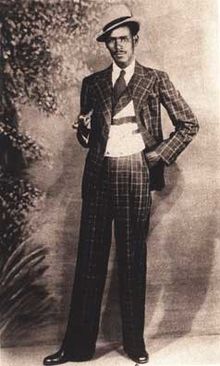
Rafael de Leon a.k.a. Roaring Lion_1908 to 1999_pictured here in the 1930s
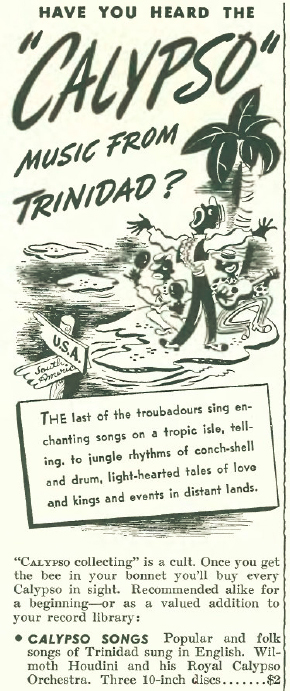
1939 ad. from NYC for calypsos on records_featuring Wilmoth Houdini
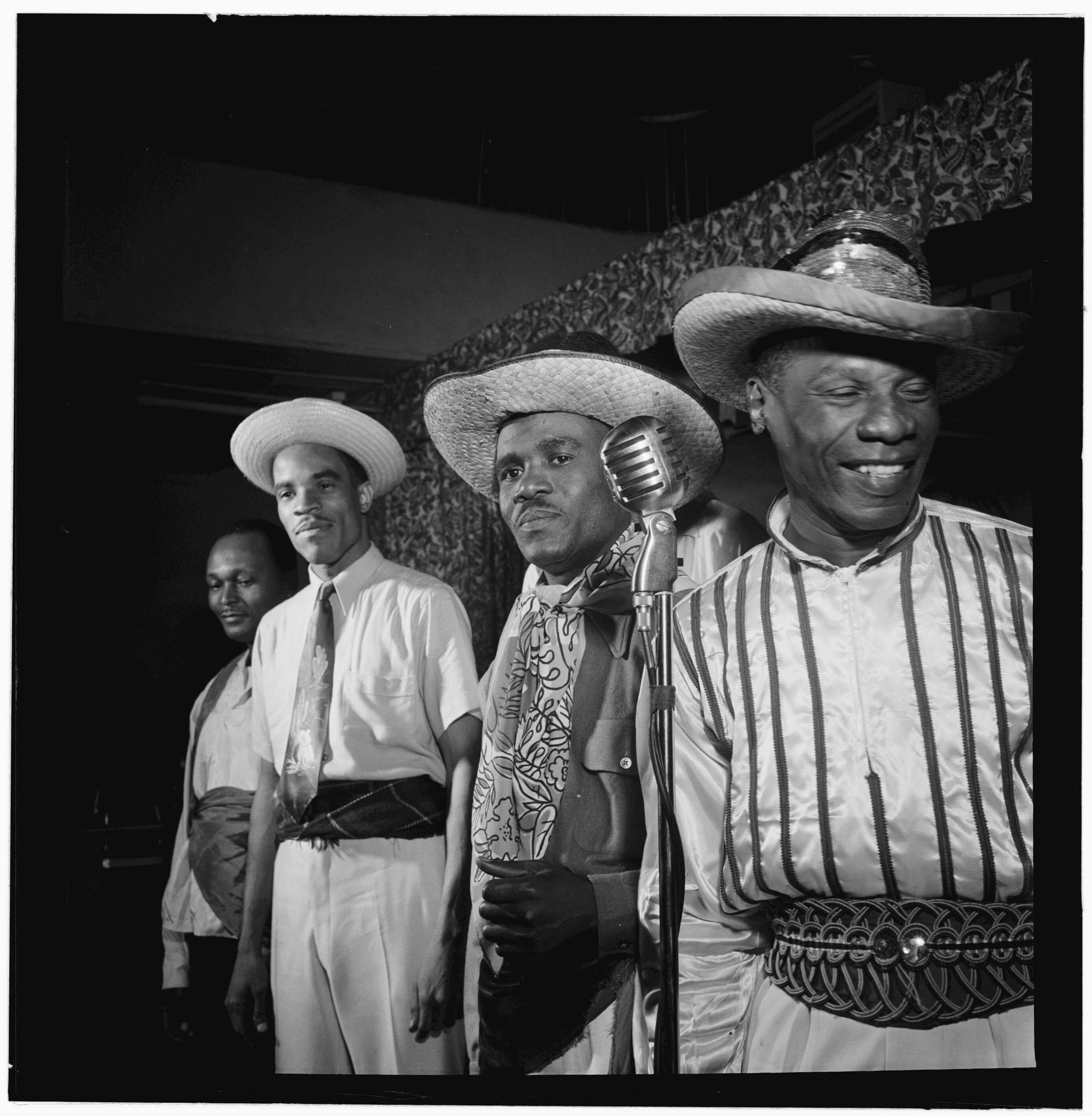
1947 photograph by William P. Gottlieb_probably at the Renaissance ballroom in Harlem_Calypsonians from Trinidad that included Lord Invader, Macbeth the Great, the Duke of Iron, and the Count of Monte Cristo
1956 was a turning point in Calypso…
The Mighty Sparrow penned “Jean and Dinah,” a song about the sudden availability and desperation of prostitutes in Port of Spain after the departure of the free-spending American sailors stationed in Trinidad during World War II. “Jean and Dinah” became an international hit, and won the calypso “crown” for Sparrow – yet it is even more important as a testimony to a sense of cultural and political confidence then being experienced across the Caribbean as Independence movements were gathering steam.
.
As Trinidad, Jamaica, Barbados, and other English-speaking islands continued their drive toward independence from the United Kingdom, folk idioms such as calypso, Carnival, Pan (steel band), the musical form ska, and even sports such as cricket, began to take on a nationalist tone. Nation-building calypsos, as they are sometimes called, emerged to praise the efforts of certain political parties and politicians and to encourage proper behaviour and decorum among the people.
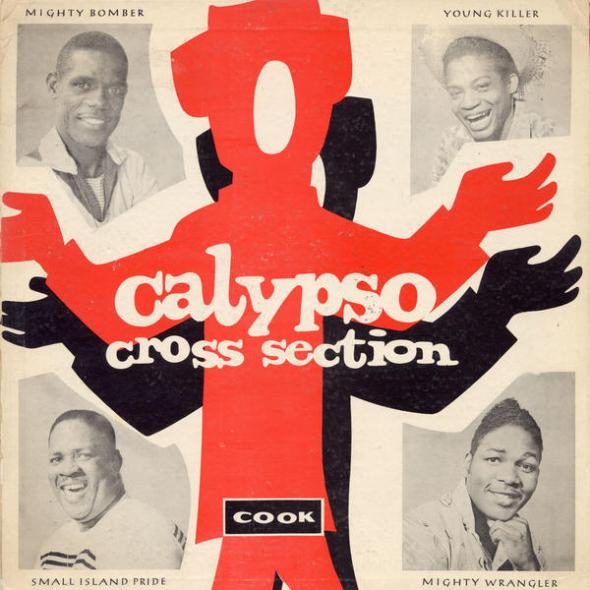
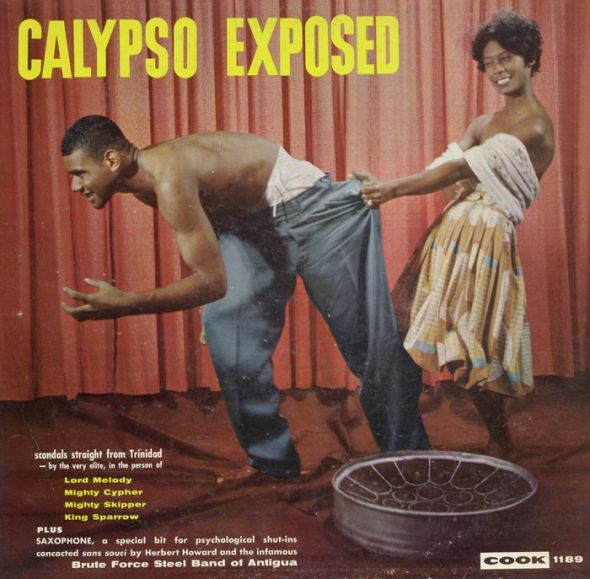
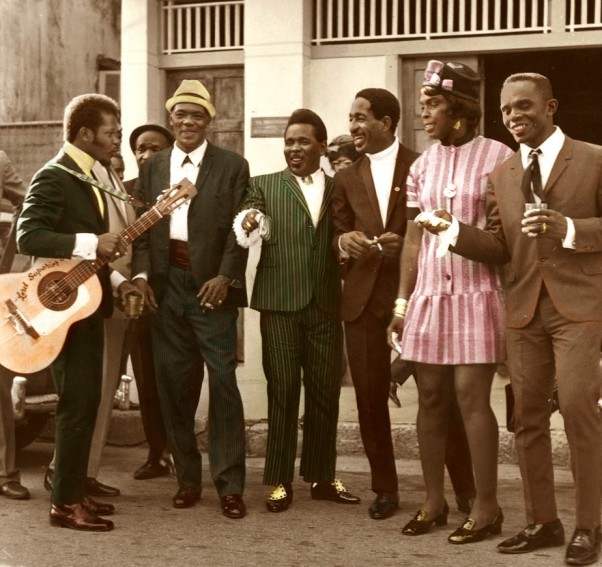
Lord Superior and Lord Blakie__plus Friends
The 1960s brought to the Caribbean not only Independence but the Black Power movement. Calypso reflected this new cultural consciousness lyrically; it also reflected the cultural source from which it came—the United States. One of the most important figures to emerge at this time was the Mighty Chalkdust, a teacher and calypsonian who has, under his given name, Hollis Liverpool, researched and published widely on Calypso, Carnival, and Trinidadian culture in general.
.
Traditionally accompanied by acoustic music, Calypso increasingly came to incorporate electronic instrumentation and the influence of North-American musical styles such as rhythm and blues and soul. Alongside Black Power came the women’s liberation movement and increasing (though still small) numbers of women singers. Indeed, women as calypsonians are not given nearly the attention they deserve in the literature. Although largely excluded from the ranks of early recorded calypsonians, and often derided in songs such as “Jean and Dinah,” women have been instrumental in the development of Trinidadian music as chantwells (praise singers for stickfighters and singers of road marches) and in religious music. In the 1960s, attitudes toward women calypsonians began to change, and it was, perhaps ironically, the Mighty Sparrow who gave the then-unknown singer Calypso Rose her start. Along with Singing Francine and Denyse Plummer, Rose has become one of the most popular calypsonians of all time.
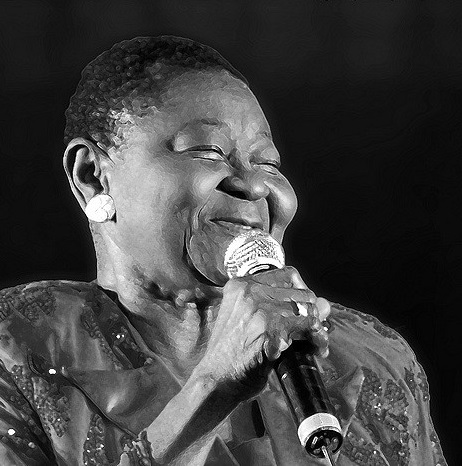
Calypso Rose_born 1940 in Tobago_painted photograph copyright Jean Pierre Jeannin_2009
With the rise of outside influences from North America came further influences from diverse musical sources, including Jamaican reggae and (due to the presence of a large and thriving Indian population) Hindi film music. The result has been the development of new musical forms, such as soca, chutney soca, rapso, and so forth.
Born in 1941, Garfield Blackman, later known as Lord Shorty (and, finally, Ras Shorty), would become the “creator” of soca music. Concerned that calypso was declining in relation to reggae, Shorty experimented in combining Indian instruments such as the dholak, tabla, and dhantal with traditional calypso instrumentation. The result was a new musical hybrid that he called solka. With his 1974 album Endless Vibrations and the single “Shanti Om,” Shorty sparked a revolution in Caribbean music. Initially the term solka referred to an attempt to recapture the “soul of calypso,” which he felt was one of inclusion, common struggle, and resistance to oppression. Shorty hoped that the “Indianization” of calypso would bring together the musical traditions of Trinidad and Tobago’s two major ethnic groups, the descendants of African slaves and of indentured labourers from India. The name was later changed to soca, and it is routinely if erroneously explained as a fusion of soul and calypso.
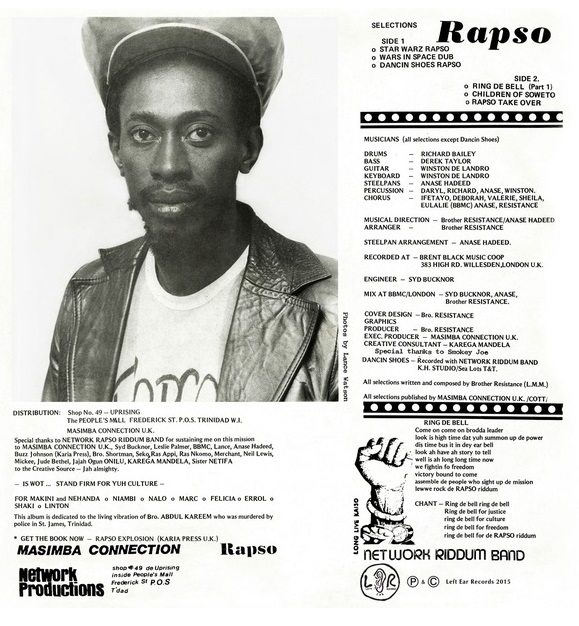
Roy Lewis a.k.a. Brother Resistance_Rapso practitioner from Trinidad
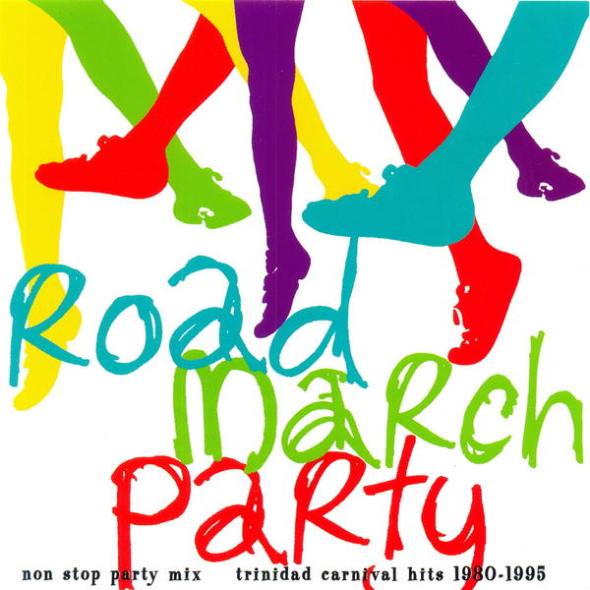 In the 1980s soca was to have its first international hit…
A singer from Montserrat – Alphonsus Celestine Edmund Cassell – better known as Arrow – recorded “Hot Hot Hot” in 1982 and the musical genre soca became known far and wide. The globalization of the music industry has meant that soca too has evolved, incorporating many influences, and branching out into ragga soca and chutney soca. But along with its increasing popularity soca has been regarded by critics within the Caribbean region as showing a reluctance to be anything more than just “party music.” The political and social commentary once so central to calypso has had to find new expression in other Caribbean musical genres. In Trinidad this mantle has largely been taken up by rapso. Rapso is a unique style of street poetry from Trinidad and Tobago that originated in the 1970s – though it was not named rapso until the 1980s – by Brother Resistance. Often credited to Lancelot Layne, rapso was created in a spirit of political protest and social justice. Layne’s 1970 hit “Blow Away” is considered to be the first rapso recording.
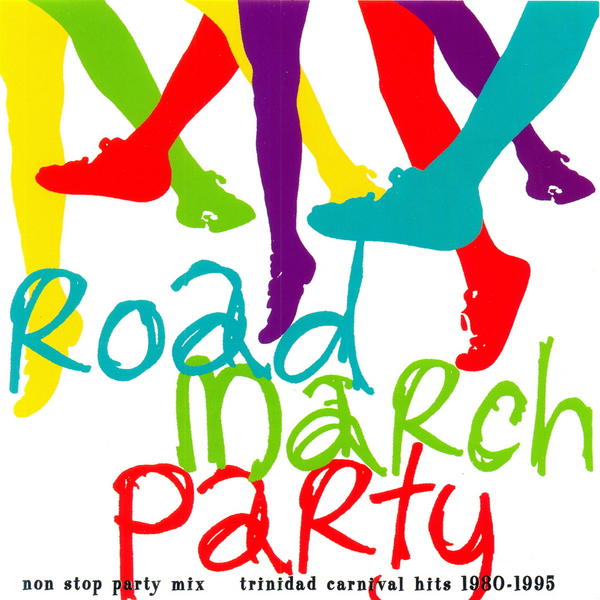
. . .
.
[The above essay – A Brief History of Calypso Music by Philip W. Scher – has been edited for length. It was originally published via the International Encyclopedia of the Social Sciences, © 2008 Thomas Gale ]
. . . . .
Robert Nesta “Bob” Marley: “Chanson de Rédemption”
Posted: February 6, 2016 Filed under: Bob Marley, English, French Comments Off on Robert Nesta “Bob” Marley: “Chanson de Rédemption”
Quatre enfants de Bob Marley_1980
Robert Nesta “Bob” Marley (6 février, 1945 – 11 mai, 1981)
Chanson de Rédemption (1980)
.
Vieux pirates, oui – ils m’ont volés
et vendus aux bateaux d’esclaves,
quelques minutes après qu’ils m’aient attrapé
du puits sans fond.
Mais par la main du Tout-Puissant
nous avançons dans cette génération – triomphante.
.
Voudrais-tu m’aider à chanter ces chansons de liberté?
Parce que tout ce que j’avais
– c’est des chansons de rédemption,
des chansons de rédemption.
.
Emancipez-vous de l’esclavage mental;
personne d’autres que nous-mêmes ne peut libérer nos esprits.
N’ayons pas peur pour l’énergie atomique,
car personne ne peut arrêter le temps.
Combien de temps encore tueront-ils nos prophètes
pendant que nous nous tenons à part et regardons?
Oui, il y a certains qui disent que c’est juste un passage,
et nous devons accomplir la Prophétie.
Ne voudrais-tu pas m’aider à chanter ces chansons de liberté?
Parce que tout ce que j’avais
– c’est des chansons de rédemption,
des chansons de rédemption
– ces chansons de liberté, chansons de liberté!
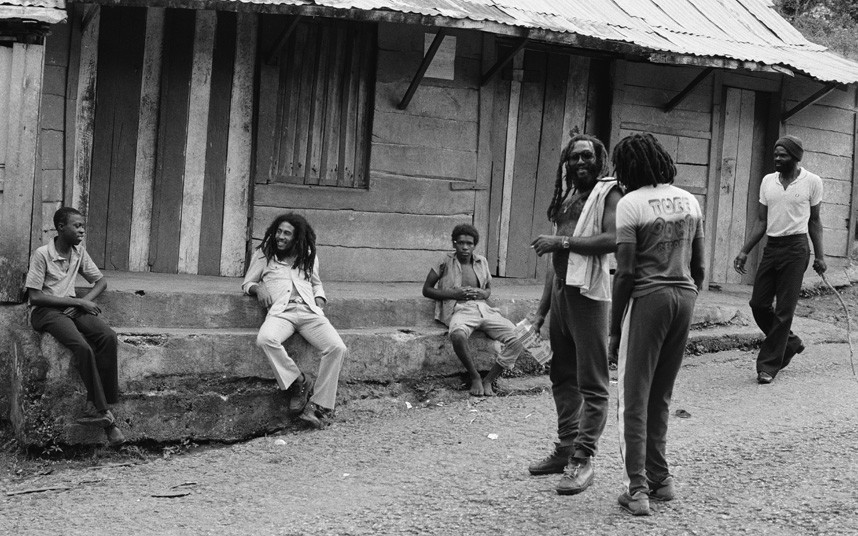
Bob Marley visitant le village de sa naissance, Nine Mile, dans la paroisse de Saint Ann, Jamaïque
Redemption Song (1980)
.
Old pirates, yes they rob I
– sold I to the merchant ships;
minutes after they took I
from the bottom-less pit.
But my hand was made strong
by the hand of the Almighty;
we forward in this generation
– triumphantly.
.
Won’t you help to sing these songs of freedom?
’cause all I ever had: redemption songs, redemption songs.
.
Emancipate yourself from the mental slavery;
none but ourselves can free our minds.
Have no fear for atomic energy,
’cause none o’ them can stop the time.
How long shall they kill our prophets
while we stand aside and look? (ouuuu!)
Some say it’s just a part of it;
we’ve got to fulfill the Book.
Won’t you help to sing these songs of freedom?
’cause all I ever had: redemption songs, redemption songs…
.
Emancipate yourselves from mental slavery;
None but ourselves can free our mind.
Woah! have no fear for atomic energy,
’cause none o’ them can stop the time.
How long shall they kill our prophets
while we stand aside and look?
Yes, some say it’s just a part of it;
we’ve got to fulfill the Book.
Won’t you help to sing these songs of freedom?
’cause all I ever had: redemption songs.
All I ever had: redemption songs.
(These songs of freedom, songs of freedom!)
. . . . .
Du Cake-Walk au Patinage artistique sur la glace: une Énergie qui danse!
Posted: February 3, 2016 Filed under: A FEW FAVOURITES / UNA MUESTRA DE FAVORITOS, Du Cake-Walk au Patinage artistique sur la glace..., French | Tags: Le mois de l'histoire des noirs Comments Off on Du Cake-Walk au Patinage artistique sur la glace: une Énergie qui danse!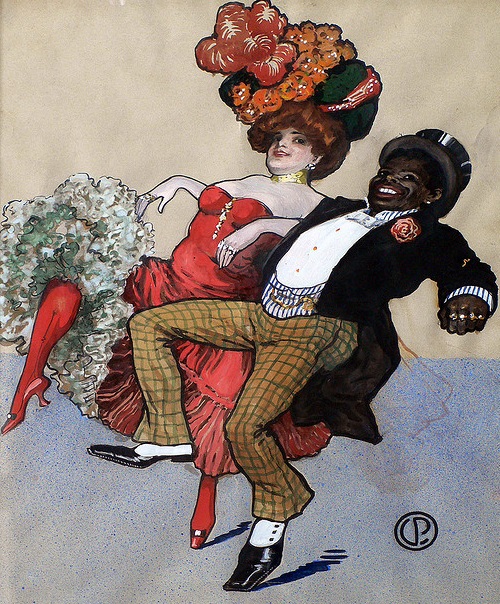 “Chocolat”, le clown nègre: son vrai nom était Rafael Padilla, esclave né à Cuba vers 1868, devenu célèbre au Cirque de Paris à partir de 1886. Il forma un duo avec Footit, le clown blanc, qui les propulsa jusqu’à la scène des Folies-Bergère. Padilla a été peint par Toulouse-Lautrec en 1896 qui le montre dansant dans un cabaret de Montmartre.
Chocolat avec La Goulue…
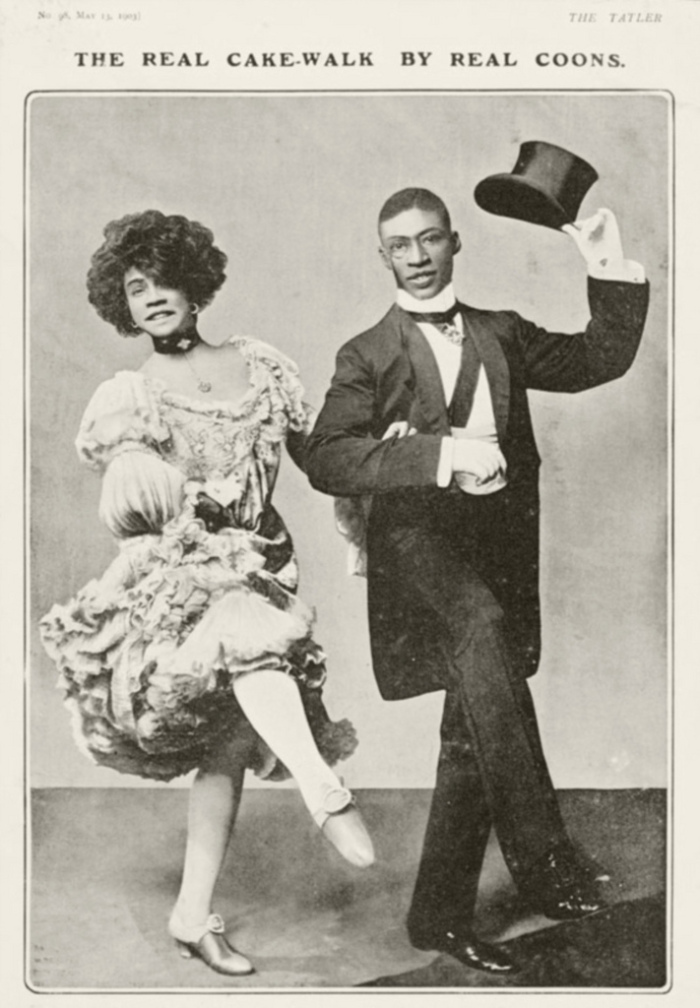 Le vrai Cake-Walk dansés par les vrais Ratons Laveurs (un terme raciste de la fin du siècle): les acteurs de vaudeville Aida Overton Walker et son épouse George Walker
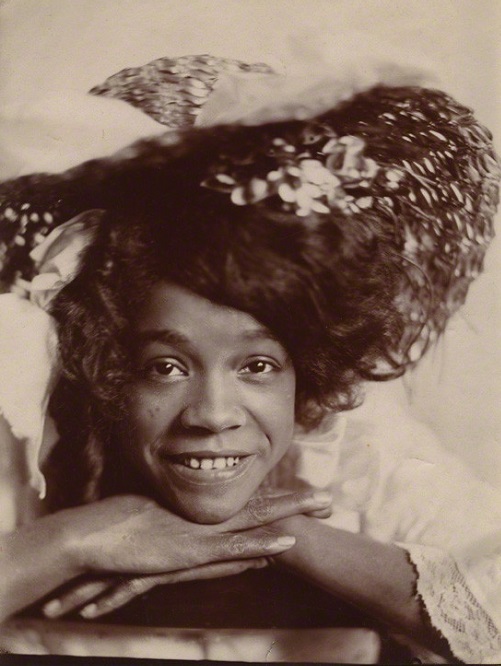
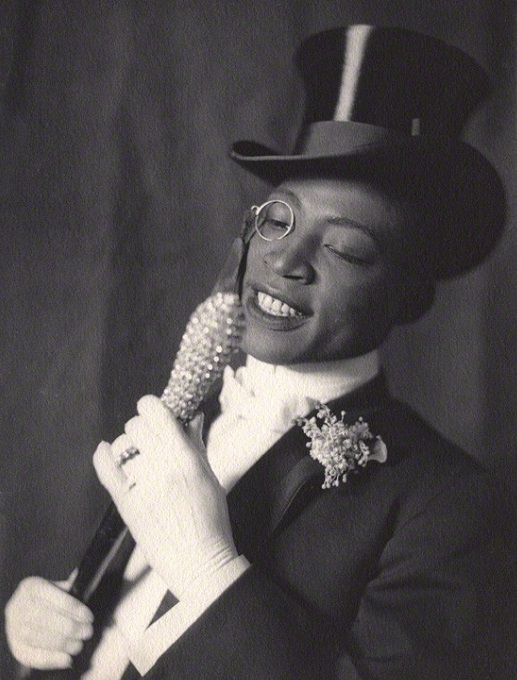 Les Walker photographiés dans la comédie musicale “In Dahomey”_Londres, 1903
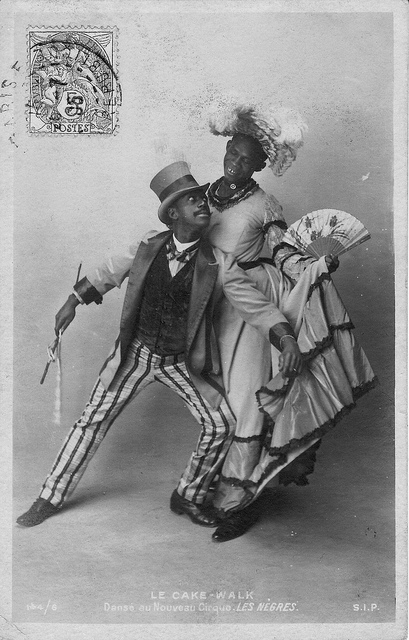 Deux hommes font Le Cake Walk, et l’un “joue” à la femme.
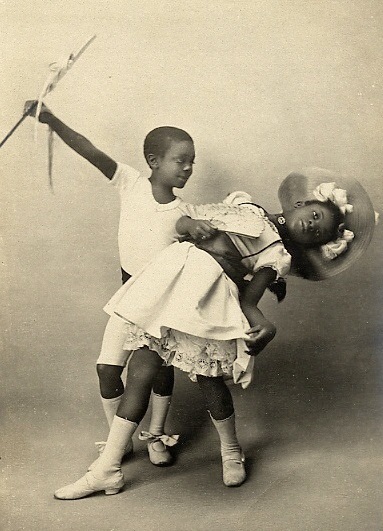
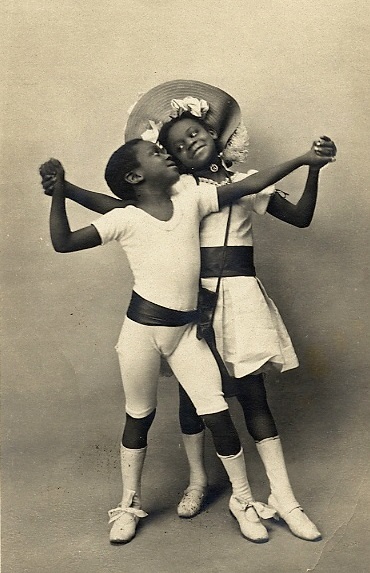 Rudy and Fredy Walker_Les Enfants Nègres de 1903_Le Cake Walk dansé au Nouveau Cirque de Paris
 …..
…..
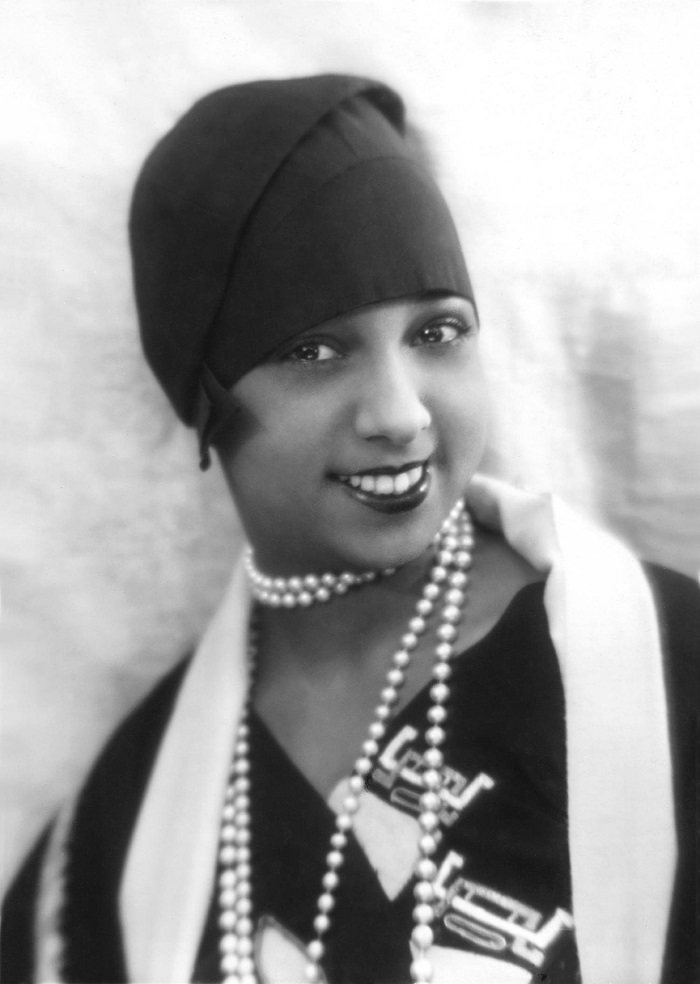 Josephine Baker était l’Américaine exotique qui se transforma à la première star noire – à cause de ses danses fraises et originales.
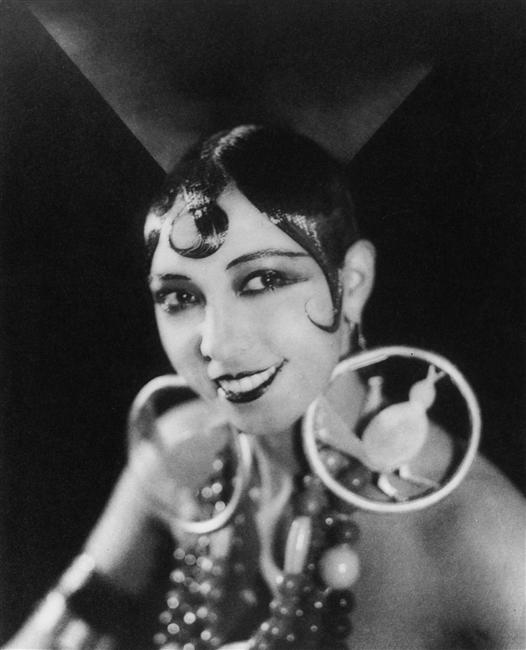 La danseuse la plus libre et ingénieuse des années 20: Josephine Baker_photo par Wolf von Gudenberg (Berlin, 1925)
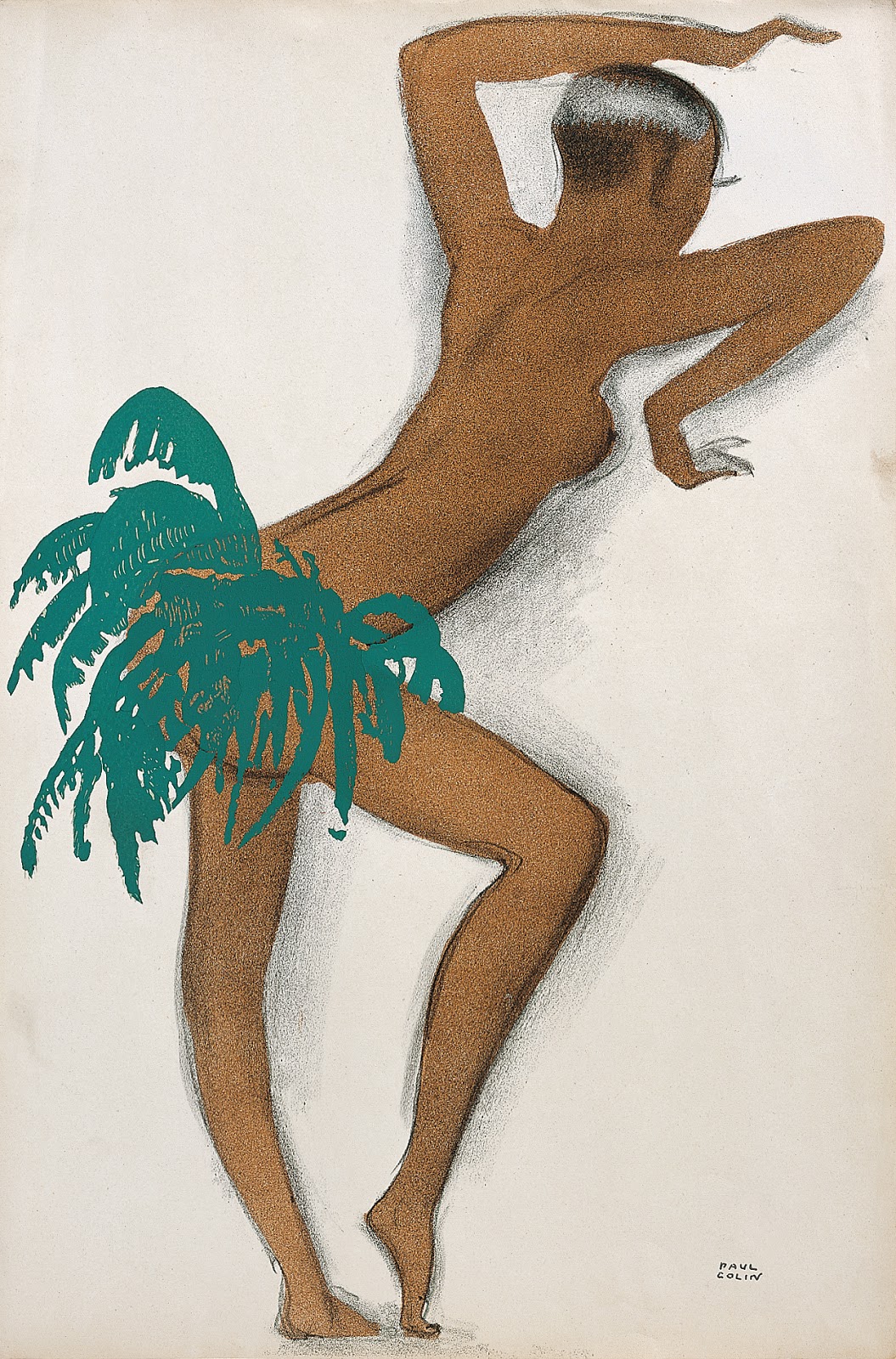 Josephine Baker: du livre Le Tumulte Noir (1927)_illustration par Paul Colin
 Danseuses de vaudeville_Washington, D.C., 1930
 Les années du Swing à Harlem
 Frankie Manning, l’inventeur de la danse “Lindy Hop”, et sa partenaire
 Les Frères Nicholas: Danseurs de claquettes des années 30 et 40: Hommes audaces, athléthiques et élégants! (photographie du film “Stormy Weather”, 1943)
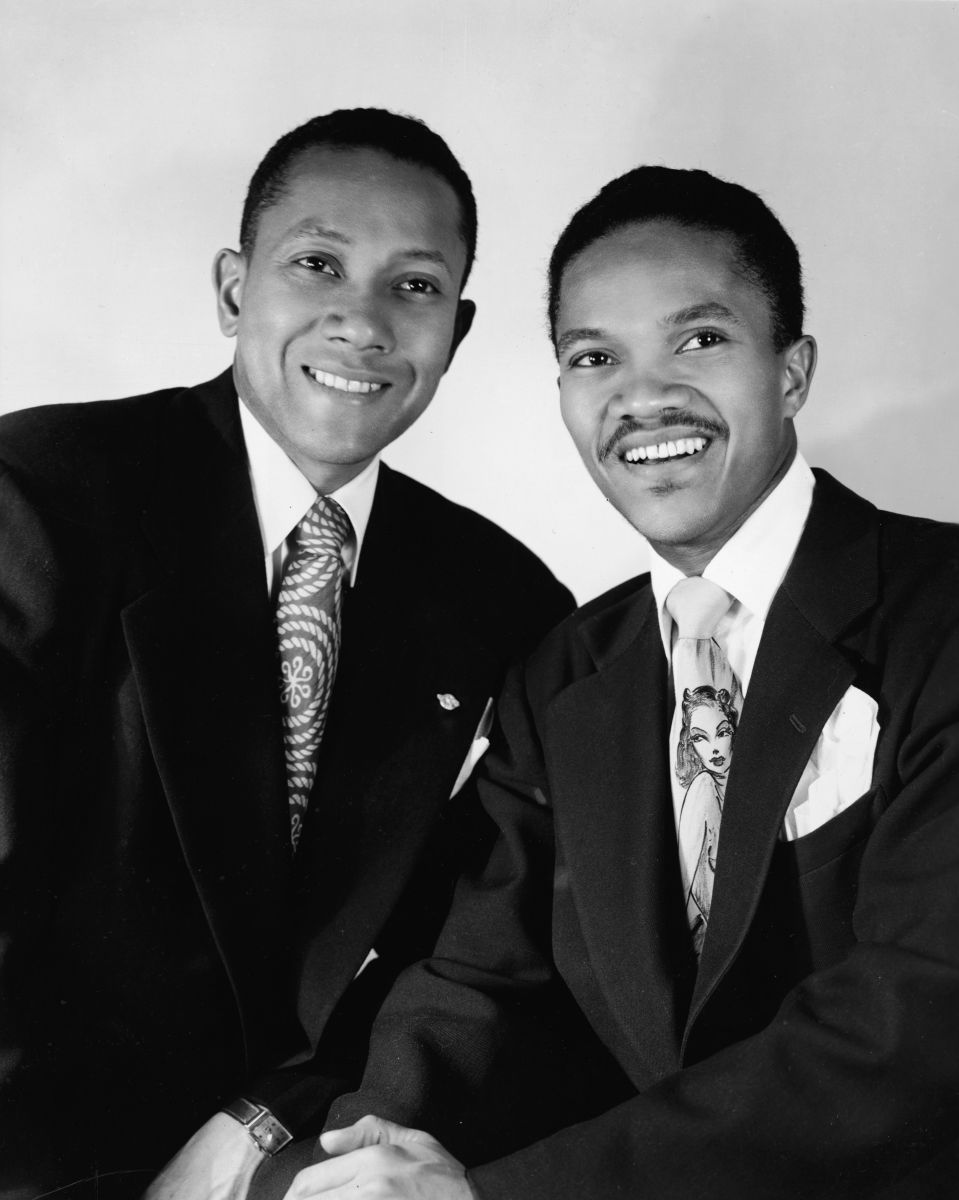 Les Frères Nicholas: Fayard (né 1914) et Harold (né 1921)
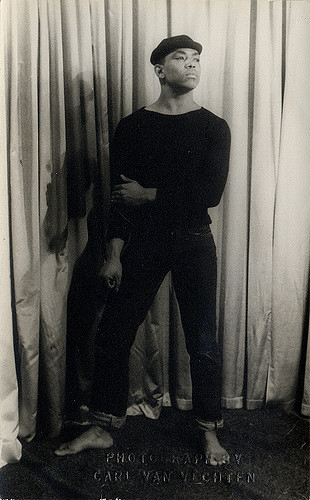 Alvin Ailey (1931-1989), fondateur et choréographe du Alvin Ailey American Dance Theater_photographie de 1955 (Carl Van Vechten)
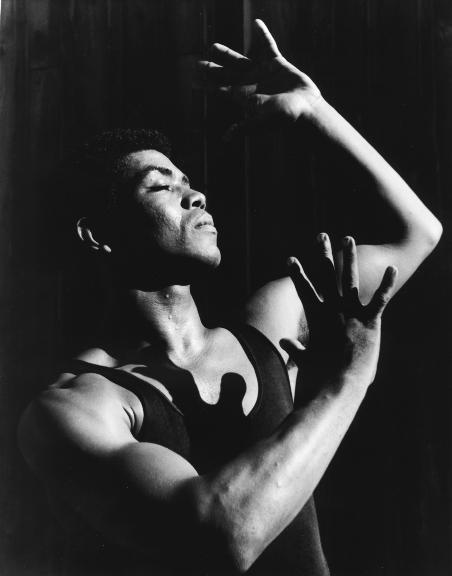 Le jeune Alvin Ailey
 Danielle Gee et Leonard Meek de la troupe Alvin Ailey_1995
 James Brown “fait le zouave” avec un de ses mouvements / pas de danse caractéristiques
 Couverture de l’album Avance avec ton Bon Pied (1972)
 Le patin à roulettes au roller-discothèque — la fureur heureuse de l’ère de la musique disco et funk
 …..
…..
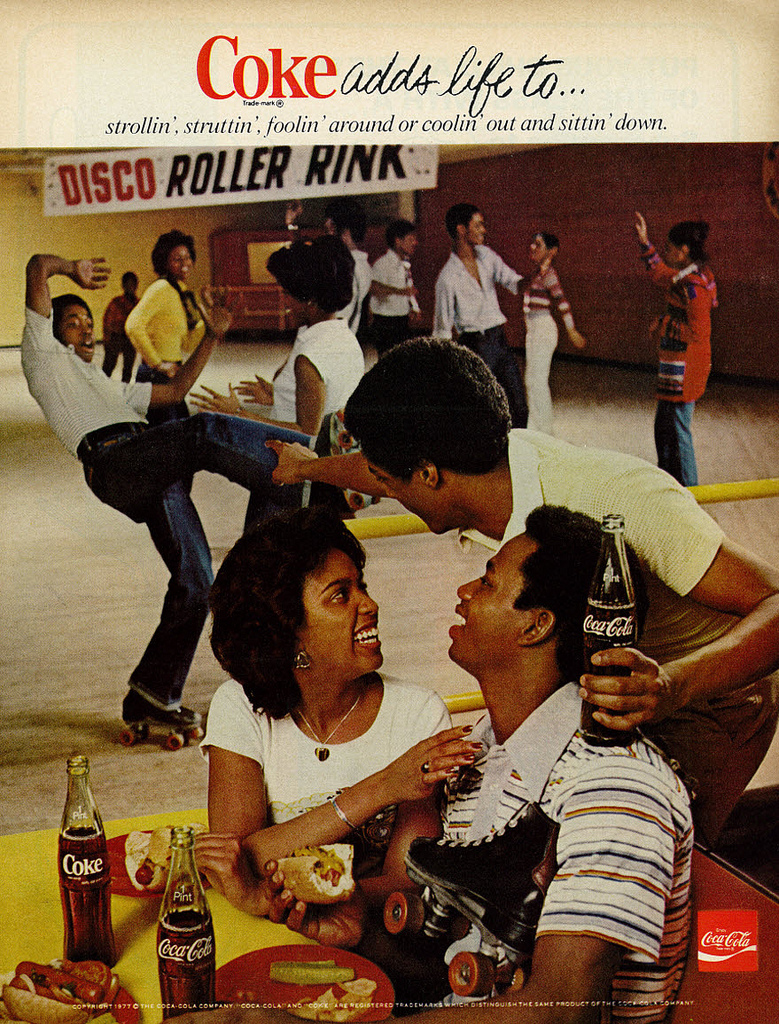 Publicité pour Coca-Cola dans un magazine américain de 1977
 Michael Jackson (1958-2009), un danseur inventif et excentrique, célébré pour sa “Moon Walk” (photographie © 1983, Jim McCrary/Redferns)

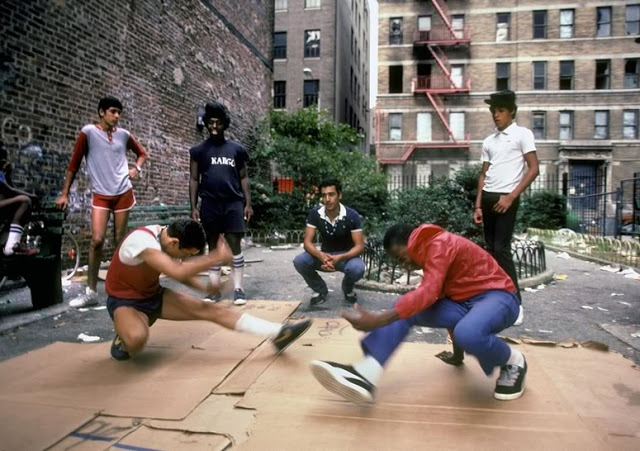 Des jeunes B-boyz ou “breakdanseurs” New-Yorkais des années 80_photographies © Martha Cooper

 Surya Varuna Claudine Bonaly (née 1973), la patineuse artistique française-américaine

 Yannick Bonheur (né 1982) et Vanessa James (née 1987)_le premier couple noir de l’histoire des jeux olympiques en patinage artistique_Vancouver, Canada_février de 2010_ (photo par Ivan Sekretarev)
 Savion Glover_danseur de claquettes de la nouvelle génération_photo © Lois Greenfield, 2012

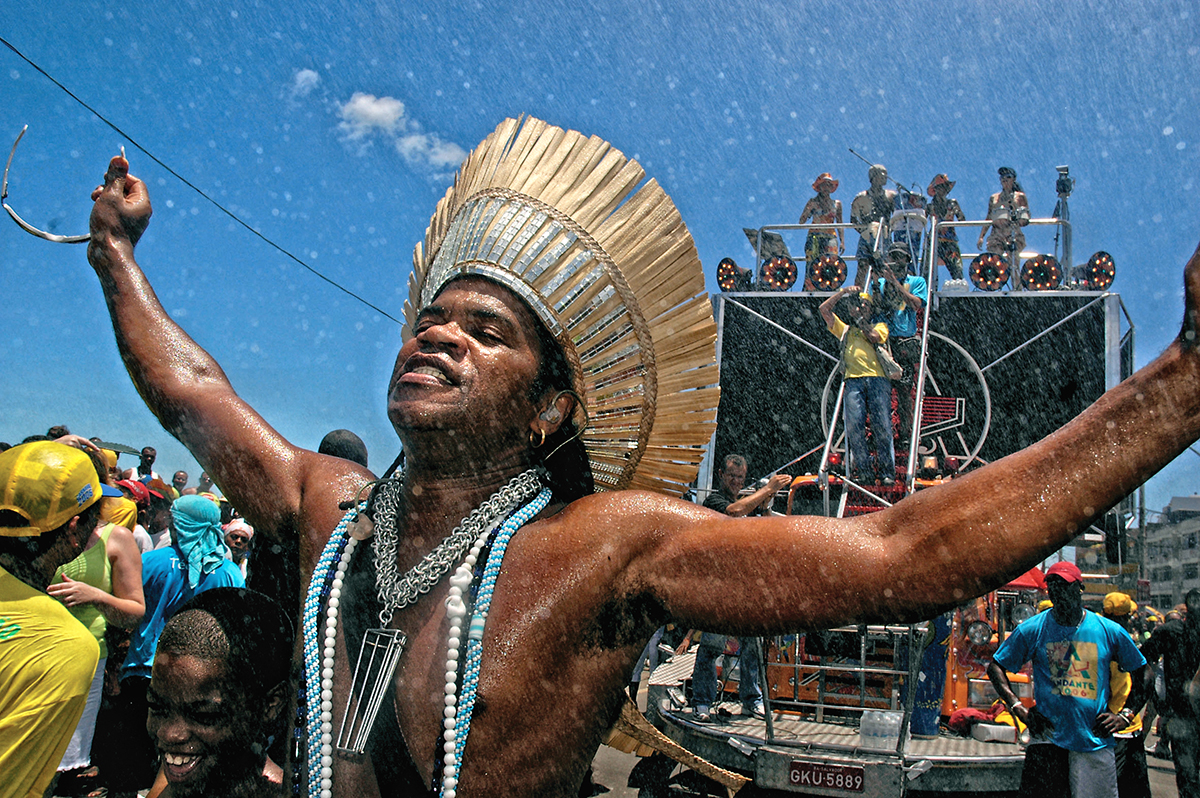 Le Carnaval au Brésil_Salvador da Bahia, 2012_Des racines africaines les gens cultivèrent une fête de la Danse et Musique – pour Tout le Monde!
Claude McKay: selected poems from “Harlem Shadows” (1922)
Posted: February 2, 2016 Filed under: Claude McKay, English | Tags: Black History Month poems Comments Off on Claude McKay: selected poems from “Harlem Shadows” (1922)
Claude McKay
(1889-1948, Jamaica / New York / Chicago)

Selected poems from Harlem Shadows (1922)
.
America
.
Although she feeds me bread of bitterness,
And sinks into my throat her tiger’s tooth,
Stealing my breath of life, I will confess
I love this cultured hell that tests my youth!
Her vigour flows like tides into my blood,
Giving me strength erect against her hate.
Her bigness sweeps my being like a flood.
Yet as a rebel fronts a king in state,
I stand within her walls with not a shred
Of terror, malice, not a word of jeer.
Darkly I gaze into the days ahead,
And see her might and granite wonders there,
Beneath the touch of Time’s unerring hand,
Like priceless treasures sinking in the sand.
. . .
Home Thoughts
.
Oh something just now must be happening there!
That suddenly and quiveringly here,
Amid the city’s noises, I must think
Of mangoes leaning o’er the river’s brink,
And dexterous Davie climbing high above,
The gold fruits ebon-speckled to remove,
And toss them quickly in the tangled mass
Of wis-wis twisted round the guinea grass ;
And Cyril coming through the bramble-track
A prize bunch of bananas on his back;
And Georgie —none could ever dive like him—
Throwing his scanty clothes off for a swim;
And schoolboys, from Bridge-tunnel going home,
Watching the waters downward dash and foam.
This is no daytime dream , there’s something in it,
Oh something’s happening there this very minute!
. . .
On Broadway
.
About me young and careless feet
Linger along the garish street;
Above, a hundred shouting signs
Shed down their bright fantastic glow
Upon the merry crowd and lines
Of moving carriages below.
Oh wonderful is Broadway—only
My heart, my heart is lonely.
Desire naked, linked with Passion,
Goes strutting by in brazen fashion;
From playhouse, cabaret and inn
The rainbow lights of Broadway blaze
All gay without, all glad within;
As in a dream I stand and gaze
At Broadway, shining Broadway—only
My heart, my heart is lonely.

Times Square in Manhattan_photograph from 1922
The Barrier
.
I must not gaze at them although
Your eyes are dawning day;
I must not watch you as you go
Your sun-illumined way;
I hear but I must never heed
The fascinating note,
Which, fluting like a river reed ,
Comes from your trembling throat;
I must not see upon your face
Love’s softly glowing spark;
For there’s the barrier of race,
You’re fair and I am dark.
. . .
The City’s Love
.
For one brief golden moment rare like wine,
The gracious city swept across the line;
Oblivious of the colour of my skin,
Forgetting that I was an alien guest,
She bent to me, my hostile heart to win,
Caught me in passion to her pillowy breast;
The great, proud city, seized with a strange love,
Bowed down for one flame hour my pride to prove.
. . .
When I Have Passed Away
.
When I have passed away and am forgotten,
And no one living can recall my face,
When under alien sod my bones lie rotten
With not a tree or stone to mark the place;
Perchance a pensive youth, with passion burning,
For olden verse that smacks of love and wine,
The musty pages of old volumes turning,
May light upon a little song of mine,
And he may softly hum the tune and wonder
Who wrote the verses in the long ago;
Or he may sit him down awhile to ponder
Upon the simple words that touch him so.
. . .
On the Road
.
Roar of the rushing train fearfully rocking,
Impatient people jammed in line for food,
The rasping noise of cars together knocking,
And worried waiters, some in ugly mood,
Crowding into the choking pantry hole
To call out dishes for each angry glutton
Exasperated grown beyond control,
From waiting for his soup or fish or mutton.
At last the station’s reached, the engine stops;
For bags and wraps the red-caps circle round;
From off the step the passenger lightly hops,
And seeks his cab or tram-car homeward bound:
The waiters pass out weary, listless, glum,
To spend their tips on harlots, cards and rum.
. . .
The Harlem Dancer
.
Applauding youths laughed with young prostitutes
And watched her perfect, half-clothed body sway;
Her voice was like the sound of blended flutes
Blown by black players upon a picnic day.
She sang and danced on, gracefully and calm,
The light gauze hanging loose about her form;
To me she seemed a proudly-swaying palm
Grown lovelier for passing through a storm.
Upon her swarthy neck black shiny curls
Luxuriant fell; and tossing coins in praise,
The wine-flushed, bold-eyed boys, and even the girls,
Devoured her shape with eager, passionate gaze;
But looking at her falsely-smiling face,
I knew her self was not in that strange place.
. . .
Outcast
.
For the dim regions whence my fathers came
My spirit, bondaged by the body, longs.
Words felt, but never heard, my lips would frame;
My soul would sing forgotten jungle songs.
I would go back to darkness and to peace,
But the great western world holds me in fee,
And I may never hope for full release
While to its alien gods I bend my knee.
Something in me is lost, forever lost,
Some vital thing has gone out of my heart,
And I must walk the way of life a ghost
Among the sons of earth, a thing apart;
For I was born, far from my native clime,
Under the white man’s menace, out of time.
. . .
I Know My Soul
.
I plucked my soul out of its secret place,
And held it to the mirror of my eye,
To see it like a star against the sky,
A twitching body quivering in space,
A spark of passion shining on my face.
And I explored it to determine why
This awful key to my infinity
Conspires to rob me of sweet joy and grace.
And if the sign may not be fully read,
If I can comprehend but not control,
I need not gloom my days with futile dread,
Because I see a part and not the whole.
Contemplating the strange, I’m comforted
By this narcotic thought: I know my soul.
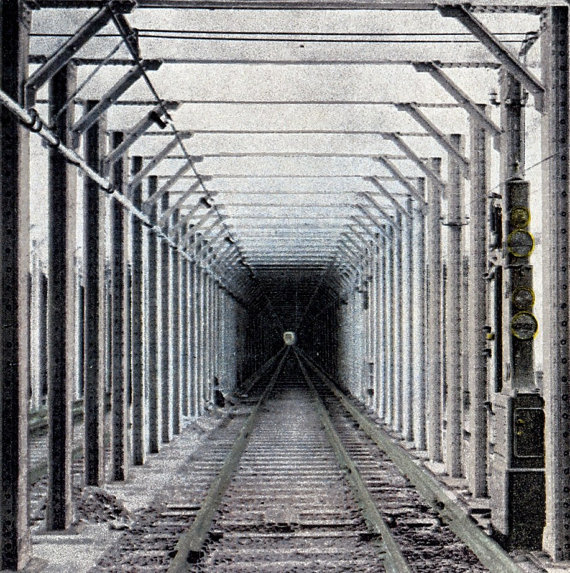

Subway Wind
.
Far down, down through the city’s great, gaunt gut
The gray train rushing bears the weary wind;
In the packed cars the fans the crowd’s breath cut,
Leaving the sick and heavy air behind.
And pale-cheeked children seek the upper door
To give their summer jackets to the breeze;
Their laugh is swallowed in the deafening roar
Of captive wind that moans for fields and seas;
Seas cooling warm where native schooners drift
Through sleepy waters, while gulls wheel and sweep,
Waiting for windy waves the keels to lift
Lightly among the islands of the deep;
Islands of lofty palm trees blooming white
That lend their perfume to the tropic sea,
Where fields lie idle in the dew drenched night,
And the Trades float above them fresh and free.
. . .
Poetry
.
Sometimes I tremble like a storm-swept flower,
And seek to hide my tortured soul from thee.
Bowing my head in deep humility
Before the silent thunder of thy power.
Sometimes I flee before thy blazing light,
As from the specter of pursuing death;
Intimidated lest thy mighty breath,
Windways, will sweep me into utter night.
For oh, I fear they will be swallowed up—
The loves which are to me of vital worth,
My passion and my pleasure in the earth—
And lost forever in thy magic cup!
I fear, I fear my truly human heart
Will perish on the altar-stone of art!
. . .

A Prayer
.
‘Mid the discordant noises of the day I hear thee calling;
I stumble as I fare along Earth’s way; keep me from falling.
Mine eyes are open but they cannot see for gloom of night;
I can no more than lift my heart to thee for inward light.
The wild and fiery passion of my youth consumes my soul;
In agony I turn to thee for truth and self-control.
For Passion and all the pleasures it can give will die the death;
But this of me eternally must live, thy borrowed breath.
‘Mid the discordant noises of the day I hear thee calling;
I stumble as I fare along Earth’s way; keep me from falling.
. . .
Rest in Peace
.
No more for you the city’s thorny ways,
The ugly corners of the Negro belt;
The miseries and pains of these harsh days
By you will never, never again be felt.
No more, if still you wander, will you meet
With nights of unabating bitterness;
They cannot reach you in your safe retreat,
The city’s hate, the city’s prejudice!
‘Twas sudden—but your menial task is done,
The dawn now breaks on you, the dark is over,
The sea is crossed, the longed-for port is won;
Farewell, oh, fare you well! my friend and lover.
. . .
Flirtation
.
Upon thy purple mat thy body bare
Is fine and limber like a tender tree.
The motion of thy supple form is rare,
Like a lithe panther lolling languidly,
Toying and turning slowly in her lair.
Oh, I would never ask for more of thee,
Thou art so clean in passion and so fair.
Enough! if thou wilt ask no more of me!
. . .
Polarity
.
Nay, why reproach each other, be unkind,
For there’s no plane on which we two may meet?
Let’s both forgive, forget, for both were blind,
And life is of a day, and time is fleet.
And I am fire, swift to flame and burn,
Melting with elements high overhead,
While you are water in an earthly urn,
All pure, but heavy, and of hue like lead.
. . .
Author’s Word: from the first edition (1922) of Claude McKay’s Harlem Shadows:
.
In putting ideas and feelings into poetry, I have tried in each case to use the medium most adaptable to the specific purpose. I own allegiance to no master. I have never found it possible to accept in entirety any one poet. But I have loved and joyed in what I consider the finest in the poets of all ages.
.
The speech of my childhood and early youth was the Jamaica Negro dialect, the native variant of English, which still preserves a few words of African origin, and which is more difficult of understanding than the American Negro dialect. But the language we wrote and read in school was England’s English. Our text books then, before the advent of the American and Jamaican readers and our teachers, too, were all English-made. The native teachers of the elementary schools were tutored by men and women of British import. I quite remember making up verses in the dialect and in English for our moonlight ring dances and for our school parties. Of our purely native songs the jammas (field and road), shay-shays (yard and booth), wakes (post-mortem), Anancy tales (transplanted African folk lore), and revivals (religious) are all singularly punctuated by metre and rhyme. And nearly all my own poetic thought has always run naturally into these regular forms.
.
Consequently, although very conscious of the new criticisms and trends in poetry, to which I am keenly responsive and receptive, I have adhered to such of the older traditions as I find adequate for my most lawless and revolutionary passions and moods. I have not used patterns, images and words that would stamp me a classicist nor a modernist. My intellect is not scientific enough to range me on the side of either; nor is my knowledge wide enough for me to specialize in any school.
.
I have never studied poetics; but the forms I have used I am convinced are the ones I can work in with the highest degree of spontaneity and freedom.
.
I have chosen my melodies and rhythms by instinct, and I have favoured words and figures which flow smoothly and harmoniously into my compositions. And in all my moods I have striven to achieve directness, truthfulness and naturalness of expression instead of an enameled originality. I have not hesitated to use words which are old, and in some circles considered poetically overworked and dead, when I thought I could make them glow alive by new manipulation. Nor have I stinted my senses of the pleasure of using the decorative metaphor where it is more truly and vividly beautiful than the exact phrase. But for me there is more quiet delight in “The golden moon of heaven” than in “The terra-cotta disc of cloud-land.”
.
Finally, while I have welcomed criticism, friendly and unfriendly, and listened with willing attention to many varying opinions concerning other poems and my own, I have always, in the summing up, fallen back on my own ear and taste as the arbiter.
.
CLAUDE McKAY
. . .
Our Special Thanks to: Chris Forster and Roopika Risam of Harlemshadows.org.
. . . . .
Claude McKay: “Songs of Jamaica” (poems)
Posted: February 2, 2016 Filed under: Claude McKay, Claude McKay: Songs of Jamaica, English, English: Jamaican Patois | Tags: Black History Month poems Comments Off on Claude McKay: “Songs of Jamaica” (poems)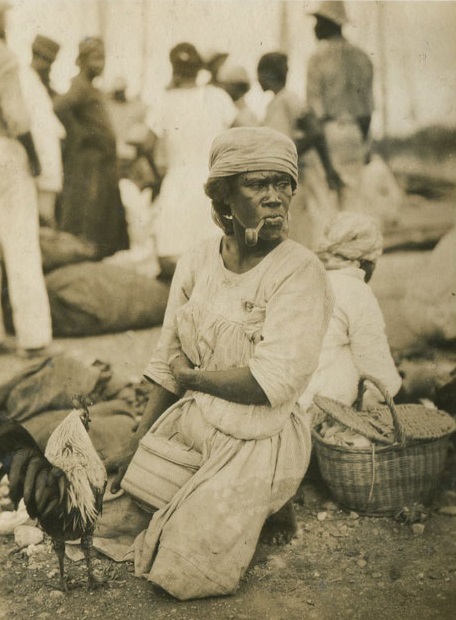
Claude McKay (1889-1948)
Poems from Songs of Jamaica (published in 1912)
. . .
Quashie to Buccra
.
You tas’e petater an’ you say it sweet,
But you no know how hard we wuk fe it;
You want a basketful fe quattiewut,
‘Cause you no know how ‘tiff de bush fe cut.
.
De cowitch under which we hab fe ‘toop,
De shamar lyin’ t’ick like pumpkin soup,
Is killin’ somet’ing for a naygur man;
Much less de cutlass workin’ in we han’.
.
De sun hot like when fire ketch a town;
Shade-tree look temptin’, yet we caan’ lie down,
Aldough we wouldn’ eben ef we could,
Causen we job must finish soon an’ good.
.
De bush cut done, de bank dem we deh dig,
But dem caan’ ‘tan’ sake o’ we naybor pig;
For so we moul’ it up he root it do’n,
An’ we caan’ ‘peak sake o’ we naybor tongue.
.
Aldough de vine is little, it can bear;
It wantin’ not’in but a little care:
You see petater tear up groun’, you run,
You laughin’, sir, you must be t’ink a fun.
.
De fiel’ pretty? It couldn’t less ‘an dat,
We wuk de bes’, an’ den de lan’ is fat;
We dig de row dem eben in a line,
An’ keep it clean – den so it mus’ look fine.
.
You tas’e petater an’ you say it sweet,
But you no know how hard we wuk fe it:
Yet still de hardship always melt away
Wheneber it come roun’ to reapin’ day.
. . .
Buccra = white man
petater = sweet potato
quattiewut = quattieworth: quattie is a quarter of sixpence.
cowitch = the Macuna pruriens climbing bean
shamar = Shamebush, a prickly sensitive plant (Mimosa pudica)
. . .
Me Bannabees
.
Run ober mango trees,
‘Pread chock to kitchen doo’,
Watch de blue bannabees,
Look how it ben’ down low!
.
De blossom draw de bees
Same how de soup draw man;
Some call it “broke-pot” peas,
It caan’ bruk we bu’n-pan.
.
Wha’ sweet so when it t’ick?
Though some calll it goat-tud,
Me all me finger lick,
An’ yet no chew me cud.
.
A mumma plant de root
One day jes’ out o’ fun;
But now look ‘pon de fruit,
See wha’ de “mek fun” done.
.
I jam de ‘tick dem ‘traight
Soon as it ‘tart fe ‘pread,
An begin count de date
Fe when de pod fe shed.
.
Me watch de vine dem grow,
S’er t’row dung a de root:
Crop time look fe me slow,
De bud tek long fe shoot.
.
But so de day did come,
I ‘crub de bu’n-pan bright,
An’ tu’n down ‘pon it from
De marnin’ till de night.
.
An’ Lard!me belly swell,
No ’cause de peas no good,
But me be’n tek a ‘pell
Mo’ dan a giant would.
.
Yet eben after dat
Me nyam it wid a will,
‘Causen it mek me fat;
So I wi’ lub it still.
.
Caan’ talk about gungu,
Fe me it is no peas;
Cockstone might do fe you,
Me want me bannabees.
. . .
Bannabees = Bonavist, a climbing bean or pea
Me nyam = I ate
gungu = Congo peas
Cockstone = red peas, the beans of America
. . .
King Banana
.
Green mancha mek fe naygur man;
Wha’ sweet so when it roas’?
Some boil it in a big black pan,
It sweeter in a toas’.
.
A buccra fancy when it ripe,
Dem use it ebery day;
It scarcely give dem belly-gripe,
Dem eat it diffran’ way.
.
Out yonder see somoke a rise,
An’ see de fire wicket;
Deh go’p to heaben wid de nize
Of hundred t’ousan cricket.
.
De black moul’ lie do’n quite prepare’
Fe feel de hoe an’ rake;
De fire bu’n, and it tek care
Fe mek de wo’m dem wake.
.
Wha’ lef” fe buccra teach again
Dis time about plantation?
Dere’s not’in dat can beat de plain
Good ole-time cultibation.
.
Banana dem fat all de same
From bunches big an’ ‘trong;
Pure nine-han’ bunch a car’ de fame, –
Ole met’od all along.
.
De cuttin’ done same ole-time way,
We wrap dem in a trash,
An’ pack dem neatly in a dray
So tight dat dem can’t mash.
.
We re’ch: banana finish sell;
Den we ‘tart back fe home:
Some hab money in t’read-bag well,
Some spen’ all in a rum.
.
Green mancha mek fe naygur man,
It mek fe him all way;
Our islan’ is banana lan’,
Banana car’ de sway.
. . .
mancha = “Martinique”, the best variety of banana in Jamaica
. . .
The Biter Bit
[“Ole woman a swea’ fe eat calalu: calalu a swea’ fe wuk him gut.” Jamaican proverb]
.
Corn an’ peas growin’ t’ick an’ fas’
Wid nice blade peepin’ t’rough de grass;
An’ ratta from dem hole a peep,
T’ink all de corn dem gwin’ go reap.
.
Ole woman sit by kitchen doo’
Is watchin’ calalu a grow,
An’ all de time a t’inking dat
She gwin’ go nyam dem when dem fat.
.
But calalu, grow’n’ by de hut,
Is swearin’ too fe wuk him gut;
While she, like some, t’ink all is right
When dey are in some corner tight.
.
Peas time come roun’ – de corn is lef”;
An’ ratta now deh train himse’f
Upon de cornstalk dem a’ night
Fe when it fit to get him bite.
.
De corn-piece lie do’n all in blue,
An’ all de beard dem floatin’ too
Amongst de yellow grain so gay,
Dat you would watch dem a whole day.
.
An’ ratta look at ebery one,
Swea’in’ dat dem not gwin’ lef’ none;
But Quaco know a t’ing or two,
An’ swear say dat dem won’t go so.
.
So him go get a little meal
An’ somet’ing good fe those dat steal,
An’ mix dem up an’ ‘pread dem out
For people possess fas’ fas’ mout’.
.
Now ratta, comin’ from dem nes’,
See it an’ say “Dis food is bes’;”
Dem nyam an’ stop, an’ nyam again,
An’ soon lie do’n, rollin’ in pain.
. . .
calalu = “spinach” (could be Amaranthus viridis or Xanthosoma or dasheen leaves)
blue = the blueish leaf of the maize
. . .
Taken Aback
.
Let me go, Joe, for I want go home:
Can’t stan’ wid you,
For Pa might go come;
An’ if him only hab him rum,
I don’t know whateber I’ll do.
.
I must go now, for it’s gettin’ night
I am afraid,
An’ ’tis not moonlight:
Give me de last hug, an’ do it tight;
Me Pa gwin’ go knock off me head.
.
No, Joe, don’t come! – you will keep me late,
An’ Pa might be
In him sober state;
Him might get vex’ an’ lock up de gate,
Den what will becomin’ of me?
.
Go wid you, Joe? – you don’t lub me den!
I shame o’ you –
Gals caan’ trust you men!
An’ I b’en tekin’ you fe me frien’;
Good-night, Joe, you’ve proven untrue.
. . .
Ione
.
Say if you lub me, do tell me truly,
Ione, Ione;
For, O me dearie, not’in’ can part we,
Ione, Ione.
.
Under de bamboo, where de fox-tail grew,
Ione, Ione,
While de cool breeze blew – sweet, I did pledge you,
Ione, Ione.
.
Where calalu grows, an’ yonder brook flows,
Ione, Ione,
I held a dog-rose under your li’l nose,
Ione, Ione.
.
There where de lee stream plays wid de sunbeam,
Ione, Ione,
True be’n de love-gleam as a sweet day-dream,
Ione, Ione.
.
Watchin’ de bucktoe under de shadow,
Ione, Ione,
Of a pear-tree low dat in de stream grow,
Ione, Ione,
.
Mek me t’ink how when we were lee children,
Ione, Ione,
We used to fishen in old Carew Pen,
Ione, Ione.
.
Like tiny meshes, curl your black tresses,
Ione, Ione,
An’ my caresses tek widout blushes,
Ione, Ione.
.
Kiss me, my airy winsome lee fairy,
Ione, Ione;
Are you now weary, little canary,
Ione, Ione?
.
Then we will go, pet, as it is sunset,
Ione, Ione;
Tek dis sweet vi’let, we will be one yet,
Ione, Ione.
. . .
bucktoe = a small crawfish
Pen = the Jamaican equivalent for ranche
. . .
My Pretty Dan
.
I have a póliceman down at de Bay,
An’ he is true to me though far away.
.
I love my pólice, and he loves me too,
An’ he has promised he’ll be ever true.
.
My little bobby is a darlin’ one,
An’ he’s de prettiest you could set eyes ‘pon.
.
When he be’n station’ up de countryside,
Fus’ time I shun him sake o’ foolish pride.
.
But as I watched him patrolling his beat,
I got to find out he was nice an’ neat.
.
More still I foun’ out he was extra kin’,
An’ dat his precious heart was wholly mine.
.
Den I became his own true sweetheart,
An’ while life last we’re hopin’ not fe part.
.
He wears a truncheon an’ a handcuff case,
An’ pretty cap to match his pretty face.
.
Dear lilly p’liceman stationed down de sout’,
I feel your kisses rainin’ on my mout’.
.
I could not give against a póliceman;
For if I do, how could I lub my Dan?
.
Prettiest of naygur is my dear police,
We’ll lub foreber, an’ our lub won’t cease.
.
I have a póliceman down at de Bay,
An’ he is true to me though far away.
. . .
A Midnight Woman to the Bobby
.
No palm me up, you dutty brute,
You’ jam mout’ mash like ripe bread-fruit;
You fas’n now, but wait lee ya,
I’ll see you grunt under de law.
.
You t’ink you wise, but we wi’ see;
You not de fus’ one fas’ wid me;
I’ll lib fe see dem tu’n you out,
As sure as you got dat mash’ mout’.
.
I born right do’n beneat’ de clack
(You ugly brute, you tu’n you’ back?)
Don’t t’ink dat I’m a come-aroun’,
I born right ‘way in ‘panish Town.
.
Care how you try, you caan’ do mo’
Dan many dat was hyah befo’;
Yet whe’ dey all o’ dem te-day?
De buccra dem no kick dem ‘way?
.
Ko ‘pon you’ jam samplatta nose:
‘Cos you wear Mis’r Koshaw clo’es
You t’ink say you’s de only man,
Yet fus’ time ko how you be’n ‘tan’.
.
You big an’ ugly ole tu’n-foot
Be’n neber know fe wear a boot;
An’ chigger nyam you’ tumpa toe,
Till nit full i’ like herrin’ roe.
.
You come from mountain naked-‘kin,
An’ Lard a mussy! you be’n thin,
For all de bread-fruit dem be’n done,
Bein’ ‘poil’ up by de tearin’ sun:
.
De coco couldn’ bear at all,
For, Lard! de groun’ was pure white-marl;
An’ t’rough de rain part o’ de year
De mango tree dem couldn’ bear.
.
An’ when de pinch o’ time you feel
A ‘pur you a you’ chigger heel,
You lef’ you’ district, big an’ coarse,
An’ come join buccra Pólice Force.
.
An’ now you don’t wait fe you’ glass,
But trouble me wid you’ jam fas’;
But wait, me frien’, you’ day wi’ come,
I’ll see you go same lak a some.
.
Say wha’? – ‘res’ me? – you go to hell!
You t’ink Judge don’t know unno well?
You t’ink him gwin’ go sentance me
Widout a soul fe witness i’?
. . .
beneat’ de clack = the clock on the public buildings at Spanish Town
come-aroun’ = day-labourer, man or woman, in Kingston streets and wharves, famous for the heavy weight he or she can carry
samplatta = a piece of leather cut somewhat larger than the size of the foot, and tied sandal-wise to it: said of anything that is flat and broad.
Mis’r Koshaw clo’es = Mister Kershaw’s clothes i.e. police uniform. Col. Kershaw was Inspector-General of Police in 1911, (when this poem was written.)
An’ chigger nyam you’ tumpa toe, etc. = And chigoes (burrowing fleas) had eaten your maimed toe, and nits (young chigoes) had filled it.
Lard a mussy! = Lord have mercy!
unno (or onnoo) = an African word meaning “you” collectively

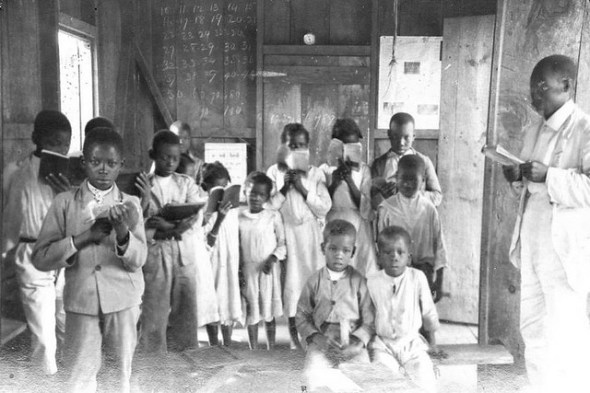
Mother Dear
.
“HUSBAN’, I am goin’ –
Though de brooklet is a-flowin’,
An’ de coolin’ breeze is blowin’
Softly by;
Hark, how strange de cow is mooin’,
An’ our Jennie’s pigeons cooin’,
While I feel de water growin’,
Climbing high.
.
“Akee trees are laden,
But de yellow leaves are fadin’
Like a young an’ bloomin’ maiden
Fallen low;
In de pond de ducks are wakin’
While my body longs for Eden,
An’ my weary breat’ is gledin’
‘Way from you.
.
“See dem John-crows flyin’!
‘Tis a sign dat I am dyin’;
Oh, I’m wishful to be lyin’
All alone:
Fait’ful husban’, don’t go cryin’,
Life is one long self-denyin’
All-surrenderin’ an’ sighin’
Livin’ moan.”
. . .
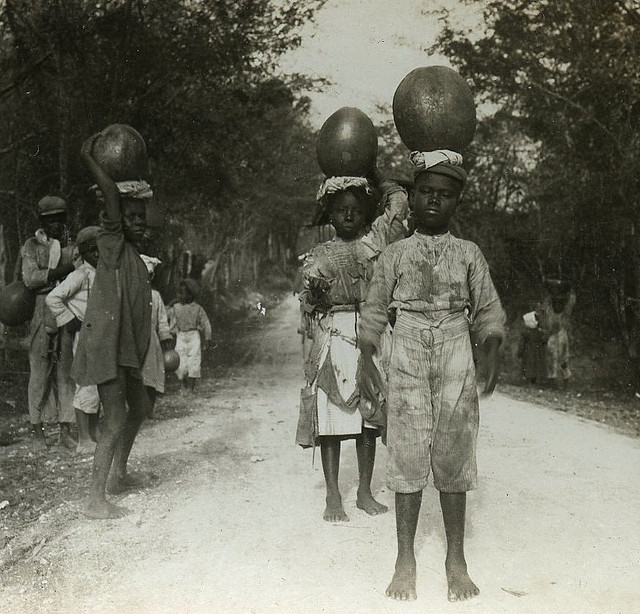

“WIFE, de parson’s prayin’,
Won’t you listen what he’s sayin’,
Spend de endin’ of your day in
Christ our Lord?”
. . .
.
But de sound of horses neighin’,
Baain’ goats an’ donkeys brayin’,
Twitt’rin’ birds an’ children playin’
Was all she heard.
.
Things she had been rearin’,
Only those could claim her hearin’,
When de end we had been fearin’
Now had come:
Now her last pain she is bearin’,
Now de final scene is nearin’,
An’ her vacant eyes are starin’
On her home.
.
Oh! it was heart-rendin’
As we watched de loved life endin’,
Dat sweet sainted spirit bendin’
To de death:
Gone all further hope of mendin’,
With de angel Death attendin’,
An’ his slayin’ spirit blendin’
With her breath.
. . .
Akee = Cupania sapida, bearing beautiful red fruits
John-crows = Turkey-buzzards
. . .
Dat Dirty Rum
.
If you must drink it, do not come
An’ chat up in my face;
I hate to see de dirty rum,
Much more to know de tas’e.
.
What you find dere to care about
I never understan’;
It only dutty up you mout’,
An’ mek you less a man.
.
I see it throw you ‘pon de grass
An ‘met you want no food,
While people scorn you as dey pass
An’ see you vomit blood.
.
De fust beginnin’ of it all,
You stood up calm an’ cool,
An’ put you’ back agains’ de wall
An’ cuss our teacher fool.
.
You cuss me too de se’fsame day
Because a say you wrong,
An’ pawn you’ books an’ went away
Widout anedder song.
.
Your parents’ hearts within dem sink,
When to your yout’ful lip
Dey watch you raise de glass to drink,
An’ shameless tek each sip.
.
I see you in de dancing-booth,
But all your joy is vain,
For on your fresh an’ glowin’ youth
Is stamped dat ugly stain.
.
Dat ugly stain of drink, my frien’,
Has cost you your best girl,
An’ med you fool ‘mongst better me
When your brain’s in a whirl.
.
You may smoke just a bit indeed,
I like de “white seal” well;
Aldough I do not use de weed,
I’m fond o’ de nice smell.
.
But wait until you’re growin’ old
An’ gettin’ weak an’ bent,
An’ feel your blood a-gettin’ cold
‘Fo you tek stimulent.
.
Then it may mek you stronger feel
While on your livin’ groun’;
But ole Time, creepin’ on your heel,
Soon, soon will pull you down:
.
Soon, soon will pull you down, my frien’,
De rum will help her too;
An’ you’ll give way to better men,
De best day you can do.
. . .
“white seal” = the name of a brand of cigarettes
. . .
Killin’ Nanny
.
Two little pickny is watchin’,
While a goat is led to deat’;
Dey are little ones of two years,
An’ know naught of badness yet.
.
De goat is bawlin’ fe mussy,
An’ de children watch de sight
As de butcher re’ch his sharp knife,
An’ ‘tab wid all his might.
.
Dey see de red blood flowin’;
An’ one chil’ trimble an’ hide
His face in de mudder’s bosom,
While t’udder look on wide-eyed.
.
De tears is fallin’ down hotly
From him on de mudder’s knee;
De udder wid joy is starin’,
An’ clappin’ his han’s wid glee.
.
When dey had forgotten Nanny,
Grown men I see dem again;
An’ de forehead of de laugher
Was brand wid de mark of Cain.

Strokes of the Tamarind Switch
.
I dared not look at him,
My eyes with tears were dim,
My spirit filled with hate
Of man’s depravity,
I hurried through the gate.
.
I went but I returned,
While in my bosom burned
The monstrous wrong that we
Oft bring upon ourselves,
And yet we cannot see.
.
Poor little erring wretch!
The cutting tamarind switch
Had left its bloody mark,
And on his legs were streaks
That looked like boiling bark.
.
I spoke to him the while:
At first he tried to smile,
But the long pent-up tears
Came gushing in a flood;
He was but of tender years.
.
With eyes bloodshot and red,
He told me of a father dead
And lads like himself rude,
Who goaded him to wrong:
He for the future promised to be good.
.
The mother yesterday
Said she was sending him away,
Away across the seas:
She told of futile prayers
Said on her wearied knees.
.
I wished the lad good-bye,
And left him with a sigh:
Again I heard him talk –
His limbs, he said, were sore,
He could not walk.
.
I ‘member when a smaller boy,
A mother’s pride, a mother’s joy,
I too was very rude:
They beat me too, though not the same,
And has it done me good?
. . .
Rise and Fall
[Thoughts of Burns – with apologies to his immortal spirit for making him speak in Jamaica dialect.]
.
Dey read ’em again an’ again,
An’ laugh an’ cry at ’em in turn;
I felt I was gettin’ quite vain,
But dere was a lesson fe learn.
.
My poverty quickly took wing,
Of life no experience had I;
I couldn’t then want anyt’ing
Dat kindness or money could buy.
.
Dey tek me away from me lan’,
De gay o’ de wul’ to behold,
An’ roam me t’rough palaces gran’,
An’ show’red on me honour untold.
.
I went to de ballroom at night,
An’ danced wid de belles of de hour;
Half dazed by de glitterin’ light,
I lounged in de palm-covered bower.
.
I flirted wid beautiful girls,
An’ drank o’ de wine flowin’ red;
I felt my brain movin’ in whirls,
An’ knew I was losin’ my head.
.
But soon I was tired of it all,
My spirit was weary to roam;
De life grew as bitter as gall,
I hungered again for my home.
.
Te-day I am back in me lan’,
Forgotten by all de gay throng,
A poorer but far wiser man,
An’ knowin’ de right from de wrong.
. . .
To Bennie
[ In Answer to a Letter ]
.
You say, dearest comrade, my love has grown cold,
But you are mistaken, it burns as of old;
And no power below, dearest lad, nor above,
Can ever lessen, frien’ Bennie, my love.
.
Could you but look in my eyes, you would see
That ’tis a wrong thought you have about me;
Could you but feel my hand laid on your head,
Never again would you say what you’ve said.
.
Naught, O my Bennie, our friendship can sever,
Dearly I love you, shall love you for ever;
Moment by moment my thoughts are of you,
Trust me, oh, trust me, for aye to be true.
. . .
. . . . .
Langston Hughes: poemas del poemario “Montaje de un Sueño Diferido” (1951)
Posted: February 1, 2016 Filed under: A FEW FAVOURITES / UNA MUESTRA DE FAVORITOS, English, English: Black Canadian / American, Langston Hughes, Langston Hughes: poemas del poemario "Montaje de un Sueño Diferido" (1951), Spanish, ZP Translator: Alexander Best | Tags: Black History Month poems, El Mes de la Historia Afroamericana Comments Off on Langston Hughes: poemas del poemario “Montaje de un Sueño Diferido” (1951)
Una selección de poemas del poemario Montage of a Dream Deferred (Montaje de un Sueño Diferido) (1951) por Langston Hughes (nacido 1 de febrero de 1902 / muerto 22 de mayo de 1967). Versiones españoles (enero de 2016): Alexander Best
. . .
Necesidad
.
¿El trabajo?
Yo, no tengo que trabajar.
No tengo que hacer nada
sino
comer, beber, permanecer negro – y morir.
Este viejo cuartito amueblado es
tan pequeño que
aun no puedo azotar un gato sin pillar el pelaje en mi boca.
Y la casera es tan anciana que sus rasgos desdibujan juntos;
¡y sabe el Señor que ella puede cobrarme de más a mí – eso es seguro!
(Entonces…éso es el motivo por que estimo que debo trabajar – después de todo.)
. . .
“Necessity”
.
Work?
I don’t have to work.
I don’t have to do nothing
but eat, drink, stay black, and die.
This little old furnished room’s
so small I can’t whip a cat
without getting fur in my mouth
and my landlady’s so old
her features is all run together
and God knows she sure can overcharge –
which is why I reckon I does
have to work after all.
. . .
Pregunta número 2
.
Dijo la señora:
¿Puedes hacer lo que no puede hacer
mi otro hombre – ? Y éso es:
¡Quiéreme, papi,
y aliméntame también!
.
Figurita
.
¡Be-bop!
. . .
“Question (2)”
.
Said the lady, Can you do
what my other man can’t do –
that is
love me, daddy –
and feed me, too?
.
Figurine
.
De-dop!
. . .
‘Bugui’ despreocupado
.
Abajo en el contrabajo
caminando andando
al firme tiempo
– como pies marchandos.
.
Abajo en el contrabajo
menearse fácil
– el revolcón como me gusta en mi alma.
.
< Riffs, manchas, descansos.>
.
¡Eh, mamacita! – ¿has oído lo que digo?
Despreocupado, yo lo impulso – ¡en mi cama!
. . .
“Easy Boogie”
.
Down in the bass
That steady beat
Walking walking walking
Like marching feet.
.
Down in the bass
That easy roll,
Rolling like I like it
In my soul.
.
Riffs, smears, breaks.
.
Hey, Lawdy, Mama!
Do you hear what I said?
Easy like I rock it
In my bed!
. . .
Las 3 de la mañana en el café…
.
Agentes de policía de la vicebrigada,
con ojos agotados y sádicos – divisando a los maricones.
Degenerados, dice alguna gente.
.
Pero Dios – o la Naturaleza – o alguien – les hizo en esa forma.
¿Una policía – o una Lesbiana – allá?
¿Dónde?
. . .
“Café: 3 a.m.”
.
Detectives from the vice squad
with weary sadistic eyes
spotting fairies.
Degenerates,
some folks say.
.
But God, Nature,
or somebody
made them that way.
Police lady or Lesbian
over there?
Where?
. . .
Calle número 125 (en Harlem)
.
Rostro como una barra de chocolate,
lleno de nueces – y dulce.
.
Cara como una calabaza de Hallowe’en,
y adentro una candela.
.
Rostro como una loncha de sandía
– y una sonrisa tan amplia.
. . .
“125th Street”
.
Face like a chocolate bar
full of nuts and sweet.
.
Face like a jack-o’-lantern,
candle inside.
.
Face like a slice of melon,
grin that wide.
. . .
Los blues en el alba
.
No oso empezar con algunos pensamientos
en las primeras horas del día
– no, no oso pensar en ese momento.
Si yo piense algo de pensamiento mientras estoy en cama,
esos pensamientos romperían mi cabeza
– pues, las mañanas: no oso empezar a pensar.
.
No oso recordar en el alba, no – nunca en el alba.
Porque, si yo evocara el día antes,
no me levantaría nunca más
– pues, las mañanas: no oso recordar.
. . .
“Blues at Dawn”
.
I don’t dare start thinking in the morning.
I don’t dare start thinking in the morning.
If I thought thoughts in bed,
Them thoughts would bust my head –
So I don’t dare start thinking in the morning.
.
I don’t dare remember in the morning
Don’t dare remember in the morning.
If I recall the day before,
I wouldn’t get up no more –
So I don’t dare remember in the morning.
. . .
El vecino
.
En el sur él se colocaba él mismo en la escalera de entrada – y miraba el sol pasando…
Aquí en Harlem, cuando está completo su trabajo – él se coloca en un bar con una cerveza.
Parece más alto que es, y más jóven que no es.
Parece su piel más oscura que es, también – y él es más listo que muestra su rostro.
No es listo, ese vato es un bufón tonto.
Aw, no es eso tampoco – es un buen tipo, salvo que platica demasiado.
A decir verdad es un cuate estupendo – pero cuando toma el vaso, bebe rápido.
A veces no bebe.
Es cierto, sólo deja estar allí su vaso – nada más.
. . .
“Neighbour”
.
Down home
he sets on a stoop
and watches the sun go by.
In Harlem
when his work is done
he sets in a bar with a beer.
He looks taller than he is
and younger than he ain’t.
He looks darker than he is, too.
And he’s smarter than he looks –
He ain’t smart.
That cat’s a fool.
Naw, he ain’t neither.
He’s a good man,
except that he talks too much.
In fact, he’s a great cat.
But when he drinks,
he drinks fast.
Sometimes
he don’t drink.
True,
he just
lets his glass
set there.
. . .
La hora punta en el metropolitano
.
Mezclados,
nuestro aliento, nuestro olor.
Tan cerca – nosotros, negros y blancos;
ningún espacio para el temor.
. . .
“Subway Rush Hour”
.
Mingled
breath and smell
so close
mingled
black and white
so near
no room for fear.
. . .
Hermanos
.
Somos parientes – tú y yo;
tú del Caribe,
yo de Kentucky.
.
Familiar – tú y yo;
tú de África,
yo de los EE.UU.
.
Hermanos somos – tú y yo.
. . .
“Brothers”
.
We’re related – you and I,
You from the West Indies,
I from Kentucky.
.
Kinsmen – you and I,
You from Africa,
I from U.S.A.
.
Brothers – you and I.
. . .
Astilla
.
Rimas pequeñas corrientes
y una tonadilla ordinária
pueden ser casi peligrosas
como una astilla de la luna.
Una tonadilla ordinária
con unas pequeñas rimas corrientes
pueden ser navaja – a veces –
a la garganta de un hombre.
. . .
“Sliver”
.
Cheap little rhymes
A cheap little tune
Are sometimes as dangerous
As a sliver of the moon.
A cheap little tune
To cheap little rhymes
Can cut a man’s
Throat sometimes.
. . .
Consejo
.
Mi gente, les digo a ustedes:
el Nacimiento es duro
y la Muerte es miserable – así que
agarren ustedes mismos algo de Amor
entre aquellos dos.
. . .
“Advice”
.
Folks, I’m telling you:
Birthing is hard
And Dying is mean,
So get yourself
Some loving in between.
. . .
Lema
.
Lo juego muy tranquilo esta vida – y me gusta toda la jerga.
Es la razón que aún estoy vivo.
.
Mi lema,
como estoy viviendo, descubriendo, es:
dar amor-tomar amor y
vivir-y-dejar-vivir.
. . .
“Motto”
.
I play it cool
And dig all jive.
That’s the reason
I stay alive.
.
My motto,
As I live and learn,
Is:
Dig And Be Dug
In Return.
. . .
No hemos incluido los dos poemas más famosos del poemario Montaje de un Sueño Diferido: Tarea para el segundo curso de inglés (“Theme for English B”) y “Harlem (2)”, más conocido por una frase extraída de su primera línea: Un Sueño Diferido (A Dream Deferred).
.
https://zocalopoets.com/2013/02/01/langston-hughes-tarea-para-el-segundo-curso-de-ingles-theme-for-english-b-translated-into-spanish-by-oscar-paul-castro/
.
https://zocalopoets.com/2011/09/26/un-sueno-diferido-langston-hughes/
. . . . .
Langston Hughes: poèmes de la Renaissance de Harlem
Posted: February 1, 2016 Filed under: English, French, Langston Hughes | Tags: Black History Month poems, Le mois de l'histoire des noirs, Poésie de la Renaissance de Harlem Comments Off on Langston Hughes: poèmes de la Renaissance de Harlem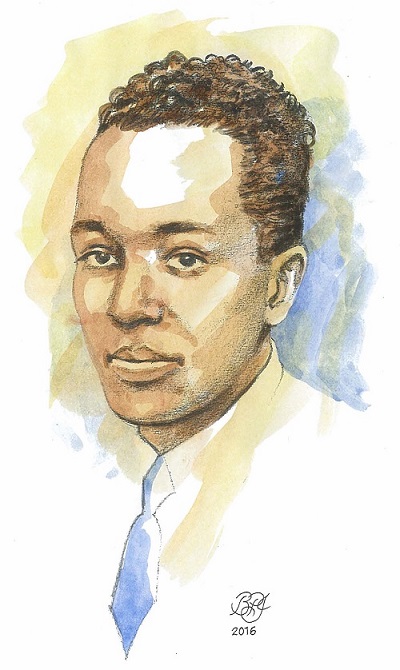
Portrait de Langston Hughes par Bruce Patrick Jones_graphite et aquarelle_2016
Langston Hughes (le 1er février 1902 – mai 1967: poète, écrivain, et dramaturge noir-américain)
Le Nègre parle des fleuves (1921)
(The Negro speaks of rivers)
.
J’ai connu des fleuves
J’ai connu des fleuves anciens comme le monde et plus vieux
que le flux du sang humain dans les veines humaines.
.
Mon âme est devenue aussi profonde que les fleuves.
.
Je me suis baigné dans l’Euphrate quand les aubes étaient neuves.
J’ai bâti ma hutte près du Congo et il a bercé mon sommeil.
J’ai contemplé le Nil et au-dessus j’ai construit les pyramides.
J’ai entendu le chant du Mississipi quand Abe Lincoln descendit
à la Nouvelle-Orléans, et j’ai vu ses nappes boueuses transfigurées
en or au soleil couchant.
.
J’ai connu des fleuves:
Fleuves anciens et ténébreux.
.
Mon âme est devenue aussi profonde que les fleuves.
. . .
Moi aussi, je chante l’Amérique (1926)
(Epilogue: I, Too)
.
Moi aussi, je chante l’Amérique.
.
Je suis le frère à la peau sombre.
Ils m’envoient manger à la cuisine
Quand il vient du monde.
Mais je ris,
Et mange bien,
Et prends des forces.
.
Demain
Je me mettrai à table
Quand il viendra du monde
Personne n’osera
Me dire
Alors
«Mange à la cuisine».
.
De plus, ils verront comme je suis beau
Et ils auront honte…
.
Moi aussi, je suis l’Amérique.
. . .
Le Blues du Désespoir (1926)
(The Weary Blues)
.
Fredonnant un air syncopé et nonchalant,
Balançant d’avant en arrière avec son chant moelleux,
J’écoutais un Nègre jouer.
En descendant la Lenox Avenue l’autre nuit
A la lueur pâle et maussade d’une vieille lampe à gaz
Il se balançait indolent…
Il se balançait indolent…
Pour jouer cet air, ce Blues du Désespoir.
Avec ses mains d’ébène sur chaque touche d’ivoire
Il amenait son pauvre piano à pleurer sa mélodie.
O Blues !
Se balançant sur son tabouret bancal
Il jouait cet air triste et rugueux comme un fou,
Tendre Blues !
Jailli de l’âme d’un Noir
O Blues !
.
D’une voix profonde au timbre mélancolique
J’écoutais ce Nègre chanter, ce vieux piano pleurer –
« J’n’ai personne en ce monde,
J’n’ai personne à part moi.
J’veux en finir avec les soucis
J’veux mettre mes tracas au rancart. »
Tamp, tamp, tamp ; faisait son pied sur le plancher.
Il joua quelques accords et continua de chanter –
« J’ai le Blues du Désespoir
Rien ne peut me satisfaire.
J’n’aurai plus de joie
Et je voudrais être mort. »
Et tard dans la nuit il fredonnait cet air.
Les étoiles disparurent et la lune à son tour.
Le chanteur s’arrêta de jouer et rentra dormir
Tandis que dans sa tête le Blues du Désespoir résonnait.
Il dormit comme un roc ou comme un homme qui serait mort.
. . .
Nègre (1922) (Negro)
.
Je suis un Nègre :
Noir comme la nuit est noire,
Noir comme les profondeurs de mon Afrique.
.
J’ai été un esclave :
César m’a dit de tenir ses escaliers propres.
J’ai ciré les bottes de Washington.
.
J’ai été ouvrier :
Sous ma main les pyramides se sont dressées.
J’ai fait le mortier du Woolworth Building.
.
J’ai été un chanteur :
Tout au long du chemin de l’Afrique à la Géorgie
J’ai porté mes chants de tristesse.
J’ai créé le ragtime.
.
Je suis un Nègre :
Les Belges m’ont coupé les mains au Congo.
On me lynche toujours au Mississipi.
.
Je suis un Nègre :
Noir comme la nuit est noire
Noir comme les profondeurs de mon Afrique.
. . .
Les poèmes originals, en anglais:
.
The Negro Speaks of Rivers
.
I’ve known rivers:
I’ve known rivers ancient as the world and older than the
flow of human blood in human veins.
.
My soul has grown deep like the rivers.
.
I bathed in the Euphrates when dawns were young.
I built my hut near the Congo and it lulled me to sleep.
I looked upon the Nile and raised the pyramids above it.
I heard the singing of the Mississippi when Abe Lincoln
went down to New Orleans, and I’ve seen its muddy
bosom turn all golden in the sunset.
.
I’ve known rivers:
Ancient, dusky rivers.
.
My soul has grown deep like the rivers.
. . .
Epilogue: I, too
.
I, too, sing America.
.
I am the darker brother.
They send me to eat in the kitchen
When company comes,
But I laugh,
And eat well,
And grow strong.
.
Tomorrow,
I’ll be at the table
When company comes.
Nobody’ll dare
Say to me,
“Eat in the kitchen,”
Then.
.
Besides,
They’ll see how beautiful I am
And be ashamed—
.
I, too, am America.
. . .
The Weary Blues
.
Droning a drowsy syncopated tune,
Rocking back and forth to a mellow croon,
I heard a Negro play.
Down on Lenox Avenue the other night
By the pale dull pallor of an old gas light
He did a lazy sway . . .
He did a lazy sway . . .
To the tune o’ those Weary Blues.
With his ebony hands on each ivory key
He made that poor piano moan with melody.
O Blues!
Swaying to and fro on his rickety stool
He played that sad raggy tune like a musical fool.
Sweet Blues!
Coming from a black man’s soul.
O Blues!
In a deep song voice with a melancholy tone
I heard that Negro sing, that old piano moan—
“Ain’t got nobody in all this world,
Ain’t got nobody but ma self.
I’s gwine to quit ma frownin’
And put ma troubles on the shelf.”
.
Thump, thump, thump, went his foot on the floor.
He played a few chords then he sang some more—
“I got the Weary Blues
And I can’t be satisfied.
Got the Weary Blues
And can’t be satisfied—
I ain’t happy no mo’
And I wish that I had died.”
And far into the night he crooned that tune.
The stars went out and so did the moon.
The singer stopped playing and went to bed
While the Weary Blues echoed through his head.
He slept like a rock or a man that’s dead.
. . .
Negro
.
I am a Negro:
Black as the night is black,
Black like the depths of my Africa.
.
I’ve been a slave:
Caesar told me to keep his door-steps clean.
I brushed the boots of Washington.
.
I’ve been a worker:
Under my hand the pyramids arose.
I made mortar for the Woolworth Building.
.
I’ve been a singer:
All the way from Africa to Georgia
I carried my sorrow songs.
I made ragtime.
.
I’ve been a victim:
The Belgians cut off my hands in the Congo.
They lynch me still in Mississippi.
.
I am a Negro:
Black as the night is black,
Black like the depths of my Africa.
. . . . .
Modern Greek women poets / Poetisas griegas modernas: una muestra de Zócalo Poets: enero de 2016
Posted: January 31, 2016 Filed under: English, Spanish | Tags: Greek women poets, Poetisas griegas Comments Off on Modern Greek women poets / Poetisas griegas modernas: una muestra de Zócalo Poets: enero de 2016

Eftychia Panayiotou: dos poemas: “Engaño de uno mismo” y “Un mano dibujando significa el psiquiátrico”
Posted: January 31, 2016 Filed under: Eftychia Panayiotou, Spanish | Tags: Poetisas griegas Comments Off on Eftychia Panayiotou: dos poemas: “Engaño de uno mismo” y “Un mano dibujando significa el psiquiátrico”
Eftychia Panayiotou (n. 1980, Chipre)
Engaño de uno mismo
.
Estoy viviendo por ese día del manicomio por el festín del mundo, cuando todos encerrarles a sí mismos dentro de sus casas; las mujeres se esquilarán el pelo; los hombres llorarán con narices sangrantes; se caerá la electricidad; y el agua, solamente como polvo al primero, y el corazón de un estroboscopio, regularán los tonos de luz en un compartimiento congelado.
.
Todos serán contra todos, y todos se rebelarán contra la revolución; y se apenarán verdades, temerán el miedo; y existirá un ojo entre sus dientes brillantes; y una lengua muy afilada parloteará jerigonza
de rerum natura / de natura deorum……….narcotized
en una manera que hace a la gente tener un espasmo.
Sí, éso es como se retorcerán hasta que saldrá su alma – y saldrá como una dama. Y ese día será un festín extraordinario – un festín sin hogar de un día festivo – y yo, con un trozo de cristal del nuevo mundo de lentes, yo vivirá en independencia (– somos todos parecidos – iguales y muertos en los ojos de la burocracia eternal); dicho de otro modo: yo, del loquero, estará viviendo en la forma de los pájaros – aún sin una boleta del dar de alta. Yo vivo – y revivo – naturalmente el día.
. . .
Un mano dibujando significa el psiquiátrico
.
en mi libro dibujo un triángulo.
dios en el rincón lo más alto,
mi gato a la izquierda y el lápiz al derecho.
es un triángulo mágico
porque
mientras mi memoria expande
indeseable
las líneas se hacen borrosas
– se aflojan y se mecen aquí y allí –
y dios se vuelve una sacerdotisa negra,
y mi gato una pantera, y mi lápiz un bolígrafo.
.
la pantera está voraz; se calienta con la sacerdotisa.
el bolígrafo es indeleble; resuelve el asuste de viejas cuentas.
los dos bordes disuelven
y la hembra está salvado
y solita
no siendo consciente del poder
ella gana una batalla que ignoró.
una compañía vestida de blanco me ha sucedido.
quizás un regalo de necesidad
que me hace fingir ser una loca con una varita mágica.
.
oxidada, fuera de práctica
.
me rindo a una cosa que galopa como mis panaceas
corto mis papeles
rasgo mis encantamientos
eres un barranco – Grotta Azzura –
y se dibuja una línea toda nueva y torcida,
y hay algo sobre esta forma – maldito triángulo – que no se puede ser dibujado.
. . .
Versiones de las traducciones ingleses [del griego]: Alexander Best
. . .
Eftychia Panagiotou nació en 1980 en la isla-nación de Chipre. Es una poetisa, también traductora y crítica literária. Acaba de lograr su doctorado sobre la poesía moderna de las griegas.
. . . . .
Kleopatra Lymperi: “Cuando Vendrás En Tu Reino…”
Posted: January 25, 2016 Filed under: English, Greek, Kleopatra Lymperis, Spanish, ZP Translator: Alexander Best | Tags: Greek women poets, Poetisas griegas Comments Off on Kleopatra Lymperi: “Cuando Vendrás En Tu Reino…”
Η Kλεοπάτρα Λυμπέρη
ΟΤΑΝ ΕΛΘΕΙΣ ΕΝ ΤΗ ΒΑΣΙΛΕΙΑ ΣΟΥ
.
Ποίημα, σε λίγο θα φύγεις, θα πάρεις
τους δρόμους σαν σκύλος
σαν ντάλια κομμένη – τι θα έχω τότε,
ποιός θα είμαι; σε τι κατοικίες θα πλαγιάζω
χωρίς φαϊ, χωρίς, νερό χωρίς κορμί;
.
Ποίημα, μου ρίχνεις τόσους σκοτωμένους
να με σκεπάσουν όλα τα υπαρκτά
και τα κατεβατά της ερήμου
όλοι οι άνεμοι, οι σχηματισμοί πτηνών και οι
φωλιές τους, οι θύελλες οι αισθηματικές τους.
.
Ποίημα, συ ο παρών, ο ενεδρεύων
σε κάμπους πίσω από μάτια και μυαλά,
σε όλα τα λόγια που με διώχνουν από τη
φωλιά, σε οράματα που φτύνουν στο στόμα μου
όπως οι σαμάνοι
μα και σε ουρλιαχτά των Άλπεων
(τόσο πολύ χιόνι μαζεύεται όταν λείπεις)
.
Ποίημα, ποιος είσαι; Ποιοι είμαστε όλοι οι
κρυμμένοι στον έναν αυτόν που τώρα μιλά;
Αν γίνεις ο ρυθμός, το σχήμα, το ρίγος
το στήθος των φτερωτών ζηλωτών των γλωσσών
σαν λαμπάδα του Πάσχα θ’ ανάψεις
σαν έρως του Ενός
-μνήσθητί μου, Ποίημα, όταν έρθεις εν τη
βασιλεία σου στο σπίτι του Κανενός.
. . .
Kleopatra Lymperi (Chalkis, Greece)
When Thou Comest Into Thy Kingdom
.
Poem, soon you will leave, you will roam
the streets like a dog,
like a cut dahlia – what will I have then?
who will I be? What home will I sleep in
with no food, no water, no body?
.
Poem, you throw me so many dead bodies
so that I am covered by all existence,
and the densely written pages of the desert:
all the winds, the bird formations and
their nests, their emotional tempests.
.
Poem, you, the omnipresent, the prowler
in lowlands behind bosoms and brains,
in all the words that cast me out of the
nest, in visions spitting into my mouth
like shamans,
but also in Alpine howlings
(that much snow piles up when you’re gone).
.
Poem, who are you? Who are we all,
hidden inside the one who is speaking now?
If you become the rhythm, the form, the tremor,
the bosom of the winged zealots of the languages,
you will light up like an Easter candle,
like Eros of the One.
Poem, remember me when thou comest into thy
kingdom, the house of No one.
. . .
Translation from the Greek original © Tatiana Sergiadi
. . .
Kleopatra Lymperis (Chalkis, Grecia)
Cuando Vendrás En Tu Reino…
.
Poema,
te irás pronto, vagabundearás las calles – como un perro, como una dalia cortada.
Pues ¿qué tendré, y quién seré?
¿En cuál hogar dormiré – sin alimento, sin agua, sin cuerpo?
.
Poema,
me tiras tantos cadáveres pues estoy cubierto por toda la existencia
y las páginas del desierto, densamente escritas; y todos los vientos,
las formaciones de pájaros y sus nidos, y sus tempestades emotivas.
.
Poema
– tú –
el merodeador omnipresente en las tierras bajas detrás de bustos y sesos;
estás en todas las palabras que me lanzan del nido;
y en las visiones que escupen en mi boca, como hacen los chamanes;
estás presente también en los aullidos alpinos
(sí, tanta nieve amontona cuando estés ausente).
.
Poema
– ¿quién eres tú? – ¿quién somos nosotros, todos, escondidos dentro del uno que habla ahora?
Si te vuelvas el ritmo-la forma-el temblor-el pecho de los fanáticos alados de los idiomas,
te iluminarás como una vela de Pascua, o como Eros del Uno.
Poema, recuérdame cuando vendrás en tu reino – en tu mansión de Nadie.
. . .
Versión español – de la traducción inglés del griego: Alexander Best
. . .
Kleopatra Lymperi estudió la música y la pintura en Atenas. Además de su poesía, tiene una obra considerable de traducciones: poemas de Dickinson, Mailer, Pound, Plath y otros. Ha contribuido al periódico Eleutherotypia y al revista Poeticanet.
.
Kleopatra Lymperi studied music and painting in Athens, at the Conservatory and the School of Fine Arts, respectively. As well as writing poetry, she has been a busy translator: poems of Dickinson, Mailer, Pound, Plath and others. She has collaborated on the newspaper Eleutherotypia and writes essays and book reviews for the e-magazine Poeticanet.
. . . . .
 Zócalo Poets