Poemas para el Ciclo de Vida: Anne Spencer: “Otro abril”
Posted: April 20, 2016 Filed under: A FEW FAVOURITES / UNA MUESTRA DE FAVORITOS, Anne Spencer, English, Poemas para el Ciclo de Vida: Anne Spencer, Spanish, ZP Translator: Alexander Best | Tags: Poemas para el Ciclo de Vida Comments Off on Poemas para el Ciclo de Vida: Anne Spencer: “Otro abril”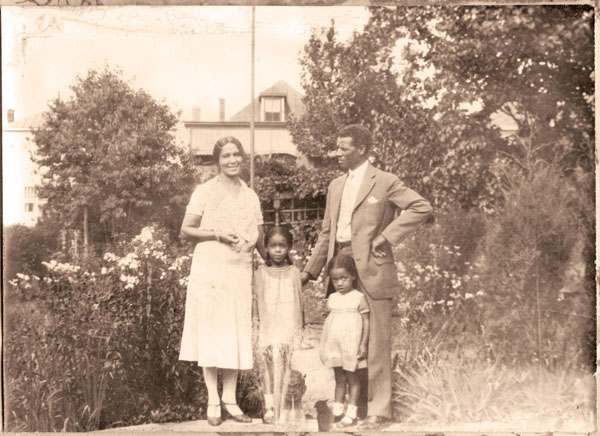
La poetisa Anne Spencer con su marido Edward y dos nietas_Lynchburg, Virginia, EE.UU._hacia 1930 / Poet Anne Spencer and her husband Edward in their Lynchburg, Virginia garden with two of their grandchildren_circa 1930
. . .
Anne Spencer (Annie Bethel Bannister, 1882-1975)
Otro abril
.
Ella está demasiado débil para cuidar a su jardín este año,
y no pudo hacerlo el año pasado; es una mujer mayor.
Las plantas lo entienden
entonces se agrupan pues crecen sin reservas.
La glicinia, púrpura y blanca,
salta del árbol a la caja-casa de golondrinas,
está arrastrado hacia abajo por globos de pétalos fragantes
que apuntalan y robustecen la vid, pues
desciende y toca la Tierra…y
se dispara otra vez
– serpenteando, colgante – y
repiquetea: “¡Abril, de nuevo, aquí está abril!”
Y la ventana de donde la vieja contempla
necesita un lavado ––
. . .
Réquiem
.
Oh, yo que había deseado tanto ser dueña de algún suelo
– ahora mejor estoy consumida por la tierra.
La sangre al río, el hueso al terreno
– la tumba restaura lo que encuentra un lecho.
.
Oh, yo que bebía del barro oloroso de la Primavera
– devuelvo su vino para otra gente.
El aliento al aire, el corazón a las hierbas
– mi corazón estando despojado,
entonces yo descanse.
. . .
Tierra, te agradezco
.
Tierra, te agradezco
por el placer de tu idioma.
Has experimentado unos momentos difíciles
trayéndolo a mí – del suelo –
gruñir a través del sustantivo
todo el camino hacia
sensibilidad
sensación
forma de ver
sentido de olfato
tocar
–– dicho de otro modo:
el conocimiento que
¡yo soy! / ¡sigo aquí!
. . .
Poemas del florilegio Black Nature: Four Centuries of African-American Nature Poetry (Naturaleza Negra: Cuatro Siglos de Poesía Afroamericana sobre la Naturaleza) © 2009, Camille T. Dungy (editor)
. . .
Anne Spencer (Annie Bethel Bannister, 1882-1975)
Another April
.
She is too weak to tend
her garden last year, this
year – and old.
The plants know, and
cluster, running free.
The wisteria, purple and white,
leaps from tree to martin-
box dragged down by globes
of the fragrant wet petals
to shore up, strengthen the vine, then
drops to touch Earth, to shoot
up again looping, hanging,
pealing out “April again!”
.
April is here!…
And the window from
which she stares needs washing ––
. . .
Requiem
.
Oh, I who so wanted to own some earth,
Am consumed by the earth instead:
Blood into river
Bone into land
The grave restores what finds its bed.
.
Oh, I who did drink of Spring’s fragrant clay,
Give back its wine for other men:
Breath into air
Heart into grass
My heart bereft – I might rest then.
. . .
[Earth, I Thank You]
.
Earth, I thank you
for the pleasure of your language.
You’ve had a hard time
bringing it to me
from the ground
to grunt thru the noun
To all the way
feeling seeing smelling touching
––awareness
I am here!
. . . . .
Lucille Clifton: “La muerte de Caballo Loco”
Posted: April 19, 2016 Filed under: English, Lucille Clifton, Spanish, ZP Translator: Alexander Best | Tags: Poemas para El Día Americano del Indio (19 de abril) Comments Off on Lucille Clifton: “La muerte de Caballo Loco” “Strange Man of the Lakota” (Crazy Horse around 1876): giclée print on watercolour paper © Kenneth Ferguson
.
Un poema para El Día Americano del Indio / El Día del Indio Americano (19 de abril):
.
Lucille Clifton (1936-2010)
la muerte de Caballo Loco * (5 de septiembre de 1877, a la edad de 35)
.
en los cerros donde el aro
del mundo
se inclina a las cuatro direcciones
ha mostrado a mí el WakanTanka*
el camino que caminan los hombres es una sombra.
Yo era un niño cuando llegué a comprender ese hecho:
que los cabellos largos y las barbas grises, y yo,
tendríamos que entrar al sueño para ser real.
.
por lo tanto soñé y soñé
y sobreviví.
.
soy el último jefe de guerra,
nunca derrotado en batalla*.
Lakotah*, acuérdense mi nombre.
.
ahora durante esta vuelta
mis huesos y mi corazón
están calentitos en las manos de mi padre.
WakanTanka me ha enseñado que
las sombras van a quebrarse
cerca del arroyo llamado Rodilla Herida*
.
acuérdense mi nombre, Lakotah.
soy el último jefe de guerra.
padre, el corazón,
nunca vencido en batalla,
padre, los huesos,
nunca dominado por batalla,
déjenlos al sitio de Rodilla Herida
.
y acuérdense nuestro nombre: Lakota.
estoy soltado de la sombra.
Mi caballo sueña / baila debajo de mí
mientras entro en el mundo real.
. . .
*Caballo Loco = “Crazy Horse” en inglés y Tȟašúŋke Witkó en la lengua Sioux. aprox.1840 – 1877. Era un líder de guerra de los indios Lakotah (una rama de la nación indígena Sioux de las Grandes Llanuras de los EE.UU.)
*WakanTanka = el “gran espíritu” o el “gran misterio”: el término para lo sagrado o lo divino en la cosmovisión de la gente Sioux.
*nunca derrotado en batalla = La Batalla de Little Big Horn (junio de 1876)
*Lakotah = la gente Sioux en los estados de Dakota del Norte y Dakota del Sur.
*Rodilla Herida = “Wounded Knee” en inglés. Lugar en Dakota del Sur. Sitio de una matanza de los indios Sioux por los soldados del gobierno estadounidense. Considerada como “el episodio final” en la conquista de la gente indígena norteamericana.
. . .
Lucille Clifton (1936-2010)
the death of crazy horse (sept.5th, 1877, age 35)
.
in the hills where the hoop
of the world
bends to the four directions
WakanTanka has shown me
the path men walk is shadow.
i was a boy when i saw it,
that long hairs and grey beards
and myself
must enter the dream to be real.
.
so i dreamed and i dreamed
and i endured.
.
i am the final war chief.
never defeated in battle.
Lakotah, remember my name.
.
now on this walk my bones
and my heart
are warm in the hands of my father.
WakanTanka has shown me the shadows
will break
near the creek called Wounded Knee.
.
remember my name, Lakotah.
i am the final war chief.
father, my heart,
never defeated in battle,
father, my bones,
never defeated in battle,
leave them at Wounded Knee
.
and remember our name. Lakotah.
i am released from shadow.
my horse dreams and dances under me
as i enter the actual world.
. . . . .
Otras reflexiones para El Día del Aborigen Americano…
.
.
https://zocalopoets.com/category/juan-felipe-herrera/
. . . . .
“Language Current”: Latino and Chicano poets from the 1980s and 1990s
Posted: April 12, 2016 Filed under: English, Spanish | Tags: Latino and Chicano poetry Comments Off on “Language Current”: Latino and Chicano poets from the 1980s and 1990s
El jardín de sueños_The garden of dreams_by Chicana artist Judithe Hernández (born 1948, Los Angeles)
Gioconda Belli
(born 1948, Managua, Nicaragua / Los Angeles, California, USA)
Menopause
.
I’m not acquainted with it, yet.
But, so far,
all over the world,
women have survived it.
Perhaps it was that our grandmothers were stoic
or that, back then, no one entitled them to complain,
still they reached old age
with wilted bodies
but strong souls.
Now, instead,
dissertations are written on the subject.
At age thirty the sorrow begins,
the premonition of catastrophe.
.
A body is much more than the sum of its hormones.
Menopausal or not
a woman remains a woman,
beyond the production of secretions or eggs.
To miss a period does not imply the loss of syntax
or coherence;
it shouldn’t lead to hiding
as a snail in a shell,
nor provoke endless brooding.
If depression sets in
it won’t be a new occurrence,
each menstrual cycle has come to us with tears
and its load of irrational anger.
There is no reason, then,
to feel devalued:
Get rid of tampons
and sanitary napkins!
Use them to light a bonfire in your garden!
Be naked
Dance the ritual of aging
And survive it,
as we all shall.
. . .
Rafael Campo
(born 1964, Dover, New Jersey, USA)
The Return
.
He doesn’t know it yet, but when my father
and I return there, it will be forever.
His antihypertensives thrown away,
his briefcase in the attic left to waste,
the football game turned off – he’s snoring now,
he doesn’t even dream it, but I know
I’ll carry him the way he carried me
when I was small: In 2023,
my father’s shrunken, eight-five years old,
weighs ninety pounds, a little dazed but thrilled
that Castro’s long been dead, his son impeached!
He doesn’t know it, dozing on the couch
across the family room from me, but this
is what I’ve dreamed of giving him, just this.
And as I carry him upon my shoulders,
triumphant strides across a beach so golden
I want to cry, that’s when he sees for sure,
he sees he’s needed me for all these years.
He doesn’t understand it yet, but when
I give him Cuba, he will love me then.
. . .
Sandra Cisneros
(Chicana, born 1954, Chicago, Illinois, USA)
Tango for the Broom
.
I would like to be a poet if
I had my life to do over again.
I would like to dance with the broom,
or sweep the kitchen as I am
.
sweeping it today and imagine
my broom is a handsome
black-haired tango man whose
black hair scented with Tres Flores
oil is as shiny as his
black patent leather shoes.
.
Or, I would like to be a poet laundress
washing sheets and towels,
pulling them hot and twisted
from the dryer, wrapping
.
myself in the warmth of
clean towels, clean sheets,
folding my work into soft towers,
satisfied. So much done in a day!
.
Or, I would like to be a poet eating soup
today because my throat hurts. Putting
big spoonfuls of hot soup
into my big fat mouth.
. . .
It occurs to me I am the creative / destructive goddess Coatlicue
.
I deserve stones.
Better leave me the hell alone.
.
I am besieged.
I cannot feed you.
You may not souvenir my bones,
knock on my door, camp, come in,
telephone, take my Polaroid. I’m paranoid,
I tell you. Lárguense. Scram.
Go home.
.
I am anomaly. Rare she who
can’t stand kids and can’t stand you.
No excellent Cordelia cordiality have I.
No coffee served in tidy cups.
No groceries in the house.
.
I sleep to excess,
smoke cigars,
drink. Am at my best
wandering undressed,
my fingernails dirty,
my hair a mess.
Terribly
.
sorry, Madame isn’t
feeling well today.
Must
Greta Garbo.
Pull an Emily D.
Roil like Jean Rhys.
Abiquiu myself.
Throw a Maria Callas.
Shut myself like a shoe.
.
Stand back. Christ
almighty. I’m warning.
Do not. Keep
out. Beware.
Help! Honey,
this means
you.
. . .
Judith Ortíz Cofer
(born 1952, Hormigueros, Puerto Rico / Georgia, USA)
The Tip
.
Just days before the crash
that killed him, my father
lost the tip of his index finger
while working on the same vehicle
that would take him away.
.
I recall my mother’s scream
that brought me out of Mann’s
The Magic Mountain,
and to the concrete drive
now sprinkled in crimson.
His stunned look
is what has stayed with me.
Shock that part of him could take leave
without permission or warning.
He was a man who hated surprises,
who lined his clothes and shoes
like a platoon he inspected daily,
and taught us to suspect the future.
His was the stranger in a strange land’s fear
of not knowing, and not having.
.
After the doctor snipped the raggéd end
of joint and skin like a cigar
and stitched it closed, my father
stared transfixed at the decapitated
finger, as if it had a message for him.
As if he suspected this small betrayal
of his body was just the tip
of chaos rising.
. . .
Carlos Cumpián
(Chicano, born 1953, San Antonio, Texas / Chicago, Illinois, USA)
The Circus
.
A cougar’s howl blasts
out of brass cornets,
matched by blaring bugles,
thunderous trombones,
plus two marching kettledrums
dum dum dumbing us deaf
as six muscle men carry cudgels,
four women wearing less than
what’s wrapped in ribbon around
their lances bounce freely alongside
13 elephants that line up, turn, mount
and massage each other,
except grey guys one and thirteen
who represent wrinkled
alpha and omega
cosmic pachyderms
possessing the patois of saints
amid the frantic pulse of these
under-the-big-top idiotics.

Puerto Rico Conga Man in Lights_copyright 2011 Carlos Reyes, photographer
Sandra María Esteves
(Nuyorican / Dominicana, born 1948, The Bronx, New York City, USA)
In the Beginning
.
In the beginning was the sound
Like the universe exploding
It came, took form, gave life
And was called Conga
.
And Conga said:
Let there be night and day
And was born el Quinto y el Bajo
.
And Quinto said: Give me female
There came Campana
And Bajo said: Give me son
There came Bongos
.
They merged produced force
Maracas y Claves
Chequere y Timbales
.
¡Qué viva la música!
So it was written
On the skin of the drum
.
¡Qué viva la gente!
So it was written
In the hearts of the people
.
¡Qué viva Raza!
.
So it is written.
. . .
Amor Negro
.
In our wagon oysters are treasured
Their hard shells clacking against each other
Words that crash into our ears
We cushion them
Cup them gently in our hands
We kiss and suck the delicate juice
And sculpture flowers from the stone skin
We wash them in the river by moonlight
With offerings of songs
And after the meal we wear them in our hair
And in our eyes.
. . .
Rosario Ferré (1938-2016, Puerto Rico)
Language Current
.
English is like a nuclear reactor.
I’m in it right now.
As I shoot down its fast track
small bits of skin, fragments, cells
stick to my sides.
Once in a while whole sentences gush forth
and slam themselves against the page
condensing their rapid sprays of pellets
into separate words.
Sometimes I travel in it at 186,000 miles an hour,
the speed of light,
when I lie sleepless on the bed at night.
No excess baggage is allowed.
No playful, baroque tendrils
curling this way and that.
No dreamtime walkabout
all the way down to Australia.
In English you have to know where you’re going:
either towards the splitting of the self
or the blasting of the molecules around you.
.
Spanish is a very different tongue.
It’s deeper and darker, with so many twists
and turns it makes me feel like I’m navigating
the uterus. Shards of gleaming stone,
emerald, amethyst, opal
wink at me as I swim down its moist shaft.
It goes deeper than the English Channel,
all the way down to the birth canal and beyond.
. . .
Leroy Quintana
(born 1944, Albuquerque, New Mexico, USA)
Zen – Where I’m From
.
A good door needs no lock, yet no one can open it.
(Lao Tsu)
.
You simply have to admire how, immediately after
the twelve-foot-high chainlink fence
crowned with coils of wicked barbed wire was
erected, the fence the City Council voted on
unanimously to guard against anyone ever again,
again breaking into one of the town’s
storage sheds, how immediately after, the
thieves drove up with their welding torches and
stole it!
. . .
What it was like
.
If you want to know what
it was like, I’ll tell you
what my tío told me:
There was a truckdriver,
Antonio, who could handle a
rig as easily in reverse as
anybody else straight ahead:
.
Too bad he’s a Mexican was
what my tío said the
Anglos had to say
about that.
.
And thus the moral:
.
Where do you begin if
you begin with
if you’re too good it’s too bad?
. . .
Bessy Reyna
(Panama/Cuba/USA)
Lunch Walk
.
He came bouncing down the street
heavy body, long hair, jacket and tie
there was an oddness about him
then, as he approached
I heard the sound of maracas
coming from his pockets
– was it candy?
I pictured hundreds of multi-coloured sweets
crashing against each other
he, oblivious to the crackling rhythm.
.
Along Capitol Avenue
our paths crossed
lunch break nearly over.
How can I explain
being late for work
because I was following a man
who sounded like maracas?

Mural on the side wall of El Milagro tortilla makers (founded in 1950 by Raul Lopez)_East Austin, Texas_photograph by J.C. Shea
Raúl R. Salinas
(1934-2008, San Antonio/Austin, Texas, USA)
Poema del Nuevo León
.
S
e
n
t…a…d…o
e………..m
n…………i
.
favourite restaurant
surrounded by carnitas
y coronas
me pongo a platonear.
.
Meanwhile…
en un booth by the bar
Gloria (la waitress
especial) sits smiling
whiling away
minutes before her
shift / swiftly munching
on a bunch of
(what i hope are
farmworker-friendly,
pesticide-free,
pro-union!)
Grapes.
.
– Austin, 1986
.
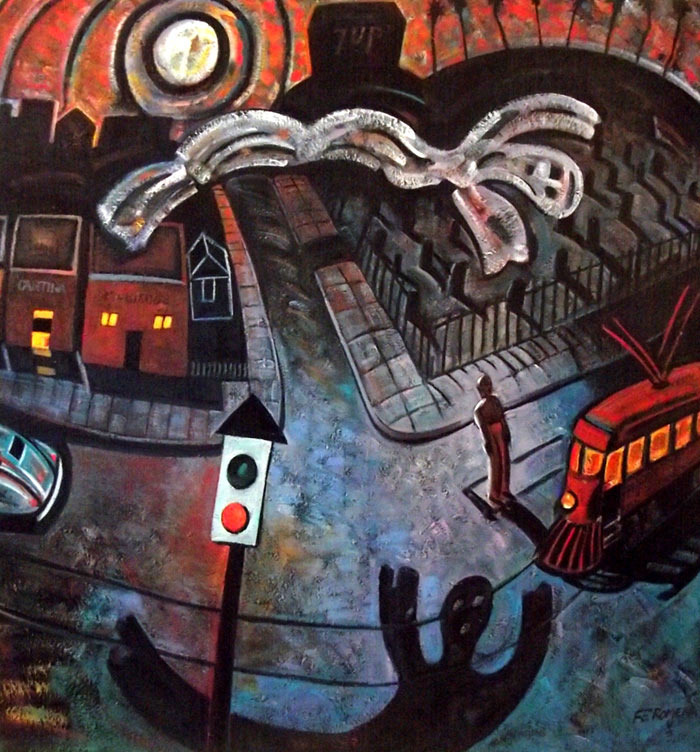
Frank Romero (born 1940)_Ghost of Evergreen Cemetery (1987)
A Walk through the Campo Santo
.
i walked through the Campo Santo of my ciudad tonight
visiting friends and relations playmates from childhoods
hurried / lived other mates from capitalist caves request stop
machinery for a while share in the sacred plants spreading the
presence of peace above / beneath the earth birthrights given
up the Spirit rusty nail at the heel locks the jaws locomotive
wheels become meat grinders the plague in the colony gang-
land guns coming and going family feud with his pistol in his
hand jazz trumpets blare flares catch the glimmer of the gun
running partner my blood of no more sounds no smoke-em-
stickpins in the skin pop poisonous veins 12 gauge shotgun
in the mouth scattered brains become wall designs life left
dangling on the old homestead backyard live oak tree elders
those who checked out caught the bus all on they own / popos
and grandpas grandmother gabriela dead not dead bracing up
temper the steel softening of the machine priestly eulogies
She Gave Birth to a Nation! an indio poet smiles and matriar-
chal voices set the tone as six generations sheep lonely in their
assimilation slump on cold, wooden church pews scratching
they heads wonder what it was the preacher meant bent on
knee i honour primos y tías compas & comrades shoulder to
shoulder laid out beneath caliche stones on sacred ground
i walked through the campo santo of my ciudad tonight.
.
– Austin, 1989
. . .
Gary Soto
(born 1952, Chicano, San Joaquin Valley/Fresno, California, USA)
The Essay Examination for what You have read in the Course “World Religions”
.
From his cross Jesus said, Sit up straight,
And Buddha said, Go ahead and laugh, big boy,
And although no god, Gandhi said, Do onto others…
The last one didn’t seem right. I re-licked my pencil
And looked out the classroom window – two dudes smoking joints,
Yukking it up while I was taking a timed exam.
I noticed a stray dog nosing a paper bag,
Which prompted me to look down at my feet –
My own lunch bag with three greasy splotches.
That was Pavlov, the reaction thing.
And at any moment I could start salivating.
I returned to my exam. I had to concentrate
And wrote, Zoroastrianism was a powerful religion
In a powerful time. Of Taoism, I wrote,
The split personality made you more friends.
I liked my progress. I looked out the window again –
The two hippie dudes now petting the dog
And blowing smoke into its furry face. I wrote:
Confucius was a good guy who stroked his whiskers.
I stalled here. The last part didn’t seem right,
And it didn’t seem right that our teacher
Should be reading the sports page while we suffered.
I got back to work. Who was Shiva?
When did Shinto start? Why did the roofs of the pagodas
Swing upward? The rubbings from my eraser snowed
To the floor and my tongue was black as plague.
The clock ate up the hour. The teacher put down
His newspaper and said, You’ve been good students.
After class I went around to see the hippie dudes,
Now passed out against the wall. The dog lay
Between them, also snoozing, the joint smouldering
Next to his furry face. Unlike Gandhi
I didn’t have much to say on the matter,
I opened my lunch bag with no judgement, no creed,
No French philosophical nada. I ate
A hog of a burrito and then the ancient, mealy fruit,
The apple of our first sin.
. . .
Gloria Vando
(Puerto Rico/New York City, USA)
HE 2-104: A True Planetary Nebula in the Making
.
On the universal clock, Sagan tells us,
we are only moments old. And this
new crab-like discovery in Centaurus,
though older by far, is but
an adolescent going through a vital
if brief stage in the evolution
of interacting stars. I see it
starting its sidereal trek
through midlige, glowingly complex –
“a pulsating red giant: with a “small
hot companion” in tow – and think
of you and me that night in August
speeding across Texas in your red
Mustang convertible, enveloped in dust
and fumes, aiming for a motel bed,
settling instead for the backseat of the car,
arms and legs flailing in all directions,
but mostly toward heaven – and now
this cool red dude winking at me
through the centuries as if to say
I know, I know, sidling in closer
to his sidekick, shedding his garments,
shaking off dust, encircling
her small girth with a high-density
lasso of himself, high-velocity
sparks shooting from her ringed
body like crazy legs and arms until
at last, he’s got his hot companion
in a classic hold and slowly,
in ecstasy, they take wing and
blaze as one across the Southern skies –
no longer crab but butterfly.
. . .
The above poems were featured in the 1997 anthology El Coro: A Chorus of Latino and Latina Poetry, edited by Martín Espada.
. . . . .
Nieve en abril: tres poemas / Snow in April: three poems
Posted: April 7, 2016 Filed under: English, Spanish, ZP Translator: Alexander Best | Tags: Poemas para el Cambio de Estaciones Comments Off on Nieve en abril: tres poemas / Snow in April: three poems
C. Richard Miles (nacido 1961, Yorkshire, Inglaterra)
La nieve en abril
.
Si tienes que despreciarme,
déjalo ser con el toque que da la nieve en abril
a las floraciones delicadas y livianas
– para que yo no sufriere y no me dañará mucho.
.
Si tienes que fastidiarme,
déjalo ser presto como la nieve cayendo en abril
– algo que no dura.
Descansando solo un rato pues pasa como una neblina;
y no me picará, no sentiré el piquete.
.
Si tienes que pelear conmigo,
déja que los golpes tiernos, como la nieve de abril,
hicieren ninguna marca duradera
– mientras la luz dulce del sol primaveral
está ocasionando el renacimiento verde en el campo herboso.
Pero aún las nieves de abril pueden sorprenderme de nuevo
y me perturba de mi reposo;
porque la nieve es la fría visitante inoportuna de abril.
. . .
Daniel Carter (EE.UU.)
La nieve en abril
.
Es de veras un alarde lamentable
cuando alguien quiere encajar en un lugar donde él no encaja,
y ser un déspota que ya no ordena el día.
.
Los hombres mortales no pueden guardar para largo sus coronas.
Nuevas doctrinas decretan la devolución de sus botines;
no está en su poder la capacidad de prolongar su vidas.
.
Al mandato del frente frío el aire cálido retrocede
mientras intenta recuperar su sitio de protagonismo;
pero no hay recompensas por esfuerzos vanos.
.
La nieve está odiada por su irritabilidad.
Deseaba el amor de la gente en masa
pero el suelo derritiendo expone su impotencia.
. . .
Matthew Zapruder
(nacido 1967, Washington, Distrito de Columbia, EE.UU.)
Nieve de abril
.
Hoy en El Paso todos los aviones están dormidos en la pista;
el mundo está retrasado.
Los consultores políticos tomando sus whisky guardan bajadas sus cabezas,
elevándolas solamente para mirar a la bella camarera marcada
que luce como collar las teclas de una máquina de escribir.
Las teclas tintinan cuando les trae las bebidas.
.
Fuera de las ventanas gigantes de hoja de vidrio
los aviones están bañados de nieve y está amontonando en las alas;
me siento como una montaña de cargadores de celulares.
Cada de las variadas fes de nuestros variados padres
nos guardan protegidos solo en parte; no quiero hablar por teléfono con un ángel.
.
De madrugada, antes de dormirme, ya estoy soñando:
de café, de generales ancianos, de las caras de estatuas
– y cada una tiene la expresión eterna de uno de mis sentimientos.
Investigo esos sentimientos sin sentirme nada.
Manejo mi bici al borde del baldío.
Soy el presidente de este vaso de agua.
. . .
C. Richard Miles (born 1961, Yorkshire, England)
Snow in April
.
If you must slight me, let it be the touch
That snow in April, falling soft and white
Gives to the blossoms delicate and light,
So I don’t suffer, it won’t harm me much.
If you must spite me, let it be as quick
As snow in April falling, not to last.
Lies just one moment then, like mist is past,
So it won’t sting me; I won’t feel the prick.
If you must fight me, let the tender blows
Like snow in April, make no lasting mark
As soft, spring sunshine, on the grassy park,
Brings green renewal. But yet April snows
Can still surprise me, stir me from my rest;
For snow is April’s chill, unwelcome guest.
. . .
Daniel Carter (USA)
Snow in April
.
It is truly a pitiful display, When one wants to belong in a place that he doesn’t belong. To be a despot that no longer rules the day. . Mortal men can’t keep their crowns for long. New doctrines decree the return of their spoils. It is not in their power for their life to prolong. . At the cold front’s behest the warm air recoils, As it tries to regain its place of prominence. But there are no rewards for futile toils. . The snow is only hated for its petulance. It desired the love of the masses, but the thawed soil displayed its impotence.
. . .
Matthew Zapruder (born 1967, Washington D.C.)
April Snow
.
Today in El Paso all the planes are asleep on the runway. The world
is in a delay. All the political consultants drinking whiskey keep
their heads down, lifting them only to look at the beautiful scarred
waitress who wears typewriter keys as a necklace. They jingle
when she brings them drinks. Outside the giant plate glass windows
the planes are completely covered in snow, it piles up on the wings.
I feel like a mountain of cell phone chargers. Each of the various
faiths of our various fathers keeps us only partly protected. I don’t
want to talk on the phone to an angel. At night before I go to sleep
I am already dreaming. Of coffee, of ancient generals, of the faces
of statues each of which has the eternal expression of one of my feelings.
I examine my feelings without feeling anything. I ride my blue bike
on the edge of the desert. I am president of this glass of water.
. . . . .
El aniversario de un magnicidio: un poema oblicuo / Anniversary of an assassination: a poem on the diagonal
Posted: April 4, 2016 Filed under: English, Spanish, ZP Translator: Alexander Best Comments Off on El aniversario de un magnicidio: un poema oblicuo / Anniversary of an assassination: a poem on the diagonal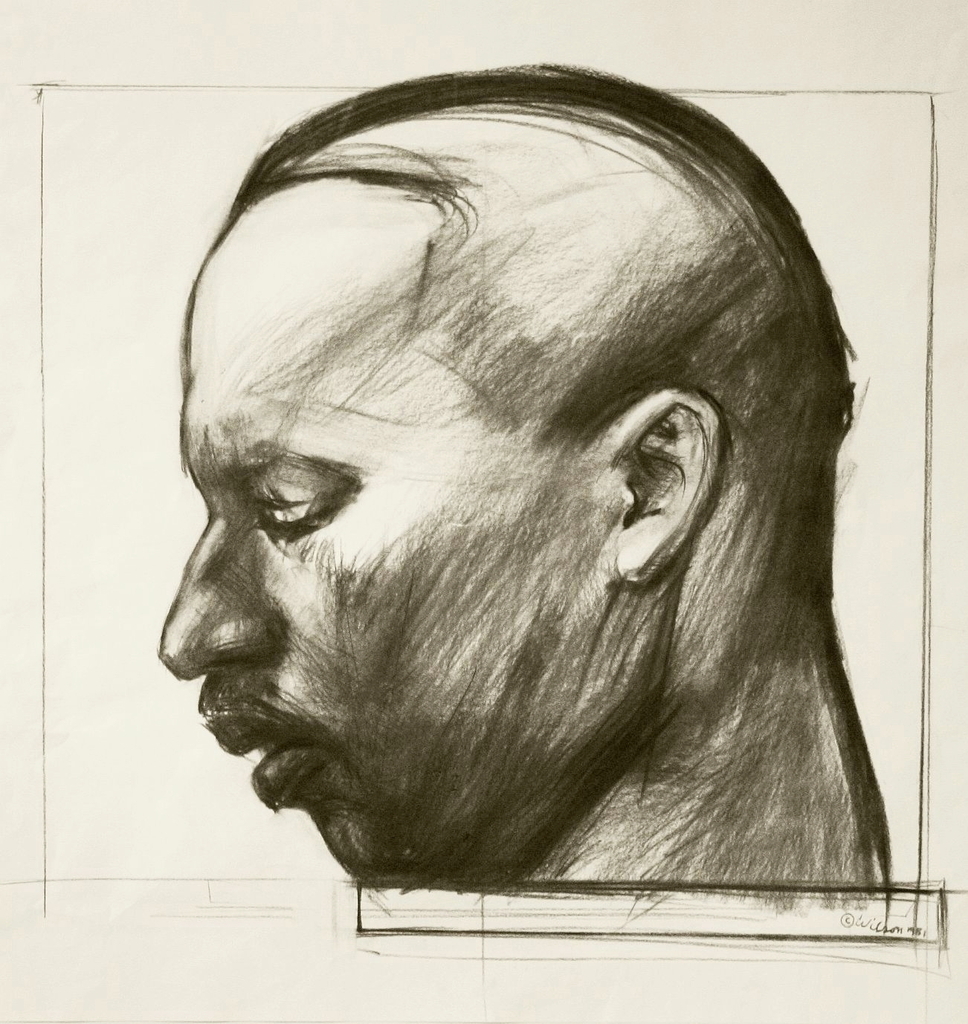
Carboncillo de Martin Luther KING junior (1929-1968)_por John Wilson / Charcoal study for a bronze sculpture of Martin Luther KING Jr. by John Wilson (1922- 2015)
Gerald W. Barrax (nac.1933, Attalla, Alabama, EE.UU.)
King: 4 de abril de 1968
(para Eva Ray *)
.
Cuando yo era un niño en Alabama
los golpetazos de las hachas bajaban en el otoño
y intenté estar en otro lugar,
pero los chillidos de los chanchos muriendos
y los guarros y la vista de sus gargantas abiertas
estaban en todas partes.
A mí no estuve dado ese tipo de estómago / fortaleza.
.
Cuando tuve catorce años
maté con mi carabina de aire comprimido Daisy Red Ryder
la última cosa más grande que un ratón:
un zorzal petirrojo gordo sobre un alambre telefónico;
un petirrojo aún cantando mientras mi primer tiro
disparó en lo alto y miré por la mira y oí de donde fui
el ruido sordo del perdigón cobre en su pecho rojo gordo.
Solo paró el petirrojo y se cayó hacia atrás.
Y yo había escaparme
– antes del pájaro chocando con el suelo –
llevando conmigo mi estómago.
.
Nunca entenderé a la gente ésto:
si la cosa blanda en el estómago puede estar recorto.
Es porque me perdí todas las Guerras.
Pero cuando aprendí que la no-violencia nos mata de todas maneras,
yo deseaba deseaba deseaba hacerlo, sí,
lo deseaba poder hacerlo –
¿Sabes como lo siente / que quiere decir
el deseo de poder matar? ¿Y desear estar dado esa capacidad?
.
Pero yo soy yo.
Y lo que me hizo es lo que te hizo
Y anestesio la cosa blanda para dejar de retorcerme
cuando lo hacen, hermanos/camaradas. Grito:
bien hecho, bien hecho, de puta madre,
está con ustedes mi corazón
aunque mi estómago queda en las pocilgas de Alabama.
.
* Eva Ray fue – quizás – una pariente de James Earl Ray (el asesino de Martin Luther King, junior).
El poeta – Gerald W. Barrax – es afroamericano.

Gerald W. Barrax (born 1933, Attalla, Alabama, USA)
King: April 4, 1968
(for Eva Ray *)
.
When I was a child
in the Fall the axes fell
in Alabama and I tried
to be somewhere else,
but the squeals of the pigs dying
and hogs and the sight of their
opened throats were everywhere.
.
I wasn’t given that kind of stomach.
.
When I was 14, I killed
my last thing bigger than a mouse
with my Daisy Red Ryder,
a fat robin on a telephone wire,
still singing,
as my first shot went high
I sighted down and heard from where I was
the soft thud of the copper pellet in his
fat red breast. It just stopped
and fell over backwards
and I had run away
before it hit the ground, taking
my stomach with me.
.
I’ll never know about people
– if the soft thing in the stomach can be cut out –
because I missed all the wars –
but when I learned that
non-violence kills you anyway
I wished
I wished I could do it I wished I
could ––
do you know what it means to wish
you could kill,
to wish you were given that?
.
But I am me.
Whatever made me made you,
and I anaesthetize the soft thing
to stop squirming when
you do it brothers I shout
right on right on rightON
my heart is with you
though my stomach is still in Alabama pigpens.
.
* Eva Ray was– perhaps –a relative of James Earl Ray (the assassin of Martin Luther King, Jr.) The poet– Gerald W. Barrax – is African-American.
. . . . .
Poemas para El Domingo de Pascua / Poems for Easter Sunday
Posted: March 27, 2016 Filed under: E.E. Cummings, English, Friedrich von Schiller, Michael Chitwood, Nikki Giovanni, Spanish, Steve Turner, ZP Translator: Alexander Best | Tags: Poemas para El Domingo de Pascua, Poems for Easter Sunday Comments Off on Poemas para El Domingo de Pascua / Poems for Easter Sunday
Nicki Giovanni (nac. 1943, EE.UU.)
Poema del Invierno
.
Una vez se cayó sobre mi ceño un copo de nieve
y yo lo amaba tanto y lo besó y él estaba feliz
pues llamó a sus hermanos y sus primos
y una telaraña de nieve me envolvió
entonces estiré el brazo para amar a todos ellos
y los estrujé y se volvieron
una lluvia de primavera y yo me paraba
perfectamente quieta y yo era una flor.
. . .
Michael Chitwood (nac. 1958, Virginia, EE.UU.)
Aquí estoy, Señor
.
El negro acanalado del paraguas
es un argumento por la existencia de Dios,
.
ese pequeño albergue
que llevamos con nosotros
.
y dejemos a un lado, junto a una silla
.
en una reunión de la comisión
que no queríamos asistir.
.
Qué bella palabra, “umbrella” [sombrilla].
Una sombra que podemos abrir.
.
Como el ala del murciélago,
con bordes de una vieira,
tirita.
.
Un parche
golpeado por los palos plateados
.
de lluvia.
Y no tengo el mío
.
entonces la lluvia me moja.
. . .
Steve Turner (nac. 1949, Reino Unido)
Para Lianne, a la edad de Uno
.
Tanto como sea posible,
sigue como eres:
con el ojo claro y abierto
y lavado limpio del miedo;
con la piel tersa,
sin arrugas del funcionamiento triste del corazón,
y los labios sin la habilidad de rencor.
Tanto como sea posible,
sigue como eres:
la primera luz de la mañana un motivo suficiente para el júbilo,
y cada cara transitaria juzgado solo del color de su sonrisa.
Tanto como sea posible,
sigue como eres.
Mira el mundo
con su misterio y ruido
pero rehusa todas ofertas de unirte al grupo.
Que seas retrasada en el mal
y avanzada en el amor.
Tanto como sea posible,
sigue como eres:
con el rostro hacia arriba
y la palma abierta,
con el tropezón de Certeza
y el grito de Esperanza ––
porque en ésto es el Reino.
. . .
Friedrich Von Schiller (1759-1805, Alemania)
Tres palabras de fortaleza
.
Hay tres lecciones que yo escribiría,
tres palabras con una pluma ardiente
y en calcos de luz eterna,
sobre el corazón de la humanidad.
.
Tengan Esperanza.
Aunque las nubes te rodean,
y la alegría esconde en desdén su cara,
lanza la sombra de tu ceño:
cada noche su mañana tendrá.
.
Tengan Fe.
Donde sea tu barco
– impulsado por el deporte de la calma o la risa de la borrasca –
comprende ésto:
Dios gobierna sobre la multitud del Cielo y los habitantes de la Tierra.
.
Tengan Amor.
No el amor solamente del uno
sino de la humanidad – llama al hombre “mi hermano”;
y esparce, como un sol rodeando,
tus bondades sobre Todos.
.
Por eso, graba estas lecciones sobre tu alma:
Esperanza,
Fe,
Amor.
Pues te descubrirás
La Fortaleza cuando los oleajes de esta Vida retondan tan rudamente,
La Luz cuando hayas sido ciego.
. . .
e.e. cummings (1894-1962, EE.UU.)
oh dulce espontánea
.
oh dulce espontánea
Tierra tan frecuentemente
.
te han pellizcado / hincado
los dedos mimandos
de Filósofos lujuriosos;
.
ha pinchado tu belleza
el pulgar malcriado
de Ciencia.
.
tan frecuentemente
te han doblado
sobre sus rodillas ásperas,
apretando / presionándote
las Religiones
.
para que
concibas a unos dioses – pero
.
fiel al diván inigualable
de la Muerte (tu amante rítmica)
.
los contestas
únicamente con
Primavera.
. . .
Nikki Giovanni
Winter Poem
.
once a snowflake fell
on my brow and I loved
it so much and I kissed
it and it was happy and called its cousins
and brothers and a web
of snow engulfed me then
I reached to love them all
and I squeezed them and they became
a spring rain and I stood perfectly
still and was a flower
. . .
Michael Chitwood
Here I am, Lord
.
The ribbed black of the umbrella
is an argument for the existence of God,
.
that little shelter
we carry with us
.
and may forget
beside a chair
.
in a committee meeting
we did not especially want to attend.
.
What a beautiful word, umbrella.
A shade to be opened.
.
Like a bat’s wing, scalloped.
It shivers.
.
A drum head
beaten by the silver sticks
.
of rain
and I do not have mine
.
and so the rain showers me.
. . .
Steve Turner
For Lianne, Aged One
.
As far as possible, stay as you are,
with the eye clear and open
and washed clean of fear;
with the skin untracked
by the sad workings of the heart,
lips unskilled in spite.
As far as possible, stay as you are,
the morning’s first light
cause enough for joy,
each passing face
judged only by the colour of its smile.
As far as possible, stay as you are.
Gaze out at the world
with its mystery and noise,
but refuse all offers to join.
Be backwards in evil,
advanced in love.
As far as possible, stay as you are,
with the upturned face
and the open palm,
with the stumble of faith
and the shout of hope.
For such is the Kingdom.
. . .
Friedrich Von Schiller
Three Words of Strength
.
There are three lessons I would write,
Three words, as with a burning pen,
In tracings of eternal light,
Upon the hearts of men.
.
Have Hope. Though clouds environ round,
And gladness hides her face in scorn,
Put thou the shadow from thy brow:
No night but hath its morn.
.
Have Faith. Where’er thy bark is driven –
The calm’s disport, the tempest’s mirth –
Know this: God rules the host of heaven,
The inhabitants of earth.
.
Have Love, not love alone for one,
But man, as man thy brother call;
And scatter, like a circling sun,
Thy charities on all.
.
Thus grave these lessons on thy soul,
Hope, Faith, and Love; and thou shalt find
Strength when life’s surges rudest roll,
Light when thou else wert blind.
. . .
e.e. cummings
o sweet spontaneous
.
O sweet spontaneous
earth how often have
the
doting
fingers of
prurient philosophers pinched
and
poked
thee
, has the naughty thumb
of science prodded
thy
beauty how
often have religions taken
thee upon their scraggy knees
squeezing and
buffeting thee that thou mightest conceive
gods
(but
true
to the incomparable
couch of death thy
rhythmic
lover
thou answerest
them only with
Spring)
. . . . .
Alexander Best: “Los Hechos” y “El Buen Libro”
Posted: March 25, 2016 Filed under: Alexander Best, English, Spanish | Tags: Good Friday poems, Poemas para El Viernes Santo Comments Off on Alexander Best: “Los Hechos” y “El Buen Libro”
Alexander Best
The Facts
.
My body’s made of clay – of iron, wool and gold – and
Mainly of clay.
The body falls apart; is brave; builds itself again – while I
Sleep; while I – crippled – walk.
A body’s made to love, though not to worship. For the
Soul must never be held. Still – I’ll
Take care of my mudcaked ” house “, at least for
This little while.
When your body’s well, I love it; when your body’s sick, too. Because it’s
There I find Us – for a time.
Oh, of all the wishes I might wish, I’d wish for — —
But the facts are enough.
Forever, You and I are
Pure as soil, delicate as dust, magical as ash.
Our body – weary, strong body –
Our body’s made of clay.
.
(2000)
. . .
Los Hechos
.
Mi cuerpo está hecho de arcilla – y de hierro, lana y oro –
Y más que todo de arcilla.
El cuerpo se desintegra; es valiente, se reconstruye por sí mismo
– mientras duermo; cuando – lisiado – camino.
Un cuerpo está hecho para ser amado, sin embargo no lo idolatres.
Porque el alma no debe ser retenida.
Aun así yo cuido a mi ‘casa’ cubierta de barro endurecido, por lo menos
por un rato.
Cuando tu cuerpo está bien, lo amo, cuando está enfermo también.
Porque es allí donde encontramos a nosotros – por un rato.
Oh, de todos los deseos que yo pudiera desear —
Pero los hechos son suficientes.
Para siempre Tú y Yo somos
Puros como tierra, delicados como polvo, mágicos como la ceniza.
Nuestro cuerpo – cansado, fuerte –
Nuestro cuerpo está hecho de arcilla.
.
(2000)
. . .
Alexander Best
The Good Book
.
I open the book, rather, The Good Book.
Is The Answer within these thousand-odd onion-skin pages?
No.
But it’s an amazing life-span’s read, just the same;
About folks – dead, all of ’em – who were
Rough, sweet, ignorant.
Naaah, Hollywood / Science
Can’t crack this nut – and I’m
Glad in that.
.
My
Favourite exasperating character is
Jesus:
Son of man, born of woman, had – (they say) – that
Divine spark, the same one burns in the billions of us.
He was a flesh-and-blood human being,
Like you and me
– but he was more than that. A
Deep and subtle thinker; simple, oblique and rich in his
Word; a vagrant who was a holy man
(such as the Hindus have). And once he
Got known – ( those Wonders with the loaves and fish; the
Leper and Lazarus; not to mention
the guy walked on water ) –
He was given no peace,
Not even on Sundays.
.
The Multitude trailed him…And here and there he sought an
Evening’s quiet in high-up mountain hollows where he
Lay with his head on a stone pillow, and
Still his restless spirit wouldn’t quit. Well…
Jesus came to a bad end, which was typical back then for
Anyone stubborn and puzzling who appeared to
Spring from nowhere.
.
People picture Jesus as a Hippy or Rastafarian, only
Jesus was more intelligent, sexy and strange than any
Social type that grew out of the twentieth century.
.
A poem is irritating if it goes on for long…but
not The Good Book. And
Jesus’ biography is merely a few chapters in it.
Oh, there’s
Plenty to read, for three-score-years-and-ten
( or however many grains of sand remain in your hourglass. )
.
I open my heart as wide as I’m able.
I close The Good Book.
This is enough for one day.
.
(2001)
. . .
El Buen Libro
.
Abro el libro, mejor dicho, El Buen Libro.
¿Está La Respuesta en este libro de miles de páginas singulares de papel cebolla?
No.
Pero igualmente es una lectura de toda una vida
Acerca de gentes – todos muertos ya – que fueron
Toscos, dulces, ignorantes.
No, no, Hollywood / la Ciencia
No pueden abrirse paso a comprenderlo
Y me alegro de ello.
.
Mi personaje favorito, exasperante, es:
Jesús:
El hijo del Hombre, nacido de Mujer
Tuvo – dicen – esa chispa divina,
La misma que quema en miles de millones
De nosotros.
Él fue un hombre de carne y hueso,
Como tú y yo
– pero él fue más que eso:
Un pensador profundo, perspicaz, simple,
Indirecto y rico en Su Palabra; un vagabundo que era
Un hombre santo (como los hindús lo han sido).
Y una vez llegó a ser reconocido
– (esos milagros con el pan y el pescado; el leproso y Lázaro;
Sin mencionar que el hombre caminó sobre agua) –
No tuvo paz – aún en los domingos.
.
La multitud le seguía
Y buscó aquí y allá el silencio de una tarde donde descansar
Su cabeza, en los huecos
En la cima de la montaña,
Sobre una almohada de piedra,
Y todavía su espíritu agitado no descansaba…
.
Bueno,
Jesús terminó mal, que era típico entonces para una persona
Testaruda y misteriosa que se aparecía de la nada.
La gente se hace una idea de Jesús como un rastafari o un hippy pero
Solamente que Él era más inteligente, atractivo y misterioso
Que cualquier sujeto que germinó del siglo veinte.
.
Un poema fastidia si se alarga…pero no El Buen Libro.
Y la biografía de Jesús está en unos cuantos capítulos solamente.
Oh, hay mucho que leer, por setenta años,
o cuantos granos nos queden en nuestro reloj de arena.
.
Abro mi corazón tanto como puedo.
Cierro El Buen Libro.
Ésto es suficiente por un día.
.
(2001)
. . .
Traducciones al español por Lidia García Garay (2011)
. . . . .
Poems about Death: Whitman, Wilcox, Millay
Posted: March 25, 2016 Filed under: Edna St.Vincent Millay, Ella Wheeler Wilcox, Walt Whitman | Tags: Poems about Death Comments Off on Poems about Death: Whitman, Wilcox, Millay
Walt Whitman (1819-1892)
To One Shortly to Die
.
From all the rest I single out you, having a message for you,
You are to die –– let others tell you what they please, I cannot prevaricate,
I am exact and merciless, but I love you –– there is no escape for you.
.
Softly I lay my right hand upon you, you must feel it,
I do not argue, I bend my head close and half envelop it,
I sit quietly by, I remain faithful,
I am more than nurse, more than parent or neighbour,
I absolve you from all except yourself spiritual bodily, that is
eternal, you yourself will surely escape,
The corpse you will leave will be but excrementitious.
.
The sun bursts through in unlooked-for directions,
Strong thoughts fill you and confidence, you smile,
You forget you are sick, as I forget you are sick,
You do not see the medicines, you do not mind the weeping friends,
I am with you,
I exclude others from you, there is nothing to be commiserated,
I do not commiserate, I congratulate you.
. . .
Ella Wheeler Wilcox (1850-1919)
My Grave
.
If, when I die, I must be buried, let
No cemetery engulf me – no lone grot,
Where the great palpitating world comes not,
Save when, with heart bowed down and eyelids wet,
It pays its last sad melancholy debt
To some outjourneying pilgrim. May my lot
Be rather to lie in some much-used spot,
Where human life, with all its noise and fret,
Throbs about me. Let the roll of wheels,
With all earth’s sounds of pleasure, commerce, love,
And rush of hurrying feet surge o’er my head.
Even in my grave I shall be one who feels
Close kinship with the pulsing world above;
And too deep silence would distress me, dead.
. . .
Edna St.Vincent Millay (1892-1950)
The Shroud
.
Death, I say, my heart is bowed
Unto thine – O mother!
This red gown will make a shroud
Good as any other!
.
(I, that would not wait to wear
My own bridal things,
In a dress dark as my hair
Made my answerings.
.
I, tonight, that till he came
Could not, could not wait,
In a gown as bright as flame
Held for them the gate.)
.
Death, I say, my heart is bowed
Unto thine – O mother!
This red gown will make a shroud
Good as any other!
. . .
Edna St.Vincent Millay
Lament
.
Listen, children:
Your father is dead.
From his old coats
I’ll make you little jackets;
I’ll make you little trousers
From his old pants.
There’ll be in his pockets
Things he used to put there,
Keys and pennies
Covered with tobacco;
Dan shall have the pennies
To save in his bank;
Anne shall have the keys
To make a pretty noise with.
Life must go on,
And the dead be forgotten;
Life must go on,
Though good men die;
Anne, eat your breakfast;
Dan, take your medicine;
Life must go on;
I forget just why.
. . . . .
Maxwell Bodenheim: poemas: “Para mi enemigo”, “Para un hombre”, “Para alguien muerto”
Posted: March 25, 2016 Filed under: English, Maxwell Bodenheim, Spanish, ZP Translator: Alexander Best | Tags: Poemas para El Viernes Santo, Poems for Good Friday Comments Off on Maxwell Bodenheim: poemas: “Para mi enemigo”, “Para un hombre”, “Para alguien muerto”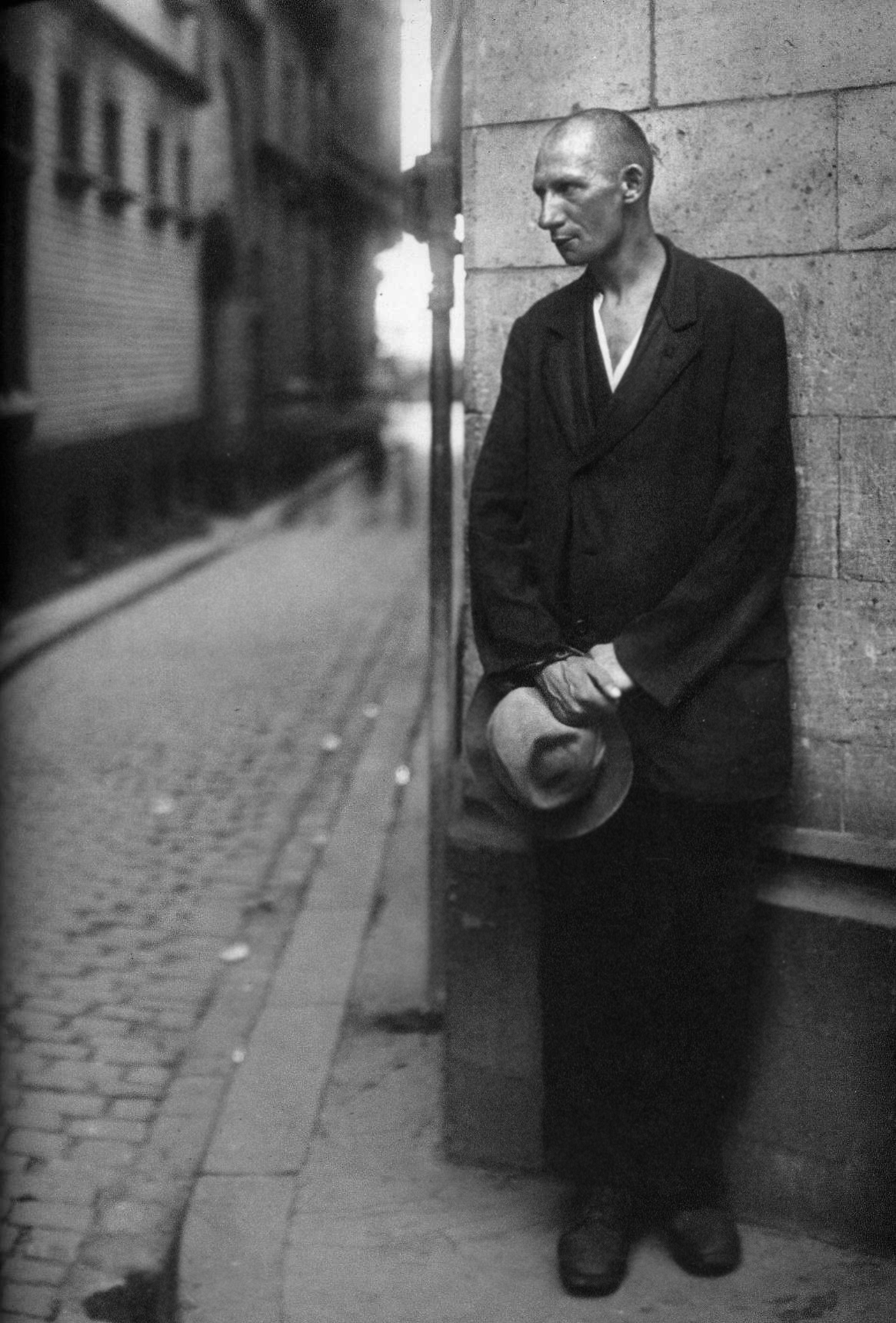
Arbeitslos_Unemployed Man_El Parado_fotografía de 1928 por August Sander
Maxwell Bodenheim
(1892-1954, EE. UU., poeta y escritor de literatura barata, bohemio, teporocho, mendigo, víctima de homicidio)
Para mi enemigo
.
Desprecio mis amigos más que te desprecio.
Yo mismo, lo entendiera pero ellos se pararon ante los espejos
y los pintaron con imágenes de las virtudes que ansié.
Llegaste con un cincel lo más afilado, rascando la pintura falsa.
Pues me conocí y me detesté – pero no te detesté –
porque los vistazos de ti en las gafas que descubriste
me enseñaron las virtudes cuyas imágenes destruiste.
. . .
Para un hombre
.
Maestro de equilibrio serio,
eres un Cristo hecho delicado
por muchos siglos de meditación perpleja.
Curvas un viejo mito hacia una espada pacífica,
como un sonámbulo desafiando
un sueño que le dio forma a él.
Con una insistencia suave y anticuada
colocas la mano de tu criatura en el universo
y delineas una sonrisa de amor dentro de sus profundidades.
Pero los hombres-espantapájaros girandos que están
hechos de algo que elude su vista
tengan la sencillez sorprendente de tu sonrisa.
.
Una vez por mil años
la quietud se materializa en una forma que
podemos crucificar.
. . .
Para alguien muerto
.
Yo caminaba por la colina
y el viento, solemnemente ebrio a causa de tu presencia,
se tambaleó contra mí.
Me encorvé para interrogar a una flor,
y flotaste entre mis dedos y los pétalos,
amarrándolos juntos.
Corté una hoja de su árbol
y una gota de agua en esa jarra verde
ahuecaba una pizca cazada de tu sonrisa.
Todas las cosas de mis alrededores se remojaron de tu recuerdo
y tiritaban mientras intentaron decírmelo.
. . .
Maxwell Bodenheim
(1892-1954, American poet, pulp-fiction author, bohemian, drunk, beggar, homicide victim)
To an enemy
.
I despise my friends more than you.
I would have known myself but they stood before the mirrors
And painted on them images of the virtues I craved.
You came with sharpest chisel, scraping away the false paint.
Then I knew and detested myself, but not you,
For glimpses of you in the glasses you uncovered
Showed me the virtues whose images you destroyed.
. . .
To a man
.
Master of earnest equilibrium,
You are a Christ made delicate
By centuries of baffled meditation.
You curve an old myth to a peaceful sword,
Like some sleep-walker challenging
The dream that gave him shape.
With gentle, antique insistence
You place your child’s hand on the universe
And trace a smile of love within its depths.
And yet, the whirling scarecrow men made
Of something that eludes their sight,
May have the startling simplicity of your smile.
.
Once every thousand years
Stillness fades into a shape
That men may crucify.
. . .
To one dead
.
I walked upon a hill
And the wind, made solemnly drunk with your presence,
Reeled against me.
I stooped to question a flower,
And you floated between my fingers and the petals,
Tying them together.
I severed a leaf from its tree
And a water-drop in the green flagon
Cupped a hunted bit of your smile.
All things about me were steeped in your remembrance
And shivering as they tried to tell me of it.
. . . . .
Edwin Morgan: “Good Friday” and “In the Snack-bar”
Posted: March 25, 2016 Filed under: Edwin Morgan, English Comments Off on Edwin Morgan: “Good Friday” and “In the Snack-bar”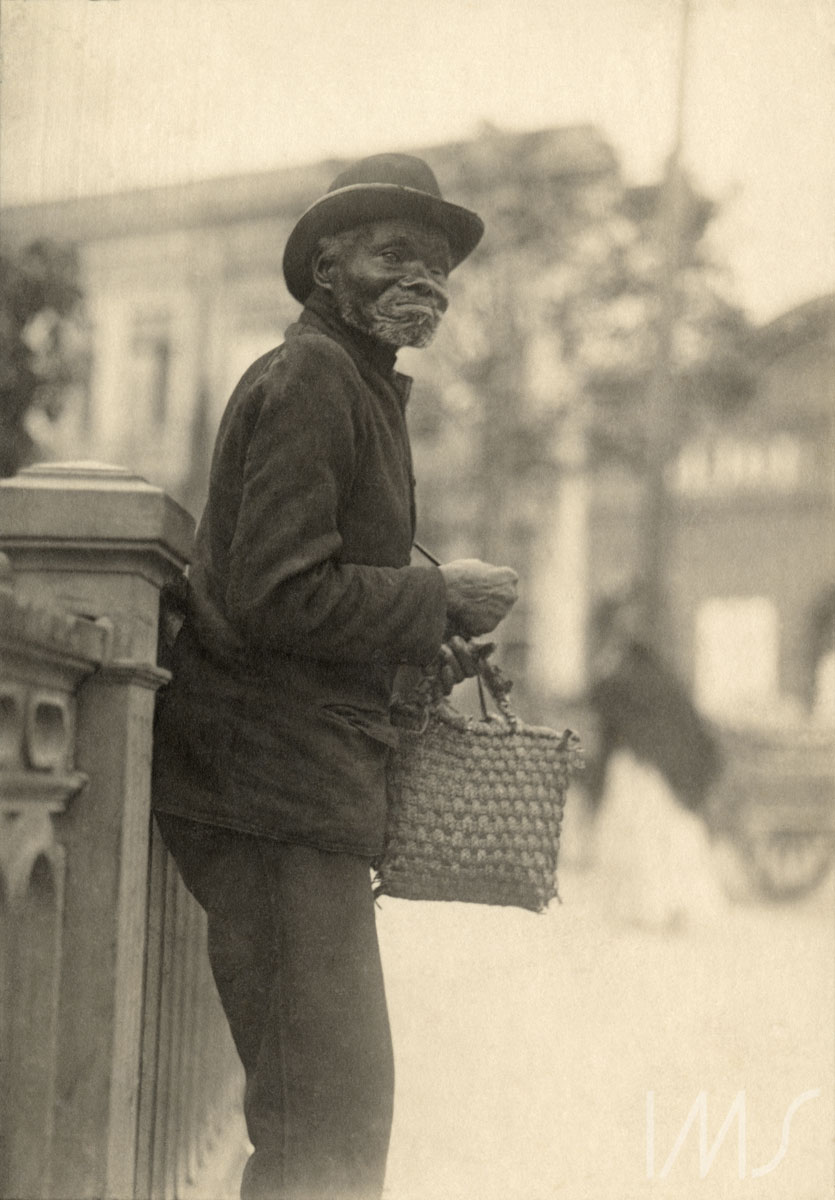
Vincenzo Pastore, photogapher_Agéd man on Rua São João in São Paulo_circa 1910
 Zócalo Poets