Oración a La Virgen de Guadalupe: un redescubrimiento en 2012
Posted: December 12, 2012 Filed under: Spanish | Tags: Oración a La Virgen de Guadalupe Comments Off on Oración a La Virgen de Guadalupe: un redescubrimiento en 2012
ZP_Pintura de Nuestra Señora de Guadalupe por Pristine Cartera Turkus
“Oración a La Virgen de Guadalupe”
(Aquí te mostramos una oración a La Guadalupana, escrita en el idioma quechua por un devoto anónimo durante la novena de agosto-septiembre 1984 en el Catedral de Sucre, Bolivia)
. . .
Acordémonos ahora que somos mortales,
Por eso honremos la gloria celestial.
.
Todos los buenos irán al cielo,
Todos los malos irán al infierno.
.
Mil veces te saludamos, aunque seamos malvados,
En cualquier loma o cerro de ti nos acordamos.
.
¿Ya no más, señora, nos escuchas ahora?
De tanto llanto nuestro, ¿no te estás compadeciendo?
.
Enojándote con pecado en esta vida te hemos perdido,
Enojándote a ti, madre, tan mal hemos vivido.
.
Si nosotros ya no nos acordamos de ti,
Cayando en tanta culpa a ti, madre, te olvidamos.
.
¿Para qué, señora, vamos a vivir?
Con tantas culpas, ¿qué más podemos esperar?
.
Antes, de mi vida despójame, si así voy a tener que vivir,
Todos mis pensamientos, madre, contigo sólo estarán.
.
Nuestra maldad, que ahora se acabe,
Todo lo que amamos, en este mundo se quedará.
.
Llorando sin consuelo, todos te pedimos perdón,
Ahora de rodillas acerquémonos a nuestra madre.
.
Bendición, señora, bendición, María,
No nos desampares, madre protectora.
.
¿Siendo mi madre no quieres oírme
A tu hija huérfana para protegerme?
.
A ti noche y día, virgen singular,
Eternamente imploramos llenos de pesar.
.
A esos tus ojos volvemos, señora,
Compadeciéndote como protectora.
.
Noche y día madre cual pobre cautivo
En medio de nuestro sufrimiento para mi destino.
.
Nuestros sufrimientos recibid, señora,
Llorando te lo pedimos de vos madre mía.
.
Como eres mi madre vengo arrepentido,
Apiádate, madre, como protectora.
.
Muy atribulados, esclavo leal,
Huérfanos, nos humillamos a vuestra piedad.
.
En medio del sufrimiento, en gozo y pena,
Tú eres su consuelo, paloma de cielo.
.
A tus pies todos ya postrados,
Tu bendición todos esperamos.
.
Te venimos a saludar, eternal y soberana María,
Para encontrar tu luz, señora.
.
Todos sus hijos a nuestra madre ahora,
De rodillas acerquémonos a ella.
.
De nuestros pecados a pedir absolución,
Todos llorando pidámosle a ella.
.
Y ahora pues ya, señora María,
Tus piecesitos te hemos besado.
.
Amargamente llorando venimos
A pedirte perdón de nuestras culpas.
.
Tal vez hubieran tropezado
Los pecadores, María,
Buscándote a ti venimos, señora madre.
.
Viéndote a ti que tristes te miramos
Con nuestros cansados ojos
Te miramos y nos alegramos.
.
Pero ahora, señora, compadécete
Y nuestras culpas mueran para siempre.
.
De rodillas acerquémonos a ella
A pedir la gracia iremos a nuestra madre.
.
De esta forma, madre, apiadándote ahora
La bendición dános a todos.
. . . . .
Oración a la Virgen de Guadalupe: Hawari quechua
Posted: December 12, 2012 Filed under: Quechua | Tags: Oración a La Virgen de Guadalupe Comments Off on Oración a la Virgen de Guadalupe: Hawari quechua
ZP_Nuestra Señora de Guadalupe_pintura por Pristine Cartera Turkus de Prisarts
Una Oración a la Virgen de Guadalupe:
Harawi quechua: A la Virgen de Guadalupepaq
.
Yuyariykuña kunanqa
wañuq runa kasqaykuta,
jinataqmin yupaychayku
janaq pachaq glorianta.
.
Tukuy allin runakuna
janaq pachaman rinanta,
takuy saqra runakun
ukhu pachaman rinanta.
.
Waranqasta napaykuyku
kay saqra kasqaykumanta,
may lomapi may urqupi
yuyarikuyku qanmanta.
.
Manañaqa ari señora,
kunanqa uyariwaykuchu?
chhika waqasqaykutapis
mana khuyawaykuñachu?
.
Juchaywan phiñachispa
kay vidapi pierdarqayku,
qan mamayta phiñachispa
chhika saqra kawsarqayku.
.
Si mañana nuqaykuqa
qantan yuyarisqaykuchu,
chhikata juchallikuspa
qan mamayta qunqapuyku.
.
Imapaqñataq señora
nuqaykuqa kawsasaqchu?
chhika juchasniykumanta
imatana suyasaqchu?
.
Antes, vidayta qichuway,
jina kawsay kaqtinqa,
tukuy ima yuyayniypis
mamay qanllapiña kanqa.
.
Chhika saqra kanaykuqa
kunanqa tukukuchunna,
tukuy ima yuyayniypis
mamy qanllapina kanqa.
.
Chhika saqra kanaykuqa
kunanqa tukukuchunña,
tukay ima munasqayku
kay mundopi qhiparinqa.
.
Waqaspa paran paranta
perdonta tukuy mañayku,
kunanmari qunqur chaki
mamanchisman sispaykuna.
.
Bendición señora,
bendición María,
no nos desampares,
madre protectora.
.
Mamay kasaspachu
no quieres oírme
waqcha wawaykita
para protegerme.
.
Qantan tuta p’unchay
virgen singular
wiñay waqyakuyku
lleno de pesar.
.
Chay ñawisniykita
volvemos, señora,
khuypayawaspa
como protectora.
.
Tuta p’unchay mamay
cual pobre cautivo
phutiyniykuñapi
para mi destino.
.
Ñak’ariynikuta
recibid señora
waqaspa mañakuyku
de vos madre mía.
.
Qan mamay kaqtiyki
vengo arrepentido
khuyaway mamáy
como protectora.
.
Sinchis phutiyniypi
esclavo leal
waqchas k’umuykuyku
a vuestra piedad.
.
Phutiypa chawpinpi
en gozo y pena
qan consuelon kanki
paloma del cielo.
.
Chakisniykipimin
todos ya postrados
bendicionniykita
todos esperamos.
.
Napaykusqayki
winay qullana María
k’anchayniykita
taripunaypaq señora.
.
Tukuy wawasnin
mamanchismanqa kunanqa
qunqur chakiwan
sispaykusunchis paymanqa.
.
Juchanchismanta
p’anpachayninta mañakuq
tukuy waqaspa
mañakusunchis paymanta.
.
Ñamin kunanqa
ari señora María
chakisniykita
much’aykuykuña qanpata.
.
Jik’un jik’unta
tukuy waqaspa jamuyku
juchaytkumanta
perdón mañayku qanmanta.
.
Ñanchá misk’aspa
juchasapasqa María
qanta maskaspa
mamay jamuyku señora.
.
Qanta rikuspa
ima llakisqas qhawayku
utiq ñawiykiwan
qhawariyku kusisqas.
.
Pero kunanqa
ari señora khuyaspa
juchasniykuqa
wañullachunña wiñaypaq.
.
Qunqur chakiwan
chinpaykusunchis payman
mamanchismanta
gracian mañakuq risunchis.
.
Jinataq mamay
ari khuyaspa kunanqa,
bendiciontaqa
churawayku tukuyman.
(Escrito por “Anónimo” en Sucre, Bolivia, 1984)
. . . . .
Harawi quechua: A una madre
.
Teqsimuyuntinpi, tukuy hinantin mamakunapaq,
hanaq pachaman ripuq mamakunapaq,
hinallataq, mösöq, hamöq mamakunpaq.
– Mamay!
.
Mamayqa manan t’ikachu,
t’ika kaspaqa,
ruphaypichá… ñaqerqonman
Nitaqmi inti k’anchachu,
inti kaspaqa,
ch’isintachá… ch’usaqyanman,
.
Ñawinkunaqa manan ch’askachu,
ch’aska kaspaqa
p´unchaypichá… tukuyukunman
Makinkunapas manan qoriqolqechu,
qoriqolqe kaspaqa
llank’asqanpichá… thantakunman,
.
Mamayqa… urpikunaq takinmi,
llakiq ñit´isqan.. sonqoyuq,
weqeq sarkhasqan… ñawiyuq,
Hump’iq qhëtusqan… mat’iyuq
hatunkaray… khuyaq sonqo.
.
Wasanqa manan sunch’uq t’ikanchu,
nitaqmi achanqaraychu rikranpipas
pallay llikllapin… erqe puñun,
oqe phullupin… khuyay llimphan,
thanta unkhuñapitaq… chani phoqchin.
.
Mamaypa chaki khallkinmi
sönqö nanayniy,
sarusqanpi laq’akusqantaq
weqe qochayniy.
Hinayá… yupi saqesqan
qonqorispa much’ana.
.
Mamaypa qhasqonpiqa…
manan
suni chukchallanchu saman,
qhasqonmantaqa
sut’i waylluymi… q’aparin,
ñuñunkunamantataqmi
inti p’unchay… phuturin,
.
Chhaynan… ñoqaq mamay
mana hayk’aq… sonqoypi tukukuspa,
mana hayk’aq… simiypi q’aymayaspa,
mana hayk’aq… ñawiruruypi tutayaspa
wiñaypaq … ñoqapi kawasan!
. . . . .
שירי חנוכה A Freilichin Chanukah: Songs and a Paley poem for Hanukkah
Posted: December 8, 2012 Filed under: English, Grace Paley, Ladino/Judeoespañol, Yiddish | Tags: Hanukkah poems Comments Off on שירי חנוכה A Freilichin Chanukah: Songs and a Paley poem for Hanukkah
שירי חנוכה
אוי חנוכה אוי חנוכה
א יום טוב א שיינע
א ליכטיגע א פרייליכע
נישט דא נאך א זיינע
אלע נאכט מיט דריידלעך ,שפילן מיר
פרישע הייסע לאטקעס ,עסן אן א שיעור
קומט קינדער געשווינדער
די חנוכה ליכט ,וועלן מיר אנצונדען
זאגט על הניסים
לובט ג-ט פאר די נסים
לאמיר אלע טאנצען צוזאמען
. . .
Suki and Ding’s Chanukah Song
.
Chanukah, oh Chanukah,
A holiday, a lovely one,
A happy and a joyful one,
There really is none like it!
Each night at ‘dreidl’ we do play,
fresh hot ‘latkes’ we eat all the day!
Come children, hurry,
the Chanukah candles we shall light!
Let us sing “al hanisim”*,
Let us thank G-d for his miracles,
And we’ll all dance together!
.
*“Al hanisim” is a phrase often uttered at the start of a daily prayer or after meals as a grace. Literally, it means “and for the miracles” – a reminder to thankfully acknowledge G-d for the miracles he has wrought…
.
Chanukah, oh Chanukah song © Suki and Ding
. . .
Daria Marmaluk-Hajioannou
A song for Hanukkah:
“Eight Candles” (an excerpt)
.
The holiday of lights is here,
Good friends and happiness to share,
Sweets with honey for us to eat,
Candles to light and friends to greet!
One little candle, One little candle!
Two little candles, three!
Four, five, six little candles, seven and eight for me!
.
The original of “Eight Candles” follows below…
It is written in the language of mediaeval Spanish Judaism – Ladino or Judeoespañol – which is spoken by about 100,000 people worldwide, including the composer of the song and its lyrics, Daria Marmaluk-Hajioannou.
.
Canción para Janucá por Daria Marmaluk-Hajioannou
(en el idioma ladino/judeoespañol):
“Ochu kandelas” (un extracto)
.
Hanukka lindo sta aki,
ochu candelas para mi!
Una kandelika, dos kandelikas,
tres kandelikas, kuatro kandelikas,
sintju kandelikas, sysh kandelikas,
sieto kandelikas, ocho kandelikas para mi!
Muchas fiestas vo fazar,
con alegrias i plazar!
Una kandelika (etcetera…)
Los pastelikas vo kumer,
con almendrikas i la miel!
Una kandelika (etcetera…)
. . .
“People in my Family” by Grace Paley:
Paley was a Jewish-American short-story writer, poet and political activist. Born in 1922 in The Bronx, New York City, USA, she grew up hearing Russian and Yiddish at home – and the cadences of Yiddish influenced her poems written in English. A pacifist who spoke out against nuclear proliferation, the Vietnam War and the gargantuan American military, Paley was a passionate person in every way. She died in 2007.
.
Grace Paley
“People in my Family”
.
In my family
people who were eighty-two were very different
from people who were ninety-two.
.
The eighty-two-year-old people grew up,
it was 1914 –
this is what they knew:
WarWorldWarWar.
.
That’s why when they speak to the child
they say
poor little one…
.
The ninety-two-year-old people remember
– it was the year 1905 –
they went to prison,
they went into exile,
they said ah soon…
.
When they speak to the grandchild
they say
yes there will be revolution,
then there will be revolution, then
once more, then the earth itself
will turn and turn and cry out
oh I have been made sick…
.
Then you my little bud
must flower and save it.
. . . . .
“Tha an saoghal fhathast àlainn, ged nach eil thu ann. / The world is still beautiful, though you are not in it.” Bàrdachd: Latha Naomh Anndra / Gaelic poems for Saint Andrew’s Day
Posted: November 30, 2012 Filed under: IMAGES Comments Off on “Tha an saoghal fhathast àlainn, ged nach eil thu ann. / The world is still beautiful, though you are not in it.” Bàrdachd: Latha Naomh Anndra / Gaelic poems for Saint Andrew’s Day
Nua-bhàrdachd: Gàidhlig / Contemporary Gaelic poetry from Scotland: Meg Bateman
Posted: November 30, 2012 Filed under: English, Gaelic: Scottish, Meg Bateman Comments Off on Nua-bhàrdachd: Gàidhlig / Contemporary Gaelic poetry from Scotland: Meg Bateman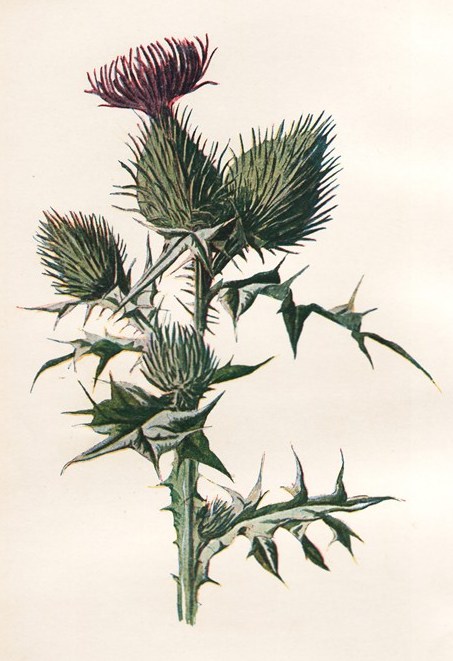
ZP_A nineteenth-century illustration, Spear-plume thistle or Cirsium vulgare, which was the original native Scotch Thistle until the arrival in the middle ages of the tougher, spinier and more impressive Onopordum acanthium.
Meg Bateman (born 1959, Edinburgh, Scotland)
“Mother”
.
We looked at the stars for a while
Before we turned in with the dogs,
And you said it was high time
You learnt their names properly.
.
But soon you will be among them yourself
And I will be the one trying to name you;
You whose nature I have seen
Only as their faint points of light –
.
As you labour behind duty,
Behind house-work, farm-work, books,
And who knows if you have your reward
For your care and effort and exhaustion.
.
I wish I could kindle a joy in you
That would let me see you whole
Or you won’t be further when you go
Than you were tonight at my side.
. . .
“Màthair”
.
Bha sinn a’coimhead nan rionnag
mus do thionndaidh sinn a-steach leis na coin,
is thuirt thu gum bu mhithich dhut
na h-ainmean aca ionnsachadh gu ceart.
.
Ach chan fhada gus am bi thu fhèin nam measg
’s is mise a bhios a’feuchainn ri d’ainmeachadh,
thusa aig nach fhaca mi do nàdar
ach mar phriobadh fann an cuid solais –
.
Is tu riamh an ceann do dhleastanais,
mu chòcaireachd, caoraich, leabhraichean;
a bheil fios an d’fhuair thu do dhìol
airson do dheataim is spàirn is sgìths?
.
O gun lasainn de dh’aighear annad
na leigeadh leam d’fhaicinn gu slàn,
no chan fhaide thu bhuam nuair a shiùbhlas tu
nab ha thu rim thaobh a-nochd.
. . .
“Lightness”
.
It was your lightness that drew me,
The lightness of your talk and your laughter,
The lightness of your cheek in my hands,
Your sweet gentle modest lightness;
And it is the lightness of your kiss
That is starving my mouth,
And the lightness of your embrace
That will let me go adrift.
. . .
“Aotromachd”
.
B’ e d’ aotromachd a rinn mo thaladh,
Aotromachd do chainnte’s do ghaire,
Aotromachd do lethchinn nam lamhan,
D’ aotromachd lurach ur mhalda;
Agus ‘s e aotromachd do phoige
A tha a’ cur trasg air mo bheoil-sa,
Is ‘s e aotromachd do ghlaic mum chuairt-sa
A leigeas seachad leis an t-sruth mi.
. . .
“O Bonnie Man, Lovely Man”
.
O bonnie man, lovely man,
You’ve brought a song to my lips,
.
A spring of clear gushing water
Spilling over the rocks,
.
Soft grasses and bracken
Covering my slopes with green;
.
Your bed is in cotton-grass
With curlews calling in flight,
.
Maytime’s sweet drizzle
is settling about me,
.
Giving mirth and voice
to my soils long barren,
.
O bonnie man, lovely man,
You’ve brought a song to my lips.
. . .
“Fhir luraich ’s fhir àlainn”
.
Fhir luraich ’s fhir àlainn,
thug thu dàn gu mo bhilean,
.
Tobar uisge ghil chraobhaich
a’ taomadh thar nan creagan,
.
Feur caoin agus raineach
a’ glasadh mo shliosan;
.
Tha do leabaidh sa chanach,
gairm ghuilbneach air iteig.
.
Tha ceòban cùbhraidh na Màighe
a’ teàrnadh mu mo thimcheall,
.
’S e a’ toirt suilt agus gutha
dham fhuinn fada dìomhain,
.
Fhir luraich ’s fhir àlainn,
thug thu dàn gu mo bhilean.
. . . . .
All poems © Meg Bateman
Latha Naomh Anndra / Scottish Gaelic poems for Saint Andrew’s Day: Sorley Maclean
Posted: November 30, 2012 Filed under: English, Gaelic: Scottish, Sorley Maclean Comments Off on Latha Naomh Anndra / Scottish Gaelic poems for Saint Andrew’s Day: Sorley Maclean.
Sorley Maclean (Somhairle MacGill-Eain)
(Raasay, Scotland, 1911-1996)
“Should I even strip off…”
.
Should I even strip off
My deceit-proof clothing
And go naked and eager
As a blaze of supreme reason,
I’d then reach the core-love
Of my reason for living
And I’d add to your pleasure
The blaze of supreme reason.
. . .
“Ged chuirinn dhiom éideadh”
.
Ged chuirinn dhiom éideadh
Faireachaidh na cluaineis
‘S nam falbhainn 10m gleusta
‘Nam chaoir céille buadhmhoir,
Ruiginn an-sin cré-ghaol
Mo chéille luaidhe
‘S liùbhrainn do t’ éibhneas
Caoir na céille buadhmhoir.
. . .
“Calvary”
.
My eye is not on Calvary
nor on Bethlehem the Blessed,
but on a foul-smelling backland in Glasgow,
where life rots as it grows;
and on a room in Edinburgh,
a room of poverty and pain,
where the diseased infant
writhes and wallows till death.
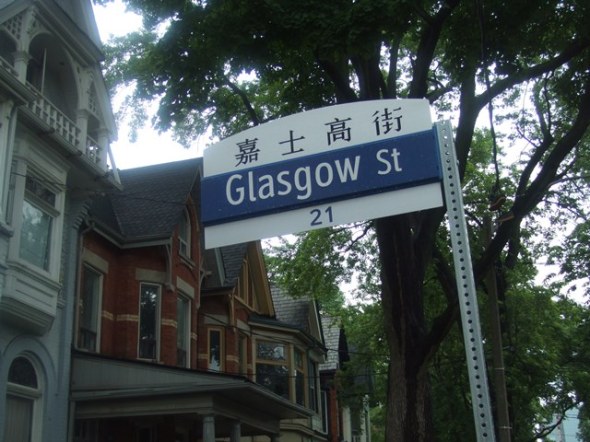
ZP_Glasgow Street, Toronto, Canada
“Calbharaigh”
.
Chan eil mo shùil air Calbharaigh
no air Betlehem an àigh
ach air cùil ghrod an Glaschu
far bheil an lobhadh fàis,
agus air seòmar an Dùn Èideann,
seòmar bochdainn ’s cràidh,
far a bheil an naoidhean creuchdach
ri aonagraich gu bhàs.
. . .
“The Choice”
.
I walked with my reason
out beside the sea.
We were together but it was
keeping a little distance from me.
.
Then it turned saying:
is it true you heard
that your beautiful white love
is getting married early on Monday?
.
I checked the heart that was rising
in my torn swift breast
and I said: most likely;
why should I lie about it?
.
How should I think that I would grab
the radiant golden star,
that I would catch it and put it
prudently in my pocket?
.
I did not take a cross’s death
in the hard extremity of Spain
and how then should I expect
the one new prize of fate?
.
I followed only a way
that was small, mean, low, dry, lukewarm,
and how then should I meet
the thunderbolt of love?
.
But if I had the choice again
and stood on that headland,
I would leap from heaven or hell
with a whole spirit and heart.
. . .
“An Roghainn”
.
Choisich mi cuide ri mo thuigse
a-muigh ri taobh a’ chuain;
bha sinn còmhla ach bha ise
a’ fuireach tiotan bhuam.
.
An sin thionndaidh i ag ràdha:
a bheil e fìor gun cual’
thu gu bheil do ghaol geal àlainn
a’ pòsadh tràth Diluain?
.
Bhac mi ’n cridhe bha ’g èirigh
’nam bhroilleach reubte luath
is thubhairt mi: tha mi cinnteach;
carson bu bhreug e bhuam?
.
Ciamar a smaoinichinn gun glacainn
an rionnag leugach òir,
gum beirinn oirre ’s gun cuirinn i
gu ciallach ’na mo phòc?
.
Cha d’ ghabh mise bàs croinn-ceusaidh
an èiginn chruaidh na Spàinn
is ciamar sin bhiodh dùil agam
ri aon duais ùir an dàin?
.
Cha do lean mi ach an t-slighe chrìon
bheag ìosal thioram thlàth,
is ciamar sin a choinnichinn
ri beithir-theine ghràidh?
.
Ach nan robh ’n roghainn rithist dhomh
’s mi ’m sheasamh air an àird,
leumainn à neamh no iutharna
le spiorad ’s cridhe slàn.
. . . . .
Poemas y Oración para el Día de Acción de Gracias
Posted: November 22, 2012 Filed under: Alexander Best, English, Spanish | Tags: Poemas para el Día de Acción de Gracias Comments Off on Poemas y Oración para el Día de Acción de Gracias
.
Dos poemas por Alexander Best
.
“Thanksgiving ‘Getaway’ March”
.
Rrrrum pa pum pa pum-key – that turkey’s on the run.
Rrrrum pa pum pa pum-key – he got away too late.
Dinner’s almost rrread-y – an hour and it’s done.
Our house smells good for comp’ny – a drrrumstick on your plate!
. . .
“Poema pavo”
.
Señor Ave distinguido,
¿Porqué eriza las plumas?
Totole, totole, manojo de nervios,
¿Te marchas a las lomas?
Macho gordo – está listo
– no buscamos bronca.
Da tu vida por plato de mole,
¡Hoy día – la gran tertulia!
Guajolote, guajolote,
Pajarote indio.
Comida antigua americana
– y ésta tarde, ¡p’ra todo!

. . .
“Oración dulce, sincera – y juguetona”
.
Padre nuestro, Madre nuestra –
que estén en el cielo,
Santificado sean sus nombres,
Venga el reino de ustedes,
Háganse la voluntad en la tierra como en el cielo,
Dennos hoy nuestro pan de cada día,
(– y hoy día guajolote al horno con chilmole y flan de calabaza también, por favor –)
Perdonen nuestras ofensas,
como también nosotros perdonamos a los que nos ofenden,
No nos dejen caer en tentación y líbrennos del mal.
Amén.
. . . . .
Muharram Mubarak: poem for a blesséd New Year المحرّم
Posted: November 15, 2012 Filed under: Arabic, English Comments Off on Muharram Mubarak: poem for a blesséd New Year المحرّم
New Year’s Resolutions:
a poem by Wayfarer
.
The first of Muharram has arrived
– Alhamdulillah –
Another year we have survived
This year we strive to do so much better
Practice our Deen down to the letter
Complete all our Salaat on time
Do many good deeds in our prime
Give Zakat without hesitation
Of the Holy Qu’ran make frequent recitation
Treat all we come across with kindness
Constantly ask for forgiveness
Muharram Mubarak to you, and
May all your Duas come true
– Insha’Allah !
. . .
Glossary of Arabic phrases and Muslim terms:
Alhamdulillah: In Arabic – God/Allah be praised
Deen: In Arabic – the way or code of life
Salaat: Arabic for proper prayer ritual
Zakat: the giving of a portion of one’s wealth to the poor or needy – a practice initiated by Muhammad
Muharram Mubarak: Blesséd Muharram – an equivalent to Happy New Year in English. Muharram is the first month of the Islamic lunar calendar. In 2012 New Year’s Day is November 15th and marks the beginning of year 1434.
Dua: calling out to/summoning God – one’s personal invocation to Allah
Insha’Allah: In Arabic – God/Allah willing, If God/Allah wishes it to be so.
.
A special Thank You to Wayfarer for this Muharram poem!
. . . . .
दीप एक जलता रहे / Poems for Diwali !
Posted: November 13, 2012 Filed under: English, Hindi Comments Off on दीप एक जलता रहे / Poems for Diwali !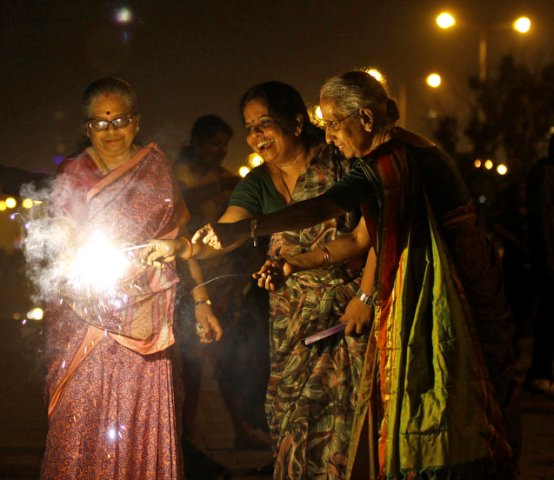
दीप एक जलता रहे / Diwali Poems in Hindi / English
.
पर्व है पुरुषार्थ का,
दीप के दिव्यार्थ का,
देहरी पर दीप एक जलता रहे,
अंधकार से युद्ध यह चलता रहे,
हारेगी हर बार अंधियारे की घोर-कालिमा,
जीतेगी जगमग उजियारे की स्वर्ण-लालिमा,
दीप ही ज्योति का प्रथम तीर्थ है,
कायम रहे इसका अर्थ, वरना व्यर्थ है,
आशीषों की मधुर छांव इसे दे दीजिए,
प्रार्थना-शुभकामना हमारी ले लीजिए!!
झिलमिल रोशनी में निवेदित अविरल शुभकामना
आस्था के आलोक में आदरयुक्त मंगल भावना!!!
. . .
Ashwani Kumar ‘Jatan’
“Pyari Deepawali Hai Aayi”
.
Bachchon khushiyan khoob manaao
rang birange deep jalaao,
dene fir khush haali aai
pyari deepawali hai aayi.
.
Ghar-ghar deep jalaana hai
khoob mithaai khana hai.
pataakhe nahin bajaana hai.
paryavaran ko bachaana hai.
.
Mat karna bachchon manmaani
pataakhon se nahin chhedkhaani.,
sabhi ke cheharon par hai laali
“Jatan” sabhi ko subh Diwali.
. . .
“Praise Laxmi Maa”
.
Goddess of riches,
Granter of health,
Most revered of all gods – Mother Laxmi,
We praise you on this day!
.
Make vanish the darkness,
Spread rays of light,
We are your children, oh Mother –
Bless us all with your boons!
.
Give us strength to conquer what’s evil,
Make us happy and civil,
You on this day killed one mighty devil –
Bestow your grace on us and
Let good prevail!
.
Lord Ram’s wife, Sita, you are,
And Lord Krishna’s great gita,
You – our lighthouse in dark seas,
Only through You will we reach our destination!
. . . . .
Remembrance Day 2012: “War is like a flower…”: poems of War world-wide
Posted: November 11, 2012 Filed under: IMAGES, Louise Glück | Tags: Remembrance Day poems Comments Off on Remembrance Day 2012: “War is like a flower…”: poems of War world-wide
.
Louise Glück
“The Red Poppy”
.
The great thing
is not having
a mind. Feelings:
oh, I have those; they
govern me. I have
a lord in heaven
called the sun, and open
for him, showing him
the fire of my own heart, fire
like his presence.
What could such glory be
if not a heart? Oh my brothers and sisters,
were you like me once, long ago,
before you were human? Did you
permit yourselves
to open once, who would never
open again? Because in truth
I am speaking now
the way you do. I speak
because I am shattered.
. . .
 Zócalo Poets