Kettly Mars: Defiance of Oblivion
Posted: October 26, 2011 Filed under: English, French, Kettly Mars, ZP Translator: Alexander Best | Tags: Black poets Comments Off on Kettly Mars: Defiance of Oblivion ZP_Kettly Mars_2011
Behind the door
.
Sweet sentinel, you keep watch
over the shadows of my room.
This evening my dreams depart
for the north. Toward the sea.
Gentle candle, gentle
flame, under your tears of light
wood, stone, copper and glass
cloaked in golden silence
bathed in the same mystery.
. . .
Derrière la porte
.
Douce sentinelle, tu veilles
sur les ombres de la chambre.
Ce soir mes rêves partent
vers le nord. Vers la mer.
Douce bougie, douce
flamme, sous tes larmes de lumière
bois, pierre, cuivre et verre
enveloppés d’or silencieux
baignent dans le même mystère.
. . .
My hand and the stone
.
My hand and the stone,
sage rebellion of noble particles
gripped in my palm.
I’ve made my own her reality:
grey, heavy, oval.
Millenial stone
whose cry
lays claim to nothing other than a
defiance of oblivion.
. . .
Ma main et la pierre
.
Ma main et la pierre,
sage rébellion de particules
tenant dans ma paume.
J’ai fait mienne sa réalité
grise, lourde et ovale.
Pierre millénaire
jusqu’en son cri
elle ne se prétend autre chose
qu’un défi à l’oubli.
. . . . .
Kettly Mars est née en 1958.
Un romancier à le proue de la littérature haïtienne,
elle est aussi un poète. Les poèmes ici viennent de
son recueil de 2011, Feulements et sanglots.
Traductions: Alexander Best
*
Kettly Mars, born in 1958, is a novelist
at the forefront of Haitian literature.
She is a poet as well, and these poems
are from her 2011 collection, Growls and Sobs.
Translations into English: Alexander Best
Haitian Creole: Five Poets
Posted: October 22, 2011 Filed under: Creole / Kréyòl | Tags: Black poets Comments Off on Haitian Creole: Five Poets
Alexander Akao (Aleksann Akao)
Zombies Arise
Since I was a kid they’ve been choking me
They grab me, they stuff me into a barrel
Too small for me
They stuff me into a dart-gun
They squash me like a mango
They squash me like a banana
They refuse to let me open my mouth
To speak my mind
“You got nothing to say, you’re a kid !”
But when I’m walking I’m looking around
I see everyone at my side
Is in the same fix as me
They’re burying us all alive
They’re stuffing us in the earth
Like slaves locked up in a canefield
When it’s not a horsewhip, papa,
Making us walk a straight line
It’s a tonton macoute* gun
That gestapoes or SDs ** us
But this morning I wake up
With salt on my tongue
Nothing’s gonna stop me from speaking out !
(1980)
* tonton macoute – paramilitary force,
including Duvalier bodyguards, involved in
organized crime; terrorized the Haitian
people, committing many human-rights abuses
** SD – Service d’Information:
Haiti president/dictator Jean-Claude Duvalier’s secret police
_____
Zonbi Leve
Depi m’piti y’ape toufe mwen
Yo pran-m, yo foure-m nan yon barik
Ki twò piti pou mwen
Yo foure-m nan sabakann
Yo toufe-m tankou mango
Yo toufe-m tankou bannann
Yo refize kite-m ouvri bouch mwen
Pou m’eksprime sa mwen panse
“Ou pa gen lapawòl, se timoun ou ye”
Men lè m’mache m’al gade
Mwen wè se tout moun ki sou kote-m
Ki nan menm eta sa-a avè-m
Yo antere-n tou vivan
Yo toufe-n nan tè-a
Tankou esklav te fèmen nan jaden kann
Lè se pa rigwaz papa
Pou fè-m mache SS
Se fizi tonton makout
K’ap gestapo, k’ap SD nou
Men maten-an mwen leve
Ak sèl sou lang mwen
Pa gen anyen ki ka anpeche-m pale !
(1980)
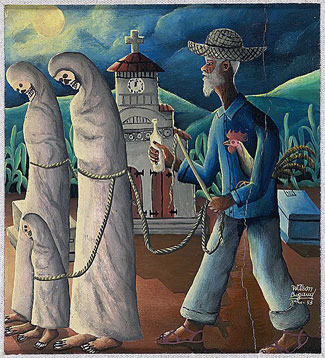 ZP_Wilson Bigaud_”Zonbi”
Suze Baron (Siz Bawon)
They say
They say
human blood
enriches the soil
If it were so
if it were so
my friends
rice millet and corn
would be plenty
in Haiti.
_____
Yo di
Yo di
san kretyen
enrichi
latè
Si sete vre
Si sete vre
mezanmi
ala diri
pitimi
ak mayi
ki ta genyen
lan peyi
d’ Ayiti.
_____
Georges Castera (Jòj Kastra), born 1936
Blood
Let’s go see blood flow,
darling.
For once in a lifetime,
it’s not people’s blood spilling,
for once in the street
it’s not animal’s blood flowing,
let’s go see blood flow,
darling:
the sun is setting.
_____
San
An n’al gade san koule,
cheri
pou yon fwa nan lavi,
se pa san moun k’ap koule,
pou yon fwa nan lari
se pa san bèt k’ap koule,
an n’al gade san koule,
cheri,
se solèy ki pral kouche.
_____
Felix Morisseau-Leroy (Feliks Moriso-Lewa), 1913-1998
Testament
When I die, make me a beautiful wake
I’m going neither to paradise nor to hell
Don’t let a priest speak Latin to my head
When I die, bury me in the yard
Gather all my friends, make a big feast
Don’t go past the church with my corpse
When I die, everyone should really get happy
Laugh, sing, dance, tell jokes
Don’t bawl, yell into my ear
I won’t be completely done when I’m dead
All the places where there were great bashes,
Where people are free – they’ll remember me.

Testaman
Lè m’mouri, fè bèl vèy pou mwen
M’pa pral ni nan paradi ni nan lanfè
Pinga pè pale laten nan tèt mwen.
Lè m’mouri, antere mwen nan lakou-a
Rasanble tout zanmi-m fè bèl fèt
Pinga pase legliz ak kadav mwen
Lè m’mouri, se pou tout moun byen ge
Ri, chante, danse, bay blag
Pinga kriye, rele nan zòrèy mwen
Lè m’mouri, m’pa p’fin ale nèt
tout kote k’ganyen bèl banbòch
Kote nèg lib, fò yo nonmen non mwen.
_____
Nounous (Lenous Surprice), born 1976
If you want
Every time I see you
You always have something
That tickles the crotch of my pants…
If it’s not your breasts
Making “sparks fly”
Before my eyes
It’s your gilded pout
Sticking its tongue out to tease me…
If you want
One day
I can take my time
And sing a mass
Into your daybreak
Every time I cross your path
It seems you purposely
Get my “sleeping cat”,
My “wild horse”, stirred up…
When your hip-swing
Isn’t calling out: “sweets are coming”
To my tray of goodies
It’s your blesséd bonbons
Making my mouth of rainbows
Water…
One day
If you want
I’ll display the musical score
Of my body
On the naked piano of yours.
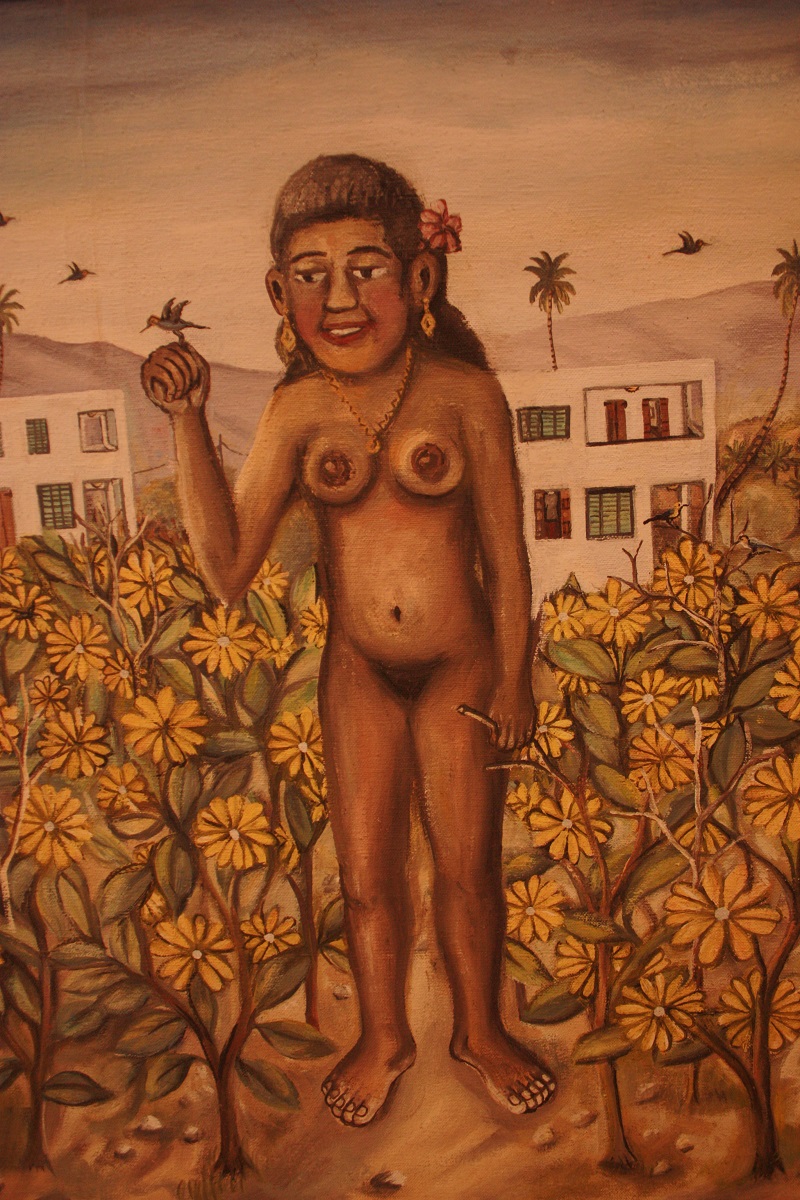 ZP_Wilson Bigaud_”Femmes aux fleurs jaunes”
Si W-Vle
Chak fwa mwen wè-w
Toujou gen youn bagay
Ki pou ap satiyèt gason kanson-m…
Lè se pa tet-w
K’ap fè “tidifevole”
Douvan je-m
Se dyòl dore-w
K’ap fè jwisans mwen filalang…
Si w-vle
Youn jou
M’ka pran tan-m
Pou m’chante lamès
Nan douvanjou-w.
Chak fwa m’kwaze-w
Ou ta di w-fè espre
Pou w-reveye “lechakidò”
Chwal bosal mwen…
Lè se pa deranchman-w
K’ap rele “ladouskivyen”
Pou machann kenèp mwen
Se bonbon beni-w
K’ap fè bouch lakansyèl mwen
Kouri dlo…
Youn jou
Si w-vle
M’a layite nòt mizik
Kò pa-m
Sou pyano toutouni kò pa-w.
_____
Reprinted from:
Open Gate: an Anthology of Haitian Creole Poetry,
edited by Paul Laraque and Jack Hirschman, 2001.
Translations: Jack Hirschman and Boadiba
James Noël: Four poems from “Kana Sutra”
Posted: October 20, 2011 Filed under: English, French, James Noël, ZP Translator: Alexander Best | Tags: Black poets Comments Off on James Noël: Four poems from “Kana Sutra”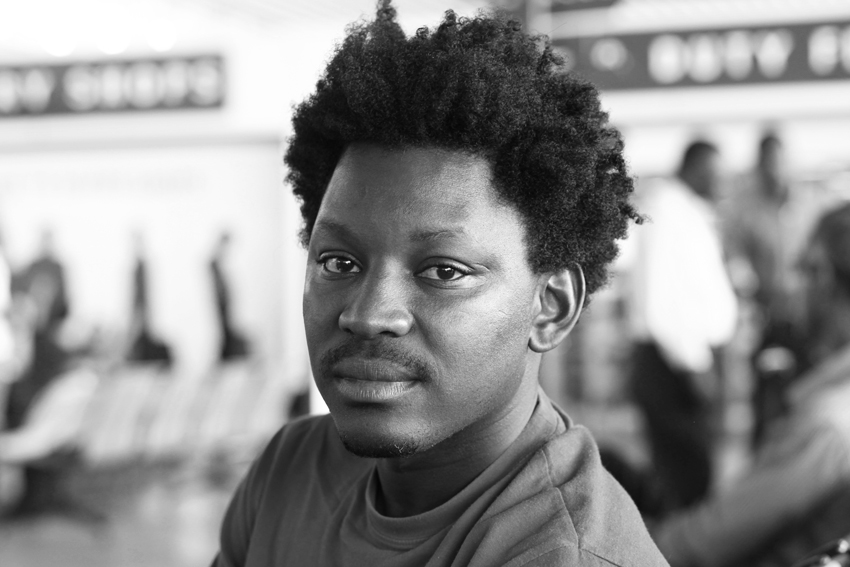 ZP_James Noël in 2011_photographed by Henry Roy
Inside my Cage
.
In me the words
released like parrots
blue-black-red-and-green
hurled like stones
at the sleeper’s roof
inside my private cage
all the illegal words
all the SDF * words
all the words without i.d. or release papers
in me all the words at the margin
which dream of a line
of a better horizon
in me love’s words
words which kiss between two fingers
– the middle and the baby one
words which die wordlessly
lacking hands to touch
or lips to kiss with
in me a word
in me the kamikaze-word of mad love
trapped in a speeding car
heading toward a public climax
.
* Self Defense Force
_____
Cage intérieure
.
En moi le mots
lâchés comme des perroquets
bleus-noirs-rouges-et-verts
lancés comme des pierres
sur le toit du dormeur
dans ma cage intérieure
tous les mots sans-papiers
tous les mots SDF
tous les mots sans-papiers ni cahier
de décharge
en moi tous les mots en marge
qui rêvent d’une ligne
d’un horizon meilleur
en moi les mots’ d’amour
les mots qui baisent entre deux doigts
le majeur el l’auriculaire
et qui crèvent sans mot dire
fate de mains pour toucher
ni de lèvres pour le baiser
en moi un mot
anmwe le mot kamikaze de l”amour fou
allant voiture piégée
vers son orgasme public.
_____
Waltz of the Valises
.
My suitcase pops open in public
i endorse this without saying anything
i’ve packed Death
inside
cash paid in full
childhoods
childhoods
see my waltzing valise
few people in this world
are as open as my valise
in public my suitcase on display
down to the merest details
my made-in-China suitcase
nylon and polyester
my suitcase with its exhibitionist’s soul
down to the least titbits
few people in this world
are as exposed as my valise
now
all my guts are out
all my dirt in disorder
my vices
my nuts and bolts
all my lives
are known
my whole history
within – without
and my poem
inside – outside
known at last
and acknowledged
for the grand importance of
its public uselessness.
_____
Valse des valises
.
Ma valise s’ouvre en public
et j’avalise sans rien dire
j’encaisse la mort
à l’intérieur
rubis sur ongle
enfances
enfances
voyez la valse de ma valise
ma valise est ouverte
peu de gens danse le monde
sont aussi ouverts que ma valise
en public ma valise étalée
dans les moindres détails
ma valise made in China
nylon et polyester
ma valise à l’âme
exhibitionniste
dans les moindres détails
peu de gens dans le monde
sont aussi ouverts que ma valise
maintenant
tous mes boyaux sont dehors
toutes mes ordures en désordre
mes vices
mes écrous
toutes mes vies
sont connues
toute mon histoire
dedans – dehors
et mon poème
dedans – dehors
enfin connu
et reconnu
pour sa grande importance
d’inutilité publique.
_____
Of love and other generalities: an excerpt
.
Certain love poems are to be read at night so that
their effect might be fully felt within the body –
like Japanese green tea, a concoction of datura, or
even a mild drug, a sweet drug that produces the
impression of the city’s dust under a rain.
The best poems often come after a break-up.
That most awful thing about a split is the feeling of
being ditched in the middle of the ocean,
with few choices for somebody who doesn’t know
how to swim.
Only one option has existed up till now: to sink.
_____
De l’amour et autres généralités: un extrait
.
Certains poèmes d’amour sont à lire la nuit
pour que leurs effets soient pleinement ressentis
dans le corps comme un thé vert japonais,
une concoction de datura, ou bien encore une
drogue douce, l’effet d’une drogue douce que
procure la poussière d’une ville sous la pluie.
Les meilleurs poèmes viennent souvent après
une rupture amoureuse. Ce qu’il y a de plus
terrible dans les ruptures, c’est le sentiment
d’être lâché en haute mer, au mauvais moment
par l’autre. Être lâché en haute mer donne peu
d’options à quelqu’un qui ne sait pas nager.
Une seule option demeure jusqu’ à ce jour:
le naufrage.
_____
Two burning candles
.
The day will come, says a man to his belovéd,
when God will intervene with a knife
to slice this onion
which costs our eyes so many tears
and sucks up so much wax
from two burning candles
on their way to dying in the rain
God will come one day
to slice this onion
under our eyes
_____
Deux bougies allumées
.
Un jour viendra , dit l’homme à sa bien-aimée,
un jour viendra
où Dieu fera une intervention au couteau
pour trancher cet oignon
qui coûte tant de larmes à nos pupilles
et pompe tant de cire
à nos deux bougies allumées
en passe de mourir sous la pluie
Dieu viendra un jour
trancher cet oignon sous nos yeux.
_____
Poet and writer James Noël was born in
Haiti in 1978. These poems are from his
2011 collection, Kana Sutra.
Translation from the original French:
Alexander Best
*
Né en Haïti en 1978, James Noël est
un poète et écrivain. Les poèmes ici
viennent de son recueil 2011, Kana Sutra.
Traduction en anglais: Alexander Best
Michèle Voltaire Marcelin: “Quicksand words”
Posted: October 15, 2011 Filed under: English, French, Michèle Voltaire Marcelin, ZP Translator: Alexander Best | Tags: Black poets Comments Off on Michèle Voltaire Marcelin: “Quicksand words” ZP_painting by Michèle Voltaire Marcelin
Michèle Voltaire Marcelin:
And there comes
the time of the Poem
.
The afternoon blazes through the window
at siesta hour
It is forbidden to speak to the poet
do not disturb
because
I’m making love to words
here behind the door
in my bed
One must not disturb the poet
there’s no response from the number you just dialed
momentarily I’ve removed myself from this world
put misery off to one side
it’s the time to say to myself
kick the door shut and
take your pleasure
Talking to the poet’s not allowed
until the month of August
because je suis in bed
with words
feetless, headless words
words that dog-howl at the moon
quivering-iguana words dazzled by roses
bad-luck words like roof tiles that bonk me on the head
because I don’t know how to put on an act
quicksand words
words like crucifixion nails
and an Easter brought back to life
words of flagellation upon naked thighs
promised-land words
Place de l’Opéra words
or of Place Saint-Pierre
or words of whichever Place you’d like
between Brooklyn and Africa
It’s forbidden to disturb the poet
I’m not there for anyone
when words are running ’round in my head
and walking through my blood
just three little turns more and then they’ll take off
– wait till the end of summer and
it’s just the time, the weather’s right,
to place a poem, to set a poem off, in the street.
. . .
Il fait un temps de poème
.
L’après-midi flambe à travers la fenêtre
à l’heure de la sieste
il est interdit de parler au poète
do not disturb
because
je fais l’amour avec des mots
derrière la porte
et dans mon lit
il ne faut pas déranger le poète
il n’y a pas de réponse au numéro que vous avez composé
je m’absente du monde momentanément
je laisse la misère de côté
le temps de me dire
pousse la porte du pied
prends ton pied
il est interdit de parler au poète
jusqu’ au mois d’août
because je suis in the bed
avec des mots
des mots sans pieds ni tête
des mots aboiements de lune aux chiens
des mots frissons d’iguanes éblouis par des roses
des mots tuiles qui me tombent sur la tête
car je na sais pas jouer la comédie
des mots sables mouvants
des mots clous de crucifixion
et de Pâques ressuscitées
des mots flagellations sur des cuisses dénudées
des mots promissions
des mots Place de l’Opéra
ou Place Saint-Pierre
ou Place où tu voudras
between Brooklyn and Africa
il est interdit de disturb le poète
je n’y suis pour personne
quand les mots courent dans ma tête
et marchent dans mon sang
trois petits tours et puis s’en vont
attendez la fin de l’été
il fait un temps à mettre un poème à la rue.
. . .
My heart
.
My heart’s “in use” so much and so often, that
rust never settles there.
Each time the lock’s got to be changed, because
it’s always my previous lover who keeps the key.
. . .
Mon coeur
.
Mon coeur sert tant et si souvent
que la rouille ne s’y installe pas
Il faut à chaque fois y changer la serrure
Le dernier amant garde toujours la clef.
. . . . .
Michèle Voltaire Marcelin is from Port-au-Prince,
Haiti. She was born in 1955.
She is both poet and painter and has been called
a “disenchanted enchantress” (editor Bruno Doucey).
Poem translations into English: Alexander Best
French originals: Éditions Bruno Doucey
*
Michèle Voltaire Marcelin, née à Port-au-Prince, Haiti,
en 1955, est une poétesse et peintre, aussi une
“désenchantée enchanteresse” (éditeur Bruno Doucey).
Traductions: Alexander Best
Un Sueño Diferido: Langston Hughes
Posted: September 26, 2011 Filed under: English, Langston Hughes, Spanish | Tags: Black poets Comments Off on Un Sueño Diferido: Langston Hughes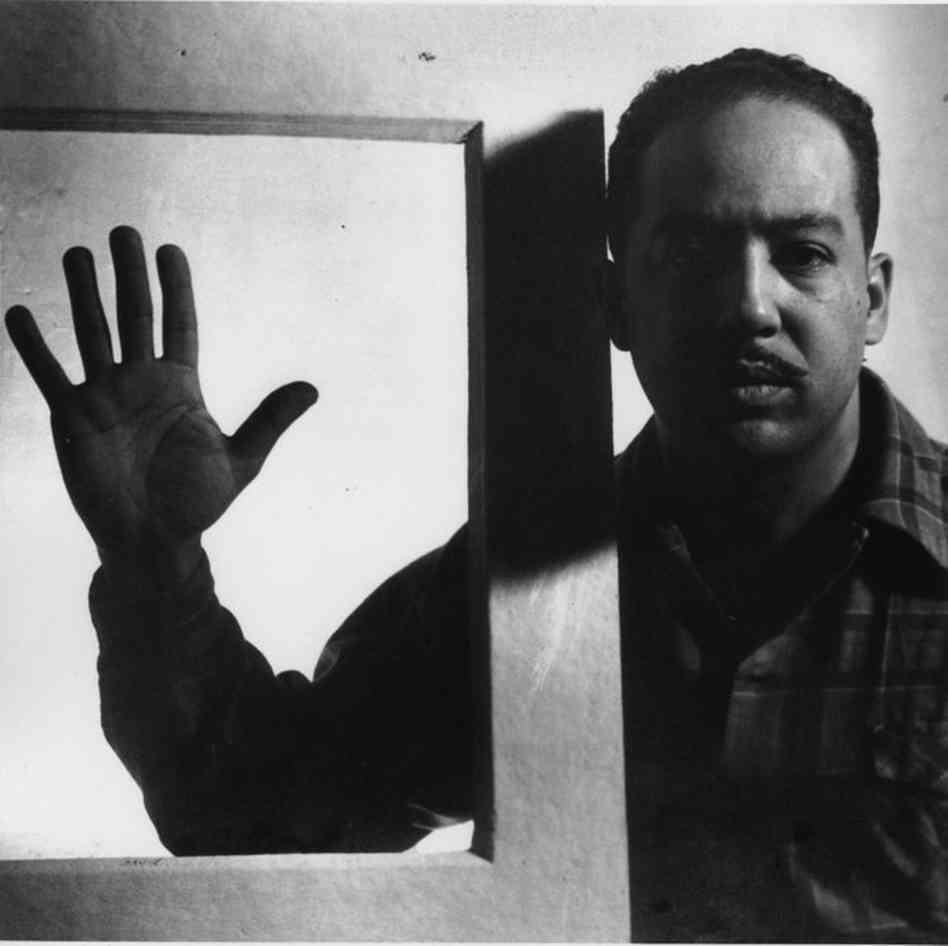
A Dream Deferred
.
What happens to a dream deferred ?
Does it dry up
Like a raisin in the sun ?
Or fester like a sore –
And then run?
Does it stink like rotten meat ?
Or crust and sugar over –
Like a syrupy sweet?
Maybe it just sags
Like a heavy load.
Or does it explode ?
*
Un Sueño Diferido
.
¿Qué pasa de un sueño diferido?
¿Se marchita
como una pasa en el sol?
¿O se encona como una llaga –
y entonces corre?
¿Apesta como carne putrida?
¿O endurece y se vuelve dulce –
como un postre con jarabe?
Tal vez solo se hunda
como una carga pesada.
¿O explota?
_____
Gracias al Super Forero de Sevilla, España,
por su traducción al español
_____
Langston Hughes (1902-1967) was a Black-American
poet and novelist at the forefront of The Harlem
Renaissance. Born in the small town of Joplin, Missouri,
he would later capture in his poems the vibrancy of his
adopted home – New York City.
Written in 1951, the minute-long “A Dream Deferred”
is perhaps the most famous American poem of the
20th century.
_____
Langston Hughes (1902-1967) fue un novelista y
poeta Negro, de Los Estados Unidos.
Nació en el pueblo pequeño de
Joplin, Missouri, pero Hughes se hizo en la vanguardia
del Renacimiento de Harlem. Abarcan sus poemas la
vitalidad y la urgencia de su ciudad adoptiva
– Nueva York.
“Un Sueño Diferido” (escrito en 1951) es, quizás,
el poema de Los Estados Unidos el más famoso del siglo XX.
“Soledad” por Robert Hayden
Posted: September 26, 2011 Filed under: English, Robert Hayden, Spanish | Tags: Black poets Comments Off on “Soledad” por Robert Hayden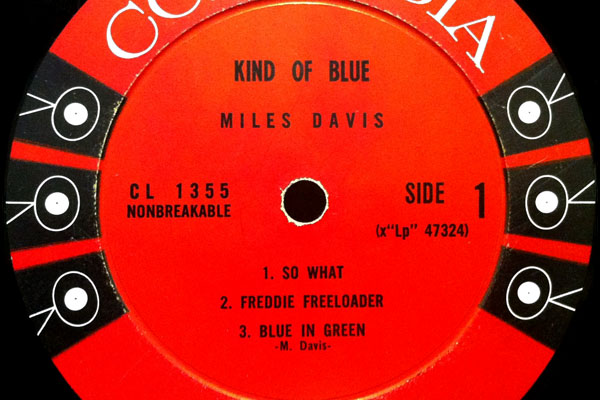
Robert Hayden
“Soledad”
.
Naked he lies in the blinded room,
chain-smoking, cradled by drugs, by jazz,
as never by any lover’s cradling flesh.
Miles Davis coolly blows for him,
oh pena negra *, sensual flamenco blues!
The redclay foxfire voice of Lady Day,
Lady of the pure black magnolias,
sobsings her sorrow and loss and fare ye well,
dryweeps the pain his treacherous jailors have
released him from for a while.
His fears and his unfinished self await him
down in the anywhere streets.
He hides on the dark side of the moon,
takes refuge in a stainedglass cell,
flees to a caulkless country of crystal.
Only the ghost of Lady Day
knows where he is, only the music, and he
swings those swings beyond
complete immortal now.
.
* pena negra – black sorrow/struggle
. . .
Robert Hayden
“Soledad”
.
Él, desnudo, está tendido en el cuarto con persianas,
fumando cigarillos, uno tras otro, acunado por la droga,
por el Jazz, como nunca por la piel de ningún amante.
Miles Davis* “toca” frescamente por él, ¡ay, pena negra, el
blues flamenco-sensual!
La voz arcilla-rojo – fuego-zorro, de Lady Day**,
Dama de las magnolias puras-negras,
solloza-canta su dolor y pérdida y
¡qué-será-será/hasta-luego!,
seca-llora la pena de cuál cosa
él está liberado por sus carceleros traicioneros.
Sus miedos y su ser incompleto
le esperan bajo en las calles de alguna parte.
Se esconde en el lado oscuro de la luna,
busca un refugio en una celda de cristal de colores,
huye a un país cristalino.
Solo sabe donde él está el espíritu de Lady Day,
solo sabe la música, y él
columpia el columpio,
danza el “swing”
más allá de
Ahora inmortal-total.
.
* Miles Davis: Trompetista negro-americano del jazz “cool”
** Lady Day: Billie Holiday – Cantante negra-americana del jazz, blues y pop
Traducción al español: Alexander Best
_____
Robert Hayden (1913-1980) was a Black-American poet
born in Detroit. His first book, Heart-Shape in the Dust,
from 1940, is based on life in the “Paradise Valley” slum.
In 1944 he joined Fisk College where he taught for more
than twenty years as professor of English, followed by
a decade at University of Michigan.
Hayden’s 1971 poem, “Soledad” (Loneliness, Solitude), is
about a friend – and drug addiction.
Frederick Ward – on Africville
Posted: September 25, 2011 Filed under: English: Black Canadian / American, Frederick Ward | Tags: Black poets Comments Off on Frederick Ward – on Africville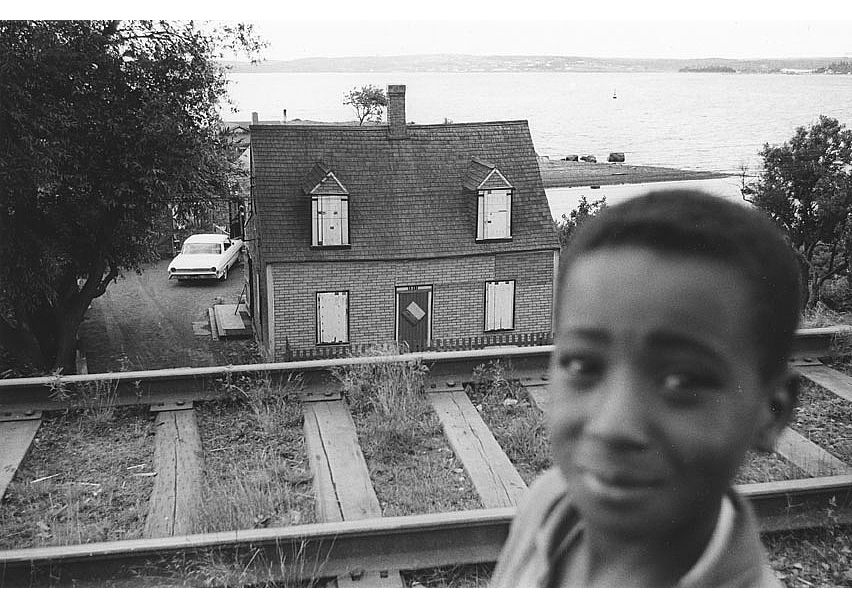
Dialogue # 3: Old Man (to the Squatter)
.
– Listen here, son. Did you think this were gonna work ?
Were you fool enough to think this were gonna work ?
They ain’t gonna let us put nothing up like that and
leave it. They don’t intend to let us git it back. You
ain’t a place. Africville is us. When we go to git a
job, what they ask us ? Where we from … and if we say
we from Africville, we are Africville ! And we don’t git
no job. It ain’t no place, son. It were their purpose to
git rid of us and you believed they done it – could do it !
You think they destroyed something. They ain’t. They
took away the place. But it come’d round, though. Now that
culture come’d round. They don’t just go out there and
find anybody to talk about Africville, they run find us,
show us off – them that’ll still talk, cause we Africville.
NOT – NO – SHACK – ON – NO – KNOLL.
That ain’t the purpose …fer
whilst your edifice is forgone destroyed, its splinters
will cry out: We still here ! Think on it, son. You effort
will infix hope in the heart of every peoples. Yet,
let’s see this thing clearer. If our folk see you in the
suit, we may git the idea we can wear it. The suit might
fall apart, but, son, it be of no notice. We need the
example. Now go back …and put you dwelling up again.
_____
Frederick Ward has been described as “the most
undeservedly unsung poet in all of English-Canadian
literature” (Arc Poetry Magazine).
Born in 1937 in Kansas City, Missouri, the Black-American Ward
came to Canada in 1970 – just passing through Halifax – and
ended up staying. There he me met Black Nova Scotians recently
turfed out of their old community – Africville – which was
bulldozed by the city to make way for a dumpsite. Their stories
became the basis of his 1974 novel, Riverlisp: Black Memories.
The poem above is from Ward’s 1983 poetry collection,
The Curing Berry.
Ward now lives in Montreal where he is a theatre teacher at
Dawson College.
_____
Photograph: Young boy with, in the background, Ralph Jones’ house boarded up for demolition
(Africville, Halifax, Nova Scotia, Canada – photo by Bob Brooks – year: 1965)
Dionne Brand: “ Hard against the Soul ”
Posted: August 31, 2011 Filed under: Dionne Brand, English | Tags: Black poets Comments Off on Dionne Brand: “ Hard against the Soul ”_____
I saw this woman once in another poem, sitting,
throwing water over her head on the rind of a country
beach as she turned toward her century. Seeing her
no part of me was comfortable with itself. I envied her,
so old and set aside, a certain habit washed from her
eyes. I must have recognized her. I know I watched
her along the rim of the surf promising myself, an old
woman is free. In my nerves something there
unraveling, and she was a place to go, believe me,
against gales of masculinity but in that then, she was
masculine, old woman, old bird squinting at the
water’s wing above her head, swearing under her
breath. I had a mind that she would be graceful in me
and she might have been if I had not heard you
laughing in another tense and lifted my head from her
dry charm.
*
You ripped the world open for me. Someone said this
is your first lover you will never want to leave her. My
lips cannot say old woman darkening anymore, she
is the peace of another life that didn’t happen and
couldn’t happen in my flesh and wasn’t peace but
flight into old woman, prayer, to the saints of my
ancestry, the gourd and bucket carrying women who
stroke their breast into stone shedding offspring and
smile. I know since that an old woman, darkening,
cuts herself away limb from limb, sucks herself white,
running, skin torn and raw like a ball of bright light,
flying, into old woman. I only know now that my
longing for this old woman was longing to leave the
prisoned gaze of men.
_____
Dionne Brand was born in Trinidad in 1953
and graduated from University of Toronto in 1975.
She is black, lesbian, feminist – three powerful things.
Toronto’s Poet Laureate, she is also the 2011 winner of
The Griffin Poetry Prize for her long poem Ossuaries.
The companion poems above are excerpted from
Brand’s series “Hard against the Soul”, part of
her collection, No Language is Neutral
© 1990, Dionne Brand.
M. NourbeSe Philip: “Meditations on the Declension of Beauty by the Girl with the Flying Cheek-bones”
Posted: August 21, 2011 Filed under: English, M. NourbeSe Philip, Spanish | Tags: Black poets Comments Off on M. NourbeSe Philip: “Meditations on the Declension of Beauty by the Girl with the Flying Cheek-bones”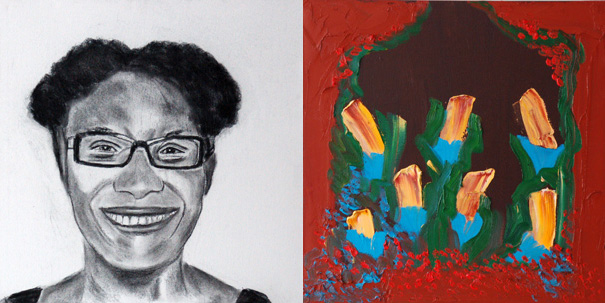 ZP_M. NourbeSe Philip_by Robin Pacific
M. NourbeSe Philip
.
“Meditations on the Declension of Beauty
by the Girl with the Flying Cheek-bones”
.
If not If not If
Not
If not in yours
_____ In whose
In whose language
Am I
If not in yours
_____ In whose
In whose language
Am I I am
_____ If not in yours
In whose
_____ Am I
(if not in yours)
_____ I am yours
In whose language
_____ Am I not
Am I not I am yours
If not in yours
If not in yours
_____ In whose
In whose language
_____ Am I …
Girl with the flying cheek-bones:
She is
I am
Woman with the behind that drives men mad
And if not in yours
Where is the woman with a nose broad
As her strength
If not in yours
In whose language
Is the man with the full-moon lips
Carrying the midnight of colour
Split by the stars – a smile
If not in yours
_____ In whose
In whose language
_____ Am I
_____ Am I not
_____ Am I I am yours
_____ Am I not I am yours
_____ Am I I am
If not in yours
_____ In whose
In whose language
_____ Am I
If not in yours
_____ Beautiful
. . .
This poem is taken from Marlene Nourbese Philip’s poetry collection,
She Tries Her Tongue – Her Silence Softly Breaks (© 1989, M. NourbeSe Philip).
In the preface she writes: ” In the absence of any other language by which the past
may be repossessed, reclaimed and its most painful aspects transcended,
English in its broadest spectrum must be made to do the job. ”
” Broadest spectrum ” includes the richly creative Caribbean dialects. And:
” The language as we know it has to be dislocated and acted upon – even destroyed –
so that it begins to serve our purposes. It is our only language, and while it is
our mother tongue, ours is also a father tongue. ”
Philip, born in Trinidad in 1947, has lived in Toronto for decades where she has been
essayist, poet and antiracism activist.
. . .
The following is a translation of the poem into Spanish:
“Meditaciones sobre la Declinación de la Belleza
por la Muchacha de los Pómulos altos”
.
Si no Si no Si
No
¿Si no en el lenguaje de usted
– en su lenguaje –
entonces, en lo de quién?
Soy yo
Si no en suyo
En lo de quién
En el lenguaje de quién
Soy yo Soy
Si no en suyo
En lo de quién
Soy yo
(si no en suyo)
Soy suya
En el lenguaje de quién
No soy
No soy, Soy suya
Si no en suyo
Si no en suyo
En lo de quién
En el lenguaje de quién
Soy…
La Muchacha de pómulos altos:
Ella es
Yo soy
Mujer del trasero que vuelve locos a los hombres
Y si no en suyo
¿Dónde está la Mujer de nariz ancha
– ancha como su fuerza?
Si no en suyo
En el lenguaje de quién
¿Está el Hombre de labios como la luna llena
Llevando la medianoche de Color
Reventada por las estrellas – una sonrisa?
En lo de quién
En el lenguaje de quién
Soy
No soy
Soy Soy suya
Soy Soy
Si no en suyo
En lo de quién
En el lenguaje de quién
Soy
Si no en suyo
Bella
. . .
Traducción del inglés al español /
Translation from English into Spanish: Alexander Best
 Zócalo Poets