Lewis Carroll: A Song of Love / Canción de Amor
Posted: April 20, 2014 Filed under: A FEW FAVOURITES / UNA MUESTRA DE FAVORITOS, English, Lewis Carroll, Lewis Carroll: Canción de Amor / A Song of Love, Spanish, ZP Translator: Alexander Best | Tags: Easter Sunday poems, Poemas para Domingo de Pascua Comments Off on Lewis Carroll: A Song of Love / Canción de Amor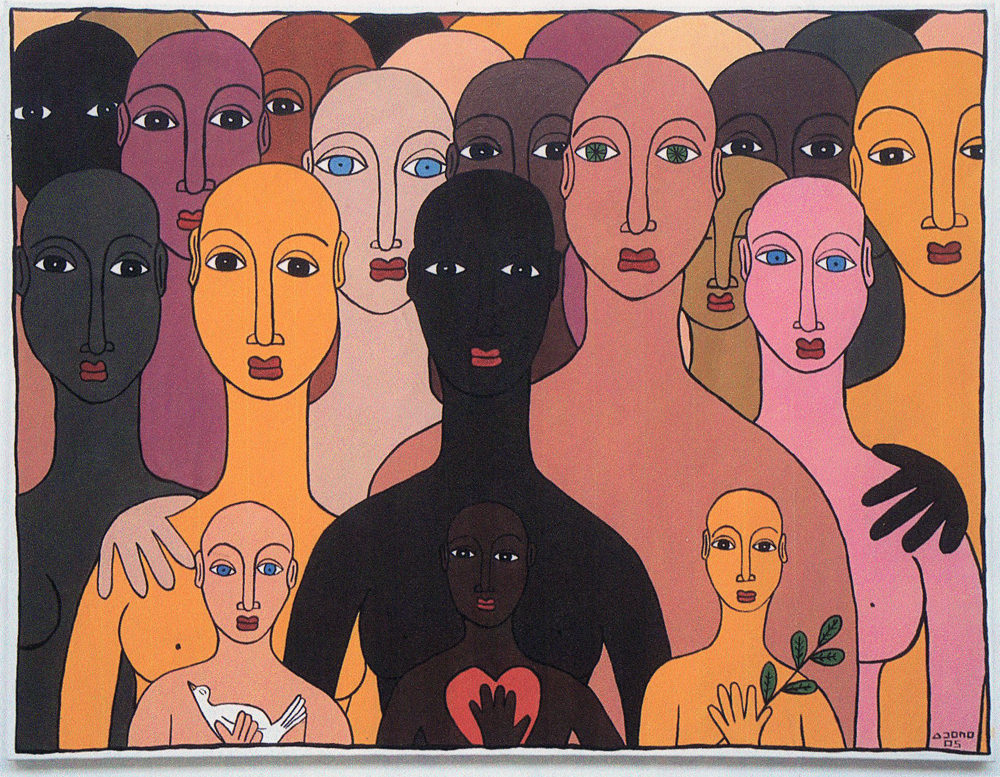
Un Mundo Mejor_derechos de autor Marie Sabal- Lecco, artista de Camerún_Un Monde Meilleur_droit dauteur Marie Sabal- Lecco, artiste camerounais_A Better World_ copyright Cameroonian artist Marie Sabal-Lecco
John 13: 34
A new commandment I give unto you: That ye love one another. As I have loved you, so ye also are to love one another.
Lewis Carroll (1832-1898)
A Song of Love
.
Say, what is the spell, when her fledglings are cheeping,
That lures the bird home to her nest?
Or wakes the tired mother, whose infant is weeping,
To cuddle and croon it to rest?
What the magic that charms the glad babe in her arms,
Till it coos with the voice of a dove?
‘Tis a secret, and so let us whisper it low
– And the name of the secret is Love.
For I think it is Love,
For I feel it is Love,
For I’m sure it is nothing but Love.
.
Say, whence is the voice that when anger is burning,
Bids the whirl of the tempest to cease?
That stirs the vexed soul with an aching – a yearning
For the brotherly hand-grip of peace?
Whence the music that fills all our being – that thrills
Around us, beneath, and above?
‘Tis a secret: none knows how it comes, or it goes
– But the name of the secret is Love.
For I think it is Love,
For I feel it is Love,
For I’m sure it is nothing but Love.
.
Say, whose is the skill that paints valley and hill,
Like a picture so fair to the sight?
That flecks the green meadow with sunshine and shadow,
Till the little lambs leap with delight?
‘Tis a secret untold to hearts cruel and cold,
Though ’tis sung by the angels above,
In notes that ring clear for the ears that can hear
– And the name of the secret is Love.
For I think it is Love,
For I feel it is Love,
For I’m sure it is nothing but Love.
. . .
Juan 13: 34
Un mandamiento nuevo os doy: Que os améis unos a otros; como yo os he amado, que también os améis unos a otros.
Canción de Amor
.
Dîgame, ¿qué es la magia que atrae a su nido
el pájaro cuando están piando sus polluelos?
¿O lo que puede despertar a la madre soñolienta
para canturrear y acurrucarse a su bebé que llora?
¿Cuál es el encanto que fascina el niño contento en sus brazos
hasta que arrulla con la voz de una paloma?
Es un secreto, pues cuchicheémoslo en voz baja
– Y el nombre del secreto es Amor.
Porque pienso es Amor,
Me siento que es el Amor,
si, ‘stoy seguro que ES el Amor.
.
Dígame, ¿de dónde llega esa voz cuando quema el enojo,
ella que ordena cesar el tumulto del torbellino?
¿O qué conmueve el alma exaltada con un anhelo
por la mano fraternal de la Paz?
¿De dónde llega la música que llena todo nuestro ser –
que nos anima, alrededor, abajo y arriba?
Es un secreto, y nadie no entiende como llega o va
– Pero su nombre-secreto: Amor.
Porque pienso es Amor,
Me siento que es el Amor,
si, ‘stoy seguro que ES el Amor.
.
Dígame, ¿de quién viene esa habilidad que pinta valle y colina,
como un dibujo tan hermoso mirar?
¿Qué motea el campo con sol y con sombra,
hasta que los corderos saltan con deleite?
Es un secreto no dicho a los corazones fríos,
aunque está cantado por los angeles arriba,
con notas cristalinos para los oídos que pueden oírlas
– Y el nombre del secreto es Amor.
Porque pienso es Amor,
Me siento que es el Amor,
si, ‘stoy seguro que ES el Amor.
. . .
Marie Sabal-Lecco, the Paris-based Cameroonian artist whose work is featured above, tells us: “Je représente sur mes toiles un éternel message de paix, de tolérance, du vivre ensemble, du respect de l’autre, de l’amour. Bonnes fêtes de Pâques!” (I represent in my canvasses an eternal message of peace, tolerance, of living together, of respect for one another, of love. A Happy Easter to you!)
Marie Sabal-Lecco, un artista de Camerún que vive en París – (su pintura está arriba) – nos dice: “Quiero mostrar en mis lienzos el mensaje eternal de la Paz, de la tolerancia, de vivir juntos, del respeto del uno al otro, y del Amor. ¡Feliz Pascua!”
. . . . .
Poemas para Domingo de Pascua: Emily Dickinson: No es La Conclusión este Mundo / This World is not Conclusion + Octavio Paz: Hermandad / Brotherhood
Posted: April 20, 2014 Filed under: Emily Dickinson, English, Octavio Paz, Spanish, ZP Translator: Alexander Best | Tags: Easter Sunday poems, Poemas para Domingo de Pascua Comments Off on Poemas para Domingo de Pascua: Emily Dickinson: No es La Conclusión este Mundo / This World is not Conclusion + Octavio Paz: Hermandad / Brotherhood
Emily Dickinson (1830-1886)
This World is not Conclusion
.
This World is not Conclusion.
A Species stands beyond—
Invisible, as Music—
But positive, as Sound—
It beckons, and it baffles—
Philosophy—don’t know—
And through a Riddle, at the last—
Sagacity, must go—
To guess it, puzzles scholars—
To gain it, Men have borne
Contempt of Generations
And Crucifixion, shown—
Faith slips—and laughs, and rallies—
Blushes, if any see—
Plucks at a twig of Evidence—
And asks a Vane, the way—
Much Gesture, from the Pulpit—
Strong Hallelujahs roll—
Narcotics cannot still the Tooth
That nibbles at the soul—
. . .
No es La Conclusión este Mundo (Traducción del inglés: Alexander Best)
.
No es La Conclusión este Mundo;
Un Especie se ubica más allá de aquí;
Como la Música, invisible,
Pero positivo como Sonido.
Atrae y confunde,
La Ética no lo entiende;
Y por Enigma, y al fin,
Debe cruzar la Sagacidad.
.
Advinarlo deja perplejo los sabios,
Ganarlo hay Hombres que han soportado
El Desprecio de Generaciones
– Y Crucifixión.
Fe resbala – y ríe y se reanima –
Y se sonroja (si alguien le mire);
Arranca una ramita de Inicio,
Y pregunta de una Veleta el camino.
Mucho Gesto del Púlpito,
Surgen Aleluyas fuertes;
Narcóticos no pueden calmar el Diente
Que mordisquea el Alma.

Octavio Paz (1914-1998)
Hermandad: Homenaje a Claudio Ptolomeo
.
Soy hombre: duro poco
y es enorme la noche.
Pero miro hacia arriba:
las estrellas escriben.
Sin entender comprendo:
también soy escritura
y en este mismo instante
alguien me deletrea.
. . .
Brotherhood: an homage to Claudius Ptolemy
(translated from Spanish by Eliot Weinberger)
.
I am a man: little do I last
and the night is enormous.
But I look up:
the stars write.
Unknowing I understand:
I too am written,
and at this very moment
someone spells me out.
. . . . .
Poemas para Domingo de Pascua: E.E. Cummings, Arthur Stringer / Poems for Easter Sunday
Posted: April 20, 2014 Filed under: Arthur Stringer, E.E. Cummings, English, Spanish, ZP Translator: Alexander Best | Tags: Easter Sunday poems, Poemas para Domingo de Pascua Comments Off on Poemas para Domingo de Pascua: E.E. Cummings, Arthur Stringer / Poems for Easter Sunday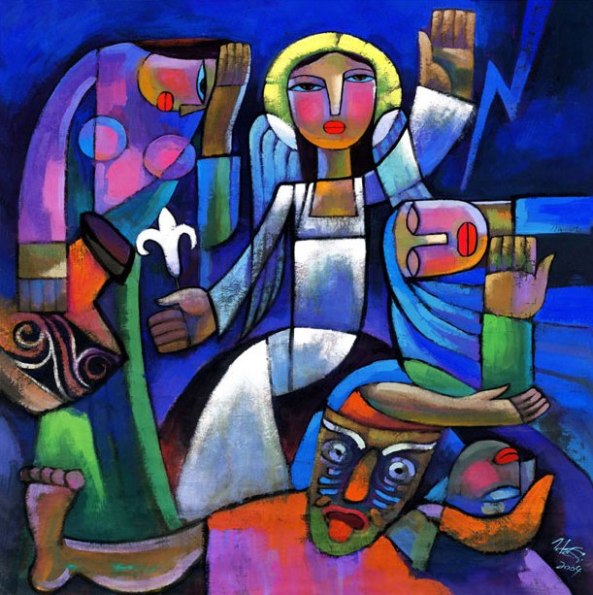
E.E. Cummings (1894-1962)
i thank you God for most this amazing
.
i thank you God for most this amazing
day: for the leaping greenly spirits of trees
and a blue true dream of sky; and for everything
which is natural which is infinite which is yes
.
(i who have died am alive again today,
and this is the sun’s birthday; this is the birth
day of life and of love and wings: and of the gay
great happening illimitably earth)
.
how should tasting touching hearing seeing
breathing any – lifted from the no
of all nothing – human merely being
doubt unimaginable You?
.
(now the ears of my ears awake and
now the eyes of my eyes are opened)
. . .
te agradezco Dios por el más esta asombrosa
.
te agradezco Dios por el más esta asombrosa
mañana: por los brincandos verde-deramente espíritus de árboles
y un azul auténtico sueño de cielo; y por todo
lo que es natural que es infinito que es sí
.
(yo que he muerto estoy viviendo de nuevo hoy,
y ésto es el aniversario del sol; ésto es el nacimiento
día de la vida y del amor y de alas: y de la tierra
alegre-grande-ocurriendo-sin límites)
.
¿cómo es posible que tocando-oyendo-viendo
respirando alguien – elevado del no
del todo-nada – simplemente ser humano
dude Tú el inimaginable?
.
(ahora los oídos de mis oídos se despiertan y
ahora los ojos de mis ojos están abiertos)
. . .
Arthur Stringer (1874-1950)
The Final Lesson
.
I have sought Beauty through the dust of strife,
I have sought Meaning for the ancient ache,
And Music in the grinding wheels of Life;
Long have I sought, and little found as yet
Beyond this truth: that Love alone can make
Earth beautiful, and Life without regret.
. . .
La lección final
.
He buscado la Belleza por el polvo de lucha,
He buscado Significado por el anhelo antiguo,
Y Música en las ruedas que giran de la Vida;
Largo tiempo he estado buscando – y poco he descubierto hasta ahora
Excepto esta verdad: que sólo el Amor puede hacer bella
La Tierra – y una Vida sin arrepentimiento.
.
Image: He Qi is a contemporary painter of religious themes. Here a triumphant angel announces that Our Redeemer Liveth. The women are not especially awake yet, and seem unaware of what has happened. They still mourn, but the angel tells them that the time of grief is over. Instead of a military-style banner often held by Christ in such triumphal depictions, He Qi has his angel bearing a luminous lily – symbol of purity and peace.
. . . . .
Badr Shakir al-Sayyab: The Messiah after The Crucifixion
Posted: April 20, 2014 Filed under: Badr Shakir al-Sayyab, English | Tags: Easter poems Comments Off on Badr Shakir al-Sayyab: The Messiah after The Crucifixion
Badr Shakir al-Sayyab (Iraqi “modernist” poet, 1926-1964)
The Messiah after The Crucifixion
(translated from Arabic by B.M. Bennani)
.
After I was brought down, I heard the winds
Whip the palm trees with wild laments;
Footsteps receded into infinity. Wounds
And the cross I was nailed to all afternoon
Didn’t kill me. I listened. A cry of grief
Crossed the plain between me and the city
Like a hawser pulling a ship
Destined to sink. The cry
Was a thread of light between morning
And night in a sad winter sky.
Despite all this, the city fell asleep.
.
When the orange and mulberry trees bloom,
When my village Jaykour reaches the limits of fantasy,
When grass grows green and sings with fragrance
And the sun suckles it with brilliance,
When even darkness grows green,
Warmth touches my heart and my blood flows into earth.
My heart becomes sun, when sun throbs with light,
My heart becomes earth, throbbing with wheat, blossom
and sweet water.
My heart is water, an ear of corn,
Its death is resurrection. It lives in him who eats
The dough, round as a little breast, life’s breast.
I died by fire. When I burned, the darkness of my clay
disappeared. Only God remained.
I was the beginning, and in the beginning was poverty.
I died so bread would be eaten in my name
So I would be sown in season.
.
Many are the lives I’ll live. In every soil
I’ll become a future, a seed, a generation of men
A drop of blood, or more, in every man’s heart.
Then I returned. When Judas saw me he turned pale:
I was his secret!
He was a shadow of mine, grown dark,
The frozen image of an idea
From which life was plucked.
He feared I might reveal death in his eyes
(his eyes were a rock
behind which he hid his death).
He feared my warmth. It was a threat to him
so he betrayed it.
“Is this you? Or is it my shadow grown white,
emitting light?
Men die only once! That’s what our fathers said.
That’s what they taught us. Or was it a lie?!”
That’s what he said when he saw me. His whole face spoke.
I hear footsteps, approaching and falling.
The tomb rumbles with their fall
Have they come again? Who else could it be?
Their falling footsteps follow me.
They lay rocks on my chest.
Didn’t they crucify me yesterday? Yet here I am!
Who could know that I . . . ? Who?
And as for Judas and his friends, no one will believe them.
Their footsteps follow me and fall.
Here I am now, naked in my dank tomb
Yesterday I curled up like a thought, a bud,
Beneath my shroud of snow. My blood bloomed from moisture.
I was then a thin shadow between night and day.
When I burst my soul into treasures and peeled it like fruit.
When I turned my pockets into swaddling clothes
and my sleeves into a cover,
When I kept the bones of little children
warm within my flesh
And stripped my wounds to dress the wound of another,
The wall between me and God disappeared.
.
The soldiers surprised even my wounds and my heartbeats.
They surprised all that wasn’t dead,
even if it was a tomb.
They took me by surprise the way a flock of starving birds
pluck the fruit of a palm tree in a deserted village.
The rifles are pointed and have eyes
with which they devour my road.
Their fire dreams of my crucifixion.
Their eyes are made of fire and iron.
The eyes of my people are a light in the skies;
they shine with memory and love.
The rifles relieve me of my burden;
my cross grows moist.
How small such death is! My death. And yet how great!
.
After I was nailed to the cross, I cast my eyes
toward the city; I could hardly recognize the plain, the wall, the cemetery.
Something, as far as my eyes could see, sprung forth
Like a forest in bloom.
Everywhere there was a cross and a mourning mother.
Blessed be the Lord!
Such are the pains of a city in labour, about to give birth.
.
Image: a painting by Guity Novin: artist, poet and translator. Visit her site: artreact.blogspot
. . . . .
John Updike: Seven Stanzas at Easter
Posted: April 20, 2014 Filed under: English, John Updike | Tags: Easter poems Comments Off on John Updike: Seven Stanzas at Easter
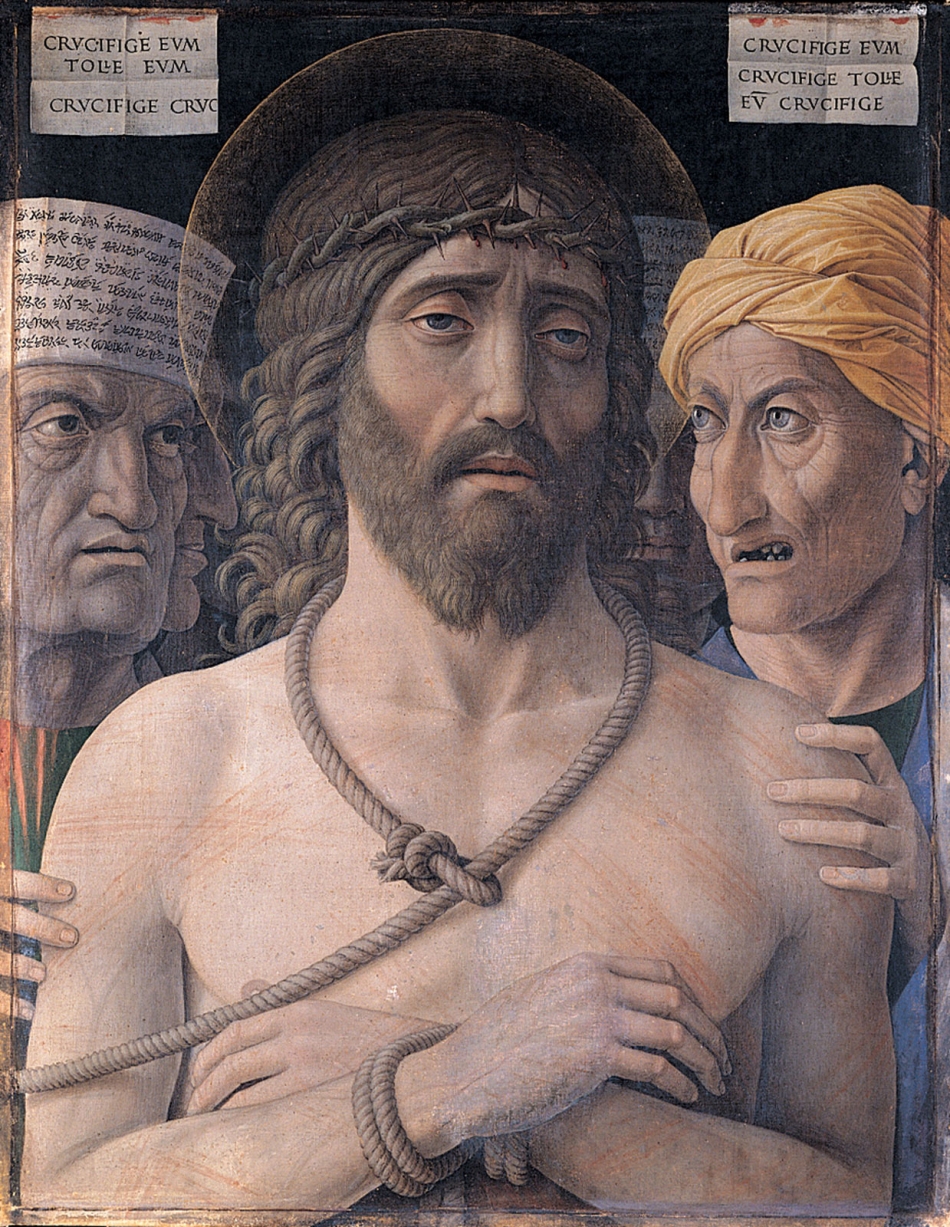
Andrea Mantegna_Ecce Homo, painted around 1500_Ecce Homo are the Latin words “Behold this man” spoken by Pontius Pilate in John chapter 19, verse 5, when he presents a scourged Jesus to the hostile crowd just before His Crucifixion.
John Updike (1926-2009)
Seven Stanzas at Easter (1960)
.
Make no mistake: if He rose at all
it was as His body;
if the cells’ dissolution did not reverse, the molecules
reknit, the amino acids rekindle,
the Church will fall.
.
It was not as the flowers,
each soft Spring recurrent;
it was not as His Spirit in the mouths and fuddled
eyes of the eleven apostles;
it was as His flesh: ours.
.
The same hinged thumbs and toes,
the same valved heart
that – pierced – died, withered, paused, and then
regathered out of enduring Might
new strength to enclose.
.
Let us not mock God with metaphor,
analogy, sidestepping, transcendence:
making of the event a parable, a sign painted in the
faded credulity of earlier ages:
let us walk through the door.
.
The stone is rolled back, not papier-mâché,
not a stone in a story,
but the vast rock of materiality that in the slow,
grinding of time will eclipse for each of us
the wide light of day.
.
And if we will have an angel at the tomb,
make it a real angel,
weighty with Max Planck’s quanta, vivid with hair,
opaque in the dawn light, robed in real linen
spun on a definite loom.
.
Let us not seek to make it less monstrous,
for our own convenience, our own sense of beauty,
lest, awakened in one unthinkable hour, we are
embarrassed by the miracle,
and crushed by remonstrance.
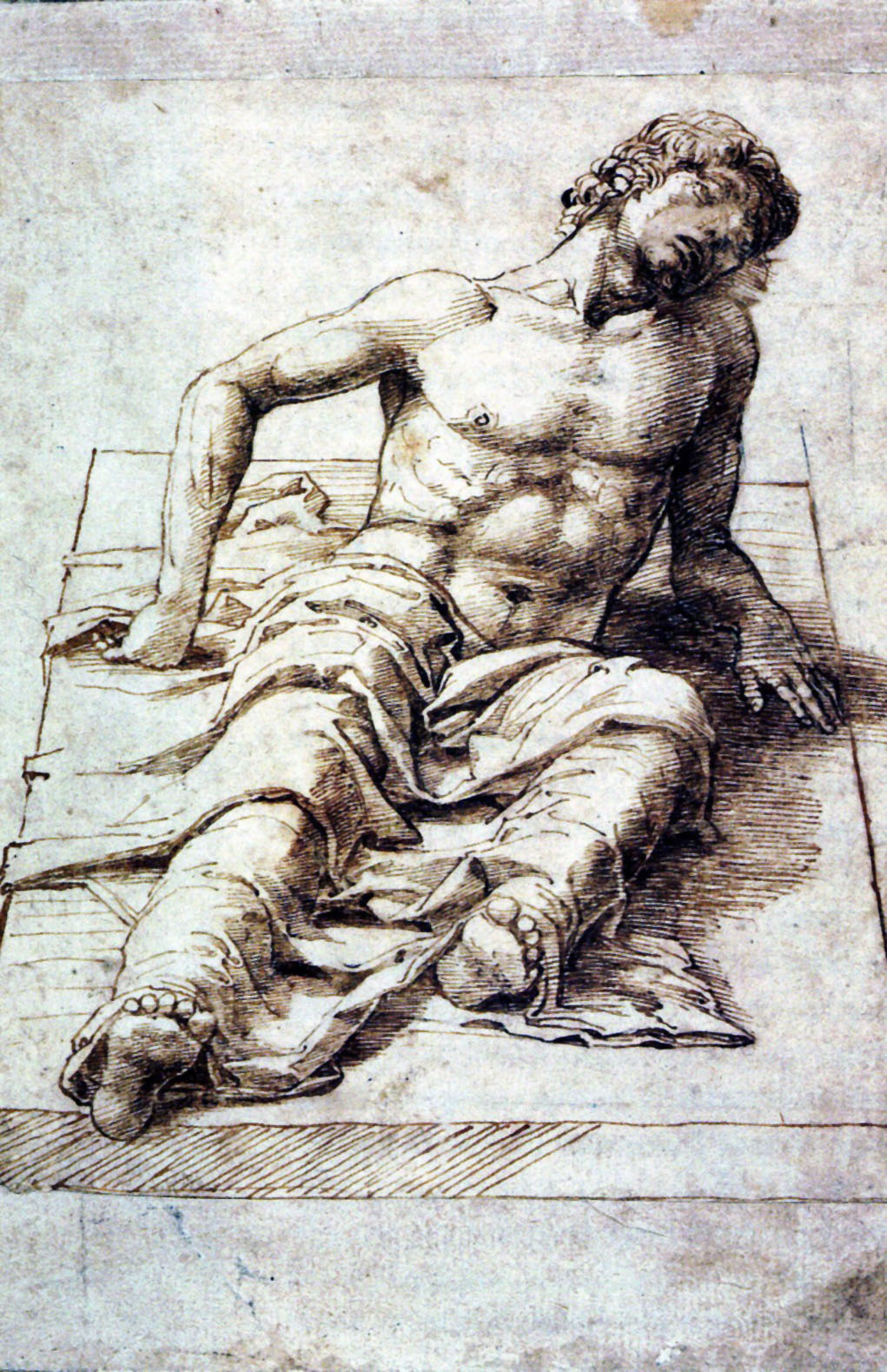
Andrea Mantegna_Study for a Christ_1480s_Tertia die resurrexit a mortuis, ascendit ad caelos, sedet ad dexteram Patris omnipotentis. Inde venturus est iudicare vivos et mortuos._On the third day He rose again from the dead, He ascended into heaven, and sitteth on the right hand of God the Father Almighty. From thence He shall come to judge the quick and the dead.
Gwendolyn Brooks: La Verdad / Truth
Posted: April 19, 2014 Filed under: English, Gwendolyn Brooks, Spanish, ZP Translator: Alexander Best | Tags: Poema para Sábado Santo Comments Off on Gwendolyn Brooks: La Verdad / Truth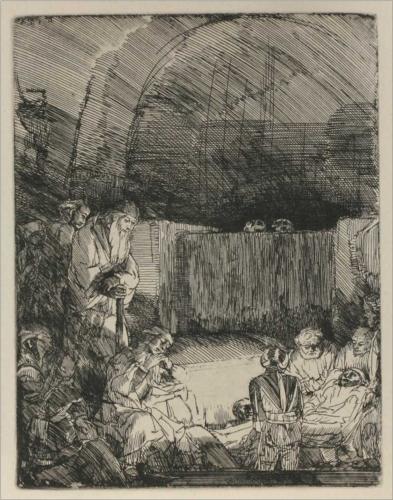
Rembrandt van Rijn_Jesús sepultado_Jesus Entombed_etching_1654
Gwendolyn Brooks (1917-2000)
Truth
.
And if sun comes
How shall we greet him?
Shall we not dread him,
Shall we not fear him
After so lengthy a
Session with shade?
Though we have wept for him,
Though we have prayed
All through the night-years—
What if we wake one shimmering morning to
Hear the fierce hammering
Of his firm knuckles
Hard on the door?
Shall we not shudder?—
Shall we not flee
Into the shelter, the dear thick shelter
Of the familiar
Propitious haze?
Sweet is it, sweet is it
To sleep in the coolness
Of snug unawareness.
The dark hangs heavily
Over the eyes.
. . .
La Verdad
.
Y si el sol viene,
¿cómo debemos saludarle?
Deberíamos temer a él,
Deberíamos amilanarse por él,
después de una sesión larga con la sombra?
.
Aunque hemos llorado por él,
Aunque hemos rezar
Durante los años de noche
– ¿Qué pasará si nos despertamos en una mañana reluciente para
Oír el martilleo feroz
De sus nudillos firmes,
Fuerte en la puerta?
.
¿Deberíamos temblar,
Deberíamos huir
Hacia el querido albergue grueso
Que es la niebla conocida y propicia?
.
Qué dulzura – cómo es dulce –
Dormir en el fresco
De un desconocimiento cómodo.
.
La oscuridad cuelga pesadamente
Sobre los ojos.
. . . . .
Poemas para Viernes Santo: Stevenson, Browning, Levertov / Poems for Good Friday
Posted: April 18, 2014 Filed under: Denise Levertov, English, Robert Browning, Robert Louis Stevenson, Spanish, ZP Translator: Alexander Best | Tags: Poemas para Viernes Santo, Poems for Good Friday Comments Off on Poemas para Viernes Santo: Stevenson, Browning, Levertov / Poems for Good Friday

Paul Gauguin_Christ on The Mount of Olives (Gethsamane)_oil on canvas, 1889
Robert Louis Stevenson (1850-1894)
Evensong
.
The embers of the day are red
Beyond the murky hill.
The kitchen smokes; the bed
In the darkling house is spread:
The great sky darkens overhead,
And the great woods are shrill.
.
So far I have been led,
Lord, by Thy will:
So far I have followed, Lord, and wondered still.
The breeze from the embalmed land
Blows sudden towards the shore,
And claps my cottage door.
I hear the signal, Lord – I understand.
The night at Thy command
Comes. I will eat and sleep and will not question more.
. . .
Vísperas
.
Las brasas del día son rojas,
Más allá de la colina turbia.
La cocina humea; el lecho de la casa oscura está hecho:
El cielo inmenso se oscurece por encima,
Y viene del gran bosque un chirrido chillón.
.
Hasta ahora, Señor, he sido guiado por Tu voluntad:
Tan larga la distancia, Señor, he seguido a Tí,
Y aún me pregunté.
La brisa del terreno embalsamado
Sopla hacia la orilla, de repente,
Y abofetea la puerta de mi casita.
Oigo la señal, Mi Señor – y la entiendo.
La Noche llega – de Tu dominio.
Comeré y dormiré y no preguntaré más.
. . .
Denise Levertov (1923-1997)
Suspended
.
I had grasped God’s garment in the void
but my hand slipped
on the rich silk of it.
The “everlasting arms” my sister loved to remember
must have upheld my leaden weight
from falling, even so;
for though I claw at empty air and feel
nothing – no embrace –
I have not plummeted.
. . .
Colgado
.
Yo había agarrado en el vacío el traje de Dios
pero mi mano resbaló en la seda exquisita.
“Los brazos eternos” que mi hermana amaba recordar
debieron haber soportado la carga pesada de mí
para que no me cayera;
porque aunque araño el aire vacío y me siento
nada – ningún abrazo –
no me he desplomado.
. . .
Robert Browning (1812-1889)
Faith
.
O never star
Was lost; here
We all aspire to heaven and there is heaven
Above us.
If I stoop
Into a dark tremendous sea of cloud,
It is but for a time; I press God’s lamp
Close to my breast; its splendour soon or late
Will pierce the gloom. I shall emerge some day.
. . .
Fe
.
Ah, nunca fue perdido una estrella; aquí
Aspiramos a llegar al Cielo y existe allá
Por encima de nosotros.
Si me encorvo en un mar de nubes,
Negro y tremendo,
Sólo es por un breve tiempo; estrecho la linterna de Dios
Contra mi pecho; y el esplendor de su luz
Perforará el tiempo plomizo – tarde o temprano.
Algún día me apareceré.
. . . . .
Jacob Nibenegenesabe: “Shaking the Pumpkin”: Narrative Poems from the Swampy Cree ᓀᐦᐃᓇᐍᐏᐣ
Posted: April 1, 2014 Filed under: English, Jacob Nibenegenesabe Comments Off on Jacob Nibenegenesabe: “Shaking the Pumpkin”: Narrative Poems from the Swampy Cree ᓀᐦᐃᓇᐍᐏᐣ

Jackson Beardy, Oji-Cree painter (1944 -1984): “Bird Calls”, 1977

Jacob Nibenegenesabe_a poem from The Wishing Bone Cycle: Narrative Poems from the Swampy Cree Indians_Translated by Howard A. Norman, 1976
.
Swampy Cree /ᓀᐦᐃᓇᐍᐏᐣ (which has sometimes been known as Maskekon, Omaškêkowak, or anglicized as Omushkego) is a variety of the more widespread Algonquian language – Cree. Swampy Cree has been spoken in Northern Manitoba, central to northeast Saskatchewan, and along the coast of Hudson Bay and James Bay in Northern Ontario. Approximately thirty years ago Swampy Cree had about 4500 native speakers; that number may be as low as 100 today (2014).
.
Jacob Nibenegenesabe
“Shaking the Pumpkin”
Translation from Swampy Cree: Howard Norman
.
One time I wanted two moons
in the sky.
But I needed someone to look up and see
those two moons
because I wanted to hear him
try and convince the others in the village
of what he saw.
I knew it would be funny.
So, I did it.
I wished another moon up!
There it was, across the sky from the old moon.
Along came a man.
Of course I wished him down that open path.
He looked up in the sky.
He had to see that other moon!
One moon for each of his eyes!
He stood looking
up in the sky
a long time.
Then he suspected me, I think.
He looked into the trees
where he thought I might be.
But he could not see me
since I was disguised as the whole night itself!
Sometimes
I wished myself into looking like the whole day,
but this time
I was dressed like the whole night.
Then he said,
“There is something strange
in the sky tonight.”
He said it out loud.
I heard it clearly.
Then he hurried home
and I followed him.
He told the others, “You will not believe this,
but there are ONLY two moons
in the sky tonight.”
He had a funny look on his face.
Then all the others began looking into the woods.
Looking for me, no doubt!
“Only two moons, ha! Who will believe you?
We won’t fall for that!” they all said to him.
They were trying to send the trick back at me!
That was clear to me!
So, I quickly wished a third moon up there
in the sky.
They looked up and saw three moons.
They had to see them!
Then one man
said out loud, “Ah, there, look up!
up there!
There is only one moon!
Well, let’s go sleep on this
and in the morning
we will try and figure it out.”
They all agreed, and went in their houses
to sleep.
I was left standing there
with three moons shining on me.
There were three . . . I was sure of it.
.
One time
all the noises met.
All the noises in the world
met in one place
and I was there
because they met in my house.
My wife said, “Who sent them?”
I said, “Fox or Rabbit,
yes one of those two.
They’re both out for tricking me back today.
Both of them
are mad at me.
Rabbit is mad because I pulled
his brother’s ear
and held him up that way.
Then I ate him.
And Fox is mad because he wanted
to do those things first.”
“Yes, it had to be one of them,”
my wife said.
So, all the noises
were there.
These things happen.
Falling-tree noise was there.
Falling-rock noise was there.
Otter-mud-sliding noise was there.
All those noises, and more,
in my house.
“How long do you expect to stay?”
my wife asked them. “We need some sleep!”
They all answered at once!
That’s how my wife and I
sometimes can’t hear well!
I should have wished them all away
first thing.
. . .
Commentary:
Trickster stories go far back in Cree culture (as elsewhere), but the figure here has been specifically invented by storyteller Jacob Nibenegenesabe, “who lived for some ninety-four years northeast of Lake Winnipeg, Canada.” Nibenegenesabe was also a teller (achimoo) of older trickster narratives, the continuity between old & new never being in question. But the move in the Wishing Bone series is toward a rapidity of plot development & changes, plus a switch into first-person narration as a form of enactment. In the frame for these stories, the trickster figure “has found a wishbone of a snow goose who has wandered into the Swampy Cree region and been killed by a lynx. This person now has a wand of metamorphosis allowing him to wish anything into existence, himself into any situation.” Howard Norman’s method of translation, in turn, involves “first listening to the narratives over & over in the source language, then re-creating them in the same context, story, etc., if notable, ultimately to get a translation word for word.”
[Originally printed in Shaking the Pumpkin: Traditional Poetry of the Indian North Americas. The book, first published by Doubleday in 1972 & later by University of New Mexico Press in 1986 & 1992, has now been out of print for several years. The full gathering of Howard Norman’s Swampy Cree translations, The Wishing Bone Cycle: Narrative Poems from the Swampy Cree Indians, was published by Ross-Erikson Publishing, Santa Barbara, & went out of print with the demise of that press.]
. . .
Three 21st-century Swampy Cree artists:

Phyllis Sinclair, folksinger

Kevin Lee Burton, filmmaker

David Alexander Robertson, author of the graphic novel series Tales from Big Spirit
Haiku harusamu 寒き春(さむきはる) / Haiku for This Cold Spring…Kyoshi & Issa
Posted: March 20, 2014 Filed under: English, Issa, Japanese, Kyoshi | Tags: Spring Haiku Comments Off on Haiku harusamu 寒き春(さむきはる) / Haiku for This Cold Spring…Kyoshi & Issa
Takahama Kyoshi (1874-1959)
Translations by Katsuya Hiromoto
.
春風や闘志いだきて丘に立つ
harukaze ya / tohshi idaki te / oka ni tatsu
.
Spring wind:
Full of fight
I stand on the hill
.
眼つむれば若き我あり春の宵
Me tsumureba / wakaki ware ari / haru no yoi
.
Shutting my eyes
I find a young me found
In the spring evening
.
この庭の遅日の石のいつまでも
Kono niwa no / chijitsu no ishi no / itsumademo
.
The rocks in this garden
Remain forever
In the lengthening days of spring
.
何事も知らずと答へ老の春
Nanigoto mo / shirazu to kotae / oi no haru
.
”I know nothing”
Is my answer:
Spring in my old age
.
これよりは恋や事業や水温む
kore-yori wa / koi ya jigyoh ya / mizu nurumu
.
From this time on
Love, enterprise, and such:
Water has warmed up
. . .
The following haiku by Kyoshi were translated by Aya Nagayama and James W. Henry:
.
時ものを解決するや春を待つ
Toki mono o kaiketsu suru ya haru o matsu
.
May time solve
Worries and difficulties –
Awaiting the spring
(1914)
.
金の輪の春の眠りにはひりけり
Kin no wa no haru no nemuri ni hairikeri
.
I have entered
The golden circle of
Spring slumber
(1942)
.
闘志尚存して春の風を見る
Tohshi nao sonshite haru no kaze o miru
.
Steadfast in my soul
My fighting spirit remains
And I see the spring breeze
(1950)
.
独り句の推敲をして遅き日を
Hitori ku no suikou o shite osoki hi o
.
In your solitude
Honing and perfecting your haiku –
On a slow spring day
(1959)
. . .
Plus: two by Issa – to have with your cup of tea :-)
(Issa was the haiku pen-name of Kobayashi Nobuyuki Yataro. Issa means Cup of Tea.)
Issa / 一茶 (1763-1828)
.
まん六の春と成りけり門の雪
manroku no haru to nari keri kado no yuki
.
some “proper spring”
this is!
snow at the gate
(1822)
.
春立や愚の上に又愚にかへる
haru tatsu ya gu no ue ni mata gu ni kaeru
.
spring begins –
more foolishness
for this fool
(1823)
. . . . .
Thomas Moore: “A Canadian Boat Song”
Posted: March 17, 2014 Filed under: English, Thomas Moore | Tags: Poems for Saint Patrick's Day Comments Off on Thomas Moore: “A Canadian Boat Song”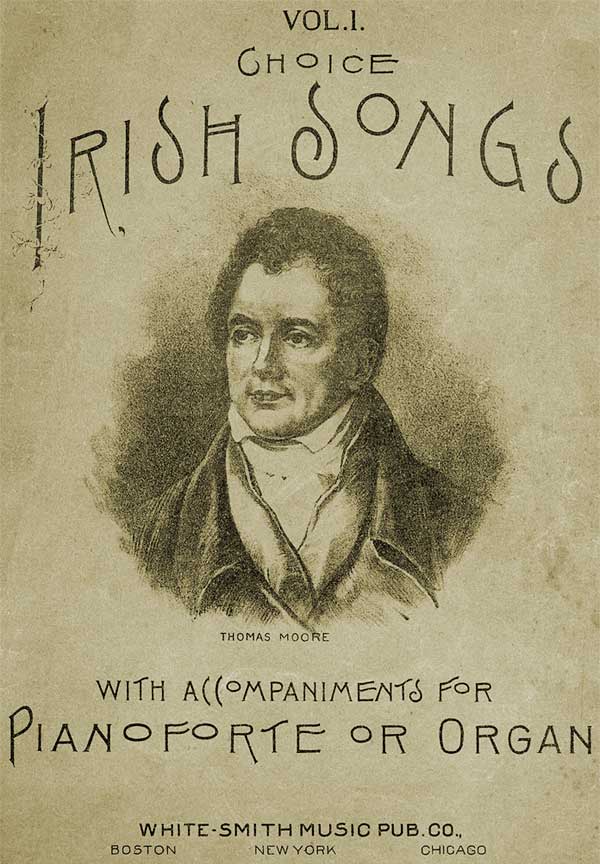
Irish songbook_published in 1892 in the USA, with an engraving of Thomas Moore on the cover
.
Thomas Moore (Irish poet, singer, songwriter, born Dublin, 1779-1853)
”A Canadian Boat Song” (1804)
. . .
Thomas Moore, who would later be renowned for poems and songs such as “The Minstrel Boy”, “The Last Rose of Summer” and “Believe Me, If All Those Endearing Young Charms”, visited Canada when he was 25 years old. He wrote “A Canadian Boat Song” during his time here in 1804.
.
*St. Anne’s: Moore visited this church – Ste-Anne-du-Bout-de-l’île–located in the town of Ste. Anne de Bellevue, on the tip of Montreal Island where the St. Lawrence River joins the Ottawa River.
*Utawa: an 18th/early 19th-century spelling of Ottawa
*“this green isle”: Montreal Island (L’île de Montréal )
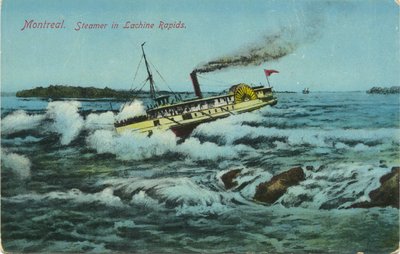
The Lachine Rapids, near Montreal Island_early 20th century postcard_These are The Rapids that Thomas Moore wrote about in his A Canadian Boat Song.
. . .
Zocalo Poets Editor’s Note:
My mother Eileen is a native of Belfast, Northern Ireland, though her family emigrated to Canada more than sixty years ago. Ma is in her eighties now, and she most definitely lives in the “here and now”. Yet she has powerful memories of those early years in the new country. She tells me: “I learned A Canadian Boat Song in the early 1950s, after coming to Canada. It was a camp song for the Eaton’s Girls’ Club up at Shadow Lake near Uxbridge. …I also have a memory from back in Ireland: the sound of a marching flute band going by. As children, we simply followed the band, and whistled and sang, as they marched along. They were playing “The Minstrel Boy” by Thomas Moore – and all of it on flutes!”
.
For more favourite poems of my mother, click on the following ZP link:
.

Montreal celebrated its 191st St.Patrick’s Day Parade on Sunday, March 16th, 2014.
. . . . .
 Zócalo Poets