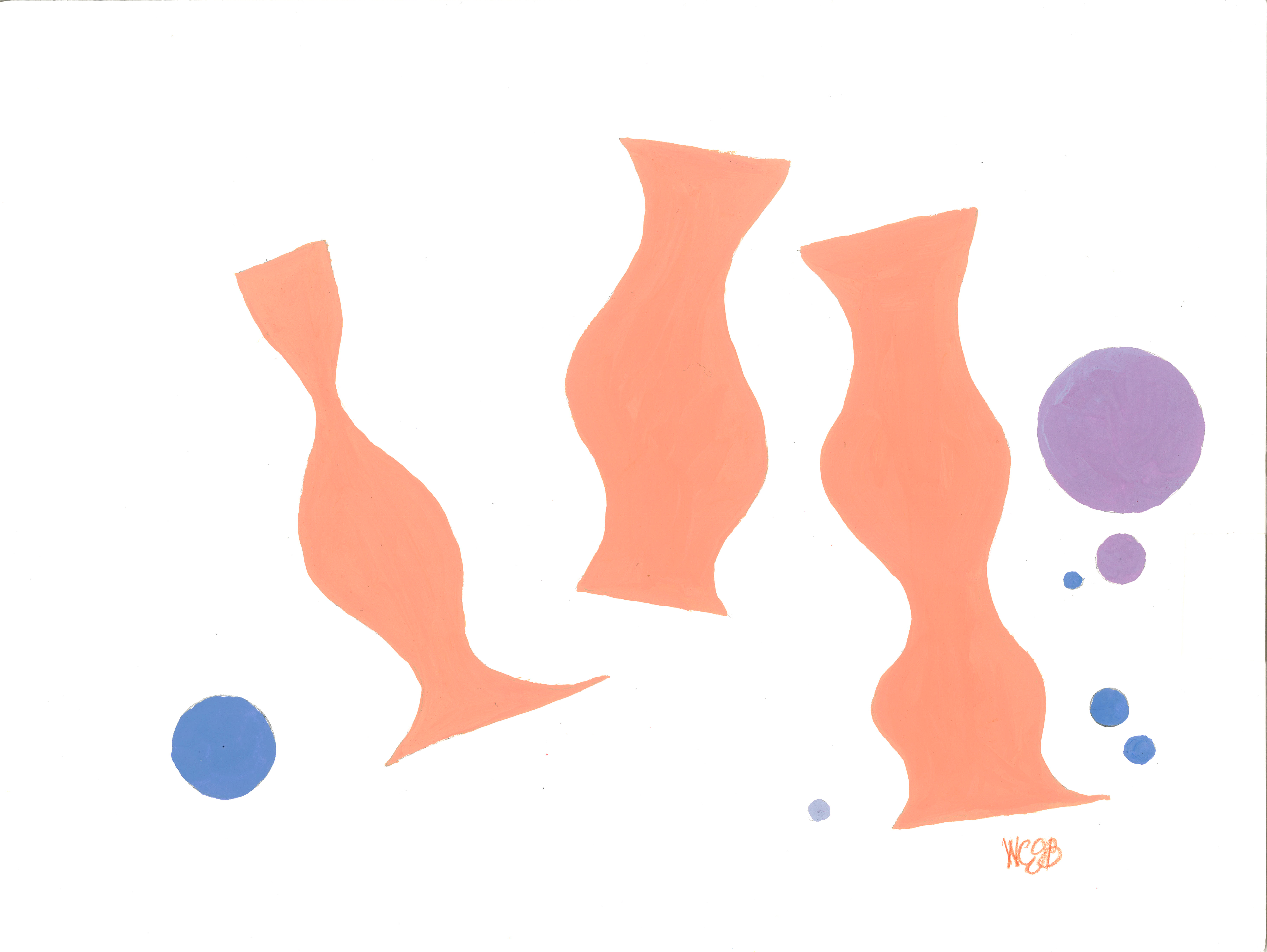
“Es algo tan muy nuevo”: versiones de poemas por e.e.cummings – con gouaches de William Gilpin-Beck / “It is so quite new a thing”: poems of e.e.cummings in Spanish translations – with gouaches by William Gilpin-Beck
Posted: July 31, 2014 Filed under: E.E. Cummings, English, Spanish, ZP Translator: Alexander Best Comments Off on “Es algo tan muy nuevo”: versiones de poemas por e.e.cummings – con gouaches de William Gilpin-Beck / “It is so quite new a thing”: poems of e.e.cummings in Spanish translations – with gouaches by William Gilpin-Beck
. . .
e.e.cummings (1894-1962, Cambridge, Massachusetts, USA)
i like my body when it is with your
.
i like my body when it is with your
body. it is so quite new a thing.
Muscles better and nerves more.
i like your body. i like what it does,
i like its hows. i like to feel the spine
of your body and its bones,and the trembling-
firm-smooth ness and which i will
again and again and again
kiss, i like kissing this and that of you,
i like,slowly stroking the,shocking fuzz
of your electric fur,and what-is-it comes
over parting flesh….And eyes big love-crumbs,
and possibly i like the thrill
of under me you so quite new
.
(from cummings’ 1925 collection, &[AND])
. . .
e.e.cummings
(1894-1962, poeta estadounidense innovador, nacido en Cambridge, Massachusetts)
me gusta mi cuerpo cuando al tuyo (1925)
.
me gusta mi cuerpo cuando al tuyo está junto.
es algo tan muy nuevo.
Músculos mejores y nervios más.
me gusta tu cuerpo. me gusta lo que hace,
y su cómo. me gusta tocar el espinazo
de tu cuerpo y sus huesos,y el temblor
-resuelto-lisura,que,
una y otra vez,
besaré, me gusta besar tu esto y tu eso,
me gusta, lentamente acariciar, el vello estremecedor
de tu pelaje eléctrico, y lo-que-es viene
sobre la raya abierta de tu carne viva. . . . Y ojos grandes-sobras de amor,
y me gusta, posiblemente, la incitación de
bajo el mí la tú tan muy nueva
. . .
since feeling is first
.
since feeling is first
who pays any attention
to the syntax of things
will never wholly kiss you;
wholly to be a fool
while Spring is in the world
my blood approves,
and kisses are a better fate
than wisdom
lady i swear by all flowers. Don’t cry
– the best gesture of my brain is less than
your eyelids’ flutter which says
we are for each other: then
laugh, leaning back in my arms
for life’s not a paragraph
And death i think is no parenthesis
.
(from cummings’ 1926 collection, is 5)
. . .
porque está primero el sentimiento (1926)
.
porque está primero el sentimiento
quien ponga atención
a la sintaxis de las cosas
nunca te besará, plenamente;
plenamente ser un bobo
mientras la Primavera está en el mundo
mi sangre aprueba,
y son un mejor destino, los besos,
que la razón
señora tengo plena confianza en todas las flores. No llores
– el mejor gesto del seso es menos que
el revuelo de tus párpados que dice que
somos el uno para el otro; pues
ríe, reclínate en mis brazos
porque no es un párrafo la vida
Y yo creo que la muerte no es ningún paréntesis
. . .
may i feel said she
.
may i feel said he
(i’ll squeal said she
just once said he)
it’s fun said she
(may i touch said he
how much said she
a lot said he)
why not said she
(let’s go said he
not too far said she
what’s too far said he
where you are said she)
may i stay said he
(which way said she
like this said he
if you kiss said she
may i move said he
is it love said she)
if you’re willing said he
(but you’re killing said she
but it’s life said he
but your wife said she
now said he)
ow said she
tiptop said he
don’t stop said she
oh no said he)
go slow said she
(cccome?said he
ummm said she)
you’re divine!said he
(you are Mine said she)
.
(from cummings’ 1935 collection, No Thanks)
. . .
puedo tocarte dijo él (1935)
.
dijo él: puedo tocarte
(dijo ella: chillaré
dijo él: sólo una vez)
dijo ella: es redivertido
(puedo palparte
cuánto
mucho)
por qué no
(vámonos dijo él
no demasiado dijo ella
qué es demasiado lejos
donde tu estás)
(puedo quedarme dijo él
cómo dijo ella
así dijo él
si me das un beso dijo ella
puedo moverme
es el amor)
si lo estás deseando
(pero me estás matando
él dijo: pero la vida es así
ella dijo: pero y tu mujer
él dijo: ahora)
ella dijo: ayy
súper dijo él
no te detengas dijo ella
ay no dijo él)
más despacio dijo ella
(¿te corres?
mmm)
¡eres divina!
(eres Mío…)

love is more thicker than forget
.
love is more thicker than forget
more thinner than recall
more seldom than a wave is wet
more frequent than to fail
it is most mad and moonly
and less it shall unbe
than all the sea which only
is deeper than the sea
love is less always than to win
less never than alive
less bigger than the least begin
less littler than forgive
it is most sane and sunly
and more it cannot die
than all the sky which only
is higher than the sky
.
(from cummings’ 1940 collection, 50 Poems)
. . .
amar es más denso que olvidar (1940)
.
amar es más denso que olvidar
más fino que recordar
más raramente que una ola mojada
más frecuente que fracasar
es más loco y lunarmente
y menos no será
que todo el mar que sólo
es más hondo que la marejada
el amor es menos siempre que ganar
menos nunca que viviente
menos grande que un comienzo que es lo mínimo
menos pequeño que perdón
es el más sensato y del sol (sol a mente)
y encima no puede morir
que todo el azul que sólo
es más alto que el cielo
. . .
i carry your heart with me
.
i carry your heart with me(i carry it in
my heart)i am never without it(anywhere
i go you go,my dear,and whatever is done
by only me is your doing,my darling)
i fear
no fate(for you are my fate,my sweet)i want
no world(for beautiful you are my world,my true)
and it’s you are whatever a moon has always meant
and whatever a sun will always sing is you
here is the deepest secret nobody knows
(here is the root of the root and the bud of the bud
and the sky of the sky of a tree called life;which grows
higher than soul can hope or mind can hide)
and this is the wonder that’s keeping the stars apart
i carry your heart(i carry it in my heart)
.
(from cummings’ 1958 collection, 95 Poems)
. . .
llevo tu corazón conmigo (1958)
.
llevo tu corazón conmigo, (lo llevo en mi corazón), sin él nunca estoy
(a donde quiera que voy vas tú mi amor;
y donde aquello que hago yo sola
es gracias a tí, mi cielo.)
no tengo miedo
del destino
(porque eres mi destino, cariño).no quiero ningún mundo porque hermosa
eres, mi mundo, mi verdad) y tú eres lo que es el siempre-significado de una luna y lo que cantará siempre el sol eres tú
este es el secreto más profundo y desconocido
(Acá está la raíz de la raíz
y el brote del brote
y el cielo del cielo de un árbol llamado vida;
que crece más alto de lo que el alma pueda esperar o la mente ocultar)
y esto es la maravilla que mantiene las estrellas separadas
llevo tu corazón, (lo llevo en mi corazón)
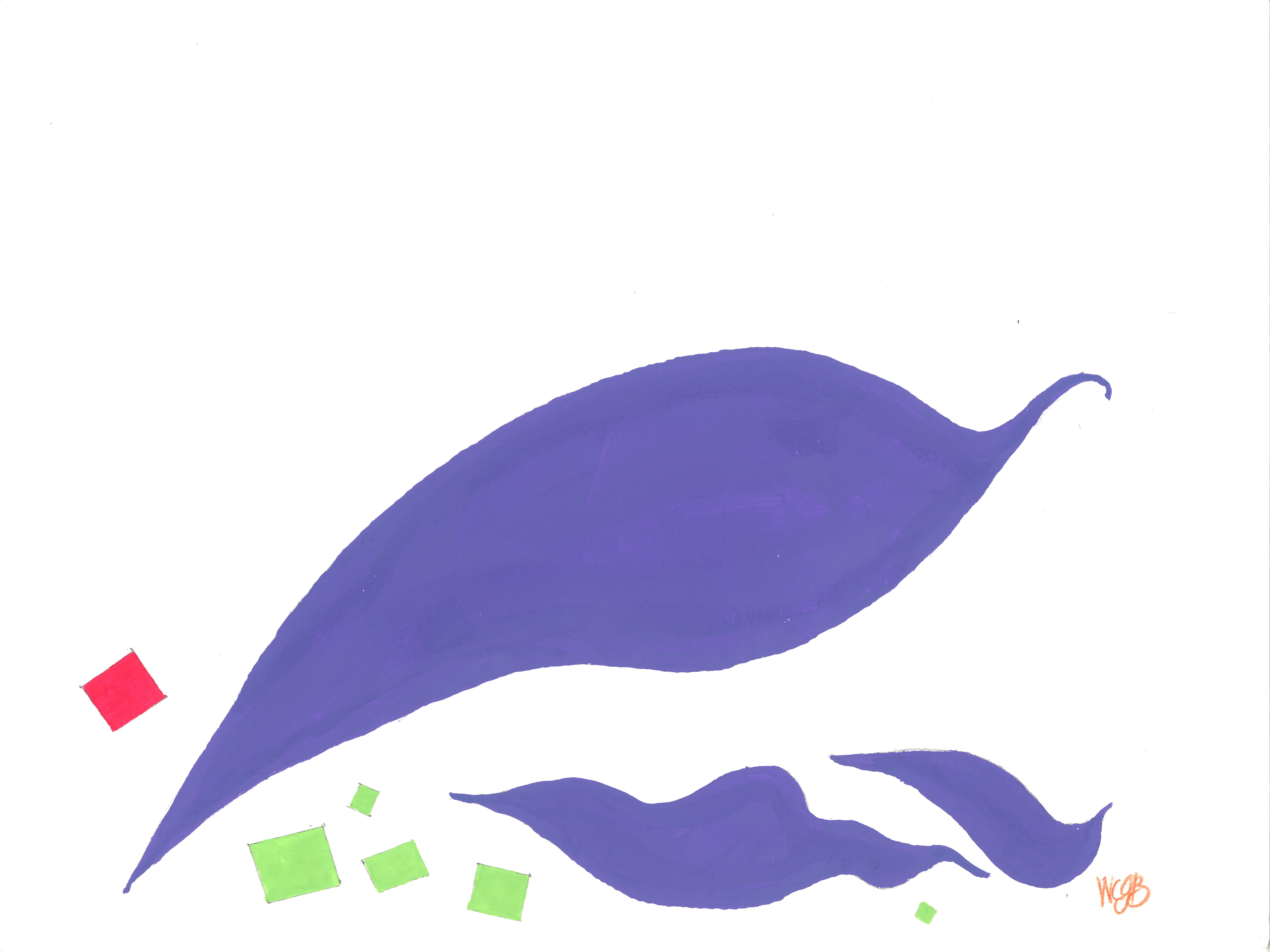
Edward Estlin Cummings (1894-1962) was an American poet and painter who grew up with the core values of New England Transcendentalism. Known for his broken syntax and a deliberate and playful mis-use of parentheses, commas, periods and lower-case letters, he was one of the modernizers of poetic language – wrenching it away from 19th century verse conventions. His 1917 poem Buffalo Bill’s defunct (based on a newspaper headline) signaled that clean break with the past. In 2014, more than a half century after his death, Cummings’ lustre has faded; his once-astonishing word games now seem less exciting when text messages and ‘tweets’ bring us fractured language daily. Joyce Kilmer’s sentimental Trees (1914) and Langston Hughes’ subtle and provocative A Dream Deferred (1951) are today far more often memorized and quoted than any verses by e.e.cummings. Yet at the time of his death, Cummings – along with Robert Frost – was the most widely read of American contemporary poets.
All of the above poems are here featured in their original lay-outs, and are taken from the 1994 centennial edition of E.E. Cummings: Complete Poems 1904-1962, edited by George J. Firmage, published by Liveright, New York City.
. . .
Edward Estlin Cummings (1894-1962) fue un poeta, pintor, ensayista y dramaturgo. Aunque él no aprobaba la práctica, sus editores frecuentemente escribían su nombre con minúsculas para representar su sintaxis extraordinaria. Cummings es conocido por sus poemas que rompen con toda estructura – incluyendo usos poco ortodoxos de las mayúsculas y la puntuación, en la que los puntos y comas podían incluso llegar a interrumpir oraciones y hasta palabras. Sus poemas también están escritos sin respeto a los renglones y los párrafos y algunos no parecen tener pies ni cabeza hasta que no son leídos en voz alta. A pesar del hecho que utilizó los estilos vanguardistas y la tipografía inusual, la buena parte de su obra es tradicional; su poesía frecuentemente trata el tema del Amor.
. . . . .
Sichtbar: e.e.cummings auf Deutsch / Silence: e.e.cummings in German
Posted: July 31, 2014 Filed under: E.E. Cummings, English, German Comments Off on Sichtbar: e.e.cummings auf Deutsch / Silence: e.e.cummings in German
stille
.ist
ein
shauender
vogel:der
wen
de;punkt,des
lebens
(suchend vor schnee
. . .
silence
.is
a
looking
bird:the
turn
ing;edge,of
life
(inquiry before snow
. . .
schnee heisst das
leben ist eine schwarze kannonad
e indie still
e go
ttllow
eg-weg)leben
?
baum3geister
sind Is 1 A ugen
Seltsam
vertraut
Gesicht
(warumlachend!unter:himmelsdiamanten
. . .
snow means that
life is a black cannonadin
g into silenc
e go
lliw
og-dog)life
?
tree3ghosts
are Is A eyes
Strange
known
Face
(whylaughing!among:skydiamonds
. . .
n
Ichtdl
n
gkann u
c
berTReff
e
n das
m
YsteriU
m
des
s
tilL.Sein
s
. . .
n
Othl
n
g can
s
urPas
s
the m
y
SteR
y
of
s
tilLnes
s
. . .
Wunderschön
ist das
unbe
deuten
des(lei
se)fal
lenden(da
nun
hier
all)s
chne
Es
. . .
Beautiful
is the
unmea
ning
of(sil
ently)fal
ling(e
ver
yw
here)s
Now
. . .
dies’ menschen herz
ist treu seiner
erde;so
jedermann’s welt
in
-t’ressiert ihn nicht(vom aus
sehen
anfühlen geschmack geruch
& klang
einer stille wer kann
ahnen
ge-
nau
was leben
tun wird)liebt
nichts
so serh so
wie(erst
das anko
-m-
me
-n)eine shneefloke tan-
zt
,auf
ihrem weg zum nie
-hier

r-f-e-p-u-e-h-s-a-g-r
welcher
al)s w(ir schau)en
aufnunrichht
PFEGERURASH
endz(u-
mDer):s
pr
iU
!ng:
T a
(n
kOmMeNd .gRrEaFsPuEh)
um
wieder(zu)ord(were)nen(en)d
,grashuepfer;

r-p-o-p-h-e-s-s-a-g-r
who
a)s w(e loo)k
upnowgath
PPEGORHRASS
eringint(o-
aThe):l
eA
!p:
S a
(r
rivinG .gRrEaPsPhOs)
to
rea(be)rran(com)gi(e)ngly
,grasshopper;
. . .
All e.e.cummings German translations © 2003, from the volume Sichtbar-Silence: Cummings coming into German, edited by Gudren M. Grabher
. . . . .
Ana María Caballero: Nuevos Poemas
Posted: July 29, 2014 Filed under: Ana María Caballero, Spanish Comments Off on Ana María Caballero: Nuevos Poemas
Ana Maria Caballero reading her poems in Roldanillo, Valle del Cauca, Colombia_La poeta leyendo sus poemas en Roldanillo, Valle, Colombia
La librería que recomendaste
Abierta a las 7 y 25 de la noche
Lunes
Mucha luz y 0 ruido, 2 libros de brujería moderna
Lunes
1 de pensamiento árabe, todos 3 en rebaja
Lunes
8 días después de dejarme un
Domingo
Después de 2 noches
Domingo
Los 2 creyendo que llamarías
Martes
1 noche a
Miércoles
Crear 1 noche
Jueves
Para sumar a las 2 noches
Viernes
Abierta tu librería a las 7 y 25
Lunes
Luz, 0 ruido, 3 libros
Lunes
2 noches, un
Lunes
0
ruido
. . .
Sí mi patrón
El patrón me llevó a su cuarto de patrón –
mesa, poltrona, balcón y hamaca.
Con el patrón yo la patrona –
palma plateada entre mi pueblo y mi puerta.
Desde el ron en la sangre cada paso su paso –
baldosa floreada un mapa de geometría opaca.
Al iniciar convidó pijama y enseres de higiene –
grueso cajón desnuda las herramientas.
Adentro cuento sombreros colgados –
afuera sopla la brisa y seca las sábanas limpias.
. . .
Te lo vi
Yo lo vi; te lo vi todo.
Te vi mi mano abriendo y cerrando
el cuero de un libro pesado.
Te vi mi mano mostrando y tapando
el reflejo de un tenedor bordado.
Te vi mi piel guardada.
Te vi la falta de crucifijos
en las paredes de mi casa.
Te vi la falta de edificios
en la vista de mi ventana.
Te vi mi perfil de florero recién lavado.
Te vi mi postura al montar a caballo,
con brinco discreto de buena equitación.
Te vi mis lenguajes clásicos y lejanos,
con sílabas que resuenan su larga educación.
Te vi mi tacón alto como si fuera guante blanco.
Yo lo vi; yo sé que se lo vi:
en el centro puro de su ojo oscuro
le vi mi ojo verde,
despedido por su merced.
. . .
Ahora se espera
Ahora no se quiere. Se espera.
Ahora no se mira, ahora no se toca.
Ahora se espera.
Ahora se piensa, se imagina, se calla.
Se ignora, se ocupa, se excusa.
Aunque se sepa, se sienta, se vea,
ahora se calla.
Aunque se piense, se imagine, se implore,
ahora se calla.
No se busca, se inventa.
Se aguanta.
Y no se cuenta.
. . .
Ana Maria Caballero has worked in the financial sector, as a journalist, for a wine importation company – even for the government of Colombia. Recently she became a mother, and now focuses her attention on writing poetry and literary commentary – what she calls “book thoughts”. These may be read at http://www.thedrugstorenotebook.co.
Her writing has appeared in numerous publications: Elephant Journal, CutBank, Aviary Review, Really Systems, Ghost House Review, Dagda Publishing, and Toasted Cheese Literary Journal.
Visit Zeteo Journal to read her weekly poetry feature in the Zeteo is Reading column:
http://www.zeteojournal.com
. . . . .
Navia Magloire: 4 poèmes de la poétesse haïtenne
Posted: July 28, 2014 Filed under: French, Navia Magloire Comments Off on Navia Magloire: 4 poèmes de la poétesse haïtenne
Tournure
Je ne veux plus rêver des hommes
Cheminant le vent des caraïbes
Je préfère imaginer leurs ombres
qui s’aventurent dans le jardin de ma conscience
Je me fais entremetteuse d’un monde connu
et celui de l’ inconnu
Avec eux, je suis ruine déshonorant mes
parterres de parfum, de naturel et de quiddité
Sans eux, je suis fortune d’imagination, de sourire
et de spontanéité
Je ne veux plus penser aux hommes
menaces pandémiques d’une société
asociale
désormais je les invente au coup
d’éclair de ma raison conditionnée
Je me fais paraphrase du réel et de l’irréel
Pour eux, je suis bonne chair, gourmet, désir
Loin d’eux, je suis pensée, divine et immortelle
Je ne veux plus parler des hommes
Je désire les créer dans des fibres d’amour
qui transcende le virtuel et peut-être
qu’un de ces matins apparaîtra l’homme
que j’ai rêvé.
Agapè
Combien j’ai envie de m’abandonner
à la prière amère de mes larmes
car j’habite un corps dont l’amour a déserté
les carrefours dès la jeunesse du matin
Sans amen je cherche l’abri de mon ombre
sans merci il me fuit
j’habite un corps désert
un corps fantôme
un corps liquide
un corps pétrifié
Combien hélas j’ai envie de marcher dans
la mémoire glissante de mes larmes
Car j’habite une ville fumée
depuis la traversée impersonnelle
de mon corps en transit
Sans relâche je furète sa vividité
Sans relâche il se tait
j’habite un corps évaporé
un corps fumant
un corps dilué
un corps périmé
Je suis poussé à voyager
les remous de mes larmes
car je cherche au participe passé
l’Agapè d’un corps inédit.


Maux d’Eau
Il pleut des rivières dans ma tête
Mon île ne rêve plus
les voix du passé obnubilent son imaginaire
Il pleut des tempêtes dans ma tête
mon île a délaissé son rêve
ses troubadours décriés s’empoissent
dans la gabégie
Il pleut à verses dans ma tête
Mon île a gommé son rêve
les tambours de ses contes s’obstinent
dans l’amnésie
il pleut, il pleut des larmes dans ma tête
mon île ne rêve plus
la cohorte des dieux a déserté l’oraison
de ses rites
il pleut dans ma tête en eau
ses semences chaotiques ont perdu
leur impulsion
mon île est un immense vase
de pleurs
Elle a cessé de rêver, mon île !

Terre arc en ciel
Le tambour de Dahomay
s’est éteint à Vertières
son roulement subversif
travesti en furie
assassine ma terre Arc-en-ciel
je décèle dans un bourdonnement
un désir de rédemption
mais hélas !
Le tam-tam des Peuls
s’est immobilisé à la Citadelle
son souffle subversif
perverti en folie
dévoye l’esprit de la gente intellect
je découvre dans ce bourdonnement
un refrain de guérison
mais hélas !
Le son des cornes des Nagos
s’est tû à la Crête à Pierrot
son esprit subversif
annihilé par le tribalisme
obscurci la vision futuriste
de ma terre Arc-en-ciel
se dénoue dans ce bourdonnement
une aversion tribale
et
l’avenir se coagule.


Navia Magloire est née au Cap Haïtien, une commune d’Haïti. Elle a débuté sa scolarité de l’âge de 2 ans à Saint-Joseph de Cluny où elle a terminé ses études primaires et secondaires classiques. Elle a complété des études universitaires en science de l’éducation et de psychologie a UJPM (Université Jean Price-Mars). Durant un séjour aux Etats-Unis d’Amérique, elle a familiarisé elle-même avec la poésie d’Anthony Phelps, et plus tard de Saint-John Kauss, qui est devenue pour elle un exemple à suivre, et qui la pousse à considérer l’écriture comme un exutoire à sa revolte.
. . .
Nos remerciements au site web Potomitan (pour les poèmes), et à CTV-Montréal (pour les photos)
6 photographies du Carnaval des Fleurs, Haïti. Cette année le Carnaval se déroule du 27 au 29 juillet 2014.
“Nature Photography” by Laboni Islam
Posted: July 28, 2014 Filed under: English, Laboni Islam Comments Off on “Nature Photography” by Laboni Islam
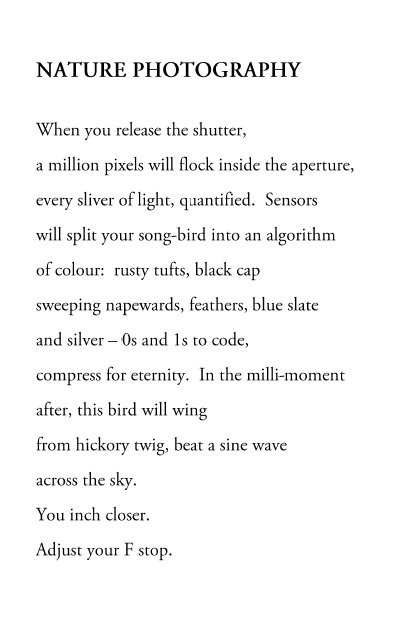
“Songbird”: a photograph by Laboni Islam
. . .
Alexander Best: La Cara del Girasol
Posted: July 16, 2014 Filed under: Alexander Best, Spanish Comments Off on Alexander Best: La Cara del Girasol
Girasol – en el alba, mediodía, anochecer –
¿por qué – para mí – tienes tan poder?
Tú: mi cara alegre cuando me abro al gozo
(y no soy el juguete de la ira);
cuando estoy franco con sentimiento,
(no tambaleándome por dentro).
Sólo ve y hazlo, asientes; haz lo posible, asientes,
y tus compañeros me dicen: si puedes soñarlo, puedes hacerlo.
Eres ávido, sincero, directo, auténtico
– ¿y puedes advinar por qué te amo tanto?
Es que: crece mi ánimo
cuando nos paramos cara a cara
– pues puedo reunirme con la raza humana.
Dylan Thomas: Poema del Ocaso del Día por El Reverendo Eli Jenkins / The Sunset Poem of The Reverend Eli Jenkins
Posted: July 15, 2014 Filed under: Dylan Thomas, English, Spanish, ZP Translator: Alexander Best Comments Off on Dylan Thomas: Poema del Ocaso del Día por El Reverendo Eli Jenkins / The Sunset Poem of The Reverend Eli Jenkins
At the end of the day…Al ocaso del día…
Bajo el bosque de leche es una pieza de radioteatro del escritor galés, Dylan Thomas, posteriormente adaptada para su representación en el teatro. También existe una adaptación cinematográfica de 1972, con Richard Burton y Elizabeth Taylor.
En Bajo el bosque de leche, un narrador omnisciente invita a los oyentes a escuchar los sueños y pensamientos íntimos de los habitantes de una imaginaria localidad galesa, “Llareggub” (inversión de bugger all, traducible aproximadamente como “iros todos al carajo”). Entre los personajes principales, cuyos nombres son casi siempre simbólicos, se encuentran el Capitán Cat, que revive su época de marino; las dos señoras Dai Breads; Organ Morgan, obsesionado con su música; y Polly Garter, que suspira por su amante muerto. Tras este inicio onírico, el pueblo despierta y cada personaje se sumerge en sus quehaceres cotidianos. (Wikipedia)
. . .
Dylan Thomas first wrote Under Milk Wood as a radio drama in 1954. It was later adapted as a stage play. In the story a narrator invites the listener to hear about the dreams and hidden thoughts of the inhabitants of a Welsh fishing village called Llareggub (“bugger all” spelt backwards). The characters include: Mrs. Ogmore-Pritchard, who nags her two deceased husbands; Captain Cat, who relives his seafaring years; the Mrs. Dai Breads; “Organ Morgan”, obsessed by music; and Polly Garter, who pines for her dead lover. Toward the end, the town “awakens”, and is aware now just how their feelings affect all that they do. And so, they go about their daily business…
The following poem by Thomas is taken from the radio play:
The Sunset Poem of The Reverend Eli Jenkins
.
Every morning when I wake,
Dear Lord, a little prayer I make;
O please to keep Thy loving eye
On all poor creatures born to die.
And every evening at sun-down
I ask a blessing on the town;
For whether we last the night or no
I’m sure is always touch-and-go.
We are not wholly bad or good
Who live our lives Under Milk Wood;
And Thou, I know, wilt be the first
To see our best side – not our worst.
O let us see another day…
Bless us all this night, I pray;
And to the sun we all will bow,
And say good-bye – but just for now.
. . .
Dylan Thomas
Poema del Ocaso del Día (por El Reverendo Eli Jenkins)
.
Cada alba cuando me levanto,
Querido Dios, una pequeña oración hago.
Por favor, que apuntes el ojo de tierno cuidado
Sobre todos nosotros – las pobres criaturas destinado a morir.
.
Y en la tarde, a la puesta del sol,
Te pido una bendición por el bien del pueblo,
Porque – en esta noche – y si duramos o no –
Yo sé que la Vida siempre es precario.
.
Buenos, malos – no somos ni el uno ni el otro
(nosotros viviendo en en el pueblo de Bajo-Leche-Madera);
Y – lo sé – que Tú serás el primero que ve en nosotros lo mejor – no lo peor.
.
¡Ah, miremos un otro día!
Bendícenos en esta noche – rezamos;
Y haremos una reverencia al sol,
Y digamos Adiós – a menos por ahora…
. . .
The Sunset Poem was also set to the music of A. H. D. Troyte (Troyte’s Chant No. 1), in four-part harmony for two tenors and two bass singers.
. . . . .
Dylan Thomas: Amor en El Manicomio / Love in The Asylum
Posted: July 15, 2014 Filed under: Dylan Thomas, English, Spanish Comments Off on Dylan Thomas: Amor en El Manicomio / Love in The Asylum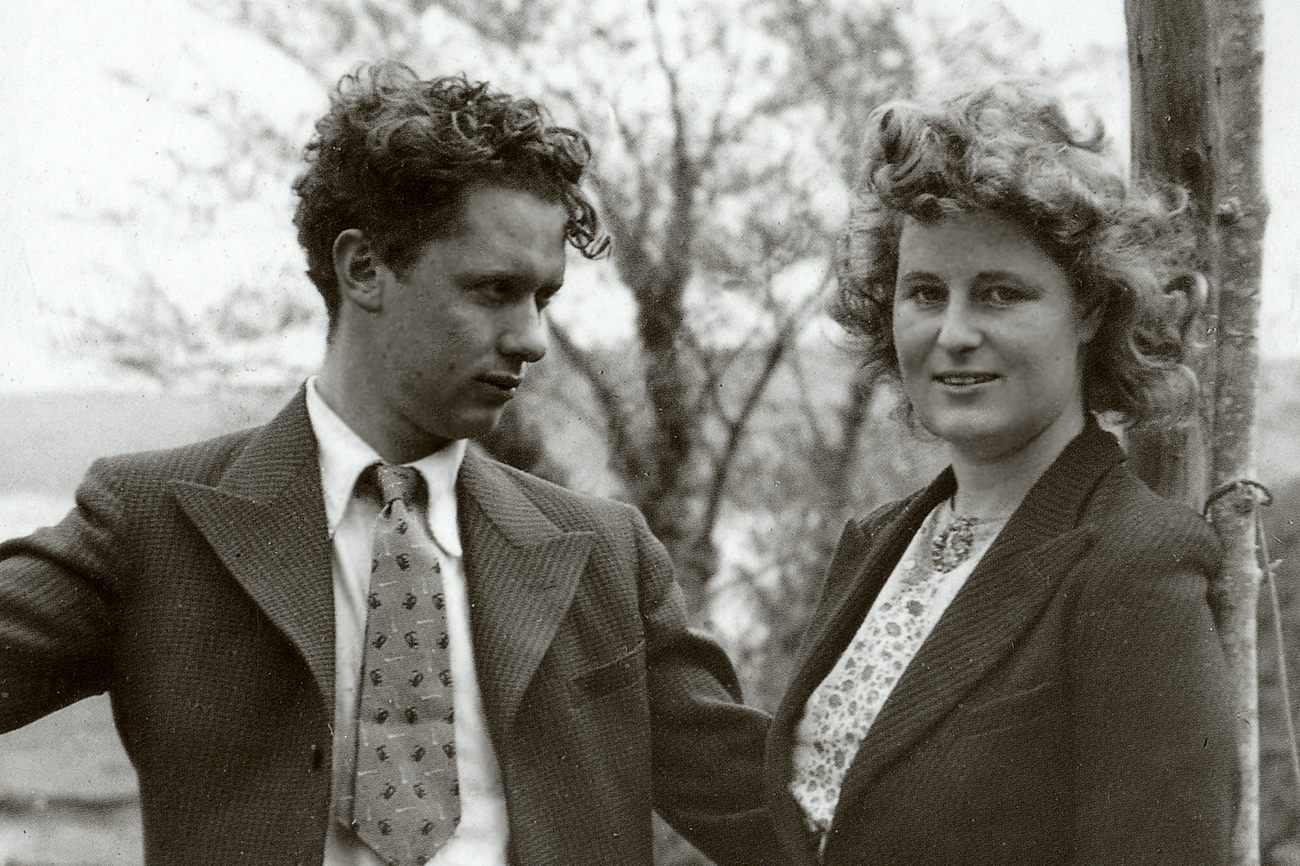
Dylan y Caitlin Thomas
Dylan Thomas (Poeta galés, 1914-1953)
Amor en El Manicomio
.
Una extraña ha venido
a compartir mi cuarto en esta casa que anda mal de la cabeza,
una muchacha loca como los pájaros
traba la puerta de la noche con sus brazos, sus plumas.
Ceñida en la revuelta cama
alucina con nubes penetrantes esta casa a prueba de cielos
hasta alucina con sus pasos este cuarto de pesadilla.
libre como los muertos
o cabalga los océanos imaginarios del pabellón de hombres.
Ha llegado posesa
la que admite la alucinante luz a través del muro saltarín,
posesa por los cielos
ella duerme en el canal estrecho, hasta camina el polvo
hasta desvaría a gusto
sobre las mesas del manicomio adelgazadas por mis lágrimas.
Y tomado por la luz de sus brazos, al fin, mi Dios, al fin
puedo yo de verdad
soportar la primera visión que incendia las estrellas.
.
Versión de Elizabeth Azcona Cranwell
. . .
Dylan Thomas (Welsh poet, 1914-1953)
Love in The Asylum
.
A stranger has come
To share my room in the house not right in the head,
A girl mad as birds
Bolting the night of the door with her arm her plume.
Strait in the mazed bed
She deludes the heaven-proof house with entering clouds
Yet she deludes with walking the nightmarish room,
At large as the dead,
Or rides the imagined oceans of the male wards.
She has come possessed
Who admits the delusive light through the bouncing wall,
Possessed by the skies
She sleeps in the narrow trough yet she walks the dust
Yet raves at her will
On the madhouse boards worn thin by my walking tears.
And taken by light in her arms at long and dear last
I may without fail
Suffer the first vision that set fire to the stars.
. . . . .
Jorge Luis Borges: “Tejas” / “Texas”
Posted: July 8, 2014 Filed under: English, Jorge Luis Borges, Spanish Comments Off on Jorge Luis Borges: “Tejas” / “Texas”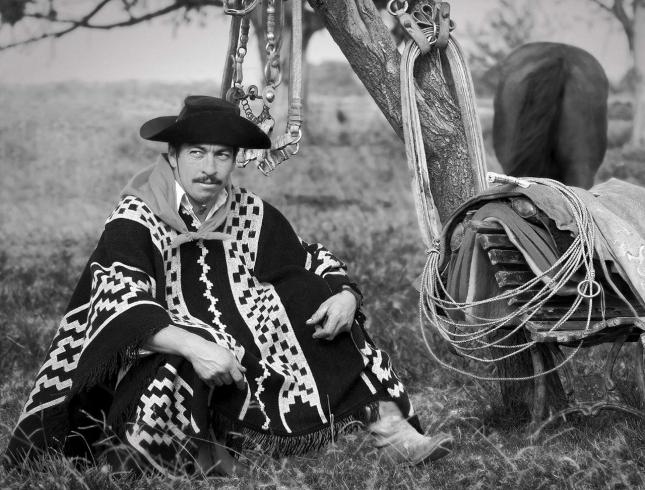
Foto romántica de un gaucho argentino estereotípico_Casi es una versión sudamericana del vaquero tejano. A romantic, stereotypical photograph of an Argentinian “gaucho”, the South-American counterpart to the Texas Cowboy.
Jorge Luis Borges
“Tejas”
.
Aquí también. Aquí, como en el otro
confín del continente, el infinito
campo en que muere solitario el grito;
aquí también el indio, el lazo, el potro.
Aquí también el pájaro secreto
que sobre los fragores de la historia
canta para una tarde y su memoria;
aquí también el místico alfabeto
de los astros, que hoy dictan a mi cálamo
nombres que el incesante laberinto
de los días no arrastra: San Jacinto
y esas otras Termópilas, el Álamo.
Aquí también esa desconocida
y ansiosa y breve cosa que es la vida.
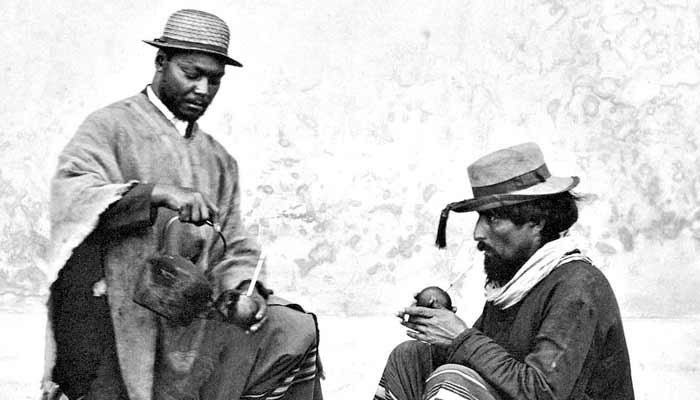
Dos gauchos de La Triple Frontera entre Argentina, Paraguay y Brasil_Bebiendo yerba mate_Vintage photograph of two “gauchos” drinking “yerba mate”
Jorge Luis Borges
(1899-1986, born Buenos Aires, Argentina)
“Texas”
.
And so it is here too. Here too, as at
the Americas’ other edge: the measureless
plain where a cry dies unattended. Yes,
here too, the Indian, mustang, lariat.
Here too the secret bird that ever yet
over the clamourings of history
sings for an evening and its memory;
here too the stars with mystic alphabet
that dictate to my writing hand below
such names, today, as the unceasing maze
of days and turning days does not displace,
as San Jacinto and the Alamo,
and such Thermopylaes. Here, too, is rife
with that brief unknown anxious thing called life.
. . .
Translation from the Spanish: A.Z. Foreman
Visit his site: http://poemsintranslation.blogspot.ca/
. . . . .
Alicia Claudia González Maveroff: Time / Tiempo
Posted: July 7, 2014 Filed under: Alicia Claudia González Maveroff, English, Spanish, ZP Translator: Alexander Best Comments Off on Alicia Claudia González Maveroff: Time / Tiempo
 Zócalo Poets