О́сип Мандельшта́м / Osip Mandelstam: “Maddening cherry brandy”
Posted: December 15, 2011 Filed under: English, Osip Mandelstam, Russian Comments Off on О́сип Мандельшта́м / Osip Mandelstam: “Maddening cherry brandy”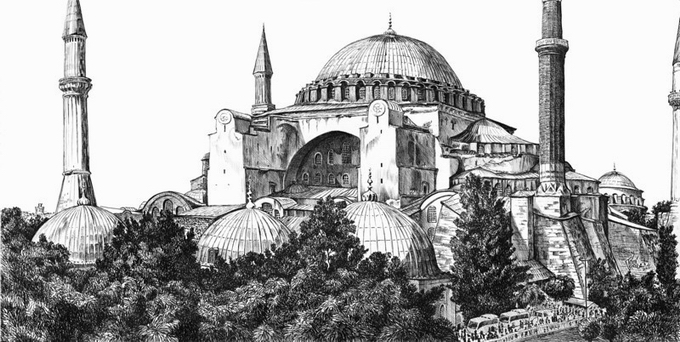
Hagia Sophia
Hagia Sophia: it was at this place
The Lord ordained that peoples and Caesars halt.
Your dome is, in a witness’s phrase,
As if hung by a chain from heaven’s vault.
And when Ephesian Diana allowed the looting
Of a hundred and seven green marble columns
For alien gods, it proved for ages yet to come
A monument to Justinian.
But what was it your generous builder meant
When he laid down apses and exhedrae,
As great his spirit as his intent,
Indicating to them east and west?
And bathing in the world, the shrine inspires awe,
Its forty windows are a celebration of light;
On the dome’s supporting vaults, the four
Archangels cause the most delight.
And the wisdom of his hemispherical dome
Shall outlive peoples, outlast the ages still to come,
While the full-voiced sobbing of the Seraphim
Shall not let its darkened gilding dim.
1912
_____
Ленинград
Я вернулся в мой город, знакомый до слез,
До прожилок, до детских припухлых желез.


Ты вернулся сюда, так глотай же скорей
Рыбий жир ленинградских речных фонарей,


Узнавай же скорее декабрьский денек,
Где к зловещему дегтю подмешан желток.


Петербург! я еще не хочу умирать!
У тебя телефонов моих номера.


Петербург! У меня еще есть адреса,
По которым найду мертвецов голоса.


Я на лестнице черной живу, и в висок
Ударяет мне вырванный с мясом звонок,


И всю ночь напролет жду гостей дорогих,
Шевеля кандалами цепочек дверных.


1930
Leningrad
I returned to my city, familiar as tears,
As veins, as mumps from childhood years.
You’ve returned here, so swallow as quick as you can
The cod-liver oil of Leningrad’s riverside lamps.
Recognize when you can December’s brief day:
Egg yolk folded into its ominous tar.
Petersburg, I don’t yet want to die:
You have the numbers of my telephones.
Petersburg, I have addresses still
Where I can raise the voices of the dead.
I live on the backstairs and the doorbell buzz
Strikes me in the temple and tears at my flesh.
And all night long I await those dear guests of yours,
Rattling, like manacles, the chains on the doors.
1930
_____
Я скажу тебе с
последней прямотой…
"Mа Vоiх аigrе еt fаussе..."
Paul Verlaine


Я скажу тебе с последней
Прямотой:
Все лишь бредни, шерри-бренди,
Ангел мой.


Там где эллину сияла
Красота,
Мне из черных дыр зияла
Срамота.


Греки сбондили Елену
По волнам,
Ну а мне - соленой пеной
По губам.


По губам меня помажет
Пустота,
Строгий кукиш мне покажет
Нищета.


Ой-ли, так-ли, дуй-ли, вей-ли,
Все равно.
Ангел Мэри, пей коктейли,
Дуй вино!


Я скажу тебе с последней
Прямотой:
Все лишь бредни, шерри-бренди,
Ангел мой.


1931
I’ll tell you bluntly…
"Mа Vоiх аigrе еt fаussе..."
(My sour, false Voice...)
Рaul Verlaine
I’ll tell you bluntly
One last time:
It’s only maddening cherry brandy,
Angel mine.
Where the Greeks saw just their raped
Beauty’s fame,
Through black holes at me there gaped
Nought but shame.
But the Greeks hauled Helen home
In their ships.
Here a smudge of salty foam
Flecks my lips.
What rubs my lips and leaves no trace?
— Vacancy.
What thrusts a V-sign in my face?
— Vagrancy.
Quickly, wholly, or slowly as a snail,
All the same,
Mary, angel, drink your cocktail,
Down your wine.
I’ll tell you bluntly
One last time:
It’s only maddening cherry brandy,
Angel mine.
1931
_____
Osip Mandelstam (1891-1938) was from a Polish-Jewish
family and grew up in St.Petersburg (later Leningrad), Russia.
His first poems appeared in 1913, and, after The Revolution
and Stalin’s increasing tendency toward totalitarianism,
Mandelstam made no effort to hide his non-conformist views.
Seized at a Moscow reading in 1934, he was banished from “the
big cities”. During The Great Purge of 1937, accused of
anti-Soviet views, he was arrested again and died en route to a
Gulag camp in Siberia.
Translations from Russian into English: Bernard Meares
_____
Oración a La Virgen de Guadalupe: José Valdez
Posted: December 12, 2011 Filed under: English, José Valdez, Spanish, ZP Translator: Alexander Best | Tags: Oración a La Virgen de Guadalupe, Prayer to Our Lady of Guadalupe Comments Off on Oración a La Virgen de Guadalupe: José Valdez
Oración a La Virgen de Guadalupe
por José Valdez (México)
“A mi Virgen de Guadalupe”
.
Necesito tu ayuda
me siento perdido
mis ojos se nublan
no encuentro el camino
tú que eres buena
y muy milagrosa
te pido, morena,
muchísimas cosas
pido por la gente
que quiero yo tanto
que siempre se encuentren
bajo de tu manto
pido me des fuerzas
que encuentre el camino
y que me protejas
con tu manto fino
eres muy hermosa
linda virgencita
pareces una rosa
que nunca se marchita
con solo mirarte
me llenas de paz
con solo tocarte
la vida me das
me inspiras confianza
y mucha ternura
me das esperanzas
y también dulzura
esa verde manta
que cubre tu cabeza
te hace ver más santa
y llena de pureza
ese resplandor
que a ti te rodea
es un bello sol
que nunca te quema
esos lindos ojos
parecen dos diamantes
y tu vestido rojo
te hace ver radiante
sé que tú me quieres
yo siempre lo supe
por eso, para mí, eres
Mi Virgen de Guadalupe.
*
“To my Virgin of Guadalupe”
.
I need your help
I am lost
my eyes cloud over
I cannot find the path,
you who are good
so very miraculous
I ask of you, morena,
very very many things
I ask for those people that I love so,
that always they may find themselves
blanketed within your cloak,
I ask that you may give me strength
that I might find the way
and that you may protect me
within your fine cloak,
you are most beautiful
lovely dear Virgin
you seem like a rose
that never wilts
I merely gaze upon you
and you fill me with peace
I touch you, merely,
and you give me life,
you inspire trust in me
and much tender feeling,
hope you give me,
gentleness too,
that green scarf
that covers your head
makes you look most saintly
and full of purity,
that dazzling gleam
surrounding you
is a beautiful sun
that never burns,
those lovely eyes
are as two diamonds,
and your red robe
makes you radiant,
I know that you love me,
always I knew it,
and, for that reason, for me, you are
My Virgin of Guadalupe.
*
We thank Mr. Valdez for his
poem from the heart honouring
Our Lady of Guadalupe on this
her feast day, December 12th.
Translation from Spanish into English:
Alexander Best
*
¡Tlazocamati, Tonantzin! / Thank You, Sacred Mother!
Posted: December 12, 2011 Filed under: English, Náhuatl, Spanish, ZP Translator: Alexander Best Comments Off on ¡Tlazocamati, Tonantzin! / Thank You, Sacred Mother!
Poema de Nezahualcóyotl
(1402-1472, Rey nahua/mexica de Texcoco)
“Tonantzin”
Tonantzin;
icuac nehuatl nimiquiz
xinechtoca notlecuilco
ihuan quemman ticchihuaz
motlaxcal xinechchoquili.
Ihuan tla aca mitztlatlaniz
Tonantzin. Tleica tichoca?
Xicnanquili; in cuahuitl xoxochuic
ihuan in poctli nechchoctia.
*
“Madrecita”
Madrecita;
cuando yo muera
entiérrame junto a tu hoguera
y cuando hagas tortillas
llora por mí
y si alguien te pregunta
Madrecita ¿Por qué lloras?
Responde; Es que la leña que está verde
y es el humo que me hace llorar.
*
“Sacred Mother”
Little Mother,
when I die
bury me next to your cooking fire
and when you make tortillas
cry for me
and if anyone asks you:
Sacred Mother, why do you cry?
Tell them: It’s only that the fire-wood’s green
and the smoke hurts my eyes…
*
Nican mopohua (“Here is recounted…”): December 9th, 1531
Posted: December 9, 2011 Filed under: English, Náhuatl | Tags: Juan Diego Cuauhtlatoatzin Comments Off on Nican mopohua (“Here is recounted…”): December 9th, 1531
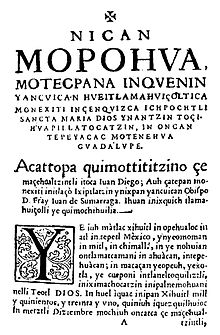
…..Auh in acico in inahuac tepetzintli in itocayocan Tepeyacac,
ye tlatlalchipahua…..
*
Concac in icpac tepetzintli cuicoa, yuhquin nepapan tlazototome cuica;
cacahuani in intozqui, iuhquin quinananquilia tepetl, huel cenca teyolquima,
tehuellamachti in incuic; quicenpanahuia in coyoltotl in tzinitzcan ihuan in
occequin tlazototome ic cuica…..
*
“Canin ye nica? Canin ye ninotta? Cuix ye oncan in quitotehuaque huehuetque
tachtohuan tococolhuan, in xochitlalpan in tonacatlalpan,
cuix ye oncan ilhuicatlalpan?”…..
*
In oyuhceuhtiquiz in cuicatl, inomocactimoman in yeequicaqui
hualnotzalo inicpac tepetzintli, quilhuia: “Juantzin, Juan Diegotzin”…..
*
Auh in ye acitiuh in icpac tepetzintli, in ye oquimottili ce Cihuapilli
oncanmoquetzinoticac, quihualmonochili inic onyaz in inahuactzinco…..
*
Auh in tetl, in texcalli in ic itech moquetza, inic quimina…..
*
Auh in mizquitl, in nopalli ihuan occequin nepapan xiuhtotontin
oncan mochichihuani yuhquin quetzaliztli. Yuhqui in teoxihuitl in
iatlapalio neci. Auh in icuauhyo, in ihuitzyo, in iahuayo yuhqui in
cozticteocuitlatl in pepetlaca…..
*
Quimolhuili: “Tlaxiccaqui noxocoyotl Juantzin, campa in timohuica?”
*
Auh in yehuatl quimonanquilili: “Notecuiyoé, Cihuapillé, Nochpochtziné!
Ca ompa nonaciz mochantzinco México-Tlatilolco,
nocontepotztoca in Teyotl…..”
_____ * _____ * _____
…..And as he drew near the little hill called Tepeyac
it was beginning to dawn…..
*
He heard singing on the little hill, like the song of many precious birds;
when their voices would stop, it was as if the hill were answering them;
extremely soft and delightful; their songs exceeded the songs of the
coyoltotl and the tzinitzcan and other precious birds…..
*
“Where am I? Where do I find myself? Is it possible that I am in the
place our ancient ancestors, our grandparents, told about, in the
land of the flowers, in the land of corn, of our flesh, of our sustenance,
possibly in the land of heaven?”…..
*
And then when the singing suddenly stopped, when it could no longer
be heard, he heard someone calling him, from the top of the hill, someone
was saying to him: “Juan, Dearest Juan Diego”…..
*
And when he reached the top of the hill, a Maiden who was standing there,
who spoke to him, who called to him to come close to her…..
*
And the stone, the crag on which she stood, seemed to be giving out rays…..
*
And the mesquites and nopales and the other little plants that are up there
seemed like emeralds. Their leaves, like turquoise. And their trunks, their
thorns, their prickles, were shining like gold…..
*
She said to him, “Listen, my dearest-and-youngest son, Juan,
Where are you going?”
*
And he answered her: “My Lady, my Queen, my Beloved Maiden!
I am going as far as your little house in Mexico-Tlatilolco,
to follow the things of God…..”
* * * * *
On December 9th, 1531, Juan Diego Cuauhtlatoatzin (1474-1548)
encountered a radiant native-Mexican woman at Tepayac Hill
(site of a former temple to the Aztec Earth-Mother goddess Tonantzin).
He knew her to be Santa María Totlaconantzin – Mary, Our
Precious Mother – and she spoke to him in his own language – Náhuatl.
*
Tepayac is now the location of the largest shrine in Latin America –
La Basílica de Nuestra Señora de Guadalupe / The Basilica of
Our Lady of Guadalupe – the name by which Juan Diego’s
Virgin Mary is known in México today…
Popularly, she is also called The Mother of All México.
Juan Diego was canonized by Pope John Paul II in 2002.
*
The above text – in the original Náhuatl (language of the Aztecs)
plus English translation by D. K. Jordan – is taken from
Nican mopohua (“Here is recounted…”)
by Antonio Valeriano (1556), and is the first chapter in the
written telling of the miraculous life of Juan Diego Cuauhtlatoatzin.
Valeriano was a native-Mexican scholar in three languages
– his birth-language, Náhuatl, plus Spanish and Latin.
Nican mopohua forms part of a larger volume,
Huei tlamahuiçoltica (“The Great Happening”),
published by Luis Laso de la Vega in 1649. The book is a
crucial Náhuatl text from the 16th and 17th centuries
– a period of immense trauma during which a new race
– el Mestizo – and a new nationality – Mexican – were being forged.
Rin Ishigaki: “Myself: a far-off island”
Posted: December 8, 2011 Filed under: English, Japanese, Rin Ishigaki Comments Off on Rin Ishigaki: “Myself: a far-off island”_____
The Economy
The phrase ‘economic animal’
I suppose is already fairly old.
Quite a gap exists between
The time when they said we seem that way
And now when we are that way.
Now then we economic animals
Will think about the economy.
From the time that I was born I’ve just been counting money.
That was what we were taught in the home
By the state.
People only count the time they have left
When it has started to run out.
We live terribly impoverished lives.
We die terribly lonely deaths.
(1987)
_____
At the Bathhouse
In Tokyo
At the public bathhouse the price went up to 19 yen and so
When you pay 20 yen at the counter
You get one yen change.
Women have no leeway in their lives
To be able to say that
They don’t need one yen
And so though they certainly accept the change
They have no place to put it
And drop it in between their washing things.
Thanks to that
The happy aluminium coins
Soak to their fill in hot water
And are splashed with soap.
One yen coins have the status of chess pawns
So worthless that they’re likely to bob up even now
In the hot water.
What a blessing to be of no value
In monetary terms.
A one yen coin
Does not distress people in the way a 1,000 yen note does
Is not as sinful as a 10,000 yen note
The one yen coin in the bath
With healthy naked women.
(1968)
_____
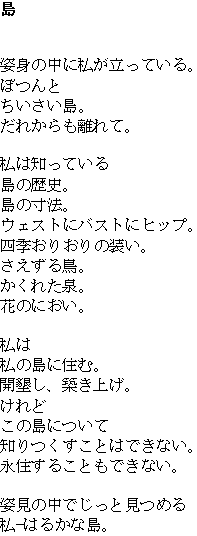
Island
I am standing in a large mirror.
A solitary
Small island.
Separated from everyone.
I know
The history of the island.
The dimensions of the island.
Waist, bust and hips.
Seasonal dress.
The singing of birds.
The hidden spring.
The flower’s fragrance.
As for me
I live on the island.
I have cultivated it, built it.
Yet
It is impossible to know
Everything about the island.
Impossible to take up permanent residence.
In the mirror staring at
Myself: A far-off island.
(2004)
_____
Rin Ishigaki (Ishigaki Rin in Japanese name-order)
was born in Tokyo in 1920 and died in 2004.
She worked for four decades as a bank clerk, kept
house, cooked, and cared for ageing parents.
Her first book of poems was published in 1959.
Without pretension or preciousness, her poems
are well-liked by people who might normally
steer clear of poetry!
These are thoughtful statements about ordinary life
– written in simple, straightforward Japanese –
and are sometimes used to teach the language to children,
as well as to foreign students.
_____
Translations from Japanese:
Leith Morton
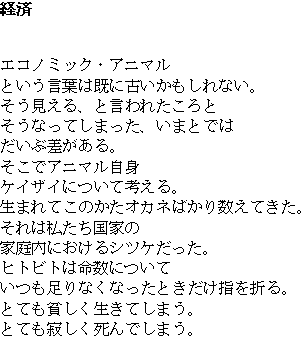
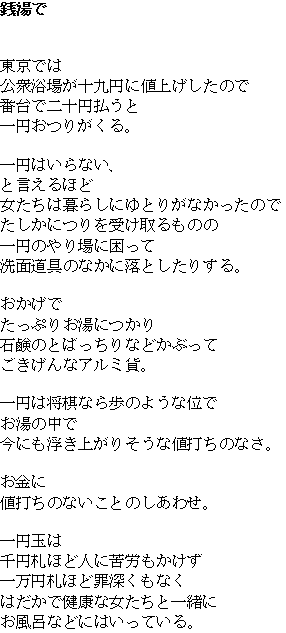
Ishigaki’s original three Japanese poems are featured below.
_____
Inuo Taguchi: “Morning Discussion”
Posted: December 8, 2011 Filed under: English, Inuo Taguchi, Japanese Comments Off on Inuo Taguchi: “Morning Discussion”_____
Inuo Taguchi
MORNING DISCUSSION
I had a strange dream.
An airplane –
it doesn’t fall straight down
but crashes horizontally.
“Don’t ask me how.
It happened in my dream.”
Now, in this ‘modern’ world
it’s common for vertical things to change into horizontal.
So it’s nothing to make a fuss about
that a plane should crash horizontally.
“Why are you making such a big deal out of it?
Nonsense is commonsense nowadays.”
Don’t worry. If you tip over you glass, wine will spill out.
If you let go of a knife, it’ll fall straight down.
Our world, as ever,
obeys divine providence.
What doesn’t obey it is your dream and –
“No, don’t turn on the television.
It’s never told us good stories. It never will.”
I am listening to the morning discussion half-heartedly,
for I only want to think about poetry.
But my thoughts suddenly turn to the grasslands of
Kharakhorum.
There, too, are things that should be floating in air
floating in air?
There, too, is what should be falling falling?
Do things never crash horizontally?
Is what should be landing landing
and what should be ascending ascending?
Suddenly I feel like confirming it
and begin to be restless.
The soul begins slowly spiraling.
A kitchen kettle
begins honking like a horn.
*
from: Hush-a-bye
(2004)
Translation from Japanese:
William I. Elliott and Kazuo Kawamura
The original Japanese poem is featured below.
_____

_____
Inuo Taguchi was born in 1967 in Tokyo, Japan. His pen-
name, Inuo, means Dog-Man. He began to write poetry
in his early twenties and his first book came out in 1995.
He has been described as having a “self-less voice” as a poet,
meaning he is off to the side, even out of the “story”
– and often his poems are little stories.
At festivals he reads his poems aloud – usually barefoot.
His poems have been translated into Turkish – among a bunch
of languages.
He muses: “I feel that poetry must strive to open giant
air holes in human consciousness.”
Inuo Taguchi: “For the Vegetarian”
Posted: December 8, 2011 Filed under: English, Inuo Taguchi Comments Off on Inuo Taguchi: “For the Vegetarian”_____
Inuo Taguchi
FOR THE VEGETARIAN
John Lennon died, you know.
“That must have been because of unpolished rice and
vegetarian food,”
Jesus said, sitting on a park bench.
“That’s not so,” I said. “John Lennon was assassinated . . . ”
I broke off mid-sentence,
because Jesus had an open New York Times before him
which actually carried an article to that effect.
When I got back to my apartment last night
there was a message from John on my answering machine.
He said he’d very much like me to participate
in a 4-day natural foods workshop in Atami.
If people get too gung-ho over something
do they even forget that they’re dead?
What’ll we call it? Karma? Anyway that’s a sad story.
Jesus spread out a take-out turkey sandwich on his lap
as he talked.
“When I was in Palestine I used to be really healthy,
but since coming to Manhattan everything’s gone wrong.
Is it because I’ve eaten too many French fries?
I tell them not to,
but my disciples themselves seem to frequent McDonald’’s
pretty often.
“Every time I argued with John I lost.
On those occasions my disciples were always upset.
Buddha once told me in all sincerity
that bad food was our karma.”
So John thought he would all by himself
eat up all the unpolished rice in the world.
I pictured John loading his cart with unpolished rice
in an Oriental market in Heaven
and at check-out
sticking out his tongue and mumbling,
“I don’t give a damn about good health, really. After all,
dead people are the freshest of all.”
The sky we see over Central Park is blue everywhere
and I slowly realized that under such a sky
it would be no wonder at all
if I had a call from dead John.
And sure enough when I got back to my room
there was a message from John.
Dead John said as follows:
“The opposite of eating is not not eating.
The opposite of eating is praying,
because while we’’re praying, at any rate,
we can’’t eat.”
_____
from: Armadillogic
2002
Translation from Japanese:
William I. Elliott and Kazuo Kawamura
Reesom Haile: the Lively Voice of Eritrea / la Voz Vivaz de Eritrea
Posted: December 1, 2011 Filed under: English, Reesom Haile: La voz vivaz de Eritrea / the lively voice of Eritrea, Spanish, Tigrinya, ZP Translator: Alexander Best | Tags: African poetry - Eritrea, Black poets Comments Off on Reesom Haile: the Lively Voice of Eritrea / la Voz Vivaz de Eritrea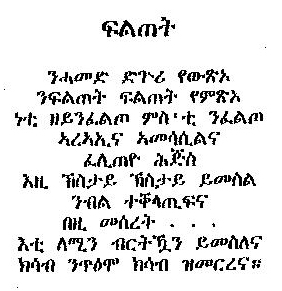


_____ * _____ * _____
KNOWLEDGE
First the earth, then the plow:
So knowledge comes out of knowledge.
We know, we don’t know.
We don’t know we know.
We know we don’t know.
We think
This looks like that –
This lemon, that orange –
Until we taste the bitter.
_____
DEVELOPMENT
Change.
Like a child, an infant.
“Let’s go ! Let’s go !”
And our household grows.
“Let’s run.”
We can slow
And sit and stretch
In the sun
Till it sets, but tomorrow
Dawned yesterday.
_____
UNDER CONSIDERATION
Consider this.
Consider that.
Excellent.
Write it
And propose it
For consideration.
Also consider
The official response,
“It’s under consideration.”
Who is considering whom?
When? Where?
How? Why?
Give up? Consider this.
_____
LEARNING FROM HISTORY
We learned from Marx and Lenin:
To be equal trim your feet
For one-size-fits-all shoes.
We made their mistakes, too.
Equally, we all make mistakes.
The evil is in not being corrected.
Aren’t we known
By what we do, undo and do again?
_____
YOUR HEAD
From birth you need
A door in your head to live.
Mother, father, teacher, preacher,
Sister, brother, relations, friends
Or others of your kind
May have the key
Or it may be lost.
But they still have other ways
To open the lock.
Rancid butter rubbed on your skull
May let the sunshine in.
The phrase, “What are you,
Stupid? Dumb?” might throw the bolt.
A flywhisk works on the less fragile.
A wooden spoon, a ruler or a good stick
Does the trick on harder nuts and…
Voilà! An open mind!
_____
SPEAK OUT
To speak out and to be spoken about,
Or to see no evil, hear no evil,
Shut up, keep it to yourself
And only complain in private?
That is not the question.
Read the constitution
Of our democratic state.
Exercise your rights
To tell it like it is,
Write as you see fit
And get a good night’s sleep.
You also have the right to take
Back what you say by mistake.
The freedom to express
Cannot be given up.
It comes from God.
Be free and brave.
Only one prison remains:
Our minds.
_____ * _____ * _____
El Saber
Al primero la tierra, pues el arado:
Tan que el saber viene del saber.
Sabemos, no sabemos.
No sabemos que sabemos.
Sabemos que no sabemos.
Pensamos que
Ésto parace como éso
– este limon, esa naranja –
hasta que degustemos el amargor.
_____
El Desarrollo
Cambio.
Como niño, como bebé.
¡Vamos! ¡Vamos!
Y crecen nuestro hogar.
¡Corramos!
Podemos aflojar el paso
Y sentarnos, estirando,
Bajo del sol,
Hasta el anochecer, pero
Ayer amaneció la mañana.
_____
Sobre la Consideración
Considera ésto.
Considera éso.
Escríbelo
Y proponlo
Por la consideración.
Considera también
La respuesta oficial:
“Éso es algo que estamos considerando.”
¿Quién está considerando a quién?
¿Cuándo? ¿Dónde?
¿Cómo – y Porqué?
¿Estás perplejo?
Considera ésto.
_____
Aprendiendo de la Historia
Aprendimos de Marx y Lenin:
A ser igual, recorta tus pies
por zapatos de unitalla.
(Cometimos sus errores también.)
Por otro lado, cometemos los errores
Todos nosotros.
Lo mal es no estar corregido.
¿ Nos conoce la gente
De lo que hacemos, deshacemos y hacemos de nuevo – no?
_____
Tu Cabeza
Del nacer te necesita
Una puerta en la cabeza para vivir.
Madre, padre, maestro, pastor.
Hermana, hermano, la familia y los amigos,
O unos otros de tu tipo
Tengan la llave
O la llave esté perdido.
Pero quedan otras maneras
Para abrir la cerradura.
La mantequilla rancia, frotada sobre el cráneo,
pueda dejar entrar la luz del sol.
La frase, “¿Eres cuál – Tonto? o Bobo?
Quizás levantará el pestillo.
Sirve bien un matamoscas sobre la gente menos delicada.
Una cuchara/regla de madera,
O un palo bueno,
Con las “cáscaras de nuez” mas duras
Logran el truco…
¡Y ya está! ¡La mente abierta!
_____
Habla – Di lo que piensas
¿Decir lo que se piensa y ser alguien discutido?
O: ¿A ver nada de mal, a oír nada de mal,
Cállate, guárdalo a tu mismo
Y quejarte en privado?
Éso no es la pregunta.
Leye la constitución
De nuestro estado democrático.
Ejerce tus derechos
A decir lo que es tu verdad,
Escribe por tu manera
Y duerme bien.
Tienes también el derecho de
Retirar lo que dijiste en error.
La libertad de expresar
no debe estar cedido.
Es algo de Dios.
Sé libre y valiente.
Solamente queda una cárcel:
Nuestra mente.
_____ * _____ * _____
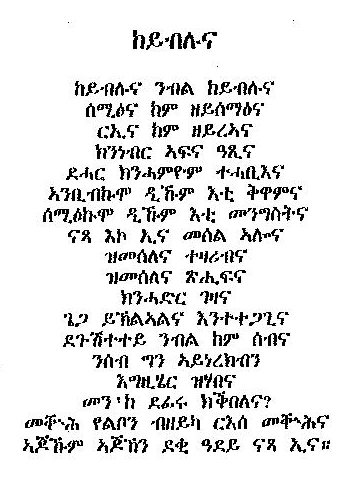
Reesom Haile, who died in 2003, was a much-loved Eritrean
poet and public personality.
After working as a radio and television journalist in Ethiopia, he
studied in the USA where he completed a doctorate at New York
University. A consultant to the U.N., government and NGOs for
twenty years, he returned in 1994 to Eritrea whose thirty-year
independence struggle with Ethiopia had just drawn to a close.
(After five years of relatively peaceful relations the two
countries engaged in a border war (1998-2000)
– over Red Sea access – that claimed 100,000 lives.) The reality of
war has formed the backdrop to, and sometimes the impetus for,
Haile’s verse.
His language, Tigrinya, is spoken by half (about 3,000,000 people)
the countryfolk in a nation which includes 9 languages and a variety
of ethnic groups. Tigrinya derives from ancient Ge’ez, as do Tigre
and Amharic. And Ge’ez is related – like Arabic and Hebrew –
to Aramaic, said to be the language spoken by Jesus.
This is poetry that embraces the Eritrean people, turns an eye
both wry and loving on their history and politics, and also issues
a sincere challenge to “get cracking” !
It is verse of vitality and wit, and is rendered beautifully
into English by Professor Charles Cantalupo of Pennsylvania State
University – a poet himself and a translator who balances gravity of
theme with a lightness of touch, thereby giving us something
of the essential character of Reesom Haile.
*
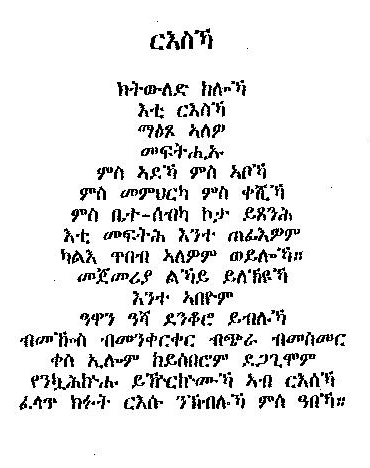
The poems featured here are from Reesom Haile’s collection:
We Have Our Voice (Lawrenceville and Asmara: The Red Sea Press,
2000) – the first-ever bilingual edition (Tigrinya + English)
of Tigrinya poems. Zócalo Poets is grateful to Professor Cantalupo for
assistance in posting the Tigrinya originals.
Translations from the English into Spanish: Alexander Best
_____
Mucho amado por sus compatriotas, Reesom Haile fue un poeta y
erudito. Su país, Eritrea, está situado al noreste de África, con una
costa al borde del Mar Rojo.
Durante su vida – se murió en 2003 – escribió dos mil poemas en el
lenguaje Tigriña, un idioma antiguo de la familia lingüística semítica
(como árabe, hebreo, y arameo – “la lengua de Jesús de Nazaret”.)
Lleno de inteligencia, vitalidad y ingenio, sus poemas han estado
traducido por el profesor universitario Charles Cantalupo
(de Penn State) con tanta franqueza, con tanto encanto.
Traducción del inglés al español: Alexander Best
“In all its breadth and ceaseless treasure”: the Contemporary Gaelic Poems of Lewis MacKinnon
Posted: November 30, 2011 Filed under: English, Gaelic: Scottish, In all its breadth and ceaseless treasure: Lewis MacKinnon and the contemporary Gaelic poem, Lewis MacKinnon Comments Off on “In all its breadth and ceaseless treasure”: the Contemporary Gaelic Poems of Lewis MacKinnon
Gaelic-language poems by Lewis MacKinnon:
Your Speech
Listening to your speech today;
A bag-of-wind speech,
A speech without ceasing,
A speech without shape,
A speech without feeling,
A speech without essence,
A speech without a path,
A speech as crazy as the birds,
A speech that was not heard,
A speech no one noticed,
A speech bawling out in the cold wind,
A speech alone, forgotten,
A speech misunderstood,
A speech calling out for aid,
A beautiful, meek, melodious, open speech, without blemish;
_____
A’ Chainnt Agad
Ag éisdeachd ris a’ chainnt agad
an diugh;
Cainnt ghuthmhor
Cainnt gun stad
Cainnt gun chruth
Cainnt gun fhaireachdainn
Cainnt gun bhrìgh
Cainnt gun rathad
Cainnt cho gòrach ri eòin nan speuran
Cainnt nach deach a chluinntinn
Cainnt air nach d’ thug neach-eiginn aire
Cainnt ag éibheachd ‘san t-soirbheas fhuar
Cainnt ‘na h-aonar, air a dìochuimhneachadh
Cainnt nach deach a tuigsinn
Cainnt ag gairm oirnn airson cuideachaidh,
Cainnt bhriagha, mhacanta, bhinn, fhosgarra, gun smal
____
Institutional Thoughts
Through the looking glass of faith
and the remains of empires,
and the institutions built by these,
a person arrives at this place in time and being;
Where the creed of his belief and the learning of colonizers
influences his every deed;
Even when he is sitting in some meeting or other
and struggling in his mind against ideas and words;
That someone else is putting forward;
Struggling for no real cause whatsoever;
But the fear of the loss of control;
That lurks under the surface of the legacy,
those institutions left from long ago;
_____
Smuaintean Air Stéidhichidhean
Troimh ghloine-seallaidh a’ chreideimh agus
fuigheall nan Ìmpireachdan,
is na stéidhichidhean a chaidh a thogail leotha,
ruigidh duin’ an t-àite seo ann an àm agus bith;
Far an toir creud a’ chreideis aig’ agus ionnsachadh
a’ luchd-ionnsaidh buaidh do gach
gnìomh a nì e;
Fìu ‘s nuair a tha e ‘na shuidhe ann an coinneimh air
choireigin
a’ dèanadh strì ‘na inntinn an aghaidh bheachdan is fhaclan;
A tha cuideigin eile a’ cur air adhart;
A’ dèanadh strì gun fhìor adhbhar sam bith;
Ach eagal call a’ smachd a tha fo uachdar na dìleib,
a dh’ fhàg na stéidhichidhean seo bho chionn fhada;
_____
Facebook and Gaelic
Writing in an unknown language,
old, shaky, alone,
in order that people will have a mere knowledge of it;
I write in this loneliness,
and I often suppose that there isn’t one person
on the surface of the earth,
that is in the same situation as me;
But I paused and I thought about the whole thing;
And then, it struck me
that Facebook
is kind of like Gaelic;
And I decided
that I would offer
Facebook the Gaelic language,
to be a friend to it,
in all its breadth
and ceaseless treasure;
And instead of being afraid
of an intrusion in its personal life
I welcome
any and all scrutinizing
that can be done of it
And I’ll provide Facebook
its date of birth,
its religious persuasion,
its sexual orientation,
its life history,
its stories,
its music,
its customs,
its expressions,
its hobbies,
its hopes,
its fears,
its musical interests,
where it was raised,
and what it is up to at this very moment
_____
Làrach Nan Ceanglaichean Agus A’ Ghàidhlig
A’ sgrìobhadh ann an cànain neo-aithnichte
sean, cugallach, aonaranach,
airson ‘s gum bi beagan eòlais aig daoin’ oirre
Is mar a sgrìobhas mi ‘san aonaranachas seo
gu tric saoilidh mi nach eil aon duin’ eile
air uachdar an t-saoghail
‘san aon suidheachadh ‘s a tha mise
Ach stad mi is smaointich mi
air a’ ghnothach
Is a’ sin, bhuail orm
gu bheil Làrach nan Ceanglaichean
car coltach ris a’ Ghàidhlig;
Agus chuir mi romham
gun tairginn-sa do Làrach nan Ceanglaichean
a’ Ghàidhlig,
a bhith ‘na caraid dhi,
‘na farsaingeachd air fad
‘na stóras gun chrìch
Agus an àite a bhith fo eagal
air foirneachd a beatha phearsanta
cuiridh mi fàilte air
sgrùdadh sam bith a théid a dhèanadh oirre
Agus bheir mi
ceann-là a breith,
a creideamh gneitheach,
a gné,
eachdraidh a beatha,
a sgeulachdan,
a h-òrain,
a ceòl,
a cleachdaidhean,
a gnàthsan-chainnt,
na cur-seachadan aice,
a dòchasan,
a h-eagail,
a sùim ciùil,
far an deach a togail,
is gu dé tha i ris an dràsda-fhéin
_____
A Fart
Now drawing the last gasp
and dying;
Free, unfettered, finally;
From the beliefs of people
who think that you died,
long ago;
But surprisingly,
you are still kicking in the hidden coffin,
with very little of your ancient little-known breath remaining;
And similar to a fart that is made someplace,
that is too confining,
and the smell wafts about choking everyone that is there,
and making them uncomfortable with shame,
You keep unexpectedly appearing;
And there are still those,
that are going around,
with their hands
tightly gripped on their noses;
Afraid of these little wiffs
that disperse;
You know that attitude you get
and how it’s shouted out, “Who did that anyway?”
And despite an immeasurable lack of attention,
you continue to fall out,
just like that fart,
that comes without welcome, without warning
_____
Braoim
A-nist a’ tarraing na h-uspaig mu dheireadh
is ag eugachdainn;
Saor, gun bhannan mu dheireadh thall;
O bheachdan dhaoine
a tha ‘smaoineachadh gun do dh’ eug thu,
o chionn iomadach bliadhna;
Ach gu h-iongantach,
tha thu fhathast air crith ‘sa’ chistidh fhalaichte seo,
le glé bheag dhen anail aosda neo-aithnicht’ agad air fhàgail,
Is mar bhraoim a chaidh a dhèanadh an àiteigin
a bha tuilleadh ‘s seasgair,
is a’ fàileadh a’ flodradh mun cuairt
a’ tachdadh a h-uile duin’ ann,
is ‘gan dèanadh mì-chomhfhurtail,
fo nàire;
Tha thu an còmhnaidh gun fhios a’ nochdadh;
Agus tha feadhainn ann,
a tha ‘dol air adhart fhathast,
leis na làmhan aca,
le fìor ghréim air an sròin;
Fo eagal nan oiteagan beaga seo,
a théid an sgapadh;
Fhios agad a’ freagairt a gheobh thu,
“Có rinn sin co-dhiubh?”
Agus a dh’ aindeoin cion-aire gun mheud,
théid agad air tuiteam a-mach,
dìreach mar a thuiteas am braoim ud,
a thig gun fhàilte, gun rabhadh
_____
Limited Pieces
I would like to meet with you again
one day,
where there is nothing between us,
but the awareness of one another;
Far away from the field of memory,
where there aren’t,
Memories
Experiences
Beliefs
Judgements
Pre-meditations
Or feelings
And there we can meet again
Since I would like to give, the pieces of you,
that do not completely constitute any of those above,
that I have been keeping so close to me,
for so long,
back to you
_____
Criomagan Beaga
Bu mhath leam coinneachadh riut
là air choireigin,
far nach eil sion sam bith ann eadarainn,
ach an t-eòlas air ré an duin’ eile;
Fad air falbh o’ phàirc a’ chuimhne
far nach eil
Cuimhnichean
Féin-fhiosrachaidhean
Creideamhan
Breitheanais
Beachdan a bh’ ann roimhe
No faireachdainnean
Is a’ sin faodaidh sinn coinneachadh a-rithist
A chionn ‘s bu mhath leam na criomagan dhìot
nach dèan suas gu h-iomlan gin dhen fheadhainn gu h-àrd,
a tha mi ‘gléidheadh cho dlùth dhomh,
fad an t-saoghail,
a thoirt air ais dhut
_____
Innards
I dug you out from the shape of your human body
And I looked at you sincerely;
To see if I could find
Out what was bothering you;
You, lamenting the deeds that you committed
And all your passions
With the hope that you would have another chance
To go back
And put things right;
In order to get some relief
You permitted me to search your insides;
You never uttered a word
When I went in
At ease, peaceful
Somehow content
That you were finally
Getting some attention
For the painful burden you
Were carrying;
And in I went
And I started
And God all mighty If I am not still there
Lost in your complexity;

Mionach
Chladhaich mi thu a-mach á cruth daonna na bothaig agad
Agus choimhead mi ort gu fìrinneach
Fiach a gheobhainn a-mach
Gu dé bha ‘cur ort
Thusa ‘caoineadh nan gnìomhan a rinn thu
Is na mianntan uile agad
Leis an dòchas gum biodh seans’ eile agad
A dhol air ais
A chur rudan ceart
Gus faothachadh ‘fhaighinn
Leig thu dhomh lorg ‘nad bhroinn
Cha d’ thuirt thu guth
Nuair a chaidh mi a-staigh
Socair, ciùin,
Is leig thu dhomh do mhionach a bhuntainn
Dòigh air choireiginn
Toilichte
Gu robh thu mu dheireadh thall
A’ faighinn air’ air an uallach phianail
A bha thu air giùlain
Chaidh mi a-staigh
Is thòisich mi
Is a Dhia nan gràsan nach eil mi fhathast ann
Air chall ‘san iom-fhillteachd agad
_____*_____*_____
Lewis MacKinnon (Lodaidh Macfhionghain) was born in 1970
in Inverness, Cape Breton, Nova Scotia, Canada.
Son of a Gaelic-speaking father and a French-Acadian mother, he is
an accomplished singer/songwriter as well as a poet.
His poems featured here were composed in Gaelic – using Nova Scotian
Gaelic’s spelling and punctuation, not Scottish Gaelic’s – then translated /
interpreted into English by the author himself.
Two of the poems, “Limited Pieces” and “Innards”, are exquisite in their
subtle intensity and candour – among the best love poems by any
Canadian poet.
MacKinnon’s 2008 book of poems, Giant and other Gaelic Poems /
Famhair agus dàin Ghàidhlig eile, includes 89 poems in Gaelic
with English versions.
Pat Lowther: “Escríbeme, cariño, del otro mundo. Y envíame aceitunas.”
Posted: November 24, 2011 Filed under: English, Pat Lowther, Spanish, ZP Translator: Alexander Best Comments Off on Pat Lowther: “Escríbeme, cariño, del otro mundo. Y envíame aceitunas.”
Oscura
Te digo: cae la oscuridad
como flechas y hambre
Ato en nudos mi cabello
para recordar otros imperios
Cae a través de mi cabeza el mundo
sin óbice – como la lluvia
Tengo que decirte: no puedo
mover siempre con el decoro
Como meteores cae la oscuridad
pétalos de negro caliente
Me escapo, quemando, solamente porque
Yo soy la oscuridad.
*
Identificación
Quiero decir:
dime
quien eres,
y me das
una respuesta clara,
quien eres
pues, pienso en
la pregunta inversa
como un cuchillo
con hoja hacia mí
dime
quien eres
: soy una metedura
una boca, llorando
una figura corriendo
con las manos al ángulo derecho
de los brazos
Y pienso, después
de todo, que
no te preguntaré
quien eres.
_____
Dark
I tell you the darkness comes down
like arrows and hunger
I tie knots in my hair
to remember other empires
The world falls through my forehead
resistlessly as rain
I must tell you I can not
always move with decorum
The darkness comes down like meteors
petals of hot black
I escape burning only because
I am the darkness.
*
I.D.
i want to say
tell me
who you are,
and you give me
a clear answer,
who you are
then i think of
the question reversed
like a knife
bladed toward me
tell me
who you are
: i’m a blunder
a mouth, crying,
a figure running
with hands upright
at right angles
to the arms
and i think after all
i won’t
ask you
who you are.
_____
Carta a Pablo número 3
Honrando a los muertos
con grasa de carne
con pan bien crujiente
con miel y ajo,
Anciano lamendo el aceite
de tus pulgares – y eructando,
eres más lustroso que
las flores.
Claveles, amapolas,
caen su especia y su bravura
en un polvo de pétalos agitados;
pasas por la imagen
para honrar la barriga,
las manos las fauces y los dientes,
el incienso de la comida
el sacramento del pan.
*
Letter to Pablo 3
Honouring your dead
with fat of meat
with well-crusted bread
with honey and garlic,
Old man licking the oil
off your thumbs – and belching,
you are more lustrous than
flowers.
Carnations, poppies,
their spice and bravura
fall in a dusting of
petals shaken;
you move past the image
to honour the belly,
the hands — the jaws and teeth,
the incense of cooking
the sacrament of bread.
_____
” Escríbeme, cariño,
del otro mundo.
Y envíame aceitunas. ”
*
” Write to me, darling,
from the other world.
And send me olives. ”
_____
Pat Lowther (1935-1975) nació en Vancouver, British Columbia, Canadá.
Su inspiración – con el poema y con la política – era el maestro-poeta chileno,
Pablo Neruda.
Estes poemas vienen de la colleción póstumo, Diario de Piedra (1977).
Traducción al español: Alexander Best
*
Pat Lowther (1935-1975) was born in Vancouver, British Columbia.
She was inspired poetically / politically by Chilean master-poet
Pablo Neruda.
These poems appeared in A Stone Diary,
published posthumously in 1977.
Translation into Spanish: Alexander Best
 Zócalo Poets