Alan Clark: “La Lengua” y “Dentro de Ti”
Posted: July 31, 2013 Filed under: Alan Clark, English, Spanish, ZP Translator: Alexander Best Comments Off on Alan Clark: “La Lengua” y “Dentro de Ti”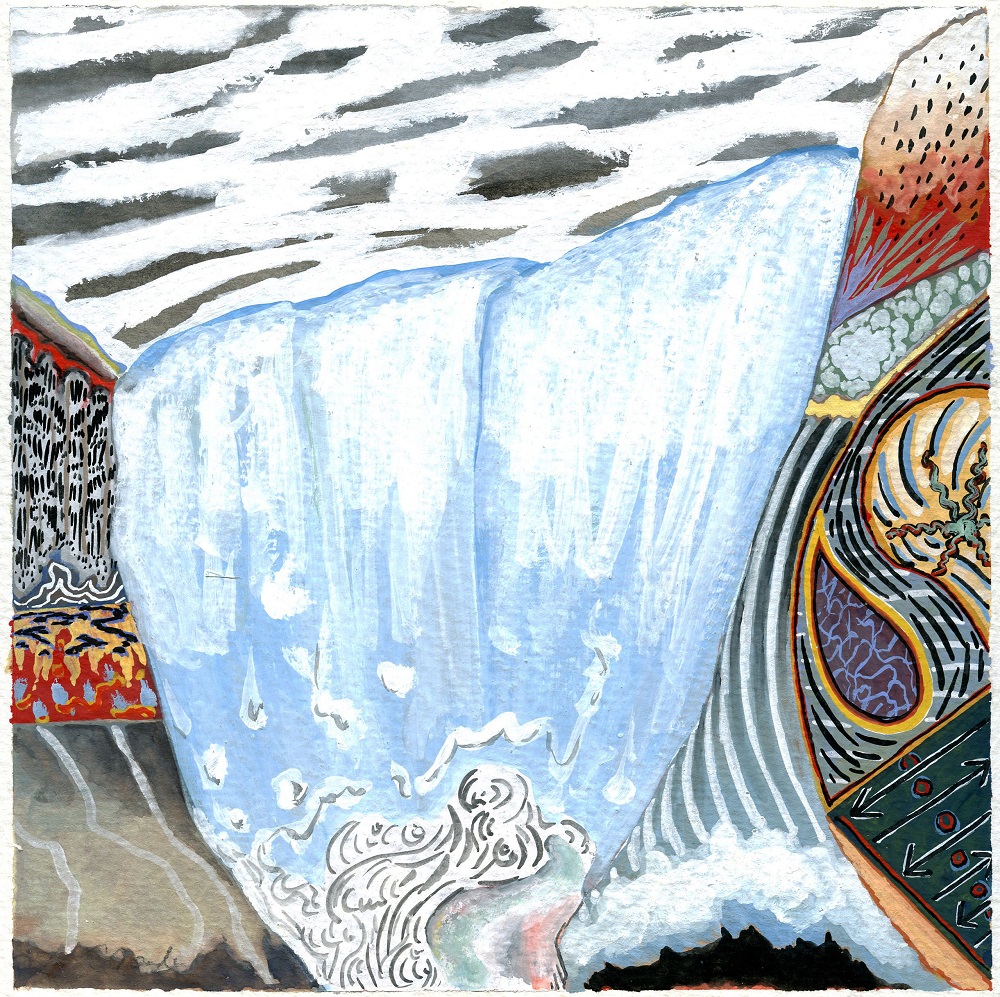 ZP_La Lengua_pintura de Alan Clark
.
La Lengua
.
Estoy “viviendo” tu leyenda sobre mi lengua
(es ésta la tierra santa en que vagaremos…)
Contigo…degustas como las palabras que me vienen,
esta lengua rastreando tus “dondes” más dulces,
y estas palabras hacen cosquillas en la garganta.
Pero está en tu piel que conozco lo que es
la adoración – la lengua, con franqueza, sobre
la piel de sal / sobre brazas de ti
(no bajo del agua sino en un nuevo aire de sal)
en que el universo – que es tú – ríe un “yo” para
bajarme más y más y inventir todas las palabras
que nunca te igualarán – la ola y “materia”
del cuento en el lenguaje de nuestro sueño
unido en nosotros…
Somos diosas y dioses del sudor,
del pecho, de las manos, y de los labios que
hablan solamente cuando no hay nada decir que:
Quede en en lugar oscuro donde están conocidos
tus muslos en lo de mi que está bastante liviano
para buscarte.
. . .
La Lengua
.
I’m living out your legend on my tongue
(this is the holy land we’re wandering in)
with you tasting like the words that come to me,
this tongue tracking down your softest “wheres”,
these words tickling my throat. But in your flesh
I know what worship is, tongue directly
to the salt skin and fathoms of yourself
(not under water, in a new salt air)
in which the universe of you is laughing me
to go down and down to make up all the words
that will never equal you, wave and matter
as the story in the language of our dream
together: goddesses and gods of sweat,
of breasts and hands and lips that only speak
when there’s nothing left to say but: Linger,
in the dark place where your thighs are met
by what of me is light enough to find you.
. . .
Dentro de Ti –
.
Puedo ver la materia prima de sombras
y como el barro se torne en una clase de luz;
que soy como un pez que debe nadar
dentro de un mundo donde se arremolinan la hierba del mar
mientras levantas las manos durante un día caluroso…
Me siento dentro de ti la verde pura de una planta que
se torna en el calor de un horno de sangre;
lo que está ni despierto ni durmiendo en
la concha de un otro día que promete
todo de sí mismo para expectativas no perladas…
El olor en tu animal, la flor de mi lengua de pavo real;
el diccionario de mis sentidos no deletreados como besos; y
siempre – siempre – la libertad del cielo
recogiendo las plumas de un pájaro – tú – que
se monta los alientos cuando miran tus ojos que
pueden asegurar – por la ley rarísima – algo que
nunca viere alguien:
las balanzas de los arcos de iris breves
y la creación del mundo.
. . .
In You –
.
I can see what stuff shadows are made of
and how clay can become a kind of light,
how I’m like a fish who can’t not swim
into a world where the seagrass is swirling
when you lift up your arms on a hot day…
feel in you the raw green of a plant
being turned into heat in an oven of blood,
what lies not awake, not asleep inside
the shell of another day promising
all of itself to no pearl expectations…
smell in your animal, the flower
of my peacock tongue, the dictionary
of my senses unspelled as kisses, and
always, always, the freedom of the sky
gathering the feathers of the bird you are,
who rides the winds when your eyes behold,
who can claim by the strangest of laws
what no-one else could ever see: the scales
of brief rainbows and the world’s creation.
. . .
Poeta y pintor, Señor Alan Clark divide su vida entre Maine en EE.UU. y el México. Guerrero y Sangre del Corazón fue publicado por Henning Bartsch (México, D.F.) Tiene también un poemario de 2010: Where They Know. Sus piezas del teatro incluyen: The End of It, The Couch – The Table – The Bed, and The Beast – y fueron montados en EE.UU. y México. En 2004 tuvo una exhibición de sus pinturas en Rockland, Maine en Farnsworth Art Museum – Sangre y Piedra.
.
Alan Clark is an artist and poet, dividing his life between Maine and Mexico. Guerrero and Heart’s Blood was published in Mexico City by Henning Bartsch. A book of poems, Where They Know, was published in 2010. Clark’s plays –including adaptations of Guerrero and Heart’s Blood – include: The End of It, The Couch – The Table – The Bed, and The Beast; these have been staged in the U.S.A. and in Mexico. Blood and Stone: Paintings by Alan Clark,was at the Farnsworth Art Museum, Rockland, Maine,in 2004.
Versiones en español / Spanish versions: Alexander Best
. . . . .
¿Eva, La Culpable? / Was IT All Eve’s Fault?
Posted: July 28, 2013 Filed under: English, Eva La Culpable...Was It All Eve's Fault?, Jee Leong Koh, Spanish, ZP Translator: Alexander Best Comments Off on ¿Eva, La Culpable? / Was IT All Eve’s Fault?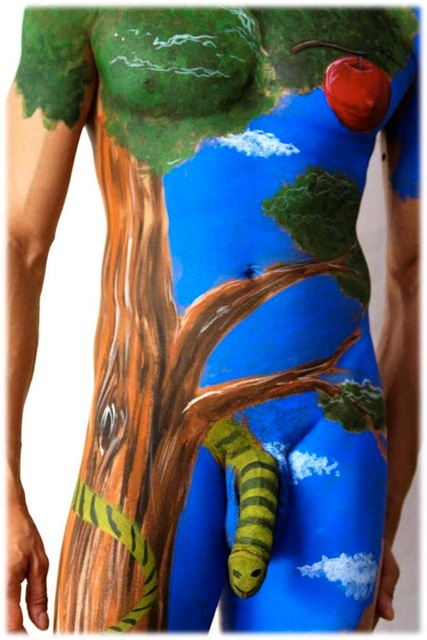 ZP_El Adán reconsiderado…¡Piense en él dos veces!_Adam reconsidered…Give him a second thought!
.
“No Eva…Solo era una cantidad excesiva del Amor, su Culpa.”
(Aemilia Lanyer, poetisa inglés, 1569 – 1645, en su obra Salve Deus Rex Judaeorum: La Apología de Eva por La Mujer, 1611)
.
Jee Leong Koh
“Eva, La Culpable”
.
Aunque se ha ido del jardín, no se para de amarles…
Dios le convenció cuando sacó rápidamente de su manga planetaría
un ramo de luz. Miraron pasar el desfile de animales.
Le contó el chiste sobre el Arqueópterix, y se dio cuenta de
las plumas y las garras brutales – un poema – el primero de su tipo.
En una playa, alzado del océano con un grito, él entró en ella;
y ella, en olas onduladas, notó que el amor une y separa.
.
El serpiente fue un tipo más callado. Llegaba durante el otoño al caer la tarde,
viniendo a través de la hierba alta, y apenas sus pasos dividió las briznas.
Cada vez él le mostró una vereda diferente. Mientras que vagaban,
hablaron de la belleza de la luz golpeando en el árbol abedul;
el comportamiento raro de las hormigas; la manera más justa de
partir en dos una manzana.
Cuando apareció Adán, el serpiente se rindió a la felicidad la mujer Eva.
.
…Porque ella era feliz cuando encontró a Adán bajo del árbol de la Vida
– y aún está feliz – y Adán permanece como Adán: inarticulado, hombre de mala ortografía;
su cuerpo estando centrado precariamente en sus pies; firme en su mente que
Eva es la mujer pristina y que él es el hombre original. Necesitó a ella
y por eso rasguñó en el suelo – y creyó en el cuento de la costilla.
Eva necesitó a la necesidad de Adán – algo tan diferente de Dios y el Serpiente,
Y después de éso ella se encontró a sí misma afuera del jardín.
. . .
“Not Eve, whose Fault was only too much Love.”
(Aemilia Lanyer, English poetess, 1569 – 1645, in Salve Deus Rex Judaeorum: Eve’s Apologie in Defence of Women, 1611)
.
Jee Leong Koh
“Eve’s Fault”
.
Though she has left the garden, she does not stop loving them.
God won her when he whipped out from his planetary sleeve
a bouquet of light. They watched the parade of animals pass.
He told her the joke about the Archaeopteryx, and she noted
the feathers and the killing claws, a poem, the first of its kind.
On a beach, raised from the ocean with a shout, he entered her
and she realized, in rolling waves, that love joins and separates.
.
The snake was a quieter fellow. He came in the fall evenings
through the long grass, his steps barely parting the blades.
Each time he showed her a different path. As they wandered,
they talked about the beauty of the light striking the birch,
the odd behavior of the ants, the fairest way to split an apple.
When Adam appeared, the serpent gave her up to happiness.
.
For happy she was when she met Adam under the tree of life,
still is, and Adam is still Adam, inarticulate, a terrible speller,
his body precariously balanced on his feet, his mind made up
that she is the first woman and he the first man. He needed
her and so scratched down and believed the story of the rib.
She needed Adam’s need, so different from God and the snake
– and that was when she discovered herself outside the garden.
. . . . .
Jee Leong Koh nació en Singapur y vive en Nueva York. Es profesor, también autor de cuatro poemarios.
Jee Leong Koh was born in Singapore and now lives in New York City where he is a teacher.
He is the author of four poetry collections: Payday Loans, Equal to the Earth, Seven Studies for a Self Portrait and The Pillow Book.
. . .
Traducción en español / Translation into Spanish: Alexander Best
. . . . .
Alicia Claudia González Maveroff: “The Storyteller in The Zócalo” / “El Fabulador del Zócalo”
Posted: July 25, 2013 Filed under: Alicia Claudia González Maveroff, English, Spanish, ZP Translator: Alexander Best Comments Off on Alicia Claudia González Maveroff: “The Storyteller in The Zócalo” / “El Fabulador del Zócalo”
.
Alicia Claudia González Maveroff
“The Storyteller in The Zócalo”
.
Earlier today in the Square there was a storyteller
enchanting people with his words – everyone who
was in and around that patch of pavement where he stood.
Those who saw him there were all listening without
so much as uttering a sound.
In The Zócalo this man earns his livelihood, selling
pretty little dolls that wiggle and sway.
Even though you can’t see any strings pulled,
you don’t know how it’s done,
these little dolls –skeletons, rather –
dance, lie down, jump, kneel and walk,
while the vendor chatters like a “fairground charlatan”.
Incredible it was, the gift of the gab that fellow displayed.
He whiled away the time offering to passers-by
a cadaverous doll which seemed to be alive-and-kicking.
Children, mute, admired the dancing doll:
“Look how the dolly can dance!”
The adults present laughed to themselves, “Yeah, right,”
as if to say: “What a scam.”
Yet he captured every one of us, this guy with his confabulations,
presenting those dolls that never ceased to dance.
Who knows what the trick is? There’s no harm in it…
For that reason, in fact, one has to hand it to him this evening,
knowing that this is all a hoax yet rascal-ishly fascinating…
Me, he left me bamboozled, making me believe him,
so I’ve gone and bought one of those little dolls
– in order to be rewarded with a performance.
And I have left the Square happy, yes – knowing that he‘s a crook…
.
Mexico City, July 22nd, 2012
. . .
Alicia Claudia González Maveroff
“El Fabulador del Zócalo”
.
Estaba el fabulador en la plaza hoy temprano,
encantando con palabras,
a todos los que rodeaban el sector donde se hallaba.
Esos que allí se encontraban, lo escuchaban sin hablar.
En el Zócalo este hombre gana su vida, vendiendo
unos muñequitos lindos pequeños que se menean.
Aunque no se ven cordeles, ni sabemos como lo hace,
estos pequeños muñecos, a más decir esqueletos,
bailan, se barazan, se acuestan, saltan, se arrodillan y andan,
mientras el vendedor habla como “charlatan de feria”.
Es increible la labia que este señor nos demuestra.
Pasa su tiempo ofreciendo, a todos los transeuntes,
el muñeco cadaverico, que está vivito y coleando.
Mientras el muñeco baila, los niños, quietos, lo admiran.
¡Cómo baila el muñequito!
Los grandes, sonriendo “a penas”, como diciendo
“¡es un cuento!”
Pero a todos ha atrapado, este señor con su charla,
ofreciendo los muñecos que no paran de bailar.
¿Quién sabe como es el truco? No lo hacen nada mal…
Por eso, por la actuación, que ha brindado él esta tarde,
sabiendo que es un engaño, que es un vil fascinador…
Yo, me he dejado embaucar, haciendo que le creía,
le he comprado un muñequito, para premiar su actuación.
Y me he marchado contenta, sabiendo que es un ladrón…
.
México D.F., 22 – 07 – 2012
.
Alicia Claudia González Maveroff is a professor living in Buenos Aires, Argentina. Her credo, in a single precise sentence, is: I believe in Utopia – because Reality strikes me as impossible.
Alicia Claudia González Maveroff es una profesora que vive en Buenos Aires, Argentina. En una oración sucinta, su consejo es ésto: Creo en la utopía, porque la realidad me parece imposible.
.
Translation and interpretation from Spanish into English / Versión inglés: Alexander Best
. . . . .
Three Poets from Chad, DRCongo and Ivory Coast: “…so that the poem that has forever haunted my steps survives” / Trois poètes du Tchad, de la RDCongo et de la Côte d’Ivoire: “…pour la survie du poème qui hante mes pas depuis toujours”
Posted: July 25, 2013 Filed under: English, French Comments Off on Three Poets from Chad, DRCongo and Ivory Coast: “…so that the poem that has forever haunted my steps survives” / Trois poètes du Tchad, de la RDCongo et de la Côte d’Ivoire: “…pour la survie du poème qui hante mes pas depuis toujours” ZP_A Baobab tree in South Africa during the dry season when they shed their leaves. Traditionally, the ancient, ruggéd Baobab has served as an informal community meeting place where elders tell stories, the town crier announces startling news, and where conflicts may be resolved through public debate under the invisible eye of the ancestors_Un arbre Baobab Za pendant la saison sèche en Afrique du Sud
.
Three Poets from Chad, DRCongo and Ivory Coast:
“…so that the poem that has forever haunted my steps survives” /
Trois poètes du Tchad, de la RDCongo et de la Côte d’Ivoire:
“…pour la survie du poème qui hante mes pas depuis toujours”
. . .
Traductions en anglais / Translations from French into English – droit d’auteur / © Patrick Williamson
Tous les poèmes – droit de chaque auteur / © the respective poets
. . .
Nimrod Bena Djangrang (born 1959, Chad)
“The Cry of the Bird”
(for Daniel Bourdanné)
.
I wanted to be overcome with silence
I abandoned the woman I love
I closed myself to the bird of hope
That invited me to climb the branches
Of the tree, my double
I created havoc in the space of my garden
I opened up my lands
I found the air that circulates between the panes
Pleasant. I was happy
To be my life’s witch doctor
When the evening rolled out its ghosts
The bird in me awoke again
Its cry spread anguish
In the heart of my kingdom.
. . .
“Le Cri de l’Oiseau”
(à Daniel Bourdanné)
.
J’ai voulu m’enivrer de silence
J’ai délaissé la femme aimée
Je me suis fermé à l’oiseau de l’espoir
Qui m’invitait à gravir les branches
De l’arbre, mon double
J’ai saccagé l’espace de mon jardin
J’ai ouvert mes terroirs
J’ai trouvé agréable l’air qui circule
Entre les vitres. Je me suis rejoui
D’être le sorcier de ma vie
Alors que le soir déroulait ses spectres
L’oiseau en moi de nouveau s’est éveillé
Son cri diffusait l’angoisse
Au sein de mon royaume.
. . .
Kama Sywor Kamanda (born 1952, Democratic Republic of Congo)
“In the Silence of Hearts”
.
Now you are queen of my kingdom of dreams!
Woman, I am lost in your darkest night
Without a guiding star!
Carried away by your everchanging soul
As on an infinite sea,
I am drowning in the light of your desires:
Your love of its sensual pleasures transfigured me,
And I distanced my life from the shores of solitude.
It is softness in my heart
Nourished by the blood of lovers!
The fears on the flanks of wind are ripening,
I pray for heaven
To protect your life from all suffering,
And the force of love to safeguard your freedom
Wherever honour
Is a requirement of election.
I will cross gulfs of bitterness
To accede to the sun of your pleasure,
And I will attain the highest summits of your slopes
So that the river of all tenderness will flow down
Broadening as it courses its way.
. . .
“Dans le Silence des Coeurs”
.
Te voici reine de mon royaume des rêves!
Je me sens, ô femme, perdu en ta profonde nuit
En l’absence de l’étoile du voyageur!
Emporté dans les mouvances de ton âme
Comme dans une mer infinie,
Je me suis noyé dans la lumière de tes desirs:
Ton amour de ses voluptés, m’a transfiguré,
Et j’ai éloigné ma vie des rivages de la solitude.
C’est une douceur dans mon coeur
Nourri du sang des amants!
Les peurs mûrissantes sur les flancs du vent,
Je prie pour que le ciel
Préserve ta vie de toute souffrance,
Et que la force de l’amour sauvegarde ta liberté
Sur toutes les terres où l’honneur
Est une exigence d’election.
Je traverserai les gouffres de l’amertume
Pour accéder au soleil de ta jouissance,
Et j’atteindrai les plus hauts sommets de tes versants
En mesure que s’en ira en s’élargissant
Le fleuve de toutes les tendresses.
. . .
“Haunted Houses”
.
Now we have our doubts to cry over.
When identities and years
Become lost in the sands,
Our depressed towns
Smell of roses
Placed on tombstones.
Our houses, haunted
By long periods of solitude
Open up to waves of love,
As abundant as the sea of farewells.
Bitter offerings
People the spheres of our ambitions.
We seek our roots
Like others seek hidden truths.
. . .
“Maisons Hantées”
.
Maintenant, nous avons nos doutes pour pleurer.
Quand les identités et les années
Se perdent dans le sable,
Nos villes moroses
Se parfument de roses
Déposées sur les tombes.
Nos maisons hantées
Par de longues solitudes
S’ouvrent aux vagues de l’amour,
Aussi abondantes qu’une mer des adieux.
Les offrandes amères
Peuplent les sphères de nos ambitions.
Nous cherchons nos racines
Comme d’autres des vérités cachées.
. . .
Suzanne Tanella Boni (born 1954, Ivory Coast)
“Gorée Baobab Island” (four poems)
.
perhaps happiness is so far away
invisible among the tamarind leaves
when my hand brushes the fruit
to share them with spirits laughing at man’s
cruelty to man
.
perhaps the hope in my eyes drags
the future in clouds of dust where I seek
sparks and the dignity of condemned souls
.
when the horizon in the early hours
creates images and silhouettes between sun and sea
you are not here to see my eyes
where you have never seen the humour of the world
. . .
with the blessing of the island’s
invisible inhabitants I become alive again
.
as your look is not a poem
but the vast sea that pours infinite pages
at my feet
. . .
here too I drank at the source
words covered with mildew
like walls oozing all the sorrows
carved on the doors of time
.
I drank the life source
that gives us memory and the capped path
of days to come
I lost count of the mouthfuls of elixir I drank
so that the poem
that has forever haunted my steps survives
.
tomorrow I will return
to hear you talk to me
again of you and me
. . .
here too the sheets where history snoozed
are white and empty
.
the covers of time alone
are green like the last word in the world
when the wind howls
day and night at the gates of chaos
.
then I wrap myself in the words of your look faraway
beyond the sea that separates us infinitely.
 ZP_photographie par Finbarr O’Reilly, Reuters_L’île de Gorée est célèbre pour La Maison des Esclaves et La porte du Voyage sans Retour, d’où partaient pour l’ultime voyage les esclaves acheminés vers les plantations d’Amérique. Gorée Island, just off the coast from Dakar, Senegal, is famous for the 18th-century House of Slaves with its “portal of sorrow” or “door of no return” which faces the westward Atlantic Ocean where ships with their “human cargo” sailed for the slave-fueled coffee, cotton and sugar plantations of The Americas. It is this symbolic “door of no return” which Suzanne Tanella Boni calls the gates of chaos or la porte du chaos (in the French original of her poem).
.
“Gorée Île Baobab” (quatre poèmes)
.
peut-être le bonheur est-il si loin
invisible dans les feuilles de tamarinier
quand ma main effleure les fruits
à partager avec les génies riant des cruautés
faites à l’homme par l’homme
.
peut-être l’espérance dans mes yeux traîne-t-elle
l’avenir en nuages de poussières où je cherche
étincelles et dignité des âmes en sursis
.
quand l’horizon au petit matin
dessine images et silhouettes entre soleil et mer
tu n’es pas là pour voir mes yeux
où tu n’a jamais vu l’humeur du monde
. . .
avec la bénédiction des habitants
invisibles de l’île ici je revis
car ton regard n’est pas un poème
mais toute la mer qui coule à mes pieds
des pages infinies
. . .
ici aussi j’ai bu à la source
des mots couverts de moisissures
comme murs suintant de tous les malheurs
gravés aux portes du temps
.
j’ai bu la source vive
qui nous donne mémoire et chemin majuscule
des jours à venir
j’ai bu je ne sais combien de gorgées élixir
“…pour la survie du poème
qui hante mes pas depuis toujours”
.
demain je reviendrai
entendre ta voix qui me parle
encore de toi et de moi
. . .
ici aussi les draps où l’histoire fait la sieste
sont blancs et vides
.
seule la couverture du temps
est verte comme dernière parole du monde
quand le vent tourbillonne
nuit et jour à la porte du chaos
.
alors je m’enroule dans les mots de ton regard horizon
par-delà la mer nous séparant infiniment.
. . . . .
Jane Kenyon: “Laissons venir le soir” / “Let Evening Come”
Posted: July 24, 2013 Filed under: English, French, Jane Kenyon Comments Off on Jane Kenyon: “Laissons venir le soir” / “Let Evening Come”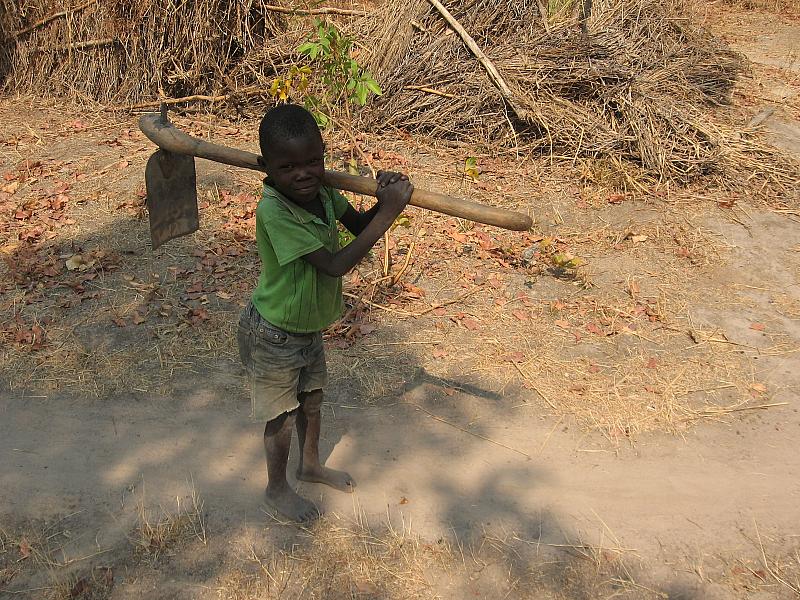 ZP_Garçonnet avec une binette_La Zambie_Little boy with hoe_Zambia_photograph © Boldt
.
Jane Kenyon(1947-1995)
“Laissons venir le soir”
.
Laissez la lumière de fin de journée
briller à travers les interstices de la grange,
pendant que le soleil descend, bougeant sur les bottes de paille.
Laissez le grillon craqueter
comme une femme prend ses aiguilles
et ses fils. Laissez venir le soir.
Laissez la rosée recueillie sur la houe abandonnée
dans les grandes herbes. Laissez les étoiles apparaître
et la lune divulguer sa corne d’argent.
Laissez le renard revenir à sa tanière de sable.
Laissez le vent s’éteindre. Laissez le hangar
aller vers le noir intérieur . Laissons venir le soir..
Pour la bouteille dans le fossé, à la pelle
dans d’avoine, pour l’air dans les poumons
Laissons venir le soir.
Qu’il vienne, comme il le fera, et n’aies
pas peur. Dieu ne nous laisse pas sans
consolation, laissons venir le soir.
. . .
Jane Kenyon (1947-1995)
“Let Evening Come”
.
Let the light of late afternoon
shine through chinks in the barn, moving
up the bales as the sun moves down.
.
Let the cricket take up chafing
as a woman takes up her needles
and her yarn. Let evening come.
.
Let dew collect on the hoe abandoned
in long grass. Let the stars appear
and the moon disclose her silver horn.
.
Let the fox go back to its sandy den.
Let the wind die down. Let the shed
go black inside. Let evening come.
.
To the bottle in the ditch, to the scoop
in the oats, to air in the lung
let evening come.
.
Let it come, as it will, and don’t
be afraid. God does not leave us
comfortless, so let evening come.
. . .
Traduction en français: “ReChab”
Voyez également son site poetique “art et tique et pique” – http://ecritscrisdotcom.wordpress.com
. . . . .
Poemas japoneses – de guerra, del honor, de la ternura – traducidos por Nuna López
Posted: July 20, 2013 Filed under: Akiko Yosano, English, Japanese, Kaneko Misuzu, Sadako Kurihara, Spanish, ZP Translator: Nuna López | Tags: Poemas japoneses de guerra Comments Off on Poemas japoneses – de guerra, del honor, de la ternura – traducidos por Nuna López
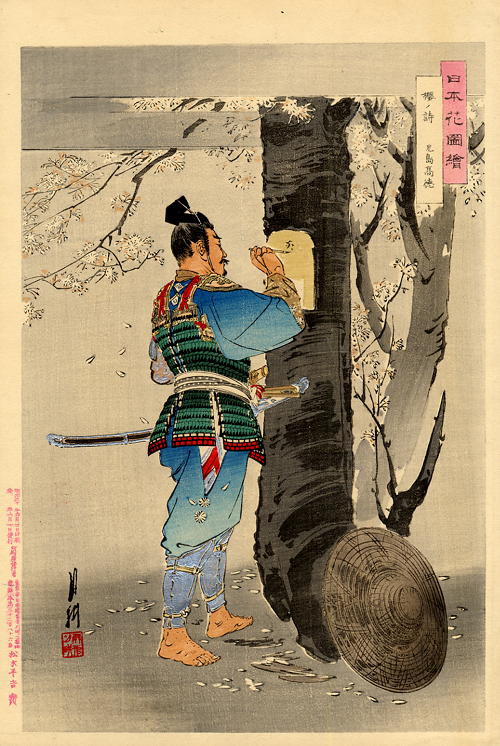 ZP_Samurai writing a poem on a flowering cherry-tree trunk by Ogata Gekko, 1859-1920_ print courtesy of ogatagekkodotnet
.
Ouchi Yoshitaka (a “daimyo” or feudal lord / un “daimyo” o soberano feudal, 1507-1551)
.
Both the victor and the vanquished are
but drops of dew, but bolts of lightning –
thus should we view the world.
. . .
Tanto el vencedor como el vencido no son
Sino gotas de rocío, relámpagos –
así deberíamos ver el mundo.
. . .
Hojo Ujimasa (1538-1590)
Hojo was a “daimyo” and “samurai” who, after a shameful defeat, committed “seppuku” or ritual suicide by self-disembowelment. He composed a poem before he killed himself:
.
“Death Poem”
.
Autumn wind of evening,
blow away the clouds that mass
over the moon’s pure light
and the mists that cloud our mind –
do thou sweep away as well.
Now we disappear –
well, what must we think of it?
From the sky we came – now we may go back again.
That’s at least one point of view.
. . .
Hojo Ujimasa (1538-1590)
“Poema de muerte”
.
Viento otoñal de la noche,
sopla lejos las nubes que obstruyen
la luz pura de la luna
y la neblina que nubla nuestra mente-
también bárrela lejos.
Ahora nosotros desaparecemos –
Y bien, ¿qué deberíamos pensar de esto?
Del cielo vinimos- ahora debemos regresar otra vez.
Ese es al menos un punto de vista.
. . .
The following poem by Akiko Yosano was composed as if to her younger brother who was drafted to fight in the Russo-Japanese War (1904-1905). It was never specifically anti-war only that the poet wished that her brother not sacrifice his life. At the time the poem was not censored but in the militaristic 1930s it was banned in Japan.
.
Akiko Yosano/ 与謝野晶子(1878-1942)
.
Oh, my brother, I weep for you.
Do not give your life.
Last-born among us,
You are the most beloved of our parents.
Did they make you grasp the sword
And teach you to kill?
Did they raise you to the age of twenty-four,
Telling you to kill and die?
.
Heir to our family name,
You will be master of this store,
Old and honoured, in Sakai, and therefore,
Brother, do not give your life.
For you, what does it matter
Whether Lu-Shun Fortress falls or not?
The code of merchant houses
Says nothing about this.
.
Brother, do not give your life.
His Majesty the Emperor
Goes not himself into the battle.
Could he, with such deeply noble heart,
Think it an honour for men
To spill one another’s blood
And die like beasts?
.
Oh, my brother, in that battle
Do not give your life.
Think of mother, who lost father just last autumn.
How much lonelier is her grief at home
Since you were drafted.
Even as we hear about peace in this great Imperial Reign,
Her hair turns whiter by the day.
.
And do you ever think of your young bride,
Who crouches weeping behind the shop curtains
In her gentle loveliness?
Or have you forgotten her?
The two of you were together not ten months before parting.
What must she feel in her young girl’s heart?
Who else has she to rely on in this world?
Brother, do not give your life.
. . .
Akiko Yosano/ 与謝野晶子(Poetisa japonesa, 1878-1942)
.
Oh, hermano mío, lloro por ti.
No entregues tu vida.
El más pequeño de nosotros,
El más amado por nuestros padres.
¿Ellos te hicieron empuñar la espada
y te enseñaron a matar?
¿Ellos te criaron hasta los veinticuatro
para matar y morir?
.
Heredero de nuestro nombre
Tú serás el dueño de esta tienda,
Vieja y honrada, en Sakai, y por eso,
Hermano, no entregues tu vida.
¿A ti que puede importarte
si la fortaleza Lu- Shun cae o no?
En el código de los comerciantes
No hay nada sobre esto.
.
Hermano, no entregues tu vida.
Su Majestad el Emperador
no pelea su propia batalla.
¿Puede él, con su profundamente noble corazón,
pensar que es un honor para los hombres
derramar la sangre de uno y otro
y morir como bestias?
Oh, hermano mío, en esa batalla
no entregues tu vida.
Piensa en mamá, que perdió a papá apenas el otoño pasado.
Qué tan solitaria es su pena en casa
desde que te enlistaron.
Incluso cuando escuchamos sobre paz en este gran Reino Imperial
su cabello se torna más blanco cada día.
.
¿Alguna vez piensas en tu joven novia,
que se acuclilla llorando tras las cortinas de la tienda
con su gentil afecto?
¿O la has olvidado?
Ustedes estuvieron juntos no más de diez meses antes de separarse.
¿Cómo debe sentirse ella en su joven corazón de niña?
¿En quién más puede confiar en este mundo?
Hemano, no entregues tu vida.
. . .
Kaneko Misuzu (Japanese poetess, 1903-1930)
“To Love Everything”
.
I wish I could love them,
Anything and everything.
.
Onions, tomatoes, fish,
I wish I could love them all.
.
Side dishes, and everything.
Because Mother made them.
.
I wish I could love them,
Anyone and everyone.
.
Doctors, and crows,
I wish I could love them all.
.
Everyone in the whole world
– Because God made them.
. . .
Kaneko Misuzu (Poetisa japonesa, 1903-1930)
“Amar todo”
.
Desearía poder amarlos,
a cualquier cosa y a todo.
Cebollas, tomates y pescados,
desearía poder amarlos todos.
Guarniciones y todo,
porque Mamá los hizo.
Desearía poder amarlos,
a cualquiera y a todos.
Doctores y cuervos,
desearía poder amarlos todos.
Todos en todo el mundo
– Porque Dios los hizo.
. . .
Kaneko Misuzu
“Me, the little bird, and the bell”
.
私が両手をひろげても、(watashi ga ryōte wo hirogete mo)
お空はちっとも飛べないが、(osora wa chitto mo tobenai ga)
飛べる小鳥は私のように、(toberu kotori ha watashi yō ni)
地面を速く走れない。(jimen wo hayaku hashirenai)
.
私が体をゆすっても、(watashi ga karada wo yusutte mo)
きれいな音はでないけど、(kirei na oto wa denai kedo)
あの鳴る鈴は私のように、(anonaru suzu wa watashi no yō ni)
たくさんな唄は知らないよ。(takusan na uta wa shiranai yo)
.
鈴と、小鳥と、それから私、(suzu to kotori to sorekara watashi)
みんなちがって、みんないい。(minna chigatte, minna ii)
. . .
Even if I stretch out my arms
I can’t fly up into the sky,
But the little bird who can fly
Cannot run fast along the ground like me.
.
Even if I shake my body,
No beautiful sound comes out,
But the ringing bell does not
Know many songs like me.
.
The bell, the little bird and, finally, me:
We’re all different, but we’re all good.
. . .
Kaneko Misuzu
“El pajarito, la campanilla y yo”
.
Aunque estire mis brazos
No puedo elevarme hacia el cielo
Pero el pajarito que puede volar
No puede correr rápido sobre la tierra, como yo.
.
Aunque sacuda mi cuerpo
Ningún bello sonido se escuchará
Pero la campanilla no conoce
Tantas canciones como yo.
.
La campanilla, el pajarito y finalmente, yo:
Todos somos diferentes pero todos igualmente buenos.
. . .
Kenzo Ishijima(Japanese Kamikaze pilot, WW2 / Piloto japonés kamikaze, Segunda Guerra Mundial)
.
Since my body is a shell
I am going to take it off
and put on a glory that will never wear out.
. . .
Ya que mi cuerpo es una carcasa
Voy a quitármela de encima
Y a vestirme de gloria que nunca se desgastará.
. . .
“Doki no Sakura”: a popular soldiers’ song of the Japanese Imperial Navy during WW2 in which a Kamikaze naval aviator addresses his fellow pilot – parted in death:
.
“Doki no Sakura”(“Cherry blossoms from the same season”)
.
You and I, blossoms of the same cherry tree
That bloomed in the naval academy’s garden.
Blossoms know they must blow in the wind someday,
Blossoms in the wind, fallen for their country.
.
You and I, blossoms of the same cherry tree
That blossomed in the flight school garden.
I wanted us to fall together, just as we had sworn to do.
Oh, why did you have to die, and fall before me?
.
You and I, blossoms of the same cherry tree,
Though we fall far away from one another.
We will bloom again together in Yasukuni Shrine.
Spring will find us again – blossoms of the same cherry tree.
. . .
“Doki no Sakura”: una canción popular entre los soldados japoneses de la Segunda Guerra Mundial:
.
“Flores de cerezo de la misma estación”
.
Tú y yo, flores de un mismo cerezo
que floreció en el jardín de la academia naval.
Flores sabedoras de que deben volar en el viento algún día,
flores en el viento, caídas por su país.
.
Tú y yo, flores de un mismo cerezo
que floreció en el jardín de la escuela de aviación.
Quería que cayéramos juntos, como habíamos jurado hacer.
Oh, ¿por qué tenías que morir y caer antes que yo?
.
Tú y yo, flores de un mismo cerezo,
aunque caemos lejos el uno del otro,
floreceremos juntos otra vez en el santuario Yasukuni.
La primavera nos encontrará otra vez – flores de un mismo cerezo.
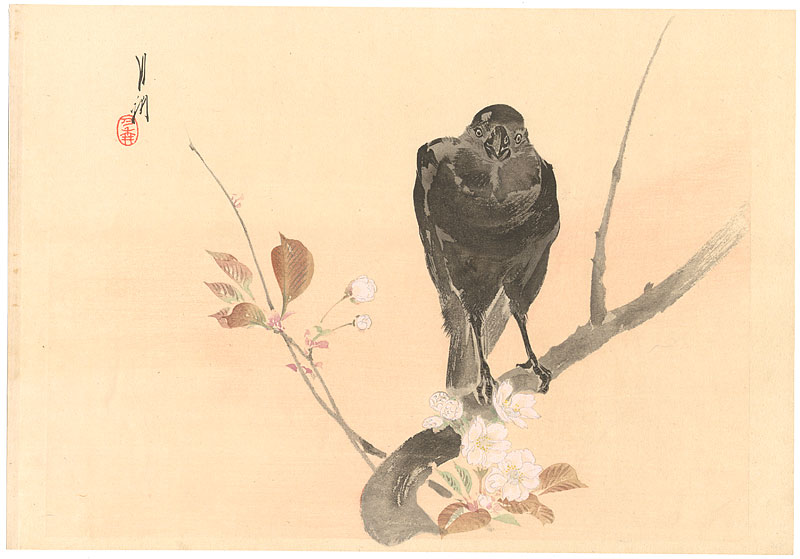 ZP_Cherry Blossom and Crow by Ogata Gekko, 1859 – 1920_print courtesy of ogatagekkodotnet
.
Sadako Kurihara (Japanese poetess, 1913-2005)
“ When we say ‘Hiroshima’ ”
.
When we say Hiroshima, do people answer,
gently, Ah, Hiroshima? …Say Hiroshima,
and hear Pearl Harbor. Say Hiroshima,
and hear Rape of Nanjing. Say Hiroshima,
and hear women and children in Manila, thrown
into trenches, doused with gasoline, and
burned alive. Say Hiroshima, and hear
echoes of blood and fire. Ah, Hiroshima,
we first must wash the blood off our own hands.
. . .
Sadako Kurihara (Poetisa japonesa, 1913-2005)
“Cuando decimos ‘Hiroshima’”
.
Cuando decimos Hiroshima, acaso la gente contesta,
gentilmente, Ah Hiroshima?… Di Hiroshima,
y escucha Pearl Harbor. Di Hiroshima,
y escucha la Violación de Nanjing. Di Hiroshima
y escucha a las mujeres y los niños en Manila, arrojados
en zanjas, empapados en gasolina y
quemados vivos. Di Hiroshima, y escucha
ecos de sangre y fuego. Ah, Hiroshima,
primero debemos lavarnos la sangre de nuestras propias manos.
. . .
Traducciones del inglés al español / Translations from English to Spanish: Nuna López
. . . . .
Les femmes-poètes africaines “griotent” de la Femme et de l’Enfant / African women poets sing, proclaim, and advise about Women and Children
Posted: July 19, 2013 Filed under: English, French | Tags: Femmes-Poètes Africaines Comments Off on Les femmes-poètes africaines “griotent” de la Femme et de l’Enfant / African women poets sing, proclaim, and advise about Women and Children
Les femmes-poètes africaines “griotent” de la Femme et de l’Enfant / African women poets sing, proclaim, and advise about Women and Children
. . .
Berthe-Evelyne Agbo (born 1949, Benin)
“My baby doll”
.
My heart so flooded with joy
Dissolves
At the sight
Of your adorable little face.
.
You’re sleeping, little marvel
In your cloth of green embroidery
Your delicately hemmed eyelashes
Resting on your little round cheeks.
.
From the depth of your sleep
You feel my presence;
You woke up, little kitten
And quickly started the game again.
.
So I watch you wiggling,
Ignoring me in your crib,
Arching your back
And yawning out loud.
.
You talk, you raise your arms
You stretch out in your bed.
That’s it: your head lifted
You look at me astonished.
.
Will you pick me up? your squinting eyes ask
Or, will you watch me a while longer?
Will I have to cry first
Before you understand?
.
And my mother’s heart breaks
At the sight of your falling tears
And I hurry to hold you,
You, so warm and stirring with innocence.
.
That’s it: you’re in my arms, cuddled
You babble and caress my cheek.
With a tender touch I turn you in my arms
I hug you, you talk to me.
.
And my heart is flooded with joy.
. . .
“Ma poupée”
.
Mon coeur chavire de joie,
Tant il fond
A la vue
De ton minois adorable.
.
Tu dors, petite merveille,
Dans tes draps brodés au fil vert,
Tes cils délicatement ourlés,
Posés sur tes joues rondelettes.
.
Du fond de ton sommeil,
tu as senti ma présence;
Tu t’es éveillée, petite chatte,
Et au jeu aussitôt tu t’es mise.
.
Et je te regarde te trémousser
Dans ton berceau, ignorant mon regard,
Tu fais le dos rond
Et tu bâilles à grand bruit.
.
Tu parles, tu lèves les bras
Tu t’étires dans ton lit.
Ça y est: ta tête s’est dressée
Et tu me regardes, étonnée.
.
Vas-tu me prendre? me disent tes yeux bridés,
Ou vas-tu m’observer encore longtemps?
Me faut-il crier d’abord
Avant que tu ne comprennes?
.
Et mon coeur de mère sanglote
A la vue de tes larmes apparues,
Et je me précipite pour te prendres,
Tant tu es chaude et émouvante de candeur.
.
Ça y est: tu es dans mes bras, blottie,
Et déjà tu babilles et me caresses la joue.
Mes bras, d’une caresse, t’entourent,
Je t’embrasses, tu me parles,
.
Et mon coeur chavire de joie.
. . .
Edwige Araba Aplogan (born 1955, Benin)
“The Child”
.
Child from above
Child from below
Child of forgotten desire
Child of love and mystery
Round child, mad child
Wolf Child
Tortured Child
The child of a newfound dream
.
Of a tomorrow that is coming
for you
for us
for them
.
A tight embrace
Flame
Desire
.
We will ride across deserts
from one adventure to another
from red earth to blue dunes
from fortresses torn from silence
.
We will take over the shore of clear water
from war steps into dance steps
from songs of love and hope
Of life snatched
From the void of the present.
. . .
“L’enfant”
.
L’enfant d’en haut
L’enfant d’en bas
L’enfant du désir oublié
L’enfant d’amour et de mystère
L’enfant boule, l’enfant fou
L’enfant loup
L’enfant torture
L’enfant d’un rêve retrouvé
.
D’un demain qui s’annonce
pour vous
pour nous
pour eux
.
Une étreinte
Flamme
Désir
.
Nous chevaucherons les déserts
d’aventures en aventures
des terres rouges aux dunes bleues
des forteresses arrachées au silence
.
Nous prendrons la rive d’eau claire
de pas de guerre en pas de danse
de chants d’amour et d’espérance
De vie arrachée
à la béance du présent.
. . .
Aminata Athié (born 1960, Senegal)
“A Seller of Women”
.
Have you passed by my stall? The seller of women is a man who
knows how to show off his merchandise. You should see him
do his thing or better still hear him: He puts on a show, almost
like magic, a little bit the con-man but terribly charming…In
fact, his pitch was so persuasive that a mob of people hurried to
gather around him. You would have seen the crowd packed in
there. Even I tried to stop, but I was in a hurry…And besides, I
could not myself be a buyer, since you had to have a good pair of
moustaches. As for the merchandise, I am not a lover of antiques:
the piece is so strange that I would risk losing my Pulaar…
Besides, I don’t even know anymore which side of the market his
stall is on. If you were to ask certain people…
.
Sister Soul
White Goose
My dove
My sweet Grave
.
Call her by every name
sweet names, names
of honey, butter, flour
.
names of things to eat
names of things to caress
names of things to trample
Call her by every name
.
The Woman is good to possess
The Woman, pride of the house
.
You must have a woman
She was an angel, the woman
Paradise is paved with good women
.
A woman-heater for winter
Woman-table for the living room
A woman air-conditioner for summer nights
Woman-seed for rainy seasons
.
Cotton-cloth woman
Lemonade-woman
Pomade-woman for bad skin
.
Call her by every name
.
The dry composed candidate
.
Stubborn-statuette woman
Chatterbox-woman
Leech-plump-woman
Hell-on-wheels woman
.
Slap-woman
Talisman-woman
Stallion-woman
.
Call her by every name
.
The woman, good to display
The woman, jewel of the house
.
They come in all shapes
There is one for every taste
.
Golden woman
Gilded woman
Woman-body
Woman-cowry
.
And even a bad-luck woman
And even fossil-woman
.
The Woman, good to console
The Woman, household rubbish
.
I sell the woman, an object
of premium necessity
.
You must have a woman
She was made from the mire – woman
.
She eats
She drinks
She sleeps
Woman is scared
Madame adorns herself
Woman weeps
.
Woman of length
Woman of breadth
Woman of depth.

“Marchand de Femmes”
.
Etes-vous déjà passé près de mon étal? Le marchand de femmes
est un homme qui sait vanter sa marchandise. Il faut le voir
à l’oeuvre ou plutôt l’écouter: cela tient du spectacle, un peu
comme la magie, un tantinet charlatan mais terriblement
charmeur…En effet, la réclame était si persuasive que bientôt
un tas de gens se pressaient de son côté. Il fallait voir la foule
agglutinée…Moi-même, j’ai tenté de faire un crochet mais
comme j’étais pressée.
…Et puis, cela ne devrait pas me concerner côté acheteur, il
fallait une bonne paire de moustaches. Quant à la marchandise,
je ne suis pas amatrice d’antiquité: le produit est si curieux que
je risque d’y perdre mon…pular! D’ailleurs, je ne sais même
plus de quel côté du marché il tient son étal. Si vous demandiez
à certains…
.
Ame soeur
Oie blanche
Ma colombe
ma douce tombe
.
Appelez-la de tous les noms
de noms doux, de noms
sucrés-miel, beurre, farine
.
des noms de choses à manger
des noms de choses à caresser
des noms de choses à fouler aux pieds
Appelez-la de tous les noms
.
La femme est bonne à posséder
La femme, un orgueil de la maison
.
Il faut avoir une femme
C’était un ange, la femme
Le paradis pavé de bonnes femmes
.
Femme-chauffage pour l’hiver
Femme-console pour ton salon
Femme-climatiseur pour nuits d’été
Femme-semence pour l’hivernage
.
Femme-cotonnade
Femme-limonade
Femme-pommade pour peaux malades
.
Appelez-la de tous les noms
.
La candidate-aride-impavide
.
Femme-statuette-têtue
Femme-à-la-langue-trop-pendue
Femme-sangsue-dodue
Femme-enfer-de-fer
.
Femme-taloche
Femme-talisman
Femme-étalon
.
Appelez-la de tous les noms
.
La femme, bonne à exhiber
La femme, bijou de la maison
.
Il y en a de toutes les formes
Vous en avez pour tous les goûts
.
Femme d’or
Femme dorure
Femme-corps
Femme-cauris
.
Et même la femme-mauvais sort
et même la femme fossile
.
La femme, bonne à consoler
La femme, rebut de la maison
.
Je vends la femme, objet
de première nécessité
.
Il faut avoir une femme
C’était de la fange la femme
.
Elle mange
Elle boit
Elle dort
La femme a peur
Madame se pare
La femme pleure
.
Femme en long
Femme en large
Femme en profondeur.
. . .
Monique Ilboudo (born 1959, Burkina Faso)
“Closed for Inventory”
.
There is nothing to sell today
No smile
No sweet word
No sour word
No sweet and sour word
I am closed
Closed for inventory
.
I am not buying anything today
No crazy laugh
No sweet talk
No sour talk
No sweet and sour talk
I am closed
Closed for inventory
.
The entire store will be inspected today
The empty shelves
The full shelves
The half-full shelves
Everything will be dusted
Everything will be checked
Everything will be rechecked
Everything will be counted
.
Everything will be weighed on a scale
Nothing will be ignored
On the left tray the assets
On the right tray the liabilities
.
Tomorrow if everything isn’t up for grabs
If some energy is left for selling
If she finds her wholeness again
The store will be open again – maybe.
But today there is nothing for sale
Nothing to buy, nothing to grab.
I am closed,
Closed for inventory.
 “Fermée pour inventaire”
.
Il n’y a rien à vendre aujourd’hui
Ni sourire
Ni mot doux
Ni mot aigre
Ni mot aigre-doux
Je suis fermée
Fermée pour inventaire
.
Je n’achète rien aujourd’hui
Ni fou rire
Ni échange de propos doux
Ni échange de propos aigres
Ni échange de propos aigre-doux
Je suis fermée
Fermée pour inventaire
.
Toute la boutique sera visitée aujourd’hui
Les rayons vides
Les rayons pleins
Les rayons à moitié vides
Les rayons à moitié pleins
Tout sera épousseté
Tout sera vu
Tout sera revu
Tout sera compté
Sur une balance tout sera pesé
Rien ne sera lésé
Sur le plateau gauche l’actif
Sur le plateau droit le passif
.
Demain si tout n’est pas à prendre
S’il reste de l’énergie à vendre
Si elle retrouve son bien-être
La boutique rouvrira peut-être
Mais aujourd’hui il n’y a rien à vendre
Rien à acheter rien à prendre
Je suis fermée
Fermée pour inventaire.
. . .
Irène Assiba d’Almeida (born 1945, Senegal)
“Waves of Pleasure”
.
You will never know
The profound joy
Of a woman
Satisfied
In the innermost depth of her body
After the tender touch
Of her lover
.
Dizzy in ecstasy
Her waist beads
Become song
Swaying with desire
Her whole body
Shivering
Rising over undreamed mountains
Arched with pleasure
She is soon
A sea becalmed
Still drifting
Her “little death” still sumptuously alive
After, long after sleep
After, long after awakeniing
.
You will never know
The profound joy
Of a woman
Satisfied
In the innermost depth of her body
After the tender touch
Of her lover.
. . .
“Vagues de plaisir”
.
Tu ne sauras jamais
La joie profonde
De la femme
Satisfaite
Au tréfonds de son corps
Après la tendre caresse
De l’amant
.
Dans le vertige de l’extase
Ser perles aux reins
Deviennent chanson
Ondoyante de désir
Tout son corps
Devient frisson
Hissée sur des sommets insoupçonnés
Arc-boutée de plaisir
Elle est bientôt
Mer étale
Et même dans l’abandon
Sa ‘petite mort’ reste somptueusement vivante
Après, bien après le sommeil
Après, bien après le réveil
.
Tu ne sauras jamais
La joie profonde
De la femme
Satisfaite
Au tréfonds de son corps
Après la tendre caresse
De l’amant.
. . .
Marie Claire Dati (born 1955, Cameroon)
“Jubilation”
.
The Good Lord made me a woman
A silken feather soothing life
Spicy islands drunken escape
A tangerine woman, a fruit-juice woman
Woman a tear, woman a pout
And a savannah and a spring and a bamboo and colours
That fall silent in a single hymn
While a hundred moving fires a thousand lights
Bathe the choruses of the miracle world
.
Woman! Nothing. But Woman, the Good Lord made me
Everything
Firefly of the volcanoes infernal rosebush
Melody in the night of the wanderer
Avowing angelic serenades woman
Fireworks woman
Woman doe of a virile prestige
Woman hope of children
Woman arranger of time
And a savannah and a spring and a bamboo and colours
That melt into the peacful sky of my soul
Tasting of the voluptuous spasms
That my heart, O Grace, speechless with plenitude
Adores in the secret of endless joy.
. . .
“Jubilation”
.
Le Bon Dieu m’a faite femme
Plume de soie berce vie
Piquantes îles évasion ivresse
Femme mandarine, femme jus de fruits
Femme une larme femme une moue
Et savane et printemps et bambou et couleurs
Se taisent en un hymne unique
Quand cent feux fluides mille lumières
Baignent le monde à miracle les choeurs.
.
Femme! Rien. Mais Femme, le Bon Dieu m’a faite
Tout
Luciole des volcans rosier infernal
Mélodie dans la nuit du promeneur
Femme aveux des sérénades d’anges
Femme feu d’artifice
Femme biche du prestige viril
Femme espérance des enfants
Femme ordre du temps
Et savane et printemps et bambou et couleurs
Se scellent en un ciel de paix dans mon âme
Goûtant aux spasmes voluptueux
Que mon coeur, ô grâce, muet de plénitude
Dans le secret des joies sans borne, adore.
. . .
Madeleine de Lallé (born 1955, Burkina Faso)
“Man”
.
When I came of age
And tradition dictated I should marry
My father took me aside one evening
And confided this to me:
“When you can listen to a man
Insult you without saying a word
And without being upset
Then come and tell me you are getting married:
Man is a feeble being
Who cannot admit he is so.
When he becomes angry
His ears withdraw
From the mouth that reasons with him.
Let him say what he wants to say,
And caress him where you can.
When he calms down and
Comes back to your arms
Embrace him as if he is your prize,
Soothe him as best you can
– He recognizes the mother in you.
And that makes him feel like a man.”
. . .
“L’homme”
.
Quand j’eus l’âge de raison,
Et que la coutume voulut que je me marie,
Mon père me retint un soir
Et me confia ceci:
“Quand tu pourras écouter un homme
T’insulter sans mot dire,
Et sans t’émouvoir,
Viens alors me dire que tu te maries:
L’homme est un être faible
Qui n’admet pas qu’on le lui montre.
Quand il se met en colère,
Ses oreilles s’éloignent
De la bouche qui le raisonne.
Laisse-le dire ce qu’il veut,
Et caresse-le où tu peux.
Quand il se calmera et
Qu’il reviendra dans tes bras,
Serre-le comme ton bien,
Berce-le comme il faut.
Il reconnaît alors en toi la mère.
Et c’est ainsi qu’il se sent homme.”
. . .
Ndèye Coumba Mbengue Diakhaté (1924-2001, Senegal)
“Seasons of Life”
.
That morning she stepped out as if she were flying
Her boubou* of muslin was spread out like wings!
Her feet barely touched the ground:
Because, finally, that morning she was to be married.
.
At noontime, she was walking steadily, quickly ahead
Her boubou of cotton was clinging with sweat
The children, the housework and her husband waited
For a mother, a wife, what turmoil in a house!
.
In the evening she set off, heavy on her feet
Her faded boubou made her look even more stooped.
The worry, the torture, and the years had passed;
Then the grown children had left her.
.
In the night she kept watch near the dying fire
Like her husband, the old man, had done one evening.
Alone in the world! In the night telling her beads
And the hours that follow each other foretelling the end.
.
*boubou – a large dress resembling a tunic or caftan

“Saisons de la vie”
.
Elle allait ce matin, on eût dit qu’elle volait;
Son boubou de mousseline lui faisait comme des ailes!
Ses pieds si légers effleuraient le sentier:
Car enfin ce matin elle allait se marier.
.
Elle marchait ce midi d’un pas ferme et pressé;
Son boubou de coton, de sueur lui collait;
Les enfants, le ménage, et son homme qui attend:
Pour une mère, une épouse, quel tracas qu’une maison!
.
Elle partait dans le soir, en pesant sur ses pas;
Son boubou délavé la faisait plus voûtée:
Les soucis, les tortures, et les ans ont passé;
Les enfants à leur tour, une fois grands, l’ont quittée.
.
Elle veillait dans la nuit, près du feu qui se meurt,
Comme un soir l’avait fait son vieil homme de mari.
Seule au monde! Dans le noir, égrenant son chapelet,
Et les heures qui se suivent, annonçant la dernière.
. . .
“Griot of My Race”
.
I am the griot of my race
Poet, troubadour
I loudly sing of my race, my blood
That proclaims who I am
.
I am…ebony wood
Not consumed by the slow fire of lies
I am…the red laterite of the fierce blood of my ancestors.
I am…the virgin wilderness
The kingdom of howling monkeys
.
Not the Negre from troubled neighbourhoods
Relegated to fetid mire, the clinging soot
There, in the grey city, that crushes, that kills.
.
I am…the one you ignore
The sunlight without illusion, not the hypocritical neon.
I am…the calm moonlight, complicit in nocturnal love games
I am the blood that gallops, rearing with impatience
In the maze of my arteries
I am the one you ignore
I spit on your vile spirit.
.
And watch how I break the chains
And the lie of silence
That you hurled at me.
. . .
“Griot de ma race”
.
Je suis le griot de ma race:
Poète, troubadour;
Je chante très haut ma race, mon sang,
Qui clame qui je suis.
.
Je suis…bois d’ébène,
Que ne consume le feu lent du mensonge.
Je suis…la latérite rouge du sang farouche de mes ancêtres.
Je suis…la brousse inviolée,
Royaume des singes hurleurs
.
Pas le Nègre des bas quartiers,
Relégué dans la fange fétide, la suie qui colle;
Là-bas, dans la ville grise, qui accable, qui tue.
.
Je suis…qui tu ignores:
Soleil sans leurre; pas le néon hypocrite.
Je suis…le clair de lune serein, complice des ébats nocturnes
Je suis le sang qui galope, se cabre d’impatience
Dans le dédale de mes artères.
Je suis qui tu ignores.
Je crache sur l’esprit immonde.
.
Et voici que je romps les chaînes,
Et le silence menteur
Que tu jetas sur moi.
. . .
Cécile-Ivelyse Diamonéka (born 1940, Congo)
“For Karim”
.
I saw him
Forgotten by everyone
Including me
I saw him
On the highway
Hoping to be crushed into it
And melt into nothingness
Everyone
Cried as one:
He is lost! He is done!
Good for prison
For life in prison
And the rest of us, well-off
By the tens and hundreds,
We had seen in him the essential evil
Delinquent
Habitual criminal
Murderer
And no-one said
A little love
A little sunshing
A little chance for happiness
Like all the children on Earth.
We fled from him as from the fatal plague
Of Oran…
Still, by the light of the moon,
We cried out together
We love children!
Long live The Year of the Child!

“A Karim”
.
Je l’ai vu
Moi aussi
Oublié de tous
Je l’ai vu
Sur le macadam
Comptant s’y faire broyer
Et s’y fondre dans le néant
Tout le monde
D’un seul cri:
Il est perdu! Il est fini!
Bon pour la prison
La prison à vie
Et nous tous, bien portants
A dix, à cent
Nous avons vu en lui le mal en être
Déliquant
Récidiviste
Assassin
Et personne n’a dit:
Un peu d’amour
Un peu de soleil
Une chance de bonheur
Comme tous les enfants de la Terre
Nous l’avons fui en peste mortelle
D’Oran
Pourtant, au clair de lune
Nous avons crié en choeur:
Nous aimons les enfants!
Vive l’Année de l’Enfant!
. . .
Colette Houéto (born 1939, Benin)
“Women, Tell Us”
(For women of all races)
.
Unspeakable silence
Imcomprehensible speech
From all these women
Meeting one day at the conference
Of our commonality.
.
Women, tell us
You who know
The water, the air and the wind
The naked hearts
For you who desire
The flame of a candle.
Why space and repose
Don’t have the same feeling
In the pathways of your bodies.
Tell us, you who give
The beginning and the longing
The pleasure and the essence
Why from our freedoms
The night is born
.
And here it is that the silence alienated for so long
Seizes speech in the name of a manifesto
Of all women
Rising
.
Why why do you demand
Artificial paradises, men!
Well then, listen
One last time
Like the wretched
Of the earth
Our hearts are filled with your treason
Exasperated by your beautiful vileness
By your fugitive “I love yous”
Tired of the clever architecture
Of your piecemeal speeches.
We are coming now at dawn
To propose a new pact.
.
Let us be the artisans of Renaissance
Of newborn Common Knowledge
And of Recognition
Today as one
Let us cheer with our watery eyes
The fragrant dance of
Our cactus flowers
Let us go
Let us find again the familiar ways
Of our streets
Of our fields
Of our factory pavements
Let us intertwine our hands our thoughts
Our doubts our intuitions
And our affirmed desires.
Then on the wet grasses
Beneath the blossoming
Cailcidrat trees of our valleys
Let us reclaim time
And re-create the history
Of our future works
With the living milk of the seed
And the patience of the roots of light.
. . .
“Dites-nous, femmes”
(A toutes les races de femmes)
.
Silence inexprimable,
Parole indéchiffrable
De toutes ces femmes
Un jour rencontrées au confluent
Du partage.
.
Dites-nous femmes
Qui savez
L’eau, l’air et le vent
Les coeurs mis à nu
Pour vous qui voulez
La flamme d’une chandelle
Pourquoi l’espace et le repos
N’ont pas le même goût
Sur les sentiers de votre corps
Dites-nous vous qui donnez
L’origine et la faim
Le plaisir et l’essence
Pourquoi nos libertés
Enfantent la nuit.
.
Et voici que le silence longtemps aliéné
Prend la parole au nom du manifeste
De toutes les femmes
Debout
.
Pourquoi pourquoi demandez-vous
Hommes des paradis artificiels
Et bien écoutez donc
Une dernière fois
Semblables aux parias
De la terre
Nos coeurs gorgés de vos trahisons
Exaspérés du bel immonde
De vos “je t’aime” fugitifs
Las des architectures sournoises
De vos discours en miettes
Viennent au point du jour maintenant
Proposer un nouveau pacte.
.
Soyons les artisans de Renaissance
De Co-naissance
Et de Reconnaissance
Ensemble aujourd’hui
Saluons d’un même regard mouillé
La danse parfumée des fleurs
De nos cactus
Partons
Retrouvons les parcours familiers
De nos rues
De nos champs
De nos trottoirs d’usines
Echangeons nos mains nos pensées
Nos doutes nos intuitions
Et nos désirs assumés
Puis sur les herbes humides
Sous les frondaisons épanouies
Des Caïlcédrats de nos vallées
Apprivoisons le temps
Et recréons l’histoire
De nos oeuvres d’avenir
Avec la sève vive de la graine
Et la patience des racines de lumière.
. . .
Werewere Liking (born 1950, Cameroon)
“Lend me your Body”
.
He said to her:
Lend me your body, mother of life,
Let it be a covering, a shield
Against the coldness of my solitude,
Against my fragility, my timidity,
Against the fear that slows my action.
.
Lend me your body, woman of my life,
Your body like a pedestal, like a costume,
And I will perform my acts of life –
Like my seed in the space of your loins
– my acts for you – like a beautiful dance.
.
Lend me your body with your heart that inflames me,
Your heart that implicates me, that calls to my soul
Do not deny it – I can no longer sleep with your cries of silence.
Lend me your body that walks as if dancing,
Say Yes – and let life become a rhythm to us.
. . .
“Prête-moi ton corps”
.
Il lui avait dit:
Prête-moi ton corps, mère de la vie
Comme une couverture, un bouclier
Contre le froid de ma solitude
Contre ma fragilité, ma timidité
Contre la peur qui me freine l’activité.
.
Prête-moi ton corps, femme de ma vie
Ton corps comme un socle, un habit
Et je poserai mes actes dans la vie
Comme au creux de tes reins ma semence
Mes actes pour toi, comme une belle danse.
.
Prête-moi ton corps avec ton coeur qui m’enflamme
Ton coeur qui m’implique, qui en appelle à mon âme
Ne le nie pas, je ne dors plus des cris de ton silence
Prête-moi ton corps qui marche comme on danse
Dis-moi Oui, et que la vie nous devienne une cadence.
. . .
Fatou Sonko (Senegal)
“My favourite Toy”
.
My doll of yesterday is now real
She is as alive as I am
Pretty baby breathing health
Your tranquility disquiets me
Your tears sadden me
Your laughter relieves me
My favourite toy
Your joy engrosses me
I love when your feet row through the joyful air
The moving of your small rose hands turns your bath
Ecstatic
Your miniscule nose represents your innocence
Your are all gentleness when you sleep with your fists closed
Your whole body is life in miniature.

“Mon jouet préféré”
.
Ma poupée d’hier est devenue réelle
Elle est aussi vivante que moi
Joli bébé respirant la santé
Ta tranquillité m’inquiète
Tes pleurs m’attristent
Tes rires me soulagent
Mon jouet préféré
Ta joie me préoccupe
J’aime quand tes pieds rament l’air rempli d’allégresse
Le mouvement de tes petites mains roses rend ton bain
Euphorique
Ton nez minuscule symbolise ton innocence
Tu es tout doux quand tu dors les poings fermés
Ton corps tout entier est la vie en miniature.
. . .
Fatou Ndiaye Sow (1956-2004, Senegal)
“Lullaby”
.
Ey Sama Neene Tutti! *
If you dry your tears
I will sing you a song
Of the wonders of the Universe
Ey Sama Neene
If you dry your tears
I will carry you in a pagne
Woven out of sun rays
Ey Sama Neene
If you dry your tears
I will give you a bouquet of stars
To find again your smile at dawn
Ey Sama Neene!
Aayoo Beyo Beyo
Aayoo…
.
* “Hush, my little baby!”
. . .
“Berceuse”
.
Eye Sama Néné Touty!
Si tu sèches tes larmes
Je te ferai un berceau
Des merveilles de l’Univers
Eye Sama Néné
Si tu sèches tes larmes
Je te porterai dans un pagne
Tissé de rayons de soleil
Eye Sama Néné
Si tu sèches tes larmes
Je t’offrirai un bouquet d’étoiles
Pour retrouver ton sourire aurore
Eye Sama Néné!
Ayo Béyo Béyo
Ayo…
. . .
Orthense Tiendrébéogo (Guinea)
“I would like to be a Griot”
.
I would like to be a griot,
To make words dance,
Modulate them on my tongue,
And make them slip across my lips;
Recapture them in the air,
To melt them again, explode them,
Polish them, caress them and make them soar.
.
I would like to be a griot, and with a loud voice
Smash the silence of the night,
Hammer on the sleeping conscience,
Shake off the obscuring veils,
Open a fissure
That would let the light escape
And keep the eyes awake.
.
I do not want to be the griot
Of the King, the Strong, the Rich,
Nor of any Power…
.
I would like to be a griot,
To be involved
Only in what fashions a human being.
. . .
“Je voudrais étre griot”
.
Je voudrais être griot,
Pour faire danser les mots,
Les moduler sur ma langue,
Et les faire glisser sur me lèvres;
Les reprendre dans l’air,
Pour les refondre, les éclater,
Les polir, les caresser et les faire voler.
.
Je voudrais être griot, et d’une voix forte
Rompre le silence de la nuit,
Marteler les consciences endormies,
Secouer les voiles obscurcissants,
Créer une fissure
Qui laisse passer la lumière,
Et maintenir les yeux éveillés.
.
Je ne voudrais être griot
Ni du Roi, ni du Fort, ni du Riche,
D’aucune Puissance…
.
Je voudrais être griot,
Pour ne m’intéresser
Qu’à ce qui construit l’homme.
. . . . .
Photographs:
Femme de la Gambie_Gambian woman
Fabric vendor_Lagos, Nigeria
South African woman_photograph © Steve Evans
Father with his toddler
Two Nigerian children_photograph © G. K. Sholanke
Mother with her toddler
. . . . .
Traductions en anglais / Translations from French into English – droit d’auteur © Professeure Janis A. Mayes. Tous les poèmes – droit de chaque auteur © the respective poetesses
. . . . .
“Los Tres Arbolitos” de Clovis S. Palmer y “Árboles” de Joyce Kilmer
Posted: July 11, 2013 Filed under: Clovis S. Palmer, English, Joyce Kilmer, Spanish, ZP Translator: Alexander Best Comments Off on “Los Tres Arbolitos” de Clovis S. Palmer y “Árboles” de Joyce Kilmer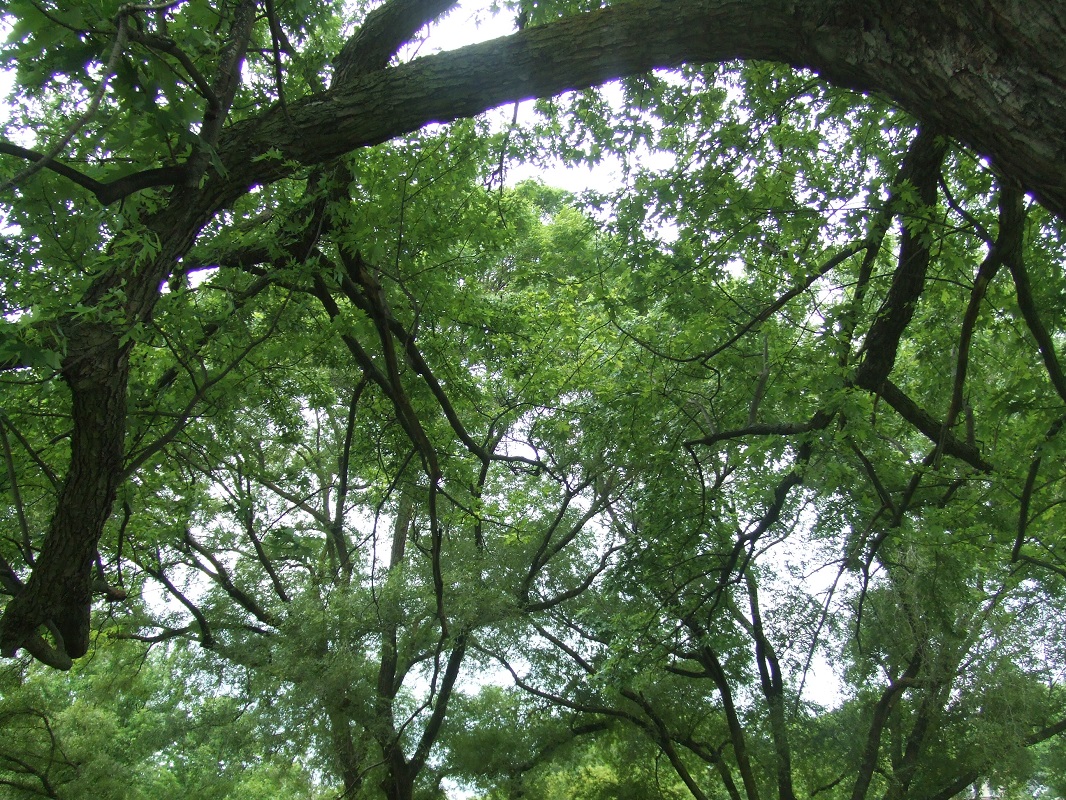
Clovis S. Palmer
“Los Tres Arbolitos”
.
Es redondo el mundo que nadie no ve,
y hay árboles de todas necesidades.
Algunos puedan ser grandes – otros, pequeños
– o, quizás, como muñequitos.
Puedan variar los árboles, tamaño por tamaño,
Están vistos por todas partes – y entre diques también.
Y nadie sabe de donde vienen.
.
Recordó mi mente unos tres arbolitos
– sobre una colina – a las tres y cuarto
– sí, sobre una colina y junto al molino
– tres arbolitos con miembros oleandos.
Estaban allá – cansados, hambrientos
– y esperaban por un jarrito de cerveza.
Sin embargo, se quedaron dormidos,
con sus manos colgantes
– directo allí.
. . .
Señor Palmer hoy es médico y escribió este poema cuando era niño de trece años (en 1987). En ese tiempo vivía en su pueblito natal de Manchioneal, Distrito de Portland, Jamaïca. Muestra el poema el “surrealismo natural” de la mente de la niñez. . . .Clovis S. Palmer
“Three Little Trees”
.
The world is round, which no one sees,
Having trees of all different needs.
Some may be big, some may be small – or even like a little doll.
Trees may vary from size to size,
Trees are seen from miles to miles.
Trees are seen from dam to dam and no one knows where they came from.
.
My mind went back on three little trees
Upon a hill – a quarter past three –
Upon the hill beside a mill, three little trees waving their limbs,
Hungry and tired the trees were there,
Waiting for a cup of beer.
Nevertheless, they fell asleep,
Having their hands hanging right there.
. . .
This poem was composed in 1987, in Manchioneal, Portland Parish, Jamaica, when Dr. Palmer was 13 years old. It displays the qualities of “natural surrealism” that only a child’s mind can create, whereas adults must strive greatly to see the world in such a way.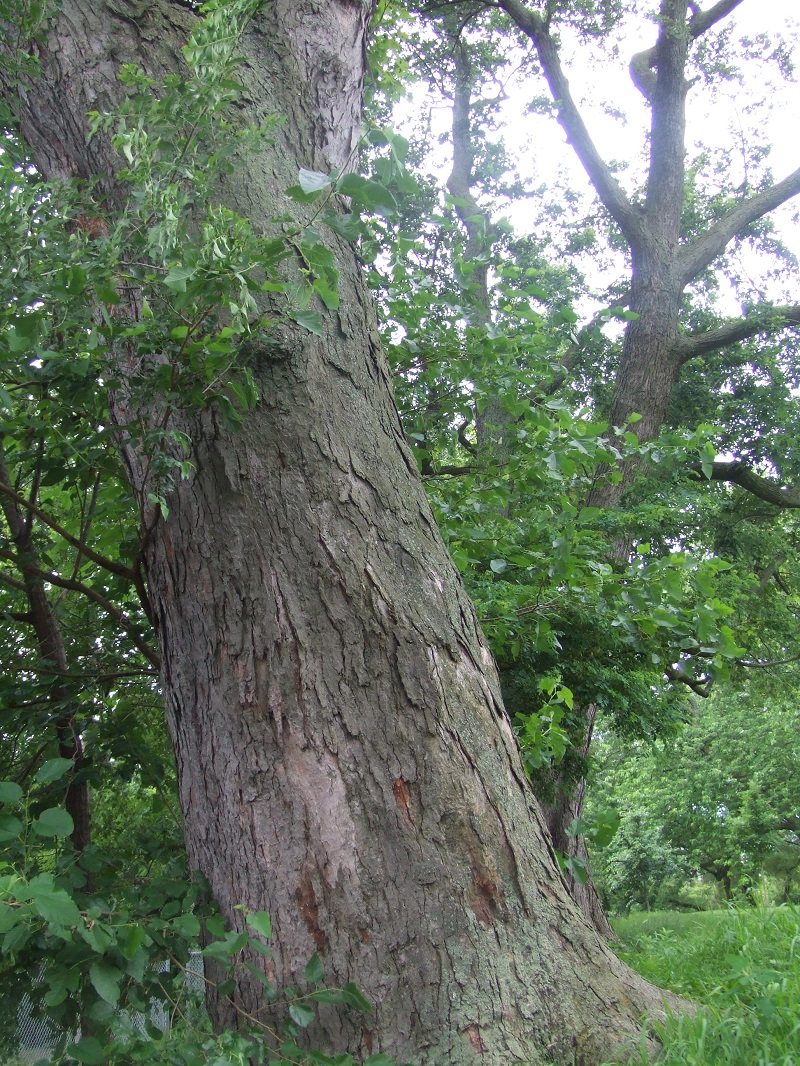
Joyce Kilmer (1886-1918)
“Árboles”
.
Creo que nunca veré
un poema tan hermoso como un árbol.
Un árbol cuya boca hambrienta esté pegada
al dulce seno fluyente de la tierra;
un árbol que mira a Dios todo el día.
Y alza sus brazos frondosos para rezar.
.
Un árbol que en verano podría llevar
un nido de petirrojos en sus cabellos;
en cuyo pecho se ha recostado la nieve;
quien vive íntimamente con la lluvia.
.
Los poemas están hechos por bufones como nosotros,
Pero solo Dios puede hacer un árbol.
. . .
Escrito en 1913, el poema “Árboles” es verso bien amado entre los hablantes del inglés americano y canadiense. Claro, es muy sentimental – faltando los sellos distintos del modernismo – pero dura su estima popular porque las palabras son sinceras – de lo más hondo del corazón. . . .Joyce Kilmer (1886-1918)
“Trees”
.
I think that I shall never see
A poem as lovely as a tree;
A tree whose hungry mouth is prest
Against the earth’s sweet flowing breast;
A tree that looks at God all day,
And lifts her leafy arms to pray;
A tree that may in summer wear
A nest of robins in her hair;
Upon whose bosom snow has lain;
Who intimately lives with rain.
Poems are made by fools like me,
But only God can make a tree.
. . .
Written in 1913, when Kilmer was 26 years old, “Trees” would become his most famous poem – sentimental, yes, a breeze to memorize, true, and popular among several generations of Americans and Canadians for its sincere tone, its plain heartfelt-ness (and with God mixed into the verse). Joyce Kilmer’s life was brief. He worked for Funk and Wagnalls Dictionary updating definitions of ordinary English-language words at a nickel a pop. When he had the chance to enlist during The Great War he was over to France in a jiffy, where he died from a German sniper’s bullet and was remembered by the men of his regiment for his valour and leadership abilities as sergeant.. . .
Versiones/interpretaciones en español: Alexander Best
. . . . .
Essex Hemphill: “We keep treasure any king would count as dear”: Poems of lust, poems of tenderness
Posted: June 29, 2013 Filed under: English, Essex Hemphill | Tags: Black gay poets Comments Off on Essex Hemphill: “We keep treasure any king would count as dear”: Poems of lust, poems of tenderness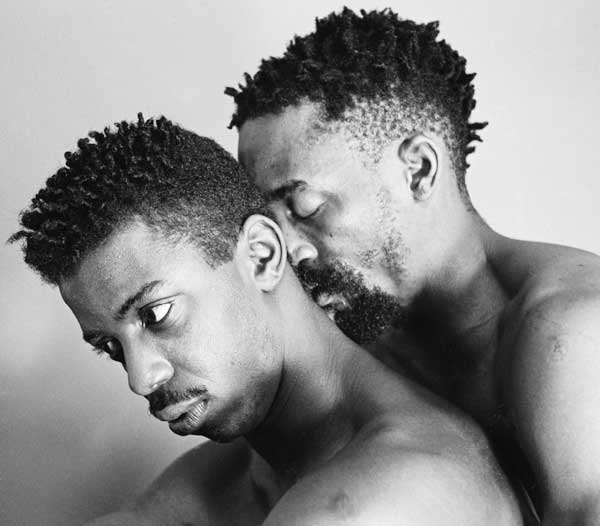 ZP_portrait by Rotimi Fani-Kayode_Dennis Carney and Essex Hemphill in Brixton, London, 1988. Hemphill is holding Carney and kissing the back of his neck.
.
Essex Hemphill (1957-1995)
From: Ceremonies (1992)
“Rights and Permissions”
.
Sometimes I hold
my warm seed
up to my mouth
very close
to my parched lips
and whisper
“I’m sorry,”
before I turn my head
over the toilet
and listen to the seed
splash into the water.
.
I rinse what remains
down the drain,
dry my hands –
they return
to their tasks
as if nothing
out of place
has occurred.
.
I go on being,
wearing my shirts
and trousers,
voting, praying,
paying rent,
pissing in public,
cussing cabs,
fussing with utilities.
.
What I learn
as age advances,
relentless pillager,
is that we shrink
inside our shirts
and trousers,
or we spread
beyond the seams.
The hair we cherished
disappears.
.
Sometimes I hold
my warm seed
up to my mouth
and kiss it.
. . .
“Object Lessons”
.
If I am comfortable
on the pedestal
you are looking at,
if I am indolent and content
to lay here on my stomach,
my determinations
indulged and glistening
in baby oil and sweat,
if I want to be here, a pet,
to be touched, a toy,
if I choose
to be liked in this way,
if I desire to be object,
to be sexualized
in this object way,
by one or two at a time,
for a night or a thousand days,
for money or power,
for the awesome orgasms
to be had, to be coveted,
or for my own selfish wantonness,
for the feeling of being
pleasure, being touched.
The pedestal was here,
so I climbed up.
I located myself.
I appropriated this context.
It was my fantasy,
my desire to do so
and lie here
on my stomach.
Why are you looking?
What do you wanna
do about it?
. . .
“Invitations All Around”
.
If he is your lover,
never mind.
Perhaps, if we ask,
he will join us.
. . .
From: Earth Life (1985)
.
“Black Beans”
.
Times are lean,
Pretty Baby,
the beans are burnt
to the bottom
of the battered pot.
Let’s make fierce love
on the overstuffed
hand-me-down sofa.
We can burn it up, too.
Our hungers
will evaporate like – money.
I smell your lust,
not the pot burnt black
with tonight’s meager meal.
So we can’t buy flowers for our table.
Our kisses are petals,
our tongues caress the bloom.
Who dares to tell us
we are poor and powerless?
We keep treasure
any king would count as dear.
Come on, Pretty Baby.
Our souls can’t be crushed
like cats crossing streets too soon.
Let the beans burn all night long.
Our chipped water glasses are filled
with wine from our loving.
And the burnt black beans –
caviar.
. . .
“Better Days”
.
In daytime hours,
guided by instincts
that never sleep,
the faintest signals
come to me
over vast spaces
of etiquette
and restraint.
Sometimes I give in
to the pressing
call of instince,
knowing the code of my kind
better than I know
the National Anthem
or “The Lord’s Prayer”.
I am so driven by my senses
to abandon restraint,
to seek pure pleasure
through every pore.
I want to smell the air
around me thickly scented
with a playboy’s freedom.
I want impractical relationships.
I want buddies and partners,
names I will forget by sunrise.
I only want to feel good.
I only want to freak sometimes.
There are no other considerations.
A false safety compels me
to think I will never need kindness,
so I don’t recognize
that need in someone else.
.
But it concerns me,
going off to sleep
and waking
throbbing with wants,
that I am being
consumed by want.
And I wonder
where stamina comes from
to search all night
until my footsteps ring
awake the sparrows,
and I go home, ghost walking,
driven indoors to rest
my hunter’s guise,
to love myself as fiercely
as I have in better days.
. . .
From: Conditions (1986)
.
“Isn’t It Funny”
.
I don’t want to hear you beg.
I’m sick of beggars.
If you a man
take what you want from me
or what you can.
Even if you have me
like some woman across town
you think you love.
.
Look at me
standing here with my dick
as straight as yours.
What do you think this is?
The weathercock on a rooftop?
.
We sneak all over town
like two damn thieves,
whiskey on our breath,
no streetlights on the back roads,
just the stars above us
as ordinary as they should be.
.
We always have to work it out,
walk it through, talk it over,
drink and smoke our way into sodomy.
I could take you in my room
but you’re afraid the landlady
will recognize you.
.
I feel thankful I don’t love you.
I won’t have to suffer you later on.
.
But for now I say, Johnnie Walker,
have you had enough, Johnnie Walker?
Do-I-look-like-a-woman-now?
Against the fogged car glass
do I look like your crosstown lover?
Do I look like Shirley?
.
When you reach to kiss her lips
they’re thick like mine.
Her hair is cut close, too,
like mine –
isn’t it?
. . .
“Between Pathos and Seduction”
(For Larry)
.
Love potions
solve no mysteries,
provide no comment
on the unspoken.
Our lives tremble
between pathos and seduction.
Our inhibitions
force us to be equal.
We swallow hard
black love potions
from a golden glass.
New language beckons us.
Its dialect present.
Intimate.
Through my eyes
focused as pure, naked light,
fixed on you like magic,
clarity. I see risks.
Regrets? There will be none.
Let some wonder,
some worry, some accuse.
Let you and I know
the tenderness
only we can bear.
. . .
“American Wedding”
.
In america,
I place my ring
on your cock
where it belongs.
No horsemen
bearing terror,
no soldiers of doom
will swoop in
and sweep us apart.
They’re too busy
looting the land
to watch us.
They don’t know
we need each other
critically.
They expect us to call in sick,
watch television all night,
die by our own hands.
They don’t know
we are becoming powerful.
Every time we kiss
we confirm the new world coming.
.
What the rose whispers
before blooming
I vow to you.
I give you my heart,
a safe house.
I give you promises other than
milk, honey, liberty.
I assume you will always
be a free man with a dream.
In america,
place your ring
on my cock
where it belongs.
Long may we live
to free this dream.
. . .
Essex Hemphill (1957 – 1995) was a poet and activist, as frank and raw – and as radical – as one can get. Hemphill’s compañero (and hero) in activism was Joseph Fairchild Beam (1954 – 1988), writer, editor, Black-Gay civil-rights agitator for positive change. In a 1984 essay Beam declared: “The bottom line is this: We are Black men who are proudly gay. What we offer is our lives, our love, our visions. We are rising to the love we all need. We are coming home with our heads held up high.”
When Hemphill wrote “In america, place your ring on my cock where it belongs” he was probably – though one cannot be sure – not talking about the symbolic ring of the traditional marriage rite as we all know it. And yet…his fervent desire was for Black, Gay Americans to be meaningfully re-connected to their own communities, communities to which they felt a powerful yearning to belong – having never left them, deep down in their hearts. We feature the following photographs because we feel that Hemphill – even though he called his black, gay world “this tribe of warriors and outlaws” – would get it. To paraphrase the final line of his poem American Wedding: Long may you live to free your dream.
.
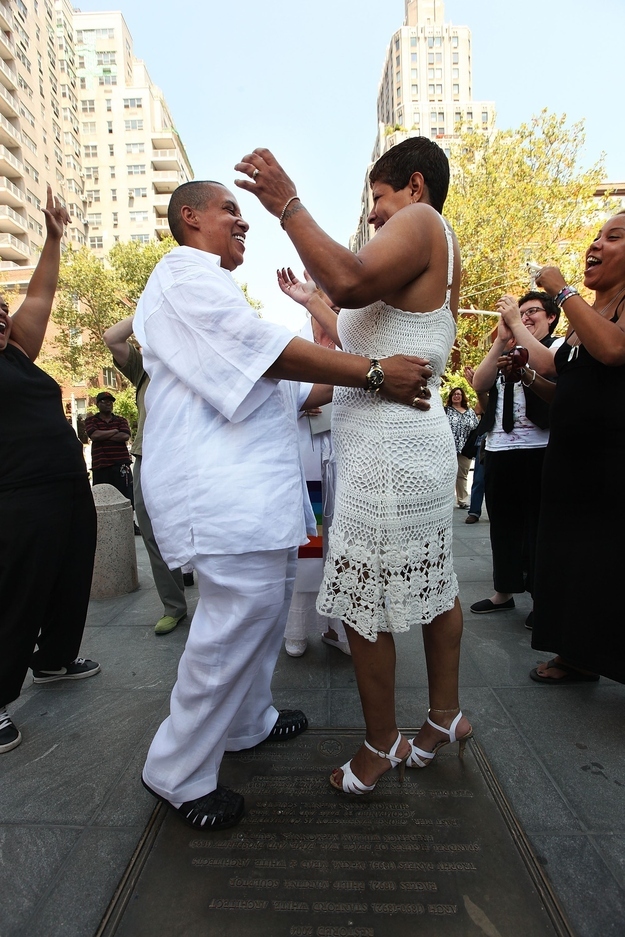 ZP_Two women celebrate with friends and relatives after their outdoor marriage in Washington Square Park , New York City, 2011.
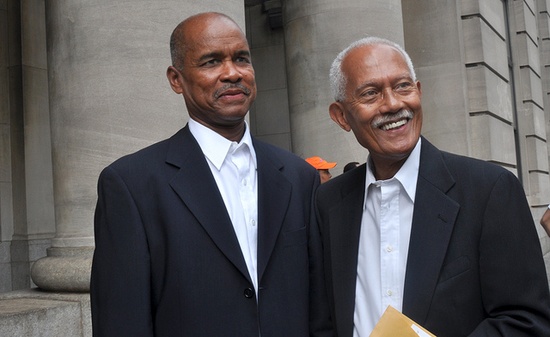 ZP_After 33 years together these two handsome septuagenarian New Yorkers married legally in 2011. Dignity and great pride are evident on their faces.
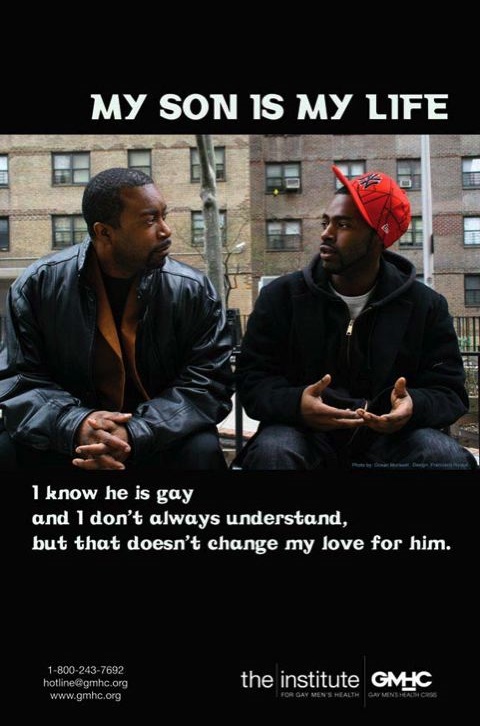 ZP_2008 poster directed toward the fathers of young, black, gay men_Gay Men’s Health Center, NYC_© photographer Ocean Morisset_Essex Hemphill, were he alive today, would’ve been heartened by such an initiative, knowing full well that the blood, sweat and tears of many ordinary people – who are also activists who love their communities – made such progress possible.
. . . . .
T’ai Freedom Ford: “fourth: a blues”
Posted: June 29, 2013 Filed under: English | Tags: Black lesbian poets Comments Off on T’ai Freedom Ford: “fourth: a blues”
.
T’ai Freedom Ford
“fourth: a blues”
.
…she taste like the colour blue…all beautifully bruised and melancholy on my tongue. like blue glinting golden…bee-stung and swollen in a field of cotton…like blue verging black until all memory’s forgotten…she taste like blues…like muddy waters…like daughters of the dust…like mississippi goddamn…like thrust and thirst…like heartbreak so new it tastes like trust at first…like a wound you must nurse with your own salty tears…she taste like blue…cause that’s the colour of her: fears/fierce…like an azure hue reminiscent of sky breaking wide open…blue like coloured girls who done tried dope when hope wasn’t enough…when that man wasn’t enough…when being tough wasn’t enough…blue like nina’s voice and storm clouds…she rains blue-black…arm, tattooed jack, and sometimes her loyalty is tragic…still she blue like magic…all stardust and confetti and taps of wands…and when the house of cards collapses she responds…with jesus on her breath…eyes watery with devotion…taste like blue: royal and periwinkle and aqua…blue like the fifth chakra vibrating her throat translucent…rocking with holyghost trying to shake loose sin…within her, blues run deep and honeysuckle sweet like grandmama’s hambone on a sunday morn…blue like early morning beckoning sinners toward their reckoning…blue like night sky sucking up light like a magic trick…tragic as guitar strings breaking like my heart…she taste blue like tragedy…all shakespearean and love unfulfilled…but that’s what she do…slips into characters like new skin…ingénue…sparkling blue on silver screens…beautifully blue…making art outta life…all spit-shined and bruised like the blues of the south…a new shade of truth…exploding its name in my mouth…she taste like…
. . .
T’ai Freedom Ford is an American “slam poet” who performs at spoken-word events. Of performance she has playfully said: “Most poets would say it’s about sharing their message or rallying a cause, but let’s be honest: it’s about ego. Signifyin’ and looking cute.”
. . . . .
 Zócalo Poets