Langston Hughes as Translator: Lorca’s “Gypsy Ballads”
Posted: February 1, 2012 Filed under: English, Federico García Lorca, Langston Hughes, Spanish | Tags: Black poets Comments Off on Langston Hughes as Translator: Lorca’s “Gypsy Ballads”_____
Brawl
Half way down the ravine,
Gay with rival blood
The knives of Albacete
Shine like fishes.
*
A light hard as playing cards
In the acid greenness
Silhouettes furious horses
And the profiles of riders.
*
On the crest of an olive tree
Two old women cry.
The bull of the dispute
Charges up the walls.
Black angels bring
Handkerchiefs and snow-water,
Angels with big wings
Made of knives from Albacete.
*
Juan Antonio of Montilla
Rolls dead down the hill,
His body full of lilies
And a pomegranate at his temples.
Now he rides a cross of fire
On the road to death.
*
The judge, with the Civil Guards,
Comes through the olive groves.
Slippery blood sings
A silent song of serpents.
Honourable Civil Guards:
The same as usual –
Four Romans dead
And five Carthaginians.
*
Crazed with hot rumours and fig trees,
The afternoon falls fainting
On the wounded limbs of the riders.
Black angels fly
Through the western air,
Angels with long braids
And hearts of oil.
_____
“Reyerta”
En la mitad del barranco
las navajas de Albacete,
bellas de sangre contraria,
relucen como los peces.
*
Una dura luz de naipe
recorta en el agrio verde
caballos enfurecidos
y perfiles de jinetes.
*
En la copa de un olivo
lloran dos viejas mujeres.
El toro de la reyerta
su sube por la paredes.
Angeles negros traían
pañuelos y agua de nieve.
Angeles con grandes alas
de navajas de Albacete.
*
Juan Antonio el de Montilla
rueda muerto la pendiente
su cuerpo lleno de lirios
y una granada en las sienes.
Ahora monta cruz de fuego,
carretera de la muerte.
*
El juez con guardia civil,
por los olivares viene.
Sangre resbalada gime
muda canción de serpiente.
Señores guardias civiles:
aquí pasó lo de siempre.
Han muerto cuatro romanos
y cinco cartagineses
*
La tarde loca de higueras
y de rumores calientes
cae desmayada en los muslos
heridos de los jinetes.
Y ángeles negros volaban
por el aire del poniente.
Angeles de largas trenzas
y corazones de aceite.
_____
The Faithless Wife
I took her to the river
Thinking she was single,
But she had a husband.
It was Saint James’ Eve,
And almost because I had to.
The street lights went out
And the crickets lit up.
At the farthest corners
I touched her sleeping breasts
And they opened for me quickly
Like bouquets of hyacinths.
The starch of her underskirts
Rustled in my ears
Like a piece of silk
Slit by ten knives.
With no silver light to crown them
The trees grew bigger,
While a horizon of dogs barked
Afar from the river.
*
Beyond the brambles,
The bulrushes, and the hawthorns,
I made her mat of hair
Hollow the muddy bank.
I took off my tie,
She took off her dress,
Me, my belt with the pistol,
She, the four parts of her bodice.
Neither lilies nor snail shells
Have such a lovely skin,
Nor do the crystals of the moon
Shine with such a light.
Half bathed in fire
And half bathed in ice,
Her thighs slipped from me
Like frightened fish.
That night I rode
Down the best of roads
On a mother-of-pearl filly
With no bridle and no stirrups.
Being a man, I can’t tell you
The things that she told me.
The light of understanding
Makes me very careful.
Soiled with kisses and sand
I led her away from the river
While the swords of the lilies
Battled with the breeze.
I acted like the thoroughbred
Gypsy that I am,
And gave her a present,
A big sewing box
Of straw-coloured satin.
But I didn’t want
To fall in love with her
For, having a husband,
She told me she was single
When I took her to the river.
_____
“La Casada Infiel”
Y que yo me la llevé al río
creyendo que era mozuela,
pero tenía marido.
Fue la noche de Santiago
y casi por compromiso.
Se apagaron los faroles
y se encendieron los grillos.
En las últimas esquinas
toqué sus pechos dormidos,
y se me abrieron de pronto
como ramos de jacintos.
El almidón de su enagua
me sonaba en el oído,
como una pieza de seda
rasgada por diez cuchillos.
Sin luz de plata en sus copas
los árboles han crecido
y un horizonte de perros
ladra muy lejos del río.
*
Pasadas las zarzamoras,
los juncos y los espinos,
bajo su mata de pelo
hice un hoyo sobre el limo.
Yo me quité la corbata.
Ella se quitó el vestido.
Yo el cinturón con revólver.
Ella sus cuatro corpiños.
Ni nardos ni caracolas
tienen el cutis tan fino,
ni los cristales con luna
relumbran con ese brillo.
Sus muslos se me escapaban
como peces sorprendidos,
la mitad llenos de lumbre,
la mitad llenos de frío.
Aquella noche corrí
el mejor de los caminos,
montado en potra de nácar
sin bridas y sin estribos.
No quiero decir, por hombre,
las cosas que ella me dijo.
La luz del entendimiento
me hace ser muy comedido.
Sucia de besos y arena
yo me la llevé del río.
Con el aire se batían
las espadas de los lirios.
*
Me porté como quién soy.
Como un gitano legítimo.
La regalé un costurero
grande, de raso pajizo,
y no quise enamorarme
porque teniendo marido
me dijo que era mozuela
cuando la llevaba al río.
_____
Langston Hughes ( February 1st 1902 – 1967)
lived in México for part of his boyhood, and,
two decades later, travelled to
Spain when he became interested in Communism.
Though he was familiar with the Spanish poetry of
Federico García Lorca (1898-1936),
the poet had already been killed by the time
Hughes got to Spain (toward the end of
The Spanish Civil War) in 1938.
*
Inspired by the Fiesta de Cante Jondo (Festival of
Deep Song) in 1922, Lorca had immersed himself
in the gypsy subculture of Andalucía, Spain. The
result was his 1928 collection of poems,
“Primer romancero gitano”. In 1951, Langston
Hughes published his translations into English
of a dozen or so of these “Gypsy Ballads”,
two of which we feature here.
_____
A “Chile” Winter / un Invierno chileno: Jorge Teillier
Posted: January 18, 2012 Filed under: English, Jorge Teillier, Spanish Comments Off on A “Chile” Winter / un Invierno chileno: Jorge Teillier_____
Poems by Jorge Teillier / Poemas por Jorge Teillier
(Chilean poet, 1935-1996 / Poeta chileno, 1935-1996)
Translation from Spanish into English © Carolyne Wright
*
Bridge in the South
Yesterday I remembered a clear winter day. I remembered
A bridge over the river, a river stealing blue from the sky.
My love was less than nothing on that bridge. An orange
sinking into the waters, a voice that doesn’t know whom it calls,
a gull whose gleam was undone among the pines.
*
Yesterday I remembered that no one is anyone on a bridge
when winter dreams with another season’s clarity,
and one wants to be a leaf motionless in the dream of winter,
and love is less than an orange losing itself in the waters,
less than a gull whose light goes out among the pines.
_____
Puente en el sur
Ayer he recordado un día de claro invierno. He recordado
un puente sobre el río, un río robándole azul al cielo.
Mi amor era menos que nada en ese puente. Una naranja
hundiéndose en las aguas, una voz que no sabe a quién llama,
una gaviota cuyo brillo se deshizo entre los pinos.
*
Ayer he recordado que no se es nadie sobre un puente
Cuando el invierno sueña con la claridad de otra estación,
y se quiere ser una hoja inmóvil en el sueño del invierno,
y el amor es menos que una naranja perdiéndose en las aguas,
menos que una gaviota cuya luz se extingue entre los pinos.
_____
Winter Poem
Winter brings white horses that slip on the ice.
They’ve lit fires to defend the orchards
from the white witch of the frost.
Among clouds of white smoke, the caretaker stirs himself.
The chill-numbed dog growls from his kennel at the drifting icefloe
of the moon.
*
Tonight they’ll forgive the boy for sleeping late.
In the house his parents are having a party.
But he opens the windows
to see the masked horsemen
who wait for him in the forest,
and he knows his fate will be to love the humble smell of footpaths in the night.
*
Winter brings moonshine for machinist and fire-stoker.
A lost star reels like a buoy.
Songs of intoxicated soldiers
returning late to their barracks.
*
In the house the party has begun.
But the boy knows the party’s somewhere else,
and he looks through the window for the strangers
he’ll spend his whole life trying to meet.
_____
Poema de invierno
El invierno trae caballos blancos que resbalan en la helada.
Han encendido fuego para defender los huertos
de la bruja blanca de la helada.
Entre la blanca humareda se agita el cuidador.
El perro entumecido amenaza desde su caseta al témpano flotante
de la luna.
*
Esta noche al niño se le perdonará que duerma tarde.
En la casa los padres están de fiesta.
Pero él abre las ventanas
para ver a los enmascarados jinetes
que lo esperan en el bosque y sabe que su destino
será amar el olor humilde de los senderos nocturnos.
*
El invierno trae aguardiente para el maquinista y el fogonero.
Una estrella perdida tambalea como baliza.
Cantos de soldados ebrios
que vuelven tarde a sus cuarteles.
*
En la casa ha empezado la fiesta.
Pero el niño sabe que la fiesta está en otra parte,
y mira por la ventana buscando a los desconocidos
que pasará toda la vida tratando de encontrar.
______
Editor’s note:
Winter in Chile is during June and July – but we are posting
Teillier’s poems during the Canadian winter: January.
Día De Los Reyes: canta Mercedes Sosa…de Melchor, Gaspar y Baltasar
Posted: January 6, 2012 Filed under: English, Spanish, ZP Translator: Alexander Best | Tags: Christmas carols and songs, Mercedes Sosa Comments Off on Día De Los Reyes: canta Mercedes Sosa…de Melchor, Gaspar y Baltasar
Canción por
Mercedes Sosa:
Los Reyes Magos
Llegaron ya, los reyes y eran tres
Melchor, Gaspar y el negro Baltasar.
Arrope y miel
Le llevaron
Y un poncho blanco de alpaca real.
Changos y chinitas duérmanse
Que ya Melchor, Gaspar y Baltasar
Todos los regalos dejaron
Para jugar mañana al despertar.
El Niño Dios muy bien lo agradeció
Comió la miel y el poncho le abrigó.
Y fue después
Que sonrió,
Y a medianoche el sol relumbró.
_____
A Song by
Mercedes Sosa:
The Three Wise Men (Adoration of the Magi)
They arrived already, those Kings, and three there were:
Melchior, Caspar, and black Balthazar.
Grape syrup and honey they took to Him
And a poncho of royal alpaca wool.
Monkeys, ladybugs – go to sleep !
All the gifts and toys are already there,
from Melchior, Caspar and Balthazar,
for Him in the morning – when he lets out a “peep”.
The Child God was truly grateful for
the poncho that wrapped him up warmly
– oh, and the honey He ate !
And it was after that
He smiled.
And at midnight the
Sun shone bright !
_____
Translation / interpretation from Spanish into English: Alexander Best
Su Nombre es Jesús y Soy Su Niña / His Name is Jesus and I’m His Child : Zella Jackson Price
Posted: December 24, 2011 Filed under: English, Spanish, ZP Translator: Lidia García Garay | Tags: Christmas carols and songs Comments Off on Su Nombre es Jesús y Soy Su Niña / His Name is Jesus and I’m His Child : Zella Jackson Price_____
Soy Su Niña
(canción evangélica de Zella Jackson Price, 1982)
Es posible que no sea lo mejor de todo
o tenga lo mejor de algo,
algunas veces me siento que soy
lo menos de todo.
Pero conozco a alguien que tiene todo
Y Él es mi Todo,
Y yo estoy feliz de
tan sólo saber que:
Soy Su Niña.
Su nombre es Jesús,
El Hijo Recto de Diós,
El Lirio del Valle y
La Estrella más Brillante de la Mañana.
Su nombre es Jesús,
y Él es mi Todo
– Ohhh sí –
y estoy feliz de
tan sólo saberlo:
¡ Soy Su Niña !
*
Traducción del inglés al español: Lidia García Garay
Translation from English into Spanish: Lidia García Garay
*
I’m His Child
(as sung by Zella Jackson Price, 1982)
I may not be the best of anything
Or have the best of anything,
Sometimes I feel like I’m the least of all.
But I know someone who has everything
And He is my Everything,
And I happy just to know that
I’m His Child !
His name is Jesus,
the Righteous Son of God, the
Lily of the Valley and the
Brightest Morning Star.
His name is Jesus, and
He’s my Everything
– Ohhh yes he is –
And I am happy just to know that
I’m His Child !
_____
Los peregrinos piden posada: el villancico “En Nombre del Cielo”
Posted: December 24, 2011 Filed under: English, Spanish | Tags: Christmas carols and songs Comments Off on Los peregrinos piden posada: el villancico “En Nombre del Cielo”_____
En Nombre del Cielo
José:
En Nombre del Cielo
os pido posada,
Pues no puede andar
mi esposa amada.
Huesped:
Aquí no es mesón,
Sigan adelante,
Yo no puedo abri,
No sea algún tunante.
José:
No seas inhumano,
Tennos caridad.
Que el Díos de los Cielos
Te lo premiará.
Huesped:
Ya se pueden ir
Y no molestar,
Porque si me enfado
Los voy a apalear.
José:
Mi esposa es María,
Es Reina del Cielo,
Y madre va a ser
Del Divino Verbo.
Huesped:
¿Eres tú, José?
¿Tu esposa es María?
¡Entren, peregrinos,
No los conocía!
_____
In the Name of Heaven
(Pray Give Us Lodging)
Joseph:
Pray, give us lodging, dear sir,
in the Name of Heaven,
All day since morning to travel we’re given,
Mary, my wife, is expecting a child,
She must shelter this night,
Let us in ! Let us in !
Host:
You cannot stop here,
I won’t make of my house an inn,
I do not trust you, your story is thin.
Rob me you might – then run away
— find somewhere else you can stay,
Go away ! Go away !
Joseph:
Please show us pity ! Your heart can’t be this hard !
Look at poor Mary, so worn and so tired !
We are most poor but I’ll pay what I can
— God will reward you, good man,
Let us in ! Let us in !
Host:
You try my patience, I’m tired and must rest,
I’ve told you nicely – but still you insist.
If you don’t stop this bother, I’ll fix you
— I guarantee !
Go away ! Go away !
Joseph:
Sir, I must tell you, my wife is
The Queen of Heaven,
chosen by God to deliver His Son.
JESUS is coming to earth on this eve
(O Heaven, make him believe !)
Let us in ! Let us in !
Host:
Joseph, dear Joseph – O how am I so blind ?
Not to know you and The Virgin so fine !
Enter, blesséd pilgrims, my house is your own
— Praise be to God on His throne !
Please come in ! Please come in !
_____
A Christmas tradition in rural México and especially
its Indigenous towns, “Las Posadas” – “The Lodgings” –
re-enacts Joseph and pregnant Mary’s search for shelter
(and a birthing place for Jesus) along the road to
Bethlehem.
Participants in the Posada procession go from house to
house singing call-and-response verses till the Gospel
story is fulfilled. This community ritual is a kind of
novena, and for the devout it requires nine days of
“posadas” in order to properly arrive at the precious
hour of Christmas Eve which, in Spanish, is called
Noche Buena (“Holy Night”).
“En Nombre del Cielo” is a classic Mexican carol.
Canciones sefardíes de la Turquía
Posted: December 20, 2011 Filed under: Ladino/Judeoespañol, Spanish Comments Off on Canciones sefardíes de la Turquía_____
Canciones sefardíes de la Turquía (2009)
en el idioma judeoespañol:
ג’ודיאו-איספאניול
Sephardic songs from Turkey (2009)
in Ladino (Judeo-Spanish)
* * *
Avram Avinu / Abraham our Father
Kuando el rey Nimrod al kampo saliya
Mirava en el cielo la esteriya
Vide luz santa en la cuderiya
Ke aviya de naser Avram Avinu.
Avram Avinu
Padre kerido
Padre bendiço
Luz de Israel
La mujer de terah kedo prenyada
De diya el ediya él le preguntava
De ke teneş la kara tan demudada
Eya ya saviya el bien ke teniya.
Avram Avinu
Padre kerido
Padre bendiço
Luz de Israel
* * *
Irme Kero Madre / Mother, I want to go
to Jerusalem
Ir me kero madre a Yeruşalayim
A pizar las yervas i artarme d’eyas
En él me arrimo yo
En él m’afiguro yo
Él es senyor de todo’l mundo.
A Yeruşalayim lo veyo d’enfrente
Pedri ayi mis ijos i paryentes
En él me arrimo yo
En él m’afiguro yo
Él es senyor de todo’l mundo.
Oración a La Virgen de Guadalupe: José Valdez
Posted: December 12, 2011 Filed under: English, José Valdez, Spanish, ZP Translator: Alexander Best | Tags: Oración a La Virgen de Guadalupe, Prayer to Our Lady of Guadalupe Comments Off on Oración a La Virgen de Guadalupe: José Valdez
Oración a La Virgen de Guadalupe
por José Valdez (México)
“A mi Virgen de Guadalupe”
.
Necesito tu ayuda
me siento perdido
mis ojos se nublan
no encuentro el camino
tú que eres buena
y muy milagrosa
te pido, morena,
muchísimas cosas
pido por la gente
que quiero yo tanto
que siempre se encuentren
bajo de tu manto
pido me des fuerzas
que encuentre el camino
y que me protejas
con tu manto fino
eres muy hermosa
linda virgencita
pareces una rosa
que nunca se marchita
con solo mirarte
me llenas de paz
con solo tocarte
la vida me das
me inspiras confianza
y mucha ternura
me das esperanzas
y también dulzura
esa verde manta
que cubre tu cabeza
te hace ver más santa
y llena de pureza
ese resplandor
que a ti te rodea
es un bello sol
que nunca te quema
esos lindos ojos
parecen dos diamantes
y tu vestido rojo
te hace ver radiante
sé que tú me quieres
yo siempre lo supe
por eso, para mí, eres
Mi Virgen de Guadalupe.
*
“To my Virgin of Guadalupe”
.
I need your help
I am lost
my eyes cloud over
I cannot find the path,
you who are good
so very miraculous
I ask of you, morena,
very very many things
I ask for those people that I love so,
that always they may find themselves
blanketed within your cloak,
I ask that you may give me strength
that I might find the way
and that you may protect me
within your fine cloak,
you are most beautiful
lovely dear Virgin
you seem like a rose
that never wilts
I merely gaze upon you
and you fill me with peace
I touch you, merely,
and you give me life,
you inspire trust in me
and much tender feeling,
hope you give me,
gentleness too,
that green scarf
that covers your head
makes you look most saintly
and full of purity,
that dazzling gleam
surrounding you
is a beautiful sun
that never burns,
those lovely eyes
are as two diamonds,
and your red robe
makes you radiant,
I know that you love me,
always I knew it,
and, for that reason, for me, you are
My Virgin of Guadalupe.
*
We thank Mr. Valdez for his
poem from the heart honouring
Our Lady of Guadalupe on this
her feast day, December 12th.
Translation from Spanish into English:
Alexander Best
*
¡Tlazocamati, Tonantzin! / Thank You, Sacred Mother!
Posted: December 12, 2011 Filed under: English, Náhuatl, Spanish, ZP Translator: Alexander Best Comments Off on ¡Tlazocamati, Tonantzin! / Thank You, Sacred Mother!
Poema de Nezahualcóyotl
(1402-1472, Rey nahua/mexica de Texcoco)
“Tonantzin”
Tonantzin;
icuac nehuatl nimiquiz
xinechtoca notlecuilco
ihuan quemman ticchihuaz
motlaxcal xinechchoquili.
Ihuan tla aca mitztlatlaniz
Tonantzin. Tleica tichoca?
Xicnanquili; in cuahuitl xoxochuic
ihuan in poctli nechchoctia.
*
“Madrecita”
Madrecita;
cuando yo muera
entiérrame junto a tu hoguera
y cuando hagas tortillas
llora por mí
y si alguien te pregunta
Madrecita ¿Por qué lloras?
Responde; Es que la leña que está verde
y es el humo que me hace llorar.
*
“Sacred Mother”
Little Mother,
when I die
bury me next to your cooking fire
and when you make tortillas
cry for me
and if anyone asks you:
Sacred Mother, why do you cry?
Tell them: It’s only that the fire-wood’s green
and the smoke hurts my eyes…
*
Reesom Haile: the Lively Voice of Eritrea / la Voz Vivaz de Eritrea
Posted: December 1, 2011 Filed under: English, Reesom Haile: La voz vivaz de Eritrea / the lively voice of Eritrea, Spanish, Tigrinya, ZP Translator: Alexander Best | Tags: African poetry - Eritrea, Black poets Comments Off on Reesom Haile: the Lively Voice of Eritrea / la Voz Vivaz de Eritrea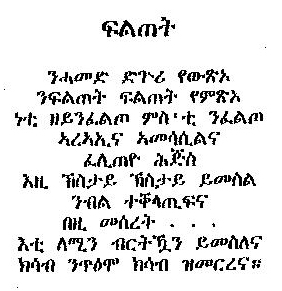


_____ * _____ * _____
KNOWLEDGE
First the earth, then the plow:
So knowledge comes out of knowledge.
We know, we don’t know.
We don’t know we know.
We know we don’t know.
We think
This looks like that –
This lemon, that orange –
Until we taste the bitter.
_____
DEVELOPMENT
Change.
Like a child, an infant.
“Let’s go ! Let’s go !”
And our household grows.
“Let’s run.”
We can slow
And sit and stretch
In the sun
Till it sets, but tomorrow
Dawned yesterday.
_____
UNDER CONSIDERATION
Consider this.
Consider that.
Excellent.
Write it
And propose it
For consideration.
Also consider
The official response,
“It’s under consideration.”
Who is considering whom?
When? Where?
How? Why?
Give up? Consider this.
_____
LEARNING FROM HISTORY
We learned from Marx and Lenin:
To be equal trim your feet
For one-size-fits-all shoes.
We made their mistakes, too.
Equally, we all make mistakes.
The evil is in not being corrected.
Aren’t we known
By what we do, undo and do again?
_____
YOUR HEAD
From birth you need
A door in your head to live.
Mother, father, teacher, preacher,
Sister, brother, relations, friends
Or others of your kind
May have the key
Or it may be lost.
But they still have other ways
To open the lock.
Rancid butter rubbed on your skull
May let the sunshine in.
The phrase, “What are you,
Stupid? Dumb?” might throw the bolt.
A flywhisk works on the less fragile.
A wooden spoon, a ruler or a good stick
Does the trick on harder nuts and…
Voilà! An open mind!
_____
SPEAK OUT
To speak out and to be spoken about,
Or to see no evil, hear no evil,
Shut up, keep it to yourself
And only complain in private?
That is not the question.
Read the constitution
Of our democratic state.
Exercise your rights
To tell it like it is,
Write as you see fit
And get a good night’s sleep.
You also have the right to take
Back what you say by mistake.
The freedom to express
Cannot be given up.
It comes from God.
Be free and brave.
Only one prison remains:
Our minds.
_____ * _____ * _____
El Saber
Al primero la tierra, pues el arado:
Tan que el saber viene del saber.
Sabemos, no sabemos.
No sabemos que sabemos.
Sabemos que no sabemos.
Pensamos que
Ésto parace como éso
– este limon, esa naranja –
hasta que degustemos el amargor.
_____
El Desarrollo
Cambio.
Como niño, como bebé.
¡Vamos! ¡Vamos!
Y crecen nuestro hogar.
¡Corramos!
Podemos aflojar el paso
Y sentarnos, estirando,
Bajo del sol,
Hasta el anochecer, pero
Ayer amaneció la mañana.
_____
Sobre la Consideración
Considera ésto.
Considera éso.
Escríbelo
Y proponlo
Por la consideración.
Considera también
La respuesta oficial:
“Éso es algo que estamos considerando.”
¿Quién está considerando a quién?
¿Cuándo? ¿Dónde?
¿Cómo – y Porqué?
¿Estás perplejo?
Considera ésto.
_____
Aprendiendo de la Historia
Aprendimos de Marx y Lenin:
A ser igual, recorta tus pies
por zapatos de unitalla.
(Cometimos sus errores también.)
Por otro lado, cometemos los errores
Todos nosotros.
Lo mal es no estar corregido.
¿ Nos conoce la gente
De lo que hacemos, deshacemos y hacemos de nuevo – no?
_____
Tu Cabeza
Del nacer te necesita
Una puerta en la cabeza para vivir.
Madre, padre, maestro, pastor.
Hermana, hermano, la familia y los amigos,
O unos otros de tu tipo
Tengan la llave
O la llave esté perdido.
Pero quedan otras maneras
Para abrir la cerradura.
La mantequilla rancia, frotada sobre el cráneo,
pueda dejar entrar la luz del sol.
La frase, “¿Eres cuál – Tonto? o Bobo?
Quizás levantará el pestillo.
Sirve bien un matamoscas sobre la gente menos delicada.
Una cuchara/regla de madera,
O un palo bueno,
Con las “cáscaras de nuez” mas duras
Logran el truco…
¡Y ya está! ¡La mente abierta!
_____
Habla – Di lo que piensas
¿Decir lo que se piensa y ser alguien discutido?
O: ¿A ver nada de mal, a oír nada de mal,
Cállate, guárdalo a tu mismo
Y quejarte en privado?
Éso no es la pregunta.
Leye la constitución
De nuestro estado democrático.
Ejerce tus derechos
A decir lo que es tu verdad,
Escribe por tu manera
Y duerme bien.
Tienes también el derecho de
Retirar lo que dijiste en error.
La libertad de expresar
no debe estar cedido.
Es algo de Dios.
Sé libre y valiente.
Solamente queda una cárcel:
Nuestra mente.
_____ * _____ * _____
Reesom Haile, who died in 2003, was a much-loved Eritrean
poet and public personality.
After working as a radio and television journalist in Ethiopia, he
studied in the USA where he completed a doctorate at New York
University. A consultant to the U.N., government and NGOs for
twenty years, he returned in 1994 to Eritrea whose thirty-year
independence struggle with Ethiopia had just drawn to a close.
(After five years of relatively peaceful relations the two
countries engaged in a border war (1998-2000)
– over Red Sea access – that claimed 100,000 lives.) The reality of
war has formed the backdrop to, and sometimes the impetus for,
Haile’s verse.
His language, Tigrinya, is spoken by half (about 3,000,000 people)
the countryfolk in a nation which includes 9 languages and a variety
of ethnic groups. Tigrinya derives from ancient Ge’ez, as do Tigre
and Amharic. And Ge’ez is related – like Arabic and Hebrew –
to Aramaic, said to be the language spoken by Jesus.
This is poetry that embraces the Eritrean people, turns an eye
both wry and loving on their history and politics, and also issues
a sincere challenge to “get cracking” !
It is verse of vitality and wit, and is rendered beautifully
into English by Professor Charles Cantalupo of Pennsylvania State
University – a poet himself and a translator who balances gravity of
theme with a lightness of touch, thereby giving us something
of the essential character of Reesom Haile.
*
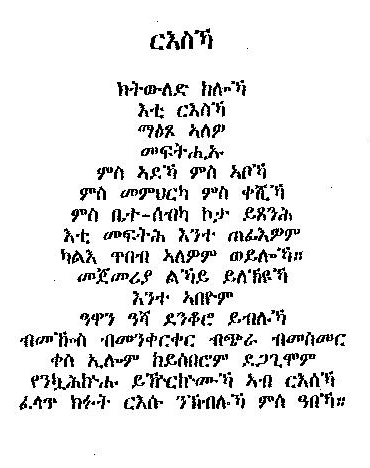
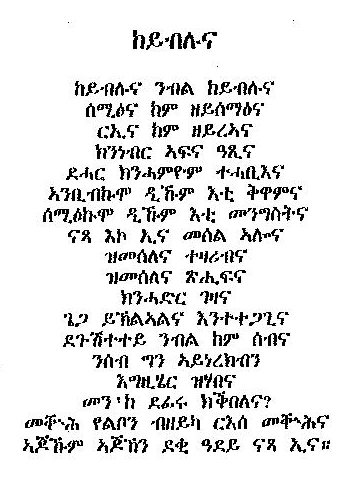
The poems featured here are from Reesom Haile’s collection:
We Have Our Voice (Lawrenceville and Asmara: The Red Sea Press,
2000) – the first-ever bilingual edition (Tigrinya + English)
of Tigrinya poems. Zócalo Poets is grateful to Professor Cantalupo for
assistance in posting the Tigrinya originals.
Translations from the English into Spanish: Alexander Best
_____
Mucho amado por sus compatriotas, Reesom Haile fue un poeta y
erudito. Su país, Eritrea, está situado al noreste de África, con una
costa al borde del Mar Rojo.
Durante su vida – se murió en 2003 – escribió dos mil poemas en el
lenguaje Tigriña, un idioma antiguo de la familia lingüística semítica
(como árabe, hebreo, y arameo – “la lengua de Jesús de Nazaret”.)
Lleno de inteligencia, vitalidad y ingenio, sus poemas han estado
traducido por el profesor universitario Charles Cantalupo
(de Penn State) con tanta franqueza, con tanto encanto.
Traducción del inglés al español: Alexander Best
Pat Lowther: “Escríbeme, cariño, del otro mundo. Y envíame aceitunas.”
Posted: November 24, 2011 Filed under: English, Pat Lowther, Spanish, ZP Translator: Alexander Best Comments Off on Pat Lowther: “Escríbeme, cariño, del otro mundo. Y envíame aceitunas.”
Oscura
Te digo: cae la oscuridad
como flechas y hambre
Ato en nudos mi cabello
para recordar otros imperios
Cae a través de mi cabeza el mundo
sin óbice – como la lluvia
Tengo que decirte: no puedo
mover siempre con el decoro
Como meteores cae la oscuridad
pétalos de negro caliente
Me escapo, quemando, solamente porque
Yo soy la oscuridad.
*
Identificación
Quiero decir:
dime
quien eres,
y me das
una respuesta clara,
quien eres
pues, pienso en
la pregunta inversa
como un cuchillo
con hoja hacia mí
dime
quien eres
: soy una metedura
una boca, llorando
una figura corriendo
con las manos al ángulo derecho
de los brazos
Y pienso, después
de todo, que
no te preguntaré
quien eres.
_____
Dark
I tell you the darkness comes down
like arrows and hunger
I tie knots in my hair
to remember other empires
The world falls through my forehead
resistlessly as rain
I must tell you I can not
always move with decorum
The darkness comes down like meteors
petals of hot black
I escape burning only because
I am the darkness.
*
I.D.
i want to say
tell me
who you are,
and you give me
a clear answer,
who you are
then i think of
the question reversed
like a knife
bladed toward me
tell me
who you are
: i’m a blunder
a mouth, crying,
a figure running
with hands upright
at right angles
to the arms
and i think after all
i won’t
ask you
who you are.
_____
Carta a Pablo número 3
Honrando a los muertos
con grasa de carne
con pan bien crujiente
con miel y ajo,
Anciano lamendo el aceite
de tus pulgares – y eructando,
eres más lustroso que
las flores.
Claveles, amapolas,
caen su especia y su bravura
en un polvo de pétalos agitados;
pasas por la imagen
para honrar la barriga,
las manos las fauces y los dientes,
el incienso de la comida
el sacramento del pan.
*
Letter to Pablo 3
Honouring your dead
with fat of meat
with well-crusted bread
with honey and garlic,
Old man licking the oil
off your thumbs – and belching,
you are more lustrous than
flowers.
Carnations, poppies,
their spice and bravura
fall in a dusting of
petals shaken;
you move past the image
to honour the belly,
the hands — the jaws and teeth,
the incense of cooking
the sacrament of bread.
_____
” Escríbeme, cariño,
del otro mundo.
Y envíame aceitunas. ”
*
” Write to me, darling,
from the other world.
And send me olives. ”
_____
Pat Lowther (1935-1975) nació en Vancouver, British Columbia, Canadá.
Su inspiración – con el poema y con la política – era el maestro-poeta chileno,
Pablo Neruda.
Estes poemas vienen de la colleción póstumo, Diario de Piedra (1977).
Traducción al español: Alexander Best
*
Pat Lowther (1935-1975) was born in Vancouver, British Columbia.
She was inspired poetically / politically by Chilean master-poet
Pablo Neruda.
These poems appeared in A Stone Diary,
published posthumously in 1977.
Translation into Spanish: Alexander Best
 Zócalo Poets