Billie Holiday: Centenario de su nacimiento: Canciones distintivas / Centenary of Her Birth: Signature Songs
Posted: April 7, 2015 Filed under: English, Spanish | Tags: Billie Holiday: Centenario de su nacimiento, Billie Holiday: Centenary of her birth Comments Off on Billie Holiday: Centenario de su nacimiento: Canciones distintivas / Centenary of Her Birth: Signature Songs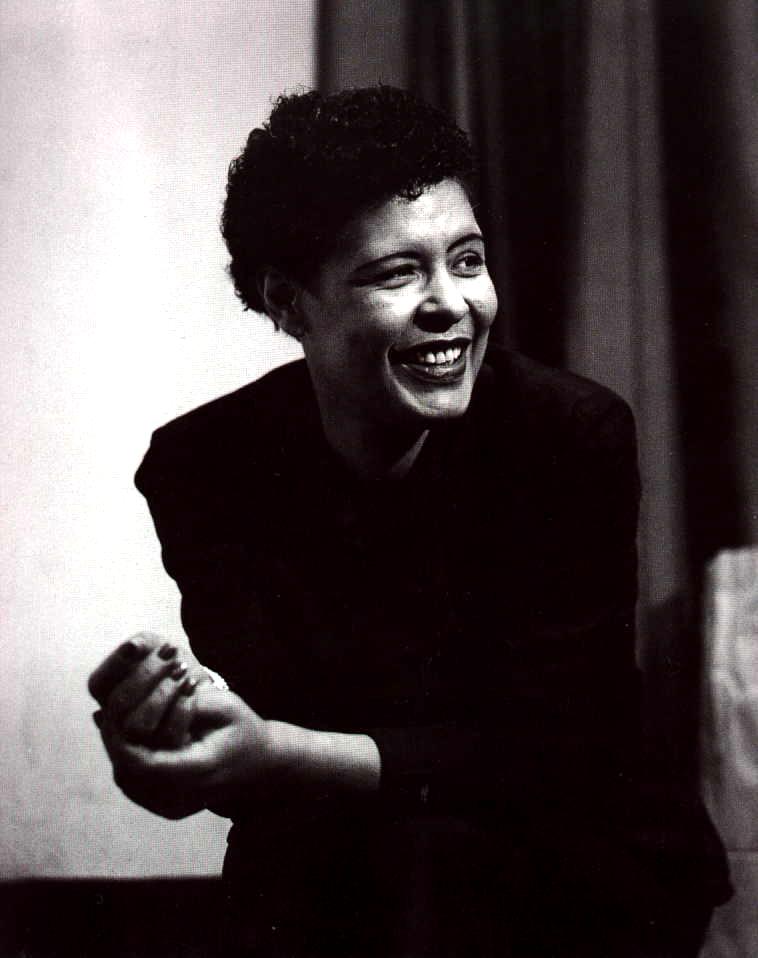
Billie Holiday, seen here at the age of 40, in a 1955 photograph_With her ground-breaking recordings from 1935 through the early 40s, Billie revolutionized how popular songs could be sung. Her voice “led” the musicians, by holding back or leaping forth, and she sang like one of the instruments, solo-ing among them, and riffing off them. The sorry details of her life do not detract from the magnificence of her musicality: a perfect, inventive rhythm; the fresh transformation of mundane lyrics; a subtle vocal balancing of sprightliness and profundity. Perhaps the greatest singer of the 20th century!
Billie Holiday: (born April 7th, 1915, died 1959)
.
“What A Little Moonlight Can Do” (1935)
.
Oo-oo-oo, what a little moonlight can do-oo-oo
Oo-oo-oo, what a little moonlight can do to you…
You’re in love, your hearts a-fluttering all day long, you only stutter ’cause your poor tongue
Just will not utter the words ‘I Love You’.
.
Oo-oo-oo, what a little moonlight can do-oo-oo,
Wait a while till a little moonbeam comes peepin’ through…
You’ll get bored,
You cant resist him,
And all you’ll say,
When you have kissed him, is
Oo-oo-oo, what a little moonlight can do!
. . .
“Did I Remember?” (1936)
.
Did I remember to tell you I adore you?
And that I am living for you alone?
Did I remember to say I’m lost without you,
And just how mad about you I’ve grown?
You were in my arms,
And that was all I knew;
We were alone, we two –
What did I say to you?
Did I remember to tell you I adore you?
And pray, forevermore, you’ll be mine!
. . .
“Travelin’ All Alone” (1937)
.
I’m so weary and all alone,
Feet are tired like heavy stone,
Travelin’, travelin’, all alone.
.
Who will see and who will care
’bout this load that I must bear?
Travelin’, travelin’, all alone.
.
Prayers are said to heaven above,
’bout my burdens,woes and love;
Head bowed down with misery,
Nothing now appeals to me…
Travelin’, travelin’,
All alone!
.
Give me just another day,
There’s one thing I want to say:
Friends are well when all is gold;
Leave you always when you’re old –
Travelin’, travelin’, all alone!
. . .
¡Qué luz de la luna puede hacer!
.
Ooh, ooh, ooh
¡Qué luz de la luna puede hacer!
Ooh, ooh, ooh
¡Qué luz de la luna puede hacer para usted!
Está en el amor
De su corazón revoloteando todo el día
Sólo tartamudeo hacer que su lengua pobre
Simplemente no pronunciar las palabras
‘Te quiero’…
Ooh, ooh, ooh
¡Qué luz de la luna puede hacer!
Espera un poco
Hasta que un rayo de luna poco viene espiar a través de
Él se aburre
No se le puede resistir
Todo lo que dicen
Cuando haya besado a él es:
Ooh, ooh, ooh…¡Qué luz de la luna puede hacer!
. . .
¿Me acordé de decirte que te adoro?
.
¿Me acordé de decirte que te adoro?
¿Y que estoy viviendo por ti solo?
Recuerdo que tenía que decir
Estoy perdido sin ti
Y cómo loco por ti he crecido…
Estaba en mis brazos
Y eso fue todo lo que sabía…
Estábamos solos, nosotros dos ,
¿Qué le digo a usted?
¿Me acordé de decirte que te adoro?
¡Y rezar para siempre que serás mía!
. . .
Vagabundeando Solo
.
Estoy tan cansada y sola
Pies cansados, como piedra pesada…
Viajando – vagabundeando – sin ayuda.
¿Qué se ve y la que le importe,
Combate de esta carga que debe soportar?
Viajando – vagabundeando – completamente sola.
Se elevan plegarias al cielo por encima de mis cargas, problemas – y el amor;
La cabeza inclinada hacia abajo con la miseria –
¡No hay nada ahora que me atrae!
Viajando – vagabundeando – yo sola.
Dame un día más,
Hay una cosa que quiero decir:
Los amigos son así, cuando todo es de oro –
y deje siempre cuando usted es viejo…
Viajando – vagabundeando – sola.

Billie Holiday in 1935_age 20

Billie Holiday in 1949_age 34
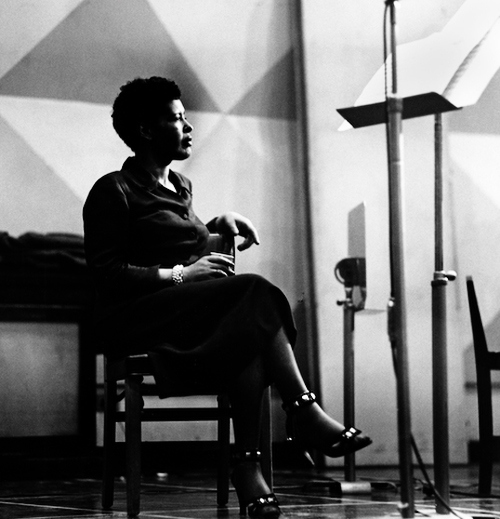
Billie Holiday in 1955_age 40
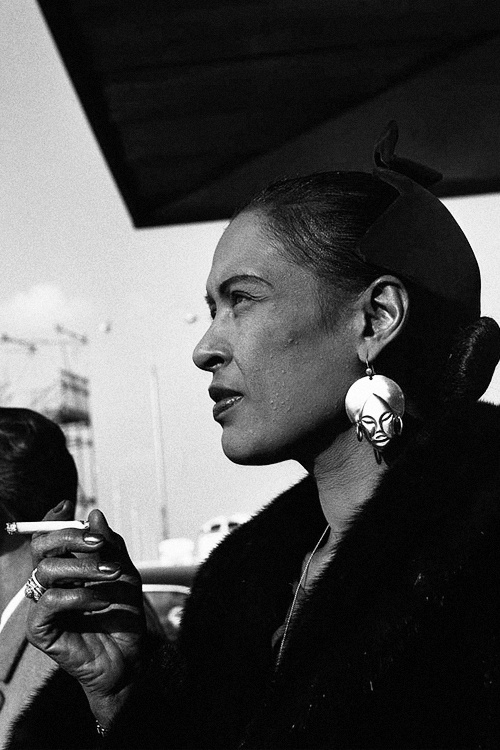
Billy Holiday in 1958_Orly airport, Paris
“Me, Myself, and I” (1937)
.
Me, myself and I
Are all in love with you;
We all think you’re wonderful,
We do.
.
Me, myself and I
Have just one point of view;
We’re convinced
There’s no one else like you.
.
It can’t be denied, dear,
You brought the sun to us;
We’d be satisfied, dear,
If you’d belong to one of us.
.
So if you pass me by,
Three hearts will break in two,
‘Cause me, myself and I
Are all in love with you!
. . .
“You Go To My Head” (1938)
.
You go to my head
And you linger like a haunting refrain,
And I find you spinning ’round in my brain
Like the bubbles in a glass of champagne.
You go to my head
Like a sip of sparkling burgundy brew,
And I find the very mention of you
Like the kicker in a julep or two.
The thrill of the thought that you might give a thought to my plea
Casts a spell over me.
Still, I say to myself: Get a hold of yourself, can’t you see that it never can be?!
You go to my head
With a smile that makes my temperature rise,
Like a summer with a thousand Julys,
You intoxicate my soul with your eyes.
Though I’m certain that this heart of mine
Hasn’t a ghost of a chance in this crazy romance…
You go to my head!
You go to my head!
. . .
“Fine and Mellow” (1939)
.
My man don’t love me,
Treats me oh so mean.
My man he don’t love me,
Treats me awful mean.
He’s the lowest man
That I’ve ever seen!
.
He wears high draped pants
(Stripes are really yellow).
He wears high draped pants
(Stripes are really yellow).
But when he starts in to love me,
He’s so fine and mellow…
.
Love will make you drink and gamble,
Make you stay out all night long.
Love will make you drink and gamble,
Make you stay out all night long.
Love will make you do things
That you know is wrong!
.
But if you treat me right, baby,
I’ll stay home everyday.
Just treat me right, baby,
I’ll stay home night and day.
But you’re so mean to me, baby,
I know you’re gonna drive me away!
.
Love is just like a faucet,
It turns off and on.
Love is like a faucet,
It turns off and on.
Sometimes when you think it’s on, baby,
It has turned off – and gone!
. . .
Yo, y Me, y Yo Mismo
.
Yo, y me, y yo mismo,
Estamos todos enamorados de ti;
Nosotros todos pensamos que eres maravilloso,
De veras.
.
Yo mismo, y me, y yo,
Tenemos un solo punto de vista:
Convencidos que no hay nadie como tú.
.
No se puede negarlo, querido,
Que nos trajiste el sol; y
Estaríamos satisfechos, querido,
Si pertenecerás a uno de nosotros.
Así que…si me pasas por alto
Tres corazones se romperán en dos,
¡Porque Yo, y Me, y Yo Mismo,
Estamos todos enamorados de ti!
. . .
Te llevo en mi pensamiento
.
Te llevo en mi pensamiento…
Que resuena como un estribillo inolvidable
Y te encuentro rodando alrededor
en mi cerebro –
Al igual que las burbujas en una copa de champán.
.
Te llevo en mi pensamiento…
Como un sorbo de cerveza brillante color burdeos,
Y me encuentro con la sola mención de que
Al igual que el subidón de un trago o dos.
.
La emoción del pensamiento
puede darte una idea
A mi súplica, lanzas un hechizo sobre mí
Aún así me digo a mí mismo
Tengo que ponerme en contacto contigo,
¡No ves que no puede ser!
.
Te llevo en mi pensamiento…con una sonrisa
hace que mi temperatura aumente,
igual que un verano con mil julios,
embriagas mi alma con los ojos…
.
Aunque estoy seguro de que este corazón mío
no tiene ni una remota posibilidad
en este romance loco – aún…
tú vas hacía mi cabeza , tu vas hacía mi cabeza…
. . .
Fino y Suave
.
Mi hombre no me quieres…
Ah, me trata tan malo.
Mi hombre no me ama,
Me trata horrible…
Él es el hombre más bajo
Que he visto alguna vez.
.
Lleva pantalones de alta recortada
(Las rayas son realmente amarillas)…
Lleva pantalones de alta recortada
(Las rayas son realmente amarillas)…
Pero cuando empiece en que me ame,
¡Es tan fino y suave!
.
El amor te hará beber y jugar,
Que su estancia fuera toda la noche repetir largo,
El amor te hará beber y jugar,
Que su estancia fuera toda la noche repetir largo…
El amor te hará hacer cosas
Que sabe que está mal…
.
Pero si me trata bien, bebé,
Me quedaré en casa todos los días…
Solo me trata bien, bebé,
Me quedaré en casa – noche y día.
Pero eres tan malo, mi bebé, pues
Sé que me vas a alejar.
.
El amor es como la llave del agua,
Que se apaga y enciende…
El amor es como la llave del agua,
Que se apaga y enciende…
A veces, cuando cree que se enciende,
pues no – se ha apagado y se ha ido.
. . . . .
Poemas para Pascua: Machado, Alarcón, Calderón de la Barca
Posted: April 5, 2015 Filed under: English, Spanish | Tags: Poemas para Domingo de Pascua Comments Off on Poemas para Pascua: Machado, Alarcón, Calderón de la Barca
Antonio Machado (1875-1939)
Pascua de Resurrección (1912)
.
Mirad: el arco de la vida traza
el iris sobre el campo que verdea.
Buscad vuestros amores, doncellitas,
donde brota la fuente de la piedra.
En donde el agua ríe y sueña y pasa,
allí el romance del amor se cuenta.
¿No han de mirar un día, en vuestros brazos,
atónitos, el sol de primavera,
ojos que vienen a la luz cerrados,
y que al partirse de la vida ciegan?
¿No beberán un día en vuestros senos
los que mañana labrarán la tierra?
¡Oh, celebrad este domingo claro,
madrecitas en flor, vuestras entrañas nuevas!.
Gozad esta sonrisa de vuestra ruda madre.
Ya sus hermosos nidos habitan las cigüeñas,
y escriben en las torres sus blancos garabatos.
Como esmeraldas lucen los musgos de las peñas.
Entre los robles muerden
los negros toros la menuda hierba,
y el pastor que apacienta los merinos
su pardo sayo en la montaña deja.
. . .
Easter of Resurrection
.
Look: the arc of life traces
a rainbow on the greening fields.
Seek your loves, young maidens,
where the spring emerges from rock.
Where water laughs and dreams and flows,
that’s where love’s ballad is sung.
Eyes born closed to light,
held in your arms will gaze one day,
astonished, at spring sun,
eyes that will grow blind as they depart from life.
Won’t there drink, one day, at your breast
those who will work the earth tomorrow?
Oh, celebrate this bright Sunday
young mothers in flower, new life within you!
Bask in the smile from your earthly mother.
The storks are already settled in their beautiful nests
and they scribble on the towers in their white scrawl.
Mosses on the peaks gleam like emeralds.
Between the oaks, black bulls
graze on sparse grass,
and the shepherd tending his sheep
leaves his brown cape on the mountainside.
.
(Translation: Mary G. Berg & Dennis Maloney)
.
Easter of Resurrection is a poem from Machado’s first collection, Campos de Castilla (Fields of Castile), published in 1912.
. . .
Abel Alarcón (1881-1954)
Pascua
.
Elevó, adusto, el sacerdote anciano
de ácimo pan la nítida blancura;
trazo el signo de un símbolo su mano
y consumo la mística figura.
.
Plegose en el altar velo liviano
Y ante el pueblo, en beatifica postura,
Fulguró el sol flamante y soberano
De la enorme custodia, su hermosura.
.
Un torrente de luz bañó las naves;
Hubo explosión de gloria en el himnario;
Surgieron del armonio notas graves;
.
Cuando entre el humo undívago del ascua
Del coro voló un ave al campanario,
La campana mayor repicó a pascua.
. . .
Pedro Calderón de la Barca (1600-1681)
¿Qué quieres?
.
¿Qué quiero, mi Jesús?…Quiero quererte,
quiero cuanto hay en mí del todo darte
sin tener más placer que el agradarte,
sin tener más temor que el ofenderte.
.
Quiero olvidarlo todo y conocerte,
quiero dejarlo todo por buscarte,
quiero perderlo todo por hallarte,
quiero ignorarlo todo por saberte.
.
Quiero, amable Jesús, abismarme
en ese dulce hueco de tu herida,
y en sus divinas llamas abrasarme.
Quiero, por fin, en Ti transfigurarme,
morir a mí, para vivir tu vida,
perderme en Ti, Jesús, y no encontrarme.
. . .
More Easter Sunday poems / Otros poemas para el Domingo de Pascuas:
https://zocalopoets.com/tag/easter-sunday-poems/
. . . . .
Stevie Smith: Creencias / Convictions
Posted: April 5, 2015 Filed under: English, Spanish, ZP Translator: Alexander Best | Tags: Easter poems Comments Off on Stevie Smith: Creencias / Convictions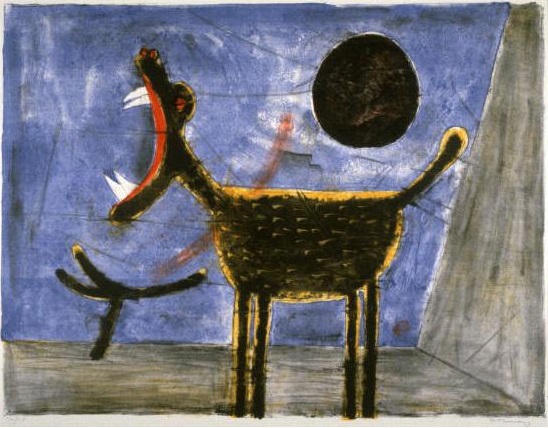
Stevie Smith (1902-1971)
Creencia 1
.
Cristo se murió por Dios y por mi
Sobre el palo crucificando;
Para Dios – la Palabra hablado,
Para mi – una espada;
Para Dios – un himno de alabanza,
Para mi – los días eternos;
Para Dios – una explicación,
Y para mi: Salvación.
. . .
Creencia 2
.
Yo caminaba en el Parque Pascua, por todos lados,
Y oí el ladrido lejano del perro salvaje.
Comprendí que Mi Señor ha resucitado
– Perro salvaje, tú ladras en vano.
. . .
Stevie Smith (1902-1971)
Conviction I
.
Christ died for God and me
Upon the crucifixion tree
For God a spoken Word
For me a Sword
For God a hymn of praise
For me eternal days
For God an explanation
For me salvation.
. . .
Conviction II
.
I walked abroad in Easter Park,
I heard the wild dog’s distant bark,
I knew my Lord was risen again…
– Wild dog, wild dog, you bark in vain.
. . . . .
Niyi Osundare: “Who’s Afraid of The Proverb?”
Posted: March 29, 2015 Filed under: English | Tags: African poets Comments Off on Niyi Osundare: “Who’s Afraid of The Proverb?”
Photograph from 2005 of a fragment of The Berlin Wall (1961-1989)…Osundare’s poems, Checkpoint Charlie and Berlin 1884/5, treat “The Wall” “falling” with multiple ironies regarding History…
Niyi Osundare
(born 1947, Ikere-Ekiti, Nigeria)
. . .
The Large Heart
.
When last did you say hello to a neighbour
Or share with him the early pick
From your backyard garden?
.
When last did you lower that fence
Trim those thorny hedges
And throw a handshake across their forbidding top?
.
When last did you stop in the street
To crack a joke or savour banter
And spread the healing magic of laughter?
.
When last did you say “Bless you”
To soothe a sneeze, or “Take care”
To one who has stubbed a toe?
.
When last did you offer a meal
To a hungry stranger and command
The water from your well to was his feet?
.
When last did your dough of friendship
Rise in the furnace of the sun,
Your milk of mercy in the pitcher of the moon?
.
When last did you think about your fatter calf
And the skinny swansong of the begging bowl
The sin-phony of your silk, and the scream of the national rag?
.
When last did you throw a bridge
Across the gulf and sew little stars in the darkness of forgotten skies?
.
When last did you listen to the wails of the forest
Arrest the savagery of a wanton machete
Enlist in the Salvation Army of Earth and Sky?
.
A genuine smile is longer than a mile,
A large heart is not a medical problem.
. . .
Letter from The Editor
(who once lectured a Nigerian poet of my acquaintance on the virtues of “traveling poems”)
.
Thank you for your poems
Our Editorial Board was tremendously amused –
.
– but there are too many foreign places
In your verse, too many African names
Too strange for the sophisticated glide
.
Of our English tongue.
(You see, we prefer words which pose
No threat to the dental health of our readers.)
.
Too many matters better left to politics – and politicians;
What does poetry have to do
With those who rule us – or those we rule?
.
– with the whimsical temper of stocks and shares,
The cost of a ream of paper
Or the price of bread in the marketplace…?
.
Too strong, your feelings; too sharp
The thrust of your tropes…
We are a people tuned to tamer truths.
.
So: why not bend your wit to the rule of rhyme,
The supremacy of nothingness,
The post-modernity of silence…?
.
Send us poems unclogged by human kindness…
Send us poems that travel.
. . .
Checkpoint Charlie
.
A tortured rainbow:
mosaic of broken epics
.
Quarry for museum hounds
and undertakers for private temples.
.
Here, now, in the dust and concrete splinters,
The Wall
which grew so tall, so wide,
.
It cut the sky in two:
the sun rose on one side, set in the other.
.
Market forces howled and swaggered on one side,
the whimsical Babel of stocks ‘n shares.
.
On the other, human Need wrestled with human Greed
– culture with chaos, mercy with monopoly.
.
Then, a smiling comrade dropped the egg…
and the world couldn’t gather the shattered pieces…
.
Our guide told the story from his own side,
as I took another look at the boy
who sold “The Wall” for tourist dollars.
.
“Come buy History, come buy History!”, he screamed
again, his voice vanishing into the late morning traffic.
. . .
Berlin 1884/5
“Come buy History, come buy History!”
.
I looked round for vendors of my own past,
For that Hall where, many seasons ago,
My Continent was sliced up like a juicy mango…
.
…to quell the quarrel of alien siblings.
I looked for the knife which exacted the rift
– how many kingdoms held its handle?
.
The bravado of its blade,
The wisdom of potentates who put
The map before the man,
.
The cruel arrogance of empire,
Of kings/queens who laid claim to rivers, to mountains,
To other peoples and other gods, and other histories…
.
And they who went to bed under one conqueror’s flag,
Waking up beneath the shadows of another,
Their ears twisted to the syllable of alien tongues.
.
Gunboats,
Territories of terror…
.
Oh, that map – that knife, those contending emperors,
These bleeding scars in a Continent’s soul,
Insisting on a millennium of healing.
. . .
Skinsong 3
.
And pale shadows descend
Upon our noon of bronze:
“You have no past,” they say,
“Your history is darkness
Which never knew the faintest sun.”
.
“Tell us another lie,”
Retort the griots,
About trees without roots,
Rivers without sources,
Because without whys.
Tell us
About the bridge
Which looks forward
Without a backward glance.
. . .
End of History
.
Old truths tumble down
In sunrise cities;
A hated wall dissolves
In a haze of fireworks
And gathering shadows.
.
Old truths tumble
– On the compost of newer Truths.
.
And sunset pundits swear
They have climbed the mountain,
And seen History’s grave
In the elbow of misty valleys.
.
Pundits say
The sun has suddenly stopped
Its limbless journey across the sky.
.
Today I look History
In the face,
His/Her brow a taut membrane
Of inexhaustible riddles.
.
Today I look History
In the face,
And I remember the child in the tale
Who touched the elephant’s tale,
Vowing he had seen everything
About the giant in the forest.
. . .
Testament 1
.
I hold this shred of eternity
in my hand
pulsating like a purple pledge;
falling leaves twirl in the soundless wind
the sun brightens up its corner of the day.
.
The afternoon bell has come and gone,
burying rapid moments in decibels of silence.
.
I hold this shred of eternity
in my hand.
.
I sew that thread
into the memory of the sky
where clouds are cottonballs
waiting for the lyric of the loom.
.
I am a poet:
my memory is a house
of many rooms.
. . .
Who’s Afraid of The Proverb?
(To go with the song:
Owe lesin oro
Oro lesin owe
Toro ba sonu
Owe la fi nwa *)
.
I
.
Who’s afraid of the proverb
of the eloquent kernel in the pod
of silent moons?
.
Who’s afraid of the proverb
of the kola in the mouth of the mountain,
giant udder of the cow of the sky?
.
Who’s afraid of the proverb
of the drum which left its echoes
in the auricles of leaping streets?
.
Who’s afraid of the proverb
of the river which traverses the earth
in limbless intensity?
.
Who’s afraid of the proverb
of the sonic feathers of metaphors in flight,
the lift and thrust of impossible fancies?
.
Who’s afraid of the proverb
of the wind’s truthful lyre,
melodic thrum of Desire’s fingers?
,
Who’s afraid of the proverb
of the shortest distance
between many truths?
.
II
.
Who’s afraid of the proverb
who’s so fat on the Lactogen of the moment,
has lost all hint of the milk of dawn?
.
Who’s afraid of the proverb
stalking minnows in brackish waters,
scared of the shoals which surprise the deep?
.
Who’s afraid of the proverb,
anonymous spaces
in the abyss of the sky?
.
Who’s afraid of the proverb,
first clay in the furnace
of chilling fires?
.
Who’s afraid of the proverb,
silent salt in the feast
of delicious words?
.
Who’s afraid of the proverb?
Who’s afraid of
m-e-m-o-r-y?
. . .
* The proverb is the horse of the word.
The word is the horse of the proverb
When the word is lost
It is the proverb we use for finding it.
. . . . .
To read Osundare’s poem “Metamorphosis”, click on the following ZP link:
Poems of Protest from Prison: Nigeria, 1995
Posted: March 24, 2015 Filed under: English | Tags: African poets, Ken Saro-Wiwa Comments Off on Poems of Protest from Prison: Nigeria, 1995
Ken Saro-Wiwa (1941-1995)
. . .
The Call
.
Hear the call of the ravaged land
The raucous cry of famished earth
The dull dirge of the poisoned air
The piteous wail of sludged streams
Hear, oh, hear!
Stunted crops fast decay
Fishes die and float away
Butterflies lose wing and fall
Nature succumbs to th’ecological war.
. . .
Keep Out Of Prison
.
“Keep out of prison,” he wrote
“Don’t get arrested anymore.”
But while the land is ravaged
And our pure air poisoned
When streams choke with pollution
Silence would be treason
Punishable by a term in prison.
. . .
Ogoni Hymn
.
Creator of Ogoni
Land of glory and wealth
Grant us thy peace and lasting love
Plant justice over the land
Give us thy wisdom and the strength
To shame our enemies.
.
Creator of Ogoni
Land of glory and wealth
Grant everlasting blessings, Lord
To people of Gokana
Khana, Eleme, Tai and Babbe
Glorious Ogoniland.
. . .
Town-Crier
.
Take these cuffs from my legs
And set me free
Pick the lies from your teeth
And let me be
Town-crier, proud gong
Calling the lame and deaf
To defend their blasted land.
. . .
Stone Deaf
.
Tired
of the questions
bored
by the din
of the lone voice
piping
to ears hearing
only
the sounds of their choice.
. . .
For Zina
.
I have raised the questions, daughter
Which you and your kids must ponder
I feel guilty I did not sooner
In my lifetime urge them stronger
And now, ere I answers provide
I may in cold blood lie buried
Have I your futures compromised?
. . .
Night Time
.
The beep of insects
The hoo-hoo of bullfrogs
And the croak of toads
Companion of a night
When nightmares burgle our sleep.
. . .
Morning Song
.
This morning is sheer poetry
as from my detention cell
my heart sings with the red
freshness of hibiscus flowers
the vivid colour of the ixoras
shooting out of the green abundance
of a heart which resists surrender
to a garden of rank weed and mush.
. . .
I Lie Alone At Night
.
I lie alone at night
And think all of one year’s gone
Since I held you in my arms
In the bed we know so well.
.
I lie alone at night
And see the callous bandits
Break into our hallowed bedroom
Cruelly knife our togetherness.
.
I lie alone at night
And think of you lying lonely
Dreaming of my return
To the home we love so well.
.
I lie alone at night
And think of the thick boots
Which stalk the halls of tyranny
And crush us underfoot.
.
I lie alone at night
And wonder why you wait
And endure the gripping pain
Which is my lot to bear.
.
I lie alone at night
And think of the stranger moon
The stars beyond my gaze
Your beauty like moons and stars.
.
I lie alone at night
And pray the day will come
To mend your broken heart
And steel my breaking soul.
.
I lie alone at night
And dream a great new dawn
Without boots and knives
Broken hearts, breaking souls
Empty dreams and lonely beds
Stranger moons and searing pain
When you and I and all of us
Can hold hands and sing our love
Into a night captured by peace.
. . .
Fire
.
There is a fire in me
Burns all night and day
Flares at injustice
Leaps at oppression
Glows warmly in beauty.
. . .
Kenule “Ken” Beeson Saro-Wiwa (1941-1995) was a Nigerian writer and environmental activist, of Ogoni ethnicity. Ogoniland, situated in the Niger Delta, was exploited for crude oil extraction from the mid-1950s onward by the Dutch giant, Shell Oil. Ogoniland suffered extreme environmental degradation – from oil spills, flares, and waste dumping. Saro-Wiwa, from 1990 to 1995, with MOSOP (Movement for the Survival of the Ogoni People), led a non-violent campaign of resistance against Shell and the complicitness of Nigeria’s government, under the military dictatorship of General Sani Abacha. The writer/activist’s execution (along with eight others) provoked international outrage, resulting in Nigeria’s suspension for several years from the Commonwealth of Nations.
. . .
Nnimmo Bassey, co-ordinator of Oilwatch International and director of the Health of Mother Earth Foundation – from his introduction to The Last Writings of Ken Saro-Wiwa (published 2013):
Reading through the treasure trove of letters and poems compiled here evoked such intense memories of Ken’s resolute struggles against an oil behemoth and a deaf autocratic government. His crusade frames one of the most tumultuous periods in Nigeria’s history; his tragic story evokes anger and demands action to resolve the crises that first led the Ogoni people to demand that Shell clean up Ogoniland or clear out of the territory. It was Ken’s leadership, in great part, that forced Shell out of Ogoniland in 1993…..His pioneering work in building a virile environmental justice movement as well as that for the rights of minorities in Nigeria remains outstanding – and continues to inspire campaigners around the world.
. . . . .
“Thought Chill”: how Parliament’s proposed Bill C-51 (the Anti-Terrorism Act) un-democratizes Canada / Poems of Protest
Posted: March 24, 2015 Filed under: English | Tags: A.E. Housman, Robert Frost, Walid Khazindar Comments Off on “Thought Chill”: how Parliament’s proposed Bill C-51 (the Anti-Terrorism Act) un-democratizes Canada / Poems of Protest
Canada’s Federal Government’s proposed Bill C-51_Opening paragraphs
. . .
Elizabeth May
Why I Am Fighting Bill C-51
(originally published in Saanich News, March 20th, 2015):
.
The reaction to Bill C-51 has been widespread and the opposition is growing. While its short title is the “Anti-Terrorism Act,” it is both more and less than that.
It is less than “anti-terrorism” because it is likely to make us less safe. The act gives new powers to CSIS to act in Canada and overseas to “reduce threats,” with virtually no limits. CSIS is specifically not allowed to cause death or bodily harm or “violate the sexual integrity” of anyone. The range of potential activities — from break and enter, search and seizure, infiltration, monkey-wrenching, include powers to offer witnesses immunity from prosecution or from ever having to testify.
There is no requirement that CSIS tell the RCMP what it is up to, and it is the RCMP that has been successfully countering plots and arresting suspects. Just imagine when the RCMP finds key witnesses have a “get out of jail free” card from CSIS. That and other sections run a high degree of probability of gumming up the works. Security experts, especially those with experience in the Air India inquiry, remind us that it is critical that security agencies not develop silos. C-51 takes a system that is currently working quite well and threatens to turn it into a three ring circus, without benefit of a ring-master.
It is also less than Canadians would expect, as there is nothing in C-51 to work against radicalization. No outreach efforts, nothing for the prison system or the schools as the U.K. government established in its new law passed in December 2014.
It is more than anti-terrorism, as the range of activities covered by a new and sweeping definition of “threats to the security of Canada” in the information sharing section of the bill covers far more than terrorism. It could plausibly cover just about anything, and certainly would cover those opposing pipelines and tankers.
It is actually five bills rolled into one. Each part contains provisions I can only describe as dangerous. For example, part 5, amendments to the Immigration and Refugee Act, appear to allow the use of evidence obtained by torture. Part 3, ostensibly about getting terrorist propaganda off the Internet, uses a set of new concepts that would criminalize private conversations — and not just about terrorism. The propaganda section does not require knowing you are spreading propaganda, and “terrorist propaganda” itself has a definition so broad as to include a visual representation (a Che Guevera poster?) promoting a new concept called “terrorism in general.” Experts are now referring to this as “thought chill.”
As the first MP to oppose C-51, I now have a lot of company: four former prime ministers, six former Supreme Court justices, over 100 legal experts, Conrad Black, Rex Murphy, Tom Mulcair and the NDP, the editorial positions of the Globe and Mail, National Post and Toronto Star. The Assembly of First Nations has called for it to be withdrawn. I hope you agree as well.
. . .

The Secret Trial 5: a documentary by Amar Wala
Classic Poems of Protest…
.
A.E. Housman (1859-1936)
The Laws of God, The Laws of Man
.
The laws of God, the laws of man,
He may keep that will and can;
Not I: let God and man decree
Laws for themselves and not for me;
And if my ways are not as theirs
Let them mind their own affairs.
Their deeds I judge and much condemn,
Yet when did I make laws for them?
Please yourselves, say I, and they
Need only look the other way.
But no, they will not; they must still
Wrest their neighbour to their will,
And make me dance as they desire,
With jail and gallows and hell-fire.
And how am I to face the odds
Of man’s bedevilment and God’s?
I, a stranger and afraid,
In a world I never made.
They will be master, right or wrong;
Though both are foolish, both are strong.
And since, my soul, we cannot fly
To Saturn nor to Mercury,
Keep we must, if keep we can,
These foreign laws of God and man.
. . .
Robert Frost (1874-1963)
Directive
.
Back out of all this now too much for us,
Back in a time made simple by the loss
Of detail, burned, dissolved, and broken off
Like graveyard marble sculpture in the weather,
There is a house that is no more a house
Upon a farm that is no more a farm
And in a town that is no more a town.
The road there, if you’ll let a guide direct you
– Who only has at heart your getting lost.
.
And if you’re lost enough to find yourself
By now, pull in your ladder road behind you
And put a sign up Closed to all but me.
.
I have kept hidden in the instep arch
Of an old cedar at the waterside
A broken drinking goblet like the Grail
Under a spell so the wrong ones can’t find it,
So can’t get saved, as Saint Mark says they mustn’t.
(I stole the goblet from the children’s playhouse.)
Here are your waters and your watering place.
Drink and be whole again beyond confusion.
. . .
Comments by poet Michael R. Burch, from The Hyper Texts:
A.E. Housman (The Laws of God, The Laws of Man) strongly protested the idea that Christians should be allowed to use the Bible to create arbitrary, unnecessary laws for nonbelievers like himself. Why should Housman have believed in the the highly dubious morality of a religion that damned him to jail and gallows and hell-fire just because he preferred men to women, sexually? This may be the first great protest poem written by a gay poet against his Christian oppressors.
.
Robert Frost (Directive) was writing about the dark load orthodox Christianity places on the slender shoulders of innocent children, when it tells them that the Bible is the infallible word of God, and that human beings live in danger of eternal torment. Frost understood all too well the emotional, psychological and spiritual damage children can suffer when they read verses in the Bible that say most human beings are “predestined” for eternal damnation before they are born, and that Jesus Christ deliberately misled most of his followers so that they could not be saved – keeping his true teachings only for his inner circle [Mark 4:10-12]. This magnificent poem is a protest against Frost’s own Christian upbringing and its “guide” who “only has at heart your getting lost”.
. . .
Walid Khazindar (born 1950)
Distant Light
.
Harsh and cold
autumn holds to it our naked trees:
If only you would free, at least, the sparrows
from the tips of your fingers
and release a smile, a small smile
from the imprisoned cry I see.
Sing! Can we sing
as if we were light, hand in hand,
sheltered in shade, under a strong sun?
Will you remain, this way
stoking the fire, more beautiful than necessary – and quiet?
Darkness intensifies,
and the distant light is our only consolation—
that one, which from the beginning
has, little by little, been flickering
and is now about to go out.
Come to me. Closer and closer.
I don’t want to know my hand from yours.
And let’s beware of sleep, lest the snow smother us.
. . .
Translation from Arabic into English: Khaled Mattawa, from the author’s collections Ghuruf Ta’isha (Dar al-Fikr, Beirut, 1992) and Satwat al-Masa (Dar Bissan, Beirut, 1996). Walid Khazindar was born in 1950 in Gaza City. Gaza City is located in the Gaza Strip, a small U.N.-sanctioned Palestinian territory surrounded by Israel.
. . . . .
Nowruz Mubarak – Happy Persian New Year! Quotations from Saadi, Barbara Sher, Ahmad Shamlu, and Article 1!
Posted: March 20, 2015 Filed under: English | Tags: First Day of Spring, Nowruz poems Comments Off on Nowruz Mubarak – Happy Persian New Year! Quotations from Saadi, Barbara Sher, Ahmad Shamlu, and Article 1!
برآمد باد صبح و بوی نوروز- به کام دوستان و بخت پیروز
مبارک بادت این سال و همه سال – همایون بادت این روز و همه روز
. . .
“You can learn new things at any time in your life if you’re willing to be a beginner. If you actually learn to like being a beginner, then the whole world opens up to you.”
Barbara Sher
. . .
Article 1, of the United Nations’ Universal Declaration of Human Rights – in the Kazakhstani language:
Барлық адамдар тумысынан азат және қадір-қасиеті мен кұқықтары тең болып дүниеге келеді. Адамдарға ақыл-парасат, ар-ождан берілген, сондықтан олар бір-бірімен туыстық, бауырмалдық қарым-қатынас жасаулары тиіс.
.
Translation:
“All human beings are born free and equal in dignity and rights. They are endowed with reason and conscience and should act towards one another in a spirit of brotherhood [ and sisterhood ].”
. . .
Ahmad Shamlu (1925-2000, Tehran, Iran)
“Bright Horizon”
.
Bright horizon
Some day we will find our doves
Kindness will take Beauty by the hand
.
That day – the least song will be a kiss
and every human being be brother to
every other human being
.
That day – house doors will not be shut
Locks will be but legends
And the Heart be enough for Living
.
The day – that the meaning of all speech is loving
so one won’t have to search for meaning down to the last word
The day – that the melody of every word be Life
and I won’t be suffering to find the right rhythm for every last poem
.
That day – when every lip is a song
and the least song will be a kiss
That day – when you come – when you’ll come forever –
and Kindness be equal to Beauty
.
The day – that we toss seeds to the doves…
and I await that day
even if upon that day I myself no longer be.
. . .
We are grateful to Hassan H. Faramarz for the Persian-to-English translation of “Bright Horizon”.
. . .
May your Nowruz be blessed with Hope – for resolutions, and moving on; for old patterns broken, and new directions sought; for common ground where there is strife; for being on the side of Life!
. . .
Image using Arabic text from a Saadi poem: graphic artist Reza Assar
. . . . .
First Day of Spring: Larkin, Mansfield, Ryōkan Taigu
Posted: March 20, 2015 Filed under: English Comments Off on First Day of Spring: Larkin, Mansfield, Ryōkan Taigu
Philip Larkin (1922-1985)
First Sight
.
Lambs that learn to walk in snow
When their bleating clouds the air
Meet a vast unwelcome, know
Nothing but a sunless glare.
Newly stumbling to and fro
All they find, outside the fold,
Is a wretched width of cold.
As they wait beside the ewe,
Her fleeces wetly caked, there lies
Hidden round them, waiting too,
Earth’s immeasurable surprise.
They could not grasp it if they knew,
What so soon will wake and grow
Utterly unlike the snow.
. . .
Katharine Mansfield (1888-1923)
Very Early Spring
.
The fields are snowbound no longer;
There are little blue lakes and flags of tenderest green.
The snow has been caught up into the sky–
So many white clouds–and the blue of the sky is cold.
Now the sun walks in the forest,
He touches the bows and stems with his golden fingers;
They shiver, and wake from slumber.
Over the barren branches he shakes his yellow curls.
Yet is the forest full of the sound of tears….
A wind dances over the fields.
Shrill and clear the sound of her waking laughter,
Yet the little blue lakes tremble
And the flags of tenderest green bend and quiver.
. . .
Ryōkan Taigu (Zen Buddhist monk, Japan, 1758-1831)
First Days of Spring
.
First days of Spring…
the sky is bright blue, the sun huge and warm.
Everything’s turning green.
Carrying my monk’s bowl, I walk to the village
to beg for my daily meal.
The children spot me at the temple gate
and happily crowd around,
dragging on my arms till I stop.
I put my bowl on a white rock,
hang my bag on a branch.
First we braid grasses and play tug-of-war,
then we take turns singing and keeping a kick-ball in the air:
I kick the ball and they sing, they kick and I sing.
Time is forgotten, the hours fly.
People passing by point at me and laugh:
“Why are you acting like such a fool?”
I nod my head and don’t answer.
I could say something – but why?
Do you want to know what’s in my heart?
From the beginning of time: just this! just this!
. . . . .
“Once upon a time, there were no stories in this world…” Toronto Storytelling Festival: March 19th-29th, 2015
Posted: March 19, 2015 Filed under: English, English: Jamaican Patois | Tags: Anansi the Spider God Comments Off on “Once upon a time, there were no stories in this world…” Toronto Storytelling Festival: March 19th-29th, 2015
Anansi: the Spider God who is a storyteller, and whose name is synonymous with skill in speech.
2015 Toronto Storytelling Festival
.
Among the many events…
The Talking Stick: a special evening at 1001 Friday Nights of Storytelling, Innis College, March 20th , 8 pm.
Queers in Your Ears, at Canadian Lesbian and Gay Archives (CLGA), March 21st, 2 pm.
All Aboard! On the Katari Story Time Machine, at the Japan Foundation, Toronto, March 21st, 3 pm.
Storytelling with Elizabeth Laird and Rubena Sinha: Animal Fables and Tiger Tales, at the Aga Khan Museum, March 22nd, 2 pm to 10 pm.
A Storytelling Journey to Ethiopia, Brazil, and The Yukon, at The Ismaili Centre, Toronto, March 23rd, 7:30 pm.
D’bi Young: dubpoet, praise-singer, storyteller, at Aki Studio Theatre, Daniels Spectrum, Regent Park, Toronto, March 24th, 5 pm.
Storytalk: What comes first – the story or the world? At Paintbox Bistro, Regent Park, Toronto, March 28th, 10 am.
Storytalk: Aqausivut – Our Inuit Love Songs from mother to child, at Paintbox Bistro, March 28th, 11:15 am.
. . .
Storytellers will include: Taina Tyebjee, Leeya Solomon, Marîa del Carmen Orodoñez, Michael Parent, Mahlika Awe:ri, Djennie Laguerre, Richard Wagamese, Itah Sadu, Donald Carr, Rubena Sinha,
…and more!
http://www.torontostorytellingfestival.ca
. . .
ANANSI is a West-African god who often takes the shape of a spider. The Asante (Ashanti) people of Ghana had many Anansi tales, and these stories were in the oral tradtion; Anansi himself was always synonymous with skill + wisdom in speech.
There is one Anansi story that explains the phenomenon of how his name became attached to the whole corpus of tales:
Once upon a time there were no stories in this world; the Sky-God, Nyame, had them all.
Anansi went to Nyame and asked how much they would cost to buy.
Nyame set a high price: Anansi must bring back Onini the Python, Osebo the Leopard, and the Mboro Hornets.
And so, Anansi set about to capture these three: python, leopard, and the hornets.
First he went to where Python lived and debated out loud whether Python was really longer than the palm branch – or not as his wife Aso had said. Python overheard, and, when Anansi explained the debate, agreed to lie along the palm branch. Because he could not easily make himself completely straight, a true impression of his actual length was difficult to obtain. So Python agreed to be tied to the branch. And once he was completely tied down, Anansi took him to Nyame.
To catch the Leopard, Anansi dug a deep hole in the ground. When the leopard fell in the hole Anansi offered to help him out with his webs. Once the leopard was out of the hole he was bound in Anansi’s webs – and carried away.
To catch the hornets, Anansi filled a calabash with water and poured some over a banana leaf he held over his head and some over the nest, calling out that it was raining. He suggested the bees get into the empty calabash, and when they obliged, he quickly sealed the opening.
Anansi handed his captives over to Nyame, and Nyame rewarded him by making him the “god of all stories”.
.
“Anancy and Common Sense” (A tale told in Jamaican Patois)
.
Wance apan a time Breda Anancy mek up im mind seh im gwine callect all a de camman sense inna de wurl. Im was tinking dat he would be de smartest smaddy in de wurl ef im do dis. So Anancy traveled all ova de wurl collecting camman sense. Im go to big countries an likkle ones. Im go to primary schools and universities. Im go to govament offices and businesses. Im go people house and dem work place.
Im tek all de zillions camman sense he had collected fram around the wurl and put it a big calabash. Im tek de calabash wid im to im backyard and climbed a big gwangu tree. His plan was to store it at de tap of the tree for safety-keeping. Nobady woulda get to it but Anancy.
To mek sure it was safe Anancy tie the calabash to de front of his bady. Dis slow down im progress up de tree to a slow crawl. Im did look very clumsy a-go up de tree wid be-caw the calabash dida hamper im.
As im was slowing going up toward de top a de tree a likkle girl below called out to im. Anancy, mek you nuh tie the calabash pon you back insteada in front of yuh. It will git up de tree much fasta and ez-a.
Anancy was bex be-cah de likkle girl show im up for not thinking. She had more good sense dan him he thought. He called out to her “Mi did tink me collected all the camman sense fram all ova de wurl”
He was so angry dat im fling the calabash to the to the groung and it bust. All of the camman sense im did callect fly back to all ova de wurl.
An dat’s how you and I manage to have just a likkle common sense for we-self tideh.
“And his wild harp slung behind him”: lyric poems of Thomas Moore for St. Patrick’s Day
Posted: March 17, 2015 Filed under: English, Thomas Moore | Tags: Saint Patrick's Day Poems Comments Off on “And his wild harp slung behind him”: lyric poems of Thomas Moore for St. Patrick’s Day
Eileen Thompson the “Colleen”_Belfast, 1944
Thomas Moore (1779-1852)
The Minstrel Boy (song composed around 1800)
.
The minstrel boy to the war is gone,
In the ranks of death you’ll find him;
His father’s sword he has girded on,
And his wild harp slung behind him;
“Land of Song!” said the warrior bard,
“Though all the world betrays thee,
One sword, at least, thy rights shall guard,
One faithful harp shall praise thee!”
.
The Minstrel fell! But the foeman’s chain
Could not bring his proud soul under;
The harp he loved ne’er spoke again,
For he tore its chords asunder;
And said “No chains shall sully thee,
Thou soul of love and bravery!
Thy songs were made for the pure and free
They shall never sound in slavery!”
. . .
Moore set his patriotic poem, The Minstrel Boy”, to the melody known as The Moreen, an old Irish air. It is believed that the poet composed the song in remembrance of friends he’d known while studying at Trinity College, Dublin, and who had taken part in / were killed during, the Irish Rebellion of 1798.
. . .
Thomas Moore
The Last Rose of Summer (written in 1805)
.
‘Tis the last rose of summer,
Left blooming alone;
All her lovely companions
Are faded and gone;
No flower of her kindred,
No rosebud is nigh,
To reflect back her blushes,
Or give sigh for sigh.
.
I’ll not leave thee, thou lone one!
To pine on the stem;
Since the lovely are sleeping,
Go, sleep thou with them.
Thus kindly I scatter,
Thy leaves o’er the bed,
Where thy mates of the garden
Lie scentless and dead.
.
So soon may I follow,
When friendships decay,
And from Love’s shining circle
The gems drop away.
When true hearts lie withered,
And fond ones are flown,
Oh! who would inhabit
This bleak world alone?
. . .
Moore’s poem, The Last Rose of Summer, was composed in 1805 while he was visiting Jenkinstown Park in County Kilkenny. It was later set to a traditional tune called “Aislean an Oigfear” or “The Young Man’s Dream”, which had been transcribed by Edward Bunting in 1792 based on a performance by harper Donnchadh Ó hÁmsaigh (Denis Hempson) at the Belfast Harp Festival. The poem and the tune together were published in December 1813 in volume 5 of a collection of Moore’s work called A Section of Irish Melodies.

The Brian Boru Harp_a 15th century cláirseach
 Zócalo Poets