Langston Hughes: poemas del poemario “Montaje de un Sueño Diferido” (1951)
Posted: February 1, 2016 Filed under: A FEW FAVOURITES / UNA MUESTRA DE FAVORITOS, English, English: Black Canadian / American, Langston Hughes, Langston Hughes: poemas del poemario "Montaje de un Sueño Diferido" (1951), Spanish, ZP Translator: Alexander Best | Tags: Black History Month poems, El Mes de la Historia Afroamericana Comments Off on Langston Hughes: poemas del poemario “Montaje de un Sueño Diferido” (1951)
Una selección de poemas del poemario Montage of a Dream Deferred (Montaje de un Sueño Diferido) (1951) por Langston Hughes (nacido 1 de febrero de 1902 / muerto 22 de mayo de 1967). Versiones españoles (enero de 2016): Alexander Best
. . .
Necesidad
.
¿El trabajo?
Yo, no tengo que trabajar.
No tengo que hacer nada
sino
comer, beber, permanecer negro – y morir.
Este viejo cuartito amueblado es
tan pequeño que
aun no puedo azotar un gato sin pillar el pelaje en mi boca.
Y la casera es tan anciana que sus rasgos desdibujan juntos;
¡y sabe el Señor que ella puede cobrarme de más a mí – eso es seguro!
(Entonces…éso es el motivo por que estimo que debo trabajar – después de todo.)
. . .
“Necessity”
.
Work?
I don’t have to work.
I don’t have to do nothing
but eat, drink, stay black, and die.
This little old furnished room’s
so small I can’t whip a cat
without getting fur in my mouth
and my landlady’s so old
her features is all run together
and God knows she sure can overcharge –
which is why I reckon I does
have to work after all.
. . .
Pregunta número 2
.
Dijo la señora:
¿Puedes hacer lo que no puede hacer
mi otro hombre – ? Y éso es:
¡Quiéreme, papi,
y aliméntame también!
.
Figurita
.
¡Be-bop!
. . .
“Question (2)”
.
Said the lady, Can you do
what my other man can’t do –
that is
love me, daddy –
and feed me, too?
.
Figurine
.
De-dop!
. . .
‘Bugui’ despreocupado
.
Abajo en el contrabajo
caminando andando
al firme tiempo
– como pies marchandos.
.
Abajo en el contrabajo
menearse fácil
– el revolcón como me gusta en mi alma.
.
< Riffs, manchas, descansos.>
.
¡Eh, mamacita! – ¿has oído lo que digo?
Despreocupado, yo lo impulso – ¡en mi cama!
. . .
“Easy Boogie”
.
Down in the bass
That steady beat
Walking walking walking
Like marching feet.
.
Down in the bass
That easy roll,
Rolling like I like it
In my soul.
.
Riffs, smears, breaks.
.
Hey, Lawdy, Mama!
Do you hear what I said?
Easy like I rock it
In my bed!
. . .
Las 3 de la mañana en el café…
.
Agentes de policía de la vicebrigada,
con ojos agotados y sádicos – divisando a los maricones.
Degenerados, dice alguna gente.
.
Pero Dios – o la Naturaleza – o alguien – les hizo en esa forma.
¿Una policía – o una Lesbiana – allá?
¿Dónde?
. . .
“Café: 3 a.m.”
.
Detectives from the vice squad
with weary sadistic eyes
spotting fairies.
Degenerates,
some folks say.
.
But God, Nature,
or somebody
made them that way.
Police lady or Lesbian
over there?
Where?
. . .
Calle número 125 (en Harlem)
.
Rostro como una barra de chocolate,
lleno de nueces – y dulce.
.
Cara como una calabaza de Hallowe’en,
y adentro una candela.
.
Rostro como una loncha de sandía
– y una sonrisa tan amplia.
. . .
“125th Street”
.
Face like a chocolate bar
full of nuts and sweet.
.
Face like a jack-o’-lantern,
candle inside.
.
Face like a slice of melon,
grin that wide.
. . .
Los blues en el alba
.
No oso empezar con algunos pensamientos
en las primeras horas del día
– no, no oso pensar en ese momento.
Si yo piense algo de pensamiento mientras estoy en cama,
esos pensamientos romperían mi cabeza
– pues, las mañanas: no oso empezar a pensar.
.
No oso recordar en el alba, no – nunca en el alba.
Porque, si yo evocara el día antes,
no me levantaría nunca más
– pues, las mañanas: no oso recordar.
. . .
“Blues at Dawn”
.
I don’t dare start thinking in the morning.
I don’t dare start thinking in the morning.
If I thought thoughts in bed,
Them thoughts would bust my head –
So I don’t dare start thinking in the morning.
.
I don’t dare remember in the morning
Don’t dare remember in the morning.
If I recall the day before,
I wouldn’t get up no more –
So I don’t dare remember in the morning.
. . .
El vecino
.
En el sur él se colocaba él mismo en la escalera de entrada – y miraba el sol pasando…
Aquí en Harlem, cuando está completo su trabajo – él se coloca en un bar con una cerveza.
Parece más alto que es, y más jóven que no es.
Parece su piel más oscura que es, también – y él es más listo que muestra su rostro.
No es listo, ese vato es un bufón tonto.
Aw, no es eso tampoco – es un buen tipo, salvo que platica demasiado.
A decir verdad es un cuate estupendo – pero cuando toma el vaso, bebe rápido.
A veces no bebe.
Es cierto, sólo deja estar allí su vaso – nada más.
. . .
“Neighbour”
.
Down home
he sets on a stoop
and watches the sun go by.
In Harlem
when his work is done
he sets in a bar with a beer.
He looks taller than he is
and younger than he ain’t.
He looks darker than he is, too.
And he’s smarter than he looks –
He ain’t smart.
That cat’s a fool.
Naw, he ain’t neither.
He’s a good man,
except that he talks too much.
In fact, he’s a great cat.
But when he drinks,
he drinks fast.
Sometimes
he don’t drink.
True,
he just
lets his glass
set there.
. . .
La hora punta en el metropolitano
.
Mezclados,
nuestro aliento, nuestro olor.
Tan cerca – nosotros, negros y blancos;
ningún espacio para el temor.
. . .
“Subway Rush Hour”
.
Mingled
breath and smell
so close
mingled
black and white
so near
no room for fear.
. . .
Hermanos
.
Somos parientes – tú y yo;
tú del Caribe,
yo de Kentucky.
.
Familiar – tú y yo;
tú de África,
yo de los EE.UU.
.
Hermanos somos – tú y yo.
. . .
“Brothers”
.
We’re related – you and I,
You from the West Indies,
I from Kentucky.
.
Kinsmen – you and I,
You from Africa,
I from U.S.A.
.
Brothers – you and I.
. . .
Astilla
.
Rimas pequeñas corrientes
y una tonadilla ordinária
pueden ser casi peligrosas
como una astilla de la luna.
Una tonadilla ordinária
con unas pequeñas rimas corrientes
pueden ser navaja – a veces –
a la garganta de un hombre.
. . .
“Sliver”
.
Cheap little rhymes
A cheap little tune
Are sometimes as dangerous
As a sliver of the moon.
A cheap little tune
To cheap little rhymes
Can cut a man’s
Throat sometimes.
. . .
Consejo
.
Mi gente, les digo a ustedes:
el Nacimiento es duro
y la Muerte es miserable – así que
agarren ustedes mismos algo de Amor
entre aquellos dos.
. . .
“Advice”
.
Folks, I’m telling you:
Birthing is hard
And Dying is mean,
So get yourself
Some loving in between.
. . .
Lema
.
Lo juego muy tranquilo esta vida – y me gusta toda la jerga.
Es la razón que aún estoy vivo.
.
Mi lema,
como estoy viviendo, descubriendo, es:
dar amor-tomar amor y
vivir-y-dejar-vivir.
. . .
“Motto”
.
I play it cool
And dig all jive.
That’s the reason
I stay alive.
.
My motto,
As I live and learn,
Is:
Dig And Be Dug
In Return.
. . .
No hemos incluido los dos poemas más famosos del poemario Montaje de un Sueño Diferido: Tarea para el segundo curso de inglés (“Theme for English B”) y “Harlem (2)”, más conocido por una frase extraída de su primera línea: Un Sueño Diferido (A Dream Deferred).
.
https://zocalopoets.com/2013/02/01/langston-hughes-tarea-para-el-segundo-curso-de-ingles-theme-for-english-b-translated-into-spanish-by-oscar-paul-castro/
.
https://zocalopoets.com/2011/09/26/un-sueno-diferido-langston-hughes/
. . . . .
Langston Hughes: poèmes de la Renaissance de Harlem
Posted: February 1, 2016 Filed under: English, French, Langston Hughes | Tags: Black History Month poems, Le mois de l'histoire des noirs, Poésie de la Renaissance de Harlem Comments Off on Langston Hughes: poèmes de la Renaissance de Harlem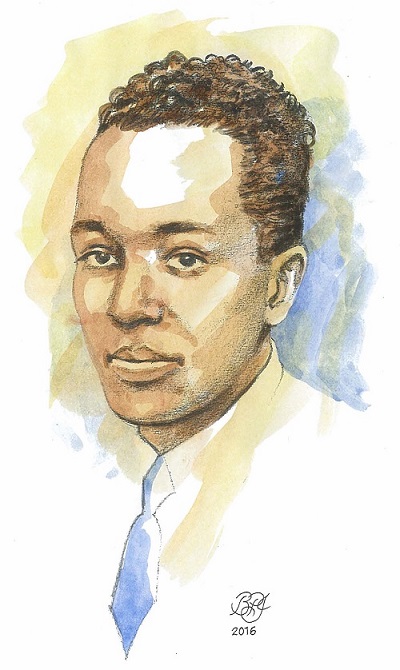
Portrait de Langston Hughes par Bruce Patrick Jones_graphite et aquarelle_2016
Langston Hughes (le 1er février 1902 – mai 1967: poète, écrivain, et dramaturge noir-américain)
Le Nègre parle des fleuves (1921)
(The Negro speaks of rivers)
.
J’ai connu des fleuves
J’ai connu des fleuves anciens comme le monde et plus vieux
que le flux du sang humain dans les veines humaines.
.
Mon âme est devenue aussi profonde que les fleuves.
.
Je me suis baigné dans l’Euphrate quand les aubes étaient neuves.
J’ai bâti ma hutte près du Congo et il a bercé mon sommeil.
J’ai contemplé le Nil et au-dessus j’ai construit les pyramides.
J’ai entendu le chant du Mississipi quand Abe Lincoln descendit
à la Nouvelle-Orléans, et j’ai vu ses nappes boueuses transfigurées
en or au soleil couchant.
.
J’ai connu des fleuves:
Fleuves anciens et ténébreux.
.
Mon âme est devenue aussi profonde que les fleuves.
. . .
Moi aussi, je chante l’Amérique (1926)
(Epilogue: I, Too)
.
Moi aussi, je chante l’Amérique.
.
Je suis le frère à la peau sombre.
Ils m’envoient manger à la cuisine
Quand il vient du monde.
Mais je ris,
Et mange bien,
Et prends des forces.
.
Demain
Je me mettrai à table
Quand il viendra du monde
Personne n’osera
Me dire
Alors
«Mange à la cuisine».
.
De plus, ils verront comme je suis beau
Et ils auront honte…
.
Moi aussi, je suis l’Amérique.
. . .
Le Blues du Désespoir (1926)
(The Weary Blues)
.
Fredonnant un air syncopé et nonchalant,
Balançant d’avant en arrière avec son chant moelleux,
J’écoutais un Nègre jouer.
En descendant la Lenox Avenue l’autre nuit
A la lueur pâle et maussade d’une vieille lampe à gaz
Il se balançait indolent…
Il se balançait indolent…
Pour jouer cet air, ce Blues du Désespoir.
Avec ses mains d’ébène sur chaque touche d’ivoire
Il amenait son pauvre piano à pleurer sa mélodie.
O Blues !
Se balançant sur son tabouret bancal
Il jouait cet air triste et rugueux comme un fou,
Tendre Blues !
Jailli de l’âme d’un Noir
O Blues !
.
D’une voix profonde au timbre mélancolique
J’écoutais ce Nègre chanter, ce vieux piano pleurer –
« J’n’ai personne en ce monde,
J’n’ai personne à part moi.
J’veux en finir avec les soucis
J’veux mettre mes tracas au rancart. »
Tamp, tamp, tamp ; faisait son pied sur le plancher.
Il joua quelques accords et continua de chanter –
« J’ai le Blues du Désespoir
Rien ne peut me satisfaire.
J’n’aurai plus de joie
Et je voudrais être mort. »
Et tard dans la nuit il fredonnait cet air.
Les étoiles disparurent et la lune à son tour.
Le chanteur s’arrêta de jouer et rentra dormir
Tandis que dans sa tête le Blues du Désespoir résonnait.
Il dormit comme un roc ou comme un homme qui serait mort.
. . .
Nègre (1922) (Negro)
.
Je suis un Nègre :
Noir comme la nuit est noire,
Noir comme les profondeurs de mon Afrique.
.
J’ai été un esclave :
César m’a dit de tenir ses escaliers propres.
J’ai ciré les bottes de Washington.
.
J’ai été ouvrier :
Sous ma main les pyramides se sont dressées.
J’ai fait le mortier du Woolworth Building.
.
J’ai été un chanteur :
Tout au long du chemin de l’Afrique à la Géorgie
J’ai porté mes chants de tristesse.
J’ai créé le ragtime.
.
Je suis un Nègre :
Les Belges m’ont coupé les mains au Congo.
On me lynche toujours au Mississipi.
.
Je suis un Nègre :
Noir comme la nuit est noire
Noir comme les profondeurs de mon Afrique.
. . .
Les poèmes originals, en anglais:
.
The Negro Speaks of Rivers
.
I’ve known rivers:
I’ve known rivers ancient as the world and older than the
flow of human blood in human veins.
.
My soul has grown deep like the rivers.
.
I bathed in the Euphrates when dawns were young.
I built my hut near the Congo and it lulled me to sleep.
I looked upon the Nile and raised the pyramids above it.
I heard the singing of the Mississippi when Abe Lincoln
went down to New Orleans, and I’ve seen its muddy
bosom turn all golden in the sunset.
.
I’ve known rivers:
Ancient, dusky rivers.
.
My soul has grown deep like the rivers.
. . .
Epilogue: I, too
.
I, too, sing America.
.
I am the darker brother.
They send me to eat in the kitchen
When company comes,
But I laugh,
And eat well,
And grow strong.
.
Tomorrow,
I’ll be at the table
When company comes.
Nobody’ll dare
Say to me,
“Eat in the kitchen,”
Then.
.
Besides,
They’ll see how beautiful I am
And be ashamed—
.
I, too, am America.
. . .
The Weary Blues
.
Droning a drowsy syncopated tune,
Rocking back and forth to a mellow croon,
I heard a Negro play.
Down on Lenox Avenue the other night
By the pale dull pallor of an old gas light
He did a lazy sway . . .
He did a lazy sway . . .
To the tune o’ those Weary Blues.
With his ebony hands on each ivory key
He made that poor piano moan with melody.
O Blues!
Swaying to and fro on his rickety stool
He played that sad raggy tune like a musical fool.
Sweet Blues!
Coming from a black man’s soul.
O Blues!
In a deep song voice with a melancholy tone
I heard that Negro sing, that old piano moan—
“Ain’t got nobody in all this world,
Ain’t got nobody but ma self.
I’s gwine to quit ma frownin’
And put ma troubles on the shelf.”
.
Thump, thump, thump, went his foot on the floor.
He played a few chords then he sang some more—
“I got the Weary Blues
And I can’t be satisfied.
Got the Weary Blues
And can’t be satisfied—
I ain’t happy no mo’
And I wish that I had died.”
And far into the night he crooned that tune.
The stars went out and so did the moon.
The singer stopped playing and went to bed
While the Weary Blues echoed through his head.
He slept like a rock or a man that’s dead.
. . .
Negro
.
I am a Negro:
Black as the night is black,
Black like the depths of my Africa.
.
I’ve been a slave:
Caesar told me to keep his door-steps clean.
I brushed the boots of Washington.
.
I’ve been a worker:
Under my hand the pyramids arose.
I made mortar for the Woolworth Building.
.
I’ve been a singer:
All the way from Africa to Georgia
I carried my sorrow songs.
I made ragtime.
.
I’ve been a victim:
The Belgians cut off my hands in the Congo.
They lynch me still in Mississippi.
.
I am a Negro:
Black as the night is black,
Black like the depths of my Africa.
. . . . .
Modern Greek women poets / Poetisas griegas modernas: una muestra de Zócalo Poets: enero de 2016
Posted: January 31, 2016 Filed under: English, Spanish | Tags: Greek women poets, Poetisas griegas Comments Off on Modern Greek women poets / Poetisas griegas modernas: una muestra de Zócalo Poets: enero de 2016

Eftychia Panayiotou: dos poemas: “Engaño de uno mismo” y “Un mano dibujando significa el psiquiátrico”
Posted: January 31, 2016 Filed under: Eftychia Panayiotou, Spanish | Tags: Poetisas griegas Comments Off on Eftychia Panayiotou: dos poemas: “Engaño de uno mismo” y “Un mano dibujando significa el psiquiátrico”
Eftychia Panayiotou (n. 1980, Chipre)
Engaño de uno mismo
.
Estoy viviendo por ese día del manicomio por el festín del mundo, cuando todos encerrarles a sí mismos dentro de sus casas; las mujeres se esquilarán el pelo; los hombres llorarán con narices sangrantes; se caerá la electricidad; y el agua, solamente como polvo al primero, y el corazón de un estroboscopio, regularán los tonos de luz en un compartimiento congelado.
.
Todos serán contra todos, y todos se rebelarán contra la revolución; y se apenarán verdades, temerán el miedo; y existirá un ojo entre sus dientes brillantes; y una lengua muy afilada parloteará jerigonza
de rerum natura / de natura deorum……….narcotized
en una manera que hace a la gente tener un espasmo.
Sí, éso es como se retorcerán hasta que saldrá su alma – y saldrá como una dama. Y ese día será un festín extraordinario – un festín sin hogar de un día festivo – y yo, con un trozo de cristal del nuevo mundo de lentes, yo vivirá en independencia (– somos todos parecidos – iguales y muertos en los ojos de la burocracia eternal); dicho de otro modo: yo, del loquero, estará viviendo en la forma de los pájaros – aún sin una boleta del dar de alta. Yo vivo – y revivo – naturalmente el día.
. . .
Un mano dibujando significa el psiquiátrico
.
en mi libro dibujo un triángulo.
dios en el rincón lo más alto,
mi gato a la izquierda y el lápiz al derecho.
es un triángulo mágico
porque
mientras mi memoria expande
indeseable
las líneas se hacen borrosas
– se aflojan y se mecen aquí y allí –
y dios se vuelve una sacerdotisa negra,
y mi gato una pantera, y mi lápiz un bolígrafo.
.
la pantera está voraz; se calienta con la sacerdotisa.
el bolígrafo es indeleble; resuelve el asuste de viejas cuentas.
los dos bordes disuelven
y la hembra está salvado
y solita
no siendo consciente del poder
ella gana una batalla que ignoró.
una compañía vestida de blanco me ha sucedido.
quizás un regalo de necesidad
que me hace fingir ser una loca con una varita mágica.
.
oxidada, fuera de práctica
.
me rindo a una cosa que galopa como mis panaceas
corto mis papeles
rasgo mis encantamientos
eres un barranco – Grotta Azzura –
y se dibuja una línea toda nueva y torcida,
y hay algo sobre esta forma – maldito triángulo – que no se puede ser dibujado.
. . .
Versiones de las traducciones ingleses [del griego]: Alexander Best
. . .
Eftychia Panagiotou nació en 1980 en la isla-nación de Chipre. Es una poetisa, también traductora y crítica literária. Acaba de lograr su doctorado sobre la poesía moderna de las griegas.
. . . . .
Kleopatra Lymperi: “Cuando Vendrás En Tu Reino…”
Posted: January 25, 2016 Filed under: English, Greek, Kleopatra Lymperis, Spanish, ZP Translator: Alexander Best | Tags: Greek women poets, Poetisas griegas Comments Off on Kleopatra Lymperi: “Cuando Vendrás En Tu Reino…”
Η Kλεοπάτρα Λυμπέρη
ΟΤΑΝ ΕΛΘΕΙΣ ΕΝ ΤΗ ΒΑΣΙΛΕΙΑ ΣΟΥ
.
Ποίημα, σε λίγο θα φύγεις, θα πάρεις
τους δρόμους σαν σκύλος
σαν ντάλια κομμένη – τι θα έχω τότε,
ποιός θα είμαι; σε τι κατοικίες θα πλαγιάζω
χωρίς φαϊ, χωρίς, νερό χωρίς κορμί;
.
Ποίημα, μου ρίχνεις τόσους σκοτωμένους
να με σκεπάσουν όλα τα υπαρκτά
και τα κατεβατά της ερήμου
όλοι οι άνεμοι, οι σχηματισμοί πτηνών και οι
φωλιές τους, οι θύελλες οι αισθηματικές τους.
.
Ποίημα, συ ο παρών, ο ενεδρεύων
σε κάμπους πίσω από μάτια και μυαλά,
σε όλα τα λόγια που με διώχνουν από τη
φωλιά, σε οράματα που φτύνουν στο στόμα μου
όπως οι σαμάνοι
μα και σε ουρλιαχτά των Άλπεων
(τόσο πολύ χιόνι μαζεύεται όταν λείπεις)
.
Ποίημα, ποιος είσαι; Ποιοι είμαστε όλοι οι
κρυμμένοι στον έναν αυτόν που τώρα μιλά;
Αν γίνεις ο ρυθμός, το σχήμα, το ρίγος
το στήθος των φτερωτών ζηλωτών των γλωσσών
σαν λαμπάδα του Πάσχα θ’ ανάψεις
σαν έρως του Ενός
-μνήσθητί μου, Ποίημα, όταν έρθεις εν τη
βασιλεία σου στο σπίτι του Κανενός.
. . .
Kleopatra Lymperi (Chalkis, Greece)
When Thou Comest Into Thy Kingdom
.
Poem, soon you will leave, you will roam
the streets like a dog,
like a cut dahlia – what will I have then?
who will I be? What home will I sleep in
with no food, no water, no body?
.
Poem, you throw me so many dead bodies
so that I am covered by all existence,
and the densely written pages of the desert:
all the winds, the bird formations and
their nests, their emotional tempests.
.
Poem, you, the omnipresent, the prowler
in lowlands behind bosoms and brains,
in all the words that cast me out of the
nest, in visions spitting into my mouth
like shamans,
but also in Alpine howlings
(that much snow piles up when you’re gone).
.
Poem, who are you? Who are we all,
hidden inside the one who is speaking now?
If you become the rhythm, the form, the tremor,
the bosom of the winged zealots of the languages,
you will light up like an Easter candle,
like Eros of the One.
Poem, remember me when thou comest into thy
kingdom, the house of No one.
. . .
Translation from the Greek original © Tatiana Sergiadi
. . .
Kleopatra Lymperis (Chalkis, Grecia)
Cuando Vendrás En Tu Reino…
.
Poema,
te irás pronto, vagabundearás las calles – como un perro, como una dalia cortada.
Pues ¿qué tendré, y quién seré?
¿En cuál hogar dormiré – sin alimento, sin agua, sin cuerpo?
.
Poema,
me tiras tantos cadáveres pues estoy cubierto por toda la existencia
y las páginas del desierto, densamente escritas; y todos los vientos,
las formaciones de pájaros y sus nidos, y sus tempestades emotivas.
.
Poema
– tú –
el merodeador omnipresente en las tierras bajas detrás de bustos y sesos;
estás en todas las palabras que me lanzan del nido;
y en las visiones que escupen en mi boca, como hacen los chamanes;
estás presente también en los aullidos alpinos
(sí, tanta nieve amontona cuando estés ausente).
.
Poema
– ¿quién eres tú? – ¿quién somos nosotros, todos, escondidos dentro del uno que habla ahora?
Si te vuelvas el ritmo-la forma-el temblor-el pecho de los fanáticos alados de los idiomas,
te iluminarás como una vela de Pascua, o como Eros del Uno.
Poema, recuérdame cuando vendrás en tu reino – en tu mansión de Nadie.
. . .
Versión español – de la traducción inglés del griego: Alexander Best
. . .
Kleopatra Lymperi estudió la música y la pintura en Atenas. Además de su poesía, tiene una obra considerable de traducciones: poemas de Dickinson, Mailer, Pound, Plath y otros. Ha contribuido al periódico Eleutherotypia y al revista Poeticanet.
.
Kleopatra Lymperi studied music and painting in Athens, at the Conservatory and the School of Fine Arts, respectively. As well as writing poetry, she has been a busy translator: poems of Dickinson, Mailer, Pound, Plath and others. She has collaborated on the newspaper Eleutherotypia and writes essays and book reviews for the e-magazine Poeticanet.
. . . . .
Tasoula Karageorgiou: “La tortuga de Kerameikos”
Posted: January 25, 2016 Filed under: English, Greek, Spanish, Tasoula Karageorgiou, ZP Translator: Alexander Best | Tags: Greek women poets, Poetisas griegas Comments Off on Tasoula Karageorgiou: “La tortuga de Kerameikos”
Η Τασούλα Καραγεωργίου
Η ΧΕΛΩΝΑ ΤΟΥ ΚΕΡΑΜΕΙΚΟΥ
.
Ίσως φανείτε τυχεροί, όπως κι εγώ,
εάν βρεθείτε Απρίλη μήνα στον Κεραμεικό,
ίσως τη δείτε ξαφνικά
να σέρνεται λικνιστικά
μες στα χλωρά τριφύλλια
.
Κι αν γύρω σας ακινητούν οι επιτύμβιας στήλες
κι έφιππος ο Δεξίλεως γλεντάει τον θάνατό του,
ακόμα κι αν σας συγκινεί μονάχα η τέχνη της σιωπής,
δώσετε λίγη προσοχή
στο θαύμα που ζωγράφισε ὁ Θεός πάνω στο καύκαλό της,
μα πιο πολύ,
στο πείσμα της αδιάφορη να οδεύει προς τους τάφους.
.
(Χελώνη η ελληνική,
πατρίδα μου, βραδύ γλυπτό, που προσπερνάει τον Άδη.)
. . .
Tasoula Karageorgiou (born 1954, Alexandria, Egypt)
The Kerameikos Tortoise
.
If you are lucky, like me,
and find yourselves in April among the graves of Kerameikos,
all of a sudden you may see her
swishing and swaying
through the green shamrocks.
.
And if the grave steles around you stay still
and if Dexileos on his horse revels in his death,
even if you are moved by the art of silence only,
pay a little attention to
the miracle God painted on her carapace,
yet even more
her stubborn, indifferent crawling to the graves.
.
<Tortoise the Greek,
homeland of mine, tardy sculpture, passing by Hades.>
. . .
Translation from the Greek original © Vasso Oikonomidou
. . .
Tasoula Karageorgiou (n. 1954, Alexandria, Egipto)
La tortuga de Kerameikos
.
Si ustedes tienen suerte – como yo –
y, en abril, se encuentran entre las tumbas de Kerameikos,
repentinamente le vieren a ella,
dando chasquidos y bamboleándose
a través de los tréboles verdes.
.
Y si las estelas de tumbas alrededor de ustedes no se mueven,
y si Dexileos en su caballo se deleita en su muerte,
y aun si estén conmovidos solamente por el arte de silencio,
presten atención al milagro que Dios pintó en su carapazón
– pero, aun más,
sus pasos tan lentos, tercos y indiferentes, hacia las tumbas.
.
< Galápago el griego…
patria mía, escultura demorada, pasando por Hades… >
. . .
Kerameikos (El Cerámico) es el nombre de un cementerio/camposanto antiguo de Atenas, no lejos del Acrópolis.
. . .
Versión español – de la traducción inglés del griego: Alexander Best
. . .
Born in Alexandria, Egypt, Tasoula Karageorgiou has worked as a secondary school teacher in Greece since 1981. She holds a PhD in philology. She has also published a half a dozen poetry collections, and since 2007 has taught a Modern Greek Poetry class in the Poetry Lab at Takis Sinopoulos Foundation.
.
Nativa de Alexandria, Egipto, Tasoula Karageorgiou ha enseñado en las escuelas secundarias de Grecia desde 1981. Y desde 2007 ha dirigido una clase sobre la poesía moderna en la Fundación Takis Sinopoulos.
. . . . .
Cloe Kutsubeli: “Mi familia”
Posted: January 25, 2016 Filed under: Cloe Kutsubeli, English, Greek, Spanish, ZP Translator: Alexander Best | Tags: Greek women poets, Poetisas griegas Comments Off on Cloe Kutsubeli: “Mi familia”
Η ΟΙΚΟΓΕΝΕΙΑ ΜΟΥ
.
Ο μπαμπάς μου φορούσε πάντα αδιάβροχο
και κρατούσε μια γκρίζα ομπρέλα για τον ήλιο,
αγαπούσε γυναίκες κι όλο έφευγε,
κι έπαιζε σε ταινίες κατασκόπων
τον ρόλο της κλειδαριάς στην πόρτα
ή του ανοιχτού παράθυρου
στη μέση μιας ερήμου.
Πολύ του άρεσαν πάντα τα καπέλα.
Η μαμά μου φορούσε όμορφα καπέλα.
με ζωντανά ακέφαλα παγόνια να μαλώνουν.
Ο αδελφός μου ήταν κύκνος,
κρυστάλλινος και διάφανος,
σε χίλιες δυο μεριές του ραγισμένος
και τόσο, μα τόσο ανυπεράσπιστος,
που πάντα έμπαινα στον πειρασμό
να τον ρίξω κάτω για να σπάσει.
Κι εγώ ήμουν αξιολάτρευτη,
στα άσπρα πάντοτε ντυμένη,
έτρωγα κέικ από μοναξιά,
σ’ ένα ετοιμόρροπο, καθόμουνα μπαλκόνι.
Υστερα η μαμά χάθηκε μες στον καθρέφτη,
ο μπαμπάς αγάπησε ένα πουλί και πέταξε,
ο αδελφός μου παντρεύτηκε την Νύχτα
και το μπαλκόνι μου κατέρρευσε στην θάλασσα.
Κι από όλη την οικογένειά μου
απόμεινε μόνο ένα άλμπουμ με σκιές
να κυνηγούν ατέρμονα η μια την άλλη μες στη νύχτα.
. . .
Cloe Kutsubeli (born 1962, Thessaloniki)
My Family
.
My father always wore a raincoat
and held a grey umbrella for the sun;
he was fond of women and always left.
He liked to play in spy films,
pretending to be a lock
or an open window in the middle of the desert.
He always liked hats.
My mother wore beautiful hats,
with headless peacocks fighting.
My brother was a swan,
crystal and transparent,
cracked in a thousand pieces,
and so very defenceless
that I was tempted
to knock him down only to see him break.
And I was adorable…
always dressed in white,
eating cake out of loneliness,
sitting on a rickety balcony.
Then: mother disappeared in a mirror,
father fell in love with a bird and flew away,
my brother took Night as his wife,
and my balcony collapsed into the sea.
And what remains of my family
is a photo album with shadows
who chase each other endlessly
all through the night.
. . .
Cloe Kutsubeli (n. 1962)
Mi familia
.
Siempre llevaba un impermeable, mi padre;
también un paraguas gris para el sol.
Estaba afecto a las mujeres y siempre partió.
Le gustaba jugar un rol en películas sobre espías,
simulando ser una cerradura
o una ventana abierta en el medio del desierto.
Y siempre le agradan gorros.
Mi madre llevaba puesto unos bellos gorros,
con pavos reales (sin cabezas) peleandos.
Mi hermano fue un cisne,
de cristal y transparente,
rajado en mil piezas;
él era tan indefenso que
estuve tentada de tumbarle para mirarle quebrando.
Y yo era adorable, siempre vestida de blanco,
comiendo pasteles a causa de mi aislamiento
mientras me sentaba en un balcón tambaleante.
Más adelante, mi madre desapareció dentro de un espejo;
mi padre se enamoró con un pájaro pues se echó a volar;
mi hermano aceptó como su esposa la Noche;
también mi balcón se derrumbó en el mar.
Y lo que queda de mi familia es un álbum fotográfico
con sombras que persiguen entre ellas,
sin parar, toda la noche.
. . .
Versión español – de la traducción del griego: Alexander Best
. . .
Cloe Kutsubeli es una poeta, novelista y dramaturga.
Nació en Salónica.
.
Cloe Kutsubeli is a poet, novelist, and playwright. She has also written books for children.
. . . . .
Erse Soteropoulou: poemas experimentales
Posted: January 22, 2016 Filed under: English, Erse Soteropoulou, Spanish, ZP Translator: Alexander Best | Tags: Greek women poets, Poetisas griegas Comments Off on Erse Soteropoulou: poemas experimentales
Erse Soteropoulou (n. 1953)
Pregunta al Sócrates, dijo Marilyn
.
Eres el perro todoterreno
– la sensación más largo y espantosa, horrible y oscura –
del cuadro el más grande.
Inclinándote hacia adelante un poco
o
más hacia atrás
– la parte viva y sauvemente blando y muerto –
¿partirá del fondo?
.
¿O invertirá el cuarto como la punta de una cuchara?
¿Qué será la imagen general de la situación?
¿Vas a hacer unas más preguntas?
Está comenzando una protuberancia contra un fondo azul:
las más grandes – más amarillas – más negras – más numerosas
mariposas.
. . .
Oda a Alexander Graham Bell
.
De la puerta del baño la cuerda asombrosamente larga del nuevo teléfono
hasta que empecé a reír cuando él dijo que es algo que es un asunto de humor, cariña.
Pues dije la cuerda es una bufanda y mi cuello es blanco como la nieve. Él dijo lo siento
extremadamente pero lo tendrá que ser pospuesto jaja él reía en ese momento. Ella dijo
Gilette super silver muy brillante es perfecto para eso. Pero no debes preocuparte, él dijo, jaja.
Reí porque las pastillas no servirán así no más. Nos veremos pronto, él dijo al fin mientras
no pude contenerme, cuando jaja – dolía mi vientre de tanta risa. Adiós él dijo. Montones de
suerte yo grité del piso quinto.
. . .
Anónimo
.
Debo levantarme
Debo completar este poema
para triunfar en la plaza, mi ojo como una esfera trabajadora.
.
Debo darme prisa
Debo picar habitaciones
cosechar y afilar la hierba en la cama matrimonial.
.
Debo llegar allí a tiempo
para agarrar en mis manos mi hijo
– como un pepino penoso;
para lanzar atrás la cabeza
y enviar sonrisas y decir hola
en la cesta de la modista (con tijeras)
donde – pegada a las cabezas de alfiler –
los padres colocan trampas.
Y debo sonreír, debo sonreír,
con el cuerpo entero en pliegues y la falda siendo altiva.
. . .
Versiones en español (de las traducciones ingleses del griego original): Alexander Best
. . .
Erse Soteropoulou (born 1953)
Ask Socrates, Marilyn Said
.
You are the general dog
The biggest most terrible awful dark
sensation of the greatest square.
Leaning forward a little bit
or
more backwards
The living part
and slightly soft dead
will it leave the bottom?
Or will the room turn upside down
like a spoon’s tip?
What will the general picture of the situation be?
Are you going to ask any more questions?
It’s starting to swell against a blue background
the biggest most yellow most black
the most numerous butterflies.
. . .
Ode to Alexander Graham Bell
.
from the bathroom door the amazingly long
cord of the new telephone until I started
to laugh when he said it’s a matter of mood
darling I said then the cord like a scarf
and my neck is white like snow he said
I’m terribly sorry but it will have to be
postponed ha ha was laughing then she said
Gilette super silver very shiny is perfect
for that but you mustn’t worry he said ha ha!
I laughed because the pills won’t do the
job anyhow we’ll see each other sometime he
said at the end while I could not hold
myself when ha!ha!my stomach hurt from
laughing goodbye he said a mountain of
luck I yelled from the 5th floor.
. . .
Translations from the Greek originals © Stavros Deligiorgis
. . .
Anonymous
.
I must get up
I must finish this poem
to succeed in the plaza my eye like a hard-working sphere
.
I must hurry
to chop up rooms to reap
To sharpen the grass in the matrimonial bed.
.
I must get there in time
to hold my son in my hands like a bashful cucumber
to throw back my head
and to send smiles
to say hello
in the dressmaker’s basket with scissors
where next to the heads of pins
the parents place traps
and I must smile, I must smile
with the whole body in pleats and the skirt haughty.
. . .
Translation from the Greek original © Amaranth Sitis and Nanos Valaoritis
. . .
Erse Soteropoulou nació en la ciudad de Patras. Ha vivido en Italia y en los Estados Unidos donde fue poeta residente de la Universidad de Iowa State. Escribe novelas también y estas muestran la misma lengua experimental e innovadora de su poesía.
. . .
Erse Soteropoulou was born in the city of Patras. She spent some years in Italy, also in the U.S.A. where she was poet-in-residence at Iowa State University. Besides poetry Soteropoulou also writes novels; her prose is every bit as avant-garde and experimental as her poems!
. . . . .
Adriana Ierodiakonou: “Una naranja” y otros poemas
Posted: January 21, 2016 Filed under: Adriana Ierodiakonou, English, Spanish, ZP Translator: Alexander Best | Tags: Cypriot poets, Poetas chipriotas Comments Off on Adriana Ierodiakonou: “Una naranja” y otros poemas
Adriana Ierodiakonou (n. 1952, Nicosia, Chipre)
Una naranja
.
Un viejo hombre dice:
¿Quién puede comprender mi anhelo
– mi anhelo por una naranja?
.
Dormí, me desperté
con toda la abundancia de Dios
– ¡pero oh, que yo agarre una naranja!
.
Una naranja, de mi jardín,
ésa endulzaría la sangre
durante esos tiempos tan amargos.
.
Un viejo dice:
¿Quién tiene la comprensión de mi anhelo?
Han tirado abajo mis casas.
.
¿Quién sabe de mi anhelo?
Mataron a mis niños
– ¡ay, que yo tuviera una naranja!
.
Una naranja de mi jardín…
¿y quién la traerá?
Veo unas otras naranjas y no las toco.
.
Un viejo dice:
Han florecido los naranjos;
mi anhelo florece de nuevo, con ellos.
. . .
Campo de batalla
.
Qué raro es
– como todo en esta isla
se mete – o está situado –
al revés o retraído.
.
En reversa, seguimos al oueste el camino
mientras nuestro corazón se apega al rumbo
precisamente paralelo en ese otro camino que estaba perdido
a causa de ser una media milla al derecho de nuestros ojos.
.
Los naranjos también sobreviven al revés,
a la inversa teniendo sed de los naranjos de la Vida.
Y en el lado opuesto el suelo y el aire
están llenos de pudrición seca.
.
¡Que estuviéremos allí – y ellos, nunca!
¡Que estén perseguidos los perseguidores!
¡Y que se situaren nuestras huidas en el justo centro del espejo!
.
Si tomamos la isla entera
pues darla vuelta, como una camisa;
si abrimos nuestras puertas en la noche.
. . .
El viaje
.
Hemos estado caminando hace muchos años
pero aún no hemos encontrado al mar.
.
Del dolor hemos hecho un despertar del deseo, un camino,
aunque seguimos caminando sobre una llanura de suelo blanco.
.
Vuelan inmediatamente las golondrinas hacia días verdes, sin hesitación.
.
Nosotros hemos estado caminando hace muchos años
y el mar nos ha olvidado
y se ha vuelto una palabra.
. . .
El bosque de los desaparecidos
.
Acabado de plantarlo
pues empezaste a platicarnos de tu otra vida,
en la voz del puro árbol
– sacado de puntos de referencia –
de cachos de suelo secretamente fabricando
la quintaesencia de oxígeno.
De cosas sin encanto y invisibles existes,
pero sin poder percebir los altos días festivos.
Has señalado Tiempo por una medida secundaria que las guardas no ven
(– quien, de todas formas, te vigilan como un hombre, no árbol.)
.
Nos estamos doblados por el suelo,
sobre esta ladera yerma donde el sol raspa piedras de la tierra escasa
– y vivimos dentro de ti:
lo que falta aquí está conocido por nosotros.
.
¿Qué queremos de it? ¿Cuál es posible querer?
Solo una más hoja – una rama –
nada: un suspiro callado de memoria.
. . .
El canje
.
A veces el viento lleva una sola palabra.
Otras veces, una oración entera.
Rara vez, llega un hombre completo
– flor extraña…no hay tal “árbol” en nuestro jardín.
.
Una noche vino la ciudad – bastante fácilmente –
con sus Marías, sus calles con bordillos, sus héroes lindos;
sus errores y sus habitantes-sonámbulos.
Pues se entendió que – mayo por mayo –
nuestras vidas han sido reemplazadas por
el sueño vacío de una decididamente otra historia.
. . .
Versiones en español – de las traducciones ingleses del griego original: Alexander Best

Adriana Ierodiakonou (born 1952, Nicosia, Cyprus)
An Orange
.
An old man says:
who knows my longing,
my longing for an orange?
.
I slept, I awoke
with all God’s plenty.
O, that I had an orange!
.
An orange from my garden
would sweeten my blood
in such bitter times.
.
An old man says:
who knows my longing?
They have torn down my houses.
.
Who knows my longing?
They killed my children.
O, that I had an orange!
.
An orange from my garden
– who shall bring it?
I see other oranges and do not touch them.
.
An old man says:
the orange trees have flowered
– my longing flowers again with them.
. . .
Field of Battle
.
Strange
how everything stands the wrong way ’round on this island.
.
Wrong way ’round the road we take to the west
while our heart follows a course precisely parallel
on the other road that was lost
because a half mile to the right of our eyes.
.
Wrong way ’round the orange trees
thirsting inversely to the orange trees of life,
the earth and the air
full of dry rots on the opposite side.
.
That we might be there and they never!
That the pursuers might be pursued and our flights
at the just centre of the mirror!
.
If we take the whole island
and turn it inside out like a shirt.
If at night we open our doors.
. . .
Journey
.
We have been walking for years
but we still haven’t found the sea.
.
We have made of pain an awakening
of desire, a road,
but we keep on walking
across a plain of white earth.
.
Swallows fly to green days
directly, without hesitation.
.
We have been walking for years
and the sea has forgotten us
and become a word.
. . .
Forest of the Missing
.
No sooner planted
than you began, with the tree’s plain voice,
to speak to us of your other life.
Removed from any landmark, any piece of earth
secretly fabricating oxygen’s quintessence.
From stuffs unlovely and invisible you exist
unable
to discern high holy days.
You’ve marked time by a secondary measure
the guards do not see – who, anyway,
keep their watch on you as man, not tree.
.
Bent low
upon this barren hillside where the sun
scrapes stones from meager dirt
we live in you:
what’s missing is known to us here.
.
What do we want of you? What can we?
Just one more leaf – one branch –
nothing: a mute sigh of memory.
. . .
The Exchange
.
Sometimes the wind brings
just one word.
Sometimes a sentence entire.
Rarely
a whole man arrives – strange flower:
no such tree in our garden.
.
One night quite easily
the city came,
with its Marias, its curbstone streets,
its sweet heroes, its mistakes,
and its sleepwalker inhabitants –
then it was realized that,
May for May,
our lives had been exchanged with
the empty dream of quite another history.
. . .
All translations from the Greek originals: the poet (Adriana Ierodiakonou)
. . .
Adriana Ierodiakonou es una licenciada de la Universidad de Oxford con un título en la bioquímica. Ha trabajado (en Atenas) como corresponsal extranjero por los Financial Times y la BBC. También pasó dos años en Berkeley, California, colaborando con los editores Dino Siotis y Nanos Valaoritis en unas revistas literárias. El tema y el humor de su poesía están influidos por los sucesos de 1974: el golpe de estado chipriota y la invasión turca de Chipre.
. . .
Adriana Ierodiakonou attended the British school in her native Cyprus, and later graduated from Oxford University in England with a degree in biochemistry. In Athens she worked for both The Financial Times and the BBC as a foreign correspondent. She also spent two years in Berkeley, California, collaborating with editors Dino Siotis and Nanos Valaoritis on the journals The Coffee House, To Vapori, and Rejection. The Greek-backed coup d’état and the Turkish military invasion of Cyprus in 1974 cast a shadow across much of Ierodiakonou’s opus; the consequences of those events often set both the mood and the theme in her poetry.
. . . . .
El silencio se volvió un canto: la poesía de Jenny Mastoraki
Posted: January 18, 2016 Filed under: English, Jenny Mastoraki, Spanish, ZP Translator: Alexander Best | Tags: Greek women poets, Poetisas griegas Comments Off on El silencio se volvió un canto: la poesía de Jenny Mastoraki
Jenny Mastoraki (Τζένη Μαστοράκη) (n. 1949, Atenas, Grecia)
. . .
Tres poemas Sin Título (del poemario Peajes (1972)):
.
Entonces el caballo de Troya dijo
No, declino hablar con la Prensa.
Y ellos dijeron ¿Porqué?
Y dijo que él sabía nada de la matanza.
De todas formas,
siempre comía ligero en la tarde
y en su juventud
trabajó un período
como poni de madera en un tiovivo.
. . .
Cantaban una canción, una canción toda suya.
Pues, de sus camisas abiertas,
el barro de su patria,
las montañas, los olivares,
vertía palas por palas.
Y, de sus templos,
el anhelo se evaporaba
como se escapa el vapor
de la tapa de una maceta
y transmite ese vapor
algo de la tristeza del frijol
y el sabor amargo de la achicoria silvestre.
. . .
El silencio que crié
entre cuatro paredes,
en etapas tempranas
estuvo destinado a
volverse una canción
– profunda, oscura,
como agua en un pozo de los deseos;
como el bolsillo en el mandil de mi madre.
Dar a cada uno su porción.
Estirar como el gran mensaje de las grullas
en las calles, en las plazas,
en los urinarios públicos,
y en las salas de espera de las estaciones de tren.
Una canción como un salmo del Domingo de Ramos;
canción de pan y agua;
un canto de gente;
el canto de mí.
. . .
Los sótanos (del poemario Cuentos del Piélago (1983))
.
Las casas que construyeron durante esos días estuvieron excavados debajo – y llamaban esos espacios “sótanos” o “bodegas”. La gente almacenaba cosas raras adentro: ropa vieja, zapatos, joyas, bello cristal, trajes tiesos de novia; álbumes, trozos de muebles con nombres difíciles – y, frecuentemente, algunos que amó – cuidó – sinceramente. En ese caso, les besó fuerte pues les encerró y prontamente tapió las puertas para que ellos (los muy queridos) no podían abrirlas y salen.
.
Dado que no era una salida y las paredes se mantenían firmes, entonces esos amores viejos duraron bien – y la gente supuso que ellos eran inmortales.
. . .
Negociaciones por el matrimonio
.
Durante ese tiempo todo brilla – resplandece – como en las películas griegas.
Las negociaciones matrimoniales entre mi encanto y la buena señorita – y estoy esperando afuera…siempre miedosa del derramamiento y de la música, particularmente cuando tocan muy fuerte y todos abren y cierran las bocas sin escuchar nada. Entiendes, ¿no? – que es bueno cuando alguien no habla – en esas horas – en voz alta, fuerte, porque es posible despertarte y te encuentres en los escalones – en el pleno verano – llevando pantalones blancos, y bajo de una estatua. Esta noche estoy considerando volverme la chica-acróbata que puede arrojarse de una peña. Inventaré unas palabras de jerigonza para confundirles. Pero, aún así, comprenderás que éso es mi despedida, también mi motivo hacerlo. Y bien – todos y cada uno buscarán su propio consuelo en la dulzura mullida o en lo hondo de las profundidades…
. . .
Versiones en español – de los poemas traducidos en inglés del griego: Alexander Best
. . .
Jenny Mastoraki (Τζένη Μαστοράκη) (born 1949, Athens)
Three poems – Untitled (from her collection Tolls, published in 1972)
.
Then the Trojan horse said
no, I refuse to see the Press
and they said why, and he said
he knew nothing about the massacre.
After all,
he always ate lightly in the evening
and in his younger days
he worked a stint
as a wooden pony on a merry-go-round.
. . .
They sang a song all their own.
Then
out of their open shirts
the soil of homeland,
mountains, olive groves
would pour in shovelfuls.
And from their temples
longing would evaporate
the way steam escaping
from the lid of a pot
takes with it
something of the sadness of the bean
and the bitter taste of wild chicory.
. . .
The silence which I nurtured
between four walls
was destined early on
to become a song.
A deep, dark song
like water in a wishing well
and like the pocket
of my mother’s apron.
To give to each their share.
To spread out like the great message of cranes
in the streets, in the squares
in the public urinals,
in the waiting rooms of train stations.
A song like the Palm Sunday liturgy
a song of bread and water
a song of people
my song.
. . .
The Cellars (from Tales of the Deep (1983))
.
The houses they built in those days were left hollow underneath and they called the spaces cellars. They kept odd things in them: old clothes, shoes, jewels, beautiful glass, stiff wedding gowns and albums, bits of furniture with difficult names, and quite often some people they dearly loved. When this was the case, they kissed them hard and locked them in, and then quickly bricked up the doors so they couldn’t open them and leave.
Since there wasn’t an exit and the walls held tight, the old loves lasted well and everyone took them for immortal.
. . .
Translations from the Greek originals © Karen Van Dyck
. . .
Marriage Negotiations
.
At such a time everything sparkles as in Greek movies, the marriage negotiations of my sweetheart with the good girl, and I wait outside always fearful of bloodshed and music, especially when they play very loud and everybody opens and closes his mouth without being heard. You understand, at such hours, it’s good for somebody not to speak in a loud voice, because you can wake up and find yourself in mid-summer on the steps, wearing white trousers, under the statue. I think tonight I’ll become the girl acrobat who throws herself from the rock. I’ll make up some kind of gibberish to confuse them. But you will know that it is farewell and why I did it, and anyway, each one seeks his own comfort on the soft or in the deep.
. . .
Translation from the Greek original © Nanos Valaoritis (2003)
. . . . .
 Zócalo Poets