Clarence Major: “Sobre la contemplación de una oruga que se transforma en una mariposa”
Posted: May 21, 2016 Filed under: Clarence Major, English, Spanish, ZP Translator: Alexander Best Comments Off on Clarence Major: “Sobre la contemplación de una oruga que se transforma en una mariposa”
Clarence Major
(nace 1936, Atlanta, Georgia, EE.UU.)
Sobre la contemplación de una oruga que se transforma en una mariposa
.
Es un proceso lente, muy lente,
mientras me siento aquí en el porche,
.
simplemente mirando un macho patoso de
las orugas del algodoncillo
.
lentamente transformándose
en una mariposa graciosa
.
mientras colgando del fondo de
una hoja marchita que está oscura con la vida
entre un racimo acre de
otras hojas intensas.
.
De esta vieja rama
que se inclina sobre mi pasamano,
la oruga está pensando
– en este momento particular de su desarrollo natural –
que puede decidir cual manera quiere escoger: volar o morir.
.
Y hacer eso por prestar juramento y por soñar de
poseer el atractivo de la mariposa “cuervo”
o las franjas de la mariposa “tigre”.
O quizás quedar en la etapa crisálida
o convertirse en una mariposa “fraile”.
.
La oruga es un visionario
y un intrigante nato
– en esta luz cambiante donde
gotas con forma de cutícula
brilla y brilla como néctar rojo.
.
Se altera
mientras cuelga del fondo de
esta hoja verde. Está calzado firmemente,
casi como atrancado con resortes metálicos;
y lanzando esa luz
– una luz plateada y purpurina,
y delineado en oro
– adornos dorados.
. . .
Clarence Major
(born 1936, Atlanta, Georgia, USA)
On Watching a Caterpillar Become a Butterfly
.
It’s a slow, slow process
sitting here on the porch
.
just watching a clumsy male
milkweed caterpillar
.
slowly turning itself
into a graceful butterfly while
.
hanging from the underside
of a withered leaf dark with life
.
among a pungent cluster
of other rich leaves
.
from this old branch
leaning over my banister
.
at a certain point
in its natural growth
.
probably caterpillar thinks it can
decide which way
.
it wants to go – to fly or die,
by simply taking an oath and dreaming
.
of having the loveliness
of, say, the male crow butterfly
.
or having the stripes
of the tiger butterfly
.
or maybe stay in the chrysalis stage
or become a friar butterfly
.
caterpillar is a dreamer
and a natural schemer
.
in this changing light where
cuticle-shaped drops of fluid
.
glow and glow
like red nectar
.
changing itself
as it hangs from the bottom
.
of this green leaf
wedged tightly
.
as though bolted
with metal springs,
.
throwing off that light,
a light of silver-purple
.
outlined in gold –
golden trimmings.
. . . . .
“Umbral” y “Mito”: dos poemas de Natasha Trethewey
Posted: May 21, 2016 Filed under: English, Natasha Trethewey, Spanish, ZP Translator: Alexander Best Comments Off on “Umbral” y “Mito”: dos poemas de Natasha Trethewey
Natasha Trethewey
(nace 1966, Gulfport, Mississippi / Poeta laureada de los EE.UU. 2012-2014)
Umbral
.
Todo el día estoy escuchando la aplicación de
un solo pájaro carpintero que
está carcomiendo una catalpa
fuera de mi ventana. Está mucho enfocado en la tarea,
.
su cuerpo es un gozne, una aldaba a la
casa abarrotada del recuerdo en que
casi puedo ver la cara de mi madre.
.
Ella está allí, de nuevo, más allá de ese árbol
con sus vainas finas y hojas en forma de corazón.
Tiende las sábanas mojadas en el tendedero, y
.
cada una es un biombo blanco y estrecho entre nosotros.
Y este pájaro carpintero –– tan insitente es, que
ciertamente tiene que buscar otra cosa, algo más –
.
no simplemente los escarabajos y las larvas adentro,
sino un otro regalo que contiene el árbol.
Todo el día ha trabajado, incansablemente,
hiciendo palpitar esos corazones verdes.
. . .
Mito
.
Estuve durmiendo mientras estabas muriendo.
Es como si se escurriera una grieta,
un hueco que hago entre mi duermevela y mi vida despierto,
.
el Érebo en que te guardo – aún intentando no soltar.
Estarás muerto mañana, otra vez, pero en los sueños vives.
Entonces intento recuperarte en la mañana por la mañana.
.
Pesada con reposo, giro con ojos abiertos,
y descubro que no me sigues.
Una y otra vez hay este abandono continuo.
*
Hay este abandono continuo – una y otra vez;
Con ojos abiertos, descubro que no me sigues.
Regresas en la mañana por la mañana,
pesado con reposo, girando.
.
Pero en los sueños vives.
Entonces intento servirme / no soltar.
Estarás muerto mañana, otra vez.
El Érebo en que te guardo – aún hiciendo un esfuerzo –
.
hago entre dormir y despertarme.
Es como si se escurriera una grieta, un hueco.
Estuve durmiendo mientras estabas muriendo.
. . .
Natasha Trethewey
(born 1966, Gulfport, Mississippi / U.S. Poet Laureate 2012-2014)
Limen
.
All day I’ve listened to the industry
of a single woodpecker, worrying the catalpa tree
just outside my window. Hard at his task,
.
his body is a hinge, a door knocker
to the cluttered house of memory in which
I can almost see my mother’s face.
.
She is there, again, beyond the tree,
its slender pods and heart-shaped leaves,
hanging wet sheets on the line –– each one
.
a thin white screen between us. So insistent
is this woodpecker, I’m sure he must be
looking for something else –– not simply
.
the beetles and grubs inside, but some other gift
the tree might hold. All day he’s been at work,
tireless, making the green hearts flutter.
. . .
Myth
.
I was asleep while you were dying.
It’s as if you slipped through some rift, a hollow
I make between my slumber and my waking,
.
the Erebus I keep you in, still trying
not to let go. You’ll be dead again tomorrow,
but in dreams you live. So I try taking
.
you back into morning. Sleep-heavy, turning,
my eyes open, I find you do not follow.
Again and again, this constant forsaking.
*
Again and again, this constant forsaking:
my eyes open, I find you do not follow.
You back into morning, sleep-heavy, turning.
.
But in dreams you live. So I try taking,
not to let go. You’ll be dead again tomorrow.
The Erebus I keep you in—still, trying—
.
I make between my slumber and my waking.
It’s as if you slipped through some rift, a hollow.
I was asleep while you were dying.
. . . . .
Poemas de suerte y casualidad / Poems of luck and chance
Posted: May 13, 2016 Filed under: Donald Hall, English, Molly Peacock, Robert Creeley, Spanish, ZP Translator: Alexander Best | Tags: Poemas de suerte para la triscaidecafobia / un viernes que caiga en el día 13, Poems for Friday the 13th Comments Off on Poemas de suerte y casualidad / Poems of luck and chance
Robert Creeley
(1926-2005, Arlington/Acton, Massachusetts, EE.UU.)
Kore
.
Mientras yo caminaba
me encontré con
la chance
que se acercaba en el mismo camino.
.
Y me senté,
por la chance,
para moverme luego
como quizás yo lo haga.
.
Ligera era la madera,
verde y ligera.
Y lo que yo vi antes
no he visto:
una dama,
acompañada por
un hombre
igual de una cabra.
.
Ella poseía ojos oscuros
y su cabello contenía el suelo;
una flauta doble le hacía impulsar.
.
Oh amor,
¿adónde me diriges ahora?
. . .
Donald Hall
(nace 1928, Hamden, Connecticut, EE.UU.)
Oro
.
Un dorado del tono pastel en las paredes,
el oro al centro de unas mayas,
y rosas amarillas empujando de un bol transparente.
Todo el día
holgazaneábamos sobre la cama,
mi mano acariciando el oro de tus muslos,
el oro de tu espalda.
Dormimos y nos depertamos,
entrando juntos en la estancia dorada,
acostándonos,
respirando rápidamente,
pues despacio, de nuevo;
acariciando / cabeceando,
tu mano ahora
tocando mi cabello,
soñolientamente.
.
Durante esos días
elaborábamos cuartos idénticos
dentro de nuestros cuerpos,
algo que los hombres encontrarán
– quienes destapan nuestras sepulturas después de un milenio –
resplandeciente y entero.
. . .
Molly Peacock
(nace 1947, Buffalo, New York, EE.UU.)
La chance
.
Ser favorecida – que esto oculte en ti tus aptitudes perspicazes y un amor del pasado, tan ciego, que te atrevas a ir (siempre obteniendo permiso) dentro de las estanterías de la biblioteca, al fondo; sin comida, sin agua; porque tienes una finalidad: para descubrir, bajo la luz regulada, que agarro en las manos un volumen (y estás agarrándolo como tú misma quieras estar agarrada). Sobre todo, tu vida será voces y imágenes – la información. Vayas muy a lo lejos, y sola, y viajes mucho para abrir un libro para renovar tu toque.
. . .
Robert Creeley
(1926-2005, Arlington/Acton, Massachusetts, USA)
Kore
.
As I was walking
I came upon
chance walking
the same road upon.
.
As I sat down
by chance to move
later
if and as I might,
.
light the wood was,
light and green,
and what I saw
before I had not seen.
.
It was a lady
accompanied
by goat men
leading her.
.
Her hair held earth.
Her eyes were dark.
A double flute
made her move.
.
“O love,
where are you
leading
me now?”
. . .
Donald Hall
(born 1928, Hamden, Connecticut, USA)
Gold
.
Pale gold of the walls, gold
of the centers of daisies, yellow roses
pressing from a clear bowl. All day
we lay on the bed, my hand
stroking the deep
gold of your thighs and your back.
We slept and woke
entering the golden room together,
lay down in it breathing
quickly, then
slowly again,
caressing and dozing, your hand sleepily
touching my hair now.
.
We made in those days
tiny identical rooms inside our bodies
which the men who uncover our graves
will find in a thousand years,
shining and whole.
. . .
Molly Peacock
(born 1947, Buffalo, New York, USA)
Chance
.
May favour obscure brainy aptitudes in you
and a love of the past so blind you would
venture, always securing permission,
into the back library stacks, without food
or water because you have a mission:
to find yourself, in the regulated light,
holding a volume in your hands as you
yourself might like to be held. Mostly your life
will be voices and images. Information. You
may go a long way alone, and travel much
to open a book to renew your touch.
. . . . .
Poema a la madre: “Todo es inminente” / “It’s all happening right now”: a poem about my mother
Posted: May 8, 2016 Filed under: Alexander Best, English, Spanish | Tags: Mother's Day poems Comments Off on Poema a la madre: “Todo es inminente” / “It’s all happening right now”: a poem about my mother .
.
Alexander Best
It’s all happening right now
(A poem about my mother)
.
It’s all happening right now
–– Life.
And what do we understand of it, in the end?
That there’ll be only one thing we’re left holding:
relationships.
––a chain of them, or a necklace – sometimes broken.
.
Yes, it’s all happening right now; there’ll be no second chance.
Yesterday I was a youngster lying with his chin in the soil on a sea of “lily of the valley”;
today, a middle-aged man who forges hope from scorched experience;
I am my mother’s son.
Someone steeled me for these battles; for grace in victory / poise in defeat.
Someone sparked in me an intense imagination / a love of learning
that make what’s painful bearable:
she did this, and does.
.
It’s all happening right now; this is
IT.
Paradise in these brief hours
granted us by choices we’ve made;
by our caprices, even;
and that ambush called luck.
.
Time will claim you, mother, and your children, too.
Ah! But to have known you – to know you still!
Here I stand, holding but one thing in the palm of my hand:
relationships.
And in this chain of them, this necklace,
our relationship, mother,
is the strongest link,
the most perfect pearl.
. . .
Alexander Best
Todo es inminente
(Poema a la madre)
.
Todo está aconteciendo ahora; todo es inminente.
Hay la Vida, esta vida – porque no hay otra.
¿Y qué comprendiéremos de ella, a la larga?
Que habrá una sola cosa que permanecemos agarrando:
las relaciones – parentesco o amistad.
Una cadena de relaciones, o un collar – a veces quebrado.
.
Sí, todo está pasando justo ahora; no habrá segundos chances.
Ayer fui un chico echándose con su barbilla en el barro
sobre un mar de “lirio del valle”;
hoy soy un hombre de mediana edad que
forja la esperanza de la experiencia quemada;
soy hijo de mi madre.
Alguien me armé de valor para estas batallas;
por la gracia en mis victorias y una desenvoltura en mis derrotas;
ella lo hizo. Alguien chisporroteó en mí
una imaginación intensa y un amor de aprendizaje que
hacen soportable el sufrimiento;
ella hizo esto, ella lo hace.
.
Todo ocurre ahora mismo; esto es el momento.
El paraíso encuadra estas horas breves
concedidas vía las elecciones que hemos hecho;
aun por nuestros caprichos;
y esa emboscada llamada la suerte.
.
El tiempo te reclamará, madre – también a tus hijos.
Ah, pero te he conocido – y aún te conozco.
Aquí estoy parado,
agarrando una sola cosa en la palma de mi mano:
las relaciones.
Y en esta cadena de relaciones, en este collar,
es la nuestra, madre, que es
el eslabón más sólido,
y la perla más perfecta.
. . . . .
Día de la Madre: poemas tiernos y extraños / Mother’s Day poems, tender and strange
Posted: May 8, 2016 Filed under: English, Grace Paley, Jean Nordhaus, Judith Kroll, Kenn Nesbitt, Robert Louis Stevenson, Spanish, ZP Translator: Alexander Best | Tags: Poemas para el Día de la Madre Comments Off on Día de la Madre: poemas tiernos y extraños / Mother’s Day poems, tender and strange 
Jean Nordhaus (nace 1939)
Un diente de león para mi madre
.
Cómo yo amaba esos soles apuntiagudos
– arraigados tercamente, como la niñez, en la hierba;
resistentes como los niños de la granja – con sus grandes cabezas
(esos tapetes de cabello amarillo con el flequillo “corte a la taza”).
.
Cómo eran robustos eso amargones
– y se transformaron en galaxias,
bóvedas de estrellas-fantasmas apenas visibles por día,
cerebros pálidos agarrándose de la vida en sus tallos verdes correosos.
.
Como tú.
Como tú, finalmente.
Si habías estado aquí, yo habría recolectado esa estera temblorosa
para enseñar la belleza que posea una cosa
– una cosa que el aliento arrancará.
.
(2006)
. . .
Kenn Nesbitt (nace 1962)
Nota de amor en la lonchera
.
Dentro de mi lonchera
hay una nota de amor, acorazonada;
qué sorpresa – descansa ahí.
.
Se lee el exterior:
¿Serás mía?
¿Quisieras ser mi pareja de San Valentín?
.
La saqué,
preguntándome
quien quiera decirme Te Amo.
.
Quizás es una muchacha
que es tan tímida – no puede dármela
cara a cara.
O tal vez fue escribido, suavemente, a solas,
de una amiga secreta,
que buscó mi lonchera
y metió la nota – furtivamente.
.
Oh, estaré entusiasmado
si es Josefina
– la linda en la fila segunda.
¿O sea Jennifer?
¿Ha descubierto que quedo encantado con ella?
.
Mi mente está encendido,
mis hombros – tensos;
no me necesita más suspenso.
Mi estómago se tambalea en mi garganta
– abro mi pequeña nota.
.
Pues el mensaje retumba
igual que una bomba;
adentro se lee
“Te quiero –– tu mamá”.
.
(2005)
. . .
Robert Louis Stevenson (1850-1894)
A qualquier lector
.
De la casa tu madre te mira mientras estás jugando
alrededor de los árboles en el jardín.
Pero veas, si doy una miradita por la ventana de este libro,
que un otro niño existe, en otro jardín – a lo lejos –
y juega también.
.
Pero no pienses en absoluto que
podrás tocar a la ventena para
llamar a ese niño;
parece decidido a jugar a su negocio – su asunto;
no puede oírte y no te contemplará:
él no estará sonsacado de este libro.
.
Porque hace mucho tiempo
– hablo la verdad –
ha madurado y se ha marchado,
y solo hay un niño etéreo que
se detiene en el jardín allí.
. . .
Judith Kroll
Tu ropa
.
Son cáscaras vacías, claro – sin esperanza de ánimo;
por supuesto son artefactos.
Aunque mi hermana y yo nos pongamos esas prendas
– o donemos unas otras –
siempre serán tus vestidos, sin ti,
así como seremos para siempre tus hijas
– sin ti.
.
(2000)
. . .
Grace Paley (1922-2007)
En el Día de la Madre
.
Salí y caminaba por el viejo barrio…
.
¡Mira! Hay más árboles en la manzana,
con “nomeolvides” en los alrededores;
hiedra lantana que brilla y
geranios en la ventana.
.
Hace veinte años
la gente creía que las raíces de los árboles
se meterían en la tubería del gas
pues se caerían, envenenados,
sobre las casas y los niños;
o saltarían a las cañerías de la ciudad,
hambreando por nitrógeno;
¡obstruirían el alcantarillado!
.
En esos días, durante las tardes,
yo flotaba en el trasbordador hacia Hoboken o Staten Island
pues empujaba a los bebés en sus carriolas
a lo largo de la pared del río, observando Manhattan.
¡Mira Manhattan!, grité, ¡Nueva York!
Donde no brilla, aun al atardecer,
pero la ciudad está parado en fuego,
carbón de leña hasta la cintura.
.
Pero durante esta tarde de domingo, este Día de la Madre,
caminé al oeste y llegué en Hudson Street;
banderas tricolores ondeaban sobre muebles en venta
hechos de madera de roble viejo;
armazones de la cama de latón,
y cacerolas y jarrones de cobre
– por libra de la India.
.
De repente, ante mis ojos,
veintidós travestis en un desfile alegre
metieron cojines bajo sus vestidos bonitos
y entraron en un restaurante
debajo de un letrero que se leyó:
Todas las madres embarazadas comen gratis.
.
Les observé colocando servilletas sobre sus vientres
y aceptando café y zabaglione.
.
Estoy especialmente abierta a la tristeza y la hilaridad
desde mi padre murió,
como si fuera un niño,
hace una semana,
y en su año nonagésimo.
. . .
Versiones de Alexander Best
. . .
Jean Nordhaus (born 1939)
A Dandelion for my Mother
.
How I loved those spiky suns,
rooted stubborn as childhood
in the grass, tough as the farmer’s
big-headed children—the mats
of yellow hair, the bowl-cut fringe.
How sturdy they were and how
slowly they turned themselves
into galaxies, domes of ghost stars
barely visible by day, pale
cerebrums clinging to life
on tough green stems. Like you.
Like you, in the end. If you were here,
I’d pluck this trembling globe to show
how beautiful a thing can be
a breath will tear away.
.
(2006)
. . .
Kenn Nesbitt (born 1962)
Lunchbox Love Note
.
Inside my lunch
to my surprise
a perfect heart-shaped
love note lies.
.
The outside says,
“Will you be mine?”
and, “Will you be
my valentine?”
.
I take it out
and wonder who
would want to tell me
“I love you.”
.
Perhaps a girl
who’s much too shy
to hand it to me
eye to eye.
.
Or maybe it
was sweetly penned
in private by
a secret friend
.
Who found my lunchbox
sitting by
and slid the note in
on the sly.
.
Oh, I’d be thrilled
if it were Jo,
the cute one in
the second row.
.
Or could it be
from Jennifer?
Has she found out
I’m sweet on her?
.
My mind’s abuzz,
my shoulders tense.
I need no more
of this suspense.
.
My stomach lurching
in my throat,
I open up
my little note.
.
Then wham! as if
it were a bomb,
inside it reads,
“I love you—Mom.”
.
(2005)
. . .
Robert Louis Stevenson (1850-1894)
To Any Reader
.
As from the house your mother sees
You playing round the garden trees,
So you may see, if you will look
Through the windows of this book,
Another child, far, far away,
And in another garden, play.
But do not think you can at all,
By knocking on the window, call
That child to hear you. He intent
Is all on his play-business bent.
He does not hear; he will not look,
Nor yet be lured out of this book.
For, long ago, the truth to say,
He has grown up and gone away,
And it is but a child of air
That lingers in the garden there.
. . .
Judith Kroll
Your Clothes
.
Of course they are empty shells, without hope of animation.
Of course they are artifacts.
.
Even if my sister and I should wear some,
or if we give others away,
.
they will always be your clothes without you,
as we will always be your daughters without you.
.
(2000)
. . .
Grace Paley (1922-2007)
On Mother’s Day
.
I went out walking
in the old neighbourhood…
.
Look! more trees on the block,
forget-me-nots all around them;
ivy lantana shining,
and geraniums in the window.
.
Twenty years ago
it was believed that the roots of trees
would insert themselves into gas lines
then fall, poisoned, on houses and children;
.
or tap the city’s water pipes – starved
for nitrogen; obstruct the sewers.
.
In those days in the afternoon I floated
by ferry to Hoboken or Staten Island
then pushed the babies in their carriages
along the river wall, observing Manhattan.
See Manhattan, I cried: New York!
Even at sunset it doesn’t shine
but stands in fire, charcoal to the waist.
But this Sunday afternoon on Mother’s Day
I walked west and came to Hudson Street: tricoloured flags
were flying over old oak furniture for sale;
brass bedsteads, copper pots and vases
by the pound from India.
.
Suddenly, before my eyes, twenty-two transvestites
in joyous parade stuffed pillows under
their lovely gowns
and entered a restaurant
under a sign which said All Pregnant Mothers Free.
.
I watched them place napkins over their bellies
and accept coffee and zabaglione.
.
I am especially open to sadness and hilarity
since my father died – as a child,
one week ago in this his ninetieth year.
. . . . .
“Our particular whirlwind”: poetry by African-American Innovators
Posted: April 30, 2016 Filed under: Amiri Baraka, Bob Kaufman, Dolores Kendrick, English, Gloria Oden, Gwendolyn Brooks, Ishmael Reed, Jayne Cortez, Joseph Jarman, June Jordan, Lucille Clifton, Ted Joans, William J. Harris | Tags: African-American poetry, Black-American poets Comments Off on “Our particular whirlwind”: poetry by African-American Innovators . . .
. . .
Gwendolyn Brooks
(1917-2000, Topeka, Kansas, USA)
Sadie and Maud
.
Maud went to college.
Sadie stayed at home.
Sadie scraped life
With a fine-tooth comb.
She didn’t leave a tangle in.
Her comb found every strand.
Sadie was one of the livingest chits
In all the land.
Sadie bore two babies
Under her maiden name.
Maud and Ma and Papa
Nearly died of shame.
Every one but Sadie
Nearly died of shame.
When Sadie said her last so-long
Her girls struck out from home.
(Sadie had left as heritage
Her fine-tooth comb.)
Maud, who went to college,
Is a thin, brown mouse.
She is living all alone
In this old house.
. . .
Gloria Oden
(1923-2011, Yonkers, New York, USA)
Testament of Loss
.
You would think that night could lift;
that something of light would sift
through to grey its thick self
sealing.
It’s five years now.
Still black gloams over
day unable to slip
across my sill
one finger
to raise its white form
of hope.
. . .
Bible Study
.
In the old testament
“Hizzoner” was forever
singling out someone
to speak with.
Dream
and he would make
a visit.
Cruise the world
from your favourite
mountain top
and he would come
to call.
Even out of the garrulous
mouth of the whirlwind
he would fetch
himself forth
for a bit of
spirited conversation.
Indeed,
he was apt to
catch up with you
at the most staggering
of times,
and in the most debatable
of places.
So, I think,
he does still.
Who else, my dear,
could have snapped us
together and put us
so warmly to bed?
What puzzles me now
is our particular whirlwind.
Tell me,
did the Old Guy
trumpet us out of
your upset
or mine?
. . .
Bob Kaufman
(1925-1986, New Orleans, Louisiana, USA)
Oregon
.
You are with me, Oregon,
Day and night, I feel you, Oregon.
I am Negro. I am Oregon.
Oregon is me, the planet
Oregon, the state Oregon, Oregon.
In the night, you come with bicycle wheels,
Oregon you come
With stars of fire. You come green.
Green eyes, hair, arms,
Head, face, legs, feet, toes
Green, nose green, your
Breasts green, your cross
Green, your blood green.
Oregon winds blow around
Oregon. I am green, Oregon.
Oregon lives in me,
Oregon, you come and make
Me into a bird and fly me
To secret places day and night.
The secret places in Oregon,
I am standing on the steps
Of the holy church of Crispus
Attucks St. John the Baptist,
the holy brother of Christ,
I am talking to Lorca. We
Decide the Hart Crane trip,
Home to Oregon,
Heaven flight from Gulf of Mexico,
The bridge is
Crossed, and the florid black found.
. . .
Dolores Kendrick
(born 1927, Washington, D.C., USA)
Jenny in Love
[the poet imagines the voice of a young black slavewoman in the nineteenth century]
.
Danced in the evenin’
while
the supper
burn;
.
whupped
in the morning:
.
danced again!
. . .
Ted Joans (born Theodore Jones)
(1928-2003, Cairo, Illinois, USA)
The Overloaded Horse
.
On a battu le cheval, au mois de Mai and they ate him
his buttons were crushed into powder for their soup
his hair was wovened into ship sails
his foreskin was sewn by an antique dealer
his manure supplied several generations with xmas gifts
and now they speak bad of him, the horse, the head of their family
On a battu le cheval, au mois de Mai and they ate him
his earwax was packaged in America
his rump was displayed on early morning garbage trucks
his crossed eye is on loan to a soap museum
his manners have since been copied by millions of glass blowers
and still yet, they spit at this stable, the horse, the head of the house
On a battu le cheval, au mois de Mai and they ate him
his ribs were riveted outside an airbase
his knees bend in shadows of Russia
his shoelaces are used to hang lovely violinists
his dignity is exported as a diary product to the Orient
and in spite of it all, those he loved most, lie and cheat horse’s heirs
On a battu le cheval, au mois de Mai and they ate him
his tears now drown the frowning yachtsmen
his urine flows rapidly across millionaires’ estates
his annual vomit destroys twelve dictators’ promises a year
his teeth tear wide holes in the scissormaker’s Swiss bank account
and even in death, filled with revenge, they eat him, again and again
they deny and lie as they speak bad of the horse,
the head of their house, the father of their home
. . .
Amiri Baraka (born Everett LeRoi Jones)
(1934-2014, Newark, New Jersey, USA)
How People Do
.
To be that weak lonely figure
coming home through the cold
up the stairs
melting in grief
the walls and footsteps echo
so much absence and ignorance
is not to be the creature emerging
into the living room, an orderly universe
of known things all names and securely placed
is not to be the orderer the namer, the stormer
and creator, is not to be that, so we throw it
from our minds, and sit down casually
to eat.
. . .
Jayne Cortez
(born 1934, Fort Huachuca, Arizona, USA)
Indelible
.
Listen i have
a complaint to make
my lips are covered
with thumb prints
insomnia sips me
the volume of isolation
is up to my thyroid
and i won’t disappear
can you help me

June Jordan
(1936-2002, Harlem, New York, USA)
All the World moved
.
All the world moved next to me strange
I grew on my knees
in hats and taffeta trusting
the holy water to run
like grief from a brownstone
cradling.
Blessing a fear of the anywhere
face too pale to be family
my eyes wore ribbons
for Christ on the subway
as weekly as holiness
in Harlem.
God knew no East no West no South
no Skin nothing I learned like
traditions of sin but later
life began and strangely
I survived His innocence
without my own.
. . .
Lucille Clifton
(1936-2010, Depew, New York, USA)
why some people
be mad at me sometimes
.
they ask me to remember
but they want me to remember
their memories
.
and i keep on remembering
mine.
. . .
Joseph Jarman
(born 1937, Pine Bluff, Arkansas, USA)
.
what we all
would have of
each other
the men of
the sides of ourworlds
contained
in a window
yes ” go contrary
go sing………. “
to give
all you have
yourself
to each yourself
yet never
to remember
to look back
into a void
––it is time
yes; to move from
yourself to
yourself again
to know
.
what you are
.
song
. . .
Ishmael Reed
(born 1938, Chattanooga, Tennessee, USA)
Dualism
(in Ralph Ellison’s Invisible Man)
.
i am outside of
history. i wish
i had some peanuts, it
looks hungry there in
its cage
i am inside of
history.it’s
hungrier than i
thot
. . .
William J. Harris
(born 1942, Yellow Springs, Ohio, USA)
Practical Concerns
.
From a distance, I watch
a man digging a hole with a machine.
I go closer.
The hole is deep and narrow.
At the bottom is a bird.
I ask the ditchdigger if I may climb down
and ask the bird a question.
He says, why sure.
It’s nice and cool in the ditch.
The bird and I talk about singing.
Very little about technique.
. . . . .
The poems above are by no means representative of all the Innovators among African-American poets; they are a brief sample. Readers should also look up the following poets’ work, wherever it is available – whether at the library, the bookstore, or upon the internet!
Lloyd Addison
Russell Atkins
Lawrence S. Cumberbatch
Randy Bee Graham
Percy Johnston
Stephen Jonas
Eloise Loftin
Clarence Major
Oliver Pitcher
Norman Pritchard
Ed Roberson
Melvin B. Tolson
Gloria Tropp
Tom Weatherly
&…
. . .
Photographs:
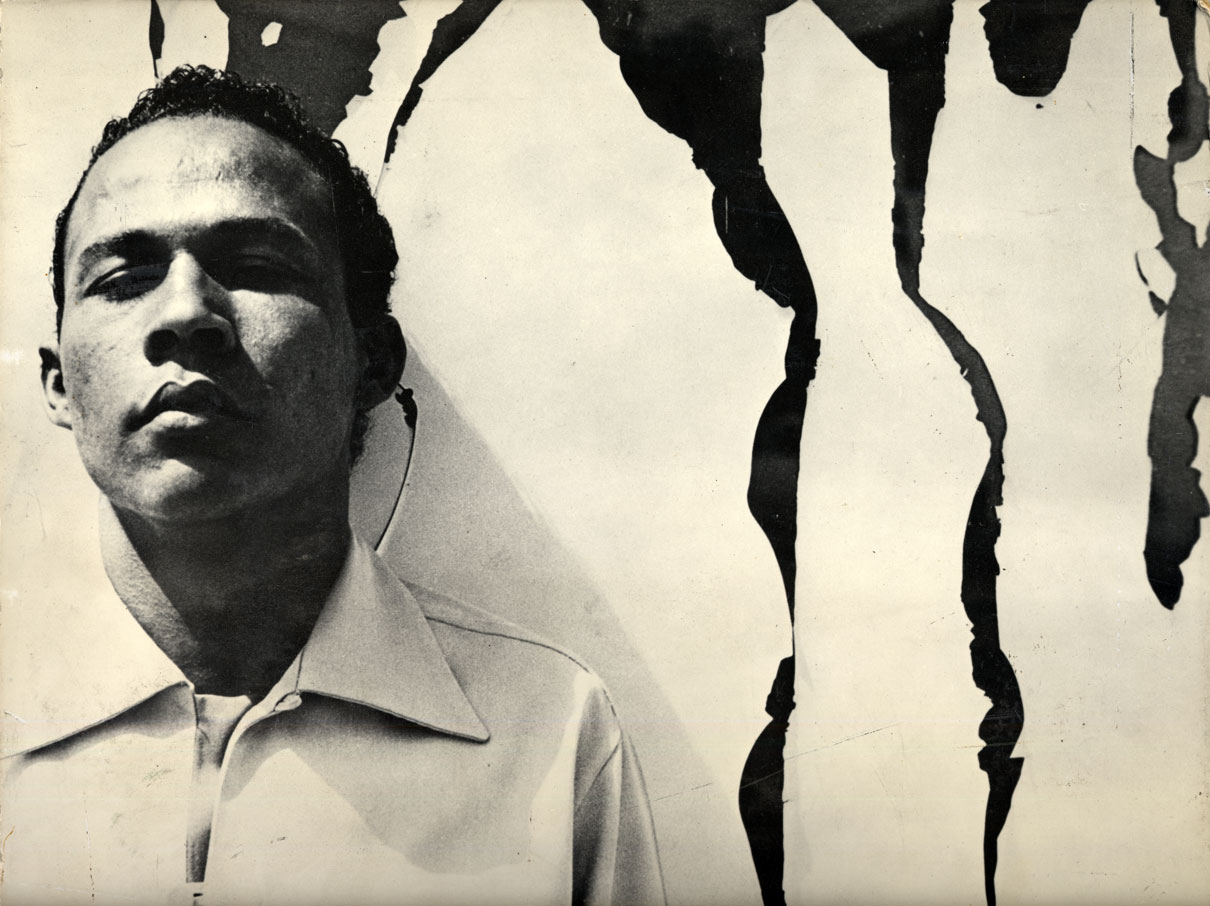
Bob Kaufman in the 1950s
June Jordan in 1968
. . . . .
La rueda de la vida: cinco poemas de Rita Dove
Posted: April 28, 2016 Filed under: English, Rita Dove, Spanish, ZP Translator: Alexander Best Comments Off on La rueda de la vida: cinco poemas de Rita Dove
Rita Dove
(nace 1952, Akron, Ohio, EE.UU.)
Canario
(para Michael S. Harper)
.
La voz quemada de Billie Holiday
poseía sombras tantas como luces,
un candelabro afligido contra un piano brillante,
y la gardenia era su firma bajo esa cara arruinada.
(Ahora estás improvisando, tamborilero a bajista,
cuchara mágica, agula mágica.
Toma todo el día, si te necesita
– con tu espejo y tu pulsera de canto.)
El hecho es que el invento de la mujer sitiada
ha sido por el bien de afilar el amor en servicio de mito.
.
Si no puedes ser libre, sé un misterio.
.
(1989)
. . .
Tarjetas educativas
.
Durante las mates yo fue la niña prodigio,
la custodia de naranjas y manzanas.
Dijo mi padre: Lo que no entiendes, domínalo.
Y el más rápido mi respuesta, pues
el más rápido vinieron las tarjetas.
Yo podía ver un capullo en el geranio del instructor,
y una abeja definida chisporroteando contra la hoja de vidrio húmedo.
Siempre rozaban los tuliperos después de un diluvio copioso
así que me plegué la cabeza mientras mis botas abofeteaban a casa.
Mi padre se ponía cómodo después de su trabajo,
relajándose con un jaibol y La Vida de Lincoln.
Después de la cena hacíamos practicar pues
yo subía la oscuridad antes de dormir, y antes de
una voz flaca siseé números múltiples
mientras yo giraba en una rueda. Tuve que adivinar:
Diez, yo seguía diciendo, Solo tengo diez años.
.
(1989)
. . .
Viejo éxito
.
Llegué temprano a casa,
pero me paré en el acceso,
meciéndome al volante
como un pianista ciego cachado por una tonada
diseñada para más de dos manos tocar.
La letra era fácil,
canturreado por una muchacha muriendo del deseo
ser viva / descubrir un sufrimiento bastante majestuoso
para guiarse.
Apagué el aire acondicionado,
y me recliné para flotar en una capa de sudor,
escuchando su sentimiento:
Chico, ¿Adónde fue nuestro amor?
––un lamento que pillé con gula,
sin la menor idea de quien pudiera
mi amante o donde empezar a buscar.
.
(1995)
. . .
El grillo primaveral considera el asunto de la Negritud
.
Solita, yo tocaba mis tonadas;
no conocí a ningún otro que podía acompañarme.
Claro, fueron tristes las canciones
–– pero agradable también, y no vendrían hasta que
el día se agotó. Sabes, ¿no?, la manera que tiene el cielo
de colgar sus últimas volutas radiantes?
Eso era cuando el dolor brotaba dentro de mí
hasta que no pude esperar; me arrodillé para rasparme limpia
y no me importó quien escuchara.
Pues los gritos y las chiflas, vinieron,
y la redada en tarros – y el trepar de patas.
Ahora vinieron otros: revolcados y enturbiados;
no supe sus nombres.
Éramos un farol musical;
los niños, dormían a nuestros suspiros.
Y si, de vez en cuando, uno de nosotros
se sacudió libre y cantó mientras trepaba al borde,
siempre se caía de nuevo.
Y esto les hacía reír y palmotear.
Al menos – en ese momento – entendimos
lo que les complacía
– y donde estuvo el borde.
.
(2012)
. . .
Trans-
.
“Yo trabajo mucho y vivo mucho menos de lo que pudiera,
pero la luna es hermosa y hay estrellas azules…..
Yo vivo la casta canción de mi corazón.”
(Federico García Lorca a Emilia Llanos Medinor, 1920)
.
La luna está en un estado de duda
sobre si deba escoger ser hombre o mujer.
Ha habido rumores y todo tipo de
alegatos, declaraciones atrevidas, embustes públicos:
Él es beligerante; Ella está deprimida.
Cuando él se disipa el mundo se balancea al filo;
cuando ella florece el crimen brota.
¡Oh, cómo vacila el impulso operístico!
Busca, querido/cosita,
en lo profundo del charco en blanco.
.
(2015)
. . .
Rita Dove
(born 1952, Akron, Ohio, USA)
Canary
(for Michael S. Harper)
.
Billie Holiday’s burned voice
had as many shadows as lights,
a mournful candelabra against a sleek piano,
the gardenia her signature under that ruined face.
(Now you’re cooking, drummer to bass,
magic spoon, magic needle.
Take all day if you have to
with your mirror and your bracelet of song.)
Fact is, the invention of women under siege
has been to sharpen love in the service of myth.
If you can’t be free, be a mystery.
.
(1989)
. . .
Flash Cards
.
In math I was the whiz kid, keeper
of oranges and apples. What you don’t understand,
master, my father said; the faster
I answered, the faster they came.
I could see one bud on the teacher’s geranium,
one clear bee sputtering at the wet pane.
The tulip trees always dragged after heavy rain
so I tucked my head as my boots slapped home.
My father put up his feet after work
and relaxed with a highball and The Life of Lincoln.
After supper we drilled and I climbed the dark
before sleep, before a thin voice hissed
numbers as I spun on a wheel. I had to guess.
Ten, I kept saying, I’m only ten.
.
(1989)
. . .
Golden Oldie
.
I made it home early, only to get
stalled in the driveway, swaying
at the wheel like a blind pianist caught in a tune
meant for more than two hands playing.
The words were easy, crooned
by a young girl dying to feel alive, to discover
a pain majestic enough
to live by. I turned the air-conditioning off,
leaned back to float on a film of sweat,
and listened to her sentiment:
Baby, where did our love go?—a lament
I greedily took in
without a clue who my lover
might be, or where to start looking.
.
(1995)
. . .
The Spring Cricket considers the Question of Negritude
.
I was playing my tunes all by myself;
I didn’t know anybody else
who could play along.
Sure, the tunes were sad—
but sweet, too, and wouldn’t come
until the day gave out. You know
that way the sky has of dangling
her last bright wisps? That’s when
the ache would bloom inside
.
until I couldn’t wait; I knelt down
to scrape myself clean
and didn’t care who heard.
.
Then came the shouts and whistles,
the roundup into jars, a clamber of legs.
Now there were others: tumbled,
clouded. I didn’t know their names.
We were a musical lantern;
children slept to our rasping sighs.
And if now and then one of us
shook free and sang as he climbed
to the brim, he would always
fall again. Which made them laugh
and clap their hands. At least then
we knew what pleased them,
and where the brink was.
.
(2012)
. . .
Trans-
.
“I work a lot and live far less than I could,
but the moon is beautiful and there are
blue stars . . . . I live the chaste song of my heart.”
—Federico García Lorca to Emilia Llanos Medinor,
1920
.
The moon is in doubt
over whether to be
a man or a woman.
There’ve been rumours,
all manner of allegations,
bold claims and public lies:
He’s belligerent. She’s in a funk.
When he fades, the world teeters.
When she burgeons, crime blossoms.
O how the operatic impulse wavers!
Dip deep, my darling, into the blank pool.
.
(2015)
. . . . .
Cornelius Eady: “Abril” y otros poemas
Posted: April 26, 2016 Filed under: Cornelius Eady, English, Spanish, ZP Translator: Alexander Best Comments Off on Cornelius Eady: “Abril” y otros poemas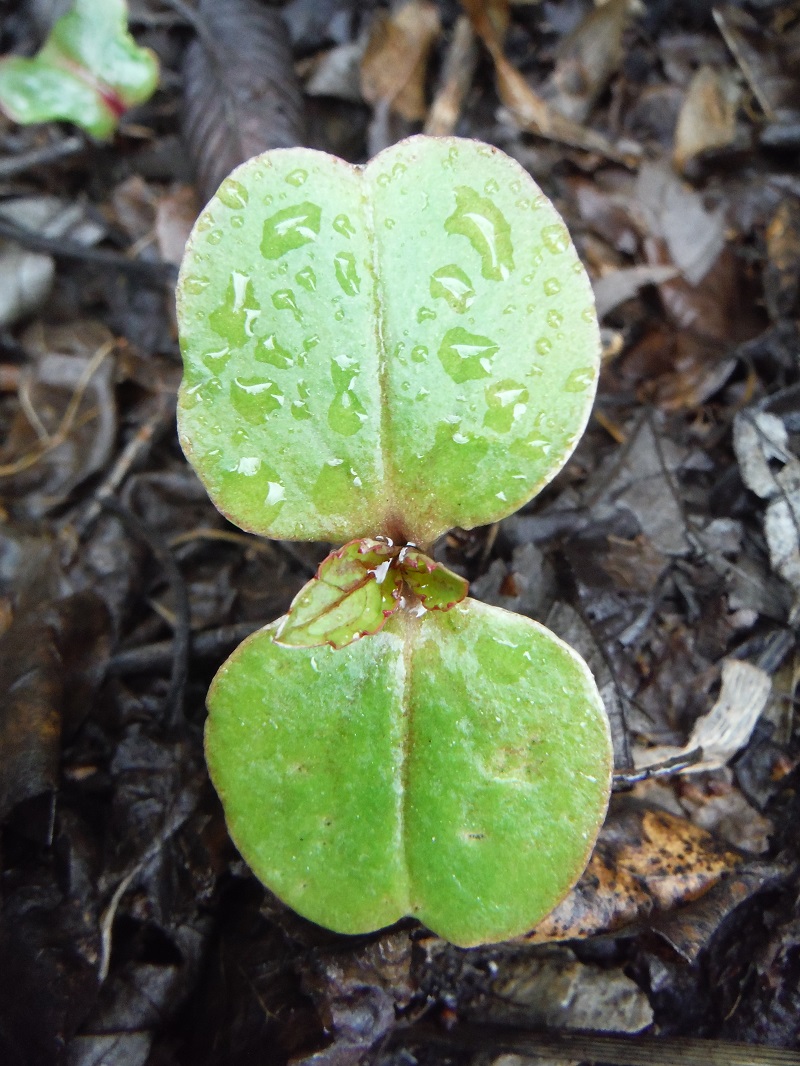
Cornelius Eady
(nace 1954, Rochester, Nueva York, EE.UU.)
Abril
.
De golpe, las piernas quieren un tipo diferente de empleo.
Esto es porque los ojos miran por la ventana
Y está llena de esperanza la vista.
Es porque están mirando por la ventana los ojos
.
Y la calle luce un quebrado mejor que el día antes.
Esto es lo que dicen los ojos a las piernas,
Y las articulaciones se vuelven embadurnadas con una savia fresca
Que echaría brotes si pegada a una rama diferente.
.
Las piernas quieren una clase de empleo diferente.
Es porque los oídos oyen lo que estaban esperando,
Lo que uno no puede trazar con palabras
Pero lo hace latir más veloz el corazón, como si
Uno había acabado de encontrar dinero en la calle.
.
Las piernas quieren actuar delante del mundo entero.
Quieren recuperar su garbo.
Esto es porque la nariz encuentra por fin el aroma correcto
Y ella jala el cuerpo protestando en la pista de baile.
Es porque las manos, estirando en su aburrimiento,
Rozan por casualidad las faldas del mundo.
. . .
Cuervos en el viento fuerte
.
Se van del techo los cuervos.
No pueden agarrarse;
También podría posarse en una fuga de petróleo.
.
Tal baile tan torpe,
Estos caballeros
Con sus chamarras negras moteadas.
Tal baile mareado,
.
Como si no supieran donde estaban.
Tal baile cómico,
Mientras intentan poner las cosas en orden
Al tiempo que el viento los reduce.
.
Y tal baile apesadumbrado.
El amor – tan embarazoso
Cuando se equivoca
.
En frente de todos.
.
(1985)
. . .
Un pequeño momento
.
Cruzo la entrada de la panadería de al lado de mi apartamento.
Estan a punto de extraer del horno algo de tostada con queso,
Y les pregunto: ¿Cuál es ese aroma? Soy siendo un poeta,
Estoy preguntando
.
Lo que todos los demás
Querían decir pero, de alguna manera, no habían podido;
Estoy hablando de parte de dos otros clientes
Que deseaban comprar el nombre de ese aroma.
A la mujer detrás del mostrador
Pido un porcentaje de su venta – ¿estoy coqueteando?
¿me vuelvo alegre porque se alargan los días? Y ésto es
.
Lo que hizo: ella toma su tiempo eligiendo las rebanadas.
“Estoy escogiendo las buenas,” me dijo.
Es el catorce de abril; la Primavera, con
Cinco a diez grados aún no llegan – pero vendrán.
Algunos días me siento mi deber;
Algunos días me encanta mi tarea.
.
(1997)
. . .
Un poeta baila con el objeto inanimado
(para Jim Schley)
.
El paraguas, en este caso;
Previamente, el taburete y
Los pilares de madera que
Soportan el techo.
.
Este cuate – sabes –
Danzará con cualquier cosa;
Le gusta la idea.
.
Pues recoge unas sandalias desechadas de alguna señora,
Las empuja contra su cabeza
– como caracolas – o
Orejas de un burro.
.
¡No hay nada
– declara su cuerpo –
Que está seguro de la danza de ideas!
.
(1985)
. . .
Cornelius Eady
(born 1954, Rochester, New York, USA)
April
.
Suddenly, the legs want a different sort of work.
This is because the eyes look out the window
And the sight is filled with hope.
This is because the eyes look out the window
.
And the street looks a fraction better than the day before.
This is what the eyes tell the legs,
Whose joints become smeared with a fresh sap
Which would bud if attached to a different limb.
.
The legs want a different sort of work.
This is because the ears hear what they’ve been waiting for,
Which cannot be described in words,
But makes the heart beat faster, as if
One had just found money in the street.
.
The legs want to put on a show for the entire world.
The legs want to reclaim their gracefulness.
This is because the nose at last finds the right scent
And tugs the protesting body onto the dance floor.
This is because the hands, stretching out in boredom,
Accidentally brush against the skirts of the world.
. . .
Crows in a Strong Wind
.
Off go the crows from the roof.
The crows can’t hold on.
They might as well
Be perched on an oil slick.
.
Such an awkward dance,
These gentlemen
In their spotted-black coats.
Such a tipsy dance,
.
As if they didn’t know where they were.
Such a humorous dance,
As they try to set things right,
As the wind reduces them.
.
Such a sorrowful dance.
How embarrassing is love
When it goes wrong
.
In front of everyone.
. . .
A Small Moment
.
I walk into the bakery next door
To my apartment. They are about
To pull some sort of toast with cheese
From the oven. When I ask:
What’s that smell? I am being
A poet, I am asking
.
What everyone else in the shop
Wanted to ask, but somehow couldn’t;
I am speaking on behalf of two other
Customers who wanted to buy the
Name of it. I ask the woman
Behind the counter for a percentage
Of her sale. Am I flirting?
Am I happy because the days
Are longer? Here’s what
.
She does: She takes her time
Choosing the slices. “I am picking
Out the good ones,” she tells me. It’s
April 14th. Spring, with five to ten
Degrees to go. Some days, I feel my duty;
Some days, I love my work.
. . .
Poet dances with inanimate object
(for Jim Schley)
.
The umbrella, in this case;
Earlier, the stool, the
Wooden pillars that hold up
the roof.
.
This guy, you realize,
Will dance with anything—
—He likes the idea.
.
Then he picks up some lady’s discarded sandals,
Holds them next to his head like sea shells,
Donkey ears.
.
Nothing,
his body states,
Is safe from the dance of ideas!
. . . . .
Poetry for Earth Day: “And I’ve been waiting long for an earth song”: Poems about Nature and Human Nature
Posted: April 22, 2016 Filed under: Arna Bontemps, English, Helene Johnson, Jessie Redmon Fauset, Langston Hughes | Tags: Poems about Nature and Human Nature Comments Off on Poetry for Earth Day: “And I’ve been waiting long for an earth song”: Poems about Nature and Human Nature

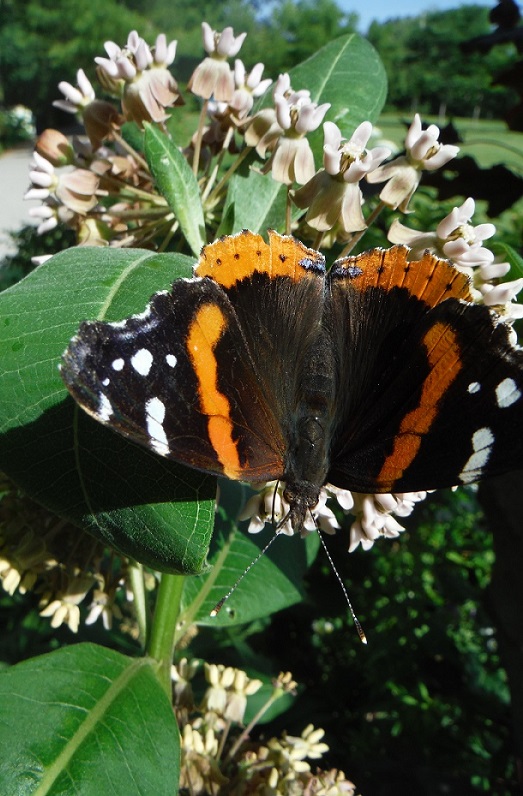
Milkweed and bumblebee_Ward’s Island, Toronto
…..
Langston Hughes (1902-1967)
Earth Song
.
It’s an earth song ––
And I’ve been waiting long
For an earth song.
It’s a spring song!
I’ve been waiting long
For a spring song:
Strong as the bursting of young buds.
Strong as the shoots of a new plant,
Strong as the coming of the first child
From its mother’s womb ––
An earth song!
A body song!
A spring song!
And I’ve been waiting long
For an earth song.
. . .
Helene Johnson (1906-1995)
Metamorphism
.
Is this the sea?
This calm emotionless bosom,
Serene as the heart of a converted Magdalene ––
Or this?
This lisping, lulling murmur of soft waters
Kissing a white beached shore with tremulous lips;
Blue rivulets of sky gurgling deliciously
O’er pale smooth-stones ––
This too?
This sudden birth of unrestrained splendour,
Tugging with turbulent force at Neptune’s leash;
This passionate abandon,
This strange tempestuous soliloquy of Nature,
All these –– the sea?
. . .
Jessie Redmon Fauset (1882-1961)
Rondeau
.
When April’s here and meadows wide
Once more with spring’s sweet growths are pied,
I close each book, drop each pursuit,
And past the brook, no longer mute,
I joyous roam the countryside.
Look, here the violets shy abide
And there the mating robins hide –
How keen my senses, how acute,
When April’s here.
.
And list! down where the shimmering tide
Hard by that farthest hill doth glide,
Rise faint streams from shepherd’s flute,
Pan’s pipes and Berecynthian lute.
Each sight, each sound fresh joys provide
When April’s here.
. . .
Remica L. Bingham (born Phoenix, Arizona)
The Ritual of Season
.
1. Autumn
.
The candles we burned each monsoon night in August
stained the wooden holders that kept them in place.
As storm beat mauve to night and night beat mauve to damp morning,
we extinguished fire and bore the day like a crown.
.
II. Winter
.
dogged air nipped our faces
as we lay in formation
along the stiff ground – the young tribe
athirst
waiting mouths open
longing for snow
.
daily the heavens held back their glory
and we swept angels
into hard earth –
donning the silt of adobe wings
mocking the sun
damning her
.
III. Spring
.
The swollen hum, circadian rhythm,
displaced cockcrow, heralded dawn.
.
We toured the tan flatland, the ages
marked in furrowed caverns –
empty, cactus-ridden – sacred
secret paintings the only life
left on cave drawn walls.
.
Noon day, come high sun and oasis,
the headland showed her fury.
Dust would flare and we’d call it devil –
sheathing our faces, yielding to copper
coating our skin.
.
IV. Summer
.
Under desert sun, road became wavering river.
The shimmer of heat, salamander swift, crossed
the burning middle of July.
.
When the moon, large as ancestry, conquered the sky,
our weapons were bare feet and laughter –
a porchswing vigil staving off the day.
. . .
Shara McCallum (born 1972)
The Spider Speaks
.
No choice but to spin,
the life given.
.
Mother warned me
I would wake one dawn
.
to a sun no longer yellow,
to an expanse of blue,
.
no proper word
to name it. Weaving
.
the patterned threads
of my life, each day
.
another web and the next.
If instead I could carve
.
my message in stone,
would it mean more?
.
I have only this form
to give. When the last
.
silvery strand leaves
my belly, I will see
.
what colour the sun
has become.
Arna Bontemps (1902-1973)
Prodigal
.
I shall come back when dogwood flowers are going
And passing drakes are honking toward the south
With eager necks, I shall come back knowing
The old unanswered question on your mouth.
.
When frost is on the manzonita shoots
And dogwoods at the spring are turning brown,
There between the interlacing roots
With folded arms I shall at last go down.
. . .
Ed Roberson (born 1939)
Urban Nature
.
Neither New Hampshire nor Midwestern farm,
nor the summer home in some Hamptons garden
thing, not that Nature, not a satori
-al leisure come to terms peel by peel, not that core
whiff of beauty as the spirit. Just a street
pocket park, clean of any smells, simple quiet ––
simple quiet not the same as no birds sing,
definitely not the dead of no birds sing:
.
The bus stop posture in the interval
of nothing coming, a not quite here running
sound underground, sidewalk’s grate vibrationless
in open voice, sweet berries ripen in the street
hawk’s kiosks. The orange is being flown in
this very moment picked of its origin.
. . .
C.S. Giscombe (born 1950)
Nature Boy
.
Air over the place partially occupied by crows going places every evening; the extent unseen from sidewalk or porch but obvious, because of the noise, even from a distance. Noise glosses – harsh, shrill, a wild card. Sundown’s a place for the eye, crows alongside that. Talk’s a rough ride, to me, what with the temptation to out-talk. At best long term memory’s the same cranky argument – changeless, not a tête-à-tête – over distance: to me, the category animals excludes birds, the plain-jane ones and birds of passage, both.To me, song’s even more ambiguous – chant itself, the place of connection and association. It’s birdless, bereft. I’m impartial, anhedonic. I’m lucky about distance but I would be remiss if I didn’t hesitate over image before going on.
. . .
Clarence Major (born 1936)
Water USA
.
america, tom sawyer, is bigger
than your swim
hole. You meant, the union, water-
falls, one waterfall
a path near, from which you
jump, folklore, holding
your nose. a chemical change
takes place as you pollute
the water i drink. as your
jet lands, crashing my
environment. tom sawyer can’t hold
all the dead bodies upright
nor get anything
out of a lecture on control
systems. and bigger
thomas didn’t have an even
chance to study chemistry
. . .
Ishmael Reed (born 1938)
Points of View
.
the pioneers and the indians
disagree about a lot of things,
for example, the pioneer says that
when you meet a bear in the woods
you should yell at him and if that
doesn’t work you should fell him.
the indians say that you should
whisper to him softly and call him by
loving nicknames.
no one’s bothered to ask the bear
what he thinks.
. . .
Carl Phillips (born 1959)
The Cure
.
The tree stood dying – dying slowly, in the usual manner
of trees, slowly, but not without its clusters of spring leaves
taking shape again, already. The limbs that held them tossed,
.
shifted, the light fell as it does, through them, though it
sometimes looked as if the light were being shaken, as if
by the branches – the light, like leaves, had it been autumn,
.
scattering down: singly, in fistfuls. Nothing about it to do
with happiness, or glamour. Not sadness either. That much
I could see, finally. I could see, and want to see. The tree
.
was itself, its branches were branches, shaking, they shook
in the wind like possibility, like impatient escorts bored with
their own restlessness, like hooves in the wake of desire, in
.
the wake of the dream of it, and like the branches they were.
A sound in the branches like that of luck when it turns, or is
luck itself a fixed thing, around which I myself turn or don’t,
.
I remember asking – meaning to ask. Where had I been, for
what felt like forever? Where was I? The tree was itself, and
dying; it resembled, with each scattering of light, all the more
.
persuasively the kind of argument that can at last let go of them,
all the lovely-enough particulars that, for a time, adorned it:
force is force. The tree was itself. The light fell here and there,
.
through it. Like history. No –– history doesn’t fall, we fall
through history, the tree is history, I remember thinking, trying
not to think it, as I lay exhausted down in its crippled shadow.
. . .
Frank X. Walker (born 1961)
Homeopathic
.
The unripe cherry tomatoes, miniature red chili peppers
and small burst of sweet basil and sage in the urban garden
just outside the window on our third floor fire escape
might not yield more than seasoning for a single meal
.
or two, but it works wonders as a natural analgesic
and a way past the monotony of bricks and concrete,
the hum of the neighbour’s TV, back to the secret garden
we planted on railroad property when I was just a boy.
.
I peer into the window, searching for that look on mamma’s face,
when she kicked off her shoes, dug her toes into dirt
teeming with corn, greens, potatoes, onions, cabbage and beets;
bit into the flesh of a ripe tomato, then passed it down the row.
.
Enjoying our own fruit, we let the juice run down our chins,
leaving a trail of tiny seeds to harvest on hungry days like these.
. . .
Tim Seibles (born 1955)
Fearless
(for Moombi)
.
Good to see the green world
undiscouraged, the green fire
bounding back every spring, and beyond
the tyranny of thumbs, the weeds
and other co-conspiring green genes
ganging up, breaking in,
despite small shears and kill-mowers,
ground gougers, seed-eaters.
Here they comes, sudden as graffiti
.
not there and then there ––
naked, unhumble, unrequitedly green ––
growing as if they would be trees
on any unmanned patch of earth,
any sidewalk cracked, crooning
between ties on lonesome railroad tracks.
And moss, the shyest green citizen
anywhere, tiptoeing the trunk
in the damp shade of an oak.
.
Clear a quick swatch of dirt
and come back sooner than later
to find the green friends moved in:
their pitched tents, the first bright
leaves hitched to the sun, new roots
tuning the subterranean flavours,
chlorophyll setting a feast of light.
.
Is it possible –– to be so glad?
The shoots rising in spite of every plot
against them. Every chemical stupidity,
every burned field, every better
home & garden finally overrun
by the green will, the green greenness
of green things growing greener.
The mad Earth publishing
her many million murmuring
unsaids. Look
.
how the shade pours
from the big branches – the ground,
the good ground, pubic
and sweet. The trees – who
are they? Their stillness, that
long silence, the never
running away.
. . .
Marilyn Nelson (born 1946)
Last Talk with Jim Hardwick
(a “found” poem)
.
When I die I will live again.
By nature I am a conserver.
I have found Nature
to be a conserver, too.
Nothing is wasted
or permanently lost
in Nature. Things
change their form,
but they do not cease
to exist. After
I leave this world
I do not believe I am through.
God would be a bigger fool
than even a man
if He did not conserve
the human soul,
which seems to be
the most important thing
He has yet done in the universe.
When you get your grip
on the last rung of the ladder
and look over the wall
as I am now doing,
you don’t need their proofs:
You see.
You know
you will not die.
. . .
Ross Gay (born 1974)
Thank You
.
If you find yourself half naked
and barefoot in the frosty grass, hearing,
again, the earth’s great, sonorous moan that says
you are the air of the now and gone, that says
all you love will turn to dust,
and will meet you there, do not
raise your fist. Do not raise
your small voice against it. And do not
take cover. Instead, curl your toes
into the grass, watch the cloud
ascending from your lips. Walk
through the garden’s dormant splendour.
Say only, thank you.
Thank you.
. . . . .
Poemas para el Ciclo de Vida: Anne Spencer: “Otro abril”
Posted: April 20, 2016 Filed under: A FEW FAVOURITES / UNA MUESTRA DE FAVORITOS, Anne Spencer, English, Poemas para el Ciclo de Vida: Anne Spencer, Spanish, ZP Translator: Alexander Best | Tags: Poemas para el Ciclo de Vida Comments Off on Poemas para el Ciclo de Vida: Anne Spencer: “Otro abril”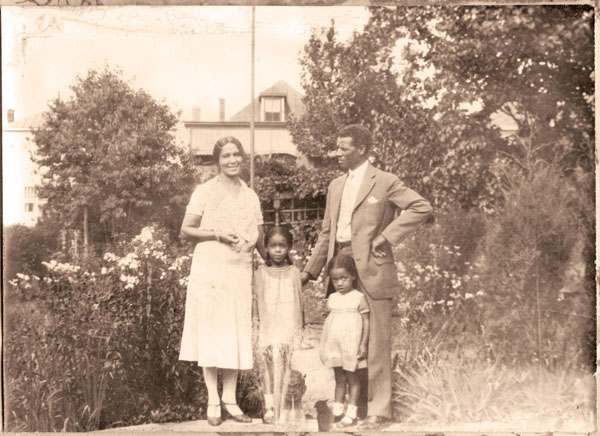
La poetisa Anne Spencer con su marido Edward y dos nietas_Lynchburg, Virginia, EE.UU._hacia 1930 / Poet Anne Spencer and her husband Edward in their Lynchburg, Virginia garden with two of their grandchildren_circa 1930
. . .
 Zócalo Poets