Louis Riel et Marilyn Dumont: poèmes à Sir John A. Macdonald
Posted: January 11, 2012 Filed under: English, French, Louis Riel, Marilyn Dumont Comments Off on Louis Riel et Marilyn Dumont: poèmes à Sir John A. Macdonald
Louis Riel
“Sir John A. Macdonald gouverne avec l’orgueil”
.
Sir John A. Macdonald gouverne avec l’orgueil
Les provinces de la Puissance
Et sa mauvaise foi vent prolonger mon deuil
Afin que son pays l’applaudisse et l’encense.
.
Au lieu de la paix qu’il me doit
Au lieu de respecter d’une manière exacte
Notre Pacte
Et mon droit,
Depuis bientôt dix ans, Sir John me fait la guerre.
Un homme sans parole est un homme vulgaire.
Fort et faible d’esprit, moi je le montre au doigt…
Je ne souhaite pas, Sir John, que votre mort
Soit pleine de tourments. Mais ce que je désire
C’est que vous connaissiez et souffriez le remord :
Parce que vous m’avez mangé, comme un vampire.
.
L’horizon, tout le ciel m’apparaissait vermeil.
Vous avez accablé de soucis mon jeune âge.
Et vous êtes sur moi comme un épais nuage
Qui dérobe à mes yeux la clarté du soleil.
.
J’espère voir la fin de vos pensées altières.
Vous avez fait le mal : et c’est ce qui détruit.
Vous tomberez peut-être avec le même bruit
Qu’on entend l’Ottawa bondir dans les Chaudières.
.
Vos moyens d’action, John, ne sont pas les miens.
Mes amis ont souffert de ma grande folie.
Ils s’en consoleront : car elle fut jolie.
Vous n’effacerez pas mon passé, car j’ y tiens.
.
Vous, vous serez connu pour le hardi mensonge.
C’est à vous que j’en veux pour ma proscription.
Je fais mon temps d’exil : et je mange mon ronge.
Et je suis, malgré vous, chef de ma nation.
.
Je n’abandonne pas mon plan : je l’étudie.
Et je l’ai travaillé d’une façon hardie.
J’ai trouvé ce qu je voulais.
Je vous connais à fond maintenant, peuple anglais.
. . .
An English translation by Paul Savoie:
“Sir John A. Macdonald governs with “pride””
.
Sir John A., shackled by pride’s endless chain,
Governs the Dominion’s vast domain,
And through perfidy prolongs my agony
To gain his kind’s approval, vain glory.
.
Disrespecting his commitments,
He does not heed the terms, fair and precise,
Of our Agreement
And my stated rights.
Nearly ten years I have endured torment.
A man who reneges on his word is base.
Let my accusing finger state my case…
.
Sir John, I do not wish upon you death
Riddled with pain and horror but instead
Days of dull remorse and daily regret
You, foul vampire, who have left me for dead.
The sky above once appeared ruby red
As did the horizon. Your actions soured
My youth and hid the sun. The day’s colours
From my famished eyes are cruelly bled.
To your own arrogance you must demur
Lest your actions wreak greater destruction.
Or, as in the Chaudieres rapids clamour,
Prepare your fall in swift swirling motion.
.
Your methods, John, are not the same as mine.
My friends have paid a price for my excess
Which, as a comfort, they may find sublime.
I will not let you rob me of my past.
You will be the seen prevaricator
And on you history will lay the blame.
I pine away in exile but remain
In spite of you my nation’s true leader.
I ponder now. I don’t relinquish
My plan. I fine-tune it and turn it plain.
My efforts have not been in vain
For I have seen the hearts of the English.
_____
Sir John A. Macdonald became, in 1867, the first prime minister
of a newly united “Canada” – which had been up till that time
a loose arrangement of British and French colonies.
He was born on January 11th, 1815, in Scotland, and
came to Canada as a boy, settling with his family in
Kingston, Ontario, where, after becoming a lawyer,
he then entered into politics.
The big achievements of his political career were
the uniting of the vast and distant colonies into
one new nation – plus the completion in 1885 of a
transcontinental railroad – the Canadian Pacific
Railroad – from the East all the way to the Pacific Ocean.
*
Louis Riel (1844-1885) was born in the Red River Colony,
(later Manitoba) and was the charismatic leader of what
was an unrecognized new nation of mixed-race people,
The Métis (French and Native).
After an unsuccessful attempt to assert his leadership
versus Ottawa in “Manitoba” – the Red River Rebellion of 1870 –
Riel went into exile in Montana, south of the border.
It was there that he wrote his intense poem in French:
“Sir John A. Macdonald gouverne avec l’orgueil”.
*
Riel returned to Canada, and in The NorthWest Rebellion
of 1885 he galvanized The Métis to assert land rights in
what would become the province of Saskatchewan.
Macdonald hanged Riel for high treason after the
Rebellion was driven down by government troops.
The legacy of this event is complex –
Riel was deemed mad by the mainly Protestant
English and an Ottawa that saw in his charisma
a passionate, dangerous rival. In Québec Riel
has been viewed as a visionary francophone folk hero.
Increasingly, in our time, he is regarded
as a thwarter of simplistic ideologies of race and
culture. Louis Riel is, in his unique way, a great Canadian
– though he goes unrecognized as such.
_____
Marilyn Dumont, born in 1955, is a Canadian poet
of Cree/Métis descent. The poem below,
“Letter to Sir John A. Macdonald”, was written in 1993.
Astutely, she points out how the completion of
the Canadian Pacific Railroad permitted the rapid
movement of new white settlers out West to
the very land Riel claimed for his people.
1885 was a crucial year, when both the
NorthWest Rebellion and The Last Spike
were “driven down”…
*
Marilyn Dumont
Letter to Sir John A. Macdonald
.
Dear John:
I’m still here and halfbreed,
after all these years.
You’re dead, funny thing,
that railway you wanted so badly,
there was talk a year ago
of shutting it down
and part of it was shut down,
the “dayliner”, at least,
‘ from sea to shining sea ‘,
and you know, John,
after all that shuffling us around to suit the settlers,
we’re still here and Métis .
We’re still here
after Meech Lake and
one no-good-for-nothing-Indian
holdin’ up the train,
stalling the ” Cabin syllables / Nouns of settlement
/ …steel syntax [and] / The long sentence of its exploitation ”
and John, that goddamned railroad never made this a great nation,
’cause the railway shut down
and this country is still quarreling over unity,
and Riel is dead
but he just keeps coming back
in all the Bill Wilsons yet to speak out of turn or favour
because you know as well as I
that we were railroaded
by some steel tracks that didn’t last
and some settlers who wouldn’t settle
and it’s funny – we’re still here and callin’ ourselves halfbreed.
. . . . .
Photograph: Louis Riel and his Council, 1870
Mao Zedong: a January 9th poem…
Posted: January 9, 2012 Filed under: Chinese (Mandarin), English, Mao Zedong Comments Off on Mao Zedong: a January 9th poem…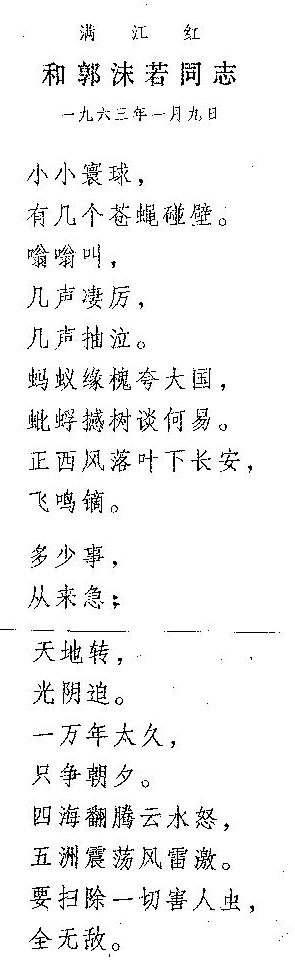
Mao Zedong (Mao Tse-tung)
A poem written January 9th, 1963
Reply to Comrade Guo Moruo
(to the tune of Man Jiang Hong)
On this tiny globe
A few flies dash themselves against the wall,
Humming without cease,
Sometimes shrilling,
Sometimes moaning.
Ants on the locust tree assume a great-nation swagger,
And mayflies lightly plot to topple the giant tree.
The west wind scatters leaves over Chang’an,
And the arrows are flying, twanging.
So many deeds cry out to be done,
And always urgently:
The world rolls on,
Time presses.
Ten thousand years are too long,
Seize the day, seize the hour !
The Four Seas are rising, clouds and waters raging,
The Five Continents are rocking, wind and thunder roaring.
Our force is irresistible,
Away with all the pests !
_____
Mao Zedong: Winter Clouds…& so forth
Posted: January 9, 2012 Filed under: Chinese (Mandarin), English, Mao Zedong Comments Off on Mao Zedong: Winter Clouds…& so forth
Winter Clouds
– a lu shi
(1962)
Winter clouds snow-laden, cotton fluff flying,
None or few the unfallen flowers.
Chill waves sweep through steep skies,
Yet earth’s gentle breath grows warm.
Only heroes can quell tigers and leopards
And wild bears never daunt the brave.
Plum blossoms welcome the whirling snow;
Small wonder flies freeze and perish.
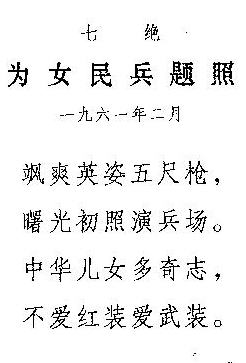
Militia Women – Inscription on a Photograph
– a jue ju
(1961)
How bright and brave they look,
shouldering five-foot rifles
On the parade ground lit up by
the first gleams of day.
China’s daughters have high-aspiring minds,
They love their battle array,
not silks and satins.
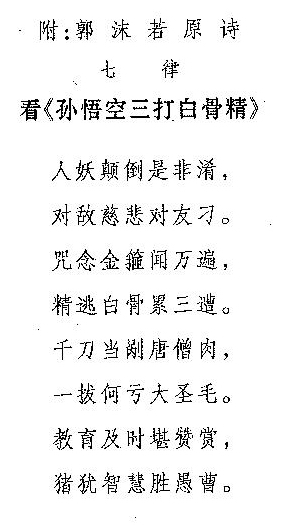
Guo Moruo’s Poem
On Seeing The Monkey Subdue The Demon
– a lu shi
Confounding humans and demons, right and wrong,
The monk was kind to foes and vicious to friends.
Endlessly he intoned “The Incantation of The Golden Hoop”,
And thrice he let the White Bone Demon escape.
The monk deserved to be torn limb from limb;
Plucking a hair means nothing to the wonder-worker.
All praise is due to such timely teaching,
Even the pig grew wiser than the fools.
Mao Zedong: Loushan Pass
Posted: January 9, 2012 Filed under: English, Mao Zedong Comments Off on Mao Zedong: Loushan Pass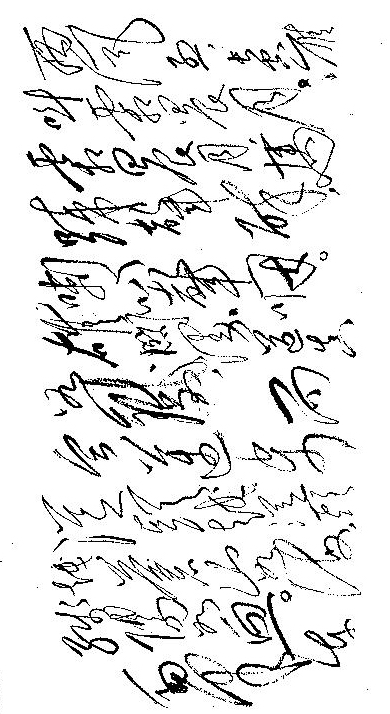
Loushan Pass
– to the tune of Yi Qin E
(February 1935)
Fierce the west wind,
Wild geese cry under the frosty morning moon.
Under the frosty morning moon
Horses’ hooves clattering,
Bugles sobbing low.
Idle boast, the strong pass is a wall of iron,
With firm strides we are crossing its summit.
We are crossing its summit,
The rolling hills sea-blue,
The dying sun blood-red.
_____
Mao Zedong (1893-1976) tried to exemplify the well-rounded
Revolutionary, and so composed poetry in the moment – even while
leading “The Long March” over the mountain pass at Loushan.
The poem above was written in a type of verse called “ci”,
a form established during the Tang Dynasty (618-907 A.D.)
The “ci” poem was always written to be sung – and with a
particular tune in mind.
Mao as poet wrote in other classical verse forms as well
– like “lu” and “jue”, both of the “shi” form –
while proclaiming heroically his subject matter.
“Shi”, a classical Chinese verse form with strict tonal patterns and
rhyme schemes, also dates back to the Tang Dynasty.
_____
Sviaty Vechir: Ukrainian Holy Evening
Posted: January 6, 2012 Filed under: English, Ivan Malkovych, Ukrainian | Tags: Christmas poems Comments Off on Sviaty Vechir: Ukrainian Holy Evening
_____
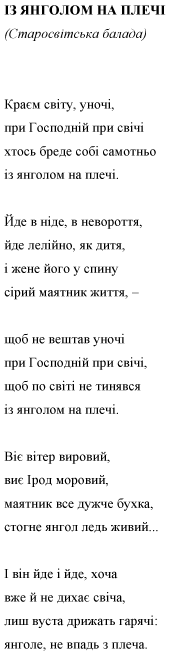
An Angel on My Shoulder
(An Old-World Ballad)
Along the edge of the world at night
in the light of the Lord’s candle
somebody is wandering alone
with an angel on his shoulder.
He’s walking towards nowhere, to non-return,
he’s walking lazily like a child,
and the gray pendulum of life
prods him from behind,
so he won’t roam at night
in the light of the Lord’s candle,
so he won’t ramble around
with an angel on his shoulder.
A whirling wind blows,
a pestilential Herod howls,
the pendulum is striking stronger,
the barely alive angel is moaning.
But he keeps going on and on,
though the candle’s no longer breathing,
just his lips quiver:
angel, don’t fall from my shoulder.
_____
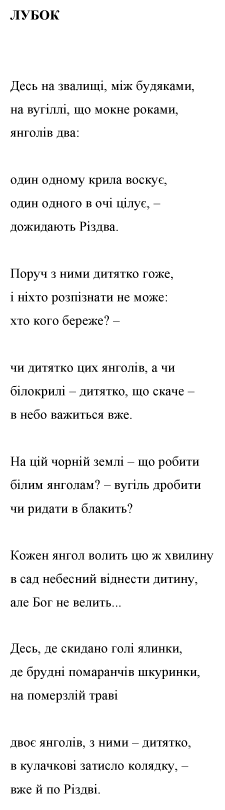
Folk Scene
On a heap amidst thistles,
on coal, soggy from rains,
two angels dwell.
They wax each other’s wings,
they kiss each other’s eyes,
awaiting Christmas.
Near them a lovely infant,
and no one can guess
who’s guarding whom?
Is the infant guarding angels or
do white-winged ones watch the child,
leaping, aiming for heaven?
What can white angels do
on this black soil? Crush coal
or weep into blue skies?
Each angel would carry the baby
into heaven’s garden any moment,
God does not will it . . .
On a heap of discarded Christmas trees,
and dirty orange peels,
on the frozen grass –
two angels and an infant
clutching a Christmas carol in its fist
– Christmas has gone.
_____
Ivan Malkovych / Іван Малкович,
born in Ukraine in 1961,
gave up poetry ten years ago to devote himself
to writing children’s books in Ukrainian – and this
creative task he describes as “the noblest work”.
When Christmas imagery appears in his poetry he
up-ends cliché with his alert, quizzical mind
yet a real love of Ukrainian tradition also comes through,
making these unusual poems special for January 6th:
Ukrainian Christmas Eve.
_____
Translations from Ukrainian into English:
Michael M. Naydan (An Angel on My Shoulder)
Bohdan Boychuk and Myrosia Stefaniuk (Folk Scene)
Рождество Христово – Ио́сиф Алекса́ндрович Бро́дский
Posted: January 6, 2012 Filed under: English, Joseph Brodsky, Russian | Tags: Christmas poems Comments Off on Рождество Христово – Ио́сиф Алекса́ндрович Бро́дский_____
Ио́сиф Алекса́ндрович Бро́дский
Рождество 1963: 1
Спаситель родился
в лютую стужу.
В пустыне пылали пастушьи костры.
Буран бушевал и выматывал душу
из бедных царей, доставлявших дары.
Верблюды вздымали лохматые ноги.
Выл ветер.
Звезда, пламенея в ночи,
смотрела, как трех караванов дороги
сходились в пещеру Христа, как лучи.
_____
Christmas 1963: 1
The saviour was born
into fierce, brutish cold.
Shepherds’ small campfires blazed in the wasteland.
A blizzard seethed and battered the souls
of the humble kings who bore gifts for the infant.
The camels lifted their shaggy legs in sequence.
The wind howled.
The star, aflame in the night,
looked on as the paths of the three processions
converged on Christ’s cave like beams of light.
_____
Рождество 1963: 2
Волхвы пришли. Младенец крепко спал.
Звезда светила ярко с небосвода.
Холодный ветер снег в сугроб сгребал.
Шуршал песок. Костер трещал у входа.
Дым шел свечой. Огонь вился крючком.
И тени становились то короче,
то вдруг длинней. Никто не знал кругом,
что жизни счет начнется с этой ночи.
Волхвы пришли. Младенец крепко спал.
Крутые своды ясли окружали.
Кружился снег. Клубился белый пар.
Лежал младенец, и дары лежали.
_____
Christmas 1963: 2
The magi had come. The infant soundly slept.
The star shone brightly from the vaulted sky.
A cold wind swept the snow up into drifts.
The sand rustled. A bonfire crackled nearby.
Smoke plumed skyward. Flames hooked and writhed.
The shadows cast by the fire grew now shorter,
now suddenly longer. No one there yet realized
that on that very night life’s count had started.
The magi had come. The infant soundly slept.
Steep arches loomed above the manger.
Snow swirled about. White steam rose in wisps.
With gifts piled near him, the child slept like an angel.
_____
Joseph Brodsky / Ио́сиф Алекса́ндрович Бро́дский
(1940-1996) was born of Jewish parents
in Leningrad. He began to write poetry in his mid-teens
and taught himself English so that he could translate John
Donne into Russian. In 1960 he met the 70-year-old
Anna Akhmatova, who had written the great epic poem
“Requiem” about Stalin’s Terror in the 1930s.
Her encouragement brought out in the young Brodsky
a flow of ideas and creativity – such that by 1963 he was
being denounced as a social parasite and anti-Soviet.
Arrested, put on trial, he spent 18 months at a labour camp
in the Arctic.
He kept on with his poetry after his release but
harassment became routine. In 1972, after persecution by
authorities who sought to have him declared schizophrenic and,
therefore, “useless to society”, he was put on a plane out of the
USSR and, with the help of foreign poets who valued his work,
he settled in the USA.
The Nativity – and the many themes of Life it touches upon –
was a constant topic in Brodsky’s poetry. He wrote
one or more Nativity poems per year between 1961 and
1995.
_____
We are grateful to Jamie Olson
for his translation from the Russian.
Visit his site: http://www.theflaxenwave.com
Auld Lang Syne: Tonight at Midnight
Posted: December 31, 2011 Filed under: English, English: Scots, Robert Burns Comments Off on Auld Lang Syne: Tonight at Midnight_____
Auld Lang Syne
Should auld acquaintance be forgot,
And never brought to mind?
Should auld acquaintance be forgot,
And auld lang syne!
For auld lang syne, my jo,
For auld lang syne.
We’ll tak a cup o’ kindness yet,
For auld lang syne.
And surely ye’ll be your pint stowp!
And surely I’ll be mine!
And we’ll tak a cup o’ kindness yet,
For auld lang syne.
For auld lang syne, my jo,
For auld lang syne.
We’ll tak a cup o’ kindness yet,
For auld lang syne.
We twa hae run about the braes,
And pou’d the gowans fine;
But we’ve wander’d mony a weary fit,
Sin’ auld lang syne.
For auld lang syne, my jo,
For auld lang syne.
We’ll tak a cup o’ kindness yet,
For auld lang syne.
We twa hae paidl’d in the burn,
Frae morning sun till dine;
But seas between us braid hae roar’d
Sin’ auld lang syne.
For auld lang syne, my jo,
For auld lang syne.
We’ll tak a cup o’ kindness yet,
For auld lang syne.
And there’s a hand, my trusty fere!
And gie’s a hand o’ thine!
And we’ll tak a right gude-willie waught,
For auld lang syne.
For auld lang syne, my jo,
For auld lang syne.
We’ll tak a cup o’ kindness yet,
For Auld Lang Syne.
_____
“Old Long Past” (For the Sake of Times Gone By)
And for old long past, my joy*,
For old long past,
We’ll take a cup of kindness yet,
For the sake of times gone by.
CHORUS: Should old acquaintance be forgot,
And never brought to mind?
Should old acquaintance be forgot,
And days of old long past.
And surely you’ll pay for your 3-pint-vessel!
And surely I’ll pay for mine!
And we’ll take a cup of kindness yet,
For the sake of times gone by.
CHORUS
We two have run about the hillsides
And pulled wild daisies fine;
But we’ve wandered many a weary foot
Since old long past.
CHORUS
We two have paddled in the stream,
From morning sun till noon;
But seas between us broad have roared
Since old long past.
CHORUS
And here’s a hand, my trusty friend!
And give me a hand of yours!
And we’ll take a right good-will drink,
For the sake of times gone by.
CHORUS: Should old acquaintance be forgot,
And never brought to mind?
Should old acquaintance be forgot,
And days of Old Long Past.
*joy — “joy” means sweetheart, but “dear” or “friend”
may also be sung
_____
Robert Burns (1759-1796) wrote his poem “Auld Lang Syne”
in 1788. It is in Scots’ dialect which is not, strictly speaking,
a hybrid of Gaelic and English, since it is derived also from
other linguistic strains.
A variant is spoken in Northern Ireland, where it is known as
Ulster Scots.
“Auld Lang Syne” has become a New Year’s Eve favourite,
the words sung to a traditional folk melody at the stroke
of midnight and into the first minutes of January 1st.
_____
Iesus Ahattonnia / Jesus, He is Born (The Huron Carol)
Posted: December 24, 2011 Filed under: English, Huron / Wendat, Jean de Brébeuf | Tags: Christmas carols and songs Comments Off on Iesus Ahattonnia / Jesus, He is Born (The Huron Carol)
.
Iesus Ahattonnia
.
Ehstehn yayau deh tsaun we yisus ahattonnia
O na wateh wado:kwi nonnwa ‘ndasqua entai
ehnau sherskwa trivota nonnwa ‘ndi yaun rashata
Iesus Ahattonnia, Ahattonnia, Iesus Ahattonnia
.
Ayoki onki hm-ashe eran yayeh raunnaun
yauntaun kanntatya hm-deh ‘ndyaun sehnsatoa ronnyaun
Waria hnawakweh tond Yosehf sataunn haronnyaun
Iesus Ahattonnia, Ahattonnia, Iesus Ahattonnia
.
Asheh kaunnta horraskwa deh ha tirri gwames
Tishyaun ayau ha’ndeh ta aun hwa ashya a ha trreh
aundata:kwa Tishyaun yayaun yaun n-dehta
Iesus Ahattonnia, Ahattonnia, Iesus Ahattonnia
.
Dau yishyeh sta atyaun errdautau ‘ndi Yisus
avwa tateh dn-deh Tishyaun stanshi teya wennyau
aha yaunna torrehntehn yataun katsyaun skehnn
Iesus Ahattonnia, Ahattonnia, Iesus Ahattonnia
.
Eyeh kwata tehnaunnte aheh kwashyehn ayehn
kiyeh kwanaun aukwayaun dehtsaun we ‘ndeh adeh
tarrya diskwann aunkwe yishyehr eya ke naun sta
Iesus Ahattonnia, Ahattonnia, Iesus Ahattonnia.
. . .
“Jesus, He is Born”
.
Have courage, you who are human beings:
Jesus, he is born
The okie spirit who enslaved us has fled
Don’t listen to him for he corrupts the spirits of our thoughts
Jesus, he is born
The okie spirits who live in the sky are coming with a message
They’re coming to say, “Rejoice!
Mary has given birth. Rejoice!”
Jesus, he is born
Three men of great authority have left for the place of his birth
Tiscient, the star appearing over the horizon leads them there
That star will walk first on the path to guide them
Jesus, he is born
The star stopped not far from where Jesus was born
Having found the place it said,
“Come this way”
Jesus, he is born
As they entered and saw Jesus they praised his name
They oiled his scalp many times, anointing his head
with the oil of the sunflower
Jesus, he is born
They say, “Let us place his name in a position of honour
Let us act reverently towards him for he comes to show us Mercy
It is the will of the spirits that you love us, Jesus,
and we wish that we may be adopted into your family.”
Jesus, he is born.
. . .
English translation from Huron: John Steckley
.
Editor’s note:
There is a famous version of The Huron Carol
in English (“T’was in the Moon of Wintertime…”) but its
lyrics were written by Jesse Edgar Middleton and are not
a translation of Brébeuf’s Huron original.
_____
The Huron Carol / Iesus Ahattonnia is the oldest
Canadian Christmas carol. It dates from 1643, with
lyrics composed for the purpose of religious conversion,
in the Huron language (Wendat) by Father Jean de Brébeuf,
a Jesuit priest at Sainte-Marie aux-pays-des-Huron, the
French-Canadian Christian mission that was near what is
now Georgian Bay, Ontario.
Brébeuf was burned at the stake during the Beaver Wars, an
aggressive push for land expansion plus control of the fur trade
that involved the Dutch, English, French, and
the Iroquois Confederacy.
The Huron were casualties of this struggle, and dispersed to
Québec in the east and, eventually, southwest to Oklahoma.
In the 21st century the Huron/Wendat People are revitalizing their
language which, 50 years ago, was virtually extinct.
. . . . .
Jakuren: The First Day of Winter
Posted: December 22, 2011 Filed under: English, Jakuren, Japanese Comments Off on Jakuren: The First Day of Winter
Poems of Mediaeval Japan by
Jakuren (Buddhist monk and poet: 1139-1202)
* Transliterated Japanese on the left *
yomosugara throughout the night
kusa no iori ni we kept the brushwood burning
shiba taite in my lowly hut,
katarishi koto o and the words that we exchanged
itsuka wasuren I never shall forget
* * *
miyamabi ni deep in this mountain
fuyugomorisuru I keep the winter indoors:
oi no mi o who would care to call
tare ka towamashi on so aged a body,
kimi naranaku ni were it not for you?
* * *
izukuyori you found a path in my dream
yoru no yumeji o the mountain
tadorikoshi is deeply in snow now
miyama wa imada
yuki no fukakini
* * *
ikanishite wondering how you
kimi imasuran have been of late, as the breath
konogoro no of snow in the wind
yukige no kaze no blows colder every day
hibi ni samuki ni
* * *
Mon Pays – c’est l’Hiver ! “Québécitude” in song
Posted: December 22, 2011 Filed under: English, French, Gilles Vigneault, Translator's Whimsy: Song Lyrics / Extravagancia del traductor: Letras de canciones traducidas por Alexander Best, ZP Translator: Alexander Best Comments Off on Mon Pays – c’est l’Hiver ! “Québécitude” in song
MY COUNTRY
My country’s not a country, it’s winter,
my garden’s not a garden, it’s a vast plain,
my road is no road – it’s the snow !
My country’s not a country – it’s winter !
A ceremony all in white
where snow marries wind,
in this blizzard-land
my father built a house
and I’m going to honour
his ways, his example…
My guest room will be where
you return, season by season
and you’ll build too – right beside it.
My country’s not a country, it’s winter,
My refrain’s no refrain, it’s a gust of wind,
My house isn’t mine – it’s the winter-chill’s !
My country’s not a country – it’s winter !
All around my solitary land
I cry out before the silence,
to everyone on earth:
My house is yours, too.
Inside four walls of ice
with time and space
I make the fire, and a place
for People of the Horizon
– and these people are of my people.
My country’s not a country, it’s winter,
my garden’s not a garden, it’s the vast plain,
my road is no road – it’s the snow !
My country’s not a country – it’s winter !
My country’s no country but the contrary
of country – neither land nor nation,
my song’s not a song – it’s my life !
And for you I wish to master these winters !
_____
MON PAYS
Mon pays ce n’est pas un pays, c’est l’hiver
Mon jardin ce n’est pas un jardin, c’est la plaine
Mon chemin ce n’est pas un chemin, c’est la neige
Mon pays ce n’est pas un pays, c’est l’hiver.
Dans la blanche cérémonie où la neige au vent se marie
Dans ce pays de poudrerie mon père a fait bâtir maison
Et je m’en vais être fidèle à sa manière à son modèle
La chambre d’amis sera telle qu’on viendra des autres saisons
pour se bâtir à côté d’elle.
Mon pays ce n’est pas un pays, c’est l’hiver
Mon refrain ce n’est pas un refrain, c’est rafale
Ma maison ce n’est pas ma maison, c’est froidure
Mon pays ce n’est pas un pays, c’est l’hiver.
De ce grand pays solitaire je crie avant que de me taire
A tous les hommes de la terre ma maison c’est votre maison
Entre mes quatre murs de glace je mets mon temps et mon espace
À préparer le feu, la place pour les humains de l’horizon
Et les humains sont de ma race.
Mon pays ce n’est pas un pays, c’est l’hiver
Mon jardin ce n’est pas un jardin, c’est la plaine
Mon chemin ce n’est pas un chemin, c’est la neige
Mon pays ce n’est pas un pays, c’est l’hiver.
Mon pays ce n’est pas un pays, c’est l’envers
D’un pays qui n’était ni pays ni patrie
Ma chanson ce n’est pas une chanson, c’est ma vie
C’est pour toi que je veux posséder mes hivers.
_____
Gilles Vigneault (born 1928) wrote “Mon Pays” for a 1965 NFB film,
La neige a fondu sur la Manicouagan. This new folk song became an
instant classic – emblematic for Québec’s growing nationalist movement.
Editor’s note:
Almost two generations later the song does show its age, for the Canadian
essential-ideal of The Great White North – intrinsic to Canadians outside of
Québec as well – holds less sway in our collective identity. Too, “Mon Pays”
is dated in that it captures the spirit of an isolated – if friendly – culture:
not the rumbling, restless Québec of the 1960s. Rather the lyrics might well
describe a People more remote in time – the Far-North Inuit of the 19th-century.
Still, if there has been a place in Canada where winter is embraced and
not merely borne, it is Québec, where coureurs de bois and habitants
were the first of Canada’s White arrivals to adapt the Naskapi/Montagnais
Native People’s’ inventions – toboggans and snowshoes – to daily use both
practical and recreational.
And Québec leads the nation for Winter fun – not drear – with many jovial
outdoor festivals and an entrenched culture of open-air ice-skating parties !
_____
Translation from French into English: Alexander Best
 Zócalo Poets