“Pasko na sinta ko”: Jean-Paul asks Sha to translate a Filipino seasonal pop song…
Posted: December 19, 2012 Filed under: English, Tagalog / Filipino | Tags: Filipino Christmas poems, Tula sa Pasko Comments Off on “Pasko na sinta ko”: Jean-Paul asks Sha to translate a Filipino seasonal pop song…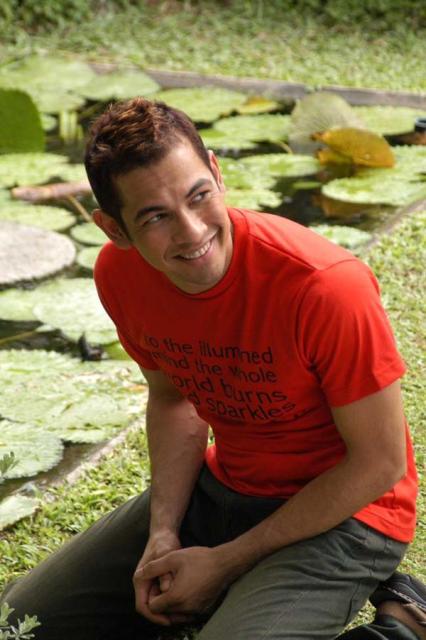
Gary Valenciano
Jean-Paul:
I heard this song when I passed through the Philippines one Christmas. The melody was beautiful. It had a haunting, melancholy quality. I’m back in The States now and I don’t have any friends that speak Tagalog well enough to translate the words for me…
.
“Pasko na sinta ko” (by Gary Valenciano)
.
Pasko na sinta ko hanap-hanap kita
Bakit magtatampo’t nilisan ako
.
Kung mawawala ka sa piling ko sinta
Paano ang Pasko, inulila mo
.
Sayang sinta ang sinumpaan
At pagtitinginang tunay
Nais mo bang kalimutang ganap
Ang ating suyuan at galak
.
Kung mawawala ka sa piling ko sinta
Paano ang Paskong alay ko sa’yo
.
Kung mawawala ka sa piling ko sinta
Paano ang Pasko, inulila mo
.
Sayang sinta ang sinumpaan
At pagtitinginang tunay
Nais mo bang kalimutang ganap
Ang ating suyuan at galak
.
Kung mawawala ka sa piling ko sinta
Paano ang paskong alay ko sa’yo.
. . .
Sha:
I know it will sound cheesy when it’s translated into English yet it’s also cheesy in Tagalog. But the lyrics are deep, we don’t even use some of these Tagalog words in our daily conversations, although singer Gary Valenciano does justice to the song – the right melody, the right singer, the right time of year…So if you’re broken hearted and Christmas time is fast approaching, listen to his song. If you want to reminisce about the good times (and bad times) you had with your ‘Ex’, if you want to have a good cry, even if you want to rub salt into your wounds, then you can relate to these words. Okay, here goes my try at a translation…
.
“It’s Christmas already, my Love” / “Pasko na sinta ko”
(A 1996 song by Gary ‘Edgardo’ Valenciano, Filipino gospel/pop singer, born 1964)
.
It’s already Christmas, my love – I’ve been longing for you…
Why are you so sullen? And you’ve left me all alone.
If you’re getting out of my life
what will Christmas be like when you have forsaken me?
Our promises, our true love for each other – were they wasted?
Do you really want to dismiss our sweetness and joy?
Oh, if you’re getting right out of my life
what will Christmas be like? – a Christmas that I dedicated to you!
Yes, if you’re vanishing from my life
what will Christmas be like once you have forsaken me?
. . . . .
Tula sa Pasko: “Simbang Gabi”
Posted: December 16, 2012 Filed under: English, Tagalog / Filipino | Tags: Filipino Christmas poems, Tula sa Pasko Comments Off on Tula sa Pasko: “Simbang Gabi”
Rebecca T. Añonuevo
“Simbang Gabi”
.
Si Nanay talaga.
Ipinaalala niya kagabi na simula na ulit
Ng siyam araw na nobena ngayong adbiyento,
At kung mabubuo ko raw iyon ay matutupad
Ang anumang hihilingin ko sa Diyos.
Alam ko ang gusto niyang hilingin ko
Na hinihiling niya para sa akin kahit mangitim
Ang tuhod niya sa pagkakaluhod
Araw-araw kahit hindi Pasko.
Simple lang ang sagot ko, pigil ang pagsinghal,
Habang pinaiikot-ikot ang bilog sa mata:
Kung ibibigay ng Diyos, ibibigay Niya. Sa isip ko’y
Hanggang ngayon ba’y kaliwaan ang areglo sa langit?
.
Ang totoo’y di sinasadyang sinasadyang buuin ko
Ang simbang gabi ngayong taon nang di inaamin sa ina.
Hindi ko alam kung ang mundong kasabay ko
Ay dumadagsa dahil may mga hinihiling din sila
Katulad ni Nanay para sa hindi nag-aasawang anak,
O may ipinagdarasal na maysakit, kaaway, kapatid,
Lumubog na negosyo, petisyon para sa Canada o Australia,
Pagtama sa lotto, o kahit man lang sa cake raffle sa parokya
Na nagpapamigay ng pulang scooter at mga bentilador.
Sa pugad ng mga Heswita ay nahabag ako
Sa puto bumbong dahil ang pinipilahan ng mga bihis na bihis
Ay ang churros con tsokolate at donut sa magkabilang tabi.
.
Gusto kong sabihin kay Nanay na ang pagsisimbang gabi ko
Ay tulad ng panalangin ng puto bumbong habang sumasagitsit
Sa nagtatanod na buwan: salamat, ulit-ulit na munting salamat
Sa pagkakataong maging payak, walang inaalalang pagkalugi
O pagtatamasa sa tangkilik ng iba, walang paghahangad
Na ipagpalit ang kapalaran pati ang kasawian sa kanila.
Salamat sa panahon ng tila matumal na grasya,
Sa sukal ng karimlan, sa budbod ng asukal ay husto na,
Ang di pagbalik ng malagkit na puhunan
Sa kabila ng matapat na paninilbihan at paghahanda
Sa anino ng Wala, luwalhating kay rikit! Tikom-bibig.
. . .
Rebecca T. Añonuevo (born 1965, Manila, Philippines)
“Simbang Gabi”
.
You’ve got to hand it to my mother.
Last night she reminded me
that the nine-day Simbang Gabi masses begin this Advent,
and that if I manage to do the whole thing,
any wish I have will be granted by God.
I know what it is she wants me to pray for—
It’s what she constantly implores,
not caring that her knees have darkened from
her daily supplications, and not just at Christmas time.
I held my tongue and rolled my eyes
but answered simply:
If God means to give me something, He will. Could it be
that after all this time, slanted deals are still made in heaven?
.
To tell the truth, I did not mean to complete
the nine-day masses this year without eventually letting Mother know.
Could it have been because I felt in the crush
of people around me, the weight of a whole world’s
requests: including Mother’s prayer for her still
unmarried daughter to please find someone, including those
praying for the sick, for their enemies, their siblings,
for a business gone bankrupt, for petitions to migrate to Canada or Australia;
prayers to win the lottery, to win even just the parish cake raffle
(which also gives away red scooters and electric fans as door prizes).
But then, in the Jesuit compound my heart went out
to the lowly puto bumbong, because well-dressed churchgoers
were making a beeline for the stands selling churros con chocolate and donuts.
.
I wanted to tell Mother that my going to Simbang Gabi
was like the little puffs of steam exuding heavenward from the puto bumbong,
as the moon, austere, kept perfect watch: manifold in even its smallest aspect,
such gratitude as the chance to feel part of the whole, without thought
of having been short-changed, without regret for the concern that others did not show,
without wishing to swap fortunes or even the pains one has been given.
I give thanks for such finitudes that are nevertheless imbued with grace,
for the powdery cone of darkness and its just-enough dusting of sugar,
for the succulent body that will soon disappear.
Faithfully we serve, preparing the feast presided over
by the shadow of Death. And yet, how beguiling! The promise of fullness cupped
and brimful in the mouth.
.
Simbang Gabi is a succession of early-morning masses attended and performed by Roman Catholics and Aglipayans in the Philippines in honour of The Virgin Mary and in anticipation of Christmas/the birth of Christ. There are nine such devotional masses – making a “novena” – beginning on December 16th and ending with the Misa de Gallo (Rooster’s Mass) just before dawn on December 24th.
Puto bumbong is a special after-novena dessert: lilac-purple-coloured sticky rice (white and black rice combined) with butter, sugar and shredded coconut, wrapped in a banana leaf. “Puto” means the sticky rice, “bumbong” means the bamboo it’s cooked in.
.
“Simbang Gabi” poem © Rebecca T. Añonuevo
Translation from Tagalog: Luisa A. Igloria for the literary journal Qarrtsiluni
Image: “Simbang Gabi”: a serigraph print by Claude Tayag
. . . . .
Li Bai to Liu Zongyan: “Snow” in Chinese poetry of the 8th and 9th centuries
Posted: December 13, 2012 Filed under: English Comments Off on Li Bai to Liu Zongyan: “Snow” in Chinese poetry of the 8th and 9th centuries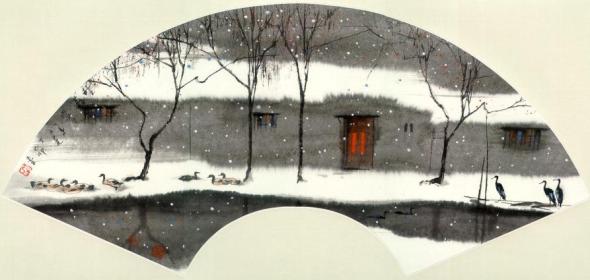
ZP_Snow scene_a fan-painting by Yang Ming-Yi
A selection of Tang-Dynasty poetry – chosen here for references to winter and snow – as translated from the Chinese by scholar, poet and University of Texas professor Frederick Turner with his collaborator “Y. D.”:
.
Li Bai (701-762)
“Thoughts in a Silent Night”
.
The moonlight falling by my bed tonight
I took for early frost upon the ground.
I lift my head, gaze at the moon, so bright,
I lower my head, think of my native land.
.
Cui Hao (704?-754)
(First of Two Songs of Chang Gan)
“Staying on a Night of Wind and Snow with the Host of Hibiscus Mountain, Liu Changqing”
.
Far teal-blue mountains and the sun’s last glow;
In this chill heaven, a poor white-wood hut;
You hear a dog bark at the wicker gate–
At night a man comes home in wind and snow.
.
Du Fu (712-770)
“Facing the Snow”
.
Many new ghosts cry out, in battle slain;
An old man’s chanting, anxious and alone.
Chaotic clouds oppress the setting sun,
Windblown, a rush of dancing snow spins down.
The gourd’s abandoned by the dry wine-jar,
The stove is real, flames seem to burn again.
The mails are cut, through several prefectures;
I sit here, anxious, write on the air in vain.
.
Lu Lun (748-800)
“Songs of the Frontier”
(Number 2 of 6)
.
The forest’s dark, grass frightened by the wind;
At night the general draws his bow of horn;
They seek the arrow, find it in the dawn
Buried up to the white fletch in the stone.
The wild geese fly above a moonless sky;
At night the Hun chief’s army slips away.
No sooner had our horse gone in pursuit
Than bow and sword with snow were covered high.
.
Meng Jiao (751-814)
“Distant View of the Luo Bridge”
.
Beneath the Tian Jin Bridge the ice
has just begun to show;
In Luo Yang City’s empty streets
no traveler will go;
Willows and elms are bare of leaves,
pavilions lie unused;
But in the bright moon brilliantly
I see Mount Song’s far snow.
.
Bai Juyi (772-846)
“The Old Charcoal-Seller”
.
There is an ancient charcoal-selling man;
He cuts down timber, burns it slow,
High on Mount Zhongnan Shan.
.
His face ingrained with dust and ash
Is browned with charcoal smoke,
His temples grey with age and toil,
His fingers black as coke.
.
You sell the charcoal, you get paid,
How do you spend the gains?
To clothe the body’s nakedness,
And feed the hunger pains.
.
Though only thin rags hang upon
His wretched arms and thighs,
He hopes the winter will be cold
So charcoal’s price will rise.
.
An inch of snow fell overnight,
He makes an early start;
Down from the hills through rutted ice
He drives the charcoal-cart.
.
The ox gets tired, the man is starved,
The sun has risen higher,
He rests outside the Southern Gate
Upon the market mire.
.
Two horsemen lightly canter up;
Who are they? By their dress,
One in yellow, one in plain white,
They’re couriers, more or less.
.
With dispatches in hand, they shout
“Imperial command!”
The old man turns his cart, the ox
Drags the whole burden round.
.
One cart of charcoal’s half a ton;
North to the palace gate
The envoys chivvy him, and now
He must unload the weight.
.
In grief he’s paid but half a bolt
Of muslin, dyed cheap red,
And but nine feet of low-grade silk
Flung round the ox’s head.
.
Bai Juyi (772-846)
“Night Snow”
.
The quilt and pillow have got strangely cold;
The window’s paper panes begin to glow.
At night I heard how heavy was the snow–
The bamboos, snapped by more than they could hold.
.
Liu Zongyuan (773-819)
“Snow River”
.
Birds fly no more among these thousand hills,
Men’s footprints blank along ten thousand ways:
With boat, straw hat and cape one old man stays
Fishing alone in the snow-river’s chills.
.
All translations © Frederick Turner, University of Texas
. . . . .
Bai Juyi’s “The Old Charcoal-Seller”
Posted: December 13, 2012 Filed under: Chinese (Mandarin), English Comments Off on Bai Juyi’s “The Old Charcoal-Seller”
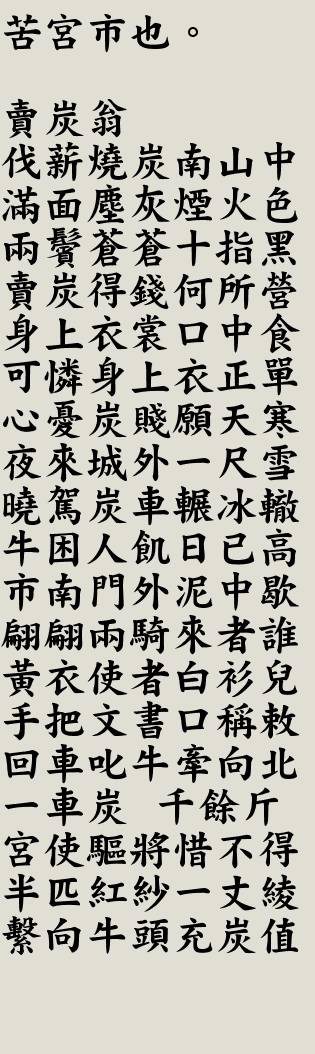
The Old Charcoal-Seller by Bai Juyi
Bái Jūyì (772-846)
Mài Tàn Wēng
(Kǔ gōngshì yě.)
.
Mài tàn wēng,
Fá xīn shāo tàn nánshān zhōng,
Mǎn miàn chén huī yān huǒ sè,
Liǎng bìn cāngcāng shí zhǐ hēi.
Mài tàn dé qián hé suǒ yíng?
Shēn shàng yīshang kǒu zhōng shí.
Kělián shēn shàng yī zhèng dān,
Xīn yōu tàn jiàn yuàn tiān hán.
Yèlái chéng wài yì chí xuě,
Xiǎo jià tàn chē niǎn bīng zhé.
Niú kùn rén jī rì yǐ gāo,
Shì nán mén wài ní zhōng xiē.
Piānpiān liǎng jì lái shì shuí?
Huǎng yī shǐzhě bái shān ér.
Shǒu bǎ wénshū kǒu chēng chì,
Huí chē chì niú qiān xiàng běi.
Yì chē tàn, qiān yú jīn,
Gōngshǐ qū jiāng xī bù dé.
Bàn pǐ hóng shā yí zhàng níng,
Jì xiàng niú tóu chōng tàn zhí.
. . .
This poem appears here in Hanzi (Chinese logograms or characters) and then in Pinyin (Chinese characters in Latin script). Following, “The Old Charcoal-Seller” as translated by Burton Watson in his Po Chu-I Selected Poems (Columbia University Press). Watson is a scholar, just as is Frederick Turner (see Turner’s translation in the “Snow” post above), yet Watson’s translation of Bai Juyi’s evocative poem is markedly different…
. . .
Bai Juyi (772-846)
“The Old Charcoal-Seller”
(Lamenting Hardships Caused by the Palace Purchasing Procedure)
.
Old Charcoal-Seller,
cutting wood, making charcoal in the southern hills,
face soot-coloured, covered with dust and grime,
sidelocks grizzled, all ten fingers black,
peddling charcoal to get money – and what does it go for?
Clothes for the body, food for the mouth.
But – pitiful! – his body clad in one thin robe,
he worries how much his coal will bring, praying for cold weather.
Last night snow outside the city heaped up a foot deep;
at dawn he sets off in his cart, wheels crunching over frozen ruts.
Ox exhausted, driver hungry, sun already high,
they rest in the mud by the market’s south gate.
And who are these two horsemen arrogantly galloping by?
Yellow-robed palace attendant with his white-shirted lackey.
Hand waving a document, mouth barking out an order,
he turns the cart around, shouts at the ox, heads off north.
One whole load of charcoal, a thousand “catties”* and more,
but when palace attendants whisk it away, what good are regrets?
Half a roll of cheap red silk, a swatch of damask tied to the ox’s horn
– this their “full payment” for the charcoal!
.
* “catties” – 1 cattie equals about 500 grams
. . . . .
Riguardo alla Palestina: Versi di una “artista della parola parlata”
Posted: December 13, 2012 Filed under: English, Italian Comments Off on Riguardo alla Palestina: Versi di una “artista della parola parlata”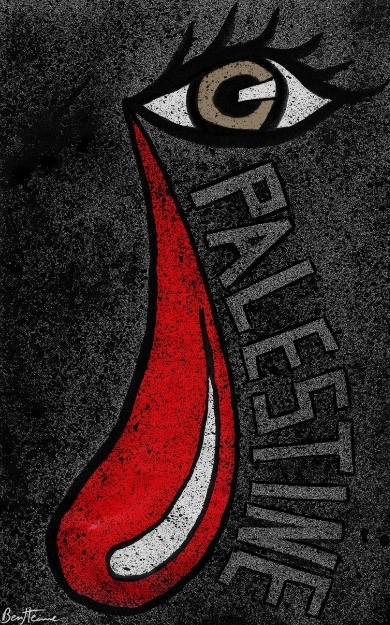
ZP_Palestine’s Agony by Ben Heine
Riguardo alla Palestina: Versi di una “artista della parola parlata”
.
Rafeef Ziadah
“Noi insegniamo la vita, signore!”
.
Oggi, il mio corpo era un massacro trasmesso in TV.
Oggi, il mio corpo era un massacro che doveva rientrare in frasi incisive e un tot di parole.
Oggi, il mio corpo era un massacro trasmesso in TV che doveva rientrare in frasi incisive
incisive e un tot di parole abbastanza pieno di statistiche per una risposta controbilanciata.
Ed io ho perfezionato il mio inglese e imparato le mie risoluzioni ONU.
Eppure, mi ha chiesto, Signorina Ziadah, non crede che tutto si risolverebbe
se solo smetteste di insegnare tanto odio ai vostri bambini?
Pausa.
Cerco dentro di me la forza per essere paziente ma la pazienza
non è esattamente quello che ho sulla punta della lingua mentre le bombe cadono su Gaza.
La pazienza mi ha appena abbandonato.
Pausa. Sorriso.
Noi insegniamo la vita, Signore.
Noi insegniamo la vita, Signore.
Noi palestinesi insegniamo la vita anche dopo che loro ci hanno occupato l’ultimo cielo.
Noi insegniamo la vita dopo che loro hanno costruito i loro insediamenti e i muri per l’apartheid,
dopo gli ultimi cieli.
Noi insegniamo la vita, Signore.
Ma oggi,
il mio corpo era un massacro trasmesso in TV tagliato per rientrare in frasi incisive e un tot di parole.
Ma ci dia solo una storia, una storia umana.
Capisce, qui non si tratta di politica.
Vogliamo solo raccontare alla gente di lei e del suo popolo
quindi ci racconti una storia umana.
Non menzioni parole come “apartheid” e “occupazione”.
Capisce, qui non si tratta di politica.
Deve aiutarmi in quanto giornalista ad aiutare lei a raccontare la sua storia
che non è una storia politica.
Oggi, il mio corpo era un massacro trasmesso in TV.
Che ne dice di raccontarci una storia di una donna a Gaza che ha bisogno di cure?
Che ne dice di lei?
Ha abbastanza arti con le ossa rotte da coprire il sole?
Mi passi un po’ dei suoi morti
e mi dia la lista dei loro nomi in milleduecento parole.
Oggi,
il mio corpo era un massacro trasmesso in TV che doveva rientrare in frasi incisive e un tot di parole
e commuovere quanti desensibilizzati al sangue terrorista.
Ma erano dispiaciuti.
Erano dispiaciuti per il bestiame su a Gaza.
Allora, gli do risoluzioni Onu
e condanniamo
e deploriamo
e ripudiamo.
E non si tratta di due parti uguali: occupanti ed occupati.
E cento morti,
duecento morti,
e mille morti.
E nel mezzo, fra crimini di guerra e massacri,
scarico parole e sorrisi “non esotici”,
sorrisi “non terroristici”.
Ed io racconto, racconto cento morti, duecento morti, mille morti.
C’è nessuno là fuori?
Qualcuno ascolterà?
Vorrei poter gemere sui loro corpi.
Vorrei solo correre scalza in ogni campo per rifugiati
e stringere ogni bambino,
coprire loro le orecchie
affinché non debbano sentire il suono delle bombe
per tutto il resto della loro vita come me.
Oggi, il mio corpo era un massacro trasmesso in TV.
E lasciate solo che vi dica,
non c’è nulla che le vostre risoluzioni Onu abbiano fatto.
E nessuna frase incisiva, nessuna frase incisiva io possa escogitare,
non importa quanto possa migliorare il mio inglese,
nessuna frase incisiva nessuna frase incisiva, nessuna frase incisiva,
nessuna frase incisiva potrà riportarli in vita.
Nessuna frase incisiva sistemerà le cose.
Noi insegniamo la vita, signore.
Noi insegniamo la vita, signore.
Noi Palestinesi ci svegliamo ogni mattina per insegnare al resto del mondo la vita, signore.
.
Rafeef Ziadah è un’attivista canadese-palestinese. Fa parte della Coalizione contro l’Apartheid Israeliano e studia all’Università York di Toronto, Canada.
Il testo originale in inglese di “Noi insegniamo la vita, signore!”è di seguito.
. . .
Rafeef Ziadah
“We teach life, sir!”
.
Today, my body was a TV’d massacre.
Today, my body was a TV’d massacre that had to fit into sound-bites and word limits filled enough with statistics to counter measured response.
And I perfected my English and I learned my UN resolutions.
But still, he asked me, Ms. Ziadah, don’t you think that everything would be resolved if you would just stop teaching so much hatred to your children?
Pause.
I look inside of me for strength to be patient but patience is not at the tip of my tongue as the bombs drop over Gaza.
Patience has just escaped me.
Pause. Smile.
We teach life, sir!
Rafeef, remember to smile.
Pause.
We teach life, sir!
We Palestinians teach life after they have occupied the last sky.
We teach life after they have built their settlements and apartheid walls, after the last skies.
We teach life, sir!
But today, my body was a TV’d massacre made to fit into sound-bites and word limits.
And just give us a story, a human story.
You see, this is not political.
We just want to tell people about you and your people so give us a human story.
Don’t mention that word “apartheid” and “occupation”.
This is not political.
You have to help me as a journalist to help you tell your story which is not a political story.
Today, my body was a TV’d massacre.
How about you give us a story of a woman in Gaza who needs medication?
How about you?
Do you have enough bone-broken limbs to cover the sun?
Hand me over your dead and give me the list of their names in one thousand two hundred word limits.
Today, my body was a TV’d massacre that had to fit into sound-bites and word limits and move those that are desensitized to terrorist blood.
But they felt sorry.
They felt sorry for the cattle over Gaza.
So, I give them UN resolutions and statistics and we condemn and we deplore and we reject.
And these are not two equal sides: occupier and occupied.
And a hundred dead, two hundred dead, and a thousand dead.
And between that, war crime and massacre, I went out words and smile “not exotic”; smile, “not terrorist”.
And I recount, I recount a hundred dead, two hundred dead, a thousand dead.
Is anyone out there?
Will anyone listen?
I wish I could veil over their bodies.
I wish I could just run barefoot in every refugee camp and hold every child, cover their ears so they wouldn’t have to hear the sound of bombing for the rest of their life the way I do.
Today, my body was a TV’d massacre.
And let me just tell you, there’s nothing your UN resolutions have ever done about this.
And no sound-bite, no sound-bite I come up with, no matter how good my English gets, no sound-bite, no sound-bite, no sound-bite, no sound-bite will bring them back to life.
No sound-bite will fix this.
We teach life, sir.
We teach life, sir.
We Palestinians wake up every morning to teach the rest of the world life, sir!
. . .
Palestinian Rafeef Ziadah has made her voice known in her adopted city of Toronto via active participation as a spoken-word artist at events such as The Festival of Resistance marking Human Rights Day. She is working toward a political-science Phd. through York University.
. . .
שירי חנוכה A Freilichin Chanukah: Songs and a Paley poem for Hanukkah
Posted: December 8, 2012 Filed under: English, Grace Paley, Ladino/Judeoespañol, Yiddish | Tags: Hanukkah poems Comments Off on שירי חנוכה A Freilichin Chanukah: Songs and a Paley poem for Hanukkah
שירי חנוכה
אוי חנוכה אוי חנוכה
א יום טוב א שיינע
א ליכטיגע א פרייליכע
נישט דא נאך א זיינע
אלע נאכט מיט דריידלעך ,שפילן מיר
פרישע הייסע לאטקעס ,עסן אן א שיעור
קומט קינדער געשווינדער
די חנוכה ליכט ,וועלן מיר אנצונדען
זאגט על הניסים
לובט ג-ט פאר די נסים
לאמיר אלע טאנצען צוזאמען
. . .
Suki and Ding’s Chanukah Song
.
Chanukah, oh Chanukah,
A holiday, a lovely one,
A happy and a joyful one,
There really is none like it!
Each night at ‘dreidl’ we do play,
fresh hot ‘latkes’ we eat all the day!
Come children, hurry,
the Chanukah candles we shall light!
Let us sing “al hanisim”*,
Let us thank G-d for his miracles,
And we’ll all dance together!
.
*“Al hanisim” is a phrase often uttered at the start of a daily prayer or after meals as a grace. Literally, it means “and for the miracles” – a reminder to thankfully acknowledge G-d for the miracles he has wrought…
.
Chanukah, oh Chanukah song © Suki and Ding
. . .
Daria Marmaluk-Hajioannou
A song for Hanukkah:
“Eight Candles” (an excerpt)
.
The holiday of lights is here,
Good friends and happiness to share,
Sweets with honey for us to eat,
Candles to light and friends to greet!
One little candle, One little candle!
Two little candles, three!
Four, five, six little candles, seven and eight for me!
.
The original of “Eight Candles” follows below…
It is written in the language of mediaeval Spanish Judaism – Ladino or Judeoespañol – which is spoken by about 100,000 people worldwide, including the composer of the song and its lyrics, Daria Marmaluk-Hajioannou.
.
Canción para Janucá por Daria Marmaluk-Hajioannou
(en el idioma ladino/judeoespañol):
“Ochu kandelas” (un extracto)
.
Hanukka lindo sta aki,
ochu candelas para mi!
Una kandelika, dos kandelikas,
tres kandelikas, kuatro kandelikas,
sintju kandelikas, sysh kandelikas,
sieto kandelikas, ocho kandelikas para mi!
Muchas fiestas vo fazar,
con alegrias i plazar!
Una kandelika (etcetera…)
Los pastelikas vo kumer,
con almendrikas i la miel!
Una kandelika (etcetera…)
. . .
“People in my Family” by Grace Paley:
Paley was a Jewish-American short-story writer, poet and political activist. Born in 1922 in The Bronx, New York City, USA, she grew up hearing Russian and Yiddish at home – and the cadences of Yiddish influenced her poems written in English. A pacifist who spoke out against nuclear proliferation, the Vietnam War and the gargantuan American military, Paley was a passionate person in every way. She died in 2007.
.
Grace Paley
“People in my Family”
.
In my family
people who were eighty-two were very different
from people who were ninety-two.
.
The eighty-two-year-old people grew up,
it was 1914 –
this is what they knew:
WarWorldWarWar.
.
That’s why when they speak to the child
they say
poor little one…
.
The ninety-two-year-old people remember
– it was the year 1905 –
they went to prison,
they went into exile,
they said ah soon…
.
When they speak to the grandchild
they say
yes there will be revolution,
then there will be revolution, then
once more, then the earth itself
will turn and turn and cry out
oh I have been made sick…
.
Then you my little bud
must flower and save it.
. . . . .
Nua-bhàrdachd: Gàidhlig / Contemporary Gaelic poetry from Scotland: Meg Bateman
Posted: November 30, 2012 Filed under: English, Gaelic: Scottish, Meg Bateman Comments Off on Nua-bhàrdachd: Gàidhlig / Contemporary Gaelic poetry from Scotland: Meg Bateman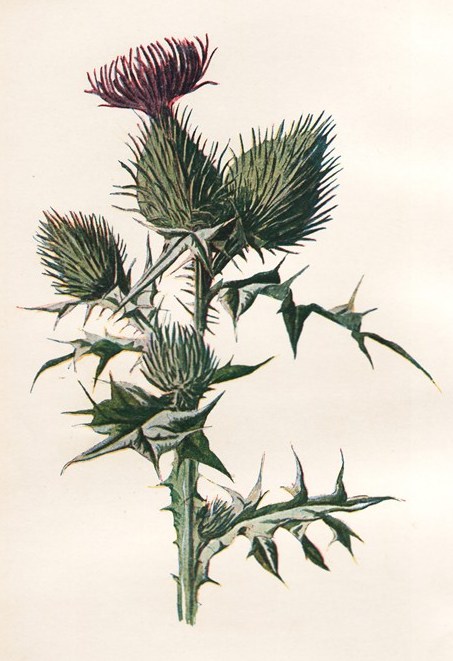
ZP_A nineteenth-century illustration, Spear-plume thistle or Cirsium vulgare, which was the original native Scotch Thistle until the arrival in the middle ages of the tougher, spinier and more impressive Onopordum acanthium.
Meg Bateman (born 1959, Edinburgh, Scotland)
“Mother”
.
We looked at the stars for a while
Before we turned in with the dogs,
And you said it was high time
You learnt their names properly.
.
But soon you will be among them yourself
And I will be the one trying to name you;
You whose nature I have seen
Only as their faint points of light –
.
As you labour behind duty,
Behind house-work, farm-work, books,
And who knows if you have your reward
For your care and effort and exhaustion.
.
I wish I could kindle a joy in you
That would let me see you whole
Or you won’t be further when you go
Than you were tonight at my side.
. . .
“Màthair”
.
Bha sinn a’coimhead nan rionnag
mus do thionndaidh sinn a-steach leis na coin,
is thuirt thu gum bu mhithich dhut
na h-ainmean aca ionnsachadh gu ceart.
.
Ach chan fhada gus am bi thu fhèin nam measg
’s is mise a bhios a’feuchainn ri d’ainmeachadh,
thusa aig nach fhaca mi do nàdar
ach mar phriobadh fann an cuid solais –
.
Is tu riamh an ceann do dhleastanais,
mu chòcaireachd, caoraich, leabhraichean;
a bheil fios an d’fhuair thu do dhìol
airson do dheataim is spàirn is sgìths?
.
O gun lasainn de dh’aighear annad
na leigeadh leam d’fhaicinn gu slàn,
no chan fhaide thu bhuam nuair a shiùbhlas tu
nab ha thu rim thaobh a-nochd.
. . .
“Lightness”
.
It was your lightness that drew me,
The lightness of your talk and your laughter,
The lightness of your cheek in my hands,
Your sweet gentle modest lightness;
And it is the lightness of your kiss
That is starving my mouth,
And the lightness of your embrace
That will let me go adrift.
. . .
“Aotromachd”
.
B’ e d’ aotromachd a rinn mo thaladh,
Aotromachd do chainnte’s do ghaire,
Aotromachd do lethchinn nam lamhan,
D’ aotromachd lurach ur mhalda;
Agus ‘s e aotromachd do phoige
A tha a’ cur trasg air mo bheoil-sa,
Is ‘s e aotromachd do ghlaic mum chuairt-sa
A leigeas seachad leis an t-sruth mi.
. . .
“O Bonnie Man, Lovely Man”
.
O bonnie man, lovely man,
You’ve brought a song to my lips,
.
A spring of clear gushing water
Spilling over the rocks,
.
Soft grasses and bracken
Covering my slopes with green;
.
Your bed is in cotton-grass
With curlews calling in flight,
.
Maytime’s sweet drizzle
is settling about me,
.
Giving mirth and voice
to my soils long barren,
.
O bonnie man, lovely man,
You’ve brought a song to my lips.
. . .
“Fhir luraich ’s fhir àlainn”
.
Fhir luraich ’s fhir àlainn,
thug thu dàn gu mo bhilean,
.
Tobar uisge ghil chraobhaich
a’ taomadh thar nan creagan,
.
Feur caoin agus raineach
a’ glasadh mo shliosan;
.
Tha do leabaidh sa chanach,
gairm ghuilbneach air iteig.
.
Tha ceòban cùbhraidh na Màighe
a’ teàrnadh mu mo thimcheall,
.
’S e a’ toirt suilt agus gutha
dham fhuinn fada dìomhain,
.
Fhir luraich ’s fhir àlainn,
thug thu dàn gu mo bhilean.
. . . . .
All poems © Meg Bateman
Latha Naomh Anndra / Scottish Gaelic poems for Saint Andrew’s Day: Sorley Maclean
Posted: November 30, 2012 Filed under: English, Gaelic: Scottish, Sorley Maclean Comments Off on Latha Naomh Anndra / Scottish Gaelic poems for Saint Andrew’s Day: Sorley Maclean.
Sorley Maclean (Somhairle MacGill-Eain)
(Raasay, Scotland, 1911-1996)
“Should I even strip off…”
.
Should I even strip off
My deceit-proof clothing
And go naked and eager
As a blaze of supreme reason,
I’d then reach the core-love
Of my reason for living
And I’d add to your pleasure
The blaze of supreme reason.
. . .
“Ged chuirinn dhiom éideadh”
.
Ged chuirinn dhiom éideadh
Faireachaidh na cluaineis
‘S nam falbhainn 10m gleusta
‘Nam chaoir céille buadhmhoir,
Ruiginn an-sin cré-ghaol
Mo chéille luaidhe
‘S liùbhrainn do t’ éibhneas
Caoir na céille buadhmhoir.
. . .
“Calvary”
.
My eye is not on Calvary
nor on Bethlehem the Blessed,
but on a foul-smelling backland in Glasgow,
where life rots as it grows;
and on a room in Edinburgh,
a room of poverty and pain,
where the diseased infant
writhes and wallows till death.
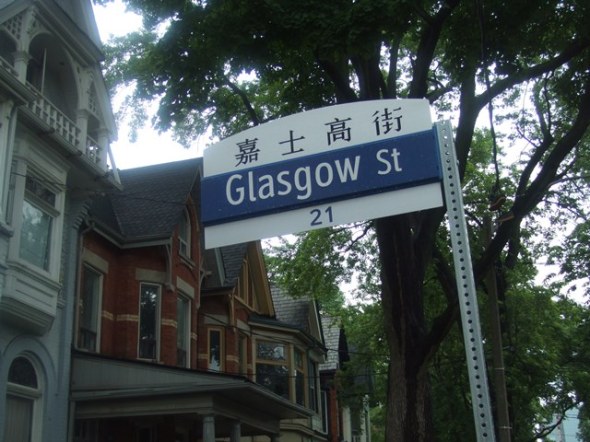
ZP_Glasgow Street, Toronto, Canada
“Calbharaigh”
.
Chan eil mo shùil air Calbharaigh
no air Betlehem an àigh
ach air cùil ghrod an Glaschu
far bheil an lobhadh fàis,
agus air seòmar an Dùn Èideann,
seòmar bochdainn ’s cràidh,
far a bheil an naoidhean creuchdach
ri aonagraich gu bhàs.
. . .
“The Choice”
.
I walked with my reason
out beside the sea.
We were together but it was
keeping a little distance from me.
.
Then it turned saying:
is it true you heard
that your beautiful white love
is getting married early on Monday?
.
I checked the heart that was rising
in my torn swift breast
and I said: most likely;
why should I lie about it?
.
How should I think that I would grab
the radiant golden star,
that I would catch it and put it
prudently in my pocket?
.
I did not take a cross’s death
in the hard extremity of Spain
and how then should I expect
the one new prize of fate?
.
I followed only a way
that was small, mean, low, dry, lukewarm,
and how then should I meet
the thunderbolt of love?
.
But if I had the choice again
and stood on that headland,
I would leap from heaven or hell
with a whole spirit and heart.
. . .
“An Roghainn”
.
Choisich mi cuide ri mo thuigse
a-muigh ri taobh a’ chuain;
bha sinn còmhla ach bha ise
a’ fuireach tiotan bhuam.
.
An sin thionndaidh i ag ràdha:
a bheil e fìor gun cual’
thu gu bheil do ghaol geal àlainn
a’ pòsadh tràth Diluain?
.
Bhac mi ’n cridhe bha ’g èirigh
’nam bhroilleach reubte luath
is thubhairt mi: tha mi cinnteach;
carson bu bhreug e bhuam?
.
Ciamar a smaoinichinn gun glacainn
an rionnag leugach òir,
gum beirinn oirre ’s gun cuirinn i
gu ciallach ’na mo phòc?
.
Cha d’ ghabh mise bàs croinn-ceusaidh
an èiginn chruaidh na Spàinn
is ciamar sin bhiodh dùil agam
ri aon duais ùir an dàin?
.
Cha do lean mi ach an t-slighe chrìon
bheag ìosal thioram thlàth,
is ciamar sin a choinnichinn
ri beithir-theine ghràidh?
.
Ach nan robh ’n roghainn rithist dhomh
’s mi ’m sheasamh air an àird,
leumainn à neamh no iutharna
le spiorad ’s cridhe slàn.
. . . . .
Poemas y Oración para el Día de Acción de Gracias
Posted: November 22, 2012 Filed under: Alexander Best, English, Spanish | Tags: Poemas para el Día de Acción de Gracias Comments Off on Poemas y Oración para el Día de Acción de Gracias
.
Dos poemas por Alexander Best
.
“Thanksgiving ‘Getaway’ March”
.
Rrrrum pa pum pa pum-key – that turkey’s on the run.
Rrrrum pa pum pa pum-key – he got away too late.
Dinner’s almost rrread-y – an hour and it’s done.
Our house smells good for comp’ny – a drrrumstick on your plate!
. . .
“Poema pavo”
.
Señor Ave distinguido,
¿Porqué eriza las plumas?
Totole, totole, manojo de nervios,
¿Te marchas a las lomas?
Macho gordo – está listo
– no buscamos bronca.
Da tu vida por plato de mole,
¡Hoy día – la gran tertulia!
Guajolote, guajolote,
Pajarote indio.
Comida antigua americana
– y ésta tarde, ¡p’ra todo!

. . .
“Oración dulce, sincera – y juguetona”
.
Padre nuestro, Madre nuestra –
que estén en el cielo,
Santificado sean sus nombres,
Venga el reino de ustedes,
Háganse la voluntad en la tierra como en el cielo,
Dennos hoy nuestro pan de cada día,
(– y hoy día guajolote al horno con chilmole y flan de calabaza también, por favor –)
Perdonen nuestras ofensas,
como también nosotros perdonamos a los que nos ofenden,
No nos dejen caer en tentación y líbrennos del mal.
Amén.
. . . . .
Muharram Mubarak: poem for a blesséd New Year المحرّم
Posted: November 15, 2012 Filed under: Arabic, English Comments Off on Muharram Mubarak: poem for a blesséd New Year المحرّم
New Year’s Resolutions:
a poem by Wayfarer
.
The first of Muharram has arrived
– Alhamdulillah –
Another year we have survived
This year we strive to do so much better
Practice our Deen down to the letter
Complete all our Salaat on time
Do many good deeds in our prime
Give Zakat without hesitation
Of the Holy Qu’ran make frequent recitation
Treat all we come across with kindness
Constantly ask for forgiveness
Muharram Mubarak to you, and
May all your Duas come true
– Insha’Allah !
. . .
Glossary of Arabic phrases and Muslim terms:
Alhamdulillah: In Arabic – God/Allah be praised
Deen: In Arabic – the way or code of life
Salaat: Arabic for proper prayer ritual
Zakat: the giving of a portion of one’s wealth to the poor or needy – a practice initiated by Muhammad
Muharram Mubarak: Blesséd Muharram – an equivalent to Happy New Year in English. Muharram is the first month of the Islamic lunar calendar. In 2012 New Year’s Day is November 15th and marks the beginning of year 1434.
Dua: calling out to/summoning God – one’s personal invocation to Allah
Insha’Allah: In Arabic – God/Allah willing, If God/Allah wishes it to be so.
.
A special Thank You to Wayfarer for this Muharram poem!
. . . . .
 Zócalo Poets