Mildred K. Barya: Helene Johnson’s “Bottled”
Posted: November 15, 2013 Filed under: 7 GUEST EDITORS, English, Helene Johnson, Mildred K. Barya Comments Off on Mildred K. Barya: Helene Johnson’s “Bottled”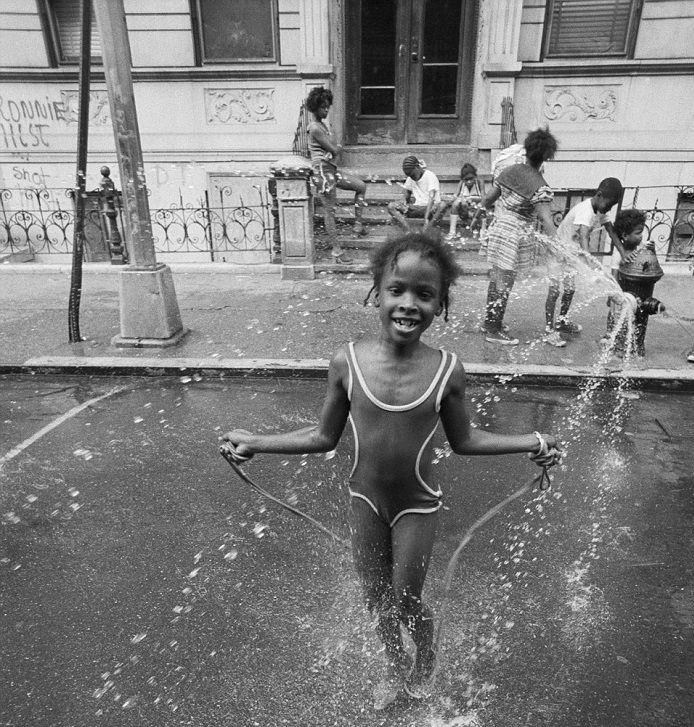 ZP_Harlem, 1970s
.
Mildred K. Barya
“Bottling”
.
The first Nigerian movie I ever watched, in early 2000—whose title I’ve long forgotten—featured a woman casting a spell on a man, bottling him, so to speak, so that he was at the woman’s mercy, doing whatever she wanted. I remember thinking, ok, she’s got her man under control, but is she happy to see another life helplessly and hopelessly at her beck and call? Wouldn’t she be better off with someone who can use his mind, body and spirit without the influence of mojos? There was this undersized image of the man speaking from a bottle, a constant reminder of perspective to the audience. Towards the end of the movie the man was released—after a series of other rituals and prayers to break the spell. Ki Nigeria movies infused with witchcraft, superstition, religious fundamentalism, jealousy and the desire to be loved have been part of popular culture across Africa, and have made Nollywood a booming industry. It’s a common thing to say in Uganda, for example, that ‘someone is bottled’ or ‘she put him in a bottle’ if the “he or she” is constantly responding to another’s demands in the name of what’s ridiculously painted as “love”. Harriet Kisakye, a Ugandan musician, dramatizes this bottling practice with a popular Luganda song about ‘putting the man in a bottle,’ Omusajja omutekka mucupa Ki Nigeria style, if one is to have a peaceful, happy home and minimize infidelity. I’ve listened to the song a number of times and I cannot tell whether Kisakye is being ironic or suggesting a potential “creative solution” to marital cheating.
(http://www.youtube.com/watch?v=N_OcF6W5toE)
Either way, it goes without saying that bottling a man, a person, no matter how you look at it, is about power and control. Ki Nigeria movies are predictable, full of melodrama, and most important: they speak of the times—Africa in the grip of fundamentalism, fusing the world of old magic with the new Christian miracles, the ancient and modern coming together once more.
.
Reading “Bottled” by Helene Johnson reminds me of the times in which the poem came into being—1927 and The Harlem Renaissance: African-American experience echoing the African continent, improvising and fusing jazz-like rhythms to provide an accurate picture and position of the taken, captured, dominated, subdued and shelved—and also the release, transcendence, freedom, dance and beauty in triumph.
There’s all the weight one can imagine in the line: This sand was taken from the Sahara desert. The bottle of sand is placed on the third floor of the 135th street Library in Harlem. At first, one might say, nice decoration, what an important place to be; in a library, who wouldn’t want that?, especially for people who like libraries. But no, oh, no, to think that Some bozo’s been all the way to Africa to get some sand is rather disturbing. So the sand isn’t just sand. The symbolism is significant and cannot be treated lightly. We can’t help but analyze/appreciate the signifier and signified. In addition, place (Library, the Sahara) and history (past and contemporary) are equally crucial.
Further along in the poem, the darky dressed flamboyantly on Seventh Avenue forgets everything and starts to dance the moment he hears the music of the organ. Not only is he given movement, but also his face shines. He is ‘happy, dignified and proud.’ The music is the vehicle that transports him elsewhere: Home. The crowd kept yellin’ but he didn’t hear, just kept on dancin’ and twirlin’… He’s not really on Seventh Avenue anymore. This kind of reimagining was necessary for the people of Harlem, African-Americans who had to think of ways to transcend slavery and where it had placed them in society. Can one comfortably say they invented Jazz as one of those ways? Yes. The influence was Africa, its rhythms and echoes, the beats blending with an incessant need to recreate and experience something in the past that was both beautiful and authentically African. Uncorrupted. Untainted. Helene Johnson weaves this need and transportation in her narrative poem so well: And somehow, I could see him dancin’ in a jungle/A real honest-to cripe jungle, and he wouldn’t leave on them/Trick clothes-those yaller shoes and yaller gloves/And swallowtail coat. He wouldn’t have on nothing/And he wouldn’t be carrying no cane/He’d be carrying a spear with a sharp fine point…
Towards the end of the poem, the ‘bottled man and his shine’ find release via imagination. The ability to be creative and resourceful was at the core of the Harlem Renaissance, why it was a renaissance, and why African-American writers were able to liberate their minds, bodies and souls that were once captured and shelved.
. . .
Helene Johnson (1906-1995)
“Bottled” (1927)
.
Upstairs on the third floor
Of the 135th Street Library
In Harlem, I saw a little
Bottle of sand, brown sand,
Just like the kids make pies
Out of down on the beach.
But the label said: “This
Sand was taken from the Sahara desert.”
Imagine that! The Sahara desert!
Some bozo’s been all the way to Africa to get some sand.
And yesterday on Seventh Avenue
I saw a darky dressed to kill
In yellow gloves and swallowtail coat
And swirling at him. Me too,
At first, till I saw his face
When he stopped to hear a
Organ grinder grind out some jazz.
Boy! You should a seen that darky’s face!
It just shone. Gee, he was happy!
And he began to dance. No
Charleston or Black Bottom for him.
No sir. He danced just as dignified
And slow. No, not slow either.
Dignified and proud! You couldn’t
Call it slow, not with all the
Cuttin’ up he did. You would a died to see him.
The crowd kept yellin’ but he didn’t hear,
Just kept on dancin’ and twirlin’ that cane
And yellin’ out loud every once in a while.
I know the crowd thought he was coo-coo.
But say, I was where I could see his face,
.
And somehow, I could see him dancin’ in a jungle,
A real honest-to cripe jungle, and he wouldn’t leave on them
Trick clothes-those yaller shoes and yaller gloves
And swallowtail coat. He wouldn’t have on nothing.
And he wouldn’t be carrying no cane.
He’d be carrying a spear with a sharp fine point
Like the bayonets we had “over there.”
And the end of it would be dipped in some kind of
Hoo-doo poison. And he’d be dancin’ black and naked and
Gleaming.
And He’d have rings in his ears and on his nose
And bracelets and necklaces of elephant’s teeth.
Gee, I bet he’d be beautiful then all right.
No one would laugh at him then, I bet.
Say! That man that took that sand from the Sahara desert
And put it in a little bottle on a shelf in the library,
That’s what they done to this shine, ain’t it? Bottled him.
Trick shoes, trick coat, trick cane, trick everything-all glass-
But inside-
Gee, that poor shine!
. . .
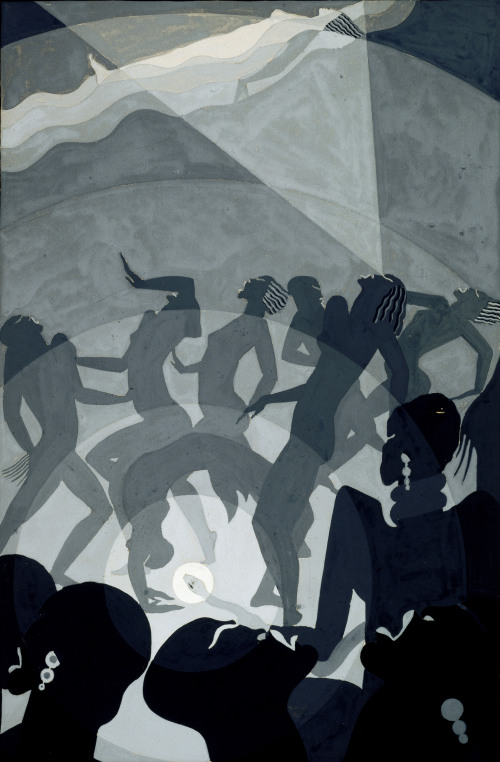 ZP_Aaron Douglas_”Congo”_1928_gouache and pencil on paperboard
.
Helene Johnson (1906-1995) was born in Boston (Brookline) to parents whose roots were in South Carolina and Tennessee. Her maternal grandparents had been born into slavery. At the age of 20 Johnson moved to New York City with her cousin – later to become the novelist Dorothy West. For a time, the two sublet the apartment of Zora Neale Hurston. Johnson’s poems were published in the journal Opportunity, and one was included in the famous 1926 one-issue avant-garde journal Fire!! A Quarterly Devoted to the Younger Negro Artists, edited by Wallace Thurman. A mere three dozen of Johnson’s poems were ever printed, most in journals and magazines of the 1920s and 30s. Her fresh point of view did not go unnoticed. A reviewer at the time said of Johnson that she “has taken the ‘racial’ bull by the horns. She has taken the very qualities and circumstances that have long called for apology or defence and extolled them in an unaffected manner.”
Helene married William Warner Hubbell in 1933 and they had one daughter, Abigail. The last published poem by Johnson – “Let me sing my song”– appeared in 1935 in the journal Challenge whose editors were West and Richard Wright. Famously reclusive, the Johnson of later years yet still wrote poems, only she kept them to herself. Verner D. Mitchell’s biography of the poet, This Waiting for Love, published in 2000, brought to light thirteen “new” poems by Johnson, and one from 1970 entitled “He’s about 22, I’m 63”, shows that her sense of humour had remained intact despite a jealously guarded privacy.
A black woman writer was an uncommon person back in the 1920s; Helene Johnson “defied the odds and put pen to paper when the century was young.”*
.
*Verner D. Mitchell
. . . . .
Remembrance Day Reflections: Juliane Okot Bitek
Posted: November 11, 2013 Filed under: 7 GUEST EDITORS, English, Juliane Okot Bitek Comments Off on Remembrance Day Reflections: Juliane Okot Bitek
ZP Guest Editor – Juliane Okot Bitek
Forgetting and Remembrance Day
.
I used to think that Remembrance Day was restricted to soldiers lost in the wars that Canada was involved in. I used to wish that I could remember my brother on Remembrance Day, in a public way, as one of a family who had lost one of its brightest and as one of a community which had lost hundreds and thousands of men and women in the various wars that were fought in my homeland of Uganda. I wanted desperately to claim Remembrance Day for us, because we too had lost a great love and a great life. But I thought it was an imposition, so I wore red poppies like everyone else and reflected on the Canadian dead and listened to speeches about how the veterans had fought for our freedom and how we owe them the comforts of our lives.
I heard my brother call out to me on a sunny morning, just after a high school assembly as me and my friends made our way to class. I looked about. I didn’t see. My brother called out again. It was an urgent call, loud. I turned around, asked one of my friends if she’d heard my name being called. No, she said. She didn’t hear anything. A couple of days later, I was picked up from school and taken home. My brother had been shot.
My brother, Keny, was an officer in the Uganda National Liberation Army, the post-Idi Amin government army. Story was that he was in Fort Portal, a town in western Uganda, and that officers did not usually fight on the frontline. Story was that my brother and other officers were on the frontline, fighting the guerrillas that would eventually make up the current government of Yoweri Museveni. Story was that my brother was shot in that battle, and that he wasn’t the only one. The weekend of Keny’s funeral, there were eight other funerals for eight others killed from the same region – the Acholi region of northern Uganda. It was a sunny day, no evidence of rain for days to come; it was hot. The kind of day that evoked memories of my brother walking with his wife and toddler to his hut during the funeral rites of my father, scant months before. There was a gun salute, I think, with the solemnity befitting an officer. And it wasn’t a grey day, it wasn’t November. The ache from losing my brother would remain just under my skin for years.
I wanted to be a soldier once. When the Canadian military would set up a booth seeking to attract students from the University of British Columbia in Vancouver. I’d pick up a brochure, take the fridge magnet or the pen they offered, the type that came with sticky notes at the other side. I wanted the chance to join the army and make it as high up as my brother might have done.
Remembrance Day in Canada is usually celebrated with wreaths and the marching of proud veterans who are often shuffling along with age and carried along with pride. Black and white film clips from the First and Second World Wars, Korea; video clips from Afghanistan. News channels often focus on the celebration of our soldiers’ efforts at the local cenotaph where a solemn declaration, carved in stone, is ignored for most of the year. Often it’s raining – a grey day, a grey month, a grey time for families who think of November 11th as a national marker for those they loved and lost, and for those who never returned whole.
Sometime after my brother Keny‘s funeral, I returned to school and tried to melt back into normal. The deaths of my brother and father in such quick succession would’ve been hard to ignore but Ugandans have weathered loss for so long and we know how to pick up, keep moving, keep smiling, keep going. Our English teacher gave us a composition exercise in which we were to write a story that ended with lines from the title of Kenyan poet, Jared Angira’s poem, “No Coffin, No Grave”. We had to write a story that was true, from our own experience, no less. What came pouring out of me was the story of losing my brother. I wrote about my sister-in-law who had gone to identify his body, and I could hear her wracked in pain as she narrated her experience. I wrote about how she identified my brother by a bracelet that she had given him. How it was that he had to be buried quickly, how it had to be a closed coffin affair. And how it was that we never had the chance to say goodbye – not really.
Keny had come to visit me in school the term before. He had come in full military regalia. He stood up when he saw me – and saluted. I saluted back – and giggled. He wanted to know how I was, if there was anyone bothering me. And if there was, I was to promise that he’d take care of it. You know how big brothers are – bragging, seemingly full of themselves. He told me not to worry about anything, that I’d be alright. Perhaps Keny had come to say goodbye, and I didn’t know – I did not know that.
There are families for whom Remembrance Day is Every Day or most days. National gratitude doesn’t and cannot match personal grief and it’s hard to argue with a public show of support and the recognition of soldiers. Often we hear phrases about how our soldiers fought for our freedom. That gives me pause: from whom do Canadian soldiers wrest our freedom? How do they do that? What do we do, for example, with the images we’ve seen from Elsipogtog just last month?
When Canada joined the war effort in Afghanistan in 2002, a professor in the English department at the University of British Columbia started to keep count of the losses. Canadians would never let fifty soldiers die over there. But fifty came and went. The faces and names on the professor’s door grew. If it got to a hundred, surely Canadians would be up in arms. A hundred soldiers died, and more; Remembrance Day was commemorated like all the other ones. A hundred and fifty eight Canadian soldiers died in Afghanistan and there was no uproar here, just another solemn Remembrance Day on November 11th.
Soldiers die, their families hurt. Soldiers live with terribly injured bodies, their families hurt. Soldiers get so badly scarred psychically that it should give us pause to think about what it means to maintain an army, to have young people sign up for duty. And then we think about them once a year – with so much solemnity and pomp. But some soldiers go it alone…
Months, years later, I would think about my brother Keny and how useless his advice had been. I worried – and he wasn’t there. I hurt, and people hurt me – and he wasn’t there. He wasn’t there to take care of the nastiness that we had to go through. He wasn’t there when my grade-school teacher returned with our marked composition papers on the “No Coffin, No Grave” theme and insisted that there was one paper that she wanted to read out – and it was mine. She held it up as an example of what not to write. After she’d read it to the class, she turned to me and asked me how it was I could lie like that, to make up such a story. And that I should be ashamed of myself, she admonished me. She told me to leave the classroom and, as I walked out in shame, the tears that threatened to choke me, I willed them to stay back; I was not going to cry.
Keny wasn’t there when I turned thirty three, his age when he died.
I think about the loss of lives of young men and women who sign up for military duty to defend their country, to fight for the rights of others, to invade other nations or to assist in reclaiming Life after disasters like Typhoon Haiyan in The Philippines – which struck land on November 7th and 8th. This is hard and dangerous work, and sometimes it’s awfulwork that returns with evidence of our armed men and women engaging in shameful acts such as the 1993 hazing of Shidane Arone in Somalia. And look at the evidence provided by the recent deconstruction of the Black Blouse Girl photo which shows that there was rape before the Massacre at My Lai. How can we continue to maintain an institution that drives our men and women to such depths, then we commemorate the wars that led them to their deaths? How then can we forget so fast, so completely?
Last summer, I had the privilege of visiting with my nephew, Keny’s son. I was going to be seeing him for the very first time since I left home in 1988. I took the train from Vancouver to Eugene, Oregon, and had dinner with him and his fiancée. My nephew grew up without his father and has no idea whose spectre walks beside him. He feels like Keny, sounds like him. He even called me waya – aunt – butthere was no urgency in his voice, not like the one I’d heard almost three decades ago one morning after assembly. We talked about all kinds of things, but nothing about the gaping absence between us. Time had collapsed to have us meet and know each other, but not enough to have my brother back.
Remembrance Day is packed full of history and valour – Canada has lost many brave women and men to the nastiness that is war. This country, and other countries which have lost brave men and women, can step up to count themselves as courageous and freedom- loving, but when are we going to be inspired by the enormity of loss to seek a future in which there are no more wars and no more losses to war? The list of dead Canadian soldiers no longer hangs on that professor’s door – but we remember what hurts, some of us do.
 Addendum: In fact, that list of soldiers‘ names on the door of the professor in the English Department is still there. I have visited his office several times since I graduated in 2009, but I stopped seeing. By his own admittance, the list needs to be updated but still, it says something to me that forgetting is an active process and possibly it begins by stopping seeing what’s in front of us. I’m grateful to Professor Zeitlin for reminding me that peace is a worthwhile pursuit and it begins with the intention to see, to remember and to question what it is we must never forget.
. . . . .
Poems for Remembrance Day: El Salvador’s Civil War
Posted: November 11, 2013 Filed under: English, Spanish | Tags: Remembrance Day poems Comments Off on Poems for Remembrance Day: El Salvador’s Civil War Families looking for “Disappeared” relatives in The Book of the Missing at the Human Rights Commission Office in San Salvador_early 1980s_photograph © Eli Reed
.
Carolyn Forché (born 1950, Detroit, Michigan, U.S.A.)
“The Colonel”
.
What you have heard is true. I was in his house. His wife carried
a tray of coffee and sugar. His daughter filed her nails, his son went
out for the night. There were daily papers, pet dogs, a pistol on the
cushion beside him. The moon swung bare on its black cord over
the house. On the television was a cop show. It was in English.
Broken bottles were embedded in the walls around the house to
scoop the kneecaps from a man’s legs or cut his hands to lace. On
the windows there were gratings like those in liquor stores. We had
dinner, rack of lamb, good wine, a gold bell was on the table for
calling the maid. The maid brought green mangoes, salt, a type of
bread. I was asked how I enjoyed the country. There was a brief
commercial in Spanish. His wife took everything away. There was
some talk then of how difficult it had become to govern. The parrot
said hello on the terrace. The colonel told it to shut up, and pushed
himself from the table. My friend said to me with his eyes: say
nothing. The colonel returned with a sack used to bring groceries
home. He spilled many human ears on the table. They were like
dried peach halves. There is no other way to say this. He took one
of them in his hands, shook it in our faces, dropped it into a water
glass. It came alive there. I am tired of fooling around he said. As
for the rights of anyone, tell your people they can go fuck them-
selves. He swept the ears to the floor with his arm and held the last
of his wine in the air. Something for your poetry, no? he said. Some
of the ears on the floor caught this scrap of his voice. Some of the
ears on the floor were pressed to the ground.
May 1978
. . .
Carolyn Forché (nacida en 1950, Detroit, Michigan, EE.UU.)
“El Coronel”
.
Lo que has oído es verdad. Estuve en su casa. Su mujer llevaba
una bandeja con café y azúcar. Su hija se limaba las uñas, su
hijo salió esa noche. Había periódicos, perritos, una pistola
sobre el cojín a su lado. La luna se mecía desnuda con su
cuerda negra encima de la casa. En la televisión daban un
programa policíaco. Era en inglés. Había botellas rotas
empotradas en la cerca que rodeaba la casa para arrancar las
rodilleras de un hombre o cortar sus manos en pedazos. En
las ventanas, rejas como las de las tiendas de licores. Cenamos
cordero a la parrilla, un buen vino; una campanilla de oro estaba
sobre la mesa para llamar a la criada. Ella nos trajo mangos
verdes, sal, un pan especial. Me preguntaron si me gustaba el
país. Hubo un breve anuncio en español. Su mejor se lo llevó
todo. Luego se habló sobre lo difícil que ahora resultaba
gobernar. El loro dijo “hola” en la terraza. El coronel le dijo
que se callara, y se levantó pesadamente de la mesa. Mi amigo
me dijo con sus ojos: no digas nada. El coronel volvió con
una bolsa de las que se usan para traer comestibles a casa.
Esparció muchas orejas humanas sobre la mesa. Eran como
orejones dulces partidos en dos. No hay otra manera de decirlo.
Cogió una en sus manos, la sacudió en nuestra presencia, y la
dejó caer en un vaso de agua. Allí revivió. Estoy hasta las
narices de tonterías, dijo. En cuanto a los derechos humanos,
dile a tu gente que se joda. Con su brazo tiró todas las orejas
al suelo y levantó en el aire el resto de su vino. Algo para tu
poesía, ¿no?, me dijo. Algunas orejas del suelo recogieron este
retazo de su voz. Algunas orejas del suelo fueron aplastadas
contra la tierra.
Mayo de 1978
.
Traducción del inglés: Noël Valis
. . .
Jaime Suárez Quemain (Salvadorean poet and journalist, 1949-1980)
“A Collective Shot”
.
In my country, sir,
men carry a padlock
on their mouths,
only when alone do they meditate,
shout and protest
because fear, sir,
is the gag
and the subtle padlock you control.
In my country, sir,
(I say mine because I want it to be mine)
even on the fence posts
you can see the longing
…they divide it, they rent it, they mortgage it,
they torture it, they kill it, they imprison it,
the newspapers declare there is total freedom, but
it’s only in the saying, sir, you know what I mean.
And it’s my country,
with its streets, its shadows, its volcanos,
its high-rises – dens of thieves –
whose children succeeded in escaping Malthus,
it’s my country, with its poets, its dreams and its roses.
And my country, sir,
is nearly a cadaver, a solitary phantom of the night,
and it agonizes,
and you, sire,
so impassive.
.
Translation from Spanish: Wilfredo Castaño
.
 National Policemen using an ice-cream vendor as a shield during a skirmish with demonstrators_San Salvador_early 1980s_photograph © Etienne Montes
 Arrest of an autorepair mechanic for failure to carry an ID card_San Salvador_early 1980s_photograph copyright John Hoagland
.
Jaime Suárez Quemain (poeta y periodista salvadoreño, 1949-1980)
“Un Disparo Colectivo”
.
En mi país, señor,
los hombres llevan un candado
en la boca,
sólo a solas
meditan, vociferan y protestan,
porque el miedo, señor,
es la mordaza
y el candado sutil que usted maneja.
En mi país, señor,
– digo mío porque lo quiero mío –
hasta en los postes
se mira la nostalgia,
lo parcelan, lo alquilan, lo hipotecan,
lo torturan, lo matan, lo encarcelan;
la prensa dice
que hay libertad completa,
es un decir, señor, usted lo sabe.
Y es así mi país,
con sus calles, sus sombras, sus volcanes,
sus grandes edificios – albergues de tahures –
sus niños que lograron
escapársele a Malthus,
sus poetas, sus sueños y sus rosas.
Y mi país, señor,
casi cadáver,
solitario fantasma de la noche,
agoniza… y usted:
tan impasible.
. . .
Alfonso Quijada Urías (Salvadorean poet, born 1940)
“Chronicle”
.
The dead man’s mother is buying flowers,
the village is lovely, yellow flowers bloom on the hills;
the day seems happy, though it’s really very sad,
nothing moves without God’s will.
And the police are buying flowers, which they’ll send
to the dead man’s mother,
and a humble righteous man sends a note of condolence
for the death of the man they killed.
The sun keeps shining on the hills,
then a man playing the saddest music feels sorry to be there
among those men much deader than the dead man himself
who is swallowing with his open eyes the flowering hills,
the village and the walls, where once he wrote: long lib liberti.
.
(1983)
.
Translation from Spanish: Barbara Paschke
. . .
Alfonso Quijada Urías (poeta salvadoreño, nacido 1940)
“Crónica”
.
La madre del muerto compra flores,
el pueble es bello, en los cerros crecen las flores amarillas;
parece un día alegre aunque realmente es muy triste,
nada se mueve sin la voluntad de Dios.
También los policías compran flores que mandaran a
la madre del muerto,
también un hombre bajito de conciencia manda
una nota en la que se conduele
por la muerte del muerto que mataron.
El sol sigue brillando sobre los cerros.
Entonces un hombre que toca la música mas triste
se conduele de estar allí
entre esos hombres mucho más muertos que el mismo muerto
que va tragando con sus ojos abiertos los cerros florecidos,
el pueblo y sus paredes, donde escribió una tarde: biva la libertá.
.
(1983)
 A Salvadorean government soldier with his automatic rifle and a sleeping toddler, after an anti-guerrilla manoeuvre in Cabañas province, El Salvador_May 1984
.
El Salvador, at the advent of the 20th century, was governed by presidents drawn from its oligarchical families; these had a cozy yet volatile relationship with the nation’s military. In the last decades of the 19th century, mass production at fincas (plantations) of coffee beans for export as the main cash crop was already being emphasized through forced elimination of communal land ownings belonging to campesinos (peasant farmers). In fact, a rural police force was created in 1912 to keep displaced campesinos in line. Social activist Farabundo Martí (1893-1932), one of the founders of the Communist Party of Central America, spearheaded a peasant uprising in 1932 which resulted in 30,000 deaths by the military – La Matanza (“The Slaughter”), as it came to be known. Decades of repression followed, then a coup d’état in1979 plus the 1980 assassination of human-rights advocate, Salvadorean Archbishop Oscar Romero, triggered a brutal civil war that lasted more than a decade. In the U.S.A., the newly elected President, Ronald Reagan, was determined to limit what he perceived as Communist and/or Leftist influence in Central America following the popular insurrection that overthrew the Somoza dictatorship in neighbouring Nicaragua, so the U.S. administration supported the Salvadorean junta with military and economic aid throughout the 1980s. During this time, death squads associated with the military terrorized civilians, sometimes massacring hundreds of people at a time, as at El Mozote * in December of 1981. All told, the war cost the lives of 75,000 civilian noncombatants – this, in a country of a mere 5.5 million people (1992 estimate.).
In the U.S.A. the general population was divided about Washington’s deepening engagement in El Salvador. University student committees and humanitarian church groups coalesced around the issue. While there were major demonstrations in U.S. cities protesting its government’s policies in the tiny Central American country – 1981 saw rallies in several U.S.cities, and one that grouped in front of the Pentagon in May that year had 20,000 participants calling for Solidarity with the People of El Salvador – the continued violence against el pueblo salvadoreño and the U.S. foreign policies that enabled it – made the unfolding “story” of the Salvadorean civil war of the 1980s one of the central parables of the Cold War era. Then, unexpectedly, in 1989, it was a crime truly capturing international attention – the murder by Salvadorean government forces of six Jesuit priests, along with their housekeeper and her daughter – that began to set in motion the wheels of peace. A United Nations Truth Commission investigated and this gradually led to a UN-brokered peace agreement, signed at Chapultepec Castle in México City in 1992. Today, there are free elections in El Salvador, and both sides of the conflict have been integrated into the political process. Yet the economy remains unstable—about 20 percent-dependent upon remittances sent home by Salvadoreans working in the U.S.A. and other countries.
.
* El Mozote, a hamlet in the mountainous Morazán region of El Salvador, was the scene of an orgy of killing by the Salvadorean Army’s Atlacatl Battalion (trained by the U.S.military) which had arrived in the vicinity searching for guerrillas of the FMLM (Farabundo Martí National Liberation Front). Campesinos had gathered in El Mozote seeking a safe haven. The Atlacatl forced everyone into the village square, where they separated the men from the women. The men were interrogated, tortured, then executed. The women and girls were rapedthen machine-gunned down. Children had their throats slit then their bodies were hung from trees. Every building – and numerous piles of bodies – were set ablaze. The entire civilian population of El Mozote and its peripheral farms was eliminated. Author Mark Hertsgaard, in his book On Bended Knee – a study of the media and the Reagan administration – wrote of the significance of the first New York Times and Washington Post reports (January 1982) of the massacre: “What made the El Mozote/Morazán massacre stories so threatening was that they repudiated the fundamental moral claim that undergirded U.S. policy. They suggested that what the United States was supporting in Central America was not democracy but repression. They therefore threatened to shift the political debate from means to ends, from how best to combat the supposed Communist threat—send US troops or merely US aid?—to why the U.S.A. was backing state terrorism in the first place.”
. . . . .
Poems for Remembrance Day: Siegfried Sassoon / El soldado sincero – y amargo: la poesía de Siegfried Sassoon
Posted: November 11, 2013 Filed under: English, Siegfried Sassoon, Spanish | Tags: Remembrance Day poems Comments Off on Poems for Remembrance Day: Siegfried Sassoon / El soldado sincero – y amargo: la poesía de Siegfried Sassoon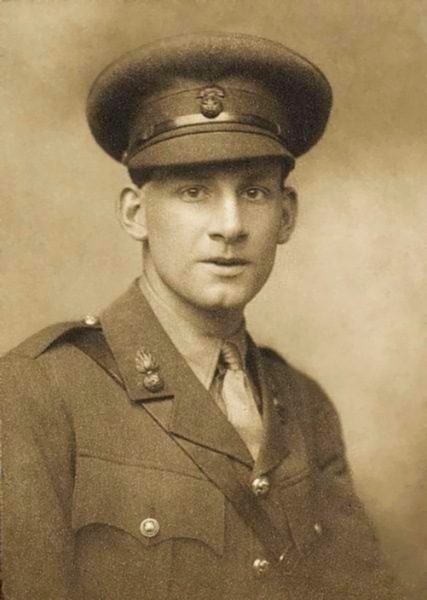 ZP_Siegfried Sassoon in 1915
.
Siegfried Sassoon (United Kingdom, 1886-1967) is best remembered for his angry and compassionate poems of the First World War (1914-1918). The sentimentality and jingoism of many War poets is entirely absent in Sassoon‘s poetic voice. His is a voice of intense feeling combined with cynicism. He wrote of the horror and brutality of trench warfare and contemptuously satirized generals, politicians, and churchmen for their incompetence and blind support of the War.
.
Siegfried Sassoon’s Declaration against The War (July 1917)
“I am making this statement as an act of wilful defiance of military authority, because I believe that the War is being deliberately prolonged by those who have the power to end it. I am a soldier, convinced that I am acting on behalf of soldiers. I believe that this War, on which I entered as a war of defence and liberation, has now become a war of aggression and conquest. I believe that the purpose for which I and my fellow soldiers entered upon this war should have been so clearly stated as to have made it impossible to change them, and that, had this been done, the objects which actuated us would now be attainable by negotiation. I have seen and endured the sufferings of the troops, and I can no longer be a party to prolong these sufferings for ends which I believe to be evil and unjust. I am not protesting against the conduct of the war, but against the political errors and insincerities for which the fighting men are being sacrificed. On behalf of those who are suffering now I make this protest against the deception which is being practised on them; also I believe that I may help to destroy the callous complacency with which the majority of those at home regard the contrivance of agonies which they do not, and which they have not, sufficient imagination to realize.”
. . .
Siegfried Sassoon (1886-1967)
“Suicide in the trenches”
.
I knew a simple soldier boy
Who grinned at life in empty joy,
Slept soundly through the lonesome dark,
And whistled early with the lark.
.
In winter trenches, cowed and glum,
With crumps and lice and lack of rum,
He put a bullet through his brain.
No one spoke of him again.
.
You smug-faced crowds with kindling eye
Who cheer when soldier lads march by,
Sneak home and pray you’ll never know
The hell where youth and laughter go.
. . .
“Suicidio en las trincheras”
.
Conocí a un soldado raso
que sonreía a la vida con alegría hueca,
dormía profundamente en la oscuridad solitaria
y silbaba temprano con la alondra.
En trincheras invernales, intimidado y triste,
con bombas y piojos y ron ausente,
se metió una bala en la sien.
Nadie volvió a hablar de él.
Vosotros, masas ceñudas de ojos incendiados
que vitoreáis cuando desfilan los soldados,
id a casa y rezad para no saber jamás
el infIerno al que la juventud y la risa van.
. . .
“Attack”
.
At dawn the ridge emerges massed and dun
In the wild purple of the glow’ring sun,
Smouldering through spouts of drifting smoke that shroud
The menacing scarred slope; and, one by one,
Tanks creep and topple forward to the wire.
The barrage roars and lifts. Then, clumsily bowed
With bombs and guns and shovels and battle-gear,
Men jostle and climb to, meet the bristling fire.
Lines of grey, muttering faces, masked with fear,
They leave their trenches, going over the top,
While time ticks blank and busy on their wrists,
And hope, with furtive eyes and grappling fists,
Flounders in mud. O Jesus, make it stop!
. . .
“Ataque”
.
Surge al alba enorme y parda la colina
en el salvaje sol púrpura de frente fruncida
ardiendo a través de columnas de humo a la deriva
envolviendo
la amenazadora pendiente arrasada; y, uno a uno,
los tanques se arrastran y vuelcan la alambrada.
La descarga ruge y se eleva. Después, torpemente agachados
con bombas y fusiles y palas y uniforme completo,
los hombres empujan y escalan para unirse al encrespado
fuego.
Filas de rostros grises, murmurantes, máscaras de miedo,
abandonan sus trincheras, pasando por la cima,
mientras el tiempo pasa en blanco apresurado en sus
muñecas
y aguardan, con ojos furtivos y puños cerrados,
luchando por flotar en el barro. ¡Oh Dios, haz que pare!
. . .
“The Investiture”
.
God with a Roll of Honour in His hand
Sits welcoming the heroes who have died,
While sorrowless angels ranked on either side
Stand easy in Elysium’s meadow-land.
Then you come shyly through the garden gate,
Wearing a blood-soaked bandage on your head;
And God says something kind because you’re dead,
And homesick, discontented with your fate.
.
If I were there we’d snowball Death with skulls;
Or ride away to hunt in Devil’s Wood
With ghosts of puppies that we walked of old.
But you’re alone; and solitude annuls
Our earthly jokes; and strangely wise and good
You roam forlorn along the streets of gold.
. . .
“La investidura”
.
Con una lista de caídos en Su mano, Dios
se sienta dando la bienvenida a los héroes que han muerto
mientras ángeles sin pena se alinean a cada lado
tranquilos en pie en los prados Elíseos.
Entonces, tú llegas tímido al jardín a través de las puertas
luciendo un vendaje empapado en sangre en la cabeza
y Dios dice algo amable porque estás muerto
y añoras tu casa, descontento con tu destino.
Si yo estuviera allí, lanzaríamos calaveras como bolas de
nieve a la muerte
o nos fugaríamos para cazar en el Bosque del Diablo
con fantasmas de cachorros que antaño paseamos.
Pero estás solo y la soledad anula
nuestras bromas terrenas; y extrañamente sabio y bueno
vagas desamparado por calles de oro.
. . .
From: Counter-Attack and Other Poems (1918)
Spanish translations © Eva Gallud Jurado (Salamanca, 2011)
De: Contraataque y otros poemas(1918)
Traducciones de Eva Gallud Jurado – derechos de autor (Salamanca, 2011)
. . . . .
Andre Bagoo / Tomorrow Please God: poems from the premiere issue of Douen Islands
Posted: November 5, 2013 Filed under: Andre Bagoo, English Comments Off on Andre Bagoo / Tomorrow Please God: poems from the premiere issue of Douen Islands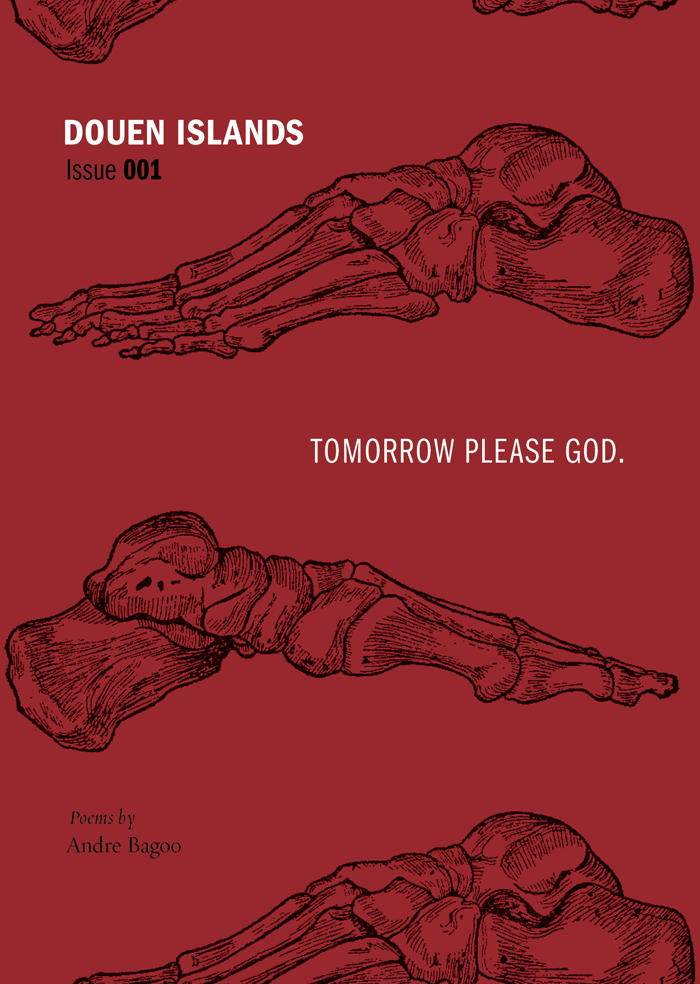
Ship of Theseus
.
I have to see your face
if am not going to stare.
.
How do we know for sure
a dead body is really there?
.
Call all you wed by my surname
so that when I die, we breathe
.
in your body, in your new lover
and then, later, his new lover
.
his and his. In this way
our marriage lasts forever.

Father of the Nation
.
My life should grow longer
With each moment you live
We, strange twins, each
Approaching middle-age
Through reversed ends
.
Assuming I will live tomorrow
I can time my midlife crisis
My life chained to yours
Our wrong-footed estimates
Leave one set of footprints
. . .
Dragon Boat
.
I will put my bucket down
Over my head
And turn it into straw, spin
Bark into gold.
Our ways always hold.
We cup love with tightness.
We know enough of currency
To know.
When you see me
You always say,
“Excuse me, you from China?”
You’ve nearly understood.
Our ways are old
Our bodies, our own.
We don’t take back
What we never gave.
. . .
These poems are taken from Douen Islands, a poetry e-book produced in collaboration by poet Andre Bagoo, graphic designer Kriston Chen, artists Brianna McCarthy and Rodell Warner, and sitarist Sharda Patasar.
Read more here: douenislands.tumblr.com
And get involved here: douenislands@gmail.com
. . . . .
Poem for Beginning Anew: “Zamzam” by Doyali Farah Islam
Posted: November 4, 2013 Filed under: Doyali Farah Islam, English | Tags: Muharram, New Year Comments Off on Poem for Beginning Anew: “Zamzam” by Doyali Farah Islam
Doyali Farah Islam
“Zamzam”
.
Zamzam was found
under a heap of dung,
where the blood of rites
fertilized stone.
.
… Zamzam … was found …
under a heap of dung.
.
it was ‘Abd al-Muttalib
who decided which to cherish.
.
it wasn’t just springwater,
but his decision
that was the freshness.
.
… this ground we unmuck
called listening heart
carves deep the shallowest
cup.
.
somewhere breathes its breath
from between your two breasts.
.
(no need to divine
perfect locations;
approximations are enough.)
.
… out in the plain open, I was searching for a particular thing,
and a thousand hidden
wellsprings of treasure
passed me by.
.
Hajar runs between two hills, desperate to find what quenches thirst.
.
then she gives up going back and forth in the desert of fear,
and Ishmael’s heel strikes water.
. . .
Poet’s notes on “Zamzam”:
Zamzam:
The Well of Zamzam was in use from the time of Ishmael and Hajar’s story (explained below), until it was filled with the treasures of pilgrimage offerings by the Jurhumites who controlled Mecca (Lings 4). The Jurhumites covered the well with sand, and the water source was largely forgotten (Lings 5). Many years later, ‘Abd al-Muttalib, sleeping near the Ka‘bah, heard the Divine command, “Dig Zamzam!” (Lings 10). The well was recovered, and it still serves Muslim pilgrims on Hajj.
‘Abd al-Muttalib:
While the “heap” element in the poem is hyperbolic, Muhammad’s grandfather, ‘Abd al-Muttalib, did re-locate the spring of Zamzam near the Ka‘bah at the site upon which he found dung, an ant’s nest, as well as blood from ritual sacrifices performed by the Quraysh (Lings 10-11).
Hajar and Ishmael:
Hajar (Biblical: Hagar), the second wife of Abraham, after Sarah, was alone in the desert with her baby, Ishmael. Desperate to find water, she ran between two hillocks – now called Safā and Marwah – so that she could view the desert from better vantage points. After seven tries with no sight of a caravan, she gave up and sat down. A well sprang up where Ishmael’s heel touched the ground (Lings 2-3). This well became the Well of Zamzam.
.
Reference: Muhammad: His Life Based on the Earliest Sources by Martin Lings (Inner Traditions/Bear & Co.) © 1983, 1991, 2006, originally published in the UK by George Allen & Unwin © 1983.
. . .
“Zamzam” is taken from Doyali Farah Islam’s 2011 collection, Yūsuf and the Lotus Flower, published by Buschek Books in Ottawa, Canada.
Doyali Farah Islam is the first-place winner of Contemporary Verse 2’s 35th Anniversary Contest, and her poems have appeared in Grain Magazine (38.2), amongst other places. Born to Bangladeshi parents, Islam grew up in Toronto and spent four years abroad in London, England. As to her true dwelling place, she can only offer: “I am borrowed breath. / if you too are borrowed, / we meet in the home of our breather.” Islam holds a Bachelor of Arts in English Literature and Equity Studies from the University of Toronto (Victoria College).
.
Image: Water – a photograph by Laboni Islam
. . . . .
All Souls Day and Dorothy Parker: “You might as well live.”
Posted: November 2, 2013 Filed under: Dorothy Parker, English Comments Off on All Souls Day and Dorothy Parker: “You might as well live.”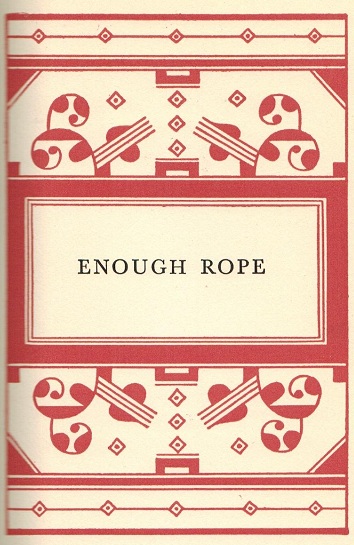 ZP_Frontispiece for Dorothy Parker’s Enough Rope_1926_taken from her 1936 collected poems entitled Not so deep as a well
.
In 1914, 21-year-old Dorothy Parker was hired by Vogue magazine in New York as an editorial assistant. By 1918 she was a staff writer for Vanity Fair where she began penning play reviews in place of an on-holiday P.G. Wodehouse.
The way she wrote – how to describe it? This was something new: cute as a button, sharp as a tack; the driest gin with a drop of grenadine syrup. After two years the editor fired her for offending a bigwig producer (Broadway impresario Flo Ziegfeld), but she had already made a name for herself as a “fast woman” – fast with words, that is. Throughout the 1920s she would contribute several hundred poems and numerous columns to Life, McCall’s, Vogue, The New Republic, and The New Yorker (where she was one of that magazine’s earliest contributors when it began publishing in 1925.) Whatever her snappy, clever, seemingly off-the-cuff social commentaries projected – whether in theatre / book reviews or luncheon quips as a “member” of The Algonquin Round Table – Dorothy Parker’s poetry dealt much in love’s loss or love’s rejection; melancholy and sorrow; the appealing thought of one’s own Death.
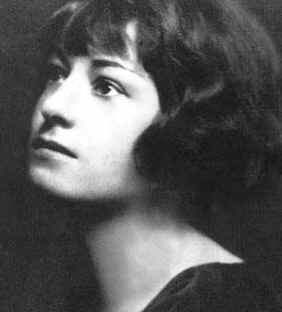 ZP_a young Dorothy Parker_around 1918
Parker is a poet who’s just right to feature on All Souls Day. Indeed, she made the magnetic appeal of Death plain in her book titles: Death and Taxes, Laments for the Living, and Here Lies. We celebrate her peculiarly morbid liveliness with words, a liveliness she displayed even when she was really really down and joked – seriously – as only she could – about suicide. Quoted in Vanity Fair in 1925, Parker proposed that her epitaph be: “Excuse my dust.” Mistress of self-deprecation or being on the attack; vulnerable and wistful or hard as nails; Parker was such things. This made her – still makes her today – a complex ‘read’. But she’s worth it.
.
Born in 1893 to a German-Jewish father and a mother of Scottish descent who died when Dorothy was four years old, Parker (her married name from her first husband, a Wall-Street stockbroker, in 1917) – referred to her stepmother, whom her father married in 1900, as “the housekeeper” – early evidence of that wise-crack wit. Her father died in 1913, and by then Parker was already earning a living playing piano at a dance studio…and beginning to work on her verse.
.
Parker in the next two decades wrote a handful of incisive, bittersweet short stories – “Big Blonde” won the 1929 O. Henry Award – and her literary reputation rests on those pieces as much as on her poetry. In 1928 she divorced from her first husband then had a series of affairs, one of which resulted in an abortion and a suicide attempt (among several over the years). Of that amour and pregnancy she remarked: “How like me to put all my eggs into one bastard.”
.
But even by the time she reached middle age she remained insecure about her literary abilities. And upon her death in 1967 – of a heart attack, not suicide – she was living in an apartment-hotel in Manhattan and was – in truth – “forgotten but not gone.” In a 1956 interview in The Paris Review she stated: “There’s a hell of a distance between wise-cracking and wit. Wit has truth in it; wise-cracking is simply calisthenics with words.” For this was one of her gnawing worries: was she just a wise-cracker and not a true wit? In fact, she was both – and in the New York of the 1920s – at least until the Wall Street “crash” of 1929 – there was room for the two; the wise-cracker got more press, though. One of her best poems combines both wise-crack and wit, in the right balance – perhaps something only she could do.
“Résumé”
.
Razors pain you;
Rivers are damp;
Acids stain you;
And drugs cause cramp.
Guns aren’t lawful;
Nooses give;
Gas smells awful;
You might as well live.
. . .
“Résumé” is from Parker’s first volume of poetry entitled Enough Rope (published 1926). The following poems are also taken from that collection:
.
“The Small Hours”
.
No more my little song comes back;
And now of nights I lay
My head on down, to watch the black
And wait the unfailing grey.
.
Oh, sad are winter nights, and slow;
And sad’s a song that’s dumb;
And sad it is to lie and know
Another dawn will come.
. . .
“The Trifler”
.
Death’s the lover that I’d be taking;
Wild and fickle and fierce is he.
Small’s his care if my heart be breaking –
Gay young Death would have none of me.
.
Hear them clack of my haste to greet him!
No one other my mouth had kissed.
I had dressed me in silk to meet him –
False young Death would not hold the tryst.
.
Slow’s the blood that was quick and stormy,
Smooth and cold is the bridal bed;
I must wait till he whistles for me –
Proud young Death would not turn his head.
.
I must wait till my breast is wilted,
I must wait till my back is bowed,
I must rock in the corner, jilted –
Death went galloping down the road.
.
Gone’s my heart with a trifling rover.
Fine he was in the game he played –
Kissed, and promised, and threw me over,
And rode away with a prettier maid.
. . .
“A very short Song”
.
Once, when I was young and true,
Someone left me sad –
Broke my brittle heart in two;
And that is very bad.
.
Love is for unlucky folk,
Love is but a curse.
Once there was a heart I broke;
And that, I think, is worse.
. . .
“Light of Love”
.
Joy stayed with me a night –
Young and free and fair –
And in the morning light
He left me there.
.
Then Sorrow came to stay,
And lay upon my breast;
He walked with me in the day,
And knew me best.
.
I’ll never be a bride,
Nor yet celibate,
So I’m living now with Pride –
A cold bedmate.
.
He must not hear nor see,
Nor could he forgive
That Sorrow still visits me
Each day I live.
. . .
“Somebody’s Song”
.
This is what I vow:
He shall have my heart to keep;
Sweetly will we stir and sleep,
All the years, as now.
Swift the measured sands may run;
Love like this is never done;
He and I are wedded one:
This is what I vow.
.
This is what I pray:
Keep him by me tenderly;
Keep him sweet in pride of me,
Ever and a day;
Keep me from the old distress;
Let me, for our happiness,
Be the one to love the less:
This is what I pray.
.
This is what I know:
Lovers’ oaths are thin as rain;
Love’s a harbinger of pain –
Would it were not so!
Ever is my heart a-thirst,
Ever is my love accurst;
He is neither last nor first:
This is what I know.
. . .
“The New Love”
.
If it shine or if it rain,
Little will I care or know.
Days, like drops upon a pane,
Slip and join and go.
.
At my door’s another lad;
Here’s his flower in my hair.
If he see me pale and sad,
Will he see me fair?
.
I sit looking at the floor.
Little will I think or say
If he seek another door;
Even if he stay.
. . .
“I shall come back”
.
I shall come back without fanfaronade
Of wailing wind and graveyard panoply;
But, trembling, slip from cool Eternity –
A mild and most bewildered little shade.
I shall not make sepulchral midnight raid,
But softly come where I had longed to be
In April twilight’s unsung melody,
And I, not you, shall be the one afraid.
.
Strange, that from lovely dreamings of the dead
I shall come back to you, who hurt me most.
You may not feel my hand upon your head,
I’ll be so new and inexpert a ghost.
Perhaps you will not know that I am near –
And that will break my ghostly heart, my dear.
. . .
“Chant for Dark Hours”
.
Some men, some men
Cannot pass a
Book shop.
(Lady, make your mind up, and wait your life away.)
.
Some men, some men
Cannot pass a
Crap game.
(He said he’d come at moonrise, and here’s another day!)
.
Some men, some men
Cannot pass a
Woman.
(Wait about, and hang about, and that’s the way it goes.)
.
Some men, some men
Cannot pass a
Golf course.
(Read a book, and sew a seam, and slumber if you can.)
.
Some men, some men
Cannot pass a
Haberdasher’s.
(All your life you wait around for some damn man!)
. . .
“Unfortunate Coincidence”
.
By the time you swear you’re his,
Shivering and sighing,
And he vows his passion is
Infinite, undying –
Lady, make note of this:
One of you is lying.
. . .
“Inventory”
.
Four be the things I am wiser to know:
Idleness, sorrow, a friend, and a foe.
.
Four be the things I’d been better without:
Love, curiosity, freckles, and doubt.
.
Three be the things I shall never attain:
Envy, content, and sufficient champagne.
.
Three be the things I shall have till I die:
Laughter and hope and a sock in the eye.
. . .
“Philosophy”
.
If I should labour through daylight and dark,
Consecrate, valorous, serious, true,
Then on the world I may blazon my mark;
And what if I don’t, and what if I do?
. . .
“Men”
.
They hail you as their morning star
Because you are the way you are.
If you return the sentiment,
They’ll try to make you different;
And once they have you, safe and sound,
They want to change you all around.
Your moods and ways they put a curse on;
They’d make of you another person.
They cannot let you go your gait;
They influence and educate.
They’d alter all that they admired.
They make me sick, they make me tired.
. . .
“General Review of the Sex Situation”
.
Woman wants monogamy;
Man delights in novelty.
Love is woman’s moon and sun;
Man has other forms of fun.
Woman lives but in her lord;
Count to ten, and man is bored.
With this the gist and sum of it,
What earthly good can come of it?
. . .
The following poems are taken from Parker’s volume Death and Taxes (published 1931):
.
“Requiescat”
.
Tonight my love is sleeping cold
Where none may see and none shall pass.
The daisies quicken in the mold,
And richer fares the meadow grass.
.
The warding cypress pleads the skies,
The mound goes level in the rain.
My love all cold and silent lies –
Pray God it will not rise again!
. . .
“The Lady’s Reward”
.
Lady, lady, never start
Conversation toward your heart;
Keep your pretty words serene;
Never murmur what you mean.
Show yourself, by word and look,
Swift and shallow as a brook.
Be as cool and quick to go
As a drop of April snow;
Be as delicate and gay
As a cherry flower in May.
Lady, lady, never speak
Of the tears that burn your cheek –
She will never win him, whose
Words had shown she feared to lose.
Be you wise and never sad,
You will get your lovely lad.
Never serious be, nor true,
And your wish will come to you –
And if that makes you happy, kid,
You’ll be the first it ever did.
. . .
“Coda” (from Parker’s 1928 volume Sunset Gun)
.
There’s little in taking or giving,
There’s little in water or wine;
This living, this living, this living
Was never a project of mine.
Oh, hard is the struggle, and sparse is
The gain of the one at the top,
For art is a form of catharsis,
And love is a permanent flop,
And work is the province of cattle,
And rest’s for a clam in a shell,
So I’m thinking of throwing the battle –
Would you kindly direct me to Hell?
. . . . .
All Souls Day: “November Rose”, “Autumn Breeze” and “On My Child – Who Died Early” / Allerseelen gedichte: Stefan George, Friedrich Rückert, Rosa Maria Assing
Posted: November 2, 2013 Filed under: English, German | Tags: All Souls Day poems Comments Off on All Souls Day: “November Rose”, “Autumn Breeze” and “On My Child – Who Died Early” / Allerseelen gedichte: Stefan George, Friedrich Rückert, Rosa Maria Assing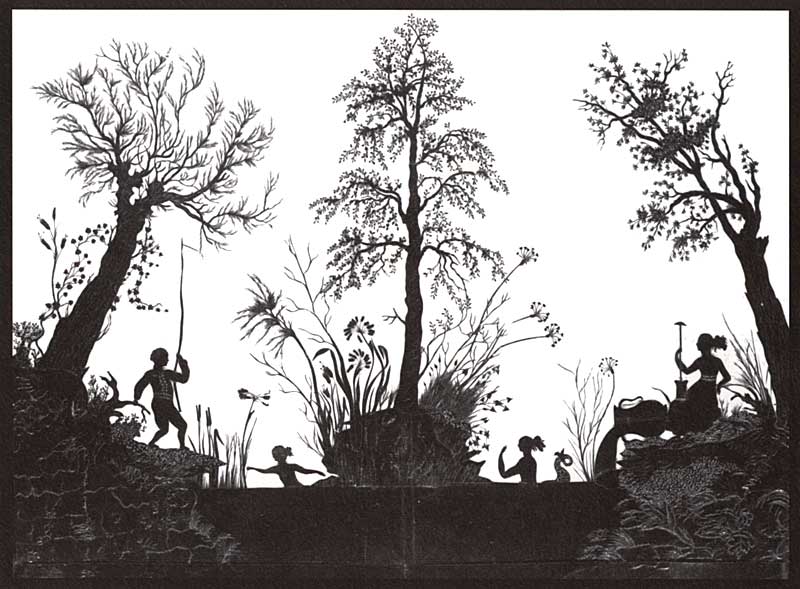 .
.
Stefan George (1868-1933)
“November Rose”
.
Tell me, wan rose there,
Why do you continue in such a dreary place?
The autumn is already sinking on the lever of time
November clouds are already drawing towards the mountains
Why do you continue alone, pale rose?
The last of your companions and sisters
Fell dead and petalless to the ground yesterday
And lies interred in its mother’s womb…
Ah, don’t admonish me for hurrying!
I’ll wait a short while yet.
I stand on the grave of a youth:
He of many hopes and charms
How did he die? Why? God only knows!
Before I fade, before I wane
I yet want to adorn
His fresh grave
On the day of death.
. . .
Stefan George
“Novemberrose”
.
Sag mir blasse Rose dort
Was stehst du noch an so trübem ort?
Schon senkt sich der herbst am zeitenhebel
Schon zieht an den bergen novembernebel.
Was bleibst du allein noch blasse rose?
Die letzte deiner gefährten und schwestern
Fiel tot und zerblättert zur erde gestern
Und liegt begraben im mutterschoosse…
Ach mahne mich nicht dass ich mich beeile!
Ich warte noch eine kleine weile.
Auf eines jünglings grab ich stehe:
Er vieler hoffnung und entzücken
Wie starb er? Warum? Gott es wissen mag!
Eh ich verwelke eh ich vergehe
Will ich sein frisches grab
noch schmücken
Am totentag.
. . .
Friedrich Rückert (1788-1866)
“Autumn Breeze”
.
Heart, already so old and yet not wise,
Do you hope from day to day,
That what the blossoming Spring didn’t bring you
Will yet come to you in Fall!
.
The sportive wind doesn’t leave the bush alone,
Always flattering, always caressing.
Its breath unfurls the roses in the morning
And strews the roses in the evening.
.
The sportive wind doesn’t leave the bush alone
Until it strips it bare.
Everything, Heart, that we loved and lyricized
Is a wind and a breath.
. . .
Friedrich Rückert
“Herbsthauch”
.
Herz, nun so alt und noch immer nicht klug,
Hoffst du von Tagen zu Tagen,
Was dir der blühende Frühling nicht trug,
Werde der Herbst dir noch tragen!
.
Läßt doch der spielende Wind nicht vom Strauch,
Immer zu schmeicheln, zu kosen.
Rosen entfaltet am Morgen sein Hauch,
Abends verstreut er die Rosen.
.
Läßt doch der spielende Wind nicht vom Strauch,
Bis er ihn völlig gelichtet.
Alles, o Herz, ist ein Wind und ein Hauch,
Was wir geliebt und gedichtet.
. . .
 .
.
Rosa Maria Assing (1783-1840)
“On My Child – Who Died Early”
.
We watched, entranced, as a pure little flame
Rose up between us out of the fire of our love
In the life of our sweet beloved child;
And for us the most joyful celebration began!
.
The flame daily lit our way towards new
And sweeter pleasures, and with joyous trembling
We united in the dearest pursuit of the heart,
To care for what was most precious to us.
.
Then death came treading with heavy steps;
The flame that lit our lives so brilliantly
Was extinguished into our deepest trembling.
.
Then life seemed cold and dark to us,
Our faces and eyes were wet with tears;
We shuddered, deeply sunken in grief.
. . .
Already spring breezes are blowing gently again,
And the sweet fragrance of the violets is wafting,
The wind plays with fresh grass and foliage,
And I hear the nightingale lifting her song.
.
So many other things are being and growing,
Everything pushes towards light and life;
But, ah, my tender child can only wilt,
It shall never see another springtime.
.
Not spring breezes, not violets, nightingales,
Nor whatever other pleasures the spring brings,
None of these shall come into your life,
.
For you were devoured so soon by the dark grave!
And for me, as I languish in sorrow over you,
Nothing blooms in spring but my deep woe!
.
(1818)
. . .
Rosa Maria Assing
“Auf mein früh gestorbenes Kind”
.
Wir sahn entzückt aus unsrer Liebe Feuer
Sich zwischen uns ein Flämmchen rein erheben
In des geliebten süßen Kindes Leben;
Und uns begann des höchsten Glückes Feier!
.
Die Flamme glänzte uns zu täglich neuer
Und süßrer Freude, und mit frohem Beben
Vereinten wir des Herzens liebstes Streben,
Zu pflegen was uns über alles theuer.
.
Da kam mit schwerem Tritt der Tod gegangen;
Die Flamme, die so herrlich uns geleuchtet,
Die löschte er zu unserm tiefsten Beben.
.
Nun scheinet kalt und dunkel uns das Leben,
Mit Thränen ist Gesicht und Aug’ befeuchtet;
Wir stehn erschüttert, tief vom Schmerz befangen.
. . .
Schon wehen wieder Frühlingslüfte lind,
Und Veilchen lassen süßen Duft entschweben,
Mit jungem Gras und Laube spielt der Wind,
Auch hör’ ich Nachtigall ihr Lied erheben.
.
So viel auch Wesen und Gewüchse sind,
Es dränget alles sich zum Licht und Leben;
Nur welken mußte, ach, mein zartes Kind,
Es sollte keinen Frühling je erleben!
.
Nicht Frühlingsluft, nicht Veilchen, Nachtigallen,
Und was noch sonst der Frühling Süßes bringt,
Nichts davon sollte in dein leben fallen,
.
Da dich so früh das dunkle Grab verschlingt!
Und mir, die ich in Schmerz um dich vergehe,
Blüht nichts im Frühling als mein tiefes Wehe!
.
(1818)
. . .
Translations from the German © Aaron Swan
. . .
Images:
Rosa Maria Assing_Landschaft mit Quellgöttinnen_a silhouette scene_paper cutout_made by the poet in 1830
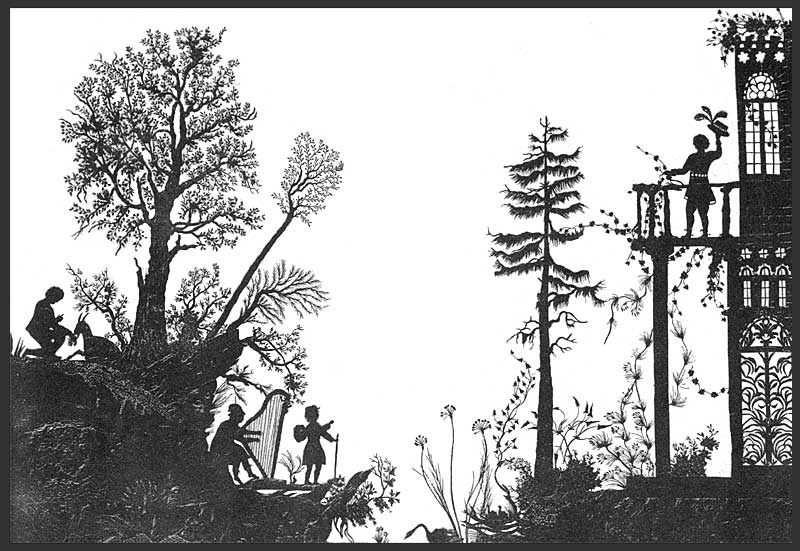
Rosa Maria Assing_Märchenlandschan mit Altan_a silhouette scene_paper cutout_made by the poet in 1830
. . . . .
Egon Schiele: Ich bin Mensch, ich liebe / Den Tod und Liebe / Das Leben. “I am a Human Being – I love Death and Love – They are alive.”
Posted: October 31, 2013 Filed under: A FEW FAVOURITES / UNA MUESTRA DE FAVORITOS, Egon Schiele, English, German | Tags: German Expressionist poets Comments Off on Egon Schiele: Ich bin Mensch, ich liebe / Den Tod und Liebe / Das Leben. “I am a Human Being – I love Death and Love – They are alive.”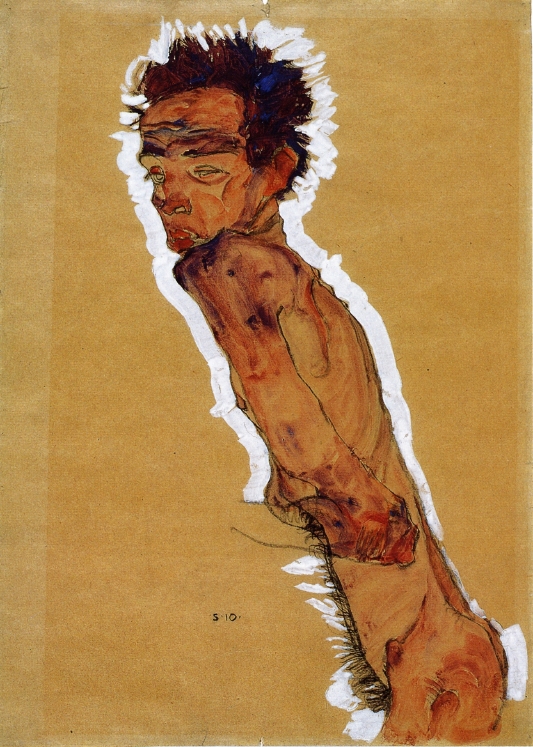 ZP_Egon Schiele_Selfportrait_Male nude in profile, facing left_1910
.
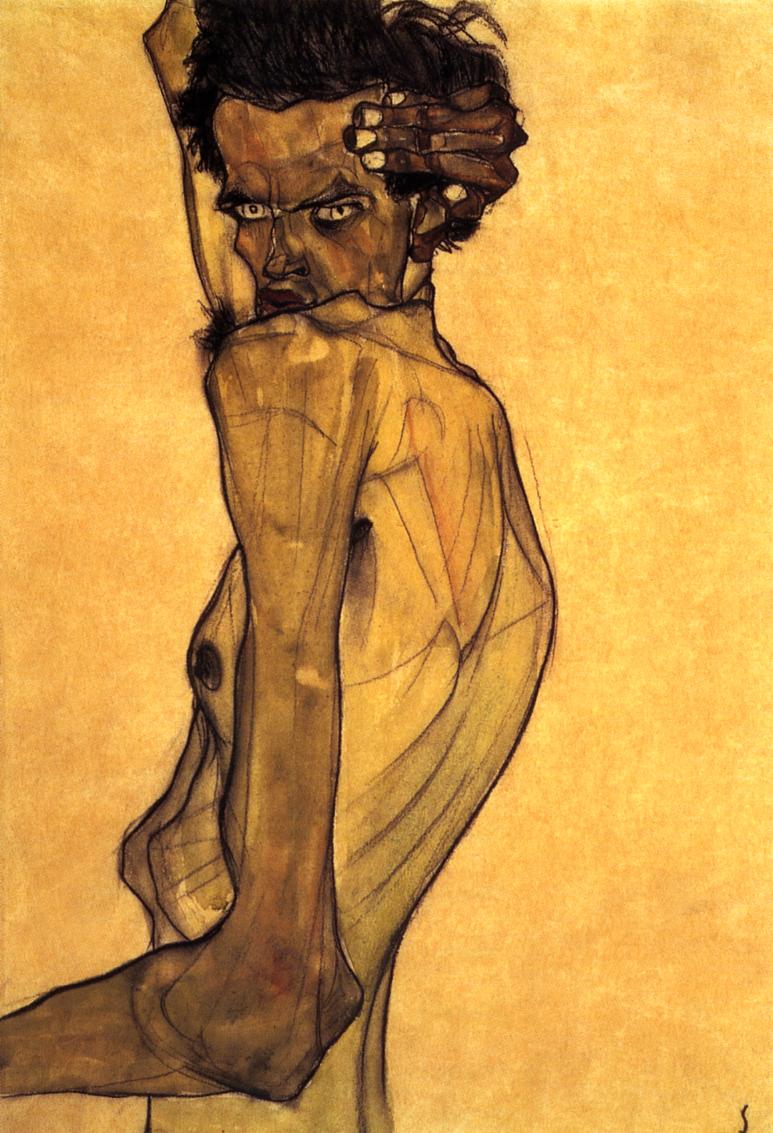
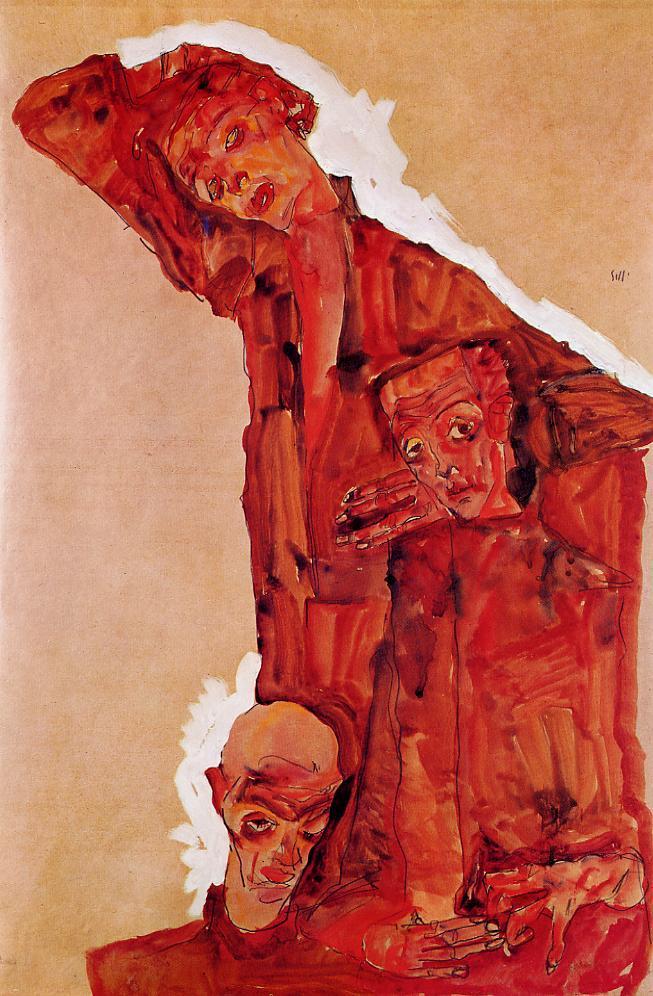
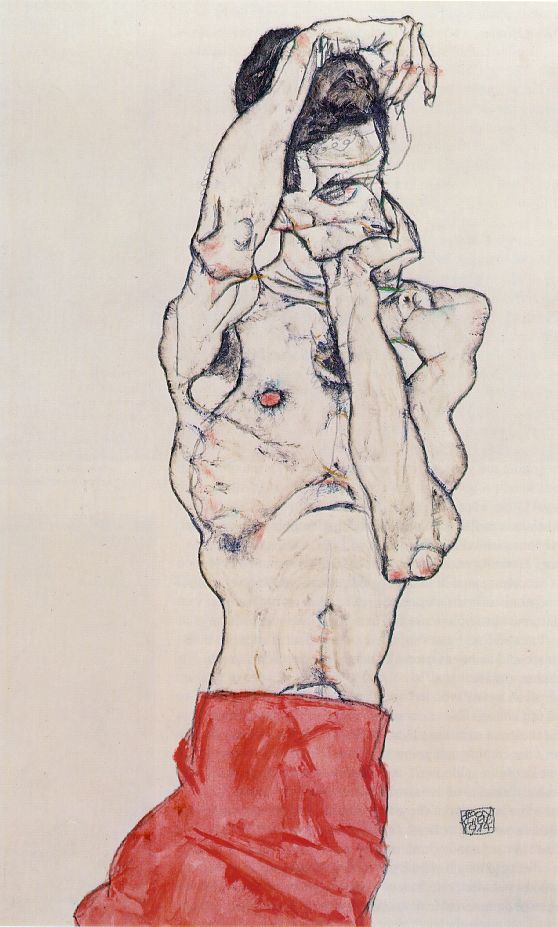
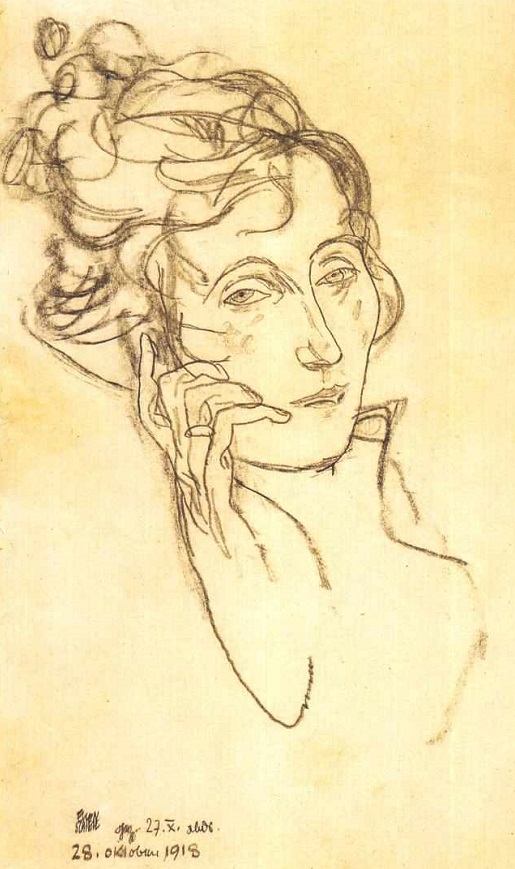
Strange Austrian “wunderkind” Egon Schiele was the son of a railroad station-master in Tulln and a mother from Krumau in Bohemia (Czechoslovakia). Schiele began to draw at the age of 18 months, and was disturbingly precocious when it came to early explorations of his own sexuality. Schiele’s paintings and drawings are always – unmistakably – his, and the artist died on this day (October 31st) in 1918, at the age of 28. One of the many millions who succumbed to the ineptly-named “Spanish Flu” pandemic which began in January 1918 – before the end of what was then known as The Great War – and lasted until December 1920 – Schiele’s art had had, even before the War, so much of Death about it – and yet also of Eros, and of Love. One of the artist’s own poems – and he did write a handful of them to accompany several canvases – states simply: Ich bin Mensch, ich liebe / Den Tod und Liebe / Das Leben. “I am a human being – I love Death and Love – they are alive.” Schiele’s wife Edith, six months pregnant, died of the “Spanish Flu” on October 28th, 1918, and Schiele, himself already extremely ill, made several sketches of her as she lay dying. He was gone just three days later.
.
Translators Will Stone and Anthony Vivis wrote, in an issue of The London Magazine: “In one of his untitled poems Schiele talks of a bird where ‘a thousand greens are reflected in its eyes’. That this was written by an artist of Schiele’s calibre infuses the image with added significance. Who but he could know the shade created by a thousand greens and hold it long enough to record? What matters is not literally that a thousand greens reflect in the bird’s eye, but the possibility that they could. The green of the eye is so overwhelming that in his determination to see truth above all else the precocious poet-artist has glutted himself with a thousand variations within a single colour. While admitting the impossibility of capturing the reality of nature – like a translator faced with a text which appears to defy intra-linguistic interpretation – Schiele takes up the challenge nevertheless. It is a microcosm of the artistic calling: proceeding with creation and conceding defeat at the same moment. The sense of precariousness, the constant wavering of the boundary between lucidity and excruciation, is perhaps why Schiele’s paintings score so deeply into us even today [April 2012].”
.
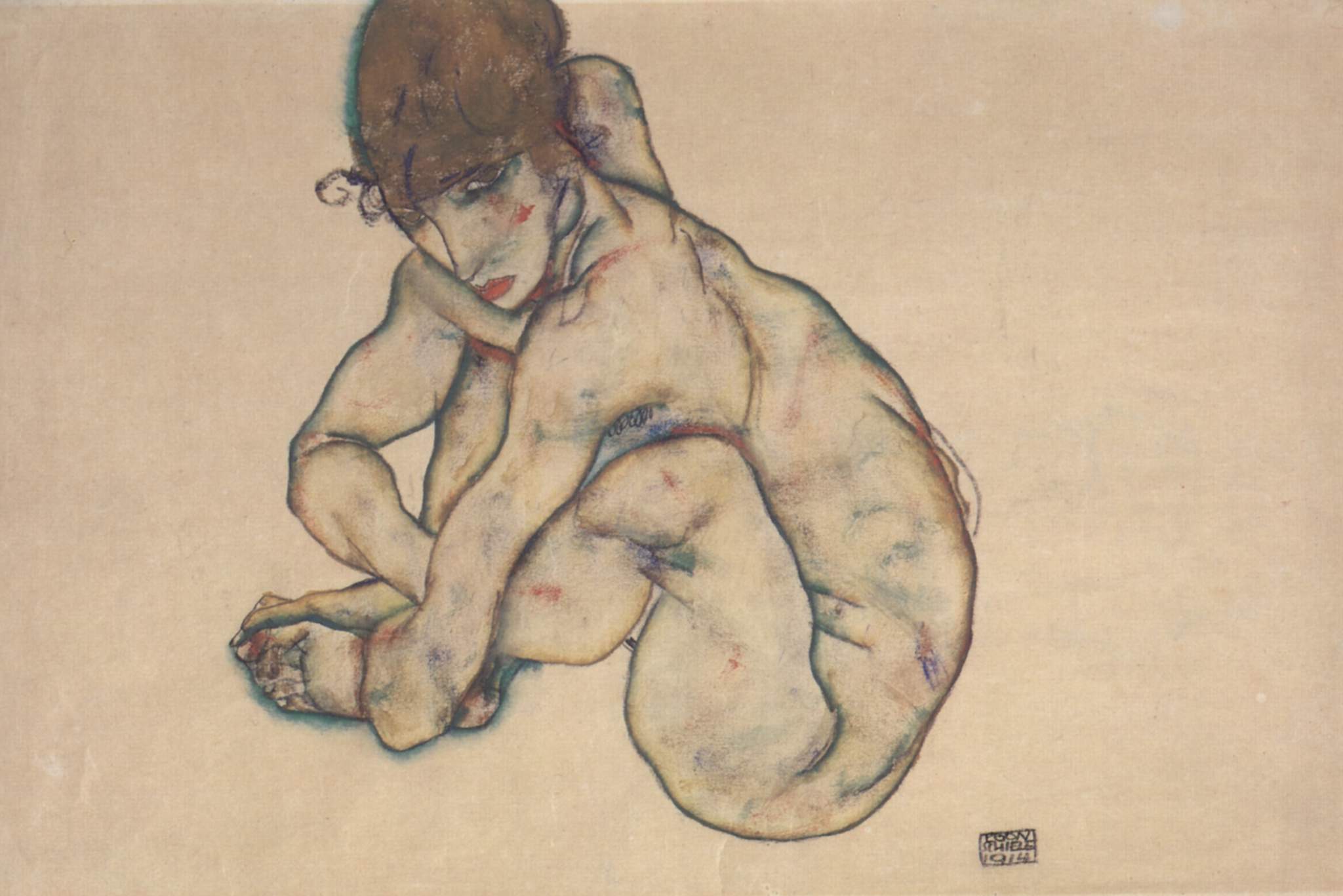
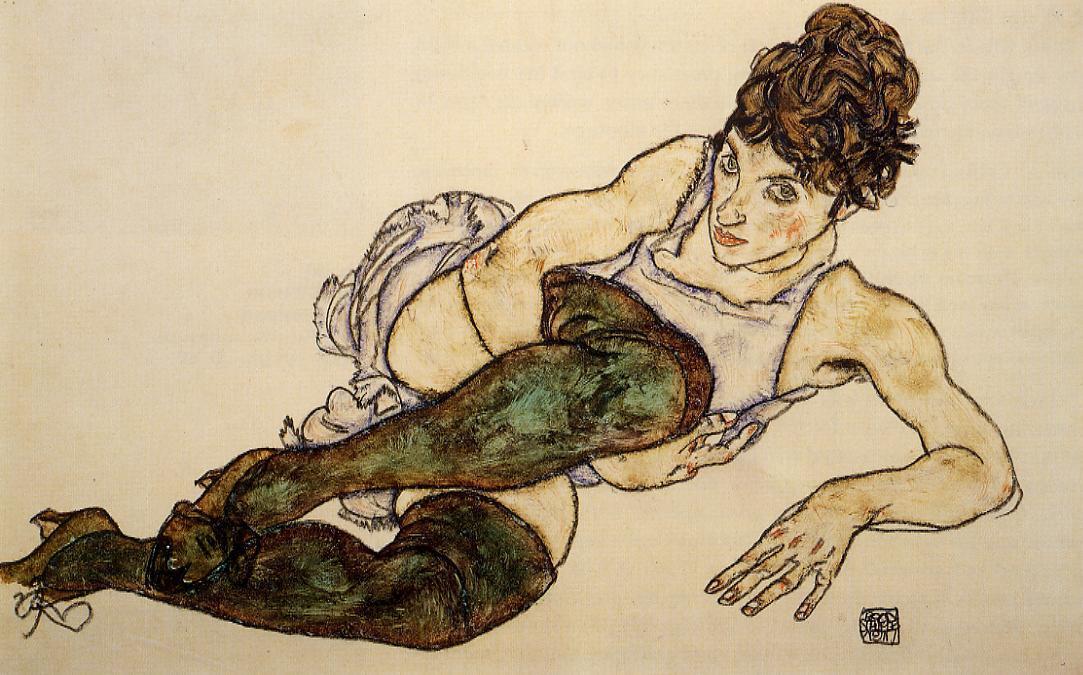
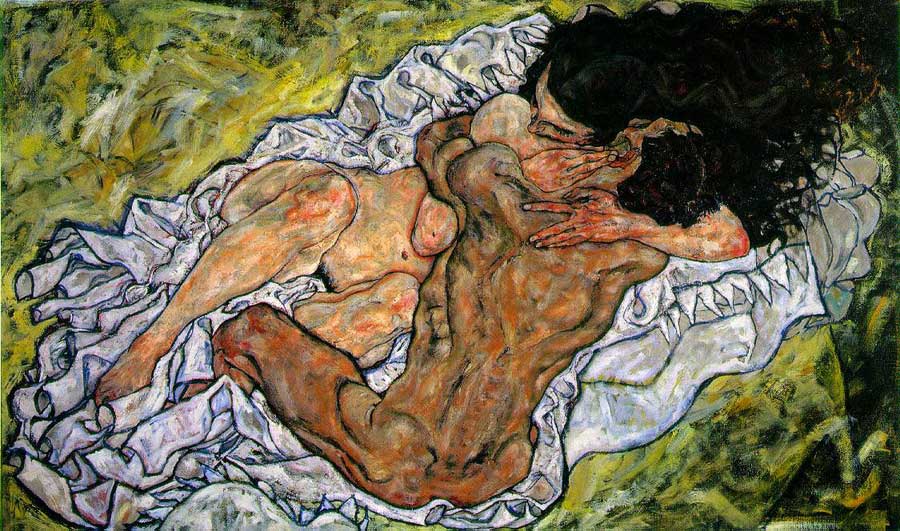
The Viennese, bourgeois-art-appreciating public had found Schiele’s un-pretty style and colour palette – often there were grey-green hues for skin, as if the living were putrefying – and his candid, awkward-limbed sexuality / unflattering poses / the angst *of his nudes – difficult to look upon. Yet he was really a proto–Expressionist who was leading the way for Expressionism** – that most powerful German artistic movement of the first quarter of the 20th century. Schiele’s influences were Vincent Van Gogh, “Art-Nouveau”, and Gustav Klimt – all from his boyhood – but it’s the poets, not visual artists, of the decade from 1910 forward, that explored – like Schiele was doing – similar discomfiting emotional and psychological “territories”. And so, we have placed a selection of their verses alongside poems of and images of paintings and drawings by Egon Schiele.
.
* Angst is a great-sounding word. It reached German – and English – via the Danish language and an 1844 treatise by the philosopher Kierkegaard. Angst means Existential anxiety or fear.
** German Expressionism – a definition from Ruth J. Owen:
“A Modernist mode, mainly in the second decade of the 20th century; perspective of angst and absurdity; disturbing visions of downfall and decay; pathological world of the crippled and insane, and images of the city and war. ‘Aufbruch’ (an awakening or departure from) becomes ubiquitous – a new era; dislocated colour, shrill tone; the grotesque, deathliness and dissolution.”
. . .
Egon Schiele (1890-1918)
“Ein Selbstbild” / “Self-Portrait” (1910)
.
Ich bin für mich und die, denen
Die durstige Trunksucht nach
Freisein bei mir alles schenkt,
und auch für alle, weil alle
ich auch Liebe, – Liebe
.
Ich bin von vornehmsten
Der Vornehmste
Und von Rückgebern
Der Rückgebigste
.
Ich bin Mensch, ich liebe
Den Tod und Liebe
Das Leben.
. . .
Egon Schiele
“Sensation”
.
High vast winds turned my spine to ice
and I was forced to squint.
On a scratchy wall I saw
the entire world
with all its valleys, mountains and lakes,
with all the animals running around
shadows of trees and the patches of sun
reminded me of clouds.
I strode upon the earth
and had no sense of my limbs
I felt so light.
. . .
“Empfindung”
.
Hohe Grosswinde machten kalt mein Rückgrat
und da schielte ich.
Auf einer krätzigen Mauer sah ich
die ganze Welt
mit allen Tälern und Bergen und Seen,
mit all den Tieren, die da umliefen –
Die Schatten der Bäume und die Sonnenflecken erinnerten
mich an die Wolken.
Auf der Erde schritt ich
und spürte meine Glieder nicht,
so leicht war mir.
. . .
Egon Schiele
“Music while drowning”
.
In no time the black river yoked all my strength
I saw the lesser waters great
and the soft banks steep and high.
.
Twisting I fought
and heard the waters within me,
the fine, beautiful black waters –
then I breathed golden strength once more.
The river ran rigid and more strongly.
. . .
“Musik beim ertrinken”
.
In Momenten jochte der schwarze Fluss meine ganzen Kräfte.
Ich sah die kleinen Wasser gross
Und die sanften Ufer steil und hoch.
.
Drehend rang ich
und hörte die Wasser in mir,
die guten, schönen Shwarzwasser –
Dann atmete ich wieder goldene Kraft.
Der Strom strömte starr und stärker.
.
Egon Schiele’s poems: translations from the German © Will Stone and Anthony Vivis

. . .
Else Lasker-Schüler (1869-1945)
“Oh, let me leave this world”
.
Then you will cry for me.
Copper beeches pour fire
On my warlike dreams.
Through dark underbrush
I crawl,
Through ditches and water.
Wild breakers beat
My heart incessantly;
The enemy within.
Oh let me leave this world!
But even from far away
I’d wander – a flickering light –
Around God’s grave.
. . .
“O ich möcht aus der Welt”
.
Dann weinst du um mich.
Blutbuchen schüren
Meine Träume kriegerisch.
Durch finster Gestrüpp
Muß ich
Und Gräben und Wasser.
Immer schlägt wilde Welle
An mein Herz;
Innerer Feind.
O ich möchte aus der Welt!
Aber auch fern von ihr
Irr ich, ein Flackerlicht
Um Gottes Grab.
. . .
. . .
|
Gottfried Benn (1886-1956) D-Zug Braun wie Kognak. Braun wie Laub. Rotbraun. Malaiengelb. |
Gottfried Benn Express Train Brown as cognac. Brown as leaves. Red-brown. Malayan yellow. . (1912) Translation from the German © Michael Hamburger |
|
Gottfried Benn Vor Einem Kornfeld Vor einem Kornfeld sagte einer: |
Gottfried Benn Before a Cornfield Before a cornfield he said: . (1913) Translation from the German © SuperVert |
.
Georg Heym (1887-1912)
“Umbra vitae”
.
Die Menschen stehen vorwärts in den Straßen
Und sehen auf die großen Himmelszeichen,
Wo die Kometen mit den Feuernasen
Um die gezackten Türme drohend schleichen.
Und alle Dächer sind voll Sternedeuter,
Die in den Himmel stecken große Röhren.
Und Zaubrer, wachsend aus den Bodenlöchern,
In Dunkel schräg, die einen Stern beschwören.
Krankheit und Mißwachs durch die Tore kriechen
In schwarzen Tüchern. Und die Betten tragen
Das Wälzen und das Jammern vieler Siechen,
und welche rennen mit den Totenschragen.
Selbstmörder gehen nachts in großen Horden,
Die suchen vor sich ihr verlornes Wesen,
Gebückt in Süd und West, und Ost und Norden,
Den Staub zerfegend mit den Armen-Besen.
Sie sind wie Staub, der hält noch eine Weile,
Die Haare fallen schon auf ihren Wegen,
Sie springen, daß sie sterben, nun in Eile,
Und sind mit totem Haupt im Feld gelegen.
Noch manchmal zappelnd. Und der Felder Tiere
Stehn um sie blind, und stoßen mit dem Horne
In ihren Bauch. Sie strecken alle viere
Begraben unter Salbei und dem Dorne.
Das Jahr ist tot und leer von seinen Winden,
Das wie ein Mantel hängt voll Wassertriefen,
Und ewig Wetter, die sich klagend winden
Aus Tiefen wolkig wieder zu den Tiefen.
Die Meere aber stocken. In den Wogen
Die Schiffe hängen modernd und verdrossen,
Zerstreut, und keine Strömung wird gezogen
Und aller Himmel Höfe sind verschlossen.
Die Bäume wechseln nicht die Zeiten
Und bleiben ewig tot in ihrem Ende
Und über die verfallnen Wege spreiten
Sie hölzern ihre langen Finger-Hände.
Wer stirbt, der setzt sich auf, sich zu erheben,
Und eben hat er noch ein Wort gesprochen.
Auf einmal ist er fort. Wo ist sein Leben?
Und seine Augen sind wie Glas zerbrochen.
Schatten sind viele. Trübe und verborgen.
Und Träume, die an stummen Türen schleifen,
Und der erwacht, bedrückt von andern Morgen,
Muß schweren Schlaf von grauen Lidern streifen.
. . .
Georg Heym
“Umbra vitae” (The Shadow of Life)
.
The people stand forward in the streets
They stare at the great signs in the heavens
Where comets with their fiery trails
Creep threateningly about the serrated towers.
And all the roofs are filled with stargazers
Sticking their great tubes into the skies
And magicians springing up from the earthworks
Tilting in the darkness, conjuring the one star.
Sickness and perversion creep through the gates
In black gowns. And the beds bear
The tossing and the moans of much wasting
They run with the buckling of death.
The suicides go in great nocturnal hordes
They search before themselves for their lost essence
Bent over in the South and West and the East and North
They dust using their arms as brooms.
They are like dust, holding out for a while
The hair falling out as they move on their way,
They leap, conscious of death, now in haste,
And are buried head-first in the field.
Yet occasionally they twitch still. The animals of the field
Blindly stand around them, poking with their horn
In the stomach. They lie on all fours
Buried under sage and thorn.
The year is dead and emptied of its winds
That hang like a coat covered with drops of water
And eternal weather, which bemoaning turns
From cloudy depth again to the depths.
But the seas stagnate. The ships hang
Rotting and querulous in the waves,
Scattered, no current draws them
And the courts of all heavens are sealed.
The trees fail in their seasonal change
Locked in their deadly finality
And over the decaying path they spread
Their wooden long-fingered hands.
He who dies undertakes to rise again,
Indeed he just spoke a word.
And suddenly he is gone. Where is his life?
And his eyes are like shattered glass.
Many are shadows. Grim and hidden.
And dreams which slip by mute doors,
And who awaken, depressed by other mornings,
Must wipe heavy sleep from greyed lids.
.
(1912)
.
Heym translation © Scott Horton
. . . . .
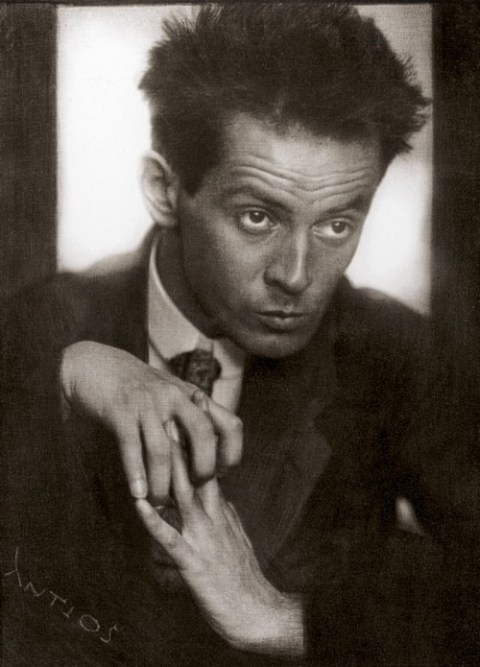 ZP_Egon Schiele_photographed at the age of 24 by Anton Josef Trcka_1914
.
Images (paintings and drawings) featured here:
Egon Schiele_Selfportrait_Male nude in profile, facing left_1910
Egon Schiele_Selfportrait with arm twisted above head_1910
Egon Schiele_Reclining male nude_1911
Egon Schiele_Composition with three male figures_Selfportrait_1911
Egon Schiele_Male nude with a red loincloth_1914
Egon Schiele_Sitzender weiblicher Akt_Female nude sitting_1914
Egon Schiele_Death and the Maiden_1915
Egon Schiele_Sitzende frau mit hochgezogenem knie_The model was – possibly – Wally Neuzil (1894 – 1917). Neuzil was a former model for Gustav Klimt and she became Schiele’s model / muse / lover before his marriage to Edith Harms.
Egon Schiele_Reclining woman with green stockings_Adele Harms_1917
Egon Schiele_Embrace_Lovers II_1917
Egon Schiele_Edith sterbend_Edith dying_October 28th 1918_the last drawing by Schiele
. . . . .
Alicia Claudia González Maveroff: “Verdun”
Posted: October 21, 2013 Filed under: Alicia Claudia González Maveroff, English, Spanish, ZP Translator: Alexander Best Comments Off on Alicia Claudia González Maveroff: “Verdun”
Alicia Claudia González Maveroff
“Verdun”
.
And now that I’m going, now that I depart,
now that autumn will be my spring;
yes, now that I’m going, I know that for always
I will carry within me
this river, and this autumn red
in the pupil of my eye.
Well, now that I go, knowing that
tomorrow I journey through another river,
perhaps seeking that “bonanza” of calm
that rivers just don’t have because
they “walk fast – and keep moving…”;
in my soul the memory remains –
of the river, road, bridge;
those autumn colours – red, yellow –
painted among the trees.
I had already loved before, long before,
many landscapes, blue skies, other trees…
But – here today –
I loved this river, this bridge and this road;
these trees – red and yellow –
painted by autumn.
.
(Toronto, Canada, 21-10-2011)

. . .
“Verdun”
.
Y ahora que me voy, ahora que parto,
ahora que el otoño será mi primavera,
ahora que me voy, sé que por siempre,
seguro llevaré este río en mi memoria
y el rojo del otoño en mis pupilas.
Bien, ahora que me voy, sabiendo
que caminaré mañana en otro río,
tal vez lo haga buscando yo “la calma”
que el agua de los ríos no la tiene,
porque “caminan fuerte y siempre pasan”.
Más quedan en mi alma, los recuerdos,
el río, el camino, el puente
el rojo y amarillo del otoño,
pintado entre los árboles.
Yo ya había amado antes:
amé muchos paisajes, hace tiempo,
amé cielos celestes y otros árboles…
Pero hoy aquí, yo amé:
este rió, este puente, este camino
y estos árboles de rojo y amarillo
pintados en otoño…
.
(Toronto, Canadá, 21-10-2011)
. . .
Preguntamos al poeta: Que es el significado del título del poema?
Y ella nos dijo:
Te comento que el poema se llama “Verdun” por el barrio de Montréal, Québec. Allí viví cuando visité Canadá y me enamoré de este país. El poema lo escribí en Toronto, mientras paseaba, para dejárselo a la amiga que visité. Esta es la historia de porque el nombre. Caminábamos cerca del río San Lorenzo, en Verdun, mirando el río, pasábamos por un puente rojo y gris y los árboles otoñales estaban pintados de rojo y amarillo, como describo en el poema. En el final del mismo dice “…yo ya había amado antes: amé muchos paisajes hace tiempo, amé cielos celestes y otros árboles…”
Aquí hago referencia a otro sitio, en la otra punta del mapa; hablo de otro río – el “Bug” en Polonia, donde he estado muchas veces (es uno de “mis sitios en el mundo” – y tengo algunos otros en mi corazón.) Allí también caminaba junto al río, en la campiña polaca, cerca de hermosos bosques y con bellos cielos, casas campesinas con techos negros de paja (algo bellisímo), diferente para mí que vivo en Buenos Aires, en el “Fin del Mundo” (como dice el Papa Francisco.) Pero ya entonces mis amigos polacos me decían que yo venia “del fin del mundo”, aunque al estar allí en Polonia, yo en broma les decía que yo estaba visitando “el fin del mundo…” Te confieso que no he encontrado el fin del mundo, por más que recorro no logro hallarlo. Curiosamente, el nombre de este río polaco que llega desde Rusia a Polonia quiere decir Dios, tal vez sea Él quien me lleve por estos lugares…¿? Lo cierto es que son lugares que están en mí por lo que he podido experimentar…
. . .
We asked the poet to talk about the name of her poem – Verdun. Here’s what Alicia told us:
“Verdun is after the Montreal borough of the same name. I lived there when I visited Canada – and fell in love with the country. The poem itself I wrote in Toronto, while passing through, to leave for the friend I’d visited. … So, in Montreal (Verdun) we were walking alongside the St. Lawrence River and we passed by a red and grey bridge, and there were autumn trees with leaves all yellow and red. After seeing this there came into my mind these words: “I had already loved before, long before, many landscapes, blue skies, other trees…” I was thinking then of another place, another point, on the map, and another river – the River “Bug” in Poland. I’ve been there many times – it’s one of my special places in this world – and I have a few others, too, in my heart. So I was walking along the “Bug”, in the Polish countryside, close to lovely woods, and a pretty sky overhead, and the rural houses with their black straw roofs – something so beautiful – and quite different for someone like me who lives in Buenos Aires (at “the End of the Earth”, as Pope Francis says.) I confess that I’ve yet to encounter “the End of the Earth”; as much as I’ve traversed the globe I haven’t attained such a feat! Oddly, the name of that Polish river – “Bug” – that flows between Russia and Poland – is supposed to mean “God”…and maybe it’s He who carries me to all these various places…? One thing’s certain: these places are “within me”, too, and I’ve been able to experiment with them…”
. . .
Translations from Spanish into English: Alexander Best

 Zócalo Poets