Lenrie Peters: 9 poems from “Katchikali” (1971)
Posted: September 1, 2014 Filed under: English, Lenrie Peters | Tags: Gambian poets Comments Off on Lenrie Peters: 9 poems from “Katchikali” (1971)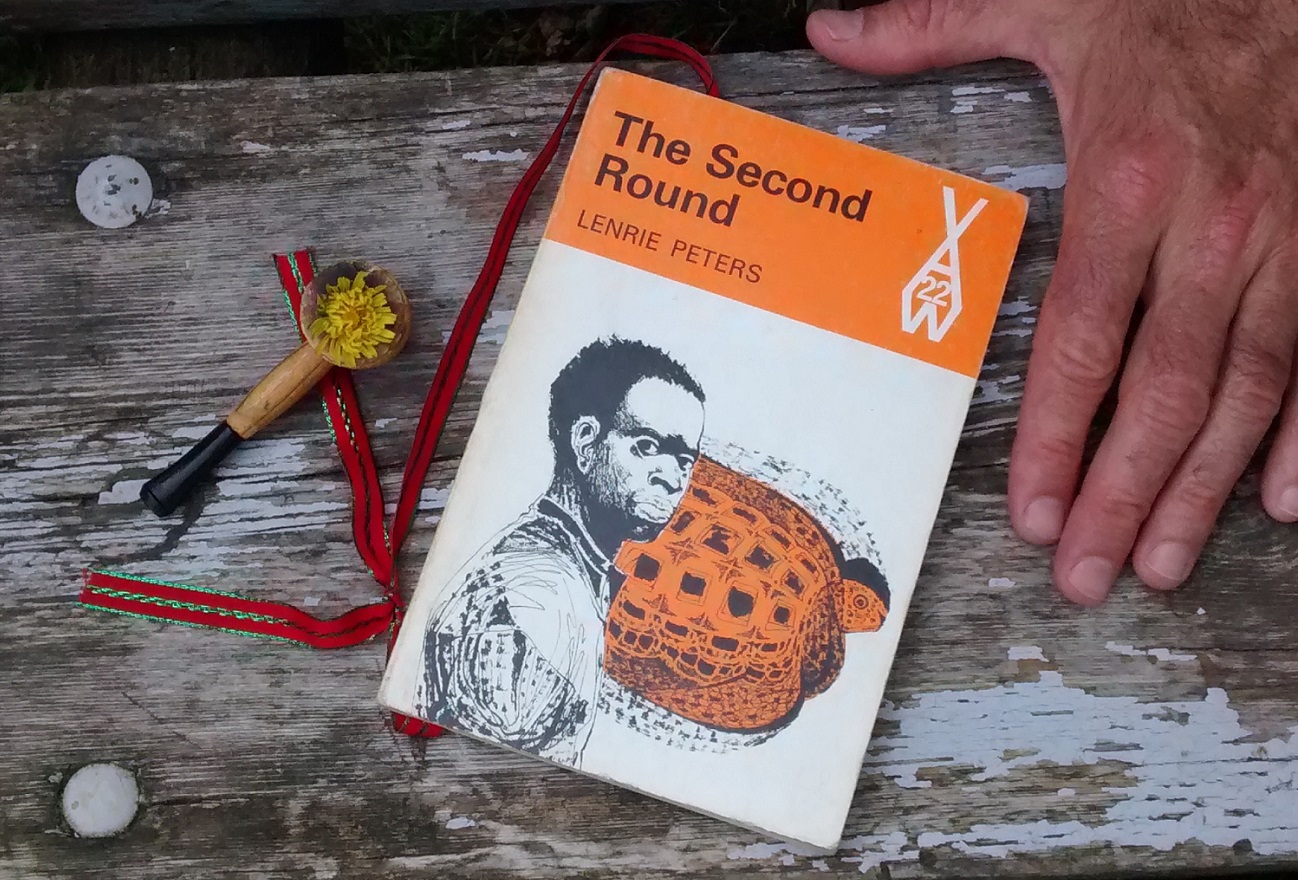
Lenrie Peters: 9 poems from “Katchikali” (1971)
. . .
Things perplex me
irritate and disgust me
Things disaffect me
when they try
to make me crawl.
.
Things persecute me
Those which try to usurp me
Things that have
no meaning
without me.
.
Things annoy me
when others worship them
Things that approximate I
to me and are
put in my place.
.
Things nauseate me,
good, bad, indifferent
Things; like flies
in a calabash
of sour milk.
.
I prefer people
laughter and comfort
the use and pleasure of science.
But my head aches when all I hear is
THINGS, THINGS, THINGS.
. . .
The Spectator
waits uncommitted
in his dry shell
hoping to see
both heaven and hell.
Silently watching
The Protagonists
use muscled fists.
Flinching when
the Referee is kicked.
Silence has many voices.
.
Soon
He must come down
to search the empty attic
for his pistol;
where thieving mice
have nibbled
at the bullets,
And he unpractised
soils his trouser pocket.
For silence has many voices.
.
He turns aside
ducking the first assault
which unconventionally
is rightly aimed.
Handsomely maimed,
he wants to know
the reason for his chains.
Silence has many voices.
. . .
I have chosen
The thick smudged layers of experience
For the fixed stare of a child.
.
I have chosen
The coloured phantoms, superficial greens and reds
For the dreamless sleep of a child.
.
I have broken
The glass eye of innocence
Which does not pigeon-hole, despise entomb
Dress in monsters’ masks
Those that have not shared the womb.
.
I have not said:
All men are children
Playing at the game
The happy game of living
From dawn till evening.
.
The poet’s heart is in a desert place
But when the winds blow
The sweat tumbles
The tears flow
The darkness lightens.
. . .
I came expecting much
turned-over soil
and acres laid with green
at least two solid ventures in between
.
don’t try to change a thing
we’ve been this idle
since the world began
the whole idea of progress is a fiddle
.
Go up the bush
and learn bush medicine.
Better than you were messed about
on higher antipodean flights
.
Hyenas dig up graves
micro-homini play with destinies.
Still I suppose no worse
than Oppenheimer and his nuclear pebbles.
. . .
The weaver-birds are nesting
shh! the weaver-birds are
happy the long day through
.
says one to another
twit-twit. I have two eggs
all shiny and white
.
shh says the other;
I’m equally bright.
Look into the water
and I’m standing on my head.
.
the weaver-birds are nesting
all yellow and black
like candles in low evening
festooning the river shrubs.
.
Be quiet snores the Hippo
one watery eye awake.
I cannot hear my dinner snap;
submerged, the crocodile complains.
.
but the weaver-birds are nesting
and so the world must wait.
They sing from dawn till evening
and next morning, they’re the first to wake.
. . .
Little one, you came
into the world knowing
nothing of misery and shame
.
when we first met
your bone cloaked in skin
your budding grace within
.
but after two days
the magic of the painless smile
the freedom of easy breath
.
Your mother said
how pleased, how happy
she was about the rest
.
I said: there was the valley
of the dead
where skeletons grow
.
and when my back was turned
she listened to another voice
snatched you forever away
.
into the world of nowhere
to die. Your footprints
will not see the day
.
but her conscience is clear
Allah! the will of the unknowing
uncaring spell of the evil eye.
. . .
It is time for reckoning Africa
time for taking stock
never mind New York, America –
it’s ours; is here, and running short
.
too long we have dragged
our slippered feet
through rank disorder
incompetence, self defeat
.
in the high capitals
the angry men; angry
with dust in their heads
a dagger at each other’s throats
.
‘Maudors’ sit on wicker thrones
ghosted by White ants
a hundred Marabus at hand
living on the fat of the land
.
all threatening coups
and claiming vast receipts
like winsome children
feeding on mother’s milk.
.
The seats of Government
leveled at the dice
they get the most
who tell the biggest lies
.
while honest men stand
waiting at the door
or rot in prison cells,
the vultures feed on sturgeon’s eggs
the riot squads
parade the avenues
like lion prides
testing their sinews
.
and every trembling heart
retires as evening falls
crushed by the weight of hours
till daylight comes
.
oh country of great hopes
and boundless possibilities
will the seed grain
perish for ever
.
will rivers run
endlessly with blood,
saints resort to massacre
and all your harvests burn?
.
will no one see
no sign instruct
till Noah’s ark
comes sailing on the flood?
.
between Alpha and Omega
is now; Africa
this is the lost time
and future time; Africa.
.
In this all revolutions end
and the straight path
from world to better world
branded across the sky.
. . .
Come let us listen together
sounds, blue, black, golden
the sea tossing the sky
yonder round an island.
Dolphin wings afloat
showers of ripe harvest
on groundnut hills
brown and white sands
in sunset; magenta seas.
They ring serene
calling with palms and drums.
The Atlantic speaks;
calling, howling, rushing
serpentine against the heated
powers of the desert.
.
A slender river flows
three hundred miles to harbour;
wide-mouthed towards the sun,
down inguinal pursuit
of open sea; tomorrow
fenced by mangroves,
settlements, ancient traditions,
The Gambia flows;
a trusting limb of elegance.
.
It flows with mirth,
an emblem flowing endlessly
through all vicissitudes;
cataracts of change, prosperity,
decline, but rising westward
dominates the strange passions
which lie about her shores.
The river flows into
a conclave of retreat
where flesh was laid
on naked bones
where first I woke to hear
the anger of the sea.
.
Four centuries ago
strange creatures rocked her shores
with greed, the branding iron,
then shut the door, on time.
Vintage of colonies
hanging precariously in
need of help. Take
nobly your sceptre with the rest
and step into the future.
.
Can any good thing come
out of Gambia? Wait.
nay; go and see.
. . .
The mind
Is like the desert winds
Ploughing the empty spaces
Listless, fastidiously laying down the dust.
gold as the ‘purdahed’ moon
the superconcentration – Pile
of most violent energies.
.
The mind
is the Southern Pole
Of men’s greatness.
At once the cancellation – And the equilibrium
after the riddle
which shrouds the magnificent darkness.
.
The mind
which will arrive upon the ageless shore
to find the barren senses there
forever shipwrecked on the tides of passion.
to find the sum total of existence
itself the explanation and the vision.
. . . . .
All poems from: Katchikali (poems) © Lenrie Peters, published in 1971 by Heinemann Educational Books Ltd., and number 122 in Heinemann’s African Writers Series. (“Katchikali” is the name of a sacred crocodile pool in Bakau, near Gambia’s Atlantic coast.)
A biographical paragraph about Peters – from the back cover of his 1965 novel The Second Round (the 1969 reprint is featured in the photograph above):
“Lenrie Peters was born in Bathurst, Gambia, on September 1st, 1932. In 1949 he moved to Sierra Leone and went to Prince of Wales School, Freetown, where he gained his Higher School Certificate in science subjects. In 1952 he left Freetown to study in England. In between reading Natural Sciences at Trinity College, Cambridge, becoming president of the African Students’ Union, interesting himself in politics – he is a Pan-Africanist – and writing poetry and plays, he started The Second Round. After qualifying in medicine in London he did special work in surgery and is now practising in Bathurst.”
.
His surgery clinic in Banjul (formerly called Bathurst) operated for many years – during which Dr. Peters continued to write and publish poetry. He died in 2009 at the age of 76 in Dakar, Senegal.
.
Critical commentary from Delalorm Sesi Semabia (African Soulja: African Poetry Review):
Peters is considered one of the most original voices of modern African poetry. A member of the African founding generation writing in English, he showed extensive pan-Africanism in his various volumes of poetry. His poems were mixed with medical terms, and sometimes his later works were angrier at the state of Africa than were his earlier volumes of poetry.
“Es algo tan muy nuevo”: versiones de poemas por e.e.cummings – con gouaches de William Gilpin-Beck / “It is so quite new a thing”: poems of e.e.cummings in Spanish translations – with gouaches by William Gilpin-Beck
Posted: July 31, 2014 Filed under: E.E. Cummings, English, Spanish, ZP Translator: Alexander Best Comments Off on “Es algo tan muy nuevo”: versiones de poemas por e.e.cummings – con gouaches de William Gilpin-Beck / “It is so quite new a thing”: poems of e.e.cummings in Spanish translations – with gouaches by William Gilpin-Beck
. . .
e.e.cummings (1894-1962, Cambridge, Massachusetts, USA)
i like my body when it is with your
.
i like my body when it is with your
body. it is so quite new a thing.
Muscles better and nerves more.
i like your body. i like what it does,
i like its hows. i like to feel the spine
of your body and its bones,and the trembling-
firm-smooth ness and which i will
again and again and again
kiss, i like kissing this and that of you,
i like,slowly stroking the,shocking fuzz
of your electric fur,and what-is-it comes
over parting flesh….And eyes big love-crumbs,
and possibly i like the thrill
of under me you so quite new
.
(from cummings’ 1925 collection, &[AND])
. . .
e.e.cummings
(1894-1962, poeta estadounidense innovador, nacido en Cambridge, Massachusetts)
me gusta mi cuerpo cuando al tuyo (1925)
.
me gusta mi cuerpo cuando al tuyo está junto.
es algo tan muy nuevo.
Músculos mejores y nervios más.
me gusta tu cuerpo. me gusta lo que hace,
y su cómo. me gusta tocar el espinazo
de tu cuerpo y sus huesos,y el temblor
-resuelto-lisura,que,
una y otra vez,
besaré, me gusta besar tu esto y tu eso,
me gusta, lentamente acariciar, el vello estremecedor
de tu pelaje eléctrico, y lo-que-es viene
sobre la raya abierta de tu carne viva. . . . Y ojos grandes-sobras de amor,
y me gusta, posiblemente, la incitación de
bajo el mí la tú tan muy nueva
. . .
since feeling is first
.
since feeling is first
who pays any attention
to the syntax of things
will never wholly kiss you;
wholly to be a fool
while Spring is in the world
my blood approves,
and kisses are a better fate
than wisdom
lady i swear by all flowers. Don’t cry
– the best gesture of my brain is less than
your eyelids’ flutter which says
we are for each other: then
laugh, leaning back in my arms
for life’s not a paragraph
And death i think is no parenthesis
.
(from cummings’ 1926 collection, is 5)
. . .
porque está primero el sentimiento (1926)
.
porque está primero el sentimiento
quien ponga atención
a la sintaxis de las cosas
nunca te besará, plenamente;
plenamente ser un bobo
mientras la Primavera está en el mundo
mi sangre aprueba,
y son un mejor destino, los besos,
que la razón
señora tengo plena confianza en todas las flores. No llores
– el mejor gesto del seso es menos que
el revuelo de tus párpados que dice que
somos el uno para el otro; pues
ríe, reclínate en mis brazos
porque no es un párrafo la vida
Y yo creo que la muerte no es ningún paréntesis
. . .
may i feel said she
.
may i feel said he
(i’ll squeal said she
just once said he)
it’s fun said she
(may i touch said he
how much said she
a lot said he)
why not said she
(let’s go said he
not too far said she
what’s too far said he
where you are said she)
may i stay said he
(which way said she
like this said he
if you kiss said she
may i move said he
is it love said she)
if you’re willing said he
(but you’re killing said she
but it’s life said he
but your wife said she
now said he)
ow said she
tiptop said he
don’t stop said she
oh no said he)
go slow said she
(cccome?said he
ummm said she)
you’re divine!said he
(you are Mine said she)
.
(from cummings’ 1935 collection, No Thanks)
. . .
puedo tocarte dijo él (1935)
.
dijo él: puedo tocarte
(dijo ella: chillaré
dijo él: sólo una vez)
dijo ella: es redivertido
(puedo palparte
cuánto
mucho)
por qué no
(vámonos dijo él
no demasiado dijo ella
qué es demasiado lejos
donde tu estás)
(puedo quedarme dijo él
cómo dijo ella
así dijo él
si me das un beso dijo ella
puedo moverme
es el amor)
si lo estás deseando
(pero me estás matando
él dijo: pero la vida es así
ella dijo: pero y tu mujer
él dijo: ahora)
ella dijo: ayy
súper dijo él
no te detengas dijo ella
ay no dijo él)
más despacio dijo ella
(¿te corres?
mmm)
¡eres divina!
(eres Mío…)

love is more thicker than forget
.
love is more thicker than forget
more thinner than recall
more seldom than a wave is wet
more frequent than to fail
it is most mad and moonly
and less it shall unbe
than all the sea which only
is deeper than the sea
love is less always than to win
less never than alive
less bigger than the least begin
less littler than forgive
it is most sane and sunly
and more it cannot die
than all the sky which only
is higher than the sky
.
(from cummings’ 1940 collection, 50 Poems)
. . .
amar es más denso que olvidar (1940)
.
amar es más denso que olvidar
más fino que recordar
más raramente que una ola mojada
más frecuente que fracasar
es más loco y lunarmente
y menos no será
que todo el mar que sólo
es más hondo que la marejada
el amor es menos siempre que ganar
menos nunca que viviente
menos grande que un comienzo que es lo mínimo
menos pequeño que perdón
es el más sensato y del sol (sol a mente)
y encima no puede morir
que todo el azul que sólo
es más alto que el cielo
. . .
i carry your heart with me
.
i carry your heart with me(i carry it in
my heart)i am never without it(anywhere
i go you go,my dear,and whatever is done
by only me is your doing,my darling)
i fear
no fate(for you are my fate,my sweet)i want
no world(for beautiful you are my world,my true)
and it’s you are whatever a moon has always meant
and whatever a sun will always sing is you
here is the deepest secret nobody knows
(here is the root of the root and the bud of the bud
and the sky of the sky of a tree called life;which grows
higher than soul can hope or mind can hide)
and this is the wonder that’s keeping the stars apart
i carry your heart(i carry it in my heart)
.
(from cummings’ 1958 collection, 95 Poems)
. . .
llevo tu corazón conmigo (1958)
.
llevo tu corazón conmigo, (lo llevo en mi corazón), sin él nunca estoy
(a donde quiera que voy vas tú mi amor;
y donde aquello que hago yo sola
es gracias a tí, mi cielo.)
no tengo miedo
del destino
(porque eres mi destino, cariño).no quiero ningún mundo porque hermosa
eres, mi mundo, mi verdad) y tú eres lo que es el siempre-significado de una luna y lo que cantará siempre el sol eres tú
este es el secreto más profundo y desconocido
(Acá está la raíz de la raíz
y el brote del brote
y el cielo del cielo de un árbol llamado vida;
que crece más alto de lo que el alma pueda esperar o la mente ocultar)
y esto es la maravilla que mantiene las estrellas separadas
llevo tu corazón, (lo llevo en mi corazón)
Edward Estlin Cummings (1894-1962) was an American poet and painter who grew up with the core values of New England Transcendentalism. Known for his broken syntax and a deliberate and playful mis-use of parentheses, commas, periods and lower-case letters, he was one of the modernizers of poetic language – wrenching it away from 19th century verse conventions. His 1917 poem Buffalo Bill’s defunct (based on a newspaper headline) signaled that clean break with the past. In 2014, more than a half century after his death, Cummings’ lustre has faded; his once-astonishing word games now seem less exciting when text messages and ‘tweets’ bring us fractured language daily. Joyce Kilmer’s sentimental Trees (1914) and Langston Hughes’ subtle and provocative A Dream Deferred (1951) are today far more often memorized and quoted than any verses by e.e.cummings. Yet at the time of his death, Cummings – along with Robert Frost – was the most widely read of American contemporary poets.
All of the above poems are here featured in their original lay-outs, and are taken from the 1994 centennial edition of E.E. Cummings: Complete Poems 1904-1962, edited by George J. Firmage, published by Liveright, New York City.
. . .
Edward Estlin Cummings (1894-1962) fue un poeta, pintor, ensayista y dramaturgo. Aunque él no aprobaba la práctica, sus editores frecuentemente escribían su nombre con minúsculas para representar su sintaxis extraordinaria. Cummings es conocido por sus poemas que rompen con toda estructura – incluyendo usos poco ortodoxos de las mayúsculas y la puntuación, en la que los puntos y comas podían incluso llegar a interrumpir oraciones y hasta palabras. Sus poemas también están escritos sin respeto a los renglones y los párrafos y algunos no parecen tener pies ni cabeza hasta que no son leídos en voz alta. A pesar del hecho que utilizó los estilos vanguardistas y la tipografía inusual, la buena parte de su obra es tradicional; su poesía frecuentemente trata el tema del Amor.
. . . . .
Sichtbar: e.e.cummings auf Deutsch / Silence: e.e.cummings in German
Posted: July 31, 2014 Filed under: E.E. Cummings, English, German Comments Off on Sichtbar: e.e.cummings auf Deutsch / Silence: e.e.cummings in German
stille
.ist
ein
shauender
vogel:der
wen
de;punkt,des
lebens
(suchend vor schnee
. . .
silence
.is
a
looking
bird:the
turn
ing;edge,of
life
(inquiry before snow
. . .
schnee heisst das
leben ist eine schwarze kannonad
e indie still
e go
ttllow
eg-weg)leben
?
baum3geister
sind Is 1 A ugen
Seltsam
vertraut
Gesicht
(warumlachend!unter:himmelsdiamanten
. . .
snow means that
life is a black cannonadin
g into silenc
e go
lliw
og-dog)life
?
tree3ghosts
are Is A eyes
Strange
known
Face
(whylaughing!among:skydiamonds
. . .
n
Ichtdl
n
gkann u
c
berTReff
e
n das
m
YsteriU
m
des
s
tilL.Sein
s
. . .
n
Othl
n
g can
s
urPas
s
the m
y
SteR
y
of
s
tilLnes
s
. . .
Wunderschön
ist das
unbe
deuten
des(lei
se)fal
lenden(da
nun
hier
all)s
chne
Es
. . .
Beautiful
is the
unmea
ning
of(sil
ently)fal
ling(e
ver
yw
here)s
Now
. . .
dies’ menschen herz
ist treu seiner
erde;so
jedermann’s welt
in
-t’ressiert ihn nicht(vom aus
sehen
anfühlen geschmack geruch
& klang
einer stille wer kann
ahnen
ge-
nau
was leben
tun wird)liebt
nichts
so serh so
wie(erst
das anko
-m-
me
-n)eine shneefloke tan-
zt
,auf
ihrem weg zum nie
-hier

r-f-e-p-u-e-h-s-a-g-r
welcher
al)s w(ir schau)en
aufnunrichht
PFEGERURASH
endz(u-
mDer):s
pr
iU
!ng:
T a
(n
kOmMeNd .gRrEaFsPuEh)
um
wieder(zu)ord(were)nen(en)d
,grashuepfer;

r-p-o-p-h-e-s-s-a-g-r
who
a)s w(e loo)k
upnowgath
PPEGORHRASS
eringint(o-
aThe):l
eA
!p:
S a
(r
rivinG .gRrEaPsPhOs)
to
rea(be)rran(com)gi(e)ngly
,grasshopper;
. . .
All e.e.cummings German translations © 2003, from the volume Sichtbar-Silence: Cummings coming into German, edited by Gudren M. Grabher
. . . . .
“Nature Photography” by Laboni Islam
Posted: July 28, 2014 Filed under: English, Laboni Islam Comments Off on “Nature Photography” by Laboni Islam
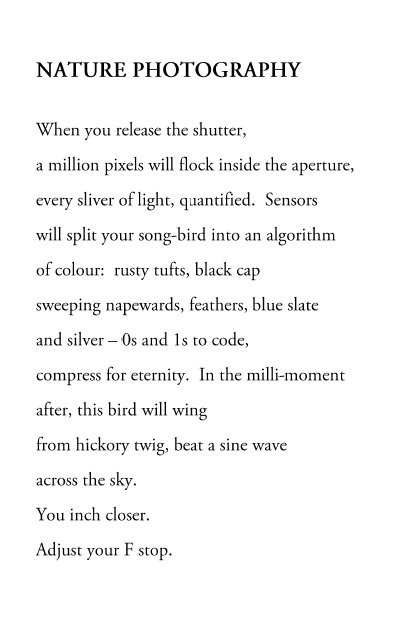
“Songbird”: a photograph by Laboni Islam
. . .
The Rwanda Genocide, twenty years later: 100 Days of photographs + poems by Wangechi Mutu and Juliane Okot Bitek: Days 43 to 1
Posted: July 18, 2014 Filed under: 7 GUEST EDITORS, English, Juliane Okot Bitek | Tags: Wangechi Mutu: 100 days of photographs for The Rwanda Genocide Comments Off on The Rwanda Genocide, twenty years later: 100 Days of photographs + poems by Wangechi Mutu and Juliane Okot Bitek: Days 43 to 1

Wangechi Mutu_Days 3_2_1_The End_Rwanda Genocide 20th anniversary
. . .
Juliane Okot Bitek
100 Days: a poetic response to Wangechi Mutu’s #Kwibuka20#100 Days
.
Day 1
I have nothing
I stand before you with nothing
I am nothing
You stand before me with nothing
I don’t know what I know
but I know that you know nothing
Having come from nothing
To nothing & from nothing
Let my nothing meet your nothing
We may find something there.
.
Day 2
This will not be a litany of remembrances:
We know who the guilty are
The guilty know themselves
This is a charge against the witnesses
& those who cannot speak
This is a charge against those who speak incompletely
& incoherently
Against nature who saw everything & did nothing
against the bodies that dissolved
& the ones that refused to dissolve
those that insisted on writing the landscape with bones
This is a charge against pain
against heartbreak
against laughter
against the dead.
.
Day 3
We were pock-marked by these things:
a torrent of accusations
bayonet sticks
lies
We were mocked
by faith in tiny shards
by the cross, with its pliant figure
representing grace
or representing the presence of God
What God in such a time?
What God afterwards?
What God ever?

Wangechi Mutu_Days 7_6_5_4_Rwanda Genocide 20th anniversary
Day 4
Acel ariyo adek angwen
Acel ariyo adek angwen
Acel ariyo adek angwen
Acel ariyo adek angwen
Acel ariyo adek angwen
Acel ariyo adek angwen
We have run out of days
.
Day 5
What do I remember?
Nothing but the contagion of stories
What do I want to say?
What do I want to say?
.
Day 6
Images from those days return like silent movies
The available light of the rest of this life and I
can’t hear anything
Just the silent movies
.
Day 7
Then we stumbled into the place where words go to die
& where words come from
First we bathed in it like sunbathers
then we washed ourselves in it
we rinsed our mouths out
shampooed our hair
swam in the words
& at night
we covered ourselves in words
& went to sleep
at night
the nightmares returned
but the dreams also came
.
Day 8
Justice woke up and went to work
but no one showed up
Justine, not justice, went to work
but no one showed up
Justice and not Justine
woke up and went to work
but no one showed up
women woke up and went to work
no one knows what Justine and/or
Justice are doing these days
.
Day 9
These days
circle and circle
some days soar from above like kites
others circle around and around
like hyenas waiting for the story to die
some sit
some stand on long legs
vultures wait
some stay some change seats
others come and go
some dive in
some walk, crawl, cycle
dial on the radio to listen
to stories in embers
stories aflame
stories in stories
stories stoking stories
stories stalking stories
stories in circles & circles
those stories haven’t yet killed me
.
Day 10
What indeed
constitutes
the criminalizing function
of language in media?
Stuffed
Hacked
Punched
Pumped full of bullets
Slaughtered
& left to rot on the street
Pigs
Dogs
Cockroaches
People murdered
Calculated and rated on a per hour basis
& sometimes exacted to ethnic & tribal
differences
struggles
divisions
clashes
Never people you know,
Until they are.
.
Day 11
Savage savage savage
savagesavagesavage
sa vedge sa vedge
sav edge sav edge
save edge save edge
saved saved
saved
.
Day 12
What now?
That we must create our own world
That we use the right words for the world we want to live in
Like God: Let there be light
And there was light
Let us forgive our enemies
Let us be good examples for the next generation
Let us belong to one another
Let us be friends
.
Day 13
There was a rainbow in that sky,
the day a chain-linked fence separated us.
You probably saw the rainbow in the sky;
The chain-linked fence, you probably saw it as well.
.
Day 14
Now their eyes flit flit flit,
dragonflies in the afternoon,
their hands are calm as they write
but clammy in the handshake
– what can we do for you?
– what can we do for you?
Their eyes like dragonflies,
what can they do for me?
.
Day 15
And so I am now a slow burning woman
Creeping through time like a gecko through a tree
I’m shedding skin then eating it up
Shedding skin then eating it as I crawl along
Height like time has a hazing effect
but wonder remains
exclusive to the uninitiated
.
Day 16
We were the carriers of the events
Days and nights worked in tandem
to make us forget
We carried proof of place & proof of time
We recited these details over & over
We marked our steps
We marked the cadences into a rhythm & held them close to heart.
.
Day 17
This is the horror that did not turn you into stone.
This the poem, the mirror with which you can behold
that you did not turn into stone.
This is true: you’re still not stone.
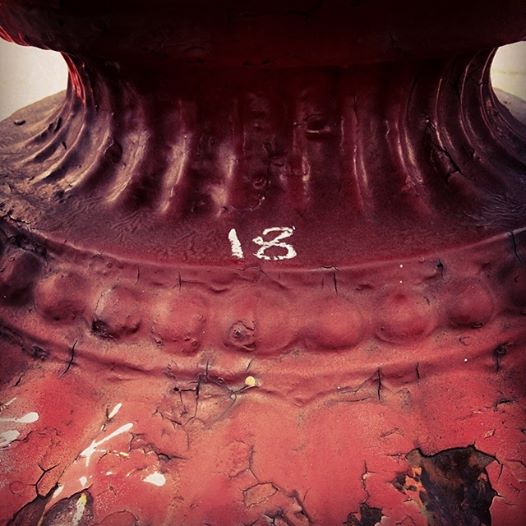
Wangechi Mutu_Day 18_Rwanda Genocide 20th anniversary
Day 18
Yesterday tripped and fell into evening
As it plunged deep into the night, voices rose up
from the abyss:
Come! Come!
They called
Come!
We never slept, trying to makes sense
whose voice was whose
Yesterday tripped and fell into a long night
of calling, of voices beckoning, recalling
things done, things undone by time
Today, I’m trying to sort out the differences
whose voice was whose
which place, what time
They all sound the same now
— the dead and the unborn;
they all sound the same.
.
Day 19
So this is what the Greek storyteller foretold:
First, the pity-inducing event,
Those poor, poor people,
Pity in the numbers, pity in the grotesque photos that followed,
the writing and the reading that followed.
There was nothing, nothing we could have done different;
Everything was beyond us.
Then came the fear it would spread like contagion,
Uncontrolled like a forest fire.
Now it is time for catharsis.
.
Day 20
It has been called a harvest of death.
It was more like a net that was cast,
A fisher net
A fisher net cast by a man
A fisher of men
– Christ, was that you?
.
Day 21
A ring around a rosie
A ring around a posy
A ring around a peony
A ring around a buttercup
A ring around a baby’s breath
A ring around a bouquet
A pocket full of posers
A pocket full of diamonds
A pocket full of memory
A pocket full of justice
A pocket full of ideas
A pocket full of shit
Ring around a rosy
A pocket full of posies
Achoo! Achoo!
We all fall down!
.
Day 22
Twenty years later we’re young again
as we should be
Welcome to this country
Welcome
Come and see how we live
Come and see how we get over everything
Come and see how we exhibit skulls
Come and see how we caress skeletons and tell stories about who these bones were
Come and see how easy we are with things;
Come and visit.
Our country is now open for tourism.
.
Day 23
Some of us fell between words
& some of us onto the sharp edges
at the end of sentences
And if we’re not impaled
we’re still falling through stories that don’t make sense

Wangechi Mutu_Day 23_Rwanda Genocide 20th anniversary
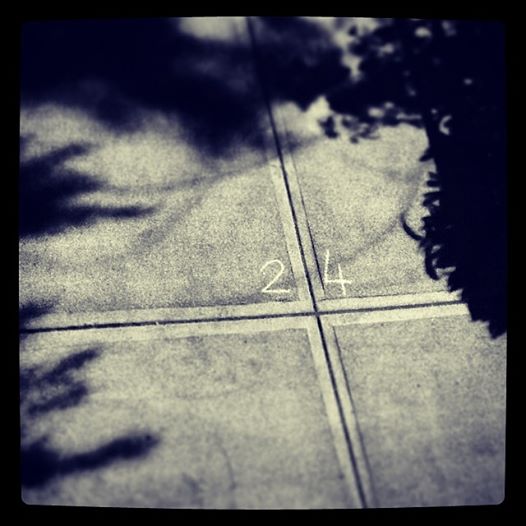
Wangechi Mutu_Day 24_Rwanda Genocide 20th anniversary
Day 24
& then there was just the two of us
everything in flames
There was the two of us
your arm around my shoulder
mine around your waist
we hobbled on
just the two of us
we hobbled on
just the two of us for a while
& then there was just me
.
Day 25
Bones lie
Bones lie
Bones lie
About their numbers and bits and parts
Bones lie in open air, in fields, under brushes, along with with others in state vaults,
in museums as if they belong there
in piles, as if they would ever do that in life.
Bones lie about being dead
bleached
broken
pulverized, as if we who are not all bone
don’t live with nightmares
Bone have nothing to say
Nothing about who it was that loved them the most
.
Day 26
That day dared to set
As did the one after it and the one after that
Days became long nights
That became mornings which appeared innocent
of the activities of the day before
That day shouldn’t have set
The next day
if that other day had collapsed from exhaustion, should have held the night sky at bay
That day should have remained fixed in perpetuity
so that we would always know it to be true
.
Day 27
Glory be to the Father to whom all this is His will
Glory be to the Son who claims to have died for the sins of all men
Glory be to the Holy Spirit that guides the tongues of flames of the believers
As it was in the beginning
As it was in the beginning
As it has always been
As long as we need to hark back to a beginning
that only exists in the memory of the elusive Trinity who can only be accessed through Faith
Nothing will ever change
Nothing will ever change except by Faith
So nothing will change
.
Day 28
When I (survey) look out at the world around me
(The wondrous cross)
On which (the Prince of Glory) every one that I loved died,
(My richest gain) My richest gain? My richest gain?
I count (but) as loss
It was all loss – all of it
And so I pour contempt on all (my) the pride
That seems to think that there is anything to celebrate.
Don’t ever forbid it, Lord,
That I should (boast) dare to speak out
(Save in) on the deaths
(of) Christ, my God, everything, everything that mattered,
All the vain things that charm (me) You most – the sky scrapers, the clean streets
& the moneyed vendors
(I) You sacrifice (them) Your own morality (to His blood)
There is nothing to party about, nothing.
See from (His head, His hands, His feet) this vantage point
Just how much sorrow and love and bone and blood flow mingling down
Did e’er such love and sorrow meet? Did ever?
Where did ever such a twisted sense of wreath-making come from?
Or why would thorns compose so rich a crown?
Can you not read the land?
Were the whole realm of nature mine
That were a present far too small
Love so amazing so divine
Demands my soul, my life, my all
So it took my soul, my life, my all.
.
Day 29
Time is a curve
so long that it seems to be a straight line
I can see myself walk away
I see
& then remember my heel striking the ground first
the weight of my shoulders
the back of my head & the low hang of my neck
Circle forward
What does my face matter if my heel is still cracked?

Wangechi Mutu_Day 29_Rwanda Genocide 20th anniversary

Wangechi Mutu_Day 30_Rwanda Genocide 20th anniversary
Day 30
A grid
a fence
a field
some grass
some stumbling
a ditch
mud
a broken slipper
a tear
a sheet
some fumbling
a groan
a metal plate with a faded rose in it
a rusty kettle that will never boil.
.
Day 31
Here: it is daytime now
We’re here
It is now twenty years after a hundred days that we did not plan on living through
We wanted to, prayed, yearned to make it
Not that those who didn’t didn’t
.
Day 32
In Eden
We heard birdsong and didn’t hear it
We saw the soft flutter & sail of a falling leaf, but we didn’t know how to read it
We worked the earth, lived off it, trampled it back and forth, back and forth
In Eden
We never thought about the difference between house and home
we never even thought to call it; we were it, it was us and ours
gang wa
Now as we fall unendingly
we know different
we understand belonging as transitory at best
& as elusive as the future we once imagined.
.
Day 33
So we mothed along towards the fire
With the full knowledge that there couldn’t be anything else beyond this
We mothed along
with bare arms, wingless
a light step here
a light step there
sometimes no step at all
& other times dreamless stops
We mothed along knowing that it was possibly death
& not fire that beckoned
.
Day 34
So we saw, tasted, smelled, touched, felt and heard what we knew to be true
We had to see, taste, smell, touch, feel and hear in order to know this word
–genocide?
How much made it valid?
Would one less death have disqualified those hundred days from being called a genocide?
And more?
.
Day 35
There’s no denying the flap of an angel’s wings
for someone who felt it fan her face in those days
The salve of a gentle touch
The stretch of an arm to catch you as you reached for the top of the wall
the strength of a wail
the depth of a moan
the light of unending days
the consistency of seasons
as real as angel wings
There is, however, a slope that leads
from these days of fiction
into nightmares that are real.
.
Day 36
Oh, I curse you.
I curse you long and hard and deep and wide
I curse you with fire from my mouth
I join everyone with fire in the mouth
Wherever we live & wherever we lay
We curse you, we curse you, we curse you.
.
Day 37
When Christ lost a beloved friend, he cried out:
Lazarus!
Lazarus, come out of the tomb
Lazarus, come out of the tomb
Imagine Christ crying for the beloved on this land:
Lazarus! Lazarus! Lazarus! Lazarus!
Lazarus, come out of the tomb!
Imagine Christ with a croaking voice:
Lazarus, Lazarus, Lazarus
Christ in a whisper
Christ mumbling:
Lazarus, Lazarus
Christ spent
Christ crumbled
Oh, Lazarus
Christ either had no idea of these one hundred days
Or he must have lost his voice in the first few moments
Christ may just have not been capable
He might have noted the endless and boundless losses of the beloved on this land
He might have hung his head down, powerless in the face of this might
Christ, look to your mother
ask her to pray for your intercession.
.
Day 38
If there’s a breeze tonight
We might think for a moment that it is sweet
There is a breeze tonight
& it is sweet
I can’t remember if the breeze was sweet in those days
There was a breeze
There might have been
Why not?
It might have been the same sweet breeze that kept us from burning
.
Day 39
If we were to go back to the time before these hundred days
We couldn’t return without knowing what was to come
How could we?
If we were to swear off, that we couldn’t return to these days
I don’t know that we could; we know
We’re marked by this knowing
We know that we’re marked
& this knowledge taints us
& so we can never absorb your innocence
But
Your innocence will not shield you from these days
Because your innocence does not cleanse
& so your innocence cannot save you from what you must know.
.
Day 40
She is my country
Every time she goes
I am a leaf in the wind
Every time she goes
She takes with her
All the home that I can ever claim
What use do I have for the carrier of bones?
What anthem can I sing for the graves of children?
She holds my home in the country that she is
& every time she returns, she is my flag
& I am home again.
.
Day 41
If justice was in a race with time
Peace would have no medal to offer
If peace sat at the table with justice
Time wouldn’t be served
If time wanted justice, so bad, so bad,
There would be nothing that peace could offer
Either by seduction or reason
.
Day 42
I kneel before you
I kneel before you but this is not an act of supplication
I kneel before you because I cannot stand
I kneel before you because I cannot speak right now
My gestures are wordless articulations
& the dark in my eyes is not an indication of anything you could imagine
& there is nothing, nothing that you could ever give me
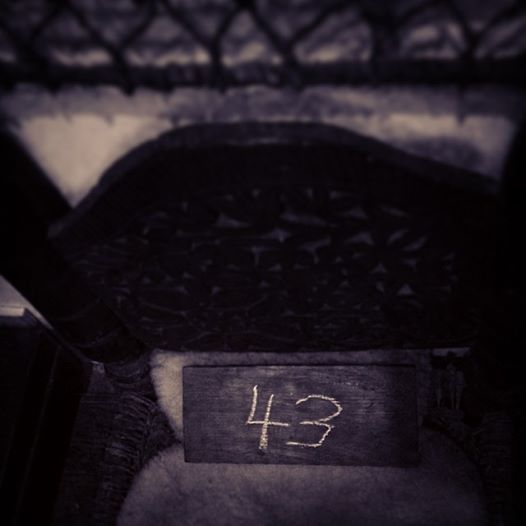
Wangechi Mutu_Day 43_Rwanda Genocide 20th anniversary
Day 43
After all the madness,
& it had to have been a madness,
You hear the arguments and explanations
That it was inevitable
That it was coming
That it had to happen after all those years
Knowing what we know now
What else should we have expected?
I hear that my loss was inevitable
I hear that my loss was coming
I hear that my heartbreak was written in the stars
& in historical documents & even in the oral stories
We had to have been blind & deaf & dumb to not have known
We had to have been oblivious, thinking that we could live
to a full life of family and community like others
After all, who misses the inevitability of a mass event like a genocide?
. . .
To see / read Days 100 to 44, click on the ZP link below:
https://zocalopoets.com/2014/05/31/the-rwanda-genocide-twenty-years-later-100-days-of-photographs-poems-by-wangechi-mutu-and-juliane-okot-bitek-4/
. . . . .
Dylan Thomas: Poema del Ocaso del Día por El Reverendo Eli Jenkins / The Sunset Poem of The Reverend Eli Jenkins
Posted: July 15, 2014 Filed under: Dylan Thomas, English, Spanish, ZP Translator: Alexander Best Comments Off on Dylan Thomas: Poema del Ocaso del Día por El Reverendo Eli Jenkins / The Sunset Poem of The Reverend Eli Jenkins
At the end of the day…Al ocaso del día…
Bajo el bosque de leche es una pieza de radioteatro del escritor galés, Dylan Thomas, posteriormente adaptada para su representación en el teatro. También existe una adaptación cinematográfica de 1972, con Richard Burton y Elizabeth Taylor.
En Bajo el bosque de leche, un narrador omnisciente invita a los oyentes a escuchar los sueños y pensamientos íntimos de los habitantes de una imaginaria localidad galesa, “Llareggub” (inversión de bugger all, traducible aproximadamente como “iros todos al carajo”). Entre los personajes principales, cuyos nombres son casi siempre simbólicos, se encuentran el Capitán Cat, que revive su época de marino; las dos señoras Dai Breads; Organ Morgan, obsesionado con su música; y Polly Garter, que suspira por su amante muerto. Tras este inicio onírico, el pueblo despierta y cada personaje se sumerge en sus quehaceres cotidianos. (Wikipedia)
. . .
Dylan Thomas first wrote Under Milk Wood as a radio drama in 1954. It was later adapted as a stage play. In the story a narrator invites the listener to hear about the dreams and hidden thoughts of the inhabitants of a Welsh fishing village called Llareggub (“bugger all” spelt backwards). The characters include: Mrs. Ogmore-Pritchard, who nags her two deceased husbands; Captain Cat, who relives his seafaring years; the Mrs. Dai Breads; “Organ Morgan”, obsessed by music; and Polly Garter, who pines for her dead lover. Toward the end, the town “awakens”, and is aware now just how their feelings affect all that they do. And so, they go about their daily business…
The following poem by Thomas is taken from the radio play:
The Sunset Poem of The Reverend Eli Jenkins
.
Every morning when I wake,
Dear Lord, a little prayer I make;
O please to keep Thy loving eye
On all poor creatures born to die.
And every evening at sun-down
I ask a blessing on the town;
For whether we last the night or no
I’m sure is always touch-and-go.
We are not wholly bad or good
Who live our lives Under Milk Wood;
And Thou, I know, wilt be the first
To see our best side – not our worst.
O let us see another day…
Bless us all this night, I pray;
And to the sun we all will bow,
And say good-bye – but just for now.
. . .
Dylan Thomas
Poema del Ocaso del Día (por El Reverendo Eli Jenkins)
.
Cada alba cuando me levanto,
Querido Dios, una pequeña oración hago.
Por favor, que apuntes el ojo de tierno cuidado
Sobre todos nosotros – las pobres criaturas destinado a morir.
.
Y en la tarde, a la puesta del sol,
Te pido una bendición por el bien del pueblo,
Porque – en esta noche – y si duramos o no –
Yo sé que la Vida siempre es precario.
.
Buenos, malos – no somos ni el uno ni el otro
(nosotros viviendo en en el pueblo de Bajo-Leche-Madera);
Y – lo sé – que Tú serás el primero que ve en nosotros lo mejor – no lo peor.
.
¡Ah, miremos un otro día!
Bendícenos en esta noche – rezamos;
Y haremos una reverencia al sol,
Y digamos Adiós – a menos por ahora…
. . .
The Sunset Poem was also set to the music of A. H. D. Troyte (Troyte’s Chant No. 1), in four-part harmony for two tenors and two bass singers.
. . . . .
Dylan Thomas: Amor en El Manicomio / Love in The Asylum
Posted: July 15, 2014 Filed under: Dylan Thomas, English, Spanish Comments Off on Dylan Thomas: Amor en El Manicomio / Love in The Asylum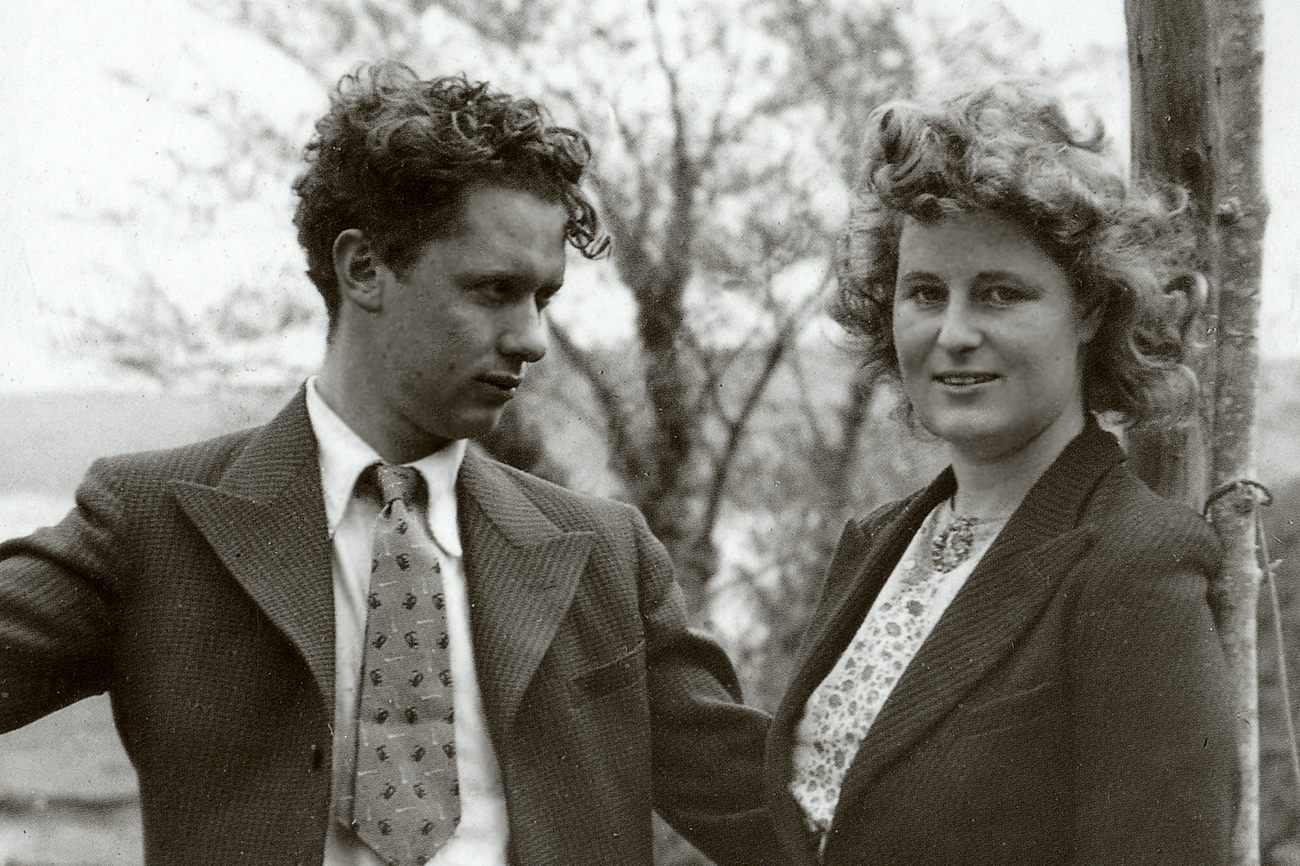
Dylan y Caitlin Thomas
Dylan Thomas (Poeta galés, 1914-1953)
Amor en El Manicomio
.
Una extraña ha venido
a compartir mi cuarto en esta casa que anda mal de la cabeza,
una muchacha loca como los pájaros
traba la puerta de la noche con sus brazos, sus plumas.
Ceñida en la revuelta cama
alucina con nubes penetrantes esta casa a prueba de cielos
hasta alucina con sus pasos este cuarto de pesadilla.
libre como los muertos
o cabalga los océanos imaginarios del pabellón de hombres.
Ha llegado posesa
la que admite la alucinante luz a través del muro saltarín,
posesa por los cielos
ella duerme en el canal estrecho, hasta camina el polvo
hasta desvaría a gusto
sobre las mesas del manicomio adelgazadas por mis lágrimas.
Y tomado por la luz de sus brazos, al fin, mi Dios, al fin
puedo yo de verdad
soportar la primera visión que incendia las estrellas.
.
Versión de Elizabeth Azcona Cranwell
. . .
Dylan Thomas (Welsh poet, 1914-1953)
Love in The Asylum
.
A stranger has come
To share my room in the house not right in the head,
A girl mad as birds
Bolting the night of the door with her arm her plume.
Strait in the mazed bed
She deludes the heaven-proof house with entering clouds
Yet she deludes with walking the nightmarish room,
At large as the dead,
Or rides the imagined oceans of the male wards.
She has come possessed
Who admits the delusive light through the bouncing wall,
Possessed by the skies
She sleeps in the narrow trough yet she walks the dust
Yet raves at her will
On the madhouse boards worn thin by my walking tears.
And taken by light in her arms at long and dear last
I may without fail
Suffer the first vision that set fire to the stars.
. . . . .
In Search of Dylan Thomas: Andre Bagoo in Wales
Posted: July 12, 2014 Filed under: 7 GUEST EDITORS, Andre Bagoo, English Comments Off on In Search of Dylan Thomas: Andre Bagoo in Wales
Andre Bagoo in Laugharne_photograph by Ann Marie Goodwin
And all your deeds and words,
Each truth, each lie,
Die in unjudging love.
Dylan Thomas, ‘This Side of the Truth’
SUNDAY
WE ARE in the strangest town in Wales.
It is a Sunday afternoon and we walk through the lych-gate and up the long asphalt path leading to the church. Where is his grave?
The path forks. To the left, a graveyard and St Martin’s. To the right, another graveyard, added more recently. The sun is setting.
St Martin’s Church has a service every Sunday at 6 pm. We hesitate at the entrance. Is a service going on? Will we interrupt the worshippers inside? From behind the thick 13th century walls, we can hear the faint sound of an organ. Are those voices? The wind.
We walk in. A small group of old ladies—and one or two men—are huddled together in the sacristy at the far end. There are shields and flags and statues. The stained glass makes everything a kaleidoscope. On one wall near the back (where we stay, looking on respectfully) is a plaque in honour of him, bearing two of his verses: “Time held me green and dying / Though I sang in my chains like the sea”. The light seems dazzled by these words, throwing long shadows on the rough stone walls.
Everyone in the church is kind, weirdly so.
“What took you so long? You should have come inside sooner,” one lady says.
“Here for Dylan Thomas, are you?” the rector adds, greeting us after the service and shaking our hands warmly.
Outside, we search among the graves and give up trying. It is quiet, the light is dying. We are tired after travelling for half a day. We will come again, we say, later in the week.
. . .
In the bar of Brown’s—the guesthouse/pub where Dylan Thomas spent most of his time drinking—the young bartender struggles to explain it. A sign on the wall advertises Laugharne as “the strangest town in Wales”.
“You’ll understand after a while,” he says, pouring a pint. “People here are really, really nice.” He says we are lucky the town is dead, because hundreds – if not thousands – of tourists will come for the Dylan Thomas centenary later this year. Our bartender is the youngest man we see all week.
A couple from a rival guesthouse a few blocks down on King Street stop in for drinks. They stare at us.
“You’re both so beautiful,” Janet says, eyeing my hamburger. Her husband, Peter, whispers into my ears that he has a hearing problem. She tells us a story about how she met Peter, who is her second husband. After her first marriage she was single for 17 years, she says, proudly. Then, she met Peter through an advertisement in the newspapers. She gives us a card for their inn, and says they have better rates. She never mentions her first husband’s name.
“She could get away with murder,” Peter jokes before they leave. I take a picture of them – just in case. That night in bed, I think of the town’s famous clock tower, standing black and white against the sky, just two blocks away.
MONDAY
Dylan Thomas was born in Swansea one hundred years ago, in 1914. He worked briefly as a reporter before his first published poem (‘And Death Shall Have No Dominion’) appeared in 1933. He skyrocketed. His stentorian voice and beautiful language made him particularly popular over the wireless; his most famous work – Under Milk Wood – was, in fact, written for radio.
Thomas spent two major periods of his relatively brief life at Laugharne. He lived there when he first married. Then, after living in several different places (London, Oxfordshire, Iran) he returned, settling with his family in a boathouse overlooking the estuary at the mouth of the River Tâf. Near the end of his life, he developed a routine at Laugharne, right up until his trip to New York in October 1953. (It was there, after a night of heavy drinking, that he died at St Vincent’s Hospital.) He made his third, and final, voyage to Laugharne, where he was buried at St Martin’s graveyard. Thomas was 39.

Dylan Thomas’ grave at St.Martin’s, Laugharne, Wales_photo by Andre Bagoo
Today, the grave looks fresh, covered with yellow, red and purple flowers. A simple white cross marks the spot where the poet who was once Wales’ most famous son is buried. “In Memory of Dylan Thomas,” it says. His wife Caitlin, who had a tempestuous relationship with him and who had not been with him in New York, would, years later, have the last word. She was buried in the same plot, and the other side of the slender white cross carries her name. There is no poetry at the grave.
TUESDAY
When you travel, nothing is as it seems. Everything has something of the air of the unreal. Each city, town, inhabitant, each landscape – becomes a mirage. But to the persons who live there, you are the one who is out of place. You are the apparition.
THURSDAY
It seems every single thing in Laugharne is connected to Dylan Thomas. Or if it is not, it fast becomes so. The entire town is a memorial to him; a living and breathing tomb. It is a monument comprising: pubs, book-shops, a clock-tower, ruins of a gothic castle, and St John’s Hill.
And all of this can be found in Thomas’ poetry.
But how much of a poet’s life and circumstance do we need to know? Do we need the back-story in order to enjoy each poem? Is it not better the less we know? Must we see the writing-shed, learn of the love affairs in New York, visit the favourite drinking haunts, the neighbours, the aunties? Of poetry Thomas once said:
All that matters about poetry is the enjoyment of it, however tragic it may be. All that matters is the eternal movement behind it, the vast undercurrent of human grief, folly, pretension, exaltation or ignorance, however unlofty the intention of the poem.
You can tear a poem apart to see what makes it technically tick, and say to yourself, when the works are laid out before you, the vowels, the consonants, the rhymes or rhythms, ‘Yes, this is it. This is why the poem moves me so. It is because of the craftsmanship.’ But you’re back again where you began. You’re back with the mystery of having been moved by words. The best craftsmanship always leaves holes and gaps in the works of the poem so that something that is not in the poem can creep, crawl, flash or thunder in.
I use everything and anything to make my poems work and move in the directions I want them to: old tricks, new tricks, puns, portmanteau-words, paradox, allusion, paranomasia, paragram, catachresis, slang, assonantal rhymes, vowel rhymes, sprung rhythm. Every device there is in language is there to be used if you will. Poets have got to enjoy themselves sometimes, and in the twistings and convolutions of words, the inventions and contrivances, are all part of the joy that is part of the painful, voluntary work.
With Thomas, there is a focus on what is not in focus: on crafting effects and experiences within the poem which hint at deeper ebbs. In addition to the devices he lists, there is also careful attention to form and an overriding sense of rhythm which propels the poetry, giving it a zealous, almost evangelical energy.
Many of his poems reflect these qualities, including some of his best-known, such as: ‘And Death Shall Have No Dominion’, ‘Poem in October’, ‘Fern Hill’, and ‘Do Not Go Gentle Into That Good Night’. A good example is also his poem ‘Twenty-four years’:
Twenty-four years remind the tears of my eyes.
(Bury the dead for fear that they walk to the grave in labour.)
In the groin of the natural doorway I crouched like a tailor
Sewing a shroud for a journey
By the light of the meat-eating sun.
Dressed to die, the sensual strut begun,
With my red veins full of money,
In the final direction of the elementary town
I advance for as long as forever is.
Thomas deploys rhyme, alliteration, paragram, memorable and unexpected imagery (“meat-eating sun”; “red veins full of money”) all to commemorate a moment; a feeling. The opening line startles, inverting the normal cause and effect relationship we associate with the provocation of tears – it bathes the poem in ambiguity. The poem is, for me, an act of grief, and seeks to point to a life force able to overcome it (“bury the dead for fear that they walk”). Ultimately, this is a snapshot as meaningful or as meaningless as life itself, grieved for or celebrated.
But if for Thomas poetry’s enjoyment is conditional upon a kind of cultivated mystery to the text, how useful is it to scour over the biographical details of Thomas’ undoubtedly tumultuous life? While Laugharne was central to his persona, is Laugharne central to the poetry? The whole point of poetry, according to Thomas, was its experience. Would he advocate that school of thought which states the reader need not get distracted or bogged down by the details of the poet’s personal life?
FRIDAY
The Dylan Thomas Walk is approximately two miles in length and takes you uphill around the shoulder of St John’s Hill, which overlooks Laugharne. Along the walk, we see views of the marshy Tâf estuary, which fans open like a sponge at low-tide; of Thomas’ boathouse; the Gower; north Devon; Caldey Island and Tenby. If you’re keen you can download an app specially made for the walk (https://itunes.apple.com/gb/app/dylan-thomas-100-birthday/id571021072?mt=8&ign-mpt=uo%3D4).
This “walk” was opened in 1856 by the Laugharne Corporation to enable cocklers to access by foot the valuable cockle beds on the upper and lower estuary marshes, when the dangerous high tides below would prevent access along the old cart road. Today, the path has been turned into a walk commemorating Thomas’s poem, ‘Poem in October’, which is ostensibly an occasional poem written by Thomas to mark what was his 30th birthday on October 24, 1944.

The Dylan Thomas Walk_Last verse of the poet’s “Poem in October”_photo by Andre Bagoo
Reading ‘Poem in October’ today it remains as vital and alive as it must have been in 1944. Thomas was writing during World War II and perhaps this context alone gives the poem a certain charge. His retreat to the Laugharne landscape allows a perspective and distance. The marsh environment comes to mirror the processes not only of war, but of economy and society generally. But reading the poem on the page is nothing like reading the poem along the specially-designed walk which now exists. At several spots, stations have been made bearing sections of the poem relating to the landscape, as well as old, faded maps and drawings of the view. Only by taking the Dylan Thomas Walk can you fully appreciate what he meant when he wrote:
My birthday began with the water-
Birds and the birds of the winged trees flying my name
Above the farms and the white horses
And I rose
In rainy autumn
And walked abroad in a shower of all my days.
High tide and the heron dived when I took the road
Over the border
And the gates
Of the town closed as the town awoke….
Pale rain over the dwindling harbour
And over the sea wet church the size of a snail
With its horns through mist and the castle
Brown as owls
But all the gardens
Of spring and summer were blooming in the tall tales
Beyond the border and under the lark full cloud.
There could I marvel
My birthday
Away but the weather turned around.
If we admit the landscape is in the poem, is the life not there too? Is the poem – even when stony, mysterious, obscure – not an artifact of a life, however shrouded in mystery? And if the life is there, can learning about the poet enrich our appreciation of what he sets out? For me, ‘Poem in October’ is a richer experience having been to Laugharne. Reading a poem is like reading a poet and, in turn, everything that has touched him. In this way, the reader and poet converge and something universal sparks between them. This is not to say this is compulsory to the enjoyment of a poem, or to advocate the limited readings so often lazily slapped onto poems when people find out about the lives of the poet, but rather to acknowledge that sometimes more information can reveal and deepen mystery simultaneously. Sometimes, the more you know, the less you know. And the more we know of a poet, the more possibilities are inherent in the text the poet leaves behind, even if the poem, like the poet, remains unknowable.
. . . . .
Mildred K. Barya: On “Donal Og” and How We Remember
Posted: July 8, 2014 Filed under: 7 GUEST EDITORS, English, Mildred K. Barya Comments Off on Mildred K. Barya: On “Donal Og” and How We Remember
“Donal Og”
It is late last night the dog was speaking of you;
the snipe was speaking of you in her deep marsh.
It is you are the lonely bird through the woods;
and that you may be without a mate until you find me.
You promised me, and you said a lie to me,
that you would be before me where the sheep are flocked;
I gave a whistle and three hundred cries to you,
and I found nothing there but a bleating lamb.
You promised me a thing that was hard for you,
a ship of gold under a silver mast;
twelve towns with a market in all of them,
and a fine white court by the side of the sea.
You promised me a thing that is not possible,
that you would give me gloves of the skin of a fish;
that you would give me shoes of the skin of a bird;
and a suit of the dearest silk in Ireland.
When I go by myself to the Well of Loneliness,
I sit down and I go through my trouble;
when I see the world and do not see my boy,
he that has an amber shade in his hair.
It was on that Sunday I gave my love to you;
the Sunday that is last before Easter Sunday.
And myself on my knees reading the Passion;
and my two eyes giving love to you for ever.
My mother said to me not to be talking with you today,
or tomorrow, or on the Sunday;
it was a bad time she took for telling me that;
it was shutting the door after the house was robbed.
My heart is as black as the blackness of the sloe,
or as the black coal that is on the smith’s forge;
or as the sole of a shoe left in white halls;
it was you that put that darkness over my life.
You have taken the east from me; you have taken the west from me;
you have taken what is before me and what is behind me;
you have taken the moon, you have taken the sun from me;
and my fear is great that you have taken God from me!
How We Remember
The last stanza of this old ballad translated from an anonymous 8th century Irish poem by Lady Augusta Gregory, has been ringing in my head, all the time thinking it was a song I may have heard over the radio, at the mall, or another poem I read some time ago but whose particular source or author I could not recall. Its strong declaration and overwhelming fear of loss kept me looking:
You have taken the east from me; you have taken the west from me;
you have taken what is before me and what is behind me;
you have taken the moon, you have taken the sun from me;
and my fear is great that you have taken God from me!
So I started to reread both familiar and new poems I’d just encountered to see if that’s where the lines were from. I also looked up popular love songs because of the energy and lyricism in the lamenting voice. I even read the Psalms and the book of Job, since I recognized the incantatory tone and hymnal-like repetition. I was amazed at my process in actively trying to remember, and the urge to experiment with various sources. I found myself thinking deeply about the steps we take in remembering things that happened a long time ago but come back to us in fragments or phrases. How do we unravel the whole? Could that be the real reason we take pictures, for instance? To help associate images/symbols with words/stories or events; to have the albums to go to when we need to bring back lives and whole scenes; not just to celebrate the moments when the pictures are being taken, but to have something that aids memory in future, as a point of reference and remembrance?
Anyway, my appeal to memory to rearrange itself and bring me the whole led me to Antonio Machado’s short poem, “Lord, You Have Ripped Away,” which has an almost similar rhythm, plea and echo to Donal Og. So I thought, even if it wasn’t what I was looking for, I liked that I had stumbled on it. And so I’ll share it.
Lord, you have ripped away from me what I loved most.
One more time, O God, hear me cry out inside.
“Your will be done,” it was done, and mine not.
My heart and the sea are together, Lord, and alone.
Antonio Machado, a native of Spain, lived from 1875 to 1939. While Machado’s poem is said to be about the death of his young wife whom he loved very much, Donal Og addresses a lover who goes away and never returns. The voice in the two poems cries out to be heard, to share the anguish of those left behind.
I had given up looking for the lines of Donal Og’s last stanza when I started to file and clean my work station, only to find the poem beneath a pile of papers on my table. I now knew why the lines were haunting me. Months ago I had wanted to write a piece for Zócalo Poets featuring the poem but the piece wouldn’t happen. I read and printed a copy thinking that if I kept looking at it on my table something wonderfully magical would be triggered. Nothing. Eventually, other poems and papers piled on top and that’s how the poem was forgotten. I think that tells you more about my organized mess and belief in random resourcefulness.
I will not go into details about the poem’s timelessness or what it has in common with modern-day songs and ballads, how it handles love, betrayal, broken promises, responsibility or translation, but rather how, when we have forgotten about its existence, it will have its own way of nudging us back to itself, to marvel at its sacred and secular emotional position, neatly brought out in stanza six:
It was on that Sunday I gave my love to you;
the Sunday that is last before Easter Sunday.
And myself on my knees reading the Passion;
and my two eyes giving love to you for ever.
Lastly, because I listened to a couple of songs while I was searching for Donal Og without knowing that’s what I was looking for, I came across Leonard Cohen’s The Darkness song, first stanza:
I caught the darkness
It was drinking from your cup
I caught the darkness
Drinking from your cup
I said, “Is this contagious?”
You said, “Just drink it up…”
And it made stanza eight of the poem remarkably significant, not just in the similes but the compounding of blackness and darkness:
My heart is as black as the blackness of the sloe,
or as the black coal that is on the smith’s forge;
or as the sole of a shoe left in white halls;
it was you that put that darkness over my life.
I think the experience of acknowledging and letting out the darkness in music, poetry, stories and so on, helps the heart to transform and go on, even in profoundly devastating situations. The cry from the writer, reader, singer, or audience becomes the light that keeps beating. If nothing else, this simple act of the experience of letting out could be the greatest gift of creative works to humankind and animals.
Enjoy the reading and the letting out.
Mildred K. Barya
. . .
Jorge Luis Borges: “Tejas” / “Texas”
Posted: July 8, 2014 Filed under: English, Jorge Luis Borges, Spanish Comments Off on Jorge Luis Borges: “Tejas” / “Texas”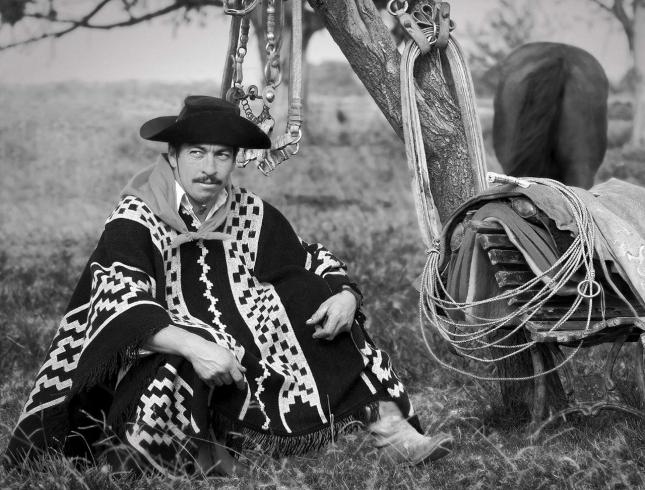
Foto romántica de un gaucho argentino estereotípico_Casi es una versión sudamericana del vaquero tejano. A romantic, stereotypical photograph of an Argentinian “gaucho”, the South-American counterpart to the Texas Cowboy.
Jorge Luis Borges
“Tejas”
.
Aquí también. Aquí, como en el otro
confín del continente, el infinito
campo en que muere solitario el grito;
aquí también el indio, el lazo, el potro.
Aquí también el pájaro secreto
que sobre los fragores de la historia
canta para una tarde y su memoria;
aquí también el místico alfabeto
de los astros, que hoy dictan a mi cálamo
nombres que el incesante laberinto
de los días no arrastra: San Jacinto
y esas otras Termópilas, el Álamo.
Aquí también esa desconocida
y ansiosa y breve cosa que es la vida.
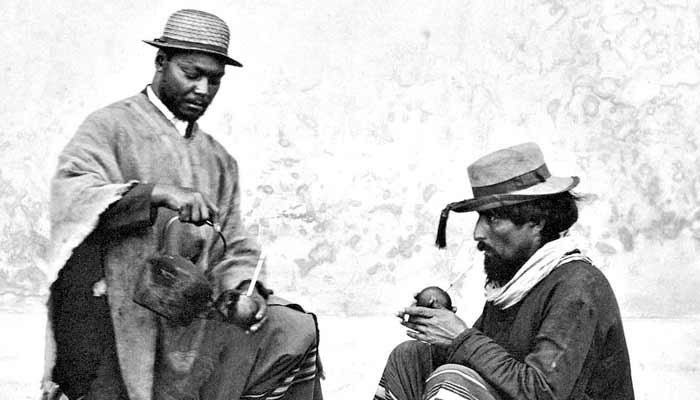
Dos gauchos de La Triple Frontera entre Argentina, Paraguay y Brasil_Bebiendo yerba mate_Vintage photograph of two “gauchos” drinking “yerba mate”
Jorge Luis Borges
(1899-1986, born Buenos Aires, Argentina)
“Texas”
.
And so it is here too. Here too, as at
the Americas’ other edge: the measureless
plain where a cry dies unattended. Yes,
here too, the Indian, mustang, lariat.
Here too the secret bird that ever yet
over the clamourings of history
sings for an evening and its memory;
here too the stars with mystic alphabet
that dictate to my writing hand below
such names, today, as the unceasing maze
of days and turning days does not displace,
as San Jacinto and the Alamo,
and such Thermopylaes. Here, too, is rife
with that brief unknown anxious thing called life.
. . .
Translation from the Spanish: A.Z. Foreman
Visit his site: http://poemsintranslation.blogspot.ca/
. . . . .
 Zócalo Poets