Nowruz Mubarak – Happy Persian New Year! Quotations from Saadi, Barbara Sher, Ahmad Shamlu, and Article 1!
Posted: March 20, 2015 Filed under: English | Tags: First Day of Spring, Nowruz poems Comments Off on Nowruz Mubarak – Happy Persian New Year! Quotations from Saadi, Barbara Sher, Ahmad Shamlu, and Article 1!
برآمد باد صبح و بوی نوروز- به کام دوستان و بخت پیروز
مبارک بادت این سال و همه سال – همایون بادت این روز و همه روز
. . .
“You can learn new things at any time in your life if you’re willing to be a beginner. If you actually learn to like being a beginner, then the whole world opens up to you.”
Barbara Sher
. . .
Article 1, of the United Nations’ Universal Declaration of Human Rights – in the Kazakhstani language:
Барлық адамдар тумысынан азат және қадір-қасиеті мен кұқықтары тең болып дүниеге келеді. Адамдарға ақыл-парасат, ар-ождан берілген, сондықтан олар бір-бірімен туыстық, бауырмалдық қарым-қатынас жасаулары тиіс.
.
Translation:
“All human beings are born free and equal in dignity and rights. They are endowed with reason and conscience and should act towards one another in a spirit of brotherhood [ and sisterhood ].”
. . .
Ahmad Shamlu (1925-2000, Tehran, Iran)
“Bright Horizon”
.
Bright horizon
Some day we will find our doves
Kindness will take Beauty by the hand
.
That day – the least song will be a kiss
and every human being be brother to
every other human being
.
That day – house doors will not be shut
Locks will be but legends
And the Heart be enough for Living
.
The day – that the meaning of all speech is loving
so one won’t have to search for meaning down to the last word
The day – that the melody of every word be Life
and I won’t be suffering to find the right rhythm for every last poem
.
That day – when every lip is a song
and the least song will be a kiss
That day – when you come – when you’ll come forever –
and Kindness be equal to Beauty
.
The day – that we toss seeds to the doves…
and I await that day
even if upon that day I myself no longer be.
. . .
We are grateful to Hassan H. Faramarz for the Persian-to-English translation of “Bright Horizon”.
. . .
May your Nowruz be blessed with Hope – for resolutions, and moving on; for old patterns broken, and new directions sought; for common ground where there is strife; for being on the side of Life!
. . .
Image using Arabic text from a Saadi poem: graphic artist Reza Assar
. . . . .
First Day of Spring: Larkin, Mansfield, Ryōkan Taigu
Posted: March 20, 2015 Filed under: English Comments Off on First Day of Spring: Larkin, Mansfield, Ryōkan Taigu
Philip Larkin (1922-1985)
First Sight
.
Lambs that learn to walk in snow
When their bleating clouds the air
Meet a vast unwelcome, know
Nothing but a sunless glare.
Newly stumbling to and fro
All they find, outside the fold,
Is a wretched width of cold.
As they wait beside the ewe,
Her fleeces wetly caked, there lies
Hidden round them, waiting too,
Earth’s immeasurable surprise.
They could not grasp it if they knew,
What so soon will wake and grow
Utterly unlike the snow.
. . .
Katharine Mansfield (1888-1923)
Very Early Spring
.
The fields are snowbound no longer;
There are little blue lakes and flags of tenderest green.
The snow has been caught up into the sky–
So many white clouds–and the blue of the sky is cold.
Now the sun walks in the forest,
He touches the bows and stems with his golden fingers;
They shiver, and wake from slumber.
Over the barren branches he shakes his yellow curls.
Yet is the forest full of the sound of tears….
A wind dances over the fields.
Shrill and clear the sound of her waking laughter,
Yet the little blue lakes tremble
And the flags of tenderest green bend and quiver.
. . .
Ryōkan Taigu (Zen Buddhist monk, Japan, 1758-1831)
First Days of Spring
.
First days of Spring…
the sky is bright blue, the sun huge and warm.
Everything’s turning green.
Carrying my monk’s bowl, I walk to the village
to beg for my daily meal.
The children spot me at the temple gate
and happily crowd around,
dragging on my arms till I stop.
I put my bowl on a white rock,
hang my bag on a branch.
First we braid grasses and play tug-of-war,
then we take turns singing and keeping a kick-ball in the air:
I kick the ball and they sing, they kick and I sing.
Time is forgotten, the hours fly.
People passing by point at me and laugh:
“Why are you acting like such a fool?”
I nod my head and don’t answer.
I could say something – but why?
Do you want to know what’s in my heart?
From the beginning of time: just this! just this!
. . . . .
“Once upon a time, there were no stories in this world…” Toronto Storytelling Festival: March 19th-29th, 2015
Posted: March 19, 2015 Filed under: English, English: Jamaican Patois | Tags: Anansi the Spider God Comments Off on “Once upon a time, there were no stories in this world…” Toronto Storytelling Festival: March 19th-29th, 2015
Anansi: the Spider God who is a storyteller, and whose name is synonymous with skill in speech.
2015 Toronto Storytelling Festival
.
Among the many events…
The Talking Stick: a special evening at 1001 Friday Nights of Storytelling, Innis College, March 20th , 8 pm.
Queers in Your Ears, at Canadian Lesbian and Gay Archives (CLGA), March 21st, 2 pm.
All Aboard! On the Katari Story Time Machine, at the Japan Foundation, Toronto, March 21st, 3 pm.
Storytelling with Elizabeth Laird and Rubena Sinha: Animal Fables and Tiger Tales, at the Aga Khan Museum, March 22nd, 2 pm to 10 pm.
A Storytelling Journey to Ethiopia, Brazil, and The Yukon, at The Ismaili Centre, Toronto, March 23rd, 7:30 pm.
D’bi Young: dubpoet, praise-singer, storyteller, at Aki Studio Theatre, Daniels Spectrum, Regent Park, Toronto, March 24th, 5 pm.
Storytalk: What comes first – the story or the world? At Paintbox Bistro, Regent Park, Toronto, March 28th, 10 am.
Storytalk: Aqausivut – Our Inuit Love Songs from mother to child, at Paintbox Bistro, March 28th, 11:15 am.
. . .
Storytellers will include: Taina Tyebjee, Leeya Solomon, Marîa del Carmen Orodoñez, Michael Parent, Mahlika Awe:ri, Djennie Laguerre, Richard Wagamese, Itah Sadu, Donald Carr, Rubena Sinha,
…and more!
http://www.torontostorytellingfestival.ca
. . .
ANANSI is a West-African god who often takes the shape of a spider. The Asante (Ashanti) people of Ghana had many Anansi tales, and these stories were in the oral tradtion; Anansi himself was always synonymous with skill + wisdom in speech.
There is one Anansi story that explains the phenomenon of how his name became attached to the whole corpus of tales:
Once upon a time there were no stories in this world; the Sky-God, Nyame, had them all.
Anansi went to Nyame and asked how much they would cost to buy.
Nyame set a high price: Anansi must bring back Onini the Python, Osebo the Leopard, and the Mboro Hornets.
And so, Anansi set about to capture these three: python, leopard, and the hornets.
First he went to where Python lived and debated out loud whether Python was really longer than the palm branch – or not as his wife Aso had said. Python overheard, and, when Anansi explained the debate, agreed to lie along the palm branch. Because he could not easily make himself completely straight, a true impression of his actual length was difficult to obtain. So Python agreed to be tied to the branch. And once he was completely tied down, Anansi took him to Nyame.
To catch the Leopard, Anansi dug a deep hole in the ground. When the leopard fell in the hole Anansi offered to help him out with his webs. Once the leopard was out of the hole he was bound in Anansi’s webs – and carried away.
To catch the hornets, Anansi filled a calabash with water and poured some over a banana leaf he held over his head and some over the nest, calling out that it was raining. He suggested the bees get into the empty calabash, and when they obliged, he quickly sealed the opening.
Anansi handed his captives over to Nyame, and Nyame rewarded him by making him the “god of all stories”.
.
“Anancy and Common Sense” (A tale told in Jamaican Patois)
.
Wance apan a time Breda Anancy mek up im mind seh im gwine callect all a de camman sense inna de wurl. Im was tinking dat he would be de smartest smaddy in de wurl ef im do dis. So Anancy traveled all ova de wurl collecting camman sense. Im go to big countries an likkle ones. Im go to primary schools and universities. Im go to govament offices and businesses. Im go people house and dem work place.
Im tek all de zillions camman sense he had collected fram around the wurl and put it a big calabash. Im tek de calabash wid im to im backyard and climbed a big gwangu tree. His plan was to store it at de tap of the tree for safety-keeping. Nobady woulda get to it but Anancy.
To mek sure it was safe Anancy tie the calabash to de front of his bady. Dis slow down im progress up de tree to a slow crawl. Im did look very clumsy a-go up de tree wid be-caw the calabash dida hamper im.
As im was slowing going up toward de top a de tree a likkle girl below called out to im. Anancy, mek you nuh tie the calabash pon you back insteada in front of yuh. It will git up de tree much fasta and ez-a.
Anancy was bex be-cah de likkle girl show im up for not thinking. She had more good sense dan him he thought. He called out to her “Mi did tink me collected all the camman sense fram all ova de wurl”
He was so angry dat im fling the calabash to the to the groung and it bust. All of the camman sense im did callect fly back to all ova de wurl.
An dat’s how you and I manage to have just a likkle common sense for we-self tideh.
“And his wild harp slung behind him”: lyric poems of Thomas Moore for St. Patrick’s Day
Posted: March 17, 2015 Filed under: English, Thomas Moore | Tags: Saint Patrick's Day Poems Comments Off on “And his wild harp slung behind him”: lyric poems of Thomas Moore for St. Patrick’s Day
Eileen Thompson the “Colleen”_Belfast, 1944
Thomas Moore (1779-1852)
The Minstrel Boy (song composed around 1800)
.
The minstrel boy to the war is gone,
In the ranks of death you’ll find him;
His father’s sword he has girded on,
And his wild harp slung behind him;
“Land of Song!” said the warrior bard,
“Though all the world betrays thee,
One sword, at least, thy rights shall guard,
One faithful harp shall praise thee!”
.
The Minstrel fell! But the foeman’s chain
Could not bring his proud soul under;
The harp he loved ne’er spoke again,
For he tore its chords asunder;
And said “No chains shall sully thee,
Thou soul of love and bravery!
Thy songs were made for the pure and free
They shall never sound in slavery!”
. . .
Moore set his patriotic poem, The Minstrel Boy”, to the melody known as The Moreen, an old Irish air. It is believed that the poet composed the song in remembrance of friends he’d known while studying at Trinity College, Dublin, and who had taken part in / were killed during, the Irish Rebellion of 1798.
. . .
Thomas Moore
The Last Rose of Summer (written in 1805)
.
‘Tis the last rose of summer,
Left blooming alone;
All her lovely companions
Are faded and gone;
No flower of her kindred,
No rosebud is nigh,
To reflect back her blushes,
Or give sigh for sigh.
.
I’ll not leave thee, thou lone one!
To pine on the stem;
Since the lovely are sleeping,
Go, sleep thou with them.
Thus kindly I scatter,
Thy leaves o’er the bed,
Where thy mates of the garden
Lie scentless and dead.
.
So soon may I follow,
When friendships decay,
And from Love’s shining circle
The gems drop away.
When true hearts lie withered,
And fond ones are flown,
Oh! who would inhabit
This bleak world alone?
. . .
Moore’s poem, The Last Rose of Summer, was composed in 1805 while he was visiting Jenkinstown Park in County Kilkenny. It was later set to a traditional tune called “Aislean an Oigfear” or “The Young Man’s Dream”, which had been transcribed by Edward Bunting in 1792 based on a performance by harper Donnchadh Ó hÁmsaigh (Denis Hempson) at the Belfast Harp Festival. The poem and the tune together were published in December 1813 in volume 5 of a collection of Moore’s work called A Section of Irish Melodies.

The Brian Boru Harp_a 15th century cláirseach
Thomas Moore
The Harp that once through Tara’s Halls…
.
The harp that once through Tara’s halls
The soul of music shed,
Now hangs as mute on Tara’s walls,
As if that soul were fled.
So sleeps the pride of former days,
So glory’s thrill is o’er,
And hearts, that once beat high for praise,
Now feel that pulse no more.
.
No more to chiefs and ladies bright
The harp of Tara swells;
The chord alone, that breaks at night,
Its tale of ruin tells.
Thus Freedom now so seldom wakes,
The only throb she gives,
Is when some heart indignant breaks,
To show that still she lives.
. . .
Zócalo Poets’ editor’s note:
The poems featured here were chosen by my mother, who was born Eileen Thompson, of Belfast, Northern Ireland. Her remarks:
When I was about fourteen I went with a choir to Ulster Hall, a Victorian concert hall in the centre of Belfast. The occasion was a choral concert. I wore the “costume” of an Irish colleen. My cloak was green and my skirt had a satin horizontal stripe. My shoes I clearly remember: black oxfords – well polished. I stood alone, stage left, with a spotlight shining on me, and I sang The Rose of Tralee, not one by Thomas Moore, yet a popular old ballad just the same. And that was my singing début! The Last Rose of Summer I learned several years earlier, at Mullaghdubh Primary School, when we were evacuated to Islandmagee after the first air raid on Belfast in April of 1941.
. . . . .
I come from the east, with a clutch under my arm: five Irish women poets
Posted: March 17, 2015 Filed under: English, Irish Comments Off on I come from the east, with a clutch under my arm: five Irish women poets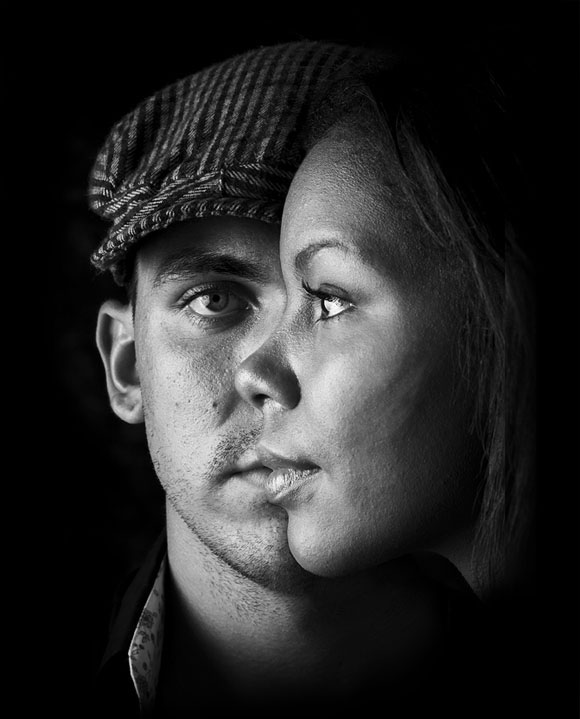
Double portrait in black and white © Cory Smith
Vona Groarke (Edgeworthstown / Athlone, Ireland, born 1964)
The Clutch Handbag
.
Black bombazine with grosgrain binding,
a clasp of diamanté butterflies and a row
of bevelled ivory sequins threaded with slipknots.
.
Finesse. A lipstick of a certain red,
a bronze compact, the cachet
of an embossed cigarette case.
.
Emerald lining that is like glossy music
from a dance-hall band or the sheen
of sable eyes on the mink stole
.
whose snout rounds on the very shape
of a tear in the satin no bigger than
her incarnadine thumbnail
.
through which five decades
have slipped like small coins
skittering the open notes
.
of a foxtrot or an old-time waltz
that nobody, but nobody,
recalls.
. . .
from the collection Spindrift © Vona Groarke and The Gallery Press
. . .
Máire Mhac an tSaoi (Dublin, Ireland, born 1922)
A fhir dar fhulaingeas
.
A fhir dar fhulaingeas grá fé rún,
Feasta fógraím an clabhsúr:
Dóthanach den damhsa táim,
Leor mo bhabhta mar bhantráill.
.
Tuig gur toil liom éirí as,
Comhraím eadrainn an costas:
‘Fhaid atáim gan codladh oíche
Daorphráinn orchra mh’osnaíle.
.
Goin mo chroí, gad mo gháire,
Cuimhnigh, a mhic mhínáire,
An phian, an phláigh, a chráigh mé,
Mo dhíol gan ádh gan áille.
.
Conas a d’agróinnse ort
Claochló gréine ach t’amharc,
Duí gach lae fé scailp dhaoirse –
Malairt bhaoth an bhréagshaoirse!
.
Cruaidh an cás mo bheith let ais,
Measa arís bheith it éagmais;
Margadh bocht ó thaobh ar bith
Mo chaidreamh ortsa, a óigfhir.
. . .
from the collection An paróiste míorúilteach/The miraculous parish ( Rogha
dánta/Selected poems), edited by Louis de Paor, © Máire Mhac an tSaoi and The O’Brien Press/Clóiar-Chonnacht
. . .
Máire Mhac an tSaoi
Man for whom I endured
.
Man, for whom I suffered love
In secret, I now call a halt.
I’ll no longer dance in step.
Far too long I’ve been enthralled.
.
Know that I desire surcease,
Reckon up what love has cost
In racking sighs, in blighted nights
When every hope of sleep is lost.
.
Harrowed heart, strangled laughter;
Though you’re dead to shame, I charge you
With my luckless graceless plight
And pain that plagues me sorely.
.
Yet, can I blame you that the sun
Darkens when you are in sight?
Until I’m free each day is dark –
False freedom to swap day for night!
.
Cruel fate, if by your side.
Crueller still, if set apart.
A bad bargain either way
To love you or to love you not.
. . .
Translation from Irish into English: Biddy Jenkinson
. . .
Eiléan Ní Chuilleanáin (Cork, Ireland, born 1942)
The Bend in the Road
.
This is the place where the child
Felt sick in the car and they pulled over
And waited in the shadow of a house.
A tall tree like a cat’s tail waited too.
They opened the windows and breathed
Easily, while nothing moved. Then he was better.
.
Over twelve years it has become the place
Where you were sick one day on the way to the lake.
You are taller now than us.
The tree is taller, the house is quite covered in
With green creeper, and the bend
In the road is as silent as ever it was on that day.
.
Piled high, wrapped lightly, like the one cumulus cloud
In a perfect sky, softly packed like the air,
Is all that went on in those years, the absences,
The faces never long absent from thought,
The bodies alive then and the airy space they took up
When we saw them wrapped and sealed by sickness
Guessing the piled weight of sleep
We knew they could not carry for long;
This is the place of their presence: in the tree, in the air.
. . .
from the collection The Girl Who Married the Reindeer
© Eiléan Ní Chuilleanáin and The Gallery Press
. . .
Nuala Ní Dhomhnaill (Dingle/Tipperary, Ireland, born 1952)
Venio Ex Oriente
.
Tugaim liom spíosraí an Oirthir
is rúin na mbasár
is cúmhraín na hAráibe
ná gealfaidh do láimhín bán.
.
Tá henna i m’chuid ghruaige
is péarlaí ar mo bhráid
is tá cróca meala na bhfothach
faoi cheilt i m’imleacán.
.
Ach tá mus eile ar mo cholainnse,
boladh na meala ó Imleacht Shlat
go mbíonn blas mísmín is móna uirthi
is gur dorcha a dath.
. . .
From Selected Poems © 2004, Nuala Ní Dhomhnaill and New Island Books
. . .
Nuala Ní Dhomhnaill
“I Come from The East”
.
Eastern spices I bring with me,
and from bazaars, a mystery:
and perfumes from Arabic land
would not make bright your small white hand.
.
My hair is henna-brown
and pearls from my neck hang down
and my navel here conceals
vials of the honey of wild bees.
.
But my body breathes another musk
that smells of wild mint and turf:
scent of honey from an ancient hill
that has darkness in its tint.
. . .
Translation from Irish into English: Michael Hartnett
. . .
Dairena Ní Chinnéide (Dingle, County Kerry, Ireland)
Suantraí na Meánmhara
.
Chuaigh an Trodaí fén uisce
is bhí pátrúin a saoil san uisce glas
comharthaí ón bhfarraige eachtrannach
ag cur comhairle uirthi fanacht fó thoinn.
d’oscail domhan mealltach
is bhí sí ar a suaimhneas
i bhfad ó chlann is leannáin
domhan draíochta an Trodaí fé uisce
fhliuch sí, is fhliuch sí í féin
d’fhonn fothain a fháil ón teas
shnámh sí lena súile oscailte
is shnámhfadh sí go dtí an Ghréig
chun éalú óna laincisí saolta
léirphictiúir ghrinneall na Meánmhara
is macalla na dtonn in suantraí aici.
. . .
from the collection An Trodaí & Dánta Eile / The Warrior & Other Poems
© Dairena Ní Chinnéide and Cló Iar-Chonnacht
. . .
Dairena Ní Chinnéide
Mediterranean Lullaby
.
The Warrior went under water
and the patterns of her life lay in the green
signs from a foreign ocean
advising her to stay under the waves
a magically enticing world opened
and she was at peace
far from her family and her lover
the magical Warrior world under the waves
she wet and wet herself
to take shelter from the heat
she swam with her eyes open
and she would swim to Greece
to escape her mortal ties
images from the bottom of the Mediterranean
and echoes of the waves her lullaby.
. . .
Translation from Irish into English: Dairena Ní Chinnéide
. . . . .
“Home” / “Zu Hause”: an Irish poet in German
Posted: March 17, 2015 Filed under: English, German Comments Off on “Home” / “Zu Hause”: an Irish poet in German
Paula Meehan (born Dublin, Ireland, 1955. Meehan is an Irish poet and playwright, who studied at Trinity College, Dublin, and at Eastern Washington University, Washington State, U.S.A. )
Home
.
I am the blind woman finding her way home by a map of tune.
When the song that is in me is the song I hear from the world
I’ll be home. It’s not written down and I don’t remember the words.
I know when I hear it I’ll have made it myself. I’ll be home.
.
A version I heard once in Leitrim was close, a wet Tuesday night
in the Sean Relig bar. I had come for the session, I stayed
for the vision and lore. The landlord called time,
the music dried up, the grace notes were pitched to the dark.
When the jukebox blared out I’d only four senses and he left me senseless,
I’d no choice but to take to the road. On Grafton Street in November
I heard a mighty sound: a travelling man with a didgeridoo
blew me clear to Botany Bay. The tune too far back to live in
but scribed on my bones. In a past life I may have been Kangaroo,
rocked in my dreamtime, convict ships coming o’er the foam.
.
In the Puzzle Factory one winter I was sure I was home.
The talking in tongues, the riddles, the rhymes, struck a chord
that cut through the pharmaceutical haze. My rhythm catatonic,
I lulled myself back to the womb, my mother’s heart
beating the drum of herself and her world. I was tricked
by her undersong, just close enough to my own. I took then
to dancing; I spun like a Dervish. I swear I heard the subtle
music of the spheres. It’s no place to live, but –
out there in space, on your own, hung aloft the night.
The tune was in truth a mechanical drone;
I was a pitiful monkey jigging on cue. I came back to earth
with a land, to rain on my face, to sun in my hair. And grateful too.
.
The wisewomen say you must live in your skin, call it home,
no matter how battered or broken, misused by the world, you can heal.
This morning a letter arrived on the nine o’clock post.
The Department of Historical Reparation, and who did I blame?
The Nuns? Your Mother? The State? Tick box provided,
we’ll consider your case. I’m burning my soapbox, I’m taking
the very next train. A citizen of nowhere, nothing to my name.
I’m on my last journey. Though my lines are all wonky
they spell me a map that makes sense. Where the song that is in me
is the song I hear from the world, I’ll set down my burdens
and sleep. The spot that I lie on at last the place I’ll call home.
. . .
Paula Meehan
Zu Hause
.
Ich bin die blinde Frau, die ihren Heimweg nach einer Karte von Klängen findet.
Wenn das Lied in mir auch das Lied von der Welt ist,
bin ich zu Hause. Es steht nirgends geschrieben, und die Worte sind mir entfallen.
Wenn ich es höre, weiß ich, daß es von mir ist. Dann bin ich zu Hause.
.
Eine Version von einst in Leitrim kam nahe, ein nasser Dienstag abend
in der Sean Relig Bar. Ich war für die Session gekommen und blieb
um der Vision und Legenden willen. Der Wirt rief zum Ende,
die Musik erstarb, die Ornamente tappten ins Dunkel.
Als die Jukebox plärrte I’d only four senses and he left me senseless,
blieb mir nur noch der Aufbruch. Auf der Grafton Street im November
hörte ich einen mächtigen Sound: Ein Weitgereister mit einem Didgeridoo
blies mich geradewegs bis zur Botany Bay. Die Melodie zu vergangen, um sie zu leben,
aber eingeschrieben in meine Knochen. In einem früheren Leben war ich wohl Känguruh,
in meiner Traumzeit gewiegt, als Sträflingsschiffe das schäumende Meer querten.
.
Im Irrenhaus eines Winters war ich sicher, zu Hause zu sein.
Die phantastischen Reden, die Reime und Rätsel trafen Töne,
die durch den Pharmadunst schnitten. Katatonisch mein Rhythmus,
sank ich zurück in den Leib meiner Mutter, ihr Herz schlug
die Trommel ihrer ureigenen Welt. Ich ließ mich
von ihrer Begleitung, der meinen sehr nahe, verführen, begann dann
zu tanzen; ich wirbelte wie ein Derwisch. Ich schwöre, ich hörte
sehr leise die Sphärenmusik. Kein Ort zum Leben, doch –
da draußen im All, ganz allein, hoch droben über der Nacht.
Die Melodie war in Wahrheit ein mechanisches Summen;
ich ein erbärmlicher Affe, der auf Stichwort herumhüpfte. Abrupt
kehrte ich auf die Erde zurück, zu Regen im Gesicht und Sonne im Haar. Und
noch dankbar dazu.
.
Die weisen Frauen meinen, du mußt in deiner Haut leben, nenn das dein Zuhause,
egal wie geschlagen, gebrochen, mißbraucht von der Welt, du kannst heilen.
Heute morgen um neun kam ein Brief bei mir an.
Das Ministerium für Historische Wiedergutmachung, und wen beschuldigte ich?
Die Nonnen? Deine Mutter? Den Staat? Zutreffendes bitte ankreuzen,
Ihr Fall wird bearbeitet. Ich lasse Ideale Ideale sein und nehme
den allernächsten Zug. Bürgerin, besitzlos, von Nirgendwo.
.
Dies ist meine letzte Reise. Obwohl meine Zeilen ganz schief sind,
verraten sie mir eine Karte, die Sinn ergibt. Wo das Lied, das in mir ist,
das Lied von der Welt ist, werde ich meine Bündel absetzen
und schlafen. Wo ich am Schluß liege, den Platz werde ich Zuhause nennen.
. . .
Translation into German from English: Dörte Eliass
. . .
Two Irish women poets – in Spanish: Ailbhe Ní Ghearbhuigh and Caitríona Ní Chléirchín. Click on their names in the right-hand column!
. . . . .
El Día Internacional de La Mujer 2015: Toronto, Canadá / International Women’s Day 2015: Toronto, Canada
Posted: March 7, 2015 Filed under: English, Spanish, ZP Translator: Alexander Best | Tags: International Women's Day poems Comments Off on El Día Internacional de La Mujer 2015: Toronto, Canadá / International Women’s Day 2015: Toronto, Canada El Día Internacional de La Mujer 2015, en Toronto, Canadá…
En solidaridad con La Marcha Mundial de Mujeres…
. . .
Arjona Delia (escritora/poeta/artista, Argentina)
Homenaje a La Mujer 1
.
En este día de marzo
en el mundo las recordamos,
unidas y con esfuerzo
ser reconocidas logramos.
.
Muchas no eran respetadas,
siempre las humillaban,
se las desvalorizaba
por su condición de mujer.
.
Hemos logrado ya mucho,
pero falta por recorrer,
algunas sufren violencia
no las tratan como un ser.
.
No todas son felices
no disfrutan la igualdad.
¡Luchemos incansablemente
para nuestra meta alcanzar!
.
Logramos un día tener
muy bien merecido quizás,
¡pero el día de la mujer
que sea por la eternidad!
. . .
Arjona Delia (writer/poet/artist from Argentina)
Tribute to Woman 1
.
On this day in March [March 8th]
all over the world we recall them,
united, in strength;
our achievement:
that they be recognized.
.
Many were not treated well,
have been shamed,
have been de-valued
for being Women.
.
Though we’ve attained much already,
there is still further to go:
there are women suffering violence,
and they are not treated like human beings.
.
Not all of us are happy
or enjoy equality.
Let us struggle
without letting up,
that we might reach our goal!
.
We will attain that well-earned day,
one day – perhaps.
But
The Day of All Women
– let such a day be for all time!
. . .
Tribute to Woman 2
.
To all women on this day [March 8th],
I render you this tribute:
for giving your blood,
for giving your life,
for fighting for the cause
– and being indefatigable.
.
Originators of Life,
your essence shines;
your soft, warm hands
like the sun in its rising.
.
You shelter us even before we are born,
give protection, well-being;
you are a fountain of purity and power,
of maternal love, of total dedication.
.
And when trouble surges,
women are fierce as a storm;
or they refresh your soul,
like the spring rain.
.
Like coffee on winter nights,
or fresh water when you’re parched,
women are your treasure,
providing loving care, peace and consolation.
.
What would we do if they were not here?!
There would be no Life in this World.
Spouses, mothers, companions and friends in the struggle:
Congratulations to every one of you on this day!
. . .
Homenaje a La Mujer 2
.
A las mujeres en este día
quiero rendirles mi homenaje,
por dar su sangre y su vida,
por ser luchadoras incansables.
.
Engendradoras de la vida,
su esencia de mujer resplandece,
sus manos son suaves y tibias
como el Sol cuando amanece.
.
Nos cobijan antes de nacer
dando protección y bienestar,
fuente de pureza y de poder,
de amor maternal y entrega total.
.
Y cuando surgen problemas
son fuertes como la tormenta,
o pueden refrescarte el alma,
como lluvia de primavera.
.
Como café en noches de invierno,
o agua fresca para el sediento.
Son el tesoro más valioso,
brindan cariño, paz y consuelo.
.
¡Qué haríamos si no estuvieran!
No existiría en el mundo vida.
Esposas, madres y compañeras,
¡Felicidades en su día!
. . .
Tribute to Woman 1 and 2 are poems from Arjona Delia’s collection A woman, a calm sea,
© 2009. Delia’s latest book of poetry, Women – Free! has just been launched (March 2015).
.
Homenaje a la Mujer 1 y 2 son poemas publicados en el libro Una mujer, un mar en calma.
Todos los derechos reservados © 2009 Arjona Delia
Fue lanzado este mes (marzo de 2015) su nuevo libro – ¡Mujer Libre!

Toronto’s International Women’s Day march, 2015
.
Declaración de la escritora:
Cuando uno escribe se siente libre. Puede volar con la imaginación y atrapar en el papel los sentimientos del alma. El lápiz se desliza y expresa los temores, los miedos, los amores y los desamores. Escribir historias y fantasías como una forma de desahogo. Escribir para vivir, porque las letras sobrevivirán cuando tú hayas muerto.
. . .
Agradecimientos: Arjona Delia – de su blogspot
. . .
Otros poemas / More poems!
.
Llegará pronto La Primavera…
Posted: March 7, 2015 Filed under: English, Joyce Wakefield, Spanish Comments Off on Llegará pronto La Primavera…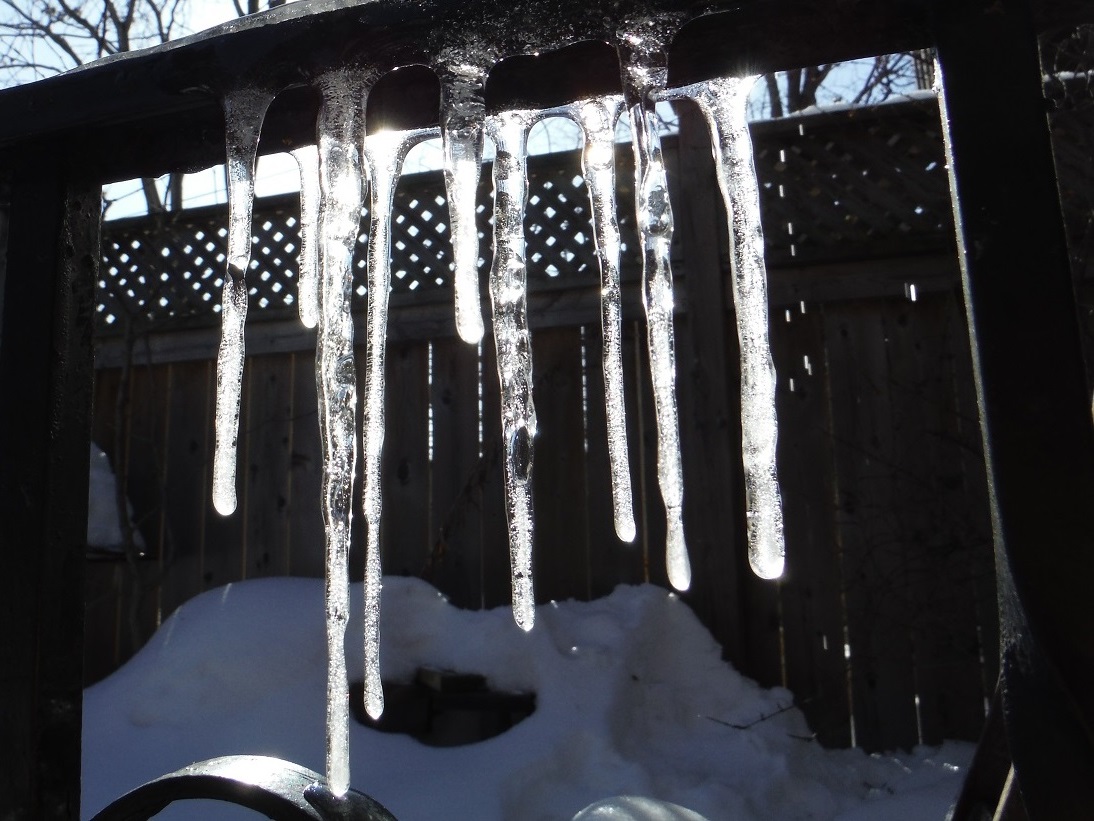
Una temperatura de menos 1 grados centígrados, aquí en Toronto…¡pero está viniendo La Primavera!
.
Joyce Wakefield
Conversación en Invierno
.
Te escucho mientras me explicas
La diferencia entre el cerebro del lado derecho y del lado izquierdo.
El olor de frío en la superficie de tu cara me distrae.
Lo lamo como una criatura con un helado de cucurucho,
con dedos pegajosos y una lengua dulce.
.
He ido estar aquí, antes, entonces
Pauso con tus palabras.
He dormido en esta piel,
He sonado estos huesos de invierno.
.
Despierto en la oscuridad entre nosotros,
Oigo la escarcha que barre el porche,
Que se acerca lentamente al alba,
Y echo mano a tu mano.
.
¿Y qué? tu susurras, con una voz que está ronca con sueños.
Mis labios, hinchados contigo, y fríos,
Están silenciados.
. . .
Joyce Wakefield
Winter Conversation
.
I listen to you explain the difference
between a right brain thought and a left.
I am distracted by the smell
of cold on your face.
I lick it away like a child
with an ice cream cone,
sticky fingers and sweet tongue.
Aware that I have been here before
I pause in your words.
I have slept in this flesh,
dreamed these winter bones.
Waking in the darkness between us
I hear frost sweeping the porch,
edging toward the morning.
I reach for your hand.
What? you whisper, voice hoarse with dream.
My lips, swollen with you, cold,
are silent.
. . . . .
Andre Bagoo: “I am the Archipelago”: Eric Roach and Black Identity
Posted: February 28, 2015 Filed under: 7 GUEST EDITORS, Andre Bagoo, English, Eric Merton Roach | Tags: Black History Month Comments Off on Andre Bagoo: “I am the Archipelago”: Eric Roach and Black Identity
“I am the Archipelago”: Eric Roach and Black Identity
By Andre Bagoo
.
THOSE who know Eric Roach, know how the story ends. This year marks the centenary of the Trinidadian poet who was born in 1915 at Mount Pleasant, Tobago. He worked as a schoolteacher, civil servant and journalist, among other things. Along the way, he published in periodicals regularly. But in 1974, he wrote the poem ‘Finis’, drank insecticide, then swam out to sea at Quinam Bay. The first-ever collected edition of his poetry only appeared two decades after his death. In it, Ian McDonald describes Roach as, “one of the major West Indian poets”. He places Roach alongside Claude McKay, Derek Walcott, Louise Bennett, Martin Carter and Edward Kamau Brathwaite.
.
Too often is the discourse on Roach coloured by his story’s ending. We cannot ignore the facts of what occurred at Quinam Bay, yes, but sometimes they distract from the poet’s genuine achievements. Notwithstanding the emerging consensus on his stature, he is still best known for his ill-fated death. Yet the journey is sometimes more important than the destination.
.
In an introduction to the same collected edition of Roach’s poems published by Peepal Tree Press in 1992, critic Kenneth Ramchand states: “in the English-speaking Caribbean, is there anyone who had written as passionately about slavery and its devastations before ‘I am the Archipelago’ (1957) hit our colonised eardrums?” Ramchand notes that Roach was, “committed, as selflessly and as passionately as one can be, to the idea of a unique Caribbean civilisation taking shape out of the implosion of cultures and peoples in the region.” For Ramchand, “the ultimate justification of [Roach’s] art would be that it contributed to the making and understanding of this new, cross-cultural civilisation.” That cross-cultural civilisation is the one Walcott speaks of when he remarks:
.
Break a vase, and the love which reassembles the fragments is stronger than the love which took its symmetry for granted when it was whole….This gathering of broken pieces is the care and pain of the Antilles….Antillean art is this restoration of our shattered histories, our shards of vocabulary, our archipelago becoming a synonym for pieces broken off from the original continent.
.
This is really a call for the new breed of Caribbean poets, the breed that reverses colonialisation’s history of plunder. Just as our colonial overlords of the past have done, poets, now, are free to pillage from whichever continent they choose. This is not a process of retribution, but rather the restoration of the resilience of the human spirit itself amid the sea of history. It also asserts the reality of the fact that we are as much a part of world culture as anyone else and cannot be marginalised from it.
.
Roach – sometimes called the “Black Yeats”– was one in a long line of poets for whom imitation and allusion are, in fact, blatant acts of rebellion. He also saw himself as key to the process of forming a West Indian Federation, a political union which he felt required a new poetry. Though that union never came to pass, Roach’s work still serves to engage key aspects of Caribbean identity.
The narrative of Black identity, whatever that may be, has to some extent played on the idea of separate black and white races. It has also called for a rejection of “white” ideas and a return to African ideas. But these are uneasy dichotomies which paper over the realities of history over time, the mixing of races and the idea that race itself is an invention. At the same time, these categories ignore the complexity of colonisation. That process of colonisation saw states and peoples being exploited for economic resources and then, in the mid-20th century, abandoned by colonial motherlands under the pretence of liberation – even as strong economic subservience remains in place to this very day.
.
And this is why Roach remains relevant: he not only asserts that the English language is as much ours as theirs, but also sings of the true implications of history, a history sometimes obscured by neat narratives of “independence” and “emancipation”. This is why Roach is still alive.
. . .
I AM THE ARCHIPELAGO
.
I am the archipelago hope
Would mould into dominion; each hot green island
Buffeted, broken by the press of tides
And all the tales come mocking me
Out of the slave plantations where I grubbed
Yam and cane; where heat and hate sprawled down
Among the cane – my sister sired without
Love or law. In that gross bed was bred
The third estate of colour. And now
My language, history and my names are dead
And buried with my tribal soul. And now
I drown in the groundswell of poverty
No love will quell. I am the shanty town,
Banana, sugarcane and cotton man;
Economies are soldered with my sweat
Here, everywhere; in hate’s dominion;
In Congo, Kenya, in free, unfree America.
.
I herd in my divided skin
Under a monomaniac sullen sun
Disnomia deep in artery and marrow.
I burn the tropic texture from my hair;
Marry the mongrel woman or the white;
Let my black spinster sisters tend the church,
Earn meagre wages, mate illegally,
Breed secret bastards, murder them in womb;
Their fate is written in unwritten law,
The vogue of colour hardened into custom
In the tradition of the slave plantation.
The cock, the totem of his craft, his luck,
The obeahman infects me to my heart
Although I wear my Jesus on my breast
And burn a holy candle for my saint.
I am a shaker and a shouter and a myal man;
My voodoo passion swings sweet chariots low.
.
My manhood died on the imperial wheels
That bound and ground too many generations;
From pain and terror and ignominy
I cower in the island of my skin,
The hot unhappy jungle of my spirit
Broken by my haunting foe my fear,
The jackal after centuries of subjection.
But now the intellect must outrun time
Out of my lost, through all man’s future years,
Challenging Atalanta for my life,
To die or live a man in history,
My totem also on the human earth.
O drummers, fall to silence in my blood
You thrum against the moon; break up the rhetoric
Of these poems I must speak. O seas,
O Trades, drive wrath from destinations.
.
(1957)
. . .
Andre Bagoo is a Trinidadian poet and journalist, born in 1983. His second book of poems, BURN, is published by Shearsman Books. To read more ZP features by Andre Bagoo, click on his name under “Guest Editors” in the right-hand column.
. . . . .
Mildred K. Barya: Birmingham Postcard and The Promised Land
Posted: February 28, 2015 Filed under: 7 GUEST EDITORS, English, Langston Hughes, Mildred K. Barya | Tags: Black History Month Comments Off on Mildred K. Barya: Birmingham Postcard and The Promised Land
 Zócalo Poets