Poemas para El Día Internacional de la Mujer: Tres poetas que deseamos honrar / Poems for International Women’s Day: Three poets we wish to honour
Posted: March 8, 2012 Filed under: Ana Castillo, bell hooks, English, Freedom Nyamubaya, Spanish, ZP Translator: Alexander Best, ZP Translator: Lidia García Garay Comments Off on Poemas para El Día Internacional de la Mujer: Tres poetas que deseamos honrar / Poems for International Women’s Day: Three poets we wish to honour ZP_Itzpapalotl_Goddess mural in San Francisco_near 16th and Sanchez streets
.
bell hooks
(nace/born 1952, Kentucky, EEUU/USA)
En ese momento que… / The moment that…
*
En ese momento que decidimos amar
Empezamos a ir en contra de
La dominación, en contra de
La opresión.
En ese momento que decidimos amar
Empezamos a irnos hacia la libertad;
A actuar de maneras que nos liberan – y que liberan a otros también.
Esa acción es el testimonio del amor como la práctica de la libertad.
*
The moment we choose to love
we begin to move
against domination,
against oppression.
The moment we choose to love
we begin to move towards freedom;
to act in ways that liberate ourselves – and others.
That action is the testimony of love as the practice of freedom.
_____
Freedom Nyamubaya
(nace/born 1958, Zimbabwe)
La Poesía
*
Alguien dijó, no eres poeta,
pero olvidó que la poesía es un arte y
El Arte is un ritmo significativo.
Pues entonces, ¿qué es ritmo,
si puedo preguntar?
Algunos dicen que es sílabas marchando
otros dicen: sonidos marchando
pero dime como puedo casarlos a los dos.
Luchamos contra Shakespeare en el campo de batalla,
Los Negros lucharon contra los Bóeres con las lanzas.
Éstas son sílabas que marchan
y son el Arte – a alguna gente,
pues, ¿cómo yo puedo casarlos a los dos?
¿Y qué decimos de un ritmo diferente?
Mueren en los guetos la gente,
por redadas de policía y disparos del ejército.
Los obreros se asfixian en las minas de carbón,
excavando el carbón que no pueden comprar
para cocinar a diario para alimentarse.
Algo poético, ésto.
Pues quedemos en no estar de acuerdo.
El Arte sirve.
_____
Freedom Nyamubaya
Poetry
*
One person said, you are not a poet,
but forgot that poetry is an art and
Art is meaningful rhythm.
Now what is rhythm
if I may ask?
Some say it’s marching syllables,
others say it’s marching sounds,
but tell me how you marry the two.
We fought Shakespeare on the battlefield,
Blacks fought the Boers with their spears.
These are marching syllables
and Art to some,
but how can I marry the two?
How about a different rhythm?
People die in the ghettoes,
from police raids and army shots.
Workers suffocate under coal mines,
digging the coal they can’t afford to buy
for cooking daily to feed themselves.
Poetic stuff, this.
Then let’s agree to disagree.
Art serves.
_____
Ana Castillo
(nace/born 1953, Chicago, Illinois, EEUU/USA)
Pido lo Imposible
*
Yo pido lo imposible: ámame por siempre
Ámame cuando todo el amor se haya ido.
Ámame con la dedicación de un monje.
Cuando el mundo en su totalidad,
y todo lo que para ti es sagrado, te aconsejan
contra ello: ámame aún más.
Cuando la cólera te llene y no tenga nombre: ámame.
Cuando cada paso de tu puerta a nuestro trabajo te fatigue,
ámame; y del trabajo de retorno a casa, ámame.
Ámame cuando estés aburrido,
cuando cada mujer que veas sea más bella que la anterior,
o más patética, ámame como siempre lo haz hecho:
no como admirador o juez pero con
la compasión que guardas para ti mismo
en tu nostalgia.
Ámame tanto cuanto aprecias tu soledad,
la anticipación de tu muerte,
misterios de la carne, mientras se rompe y se sana.
Ámame como tu más atesorada memoria de la infancia
– y si no hay ninguna a recordar –
imagínate una, y yo allí contigo.
Ámame marchita tanto como me amastes nueva.
Ámame como si yo fuera para siempre
y haré de lo imposible
un acto simple,
al amarte, amarte como yo te amo.
_____
Ana Castillo
I Ask The Impossible
*
I ask the impossible: love me forever.
Love me when all desire is gone.
Love me with the single mindedness of a monk.
When the world in its entirety,
and all that you hold sacred, advise you
against it: love me still more.
When rage fills you and has no name: love me.
When each step from your door to our job tires you,
love me; and from job to home again, love me, love me.
Love me when you’re bored,
when every woman you see is more beautiful than the last,
or more pathetic, love me as you always have:
not as admirer or judge but with
the compassion you save for yourself
in your solitude.
Love me as you relish your loneliness,
the anticipation of your death,
mysteries of the flesh, as it tears and mends.
Love me as your most treasured childhood memory
– and if there is none to recall –
imagine one, place me there with you.
Love me withered as you loved me new.
Love me as if I were forever
and I will make the impossible
a simple act,
by loving you, loving you as I do.
_____
Traducciones del inglés al español:
Alexander Best (“En ese momento que…” y “La Poesía”)
Lidia García Garay (“Pido lo Imposible”)
_____
Etta James: “Mi Fuerte Amante” / “Tough Lover”
Posted: February 28, 2012 Filed under: English: Black Canadian / American, Etta James, Spanish, Translator's Whimsy: Song Lyrics / Extravagancia del traductor: Letras de canciones traducidas por Alexander Best, ZP Translator: Lidia García Garay Comments Off on Etta James: “Mi Fuerte Amante” / “Tough Lover”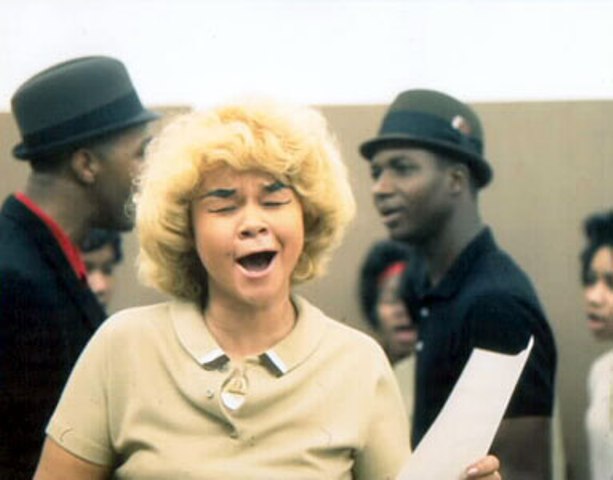
Etta James
“Mi Fuerte Amante” (1956)
Tengo un amante que me mueve tanto,
Sabe hacer ‘el rocanrol’,
Porque es fuerte – mi amante –
Es un amante vigoroso,
Amante recio,
Un amante fuerte – ¡eso es!
*
Cuando me besa,
Me emociona;
Cuando se sacude,
No me quedo quieta.
Es un amante vigoroso,
Amante recio,
Un amante fuerte – ¡aaah, sííí!
*
Las Siete Hermanas no lo pueden tener,
Estoy hablando acerca del Amor –
Y es veloz – él – como el viento.
Habla la gente que estoy enbrujada.
Pero no es el vudú – ¡es ese “twist”!
El Amante más grande de nuestra era,
Aún Don Juan no tiene ningun’esperanza.
Te hace reír,
Te hace llorar,
Se pone tan recio que
Pued’hacer a un’estatua de Venus resucitar.
Hace todo lo que quiera – aún:
Pisotear los zapatos de gamuza-azul de Jesse James.
Es un amante audaz,
y duro, y recio,
Un amante fuerte – ¡ajá, ajá!
*
¿Tienes amante que quieras amar?
¡Golpéale en la cabeza una vez – o dos!
Será tu amante vigoroso – ¡sí, sí! –
Un amante recio – ¡eso es!
Un amante fuerte – ¡aaah, sííí!
Glosario:
Las Siete Hermanas se llaman Las Pléyades – en la mitología griega.
Las dos más famosas – Electra y Maia – eran “Fuerzas de la Naturaleza”.
Jesse James era un forajido estadounidense de la era “Viejo Oeste”.
_____
Etta James (1938-2012)
escribió las letras y grabó esta canción
en 1956 – a la edad tierna de dieciocho años.
Su personalidad era fuerte y burlona pero pudo
cantar también la música íntima del Blues.
*
Traducción / interpretación en español: Lidia García Garay
_____
Etta James
“Tough Lover” (1956)
Well, I’ve got a lover that moves me so
He sho knows how to rock’n’roll
‘Cause he’s a tough lover – yeah, yeah
He’s a tough lover – wooooo
Tough Lover – yeah, yeah
Tough Lover – unh hunh!
*
When he kisses me
I get a thrill
But when he does that wiggle
I can’t keep still
‘Cause he’s a tough lover – yeah, yeah
He’s a tough lover – wooooo!
Tough Lover – yeah, yeah
Tough Lover – unh hunh!
*
The Seven Sisters have nothin’ on him
I’m talkin’ about love – and he’s fast as the wind
People all talk about he’s got me fixed
It ain’t hoodoo – it’s just that twist!
He’s the greatest lover ever come to pass
Don Juan ain’t got a half of a chance.
He can make you laugh
He can make you cry
He’s so tough he’ll make Venus come alive.
He can do anything that he wants to do –
Step on Jesse James’s blue-suede shoes
‘Cause he’s a tough lover – yeah, yeah
He’s a tough lover – wooooo!
Tough Lover – yeah, yeah
Tough Lover – unh hunh!
*
You got a lover
That you wanna love right?
Just pop him ’side the head
– Once or twice!
He’ll be a tough lover – yeah, yeah
He’ll be your tough lover – wooooo!
Tough lover – yeah, yeah
Tough lover – unh hunh!
_____
Etta James (1938-2012)
was a rock’n’roll “mama” even
at the tender age of 18, which is when she
wrote and recorded this song with her band,
The Peaches. Her vocal delivery was often
rough-and-tough in sound – but also full of
fun. The “wooooo’s” in her singing she
borrowed from Little Richard, with whom
she toured in the 1950s. By middle age she
was undisputedly the best living Blues singer
in The United States.
_____
Nicomedes Santa Cruz: “Black Rhythms of Peru” / “Ritmos negros del Perú” – “Latin America” / “América Latina”
Posted: February 12, 2012 Filed under: English, Nicomedes Santa Cruz, Spanish, ZP Translator: Alexander Best, ZP Translator: Lidia García Garay | Tags: Black poets Comments Off on Nicomedes Santa Cruz: “Black Rhythms of Peru” / “Ritmos negros del Perú” – “Latin America” / “América Latina”
Nicomedes Santa Cruz
( Poeta y músico afro-peruano, 1925-1992)
“Ritmos negros del Perú” (1957)
Ritmos de la esclavitud
contra amarguras y penas.
Al compás de las cadenas
Ritmos negros del Perú.
*
De África llegó mi abuela
vestida con caracoles,
la trajeron lo´epañoles
en un barco carabela.
La marcaron con candela,
la carimba fue su cruz.
Y en América del Sur
al golpe de sus dolores
dieron los negros tambores
ritmos de la esclavitud
*
Por una moneda sola
la revendieron en Lima
y en la Hacienda “La Molina”
sirvió a la gente española.
Con otros negros de Angola
ganaron por sus faenas
zancudos para sus venas
para dormir duro suelo
y naíta´e consuelo
contra amarguras y penas…
*
En la plantación de caña
nació el triste socabón,
en el trapiche de ron
el negro cantó la zaña.
El machete y la guadaña
curtió sus manos morenas;
y los indios con sus quenas
y el negro con tamborete
cantaron su triste suerte
al compás de las cadenas.
*
Murieron los negros viejos
pero entre la caña seca
se escucha su zamacueca
y el panalivio muy lejos.
Y se escuchan los festejos
que cantó en su juventud.
De Cañete a Tombuctú,
de Chancay a Mozambique
llevan sus claros repiques
ritmos negros del Perú.
_____
Nicomedes Santa Cruz
(Black Peruvian poet and singer, 1925-1992)
Black Rhythms of Peru (1957)
Rhythms of slavery
Against bitterness and sorrows.
Keeping time to the beat of the chains
– Black rhythms of Peru.
*
From Africa arrived my grandmother
Adorned with conch-shells,
They brought her, those Spaniards,
In a three-masted ship.
Marked by wax and fire – the
“carimba” scar was the cross she bore.
And in South America
To each strike, in her suffering,
The Black drums gave
Rhythms to that slavery.
*
For one coin
They sold my grandmother again
In Lima
And at Hacienda La Molina
She served the Spanish people.
With other Blacks from Angola
She earned for her tasks
Mosquito bites on her veins
Sleeping upon hard ground,
And nuthin’ ain’t no consolation
Against bitterness and sorrows…
*
On the sugarcane plantation
Was born that sad “socabón” dance
In the rum-press at the mill,
The Black man sang of Zaña.
The “machete” and the scythe
Cut his dark hands;
And the Indians with their reed-flutes,
The Black man and his tambourine,
Sang of their sad luck
Keeping time to the beat of the chains.
*
They died, those old Black folks…
But within the dried fibres of the cut cane
One hears the Zamacueca dance
And the distant Panalivio.
One hears the festivities they
Sang of in their youth.
From Cañete to Timbuktu,
From Chancay to Mozambique
They carried the clear pitter-patter,
The tap-tap-tap of those
Black rhythms of Peru.
_____
Glossary:
Zaña: 16th-century Spanish-Colonial town in Peru – inhabited by
wealthy, pious Spanish families involved in sugar and cotton
plantations based upon African slavery and Native-Indian servitude.
Raided by English pirates in 1686 – many people were killed,
prosperous families abandoned the town, and slaves
became unexpectedly “free”… La Zaña is an Afro-Peruvian dance
originating in the town.
Zamacueca, Panalivio: Afro-Peruvian dances of the 18th
and 19th centuries – the Zamacueca was a courtship dance and
the Panalivio’s lyrics often told of the trials of slavery.
*
Cañete, Chancay: Peruvian Spanish-Colonial towns – prominent in
the 17th through the 19th centuries – surrounded by haciendas
and sugar/cotton plantations. Large African-born and native-
born Black slave populations.
* * *
Nicomedes Santa Cruz:
“América Latina”(1963) / “Latin America”(1963)
Mi cuate My pal
Mi socio My mate
Mi hermano My brother
Aparcero Sharecropper
Camarado Colleague
Compañero Comrade
Mi pata My buddy
M´hijito My boy
Paisano… Compatriot…
He aquí mis vecinos. Here I have my neighbours
He aquí mis hermanos. Here I have my brothers
*
Las mismas caras latinoamericanas The same Latin-American faces
de cualquier punto de América Latina: from every corner of Latin America:
Indoblanquinegros Indianwhiteblacks
Blanquinegrindios Whiteblackindians
y Negrindoblancos and Blackindianwhites
*
Rubias bembonas Blondes with thick lips
Indios barbudos Bearded Indians
y negros lacios and straight-haired Blacks
*
Todos se quejan: All of them complain
-¡Ah, si en mi país – Oh, if only in my country
no hubiese tanta política…! there wasn’t so much “politics”…!
-¡Ah, si en mi país – Oh, if only in my country
no hubiera gente paleolítica…! there weren’t such paleolithic people…!
-¡Ah, si en mi país – Oh, if only in my country
no hubiese militarismo, there was no militarism,
ni oligarquía or oligarchy
ni chauvinismo or chauvinism
ni burocracia or bureaucracy
ni hipocresía or hypocrisy
ni clerecía or clergy
ni antropofagia… or anthropophagy…
-¡Ah, si en mi país…! – Oh, if only – in my country…!
*
Alguien pregunta de dónde soy Someone asks where I’m from
(Yo no respondo lo siguiente): (I do not answer with the following):
Nací cerca de Cuzco I was born close to Cuzco
admiro a Puebla Puebla I admire
me inspira el ron de las Antillas I’m inspired by rum from The Antilles
canto con voz argentina I sing in an Argentinian voice
creo en Santa Rosa de Lima I believe in Saint Rose of Lima
y en los Orishas de Bahía. and in the Orishas of Bahia.
Yo no coloreé mi Continente I didn’t paint my Continent
ni pinté verde a Brasil the green of Brazil
amarillo Perú the yellow of Peru
roja Bolivia Bolivia’s red
*
Yo no tracé líneas territoriales I drew no border-lines
separando al hermano del hermano. separating brother from brother
*
Poso la frente sobre Río Grande I rest by the Rio Grande
me afirmo pétreo sobre el Cabo de Hornos I stand firm at Cape Horn
hundo mi brazo izquierdo en el Pacífico my left hand I dip down into the Pacific
y sumerjo mi diestra en el Atlántico. and into the Atlantic I submerge my right.
*
Por las costas de oriente y occidente By the coasts East and West
y doscientas millas entro and two-thousand miles inland
a cada Océano from each Ocean
sumerjo mano y mano I immerse both hands
y así me aferro a nuestro Continente and in this way I hold our Continent
en un abrazo Latinoamericano. in a Latin-American embrace.
*
Translation from the original Spanish into English:
“Black Rhythms of Peru”: Alexander Best
“Latin America”: Lidia García Garay
Juliane Okot Bitek: “Dans Sept Jours” et “À Langston Hughes”
Posted: February 1, 2012 Filed under: English, French, Juliane Okot Bitek, ZP Translator: Lan Truong, ZP Translator: Lidia García Garay | Tags: Black poets Comments Off on Juliane Okot Bitek: “Dans Sept Jours” et “À Langston Hughes”_____
“Dans Sept Jours”
Une main delicate
tient un eventail
Evoque des souvenirs de la performance d’un amoureux
*
Dis-moi
Dis-moi car je ne m’imagine pas
La chaleur qui se lève dans l’arrière de ma gorge
S’étendre dans ma poitrine
Tombe
Et se dépose
*
Je ne reviendrai pas vers toi
*
Une fleur se ferme
Se dessèche à cause de la froide étreinte
D’un vent sec et amer
*
Tout sera fini
Dans sept jours.
_____
“À Langston Hughes”
Si tu ne restes pas
Pour lire mon coeur,
Cela ne me dérange pas
*
J’ai déchiré ton livre de poésie
*
Tu as menti:
Comme je prenais le train à Harlem
Tu as déraillé.
_____
Le poète Juliane Okot Bitek est née à Kenya en 1966.
Elle a passé son enfance en Ouganda.
Et maintenant elle habite à Vancouver, Canada.
*
Traductions de l’anglais au français:
Lidia Garcia Garay, Lan Truong
_____
“Seven Days”
A delicate hand
Holds a fan
Evokes memories of a lover’s performance
Tell me
Tell me that I do not imagine
The heat that rises at the back of my throat
Spreads through my chest
Falls
And settles
I am not returning to you
A flower folds up
Shrivels from the cold embrace
Of a dry and bitter wind
In seven days
It will be over.
_____
“To Langston Hughes”
That you will not stay
To read my heart
Doesn’t matter to me
I tore your book of poetry
You lied:
While I took the Harlem train uptown
You strayed.
_____
Poet Juliane Okot Bitek was born in Kenya in 1966
and spent her childhood in Uganda.
She now lives in Vancouver, Canada.
_____
Langston Hughes: “La Señora y su Señora” / “Madame et sa Madame” / “Madam and her Madam”
Posted: February 1, 2012 Filed under: English: Black Canadian / American, French, Langston Hughes, Spanish, ZP Translator: Lan Truong, ZP Translator: Lidia García Garay | Tags: Black poets Comments Off on Langston Hughes: “La Señora y su Señora” / “Madame et sa Madame” / “Madam and her Madam”_____
Langston Hughes (February 1st, 1902 – 1967)
“Madam and Her Madam”
I worked for a woman,
She wasn’t mean–
But she had a twelve-room
House to clean.
*
Had to get breakfast,
Dinner, and supper, too–
Then take care of her children
When I got through.
*
Wash, iron, and scrub,
Walk the dog around–
It was too much,
Nearly broke me down.
*
I said, Madam,
Can it be
You trying to make a
Pack-horse out of me?
*
She opened her mouth.
She cried, Oh, no!
You know, Alberta,
I love you so!
*
I said, Madam,
That may be true–
But I’ll be dogged
If I love you!
_____
“La Señora y su Señora”
por Langston Hughes
Trabajé para una mujer
No era muy malvada—
Ella tenía una casa de doce cuartos
que yo tenía que limpiar.
*
Tenía que hacer desayuno,
Almuerzo y cena también—
Después atender a los niños,
Al terminar.
*
Lavar, planchar, y limpiar
Llevar a caminar al perro…
Era demasiado,
Casi me destroza.
*
Yo le dije, Señora,
¿Es posible que usted
Está tratando de convertirme
En un caballo de carga?
*
Ella habrió su boca
Y exclamó:
¡Oh, no!
Sabes Alberta,
¡Yo a tí te quiero mucho!
*
Yo le dije: Señora,
Puede que eso sea verdad—
¡Pero que desgracia la mía
Si yo la quiero a usted!
*
Traducción del inglés al español: Lidia García Garay
_____
“Madame et sa Madame”
par Langston Hughes
J’ai travaillé pour une femme,
Elle n’était pas méchante—
Elle avait une maison avec
douze chambres
Que je devais nettoyer.
Préparer le petit déjeuner,
Le déjeuner et le dîner aussi—
Je devais garder ses enfants
Après tout ca.
Faire la lessive et la repasser,
et nettoyer le plancher,
Promener son chien—
C’était trop!,
Le travail m’a fait presque craquer.
*
Je lui ai dit: Madame,
Est-ce qu’il est possible
Que vous essayiez
De me transformer en cheval de trait?
*
Elle a ouvert sa bouche.
Et elle a dit: Pas du tout!
Tu sais Alberta,
Je t’aime beaucoup!
*
Je lui ai dit: Madame,
Cela peut être la vérité
Mais je serais foutue
si je vous aime!
*
Traduction de l’anglais au français:
Lidia García Garay, Lan Truong
_____
Langston Hughes: “La Vida es buena” / “La Vie est bien” / “Life is Fine”
Posted: February 1, 2012 Filed under: English: Black Canadian / American, French, Spanish, ZP Translator: Lan Truong, ZP Translator: Lidia García Garay | Tags: Black poets Comments Off on Langston Hughes: “La Vida es buena” / “La Vie est bien” / “Life is Fine”_____
Langston Hughes (February 1st, 1902 – 1967)
“Life is Fine”
I went down to the river,
I set down on the bank.
I tried to think but couldn’t,
So I jumped in and sank.
I came up once and hollered!
I came up twice and cried!
If that water hadn’t a-been so cold
I might’ve sunk and died.
But it was Cold in that water! It was cold!
*
I took the elevator
Sixteen floors above the ground.
I thought about my baby
And thought I would jump down.
I stood there and I hollered!
I stood there and I cried!
If it hadn’t a-been so high
I might’ve jumped and died.
But it was high up there! It was high!
*
So since I’m still here livin’,
I guess I will live on.
I could’ve died for love–
But for livin’ I was born
Though you may hear me holler,
And you may see me cry–
I’ll be dogged, sweet baby,
If you gonna see me die.
Life is fine! Fine as wine! Life is fine!
_____
“La Vida es Buena”
por Langston Hughes
Fuí al río
Me senté a la orilla
Traté de pensar sin éxito alguno,
Entonces me lancé al agua y me hundí
¡Salí una vez y grité!
¡Sali una segunda vez y lloré!
Si el agua no hubiera estado tan fría
Me habría hundido y habría muerto
¡Pero estaba
Frío en el agua!
¡Hacía frío!
*
Tomé el ascensor
Quince pisos arriba
Pensé en mi amor
Y pensé que me tiraría
¡Estube un rato y grité!
¡Estube un rato y lloré!
Si no hubiera estado tan alto
Habría saltado y muerto.
¡Pero estaba muy alto allá arriba!
*
Entonces ya que estoy aquí vivo,
Supongo que seguiré viviendo.
Yo podría haber muerto por amor,
Pero para vivir nací
Aunque me oigan gritar—
Y me oigan llorar
Que desgracia la mía, dulce amor,
Si tu me vas a ver morir.
¡La Vida es Buena! ¡Buena como el vino! ¡La Vida es Buena!
*
Traducción del inglés al español: Lidia García Garay
_____
“La Vie est Bien”
par Langston Hughes
(1er février, 1902 – 1967)
Je suis allé à la rivière,
me suis assis sur le bord,
J’ai essayé de penser mais je n’en ai pas pu,
alors je me suis jeté dans l’eau et j’ai coulé,
Je suis sorti de là et j’ai beuglé!
Une deuxième fois et j’ai pleuré.
Si l’eau n’avait pas été si froide
j’aurais coulé et été mort.
Mais il faisait froid dans l’eau!
*
J’ai pris l’ascenseur,
suis monté dans le seizième étage,
J’ai pensé a mon amour
Et j’ai pensé à me jeter du haut de l’édifice.
Je suis resté un moment et j’ai beuglé!
Je suis resté là et j’ai pleuré!
Si où j’était n’était si haut
j’aurais eu me jeter et mourir.
Mais il était très haut là bas!
*
Alors, comme je suis encore ici et vivant,
Ça veut dire que je vais continuer à vivre.
Je serais mort à cause de l’amour
Mais je suis né pour vivre.
Vous pouvez m’entendre hurler
Et vous pouvez me voir pleurer –
Je serais foutu, mon amour,
Si tu me vois mourir.
La vie est bonne! Comme le vin est bon! La vie est bien!
*
Traduction de l’anglais au français:
Lidia García Garay, Lan Truong
_____
Su Nombre es Jesús y Soy Su Niña / His Name is Jesus and I’m His Child : Zella Jackson Price
Posted: December 24, 2011 Filed under: English, Spanish, ZP Translator: Lidia García Garay | Tags: Christmas carols and songs Comments Off on Su Nombre es Jesús y Soy Su Niña / His Name is Jesus and I’m His Child : Zella Jackson Price_____
Soy Su Niña
(canción evangélica de Zella Jackson Price, 1982)
Es posible que no sea lo mejor de todo
o tenga lo mejor de algo,
algunas veces me siento que soy
lo menos de todo.
Pero conozco a alguien que tiene todo
Y Él es mi Todo,
Y yo estoy feliz de
tan sólo saber que:
Soy Su Niña.
Su nombre es Jesús,
El Hijo Recto de Diós,
El Lirio del Valle y
La Estrella más Brillante de la Mañana.
Su nombre es Jesús,
y Él es mi Todo
– Ohhh sí –
y estoy feliz de
tan sólo saberlo:
¡ Soy Su Niña !
*
Traducción del inglés al español: Lidia García Garay
Translation from English into Spanish: Lidia García Garay
*
I’m His Child
(as sung by Zella Jackson Price, 1982)
I may not be the best of anything
Or have the best of anything,
Sometimes I feel like I’m the least of all.
But I know someone who has everything
And He is my Everything,
And I happy just to know that
I’m His Child !
His name is Jesus,
the Righteous Son of God, the
Lily of the Valley and the
Brightest Morning Star.
His name is Jesus, and
He’s my Everything
– Ohhh yes he is –
And I am happy just to know that
I’m His Child !
_____
The Old Empire’s Language, 2: Jun Tiburcio
Posted: August 20, 2011 Filed under: English, French, Jun Tiburcio, Spanish, Tutunakú, ZP Translator: Alexander Best, ZP Translator: Lidia García Garay Comments Off on The Old Empire’s Language, 2: Jun Tiburcio
“Taskulanatlon”
.
Kakuwinin katlawalh chichini xatutunaku,
kaj matsiswanimakgólh tama luwanan.
Kakisikulanatlawa xa tutunaku kintlatikan,
tama luwanan ka ki lakgapalamakgólh.
Kakimakgalhtokge xa tutunaku,
tama tatsokgni xa luwan ka akgsaninan.
Kakintlini xa tutunaku,
akan tliy luwan ka lixkan kiwaniy.
Kakixakgatli xa tutunaku,
ntama xtachuwinkan luwanan kimatasiy.
_____
“Bendiciones”
.
Bendíceme en totonaco, Dios mío,
porque en español me maldicen.
Illumíname con el sol totonaco,
porque me opacan en español.
Dame sabiduría totonaca, Dios mío,
porque en español me llaman tonto.
Dame letras en totonaco,
porque las letras españoles mienten.
Cántame en totonaco,
porque en español me ofenden.
Háblame en totonaco,
porque en español me gritan.
_____
“Blessings”
.
Bless me in Tutunaku, my God,
because in Spanish they say bad things about me.
Illuminate me with the Tutunaku sun,
because the Spanish sun makes me dull and hazy.
Give me Tutunaku wisdom, my God,
because in Spanish they call me stupid.
Give me the Tutunaku alphabet,
because Spanish letters lie.
Sing to me in Tutunaku,
because the sound of Spanish offends me.
Speak to me in Tutunaku,
because in Spanish they always shout at me.
_____
“Bénédictions”
.
Bénis-moi, mon Dieu,
parce qu’ils me maudissent en espagnol.
Illumine-moi avec le soleil totonaque
parce qu’ils m’assombrent en espagnol.
Donne-moi la sagesse totonaque, mon Dieu,
parce qu’en espagnol ils m’appellent bête.
Donne-moi des lettres en totonaque,
parce que les lettres en espagnol mentent.
Chante-moi en totonaque,
parce qu’ils m’offensent en espagnol.
Parle-moi en totonaque,
parce qu’ils me hurlent en espagnol.
__________
Jun Tiburcio (nació en 1960) es un poeta del lenguaje totonaco (tutunaku), y
su pueblo de familia es Chumatlán, Estado de Veracruz, México.
“Bendiciones” contiene el poder del enojo en forma de palabras de un ritual religioso.
*
Jun Tiburcio (born 1960) is an indigenous poet from the town of Chumatlán, in the
State of Veracruz, México. He writes in his native language of Tutunaku.
“Blessings” contains all of anger’s power using the word-forms of religious ritual.
*
Traducción al español por el poeta
Spanish translation by the poet himself
*
Translation from Spanish into French by Lidia García Garay
Translation from Spanish into English by Alexander Best
“De mis manos te doy a Ti”: una canción evangélica de Trinidad y Tobago
Posted: July 30, 2011 Filed under: English, Spanish, Translator's Whimsy: Song Lyrics / Extravagancia del traductor: Letras de canciones traducidas por Alexander Best, ZP Translator: Lidia García Garay Comments Off on “De mis manos te doy a Ti”: una canción evangélica de Trinidad y Tobago
De mis manos te doy a Ti, ah Señor,
De mis manos te doy a Ti.
Te doy a Ti como tú me diste a mí,
De mis manos te doy a Ti.
Nos guiaste fuera de la oscuridad
Cuando no sabíamos donde ir.
Entonces nos pediste que te siguiéramos
Y dijimos: NO.
De mis manos te doy a Ti, ah Señor,
De mis manos te doy a Ti.
Te doy a Ti como tú me diste a mí,
De mis manos te doy a Ti.
Sufriste por la Humanidad
Para que pudiéramos estar contigo,
Ah, ¡ que podamos mostrarte un poco de
Agradecimiento
En lo que decimos y hacemos !
De nuestras manos te damos a Ti, ah Señor,
De nuestras manos te damos a Ti.
Te damos a Ti como tú nos diste a nosotros,
De nuestras manos te damos a Ti…
*
” Of my hands I give to You ”
Of my hands I give to You, Oh Lord,
Of my hands I give to You.
I give to You as You gave to me,
Of my hands I give to You.
You led us out of darkness
When we knew not where to go,
You asked us then to follow You,
And we said: NO.
Of my hands I give to You, Oh Lord,
Of my hands I give to You.
I give to You as You gave to me,
Of my hands I give to You.
You suffered for the sake of Man
That we might be with You,
Oh, may we show some gratefulness
In what we say and do !
Of our hands we give to You, Oh Lord,
Of our hands we give to You.
We give to You as You gave to us,
Of our hands we give to You…
_____
“Of my hands I give to You” is a gospel song written by R. Repp,
recorded in the 1970s in Port of Spain, Trinidad,
by The Goretti Group Singers with The Dennis De Souza Trio.
Emily Dickinson: Two poems
Posted: July 26, 2011 Filed under: Emily Dickinson, English, Italian, Spanish, ZP Translator: Lidia García Garay Comments Off on Emily Dickinson: Two poems
After great pain, a formal feeling comes –
The Nerves sit ceremonious, like Tombs –
The stiff Heart questions “was it He, that bore,”
And “Yesterday, or Centuries before”?
The Feet, mechanical, go round
A Wooden way
Of Ground, or Air, or Ought –
Regardless grown,
A Quartz contentment, like a stone –
This is the Hour of Lead –
Remembered, if outlived,
As Freezing persons recollect the Snow –
First – Chill – then Stupor – then the letting go –
*
Italiano:
Dopo una grande pena, un sentimento formale subentra –
I Nervi siedono cerimoniosi, come Tombe –
Il Cuore irrigidito si chiede “fu proprio Lui, che soffrì,”
E “Ieri, o Secoli fa?”
I Piedi, meccanicamente, vanno tutt’intorno –
Un Legnoso percorso
Di Terra, o Aria, o Altro –
Incuranti del divenire,
Un appagamento di Quarzo, come una pietra –
Questa è l’Ora Plumbea –
Ricordata, se si sopravvive,
Come un Assiderato, rammenta la Neve –
Prima – il Freddo – poi lo Stupore – poi il lasciarsi andare –
*
Español:


Después de un gran dolor un sentimiento solemne llega –
Los Nervios descansan ceremoniosos, como Tumbas –
El Corazón endurecido se pregunta  ¿si fue Él, quien aguantó,
Y Ayer, o hace Siglos?


Los Pies dan vuelta mecánicamente –
Una senda Rígida
De Suelo, de Aire, de Obligación –
Crecido sin cuidado alguno,
Una conformidad de Quarzo, como una piedra –

Esta es la Hora de Plomo –
Recordados, si hay sobrevivientes,
Como las personas Helandas recolectan la Nieve –
Primero – Frío – después Asombro – después rendirse –
_____
To make Routine a Stimulus
Remember it can cease –
Capacity to terminate
Is a specific Grace –
Of Retrospect the Arrow
That power to repair
Departed with the torment
Become, alas, more fair –
*
Italiano:
Per fare della Routine uno Stimolo
Ricorda che può cessare –
La capacità di concludere
È una specifica Grazia –
Della Memoria la Freccia
Quel potere di riparare
Spartito con il tormento
Diventa, ahimè, più caro –
Traduzione Italiana de Giuseppe Ierolli
Giuseppe Ierolli has translated the complete works of Emily Dickinson – sì,
tutte le opere ! He is an acknowledged expert on the poet’s life and oeuvre;
his passion makes for a true labour of love.
*
Español:
Para hacer la Rutina un Estímulo
Recuerda que puede cesar –
La abilidad de terminar
Es una Gracia específica –
De Retrospección la Flecha
Ese poder de reparar
Partió con el tormento
¡ay de tí!, sé mas justo –
Traducciones al español por Lidia García Garay
_____
Emily Dickinson, (1830 – 1886), was
born and raised in Amherst, Massachusetts, U.S.A.
She was eccentric, reclusive, and a prolific poet –
though only a handful of her thousand-plus poems
were published in her lifetime.
Unusual for 19th-century poems, Dickinson’s
often had short line lengths, made frequent
use of the dash, and no titles. Early posthumous editions of
her poetry were edited so as to force her verse into
the poetical conventions of the period. These two poems,
written in 1862 and 1871 respectively, are
modernizers of English well before the advent of
20th century experimentation.
 Zócalo Poets