Murielle Jassinthe: Of Country Bodies
Posted: March 6, 2012 Filed under: English, Murielle Jassinthe, ZP Translator: Alexander Best Comments Off on Murielle Jassinthe: Of Country Bodies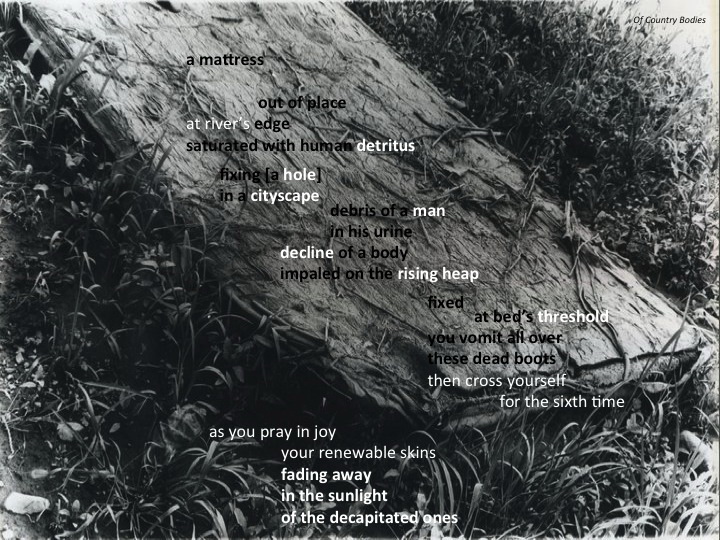
Jassinthe writes of this poem:
“I’m speaking here of two homeless drug-addicts. Having no shelter other than the banks of an urban river, there they sleep where solitude isolates them, pushes them toward a more physical closeness. Drug-taking and love-making help them forget the cold, the loneliness – and their Being.”
_____
Murielle Jassinthe was born in Québec in 1982 – of Haitian parentage.
Currently she’s pursuing a Masters in African and Francophone Literatures at Laval University where she works also as a research assistant. Two years ago, Éditions Bruno Doucey published “Land of Women” – an anthology of Haitian women poets spanning a century-and-a-half. Jassinthe’s poetry was included – one of the youngest voices. Last year, at Laval University’s Lantiss, she worked both as actress and production assistant on a play by Haitian playwright Guy Régis, Jr., entitled “La mort de soi dans sa longue robe de Mariée”. Also in 2011 Murielle received a writer’s grant from Première Ovation, and was mentored by poet Alix Renaud for the creation of her collection of poems with photographs, “Trouble Optik” – from which comes the poem we feature here.
_____
Poem translation from French into English:
Alexander Best – with Murielle Jassinthe
Murielle Jassinthe: Des corps champêtres
Posted: March 6, 2012 Filed under: French, Murielle Jassinthe Comments Off on Murielle Jassinthe: Des corps champêtres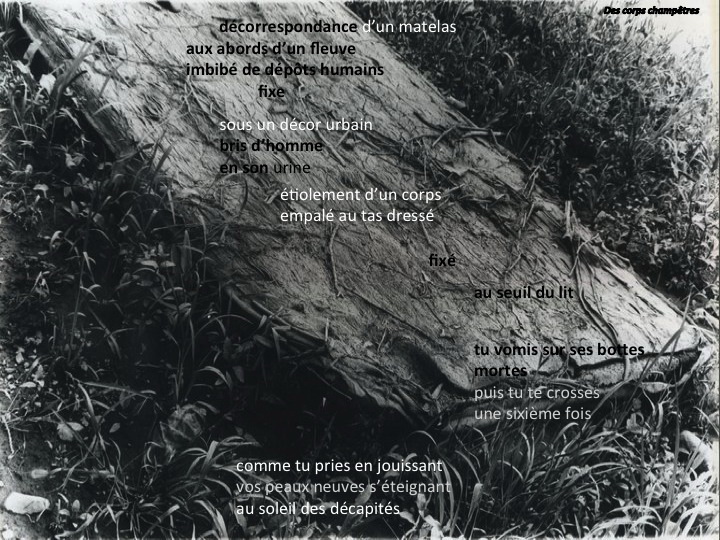
Jassinthe écrit de son poème:
“Je parle de deux sans-abris toxicomanes. N’ayant nul autre abris que les berges d’un
fleuve en ville, ils y dorment. La solitude les isolent et les pousse à se rapprocher
physiquement. La drogue et l’amour physique les aident à oublier le froid, la solitude,
leur être.”
_____
D’origine haïtienne, Murielle Jassinthe naît à Québec en 1982.
Elle poursuit une maîtrise à la Chaire de recherche du Canada en
littératures africaines et francophones à l’Université Laval où elle
œuvre en tant qu’auxiliaire de recherche.
En 2010, les Éditions Bruno Doucey publient trois de ses poèmes
au sein de l’anthologie Terre de femmes, 150 ans de poésie féminine en Haïti.
En 2011, au Lantiss (à Laval), elle y campe le double rôle d’actrice et d’assistante
à la mise en scène, matérialisant ainsi La mort de soi dans sa longue robe de Mariée,
l’une des œuvres du dramaturge haïtien contemporain Guy Régis Jr.
Aussi en 2011 – Bénéficiaire d’une bourse en création littéraire octroyée par
Première Ovation, Murielle fut mentorée par le poète Alix Renaud pour l’écriture de
son recueil Trouble Optik – duquel vient le poème ici.
____
Lisez au-dessus notre traduction français-anglais…
Murielle Jassinthe: The maternal angle / L’angle maternel
Posted: March 6, 2012 Filed under: English, French, Murielle Jassinthe, ZP Translator: Alexander Best Comments Off on Murielle Jassinthe: The maternal angle / L’angle maternel_____
Murielle Jassinthe
L’angle maternel * The maternal angle
_
La langue de ma mère * The language of my mother
se tord en ma bouche * gets twisted in my mouth
attise la brûlure * fans the burn
à l’oeil nu * clear and direct
métallique conte nocturne * metallic nocturne tale
ses chants de volaille * these birdsongs
ne se mangent * can only be eaten
que par la bouche colonial * by the colonial mouth
_
digérés par ce vent de sel * digested by this saltwind
mes viscères rubiconds haïssent * that my bloody guts hate
les odeurs transfigurent * the smell transforms
ma veste ma peau d’être * my coat my skin myself
fort ce hâle qui me fait cuir * strong this browning that
davantage que le soleil * burns even more than sun
la main le regard * hand and eyes
m’ont fait cuire * have baked me.
_
je me sens * I feel
j’exhale * I exhale
danse pour la terre seule * dance for the earth
creuset de fièvre
* alone feverish
verve lente douce * slow sweet verve
érosion qui s’inscrit * erosion that etches
en mes muscles * into my muscles
ma tête arabesque * my headband’s
est porte-étendard * a standard-bearer
_
la langue de ma mère * my mother tongue
se tord en ma bouche. * writhes in my mouth.
_____
The poet states:
“I’m writing here about feelings of cultural dislocation. The Haitian Creole language – that is, the mother tongue – that I have not mastered speaking. This native language of my mother and father which is not mine. All the same, there exist the words, my love of language to describe and to shout out my identity, suffering, joy, injustice, love, desire, fear, etc: The World in all its wonderful ugliness and tortuous beauty. And I am proud, as well, of my people – Haitians – I am one of their blazing torches.”
_____
Résumé par le poète:
“J’écris à propos d’un sentiment de dépossession culturelle. De cette langue créole, le
langue maternelle, que je ne maîtrise pas. La langue maternelle de ma mère et de mon père
qui n’est pas la mienne. Toutefois, il me reste les mots, mon amour de la langue pour
décrier et crier mon identité, la souffrance, la joie, l’injustice, l’amour, le désir, la peur, etc:
Le monde dans toute son admirable laideur et sa tortueuse beauté. Aussi, je suis fière de
mon people, les Haïtiens, et j’en suis l’un des flambeaux.”
_____
Poem translation from French into English /
Traduction du poème, français-anglais:
Alexander Best – with/avec Murielle Jassinthe
Hector Poullet: “Mi yo doubout an péyi-la…” / “Standing tall in our country…”
Posted: February 29, 2012 Filed under: Creole / Kréyòl, English, French, Hector Poullet | Tags: Black poets Comments Off on Hector Poullet: “Mi yo doubout an péyi-la…” / “Standing tall in our country…”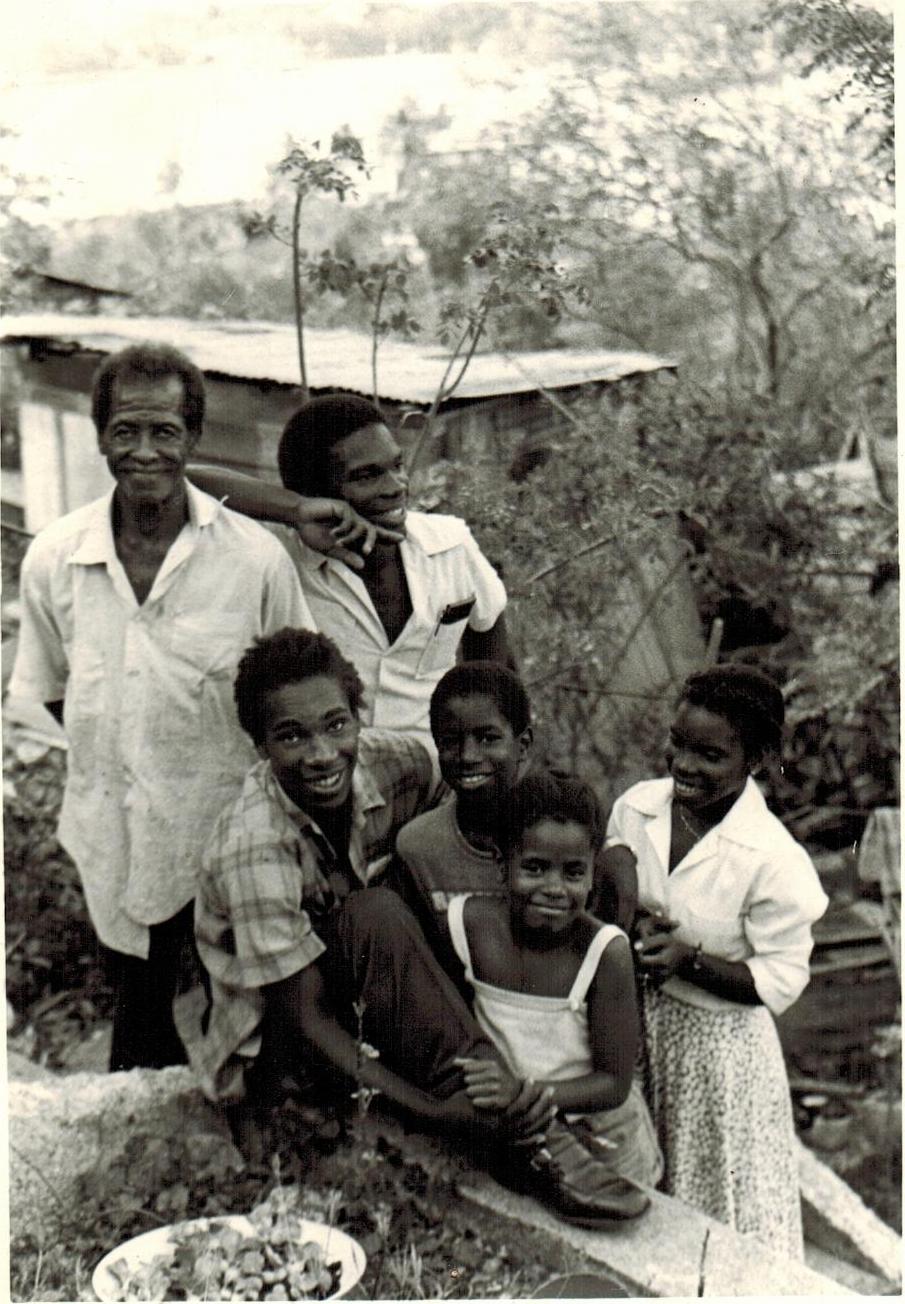
Hector Poullet (né/born 1938)
(Écrivain noir, créoliste, de La Guadeloupe
/ Black Creole-language writer, Guadeloupe)
E mi sé ti moun péyi-la
Mi yo
Mi yo doubout an péyi-la
An mitan lanmé
An mitan soley
Yo la
Po nwè
Po jonn
Po rouj
Po shapé
Po blan
Nou byen fouté pa mal !
Nou sa sé zenfan péyi-la
Sé swé a yo ki ka rozé péyi-la
_____
Voici les enfants du pays, Here are the children of the country,
Les voici, Here they are,
Les voici érigés au pays, Standing tall in our country,
Au coeur même de la mer, With hearts as much of the sea as sun.
Au coeur même du soleil.
Ils sont là There they are: the
Peaux noires Black skins, yellows,
Peaux jaunes Red skins and shedded skins,
Peaux rouges White skins, too.
Peaux échappées et
Peaux blanches
Quelle importance ! And it’s so important –
Ce sont, nous le savons, That they are – and we know it –
Les fils de ce pays; The children of this country;
Leur sueur nourrit la terre de ce pays! Their sweat nourishes this earth!
_____
Etta James: “Mi Fuerte Amante” / “Tough Lover”
Posted: February 28, 2012 Filed under: English: Black Canadian / American, Etta James, Spanish, Translator's Whimsy: Song Lyrics / Extravagancia del traductor: Letras de canciones traducidas por Alexander Best, ZP Translator: Lidia García Garay Comments Off on Etta James: “Mi Fuerte Amante” / “Tough Lover”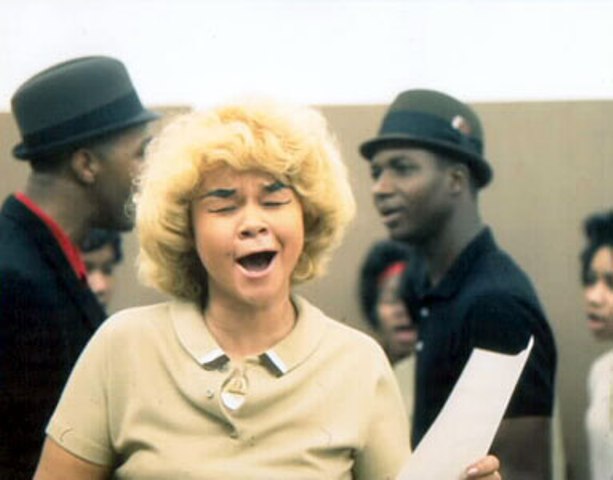
Etta James
“Mi Fuerte Amante” (1956)
Tengo un amante que me mueve tanto,
Sabe hacer ‘el rocanrol’,
Porque es fuerte – mi amante –
Es un amante vigoroso,
Amante recio,
Un amante fuerte – ¡eso es!
*
Cuando me besa,
Me emociona;
Cuando se sacude,
No me quedo quieta.
Es un amante vigoroso,
Amante recio,
Un amante fuerte – ¡aaah, sííí!
*
Las Siete Hermanas no lo pueden tener,
Estoy hablando acerca del Amor –
Y es veloz – él – como el viento.
Habla la gente que estoy enbrujada.
Pero no es el vudú – ¡es ese “twist”!
El Amante más grande de nuestra era,
Aún Don Juan no tiene ningun’esperanza.
Te hace reír,
Te hace llorar,
Se pone tan recio que
Pued’hacer a un’estatua de Venus resucitar.
Hace todo lo que quiera – aún:
Pisotear los zapatos de gamuza-azul de Jesse James.
Es un amante audaz,
y duro, y recio,
Un amante fuerte – ¡ajá, ajá!
*
¿Tienes amante que quieras amar?
¡Golpéale en la cabeza una vez – o dos!
Será tu amante vigoroso – ¡sí, sí! –
Un amante recio – ¡eso es!
Un amante fuerte – ¡aaah, sííí!
Glosario:
Las Siete Hermanas se llaman Las Pléyades – en la mitología griega.
Las dos más famosas – Electra y Maia – eran “Fuerzas de la Naturaleza”.
Jesse James era un forajido estadounidense de la era “Viejo Oeste”.
_____
Etta James (1938-2012)
escribió las letras y grabó esta canción
en 1956 – a la edad tierna de dieciocho años.
Su personalidad era fuerte y burlona pero pudo
cantar también la música íntima del Blues.
*
Traducción / interpretación en español: Lidia García Garay
_____
Etta James
“Tough Lover” (1956)
Well, I’ve got a lover that moves me so
He sho knows how to rock’n’roll
‘Cause he’s a tough lover – yeah, yeah
He’s a tough lover – wooooo
Tough Lover – yeah, yeah
Tough Lover – unh hunh!
*
When he kisses me
I get a thrill
But when he does that wiggle
I can’t keep still
‘Cause he’s a tough lover – yeah, yeah
He’s a tough lover – wooooo!
Tough Lover – yeah, yeah
Tough Lover – unh hunh!
*
The Seven Sisters have nothin’ on him
I’m talkin’ about love – and he’s fast as the wind
People all talk about he’s got me fixed
It ain’t hoodoo – it’s just that twist!
He’s the greatest lover ever come to pass
Don Juan ain’t got a half of a chance.
He can make you laugh
He can make you cry
He’s so tough he’ll make Venus come alive.
He can do anything that he wants to do –
Step on Jesse James’s blue-suede shoes
‘Cause he’s a tough lover – yeah, yeah
He’s a tough lover – wooooo!
Tough Lover – yeah, yeah
Tough Lover – unh hunh!
*
You got a lover
That you wanna love right?
Just pop him ’side the head
– Once or twice!
He’ll be a tough lover – yeah, yeah
He’ll be your tough lover – wooooo!
Tough lover – yeah, yeah
Tough lover – unh hunh!
_____
Etta James (1938-2012)
was a rock’n’roll “mama” even
at the tender age of 18, which is when she
wrote and recorded this song with her band,
The Peaches. Her vocal delivery was often
rough-and-tough in sound – but also full of
fun. The “wooooo’s” in her singing she
borrowed from Little Richard, with whom
she toured in the 1950s. By middle age she
was undisputedly the best living Blues singer
in The United States.
_____
Mildred Barya: “Una Gota de Sangre” / “A Drop of Blood”
Posted: February 23, 2012 Filed under: English, Mildred Barya, Spanish, ZP Translator: Alexander Best | Tags: Black poets, Poetas negros Comments Off on Mildred Barya: “Una Gota de Sangre” / “A Drop of Blood”
Mildred Barya (nace 1976)
“Una Gota de Sangre”
El día que me llegó la regla
Exclamó mi madre:
“¡Ahora eres mujer!”
Entonces me pregunté:
¿Qué yo había sido antes?
¿Y cómo me ha hecho una mujer
Una gota de sangre?
*
Cuando llevaron a mi hermano al círculo,
Él se estremeció a la sensación de un cuchillo afilado.
Pero le convencieron:
“No debes tener miedo,
No muestres ninguna cobardía.
Tan pronto como te cortemos la piel
Te harás un hombre.”
*
Cuando mi madre tenía a Junior
Tan pesado en su vientre
Se apuraba de la mesa
Y corría al lavaplatos.
El día que le llevaron al hospital
Cayó al suelo una bolsa de agua
Pues una gota de sangre.
Gritó mi padre: “¡Mujer!”
*
Leí en Las Sagradas Escrituras
Como fue sacrificado el Hijo de Hombre.
Antes de dar su último aliento,
Manaron fuera de él
Agua y la sangre.
En este momento se hizo Hombre
Que era el Dios.
*
Supongo que haya algo en una gota de sangre
Que nos hace hombres y mujeres.
_____
Mildred Barya (born 1976)
“A Drop of Blood”
The day I got my first period,
Mother exclaimed:
“You’ve become a woman!”
And so I wondered,
What had I been earlier?
And how could a drop of blood
Make me a woman?
*
When they took my brother to the circle,
He flinched at the feel of a sharp knife.
But the elders convinced him:
“You must not fear
Do not show any cowardice
Once we slice off the skin
You become a man.”
*
When mother was heavy with Junior,
She would rush off the table
And run to the sink.
The day she was taken to hospital
A bag of water dropped to the ground,
Then a drop of blood.
Father cried: “Woman!”
*
I read in the Holy Scriptures
How the Son of Man was crucified
Before he breathed his last.
Water and blood flowed out,
There he became Man,
Who was God.
*
I guess there’s something in a drop of blood
That makes us men and women.
_____
Mildred Barya, poeta, nació en Uganda.
Ganó el Premio Pan-Africano del Foro Literário
en 2008. Barya también es periodista y escritor
de viaje. Vive en Syracuse, Nueva York, EEUU.
*
Poet Mildred Barya was born in Uganda.
She won the 2008 Prize of the Pan African
Literary Forum. Barya is also a journalist
and travel-writer. Currently she lives in
Syracuse, New York.
*
Translation from English into Spanish /
Traducción del inglés al español: Alexander Best
Ataulfo Alves: “In a masquerade of Joy I hid my Sadness…”
Posted: February 20, 2012 Filed under: Ataulfo Alves, English, Portuguese, Translator's Whimsy: Song Lyrics / Extravagancia del traductor: Letras de canciones traducidas por Alexander Best, ZP Translator: Alexander Best | Tags: Black poets, Poetas negros Comments Off on Ataulfo Alves: “In a masquerade of Joy I hid my Sadness…”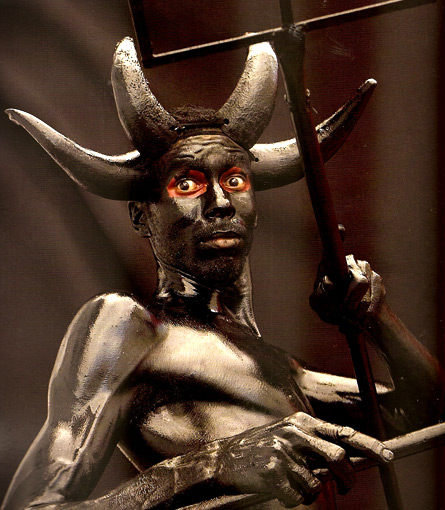
Ataulfo Alves (Sambista brasileiro, 1906-1969)
“Ilusão de carnaval”
.
Mascarado de alegria
Escondi minha tristeza
Terminada a folia
Sou mais triste com certeza
Ilusão de carnaval
Enganei somente a mim
Sem pensar que afinal
Carnaval também tem fim.
*
Ataulfo Alves
(Brazilian Samba composer, 1906-1969)
“Carnival Illusion”
.
In a masquerade of Joy
I hid my Sadness.
Revelry done,
More sad than ever
Am I…
.
You Illusion – oh Carnival !
I merely tricked myself
Without thinking that,
After all,
Carnival too comes to an end.
.
Translation from Portuguese:
Alexander Best

Nigel Darbasie: “Empires of Imagination”
Posted: February 20, 2012 Filed under: English, Nigel Darbasie Comments Off on Nigel Darbasie: “Empires of Imagination”_____
“Monday Jump-Up”
Is ol’ mas’ one carnival,
the best we could have fashioned
from our fathers’ discarded clothes.
In fat-pants and suspenders,
felt hats at our eyebrows,
we went to the railway station,
jammin’ steelband a cappella
as we headed for the city.
*
Almost everyone was on the hadj
to Queen’s Park Savannah in Port-of-Spain.
Royalty from unknown civilizations,
in silk and lamé, hobnobbed
with families of spectators
whose baskets filled our carriage
with aromas of peas and rice, and curry.
*
Outside the city terminus
a pack of half-naked devils descended.
Skins oily blue, and ochre.
Horned foreheads. Upturned tails
bobbing in wicked waist motion.
“Pay de devil! Pay de devil!” they chanted,
hustling purgatory dues from the crowd.
*
An ol’ mas’ band came along:
women in men’s clothes,
men in diapers, sucking carnival formula
from nippled Vat 19 and Old Oak rum bottles.
We revelled with them awhile
before jumpin’ behind giant butterflies
all the way to the Savannah.
*
There, at the confluence of worlds,
fantastic creatures swarmed overhead.
And down the streets,
from the empires of imagination,
flowed waves of mortal souls
dancing in the sunlight.
_____
Nigel Darbasie lives in Edmonton, Alberta, Canada.
He emigrated from Trinidad, West Indies, in 1969.
This poem, from his collection “A Map of the Island”,
brings us a nostalgic memory of Carnival in the 1960s
from the point-of-view of a lively, observant boy.
“Monday Jump-Up” is here used by permission of
The University of Alberta Press.
*
Editor’s note:
This year, 2012, today – February 20th – is the
“Monday” in the title of Darbasie’s poem:
a.k.a. J’Ouvert (Opening Day) of Trinidad Carnival.
_____
Djavan: “Face of the Indian” / “Cara de Índio”
Posted: February 19, 2012 Filed under: Djavan, English, Portuguese, Translator's Whimsy: Song Lyrics / Extravagancia del traductor: Letras de canciones traducidas por Alexander Best, ZP Translator: Alexander Best | Tags: Black poets Comments Off on Djavan: “Face of the Indian” / “Cara de Índio”
Letra da canção de
cantor e compositor afrobrasileiro
Djavan (nasce 1949)
“Cara de Índio”(1978)
Índio cara pálida,
cara de índio.
Índio cara pálida,
cara de índio.
Sua ação é válida, meu caro índio.
Sua ação é válida, válida ao índio.
Nessa terra tudo dá,
terra de índio.
Nessa terra tudo dá,
não para o índio.
Quando alguém puder plantar,
quem sabe índio.
Quando alguém puder plantar,
não é índio.
Índio quer se nomear,
nome de índio.
Índio quer se nomear,
duvido índio.
Isso pode demorar,
te cuida índio.
Isso pode demorar,
coisa de índio.
*
Índio sua pipoca,
tá pouca índio.
Índio quer pipoca,
te toca índio.
Se o índio se tocar,
touca de índio.
Se o índio toca,
não chove índio.
Se quer abrir a boca,
pra sorrir índio.
Se quer abrir a boca,
na toca índio.
*
A minha também tá pouca,
cota de índio.
Apesar da minha roupa,
também sou índio.
_____
Djavan
(Brazilian songwriter, born 1949)
“The Indian Face” (1978)
Indio pale-face
Indian face.
Pale-face Indio
Your action is just, my dear Indio.
Your action is valid, right for the Indian.
In that land everything grows
– the Indian’s land.
In that land everything grows
– but not for the Indian.
When someone can plant,
who knows? The Indio.
When someone inspires,
Isn’t it the Indio?
An Indian wants to call himself
an Indian name.
Indio wants to call himself himself
– I doubt it, Indio
– that might take time – take care,
That might take time,
The Indian thing.
*
Indio gets just
A little “popcorn”.
He wants “popcorn” too
– it’s your turn, Indio.
If the Indian touches his head
it doesn’t rain.
If he wants to open his mouth
– Smile, Indio.
If he wants to open his mouth,
Don’t touch him.
*
I also have little,
An Indian’s share.
Despite my clothes,
I’m an Indio, too.
_____
Jorge Ben Jor: Day of the Indian / Dia de Índio
Posted: February 19, 2012 Filed under: English, Jorge Ben Jor, Portuguese, Translator's Whimsy: Song Lyrics / Extravagancia del traductor: Letras de canciones traducidas por Alexander Best | Tags: Black poets Comments Off on Jorge Ben Jor: Day of the Indian / Dia de Índio_____
Jorge Ben Jor (nasce 1942)
“Curumin chama cunhãtã que eu vou contar
(Todo dia era Dia de Índio)” (1981)
Hey Hey Hey!
Hey Hey Hey!
Jês, Kariris, Karajás, Tukanos, Caraíbas,
Makus, Nambikwaras, Tupis, Bororós,
Guaranis, Kaiowa, Ñandeva, YemiKruia
Yanomá, Waurá, Kamayurá, Iawalapiti,
Txikão, Txu-Karramãe, Xokren, Xikrin,
Krahô, Ramkokamenkrá, Suyá !
*
Curumim chama cunhatã que eu vou contar
Cunhatã chama curumim que eu vou contar
Curumim, cunhatã
Cunhatã, curumim
*
Antes que os homens aqui pisassem
Nas ricas e férteis terraes brazilis
Que eram povoadas e amadas por milhões de índios
Reais donos felizes
Da terra do pau-brasil
Pois todo dia, toda hora, era dia de índio
Pois todo dia, toda hora, era dia de índio
*
Mas agora eles só têm um dia
O dia dezenove de abril…
Amantes da pureza e da natureza
Eles são de verdade incapazes
De maltratarem as fêmeas
Ou de poluir o rio, o céu e o mar
Protegendo o equilíbrio ecológico
Da terra, fauna e flora.
Pois na sua história, o índio
É o exemplo mais puro
Mais perfeito, mais belo
Junto da harmonia da fraternidade.
É da alegria,
Da alegria de viver
Da alegria de amar.
Mas no entanto agora
O seu canto de guerra
É um choro de uma raça inocente…
Que já foi muito contente
Pois antigamente
Todo dia, toda hora, era dia de índio.
*
Jês, Kariris, Karajás, Tukanos, Caraíbas,
Makus, Nambikwaras, Tupis, Bororós,
Guaranis, Kaiowa, Ñandeva, YemiKruia
Yanomá, Waurá, Kamayurá, Iawalapiti, Suyá,
Txikão, Txu-Karramãe, Xokren, Xikrin, Krahô,
Ramkokamenkrá, Suyá !
*
Todo dia, toda hora, era dia de índio…..
Curumim, cunhatã / Hey! Hey! Hey!
Hey! Hey! Hey! / Cunhatã, curumim…..
_____
Jorge Ben Jor
“Every day, every hour, was the Day of the Indian”
Hey Hey Hey!
Hey Hey Hey!
Jês, Kariris, Karajás, Tukanos, Caraíbas,
Makus, Nambikwaras, Tupis, Bororós,
Guaranis, Kaiowa, Ñandeva, YemiKruia
Yanomá, Waurá, Kamayurá, Iawalapiti,
Suyá, Txikão, Txu-Karramãe, Xokren, Xikrin,
Krahô, Ramkokamenkrá, Suyá !
*
Call: “Curumim cunhatã” – I’m going to tell it.
Cry: “Cunhatã curumim” is how I’m going to tell it.
Curumim, cunhatã
Cunhatã, curumim
*
Before people trod here
Upon this rich and fertile land of Brazil
It was populated and loved by millions of Indians,
Happy moneyless owners
Of this land of “Brazil-wood”.
Back then, every day, every hour, was the Day of the Indian.
But now they have only one day,
The 19th of April…
*
Lovers of purity, of nature,
They knew truth, incapable of
Mistreating Woman
Or of polluting river, sky and sea,
Protecting the ecological equilibrium
Of earth, flora and fauna.
And so, in history, the Indio
Is an exemplar most pure,
Perfect and beautiful.
Together in the harmony of humanity
He gives joy – joy of life, joy of love.
Now, though, theirs is a war song – and it’s
The cry of an innocent race…
In olden times they were most happy because
Every day, every hour, was the Day of the Indian.
*
Jês, Kariris, Karajás, Tukanos, Caraíbas,
Makus, Nambikwaras, Tupis, Bororós,
Guaranis, Kaiowa, Ñandeva, YemiKruia
Yanomá, Waurá, Kamayurá, Iawalapiti,
Txikão, Txu-Karramãe, Xokren, Xikrin,
Krahô, Ramkokamenkrá, Suyá !
*
Every day, every hour, was the Day of the Indian.
Curumim, cunhatã / Hey! Hey! Hey!
Hey! Hey! Hey! / Cunhatã, curumim…..
_____
Glossary:
Jês, Kariris, Karajás, Tukanos, Caraíbas, etc.,
– Ben gives us a list of names of the
Indian/Indigenous/Native Peoples of Brazil
The 19th of April – throughout Latin and South America,
this day – Dia Americano del Indio – draws attention to the
cultures, struggles and progress of Indigenous Peoples;
initiated in 1940 at Pátzcuaro, México, during the first
“Congreso Indigenista Interamericano”
/ InterAmerican Indigenous Congress
 Zócalo Poets