Robert Gurney: “Horneritos” / “Ovenbirds”
Posted: July 31, 2013 Filed under: English, Robert Gurney, Spanish Comments Off on Robert Gurney: “Horneritos” / “Ovenbirds” ZP_Crested Hornero in Argentina_Furnarius cristatus en Argentina_foto por Nick Athanas
.
Robert Gurney
“Horneritos”
( a Ramón Minieri )
.
Recibí un mail desde la Patagonia
acerca de unos pájaros.
.
Tienen el plumaje de la cabeza
estilo punk.
.
Dicen que son oriundos
del Paraguay y del Chaco
pero que a veces vuelan
hasta la Pampa
y otras incluso
hasta la Patagonia.
.
El mail describe
cómo descienden a comer
en el patio de un amigo
que vive en Río Colorado.
.
Luego vuelven a un árbol
para posar ante la cámara.
.
Ni siquiera se molestan
en peinarse primero.
.
Otro amigo,
que vive en Londres,
me dice que se llaman
horneritos copetones
y que sus nidos se parecen
a los hornos de los panaderos.
.
Pero no es eso
lo que me llama la atención
sino la imagen
del horno de barro
en la pared
de la casa de Vallejo*
en Santiago de Chuco.
.
Hay pájaros
que van y vienen,
entrando y saliendo
de su boca.
.
* César Vallejo, poeta peruano, 1892 – 1938
. . .
Robert Gurney
“Ovenbirds”
( to Ramón Minieri )
.
I had an e-mail the other day
from Patagonia
about some birds
with punk-style head feathers.
.
It said they are native
to Paraguay
and The Chaco
but that they sometimes
fly south
to the Pampas
and, sometimes,
even, to Patagonia.
.
It describes how
they come down to feed
in a friend’s patio
in Río Colorado.
.
Then they fly back into a tree
to pose for the camera
without even bothering
to comb their hair first.
.
Another friend,
who lives in London,
tells me that they are called
“horneritos copetones”
(furnarius cristatus);
in English –
Crested Horneros
or Ovenbirds;
and that they nest
in shrubs in scrub.
.
It seems
that they are so named
because they make
globular mud nests
that resemble
bakers’ ovens.
.
It wasn’t so much this,
though,
that filled my mind
but an image
of an oven in a wall
inside Vallejo’s* house
in Santiago de Chuco
with birds flying
in and out of it.
.
(St. Albans, England, June 2013)
.
* César Vallejo, Peruvian poet, 1892 – 1938
. . .
Robert Gurney nació en Luton, Bedfordshire, Inglaterra. Divide su tiempo ahora entre St Albans, Hertfordshire, Inglaterra, y la aldea de Port Eynon en El País de Gales. Su esposa Paddy es galesa. Tienen dos hijos y dos nietos. Su primer profesor de Español en el liceo de Luton, el señor Enyr Jones, era argentino, precisamente patagónico galés, de Gaiman. Las clases eran una oasis de paz, amistad e inspiración: un grupo pequeño en la biblioteca, sentado en un círculo alrededor de una elegante mesa de madera, con los diccionarios a la mano. En la Universidad de St Andrew’s (Escocia) su profesor fue el Profesor L. J. (“Ferdy”) Woodward, quien daba maravillosas clases sobre la poesía española. Luego, en el ciclo de doctorado, en Birkbeck College, Universidad de Londres, tenía al profesor Ian Gibson como mentor inspiracional. Con la supervisión de Ian preparó su tesis doctoral sobre Juan Larrea (The Poetry of Juan Larrea, 1975), poeta al que entrevistó en francés en treinta y seis oportunidades (200 horas) en 1972, en Córdoba, Argentina. La Universidad del País Vasco publicó La poesía de Juan Larrea en 1985. Mantuvo una correspondencia intensa con el poeta (inédita). Entrevistó a Salvador Dalí, a Gerardo Diego, a Luis Vivanco (el traductor de Larrea), a José María de Cossío y a los amigos de Larrea en España y Argentina: Gregorio San Juan, Osvaldo Villar, Luis Waysmann y otros. Escribe poesía y cuentos. Ha escrito una novela ‘anglo-argentina’ (inédita). Su último poemario La libélula / The Dragonfly (edición bilingüe) salió este año en Madrid. Su próximo libro, también bilingüe, será La Casa de empeño / The Pawn Shop (Ediciones Lord Byron). Prepara un libro de cuentos breves sobre sus años en Buganda.
Para leer más poemas de Robert Gurney cliquea aquí: http://verpress.com/
.
Robert Gurney was born in Luton, Befordshire, England. He divides his time now between St Albans, Hertfordshire and the village of Port Eynon in Wales. His wife Paddy is Welsh. They have two sons and two grandsons. His first Spanish teacher at Luton Grammar School, Mr Enyr Jones, was Argentine, Patagonian Welsh, to be precise, from Gaiman. The classes were an oasis of peace, friendship and inspiration: a small group sitting in a circle around an elegant wooden table in the library, with dictionaries to hand. At the University of St Andrew’s in Scotland, his teacher was Professor L.J. (“Ferdy”) Woodward who gave marvelous lectures on Spanish poetry. Then, for his PhD at Birkbeck College, the University of London, he had Ian Gibson as his inspirational tutor. Under Ian’s supervision, he wrote his thesis on Juan Larrea (The Poetry of Juan Larrea, 1975), published by the University of the Basque Country as La poesía de Juan Larrea in 1985. He interviewed Larrea, in French, on 36 separate occasions in Córdoba, Argentina, in 1972, and conducted an intense correspondence with him. He interviewed Salvador Dalí, Gerardo Diego (in Spain and France), Luis Vivanco (Larrea’s translator), Jose María de Cossío and Larrea’s friends in Argentina: Ovaldo Villar, Luis Waysmann and others. He has written one “Anglo-Argentine” novel (unpublished). He writes poetry and short stories and is currently preparing a book of short stories on his years in Buganda.
. . . . .
Alan Clark: “La Lengua” y “Dentro de Ti”
Posted: July 31, 2013 Filed under: Alan Clark, English, Spanish, ZP Translator: Alexander Best Comments Off on Alan Clark: “La Lengua” y “Dentro de Ti”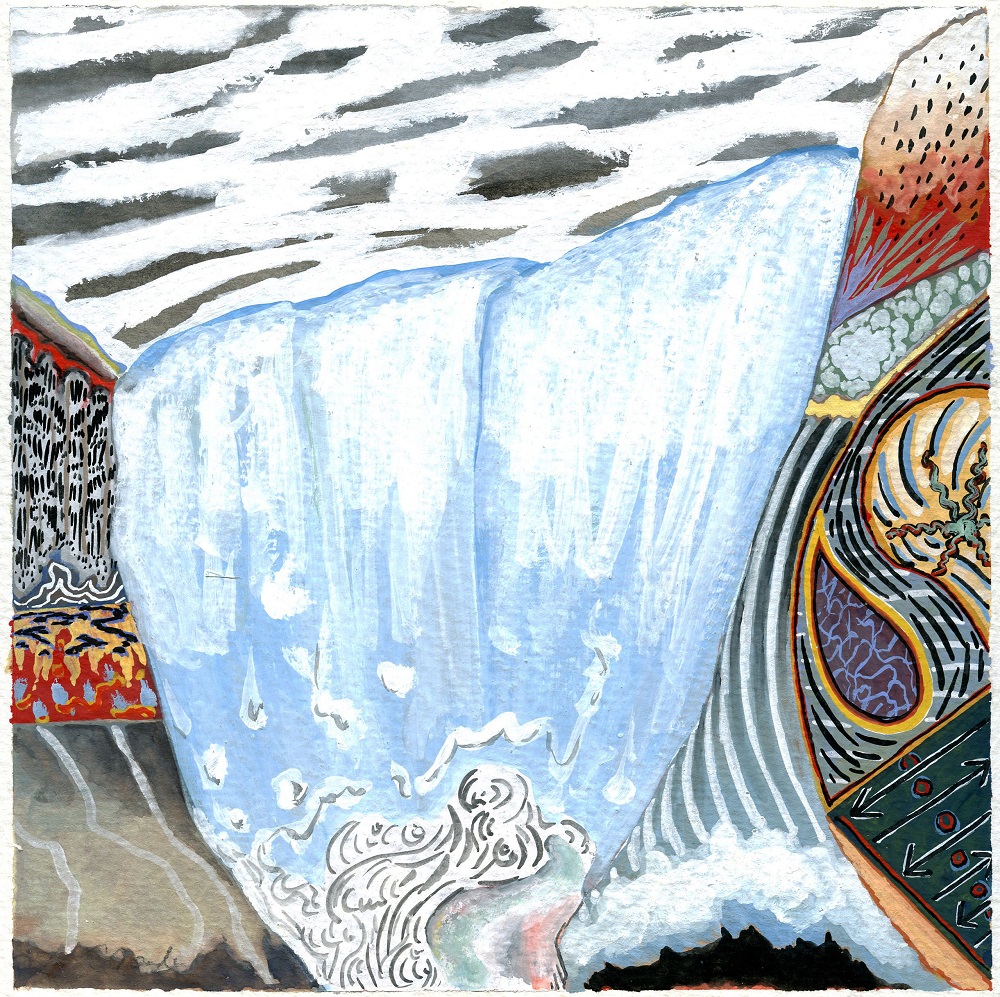 ZP_La Lengua_pintura de Alan Clark
.
La Lengua
.
Estoy “viviendo” tu leyenda sobre mi lengua
(es ésta la tierra santa en que vagaremos…)
Contigo…degustas como las palabras que me vienen,
esta lengua rastreando tus “dondes” más dulces,
y estas palabras hacen cosquillas en la garganta.
Pero está en tu piel que conozco lo que es
la adoración – la lengua, con franqueza, sobre
la piel de sal / sobre brazas de ti
(no bajo del agua sino en un nuevo aire de sal)
en que el universo – que es tú – ríe un “yo” para
bajarme más y más y inventir todas las palabras
que nunca te igualarán – la ola y “materia”
del cuento en el lenguaje de nuestro sueño
unido en nosotros…
Somos diosas y dioses del sudor,
del pecho, de las manos, y de los labios que
hablan solamente cuando no hay nada decir que:
Quede en en lugar oscuro donde están conocidos
tus muslos en lo de mi que está bastante liviano
para buscarte.
. . .
La Lengua
.
I’m living out your legend on my tongue
(this is the holy land we’re wandering in)
with you tasting like the words that come to me,
this tongue tracking down your softest “wheres”,
these words tickling my throat. But in your flesh
I know what worship is, tongue directly
to the salt skin and fathoms of yourself
(not under water, in a new salt air)
in which the universe of you is laughing me
to go down and down to make up all the words
that will never equal you, wave and matter
as the story in the language of our dream
together: goddesses and gods of sweat,
of breasts and hands and lips that only speak
when there’s nothing left to say but: Linger,
in the dark place where your thighs are met
by what of me is light enough to find you.
. . .
Dentro de Ti –
.
Puedo ver la materia prima de sombras
y como el barro se torne en una clase de luz;
que soy como un pez que debe nadar
dentro de un mundo donde se arremolinan la hierba del mar
mientras levantas las manos durante un día caluroso…
Me siento dentro de ti la verde pura de una planta que
se torna en el calor de un horno de sangre;
lo que está ni despierto ni durmiendo en
la concha de un otro día que promete
todo de sí mismo para expectativas no perladas…
El olor en tu animal, la flor de mi lengua de pavo real;
el diccionario de mis sentidos no deletreados como besos; y
siempre – siempre – la libertad del cielo
recogiendo las plumas de un pájaro – tú – que
se monta los alientos cuando miran tus ojos que
pueden asegurar – por la ley rarísima – algo que
nunca viere alguien:
las balanzas de los arcos de iris breves
y la creación del mundo.
. . .
In You –
.
I can see what stuff shadows are made of
and how clay can become a kind of light,
how I’m like a fish who can’t not swim
into a world where the seagrass is swirling
when you lift up your arms on a hot day…
feel in you the raw green of a plant
being turned into heat in an oven of blood,
what lies not awake, not asleep inside
the shell of another day promising
all of itself to no pearl expectations…
smell in your animal, the flower
of my peacock tongue, the dictionary
of my senses unspelled as kisses, and
always, always, the freedom of the sky
gathering the feathers of the bird you are,
who rides the winds when your eyes behold,
who can claim by the strangest of laws
what no-one else could ever see: the scales
of brief rainbows and the world’s creation.
. . .
Poeta y pintor, Señor Alan Clark divide su vida entre Maine en EE.UU. y el México. Guerrero y Sangre del Corazón fue publicado por Henning Bartsch (México, D.F.) Tiene también un poemario de 2010: Where They Know. Sus piezas del teatro incluyen: The End of It, The Couch – The Table – The Bed, and The Beast – y fueron montados en EE.UU. y México. En 2004 tuvo una exhibición de sus pinturas en Rockland, Maine en Farnsworth Art Museum – Sangre y Piedra.
.
Alan Clark is an artist and poet, dividing his life between Maine and Mexico. Guerrero and Heart’s Blood was published in Mexico City by Henning Bartsch. A book of poems, Where They Know, was published in 2010. Clark’s plays –including adaptations of Guerrero and Heart’s Blood – include: The End of It, The Couch – The Table – The Bed, and The Beast; these have been staged in the U.S.A. and in Mexico. Blood and Stone: Paintings by Alan Clark,was at the Farnsworth Art Museum, Rockland, Maine,in 2004.
Versiones en español / Spanish versions: Alexander Best
. . . . .
¿Eva, La Culpable? / Was IT All Eve’s Fault?
Posted: July 28, 2013 Filed under: English, Eva La Culpable...Was It All Eve's Fault?, Jee Leong Koh, Spanish, ZP Translator: Alexander Best Comments Off on ¿Eva, La Culpable? / Was IT All Eve’s Fault? ZP_El Adán reconsiderado…¡Piense en él dos veces!_Adam reconsidered…Give him a second thought!
.
“No Eva…Solo era una cantidad excesiva del Amor, su Culpa.”
(Aemilia Lanyer, poetisa inglés, 1569 – 1645, en su obra Salve Deus Rex Judaeorum: La Apología de Eva por La Mujer, 1611)
.
Jee Leong Koh
“Eva, La Culpable”
.
Aunque se ha ido del jardín, no se para de amarles…
Dios le convenció cuando sacó rápidamente de su manga planetaría
un ramo de luz. Miraron pasar el desfile de animales.
Le contó el chiste sobre el Arqueópterix, y se dio cuenta de
las plumas y las garras brutales – un poema – el primero de su tipo.
En una playa, alzado del océano con un grito, él entró en ella;
y ella, en olas onduladas, notó que el amor une y separa.
.
El serpiente fue un tipo más callado. Llegaba durante el otoño al caer la tarde,
viniendo a través de la hierba alta, y apenas sus pasos dividió las briznas.
Cada vez él le mostró una vereda diferente. Mientras que vagaban,
hablaron de la belleza de la luz golpeando en el árbol abedul;
el comportamiento raro de las hormigas; la manera más justa de
partir en dos una manzana.
Cuando apareció Adán, el serpiente se rindió a la felicidad la mujer Eva.
.
…Porque ella era feliz cuando encontró a Adán bajo del árbol de la Vida
– y aún está feliz – y Adán permanece como Adán: inarticulado, hombre de mala ortografía;
su cuerpo estando centrado precariamente en sus pies; firme en su mente que
Eva es la mujer pristina y que él es el hombre original. Necesitó a ella
y por eso rasguñó en el suelo – y creyó en el cuento de la costilla.
Eva necesitó a la necesidad de Adán – algo tan diferente de Dios y el Serpiente,
Y después de éso ella se encontró a sí misma afuera del jardín.
. . .
“Not Eve, whose Fault was only too much Love.”
(Aemilia Lanyer, English poetess, 1569 – 1645, in Salve Deus Rex Judaeorum: Eve’s Apologie in Defence of Women, 1611)
.
Jee Leong Koh
“Eve’s Fault”
.
Though she has left the garden, she does not stop loving them.
God won her when he whipped out from his planetary sleeve
a bouquet of light. They watched the parade of animals pass.
He told her the joke about the Archaeopteryx, and she noted
the feathers and the killing claws, a poem, the first of its kind.
On a beach, raised from the ocean with a shout, he entered her
and she realized, in rolling waves, that love joins and separates.
.
The snake was a quieter fellow. He came in the fall evenings
through the long grass, his steps barely parting the blades.
Each time he showed her a different path. As they wandered,
they talked about the beauty of the light striking the birch,
the odd behavior of the ants, the fairest way to split an apple.
When Adam appeared, the serpent gave her up to happiness.
.
For happy she was when she met Adam under the tree of life,
still is, and Adam is still Adam, inarticulate, a terrible speller,
his body precariously balanced on his feet, his mind made up
that she is the first woman and he the first man. He needed
her and so scratched down and believed the story of the rib.
She needed Adam’s need, so different from God and the snake
– and that was when she discovered herself outside the garden.
. . . . .
Jee Leong Koh nació en Singapur y vive en Nueva York. Es profesor, también autor de cuatro poemarios.
Jee Leong Koh was born in Singapore and now lives in New York City where he is a teacher.
He is the author of four poetry collections: Payday Loans, Equal to the Earth, Seven Studies for a Self Portrait and The Pillow Book.
. . .
Traducción en español / Translation into Spanish: Alexander Best
. . . . .
Alicia Claudia González Maveroff: “The Storyteller in The Zócalo” / “El Fabulador del Zócalo”
Posted: July 25, 2013 Filed under: Alicia Claudia González Maveroff, English, Spanish, ZP Translator: Alexander Best Comments Off on Alicia Claudia González Maveroff: “The Storyteller in The Zócalo” / “El Fabulador del Zócalo”
.
Alicia Claudia González Maveroff
“The Storyteller in The Zócalo”
.
Earlier today in the Square there was a storyteller
enchanting people with his words – everyone who
was in and around that patch of pavement where he stood.
Those who saw him there were all listening without
so much as uttering a sound.
In The Zócalo this man earns his livelihood, selling
pretty little dolls that wiggle and sway.
Even though you can’t see any strings pulled,
you don’t know how it’s done,
these little dolls –skeletons, rather –
dance, lie down, jump, kneel and walk,
while the vendor chatters like a “fairground charlatan”.
Incredible it was, the gift of the gab that fellow displayed.
He whiled away the time offering to passers-by
a cadaverous doll which seemed to be alive-and-kicking.
Children, mute, admired the dancing doll:
“Look how the dolly can dance!”
The adults present laughed to themselves, “Yeah, right,”
as if to say: “What a scam.”
Yet he captured every one of us, this guy with his confabulations,
presenting those dolls that never ceased to dance.
Who knows what the trick is? There’s no harm in it…
For that reason, in fact, one has to hand it to him this evening,
knowing that this is all a hoax yet rascal-ishly fascinating…
Me, he left me bamboozled, making me believe him,
so I’ve gone and bought one of those little dolls
– in order to be rewarded with a performance.
And I have left the Square happy, yes – knowing that he‘s a crook…
.
Mexico City, July 22nd, 2012
. . .
Alicia Claudia González Maveroff
“El Fabulador del Zócalo”
.
Estaba el fabulador en la plaza hoy temprano,
encantando con palabras,
a todos los que rodeaban el sector donde se hallaba.
Esos que allí se encontraban, lo escuchaban sin hablar.
En el Zócalo este hombre gana su vida, vendiendo
unos muñequitos lindos pequeños que se menean.
Aunque no se ven cordeles, ni sabemos como lo hace,
estos pequeños muñecos, a más decir esqueletos,
bailan, se barazan, se acuestan, saltan, se arrodillan y andan,
mientras el vendedor habla como “charlatan de feria”.
Es increible la labia que este señor nos demuestra.
Pasa su tiempo ofreciendo, a todos los transeuntes,
el muñeco cadaverico, que está vivito y coleando.
Mientras el muñeco baila, los niños, quietos, lo admiran.
¡Cómo baila el muñequito!
Los grandes, sonriendo “a penas”, como diciendo
“¡es un cuento!”
Pero a todos ha atrapado, este señor con su charla,
ofreciendo los muñecos que no paran de bailar.
¿Quién sabe como es el truco? No lo hacen nada mal…
Por eso, por la actuación, que ha brindado él esta tarde,
sabiendo que es un engaño, que es un vil fascinador…
Yo, me he dejado embaucar, haciendo que le creía,
le he comprado un muñequito, para premiar su actuación.
Y me he marchado contenta, sabiendo que es un ladrón…
.
México D.F., 22 – 07 – 2012
.
Alicia Claudia González Maveroff is a professor living in Buenos Aires, Argentina. Her credo, in a single precise sentence, is: I believe in Utopia – because Reality strikes me as impossible.
Alicia Claudia González Maveroff es una profesora que vive en Buenos Aires, Argentina. En una oración sucinta, su consejo es ésto: Creo en la utopía, porque la realidad me parece imposible.
.
Translation and interpretation from Spanish into English / Versión inglés: Alexander Best
. . . . .
Jane Kenyon: “Laissons venir le soir” / “Let Evening Come”
Posted: July 24, 2013 Filed under: English, French, Jane Kenyon Comments Off on Jane Kenyon: “Laissons venir le soir” / “Let Evening Come” ZP_Garçonnet avec une binette_La Zambie_Little boy with hoe_Zambia_photograph © Boldt
.
Jane Kenyon(1947-1995)
“Laissons venir le soir”
.
Laissez la lumière de fin de journée
briller à travers les interstices de la grange,
pendant que le soleil descend, bougeant sur les bottes de paille.
Laissez le grillon craqueter
comme une femme prend ses aiguilles
et ses fils. Laissez venir le soir.
Laissez la rosée recueillie sur la houe abandonnée
dans les grandes herbes. Laissez les étoiles apparaître
et la lune divulguer sa corne d’argent.
Laissez le renard revenir à sa tanière de sable.
Laissez le vent s’éteindre. Laissez le hangar
aller vers le noir intérieur . Laissons venir le soir..
Pour la bouteille dans le fossé, à la pelle
dans d’avoine, pour l’air dans les poumons
Laissons venir le soir.
Qu’il vienne, comme il le fera, et n’aies
pas peur. Dieu ne nous laisse pas sans
consolation, laissons venir le soir.
. . .
Jane Kenyon (1947-1995)
“Let Evening Come”
.
Let the light of late afternoon
shine through chinks in the barn, moving
up the bales as the sun moves down.
.
Let the cricket take up chafing
as a woman takes up her needles
and her yarn. Let evening come.
.
Let dew collect on the hoe abandoned
in long grass. Let the stars appear
and the moon disclose her silver horn.
.
Let the fox go back to its sandy den.
Let the wind die down. Let the shed
go black inside. Let evening come.
.
To the bottle in the ditch, to the scoop
in the oats, to air in the lung
let evening come.
.
Let it come, as it will, and don’t
be afraid. God does not leave us
comfortless, so let evening come.
. . .
Traduction en français: “ReChab”
Voyez également son site poetique “art et tique et pique” – http://ecritscrisdotcom.wordpress.com
. . . . .
Poemas japoneses – de guerra, del honor, de la ternura – traducidos por Nuna López
Posted: July 20, 2013 Filed under: Akiko Yosano, English, Japanese, Kaneko Misuzu, Sadako Kurihara, Spanish, ZP Translator: Nuna López | Tags: Poemas japoneses de guerra Comments Off on Poemas japoneses – de guerra, del honor, de la ternura – traducidos por Nuna López
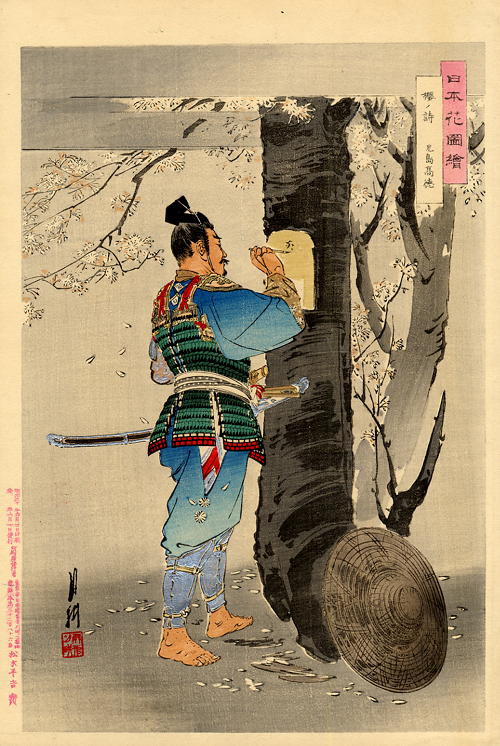 ZP_Samurai writing a poem on a flowering cherry-tree trunk by Ogata Gekko, 1859-1920_ print courtesy of ogatagekkodotnet
.
Ouchi Yoshitaka (a “daimyo” or feudal lord / un “daimyo” o soberano feudal, 1507-1551)
.
Both the victor and the vanquished are
but drops of dew, but bolts of lightning –
thus should we view the world.
. . .
Tanto el vencedor como el vencido no son
Sino gotas de rocío, relámpagos –
así deberíamos ver el mundo.
. . .
Hojo Ujimasa (1538-1590)
Hojo was a “daimyo” and “samurai” who, after a shameful defeat, committed “seppuku” or ritual suicide by self-disembowelment. He composed a poem before he killed himself:
.
“Death Poem”
.
Autumn wind of evening,
blow away the clouds that mass
over the moon’s pure light
and the mists that cloud our mind –
do thou sweep away as well.
Now we disappear –
well, what must we think of it?
From the sky we came – now we may go back again.
That’s at least one point of view.
. . .
Hojo Ujimasa (1538-1590)
“Poema de muerte”
.
Viento otoñal de la noche,
sopla lejos las nubes que obstruyen
la luz pura de la luna
y la neblina que nubla nuestra mente-
también bárrela lejos.
Ahora nosotros desaparecemos –
Y bien, ¿qué deberíamos pensar de esto?
Del cielo vinimos- ahora debemos regresar otra vez.
Ese es al menos un punto de vista.
. . .
The following poem by Akiko Yosano was composed as if to her younger brother who was drafted to fight in the Russo-Japanese War (1904-1905). It was never specifically anti-war only that the poet wished that her brother not sacrifice his life. At the time the poem was not censored but in the militaristic 1930s it was banned in Japan.
.
Akiko Yosano/ 与謝野晶子(1878-1942)
.
Oh, my brother, I weep for you.
Do not give your life.
Last-born among us,
You are the most beloved of our parents.
Did they make you grasp the sword
And teach you to kill?
Did they raise you to the age of twenty-four,
Telling you to kill and die?
.
Heir to our family name,
You will be master of this store,
Old and honoured, in Sakai, and therefore,
Brother, do not give your life.
For you, what does it matter
Whether Lu-Shun Fortress falls or not?
The code of merchant houses
Says nothing about this.
.
Brother, do not give your life.
His Majesty the Emperor
Goes not himself into the battle.
Could he, with such deeply noble heart,
Think it an honour for men
To spill one another’s blood
And die like beasts?
.
Oh, my brother, in that battle
Do not give your life.
Think of mother, who lost father just last autumn.
How much lonelier is her grief at home
Since you were drafted.
Even as we hear about peace in this great Imperial Reign,
Her hair turns whiter by the day.
.
And do you ever think of your young bride,
Who crouches weeping behind the shop curtains
In her gentle loveliness?
Or have you forgotten her?
The two of you were together not ten months before parting.
What must she feel in her young girl’s heart?
Who else has she to rely on in this world?
Brother, do not give your life.
. . .
Akiko Yosano/ 与謝野晶子(Poetisa japonesa, 1878-1942)
.
Oh, hermano mío, lloro por ti.
No entregues tu vida.
El más pequeño de nosotros,
El más amado por nuestros padres.
¿Ellos te hicieron empuñar la espada
y te enseñaron a matar?
¿Ellos te criaron hasta los veinticuatro
para matar y morir?
.
Heredero de nuestro nombre
Tú serás el dueño de esta tienda,
Vieja y honrada, en Sakai, y por eso,
Hermano, no entregues tu vida.
¿A ti que puede importarte
si la fortaleza Lu- Shun cae o no?
En el código de los comerciantes
No hay nada sobre esto.
.
Hermano, no entregues tu vida.
Su Majestad el Emperador
no pelea su propia batalla.
¿Puede él, con su profundamente noble corazón,
pensar que es un honor para los hombres
derramar la sangre de uno y otro
y morir como bestias?
Oh, hermano mío, en esa batalla
no entregues tu vida.
Piensa en mamá, que perdió a papá apenas el otoño pasado.
Qué tan solitaria es su pena en casa
desde que te enlistaron.
Incluso cuando escuchamos sobre paz en este gran Reino Imperial
su cabello se torna más blanco cada día.
.
¿Alguna vez piensas en tu joven novia,
que se acuclilla llorando tras las cortinas de la tienda
con su gentil afecto?
¿O la has olvidado?
Ustedes estuvieron juntos no más de diez meses antes de separarse.
¿Cómo debe sentirse ella en su joven corazón de niña?
¿En quién más puede confiar en este mundo?
Hemano, no entregues tu vida.
. . .
Kaneko Misuzu (Japanese poetess, 1903-1930)
“To Love Everything”
.
I wish I could love them,
Anything and everything.
.
Onions, tomatoes, fish,
I wish I could love them all.
.
Side dishes, and everything.
Because Mother made them.
.
I wish I could love them,
Anyone and everyone.
.
Doctors, and crows,
I wish I could love them all.
.
Everyone in the whole world
– Because God made them.
. . .
Kaneko Misuzu (Poetisa japonesa, 1903-1930)
“Amar todo”
.
Desearía poder amarlos,
a cualquier cosa y a todo.
Cebollas, tomates y pescados,
desearía poder amarlos todos.
Guarniciones y todo,
porque Mamá los hizo.
Desearía poder amarlos,
a cualquiera y a todos.
Doctores y cuervos,
desearía poder amarlos todos.
Todos en todo el mundo
– Porque Dios los hizo.
. . .
Kaneko Misuzu
“Me, the little bird, and the bell”
.
私が両手をひろげても、(watashi ga ryōte wo hirogete mo)
お空はちっとも飛べないが、(osora wa chitto mo tobenai ga)
飛べる小鳥は私のように、(toberu kotori ha watashi yō ni)
地面を速く走れない。(jimen wo hayaku hashirenai)
.
私が体をゆすっても、(watashi ga karada wo yusutte mo)
きれいな音はでないけど、(kirei na oto wa denai kedo)
あの鳴る鈴は私のように、(anonaru suzu wa watashi no yō ni)
たくさんな唄は知らないよ。(takusan na uta wa shiranai yo)
.
鈴と、小鳥と、それから私、(suzu to kotori to sorekara watashi)
みんなちがって、みんないい。(minna chigatte, minna ii)
. . .
Even if I stretch out my arms
I can’t fly up into the sky,
But the little bird who can fly
Cannot run fast along the ground like me.
.
Even if I shake my body,
No beautiful sound comes out,
But the ringing bell does not
Know many songs like me.
.
The bell, the little bird and, finally, me:
We’re all different, but we’re all good.
. . .
Kaneko Misuzu
“El pajarito, la campanilla y yo”
.
Aunque estire mis brazos
No puedo elevarme hacia el cielo
Pero el pajarito que puede volar
No puede correr rápido sobre la tierra, como yo.
.
Aunque sacuda mi cuerpo
Ningún bello sonido se escuchará
Pero la campanilla no conoce
Tantas canciones como yo.
.
La campanilla, el pajarito y finalmente, yo:
Todos somos diferentes pero todos igualmente buenos.
. . .
Kenzo Ishijima(Japanese Kamikaze pilot, WW2 / Piloto japonés kamikaze, Segunda Guerra Mundial)
.
Since my body is a shell
I am going to take it off
and put on a glory that will never wear out.
. . .
Ya que mi cuerpo es una carcasa
Voy a quitármela de encima
Y a vestirme de gloria que nunca se desgastará.
. . .
“Doki no Sakura”: a popular soldiers’ song of the Japanese Imperial Navy during WW2 in which a Kamikaze naval aviator addresses his fellow pilot – parted in death:
.
“Doki no Sakura”(“Cherry blossoms from the same season”)
.
You and I, blossoms of the same cherry tree
That bloomed in the naval academy’s garden.
Blossoms know they must blow in the wind someday,
Blossoms in the wind, fallen for their country.
.
You and I, blossoms of the same cherry tree
That blossomed in the flight school garden.
I wanted us to fall together, just as we had sworn to do.
Oh, why did you have to die, and fall before me?
.
You and I, blossoms of the same cherry tree,
Though we fall far away from one another.
We will bloom again together in Yasukuni Shrine.
Spring will find us again – blossoms of the same cherry tree.
. . .
“Doki no Sakura”: una canción popular entre los soldados japoneses de la Segunda Guerra Mundial:
.
“Flores de cerezo de la misma estación”
.
Tú y yo, flores de un mismo cerezo
que floreció en el jardín de la academia naval.
Flores sabedoras de que deben volar en el viento algún día,
flores en el viento, caídas por su país.
.
Tú y yo, flores de un mismo cerezo
que floreció en el jardín de la escuela de aviación.
Quería que cayéramos juntos, como habíamos jurado hacer.
Oh, ¿por qué tenías que morir y caer antes que yo?
.
Tú y yo, flores de un mismo cerezo,
aunque caemos lejos el uno del otro,
floreceremos juntos otra vez en el santuario Yasukuni.
La primavera nos encontrará otra vez – flores de un mismo cerezo.
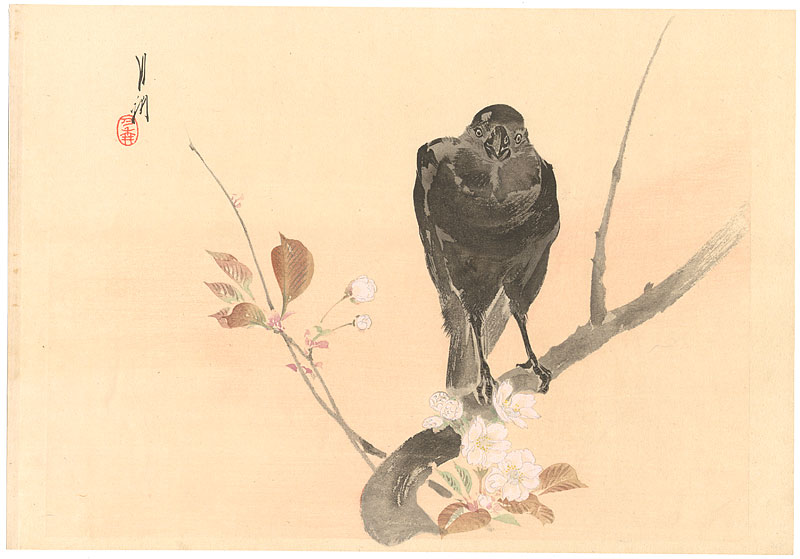 ZP_Cherry Blossom and Crow by Ogata Gekko, 1859 – 1920_print courtesy of ogatagekkodotnet
.
Sadako Kurihara (Japanese poetess, 1913-2005)
“ When we say ‘Hiroshima’ ”
.
When we say Hiroshima, do people answer,
gently, Ah, Hiroshima? …Say Hiroshima,
and hear Pearl Harbor. Say Hiroshima,
and hear Rape of Nanjing. Say Hiroshima,
and hear women and children in Manila, thrown
into trenches, doused with gasoline, and
burned alive. Say Hiroshima, and hear
echoes of blood and fire. Ah, Hiroshima,
we first must wash the blood off our own hands.
. . .
Sadako Kurihara (Poetisa japonesa, 1913-2005)
“Cuando decimos ‘Hiroshima’”
.
Cuando decimos Hiroshima, acaso la gente contesta,
gentilmente, Ah Hiroshima?… Di Hiroshima,
y escucha Pearl Harbor. Di Hiroshima,
y escucha la Violación de Nanjing. Di Hiroshima
y escucha a las mujeres y los niños en Manila, arrojados
en zanjas, empapados en gasolina y
quemados vivos. Di Hiroshima, y escucha
ecos de sangre y fuego. Ah, Hiroshima,
primero debemos lavarnos la sangre de nuestras propias manos.
. . .
Traducciones del inglés al español / Translations from English to Spanish: Nuna López
. . . . .
“Los Tres Arbolitos” de Clovis S. Palmer y “Árboles” de Joyce Kilmer
Posted: July 11, 2013 Filed under: Clovis S. Palmer, English, Joyce Kilmer, Spanish, ZP Translator: Alexander Best Comments Off on “Los Tres Arbolitos” de Clovis S. Palmer y “Árboles” de Joyce Kilmer
Clovis S. Palmer
“Los Tres Arbolitos”
.
Es redondo el mundo que nadie no ve,
y hay árboles de todas necesidades.
Algunos puedan ser grandes – otros, pequeños
– o, quizás, como muñequitos.
Puedan variar los árboles, tamaño por tamaño,
Están vistos por todas partes – y entre diques también.
Y nadie sabe de donde vienen.
.
Recordó mi mente unos tres arbolitos
– sobre una colina – a las tres y cuarto
– sí, sobre una colina y junto al molino
– tres arbolitos con miembros oleandos.
Estaban allá – cansados, hambrientos
– y esperaban por un jarrito de cerveza.
Sin embargo, se quedaron dormidos,
con sus manos colgantes
– directo allí.
. . .
Señor Palmer hoy es médico y escribió este poema cuando era niño de trece años (en 1987). En ese tiempo vivía en su pueblito natal de Manchioneal, Distrito de Portland, Jamaïca. Muestra el poema el “surrealismo natural” de la mente de la niñez. . . .Clovis S. Palmer
“Three Little Trees”
.
The world is round, which no one sees,
Having trees of all different needs.
Some may be big, some may be small – or even like a little doll.
Trees may vary from size to size,
Trees are seen from miles to miles.
Trees are seen from dam to dam and no one knows where they came from.
.
My mind went back on three little trees
Upon a hill – a quarter past three –
Upon the hill beside a mill, three little trees waving their limbs,
Hungry and tired the trees were there,
Waiting for a cup of beer.
Nevertheless, they fell asleep,
Having their hands hanging right there.
. . .
This poem was composed in 1987, in Manchioneal, Portland Parish, Jamaica, when Dr. Palmer was 13 years old. It displays the qualities of “natural surrealism” that only a child’s mind can create, whereas adults must strive greatly to see the world in such a way.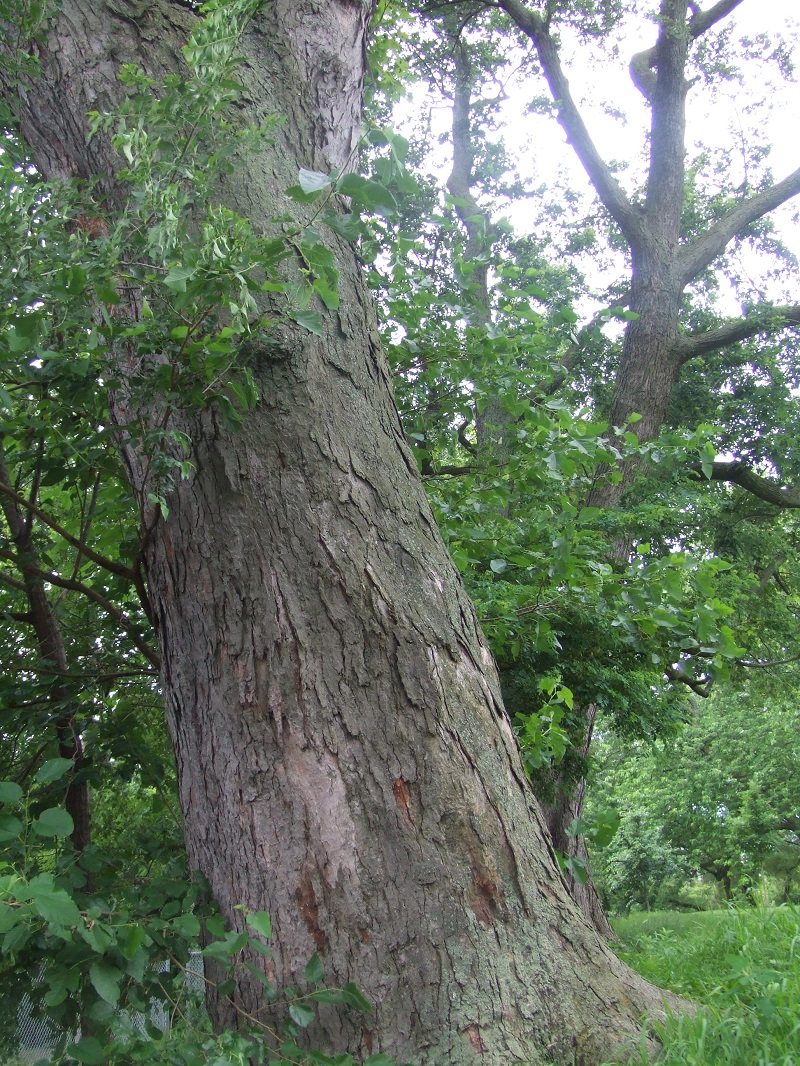
Joyce Kilmer (1886-1918)
“Árboles”
.
Creo que nunca veré
un poema tan hermoso como un árbol.
Un árbol cuya boca hambrienta esté pegada
al dulce seno fluyente de la tierra;
un árbol que mira a Dios todo el día.
Y alza sus brazos frondosos para rezar.
.
Un árbol que en verano podría llevar
un nido de petirrojos en sus cabellos;
en cuyo pecho se ha recostado la nieve;
quien vive íntimamente con la lluvia.
.
Los poemas están hechos por bufones como nosotros,
Pero solo Dios puede hacer un árbol.
. . .
Escrito en 1913, el poema “Árboles” es verso bien amado entre los hablantes del inglés americano y canadiense. Claro, es muy sentimental – faltando los sellos distintos del modernismo – pero dura su estima popular porque las palabras son sinceras – de lo más hondo del corazón. . . .Joyce Kilmer (1886-1918)
“Trees”
.
I think that I shall never see
A poem as lovely as a tree;
A tree whose hungry mouth is prest
Against the earth’s sweet flowing breast;
A tree that looks at God all day,
And lifts her leafy arms to pray;
A tree that may in summer wear
A nest of robins in her hair;
Upon whose bosom snow has lain;
Who intimately lives with rain.
Poems are made by fools like me,
But only God can make a tree.
. . .
Written in 1913, when Kilmer was 26 years old, “Trees” would become his most famous poem – sentimental, yes, a breeze to memorize, true, and popular among several generations of Americans and Canadians for its sincere tone, its plain heartfelt-ness (and with God mixed into the verse). Joyce Kilmer’s life was brief. He worked for Funk and Wagnalls Dictionary updating definitions of ordinary English-language words at a nickel a pop. When he had the chance to enlist during The Great War he was over to France in a jiffy, where he died from a German sniper’s bullet and was remembered by the men of his regiment for his valour and leadership abilities as sergeant.. . .
Versiones/interpretaciones en español: Alexander Best
. . . . .
Essex Hemphill: “We keep treasure any king would count as dear”: Poems of lust, poems of tenderness
Posted: June 29, 2013 Filed under: English, Essex Hemphill | Tags: Black gay poets Comments Off on Essex Hemphill: “We keep treasure any king would count as dear”: Poems of lust, poems of tenderness ZP_portrait by Rotimi Fani-Kayode_Dennis Carney and Essex Hemphill in Brixton, London, 1988. Hemphill is holding Carney and kissing the back of his neck.
.
Essex Hemphill (1957-1995)
From: Ceremonies (1992)
“Rights and Permissions”
.
Sometimes I hold
my warm seed
up to my mouth
very close
to my parched lips
and whisper
“I’m sorry,”
before I turn my head
over the toilet
and listen to the seed
splash into the water.
.
I rinse what remains
down the drain,
dry my hands –
they return
to their tasks
as if nothing
out of place
has occurred.
.
I go on being,
wearing my shirts
and trousers,
voting, praying,
paying rent,
pissing in public,
cussing cabs,
fussing with utilities.
.
What I learn
as age advances,
relentless pillager,
is that we shrink
inside our shirts
and trousers,
or we spread
beyond the seams.
The hair we cherished
disappears.
.
Sometimes I hold
my warm seed
up to my mouth
and kiss it.
. . .
“Object Lessons”
.
If I am comfortable
on the pedestal
you are looking at,
if I am indolent and content
to lay here on my stomach,
my determinations
indulged and glistening
in baby oil and sweat,
if I want to be here, a pet,
to be touched, a toy,
if I choose
to be liked in this way,
if I desire to be object,
to be sexualized
in this object way,
by one or two at a time,
for a night or a thousand days,
for money or power,
for the awesome orgasms
to be had, to be coveted,
or for my own selfish wantonness,
for the feeling of being
pleasure, being touched.
The pedestal was here,
so I climbed up.
I located myself.
I appropriated this context.
It was my fantasy,
my desire to do so
and lie here
on my stomach.
Why are you looking?
What do you wanna
do about it?
. . .
“Invitations All Around”
.
If he is your lover,
never mind.
Perhaps, if we ask,
he will join us.
. . .
From: Earth Life (1985)
.
“Black Beans”
.
Times are lean,
Pretty Baby,
the beans are burnt
to the bottom
of the battered pot.
Let’s make fierce love
on the overstuffed
hand-me-down sofa.
We can burn it up, too.
Our hungers
will evaporate like – money.
I smell your lust,
not the pot burnt black
with tonight’s meager meal.
So we can’t buy flowers for our table.
Our kisses are petals,
our tongues caress the bloom.
Who dares to tell us
we are poor and powerless?
We keep treasure
any king would count as dear.
Come on, Pretty Baby.
Our souls can’t be crushed
like cats crossing streets too soon.
Let the beans burn all night long.
Our chipped water glasses are filled
with wine from our loving.
And the burnt black beans –
caviar.
. . .
“Better Days”
.
In daytime hours,
guided by instincts
that never sleep,
the faintest signals
come to me
over vast spaces
of etiquette
and restraint.
Sometimes I give in
to the pressing
call of instince,
knowing the code of my kind
better than I know
the National Anthem
or “The Lord’s Prayer”.
I am so driven by my senses
to abandon restraint,
to seek pure pleasure
through every pore.
I want to smell the air
around me thickly scented
with a playboy’s freedom.
I want impractical relationships.
I want buddies and partners,
names I will forget by sunrise.
I only want to feel good.
I only want to freak sometimes.
There are no other considerations.
A false safety compels me
to think I will never need kindness,
so I don’t recognize
that need in someone else.
.
But it concerns me,
going off to sleep
and waking
throbbing with wants,
that I am being
consumed by want.
And I wonder
where stamina comes from
to search all night
until my footsteps ring
awake the sparrows,
and I go home, ghost walking,
driven indoors to rest
my hunter’s guise,
to love myself as fiercely
as I have in better days.
. . .
From: Conditions (1986)
.
“Isn’t It Funny”
.
I don’t want to hear you beg.
I’m sick of beggars.
If you a man
take what you want from me
or what you can.
Even if you have me
like some woman across town
you think you love.
.
Look at me
standing here with my dick
as straight as yours.
What do you think this is?
The weathercock on a rooftop?
.
We sneak all over town
like two damn thieves,
whiskey on our breath,
no streetlights on the back roads,
just the stars above us
as ordinary as they should be.
.
We always have to work it out,
walk it through, talk it over,
drink and smoke our way into sodomy.
I could take you in my room
but you’re afraid the landlady
will recognize you.
.
I feel thankful I don’t love you.
I won’t have to suffer you later on.
.
But for now I say, Johnnie Walker,
have you had enough, Johnnie Walker?
Do-I-look-like-a-woman-now?
Against the fogged car glass
do I look like your crosstown lover?
Do I look like Shirley?
.
When you reach to kiss her lips
they’re thick like mine.
Her hair is cut close, too,
like mine –
isn’t it?
. . .
“Between Pathos and Seduction”
(For Larry)
.
Love potions
solve no mysteries,
provide no comment
on the unspoken.
Our lives tremble
between pathos and seduction.
Our inhibitions
force us to be equal.
We swallow hard
black love potions
from a golden glass.
New language beckons us.
Its dialect present.
Intimate.
Through my eyes
focused as pure, naked light,
fixed on you like magic,
clarity. I see risks.
Regrets? There will be none.
Let some wonder,
some worry, some accuse.
Let you and I know
the tenderness
only we can bear.
. . .
“American Wedding”
.
In america,
I place my ring
on your cock
where it belongs.
No horsemen
bearing terror,
no soldiers of doom
will swoop in
and sweep us apart.
They’re too busy
looting the land
to watch us.
They don’t know
we need each other
critically.
They expect us to call in sick,
watch television all night,
die by our own hands.
They don’t know
we are becoming powerful.
Every time we kiss
we confirm the new world coming.
.
What the rose whispers
before blooming
I vow to you.
I give you my heart,
a safe house.
I give you promises other than
milk, honey, liberty.
I assume you will always
be a free man with a dream.
In america,
place your ring
on my cock
where it belongs.
Long may we live
to free this dream.
. . .
Essex Hemphill (1957 – 1995) was a poet and activist, as frank and raw – and as radical – as one can get. Hemphill’s compañero (and hero) in activism was Joseph Fairchild Beam (1954 – 1988), writer, editor, Black-Gay civil-rights agitator for positive change. In a 1984 essay Beam declared: “The bottom line is this: We are Black men who are proudly gay. What we offer is our lives, our love, our visions. We are rising to the love we all need. We are coming home with our heads held up high.”
When Hemphill wrote “In america, place your ring on my cock where it belongs” he was probably – though one cannot be sure – not talking about the symbolic ring of the traditional marriage rite as we all know it. And yet…his fervent desire was for Black, Gay Americans to be meaningfully re-connected to their own communities, communities to which they felt a powerful yearning to belong – having never left them, deep down in their hearts. We feature the following photographs because we feel that Hemphill – even though he called his black, gay world “this tribe of warriors and outlaws” – would get it. To paraphrase the final line of his poem American Wedding: Long may you live to free your dream.
.
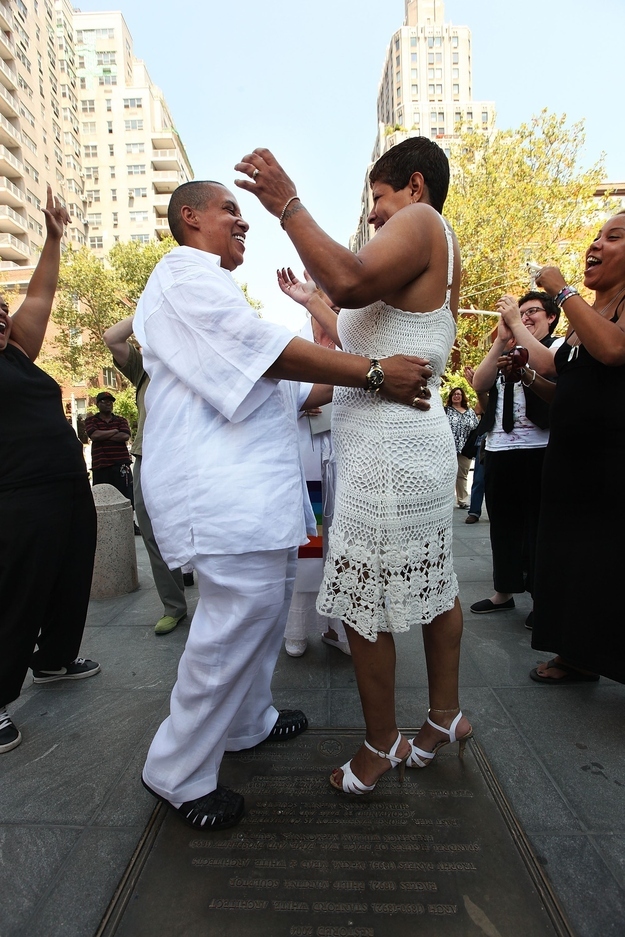 ZP_Two women celebrate with friends and relatives after their outdoor marriage in Washington Square Park , New York City, 2011.
 ZP_After 33 years together these two handsome septuagenarian New Yorkers married legally in 2011. Dignity and great pride are evident on their faces.
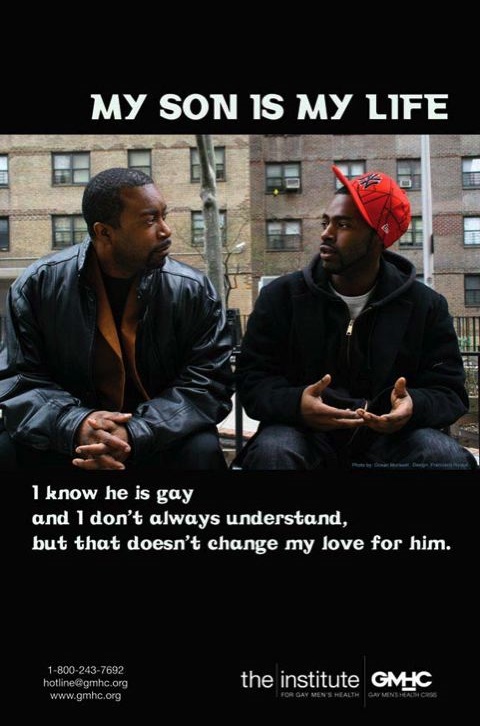 ZP_2008 poster directed toward the fathers of young, black, gay men_Gay Men’s Health Center, NYC_© photographer Ocean Morisset_Essex Hemphill, were he alive today, would’ve been heartened by such an initiative, knowing full well that the blood, sweat and tears of many ordinary people – who are also activists who love their communities – made such progress possible.
. . . . .
Loving the Ladies: the poems of Pat Parker
Posted: June 29, 2013 Filed under: English, Pat Parker | Tags: Black lesbian poets Comments Off on Loving the Ladies: the poems of Pat Parker ZP_Pat Parker in 1989_photograph © Robert Giard
Pat Parker
“Sunshine”
.
If it were possible
to place you in my brain
to let you roam around
in and out
my thought waves
you would never
have to ask
why do you love me?
.
This morning as you slept
I wanted to kiss you awake
say I love you till your brain
smiled and nodded yes
this woman does love me.
.
Each day the list grows
filled with the things that are you
things that make my heart jump
yet words would sound strange
become corny in utterance.
.
In the morning when I wake
I don’t look out my window
to see if the sun is shining.
I turn to you instead.
. . .
“I have”
.
i have known
many women
and the you of you
puzzles me.
.
it is not beauty
i have known
beautiful women.
.
it is not brains
i have known
intelligent women.
.
it is not goodness
i have known
good women.
.
it is not selflessness
i have known
giving women.
.
yet you touch me
in new
different
ways.
.
i become sand
on a beach
washed anew with
each wave of you.
.
with each touch of you
i am fresh bread
warm and rising.
.
i become a newborn kitten
ready to be licked
and nuzzled into life.
.
you are my last love
and my first love
you make me a virgin
and I want to give myself to you.
. . .
“Sublimation”
.
It has been said that
sleep is a short death.
I watch you, still,
your breath moving –
soft summer breeze.
Your face is velvet
the tension of our love,
gone.
No, false death is not here
in our bed
just you – asleep
and me – wanting
to make love to you,
writing words instead.
. . .
“Metamorphosis”
.
you take these fingers
bid them soft
a velvet touch
to your loins
.
you take these arms
bid them pliant
a warm cocoon
to shield you
.
you take this shell
bid it full
a sensual cup
to lay with you
.
you take this voice
bid it sing
an uncaged bird
to warble your praise
.
you take me, love,
a sea skeleton
fill me with you
and I become
pregnant with love
give birth
to revolution.
. . .
“For Willyce”
.
When i make love to you
i try
with each stroke of my tongue
to say
i love you
to tease
i love you
to hammer
i love you
to melt
i love you
and your sounds drift down
oh god!
oh jesus!
and i think
here it is, some dude’s
getting credit for what
a woman
has done
again.
. . .
Pat Parker (1944-1989) was a Black-American lesbian and feminist. She was born in Houston, Texas, and lived and worked (at a women’s health centre) in Oakland, California, from 1978 almost up until her death from breast cancer. Racism, misogyny, homophobia – Parker “kept it real” about such facts at numerous poetry readings throughout the 1970s. She had had two marriages – and raised two children from them – but when her second marriage ended in divorce she journeyed down a different road, stating: “After my first relationship with a woman, I knew where I as going.” Known for her “hard truths” in poems such as “Exodus”, “Brother”, “Questions” and “Womanslaughter”, Parker also had a whole other lesser-known side to her as a poet who made love poems – several of which we present here. Some are tender and euphoric and one – “For Willyce” – has Parker’s characteristic ‘edge’.
. . . . .
From Lagos with Love: two gay poets
Posted: June 29, 2013 Filed under: Abayomi Animashaun, English, Rowland Jide Macaulay | Tags: African gay poets Comments Off on From Lagos with Love: two gay poets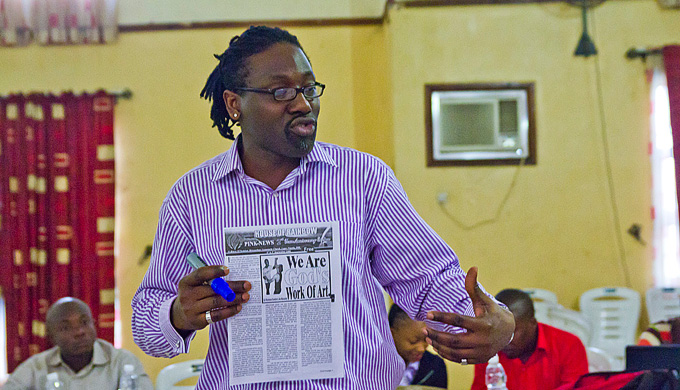 ZP_Pastor Macaulay leading a House of Rainbow gathering of conversation and loving prayer
.
Rowland Jide Macaulay (born 1966) is an openly gay Nigerian poet and pastor who – as of tomorrow (June 30th 2013) will also be an ordained preacher in The Church of England. He begins duties as a curate in London this July and says that his will be “an inclusive parish ministry – and I cannot wait!”
Macaulay’s involvement in church activity has deep roots. He was raised Pentecostal in Lagos, where his father, Professor Augustus Kunle Macaulay, is the principal of Nigeria’s United Bible University.
But the truth of his sexuality needed telling and Rowland reached a juncture in the spiritual road, founding House of Rainbow Fellowship which gives pastoral care to sexual minorities in Nigeria, and includes sister fellowships in Ghana, Lesotho and several other African states.
The Easter story holds great power for Macaulay; the following is a poem he wrote in 1999:
.
Rowland Jide Macaulay
“In Just Three Days”
.
For a life time
He came that we may have life
He died that we may have life in abundance.
In Just Three Days
Better known than ever before
Crowned King of kings
Tired but never gave up
Alone, forsaken and frightened
The world is coming to a close
Doors closing, wall to wall thickening.
In Just Three Days
Prophecies have been fulfilled
Unto us a child is born…
Destroy the world and build the kingdom
Followers deny His existence
His betrayer will accompany the enemy.
In Just Three Days
The world had Him and lost Him
Chaos in the enemies’ camp
Death could not hold Him prisoner
In the grave, Jesus is Lord.
Bethany, the house of Simon the leper,
Alabaster box of precious oil
Ointment for my body
Gethsemane, place of my refuge
Watch and pray.
In Just Three Days
Destruction, Rebuilding
Chastisement, Loving, Caring
Killing, Survival
Mockery, Praises
Passover, Betrayal
The people, The high priest
Crucify him, crown of thorns
Hail him, Strip him, bury him.
In Just Three Days
He is risen
Come and see the place where the Lord lay
His arrival in the clouds of heaven.
In Just Three Days
He was dead and buried
My resurrection, my hope, my dream
Hopelessness, helplessness turned around
In Just Three Days
In Just Three Days.
. . .
Nigerian Abayomi Animashaun, now living in the U.S.A., completed a university degree in mathematics and chemistry but then took that precise quantum leap into the ever-expanding universe that is Poetry. He teaches at The University of Wisconsin (Oshkosh).
The following poem is from his 2008 collection, The Giving of Pears.
.
Abayomi Animashaun
“In bed with Cavafy”
.
After pleasing each other,
We laid in bed a long time…
Curtains drawn,
Bolt fastened,
We’d been cautious,
Had made a show for others—
We ordered meat and wine
From the local restaurant.
And, like other guys, we talked loud
About politics into the night,
But whispered about young men
We’d bent in the dark.
At midnight, when from the bars drunks
Staggered onto the streets,
We shook hands the way they did,
Laughed their prolonged laughs,
And warned each other to steer clear
From loose girls and diseases—
All the while knowing
He’ll circle round as planned,
Sit in the unused shack behind my house
Till my neighbours’ candles are blown out.
And, after his soft knock,
I’ll slowly release the latch
– As I did last night.
. . .
Editor’s note: “In bed with Cavafy” captures the mood, nuance, and subtle tone of the poetic voice of Constantine Cavafy (1863-1933), the homosexual Greek poet who was a native of Alexandria, Egypt. Animashaun updates this Cavafy-an “voice”, making it heard in his description of two bisexual lovers in Lagos who are caught up in strategies of social hypocrisy and secret honesty in a place where sexual open-ness means great personal risk.
.
Special Thanks to Duane Taylor (York University, Toronto) for his editorial assistance!
. . . . .
 Zócalo Poets