Picong: the verbal “duels” of calypsonians
Posted: February 16, 2015 Filed under: English, IMAGES | Tags: Black History Month: Picong in Calypso Comments Off on Picong: the verbal “duels” of calypsonians
Silhouette pen and ink by Bruce Patrick Jones_The Calypsonian Master wears many hats: Party inciter, social commentator, dueling wordsmith!
Picong or Ex-tempo, is light comical banter with music, usually performed at someone else’s expense. As part of the Trinidadian Calypso tradition, it’s a way in which West Indians (particularly those in the Eastern Caribbean) tease, heckle and mock each other – usually in a friendly manner. The line between humour and insult, though, may be a slender one, and often shifts; at times the convivial spirit may degenerate into more heated debate. So the ability to engage in picong without crossing over into rude insult is highly valued in the culture of calypso music.
The verbal duels between the The Mighty Sparrow and his friendly nemesis, Lord Melody, are the stuff of calypso legend, and the following 1957 ex-tempo session – a witty, improvised exchange of humorous insults – is a great example of the art of picong.
As they used to say in the old days: Santimanitay (Sans humanité)! Without mercy!
.
The Mighty Sparrow vs. Lord Melody (from the Emory Cook album “Calypso Kings and Pink Gin”, 1957):
http://youtu.be/7SdQuzKOFvw
. . .
Currently, an “Extempo King” (and sometimes a female “Monarch”) is crowned each year as part of the carnival in Trinidad. Recent crowned verbal acrobats have included King Black Sage, Lady Africa, Brian London, Abebele and Lingo, who is 2015 Carnival’s ex-tempo king.
Black History Month: Samba and Calypso
Posted: February 15, 2015 Filed under: English, IMAGES | Tags: Black History Month: Carnival in Brazil and Trinidad Comments Off on Black History Month: Samba and Calypso
Congo pepper – sliced, on ice!
Minus 24 degrees celsius this morning, here in Toronto…
February is, typically, our coldest month of the year, but today is exceptionally cold; a blue-blue sky and bright, though heat-less, sun, reflected on heaps of snow – do make this Sunday feel cheerful and upbeat. Yet we cannot help but long for warmer climes just now: Brazil, and Trinidad & Tobago, where Carnaval is already in full-Samba-swing, or where “ playing Mas’ ” to the latest Soca songs on Jouvert Morning (February 16th this year) is nearly upon us!
.
Click on the following links for Zocalo Poets’ Carnaval / Carnival features with poems and pictures!
.
.
.
Jorge Ben Jor: “Em fevereiro tem carnaval…” / “In February there’s Carnaval…”
.
.
. . . . .
Black History Month and Canada’s Flag (50th anniversary)
Posted: February 15, 2015 Filed under: English, IMAGES Comments Off on Black History Month and Canada’s Flag (50th anniversary)

On this day, the 50th anniversary of Canada’s Flag, we reflect on the contributions of Black people to Canadian society through elected or appointed office…
.
There is a journey of commitment and hard work for all those who choose public life, and Black Canadians have persevered – and excelled. From William Peyton Hubbard we reach Michael Thompson; from Zanana Akande we come to Margarett Best; from Keith Forde there is an unwavering line that leads to Devon Clunis.
Here are some Black “Firsts” in Canada:
.
Saint-Firmin Monestime (1909-1977): Haitian-born doctor and first Black mayor of a Canadian municipality (Mattawa, Ontario, 1964-1977)
.
Lincoln MacCauley Alexander (1922-2012): Toronto-born lawyer and elected first Black member of Canada’s federal parliament (1968-1980)
.
Leonard Austin Braithwaite (1923-2012): Born in Toronto of West-Indian parents, he was elected the first Black member of a Canadian provincial legislature (Ontario, 1963-1975).
.
Rosemary Brown (1930-2003): Jamaican-born Brown was the first Black woman elected to a Canadian provincial legislature (British Columbia, 1972-1986), and also the first Black woman (and only the second woman) to run for leadership of a Canadian federal political party (the NDP, in 1975).
.
Jean Augustine (born 1937, Grenada): In 1993 she was elected the first Black woman member of Canada’s federal parliament (1993-2006), and also the first to serve as a federal cabinet minister (2003).
.
Michaëlle Jean: Born in 1957, the Haitian-Montrealer was the first Black Governor-General of Canada (2005-2010).
. . . . .
Black History Month: Love Poems for the Belovéd; for God; for a Child
Posted: February 14, 2015 Filed under: English, Eric Merton Roach, Esther Phillips, Gladys Waterberg, Kendel Hippolyte, Margaret D. Gill, Mervyn Morris, R.L.C. McFarlane | Tags: Black History Month: Love Poems, Día del Amor y la Amistad Comments Off on Black History Month: Love Poems for the Belovéd; for God; for a Child
Eric Merton Roach (1915-1974, Trinidad and Tobago)
A Lover Speaks (1948)
.
Climb up a rainbow’s arch
And be arrayed in all that loveliness;
Be gilded as a sunset cloud
Or take the moon’s soft radiance for gown
And the great stars for diamonds,
Be costumed like a queen in cloth of gold
And all the earth’s rare and famous finery,
Be what you will for I am fancy free.
.
Become all legend beauty,
The glorious goddess from Olympus leaping,
Contested Helen or the Pharaoh queen,
Isolde or Deidre,
All that fair company that pass
In love and sorrow down the corridors
Of rhyme and story.
Be what you will for I am fancy free.
.
But, when your bright imaginings shall end
And you are your black hair,
Black eyes, deep lips and dark complexion;
When you are native to this time and island,
Attractive in the streets and gay and graceful,
Your beauty maddening in the moment’s dusk,
Your Naiad nakedness in the clean sea;
When you are you
Then shall my fancy not be free
But slave and bound to what I love to see.
. . .
Eric Merton Roach
Song
.
Buy her wine and roses,
gladden her laughter,
tell her she’s legend
like Ledas daughter,
a boldly made beauty
aching the eye, Isis, Astarte.
.
But never ask her
of hearts that keep honour,
puritan modes,
ethics and codes.
Cords that should bind her
to one bed
crumble in
her passionate blood.
.
To the body only
that ripe beauty,
golden as honey
hum your canzone.
. . .
R. L. C. McFarlane (born 1925, Jamaica)
O Girl, How Should I Tell You
.
O girl, how should I tell you how
You shatter all philosophy,
And melt the hardened theory,
And lay the walls of reason low?
.
For so I yield within an hour
The strength that I had wrought with pain,
And am become a fool again,
Colonial to an alien power,
.
Seeking the furtherance of my being
Within another’s happiness;
Enwombed in utter helplessness
– Blank days that jump the time for freeing.
.
No, stand apart and keep your state
Free of my tribute, lest we prove
How in the curious knot of love
The mind conceals a knife of hate.
. . .
Mervyn Morris (born 1937, Jamaica)
Love-Story
.
Love gave her eyes:
the tough man snatched,
locked them up tight.
.
Love gave her hand:
the tough man tickled it
early one night.
.
Love gave her tongue:
the tough man found
it tasted right.
.
Love gave her body:
the tough man smiled,
switched off the light.
.
Love gave her heart:
the tough man fled,
flaccid with fright.
. . .
Esther Phillips (born 1950, Barbados)
Guilt
.
Between the silent Seraphim,
Wings overarching me,
I kneel before Your Mercy Seat.
.
Oh, do not speak, I fear
Your anger; I cannot bear
The censure in Your voice.
.
Commune with me,
Your great Heart to
My trembling heart.
.
Feel my love torn,
The greater portion Yours
And still shall always be.
.
The rest is his, and he
And I are flesh – eyes, lips,
Hands and thighs, and sweetness.
.
Do not forsake me,
Oh, do not cast me off!
Was it for love You died
That I might live
– And love?
. . .
Esther Phillips
Night Errant
.
You hate the ignoble
thing, the unworthy.
You believe man is
the measure (despite
your brilliance.)
So when the wolf rips
the night open,
the night you had so drawn
with soft colours,
you deny, you deny,
you deny.
And the creature,
on cue, disappears;
the air, snarled, lies
heavy between us.
.
I’ve not much use
for a cerebral-shaped heart
nurtured on some one-eyed
philosophy.
.
Love me with your own
heart hoarding the traitor,
the rough rage, your un-
certain compassion.
. . .
Kendel Hippolyte (born 1952, Saint Lucia)
Mamoyi
.
The child is sleeping,
folded in among the brown boughs of my arms,
and a promise, formed beyond language, drawn upward
like sap through a pith, stirs through me.
In its slow course, I feel a vow so deep
it does not reach the flower and fade of word
but leaves me steeped, resined, in its truth.
Because I wish this child, awake, a man,
to know that he can keep, lifelong,
the trust, the self-astonishing joy that he has now
and he can draw from them the strength to make
his true path from the place I am
to where he will become, for his own child, a tree,
I vow: these boughs will never break.
. . .
Margaret D. Gill (born 1953, Barbados)
I want to make you cry tonight
.
I want to make you
cry tonight
I want to shake you
and break you
and take you apart and then –
want to create you
tonight
.
To begin you
And sing you
And bring you
to
where
(if you care to)
They say heaven is
heaven is
heaven is.
.
I want to make you
cry tonight
Like a big ole man child.
Shall I liberate you from all that holding in and
holding on and
self sufficient?
I may not succeed now! But
I shall certainly try –
cry
cry, cry
cry (it’s good for you).
. . .
Gladys Waterberg (born 1959, Surinam)
Poem
.
Never before
the past
has been
such a
great future dream
than
when I met you
the first time
and wished
that the future
would never
become part
of the past.
. . .
More Love Poems at ZP:
“And Don’t Think I Won’t Be Waiting”: Love poems by Audre Lorde
.
Melvin Dixon as translator: a handful of “love letter” poems by Léopold Sédar Senghor
.
“Baby, I’m for real”: Black-American Gay poets from a generation ago
. . . . .
Manuel Iris: poemas inspirados por Jazz (Davis y Monk) – con Gabriel Okara
Posted: February 10, 2015 Filed under: English, Gabriel Okara, Spanish Comments Off on Manuel Iris: poemas inspirados por Jazz (Davis y Monk) – con Gabriel Okara
Manuel Iris (México, nacido 1983, poeta yucateco / ganador del Premio Nacional de Poesía, Mérida, 2009)
[ de su poemario Overnight Medley (ARC Edições, Brasil, 2014) ]
Escrito en Oquedad
I fall in love too easily / Me enamoro tan fácilmente (versión de Miles Davis, 1963)
.
Afuera, corazón
quédate afuera
.
no nades en mi pecho
.
tuércete
respira
como pez fuera del mar
pero también de ella
.
no mueras, sin embargo
y calla
no renuncies
.
aprende a consumirte
y no solloces
.
duerme.
.
Afuera, corazón
quédate afuera
.
no vengas a buscarla.
. . .
La canción jazz que incentiva…
.
I fall in love too easily, I fall in love too fast;
I fall in love too terribly hard for love to ever last!
My heart should be well schooled, ’cause I’ve been fooled in the past…
And still: I fall in love too easily, I fall in love too fast.
.
I fall in love too easily, I fall in love too fast;
I fall in love too terribly hard, for love to ever last!
My heart should be well schooled, ’cause I’ve been fooled in the past…
And still: I fall in love too easily, I fall in love too fast.
.
[Julie Styne & Sammy Cahn, 1945]
. . .
Me enamoro – de golpe y sopetón,
Me enamoro apresuradamente;
Sí, caigo en Amor tan terriblemente duro
que no pueda persistir el arranque de pasión.
Mi corazón ya debe ser bien educado
Porque yo he sido engañado en el pasado;
Y todavía, me enamoro fácilmente,
¡Hey presto, caigo en Amor!
.
[Compositor y Letrista: Julie Styne y Sammy Cahn, 1945]
.
[ I fall in love too easily: del álbum Seven Steps to Heaven, grabado en 1963 por el “new” Miles Davis Quintet ]
. . .
Gabriel Okara (Nigeria, born 1921)
Piano and Drums
.
When at break of day at a riverside
I hear the jungle drums telegraphing
the mystic rhythm, urgent, raw,
like bleeding flesh, speaking of
primal youth and the beginning,
I see the panther ready to pounce,
the leopard snarling, about to leap,
and the hunters crouch with spears poised;
.
And my blood ripples, turns torrent,
topples the years, and at once I’m
in my mother’s laps – a suckling;
at once I’m walking simple
paths with no innovations,
rugged, fashioned with the naked
warmth of hurrying feet and groping hearts,
in green leaves and wild flowers pulsing.
.
Then I hear a wailing piano
solo, speaking of complex ways in
tear-furrowed concerto;
of faraway lands
and new horizons, with
coaxing diminuendo, counterpoint,
crescendo. But lost in the labyrinth
of its complexities, it ends in the middle
of a phrase – at a daggerpoint.
.
And I am lost in the morning mist
of an age at a riverside;
keep wandering in the mystic rhythm
of jungle drums – and the concerto…
. . .
Manuel Iris
Round Midnight
.
“And I am lost in the morning mist
of an age at a riverside; keep
wandering in the mystic rhythm
of jungle drums – and the concerto…”
[Gabriel Okara, Piano and drums]
.
El Arquitecto calla, piensa. Planea
juntar las puntas de la media noche
para hacer de nuevo el puente
entre tu voz y tu verdad primera.
.
El inicio es torpe. Borro y escribo:
Thelonius Monk ató puntas de la media noche
para tender la melodía que funciona
como puente de tu voz
al grito primigenio.
.
Acaso ha mejorado. Sigo escribiendo pero entonces apareces. Entras al cuarto y a pesar de que te veo de frente, prefiero la otra imagen que hay en el espejo, la variación del vidrio boquiabierto junto a ti.
.
Me detiene boquiabierto: evidente efectismo. Pongo de nuevo esa canción del Arquitecto y dejo que te vayas. Continúo:
.
Thelonius Monk ha atado los extremos de la media noche
para iniciar la variación de los andamios
que se alargan de tu hablar
a tu gemir de orgasmo al primitivo
tiempo de los otros los pre-humanos
que se aman contemplando el fuego.
.
Thelonius Monk armó la media noche circular
y entonces la ternura más rudimentaria
se apropió de ti te convirtió en la imagen
del primer amor que es casi el eufemismo
de quedar en celo es casi ronda casi
día siguiente…
La canción termina pero alguna variación es todavía posible. Callo. Imagino al arquitecto componiendo partituras que sirven nada más para salir o para entrar en ellas. Pongo play:
.
…pensaba
unir las puntas de la media noche
y la ternura más homínida posible
el más elemental amor te vio las manos
y pensó en dejarlas en la piedra para siempre
en invocarte como a la cacería y te volvió rupestre
y te dejó en la cueva del amor original
del eufemismo de quedar en celo
de ser Thelonius Monk haciendo los andamios
que se alargan de tu voz a los aullidos de tu risa
hacia el temblor de orgasmo
y vas del piano al tambor y vas también
en dirección contraria.
Caigo en cuenta
de que el puente es una forma de la eternidad
que el Arquitecto escribe los reflejos de tu rostro
cuando entras por la puerta tu precisa variación
tus puntos tus momentos de llegada
o de partida.
. . .
[ ‘Round Midnight: del álbum Misterioso, grabado en 1958 por Thelonius Monk ]
. . . . .
Cumpleaños de Bob Marley: “400 años” y “Tontos tercos”
Posted: February 6, 2015 Filed under: Bob Marley, English, Spanish | Tags: Black History Month, El Mes de la Historia Afroamericana Comments Off on Cumpleaños de Bob Marley: “400 años” y “Tontos tercos”
400 años, una canción de Peter Tosh, del album “Catch a Fire” (“Coge un Fuego”), grabado en 1973 por Bob Marley & The Wailers (“Los Plañideros”):
. . .
400 years, 400 years, 400 years…Wo-o-o-o,
And it’s the same philosophy.
I’ve said it’s four hundred years, 400 years, 400 years…Wo-o-o-o,
Look, how long!
And the people they still can’t see.
Why do they fight against the poor youth of today?
And without these youths, they would be gone, all gone astray.
.
Come on, let’s make a move, make a move, make a move…Wo-o-o-o,
I can see time, the time has come.
And if a-fools don’t see, fools don’t see, fools don’t see…Wo-o-o-o,
I can’t save the youth.
But the youth is gonna be strong!
So, won’t you come with me?
I’ll take you to a land of liberty
Where we can live – yes, live a good, good life,
And be free.
.
Look how long! (400 years, 400 years, 400 years…)
Way too long! (Wo-o-o-o…)
That’s the reason my people, my people can’t see.
Said: it’s four hundred long years (400 years, 400 years. Wo-o-o-o)
Give me patience – and it’s the same philosophy.
.
It’s been 400 years, 400 years, 400 years…
Wait so long! Wo-o-o-o,
How long?
400 long, long years…
. . .
400 años, 400 años, y seguimos teniendo la misma filosofía…
Yo he dicho que es 400 años, 400 años, y todavía la gente no ve más allá…
¿Por qué luchar contra los pobres jóvenes de hoy?
Sin ellos hoy estarían todos yendo por el mal camino…
Vamos, movámonos, la hora ha llegado, y aunque los tontos no lo ven como salvar a la juventud – pero ellos son fuertes…
Entonces, ¿por qué no vienes conmigo? Te llevaré a un lugar – la tierra de la libertad – donde podremos vivir bien y ser libres…
Mira – tan largo – 400 años, 400 años, tanto tiempo que no pueden ver más allá…
400 años, 400 años…Dame paciencia…la misma filosofía…
Hemos atravesado 400 años – hemos esperado tanto tiempo…largos años…
. . .
La frase 400 años hace referencia al principio del comercio de la esclavitud africana (durante el siglo XVI.) El primero ingenio azucarero jamaicano fue fundado en Sevilla La Nueva (cerca de Bahía Santa Ana) por los Españoles durante su periodo colonizador (1509–1655) en “Santiago” (el primero nombre castellano para Jamaica). En hecho, es la mayoría de Jamaicanos que son descendientes de esos esclavos…
Para leer otras letras de Bob Marley & The Wailers que se tratan de liberarse de las formas diversas de la esclavitud, cliquea en el enlace:
https://zocalopoets.com/2013/02/06/mind-is-your-only-ruler-sovereign-marcus-garvey-and-bob-marley-emancipense-de-la-esclavitud-mental-nadie-mas-que-nosotros-puede-liberar-nuestras-mentes/
. . . . .
Stiff-necked Fools (1980/1983)
.
Stiff-necked fools, you think you are cool
To deny me for simplicity.
Yes, you have gone for so long
With your love for vanity now.
Yes, you have got the wrong interpretation
Mixed up with vain imagination.
.
So take Jah Sun, and Jah Moon,
And Jah Rain, and Jah Stars,
And forever, yes, erase your fantasy, yeah!
.
The lips of the righteous teach many,
But fools die for want of wisdom.
The rich man’s wealth is in his city;
The righteous’ wealth is in his Holy Place.
So take Jah Sun, and Jah Moon,
And Jah Rain, and Jah Stars,
And forever, yes, erase your fantasy, yeah!
Destruction of the poor is in their poverty;
Destruction of the soul is vanity, yeah!
.
So stiff-necked fools, you think you are cool
To deny me for simplicity, yeah!
Yes, you have gone, gone for so long
With your love for vanity now.
.
But I don’t wanna rule ya!
I don’t wanna fool ya!
I don’t wanna school ya,
Things you might never know about!
.
Yes, you have got the wrong interpretation
Mixed up with vain imagination…
Stiff-necked fools, you think you are cool
To deny me for, ooh-ooh, simplicity!
. . .
Stiff-necked Fools: Marley has used phrases from The Bible in this song, particularly Proverbs 10, verses 15 and 21.
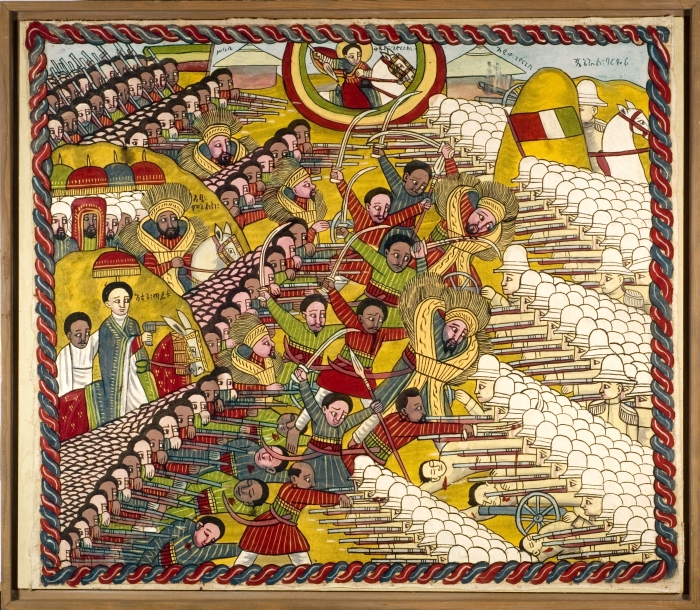
The Battle of Adwa fought in 1896 was the climactic confrontation of the First Italo-Ethiopian War, and it secured Ethiopian sovereignty. Painting from the collection of the Tropenmuseum in The Netherlands_Una representación de la victoria etíope contra los italianos en la Batalla de Adwa (1896).
El imperio de Etiopía quedó independiente durante la era de dominio européo en África; este hecho histórico fue de suma importancia al nacimiento de un movimiento afro-caribeño cuasi-bíblico: el Rastafarianismo. Robert Nesta Marley permanece el “Rasta” más famoso mundial.
Tontos tercos
.
Tontos tercos, piensan que son ‘cool’
para negarme la simplicidad.
Sí, tu te has ido por largo tiempo
Con tu amor por vanidad ahora.
Sí, tu tienes mala interpretación
Mezclada con vana imaginación.
.
Así que toma el Sol de Jah, la Luna de Jah y la Lluvia de Jah, las Estrellas de Jah,
Y para siempre, sí, borra tu fantasía, yeah-yeah.
.
Los labios del justo enseñan a muchos,
Pero los necios mueren por falta de entendimiento.
La riqueza del hombre rico está en su ciudad;
La riqueza de los justos está en su santo lugar.
.
Así que toma el Sol de Jah, la Luna de Jah y la Lluvia de Jah, las Estrellas de Jah,
Y para siempre, sí, borra tu fantasía, yeah-yeah.
La destrucción de los pobres esta en su pobreza;
¡La destrucción del alma es la vanidad, sí!
.
Entonces, tontos tercos, piensan que son ‘cool’
Para negarme la simplicidad, yeah-yeah.
Sí, tu te has ido por largo tiempo
Con tu amor por vanidad ahora.
¡Pero yo no quiero ya las reglas!
¡No quiero ser tonto ya!
Yo no quiero ya la escuela:
Cosas tuyas..¡puede ser que nunca sepamos de ellas!
.
Sí, tienen mala interpretación
Mezclada con vana imaginación…
Tontos tercos, ¡piensan que son ‘cool’
Para negar a mí, ooh-ooh, la simplicidad!
. . .
Marley utiliza unas frases biblicas en sus letras aqui: por ejemplo, Proverbios 10, versos 15 y 21.
. . .
Bob Marley & The Wailers: “Stiff-necked Fools” / “Tontos tercos” fue grabado en 1980 y lanzado póstumamente, en 1983. Puede oír el sonido frágil de la voz de Marley, porque sufría del cáncer que pronto le mataría…
http://youtu.be/0sBrvhMeGlw
.
Retrato en lo alto por Bruce Patrick Jones: Silueta de Robert Nesta Marley (1945-1981)
. . . . .
Jamaica Omnibus Services: “The Rhymes of Jolly Joseph” / Las Rimas de José “El Jovial”
Posted: February 6, 2015 Filed under: English | Tags: Black History Month, El Mes de la Historia Afroamericana Comments Off on Jamaica Omnibus Services: “The Rhymes of Jolly Joseph” / Las Rimas de José “El Jovial”
A vintage Jamaica Omnibus ticket_dimensions 1.5 inches by 2.5 inches_au verso is printed Courtesy Makes Life Smooth. The fare price, printed in pounds sterling, denotes a 1960s ticket, before the switch to a Jamaican dollar currency.
Bruce Patrick Jones remembers the Jamaica Omnibus Services: “The Rhymes of Jolly Joseph”
. . .
I remember, I remember,
The house where I was born,
The little window where the sun
Came peeping in at morn…
.
So begins Thomas Hood’s poem of memories.
In the 1960s, poetry was an essential inclusion in Jamaican Secondary School education. Simple, rhyming poems have always been the most accessible and sweetest examples of what remains, for me, a mysterious and enigmatic art form. Couplets, with their natural sing-song sway, easily pull a reader into their world, guiding them to the more complex forms of poetic writing.
A bus ride on a recent visit home to Jamaica jolted back a memory from my early teen years. Back then, the Jamaica Omnibus Service (JOS) was essential to the transportation of the citizens of Kingston. Advertising promotion affectionately named the bus line “Jolly Joseph”, and each vehicle was operated by a driver, usually male, and a conductor or conductress, almost always female. As riders entered the bus by a rear side door and paid their fares, the conductor would issue the appropriate ticket for the requested journey. Tickets were rectangular, printed in black on light card of various colours. On one side was the fare price and on the other, rhyming couplets with a variety of messages to aid the rider. Of these, two came clearly back to mind:
.
To stop the bus hold out your hand,
The driver then will understand.
.
And, to address easy loading:
.
If at the stop you form a queue,
We’ll all get on, including you.
.
The latter was great on over-promise, as the exploding population of Kingston began to put a heavy burden on infrastructure in those days.
I’ve thought hard and long trying to remember the other rhymes, and dream that one day I might find an old JOS ticket doing duty as a bookmark or hidden away in a drawer, ready to help me make the leap to Keats and Wordsworth.
. . .
. . . . .
Bruce Patrick Jones: Recuerdos del Servicio de Autobuses Jamaicanos (JOS)
.
Las Rimas de José “El Jovial”
.
“Recuerdo, recuerdo, la casa donde yo nací,
y la pequeña ventana donde llega con su miradita el sol,
cada mañana…”
Y bien inicia Thomas Hood su poema de memorias…
.
Durante los años 1960, la poesía era una inclusión esencial por la educación secundaria jamaicana.
Simples coplas rimadas siempre han sidos los ejemplos más dulces – y alcanzables – de lo que queda, para mí, una forma de arte tan misteriosa y enigmática. Coplas, con su bamboleo y sonsonete natural, atraen en su mundo el lector, guiándole hacia la poesía más compleja.
.
Un aventón en autobus durante una visita reciente a mi país natal me impresionó un recuerdo de mi adolescencia. En esos años del décado 1960, El Servicio de Autobuses Jamaicanos (JOS) era un sistema esencial en la vida de los ciudadanos de Kingston (la capital).
Anuncios dieron al autobus el apodo José “El Jovial”, y cada vehículo tuvo un conductor manejando y una conductora – casi siempre una conductora – que expedía los billetes apropriados por el viaje pedido. Los billetes eran rectangulares, de tarjeta liviana de varios colores, imprimido con tinta. En un lado apareció el precio y en el otro: coplas rimadas. Puedo recordar dos ejemplos:
.
Para detener el bus – estira la mano,
El conductor – pues – va entenderlo.
.
Y una rima que trata sobre el tema del abordaje fácil:
.
Si en la parada hacemos la cola,
Vamos avanzar – todos – cada en fila.
.
La segunda fue pesado con una promesa casi imposible, a causa de la población explotando de Kingston durante esa era; la infraestructura de la ciudad se volvía muy cargada.
.
Yo he reflexionado mucho sobre estas “poemitas”, y es mi sueño que descubriré, algún día, un billete viejo de JOS que está sirviendo como marcalibros – o escondiendo en un cajón – ¡listo para ayudarme saltar al mundo de Keats y Wordsworth!

Bruce Patrick Jones_AutoRetrato en Silueta_Self Portrait in Silhouette
Bruce Patrick Jones es un artista gráfico, nacido en Jamaica en 1949. Ha vivido en Toronto, Canadá, desde 1971. / Bruce Patrick Jones is a Jamaican-born graphic artist who has lived in Toronto, Canada, since 1971.
. . . . .
Marcus Garvey: “Those Who Know”
Posted: February 6, 2015 Filed under: English, Marcus Garvey | Tags: Black History Month Comments Off on Marcus Garvey: “Those Who Know”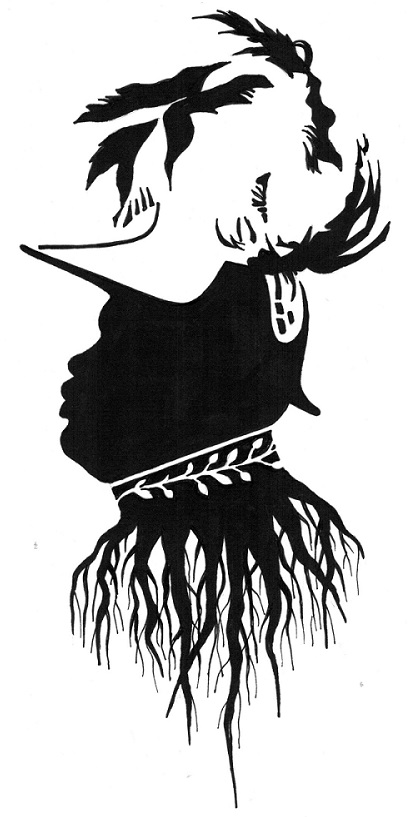 Marcus Mosiah Garvey (1887-1940, born Saint Ann’s, Jamaica) was a Black Renaissance Man: energetic, intense, full of creative ideas – and “all over the map”. A political leader, prosyletizer, journalist, publisher, and all-round entrepreneur, he was most especially a passionate, moralizing orator.
Dusé Mohamed Ali (1866-1945), the Egyptian-Sudanese founder of the African Times and Orient Review (in London in 1912) was one of Garvey’s mentors during the Jamaican’s time in England; Garvey’s pan-African and Black Nationalist thrust owed much to Ali’s example.
Though Garvey found himself on the wrong side of the NAACP’s W.E.B. DuBois (calling DuBois’ mulatto-ness “a monstrosity” ) and on the right side of Edward Young Clarke (Imperial Wizard of the KKK) – “repatriation” of “Africans” from the U.S.A. “back to” Liberia being the agreed goal – still, Garvey’s legacy has been much more solid than the sometimes madcap careenings of his tumultuous life.
However one perceives, weighs, accepts or judge’s this complex thinker’s worldview, Garvey nevertheless gives good advice to all of us in the following poem…
. . .
Marcus Mosiah Garvey (1887-1940)
“Those Who Know”
.
You may not know, and that is all
That causes you to fail in life;
All men should know, and thus not fall
The victims of the heartless strife.
Know what? Know what is right and wrong,
Know just the things that daily count,
That go to make all life a song,
And cause the wise to climb the mount.
.
To make man know, is task, indeed,
For some are prone to waste all time:
It’s only few who see the need
To probe and probe, then climb and climb.
The midnight light, the daily grind,
Are tasks that count for real success
In life of those not left behind,
Whom Nature chooses then to bless.
.
The failing men you meet each day,
Who curse their fate, and damn the rest,
Are just the sleeping ones who play
While others work to reach the best.
All life must be a useful plan,
That calls for daily, serious work –
The work that wrings the best from man –
The work that cowards often shirk.
.
All honour to the men who know,
By seeking after Nature’s truths.
In wisdom they shall ever grow,
While others hum the awful ‘blues’.
Go now and search for what there is –
The knowledge of the Universe.
Make it yours, as the other, his;
And be as good, but not the worse.
. . . . .
Image: Bruce Patrick Jones: Silhouette of Marcus Garvey
Maya Angelou: “La vida no me asusta…” / “Life doesn’t frighten me”
Posted: February 5, 2015 Filed under: English, Maya Angelou, Spanish, ZP Translator: Alexander Best | Tags: Black History Month, Jean-Michel Basquiat Comments Off on Maya Angelou: “La vida no me asusta…” / “Life doesn’t frighten me”
Maya Angelou (born Marguerite Annie Johnson, 1928-2014)
Life doesn’t frighten me (1993)
.
Shadows on the wall, noises down the hall,
Life doesn’t frighten me at all.
Bad dogs barking loud, big ghosts in a cloud,
That doesn’t frighten me at all.
.
Mean old Mother Goose, lions on the loose,
They don’t frighten me at all.
Dragons breathing flame on my counterpane,
That doesn’t frighten me at all.
.
– I go Boo, make them shoo,
I make fun, a-waaay they run!
I won’t cry, so they fly,
I just smile, and they go wild!
Life doesn’t frighten me at all.
.
Tough guys in a fight, all alone at night,
Life doesn’t frighten me at all.
Panthers in the park, strangers in the dark,
No, they don’t frighten me at all.
.
That new classroom where
Boys all pull my hair,
They don’t frighten me – at all.
Kissy little girls
With their hair in curls,
They don’t frighten me – at all.
.
Don’t show me frogs and snakes
And listen for my screams
– IF I’m afraid at all,
It’s ONLY in my dreams…
.
I have got a magic charm that I keep up my sleeve,
I can walk the ocean floor and never have to breath.
Life doesn’t frighten me – not at all – not at all,
Life doesn’t frighten me at all.
. . .
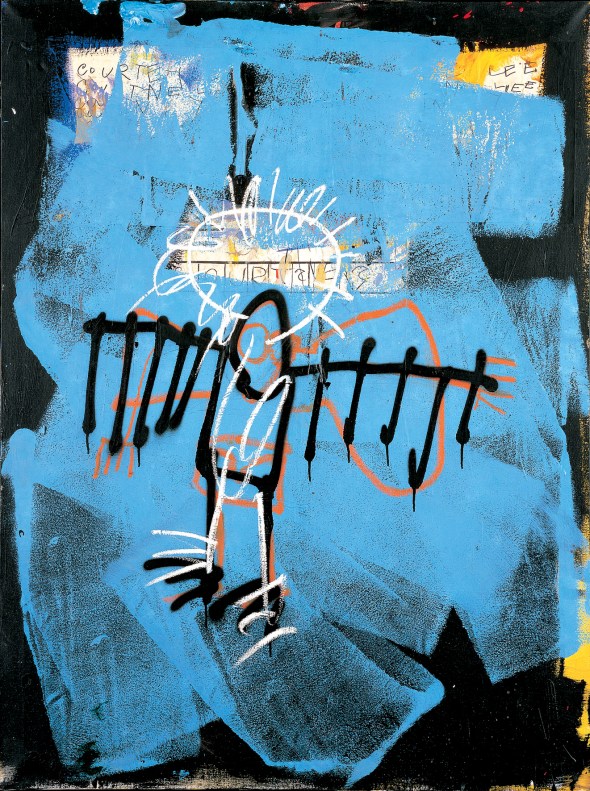
“Life doesn’t frighten me”, Maya Angelou’s children’s poem paired posthumously with paintings by Jean-Michel Basquiat, was published in 1993 by Stewart, Tabori & Chang press (editor Sara Jane Boyers).
Maya Angelou (1928-2014)
“La vida no me asusta…”
.
Sombras en la pared, ruidos abajo el corredor,
no, esta vida no me da miedo – ni una pizca.
Perros malos que ladran tan altos, fantasmas en una nube
– no, esos no me asustan, para nada.
.
La infame Mamá Ganso, y leones cuando están sueltos,
no me dan miedo, sí – no me dan miedo.
Dragones que respiran la llama…sobre mi ventanilla,
no, esto no me asusta – ni una pizca.
Digo: ¡Bu! Y los ahuyento.
Los burlo de ellos ¡y huyen!
No voy a llorar, ¡pues se echan a volar!
Solo sonrío – ¡y se vuelven locos!
La vida no me da miedo, de veras.
.
Matones en una pelea, solitaria en la noche,
La vida no me asusta – ni una pizca.
Panteras en el parque, desconocidos en la oscuridad,
no, ellos no me dan miedo, ah no.
.
Esa nueva aula donde los chicos jalan mi cabello,
Ellos no me dan miedo – ni una pizca.
Chicas cursis con su pelo chino,
no, ellas no me asustan, para nada.
.
No me mostras ranas y culebras
– pues esperar mis gritos…
SI yo tenga miedo – quizás –
SOLO exista en mis sueños…
.
Poseo un amuleto mágico que guardo en la manga,
Puedo caminar por el suelo marino y nunca no tengo que respirar.
Esta vida no me da miedo – ni una pizca – para nada,
no, la vida no me asusta, ah no.
. . .
“La vida no me asusta” es un poema de Maya Angelou escrito para niños, y emparejado póstumamente con unas pinturas de Jean-Michel Basquiat (“la estrella fugaz” del mundo-arte en los años 80). Fue publicado en 1993 por Stewart, Tabori & Chang (editor: Sara Jane Boyers).
. . . . .
Jean-Michel Basquiat: Now’s The Time…
Posted: February 5, 2015 Filed under: English | Tags: Black History Month Comments Off on Jean-Michel Basquiat: Now’s The Time…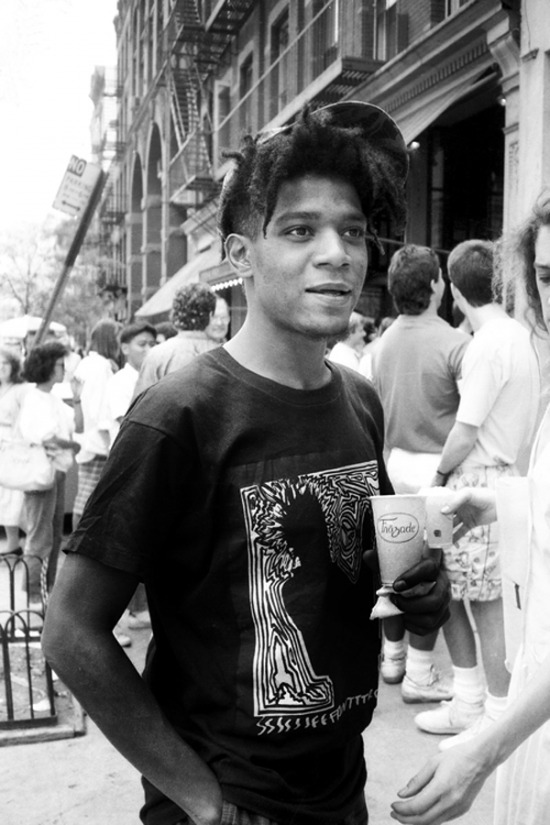
Jean-Michel Basquiat in 1986
In conjunction with a retrospective exhibition opening this week at the Art Gallery of Ontario in Toronto, Canada…
Jean-Michel Basquiat (1960-1988) was a “shooting-star” phenomenon of the New York City art scene during the 1980s. In less than a decade he zoomed from teenage magic-marker-on-walls graffiti punk – from 1977 to 1980 – under the name SAMO © (Same Old Shit Copyright) with fellow high-schoolers Al Diaz, Shannon Dawson, and Matt Kelly – to major Manhattan trendy. The enigmatic poetic thoughts and slogans of SAMO found their way onto Basquiat’s canvases, and his SAMO “tagging” years in SoHo and Lower Manhattan can be viewed as a kind of early advertisement for himself as an Artist.
.
One of three children born to Gérard Basquiat, from Haiti, and Matilde Andrades, Brooklyn-born but of Puerto-Rican descent, Jean-Michel’s home life was unstable, his mother being institutionalized from the time he was 11 years old, and his father banishing him from about the age of 15 after he dropped out of school following Grade 10. However, his mother’s gift to him of a copy of Gray’s Anatomy, the 1858 illustrated encylopaedia of the human body, before he was ten years old, planted in him the seed of ambition for future artistic expression.
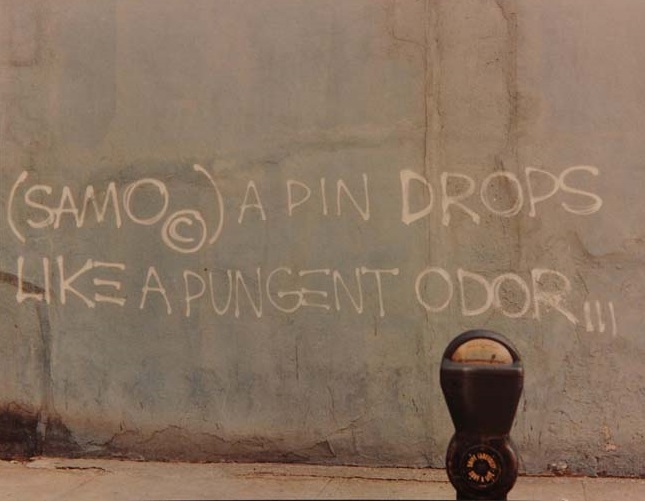
SAMO graffiti photographed by Henry Flynt in 1979
.
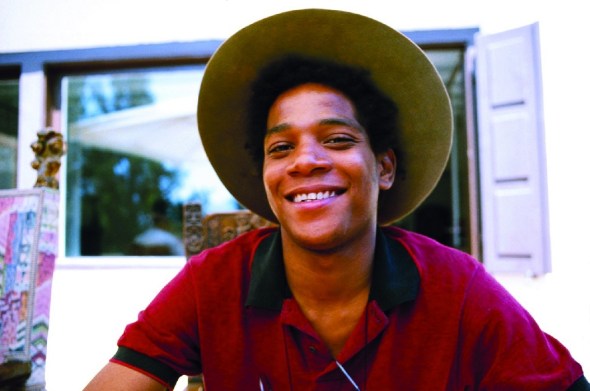
The late 1970s-early 1980s New York City confluence of street culture with art, via the emerging rap (later “hip-hop”) and graffiti scenes, plus his interest in a “serious” art career, helped to position Basquiat for stardom; he was, in fact, in the right place at the right time.
.
Keith Haring, two and a half years older, would take the NYC graffiti phenomenon in a whole other Street Meets the PopArt World direction during the 1980s, whereas Basquiat aimed for a more painterly self-expression, fashioning a synthesis of Primitivism and Neo-Expressionism on canvas initiated through his graffiti and “tagging” origins.
.
In February of 1985, Basquiat appeared on the cover of The New York Times Magazine in a feature titled “New Art, New Money: The Marketing of an American Artist”.
.
http://www.nytimes.com/books/98/08/09/specials/basquiat-mag.html
.
He was both successful and very “Now” by then, yet his growing appetite for heroin use was beginning to interfere with his friendships and professional obligations. Though he did attempt to kick his heroin habit, he ultimately died of an overdose in his Great Jones Street studio in August of 1988. He was 27 years old.
At the artist’s funeral, rap/hiphop pioneer Fab Five Freddy read the following poem:
“Genius Child” by Langston Hughes
.
This is a song for the genius child,
Sing it softly, for the song is wild.
Sing it softly as ever you can,
Lest the song get out of hand.
Nobody loves a genius child,
Can you love an eagle,
Tame or wild?
Can you love an eagle,
Wild or tame?
Can you love a monster
Of frightening name?
Nobody loves a genius child.
Kill him – and let his soul run wild.
.
.
Of Basquiat’s worldview, artist Lydia Lee has said:
“Like a DJ, he adeptly reworked the clichéd language of gesture, freedom, and angst in Neo-Expressionism, and redirected Pop Art’s strategy of appropriation, in order to produce a body of work that at times celebrated Black culture and history, yet also revealed its complexity and contradictions.”
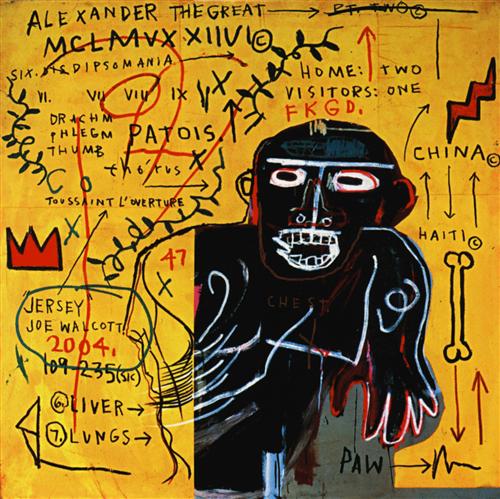
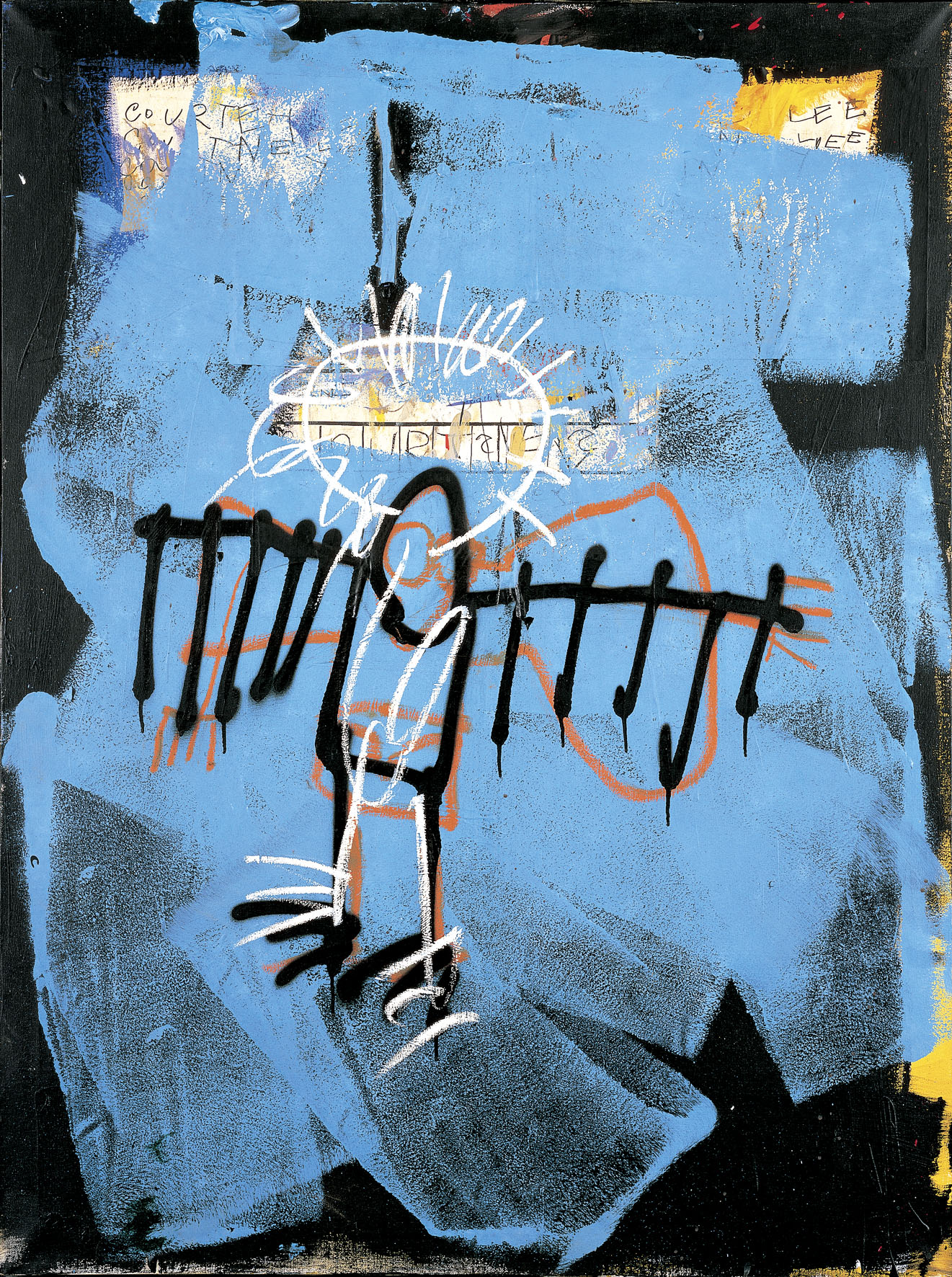
All Colored Cast Part 3 by Jean-Michel Basquiat_1982_acrylic paint and crayon on canvas
 Zócalo Poets