Of God and “Hard questions that crack the teeth”: Five Nigerian Poets
Posted: April 7, 2012 Filed under: Abubakar Othman, English, Helon Habila, Nike Adesuyi, Sunday Ayewanu, Tony Kan Comments Off on Of God and “Hard questions that crack the teeth”: Five Nigerian Poets_____
Helon Habila
(for the unknown child)
.
They say souls of the dead
Sometimes turn into birds
*
In the still morning
Metal rings against stone and sand
*
The men in a semi-circle
Display minds in flux
There is no sadness here:
*
The morning offers only greenery
Rude petals distract the mind
With sudden beauty.
*
Petals that wither
Like a child’s body
Not having lived to sin
Not having sinned to die
*
Birds in bright feathers
Fan out behind bushes, fresh, like hidden fire
Roaring suddenly into flame
Into life, into maturity…..
*
They say the souls of the dead,
Small children, often persist as birds,
To strive further, not to return empty
To their maker.
*
Not having known sin and growth,
The doom, the antidote.
_____
Tony Kan
A Prayer for a Good Death
.
Dear Lord,
I offer this prayer for a good death
May I never fall from a Molue on a Monday morning
May I never know the hard feel of asphalt’s bite
On bare skin
May the road and its ogres never bare their fangs
when I tread the pathways
*
Secrets have sprouted tendrils
And like the spider’s feet they spin
A web of fear around my mind
I stutter, I flutter, I flutter like a candle
In the cold embrace of the wind
I find empty solace in silence
*
There in the cloying warmth of the womb
The unborn child suckles silence
Weaving toneless ditties
From the sad monodies of nascent dreams
*
Why are we born? Why do we die?
Hard questions that crack the teeth
Hard questions that eclipse answers
Drowning them in the penumbra of their beginnings
*
So I circle the pregnant gloom
I reach a febrile finger into its depths
I finger its rancid entrails
Exciting worms and maggots
I feel the osmosis, the kinesis
The end of life’s ultimate synthesis
*
So I offer this prayer, dear Lord,
On this morning of death and renewal
Having tasted joy and supped on tears
And having seen that man fall and die
I, who have known love and heartache
Sweet passion and its after-glow
I beg of thee, Sweet Lord,
May I not lose my head in the urgent dialogue of
tar and tyres.
_____
Sunday Ayewanu
God’s Voice
.
The servant was startled
To see his master at the door,
Staring at him
*
What! He thought aloud
I should be cleaning the rooms
And dusting the tables
I should be washing his clothes;
Those clothes, soiled
By the spoils of high society
I should…
*
The boy stopped his morning meditation
And put his bible aside
*
“where are your roots?”
The voice was calm,
Was clear enough
*
“The streets, my lord. You picked me from the streets
As I walked through the valley of the shadow of death”
The servant answered tremulously
*
The lord said nothing, but rather
Cast a cold glance at the bible
Beside the poor boy’s pillow
“Who then is your God?”
The servant fell on his knees
Raising his hands as if in supplication
Blurting
“You are my God; for you provide me shelter
And give me my daily bread”.
_____
Nike Adesuyi
The New Testament
.
I walk the coasts of Ibeju Lekki
White sands, a blue sea and a
Happy sun distil putrid visions
*
I run into the winds;
A kite buoyed on the wings of fun
*
I race the wind to an infinity of sands and shells
Until my feet are shocked by the magic of Mammon**:
Asphalt scarifies the polish of the sands like tribal marks
*
Beyond the billowing wrapper of the sea,
In places secret to the coastal eyes,
Principalities and powers are violating
Our maiden of mercies
*
In Ogoni** the fishes are fevered
From the typhoid of crude
Oil paints the sea black
And all the waters mourn.
.
** Mammon – wealth or greed as a deity
** Ogoni refers to Ogoniland in Nigeria,
where The Shell Oil Company vastly polluted the Niger River Delta.

Abubakar Othman
The Dual Call
.
Hayyal al salat, hayyal al salat
Hayyal al falah, hayyal al falah
*
Awake my soul
Hearken to this call
The first call of the five chores
When the dawn is falling down
Over the dull slumbering town
Awake my soul
*
Al salat hairun min al naum
Al salat hairun min al naum
*
But an incubus clad to my bosom
Weighs me down in the cozy embrace
Of another call
The intimate voice of her throbbing heart
Mixes with the distant voice of the minaret
In the sensuous ears of my soul
And I am lost in the dual call
*
Awake my soul
Awake from the cozy embrace of a siren
To the real call of the distant minaret
Awake my soul and say
*
Allahu akbar, Allahu akbar
La ilaha illallah, Allahu akbar
_ _ _ _ _
Translation of the poet’s transliterated Arabic:
Hurry to prayer, hurry to prayer
Hurry to success – to salvation
*
Prayer is better than sleep
Prayer is better than sleep
*
God is most great, God is most great
There is no God but Allah, God is most great
_____
This compilation © Nigerian poet and editor Toyin Adewale
Speak speak, that we may know the end of this travelling: Mahmoud Darwish محمود درويش
Posted: April 7, 2012 Filed under: Arabic, English, Mahmoud Darwish Comments Off on Speak speak, that we may know the end of this travelling: Mahmoud Darwish محمود درويشWe are grateful to A. Z. Foreman for the following translation from Arabic into English.
Visit his site: http://www.poemsintranslation.blogspot.com
_____
Mahmoud Darwish / محمود درويش
(Palestine/Israel,1941-2008)
We travel like anyone else
We travel like anyone else, but do not return to anything
as if travelling
Were the way of the clouds. We buried our loved ones deep
in the shadow of the clouds and among the trunks of the trees.
We told our wives: give birth by us for centuries,
that we may complete this journey and see
A moment of a country, a meter of what can’t be.
In the carriages of the psalms we travel, in the tent of the prophets we sleep,
we come out of the words the gypsies speak.
We measure space with a hoopoe’s beak
or sing to while the distance away or wash the moonlight clear.
Long is your path, so dream of seven women to bear this long path on
Your shoulders. Shake the palmtree for each one
to know her name and which shall be
the mother of the boy from Galilee*.
Ours is a country of words. Speak, speak,
that I may lay my road on stone of stone to something.
Ours is a country of words. Speak speak
that we may know the end of this travelling.
* “the mother of the boy from Galilee”
refers to Mary, mother of Jesus
Passover poems: “An experience of redemption, more or less…”
Posted: April 7, 2012 Filed under: English Comments Off on Passover poems: “An experience of redemption, more or less…”Mrs. Bracha Meshchaninov
“Pesach”*
House cleaned
more or less
kitchen surfaces covered
more or less
food ready
more or less
an experience of redemption
more or less
_____
“The Seder”**
We chewed the hand-made bread
of redemption
and wine specially made
children primed for performance… performed
and wonderful guests came and prayed
yet his eyes were sad and her skin showed strain
We left Mitzraim***
but in pain we stayed.
* Pesach = Passover, the Jewish holyday and festival
** The Seder = a ritual feast of Passover, includes family and friends
re-telling the story of the Israelites’ flight from Ancient Egypt
*** We left “Mitzraim” = We left “Ancient Egypt”,
referring to The Exodus from slavery under The Pharaohs
_____
Today, April 7th, is the first day of Passover 2012.
Jesus’ Descent from The Cross: 3 contemporary painters
Posted: April 7, 2012 Filed under: IMAGES Comments Off on Jesus’ Descent from The Cross: 3 contemporary painters


Pauline Johnson: “I do not feel the thorns so much today…”
Posted: April 6, 2012 Filed under: English, Pauline Johnson Comments Off on Pauline Johnson: “I do not feel the thorns so much today…”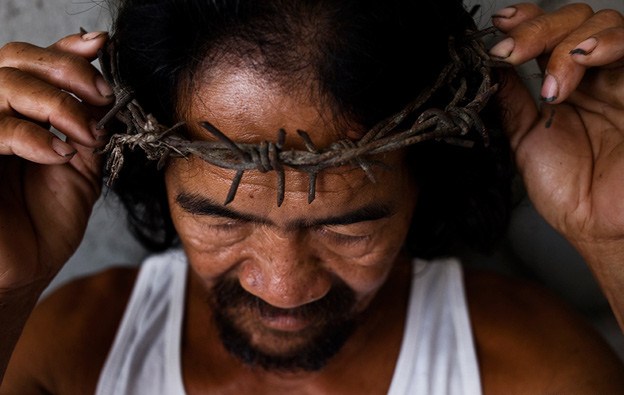
Pauline Johnson (“Tekahionwake”)
(Ontario Mohawk poet, 1861-1913)
“Brier: Good Friday”
Because, dear Christ, your tender, wounded arm
Bends back the brier that edges life’s long way,
That no hurt comes to heart, to soul no harm,
I do not feel the thorns so much today.
*
Because I never knew your care to tire,
Your hand to weary guiding me aright,
Because you walk before and crush the brier,
It does not pierce my feet so much tonight.
*
Because so often you have hearkened to
My selfish prayers, I ask but one thing now,
That these harsh hands of mine add not unto
The crown of thorns upon your bleeding brow.
_____
Poema para Viernes Santo / “Good Friday” poem: Javier Álvarez
Posted: April 6, 2012 Filed under: English, Javier Álvarez, Spanish, ZP Translator: Lidia García Garay Comments Off on Poema para Viernes Santo / “Good Friday” poem: Javier Álvarez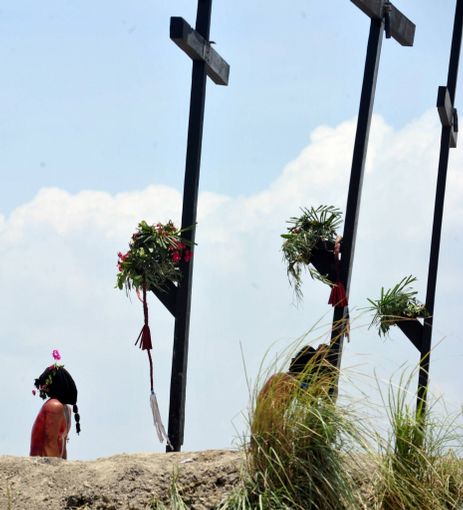
Javier Álvarez
“Good Friday”
It’s gone to the dogs, this afternoon;
a cold rain slaps my face,
the wind numbs my skin.
A bad day for running!
On the rock the rain’s turned to snow.
That proverb’s proven again:
Comes snow in October, seven months till it’s over.
Yes, a rotten day for running!
Dismal April afternoon,
not a soul in the street.
A darkness like winter’s
– the wrong day for rushing around!
Vast hellish afternoon
that the mind carves in verse:
“Save humankind, oh Lord, in this hour
of horror, of tragic destiny;
we know neither where we’re headed, nor whence we came…”
Gloomy night of death,
this evening in transit
– Good Friday evening –
A terrible day to be running…away!
Editor’s note:
In Latin-American cultures Good Friday, traditionally, has been a day to
tread softly upon the ground – not to pound or stomp, or run. The folk
belief is that we walk this day and night upon the body of Jesus.
Álvarez the poet may also be implying that we cannot run away from the
truth of pain, sacrifice, suffering.
_____
Javier Álvarez
“Viernes Santo”
Tarde de perros;
la lluvia fría azota la cara,
el viento entumece la piel.
¡Mal día para correr!
En la peña el agua es nieve.
El dicho se cumple otra vez:
La de octubre, siete meses cubre *.
¡Mal día para correr!
Tarde desolada de abril,
ni un alma por la calle.
Oscuridad de invierno,
¡Mal día para correr!
Tarde de abismal infierno,
que la mente cincela en verso:
“Salva al hombre, Señor, en esta hora
horrorosa, de trágico destino;
no sabe adónde va, de dónde vino…”
Noche oscura de muerte
esta tarde de tránsito:
Tarde de Viernes Santo
– ¡Mal día para correr!
* “La nieve de octubre siete meses cubre” (un refrán castellano)
Traducción del español al inglés / Translation from Spanish into English:
Lidia García Garay
Mike Finley: “Hot and Cold Running Good Friday” / “Un Viernes Santo corriente-caliente-y-frío”
Posted: April 6, 2012 Filed under: English, Mike Finley, Spanish, ZP Translator: Alexander Best Comments Off on Mike Finley: “Hot and Cold Running Good Friday” / “Un Viernes Santo corriente-caliente-y-frío”_____
Mike Finley
“Un Viernes Santo corriente-caliente-y-frío”
Día frío-dulce de abril
o mayo, y los bulbos
se agachan como cobardes
detrás de puertas atornilladas,
chubascos aislados
e incidencias de pecado
mojan las aceras
y humedecen la piel.
*
El agua mana de mí
mientras la tortura retuerce
mi sonrisa a una mueca,
las manos se hacen puños.
Tantas veces yo estuve apaleado por el camino
y miré hacia arriba y no había ningún velo
para agarrar el sudor.
*
Nuestro Señor, que está en el Cielo,
amo al Judío que se murió por mí
(aunque sé que es tontería),
y abril es un mes atontado y casi cruel.
Y los poemas son criaturas dando volteretas,
panfletos, circulares,
volando por
debajo de mis pies, y
la tierra que yo remuevo.
Traducción del inglés al español: Alexander Best
_____
Mike Finley
“Hot-and-Cold-Running Good Friday”
A cold warm day in April
or May, and the bulbs
crouch like cowards
behind bolted doors,
occasional showers
and occasions of sin
dampen the sidewalks
and moisten the skin.
Water flows from me
as the torture twists
my grin to a grimace,
my hands into fists.
How many times was I
battered by road and looked
up and there was no veil
to catch my sweat.
Our father who art in heaven,
I love the Jew who died for me
though I know it is nonsense,
and April is a foolish, cruelish month.
And poems are cartwheeling
creatures, flyers, circulars,
winging their way beneath
my feet and the earth I roll away.
José López Vásquez: One’s own personal “Calvary” / Su “Calvario” personal
Posted: April 6, 2012 Filed under: English, José López Vásquez, Spanish Comments Off on José López Vásquez: One’s own personal “Calvary” / Su “Calvario” personal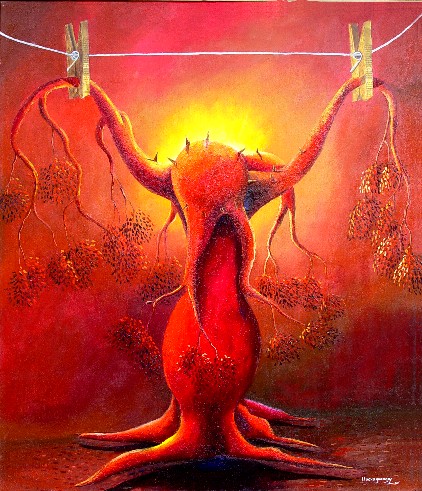
José López Vásquez (nace/born 1986, Managua, Nicaragua)
“Calvario”
No tuve última cena, no conocí huerto de olivos,
no tuve discípulos pero si un Iscariote.
Sobraron Caífaces, Pilatos, Heródes, para condenar
mis parábolas, pero no hubo un Barrabás que compitiera en
Pascua conmigo.
En mi tórrido sendero al Gólgota no hubo
Verónica ni Cirineo pero si hubo latigazos,
mofa y escupitajos. En mi crucificción no
hubo un pretoriano que humedeciera al menos
con vinagre mis labios, ni un Dimas ni un
Gestas ni una María acompañándome.
Ningún Arimateano me bajó de la cruz.
Nunca resucité.
_____
“Calvary”
I had no Last Supper, I knew no olive grove,
had no disciples, only an Iscariot*.
There were plenty of Caliphs, Pilates and Herods to condemn
my parables, but there was no Barabbas that might’ve
competed with me at Easter.
On my torrid path to Golgotha there was
neither Veronica nor Simon of Cyrene but there were lashes of the whip,
jeers and gobs of spit. At my crucifixion
there was no Praetorian guard who might’ve
moistened my lips with vinegar, neither was there a Dismas**
nor a Gestas** or a Mary Magdalene to keep me company.
Not a single Arimathean lowered me from the cross.
And I never rose from the dead.
*Judas
**Dismas and Gestas, the Good Thief and Bad Thief,
crucified alongside Jesus
Translation from Spanish into English: Alexander Best
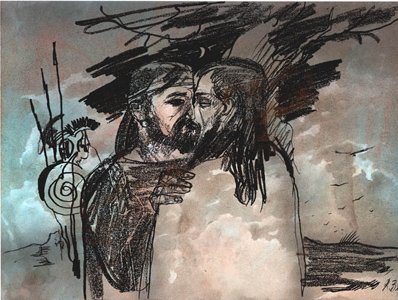
William Blake: “Quinta-feira Santa” / Holy Thursday
Posted: April 5, 2012 Filed under: English, Portuguese, William Blake Comments Off on William Blake: “Quinta-feira Santa” / Holy Thursday_____
William Blake (1757-1827)
“Quinta-feira Santa”
É coisa santa de se ver,
Em terra fértil e opulenta,
Deixar na miséria um bebê,
Nutrido por mão avarenta?
*
Este grito é uma canção?
Será ela de alegria?
E tantas crianças pobres?
É uma terra de indigência!
*
E seu sol nunca tem brilho.
Seus campos secos, desertos
Seus caminhos, com espinhos
E lá é um eterno inverno.
*
Pois onde quer que o sol brilhe
Onde quer que a chuva assente:
Bebês não podem passar fome
Nem miséria assustar a mente.
(1794, Canções da Experiência)
Tradução inglês-português: Mário Alves Coutinho, Leonardo Gonçalves
_____
William Blake (1757-1827)
“Holy Thursday”
Is this a holy thing to see
In a rich and fruitful land,
Babes reduced to misery,
Fed with cold and usurious hand?
*
Is that trembling cry a song?
Can it be a song of joy?
And so many children poor?
It is a land of poverty!
*
And their sun does never shine,
And their fields are bleak and bare,
And their ways are filled with thorns:
It is eternal winter there.
*
For where-e’er the sun does shine,
And where-e’er the rain does fall,
Babe can never hunger there,
Nor poverty the mind appall.
(1794, Songs of Experience)
Editor’s note: In this poem Blake drew attention to the misery of orphans and foundlings in England.
And Maundy/Holy Thursday – the day before Good Friday – was when the monarch and the nobility
would make ostentatious displays of charity toward the poor.
Rainer Maria Rilke: “Upon Seeing Leonardo da Vinci’s ‘The Last Supper’, Milan, 1904”
Posted: April 5, 2012 Filed under: English, German, Rainer Maria Rilke Comments Off on Rainer Maria Rilke: “Upon Seeing Leonardo da Vinci’s ‘The Last Supper’, Milan, 1904”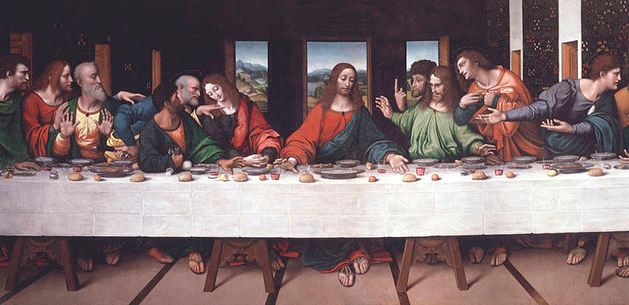
Rainer Maria Rilke
“Upon Seeing Leonardo da Vinci’s ‘The Last Supper’, Milan, 1904”
They are assembled, astonished and disturbed
round him, who like a sage resolved his fate,
and now leaves those to whom he most belonged,
leaving and passing by them like a stranger.
The loneliness of old comes over him
which helped mature him for his deepest acts;
now will he once again walk through the olive grove,
and those who love him still will flee before his sight.
*
To this last supper he has summoned them,
and (like a shot that scatters birds from trees)
their hands draw back from reaching for the loaves
upon his word: they fly across to him;
they flutter, frightened, round the supper table
searching for an escape. But he is present
everywhere like an all-pervading twilight-hour.
Translation from German into English: Albert Ernest Flemming
_____
Rainer Maria Rilke
“Das Abendmahl”
Sie sind versammelt, staunende Verstörte,
um ihn, der wie ein Weiser sich beschließt,
und der sich fortnimmt denen er gehörte
und der an ihnen fremd vorüberfließt.
*
Die alte Einsamkeit kommt über ihn,
die ihn erzog zu seinem tiefen Handeln;
nun wird er wieder durch den Oelwald wandeln,
und die ihn lieben, werden vor ihm fliehn.
*
Er hat sie zu dem letzten Tisch entboten
und (wie ein Schuß die Vögel aus den Schoten
scheucht) scheucht er ihre Hände aus den Broten
mit seinem Wort: sie fliegen zu ihm her;
*
sie flattern bange durch die Tafelrunde
und suchen einen Ausgang. Aber er
ist überall wie eine Dämmerstunde.
_____
Editor’s note:
In Leonardo da Vinci’s 1498 mural – as in Gianpietrino’s 1520 “copy” –
the painter has chosen from biblical scripture the moment
immediately after Jesus says:
Amen, I say to you
that one from among
you is going to
deliver me up [“betray me”],
one of you who is eating with me.
The painting depicts the disciples’ reactions to Jesus’ words.
 Zócalo Poets