Les femmes-poètes africaines “griotent” de la Poésie, de l’Amour, du Néant – et de la Jupe / African women poets sing, proclaim, and advise about Poetry, about Love, The Void – and Skirts
Posted: October 1, 2013 Filed under: English, French | Tags: Femmes-Poètes Africaines Comments Off on Les femmes-poètes africaines “griotent” de la Poésie, de l’Amour, du Néant – et de la Jupe / African women poets sing, proclaim, and advise about Poetry, about Love, The Void – and Skirts ZP_Werewere Liking reciting at the Festival Internacional de Poesía de Medellín in Colombia_2011
.
Assamala Amoi (born 1960, Paris / Abidjan, Ivory Coast)
“If you could”
.
If you could leave when work was done
Like the sun at the end of its day;
If you could arrive like the day and the night
At an hour chosen by the seasons;
If you could hear the farewells like the tree
Listens to the song of the migrating bird
– who would dread departures, returns and death?
. . .
“Si on pouvait”
.
Si on pouvait s’en aller à la fin de son ouvrage
Comme le soleil au terme de sa course;
Si on pouvait arriver comme le jour et la nuit
A l’heure choisie par les saisons;
Si on pouvait entendre les adieux comme l’arbre
Ecoute le chant de l’oiseau qui le quitte
Qui craindrait les départs, les retours et la mort?
. . .
Dominique Aguessy (born 1937, Benin)
“The poem seeks its own way”
.
The poem seeks its own way
Nestled in the parchment’s heart
Elegantly inscribed
By a sure and decided hand
While ideas wait to be set free
By the force of the poet
Expecting she will intercede
Bringing them alive
Without an excess of prejudice
Will she choose simplicity,
Or more exuberance, more spontaneity
Or still more circumspection?
From the madness of colours
To the vertigo of flavours
From the combinations of archipelagos
Drafting the sensual structures
The sap of the words sows images
Multiple trials bear witness
Disclosing the singular essence
Of eternal idle wandering.
. . .
“Le poème poursuit son chemin”
.
Le poème poursuit son chemin
Niché au coeur du parchemin
Elégamment buriné
D’une main ferme et décidée
Tandis que les idées
Attendent d’être délivrées
Par la vertu de l’aède
Espèrent qu’il intercède
Les amène à la vie
Sans trop de parti pris
Optera-t-il pour la simplicité,
Davantage d’exubérance, de spontanéité
Ou plus encore de retenue?
De la folie des couleurs
Au vertige des saveurs
Des combinaisons d’archipels
Ebauchent des structures sensuelles
La sève des mots ensemence les images
De multiples essais rendent témoignage
Dévoile l’essence originelle
De vagabondages sempiternels.
. . .
“When sudden passion comes”
.
When sudden passion comes
There is no age of reason
There is no future to protect
There are no inquisitors to mislead.
.
Who dares to touch it is stung
Who comes near it is consumed
Who speaks of it becomes ignorant
Who says nothing is reborn.
. . .
“Quand survient la passion”
.
Quand survient la passion
Il n’est pas d’âge de raison
Ni de futur à préserver
D’inquisiteurs à déjouer
.
Qui s’y frotte s’y pique
Qui s’en approche s’y consume
Qui en disserte l’ignore
Qui se tait en renaît.
. . .
Fatou Ndiaye Sow (1956-2004, Senegal)
“On the Threshold of Nothingness”
.
In this vampire world,
Here I am filled with my exile.
Let me rediscover
The Original Baobab
Where the Ancestor sleeps
In the deep murmur
Of his original solitude.
Let my eyes gleam
With a myriad of suns,
Voyaging across time and space without shores
And dissolving into faith the cries of anguish
And fishing for glimmers of hope
In the purple horizon of dusk
To ennoble rapacious humanity
Executioner or victim
In search of a distant star
Distant
Hidden behind doors of silence
Inside the Universe of hope
Let me decipher
At the foot of the Original Baobab
The message of my cowrie shells
Where I read
That every epoch lives its drama
Every people their suffering
But that before the doors of Nothingness
Each one PAUSES and THINKS.
. . .
“Au seuil du néant”
.
Dans ce monde vampire,
Me voilà remplie de mon exil.
Laissez-moi redécouvrir
Le Baobab Originel
Où dort l’Aïeul
Dans la rumeur profonde
De sa solitude première.
Laissez mon oeil éclaté
De myriades de soleils,
Voyager dans l’espace-temps sans rivages
Et dissoudre dans la foi les râles de l’angoisse,
Et pêcher des éclats d’espoir
Dans l’horizon pourpre du couchant
Pour ennoblir le rapace humain
Bourreau ou victime
A la recherche d’une étoile lointaine
Lointaine
Cachée aux portes du silence.
Dans l’Univers de l’espérance
Laissez-moi déchiffrer
Au pied du Baobab Originel
Le message de mes cauris,
Où je lis
Que chaque époque vit son drame
Chaque peuple ses souffrances
Mais qu’aux portes du Néant
Chacun S’ARRÊTE et PENSE.
. . .
Clémentine Nzuji (born 1944, Tshofa, Zaïre/Democratic Republic of Congo)
“It’s not my fault…”
.
It’s not my fault
If no one understands me
If I must
Express myself in
An absurd language
.
The trees also
and the winds
the flowers
and the waters
Express themselves in their own way
Strange to human beings
.
Take me as a tree
as wind
as flower
or as water
If you want to understand me.
. . .
“Ce n’est pas ma faute…”
.
Ce n’est pas ma faute
Si personne ne me comprend
Si j’ai
Pour m’exprimer
Un langage absurde
.
Les arbres aussi
les vents
les fleurs
et les eaux
S’expriment à leur manière
Etrange pour les humains
.
Prenez-moi pour arbre
pour vent
pour fleur
ou pour eau
Si vous voulez me comprendre.
. . .
Hortense Mayaba (born 1959, Djougou, Benin)
“When Life Ends”
.
A life ends
Another begins
We are the descendents
Of our dead
Each family keeps their own
Every being keeps their lineage
Our sleep makes them live again
In us they are reborn each night
Wearing our tattered clothes
Moving with our limbs
Walking often in our shadows
Drunk with our desires
And vanishing with our waking
When Life Ends!
. . .
“Quand la vie s’éteint”
.
Une vie s’éteint
Une autre renaît
Nous sommes les descendants
De nos morts
Chaque famille conserve les siens
Chaque être conserve sa lignée
Notre sommeil les fait revivre
Ils renaissent chaque nuit en nous
S’habillent de nos guenilles
Se mouvant de nos membres
Marchant souvent dans nos ombres
S’enivrant de nos désirs
Et s’évanouissant en nos réveils.
Quand la vie s’éteint!
. . .
“The Great Eye of the Good Lord”
.
I tried to find
Where the moon came from,
That princess
The colour of silver
.
I wanted to understand
Where the moon went,
That princess
Who lights up the sky
.
I tried to discover
Who commands the moon,
That princess
Of Africa’s nights
.
At last I understood
What the moon was,
That princess of the sky –
She is the Great Eye of the Good Lord.
. . .
“Le gros oeil du Bon Dieu”
.
J’ai cherché à savoir
D’où venait la lune,
Cette princesse
Couleur d’argent
.
J’ai voulu comprendre
Où allait la lune,
Cette princesse
Qui illumine le ciel
.
J’ai tenté de découvrir
Qui commandait à la lune,
Cette princesse
Des nuits d’Afrique
.
J’ai enfin compris
Ce qu’était la lune,
Cette princesse du ciel –
C’est le gros oeil du Bon Dieu.
. . .
Werewere Liking (born 1950, Cameroon)
“To Be Able”
.
There are words like a balm
They sweeten and leave a taste of mint
There are gazes like the wool of a lamb
They enfold and warm like a caress
There are smiles like full moons
They enlighten with intimacy
.
To be able!
Able to look
Able to discover
Able to predict
Able to feel
And be happy!
.
There are intoxicating promiscuities
And soft touches like caresses of sunlight
Furtive and discrete and exciting
They leave a taste of anticipation!
.
To be able
Able to feel
And be happy!
.
There are alarming caresses
That leave one on guard
And there are names that foretell fate
And phrases like decrees.
.
To be able to discover
To be able
And be happy!
.
There are faces like proverbs
Enigmatic and symbolic
They call up wisdom
Because life is the future
And the future is you
.
Ah, to be able
Able to predict
And be happy!
.
There are marvelous beauties
Present and numerous there
Under the nose there before our eyes
.
To be able
Ah, able to look
Yes, able to see
Because to see is to understand
That love
That happiness
Is as true
And as near
As your being here.
. . .
“Pouvoir”
.
Il est des mots comme des baumes
Ils adoucissent et laissent un goût de menthe
Il est des regards comme de la laine d’agneau
Ils enveloppent et réchauffent dans la caresse
Il est des sourires comme des pleines lunes
Ils illuminent avec intimité
.
Pouvoir!
Pouvoir regarder
Pouvoir déceler
Pouvoir deviner
Pouvoir sentir
Et être heureux!
.
Il est des promiscuités enivrantes
Et des frôlements comme des caresses de soleil
Furtives et discrètes et excitantes
Elles laissent un goût d’attente!
.
Pouvoir
Pouvoir sentir
Et être heureux!
.
Il est des caresses alarmantes
Qui laissent sur le qui-vive!
Il est des noms qui augurent du destin
Et des phrases comme des décrets.
.
Pouvoir déceler
Pouvoir
Et être heureux!
.
Il est des visages comme des proverbes
Enigmatiques et symboliques
Ils appellent à la sagesse
Parce que la vie c’est l’avenir
Et que l’avenir c’est toi
.
Ah, pouvoir
Pouvoir deviner
Et être heureux!
.
Il est beautés merveilleuses
Présentes et nombreuses là
Sur le nez là sous nos yeux
.
Pouvoir
Ah, pouvoir regarder
Oui pouvoir voir
Car voir c’est comprendre
Que l’amour
Que le bonheur
C’est aussi vrai
Et aussi près
Que tu es là.
. . .
Monique Ilboudo (born 1959, Burkina Faso)
“Skirts”
.
I don’t like skirts
Not short ones
Not long ones
Not straight ones
Not pleated ones
.
I don’t like skirts
The short ones show me
The long ones slow me
The straight ones smother me
The pleated ones oppress me
.
I don’t like skirts
Pretty or ugly
Red or green
Short or long
Straight or pleated
.
I don’t like skirts
Except if they’re culottes…
But the long pleated skirt
That’s the worst of all!
I don’t like skirts.
 ZP_Monique Ilboudo_2012
“Les jupes”
.
J’aime pas les jupes
Ni les courtes
Ni les longues
Ni les droites
Ni les plissées
.
J’aime pas les jupes
Les courtes m’exhibent
Les longues m’entravent
Les droites m’étouffent
Les plissées m’encombrent
.
J’aime pas les jupes
Belles ou laides
Rouges ou vertes
Courtes ou longues
Droites ou plissées
.
J’aime pas les jupes
Sauf si elles sont culottes…
Mais la jupe-longue-plissée
C’est la pire de toutes!
J’aime pas les jupes.
. . .
Nafissatou Dia Diouf (born 1973, Senegal)
“Tell Me…”
.
If what you have to say
Is not as beautiful as silence
Then, say nothing
Because nothing is more beautiful
Than your mouth half-open
On a hanging word
.
Tell me the unspeakable
Tell me the unname-able
Tell me with words
That will melt into nothingness
As soon as you speak them
.
Tell me what is on the other side of the mirror
Behind your eyes without silvering
Tell me your life, tell me your dreams
Tell me your grief and also your hopes
And I will live them with you
.
In the world of silence and rustling silk
Of velvet gazes and quilted caresses
Now, everything has been said
Or almost
So hussssssssh……
. . .
“Dis-moi…”
.
Si ce que tu as à dire
N’est pas aussi beau que le silence
Alors, tais-toi
Car il n’y a rien de plus beau
Que ta bouche entrouverte
Sur une parole arrêtée
.
Dis-moi l’indicible
Dis-moi l’innommable
Dis-le moi avec les mots
Qui se fondront dans le vide
Aussitôt prononcés
.
Dis-moi ce qu’il y a de l’autre côté du miroir
Derrière tes yeux sans tain
Dis-moi ta vie, dis-moi tes rêves
Dis-moi tes peines et tes espoirs aussi
Et je les vivrai avec toi
.
Dans un monde de silence et de soie crissante
De regards veloutés et de caresses ouatées
A présent, tout a été dit
Ou presque
Alors chuuuuuuuut……
. . . . .
Traductions en anglais / Translations from French into English – droit d’auteur © Professeure Janis A. Mayes. Tous les poèmes – droit de chaque auteur © the respective poetesses
. . . . .
“Esta canção ardente”: “Quenguelequêze!” de Rui de Noronha
Posted: October 1, 2013 Filed under: Portuguese, Rui de Noronha | Tags: Poetas africanos Comments Off on “Esta canção ardente”: “Quenguelequêze!” de Rui de Noronha
Rui de Noronha
(poeta e contista, Maputo, Moçambique, 1909 – 1943)
“Quenguelequêze!”
.
Durante o período de reclusão, que vai do nascimento à queda do cordão umbilical das crianças, o pai não pode entrar na palhota sob pretexto algum e ao amante da mãe de uma criança ilegítima é vedado, sob pena de a criança morrer, passar nesse período defronte da palhota. O período de reclusão, entre albumas famílias de barongas, é levado até ao aparecimento da primeira lua nova, dia de grande regozijo e em que a criança, depois de uma cerimónia especial denominada “iandlba”, aparece publicamente na aldeia, livre da poluição da mãe.
.
Quenguelequêze!… Quenguelequêze!…
Quenguelequêêêzeee
Quenguelequêêêzeee
.
Na tarde desse dia de janeiro
Um rude caminheiro
Chegara à aldeia fatigado
De um dia de jornada.
E acordado
Contara que descera à noite a velha estrada
Por onde outrora caminhara Guambe
E vento não achando a erva agora lambe
Desde o nascer do sol ao despontar de lua,
Areia dura e nua.
.
Depois bebera a água quente e suja
Onde o mulói pousou o seu cachimbo outrora,
Ouvira, caminhando, o canto da coruja
E quase ao pé do mar lhe surpreendera a aurora.
.
Quenguelequêze!… Quenguelequêze!…
Quenguelequêêêzeee
.
Pisara muito tempo uma vermelha areia,
E àquela dura hora à qual o sol apruma
Uma mulher lhe deu numa pequena aldeia
Um pouco de água e “fuma”.
.
guelequêêêzeee!…
.
Descera o vale. O sol quase cansado
Desenrolara esteiras
Que caíram silentes pelo prado
Cobrindo até distante as maçaleiras…
.
Quenguelequêêê…
.
Vinha pedir pousada
Ficava ainda distante o fim de sua jornada,
Lá muito para baixo, a terra onde os parentes
Tinham ido buscar os ouros reluzentes
Para comprar mulheres, pano e gado
E não tinham voltado…
.
Quenguelequêze! Quenguelequêêêze!…
Surgira a lua nova
E a grande nova
Quenguelequêze! ia de boca em boca
Numa alegria enorme, numa alegria louca,
Traçando os rostos de expressões estranhas
Atravessando o bosque, aldeias e montanhas,
Loucamente…
Perturbadoramente…
Danças fantásticas
Punham nos corpos vibrações elásticas,
Febris,
Ondeando ventres, troncos nus, quadris…
E ao som das palmas
Os homents cabriolando
Iam cantando
.
Medos de estranhas, vingativas almas,
Guerras antigas
Com destemidas ímpias inimigas
E obscenidades claras, descaradas,
Que as mulheres ouviam com risadas
Ateando mais e mais
O rítmico calor das danças sensuais.
.
Quenguelequêze!… Quenguelequêze!…
.
Uma mulher de quando em quando vinha
Coleava a espinha,
Gingava as ancas voluptuosamente
E posta diante do homem, frente a frente,
Punha-se a simular os conjugais segredos.
Nos arvoredos
la um murmúrio eólico
Que dava à cena, à luz da lua um quê diabólico…
Queeezeee… Quenguelequêêêzeee!…
.
Entanto uma mulher saíra sorrateira
Com outra mais velhinha,
Dirigira-se na sombra à montureira
Com uma criancinha.
Fazia escuro e havia ali um cheiro estranho
A cinzas ensopadas,
Sobras de peixe e fezes de rebanho
Misturadas…
O vento perpassando a cerca de caniço
Trazia para fora um ar abafadiço
Um ar de podridão…
E as mulheres entraram com um tição.
E enquanto a mais idosa
Pegava criança e a mostrava à lua
Dizendo-lhe: “Olha, é a tua”,
A outra erguendo a mão
.
Lançou direita à lua a acha luminosa
O estrepitar das palmas foi morrendo
A lua foi crescendo… foi crescendo
Lentamente…
Como se fora em branco e afofado leito
Deitaram a criança rebolando-a
Na cinza de monturo.
E de repente,
Quando chorou, a mãe arrebatando-a
Ali, na imunda podridão, no escuro
Lhe deu o peito
O pai então chegou,
Cercou-a de desvelos,
De manso a conduziu com [sic] os cotovelos
Depois tomou-a nos braços e cantou
Esta canção ardente:
Meu filho, eu estou contente.
Agora já não temo que ninguém
Mofe de ti na rua
E diga, quando errares, que tua mãe
Te não mostrou à lua.
Agora tens abertos os ouvidos
P’ra tudo compreender.
Teu peito afoitará impávido os rugidos
Das feras sem tremer.
Meu filho, eu estou contente
Tu és agora um ser inteligente.
E assim hás-de crescer, hás-de ser homem forte
Até que já cansado
Um dia muito velho
De filhos rodeado,
Sentindo já dobrar-se o teu joelho
Virá buscar-te a Morte…
Meu filho, eu estou contente.
Meu susto já lá vai.
.
Entanto o caminheiro olhou para a criança,
Olhou bem as feições, a estranha semelhança,
E foi-se embora.
Na aldeia, lentamente,
O estrepitar das palmas foi morrendo…
E a lua foi crescendo…
Foi crescendo…
Como um ai…
.
Quando rompeu ao outro dia a aurora
Ia já longe… muito longe… o verdadeiro pai…
. . .
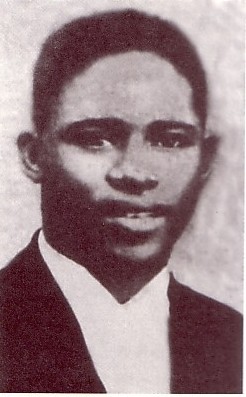
António Rui de Noronha nasceu na então Lourenço Marques – atual Maputo – Moçambique, em 1909. Mestiço, de pai indiano, de origem brâmane, e de mãe negra, foi funcionário público (Serviço de Portos e Caminho de Ferro) e jornalista. O autor colaborou na imprensa escrita de Moçambique, notadamente em O Brado Africano, com apenas 17 anos de idade. Esta produção inicial, que se reduziram apenas a três contos, e que correspondem ainda a uma fase de afirmação literária, virá a ser prosseguida a partir de 1932, com uma intervenção mais activa na vida do jornal, chegando mesmo a integrar o seu corpo directivo.
Uma desilusão amorosa, causada pelo preconceito racial, fez, segundo os seus amigos, com que o escritor se deixasse morrer no hospital da capital de Moçambique, com 34 anos, em 1943.
Seu professor de Frances, Dr. Domingos Reis Costa reuniu, selecionou e revisou 60 poemas para a edição póstuma intitulada Sonetos (1946), editado pela tipografia Minerva Central.
Sua obra completa está reunida em Os meus versos, publicada em 2006, com organização, notas e comentários de Fátima Mendonça.
Rui de Noronha é considerado o precursor (mais jovem) da poesia moderna Moçambicana.
. . . . .
Ralph Carmichael: “Un lugar tranquilo” / “A Quiet Place”
Posted: October 1, 2013 Filed under: English, Ralph Carmichael, Spanish, Translator's Whimsy: Song Lyrics / Extravagancia del traductor: Letras de canciones traducidas por Alexander Best, ZP Translator: Alexander Best Comments Off on Ralph Carmichael: “Un lugar tranquilo” / “A Quiet Place”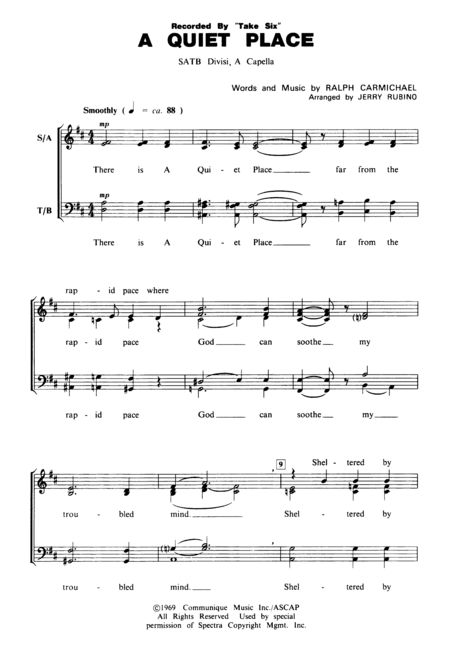
.
Ralph Carmichael (Compositor góspel, nacido 1927)
“Un lugar tranquilo”
.
Hay un lugar tranquilo
lejos del paso raudo
donde Dios puede calmar mi mente afligida.
Guardado por árbol y flor,
está allí que dejo atrás mis penas
durante la hora quieta con Él.
.
En un jardín pequeño
o alta montaña,
Encuentro allí
una nueva fortaleza
y mucho ánimo.
.
Y luego salgo de ese lugar sereno
bien listo para enfrentar un nuevo día
con amor por toda la raza humana.
. . .
Ralph Carmichael es un compositor de canciones ‘pop’ / cristianas contemporáneas.
Su canción “A Quiet Place” (“Un lugar tranquilo”) fue adaptada por un cantautor góspel estadounidense, Mervyn Warren, con su grupo “a capela” cristiano, Take 6, organizado en la Universidad Adventista Oakwood, de Huntsville, Alabama, EE.UU., durante los años 80. El arreglo musical de Señor Warren – hecho para seis voces en 1988 – es exquisitamente dulce y sensitivo. Éste no es el sonido tradicional de la música góspel, sino algo afinado y jazzístico.
Escuche la canción (versión original en inglés) en este videoclip del Festival de Jazz de Vitoria-Gasteiz (País Vasco, 1997):
http://www.youtube.com/watch?v=SH2orpg6ww4
. . .
Ralph Carmichael (born 1927)
“A Quiet Place” (1969)
.
There is a quiet place
far from the rapid pace
where God can soothe my troubled mind.
.
Sheltered by tree and flower
there in my quiet hour with Him
my cares are left behind.
.
Whether a garden small
or on a mountain tall
new strength and courage there I find.
.
And then from that quiet place
I go prepared to face a new day
with love for all mankind.
. . .
Ralph Carmichael is a composer and arranger of both pop music and contemporary Christian songs.
From 1962 to 1964 he arranged music for Nat King Cole, including Cole’s final hit, “L-O-V-E”.
“A Quiet Place” dates from 1969.
Mervyn Warren and Claude McKnight arranged a number of Christian songs – both traditional and “new” – for their six-part-harmony “barbershop”-style Gospel vocal sextet, Take 6.
Take 6 was formed at the Seventh-Day-Adventist college, Oakwood University, in Huntsville, Alabama in the early 1980s.
Mervyn Warren – most especially – is responsible for the exquisitely tender or playful harmonies that characterize Take 6’s unique sound. His 1988 arrangement of “A Quiet Place” is a good example of his genius as arranger. Astonishingly, Warren’s magnificent arrangements were never published or transcribed – all members learned their harmonies “in the moment” – through many hours of vocal jamming and experiment. Warren later left the group because the revelation of his homosexuality put him at cross-purposes with the Seventh-Day-Adventist credo.
Listen to Take 6 perform “A Quiet Place” (Mervyn Warren’s arrangement) on the following YouTube clip from a 1997 concert in Spain at the Festival de Jazz de Vitoria Gasteiz – their unusual Gospel sound is belovéd of Jazz aficionados, too!
http://www.youtube.com/watch?v=SH2orpg6ww4
. . . . .
Zócalo Poets…Volveremos en octubre de 2013 / ZP will return October 2013
Posted: August 31, 2013 Filed under: IMAGES Comments Off on Zócalo Poets…Volveremos en octubre de 2013 / ZP will return October 2013Zócalo Poets – ¡qué reunamos aquí en la gran plaza de poemas!
ZP – meet us in the Square!
¡Mándanos tus poemas – en cualquier idioma!
Send us your poems – in any language!
zocalopoets@hotmail.com

Hielo – Limón_Hasta luego, Verano…
“Problematic”: Jay Bernard on poems, performance, problem-solving
Posted: August 31, 2013 Filed under: 7 GUEST EDITORS, English, Jay Bernard Comments Off on “Problematic”: Jay Bernard on poems, performance, problem-solving“Problematic”: Zócalo Poets Guest Editor Jay Bernard on poems, performance, problem-solving:
.
Poetry is a form of problem solving. There are poems and performances I return to often because they speak to – but do not necessarily solve – problems I enjoy. These problems are usually on the merry-go-round that is the relationship between society and art, and some of the pieces I mention below exemplify the kinds of problems I think about. How to speak. How to sound authentic. How to speak so you are understood. The art of incantation.
.
So let’s start with a light take on a heavy subject. Every few months I watch Tamarin Norwood (https://www.youtube.com/watch?v=jjMvde0GJBk) read at an event called Minimum Security Prison Poetry, then spend a few hours admiring her website. It’s a great fusion of academia and playfulness. But listen to her voice. The facetious use of arch-formalism, the repetition, the nature of the repetition, the element of the absurd. It’s the conventional voice for this style of poetry. If she was a spoken word poet, she’d gravitate towards the American slam formula in which you start with slow declarative sentences, then speed up. But sometimes the convention works. Norwood’s piece is an example, as is another favourite: Kai Davis’s Fuck I Look Like (https://www.youtube.com/watch?v=hGdYAK2sLjA) There’s a bit of a contradiction when she says “You say gargantuan, I say big as shit”, then goes on to criticise another student for not using big words, but her performance is a seamless combination between the voice she’d actually use in an argument and that uniquely American oratory style. She affirms my suspicions that some social problems don’t need answers, they need to be cussed out.
.
But what about the voice in other cultures? In 2012 I visited Angelica Mesiti’s Citizens Band, showing at ACCA in Melbourne. It featured four musicians with unique talents, but the one that impressed was the Mongolian throat singer. Later research yielded dozens of varieties, including the Tuvan version here at Ubuweb’s ethnopoetics page (http://www.ubu.com/ethno/soundings/tuva.html). When I taught myself to do it (you can too) the idea of the technique as a “conduit” of poetry really moved me. How else is it possible to speak? What else can our voices do? And what kind of wordless poem is created?
.
Speaking of wordlessness: Ng Yi Sheng’s performance of Singapore’s national pledge is a performance I don’t have a video for, but I wanted to include it because it’s a remarkable piece of mockery and exaggeration. Imagine: a slight, smiling man dressed as an air hostess gets up and places a pencil in his mouth. He then spends the next five minutes waving his hands around like a dictator, as he shouts lines from the national pledge to a marching rhythm. JUSTICE! JUSTICE! SOCIETY! The pencil makes him dribble. His movements exhaust him. This poem, when performed in front of Singaporean ministers, got him blacklisted. But as someone who has always been contemptuous of nationalism, I recall this performance as a great union of politics and performance. Conclusion: the more humourless the target of the joke, the better the joke.
.
Sometimes the joke is hard to get. Tongues Untied (https://www.youtube.com/watch?v=tWuPLxMBjM8), a 1989 film by Marlon Riggs, is the nuanced pursuit of a unified sexual/racial aesthetic. His voice, his desire to be seen as he is – dark-skinned, black, American – is complicated by his sexuality; it leads him into the white world, makes him vulnerable – neither this nor that. Yet like Norwood, there’s a lightness to his touch, and I admire the unity of his vision. Why does two identities imply a split? Why isn’t the person doubled or squared? It’s a problem that Riggs sets to song, and I return to this long, cinematic poem every year.
.
What Riggs also touches on is the yearning to say as an adult what you needed to hear as a young person; and sometimes that thing can be said not in words, but in the simple combination of *that* person, *that* voice, *that* context. Which is why Leah Lakshmi Piepzna-Samarasinha (http://vimeo.com/11997033) in conversation with Ellery Russian about queer crip sexuality is one of my favourite videos. The humanity in what they are saying is simple and elegant, and the same could be said generally of Samarasinha’s poetry. She writes a lot about her father’s past and how it was a mystery she had to become queer to solve. Sometimes I want the voice that wrote the poems to talk simply, humanely and intelligently about the world at large, and that is what she does here.
. . . . .
ZP Editor’s Note: To read poems by Jay Bernard, click on April 2012 and hers are right at the top.
Classic Kaiso: “Bass Man” by The Mighty Shadow
Posted: August 31, 2013 Filed under: English, English: Trinidadian, Winston Anthony Bailey Comments Off on Classic Kaiso: “Bass Man” by The Mighty Shadow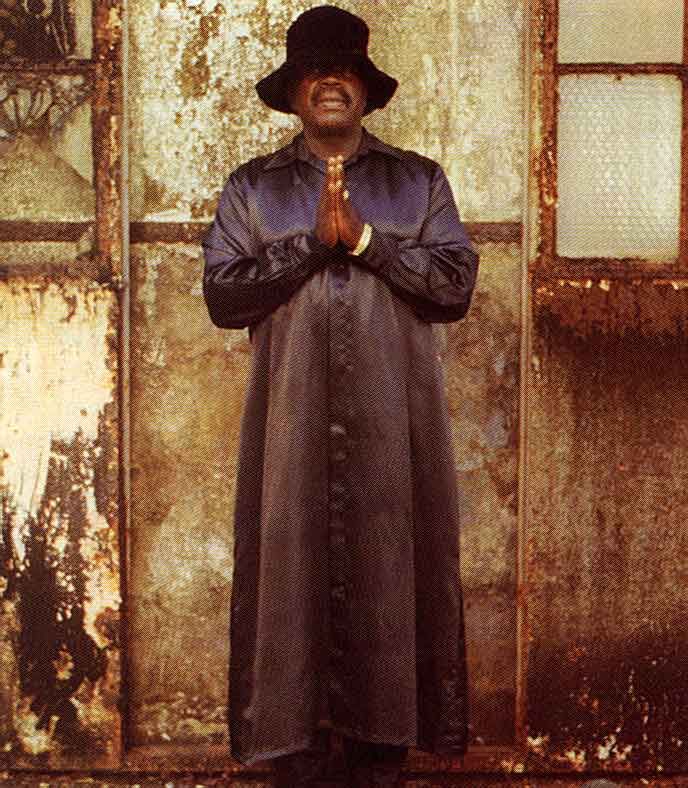 ZP_The Mighty Shadow_photograph by Abigail Hadeed
.
August 31st is Independence Day in Trinidad and Tobago, and, since “we” [here at Zócalo Poets] have a sentimental attachment to Kaiso, let “us” therefore share the lyrics to an old favourite – “Bassman” by The Mighty Shadow (Winston Anthony Bailey, born 1941, Belmont, Port of Spain) – which, back in 1974, was a strikingly original Calypso tune with a new sound and instrumental arrangement: bandy-leggéd rhythms + a bunny-hoppity bass-line.
Influenced by the style of The Mighty Spoiler (Theophilus Phillip, 1926-1960), who was a great exponent of humorous and imaginative Calypsos, Shadow has had a propensity for the eccentric and the eery. Often, he has worn dark clothing with a broad-brimmed hat and regal cape; and he has the most curious movements – including a minimalist approach – when it comes to his deportment while performing. Winning first and second places in the contest for Road March 1974 – with his songs “Bassman” and “Ah Come Out To Play” – released as a 7-inch 45rpm single vinyl record the same year – Shadow was the ‘new’ calypsonian to break the stranglehold on Road March Title held for eleven years by “biggies” Kitchener and Sparrow. While Shadow came very close to winning Calypso Monarch for 1974 – certainly he was the crowd favourite – the judges didn’t agree. He would be denied the crown several seasons over before deciding to just ignore that competition – well, for 17 years, at any rate. In 1993 he re-entered for Calypso Monarch and, though he was not to win, he would comment afterwards: “I never get no crown, but they can’t touch my music. The Shadow music sweet too bad.” However, in 2000, he did finally win the Monarch title – something he’d been deserving of for many years.
As regards his musical contribution to the Calypso genre, Shadow told the Trinidad newspaper, TnT Mirror, in 1989, that his claim to fame was in “moving the bottom of the music, and introducing changes in the bass lines…My music is characterized by a lot of energy, because of my emphasis on the foot drums and bass…” Among The Mighty Shadow‘s famous songs are: Obeah (1982), Ah Come Out Tuh Party (1983), If I Wine I Wine (1985), The Garden Want Water (1988), and Mr. Brown (1996).
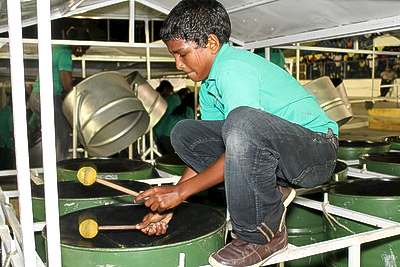 ZP_A 12 year old boy and member of the Tamana Pioneers steel orchestra practises his bass drums_ Arima, Trinidad_ January 2013
. . .
Winston Anthony Bailey a.k.a. The Mighty Shadow
“Bass Man”
(Music and lyrics by Bailey / Arranger: Art de Coteau)
.
I was planning to forget Calypso
And go and plant peas in Tobago
But I am afraid ah cyah make de grade.
Cuz every night I lie down in mih bed
Ah hearing a Bassman in mih head
.
Ah don’t know how dis t’ing get inside me
But e-ve-ry morning, he drivin’ me crazy
Like he takin’ me head for a pan-yard
Morning and evening, like dis fella gone mad.
Pim pom – an’ if ah don’t want to sing
Pim pom – well, he start to do he t’ing
I don’t want to – but ah have to sing
Pim pom – an’ if ah don’t want to dance
Pim pom – he does have me in a trance
I don’t want to – but ah have to prance to his:
pom pom pidi pom, pom, pom pom pidi pom, pom…
.
One night I said to de Bassman
Give me your identification
He said “Is me – Farrell –
Your Bassman from hell.
Yuh tell me you singing Calypso
An’ ah come up to pull some notes for you.”
.
Ah don’t know how dis t’ing get inside me
But e-ve-ry morning, he drivin’ me crazy
Like he takin’ me head for a pan-yard
Morning and evening, like dis fella gone mad.
Pim pom – an’ if ah don’t want to sing
Pim pom – well, he start to pull he string
I don’t want to – but ah have to sing
Pim pom – an’ if ah don’t want to dance
Pim pom – he does have me in a trance
I don’t want to – but ah have to prance to his:
pom pom pidi pom, pom, pom pom pidi pom, pom…
.
I went and ah tell Dr Lee Yeung
That I want a brain operation
A man in meh head
I want him to dead
He said it’s my imagination
But I know ah hearin’ de Bassman…
Ah don’t know how dis t’ing get inside me
But e-ve-ry morning, he drivin’ me crazy
Like he takin’ me head for a pan-yard
Morning and evening, like dis fella gone mad.
Pim pom – etcetera…..
. . . . .
Véronique Tadjo: “Cocodrilo” / “Crocodile”
Posted: August 27, 2013 Filed under: English, French, Spanish, Véronique Tadjo, ZP Translator: Alexander Best Comments Off on Véronique Tadjo: “Cocodrilo” / “Crocodile”
Véronique Tadjo (nacido en 1955, Paris/Abidjan, Costa de Marfil)
“Cocodrilo”
.
No es la vida fácil ser un cocodrilo
especialmente si no quiere ser un cocodrilo
El coco que usted puede ver – en la página opuesta* –
no es feliz en su
piel de coco
Era su preferencia
ser diferente
Habría preferido
llamar la atención de
Los niños
y jugar con ellos
Platicar con sus padres
Dar paseos
por la aldea
Excepto, excepto, excepto…
.
Cada vez que sale del agua
Los pescadores
tiran lanzas
Los niños
huyen
Las muchachas
abandonan sus jarros
.
Su vida es
una vida
de soledad y de la pena
Vida sin cuate y sin cariño,
sin ningún lugar a visitar
.
En todas partes – Desconocidos
.
Ese cocodrilo
Vegetariano
Un cocodrilo
y bueno para nada
Un cocodrilo
que se siente un
Horror sagrado de la sangre
.
Por favor:
Escríbale,
Escríbale a:
Cocodrilo Amable,
Caleta número 3,
Cuenca del Rio Níger.
.
*La versión original en francés presenta un dibujo hecho por Señora Tadjo.
.
Traducción en español: Alexander Best
. . .
Véronique Tadjo (née en 1955, Paris/Abidjan, Côte d’Ivoire)
“Crocodile”
.
Ce n’est pas facile d’être un crocodile
Surtout si on na’a pas envie
D’être un crocodile
Celui que vous voyez
Sur la page opposée
N’est pas bien
Dans sa peau
De croco
il aurait aimé
Etre different
Il aurait aimé
Attirer
Les enfants
Jouer
Avec eux
Converser
avec les parents
Se balader
Dans
Le village
Mais, mais, mais
.
Quand il sort
De l’eau
Les pêcheurs
Lancent des sagaies
Les gamins
Détalent
Les jeunes filles
Abandonnent leurs canaris
.
Sa vie
Est une vie
De solitude
Et de tristesse
.
Sans ami
Sans caresse
Nulle part
Où aller
.
Partout –
Etranger
.
Un crocodile
Crocodile
Végétarien
Et bon à rien
Qui a
Une sainte horreur
Du sang
.
S’il vous plaît
Ecrivez,
Ecrivez à:
Gentil Crocodile,
Baie Numéro 3,
Fleuve Niger.
. . .
Véronique Tadjo (born 1955, Paris/Abidjan, Ivory Coast)
“Crocodile”
.
It’s not easy to be a crocodile
Especially if you don’t want
To be a crocodile
The one you see
On the opposite page*
Is not happy
in his croc’s
Skin
He would have liked
To be different
He would have liked
To attract
Children
Play
with them
Talk
With their parents
Walk around
in the village
But, but, but
.
When he comes out
Of the water
Fisherman
Throw spears
Children
Take off
Young girls
Abandon their water jugs
.
His life
Is a life
Of solitude
And sadness
.
Without a friend
Without affection
Nowhere
To go
.
Everywhere
Strangers
.
A Crocodile
Vegetarian
Crocodile
And good for nothing
Who has
A holy horror
Of blood
.
Please
Write,
Write to:
Nice Crocodile,
Bay Number 3,
Niger River.
.
*The original French-language version of this poem featured a drawing by Tadjo herself of a crocodile.
. . . . .
Irene Rutherford McLeod: “Perro solitário” / “Lone Dog”
Posted: August 27, 2013 Filed under: English, Irene Rutherford McLeod, Spanish, ZP Translator: Alexander Best Comments Off on Irene Rutherford McLeod: “Perro solitário” / “Lone Dog” ZP_Perro solitário_Las Playitas_Cuatro Ciénegas_Coahuila_México_fotógrafo Hector Garza
.
Irene Rutherford McLeod (1891-1968)
“Perro solitário”
.
Soy un perro magro, un perro agudo – salvaje y solitário;
Un perro alborotador y firme, estoy cazando yo solo;
Un perro malo – y me cabreo – provocando a los tontos borregos;
Me gusta sentirme y aullar a la luna – para evitar que los almas gordas duerman.
.
Nunca ser un cachorro del regazo o lamer los pies sucios,
Un perrito dócil, elegante, arrastrándome por mi carne,
Ni la alfombrilla del hogar ni el plato bien llenado,
Sino puertas cerradas, piedras afiladas – y golpes, patadas: el odio.
.
Ningunos otros perros – para mí – corriendo hombro a hombro,
Algunos han corrido un rato corto – pero ningunos pueden durar.
El camino solo es mío – ¡Ah! – la senda ardua me parece bien:
¡Viento furioso, estrellas indómitas, el hambre de la búsqueda!
. . .
Irene Rutherford McLeod (1891-1968)
“Lone Dog”
.
I’m a lean dog, a keen dog, a wild dog, and lone;
I’m a rough dog, a tough dog, hunting on my own;
I’m a bad dog, a mad dog, teasing silly sheep;
I love to sit and bay the moon, to keep fat souls from sleep.
.
I’ll never be a lap dog, licking dirty feet,
A sleek dog, a meek dog, cringing for my meat,
Not for me the fireside, the well-filled plate,
But shut door, and sharp stone, and cuff and kick and hate.
.
Not for me the other dogs, running by my side,
Some have run a short while, but none of them would bide.
O mine is still the lone trail, the hard trail, the best –
Wide wind, and wild stars, and hunger of the quest!
.
Traducción del inglés al español / Translation from English into Spanish: Alexander Best
. . . . .
“Quien nace chicharra, muere cantando.”: ¡Las cigarras torontonienses hacen un gran zumbido! / “He who is born a cicada will die singing.”: Torontonian cicadas are right now making a big noise!
Posted: August 25, 2013 Filed under: English, Ernesto Cardenal, Spanish, ZP Translator: Alexander Best Comments Off on “Quien nace chicharra, muere cantando.”: ¡Las cigarras torontonienses hacen un gran zumbido! / “He who is born a cicada will die singing.”: Torontonian cicadas are right now making a big noise! ZP_Cicada from Borneo_© photographer Alex Hyde
.
Después de un mutismo de seis semanas – tiempo fresco en vez del calor típico del verano – empieza de nuevo “la música de cámara de los timbales” – con la recurrencia de temperaturas de 30 grados centígrados. Las cigarras-machos del barrio “cantan” para llamar la atención de sus hembras – y después del apareamiento las cigarras morirán. Pero – como sucede con nuestro aposte de María Elena Walsh (“Como la Cigarra”) – La Cigarra nos inspira metafóricamente – un testigo es el poema siguiente del Padre Ernesto Cardenal…
.
Ernesto Cardenal (poeta, sacerdote y político, nace en 1925, Granada, Nicaragua)
“En Pascua resucitan las cigarras”
.
En Pascua resucitan las cigarras
—enterradas 17 años en estado de larva—
millones y millones de cigarras
que cantan y cantan todo el día
y en la noche todavía están cantando.
Sólo los machos cantan:
las hembras son mudas.
Pero no cantan para las hembras:
porque también son sordas.
Todo el bosque resuena con el canto
y sólo ellas en todo el bosque no los oyen.
¿Para quien cantan los machos?
¿Y porque cantan tanto? ¿Y que cantan?
Cantan como trapenses en el coro
delante de sus Salterios y sus Antifonarios
cantando el Invitatorio de la Resurrección.
Al fin del mes el canto se hace triste,
y uno a uno van callando los cantores,
y después sólo se oyen unos cuantos,
y después ni uno. Cantaron la resurrección.
. . .
After a silence of six weeks – cool weather instead of our typical Torontonian hot summer days – the “tymbal” chamber-music of the male cicadas is back in full force, now that temperatures are hitting 30 degrees celsius once again. The cicada’s “song” attracts a female to mate, and afterwards the cicadas die. And yet, as with our previous post – María Elena Walsh’s “Like a Cicada” – The Cicada inspires us metaphorically; witness the following poem by Father Ernesto Cardenal…
.
Ernesto Cardenal (poet, priest, politician, born 1925, Granada, Nicaragua)
“At Easter-time the cicadas are resurrected”
.
At Easter-time* the cicadas are resurrected
– underground 17 years in a larval state –
millions and millions of cicadas
which sing sing sing all day long
and which, at nightfall, are still singing…
Only the males do so – the females are quiet;
because they are also deaf.
The woods resound with cicada-song
and just the female cicadas – among all of us in the woods – don’t hear it.
For whom do these male cicadas sing then?
And why do they sing so much – and what is it that they are singing?
They sing like Trappist monks in a chorus,
before them their open Book of Psalms and “Antifonarios”,
incanting the Invitatory Psalm of the Resurrection.
After a month or more the cicada-song becomes sad,
and, one by one, the “singers” fall silent,
and then we hear just a few,
and, after that, nary a one.
They have sung the Resurrection.
.
* Perhaps April in a hotter southern climate, but not till July in Canada
.
Traducción en inglés / Translation from Spanish into English: Alexander Best
. . . . .
María Elena Walsh: “Como la cigarra” / “Like the Cicada”
Posted: August 22, 2013 Filed under: English, María Elena Walsh, Spanish Comments Off on María Elena Walsh: “Como la cigarra” / “Like the Cicada”
|
 Zócalo Poets