Nican mopohua (“Here is recounted…”): December 9th, 1531
Posted: December 9, 2011 Filed under: English, Náhuatl | Tags: Juan Diego Cuauhtlatoatzin Comments Off on Nican mopohua (“Here is recounted…”): December 9th, 1531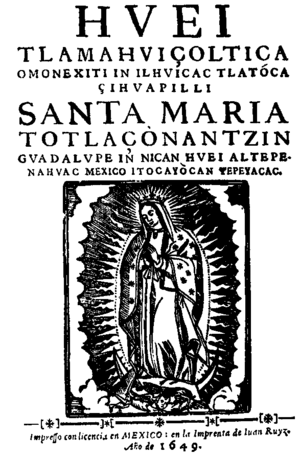
…..Auh in acico in inahuac tepetzintli in itocayocan Tepeyacac,
ye tlatlalchipahua…..
*
Concac in icpac tepetzintli cuicoa, yuhquin nepapan tlazototome cuica;
cacahuani in intozqui, iuhquin quinananquilia tepetl, huel cenca teyolquima,
tehuellamachti in incuic; quicenpanahuia in coyoltotl in tzinitzcan ihuan in
occequin tlazototome ic cuica…..
*
“Canin ye nica? Canin ye ninotta? Cuix ye oncan in quitotehuaque huehuetque
tachtohuan tococolhuan, in xochitlalpan in tonacatlalpan,
cuix ye oncan ilhuicatlalpan?”…..
*
In oyuhceuhtiquiz in cuicatl, inomocactimoman in yeequicaqui
hualnotzalo inicpac tepetzintli, quilhuia: “Juantzin, Juan Diegotzin”…..
*
Auh in ye acitiuh in icpac tepetzintli, in ye oquimottili ce Cihuapilli
oncanmoquetzinoticac, quihualmonochili inic onyaz in inahuactzinco…..
*
Auh in tetl, in texcalli in ic itech moquetza, inic quimina…..
*
Auh in mizquitl, in nopalli ihuan occequin nepapan xiuhtotontin
oncan mochichihuani yuhquin quetzaliztli. Yuhqui in teoxihuitl in
iatlapalio neci. Auh in icuauhyo, in ihuitzyo, in iahuayo yuhqui in
cozticteocuitlatl in pepetlaca…..
*
Quimolhuili: “Tlaxiccaqui noxocoyotl Juantzin, campa in timohuica?”
*
Auh in yehuatl quimonanquilili: “Notecuiyoé, Cihuapillé, Nochpochtziné!
Ca ompa nonaciz mochantzinco México-Tlatilolco,
nocontepotztoca in Teyotl…..”
_____ * _____ * _____
…..And as he drew near the little hill called Tepeyac
it was beginning to dawn…..
*
He heard singing on the little hill, like the song of many precious birds;
when their voices would stop, it was as if the hill were answering them;
extremely soft and delightful; their songs exceeded the songs of the
coyoltotl and the tzinitzcan and other precious birds…..
*
“Where am I? Where do I find myself? Is it possible that I am in the
place our ancient ancestors, our grandparents, told about, in the
land of the flowers, in the land of corn, of our flesh, of our sustenance,
possibly in the land of heaven?”…..
*
And then when the singing suddenly stopped, when it could no longer
be heard, he heard someone calling him, from the top of the hill, someone
was saying to him: “Juan, Dearest Juan Diego”…..
*
And when he reached the top of the hill, a Maiden who was standing there,
who spoke to him, who called to him to come close to her…..
*
And the stone, the crag on which she stood, seemed to be giving out rays…..
*
And the mesquites and nopales and the other little plants that are up there
seemed like emeralds. Their leaves, like turquoise. And their trunks, their
thorns, their prickles, were shining like gold…..
*
She said to him, “Listen, my dearest-and-youngest son, Juan,
Where are you going?”
*
And he answered her: “My Lady, my Queen, my Beloved Maiden!
I am going as far as your little house in Mexico-Tlatilolco,
to follow the things of God…..”
* * * * *
On December 9th, 1531, Juan Diego Cuauhtlatoatzin (1474-1548)
encountered a radiant native-Mexican woman at Tepayac Hill
(site of a former temple to the Aztec Earth-Mother goddess Tonantzin).
He knew her to be Santa María Totlaconantzin – Mary, Our
Precious Mother – and she spoke to him in his own language – Náhuatl.
*
Tepayac is now the location of the largest shrine in Latin America –
La Basílica de Nuestra Señora de Guadalupe / The Basilica of
Our Lady of Guadalupe – the name by which Juan Diego’s
Virgin Mary is known in México today…
Popularly, she is also called The Mother of All México.
Juan Diego was canonized by Pope John Paul II in 2002.
*
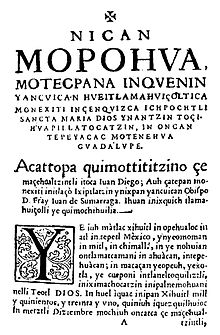
The above text – in the original Náhuatl (language of the Aztecs)
plus English translation by D. K. Jordan – is taken from
Nican mopohua (“Here is recounted…”)
by Antonio Valeriano (1556), and is the first chapter in the
written telling of the miraculous life of Juan Diego Cuauhtlatoatzin.
Valeriano was a native-Mexican scholar in three languages
– his birth-language, Náhuatl, plus Spanish and Latin.
Nican mopohua forms part of a larger volume,
Huei tlamahuiçoltica (“The Great Happening”),
published by Luis Laso de la Vega in 1649. The book is a
crucial Náhuatl text from the 16th and 17th centuries
– a period of immense trauma during which a new race
– el Mestizo – and a new nationality – Mexican – were being forged.
Rin Ishigaki: “Myself: a far-off island”
Posted: December 8, 2011 Filed under: English, Japanese, Rin Ishigaki Comments Off on Rin Ishigaki: “Myself: a far-off island”_____
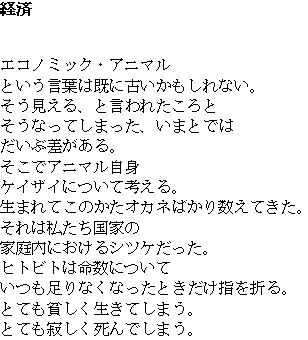
The Economy
The phrase ‘economic animal’
I suppose is already fairly old.
Quite a gap exists between
The time when they said we seem that way
And now when we are that way.
Now then we economic animals
Will think about the economy.
From the time that I was born I’ve just been counting money.
That was what we were taught in the home
By the state.
People only count the time they have left
When it has started to run out.
We live terribly impoverished lives.
We die terribly lonely deaths.
(1987)
_____
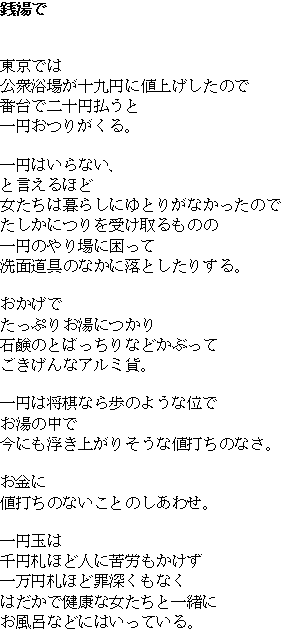
At the Bathhouse
In Tokyo
At the public bathhouse the price went up to 19 yen and so
When you pay 20 yen at the counter
You get one yen change.
Women have no leeway in their lives
To be able to say that
They don’t need one yen
And so though they certainly accept the change
They have no place to put it
And drop it in between their washing things.
Thanks to that
The happy aluminium coins
Soak to their fill in hot water
And are splashed with soap.
One yen coins have the status of chess pawns
So worthless that they’re likely to bob up even now
In the hot water.
What a blessing to be of no value
In monetary terms.
A one yen coin
Does not distress people in the way a 1,000 yen note does
Is not as sinful as a 10,000 yen note
The one yen coin in the bath
With healthy naked women.
(1968)
_____
Island
I am standing in a large mirror.
A solitary
Small island.
Separated from everyone.
I know
The history of the island.
The dimensions of the island.
Waist, bust and hips.
Seasonal dress.
The singing of birds.
The hidden spring.
The flower’s fragrance.
As for me
I live on the island.
I have cultivated it, built it.
Yet
It is impossible to know
Everything about the island.
Impossible to take up permanent residence.
In the mirror staring at
Myself: A far-off island.
(2004)
_____
Rin Ishigaki (Ishigaki Rin in Japanese name-order)
was born in Tokyo in 1920 and died in 2004.
She worked for four decades as a bank clerk, kept
house, cooked, and cared for ageing parents.
Her first book of poems was published in 1959.
Without pretension or preciousness, her poems
are well-liked by people who might normally
steer clear of poetry!
These are thoughtful statements about ordinary life
– written in simple, straightforward Japanese –
and are sometimes used to teach the language to children,
as well as to foreign students.
_____
Translations from Japanese:
Leith Morton
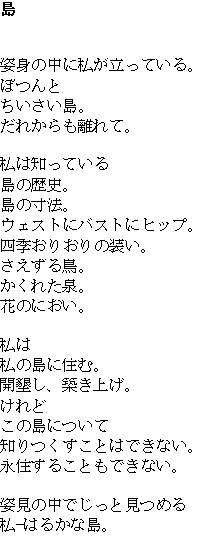
Ishigaki’s original three Japanese poems are featured below.
_____


Inuo Taguchi: “Morning Discussion”
Posted: December 8, 2011 Filed under: English, Inuo Taguchi, Japanese Comments Off on Inuo Taguchi: “Morning Discussion”_____
Inuo Taguchi
MORNING DISCUSSION
I had a strange dream.
An airplane –
it doesn’t fall straight down
but crashes horizontally.
“Don’t ask me how.
It happened in my dream.”
Now, in this ‘modern’ world
it’s common for vertical things to change into horizontal.
So it’s nothing to make a fuss about
that a plane should crash horizontally.
“Why are you making such a big deal out of it?
Nonsense is commonsense nowadays.”
Don’t worry. If you tip over you glass, wine will spill out.
If you let go of a knife, it’ll fall straight down.
Our world, as ever,
obeys divine providence.
What doesn’t obey it is your dream and –
“No, don’t turn on the television.
It’s never told us good stories. It never will.”
I am listening to the morning discussion half-heartedly,
for I only want to think about poetry.
But my thoughts suddenly turn to the grasslands of
Kharakhorum.
There, too, are things that should be floating in air
floating in air?
There, too, is what should be falling falling?
Do things never crash horizontally?
Is what should be landing landing
and what should be ascending ascending?
Suddenly I feel like confirming it
and begin to be restless.
The soul begins slowly spiraling.
A kitchen kettle
begins honking like a horn.
*
from: Hush-a-bye
(2004)
Translation from Japanese:
William I. Elliott and Kazuo Kawamura
The original Japanese poem is featured below.
_____

_____
Inuo Taguchi was born in 1967 in Tokyo, Japan. His pen-
name, Inuo, means Dog-Man. He began to write poetry
in his early twenties and his first book came out in 1995.
He has been described as having a “self-less voice” as a poet,
meaning he is off to the side, even out of the “story”
– and often his poems are little stories.
At festivals he reads his poems aloud – usually barefoot.
His poems have been translated into Turkish – among a bunch
of languages.
He muses: “I feel that poetry must strive to open giant
air holes in human consciousness.”
Inuo Taguchi: “For the Vegetarian”
Posted: December 8, 2011 Filed under: English, Inuo Taguchi Comments Off on Inuo Taguchi: “For the Vegetarian”_____
Inuo Taguchi
FOR THE VEGETARIAN
John Lennon died, you know.
“That must have been because of unpolished rice and
vegetarian food,”
Jesus said, sitting on a park bench.
“That’s not so,” I said. “John Lennon was assassinated . . . ”
I broke off mid-sentence,
because Jesus had an open New York Times before him
which actually carried an article to that effect.
When I got back to my apartment last night
there was a message from John on my answering machine.
He said he’d very much like me to participate
in a 4-day natural foods workshop in Atami.
If people get too gung-ho over something
do they even forget that they’re dead?
What’ll we call it? Karma? Anyway that’s a sad story.
Jesus spread out a take-out turkey sandwich on his lap
as he talked.
“When I was in Palestine I used to be really healthy,
but since coming to Manhattan everything’s gone wrong.
Is it because I’ve eaten too many French fries?
I tell them not to,
but my disciples themselves seem to frequent McDonald’’s
pretty often.
“Every time I argued with John I lost.
On those occasions my disciples were always upset.
Buddha once told me in all sincerity
that bad food was our karma.”
So John thought he would all by himself
eat up all the unpolished rice in the world.
I pictured John loading his cart with unpolished rice
in an Oriental market in Heaven
and at check-out
sticking out his tongue and mumbling,
“I don’t give a damn about good health, really. After all,
dead people are the freshest of all.”
The sky we see over Central Park is blue everywhere
and I slowly realized that under such a sky
it would be no wonder at all
if I had a call from dead John.
And sure enough when I got back to my room
there was a message from John.
Dead John said as follows:
“The opposite of eating is not not eating.
The opposite of eating is praying,
because while we’’re praying, at any rate,
we can’’t eat.”
_____
from: Armadillogic
2002
Translation from Japanese:
William I. Elliott and Kazuo Kawamura
Reesom Haile: the Lively Voice of Eritrea / la Voz Vivaz de Eritrea
Posted: December 1, 2011 Filed under: English, Reesom Haile: La voz vivaz de Eritrea / the lively voice of Eritrea, Spanish, Tigrinya, ZP Translator: Alexander Best | Tags: African poetry - Eritrea, Black poets Comments Off on Reesom Haile: the Lively Voice of Eritrea / la Voz Vivaz de Eritrea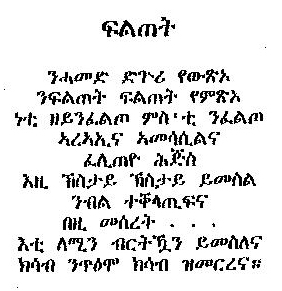


_____ * _____ * _____
KNOWLEDGE
First the earth, then the plow:
So knowledge comes out of knowledge.
We know, we don’t know.
We don’t know we know.
We know we don’t know.
We think
This looks like that –
This lemon, that orange –
Until we taste the bitter.
_____
DEVELOPMENT
Change.
Like a child, an infant.
“Let’s go ! Let’s go !”
And our household grows.
“Let’s run.”
We can slow
And sit and stretch
In the sun
Till it sets, but tomorrow
Dawned yesterday.
_____
UNDER CONSIDERATION
Consider this.
Consider that.
Excellent.
Write it
And propose it
For consideration.
Also consider
The official response,
“It’s under consideration.”
Who is considering whom?
When? Where?
How? Why?
Give up? Consider this.
_____
LEARNING FROM HISTORY
We learned from Marx and Lenin:
To be equal trim your feet
For one-size-fits-all shoes.
We made their mistakes, too.
Equally, we all make mistakes.
The evil is in not being corrected.
Aren’t we known
By what we do, undo and do again?
_____
YOUR HEAD
From birth you need
A door in your head to live.
Mother, father, teacher, preacher,
Sister, brother, relations, friends
Or others of your kind
May have the key
Or it may be lost.
But they still have other ways
To open the lock.
Rancid butter rubbed on your skull
May let the sunshine in.
The phrase, “What are you,
Stupid? Dumb?” might throw the bolt.
A flywhisk works on the less fragile.
A wooden spoon, a ruler or a good stick
Does the trick on harder nuts and…
Voilà! An open mind!
_____
SPEAK OUT
To speak out and to be spoken about,
Or to see no evil, hear no evil,
Shut up, keep it to yourself
And only complain in private?
That is not the question.
Read the constitution
Of our democratic state.
Exercise your rights
To tell it like it is,
Write as you see fit
And get a good night’s sleep.
You also have the right to take
Back what you say by mistake.
The freedom to express
Cannot be given up.
It comes from God.
Be free and brave.
Only one prison remains:
Our minds.
_____ * _____ * _____
El Saber
Al primero la tierra, pues el arado:
Tan que el saber viene del saber.
Sabemos, no sabemos.
No sabemos que sabemos.
Sabemos que no sabemos.
Pensamos que
Ésto parace como éso
– este limon, esa naranja –
hasta que degustemos el amargor.
_____
El Desarrollo
Cambio.
Como niño, como bebé.
¡Vamos! ¡Vamos!
Y crecen nuestro hogar.
¡Corramos!
Podemos aflojar el paso
Y sentarnos, estirando,
Bajo del sol,
Hasta el anochecer, pero
Ayer amaneció la mañana.
_____
Sobre la Consideración
Considera ésto.
Considera éso.
Escríbelo
Y proponlo
Por la consideración.
Considera también
La respuesta oficial:
“Éso es algo que estamos considerando.”
¿Quién está considerando a quién?
¿Cuándo? ¿Dónde?
¿Cómo – y Porqué?
¿Estás perplejo?
Considera ésto.
_____
Aprendiendo de la Historia
Aprendimos de Marx y Lenin:
A ser igual, recorta tus pies
por zapatos de unitalla.
(Cometimos sus errores también.)
Por otro lado, cometemos los errores
Todos nosotros.
Lo mal es no estar corregido.
¿ Nos conoce la gente
De lo que hacemos, deshacemos y hacemos de nuevo – no?
_____
Tu Cabeza
Del nacer te necesita
Una puerta en la cabeza para vivir.
Madre, padre, maestro, pastor.
Hermana, hermano, la familia y los amigos,
O unos otros de tu tipo
Tengan la llave
O la llave esté perdido.
Pero quedan otras maneras
Para abrir la cerradura.
La mantequilla rancia, frotada sobre el cráneo,
pueda dejar entrar la luz del sol.
La frase, “¿Eres cuál – Tonto? o Bobo?
Quizás levantará el pestillo.
Sirve bien un matamoscas sobre la gente menos delicada.
Una cuchara/regla de madera,
O un palo bueno,
Con las “cáscaras de nuez” mas duras
Logran el truco…
¡Y ya está! ¡La mente abierta!
_____
Habla – Di lo que piensas
¿Decir lo que se piensa y ser alguien discutido?
O: ¿A ver nada de mal, a oír nada de mal,
Cállate, guárdalo a tu mismo
Y quejarte en privado?
Éso no es la pregunta.
Leye la constitución
De nuestro estado democrático.
Ejerce tus derechos
A decir lo que es tu verdad,
Escribe por tu manera
Y duerme bien.
Tienes también el derecho de
Retirar lo que dijiste en error.
La libertad de expresar
no debe estar cedido.
Es algo de Dios.
Sé libre y valiente.
Solamente queda una cárcel:
Nuestra mente.
_____ * _____ * _____
Reesom Haile, who died in 2003, was a much-loved Eritrean
poet and public personality.
After working as a radio and television journalist in Ethiopia, he
studied in the USA where he completed a doctorate at New York
University. A consultant to the U.N., government and NGOs for
twenty years, he returned in 1994 to Eritrea whose thirty-year
independence struggle with Ethiopia had just drawn to a close.
(After five years of relatively peaceful relations the two
countries engaged in a border war (1998-2000)
– over Red Sea access – that claimed 100,000 lives.) The reality of
war has formed the backdrop to, and sometimes the impetus for,
Haile’s verse.
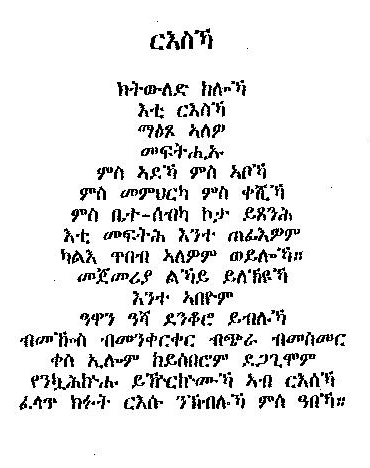
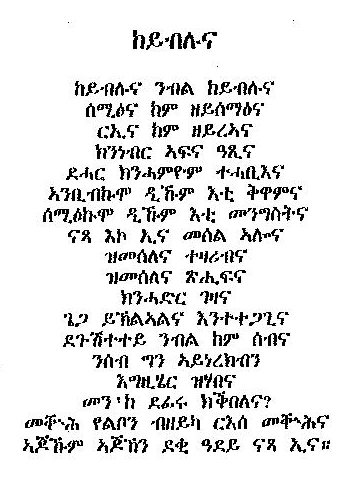
His language, Tigrinya, is spoken by half (about 3,000,000 people)
the countryfolk in a nation which includes 9 languages and a variety
of ethnic groups. Tigrinya derives from ancient Ge’ez, as do Tigre
and Amharic. And Ge’ez is related – like Arabic and Hebrew –
to Aramaic, said to be the language spoken by Jesus.
This is poetry that embraces the Eritrean people, turns an eye
both wry and loving on their history and politics, and also issues
a sincere challenge to “get cracking” !
It is verse of vitality and wit, and is rendered beautifully
into English by Professor Charles Cantalupo of Pennsylvania State
University – a poet himself and a translator who balances gravity of
theme with a lightness of touch, thereby giving us something
of the essential character of Reesom Haile.
*
The poems featured here are from Reesom Haile’s collection:
We Have Our Voice (Lawrenceville and Asmara: The Red Sea Press,
2000) – the first-ever bilingual edition (Tigrinya + English)
of Tigrinya poems. Zócalo Poets is grateful to Professor Cantalupo for
assistance in posting the Tigrinya originals.
Translations from the English into Spanish: Alexander Best
_____
Mucho amado por sus compatriotas, Reesom Haile fue un poeta y
erudito. Su país, Eritrea, está situado al noreste de África, con una
costa al borde del Mar Rojo.
Durante su vida – se murió en 2003 – escribió dos mil poemas en el
lenguaje Tigriña, un idioma antiguo de la familia lingüística semítica
(como árabe, hebreo, y arameo – “la lengua de Jesús de Nazaret”.)
Lleno de inteligencia, vitalidad y ingenio, sus poemas han estado
traducido por el profesor universitario Charles Cantalupo
(de Penn State) con tanta franqueza, con tanto encanto.
Traducción del inglés al español: Alexander Best
 Zócalo Poets