Eugenio Florit: “Los poetas solos de Manhattan”
Posted: June 10, 2016 Filed under: English, Eugenio Florit, Spanish | Tags: Cuban poets, Poetas cubanos Comments Off on Eugenio Florit: “Los poetas solos de Manhattan”
Eugenio Florit (1903-1999)
Poets Alone in Manhattan
.
The Cuban poet Alcides Iznaga came to visit New York in August of 1959. On his return to Cienfuegos he sent me a poem, “We’re alone in Manhattan,” to which I answered with these lines:
.
My dear Alcides Iznaga:
it’s true that neither Langston Hughes nor I was at home.
Because Langston, who lives in the black quarter,
also goes downtown.
And I, when you phoned,
or rather, passed by my house,
was far away in the country,
I who live among whites.
But up here
it makes no difference whether you live
on 127th Street
or at 7 Park Avenue.
Here we all go about lost and alone,
unknown
amid the noise
of subway trains and fire trucks,
and sirens of ambulances
trying to rescue suicides
who throw themselves from a bridge into a river,
or from their window to the street,
or who open the gas valves,
or swallow a hundred sleeping pills
– because, since they haven’t been found yet,
what they want is to sleep and forget everything –
to forget that no one remembers them,
that they’re alone, terribly alone among the multitude.
.
For instance, I ran into Langston Hughes around the end of August
at a party at the Pen Club,
very courteous and formal,
dressed in blue.
And then the years pass, and at most we might
exchange books: “For my dear friend…”
“Recuerdo muy afectuoso…,” etc.
And as we grow old
the black poet
and the white poet,
and the mulato and the Chinese, and every living creature.
As you, my friends in Cienfuegos,
will grow old,
you who on that unforgettable day in February (1955)
took me to the Castillo de Jagua
where I trembled with emotion upon seeing
a vicaria among the stones.
The thing is,
my dear Alcides Iznaga,
that here there are no vicarias,
nor Castillo de Jagua,
nor are my poets with me
nor my palm trees (“Las palmas, ay…”)
nor the blue waters of Cienfuegos Bay
nor those of Havana.
Here only the sad lazy waters
of the two rivers circling Manhattan…
.
You, my dear Alcides,
came
searching for us in New York, this city where
no one knows anyone…
Where
all of us, each,
are nothing but a drop of water,
a mote of dust, one of those
rising sadly from the chimneys.
Sadly as one says. Thank God,
I still have the serene words
with which to greet the morning sun
that rises – when it rises – before my window.
And if it doesn’t rise, then to greet the wind, the air, the mist and clouds;
to greet this world in which we live
with these words we write.
And to give thanks to God for the day and the night
and for having a word of our own, here, where no one knows us.
.
(October 23rd, 1959)
. . .
Translation from Spanish into English © 2009 Jason Weiss / Traducción al inglés © 2009 Jason Weiss
. . .
Eugenio Florit (1903-1999)
Los poetas solos de Manhattan
.
El poeta cubano Alcides Iznaga vino a Nueva York, de paseo, en agosto de 1959. A su regreso a Cienfuegos me envió un poema, “Estamos solos en Manhattan,” al que contesté con estos versos:
.
Mi muy querido Alcides Iznaga:
es cierto que ni Langston Hughes ni yo estábamos en casa.
Porque Langston, que vive con sus negros,
también baja hasta el centro.
Y yo, cuando llamaste por teléfono,
o mejor dicho, pasaste por mi casa,
estaba lejos, en el campo,
yo que vivo con mis blancos.
Pero es que aquí, por aquí arriba,
lo mismo da que vivas
en la calle 127
on en el número 7
de la Avenida del Parque.
Aquí todos andamos solos y perdidos,
todos desconocidos
entre el ruido
de trenes subterráneos, y de bombas de incendio,
y de sirenas de ambulancias
que tratan de salvar a los suicidas
que se tiran al río desde un puente,
o a la calle desde su ventana,
o que abren las llaves del gas,
o se toman cien pastillas para dormir
– porque, como no se han encontrado todavía,
lo que desean es dormir y olvidarse de todo–,
olvidarse de que nadie se acuerda de ellos,
de que están solos, terriblemente solos entre la multitud.
.
Ya ves, a Langston Hughes me lo encontré a fines de agosto
en un cóctel del Pen Club,
muy cortés y muy ceremonioso
y muy vestido de azul.
Y luego pasan los años, y lo más, si acaso,
nos cambiamos un libro: “Inscribed for my dear friend…”
“Recuerdo muy afectuoso…,” etc.
Y así nos vamos haciendo viejos
el poeta negro
y el poeta blanco,
y el mulato y el chino, y todo bicho viviente.
Como se irán haciendo viejos
ustedes, los amigos de Cienfuegos;
los que aquel día inolvidable de febrero (1955)
me llevaron al Castillo de Jagua
donde me hizo temblar de emoción una vicaria
que me salió al encuentro entre las piedras.
Lo que pasa,
mi muy querido Alcides Iznaga,
es que aquí no hay vicarias,
ni Castillo de Jagua,
ni están conmigo mis poetas
ni mis palmas (“Las palmas, ay…”)
ni las aguas azules de la bahía de Cienfuegos
ni las de la bahía de La Habana.
Aquí sólo las aguas perezosas y tristes
de los dos ríos que ciñen a Manhattan…
.
Tú, mi querido Alcides,
viniste en busca de nosotros a Nueva York, a esta ciudad en donde
nadie a nadie conoce…
Donde
todos nosotros, cada uno,
no somos otra cosa que una gota de agua,
una mota de polvo, de esas
que salen tristes por las chimeneas.
Tristes, es un decir. Que yo, a Dios gracias,
aún conservo serenas las palabras
con las que doy los buenos días al sol
que sale – cuando sale – enfrente de mi ventana.
Y si no sale, da lo mismo, al viento, al aire, a niebla y nube;
saludar a este mundo en que vivimos
con estas las palabras que escribimos.
Y dar gracias a Dios por el día y la noche
y por tener una palabra nuestra, aquí, en donde nadie nos conoce.
.
(23 de octubre de 1959)
. . . . .
Muhtadi International Drumming Festival in Toronto + Nicolás Guillén: “La canción del bongó” / “The Bongo’s Song”
Posted: June 5, 2016 Filed under: English, Spanish | Tags: Cuban poets, Poetas cubanos Comments Off on Muhtadi International Drumming Festival in Toronto + Nicolás Guillén: “La canción del bongó” / “The Bongo’s Song”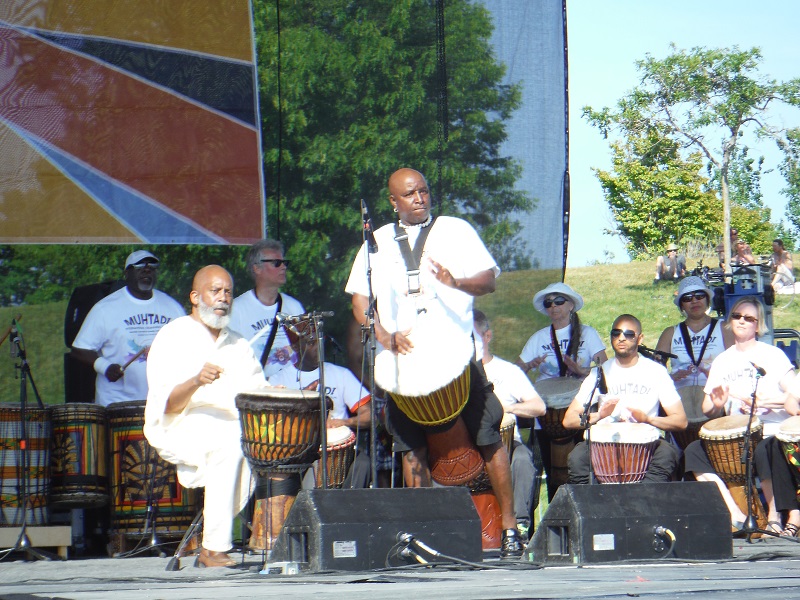
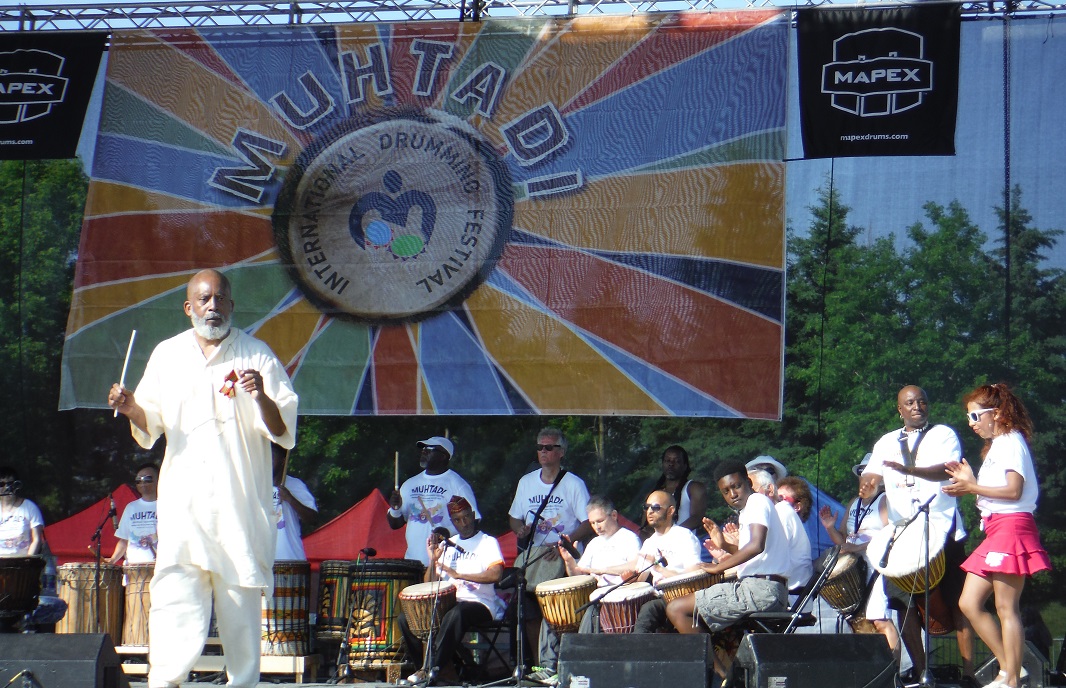
Muhtadi Thomas, seated at front left, performs with his World Drummers ensemble at Woodbine Park in Toronto_June 4th, 2016
. . .
.
“The drum is a heartbeat of creation, and represents our connection with the mother, the source…and with our own mother, the echo chamber of the womb. With mother earth, and the beat of the sea. The pounding surf, the crack of lightning, the wingbeats of migrating birds. The turning of the seasons, the sound of our own breath. The moving feet and pumping arms of a runner; the rhythmic stride of a long-distance walker. The movements of lovers, and people working the fields. All the sounds of all the movements we do to keep alive and to express our joy, and even our pain; the insistent clockwork of stress, the innocent soft lapping of a kitten’s tongue.
The drum heals our connection with each other when we play it together. It brings to our attention what works between us and what doesn’t. It shows us exactly where and how we harmonize and where we don’t. It makes us attune to the invisible world of the energy between us: this becomes more important than what we think we see, what we wish for or regret. What’s real is happening right now, in the moving moment. And when it’s gone, we have only to look for the next to get back on; this time we ride!”
(Writer and musician Nowick Gray – from his website Djembe Rhythms)
. . .
Nicolás Guillén
( Poeta cubano, 1902-1989 )
“La canción del bongó” (1930)
.
Esta es la canción del bongó:
—Aquí el que más fino sea,
responde, si llamo yo.
Unos dicen: Ahora mismo,
otros dicen: Allá voy.
Pero mi repique bronco,
pero mi profunda voz,
convoca al negro y al blanco,
que bailan el mismo son,
cueripardos y almiprietos
más de sangre que de sol,
pues quien por fuera no es de noche,
por dentro ya oscureció.
Aquí el que más fino sea,
responde, si llamo yo.
.
En esta tierra, mulata
de africano y español
(Santa Bárbara de un lado,
del otro lado, Changó),
siempre falta algún abuelo,
cuando no sobra algún Don
y hay títulos de Castilla
con parientes en Bondó:
Vale más callarse, amigos,
y no menear la cuestión,
porque venimos de lejos,
y andamos de dos en dos.
Aquí el que más fino sea,
responde si llamo yo.
.
Habrá quién llegue a insultarme,
pero no de corazón;
habrá quién me escupa en público,
cuando a solas me besó…
A ése, le digo:
—Compadre,
ya me pedirás perdón,
ya comerás de mi ajiaco,
ya me darás la razón,
ya me golpearás el cuero,
ya bailarás a mi voz,
ya pasearemos del brazo,
ya estarás donde yo estoy:
ya vendrás de abajo arriba,
¡que aquí el más alto soy yo!
. . .
Nicolás Guillén
(Cuban poet, 1902-1989)
“The Bongo’s Song” (1930)
(To Lino Dou)
.
This is the bongo’s song:
“Let the finest of you here
answer when I call you!
Some say: I’ll be right there,
others say: Just a minute.
But my harsh peal,
but my deep voice,
summons blacks and whites,
who dance to the same son,
men with brownish skins and blackish souls
caused more by blood than by the sun,
for who on the outside are not night,
have already darkened on the inside.
Let the finest of you here
answer when I call you.
.
“In this land made mulatto
by Africans and Spaniards
(Santa Bárbara on the one hand,
Changó on the other),
there is always a missing grandfather,
when there isn’t an excess of Dons.
Some have titles from Castile
and relatives in Bondó :
it is better to keep quiet, my friends,
and not stir up the matter
because we came from far away,
and we walk two by two.
Let the finest of you here
answer when I call you!
.
“There’ll be those who will insult me,
but not of their full accord;
there’ll be those who spit on me in public,
yet when we are alone they kiss me…
To them I say:
My friends,
you’ll soon be begging my pardon,
you’ll soon be eating my ajiaco,
you’ll soon be saying I’m right,
you’ll soon be beating my leather,
you’ll soon be dancing to my voice,
we’ll soon walk arm in arm,
you’ll soon be where I am:
you’ll soon be moving up,
for the highest here is me!”
.
Translation from Spanish into English
© 2003, KEITH ELLIS
* * *
Glossary:
Son – Quintessential original Cuban musical style, nascent in
the late 19th-century, flowered fully in the 20th; a hybrid of
Bantu-African percussion – bongos, maracas – with Spanish guitars
and melodies, combined with African “call-and-response”
song structure; the precursor of modern-day “Salsa” music
Mulatto – “mixed-race” i.e. African and European ancestry
Santa Bárbara – Roman-Catholic saint, syncretized into
Santería, a Caribbean religion combining West-African and
Christian beliefs; practised in Cuba.
Changó – Yoruba-African God of fire, thunder and lightning
Don – prefix of Spanish nobility
Bondó – a “typical” African town/province name, found in
Congo, Ivory Coast, Kenya, Mali, Uganda
Ajiaco – a hearty Cuban soup consisting of chicken, pork,
plaintains, sweet potatoes, taro, black pepper and lime juice
 . . .
. . .
José Craveirinha’s “I want to be a drum” / “Quero ser tambor”
. . . . .
 Zócalo Poets