Armand Garnet Ruffo: “En el Lago de Titicaca”
Posted: September 9, 2011 Filed under: Armand Garnet Ruffo, English, Spanish, ZP Translator: Alexander Best Comments Off on Armand Garnet Ruffo: “En el Lago de Titicaca”
Armand Garnet Ruffo
“On Lake Titicaca”
.
Between Bolivia and Peru I forget who I am
and the guides continue to keep course. Here
the waves against the boat and the old man
braced against the tiller are important.
I turn and look directly
at him. Not a word parts his lips
and I think of the depth of the lake
the elixir of rhythm tradition.
We are out past the reed islands
past the fishermen
the birds
out among one another inside
a path deep and blue as a prayer.
The old man’s companion decked out in bright wool
cap and sweater fiddles with an old oily motor
he somehow keeps going. Like the old man
his Indian life is carved into his face
and defines his presence and like the old man he knows
he is taking me somewhere I have never been
past everything except ourselves
on this water under this sky.
. . .
Armand Garnet Ruffo
“En el Lago de Titicaca”
.
Entre Bolivia y el Perú olvido quien soy
y siguen manteniendo el rumbo los guías. Aquí
son importantes las ondas contra el barco y
el viejo hombre apoyado en la caña del timón.
Me vuelvo y miro directamente
a él. Ninguna palabra separa sus labios
y pienso en la profundidad del lago,
el elixir de la tradición del ritmo.
Estamos afuera y más allá de las islas de junco,
más allá de los pescadores,
los pájaros,
afuera entre uno y otro dentro de
una senda profunda y azúl como una oración.
El compañero del viejo hombre,
que está adornado con cachucha y chompa de lana de colores muy vivos,
juguetea con un motor antiguo y oleaginoso
y de algún modo continua en marcha. Como el viejo hombre,
su vida india está tallada en su cara
y define su presencia y como el viejo hombre él sabe también que
me está llevando adonde nunca he ido
más allá de todo salvo de nosotros mismos
sobre esta agua bajo de este cielo.
.
Traducción al español por Alexander Best
. . .
Armand Garnet Ruffo (born 1955) is Ojibwe, from Chapleau, Ontario.
A professor at Carleton University, he teaches creative writing and Native literature.
He has just completed a biography of Norval Morrisseau – “Man Changing into Thunderbird”.
The poem above is from his first collection, Opening In The Sky (Theytus Books, 1994).
. . . . .
The Old Empire’s Language, 2: Jun Tiburcio
Posted: August 20, 2011 Filed under: English, French, Jun Tiburcio, Spanish, Tutunakú, ZP Translator: Alexander Best, ZP Translator: Lidia García Garay Comments Off on The Old Empire’s Language, 2: Jun Tiburcio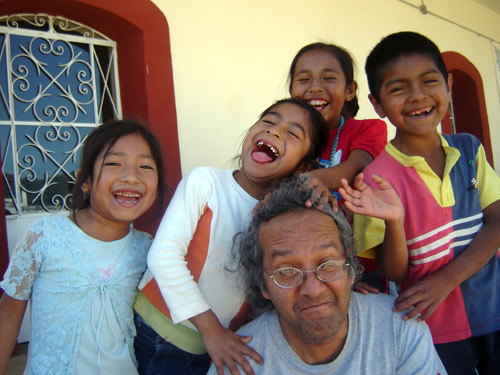
“Taskulanatlon”
.
Kakuwinin katlawalh chichini xatutunaku,
kaj matsiswanimakgólh tama luwanan.
Kakisikulanatlawa xa tutunaku kintlatikan,
tama luwanan ka ki lakgapalamakgólh.
Kakimakgalhtokge xa tutunaku,
tama tatsokgni xa luwan ka akgsaninan.
Kakintlini xa tutunaku,
akan tliy luwan ka lixkan kiwaniy.
Kakixakgatli xa tutunaku,
ntama xtachuwinkan luwanan kimatasiy.
_____
“Bendiciones”
.
Bendíceme en totonaco, Dios mío,
porque en español me maldicen.
Illumíname con el sol totonaco,
porque me opacan en español.
Dame sabiduría totonaca, Dios mío,
porque en español me llaman tonto.
Dame letras en totonaco,
porque las letras españoles mienten.
Cántame en totonaco,
porque en español me ofenden.
Háblame en totonaco,
porque en español me gritan.
_____
“Blessings”
.
Bless me in Tutunaku, my God,
because in Spanish they say bad things about me.
Illuminate me with the Tutunaku sun,
because the Spanish sun makes me dull and hazy.
Give me Tutunaku wisdom, my God,
because in Spanish they call me stupid.
Give me the Tutunaku alphabet,
because Spanish letters lie.
Sing to me in Tutunaku,
because the sound of Spanish offends me.
Speak to me in Tutunaku,
because in Spanish they always shout at me.
_____
“Bénédictions”
.
Bénis-moi, mon Dieu,
parce qu’ils me maudissent en espagnol.
Illumine-moi avec le soleil totonaque
parce qu’ils m’assombrent en espagnol.
Donne-moi la sagesse totonaque, mon Dieu,
parce qu’en espagnol ils m’appellent bête.
Donne-moi des lettres en totonaque,
parce que les lettres en espagnol mentent.
Chante-moi en totonaque,
parce qu’ils m’offensent en espagnol.
Parle-moi en totonaque,
parce qu’ils me hurlent en espagnol.
__________
Jun Tiburcio (nació en 1960) es un poeta del lenguaje totonaco (tutunaku), y
su pueblo de familia es Chumatlán, Estado de Veracruz, México.
“Bendiciones” contiene el poder del enojo en forma de palabras de un ritual religioso.
*
Jun Tiburcio (born 1960) is an indigenous poet from the town of Chumatlán, in the
State of Veracruz, México. He writes in his native language of Tutunaku.
“Blessings” contains all of anger’s power using the word-forms of religious ritual.
*
Traducción al español por el poeta
Spanish translation by the poet himself
*
Translation from Spanish into French by Lidia García Garay
Translation from Spanish into English by Alexander Best
Natalio Hernández: Náhuatl poems / Poemas en náhuatl / In xochitl in cuicatl
Posted: August 17, 2011 Filed under: English, Natalio Hernández, Náhuatl, Spanish, ZP Translator: Alexander Best Comments Off on Natalio Hernández: Náhuatl poems / Poemas en náhuatl / In xochitl in cuicatlNatalio Hernández
Poemas de su poemario Yancuic Anahuac Cuicatl / Canto Nuevo de Anahuac (1994):
De la sección “Xochicoscatl / Collar de Flores”:
Amo ninequi nimiquis
Amo ninequi nimiquis
ninequi niquitas yanquic tonati
ihuan yancuic tlanextli.
Amo ninequi nimiquis
ninequi nicactehuas yancuic xochicuicatl
yancuic masehualcuicatl.
Amo ninequi nimiquis
ninequi niquipohuas
yancuic masehualamoxme,
ninequi niquitztehuas
yancuic tlalamiquilistli.
Amo ninequi nimiquis
ninequi sampa nimoyolchicahuas
ocsepa cuali nimonelhuayotis
amo quema ninequi nitlacatehuas.
_____
No quiero morir
No quiero morir,
quiero ser participe del nuevo dia
y del nuevo amanecer.
No quiero morir,
quiero disfrutar los nuevos cantos floridos,
los nuevos cantos del pueblo.
No quiero morir,
anehelo leer los nuevos libros
y admirar el surgimiento
de la nueva sabiduria.
No quiero morir,
quiero que sea vigorosa mi propia vida,
ansio recuperar mis raices:
no deseo abandonar mi vida en la tierra.
_____
I don’t want to die
I don’t want to die,
I want to be a part of the new day,
the new dawn.
I don’t want to die,
I want to enjoy the new flowery songs,
the chants of the people.
I don’t want to die,
I long to read the new books
and to admire the rise of a new wisdom.
I don’t want to die,
I want that I might be vigorous in my own life,
I’m eager to recover my roots:
I do not wish to give up my life on this earth.
_____
Toselti matinemican
Quemantica nimachilia
tehuan timasehualme tichia
se tlacatl tlen nochi hueli
ihuan nochi quimatl:
yehuatl huelis tech maquixtis.
Inin tlacatl tlen nochi hueli
ihuan nochi quimati
amo queman asis:
ipampa tohuan itztoc,
tohuaya nemi,
pehuaya tlachia,
nohua cochtoc.
_____
Caminemos solos
A veces pienso que los indios
esperamos a un hombre
que todo lo pueda,
que todo lo sepa,
que ayude a resolver
todos nuestros problemas.
Pero ese hombre que todo lo puede
que todo lo sabe,
nunca llegará:
porque vive en nosotros,
se encuentra en nosotros,
camina con nosotros.
Empieza a despertar, aún duerme.
_____
Let’s go solo
At times I think us Native people
are hoping for a man
who could do all
and know all,
who could solve
our every problem.
But that do-all know-all man,
he’ll never arrive:
because he lives inside us,
one finds him inside us,
and he walks within us.
Even though he sleeps, he’s starting to awake.
_____
Axtosel tinemi
Axcana toselti tiztoque
tohuaya nemi toteotzitzin
tech chicahualia yaotecame
tech tlalamictia huehuetlacame.
Tinequi chicahuac timonelhuayotise
tinequi timoyolchicahuase
tinequi tinextise totlalamiquilis.
Ohuitoc ni tequitl
ohuitoc ni ohtli: yancuic ohtli
ihuan yancuic tlanextli.
Xihualaca, xihualaca, xihualaca
xihualaca nochi xiseliqui:
yancuic tonati ihuan yancuic tlanextli.
_____
No estamos solos
No estamos solos
los Dioses caminan con nosotros
los guerreros nos fortalecen
recibimos consejos de los ancianos.
Queremos fortalecer nuestras raíces
deseamos fortalecer nuestros corazones
y difundir nuestra sabiduría.
Resulta difícil el trabajo
largo y penoso el camino:
camino nuevo, nuevo amanecer.
Vengan, vengan, vengan
vengan todos a recibir:
el nuevo sol y el nuevo amanecer.

De la sección “In Ahuehuetl / El Ahuehuete”:
Nisentlachixtos
Niyectlachixtos nochi tzictzin cahuitl
niyectlachixtos se xihuilpilli,
niyectlachixtos mica xihuilpilli.
*
Niyolpaquis ica se ihuan se tlahtolli
ihuan xochitzitzin,
nimoyolcuis ipan yancuix tlanextli
ihuan nochi teotlac.
*
Queman nitequichihuas
nimoyolnenemilis tlen axcan,
tlen mostla ihuan huiptla tonemilis:
nichihuas se ohtli,
se ohtli tlen nehuatl nonemilis.
_____
Viviré
Viviré cada segundo de mi vida,
viviré un siglo,
viviré muchos siglos.
*
Disfrutaré de la palabra
y cada una de las flores;
me recrearé en el amanecer
y en cada atardecer.
*
Trabajaré pensando en el hoy,
en el mañana y pasado mañana;
trazaré un camino:
mi camino, mi propio destino.
_____
Cactli cahuitl
(Teotihuacan icuic)
Sintli yolli
sintli xochiohua
sintli chicahuia
sintli huaqui.
*
Nochi yolihui
nochi xochiohua
nochi chicahuia
nochi ixpolihui.
*
Toyolo yolihui
toyolo xochiohua
toyolo chicahuia
toyolo miqui.
*
Toaltepeme yolihui
toaltepeme xochiohua
toaltepeme chicahuia
toaltepeme ixpolihui.
*
Nochi yolihui
nochi ixpolihui;
ihuan iquino ocsepa
yolli ihuan ixpolihui.
_____
Tiempo cero
(Canto a Teotihuacan)
El maíz nace
el maíz florece
el maíz madura
el maíz se seca.
*
Todo nace
todo florece
todo madura
todo fenece.
*
Nuestro corazón nace
nuestro corazón florece
nuestro corazón madura
nuestro corazón muere.
*
Nuestras ciudades nacen
nuestras ciudades florecen
nuestras ciudades maduran
nuestras ciudades envejecen.
*
Todo nace
todo desaparece;
y todo vuelve a nacer
para volver a florecer.
_____
Ilhuicac xochitlahtolli
(Tocoltzitzin Toltecame incuic)
Amo queman titlamomatise tlahlamiquilistli,
ihuan amo queman ticasicamatise Toltecayotl;
nochipa oncas yancuic tlalamiquilistli
ihuan huehuetlamatilistli ipan tonemilis.
*
Cactli cahuitl ihuan Sencahuitl tlayeyecolli…
_____
Poema sin fin
(Canto a los abuelos Toltecas)
Jamás agotaremos el conocimiento
ni alcanzaremos la perfección.
Siempre habrá algo nuevo
o algo viejo
que aprender en la vida
*
Sin tiempo y para todo tiempo…
_____
Natalio Hernández nació en 1947. Es Nahua del Estado deVeracruz, México.
Escribe poemas en la lengua náhuatl, con sus propias traducciones en español.
En 2011 en México todavía hablan Náhuatl (el lenguaje de los Aztecas)
un millón y medio de personas.
(Traducción del español al inglés por Alexander Best)
_____
Natalio Hernández (Natalio Hernández Xocoyotzin) was born in 1947.
He is a Nahua from the State of Veracruz, México, and writes in Náhuatl
and Spanish. In 2011 Náhuatl (the language of the Aztecs) is still spoken by
a million and a half Mexicans.
(Translations from Spanish into English by Alexander Best)
Briceida Cuevas Cob: Mayan poems
Posted: August 17, 2011 Filed under: Briceida Cuevas Cob, English, Maya, Spanish, ZP Translator: Alexander Best Comments Off on Briceida Cuevas Cob: Mayan poems
“In K’aba’”
In k’abae,
tikín ot’el,
chi’il chi’ u chi’chi’al,
u chá’acha’al tumén u dzay máako’ob.
Dzok in pitik u nóok’il in k’aba’
je bix u podzikúbal kan tu xla sóol.
ƑBaanten ma’ tan u yala xkakbach ti’ uj?
Leti’e suk u xínbal bul ák’ab,
suk u bulik u uínklil,
suk u balik u su’tal,
suk u t’ubkubaj ich ek’jochénil tumén dzok u p’ektik u sáasil.
Tumén leti’e sak kichpán xba’ba’al.
In k’abae
cha takan ti’ páalal.
In k’abae
tatak’cha’tan tumén p’ek.
Bejlae mina’an in k’aaba.
Tené aluxén tan in sosok’ik u tzotzel u pool yáamaj.
_____
“Mi Nombre”
Mi nombre
pellejo disecado
de boca en boca es mordido,
es masticado por los colmillos de la gente.
Me he despojado del ropaje de mi nombre
así como la serpiente de su piel.
Por qué no llaman prostituta a la luna?
Ella acostumbra caminar por las noches,
acostumbra apostar su cuerpo,
acostumbra ocultar su vergüenza,
acostumbra sumergirse en la oscuridad porque ya detesta su claridad.
Porque ella es una hermosa alimaña blanca.
Mi nombre
es chicle prohibido para los niños.
Mi nombre
ha sido pisoteado por el desprecio.
Ahora ya no tengo nombre.
Soy un duende que le revuelve la cabellera al amor.
_____
“My Name”
My name
a scraped animal hide,
from mouth to mouth
bitten and chewed by people’s fangs.
I’ve stripped myself of the garb of my name
like a snake sheds its skin.
Why don’t they call the moon prostitute ?
She’s used to walking through the night,
accustomed to betting on her body,
to hiding her shame,
immersing herself in darkness
(because she loathes her own brightness).
Because she’s a pretty white pest
my name is chewing gum the kids aren’t allowed to have.
My name
has been trampled upon by contempt.
And now I have no name.
I am a spirit that turns its tail on love.
_____
“A Yáamaj”
Mix máak ku yuk’ul tin luuch,
mix máak ku jupik u k’ab ichil in leek,
mix máak ku janal tin laak.
A yámae júntuul tzayam kóil peek’ ch’apachtán tumen máako’ob.
Nájil naj ku páatal yéetel u xtakche’il jool naj
Tu láakal máak yójel dzok u chíiken a yáamaj.
_____
“Tu Amor”
Nadie bebe en mi jícara,
nadie introduce la mano en mi guardatortillas,
nadie come en mi cajete.
Tu amor es un perro rabioso perseguido por la gente.
De casa en casa es esperado con la tranca en la puerta.
Toda la gente sabe que me ha mordido tu amor.
_____
“Your Love”
Nobody drinks from my gourd,
Nobody slips their hand into my breadbox,
Nobody eats from my bowl.
Your love is a rabid dog chased away by everyone.
From house to house a barred door awaits it.
And people know your love has bitten me.
_____
“Como el carbón”
Y entonces naciste,
niña de ojos muy negros.
Tan negros como el carbón que hace tu padre,
como la olla de tu madre,
como el reverso de su comal.
Como el ojo del pozo cuando lo asaetea la oscuridad.
_____
“Like charcoal”
And so you were born,
little girl with eyes so black.
Black like the charcoal your father makes,
like your mother’s cooking pot,
or the underside of the “comal”*.
Like the eye of the waterwell when it pierces the darkness.
* comal: earthenware disc or metal pan placed over the fire,
especially used for cooking corn tortillas
_____
Briceida Cuevas Cob nació en 1969. Su pueblo natal es Tepakán,
Estado de Campeche, en la península de Yucatán, México.
Es una poetisa vívida en la lengua maya y hace también sus propias traducciones al español.
(Traducciones al inglés por Alexander Best)
*
Briceida Cuevas Cob (born 1969) is a Mayan poet born in the town of Tepakán,
Campeche State, in the Yucatán Peninsula of México.
She also translates her own vivid Mayan-language poems into Spanish.
(English translations from the Spanish by Alexander Best)
Δυνάμωσις + Κρυμμένα
Posted: July 16, 2011 Filed under: English, Greek, Konstantin Kavafis, Spanish, ZP Translator: Alexander Best Comments Off on Δυνάμωσις + Κρυμμένα
“Growing in Spirit”
He who hopes to grow in spirit
will have to transcend obedience and respect.
He will hold to some laws
but he will mostly violate
both law and custom, and go beyond
the established, inadequate norm.
Sensual pleasures will have much to teach him.
He will not be afraid of the destructive act:
half the house will have to come down.
This way he will grow virtuously into wisdom.
*
Greek:
Δυνάμωσις
Όποιος το πνεύμα του ποθεί να δυναμώσει
να βγει απ’ το σέβας κι από την υποταγή.
Aπό τους νόμους μερικούς θα τους φυλάξει,
αλλά το περισσότερο θα παραβαίνει
και νόμους κ’ έθιμα κι απ’ την παραδεγμένη
και την ανεπαρκούσα ευθύτητα θα βγει.
Aπό τες ηδονές πολλά θα διδαχθεί.
Την καταστρεπτική δεν θα φοβάται πράξι·
το σπίτι το μισό πρέπει να γκρεμισθεί.
Έτσι θ’ αναπτυχθεί ενάρετα στην γνώσι.
*
Español:
“Creciendo en Espíritu”
El que espera crecer en espíritu
tendrá que transcender la obediencia y el respeto.
Cumplirá ciertas leyes
pero más que todo violará
la ley y la costumbre ambas, e irá más allá
de la norma establecida insuficiente.
Los placeres sensuales tendrán mucho que enseñarle.
No tendrá miedo del acto destructor:
tendrá que echar abajo la mitad de la casa.
De esta manera madurará virtuosamente en sabiduría.
*
“Hidden Things”
From all I did and all I said
let no one try to find out who I was.
An obstacle was there that changed the pattern
of my actions and the manner of my life.
An obstacle was often there
to stop me when I’d begin to speak.
From my most unnoticed actions,
my most veiled writing—
from these alone will I be understood.
But maybe it isn’t worth so much concern,
so much effort to discover who I really am.
Later, in a more perfect society,
someone else made just like me
is certain to appear and act freely.
*
Greek:
Κρυμμένα
Aπ’ όσα έκαμα κι απ’ όσα είπα
να μη ζητήσουνε να βρουν ποιος ήμουν.
Εμπόδιο στέκονταν και μεταμόρφωνε
τες πράξεις και τον τρόπο της ζωής μου.
Εμπόδιο στέκονταν και σταματούσε με
πολλές φορές που πήγαινα να πω.
Οι πιο απαρατήρητές μου πράξεις
και τα γραψίματά μου τα πιο σκεπασμένα —
από εκεί μονάχα θα με νιώσουν.
Aλλά ίσως δεν αξίζει να καταβληθεί
τόση φροντίς και τόσος κόπος να με μάθουν.
Κατόπι — στην τελειοτέρα κοινωνία —
κανένας άλλος καμωμένος σαν εμένα
βέβαια θα φανεί κ’ ελεύθερα θα κάμει.
Translated from Greek into English by Edmund Keeley / Philip Sherrard
*
Español:
“Cosas Ocultas”
De todo lo que hice y dije,
que nadie intente descubrir quien yo era.
Había un obstáculo allá que cambió el diseño
de mis actos y la manera de mi vida.
Allá había un obstáculo, a menudo,
para pararme cuando yo comenzaba a hablar.
De los actos más desapercibidos,
de la obra escrita más velada –
de aquellos solamente yo seré comprendido.
Pero quizás no vale la pena tanta inquietud,
tanto esfuerzo para descubrir quien soy yo en verdad.
Después, en una sociedad más perfecta,
algún otro – hecho justamente como yo –
con seguridad aparecerá y se comportará con libertad.
Traducciones al español por Alexander Best
_____
Constantine Cavafy (Konstantin Kavafis), 1863-1933,
was born and died in Alexandria, Egypt,
though his parents were from Greece. He
wrote most of his poems after the age of 40,
all the while holding a dull job as a civil servant.
He is one of the great poets in modern Greek, and
though the Greek originals are in rhyme, still
Keeley and Sherrard (the standard setters for 20th-century
Greek poetry translation, along with George Savidis), in their free-verse
English renderings remain true to Kavafis’ signature “pondering-aloud” style
as well as preserving the poet’s subtlety of feeling and tone.
Carlos Drummond de Andrade: Um boi vê os homens + No meio do caminho
Posted: July 16, 2011 Filed under: Carlos Drummond de Andrade, English, Portuguese, Spanish, ZP Translator: Alexander Best Comments Off on Carlos Drummond de Andrade: Um boi vê os homens + No meio do caminho
Carlos Drummond de Andrade
“Um boi vê os homens”
.
Tão delicados (mais que um arbusto) e correm e correm de um para o outro lado, sempre esquecidos de alguma coisa. Certamente falta-lhes não sei que atributo essencial, posto se apresentem nobres e graves, por vezes.
Ah, espantosamente graves, até sinistros.
Coitados, dir-se-ia que não escutam nem o canto do ar nem os segredos do feno,
como também parecem não enxergar o que é visível
e comum a cada um de nós, no espaço.
E ficam tristes e no rasto da tristeza chegam à crueldade.
Toda a expressão deles mora nos olhos –
e perde-se a um simples baixar de cílios, a uma sombra.
Nada nos pêlos, nos extremos de inconcebível fragilidade, e como neles há pouca montanha, e que secura e que reentrâncias e que impossibilidade de se organizarem em formas calmas, permanentes e necessárias.
Têm, talvez, certa graça melancólica (um minuto) e com isto se fazem
perdoar a agitação incômoda e o translúcido vazio interior que os torna tão pobres e carecidos de emitir sons absurdos e agônicos: desejo, amor, ciúme
(que sabemos nós), sons que se despedaçam e tombam no campo
como pedras aflitas e queimam a erva e a água,
e difícil, depois disto, é ruminarmos nossa verdade.
*
In English:
“An Ox Looks At Man”
.
They are more delicate even than shrubs and they run
and run from one side to the other, always forgetting
something.
Surely they lack I don’t know what
basic ingredient, though they present themselves
as noble or serious, at times.
Oh, terribly serious,
even tragic.
Poor things, one would say that they hear
neither the song of the air nor the secrets of hay;
likewise they seem not to see what is visible
and common to each of us, in space.
And they are sad,
and in the wake of sadness they come to cruelty.
All their expression lives in their eyes – and loses itself
to a simple lowering of lids, to a shadow.
And since there is little of the mountain about them –
nothing in the hair or in the terribly fragile limbs
but coldness and secrecy – it is impossible for them
to settle themselves into forms that are calm, lasting
and necessary.
They have, perhaps, a kind
of melancholy grace (one minute) and with this they allow
themselves to forget the problems
and translucent inner emptiness
that make them so poor and so lacking
when it comes to uttering silly and painful sounds:
desire, love, jealousy – (what do we know ?)
– sounds that scatter and fall in the field
like troubled stones and burn the herbs and the water,
and after this it is hard to keep chewing away at our truth.
*
En Español:
“Mira al Hombre el Buey”
.
Son tan delicados (más que los arbustos) y corren
y corren de un lado a otro, siempre olvidando algo.
Seguramente, les falta no sé
cual atributo esencial , aunque presentan a si mismos
como nobles or serios – a veces.
Ah, profundamente serios,
aun trágicos.
Pobrecitos, alguien podría decir que no escuchan
ni la canción del aire ni los secretos del heno,
como también parecen que no observan lo que es visible
y común a cada uno de nosotros, en el espacio.
Y están tristes,
y a su paso de la tristeza llegan a la crueldad.
Toda su expresión vive en los ojos – y se pierde
en un simple bajar de los párpados, a una sombra.
Y ya que hay poco de la montaña en ellos –
nada en su cabello o dentro los miembros de una inconcebible fragilidad
solo el friolento y el secreto – para ellos, es imposible
acostumbrarles a las formas tranquilas, duraderas
Y necesárias.
Tienen, quizás, una cierta gracia melancólica (un minuto) y con ésta les permiten
olvidar la agitación incómoda
y el vacío interior transparente
que les ponen tan pobres y tan careciendo
cuando dan los sonidos absurdos y agónicos:
el deseo, el amor, los celos – ¡ No sabemos nada ! –
los sonidos que esparcen y caen en el campo
como las piedras preocupadas y queman la hierba y el agua,
y después de ésto es difícil a seguir rumiando el asunto de nuestra verdad.
.
Traducción al español por Alexander Best
*
“No meio do caminho”
.
No meio do caminho tinha uma pedra
tinha uma pedra no meio do caminho
tinha uma pedra
no meio do caminho tinha uma pedra
Nunca me esquecerei desse acontecimento
na vida de minhas retinas tão fatigadas.
Nunca me esquecerei que no meio do caminho
tinha uma pedra
tinha uma pedra no meio do caminho
no meio do caminho tinha uma pedra.
*
In English:
“In the middle of the road”
.
In the middle of the road there was a stone
there was a stone in the middle of the road
there was a stone
in the middle of the road there was a stone.
Never should I forget this event
in the life of my fatigued retinas.
Never should I forget that in the middle of the road
there was a stone
there was a stone in the middle of the road
in the middle of the road there was a stone.
*
En Español:
“En el medio de la carretera”
.
En el medio de la carretera había una piedra
había una piedra en el medio de la carretera
había una roca
en el centro del camino había una roca.
Que nunca yo debería escaecer este acontecimiento
en la vida de mis retinas fatigadas.
Que nunca yo debería escaecer que en el medio de la carretera
había una piedra
había una piedra en el medio de la carretera
en el centro del camino había una roca.
.
Traducción (y interpretación) al español por Alexander Best
* * *
Carlos Drummond de Andrade, 1902 – 1987, was a Brazilian poet,
born in Minas Gerais. His Portuguese poems often have a free-verse style,
and are full of every-day observations seen through a socialist eye.
Translations into English from the original Portuguese by Mark Strand
Mark Strand is a Pulitzer-Prize-winning poet and translator. His thoughtful
translations of de Andrade’s poems recreate the beautiful plain-ness of the originals.
“En Mi Vida” por John Lennon
Posted: July 16, 2011 Filed under: English, John Lennon, Spanish, Translator's Whimsy: Song Lyrics / Extravagancia del traductor: Letras de canciones traducidas por Alexander Best, ZP Translator: Alexander Best Comments Off on “En Mi Vida” por John Lennon _____
_____
“En mi Vida ”
Hay lugares que recuerdo
Durante toda mi vida
Aunque algunos han cambiado,
Unos para siempre y no para mejor
Algunos han desaparecido
Y otros quedan todavía,
Todos éstos lugares tienen sus momentos
Con amantes y amigos que aún puedo recordar,
Hay muertos y otros que viven,
En mi vida… les he amado a todos.
Pero, entre todos estos amigos y amantes
No hay nadie como tu,
Y pierden estas memorias su sentido
Cuando pienso en el amor como algo nuevo,
Aunque sé que no perderé el cariño
Por la gente y las cosas que ántes fueron,
Sé que pararé a menudo
a pensar en ellos,
En mi vida…a tí te amo más.
Aunque sé que no perderé el cariño
Por la gente y las cosas que ántes fueron,
Sé que pararé a menudo
a pensar en ellos,
En mi vida…a tí te amo más.
En mi vida…a tí te amo más.
_____
Traducción al español por Alexander Best
Translation into Spanish by Alexander Best
_____
*
“In My Life”
(poem by John Lennon, set to music by Paul McCartney, 1965)
There are places I remember
All my life though some have changed,
Some forever not for better
Some have gone and some remain,
All these places have their moments
With lovers and friends I still can recall,
Some are dead and some are living,
In my life I’ve loved them all.
But of all these friends and lovers
There is no one compares with you ,
And these memories lose their meaning
When I think of love as something new,
Though I know I’ll never lose affection
For people and things that went before,
I know I’ll often stop and think about them,
In my life I love you more.
Though I know I’ll never lose affection
For people and things that went before,
I know I’ll often stop and think about them,
In my life I love you more.
In my life I love you more.
Absence / Ausencia by Luis Ronald Calderón Sánchez
Posted: June 27, 2011 Filed under: English, Luis Ronald Calderón Sánchez, Spanish, ZP Translator: Alexander Best Comments Off on Absence / Ausencia by Luis Ronald Calderón Sánchez
ABSENCE
I consider the shelf full of books
and a feeling of your presence
seizes nostalgia in me,
and I say: you will return…
Moments pleasant, sad, tiresome,
shake the vault of remembrance
and I see many-coloured chimeras
in the pupils of your faraway eyes, eyes
at times slipping away from your face
in a lost gaze
studying the enigma of the universe
in the labyrinth of a utopia
in the twists and turns of memory
in the obstacles of time
and you are always touching life
weighing the infinite
distilling it
like a teardrop that falls
between phantoms in a dream.
_____
Traducción al inglés por Alexander Best
Translation into English by Alexander Best
*
AUSENCIA
Contemplo los estantes llenos de libros
la sensación de su calidad presencia
embarga mi nostalgia
y digo, volverá…
Los momentos gratos
los tristes y los fastidiosos
sacuden la bóveda de mis recuerdos
y veo sus quimeras
pintadas en las pupilas de sus ojos errantes
a veces escurriéndose por el rostro
con la mirada perdida
escudriñando el enigma del universo
perdida en el laberinto de una utopía
en los recovecos de la memoria
en los escollos del tiempo
y siempre palpando la vida
sopesando el infinito
destilándolo
como se escurre una lágrima
entre los fantasmas del sueño.
_____
Luis Ronald Calderón Sánchez
Cuando Me Haya Ido / When I’m Gone
Posted: June 27, 2011 Filed under: English, Luis Ronald Calderón Sánchez, Spanish, ZP Translator: Alexander Best Comments Off on Cuando Me Haya Ido / When I’m Gone_____
Cuando me haya ido
cuando mi aliento te sueñe lejos
cuando tu mirada se pierda en el alba
recuérdame
recuérdame
que partiré en tu otoño
y en tu primavera
recuérdame
recuérdame
que partiré en tu ocaso
y en tu alborada
recuérdame
recuérdame
aun cuando el invierno que me caiga
haga alianzas con Neptuno
búscame
búscame
aun cuando sepas que me entregué a la tierra
que no queda más que olvido
búscame
búscame
búscame en las raíces de tu nostalgia
y encontrarás mi faz revuelta en tu silueta.
_____
When I’m Gone
When I’m gone
when my breath’s a faint far-off sound
when your gaze merges with the dawn
Remember me
Remember me
that I will leave in your autumn
and in your spring
Remember me
Remember me
that I depart at dusk
and in your sunrise
Remember me
Remember me
even when winter snows me under
make an alliance with Neptune
and Look for me
Search for me
even when you know that I’ve given myself up to the earth,
that there’s nothing left but oblivion
Look for me
Search for me
Seek me out in the roots of your reminiscence
and you will find my weather-beaten face in your own silhouette.
_____
Luis Ronald Calderón Sánchez
_____
Translation into English by Alexander Best
Traducción al inglés por Alexander Best
 Zócalo Poets