Niyi Osundare: “La palabra es un huevo” y “Comida de oído” / “The word is an egg” and “Ear food”
Posted: April 11, 2012 Filed under: English, Niyi Osundare, Spanish, ZP Translator: Alexander Best Comments Off on Niyi Osundare: “La palabra es un huevo” y “Comida de oído” / “The word is an egg” and “Ear food”_____
Niyi Osundare (nace 1947, Nigeria)
“La palabra es un huevo” *
Mi lengua es un fuego rosado
No le permitas que prenda fuego a tus orejas
Cuando los proverbios chocan
En La calle de risas esperandos
Y momentos murmurandos sacan
Un canto fúnebre de los labios del sol atardeciente
Contaremos los dientes
De la luna
Y cantaremos coronitas
Para las estrellas desaparecidas…
La Palabra, es un huevo la Palabra:
Si se cae en el saliente
De una lengua tropezando
Se quiebra sin reunirse.
* un proverbio del idioma yoruba
_____
Niyi Osundare (born 1947, Nigeria)
“The word is an egg” *
My tongue is a pink fire
Don’t let it set your ears on fire
When proverbs clash
In the street of waiting laughters
And murmuring moments eke out
A dirge from the lips of the setting sun
We shall count the teeth
Of the moon
And sing little wreaths
For missing stars…
The Word, the Word
Is an egg:
If it falls on the outcrop
Of a stumbling tongue
It breaks
Ungatherably.
* a proverb from the Yoruba language
_____
“Comida de oído”
¿Lo has visto
a quién que puede alimentar a una multitud de orejas
Con siete pescados de imaginación
y tres panes de silencio?
¿Has visto a la Palabra
que brotó una serpiente
a la sorpresa frenética de Faraón?
Caminan estas Palabras sobre el mar
Y nunca se hunden.
_____
“Ear food”
Have you seen him
who can feed a multitude of ears
With seven fishes of fancy
And three loaves of silence?
Have you seen the Word
which sprang a serpent
to Pharaoh’s frenetic surprise?
These Words walk on the sea
and they never sink.
_____
Traducción del inglés al español / Translation from English into Spanish:
Alexander Best
Mike Finley: “Hot and Cold Running Good Friday” / “Un Viernes Santo corriente-caliente-y-frío”
Posted: April 6, 2012 Filed under: English, Mike Finley, Spanish, ZP Translator: Alexander Best Comments Off on Mike Finley: “Hot and Cold Running Good Friday” / “Un Viernes Santo corriente-caliente-y-frío”_____
Mike Finley
“Un Viernes Santo corriente-caliente-y-frío”
Día frío-dulce de abril
o mayo, y los bulbos
se agachan como cobardes
detrás de puertas atornilladas,
chubascos aislados
e incidencias de pecado
mojan las aceras
y humedecen la piel.
*
El agua mana de mí
mientras la tortura retuerce
mi sonrisa a una mueca,
las manos se hacen puños.
Tantas veces yo estuve apaleado por el camino
y miré hacia arriba y no había ningún velo
para agarrar el sudor.
*
Nuestro Señor, que está en el Cielo,
amo al Judío que se murió por mí
(aunque sé que es tontería),
y abril es un mes atontado y casi cruel.
Y los poemas son criaturas dando volteretas,
panfletos, circulares,
volando por
debajo de mis pies, y
la tierra que yo remuevo.
Traducción del inglés al español: Alexander Best
_____
Mike Finley
“Hot-and-Cold-Running Good Friday”
A cold warm day in April
or May, and the bulbs
crouch like cowards
behind bolted doors,
occasional showers
and occasions of sin
dampen the sidewalks
and moisten the skin.
Water flows from me
as the torture twists
my grin to a grimace,
my hands into fists.
How many times was I
battered by road and looked
up and there was no veil
to catch my sweat.
Our father who art in heaven,
I love the Jew who died for me
though I know it is nonsense,
and April is a foolish, cruelish month.
And poems are cartwheeling
creatures, flyers, circulars,
winging their way beneath
my feet and the earth I roll away.
Daniel Chirom: Leonardo and The Last Supper
Posted: April 5, 2012 Filed under: Daniel Chirom, English, Spanish, ZP Translator: Alexander Best Comments Off on Daniel Chirom: Leonardo and The Last SupperDaniel Chirom (born 1955, Argentina)
Leonardo and The Last Supper
.
Under commission to Ludovico il Moro
I did “The Last Supper”, in careful detail, over a period of three years.
I made not a single mistake
– it was my intention that Christ and his apostles
would be disintegrating over time.
When perhaps the Supper is to be served again
another Ludovico will order me to re-do it
– at least until the wine runs out.
I trust in the eternal thirst of humankind.
. . .
Editor’s note:
Ludovico il Moro was Duke of Milan, and a patron of the arts.
In 1496 he commissioned Leonardo da Vinci to paint “The Last Supper”
on a wall inside a Dominican convent. Da Vinci did not use
traditional fresco techniques, rather he experimented.
His method, and the paints he used, have not stood the test of time;
the mural has had to be restored repeatedly.
.
Translation from Spanish into English: Alexander Best
. . .
Daniel Chirom (nace 1955, Argentina)
Leonardo y la última cena
.
Por encargo de Ludovico el Moro
deletreé durante tres años la Última Cena.
No cometí ningún error,
fue mi voluntad que Cristo y sus apóstoles
se fueran desintegrando con el tiempo.
Cuando la Cena sea nuevamente servida
otro Ludovico me encargará rehacerla
hasta que el vino vuelva a escasear.
Confío en la eterna sed del hombre.
. . .
“An Acrostic to Benito Juárez” by Rubi / “Acróstico a Benito Juárez” por Rubi
Posted: March 21, 2012 Filed under: English, Spanish, ZP Translator: Alexander Best | Tags: Poema a Benito Juárez Comments Off on “An Acrostic to Benito Juárez” by Rubi / “Acróstico a Benito Juárez” por Rubi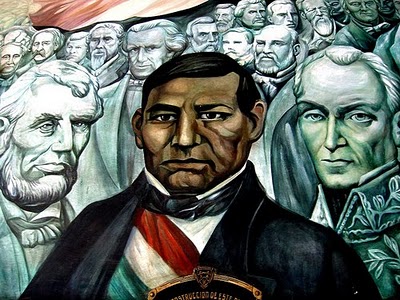
“Acróstico a Benito Juárez” por Rubi / “An Acrostic to Benito Juárez” by Rubi
B enito Juárez B enito Juárez:
E ra mexicano. E specially Mexican was he.
N acido en Oaxaca, N atal place? Oaxaca, and he was
I ndígeno – ¡seguro! I ndigenous – for sure!
T oda su infancia T ending sheep was the task
O vejas cuidaba. O f his childhood.
* *
J uárez político J uárez the Politician
U nió a los pobres, U nited with the poor, en-
A mó la justicia, A moured of justice,
R echazó a los franceses. R epelled the French.
E n conclusión él fue Ever known shall he be, the
Z apoteco valiente. Z apotec most brave.
_____
Hoy día – el 21 marzo – se celebra el natalicio del prócer mexicano – Benito Juárez .
Rubi…¡te agradecemos!
Benito Juárez (1806-1872) was President of México, serving five terms between 1858 and 1872.
Illiterate till the age of 12, by 1834 he was a lawyer, and by 1847 – governor of the state of Oaxaca.
As President he began nation-wide reforms, including the promotion of a civil society
– this included the curtailment of the powers of the dominant Catholic Church. He brought an end to
the Franco-Mexican War (“The Maximilian Affair”) of the 1860s, and his political movement,
La Reforma, though interrupted by the sometimes-regressive presidency of Porfirio Díaz, is
clearly viewed as the first push toward modernization of Mexico’s economy, politics, and society.
Today, March 21st, is Benito Juárez’ birth date.
Interpretación del poema en inglés / Poem interpretation into English from Spanish:
Alexander Best
Caitríona Ní Chléirchín: La nueva poetisa lírica irlandesa / The new love lyricist of Irish poetry
Posted: March 17, 2012 Filed under: Caitríona Ní Chléirchín, English, Irish, Spanish, ZP Translator: Alexander Best, ZP Translator: Lidia García Garay | Tags: Saint Patrick's Day Poems Comments Off on Caitríona Ní Chléirchín: La nueva poetisa lírica irlandesa / The new love lyricist of Irish poetry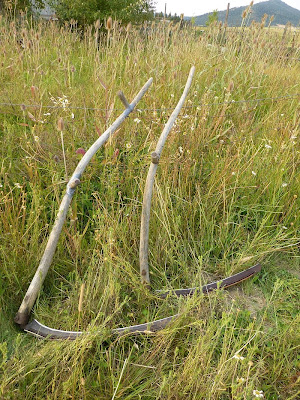 .
.
Caitríona Ní Chléirchín
(nace/born 1978, Gortmoney, Emyvale,
condado de Monaghan, Irlanda/Ireland)
“Segando con Guadaña”
.
Érase una vez, la guadaña
era afilada
con la piedra de guadaña
ocultada
debajo del tocador
por miedo de que
un niño hiciera pedazos de ella.
.
Hoy día, no quedan ni guadaña ni piedra de guadaña
sólo los pedazos de recuerdo.
_____
“Spealadóireacht”
.
Tráth, cuireadh
faobhar ar speal
le cloch faobhair
a cuireadh faoi cheilt
faoin drisiúr
ar eagla go ndéanfadh
leanbh conamar de.
.
Inniu, níl speal, ná cloch faobhair,
ná drisiúr a thuilleadh,
níl ach conamar na gcuimhní againn.
_____
“Scything”
.
Once, a scythe
would be sharpened
with the scything stone
hidden
under the dresser
for fear
a child would make fragments of it.
.
Today, no scythe or scything stone remains
only the fragments of memory.
_____
“Abeja”
.
Como una abeja casi en mi corazón,
apareciste floreando por mis pechos,
y todos tus besos eran las picaduras más dulces,
atrayéndome con besos-picaduras.
Hiciste la miel en mi ombligo,
pero la picadura la más grande fue entre mis piernas.
Me pinchaste
con palabras tan suaves.
Revoloteó el corazón
y debajo de ti
como un azahar o un tallo, me doblé.
Me abriste como una puerta de miel
y todo mi dulzura bebiste.
Está moteado ahora el cuerpo con picaduras azules-rojas,
con salpicadura de gema morada,
y pintada por todo con mordiscos de amor y odio.
Clavaste en mí tu aguijón,
y llena mi cabeza tu zángano.
Una abeja salvaje, un abejorro zumbando
dentro de mí para siempre,
nunca mostrándome ninguna clemencia.
_____
“Beach”
.
Ba gheall le beach i mo chroí thú.
Tháinig tú amach ag bláthú trí mo chíocha
is ba chealg mhilis iad na póga
cealgphógadh do mo chealgadh.
Rinne tú mil i m’imleacán,
ach chuaigh an chealg ba mhó idir an dá chos.
Phrioc tú mé
le briathra míne.
Tháinig eitilt ar mo chroí
is lúb mé fút mar bhláth, mar ghas.
D’oscail tú mé mar dhoras meala
is d’ól tú uaim
achan mhilseacht.
Anois tá mo cholainn breactha le cealga gormdhearga,
buailte le seodchealga corcra
clúdaithe le baill seirce is fuatha ó bhun go barr.
Sháigh tú ionam do chealg bheiche
is níor stad do dhordán riamh i m’inchinn.
Beach fhiáin ab ea thú, bumbóg ag crónán go síoraí ionam
is ní raibh trócaire ar bith agat dom.
_____
“Bee”
.
Like a bee almost in my heart,
you emerged flowering though my breasts,
and your every kiss was the sweetest sting,
enticing me with sting-kissing.
You made honey in my navel,
but the greatest sting went between my legs.
You pricked me
with words so gentle.
My heart fluttered
and beneath you
like a blossom or a stem, I bent.
You opened me like a honey door
and all my sweetness you drank.
My body is speckled now with blue-red stings,
with purple gem-sting stippling,
and dappled all over with love and hate bites.
You thrust your bee-sting into me,
and your drone still fills my brain.
A wild bee, a bumbling humming bee
forever inside me,
never showing any mercy.
_____
The poet tells us:
“The ‘musics’ of Irish and English are different…In Irish you can hear the sea, the mountains,you can hear echoes of loss. I’m not saying you can’t hear these in English – just that Irish is more musical, less clinical. English has been described by some Irish speakers as the language to sell pigs in – I think that’s too harsh. I think in the way we speak English in Ireland you can hear the longing for Irish. Irish is more elemental, earthy, more natural in a way – a language greatly wounded and for that reason maybe closer to the body and emotion – for me as a poet.”
_____
© Caitríona Ní Chléirchín
Translations from Irish to English:
by the poet herself.
.
Translations from English into Spanish /
Traducciones del inglés al español:
Alexander Best (“Bee”)
Lidia García Garay (“Scything”)
_____
Poems for Saint Patrick’s Day: Love and The Poet / Poemas para el Día de San Patricio: Amor y El Poeta
Posted: March 17, 2012 Filed under: English, Poemas para el Día de San Patricio: Amor y el Poeta, Spanish, William Butler Yeats, ZP Translator: Alexander Best | Tags: Saint Patrick's Day Poems Comments Off on Poems for Saint Patrick’s Day: Love and The Poet / Poemas para el Día de San Patricio: Amor y El Poeta
William Butler Yeats (1865-1939)
“Memoria” (1919)
Una tenía la cara linda,
Y dos o tres eran encantadoras,
Pero cara y encanto fueron en vano
Porque la hierba de la sierra
Siempre conserva la forma
Donde se ha tendido la liebre del monte.
_____
“Canción de Muchacha” (1933)
Salí sola
Para cantar una canción o dos,
Se me antoja un hombre
Y usted sabe quien es.
*
Otro se apareció
que dependía de un bastón
Para estar de pié;
Me senté y lloré.
*
Y ésta fue toda mi canción
– cuando todo ha sido dicho
¿Vi a un anciano joven,
O a un joven anciano?
_____
“Canción para beber” (1910)
El vino entra vía la boca
Y el amor entra vía el ojo;
Es toda la verdad que sabremos
Antes de envejecer y morir.
Levanto el vaso a mi boca,
Te miro, y suspiro.
_____
“La Espuela” (1936)
Tu piensas que es horrible que lujuria y furia
Me adoran en la vejez…
No eran una peste cuando yo era joven;
¿Tengo algo más para espolearme cantar?
_____
“Un Voto Jurado en lo Más Profundo” (1919)
Habían otros – porque no cumpliste
Ese voto jurado en lo más profundo – que han sido amigos míos;
Pero siempre cuando miro a la muerte en la cara,
Cuando trepo a las cumbres de sueño,
O cuando me estremezco con el vino,
De súbito me encuentro con tu cara.
__________
William Butler Yeats (1865-1939)
“Memory” (1919)
One had a lovely face,
And two or three had charm,
But charm and face were in vain
Because the mountain grass
Cannot but keep the form
Where the mountain hare has lain.
_____
“Girl’s Song” (1933)
I went out alone
To sing a song or two,
My fancy on a man,
And you know who.
*
Another came in sight
That on a stick relied
To hold himself upright;
I sat and cried.
*
And that was all my song
– when everything is told,
Saw I an old man young
Or young man old?
_____
“Drinking Song” (1910)
Wine comes in at the mouth
And love comes in at the eye;
That’s all we shall know for truth
Before we grow old and die.
I lift the glass to my mouth,
I look at you, and I sigh.
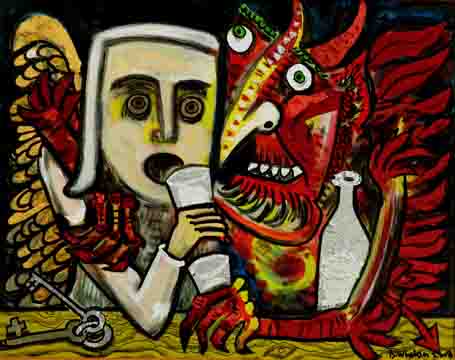
Poteen Drinkers by Brian Whelan_2011
“The Spur” (1936)
You think it horrible that lust and rage
Should dance attention upon my old age;
They were not such a plague when I was young;
What else have I to spur me into song?
_____
“A deep-sworn vow” (1919)
Others because you did not keep
That deep-sworn vow have been friends of mine;
Yet always when I look death in the face,
When I clamber to the heights of sleep,
Or when I grow excited with wine,
Suddenly I meet your face.
_____
Translation into Spanish /
Traducción en español: Alexander Best
Poemas para El Día Internacional de la Mujer: Tres poetas que deseamos honrar / Poems for International Women’s Day: Three poets we wish to honour
Posted: March 8, 2012 Filed under: Ana Castillo, bell hooks, English, Freedom Nyamubaya, Spanish, ZP Translator: Alexander Best, ZP Translator: Lidia García Garay Comments Off on Poemas para El Día Internacional de la Mujer: Tres poetas que deseamos honrar / Poems for International Women’s Day: Three poets we wish to honour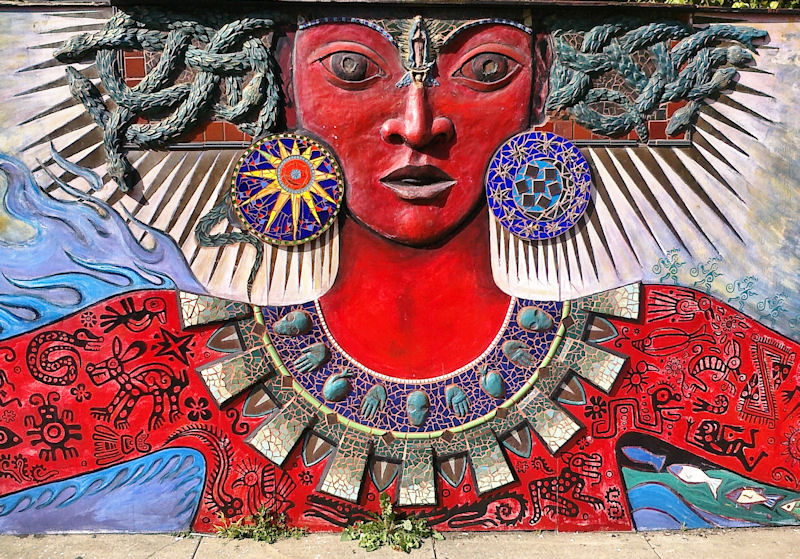 ZP_Itzpapalotl_Goddess mural in San Francisco_near 16th and Sanchez streets
.
bell hooks
(nace/born 1952, Kentucky, EEUU/USA)
En ese momento que… / The moment that…
*
En ese momento que decidimos amar
Empezamos a ir en contra de
La dominación, en contra de
La opresión.
En ese momento que decidimos amar
Empezamos a irnos hacia la libertad;
A actuar de maneras que nos liberan – y que liberan a otros también.
Esa acción es el testimonio del amor como la práctica de la libertad.
*
The moment we choose to love
we begin to move
against domination,
against oppression.
The moment we choose to love
we begin to move towards freedom;
to act in ways that liberate ourselves – and others.
That action is the testimony of love as the practice of freedom.
_____
Freedom Nyamubaya
(nace/born 1958, Zimbabwe)
La Poesía
*
Alguien dijó, no eres poeta,
pero olvidó que la poesía es un arte y
El Arte is un ritmo significativo.
Pues entonces, ¿qué es ritmo,
si puedo preguntar?
Algunos dicen que es sílabas marchando
otros dicen: sonidos marchando
pero dime como puedo casarlos a los dos.
Luchamos contra Shakespeare en el campo de batalla,
Los Negros lucharon contra los Bóeres con las lanzas.
Éstas son sílabas que marchan
y son el Arte – a alguna gente,
pues, ¿cómo yo puedo casarlos a los dos?
¿Y qué decimos de un ritmo diferente?
Mueren en los guetos la gente,
por redadas de policía y disparos del ejército.
Los obreros se asfixian en las minas de carbón,
excavando el carbón que no pueden comprar
para cocinar a diario para alimentarse.
Algo poético, ésto.
Pues quedemos en no estar de acuerdo.
El Arte sirve.
_____
Freedom Nyamubaya
Poetry
*
One person said, you are not a poet,
but forgot that poetry is an art and
Art is meaningful rhythm.
Now what is rhythm
if I may ask?
Some say it’s marching syllables,
others say it’s marching sounds,
but tell me how you marry the two.
We fought Shakespeare on the battlefield,
Blacks fought the Boers with their spears.
These are marching syllables
and Art to some,
but how can I marry the two?
How about a different rhythm?
People die in the ghettoes,
from police raids and army shots.
Workers suffocate under coal mines,
digging the coal they can’t afford to buy
for cooking daily to feed themselves.
Poetic stuff, this.
Then let’s agree to disagree.
Art serves.
_____
Ana Castillo
(nace/born 1953, Chicago, Illinois, EEUU/USA)
Pido lo Imposible
*
Yo pido lo imposible: ámame por siempre
Ámame cuando todo el amor se haya ido.
Ámame con la dedicación de un monje.
Cuando el mundo en su totalidad,
y todo lo que para ti es sagrado, te aconsejan
contra ello: ámame aún más.
Cuando la cólera te llene y no tenga nombre: ámame.
Cuando cada paso de tu puerta a nuestro trabajo te fatigue,
ámame; y del trabajo de retorno a casa, ámame.
Ámame cuando estés aburrido,
cuando cada mujer que veas sea más bella que la anterior,
o más patética, ámame como siempre lo haz hecho:
no como admirador o juez pero con
la compasión que guardas para ti mismo
en tu nostalgia.
Ámame tanto cuanto aprecias tu soledad,
la anticipación de tu muerte,
misterios de la carne, mientras se rompe y se sana.
Ámame como tu más atesorada memoria de la infancia
– y si no hay ninguna a recordar –
imagínate una, y yo allí contigo.
Ámame marchita tanto como me amastes nueva.
Ámame como si yo fuera para siempre
y haré de lo imposible
un acto simple,
al amarte, amarte como yo te amo.
_____
Ana Castillo
I Ask The Impossible
*
I ask the impossible: love me forever.
Love me when all desire is gone.
Love me with the single mindedness of a monk.
When the world in its entirety,
and all that you hold sacred, advise you
against it: love me still more.
When rage fills you and has no name: love me.
When each step from your door to our job tires you,
love me; and from job to home again, love me, love me.
Love me when you’re bored,
when every woman you see is more beautiful than the last,
or more pathetic, love me as you always have:
not as admirer or judge but with
the compassion you save for yourself
in your solitude.
Love me as you relish your loneliness,
the anticipation of your death,
mysteries of the flesh, as it tears and mends.
Love me as your most treasured childhood memory
– and if there is none to recall –
imagine one, place me there with you.
Love me withered as you loved me new.
Love me as if I were forever
and I will make the impossible
a simple act,
by loving you, loving you as I do.
_____
Traducciones del inglés al español:
Alexander Best (“En ese momento que…” y “La Poesía”)
Lidia García Garay (“Pido lo Imposible”)
_____
Murielle Jassinthe: Of Country Bodies
Posted: March 6, 2012 Filed under: English, Murielle Jassinthe, ZP Translator: Alexander Best Comments Off on Murielle Jassinthe: Of Country Bodies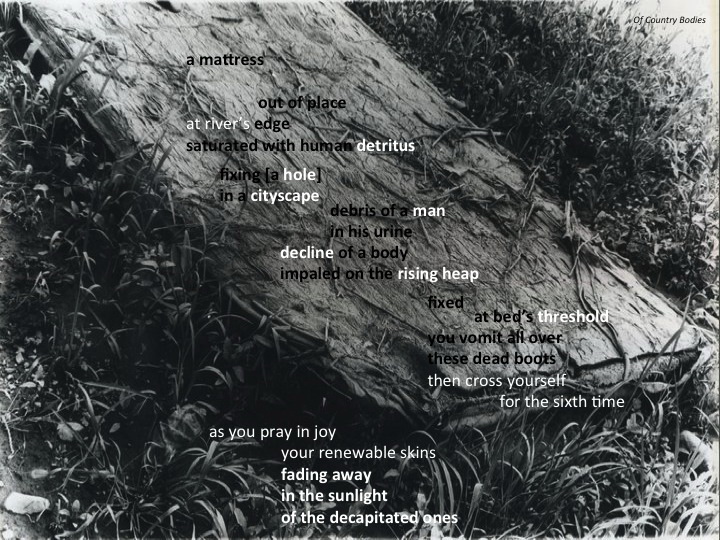
Jassinthe writes of this poem:
“I’m speaking here of two homeless drug-addicts. Having no shelter other than the banks of an urban river, there they sleep where solitude isolates them, pushes them toward a more physical closeness. Drug-taking and love-making help them forget the cold, the loneliness – and their Being.”
_____
Murielle Jassinthe was born in Québec in 1982 – of Haitian parentage.
Currently she’s pursuing a Masters in African and Francophone Literatures at Laval University where she works also as a research assistant. Two years ago, Éditions Bruno Doucey published “Land of Women” – an anthology of Haitian women poets spanning a century-and-a-half. Jassinthe’s poetry was included – one of the youngest voices. Last year, at Laval University’s Lantiss, she worked both as actress and production assistant on a play by Haitian playwright Guy Régis, Jr., entitled “La mort de soi dans sa longue robe de Mariée”. Also in 2011 Murielle received a writer’s grant from Première Ovation, and was mentored by poet Alix Renaud for the creation of her collection of poems with photographs, “Trouble Optik” – from which comes the poem we feature here.
_____
Poem translation from French into English:
Alexander Best – with Murielle Jassinthe
Murielle Jassinthe: The maternal angle / L’angle maternel
Posted: March 6, 2012 Filed under: English, French, Murielle Jassinthe, ZP Translator: Alexander Best Comments Off on Murielle Jassinthe: The maternal angle / L’angle maternel_____
Murielle Jassinthe
L’angle maternel * The maternal angle
_
La langue de ma mère * The language of my mother
se tord en ma bouche * gets twisted in my mouth
attise la brûlure * fans the burn
à l’oeil nu * clear and direct
métallique conte nocturne * metallic nocturne tale
ses chants de volaille * these birdsongs
ne se mangent * can only be eaten
que par la bouche colonial * by the colonial mouth
_
digérés par ce vent de sel * digested by this saltwind
mes viscères rubiconds haïssent * that my bloody guts hate
les odeurs transfigurent * the smell transforms
ma veste ma peau d’être * my coat my skin myself
fort ce hâle qui me fait cuir * strong this browning that
davantage que le soleil * burns even more than sun
la main le regard * hand and eyes
m’ont fait cuire * have baked me.
_
je me sens * I feel
j’exhale * I exhale
danse pour la terre seule * dance for the earth
creuset de fièvre
* alone feverish
verve lente douce * slow sweet verve
érosion qui s’inscrit * erosion that etches
en mes muscles * into my muscles
ma tête arabesque * my headband’s
est porte-étendard * a standard-bearer
_
la langue de ma mère * my mother tongue
se tord en ma bouche. * writhes in my mouth.
_____
The poet states:
“I’m writing here about feelings of cultural dislocation. The Haitian Creole language – that is, the mother tongue – that I have not mastered speaking. This native language of my mother and father which is not mine. All the same, there exist the words, my love of language to describe and to shout out my identity, suffering, joy, injustice, love, desire, fear, etc: The World in all its wonderful ugliness and tortuous beauty. And I am proud, as well, of my people – Haitians – I am one of their blazing torches.”
_____
Résumé par le poète:
“J’écris à propos d’un sentiment de dépossession culturelle. De cette langue créole, le
langue maternelle, que je ne maîtrise pas. La langue maternelle de ma mère et de mon père
qui n’est pas la mienne. Toutefois, il me reste les mots, mon amour de la langue pour
décrier et crier mon identité, la souffrance, la joie, l’injustice, l’amour, le désir, la peur, etc:
Le monde dans toute son admirable laideur et sa tortueuse beauté. Aussi, je suis fière de
mon people, les Haïtiens, et j’en suis l’un des flambeaux.”
_____
Poem translation from French into English /
Traduction du poème, français-anglais:
Alexander Best – with/avec Murielle Jassinthe
Mildred Barya: “Una Gota de Sangre” / “A Drop of Blood”
Posted: February 23, 2012 Filed under: English, Mildred Barya, Spanish, ZP Translator: Alexander Best | Tags: Black poets, Poetas negros Comments Off on Mildred Barya: “Una Gota de Sangre” / “A Drop of Blood”
Mildred Barya (nace 1976)
“Una Gota de Sangre”
El día que me llegó la regla
Exclamó mi madre:
“¡Ahora eres mujer!”
Entonces me pregunté:
¿Qué yo había sido antes?
¿Y cómo me ha hecho una mujer
Una gota de sangre?
*
Cuando llevaron a mi hermano al círculo,
Él se estremeció a la sensación de un cuchillo afilado.
Pero le convencieron:
“No debes tener miedo,
No muestres ninguna cobardía.
Tan pronto como te cortemos la piel
Te harás un hombre.”
*
Cuando mi madre tenía a Junior
Tan pesado en su vientre
Se apuraba de la mesa
Y corría al lavaplatos.
El día que le llevaron al hospital
Cayó al suelo una bolsa de agua
Pues una gota de sangre.
Gritó mi padre: “¡Mujer!”
*
Leí en Las Sagradas Escrituras
Como fue sacrificado el Hijo de Hombre.
Antes de dar su último aliento,
Manaron fuera de él
Agua y la sangre.
En este momento se hizo Hombre
Que era el Dios.
*
Supongo que haya algo en una gota de sangre
Que nos hace hombres y mujeres.
_____
Mildred Barya (born 1976)
“A Drop of Blood”
The day I got my first period,
Mother exclaimed:
“You’ve become a woman!”
And so I wondered,
What had I been earlier?
And how could a drop of blood
Make me a woman?
*
When they took my brother to the circle,
He flinched at the feel of a sharp knife.
But the elders convinced him:
“You must not fear
Do not show any cowardice
Once we slice off the skin
You become a man.”
*
When mother was heavy with Junior,
She would rush off the table
And run to the sink.
The day she was taken to hospital
A bag of water dropped to the ground,
Then a drop of blood.
Father cried: “Woman!”
*
I read in the Holy Scriptures
How the Son of Man was crucified
Before he breathed his last.
Water and blood flowed out,
There he became Man,
Who was God.
*
I guess there’s something in a drop of blood
That makes us men and women.
_____
Mildred Barya, poeta, nació en Uganda.
Ganó el Premio Pan-Africano del Foro Literário
en 2008. Barya también es periodista y escritor
de viaje. Vive en Syracuse, Nueva York, EEUU.
*
Poet Mildred Barya was born in Uganda.
She won the 2008 Prize of the Pan African
Literary Forum. Barya is also a journalist
and travel-writer. Currently she lives in
Syracuse, New York.
*
Translation from English into Spanish /
Traducción del inglés al español: Alexander Best
 Zócalo Poets