Inspired by Yeats: contemporary poets weigh in
Posted: March 17, 2016 Filed under: English, William Butler Yeats | Tags: Poems for Saint Patrick's Day Comments Off on Inspired by Yeats: contemporary poets weigh in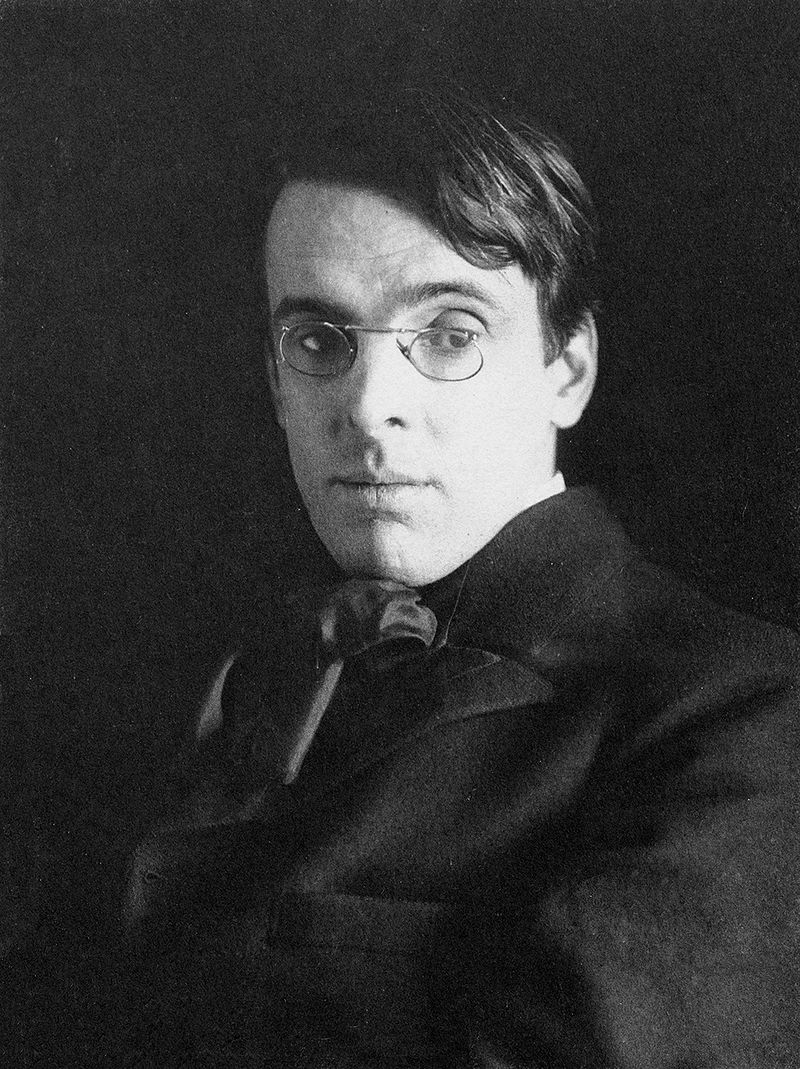
William Butler Yeats, age 38_December 1903_portrait by Alice Broughton
.
William Butler Yeats (1865-1939)
Hound Voice
.
Because we love bare hills and stunted trees
And were the last to choose the settled ground,
Its boredom of the desk or of the spade, because
So many years companioned by a hound,
Our voices carry; and though slumber-bound,
Some few half wake and half renew their choice,
Give tongue, proclaim their hidden name: ‘Hound Voice.’
.
The women that I picked spoke sweet and low
And yet gave tongue. ‘Hound Voices’ were they all.
We picked each other from afar and knew
What hour of terror comes to test the soul,
And in that terror’s name obeyed the call,
And understood, what none have understood,
Those images that waken in the blood.
Some day we shall get up before the dawn
And find our ancient hounds before the door,
And wide awake know that the hunt is on;
Stumbling upon the blood-dark track once more,
Then stumbling to the kill beside the shore;
Then cleaning out and bandaging of wounds,
And chants of victory amid the encircling hounds.
. . .
Margaret Atwood (born 1939)
Because We Love Bare Hills and Stunted Trees
.
Because we love bare hills and stunted trees
we head north when we can,
past taiga, tundra, rocky shoreline, ice.
.
Where does it come from, this sparse taste
of ours? How long
did we roam this hardscape, learning by heart
all that we used to know:
turn skin fur side in,
partner with wolves, eat fat, hate waste,
carve spirit, respect the snow,
build and guard flame?
.
Everything once had a soul,
even this clam, this pebble.
Each had a secret name.
Everything listened.
Everything was real,
but didn’t always love you.
You needed to take care.
.
We long to go back there,
or so we like to feel
when it’s not too cold.
We long to pay that much attention.
But we’ve lost the knack;
also there’s other music.
All we hear in the wind’s plainsong
is the wind.
. . .
William Butler Yeats
Vacillation
.
I
Between extremities
Man runs his course;
A brand, or flaming breath.
Comes to destroy
All those antinomies
Of day and night;
The body calls it death,
The heart remorse.
But if these be right
What is joy?
II
A tree there is that from its topmost bough
Is half all glittering flame and half all green
Abounding foliage moistened with the dew;
And half is half and yet is all the scene;
And half and half consume what they renew,
And he that Attis’ image hangs between
That staring fury and the blind lush leaf
May know not what he knows, but knows not grief.
III
Get all the gold and silver that you can,
Satisfy ambition, animate
The trivial days and ram them with the sun,
And yet upon these maxims meditate:
All women dote upon an idle man
Although their children need a rich estate;
No man has ever lived that had enough
Of children’s gratitude or woman’s love.
.
No longer in Lethean foliage caught
Begin the preparation for your death
And from the fortieth winter by that thought
Test every work of intellect or faith,
And everything that your own hands have wrought
And call those works extravagance of breath
That are not suited for such men as come
proud, open-eyed and laughing to the tomb.
IV
My fiftieth year had come and gone,
I sat, a solitary man,
In a crowded London shop,
An open book and empty cup
On the marble table-top.
While on the shop and street I gazed
My body of a sudden blazed;
And twenty minutes more or less
It seemed, so great my happiness,
That I was blessed and could bless.
V
Although the summer Sunlight gild
Cloudy leafage of the sky,
Or wintry moonlight sink the field
In storm-scattered intricacy,
I cannot look thereon,
Responsibility so weighs me down.
.
Things said or done long years ago,
Or things I did not do or say
But thought that I might say or do,
Weigh me down, and not a day
But something is recalled,
My conscience or my vanity appalled.
VI
A rivery field spread out below,
An odour of the new-mown hay
In his nostrils, the great lord of Chou
Cried, casting off the mountain snow,
‘Let all things pass away.’
.
Wheels by milk-white asses drawn
Where Babylon or Nineveh
Rose; some conquer drew rein
And cried to battle-weary men,
‘Let all things pass away.’
.
From man’s blood-sodden heart are sprung
Those branches of the night and day
Where the gaudy moon is hung.
What’s the meaning of all song?
‘Let all things pass away.’
VII
The Soul. Seek out reality, leave things that seem.
The Heart. What, be a singer born and lack a theme?
The Soul. Isaiah’s coal, what more can man desire?
The Heart. Struck dumb in the simplicity of fire!
The Soul. Look on that fire, salvation walks within.
The Heart. What theme had Homer but original sin?
VIII
Must we part, Von Hugel, though much alike, for we
Accept the miracles of the saints and honour sanctity?
The body of Saint Teresa lies undecayed in tomb,
Bathed in miraculous oil, sweet odours from it come,
Healing from its lettered slab. Those self-same hands perchance
Eternalised the body of a modern saint that once
Had scooped out pharaoh’s mummy. I – though heart might find relief
Did I become a Christian man and choose for my belief
What seems most welcome in the tomb – play a pre-destined part.
Homer is my example and his unchristened heart.
The lion and the honeycomb, what has Scripture said?
So get you gone, Von Hugel, though with blessings on your head.
. . .
Harry Clifton (born 1952)
Chez Jeanette
.
My fiftieth year had come and gone.
I sat, a solitary man,
In a crowded London shop…
– W.B. Yeats
.
And so do I, past fifty now,
In the gilt and mirror-glass
Of Chez Jeanette’s immigrant bar.
Wine, cassis, an overflow
Spilt on the table – marble
Like Yeats’ but more of a mess.
.
Behind the bottles on the shelf
A real, a transcendental self
Is hiding. Great Master,
Tell me, as you sat with your cup,
And grace came down like interruption,
Did these flakes of ceiling plaster
.
Also drown in your dregs?
The fallen angels, broken spirits
Told like tea-leaves, disinherited,
Sold into Egypt? Child-wives, pregnant,
Hide the future, keep it dark.
Splinter-groups of young Turks
.
Stand at the counter, arguing.
And the saucers of small change
Accumulate. The minutes, the hours,
If grace or visitation
Ever enter . . . A prostitute,
Bottom of the range,
.
Her hangdog client, middle-aged,
Go next door, to the short-time hotel.
In the hour that God alone sees,
We are all anonymities,
No-one finds us, we cannot be paged
In Dante’s Heaven, Swedenborg’s Hell
.
Or the visions of William Yeats.
And whether the hour is early or late
Or out of time, I do not know.
But for now, it comes down to this –
The marble top, the wine, cassis,
And the finite afterglow.
. . .
William Butler Yeats
The Folly of Being Comforted
.
One that is ever kind said yesterday:
“Your well-belovéd’s hair has threads of grey,
And little shadows come about her eyes;
Time can but make it easier to be wise
Though now it seems impossible, and so
All that you need is patience.”
Heart cries, “No,
I have not a crumb of comfort, not a grain.
Time can but make her beauty over again:
Because of that great nobleness of hers
The fire that stirs about her, when she stirs,
Burns but more clearly. O she had not these ways
When all the wild Summer was in her gaze.”
Heart! O heart! if she’d but turn her head,
You’d know the folly of being comforted.
. . .
Rita Ann Higgins (born 1955)
The Bottom Lash
.
One that is ever kind said yesterday:
My dearest dear,
your temples are starting to resemble
the contents of our ash bucket
on a wet day.
.
What’s with your eyelashes?
They grow more sparse by the tic tock.
Are you biting them off
or having them bitten off,
like the lovers do during intimacy
in the Trobriand islands?
.
You have no bottom lashes at all.
Personally, I wouldn’t be seen out
without my bottom lash.
A bare bottom lash is tantamount
to social annihilation.
.
A word to the wise, my dearest dear,
the next time you lamp the hedger
you might ask him to clip clop
your inner and outer nostril hairs.
It’s not a good look for a woman.
.
By the by, doteling,
I’ve noticed the veins on your neck
are bulging like billio
when a male of the species
walks into the room.
Is that a natural phenomenon
or is it a practised technique?
Up or down you’ll get no accolades for it,
nor for the black pillows
under your balding eyes.
Apart from that, my dearest dear,
your beauty is second to none.
. . .
The above poems by Atwood, Clifton and Higgins, first appeared in The Irish Times (September 2015).
For other poems by W.B. Yeats (including translations into Spanish) click on the link:
https://zocalopoets.com/2012/03/17/poems-for-saint-patricks-day-love-and-the-poet-poemas-para-el-dia-de-san-patricio-amor-y-el-poeta/
. . . . .
El Día Internacional de la Mujer: Poemas / International Women’s Day: Poems
Posted: March 5, 2016 Filed under: English, Fehmida Riaz, Halima Xudoyberdiyeva, Marge Piercy, Mina Loy, Qiu Jin, Spanish, Uzbek, ZP Translator: Alexander Best Comments Off on El Día Internacional de la Mujer: Poemas / International Women’s Day: Poems
. . .
Qiu Jin ( 秋瑾 1875-1907, Chinese revolutionary and poet)
Capping Rhymes With Sir Shih Ching From Sun’s Root Land
.
Don’t tell me women
are not the stuff of heroes –
I alone rode over the East Sea’s
winds for ten thousand leagues.
My poetic thoughts ever expand,
like a sail between ocean and heaven.
I dreamed of your three islands,
all gems, all dazzling with moonlight.
I grieve to think of the bronze camels,
guardians of China, lost in thorns.
Ashamed, I have done nothing;
not one victory to my name.
I simply make my war horse sweat.
Grieving over my native land
hurts my heart. So tell me:
how can I spend these days here?
A guest enjoying your spring winds?
. . .
Qiu Jin
Crimson Flooding into the River
(Translation from Mandarin: Michael A. Mikita III)
.
Just a short stay at the Capital
But it is already the mid-autumn festival
Chrysanthemums infect the landscape
Fall is making its mark
The infernal isolation has become unbearable here
All eight years of it make me long for my home
It is the bitter guile of them forcing us women into femininity
–We cannot win!
Despite our ability, men hold the highest rank
But while our hearts are pure, those of men are rank
My insides are afire in anger at such an outrage
How could vile men claim to know who I am?
Heroism is borne out of this kind of torment
To think that so putrid a society can provide no camaraderie
Brings me to tears!
. . .
Mina Loy (1882-1966, Anglo-American modernist poet)
Religious Instruction
.
This misalliance
follows the custom
for female children
to adhere to maternal practices
.
while the atheist father presides over
the prattle of the churchgoer
with ironical commentary from his arm-chair.
.
But by whichever
religious route
to brute
reality
our forebears speed us
.
there is often a pair
of idle adult
accomplices in duplicity
to impose upon their brood
.
an assumed acceptance
of the grace of God
defamed as human megalomania
.
seeding the Testament
with inconceivable chastisement,
.
and of Christ
who
come with his light
of toilless lilies
To say “fear
not, it is I”
wanting us to be fearful;
.
He who bowed the ocean tossed
with holy feet
which supposedly dead
.
are suspended over head
neatly crossed in anguish
wounded with red
varnish.
.
From these
slow-drying bloods of mysticism
mysteriously
the something-soul emerges
miserably,
.
and instinct (of economy)
in every race
for reconstructing débris
has planted an avenging face
in outer darkness.
…..
The lonely peering eye
of humanity
looked into the Néant
and turned away.
…..
Ova’s consciousness
impulsive to commit itself to justice
—to arise and walk
its innate straight way
out of the
accident of circumstance—
.
collects the levitate chattels
of its will and makes for the
magnetic horizon of liberty
with the soul’s foreverlasting
opposition
to disintegration.
.
So this child of Exodus
with her heritage of emigration
often
“sets out to seek her fortune”
in her turn
trusting to terms of literature
dodging the breeders’ determination
not to return “entities sent on consignment”
by their maker Nature
except in a condition
of moral
effacement;
Lest Paul and Peter
never
notice the creatures
ever had had Fathers
and Mothers.
.
They were disgraced in their duty
should such spirits
take an express passage
through the family bodies
to arrive at Eternity
as lovely as they originally
promised.
.
So on whatever days
she chose to “run away”
the very
street corners of Kilburn
close in upon Ova
to deliver her
into the hands of her procreators.
.
Oracle of civilization:
‘Thou shalt not live by dreams alone
but by every discomfort
that proceedeth out of
legislation’.
. . .
Mina Loy’s “Religious Instruction” from Lunar Baedeker and Times-Tables copyright The Jargon Society, 1958.
. . .
Mina Loy
No hay Vida o Muerte
.
No hay vida ni muerte,
sólo actividad.
Y en lo absoluto
no hay declive.
No hay amor ni deseo,
sólo la tendencia.
Quien quiera poseer
es una no entidad.
No hay primero ni último,
sólo igualdad.
Y quien quiera dominar
es uno más en la totalidad.
No hay espacio ni tiempo,
sólo intesidad.
Y las cosas dóciles
no tienen inmensidad.
.
Traducción del inglés: Michelle (de MujerPalabra)
. . .
Mina Loy
There is no Life or Death
.
There is no Life or Death
Only activity
And in the absolute
Is no declivity.
There is no Love or Lust
Only propensity
Who would possess
Is a nonentity.
There is no First or Last
Only equality
And who would rule
Joins the majority.
There is no Space or Time
Only intensity,
And tame things
Have no immensity.
. . .
Marge Piercy (nac.1936, EE.UU. / poeta, novelista, activista social)
Ser útil
.
Aquellos que yo amo mejor
se meten de cabeza en su trabajo
sin demorar en el bajío;
y nadan ahí fuera con brazadas seguras,
casi fuera de la vista.
Parecen ser nativos de eso elemento,
las cabezas negras lisas de focas
que rebotan como balones semi-sumergidos.
.
Me gustan los que se enjaezan: bueyes a una carreta pesada;
búfalos de agua que jalan con un temple masivo,
que tensan en el barro y la ciénaga para avanzar las cosas;
quienes que hacen lo que debe hacer, una y otra vez.
.
Quiero estar con la gente que se sumergir en la tarea;
que va en los sembríos para cosechar;
que trabaja en línea y que difunde los costales;
hombres y mujeres que no son generales del salón y desertores del deber
sino mueven en un ritmo común
cuando tiene que traer el alimento o necesita apagar el fuego.
.
La tarea del mundo es algo común, generalizado, como el barro.
Si hacemos una chapuza, embadurna las manos y se desmigaja al polvo.
Pero la cosa bien hecha
tiene la forma que complace, algo limpio, sencillo, evidente.
Ánforas griegos por el vino o el aceite,
y jarrones por el maíz del pueblo hopi,
están colocados en museos
– pero sabes que eran cosas hechas para utilizar.
El jarro llora por el agua a llevar
y la persona por el trabajo que es auténtico.
. . .
Del poemario Circles on the Water © 1982 / Traducción del inglés: Alexander Best
. . .
Marge Piercy (born 1936, American poet, novelist, social activist)
To be of use
.
The people I love the best
jump into work head first
without dallying in the shallows
and swim off with sure strokes almost out of sight.
They seem to become natives of that element,
the black sleek heads of seals
bouncing like half-submerged balls.
.
I love people who harness themselves, an ox to a heavy cart,
who pull like water buffalo, with massive patience,
who strain in the mud and the muck to move things forward,
who do what has to be done, again and again.
.
I want to be with people who submerge
in the task, who go into the fields to harvest
and work in a row and pass the bags along,
who are not parlour generals and field deserters
but move in a common rhythm
when the food must come in or the fire be put out.
.
The work of the world is common as mud.
Botched, it smears the hands, crumbles to dust.
But the thing worth doing well done
has a shape that satisfies, clean and evident.
Greek amphoras for wine or oil,
Hopi vases that held corn, are put in museums
but you know they were made to be used.
The pitcher cries for water to carry
and a person for work that is real.
. . .
Marge Piercy
Para las mujeres fuertes
.
Una mujer fuerte es una mujer esforzada.
Una mujer fuerte es una mujer que se sostiene de puntillas
y levanta unas pesas mientras intenta cantar Boris Godunov…
Una mujer fuerte es una mujer “manos a la obra”
limpiando el pozo negro de la historia.
Y mientras saca la porquería con la pala
habla de que no le importa llorar,
porque abre los conductos de los ojos…
Ni vomitar, porque estimula los músculos del estómago…
Y sigue dando paladas, con lágrimas en la nariz.
Una mujer fuerte es una mujer con una voz en la cabeza,
que le repite: “Te lo dije: sos fea, sos mala, sos tonta…
nadie más te va a querer nunca”.
“¿Por qué no eres femenina,
por qué no eres suave y discreta…
por qué no estás muerta…?“
Una mujer fuerte es una mujer empeñada
en hacer algo que los demás están empeñados en que no se haga.
Está empujando la tapa de plomo de un ataúd desde adentro.
Está intentando levantar con la cabeza la tapa de una alcantarilla.
Está intentando romper una pared de acero a cabezazos…
Le duele la cabeza.
La gente que espera a que haga el agujero,
le dice:”date prisa…¡eres tan fuerte…!”
Una mujer fuerte es una mujer que sangra por dentro.
Una mujer fuerte es una mujer que se hace a sí misma.
Fuerte cada mañana mientras se le sueltan los dientes
y la espalda la destroza.
“Cada niño, un diente…”, solían decir antes.
Y ahora “por cada batalla… una cicatriz”.
Una mujer fuerte es una masa de cicatrices
que duelen cuando llueve.
Y de heridas que sangran cuando se las golpea.
Y de recuerdos que se levantan por la noche
y recorren la casa de un lado a otro, calzando botas…
Una mujer fuerte es una mujer que ansía el amor
como si fuera oxígeno, para no ahogarse…
Una mujer fuerte es una mujer que ama con fuerza
y llora con fuerza…
Y se aterra con fuerza y tiene necesidades fuertes…
Una mujer fuerte es fuerte en palabras, en actos,
en conexión, en sentimientos…
No es fuerte como la piedra
sino como la loba amamantando a sus cachorros.
La fuerza no está en ella,
pero la representa como el viento llena una vela.
Lo que la conforta es que los demás la amen,
tanto por su fuerza como por la debilidad de la que ésta emana,
como el relámpago de la nube.
El relámpago deslumbra, llueve, las nubes se dispersan
Sólo permanece el agua de la conexión, fluyendo con nosotras.
Fuerte es lo que nos hacemos unas a otras.
Hasta que no seamos fuertes juntas
una mujer fuerte es una mujer fuertemente asustada…
. . .
Traducción del inglés: Desconocida/o
. . .
Marge Piercy
For strong women
.
A strong woman is a woman who is straining.
A strong woman is a woman standing
on tiptoe and lifting a barbell
while trying to sing Boris Godunov.
A strong woman is a woman at work
cleaning out the cesspool of the ages,
and while she shovels, she talks about
how she doesn’t mind crying, it opens
the ducts of the eyes, and throwing up
develops the stomach muscles, and
she goes on shoveling with tears
in her nose.
.
A strong woman is a woman in whose head
a voice is repeating: I told you so,
ugly, bad girl, bitch, nag, shrill, witch,
ballbuster, nobody will ever love you back,
why aren’t you feminine, why aren’t
you soft, why aren’t you quiet, why
aren’t you dead?
.
A strong woman is a woman determined
to do something others are determined
not be done. She is pushing up on the bottom
of a lead coffin lid. She is trying to raise
a manhole cover with her head, she is trying
to butt her way through a steel wall.
Her head hurts. People waiting for the hole
to be made say: hurry, you’re so strong.
.
A strong woman is a woman bleeding
inside. A strong woman is a woman making
herself strong every morning while her teeth
loosen and her back throbs. Every baby,
a tooth, midwives used to say, and now
every battle a scar. A strong woman
is a mass of scar tissue that aches
when it rains and wounds that bleed
when you bump them and memories that get up
in the night and pace in boots to and fro.
.
A strong woman is a woman who craves love
like oxygen or she turns blue choking.
A strong woman is a woman who loves
strongly and weeps strongly and is strongly
terrified and has strong needs. A strong woman is strong
in words, in action, in connection, in feeling;
she is not strong as a stone but as a wolf
suckling her young. Strength is not in her, but she
enacts it as the wind fills a sail.
.
What comforts her is others loving
her equally for the strength and for the weakness
from which it issues, lightning from a cloud.
Lightning stuns. In rain, the clouds disperse.
Only water of connection remains,
flowing through us. Strong is what we make
each other. Until we are all strong together,
a strong woman is a woman strongly afraid.
. . .
Fehmida Riaz (Pakistani poet who writes in Urdu / born 1946, Uttar Pradesh, India)
Come, Let us create a New Lexicon
.
Come let us create a new lexicon
Wherein is inserted before each word
Its meaning that we do not like
And let us swallow like bitter potion
The truth of a reality that is not ours
The water of life bursting forth from this stone
Takes a course not determined by us alone
We who are the dying light of a derelict garden
We who are filled with the wounded pride of self-delusion
We who have crossed the limits of self-praise
We who lick each of our wounds incessantly
We who spread the poisoned chalice all around
Carrying only hate for the other
On our dry lips only words of disdain for the other
We do not fill the abyss within ourselves
We do not see that which is true before our own eyes
We have not redeemed ourselves yesterday or today
For the sickness is so dear that we do not seek to be cured
But why should the many-hued new horizon
Remain to us distant and unattainable?
So why not make a new lexicon
If we emerge from this bleak abyss?
Only the first few footsteps are hard
The limitless expanses beckon us
To the dawning of a new day
We will breathe in the fresh air
Of the abundant valley that surrounds us
We will cleanse the grime of self-loathing from our faces.
To rise and fall is the game time plays
But the image reflected in the mirror of time
Includes our glory and our accomplishments
So let us raise our sight to friendship
And thus glimpse the beauty in every face
Of every visitor to this flower-filled garden
We will encounter ‘potentials’
A word in which you and me are equal
Before which we and they are the same
So come let us create a new lexicon!
. . .
Fehmida Riaz (Poetisa paquistaní, nac. 1946, Uttar Pradesh, India)
¡Ven, creemos un nuevo léxico!
.
¡Ven, creemos un nuevo léxico!
Uno donde el sentido de cada palabra
(que no nos gusta)
está insertado antes.
Y traguemos, como un veneno amargo,
la verdad de una realidad que no es nuestra.
El agua de vida que estalla de esta piedra
conduce un rumbo que nosotros solos no determinamos.
Nosotros – que son la luz murienda de un jardín decrépito;
nosotros – llenos del orgullo herido de nuestras ilusiones;
nosotros – que han superado los límites del autobombo;
nosotros – que lamen cada herida nuestra sin cesar;
nosotros – que hacen circular el cáliz envenenado,
nosotros – que llevan del uno al otro solo el odio,
y, sobre nuestras labias secas, nada más que palabras del desdén.
No llenamos el abismo en el interior;
no vemos con nuestros propios ojos lo que es auténtico en frente de nosotros;
no nos hemos redimido ayer o hoy;
porque nuestra enfermedad es tan preciada que no buscamos un tratamiento.
¿Pero por qué el horizonte de muchos tonos debe permanecernos como
remoto y inalcanzable?
.
Entonces, ¿Por qué no creamos un nuevo léxico?
Si resurgimos de este abismo austero,
solamente las primeras pisadas serán duras.
Las extensiones ilimitadas nos atraen al amanecer de un nuevo día.
Inhalaremos el aire fresco
del valle abundante que nos rodea.
Purificaremos de nuestras caras la mugre de aversión de uno mismo.
El vaivén, el auge y caída – son estos el juego que juega el Tiempo.
Pero la imagen que vemos en el espejo del Tiempo
incluye nuestra gloria también nuestros logros
– pues alcemos la mirada hasta la amistad,
por lo tanto entrever la belleza en cada rostro
de cada visitante en este jardín de muchas flores.
Nos encontraremos con ‘potenciales’,
una palabra en que tú y yo son equitativos;
una palabra en que nosotros y ellos son iguales.
Entonces,
¡Ven, creemos un nuevo léxico!
. . .
Traducción del inglés: Alexander Best
. . .
Fehmida Riaz
Chador and Char-Diwari
.
Sire! What use is this black chador to me?
A thousand mercies, why do you reward me with this?
.
I am not in mourning that I should wear this
To flag my grief to the world
I am not a disease that needs to be drowned in secret darkness
.
I am not a sinner nor a criminal
That I should stamp my forehead with its darkness
If you will not consider me too impudent
If you promise that you will spare my life
I beg to submit in all humility,
O Master of men!
In your highness’ fragrant chambers
lies a dead body—
Who knows how long it has been rotting?
It seeks pity from you
.
Sire, do be so kind
Do not give me this black chador—
With this black chador cover the shroudless body
lying in your chamber
.
For the stench that emanates from this body
Walks buffed and breathless in every alleyway
Bangs her head on every doorframe
Covering her nakedness
.
Listen to her heart-rending screams
Which raise strange spectres
That remain naked in spite of their chador.
Who are they ? You must know them, Sire.
.
Your highness must recognize them
These are the hand-maidens,
The hostages who are halal for the night.
With the breath of morning they become homeless
They are the slaves who are above
The half-share of inheritance for your
Highness’s off-spring.
.
These are the Bibis
Who wait to fulfill their vows of marriage
In turn, as they stand, row upon row
They are the maidens
On whose heads, when your highness laid a hand
of paternal affection,
The blood of their innocent youth stained the
whiteness of your beard with red.
In your fragrant chamber, tears of blood
life itself has shed
Where this carcass has lain
For long centuries, this body—
spectacle of the murder
of humanity.
.
Bring this show to an end now.
Sire, cover it up now—
Not I, but you need this chador now.
.
For my person is not merely a symbol of your lust:
Across the highways of life, sparkles my intelligence;
If a bead of sweat sparkles on the earth’s brow it is
my diligence.
.
These four walls, this chador I wish upon the
rotting carcass.
In the open air, her sails flapping, races ahead
my ship.
I am the companion of the New Adam
Who has earned my self-assured love.
. . .
Translation form Urdu: Rukhsana Ahmed
. . .
Halima Xudoyberdiyeva (born 1947, Boyovut, Uzbekistan)
Sacred Woman
(Translation from Uzbek: Johanna-Hypatia Cybeleia)
.
Your lovers have thrown flowers at your feet,
In solitude they have tasted honey from your lips,
And they have sold it to anyone at all,
You are sacred anyway, sacred woman.
.
First they came to fill your embrace, and told you to shine
You did not consent, woman, though people said the opposite
Unable to reach you, they turned their faces and called you bitter
You are sacred anyway, sacred woman.
.
You flutter your wings slowly and you lay your head down,
It’s been thousands of years, your eyes sparkle with tears,
A thousand and one criminals will hurt you with stones,
You are sacred anyway, sacred woman.
.
Though you come silently when summoned, though you come uselessly,
Though you come humbly to the drunken circle, though you come pleading to scoundrels,
Though you come oppressed to the scoundrels, though you come humbly,
You are sacred anyway, sacred woman.
.
In fact you’ll have amusements where you go,
Good and bad stories where you go,
You’ll have men like wild horses where you go,
You are sacred anyway, sacred woman.
.
Your silk-perfume body has the marks of stones,
Your bosom has the traces of heads that have leaned there,
You have the remnants of suns whose sun-fire has burned out,
You are sacred anyway, sacred woman.
. . .
Halima Xudoyberdiyeva
Water Flowing in Front of Me
.
To live in ease, to live in torment,
Not uselessly inclined away from you another sky,
My lifetime of hunting for hearts is over with,
There’s not even any thought of you going away.
.
Water flowing in front of me, my unappreciated water,
Enjoying myself for once in my life, I don’t feel relieved.
Ongoing sympathy, my secret water;
Until it dried up, I was not noticed.
.
I tell others don’t go away from me,
I go to find them in the dawn and evening time;
I offend others, telling them don’t show up;
I don’t even think anything about your going away.
.
I ran to others in cities, in towns,
You didn’t turn back or get sarcastic once.
Here I am, I’m the prey; here I am, I’ll go away,
Saying why didn’t you remind me once?
My mother, O my mother?!
. . .
Water Flowing in Front of Me in the original Uzbek:
.
Oldimdan Oqqan Suv
.
Yashamoq farog’at, yashamoq azob,
Bekorga egilmas Sizdan boshqa ko’k,
Ko’ngillarni ovlab umrim bo’pti sob,
Sizning ketishingiz xayolda ham yo’q.
.
Oldimdan oqqan suv, beqadr suvim,
Umrida bir yayrab, yozilmaganim.
Bor turishi shafqat, bori sir suvim,
To qurib qolguncha sezilmaganim.
.
Boshqalar yonimdan ketmasin debman,
Vaqt topib ularga boribman tong-kech,
Boshqalarga ozor yetmasin debman,
Sizga ham yetishin o’ylamabman hech.
.
Boshqalarga chopdim shahar, kentda man,
Bir qaytarib yo bir kesatmadingiz,
Manam g’animatman, manam ketaman,
Deb nechun bir bora eslatmadingiz?
Onam, onam-a?!
. . . . .
“As dearly as possible”: the Life of Ida B. Wells + poems by Lucille Clifton and Sterling A. Brown
Posted: February 29, 2016 Filed under: English, Lucille Clifton, Sterling A. Brown | Tags: Black History Month poems Comments Off on “As dearly as possible”: the Life of Ida B. Wells + poems by Lucille Clifton and Sterling A. Brown. . .
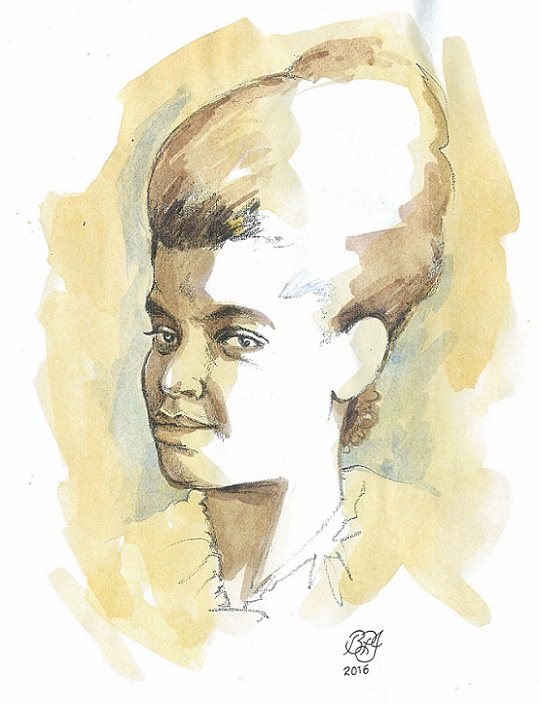
Ida B. Wells portrait by Bruce Patrick Jones_graphite and watercolour
. . .
IDA B. WELLS (African-American journalist / civil-rights activist, 1862-1931)
.
Born to slave parents in Holly Springs, Mississippi in 1862, Ida Bell Wells grew up to become a gutsy journalist and a pioneer civil-rights activist who launched a virtual one-woman crusade against the vicious practice of Lynching (a murderous mob action taken by Whites in the decades following Emancipation as a form of intimidation and social control mainly of newly-free Blacks). In her early 20s, after asserting her place in but being forcibly removed from a railway car, Wells went on to co-own and write for a Memphis newspaper, The Free Speech, and to write passionate editorials which resulted in both death threats made upon her plus an act of arson that destroyed the business.
.
In school the young Ida favoured reading Shakespeare and The Bible, but at the age of 16 both of her parents died during a yellow-fever epidemic, leaving Ida to care for her six younger siblings. She obtained a teaching position at a rural school which paid her $25 per month. Later on, while her brothers remained in Holly Springs to train as carpenter’s apprentices, she moved with her sisters to her aunt’s home near Memphis, Tennessee. She began to teach in Shelby County, and also to attend Fisk University to broaden her teaching skills. It was in May of 1884 that the discriminatory railway-car incident occurred, and some time after that the name “Iola” began to appear in print in black publications as the author of articles about race and politics in the South. Miss Wells had been using the pseudonym for less than a year when, in 1887, she attended the National Afro-American Press Convention and was named the most prominent correspondent for the American black press.
.
Miss Wells did not shy away from controversy when she wrote for Free Speech. An anonymous article she penned was critical of Memphis’s separate but not-so-equal schools. She described rundown buildings and teachers who had received little more education than their students. Such revelations irked members of the local Board of Education. They also took issue with her claim that a member of the all-white board was having an affair with a black teacher. The ensuing uproar cost Wells her teaching job.
.
Yet she was now prepared to focus more fully on the newspaper and what its very name – Free Speech – entailed. She gradually earned enough to purchase a half-share of Free Speech, and while her partner, J.L. Fleming, handled business matters, Miss Wells handled the editorial and subscription departments, and under her leadership circulation increased from 1,500 to 4,000. Readers continued to rely on Free Speech to tackle controversial subjects, even when that meant speaking out against blacks as well as whites — even when it meant challenging the widely-accepted practice of Lynching.
.
When word reached Miss Wells that her friend Tom Moss, the father of her goddaughter, had been lynched, she learned a great deal more about the horrific practice than she could’ve imagined. Until that time, Wells, like most other people, knew that there were usually two reasons why a black man was lynched: he was accused of raping a white woman, or he was accused of killing a white man. Yet Moss’s “crime” was that he successfully competed with a white grocer, and for this reason he and his partners were murdered. Wells now understood that lynchings were not being used to weed out criminals but to enforce the ugly values of White Supremacy. So, in a series of scathing editorials in Free Speech, she urged Memphis’ black populace to boycott the city’s new streetcar line and to pack up their belongings and move out West if they could manage it.
.
African Americans heeded Wells’ pleas and began leaving Memphis by the hundreds. Two pastors of large black churches took their entire congregations to Oklahoma, and others soon followed. Those who stayed behind boycotted white businesses, creating financial hardships for commercial establishments as well as for the public transportation system. The city’s papers attempted to dissuade blacks from leaving by reporting on the hostile American Indians and dangerous diseases awaiting them out West. To counter their claims, Wells spent three weeks traveling in Oklahoma and published a firsthand account of the actual conditions. She was fast becoming a target for angry white men and women, so she was advised by her friends to ease up on her editorials. Instead, though, she decided to carry a pistol. In later years she was to recall: “[I had] already determined to sell my life as dearly as possible if attacked. I felt if I could take one lyncher with me, that might even up the score a little bit.”
.
After the murders of Moss and his partners, Wells spent some months investigating other lynchings across the South. Traveling from Texas to Virginia, she interviewed both whites and blacks in order to discern truth from rumour. Margaret Truman has written in her book Women of Courage: “To call this dangerous work is an understatement. Imagine a lone black woman in a small town in Alabama or Mississippi, asking questions that no one wanted to answer about a crime that half the whites in the town might’ve committed.” Miss Wells was to learn that rape was far from being the only crime lodged against victims of lynch mobs. Indeed, men had been lynched for “being saucy.”
.
In May of 1892, an article appeared in Free Speech stating that “nobody in this section believes the old thread-bare lie that Negro men assault white women. If Southern white men are not careful they will over-reach themselves and a conclusion will be reached which will be very damaging to the moral reputation of their women.” Many white citizens of Memphis did not appreciate the implication that some of their women might prefer the company of black men, and the editor of one Memphis newspaper declared that the “black wretch who had written that foul lie should be tied to a stake at the corner of Main and Madison Streets, a pair of tailor’s shears used on him, and he should then be burned at the stake.”
.
Wells, en route to New York City and unaware of the impact of her latest anonymous editorial, did not discover its fallout until reaching her destination. Fellow journalist T. Thomas Fortune, editor of the New York Age, informed her that a mob of white men had marched into the Free Speech offices, demolished the printing press, and set fire to the building. Fleming, Wells’s partner, had escaped just before the attack and was in hiding. The angry group had promised that both editors would be lynched if they ever again set foot again in Memphis. Wells received telegrams and letters from friends begging her not to return. They told her that there were instructions to kill her on sight.
.
And so, Miss Wells remained in New York and accepted a job from Fortune at the New York Age. Among the first stories she wrote for the newspaper was a front-page spread detailing names, dates, and locations of several dozen lynchings. In some cases, the lynchers were prominent members of society who could have easily gone through proper legal channels had there been actual evidence of their victims’ guilt.
.
That particular issue of the Age sold 10,000 copies, yet it reached a predominantly black audience — not the northern white progressives Wells knew she needed to move to action if she wanted to stop the brutalities of Lynching. In 1893, therefore, she embarked upon a speaking tour of the British Isles and Europe, and it was in those overseas nations that she found white people who were more receptive to her activist concerns. Via this circuitous route, Miss Wells’ message – with the help of various newspaper editors and organizations such as the London-based Anti-Lynching Committee and the Society of Brotherhood of Man – made its way back to the United States. Some American newspaper editorials continued to attack Wells, referring to her as “the slanderous and nasty-minded mulattress.” And she faced the opposition of both conservative whites and upper-class blacks who feared any threat to the security of their positions.
.
“Home” after her overseas speaking tour, Wells moved to Chicago in 1893 or 1894, and began working for The Conservator, a black newspaper founded and edited by a lawyer named Ferdinand Barnett. When blacks were excluded from participating in the 1893 World’s Columbian Exposition (held in Chicago), she teamed up with Barnett and Frederick Douglass to compile a booklet entitled “The Reason Why the Colored American Is Not Represented in the World’s Columbian Exposition.” Thousands of copies of it were distributed during the fair. Miss Wells also published A Red Record, which recounted three years’ worth of American lynchings, and in order to avoid any charges of bias, she gathered all of her data from white-published sources, primarily the Chicago Tribune.
.
In 1895, at the age of 33, Miss Wells married Barnett, who shared her passion for civil rights. They remained in Chicago, and Mrs. Wells-Barnett divided her time between raising four children and working on various causes: the anti-lynching crusade; establishing kindergartens in the black district of Chicago; and – with reformer Jane Addams – protesting successfully against a plan to segregate the city’s schools.
.
Ida Wells-Barnett – now a wife and mother – kept on speaking out against discrimination…
She denounced the restriction of blacks to the backs of buses and theatre balconies, plus their exclusion from organizations such as the Women’s Christian Temperance Union and the Young Men’s Christian Association (YMCA). In 1909, Wells-Barnett attended the conference of “radical” activists that led to the founding of the National Association for the Advancement of Colored People (NAACP). Perhaps not surprisingly – given her feisty and energetic character – she resigned not long afterwards, frustrated that the organization was not committed enough to militant action. Some years earlier, she had quit the Afro-American Council in protest against Booker T. Washington and his policy of “accommodation”.
.
In the last decades of her passionate life, Wells-Barnett devoted most of her time and energy to various civic and political activities in Chicago. From 1913 until 1916, for instance, she worked as an adult probation officer. She also remained busy with club work and founded the first African-American women’s suffrage organization. She even ran for state senator in the 1930 elections, though she was easily defeated.
.
Imagine if Ida Wells-Barnett had been able to see into the future?
She might then have seen how much she influenced the civil-rights movement of the 1960s – and a new era in race relations – with her own battles against discrimination all those decades earlier. Ida Wells-Barnett died of kidney disease in 1931 at the age of sixty-nine. But she is remembered here and now in the 21st century as a courageous pioneer for truth and justice – and as an African-American woman of whom we should all be proud.
. . .
The above biographical essay and commentary has been edited for length. It first appeared in Americans Who Tell The Truth: Models of Courageous Citizenship © The Gale Group
. . .
Lynching as a subject for poetry: two examples from poets Lucille Clifton and Sterling Allen Brown:
.
. . .
Lucille Clifton (1936-2010)
The Photograph: A Lynching
.
Is it the cut glass
of their eyes
looking up toward
the new gnarled branch
of the black man
hanging from a tree?
.
Is it the white milk pleated
collar of the woman
smiling toward the camera,
her fingers loose around
a christian cross drooping
against her breast?
.
Is it all of us
captured by history into an
accurate album? Will we be
required to view it together
under a gathering sky?
. . .
Sterling A. Brown (1901-1989)
Let Us Suppose
.
Let us suppose him differently placed
In wider fields than these bounded by bayous
And the fringes of moss-hung trees
Over which, in lazy spirals, the carancros [carrion crows] soar and dip.
.
Let us suppose these horizons pushed farther,
So that his eager mind,
His restless senses, his swift eyes,
Could glean more than the sheaves he stored
Time and time again:
Let us suppose him far away from here.
.
Or let us, keeping him here, suppose him
More submissive, less ready for the torrent of hot Cajan speech,
The clenched fist, the flushed face,
The proud scorn and the spurting anger;
Let us suppose him with his hat crumpled in his hand,
The proper slant to his neck, the eyes abashed,
Let us suppose his tender respect for his honour
Calloused, his debt to himself outlawed.
.
Let us suppose him what he could never be.
.
Let us suppose him less thrifty
Less the hustler from early morning until first dark,
Let us suppose his corn weedy,
His cotton rusty, scantily fruited, and his fat mules poor.
His cane a sickly yellow
Like his white neighbour’s.
.
Let us suppose his burnt brick colour,
His shining hair thrown back from his forehead,
His stalwart shoulders, his lean hips,
His gently fused patois of Cajan, Indian, African,
Let us suppose these less the dragnet
To her, who might have been less lonesome
Less driven by Louisiana heat, by lone flat days,
And less hungry.
.
Let us suppose his full-throated laugh
Less repulsive to the crabbed husband,
Let us suppose his swinging strides
Less of an insult to the half-alive scarecrow
Of the neighbouring fields:
Let us suppose him less fermenting to hate.
.
Let us suppose that there had been
In this tiny forgotten parish, among these lost bayous,
No imperative need
Of preserving unsullied,
Anglo-Saxon mastery.
.
Let us suppose –
Oh, let us suppose him alive.
. . .
“Let Us Suppose” was first published in the September 1935 issue of Opportunity: Journal of Negro Life.
. . . . .
Countee Cullen: poems from “The Black Christ” (1929) and “Color” (1925)
Posted: February 22, 2016 Filed under: Countee Cullen, English | Tags: Black History Month poems, Harlem Renaissance poets Comments Off on Countee Cullen: poems from “The Black Christ” (1929) and “Color” (1925)
Poems from The Black Christ and Other Poems (1929) by Countee Cullen (1903-1946)
. . .
Little Sonnet to Little Friends
.
Let me not the proud of heart condemn
Me that I mould my ways to hers,
Groping for healing in a hem
No wind of passion ever stirs;
Nor let them sweetly pity me
When I am out of sound and sight;
They waste their time and energy;
No mares encumber me at night.
.
Always a trifle fond and strange,
And some have said a bit bizarre,
Say, “Here’s the sun,” I would not change
It for my dead and burnt-out star.
Shine as it will, I have no doubt
Some day the sun, too, may go out.
. . .
Mood
.
I think an impulse stronger than my mind
May some day grasp a knife, unloose a vial,
Or with a little leaden ball unbind
The cords that tie me to the rank and file.
My hands grow quarrelsome with bitterness,
And darkly bent upon the final fray;
Night with its stars upon a grave seems less
Indecent than the too complacent day.
.
God knows I would be kind, let live, speak fair,
Requite an honest debt with more than just,
And love for Christ’s dear sake these shapes that wear
A pride that had its genesis in dust,–
The meek are promised much in a book I know
But one grows weary turning cheek to blow.
Minutely Hurt
.
Since I was minutely hurt,
Giant griefs and woes
Only find me staunchly girt
Against all other blows.
.
Once an atom cracks the heart
All is done and said;
Poison, steel, and fiery dart
May then be buffeted.
. . .
Revelation
.
Pity me, I said;
But you cried, Pity you;
And suddenly I saw
Higher than my own grief grew.
I saw a tree of woe so tall,
So deeply boughed with grief,
That matched with it my bitter plant
Was dwarfed into a leaf.
. . .
Song in Spite of Myself
.
Never love with all your heart,
It only ends in aching;
And bit by bit to the smallest part
That organ will be breaking.
.
Never love with all your mind,
It only ends in fretting;
In musing on sweet joys behind,
Too poignant for forgetting.
.
Never love with all your soul,
For such there is no ending,
Though a mind that frets may find control,
And a shattered heart find mending.
.
Give but a grain of the heart’s rich seed,
Confine some under cover,
And when love goes, bid him God-speed.
And find another lover.
. . .
One Day I Told My Love
.
One day I told my love my heart,
Disclosed it out and in;
I let her read the ill-writ chart
Small with virtue, big with sin.
.
I took it from the hidden socket
Where it was wont to grieve;
“I’ll turn it,” I said, “into a locket,
Or a bright band for your sleeve.”
.
I let her hold the naked thing
No one had seen before;
And had she willed, her hand might wring
It dry and drop it to the floor.
.
It was a gentle thing she did,
The wisest and the best;
“The proper place for a heart,” she said
“Is back in the sheltering breast.”
. . .
Black Majesty
(After reading John W. Vandercook’s chronicle of sable glory)
.
These men were kings, albeit they were black,
Christophe and Dessalines and L’Ouverture;
Their majesty has made me turn my back
Upon a plaint I once shaped to endure.
These men were black, I say, but they were crowned
And purple-clad, however brief their time.
Stifle your agony; let grief be drowned;
We know joy had a day once and a clime.
.
Dark gutter-snipe, black sprawler-in-the-mud,
A thing men did a man may do again.
What answer filters through your sluggish blood
To these dark ghosts who knew so bright a reign?
“Lo, I am dark, but comely,” Sheba sings.
“And we were black,” three shades reply, “but kings.”

Song of Praise
.
Who lies with his milk-white maiden,
Bound in the length of her pale gold hair,
Cooled by her lips with the cold kiss laden,
He lies, but he loves not there.
.
Who lies with his nut-brown maiden,
Bruised to the bone by her sin-black hair,
Warmed with the wine that her full lips trade in,
He lies, and his love lies there.

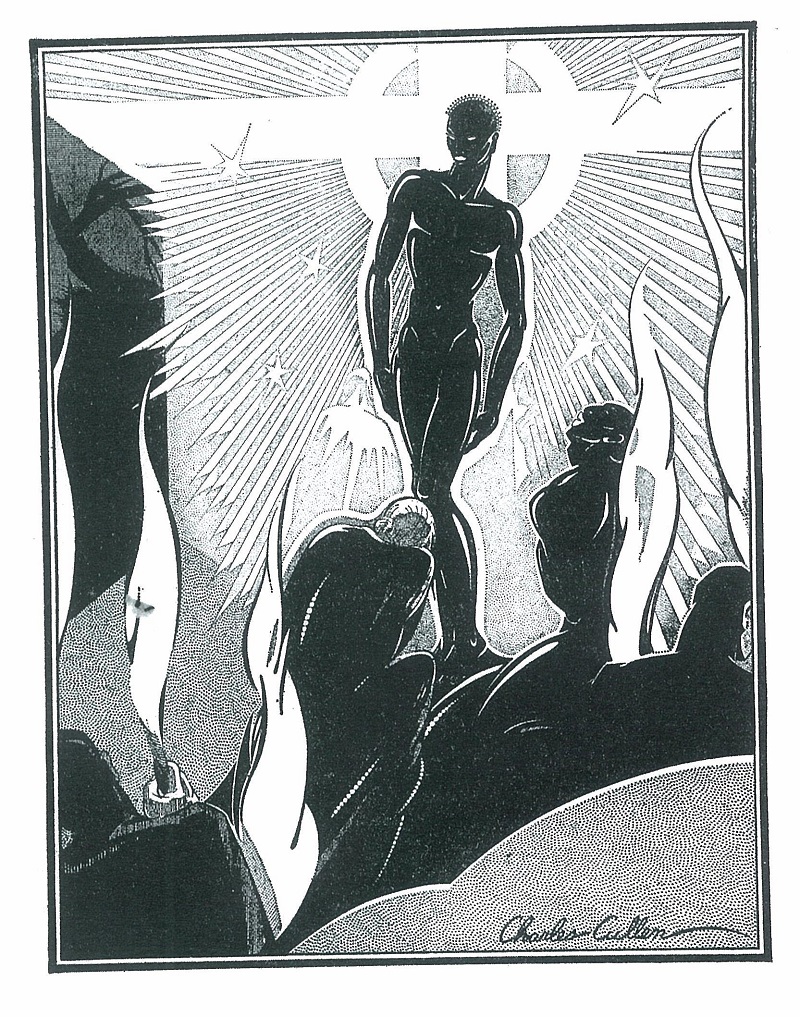
Illustration by Charles Cullen for the epic poem “The Black Christ” by Countee Cullen

 . . .
. . .
Four poems from Countee Cullen’s Color (1925)
.
Caprice
.
“I’ll tell him, when he comes,” she said,
“Body and baggage, to go,
Though the night be darker than my hair,
And the ground be hard with snow.”
.
But when he came with his gay black head
Thrown back, and his lips apart,
She flipped a light hair from his coat,
And sobbed against his heart.
. . .
Sacrament
.
She gave her body for my meat,
Her soul to be my wine,
And prayed that I be made complete
In sunlight and starshine.
.
With such abandoned grace she gave
Of all that passion taught her,
She never knew her tidal wave
Cast bread on stagnant water.
. . .
Bread and Wine
.
From death of star to new star’s birth,
This ache of limb, this throb of head,
This sweaty shop, this smell of earth,
For this we pray, “Give daily bread.”
.
Then tenuous with dreams the night,
The feel of soft brown hands in mine,
Strength from your lips for one more fight:
Bread’s not so dry when dipped in wine.
. . .
Gods
.
I fast and pray and go to church,
And put my penny in,
But God’s not fooled by such slight tricks,
And I’m not saved from sin.
.
I cannot hide from Him the gods
That revel in my heart,
Nor can I find an easy word
To tell them to depart:
.
God’s alabaster turrets gleam
Too high for me to win,
Unless He turns His face and lets
Me bring my own gods in.
. . . . .
Audre Lorde: poemas traducidos (1962-1973)
Posted: February 18, 2016 Filed under: A FEW FAVOURITES / UNA MUESTRA DE FAVORITOS, Audre Lorde, Audre Lorde: poemas traducidos, Spanish, ZP Translator: Alexander Best | Tags: El Mes de la Historia Afroamericana: Poetas Comments Off on Audre Lorde: poemas traducidos (1962-1973)
Retrato de Audre Lorde por Bruce Patrick Jones_grafito y acuarela_2016 / Portrait of Audre Lorde by Bruce Patrick Jones_graphite and watercolour_2016
Audre Lorde (18 de febrero de 1934 – 17 de noviembre de 1992)
Carbón (“Coal”, 1962)
.
“Yo” es
el negro completo,
algo hablado del interior de la Tierra.
Hay muchas clases de “abierto” –
como un diamante se vuelve en nudo de llama,
como un sonido se vuelve a una palabra,
coloreado por quien-paga-cuál para hablar.
.
Algunas palabras son abiertas
como un diamante sobre ventanas de cristal,
cantando en alto dentro del choque pasajero del sol.
También hay palabras como
apuestas grapadas en un libro perforado
(cómpralo, fírmalo, y despedázalo)
y pase-lo-que-pase anhela todas las oportunidades;
queda el boleto, y un diente extraído (incorrectamente)
con un borde desigual.
Unas palabras viven en mi garganta,
engendrandas como culebras.
Otros conocen el sol,
buscando como gitanos sobre mi lengua
para explotar a través de mis labios
– como gorriones jóvenes que brotan de su cáscara.
Hay ciertas palabras
que me importunan.
.
“Amor” es una palabra – y una otra clase de “abierto”.
Así como un diamante se vuelve en nudo de llama,
yo soy “Negro” – porque me origino del interior de la tierra.
Ahora: agarra mi palabra – como una joya – en la luz abierta.
. . .
Libro de cuentos en la mesa de la cocina
(“Story books on a kitchen table”, 1970)
.
La matriz dolorosa de mi madre escupió algo: yo.
Escupió “yo”
en su arnés incómodo de desesperanza,
en sus engaños,
donde la ira me concibió (una segunda vez),
perforando mis ojos, como flechas
señaladas por su pesadilla de la “ella” que yo no me volvía.
.
Y ella, yendo, dejó en su lugar
unas doncellas de hierro que me protegieran;
y mi comida fuera
la leche arrugada de leyenda
donde yo, envuelta de pesadillas,
vagabundeaba a través de las habitaciones aisladas de la tarde.
Las pesadillas llegaron de los
Libros de las Hadas
en colores de
Naranja y Rojo y Amarillo,
Púrpura y Azul y Verde.
En esos libros
las brujas blancas gobernaron
la mesa vacía de la cocina;
y ellas ni lloraron ni ofrecieron de oro a nadie
– nunca –
y ningún encantamiento cálido por
la madre desaparecida de una niña negra.
. . .
Generación II (“Generation II”, 1971)
.
Una chica negra
– que iba en / crecía en
la deseada mujer para quién
su madre había rezado –
está caminando sola
y tiene miedo de
sus iras – ambas iras.
. . .
La revolución es una forma de cambio social
(“Revolution is one form of social change”, 1968)
.
Cuando el Jefe está ocupado
haciendo “niggers”,
pues no importa
cual es tu tono.
.
Si se agota un color específico,
siempre el Jefe puede cambiar a tamaño;
y cuando ha eliminado los grandes
pues cambiará hacia el sexo
que es
– seamos realistas –
donde comenzó Todo.
. . .
Una planta de alcantarilla crece en Harlem
o
Yo mismo, soy una extranjera aquí –
¿Cuándo parte el próximo cisne?
(“A sewerplant grows in Harlem
or
I’m a stranger here myself –
When does the next swan leave?”, 1969)
.
¿Cómo está hecho la palabra hecho carne hecho acero hecho mierda
por embutirla dentro Sin Salida
como una bomba casera
hasta que explota
y se unta
y está hecho real
– contra nuestras ventanas ya sucias –
o por purgarla en una fuente verbal?
.
Mientras tanto, los “Ellos” editoriales
– que no son menos potentes –
se preparan para asfixiar a los “Nosotros” reales
con un flujo manufacturado de todo nuestra mierda no verbal.
.
¿Te has levantado durante la noche,
estallando de comprensión,
y el mundo se disuelve hacia un oído escuchando
(y puedes verter en ese oído todo lo que sabías
antes de despertarte)
pero descubriste que todos los oídos estuvieron dormidos
o quizás anestesiados por un sueño de palabras;
porque, como estás gritando en esos oídos
– una y otra vez –
nada se mueve
y la mente que has alcanzar no es una mente que funciona?
.
Por favor, que cuelgues pues marques de nuevo el número de malasuerte…
Cuelga, (por favor), pues muere.
La mente que has contactado no es una mente operativa.
Por favor, que cuelgues pues mueras – de nuevo.
.
Hablar con alguna gente es como hablar a un váter.
. . .
Rock Amor-Duro #II (“Hard Rock Love #II”, 1971)
.
Escúchame, Hermano,
te amo, t’amo-t’amo-t’amo,
entiéndeme / cávame
una tumba de un otro color.
Estamos ambos echado / mintiendo
uno al lado de otro en el mismo lugar
donde tú me pusiste;
abajo
y más hondo todavía.
Somos
una soledad no resuelto por llorar;
somos
ciudades saqueadas no reconstruidas
por consignas,
por punzadas retóricas
que fuerza una cerradura
que siempre ha sido abierta.
.
“Ser Negra
No Es Bella”, baby.
Bel amor, chico bello
– hazlo otra vez.
Lo
que
es es
no estar exprimida / chingada
doble,
al mismo tiempo
de arriba y del lado.
. . .
Poema de Amor (“Love poem”, 1971)
.
Habla, Tierra,
y bendígame con lo que es más rico;
haga el cielo desacelerar la miel de mis caderas:
rígidas como las montañas,
extendido sobre un valle,
forjado por la boca de la lluvia.
.
Y lo entendí cuando entré en ella
que fui el viento alto en sus bosques,
dedos huecos susurrando sonido.
Una miel fluía
de la copa rajada;
Estuve empalada en una lanza de lenguas,
en las puntas de sus mamas,
en su ombligo.
Y mi aliento
aullaba dentro de sus entradas
vía pulmones de dolor.
.
Avara / ávida como gaviotas argénteas
o como un chamaco,
me balanceo por lo alto / sobre la Tierra
sin parar.
. . .
Ruptura (“Separation”, 1972)
.
Menguan las estrellas;
no me premiarán,
aun en mi triunfo.
.
Es posible
en autodefensa
darle un balazo a un hombre
pues todavía notar que
su sangre roja
adorna la nieve.
. . .
Ahora (“Now”, 1973)
.
Fuerza / Poder de Mujer
es
Fuerza / Poder de Negro
es
Fuerza / Poder del Ser Humano
es
siempre sentir.
Late mi corazón
mientras se abiertan mis ojos,
mientras se mueven mis manos,
mientras cuenta mi boca.
.
Yo soy
¿eres tú?
.
Lista.
. . .
Memorial III: de una cabina telefónica en la avenida Broadway
(“Memorial III: from a phone booth on Broadway”, 1973)
.
Alguna vez
un rato pone al revés
y el día entero se derrumba a
una búsqueda urgente
por una cabina telefónica que funciona.
Porque
presto-presto
debo telefonearte
– tú que no has hablado dentro de mi cabeza
hace más de un año.
Si este teléfono timbraría bastante largo,
empujado sobre mi oreja,
florecerás en sonido;
contestarás,
debes contestar;
contéstame-contéstame-contéstame, maldición.
Contesta,
por favor,
contesta.
Es la última vez
que yo te llamaré.
Nunca jamás.
. . .
Versiones españoles del inglés: Alexander Best
. . .
Audre Geraldine Lorde (18/02/1934 – 17/11/1992) fue una poeta-ensayista-activista afroamericana. Ella se identificaba como “una poeta-guerrera-madre lesbiana negra”; pugnaba por no reducirse a una de aquellas identidades, sino reafirmarlas como fuente de fuerza. Planteó, entre otras ideas, que el racismo, el clasismo, el sexismo y la homofobia son cuatro tipos de ceguera nacidos de la misma raíz: la imposibilidad de reconocer el concepto de diferencia en cuanto fuerza humana dinámica.
. . . . .
Sexploitation, Politics, Anger, God, and Happiness: Poems by Gerald Kithinji (Kenya, 1976)
Posted: February 11, 2016 Filed under: English, Gerald Kithinji | Tags: African poets: Kenya, Black History Month poems Comments Off on Sexploitation, Politics, Anger, God, and Happiness: Poems by Gerald Kithinji (Kenya, 1976) Gerald Kithinji (Kenya)
Selections from Whispers at Dawn
. . .
Magic Woman
.
I am the black magic woman
I feed from the dartboard
served by the wine drunkards
.
I am the female equivocator
I provoke the male prostitutes
by a lisp of “guinness is good for you!”
.
I am the adding machine
computing your poverty
by a controlled throw of the dart
.
I am the ‘mother-in-law’
sucking your slumberous prick
for want of a longer trip
.
I am the ever-thirsty sleuth
whose eternal furnace
consumes your holy waters
.
If in any reasonable doubt
follow that last stagger
to the edge of the moonlight
– to the last tango away from the dartboard.
. . .
Sexploitation
.
The talk took a comic turn
adding dry wood to the fire
lit by the sex debate
– or was it the women’s lib
.
Yes; I think it was that lost battle
now come from the mists of antiquity
through currents of a missionary zeal
to plague the human race
.
They were not ‘fiddlers on the roof’
nor sexperienced population exploders
but just college infuriates
that must have sexquality – or die!
.
“What men can do
that women can do
what men can do
let women do”
.
The lioness roamed the jungle
the zebras rubbed noses
and the birds on the equality twig sung:
“were I an ilk with all her ilk”
.
And the lights dimmed
leaving only the fireglow
leaving the sons of strife
in clouds of misty speculation
.
The wind carried no pollen
the flowers refused to bloom
the world stood still
in the wake of a woman’s protest
.
The world of merit
shed a light on sexpression
but the question persisted
“what if they played hard to get?”
. . .
In Praise of Work
.
The possibility is there
that I might write
with the poet’s inbuilt inspiration
what comrade time
has reason to portend
.
Of our aims
I might write
or even our dreams
.
But our destinations?
Even the Pope’s edict…
hist–
I pledge my doubt
.
Of greater moment
is our faith
in the plough.
.
Hail plough!
Hail abundance!
. . .
A Pause
.
On that hot afternoon
even the creatures of heaven
could feel the heat in hell
and paused awhile
to let it pass
.
But as for me, a wayward son
doomed to labour and toil
there was no pause, no rest
but an eternal longing
an eternal thirst
.
Had I not been sleepy
I might have witnessed
the comings and goings
of the multitudes
I might have lived!
.
Hey, birds on the twig
what became of your nests
and your thousand promises
of a thousand nestlings?
I might have witnessed!
.
Looking back on that day
I see the present through a crack
and I know I have arrived
at the edge of my sanity
at the top of the precipice
.
Will the heat now abate
and let me fondle the coolness
of the moonlit evening
and let me lick the honey
on my latest fount!
. . .
I have come to take away my Love
.
I have been thinking about you
all night long;
and re-thinking, asking myself
which is the mid-point
between now and eternity.
.
And in that one night
I lived three centuries into the past
and three others into the future
(into the ‘dim regions
whence my fathers came’
and into a void
far from my native clime)
.
And in that one night, too,
I peered deep into your heart
and saw seated there
(as on a pile of loot!)
cupid – silently beckoning…
.
Ha-ha-ha I have come
to take away my love!
and you whose faces I see
remain invisible to Wanja.
.
I tried to write in rhyme
of nights I’ve spent awake
weaning my infant love
humming a silent lullaby.
.
I took my ball-point pen
and jotted down your name
in the space of an hour an’ a half
begging the letters to come.
.
Every letter I wrote spelt love
and every pause, a prayer
that those that love
should rhyme in love.
Politics
.
Listen to the deafening silence
of the politician
Behold the benevolence
of this native tyrant
.
Listen to the transcendental claptrap
of the lonely pauper
Endure the ordeal of change
and the quintessential shock
.
Beyond freedom and dignity
aspiration and accomplishment
and remember your kinsmen
dancing on a volcano.
. . .
My Ballot Paper
.
I have long waited
this sunny day
to chide myself
.
Should I cast for this clown
who with dripping mouth
sang his electorate his ambitions?
.
Or this home-made angel
who with wings of kites
would myrrh his disciples?
.
And then again I wonder
should the heavens rock
who will restrain the storm?
.
So I take the little ballot
and with raging words
in verse expend my anguish.
. . .
The Candidates
.
They promised us
all manner of pleasant solace
as this manifesto witnesseth;
and to show our reliance
we implored them to denounce
older forms of dishonesty
with charity appreciable by view.
.
They and each of them
and all their ilk
swore to buy our support
in gross and in detail
and so on and so forth
mutatis mutandis
per omnia saecula saeculorum!!
.
But we were lowly natives
and matched with local casuistry
and various verbal falsehoods
what code of necromancy
would misfortunes forestall!
.
Nefarious candidates
the time has come:
purge your consciences!
Power
.
I hate your wife – capitalism
I hate your daughter – socialism
I also detest their suitors –
fascism, militarism, nazism
and even communism!
.
I clung, yes, clung
to that alien stupor
sapped that suave subastral quintessence
that makes us
cry…
and seldom
laugh.
.
And I woke up
rabid
as familiars quirked,
“He will bite them,
these racists.”
Not my Continent
.
Do not deride me
Do not mistake my identity
Do not kill my image
.
You ask me to drive you
to the cocktail in a Benz
You ask me to fly you to Addis
.
My friend, you’ve got me wrong
Put the cart before the horse
Want me to run before I can walk
.
If you want me you take me as I am
Not fragments of my torn mouldings
Not imitations of my constitution
.
Or else leave me alone
I have admirers enough
I have my continent to defend
.
Would you I sold my self
to the fullest coffer
Would you gnaw at my existence
.
I will not ration my inherited pride
I will not solicit your return
I will not wail your departure
.
Take your gifts away
They smack of blackmail
They smell of betrayal
.
I want nothing from you
And nothing will I take
Save this: Leave my continent!
. . .
Anger!
.
And anger
is a friend
that the oppressed
must seize –
a purgative drug
to cleanse and preserve
the knowledge
and indignation
with which they affront
agglutinated
the excesses of apartheid.
.
Come, behold the scars
that those who angered
seized, arms outstretched
their spears flaming!
.
And you who dither
de-ice your souls
with flames of anger:
and unreason
will succumb
to reason.
.
Hail, vanguard
of our freedom. Hail!
. . .
The Palm Tree
.
We had fought and won
the internecine war;
The foreigners had demarcated
their spoils on our land:
but our spirit of struggle
our thirst for freedom –
kept burning within our hearts.
.
Our vow and determination
to recapture our terre
to tender our palm tree –
this, too, kept burning
with rage and vengeance.
Our thoughts no longer hazy
Our deeds no longer wavy:
but studied and firm
our men advanced sure of foot.
.
Vengeance is ours
(and not the Lord’s!)
For we know, liberated,
even here
all manner of genius
may grow…
turning pages of transformation
from centuries of silent mutation
to an eternity of unqualified progress.
.
Where the wheels of oppression
have finally ground to a halt
There shall be found
the masses that struggle!
. . .
A Dream
.
None dare call it a dream
to be born and to die
to walk to the market
with a bag empty
and back home
with the bag full
to take cattle to the river
to take calves to the slaughter
.
None dare call it wisdom
to laugh and to cry
to mourn and to sigh
to be able to reap
what one has sown
to slaughter the ram
to feed their offspring
.
They die in the evening
they rise in the morning
they live in the day
.
Each life confirms a death
each death promises a life
and I watch these at my window
. . .
A God
.
While you are catholic
And I am protestant
We shall remain slaves
.
Let us shed christianity
And together
Cultivate the African God
.
Let us learn the creed
That says
Black is Beautiful…
And believe it.
. . .
Happiness
.
Friends
if ever you be happy
let it be
for things done
dreams come true
possibilities realised
.
Let it be
for aspirations attained
ambitions accomplished
extremities fathomed
.
Let it be
for misfortunes overcome
wrongs righted
life well spent
.
But above all else
let it be
for love bestowed
extended
assured
.
For these
dear friends
we longed
and lived
to miss.
. . .
The Dreamers
.
Let us dream
dream our dream
seated
lying here
naked
loving here
Our hearts naked
stripped bare
telling tales
dreaming our naked truth.
.
Our nakedness
loving
My ego
dreaming
Perhaps boozing
oozing with hatred
with love
dreams
with child.
.
A sore on foot
on breast
on lip
Like dream – love dream
bending, lame…
bleeding
like nose
like tick.
.
Blood
thick blood
sticky, haunting –
like ghost
like dream
like fairies
dreaming
loving
hating…
living.
. . .
Shade
.
Let’s rest here
under this shade
of ignorance
it is so cool
and so empty
there is only you
and me
and our host
.
Come, let’s quick
to the shade
lest, exposed,
we become wise
and waste ourselves
on things philosophic
psychologic, pathologic…
.
There, under the shade,
there is no literature
no law, nor art
no science of deceit
no poetry, music or life:
just ignorance and ourselves
.
Just ignorance and ourselves
just ignorance
ignorance
.
I came out here
to record nature
but found nature
had herself recorded
in greater detail
and better form:
‘Nature has done her part –
Do thou but thine!’
. . .
The above poems from Whispers at Dawn were composed while Gerald Kithinji attended university, and were published in 1976 by East African Literature Bureau (Dar es Salaam / Kampala / Nairobi). The poet’s Dedication at that time read as follows:
Dedicated to those whose imagination fired my own; whose beauties yearned for recognition; whose hearts overflowed with warmth; whose interest laid bare my secrets; whose magic still conjures my dreams.
. . .
Gerald Kithinji grew up along the eastern slopes of Mt. Kenya, about 250 kilometres from Nairobi. He speaks Kimeru (his natal Kenyan language), and has expanded his reading to include books in French and Portuguese. He has continued to write over the past several decades, but he concentrates now on collections of short stories. Recent titles (2014 and 2015) have included: Hear Me Angry God, Kiss the Handcuffs, Pastor X, Set Her Free, and Masai Mara Adventures with Olê Ntutu. He writes adult fiction as well as children’s books.
In a February 2015 interview Mr. Kithinji was asked What inspires you to get out of bed each day? And his reply: Unfinished business – and that means writing.
. . .
Images: Richard Kimathi (born 1971, Kenya): recent works in mixed media on canvas: “Churches in Africa”, “The Kiss”, “The Couple: Motherly Love”, and “Soldiers in Pyjamas”.
. . . . .
Marcus Bruce Christian: “I am New Orleans” and “The Masquerader”
Posted: February 9, 2016 Filed under: English, English: Black Canadian / American, English: Nineteenth-century Black-American Southern Dialect, French, Marcus Bruce Christian | Tags: Black History Month poems Comments Off on Marcus Bruce Christian: “I am New Orleans” and “The Masquerader”
Marcus Bruce Christian as a boy_probably around 1912
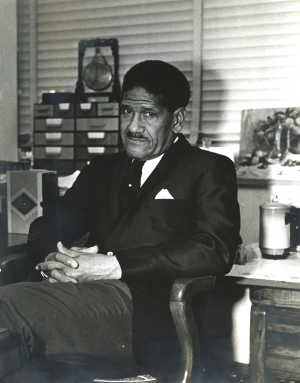
Marcus Bruce Christian in the 1960s
Marcus Bruce Christian
(1900 – 1976, Louisiana poet, historian and folklorist)
. . .
I am New Orleans: A Poem (excerpts)
.
I have known
Many people –
Many voices –
Many languages.
I have heard the soft cries of the African,
Jargoning an European tongue:
“Belles des figures!”
“Bon petit calas! Tout chauds, chère, tout chauds!”
“Pralines – pistaches! Pralines – pecanes!”
“Ah got duh nice yahlah bananas, lady!”
“Bla-a-a-a-a-ack ber-r-r-r-r-r-e-e-e-e-z!”
“Peenotsa! Peenotsa! Cuma gitta fromee!”
.
“Ah wanna qua’tee red beans,
Ena qua’tee rice,
Ena piece uh salt meat –
Tuh makkit tas’e nice:
En hurry up, Mr. Groceryman,
En put dat lan-yap in mah han’!”
.
“Papa Bonnibee, beat dem hot licks out! –
Ah sed, Poppa Stoppa, let dat jazz cum out!
En efyuh donh feet it,
‘Tain’t no use tellin’ yuh
Jess what it’s all about!
Now, gimme sum High Cs on dat horn ‘n’ let dem
Saints go marching in!”
Way Down Yonder In New Orleans…
Take it away, Mister Charlie!”
. . .
I am New Orleans,
A perpetual Mardi Gras
Of wild Indians, clowns, lords and ladies,
Bourbon Street Jezebels, Baby Dolls, and Fat Cats;
Peanut-vendors, flower-sellers, organ-grinders,
chimney-sweepers, and fortune-tellers.
And then, at the end, bone-rattling skeletons
and flying ghosts.
I am New Orleans –
A city that is a part of, and yet apart from all,
America;
A collection of contradictory environments;
A conglomeration of bloods and races and classes
and colours;
Side-by-side, the New tickling the ribs of the Old;
Cheek-by-jowl, the Ludicrous making faces at the Sublime.
. . .
The Masquerader
.
Here, as a guest esteemed,
I do not hide;
None would dare laugh at me –
None dare deride.
.
For I am white now –
Far whiter than you;
How did I get that way?
Ah! if you knew!
.
You have been very nice!
Took me to tea,
Took me to dinners –
And made love to me.
.
You have been very kind –
Begged for a date –
Me — in whose veins there flows
Blood that you hate.
.
I, who am cherished
And part of your joy –
I am more alien than
Those you employ.
.
You say I am a dream?
Dreams do not last.
When I am lost to you,
Whisper, “She passed.”
. . .
Resolution
.
I shall take your image
From out of my heart
And sweep your tracks
From its floor,
Forgetting
Dead yesterdays
And you.
Step by step,
As you walk away,
I go behind you
Sweeping . . .
Sweeping . . .
. . .
Inconvenient Love
.
Love is an inconvenient thing –
Out of nowhere it slips,
And grows into something that saves or slays,
Or something that binds or grips;
And it sets a seal upon one’s lips.
.
Love has its own peculiar way –
Knowing its own blind art;
Bending strong souls like reeds to the wind,
And then – when it does depart –
Stamping in frantic and frenzied pain
A signet upon one’s heart.
. . .
Bachelor’s Apartment
.
The curtains from Daphne,
The curtains from Chloe;
The doilies from Helen;
The pillows from Flo;
The towels from Myrtle,
The teapot from Rose;
The book-ends from Marion –
Anything goes!
.
The comb-set from Muriel,
The lampshade from Delia;
The picture from Mabel,
The vases from Celia;
From Bertha – the candlesticks;
.
Those women left things
In my heart and my home!
. . .
The Craftsman
.
I ply with all the cunning of my art
This little thing, and with consummate care
I fashion it—so that when I depart,
Those who come after me shall find it fair
And beautiful. It must be free of flaws—
Pointing no labourings of weary hands;
And there must be no flouting of the laws
Of beauty—as the artist understands.
.
Through passion, yearnings infinite—yet dumb—
I lift you from the depths of my own mind
And gild you with my soul’s white heat to plumb
The souls of future men. I leave behind
This thing that in return this solace gives:
“He who creates true beauty ever lives.”
. . .
After the Years…
.
After the years have carted away
The grief and the shame;
After the years have carted away
The crime and the lust;
After the years have carted away
The faith and the trust:
After the years have carted them all
I claim
–The humblest claim–
Oblivion in the dust.
. . .
The Dreamer
(for Arturo Toscanini)
.
I am the dreamer – one whose dream
Is a diaphanous strange thing;
I top the crags, I bridge the stream,
I make the dead page glow and sing.
.
I plumb the depths, I count the stars,
I strain the sinews of my soul
To break through earth’s material bars
And seek perfection at its goal.
.
For I he who never halts –
I never say, “This task is done.”
I climb through subterranean vaults
To tilt my lance against the sun.
.
I am the essence of all art –
Javelins of gold from darkness hurled
Into the light – I break my heart
To set my dream against the world.
. . .
Source for the above poems:
I Am New Orleans & Other Poems By Marcus B. Christian, edited by Rudolph Lewis & Amin Sharif
. . .
ZP Editor’s note:
Tuesday, February 9th (Mardi Gras, 2016):
Wishing to feature Black History Month poems for Mardi Gras in New Orleans, we chanced upon a poet too little known: Marcus Bruce Christian. Themes of love and loss, love across “the colour line”, labour and economic struggle, and the spirit of place (I am New Orleans: A Poem) run throughout Christian’s close to 2000 poems. Our Special Thanks to editor Rudolph Lewis of Chicken Bones: A Journal, for introducing us to this fine poet from the past!
. . . . .
Robert Nesta “Bob” Marley: “Chanson de Rédemption”
Posted: February 6, 2016 Filed under: Bob Marley, English, French Comments Off on Robert Nesta “Bob” Marley: “Chanson de Rédemption”
Quatre enfants de Bob Marley_1980
Robert Nesta “Bob” Marley (6 février, 1945 – 11 mai, 1981)
Chanson de Rédemption (1980)
.
Vieux pirates, oui – ils m’ont volés
et vendus aux bateaux d’esclaves,
quelques minutes après qu’ils m’aient attrapé
du puits sans fond.
Mais par la main du Tout-Puissant
nous avançons dans cette génération – triomphante.
.
Voudrais-tu m’aider à chanter ces chansons de liberté?
Parce que tout ce que j’avais
– c’est des chansons de rédemption,
des chansons de rédemption.
.
Emancipez-vous de l’esclavage mental;
personne d’autres que nous-mêmes ne peut libérer nos esprits.
N’ayons pas peur pour l’énergie atomique,
car personne ne peut arrêter le temps.
Combien de temps encore tueront-ils nos prophètes
pendant que nous nous tenons à part et regardons?
Oui, il y a certains qui disent que c’est juste un passage,
et nous devons accomplir la Prophétie.
Ne voudrais-tu pas m’aider à chanter ces chansons de liberté?
Parce que tout ce que j’avais
– c’est des chansons de rédemption,
des chansons de rédemption
– ces chansons de liberté, chansons de liberté!
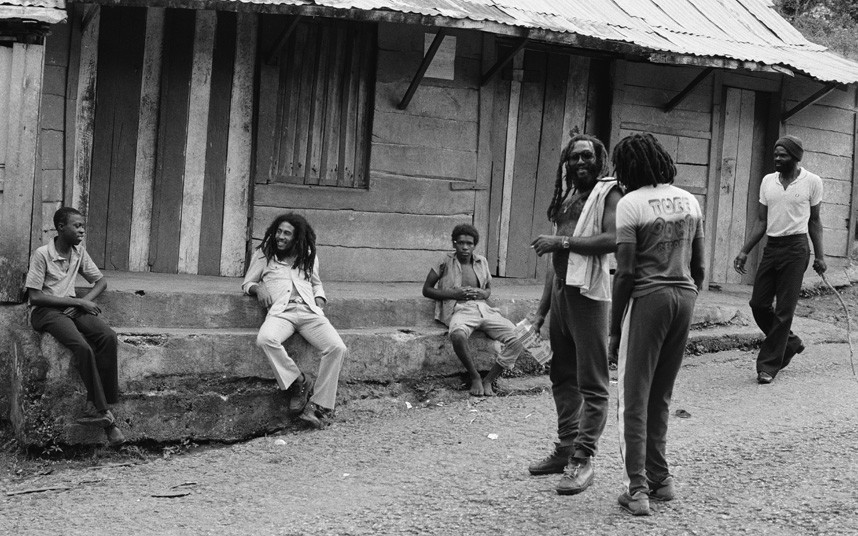
Bob Marley visitant le village de sa naissance, Nine Mile, dans la paroisse de Saint Ann, Jamaïque
Redemption Song (1980)
.
Old pirates, yes they rob I
– sold I to the merchant ships;
minutes after they took I
from the bottom-less pit.
But my hand was made strong
by the hand of the Almighty;
we forward in this generation
– triumphantly.
.
Won’t you help to sing these songs of freedom?
’cause all I ever had: redemption songs, redemption songs.
.
Emancipate yourself from the mental slavery;
none but ourselves can free our minds.
Have no fear for atomic energy,
’cause none o’ them can stop the time.
How long shall they kill our prophets
while we stand aside and look? (ouuuu!)
Some say it’s just a part of it;
we’ve got to fulfill the Book.
Won’t you help to sing these songs of freedom?
’cause all I ever had: redemption songs, redemption songs…
.
Emancipate yourselves from mental slavery;
None but ourselves can free our mind.
Woah! have no fear for atomic energy,
’cause none o’ them can stop the time.
How long shall they kill our prophets
while we stand aside and look?
Yes, some say it’s just a part of it;
we’ve got to fulfill the Book.
Won’t you help to sing these songs of freedom?
’cause all I ever had: redemption songs.
All I ever had: redemption songs.
(These songs of freedom, songs of freedom!)
. . . . .
Claude McKay: selected poems from “Harlem Shadows” (1922)
Posted: February 2, 2016 Filed under: Claude McKay, English | Tags: Black History Month poems Comments Off on Claude McKay: selected poems from “Harlem Shadows” (1922)
Claude McKay
(1889-1948, Jamaica / New York / Chicago)

Selected poems from Harlem Shadows (1922)
.
America
.
Although she feeds me bread of bitterness,
And sinks into my throat her tiger’s tooth,
Stealing my breath of life, I will confess
I love this cultured hell that tests my youth!
Her vigour flows like tides into my blood,
Giving me strength erect against her hate.
Her bigness sweeps my being like a flood.
Yet as a rebel fronts a king in state,
I stand within her walls with not a shred
Of terror, malice, not a word of jeer.
Darkly I gaze into the days ahead,
And see her might and granite wonders there,
Beneath the touch of Time’s unerring hand,
Like priceless treasures sinking in the sand.
. . .
Home Thoughts
.
Oh something just now must be happening there!
That suddenly and quiveringly here,
Amid the city’s noises, I must think
Of mangoes leaning o’er the river’s brink,
And dexterous Davie climbing high above,
The gold fruits ebon-speckled to remove,
And toss them quickly in the tangled mass
Of wis-wis twisted round the guinea grass ;
And Cyril coming through the bramble-track
A prize bunch of bananas on his back;
And Georgie —none could ever dive like him—
Throwing his scanty clothes off for a swim;
And schoolboys, from Bridge-tunnel going home,
Watching the waters downward dash and foam.
This is no daytime dream , there’s something in it,
Oh something’s happening there this very minute!
. . .
On Broadway
.
About me young and careless feet
Linger along the garish street;
Above, a hundred shouting signs
Shed down their bright fantastic glow
Upon the merry crowd and lines
Of moving carriages below.
Oh wonderful is Broadway—only
My heart, my heart is lonely.
Desire naked, linked with Passion,
Goes strutting by in brazen fashion;
From playhouse, cabaret and inn
The rainbow lights of Broadway blaze
All gay without, all glad within;
As in a dream I stand and gaze
At Broadway, shining Broadway—only
My heart, my heart is lonely.

Times Square in Manhattan_photograph from 1922
The Barrier
.
I must not gaze at them although
Your eyes are dawning day;
I must not watch you as you go
Your sun-illumined way;
I hear but I must never heed
The fascinating note,
Which, fluting like a river reed ,
Comes from your trembling throat;
I must not see upon your face
Love’s softly glowing spark;
For there’s the barrier of race,
You’re fair and I am dark.
. . .
The City’s Love
.
For one brief golden moment rare like wine,
The gracious city swept across the line;
Oblivious of the colour of my skin,
Forgetting that I was an alien guest,
She bent to me, my hostile heart to win,
Caught me in passion to her pillowy breast;
The great, proud city, seized with a strange love,
Bowed down for one flame hour my pride to prove.
. . .
When I Have Passed Away
.
When I have passed away and am forgotten,
And no one living can recall my face,
When under alien sod my bones lie rotten
With not a tree or stone to mark the place;
Perchance a pensive youth, with passion burning,
For olden verse that smacks of love and wine,
The musty pages of old volumes turning,
May light upon a little song of mine,
And he may softly hum the tune and wonder
Who wrote the verses in the long ago;
Or he may sit him down awhile to ponder
Upon the simple words that touch him so.
. . .
On the Road
.
Roar of the rushing train fearfully rocking,
Impatient people jammed in line for food,
The rasping noise of cars together knocking,
And worried waiters, some in ugly mood,
Crowding into the choking pantry hole
To call out dishes for each angry glutton
Exasperated grown beyond control,
From waiting for his soup or fish or mutton.
At last the station’s reached, the engine stops;
For bags and wraps the red-caps circle round;
From off the step the passenger lightly hops,
And seeks his cab or tram-car homeward bound:
The waiters pass out weary, listless, glum,
To spend their tips on harlots, cards and rum.
. . .
The Harlem Dancer
.
Applauding youths laughed with young prostitutes
And watched her perfect, half-clothed body sway;
Her voice was like the sound of blended flutes
Blown by black players upon a picnic day.
She sang and danced on, gracefully and calm,
The light gauze hanging loose about her form;
To me she seemed a proudly-swaying palm
Grown lovelier for passing through a storm.
Upon her swarthy neck black shiny curls
Luxuriant fell; and tossing coins in praise,
The wine-flushed, bold-eyed boys, and even the girls,
Devoured her shape with eager, passionate gaze;
But looking at her falsely-smiling face,
I knew her self was not in that strange place.
. . .
Outcast
.
For the dim regions whence my fathers came
My spirit, bondaged by the body, longs.
Words felt, but never heard, my lips would frame;
My soul would sing forgotten jungle songs.
I would go back to darkness and to peace,
But the great western world holds me in fee,
And I may never hope for full release
While to its alien gods I bend my knee.
Something in me is lost, forever lost,
Some vital thing has gone out of my heart,
And I must walk the way of life a ghost
Among the sons of earth, a thing apart;
For I was born, far from my native clime,
Under the white man’s menace, out of time.
. . .
I Know My Soul
.
I plucked my soul out of its secret place,
And held it to the mirror of my eye,
To see it like a star against the sky,
A twitching body quivering in space,
A spark of passion shining on my face.
And I explored it to determine why
This awful key to my infinity
Conspires to rob me of sweet joy and grace.
And if the sign may not be fully read,
If I can comprehend but not control,
I need not gloom my days with futile dread,
Because I see a part and not the whole.
Contemplating the strange, I’m comforted
By this narcotic thought: I know my soul.

Subway Wind
.
Far down, down through the city’s great, gaunt gut
The gray train rushing bears the weary wind;
In the packed cars the fans the crowd’s breath cut,
Leaving the sick and heavy air behind.
And pale-cheeked children seek the upper door
To give their summer jackets to the breeze;
Their laugh is swallowed in the deafening roar
Of captive wind that moans for fields and seas;
Seas cooling warm where native schooners drift
Through sleepy waters, while gulls wheel and sweep,
Waiting for windy waves the keels to lift
Lightly among the islands of the deep;
Islands of lofty palm trees blooming white
That lend their perfume to the tropic sea,
Where fields lie idle in the dew drenched night,
And the Trades float above them fresh and free.
. . .
Poetry
.
Sometimes I tremble like a storm-swept flower,
And seek to hide my tortured soul from thee.
Bowing my head in deep humility
Before the silent thunder of thy power.
Sometimes I flee before thy blazing light,
As from the specter of pursuing death;
Intimidated lest thy mighty breath,
Windways, will sweep me into utter night.
For oh, I fear they will be swallowed up—
The loves which are to me of vital worth,
My passion and my pleasure in the earth—
And lost forever in thy magic cup!
I fear, I fear my truly human heart
Will perish on the altar-stone of art!
. . .

A Prayer
.
‘Mid the discordant noises of the day I hear thee calling;
I stumble as I fare along Earth’s way; keep me from falling.
Mine eyes are open but they cannot see for gloom of night;
I can no more than lift my heart to thee for inward light.
The wild and fiery passion of my youth consumes my soul;
In agony I turn to thee for truth and self-control.
For Passion and all the pleasures it can give will die the death;
But this of me eternally must live, thy borrowed breath.
‘Mid the discordant noises of the day I hear thee calling;
I stumble as I fare along Earth’s way; keep me from falling.
. . .
Rest in Peace
.
No more for you the city’s thorny ways,
The ugly corners of the Negro belt;
The miseries and pains of these harsh days
By you will never, never again be felt.
No more, if still you wander, will you meet
With nights of unabating bitterness;
They cannot reach you in your safe retreat,
The city’s hate, the city’s prejudice!
‘Twas sudden—but your menial task is done,
The dawn now breaks on you, the dark is over,
The sea is crossed, the longed-for port is won;
Farewell, oh, fare you well! my friend and lover.
. . .
Flirtation
.
Upon thy purple mat thy body bare
Is fine and limber like a tender tree.
The motion of thy supple form is rare,
Like a lithe panther lolling languidly,
Toying and turning slowly in her lair.
Oh, I would never ask for more of thee,
Thou art so clean in passion and so fair.
Enough! if thou wilt ask no more of me!
. . .
Polarity
.
Nay, why reproach each other, be unkind,
For there’s no plane on which we two may meet?
Let’s both forgive, forget, for both were blind,
And life is of a day, and time is fleet.
And I am fire, swift to flame and burn,
Melting with elements high overhead,
While you are water in an earthly urn,
All pure, but heavy, and of hue like lead.
. . .
Author’s Word: from the first edition (1922) of Claude McKay’s Harlem Shadows:
.
In putting ideas and feelings into poetry, I have tried in each case to use the medium most adaptable to the specific purpose. I own allegiance to no master. I have never found it possible to accept in entirety any one poet. But I have loved and joyed in what I consider the finest in the poets of all ages.
.
The speech of my childhood and early youth was the Jamaica Negro dialect, the native variant of English, which still preserves a few words of African origin, and which is more difficult of understanding than the American Negro dialect. But the language we wrote and read in school was England’s English. Our text books then, before the advent of the American and Jamaican readers and our teachers, too, were all English-made. The native teachers of the elementary schools were tutored by men and women of British import. I quite remember making up verses in the dialect and in English for our moonlight ring dances and for our school parties. Of our purely native songs the jammas (field and road), shay-shays (yard and booth), wakes (post-mortem), Anancy tales (transplanted African folk lore), and revivals (religious) are all singularly punctuated by metre and rhyme. And nearly all my own poetic thought has always run naturally into these regular forms.
.
Consequently, although very conscious of the new criticisms and trends in poetry, to which I am keenly responsive and receptive, I have adhered to such of the older traditions as I find adequate for my most lawless and revolutionary passions and moods. I have not used patterns, images and words that would stamp me a classicist nor a modernist. My intellect is not scientific enough to range me on the side of either; nor is my knowledge wide enough for me to specialize in any school.
.
I have never studied poetics; but the forms I have used I am convinced are the ones I can work in with the highest degree of spontaneity and freedom.
.
I have chosen my melodies and rhythms by instinct, and I have favoured words and figures which flow smoothly and harmoniously into my compositions. And in all my moods I have striven to achieve directness, truthfulness and naturalness of expression instead of an enameled originality. I have not hesitated to use words which are old, and in some circles considered poetically overworked and dead, when I thought I could make them glow alive by new manipulation. Nor have I stinted my senses of the pleasure of using the decorative metaphor where it is more truly and vividly beautiful than the exact phrase. But for me there is more quiet delight in “The golden moon of heaven” than in “The terra-cotta disc of cloud-land.”
.
Finally, while I have welcomed criticism, friendly and unfriendly, and listened with willing attention to many varying opinions concerning other poems and my own, I have always, in the summing up, fallen back on my own ear and taste as the arbiter.
.
CLAUDE McKAY
. . .
Our Special Thanks to: Chris Forster and Roopika Risam of Harlemshadows.org.
. . . . .
Claude McKay: “Songs of Jamaica” (poems)
Posted: February 2, 2016 Filed under: Claude McKay, Claude McKay: Songs of Jamaica, English, English: Jamaican Patois | Tags: Black History Month poems Comments Off on Claude McKay: “Songs of Jamaica” (poems)
Claude McKay (1889-1948)
Poems from Songs of Jamaica (published in 1912)
. . .
Quashie to Buccra
.
You tas’e petater an’ you say it sweet,
But you no know how hard we wuk fe it;
You want a basketful fe quattiewut,
‘Cause you no know how ‘tiff de bush fe cut.
.
De cowitch under which we hab fe ‘toop,
De shamar lyin’ t’ick like pumpkin soup,
Is killin’ somet’ing for a naygur man;
Much less de cutlass workin’ in we han’.
.
De sun hot like when fire ketch a town;
Shade-tree look temptin’, yet we caan’ lie down,
Aldough we wouldn’ eben ef we could,
Causen we job must finish soon an’ good.
.
De bush cut done, de bank dem we deh dig,
But dem caan’ ‘tan’ sake o’ we naybor pig;
For so we moul’ it up he root it do’n,
An’ we caan’ ‘peak sake o’ we naybor tongue.
.
Aldough de vine is little, it can bear;
It wantin’ not’in but a little care:
You see petater tear up groun’, you run,
You laughin’, sir, you must be t’ink a fun.
.
De fiel’ pretty? It couldn’t less ‘an dat,
We wuk de bes’, an’ den de lan’ is fat;
We dig de row dem eben in a line,
An’ keep it clean – den so it mus’ look fine.
.
You tas’e petater an’ you say it sweet,
But you no know how hard we wuk fe it:
Yet still de hardship always melt away
Wheneber it come roun’ to reapin’ day.
. . .
Buccra = white man
petater = sweet potato
quattiewut = quattieworth: quattie is a quarter of sixpence.
cowitch = the Macuna pruriens climbing bean
shamar = Shamebush, a prickly sensitive plant (Mimosa pudica)
. . .
Me Bannabees
.
Run ober mango trees,
‘Pread chock to kitchen doo’,
Watch de blue bannabees,
Look how it ben’ down low!
.
De blossom draw de bees
Same how de soup draw man;
Some call it “broke-pot” peas,
It caan’ bruk we bu’n-pan.
.
Wha’ sweet so when it t’ick?
Though some calll it goat-tud,
Me all me finger lick,
An’ yet no chew me cud.
.
A mumma plant de root
One day jes’ out o’ fun;
But now look ‘pon de fruit,
See wha’ de “mek fun” done.
.
I jam de ‘tick dem ‘traight
Soon as it ‘tart fe ‘pread,
An begin count de date
Fe when de pod fe shed.
.
Me watch de vine dem grow,
S’er t’row dung a de root:
Crop time look fe me slow,
De bud tek long fe shoot.
.
But so de day did come,
I ‘crub de bu’n-pan bright,
An’ tu’n down ‘pon it from
De marnin’ till de night.
.
An’ Lard!me belly swell,
No ’cause de peas no good,
But me be’n tek a ‘pell
Mo’ dan a giant would.
.
Yet eben after dat
Me nyam it wid a will,
‘Causen it mek me fat;
So I wi’ lub it still.
.
Caan’ talk about gungu,
Fe me it is no peas;
Cockstone might do fe you,
Me want me bannabees.
. . .
Bannabees = Bonavist, a climbing bean or pea
Me nyam = I ate
gungu = Congo peas
Cockstone = red peas, the beans of America
. . .
King Banana
.
Green mancha mek fe naygur man;
Wha’ sweet so when it roas’?
Some boil it in a big black pan,
It sweeter in a toas’.
.
A buccra fancy when it ripe,
Dem use it ebery day;
It scarcely give dem belly-gripe,
Dem eat it diffran’ way.
.
Out yonder see somoke a rise,
An’ see de fire wicket;
Deh go’p to heaben wid de nize
Of hundred t’ousan cricket.
.
De black moul’ lie do’n quite prepare’
Fe feel de hoe an’ rake;
De fire bu’n, and it tek care
Fe mek de wo’m dem wake.
.
Wha’ lef” fe buccra teach again
Dis time about plantation?
Dere’s not’in dat can beat de plain
Good ole-time cultibation.
.
Banana dem fat all de same
From bunches big an’ ‘trong;
Pure nine-han’ bunch a car’ de fame, –
Ole met’od all along.
.
De cuttin’ done same ole-time way,
We wrap dem in a trash,
An’ pack dem neatly in a dray
So tight dat dem can’t mash.
.
We re’ch: banana finish sell;
Den we ‘tart back fe home:
Some hab money in t’read-bag well,
Some spen’ all in a rum.
.
Green mancha mek fe naygur man,
It mek fe him all way;
Our islan’ is banana lan’,
Banana car’ de sway.
. . .
mancha = “Martinique”, the best variety of banana in Jamaica
. . .
The Biter Bit
[“Ole woman a swea’ fe eat calalu: calalu a swea’ fe wuk him gut.” Jamaican proverb]
.
Corn an’ peas growin’ t’ick an’ fas’
Wid nice blade peepin’ t’rough de grass;
An’ ratta from dem hole a peep,
T’ink all de corn dem gwin’ go reap.
.
Ole woman sit by kitchen doo’
Is watchin’ calalu a grow,
An’ all de time a t’inking dat
She gwin’ go nyam dem when dem fat.
.
But calalu, grow’n’ by de hut,
Is swearin’ too fe wuk him gut;
While she, like some, t’ink all is right
When dey are in some corner tight.
.
Peas time come roun’ – de corn is lef”;
An’ ratta now deh train himse’f
Upon de cornstalk dem a’ night
Fe when it fit to get him bite.
.
De corn-piece lie do’n all in blue,
An’ all de beard dem floatin’ too
Amongst de yellow grain so gay,
Dat you would watch dem a whole day.
.
An’ ratta look at ebery one,
Swea’in’ dat dem not gwin’ lef’ none;
But Quaco know a t’ing or two,
An’ swear say dat dem won’t go so.
.
So him go get a little meal
An’ somet’ing good fe those dat steal,
An’ mix dem up an’ ‘pread dem out
For people possess fas’ fas’ mout’.
.
Now ratta, comin’ from dem nes’,
See it an’ say “Dis food is bes’;”
Dem nyam an’ stop, an’ nyam again,
An’ soon lie do’n, rollin’ in pain.
. . .
calalu = “spinach” (could be Amaranthus viridis or Xanthosoma or dasheen leaves)
blue = the blueish leaf of the maize
. . .
Taken Aback
.
Let me go, Joe, for I want go home:
Can’t stan’ wid you,
For Pa might go come;
An’ if him only hab him rum,
I don’t know whateber I’ll do.
.
I must go now, for it’s gettin’ night
I am afraid,
An’ ’tis not moonlight:
Give me de last hug, an’ do it tight;
Me Pa gwin’ go knock off me head.
.
No, Joe, don’t come! – you will keep me late,
An’ Pa might be
In him sober state;
Him might get vex’ an’ lock up de gate,
Den what will becomin’ of me?
.
Go wid you, Joe? – you don’t lub me den!
I shame o’ you –
Gals caan’ trust you men!
An’ I b’en tekin’ you fe me frien’;
Good-night, Joe, you’ve proven untrue.
. . .
Ione
.
Say if you lub me, do tell me truly,
Ione, Ione;
For, O me dearie, not’in’ can part we,
Ione, Ione.
.
Under de bamboo, where de fox-tail grew,
Ione, Ione,
While de cool breeze blew – sweet, I did pledge you,
Ione, Ione.
.
Where calalu grows, an’ yonder brook flows,
Ione, Ione,
I held a dog-rose under your li’l nose,
Ione, Ione.
.
There where de lee stream plays wid de sunbeam,
Ione, Ione,
True be’n de love-gleam as a sweet day-dream,
Ione, Ione.
.
Watchin’ de bucktoe under de shadow,
Ione, Ione,
Of a pear-tree low dat in de stream grow,
Ione, Ione,
.
Mek me t’ink how when we were lee children,
Ione, Ione,
We used to fishen in old Carew Pen,
Ione, Ione.
.
Like tiny meshes, curl your black tresses,
Ione, Ione,
An’ my caresses tek widout blushes,
Ione, Ione.
.
Kiss me, my airy winsome lee fairy,
Ione, Ione;
Are you now weary, little canary,
Ione, Ione?
.
Then we will go, pet, as it is sunset,
Ione, Ione;
Tek dis sweet vi’let, we will be one yet,
Ione, Ione.
. . .
bucktoe = a small crawfish
Pen = the Jamaican equivalent for ranche
. . .
My Pretty Dan
.
I have a póliceman down at de Bay,
An’ he is true to me though far away.
.
I love my pólice, and he loves me too,
An’ he has promised he’ll be ever true.
.
My little bobby is a darlin’ one,
An’ he’s de prettiest you could set eyes ‘pon.
.
When he be’n station’ up de countryside,
Fus’ time I shun him sake o’ foolish pride.
.
But as I watched him patrolling his beat,
I got to find out he was nice an’ neat.
.
More still I foun’ out he was extra kin’,
An’ dat his precious heart was wholly mine.
.
Den I became his own true sweetheart,
An’ while life last we’re hopin’ not fe part.
.
He wears a truncheon an’ a handcuff case,
An’ pretty cap to match his pretty face.
.
Dear lilly p’liceman stationed down de sout’,
I feel your kisses rainin’ on my mout’.
.
I could not give against a póliceman;
For if I do, how could I lub my Dan?
.
Prettiest of naygur is my dear police,
We’ll lub foreber, an’ our lub won’t cease.
.
I have a póliceman down at de Bay,
An’ he is true to me though far away.
. . .
A Midnight Woman to the Bobby
.
No palm me up, you dutty brute,
You’ jam mout’ mash like ripe bread-fruit;
You fas’n now, but wait lee ya,
I’ll see you grunt under de law.
.
You t’ink you wise, but we wi’ see;
You not de fus’ one fas’ wid me;
I’ll lib fe see dem tu’n you out,
As sure as you got dat mash’ mout’.
.
I born right do’n beneat’ de clack
(You ugly brute, you tu’n you’ back?)
Don’t t’ink dat I’m a come-aroun’,
I born right ‘way in ‘panish Town.
.
Care how you try, you caan’ do mo’
Dan many dat was hyah befo’;
Yet whe’ dey all o’ dem te-day?
De buccra dem no kick dem ‘way?
.
Ko ‘pon you’ jam samplatta nose:
‘Cos you wear Mis’r Koshaw clo’es
You t’ink say you’s de only man,
Yet fus’ time ko how you be’n ‘tan’.
.
You big an’ ugly ole tu’n-foot
Be’n neber know fe wear a boot;
An’ chigger nyam you’ tumpa toe,
Till nit full i’ like herrin’ roe.
.
You come from mountain naked-‘kin,
An’ Lard a mussy! you be’n thin,
For all de bread-fruit dem be’n done,
Bein’ ‘poil’ up by de tearin’ sun:
.
De coco couldn’ bear at all,
For, Lard! de groun’ was pure white-marl;
An’ t’rough de rain part o’ de year
De mango tree dem couldn’ bear.
.
An’ when de pinch o’ time you feel
A ‘pur you a you’ chigger heel,
You lef’ you’ district, big an’ coarse,
An’ come join buccra Pólice Force.
.
An’ now you don’t wait fe you’ glass,
But trouble me wid you’ jam fas’;
But wait, me frien’, you’ day wi’ come,
I’ll see you go same lak a some.
.
Say wha’? – ‘res’ me? – you go to hell!
You t’ink Judge don’t know unno well?
You t’ink him gwin’ go sentance me
Widout a soul fe witness i’?
. . .
beneat’ de clack = the clock on the public buildings at Spanish Town
come-aroun’ = day-labourer, man or woman, in Kingston streets and wharves, famous for the heavy weight he or she can carry
samplatta = a piece of leather cut somewhat larger than the size of the foot, and tied sandal-wise to it: said of anything that is flat and broad.
Mis’r Koshaw clo’es = Mister Kershaw’s clothes i.e. police uniform. Col. Kershaw was Inspector-General of Police in 1911, (when this poem was written.)
An’ chigger nyam you’ tumpa toe, etc. = And chigoes (burrowing fleas) had eaten your maimed toe, and nits (young chigoes) had filled it.
Lard a mussy! = Lord have mercy!
unno (or onnoo) = an African word meaning “you” collectively

Mother Dear
.
“HUSBAN’, I am goin’ –
Though de brooklet is a-flowin’,
An’ de coolin’ breeze is blowin’
Softly by;
Hark, how strange de cow is mooin’,
An’ our Jennie’s pigeons cooin’,
While I feel de water growin’,
Climbing high.
.
“Akee trees are laden,
But de yellow leaves are fadin’
Like a young an’ bloomin’ maiden
Fallen low;
In de pond de ducks are wakin’
While my body longs for Eden,
An’ my weary breat’ is gledin’
‘Way from you.
.
“See dem John-crows flyin’!
‘Tis a sign dat I am dyin’;
Oh, I’m wishful to be lyin’
All alone:
Fait’ful husban’, don’t go cryin’,
Life is one long self-denyin’
All-surrenderin’ an’ sighin’
Livin’ moan.”
. . .

“WIFE, de parson’s prayin’,
Won’t you listen what he’s sayin’,
Spend de endin’ of your day in
Christ our Lord?”
. . .
.
But de sound of horses neighin’,
Baain’ goats an’ donkeys brayin’,
Twitt’rin’ birds an’ children playin’
Was all she heard.
.
Things she had been rearin’,
Only those could claim her hearin’,
When de end we had been fearin’
Now had come:
Now her last pain she is bearin’,
Now de final scene is nearin’,
An’ her vacant eyes are starin’
On her home.
.
Oh! it was heart-rendin’
As we watched de loved life endin’,
Dat sweet sainted spirit bendin’
To de death:
Gone all further hope of mendin’,
With de angel Death attendin’,
An’ his slayin’ spirit blendin’
With her breath.
. . .
Akee = Cupania sapida, bearing beautiful red fruits
John-crows = Turkey-buzzards
. . .
Dat Dirty Rum
.
If you must drink it, do not come
An’ chat up in my face;
I hate to see de dirty rum,
Much more to know de tas’e.
.
What you find dere to care about
I never understan’;
It only dutty up you mout’,
An’ mek you less a man.
.
I see it throw you ‘pon de grass
An ‘met you want no food,
While people scorn you as dey pass
An’ see you vomit blood.
.
De fust beginnin’ of it all,
You stood up calm an’ cool,
An’ put you’ back agains’ de wall
An’ cuss our teacher fool.
.
You cuss me too de se’fsame day
Because a say you wrong,
An’ pawn you’ books an’ went away
Widout anedder song.
.
Your parents’ hearts within dem sink,
When to your yout’ful lip
Dey watch you raise de glass to drink,
An’ shameless tek each sip.
.
I see you in de dancing-booth,
But all your joy is vain,
For on your fresh an’ glowin’ youth
Is stamped dat ugly stain.
.
Dat ugly stain of drink, my frien’,
Has cost you your best girl,
An’ med you fool ‘mongst better me
When your brain’s in a whirl.
.
You may smoke just a bit indeed,
I like de “white seal” well;
Aldough I do not use de weed,
I’m fond o’ de nice smell.
.
But wait until you’re growin’ old
An’ gettin’ weak an’ bent,
An’ feel your blood a-gettin’ cold
‘Fo you tek stimulent.
.
Then it may mek you stronger feel
While on your livin’ groun’;
But ole Time, creepin’ on your heel,
Soon, soon will pull you down:
.
Soon, soon will pull you down, my frien’,
De rum will help her too;
An’ you’ll give way to better men,
De best day you can do.
. . .
“white seal” = the name of a brand of cigarettes
. . .
Killin’ Nanny
.
Two little pickny is watchin’,
While a goat is led to deat’;
Dey are little ones of two years,
An’ know naught of badness yet.
.
De goat is bawlin’ fe mussy,
An’ de children watch de sight
As de butcher re’ch his sharp knife,
An’ ‘tab wid all his might.
.
Dey see de red blood flowin’;
An’ one chil’ trimble an’ hide
His face in de mudder’s bosom,
While t’udder look on wide-eyed.
.
De tears is fallin’ down hotly
From him on de mudder’s knee;
De udder wid joy is starin’,
An’ clappin’ his han’s wid glee.
.
When dey had forgotten Nanny,
Grown men I see dem again;
An’ de forehead of de laugher
Was brand wid de mark of Cain.

 Zócalo Poets