Juliane Okot Bitek: “Dans Sept Jours” et “À Langston Hughes”
Posted: February 1, 2012 Filed under: English, French, Juliane Okot Bitek, ZP Translator: Lan Truong, ZP Translator: Lidia García Garay | Tags: Black poets Comments Off on Juliane Okot Bitek: “Dans Sept Jours” et “À Langston Hughes”_____
“Dans Sept Jours”
Une main delicate
tient un eventail
Evoque des souvenirs de la performance d’un amoureux
*
Dis-moi
Dis-moi car je ne m’imagine pas
La chaleur qui se lève dans l’arrière de ma gorge
S’étendre dans ma poitrine
Tombe
Et se dépose
*
Je ne reviendrai pas vers toi
*
Une fleur se ferme
Se dessèche à cause de la froide étreinte
D’un vent sec et amer
*
Tout sera fini
Dans sept jours.
_____
“À Langston Hughes”
Si tu ne restes pas
Pour lire mon coeur,
Cela ne me dérange pas
*
J’ai déchiré ton livre de poésie
*
Tu as menti:
Comme je prenais le train à Harlem
Tu as déraillé.
_____
Le poète Juliane Okot Bitek est née à Kenya en 1966.
Elle a passé son enfance en Ouganda.
Et maintenant elle habite à Vancouver, Canada.
*
Traductions de l’anglais au français:
Lidia Garcia Garay, Lan Truong
_____
“Seven Days”
A delicate hand
Holds a fan
Evokes memories of a lover’s performance
Tell me
Tell me that I do not imagine
The heat that rises at the back of my throat
Spreads through my chest
Falls
And settles
I am not returning to you
A flower folds up
Shrivels from the cold embrace
Of a dry and bitter wind
In seven days
It will be over.
_____
“To Langston Hughes”
That you will not stay
To read my heart
Doesn’t matter to me
I tore your book of poetry
You lied:
While I took the Harlem train uptown
You strayed.
_____
Poet Juliane Okot Bitek was born in Kenya in 1966
and spent her childhood in Uganda.
She now lives in Vancouver, Canada.
_____
Langston Hughes: “La Señora y su Señora” / “Madame et sa Madame” / “Madam and her Madam”
Posted: February 1, 2012 Filed under: English: Black Canadian / American, French, Langston Hughes, Spanish, ZP Translator: Lan Truong, ZP Translator: Lidia García Garay | Tags: Black poets Comments Off on Langston Hughes: “La Señora y su Señora” / “Madame et sa Madame” / “Madam and her Madam”_____
Langston Hughes (February 1st, 1902 – 1967)
“Madam and Her Madam”
I worked for a woman,
She wasn’t mean–
But she had a twelve-room
House to clean.
*
Had to get breakfast,
Dinner, and supper, too–
Then take care of her children
When I got through.
*
Wash, iron, and scrub,
Walk the dog around–
It was too much,
Nearly broke me down.
*
I said, Madam,
Can it be
You trying to make a
Pack-horse out of me?
*
She opened her mouth.
She cried, Oh, no!
You know, Alberta,
I love you so!
*
I said, Madam,
That may be true–
But I’ll be dogged
If I love you!
_____
“La Señora y su Señora”
por Langston Hughes
Trabajé para una mujer
No era muy malvada—
Ella tenía una casa de doce cuartos
que yo tenía que limpiar.
*
Tenía que hacer desayuno,
Almuerzo y cena también—
Después atender a los niños,
Al terminar.
*
Lavar, planchar, y limpiar
Llevar a caminar al perro…
Era demasiado,
Casi me destroza.
*
Yo le dije, Señora,
¿Es posible que usted
Está tratando de convertirme
En un caballo de carga?
*
Ella habrió su boca
Y exclamó:
¡Oh, no!
Sabes Alberta,
¡Yo a tí te quiero mucho!
*
Yo le dije: Señora,
Puede que eso sea verdad—
¡Pero que desgracia la mía
Si yo la quiero a usted!
*
Traducción del inglés al español: Lidia García Garay
_____
“Madame et sa Madame”
par Langston Hughes
J’ai travaillé pour une femme,
Elle n’était pas méchante—
Elle avait une maison avec
douze chambres
Que je devais nettoyer.
Préparer le petit déjeuner,
Le déjeuner et le dîner aussi—
Je devais garder ses enfants
Après tout ca.
Faire la lessive et la repasser,
et nettoyer le plancher,
Promener son chien—
C’était trop!,
Le travail m’a fait presque craquer.
*
Je lui ai dit: Madame,
Est-ce qu’il est possible
Que vous essayiez
De me transformer en cheval de trait?
*
Elle a ouvert sa bouche.
Et elle a dit: Pas du tout!
Tu sais Alberta,
Je t’aime beaucoup!
*
Je lui ai dit: Madame,
Cela peut être la vérité
Mais je serais foutue
si je vous aime!
*
Traduction de l’anglais au français:
Lidia García Garay, Lan Truong
_____
Langston Hughes: “Yo también, canto a América…”/ “I, too, sing America…”
Posted: February 1, 2012 Filed under: English, Langston Hughes, Spanish | Tags: Black poets Comments Off on Langston Hughes: “Yo también, canto a América…”/ “I, too, sing America…”_____
Langston Hughes (1 febrero 1902 – 1967)
“Yo también, canto a América”
Yo también, canto a América.
Yo soy el hermano de piel oscura.
Ellos me mandan a comer a la cocina
cuando vienen las visitas.
Pero yo me río,
Y como bien,
Y crezco fuerte.
Mañana,
Yo comeré en la mesa
Cuando las visitas lleguen.
Entonces,
Nadie se atreverá
A decirme,
“Come en la cocina,”
Además,
Ellos verán que tan bello soy
Y sentirán vergüenza-
Yo, también, soy América.
(1925)
Traducción del inglés al español:
Anónimo/Anónima (de los años sesenta)
_____
“I, too, sing America”
I, too, sing America.
I am the darker brother.
They send me to eat in the kitchen
When company comes,
But I laugh,
And eat well,
And grow strong.
Tomorrow,
I’ll be at the table
When company comes.
Nobody’ll dare
Say to me,
“Eat in the kitchen,”
Then.
Besides,
They’ll see how beautiful I am
And be ashamed–
I, too, am America.
(1925)
_____
Langston Hughes as Translator: Lorca’s “Gypsy Ballads”
Posted: February 1, 2012 Filed under: English, Federico García Lorca, Langston Hughes, Spanish | Tags: Black poets Comments Off on Langston Hughes as Translator: Lorca’s “Gypsy Ballads”_____
Brawl
Half way down the ravine,
Gay with rival blood
The knives of Albacete
Shine like fishes.
*
A light hard as playing cards
In the acid greenness
Silhouettes furious horses
And the profiles of riders.
*
On the crest of an olive tree
Two old women cry.
The bull of the dispute
Charges up the walls.
Black angels bring
Handkerchiefs and snow-water,
Angels with big wings
Made of knives from Albacete.
*
Juan Antonio of Montilla
Rolls dead down the hill,
His body full of lilies
And a pomegranate at his temples.
Now he rides a cross of fire
On the road to death.
*
The judge, with the Civil Guards,
Comes through the olive groves.
Slippery blood sings
A silent song of serpents.
Honourable Civil Guards:
The same as usual –
Four Romans dead
And five Carthaginians.
*
Crazed with hot rumours and fig trees,
The afternoon falls fainting
On the wounded limbs of the riders.
Black angels fly
Through the western air,
Angels with long braids
And hearts of oil.
_____
“Reyerta”
En la mitad del barranco
las navajas de Albacete,
bellas de sangre contraria,
relucen como los peces.
*
Una dura luz de naipe
recorta en el agrio verde
caballos enfurecidos
y perfiles de jinetes.
*
En la copa de un olivo
lloran dos viejas mujeres.
El toro de la reyerta
su sube por la paredes.
Angeles negros traían
pañuelos y agua de nieve.
Angeles con grandes alas
de navajas de Albacete.
*
Juan Antonio el de Montilla
rueda muerto la pendiente
su cuerpo lleno de lirios
y una granada en las sienes.
Ahora monta cruz de fuego,
carretera de la muerte.
*
El juez con guardia civil,
por los olivares viene.
Sangre resbalada gime
muda canción de serpiente.
Señores guardias civiles:
aquí pasó lo de siempre.
Han muerto cuatro romanos
y cinco cartagineses
*
La tarde loca de higueras
y de rumores calientes
cae desmayada en los muslos
heridos de los jinetes.
Y ángeles negros volaban
por el aire del poniente.
Angeles de largas trenzas
y corazones de aceite.
_____
The Faithless Wife
I took her to the river
Thinking she was single,
But she had a husband.
It was Saint James’ Eve,
And almost because I had to.
The street lights went out
And the crickets lit up.
At the farthest corners
I touched her sleeping breasts
And they opened for me quickly
Like bouquets of hyacinths.
The starch of her underskirts
Rustled in my ears
Like a piece of silk
Slit by ten knives.
With no silver light to crown them
The trees grew bigger,
While a horizon of dogs barked
Afar from the river.
*
Beyond the brambles,
The bulrushes, and the hawthorns,
I made her mat of hair
Hollow the muddy bank.
I took off my tie,
She took off her dress,
Me, my belt with the pistol,
She, the four parts of her bodice.
Neither lilies nor snail shells
Have such a lovely skin,
Nor do the crystals of the moon
Shine with such a light.
Half bathed in fire
And half bathed in ice,
Her thighs slipped from me
Like frightened fish.
That night I rode
Down the best of roads
On a mother-of-pearl filly
With no bridle and no stirrups.
Being a man, I can’t tell you
The things that she told me.
The light of understanding
Makes me very careful.
Soiled with kisses and sand
I led her away from the river
While the swords of the lilies
Battled with the breeze.
I acted like the thoroughbred
Gypsy that I am,
And gave her a present,
A big sewing box
Of straw-coloured satin.
But I didn’t want
To fall in love with her
For, having a husband,
She told me she was single
When I took her to the river.
_____
“La Casada Infiel”
Y que yo me la llevé al río
creyendo que era mozuela,
pero tenía marido.
Fue la noche de Santiago
y casi por compromiso.
Se apagaron los faroles
y se encendieron los grillos.
En las últimas esquinas
toqué sus pechos dormidos,
y se me abrieron de pronto
como ramos de jacintos.
El almidón de su enagua
me sonaba en el oído,
como una pieza de seda
rasgada por diez cuchillos.
Sin luz de plata en sus copas
los árboles han crecido
y un horizonte de perros
ladra muy lejos del río.
*
Pasadas las zarzamoras,
los juncos y los espinos,
bajo su mata de pelo
hice un hoyo sobre el limo.
Yo me quité la corbata.
Ella se quitó el vestido.
Yo el cinturón con revólver.
Ella sus cuatro corpiños.
Ni nardos ni caracolas
tienen el cutis tan fino,
ni los cristales con luna
relumbran con ese brillo.
Sus muslos se me escapaban
como peces sorprendidos,
la mitad llenos de lumbre,
la mitad llenos de frío.
Aquella noche corrí
el mejor de los caminos,
montado en potra de nácar
sin bridas y sin estribos.
No quiero decir, por hombre,
las cosas que ella me dijo.
La luz del entendimiento
me hace ser muy comedido.
Sucia de besos y arena
yo me la llevé del río.
Con el aire se batían
las espadas de los lirios.
*
Me porté como quién soy.
Como un gitano legítimo.
La regalé un costurero
grande, de raso pajizo,
y no quise enamorarme
porque teniendo marido
me dijo que era mozuela
cuando la llevaba al río.
_____
Langston Hughes ( February 1st 1902 – 1967)
lived in México for part of his boyhood, and,
two decades later, travelled to
Spain when he became interested in Communism.
Though he was familiar with the Spanish poetry of
Federico García Lorca (1898-1936),
the poet had already been killed by the time
Hughes got to Spain (toward the end of
The Spanish Civil War) in 1938.
*
Inspired by the Fiesta de Cante Jondo (Festival of
Deep Song) in 1922, Lorca had immersed himself
in the gypsy subculture of Andalucía, Spain. The
result was his 1928 collection of poems,
“Primer romancero gitano”. In 1951, Langston
Hughes published his translations into English
of a dozen or so of these “Gypsy Ballads”,
two of which we feature here.
_____
Robbie Burns: “To a Louse”
Posted: January 25, 2012 Filed under: English: Scots, Robert Burns Comments Off on Robbie Burns: “To a Louse”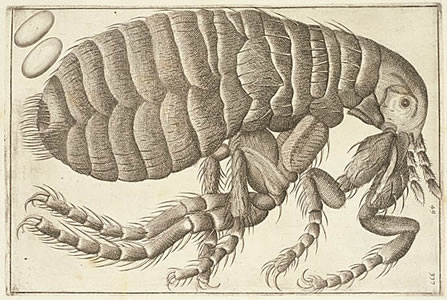
Filippo Bonanni_Drawing of a louse observed under a microscope_1709
“To a Louse*:
On Seeing One on a Lady’s Bonnet, at Church”
(1786)
.
Ha! whaur ye gaun, ye crowlin ferlie?
Your impudence protects you sairly;
I canna say but ye strunt rarely,
Owre gauze and lace;
Tho’, faith! I fear ye dine but sparely
On sic a place.
Ye ugly, creepin, blastit wonner,
Detested, shunn’d by saunt an’ sinner,
How daur ye set your fit upon her-
Sae fine a lady?
Gae somewhere else and seek your dinner
On some poor body.
Swith! in some beggar’s haffet squattle;
There ye may creep, and sprawl, and sprattle,
Wi’ ither kindred, jumping cattle,
In shoals and nations;
Whaur horn nor bane ne’er daur unsettle
Your thick plantations.
Now haud you there, ye’re out o’ sight,
Below the fatt’rels, snug and tight;
Na, faith ye yet! ye’ll no be right,
Till ye’ve got on it-
The verra tapmost, tow’rin height
O’ Miss’ bonnet.
My sooth! right bauld ye set your nose out,
As plump an’ grey as ony groset:
O for some rank, mercurial rozet,
Or fell, red smeddum,
I’d gie you sic a hearty dose o’t,
Wad dress your droddum.
I wad na been surpris’d to spy
You on an auld wife’s flainen toy;
Or aiblins some bit dubbie boy,
On’s wyliecoat;
But Miss’ fine Lunardi! fye!
How daur ye do’t?
O Jeany, dinna toss your head,
An’ set your beauties a’ abread!
Ye little ken what cursed speed
The blastie’s makin:
Thae winks an’ finger-ends, I dread,
Are notice takin.
O wad some Power the giftie gie us
To see oursels as ithers see us!
It wad frae mony a blunder free us,
An’ foolish notion:
What airs in dress an’ gait wad lea’e us,
An’ ev’n devotion!
.
*Louse = the singular of Lice
. . . . .
Robbie Burns: “A Bottle and Friend”
Posted: January 25, 2012 Filed under: English: Scots, Robert Burns Comments Off on Robbie Burns: “A Bottle and Friend”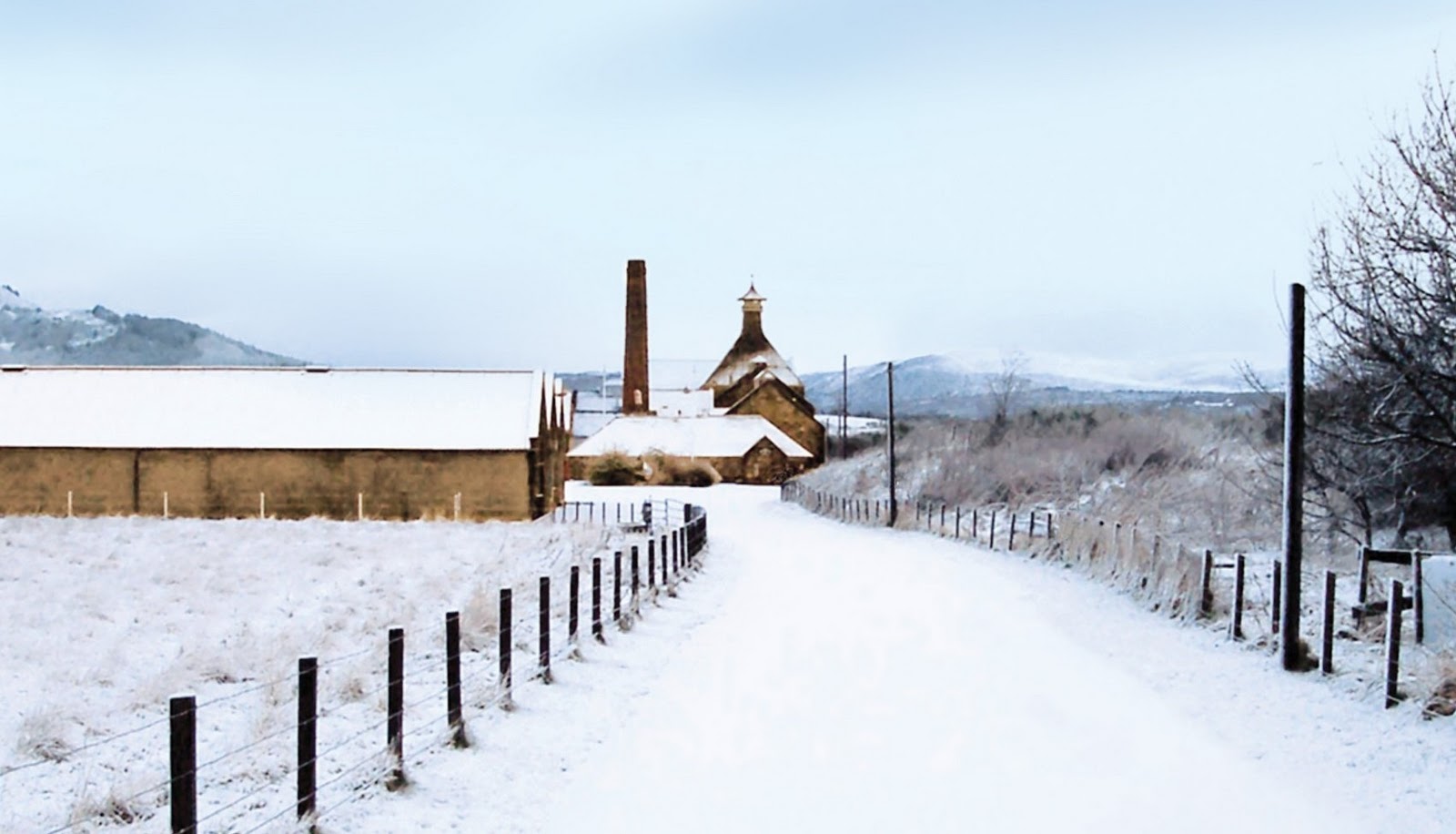
Balblair Distillery in Scotland
“A Bottle and Friend”
(1789)
.
There’s nane that’s blest of human kind,
But the cheerful and the gay, man,
Fal, la, la, &c.
Here’s a bottle and an honest friend!
What wad ye wish for mair, man?
Wha kens, before his life may end,
What his share may be o’ care, man?
Then catch the moments as they fly,
And use them as ye ought, man:
Believe me, happiness is shy,
And comes not aye when sought, man.
. . .
Scotland’s “Bard”,
Robert Burns (1759-1796),
was born on
this day – January 25th.
. . . . .
Mao Zedong: “New Year’s Day”
Posted: January 23, 2012 Filed under: English, Mao Zedong Comments Off on Mao Zedong: “New Year’s Day”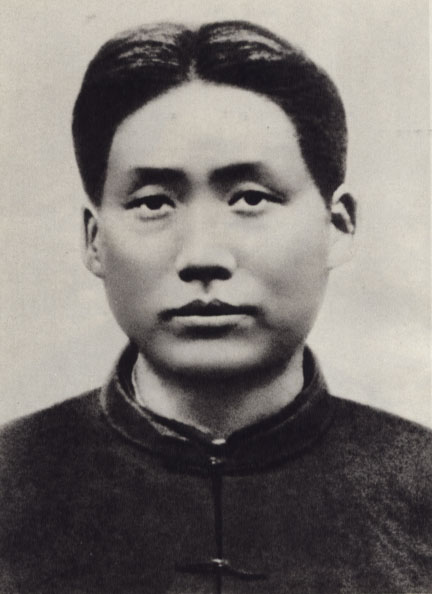
New Year’s Day (January 29th, 1930)
– to the tune of Ju Meng Ling
Ninghua, Chingliu, Kueihua–
What narrow paths, deep woods and slippery moss!
Whither are we bound today?
Straight to the foot of Wuyi Mountain.
To the mountain, the foot of the mountain,
Red flags stream in the wind in a blaze of glory.
* English translation from Mandarin Chinese *

A “Chile” Winter / un Invierno chileno: Jorge Teillier
Posted: January 18, 2012 Filed under: English, Jorge Teillier, Spanish Comments Off on A “Chile” Winter / un Invierno chileno: Jorge Teillier_____
Poems by Jorge Teillier / Poemas por Jorge Teillier
(Chilean poet, 1935-1996 / Poeta chileno, 1935-1996)
Translation from Spanish into English © Carolyne Wright
*
Bridge in the South
Yesterday I remembered a clear winter day. I remembered
A bridge over the river, a river stealing blue from the sky.
My love was less than nothing on that bridge. An orange
sinking into the waters, a voice that doesn’t know whom it calls,
a gull whose gleam was undone among the pines.
*
Yesterday I remembered that no one is anyone on a bridge
when winter dreams with another season’s clarity,
and one wants to be a leaf motionless in the dream of winter,
and love is less than an orange losing itself in the waters,
less than a gull whose light goes out among the pines.
_____
Puente en el sur
Ayer he recordado un día de claro invierno. He recordado
un puente sobre el río, un río robándole azul al cielo.
Mi amor era menos que nada en ese puente. Una naranja
hundiéndose en las aguas, una voz que no sabe a quién llama,
una gaviota cuyo brillo se deshizo entre los pinos.
*
Ayer he recordado que no se es nadie sobre un puente
Cuando el invierno sueña con la claridad de otra estación,
y se quiere ser una hoja inmóvil en el sueño del invierno,
y el amor es menos que una naranja perdiéndose en las aguas,
menos que una gaviota cuya luz se extingue entre los pinos.
_____
Winter Poem
Winter brings white horses that slip on the ice.
They’ve lit fires to defend the orchards
from the white witch of the frost.
Among clouds of white smoke, the caretaker stirs himself.
The chill-numbed dog growls from his kennel at the drifting icefloe
of the moon.
*
Tonight they’ll forgive the boy for sleeping late.
In the house his parents are having a party.
But he opens the windows
to see the masked horsemen
who wait for him in the forest,
and he knows his fate will be to love the humble smell of footpaths in the night.
*
Winter brings moonshine for machinist and fire-stoker.
A lost star reels like a buoy.
Songs of intoxicated soldiers
returning late to their barracks.
*
In the house the party has begun.
But the boy knows the party’s somewhere else,
and he looks through the window for the strangers
he’ll spend his whole life trying to meet.
_____
Poema de invierno
El invierno trae caballos blancos que resbalan en la helada.
Han encendido fuego para defender los huertos
de la bruja blanca de la helada.
Entre la blanca humareda se agita el cuidador.
El perro entumecido amenaza desde su caseta al témpano flotante
de la luna.
*
Esta noche al niño se le perdonará que duerma tarde.
En la casa los padres están de fiesta.
Pero él abre las ventanas
para ver a los enmascarados jinetes
que lo esperan en el bosque y sabe que su destino
será amar el olor humilde de los senderos nocturnos.
*
El invierno trae aguardiente para el maquinista y el fogonero.
Una estrella perdida tambalea como baliza.
Cantos de soldados ebrios
que vuelven tarde a sus cuarteles.
*
En la casa ha empezado la fiesta.
Pero el niño sabe que la fiesta está en otra parte,
y mira por la ventana buscando a los desconocidos
que pasará toda la vida tratando de encontrar.
______
Editor’s note:
Winter in Chile is during June and July – but we are posting
Teillier’s poems during the Canadian winter: January.
Meena Kandasamy: Reverence :: Nuisance + Becoming a Brahmin
Posted: January 17, 2012 Filed under: English, Meena Kandaswamy Comments Off on Meena Kandasamy: Reverence :: Nuisance + Becoming a Brahmin_____
Meena Kandasamy:
Reverence :: Nuisance
.
On walls of reception counters
and staircases of offices, hospitals, firms
and other ‘secular’ institutions –
pictures of Hindu Gods are painted…
so that casual people walking in (or up or down)
fear to spit on the adorned walls.
But still looking around or climbing:
you can always find the work done
an irregular red border underlining the walls
owing so much to betel juice and spit.
And on cheap roadside compound walls
that don’t bear ‘Stick No Bills’ messages or
cinema and political posters — the Gods once again
are advertised. And captioned with legends that read
‘Do Not Urinate’. And yet, the Gods are covered with
layers of smelly urine – they don’t retaliate.
Tolerance is a very holy concept.
Or like someone said,
the Caste Gods deserve
the treatment they get.
_____
Becoming a Brahmin
.
Algorithm for converting a Shudra* into a Brahmin**:
Begin.
Step 1: Take a beautiful Shudra girl.
Step 2: Make her marry a Brahmin.
Step 3: Let her give birth to his female child.
Step 4: Let this child marry a Brahmin.
Step 5: Repeat steps 3-4 six times.
Step 6: Display the end product. It is a Brahmin.
End.
Algorithm advocated by Father of the Nation at Tirupur:
Documented by Periyar on 20-09-1947.
Algorithm for converting a pariah into a Brahmin:
Awaiting another Father of the Nation
to produce this algorithm.
Inconvenience caused due to inadvertent delay
is sincerely regretted.
.
* Shudra: the fourth and lowest caste of India – “serving” the three above it
** Brahmin: the first and highest caste of India
.
Both poems © 2006, Meena Kandasamy
_____
Meena Kandasamy, born in Chennai in 1984, writes poems that
are a literary discovery of being a woman – and Tamil in India –
and about low-caste and even outcaste-ness.
Being a Poet is glamourized – often – all around the world.
But Kandasamy is not interested in praise or literary garlands
– she feels a responsibility to ensure that language is not always
at the mercy of those who would oppress others.
_____
Mona Zote: An Impression of Being Alive
Posted: January 17, 2012 Filed under: English, Mona Zote Comments Off on Mona Zote: An Impression of Being Alive.
and careen, shed skin, refill, crest and yaw,
corrected our taste for oranges
packed by other hands from other places, bought
tokens of summer and the coming happiness —
we paused at the Korean romances: A Tale of a Prince,
Over The Rainbow, Tree of Heaven.
who went mad for a girl.
No prince arrived with a piece of fax.
You said: Plainly, it’s all money and for-
nication, just like everywhere else. We smiled
at the notion of moon bases and hummed a tune
from the movie we figured
we were still living in.
among bright open windows while the shopgirls cheered on,
and the pavement singers, and those women
fingering black laces in Foreign Lane
and we lived in and out of restaurants, smoking nonstop,
not thinking or speaking, our nerves
shattered by the urge to depart. All day
we have waited and waited
under heaven’s wide and lovely tree
for princes, advisors,
even some flannel postman to come and say
that the ship’s sailed, the bus
has left, all families look for us.
Have we said too much? Or not enough –
to its usual brilliant bedtime, the astronauts gone, the rain
now cadencing in our heads. The restaurant must close.
We have learned nothing. You wisely add: Really,
there was nothing to learn.
 Zócalo Poets