Gedenktag der heilige Cäcilia: An die Musik !
Posted: November 22, 2011 Filed under: English, German Comments Off on Gedenktag der heilige Cäcilia: An die Musik !_____
“An die Musik”
(Franz von Schober / Franz Schubert, 1817)
Du holde Kunst, in wieviel grauen Stunden,
wo mich des Lebens wilder Kreis umstrickt,
hast du mein Herz zu warmer Lieb’ entzunden,
hast mich in eine be§re Welt entrückt,
in eine be§re Welt entrückt.
Oft hat ein Seufzer deiner Harf’ entflossen,
ein sü§er heiliger Akkord von dir,
den Himmel be§rer Zeiten mir erschlossen,
du holde Kunst, ich danke dir dafür,
du holde Kunst, ich danke dir !
_____
November 22nd: Saint Cecilia’s Day
“To Music”
(Franz von Schober / Franz Schubert, 1817)
Thou lovely Art, in many a gloomy hour,
When I have bow’d before the storms of life,
Hast thou revived my heart with glowing power
In better realms, unknown to earthly strife,
in realms unknown to earthly strife.
How oft the tones thy golden harp did bear me,
The holy, sweet accords that heav’nward soar,
The heav’n of better days has open’d o’er me:
Thou lovely Art, my thanks to thee therefore,
thou lovely Art, my thanks therefore !
Poem for the Man of Light: Abdul Wahhab Al-Bayati
Posted: November 16, 2011 Filed under: Abdul Wahhab Al-Bayati, Arabic, English Comments Off on Poem for the Man of Light: Abdul Wahhab Al-Bayati_____
The man of light
Goes vagrant through my sleep at night
He stops in the abandoned corner
To extract words from my memory to write
And rewrite them aloud,
To blot lines out
He looks into the mirror
Of the house sunken deep in the darklight.
He recollects something
And slinks from my sleep.
I wake in dread
And try to recollect some thing
Of what he wrote, of what was said,
In vain. For the light
Has erased the papers and my memory
With daybreak’s deadman white.
*
We are grateful to A. Z. Foreman for his translation from the Arabic into English.
Visit his site: poemsintranslation.blogspot.com
Abdul Wahhab Al-Bayati (1926-1999) was an Iraqi poet who modernized Arabic poetry, introducing broader topics and breaking with the classical tradition of strict rhyme and metre.
The Arabic original of the poem follows:
قصيدة لرجل النور
عبد الوهاب البياتي
يتجول في نومي رجل النور
يتوقف في الركن المهجور
يُخرج من ذاكرتي كلماتٍ
يكتبها
ويعيد كتابتها في صوت مسموع
يمحو بعض سطور
ينظر في مرآة البيت الغارق بالظلمة والنور
يتذكر شيئاً
فيغادر نومي
استيقظ مذعوراً
وأحاول أن أتذكر شيئاً
مما قال ومما هو مكتوب
عبثاً ، فالنور
مسح الأوراق وذاكرتي
ببياض الفجر المقتول
Maltese Proverbs: Min jobżoq lejn is-sema jiġi f’wiċċu !
Posted: November 16, 2011 Filed under: English, Maltese Comments Off on Maltese Proverbs: Min jobżoq lejn is-sema jiġi f’wiċċu !
Old Maltese Proverbs:
La ddardarx l-għajn li trid tixrob minnha.
Don’t foul the spring from which you may want to drink.
*
Wieħed imut fis-sakra, u l-ieħor imut għal qatra.
One man dies of drunkenness, another dies for want of a drop.
*
Min jobżoq lejn is-sema jiġi f ‘wiċċu.
Whoever spits toward the sky, it comes down on his own face.
*
Aħjar ħarba minn karba.
Better to run away than to groan.
*
L-ilma fil-bir ma jaqtax għatx.
Water still in the well doesn’t quench a thirst.
*
Min igħid li jrid, ikollu jisma’ milli ma jridx.
Whoever says whatever he likes will have to hear what he doesn’t like.
*
Għajn ma tara(x) qalb ma tuġa'(x).
What the eye doesn’t see the heart doesn’t grieve over.
*
Min jiekol il-laħma jeħtieġ iġerrem l-għadma.
He who eats the meat must also gnaw the bone.
*
Il-flus jagħmlu l-flus, u d-dud jagħmel id-dud.
Money breeds money, and worms breed worms.
*
Agħtini xortija u itfagħni ‘l-baħar.
Give me my luck – and throw me in the sea.
_____
Maltese Riddles:
Il-Halq
Sala b’ħafna siġġijiet,
Pulċinell jiżfen fin-nofs.
The Mouth
A drawing-room with many chairs,
In the middle a clown dancing.
*
In-Nifs
Ħaga moħġaġa:
Ma tistax iżżommha iktar minn minuta
Għalkemm ħafifa iktar minn rixa.
The Breath
Riddle-dee-dee:
You cannot hold it more than a minute
Though it is lighter than a feather.
*
Il-Qalb
Ħaġa moħġaġa:
Imsakkra ġo fik
U jistgħu jisirquhielek.
The Heart
Riddle-dee-dee:
Locked up inside you
And yet they can steal it from you.
_____
Proverbs and riddles compiled by Arthur John Arberry
“War is like a Flower”: Aztec Songs
Posted: November 11, 2011 Filed under: English | Tags: Remembrance Day poems, War poems Comments Off on “War is like a Flower”: Aztec Songs
The following “Song-Poems” are taken from the Cantares Mexicanos,
a late 16th-century collection – transcribed by a Franciscan monk,
Bernardino de Sahagún – of Náhuatl-language (Aztec) poetry known as
“flower and song” (” xóchitl in cuícatl “): stylized, symbolic poem forms
composed and performed by nobles – including kings. These song-poems
were carriers of sacred ritual energy.
*
To the God of War: Huitzilopochtli
.
Huitzilopochtli, the Warrior,
He who acts on high
Follows his own path.
Oh marvellous dweller among clouds,
Oh dweller in the region of the frozen wings.
He causes the walls of fire to fall down
Where the feathers are gathered.
Thus he wages war
And subdues the Peoples.
Eager for war, the Flaming One descends,
He rages where the whirling dust arises.
Come to our aid !
There is War, there is burning.
Those Pipitlan are our enemies…
.
Huitzilopochtli – Aztec god of War, from the Náhuatl words for
“hummingbird of the left-side/south-side” – the hummingbird being
known for its aggression, daring, and persistence
Pipitlan – a People to the south of Tenochtitlan (capital of the
Aztec Empire, site of present-day Mexico City)
*
Heart, have no fright.
There on the battlefield
I cannot wait to die
by the blade of sharp obsidian.
Our hearts want nothing but a war death.
You who are in the struggle:
I am anxious for a death
from sharp obsidian.
Our hearts want nothing but a war death.
*
Sacred crazy flowers,
flowers of bonfires,
our only ornament,
war flowers.
*
How do they fall? How do they fall?
These hearts, ripe fruit for harvest**.
Look at them,
These fall, the hearts — oh our arrows
These fall, the hearts — oh our arrows.
.
(**These hearts, ripe fruit for harvest – a reference to the
human hearts that must be offered to Tonatiuh – the Sun god –
to ensure he will make his daily journey across the sky;
Tlaloc, the Rain god, also required human hearts – and
Waging War was the surest method to get them…)
*
Where are you going? Where are you going?
To war, to the sacred water.
There our mother, Flying Obsidian,
dyes men, on the battlefield.
The dust rises
on the pool of flame,
the heart of the god of sun is wounded.
Oh Mactlacueye, oh Macuil Malinalli!
War is like a flower.
You are going to hold it in your hands.
.
Mactlacueye – volcano north of the present-day city of Puebla;
locally known as La Malinche
Macuil Malinalli – a friend of Aztec King Nezahualpilli (1465-1515)
*
One day we must go
.
One day we must go,
one night we will descend into the region of mystery.
Only here we come to know ourselves;
only in passing are we on earth.
In peace and pleasure let us spend our lives;
come, let us enjoy ourselves.
Let not the angry do so; the earth is vast indeed.
If only one lived forever;
If only one were not to die !
. . .
Editor’s note:
The Aztec Empire was a brief one, lasting 150 years.
Like the Romans (who borrowed heavily from the Greeks),
so too the Aztecs built upon a previous culture (the Toltecs),
and – also like the Romans – the Aztecs were well-organized expansionists,
constructing a Tribute-State that taxed neighbouring peoples and
waged wars here and there to keep those peoples in check.
But Aztec Gods needed vast quantities of blood to keep the
fragile Cosmos oiled, and the Spanish, arriving in 1519, under Hernán Cortés,
were rapidly able to make alliances with peoples who had lost
much blood — thousands of lives every year — to the Aztec system.
In 1521, after a major slaughter at the temple-city of Tenochtitlan
– and the murder of King Moctezuma Xocoyotzin – the Empire fell.
But the Aztecs – they called themselves Mexicas –
have lived on…They numbered in the millions at the time of
The Conquest and they exist today in the bloodstreams of the
80% of Mexicans who are Mestizo (Spanish + Indigenous).
_____
English translations from the Náhuatl and/or from the Spanish:
John Bierhorst, Edward Kissam, Michael Schmidt
_____
Top Image: a drawing of Huitzilopochtli by Ueuehualli_2009
“My heart is the most tormented country of all / È il mio cuore Il paese più straziato” – Giuseppe Ungaretti
Posted: November 11, 2011 Filed under: English, Giuseppe Ungaretti, Italian | Tags: Remembrance Day poems, War poems Comments Off on “My heart is the most tormented country of all / È il mio cuore Il paese più straziato” – Giuseppe Ungaretti
Giuseppe Ungaretti (1888-1970, Italian poet, World War I soldier in the trenches)
.
I am a creature
Like this stone of San Michele *
as hard
as thoroughly dried
as refractory
as deprived of spirit
Like this stone
is my weeping that can’t
be seen
Living
pays for death
.
(1916)
* Saint Michael – Leader of “The Army of God”; Angel of Death
. . .
Sono una creatura
.
Come questa pietra
Del S. Michele
Così fredda
Così dura
Così prosciugata
Così refrattaria
Così totalmente
Disanimata
Come questa pietra
È il mio pianto
Che non si vede
La morte
Si sconta
Vivendo
.
(Valloncello di Cima Quattro, il 5 agosto 1916)
. . .
San Martino del Carso
.
Of these houses
nothing
but fragments of memory
Of all who
would talk with me not
one remains
But in my heart
no one’s cross is missing
My heart is
the most tormented country of all
.
(1916)
. . .
San Martino sul Carso
.
Di queste case
Non è rimasto
Che qualche
Brandello di muro
Di tanti
Che mi corrispondevano
Non è rimasto
Neppure tanto
Ma nel cuore
Nessuna croce manca
È il mio cuore
Il paese più straziato
.
(Valloncello dell’albero isolato, il 27 agosto 1916)
. . . . .
Siegfried Sassoon: the Enemy within
Posted: November 11, 2011 Filed under: English, Siegfried Sassoon | Tags: Remembrance Day poems, War poems Comments Off on Siegfried Sassoon: the Enemy within
Ancient History
Adam, a brown old vulture in the rain,
Shivered below his wind-whipped olive-trees;
Huddling sharp chin on scarred and scraggy knees,
He moaned and mumbled to his darkening brain;
“He was the grandest of them all was Cain!
A lion laired in the hills, that none could tire:
Swift as a stag: a stallion of the plain,
Hungry and fierce with deeds of huge desire.”
Grimly he thought of Abel, soft and fair,
A lover with disaster in his face,
And scarlet blossom twisted in bright hair.
“Afraid to fight; was murder more disgrace?
God always hated Cain.” He bowed his head,
The gaunt wild man whose lovely sons were dead.
_____
Parable of the Old Men and the Young
So Abram rose, and clave the wood, and went,
And took the fire with him, and a knife.
And as they sojourned both of them together,
Isaac the first-born spake and said, My Father,
Behold the preparations, fire and iron,
But where the lamb for this burnt-offering?
Then Abram bound the youth with belts and straps,
And builded parapets and trenches there,
And stretchéd forth the knife to slay his son.
When lo! an angel called him out of heaven,
Saying, Lay not thy hand upon the lad,
Neither do anything to him. Behold,
A ram caught in a thicket by its horns;
Offer the Ram of Pride instead of him.
But the old man would not so, but slew his son. . . .
_____
Siegfried Sassoon (1886-1967) was an English poet – and a soldier
during “The Great War” (1914-1918) a.k.a. World War I. For him,
it was “The Vainglorious War”.
Belfast, 1942
Posted: November 11, 2011 Filed under: Alexander Best, English | Tags: Remembrance Day poems, War poems Comments Off on Belfast, 1942
Alexander Best
“Belfast, 1942″
“Mrs. Thompson, I’ll take your Aileen to The Camp,
and she’ll play for the P.O.W.s.
Are you agreeable to it?”
“Aye, Mr. Nutt – she can play, so take her.”
And the Rev. James Nutt took 11-year-old Aileen
to The Camp – in his little Austin car.
At the barb-wire gate British soldiers let the minister pass
– and the child.
Inside the Nissen hut was a large platform and
an upright piano upon it.
Those foreign fellows had bombed
– blitzed – Belfast
but,
shot down,
they were now the luckiest of boys
– would have God’s grace in this far-off place.
And the child knew every chord progression for Luther’s hymn:
A Mighty Fortress is Our God.
And the young German prisoners sang strong in their
own tongue: Ein feste Burg ist unser Gott.
After she’d played the hymns Aileen was
borne aloft the shoulders of a Tommy and
off they were to the NAAFI canteen where she got a
Rock Bun and a beaker of cocoa – her first time of
hot chocolate.
And, tasting that flavour, she thought to herself:
Those wee Germans know all our same hymns !
_____
Jo Westren: the Poet was a Nurse
Posted: November 11, 2011 Filed under: English, Jo Westren | Tags: Remembrance Day poems, War poems Comments Off on Jo Westren: the Poet was a Nurse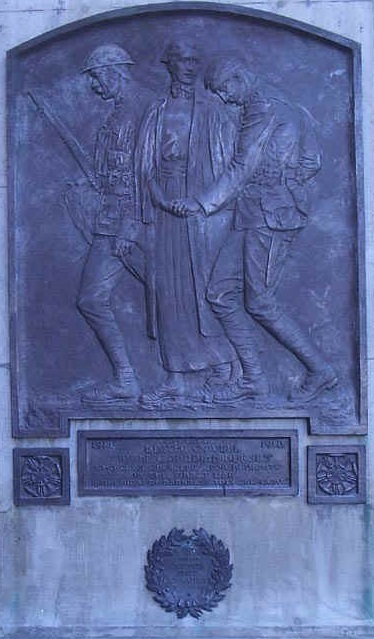 ZP_Toronto sculptor Florence Wyle’s memorial to Nurse Edith Cavell (1865-1915)
.
Brief Sanctuary
.
You from the guns
and I from tending,
made love at an inn;
deep-dusked
in a narrow room
were freed from war,
from fear of our fear,
made of our smooth limbs
our sweet love
sanctuary
each for the other.
In the empty saloon
drank then cool wine
and sang as you
strummed the piano.
When time moved from us
and we must go,
we drew our glasses close
on the bare table,
their shadows one.
Look, we said,
they will stand here
together
when we have gone,
images of ourselves,
witnesses to our love.
As we left
you smiled at me
lifting the latch,
then the bombs came…
*
Behind the Screens
.
Meticulously
I dress your wound
knowing you cannot live.
In ten swift rivers
from my finger-tips
compassion runs
into your pale body
that is so hurt
it is no more
than the keeper
of your being.
Behind these screens,
soldier,
we two are steeped
in a peace deeper
than life gives,
you with closed eyes
and I moving quietly
as though you could wake,
all my senses aware
that your other self
is here,
waiting to begin
life without end.
. . .
Jo Westren, the author of these exquisite poems,
was born in Essex, England, in 1914.
During World War II, she served as a nurse at Colchester Military Hospital.
. . . . .
Joy Kogawa: Where there’s a wall there’s a way…
Posted: November 11, 2011 Filed under: English, Joy Kogawa | Tags: Remembrance Day poems Comments Off on Joy Kogawa: Where there’s a wall there’s a way…
Where there’s a wall
Where there’s a wall
there’s a way through a
gate or door. There’s even
a ladder perhaps and a
sentinel who sometimes sleeps.
There are secret passwords you
can overhear. There are methods
of torture for extracting clues
to maps of underground passages.
There are zeppelins, helicopters,
rockets, bombs, battering rams,
armies with trumpets whose
all at once blast shatters
the foundations.
Where there’s a wall there are
words to whisper by loose bricks,
wailing prayers to utter, birds
to carry messages taped to their feet.
There are letters to be written —
poems even.
Faint as in a dream
is the voice that calls
from the belly
of the wall.
_____
Joy Kogawa was born in Vancouver, British Columbia, in 1935.
This poem is from her 1985 collection, Woman in the Woods.
Kogawa and many other Japanese-Canadians were forcibly removed
from their homes during World War II, and sent to to internment camps
for the duration. Many lost their property and businesses, with no
compensation. This ugly racist chapter in Canadian history – the design of
Mackenzie-King’s government – was brought fully to public attention in the 1980s,
partly through the power of Kogawa’s 1981 novel, Obasan.
À propos du Génocide Rwandais de 1994: Matthieu Gosztola
Posted: November 11, 2011 Filed under: English, French, Matthieu Gosztola, ZP Translator: Alexander Best | Tags: Remembrance Day poems, War poems Comments Off on À propos du Génocide Rwandais de 1994: Matthieu Gosztola
À propos du Génocide Rwandais de 1994:
Poème par Matthieu Gosztola
.
Pourquoi une nouvelle journée
renoncer à s’élancer
les disparus
en parler à voix basse
jusqu’à ce que le sommet
nous rattrape
le « n ous » qu’une personne
a sorti de sa volonté
s’expose à la machette
on a diminué de solitude
on apprend à mesurer notre cri
on fait nos peurs moins sillonnantes
dans tous les sens
devant la mort et ses tracas
au premier jour
on n’avait pas les mêmes lois
on a appris à rebrousser chemin dans nos murmures
et à se contenter sans murmurer de ce qui
ne propose plus de cachette
pardon ………… espérer.
_____
À propos the Rwanda Genocide of 1994:
Poem
by Matthieu Gosztola
.
Why a new day
gives up throbbing
the dead
speak of it in hushed tones
until the ‘crown’ of our head
catches us
the “We” that nobody
‘exited’ of his own will
is right under the ‘machete’
Diminished is one’s solitude
we learn to measure our cries
making our fears less furrowed,
less cross-hatched – in every sense
before death and its troubles
on that first day
we hadn’t the same laws
we taught ourselves to retrace our steps in mutterings,
to be satisfied without complaint over
no more offers of any hiding place
Forgiveness … … … ( is ) … … … to hope.
_____
Matthieu Gosztola (né en France, 1981) est un écrivain et poète.
Ce poème vient de son recueil de 2010, Débris de tuer (Rwanda, 1994).
Rwanda, un pays de l’Afrique de l’Est, est entrée dans une guerre civile
en 1990 et puis, plus de 800,000 Rwandais ont trouvée la mort durant
simplement cent jours entre avril et juillet, 1994.
*
Matthieu Gosztola is a French writer and poet, born in 1981.
This poem is from his 2010 collection, Debris of killing (Rwanda, 1994).
A small country in East Africa with a history of ethnic strife between
Hutus and Tutsis – greatly exacerbated under German then Belgian colonial
rule – tensions built until the stupefying hundred-day massacre of 1994
in which 800,000 people died. Rwanda’s Genocide was the final “slaughter”
in the most violent century known to humankind – the 20th century.
_____
Translation/interpretation from French into English: Alexander Best
Traduction/interprétation en anglais: Alexander Best
_____
 Zócalo Poets