Karibu, Mgeni? / Welcome, Guest?: a Swahili poem about Hospitality
Posted: December 26, 2012 Filed under: English, Swahili Comments Off on Karibu, Mgeni? / Welcome, Guest?: a Swahili poem about Hospitality
ZP_The Flag of Zanzibar
Author Unknown:
A Swahili poem about Hospitality, based on the proverb
Mgeni siku mbili, ya tatu mpe jembe /
If a guest has stayed two days, on the third hand him a hoe
.
Mgeni siku ya kwanza . The first day give the guest
mpe mchele na panza . rice with flying fish
mtilie kifuani . embrace him,
mkaribishe mgeni . introduce him to your family.
Mgeni siku ya pili . The second day
mpe ziwa na samli . give him milk and butter.
mahaba yakizidia . If love can increase
mzidie mgeni. . give more to the guest.
Mgeni siku ya tatu . The third day
jumbani hamuna kitu . there is nothing left
Mna zibaba zitatu . but three bags of rice
pika ule na mgeni . boil it and eat.
Mgeni siku ya nne . The fourth day
mpe jembe akalime . give him a hoe to farm.
Akirudi muagane . When he comes back say
enda kwao mgeni . Goodbye, go home, dear guest.
Mgeni siku ya tano . The fifth day
mwembamba kama sindano . the guest is needle-thin
Hauishi musengenyano . He does not listen to advice,
asengenyao mgeni . the guest is well warned.
Mgeni siku ya sita . The sixth day,
mkila mkajificha . hide in a corner
mwingine vipembeni . while you eat,
afichwaye yeye mgeni . out of sight from the guest.
Mgeni siku ana ya sabaa . The seventh day
si mgeni a na baa . a guest now is a monster
Hatta moto mapaani . and has put fire
akatia yeye mgeni. . to the roof.
Mgeni siku ya nane . The eighth day
njo ndani tuonane . the guest comes in to greet us.
Atapotokea nje . When he comes outside
tuagane mgeni . we take leave.
Mgeni siku ya kenda . The ninth day:
enenda mwana kwenenda! . go now, son, go now
Usirudi nyuma . and don’t come back
usirudi mgeni . don’t return, oh guest.
Mgeni siku ya kumi . The tenth day, chase him away,
kwa mateke na magumi . with kicks and blows.
Hapana afukuzwaye . There is no other such a one
yeye mgeni. . who is chased away this way.
. . .
Hospitality poem: courtesy of Albert Scheven and Dr. Peter Ojiambo, The University of Illinois at Urbana-Champaign.
.
Swahili or Kiswahili is a Bantu language of East Africa spoken by various ethnic groups in several contiguous states. Fewer than 10 million people speak Swahili as their mother tongue but more than 60 million use it as a ‘ lingua franca ‘ for commerce and transnational communication. It is an official language in five countries: Comoros, Democratic Republic of Congo, Kenya, Tanzania and Uganda. Written Swahili once used the Arabic script but now the Latin alphabet is standard. There have been many Swahili dialects; modern Swahili is based on the dialect used in Mji Mkongwe (the name of the old-town quarter in Zanzibar City, Zanzibar, Tanzania).
. . .
Poemas de Navidad: Mary Elizabeth Coleridge y G. K. Chesterton
Posted: December 25, 2012 Filed under: English, G. K. Chesterton, Mary Elizabeth Coleridge, Spanish | Tags: Christmas poems, Poemas de Navidad Comments Off on Poemas de Navidad: Mary Elizabeth Coleridge y G. K. Chesterton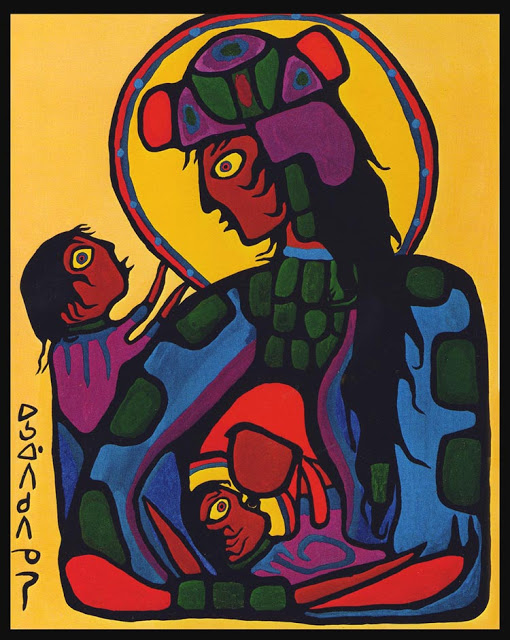
ZP_ᐅᓴᐘᐱᑯᐱᓀᓯ Norval Morrisseau_Virgin Mary with Christ Child and St. John the Baptist, 1973
Mary Elizabeth Coleridge (1861-1907)
“Vi un establo”
.
Vi un estable, tan bajo, desnudo,
Con un niño diminuto al heno.
Le conocieron los bueyes y cuidaron de Él
– al hombre fue un desconocido.
La seguridad del mundo estaba tendido
Allá en el jacal
– el peligro del mundo, también.
. . .
“I saw a stable”
.
I saw a stable, low and very bare,
A little child in a manger.
The oxen knew Him, had Him in their care,
To men He was a stranger.
The safety of the world was lying there,
And the world’s danger.
. . .
G. K. Chesterton (1874-1936)
“The House of Christmas”
.
There fared a mother driven forth
Out of an inn to roam;
In the place where she was homeless
All men are at home.
The crazy stable close at hand,
With shaking timber and shifting sand,
Grew a stronger thing to abide and stand
Than the square stones of Rome.
.
For men are homesick in their homes,
And strangers under the sun,
And they lay their heads in a foreign land
Whenever the day is done.
Here we have battle and blazing eyes,
And chance and honour and high surprise;
But our homes are under miraculous skies
Where the Yule tale was begun.
.
A child in a foul stable,
Where the beasts feed and foam;
Only where He was homeless
Are you and I at home;
We have hands that fashion and heads that know,
Bur our hearts we lost – how long ago! –
In a place no chart nor ship can show
Under the sky’s dome.
.
This world is wild as an old wives’ tale,
And strange the plain things are,
The earth is enough and the air is enough
For our wonder and our war;
But our rest is as far as the fire-drake swings
Where clashed and thundered unthinkable wings
Round an incredible star.
.
To an open house in the evening
Home shall men come,
To an older place than Eden
And a taller town than Rome;
To the end of the way of the wandering star,
To the things that cannot be and that are,
To the place where God was homeless
And all men are at home.
. . . . .
Luke 2: 1-14: “Di Gud Nyuuz bout Jiizas”: El nacimiento de Jesús en la prosa poética de La Biblia / Jesus’ birth in the poetic prose of Renaissance Spanish and English Bibles + Wycliffe(1395), Haitian Creole and Jamaican Patois
Posted: December 25, 2012 Filed under: Creole / Kréyòl, English, English: Jamaican Patois, English: Middle English, Spanish Comments Off on Luke 2: 1-14: “Di Gud Nyuuz bout Jiizas”: El nacimiento de Jesús en la prosa poética de La Biblia / Jesus’ birth in the poetic prose of Renaissance Spanish and English Bibles + Wycliffe(1395), Haitian Creole and Jamaican Patois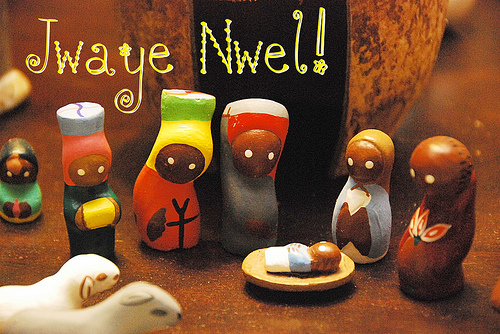
ZP_A toy Nativity scene with a coconut shell as the stable, from Haiti. Jwaye Noel means Merry Christmas in Haitian Creole._Jwaye Nwel dice Feliz Navidad en el idioma criollo haitiano.
Un fino ejemplo de la prosa poética de La Biblia en su Antigua Versión de Casidoro de Reina (1569) con revisiones por Cipriano de Valera (1602):
Luca 2: 1-14:
“ Aconteció en aquellos días que salió un edicto de parte de César Augusto, para levantar un censo de todo el mundo habitado. Este primer censo se realizó mientras Cirenio era gobernador de Siria. Todos iban para inscribirse en el censo, cada uno a su ciudad. Entonces José también subió desde Galilea, de la ciudad de Nazaret, a Judea, a la ciudad de David que se llama Belén, porque él era de la casa y de la familia de David, para inscribirse con María, su esposa, quien estaba encinta. Aconteció que, mientras ellos estaban allí, se cumplieron los días de su alumbramiento, y dio a luz a su hijo primogénito. Le envolvió en pañales, y le acostó en un pesebre, porque no había lugar para ellos en el mesón. Había pastores en aquella región, que velaban y guardaban las vigilias de la noche sobre su rebaño. Y un ángel del Señor se presentó ante ellos, y la gloria del Señor los rodeó de resplandor; y temieron con gran temor. Pero el ángel les dijo: No temáis, porque he aquí os doy buenas nuevas de gran gozo, que será para todo el pueblo: que hoy, en la ciudad de David, os ha nacido un Salvador, que es Cristo el Señor. Y esto os servirá de señal: Hallaréis al niño envuelto en pañales y acostado en un pesebre.
De repente apareció con el ángel una multitud de las huestes celestiales, que alababan a Dios y decían: ¡Gloria a Dios en las alturas, y en la tierra paz entre los hombres de buena voluntad! ”
. . .
Y en el inglés del tiempo de Shakespeare, de la versión del rey Jacobo (1611):
A fine example of the poetic prose of The King James Version (1611) of The Bible:
Luke 2: 1-14:
“And it came to pass in those days, that there went out a decree from Caesar Augustus, that all the world should be taxed. And this taxing was first made when Cyrenius was governor of Syria. And all went to be taxed, every one into his own city. And Joseph also went up from Galilee, out of the city of Nazareth, into Judaea, unto the city of David, which is called Bethlehem; because he was of the house and lineage of David: to be taxed with Mary his espoused wife, being great with child. And so it was, that, while they were there, the days were accomplished that she should be delivered. And she brought forth her firstborn son, and wrapped him in swaddling clothes, and laid him in a manger; because there was no room for them in the inn. And there were in the same country shepherds abiding in the field, keeping watch over their flock by night. And lo, the angel of the Lord came upon them, and the glory of the Lord shone round about them: and they were sore afraid. And the angel said unto them: Fear not, for behold, I bring you good tidings of great joy, which shall be to all people. For unto you is born this day in the city of David a Saviour, which is Christ the Lord. And this shall be a sign unto you; Ye shall find the babe wrapped in swaddling clothes, lying in a manger.
And suddenly there was with the angel a multitude of the heavenly host praising God, and saying: Glory to God in the highest, and on earth peace and good will toward men.”
. . .
Y en el ‘inglés medio’de dos siglos antes de la versión del rey Jacobo, de la Biblia de John Wycliffe (1395):
And, from The Wycliffe Bible, two centuries earlier (1395) – in ‘Middle English’:
Luke 2: 1-14:
“ And it was don in tho daies, a maundement wente out fro the emperour August, that al the world schulde be discryued. This firste discryuyng was maad of Cyryn, iustice of Sirie. And alle men wenten to make professioun, ech in to his owne citee. And Joseph wente vp fro Galilee, fro the citee Nazareth, in to Judee, in to a citee of Dauid, that is clepid Bethleem, for that he was of the hous and of the meyne of Dauid, that he schulde knouleche with Marie, his wijf, that was weddid to hym, and was greet with child. And it was don, while thei weren there, the daies weren fulfillid, that sche schulde bere child. And sche bare hir first borun sone, and wlappide hym in clothis, and leide hym in a cratche, for ther was no place to hym in no chaumbir. And scheepherdis weren in the same cuntre, wakynge and kepynge the watchis of the nyyt on her flok. And lo! the aungel of the Lord stood bisidis hem, and the cleernesse of God schinede aboute hem; and thei dredden with greet drede. And the aungel seide to hem, Nyle ye drede; for lo! Y preche to you a greet ioye, that schal be to al puple. For a sauyoure is borun to dai to you, that is Crist the Lord, in the citee of Dauid. And this is a tokene to you; ye schulen fynde a yong child wlappid in clothis, and leid in a cratche.
And sudenli ther was maad with the aungel a multitude of heuenli knyythod, heriynge God, and seiynge, Glorie be in the hiyeste thingis to God, and in erthe pees be to men of good wille. “
. . .
En Kréyòl ayisyen / In Haitian Creole / en el idioma de criollo haitiano:
Lik 2: 1-14:
Lè sa a, Seza Ogis te bay lòd pou yo te konte dènye moun ki nan peyi l’ap gouvènen yo.
Premye travay sa a te fèt nan tan Kireniyis t’ap kòmande nan peyi yo rele Siri a.
Tout moun te al fè pran non yo nan lavil kote fanmi yo te soti.
Jozèf te rete nan peyi Galile, nan yon bouk yo rele Nazarèt. Men, paske li te moun nan fanmi ak ras David, li moute, li ale nan Jide, nan lavil David yo rele Betleyèm lan.
Jozèf tapral fè yo pran non l’ ansanm ak non Mari, fiyanse li, ki te ansent.
Antan yo te la, jou pou Mari te akouche a rive.
Li fè premye pitit li a, yon ti gason. Mari vlope pitit la nan kouchèt, li mete l’ kouche nan yon kay kote yo bay bèt manje, paske pa t’ gen plas pou yo nan lotèl la.
Nan menm zòn sa a, te gen gadò mouton ki t’ap pase nwit la deyò ap veye mouton yo.
Lè sa a, yon zanj Bondye parèt devan yo, bèl limyè Bondye a klere tout kote yo te ye a. Yo te pè anpil.
Men zanj lan di yo konsa: Pa pè. N’ap anonse nou yon bon nouvèl ki pral fè tout pèp la kontan anpil.
Jòdi a, nan lavil David la, nou gen yon Sovè ki fenk fèt: se Kris la, Seyè a.
Men remak ki va fè nou rekonèt li: n’a jwenn yon tibebe vlope nan kouchèt, kouche nan yon kay kote yo bay bèt manje.
Menm lè a, yon foul lòt zanj nan syèl la vin jwenn zanj lan; yo t’ap fè lwanj Bondye, yo t’ap di konsa:
Lwanj pou Bondye anwo nan syèl la, kè poze sou latè pou tout moun li renmen.
. . .
And…in Jamaican Patois:
Luuk 2: 1-14:
1 Iina dem die de, di Ruoman ruula, Siiza Agostos, gi aada fi rait dong di niem a evribadi iina im kindom. 2 (Dis a di fos taim niem a rait dong sins di taim wen Kiriniyos did a ruul uova Siriya.) 3 Aal im piipl dem did afi go a di toun we dem baan fi get dem niem rait dong, so di govament kyan taks dem.
4 So kaaz Juozif did kom fram Dievid fambili an Dievid did baan iina Judiya, im did afi lef fram Nazaret iina Gyalalii an go a Betliyem iina Judiya. 5 Juozif go de wid Mieri fi get dem niem rait dong. Di tuu a dem did ingiej fi marid dem wan aneda an shi did av biebi iina beli. 6 Wen dem de de, Mieri tek iin fi av biebi, 7 an shi av ar fos pikni, wan bwai. Shi rap im op iina biebi blangkit an put im iina di baks we di animal dem nyam outa, kaaz no spies neva iina di ges ous fi dem.
8 Da nait de, som shepad did a luk aafa dem shiip iina wan fiil, nier we Mieri dem did de. 9 Wan a di Laad ienjel dem kom tu di shepad dem. Wan brait brait lait fram Gad kova dem an it mek dem fraitn so til. 10 So di ienjel tel dem se, “No fried! Mi av gud nyuuz fi unu. Nyuuz we ago mek evribadi api. 11 Di wan we ago siev unu baan tide iina di toun we Dievid kom fram. Im a Krais, di Laad. 12 Mi ago tel unu wa unu ago si, so wen unu si dat unu ago nuo se a im. Unu ago si wan biebi rap op iina wan biebi blangkit an a lidong iina di baks we di animal dem nyam outa.”
13 Aal av a sodn uol iip a ienjel fram evn, jain im. Dem did a priez di Laad an se, 14 “Priez Gad we de a evn, an piis fi evribadi we Gad api wid.”
. . . . .
Roch Carrier’s “Le chandail de hockey” / “The hockey sweater”: Canada’s Ol’ Time Religion
Posted: December 25, 2012 Filed under: English, French Comments Off on Roch Carrier’s “Le chandail de hockey” / “The hockey sweater”: Canada’s Ol’ Time Religion.
Religious fanaticism is rare in Canada, except for our devotion to the ice-hot God of Hockey – most especially for boys (and even girls) who grew up in Ontario and Québec. Fans of NHL games have soured on the sport as a “professional” manifestation, what with a decade of crassly-deliberate violence on the ice, not to mention the current “lock-out” making 2012-2013 a lost season. But the game itself, played by amateurs lucky enough to be skating on an outdoor rink, perhaps even under a starry sky, remains crisp, clear, good fun.
It’s Christmas Day…so we present to our readers the first page of Roch Carrier’s classic 1979 children’s story, The Hockey Sweater, here translated from French into English by Sheila Fischman:
“
The winters of my childhood were long, long seasons. We lived in three places – the school, the church, and the skating-rink – but our real life was on the skating-rink. Real battles were won on the rink, real strength appeared on the rink. The real leaders showed themselves on the skating-rink.
.
School was a sort of punishment. Parents always want to punish their children and school is their most natural way of punishing us. However, school was also a quiet place where we could prepare for the next hockey game, lay out our next strategies.
.
As for church, we found there the tranquility of God: there we forgot school and dreamed about the next hockey game. Through our daydreams it might happen that we would recite a prayer: we would ask God to help us play as well as Maurice Richard *…
“

ZP_Zócalo Poets’ editor laces up for a go-round the rink…
Carrier’s first page in its original French:
Les hivers de mon enfance étaient des saisons longues, longues. Nous vivions en trois lieux : l’école, l’église et la patinoire : mais la vraie vie était sur la patinoire. Les vrais combats se gagnaient sur la patinoire. La vraie force apparaissait sur la patinoire. Les vrais chefs se manifestaient sur la patinoire.
.
L’école était une sorte de punition. Les parents ont toujours envie de punir les enfants et l’école était leur façon la plus naturelle de nous punir. De plus, l’école était un endroit tranquille où l’on pouvait préparer les prochaines parties de hockey, dessiner les prochaines stratégies.
.
Quant à l’église, nous trouvions là le repos de Dieu : on y oubliait l’école et l’on rêvait à la prochaine partie de hockey. A travers nos rêveries, il nous arrivait de réciter une prière : c’était pour demander à Dieu de nous aider à jouer aussi bien que Maurice Richard…
. . .
* Maurice ‘ The Rocket ‘ Richard (born Montréal, Québec, 1921-2000) was one of the early stars of professional hockey, playing for the Montréal Canadiens (The Habs) between 1942 and 1960. He was the first to score fifty goals in fifty games, and did so during the 1944-45 NHL season.
. . . . .
Nawāz, Forughi, ’Attār: Three Sufi poets translated from Persian into English
Posted: December 23, 2012 Filed under: English Comments Off on Nawāz, Forughi, ’Attār: Three Sufi poets translated from Persian into English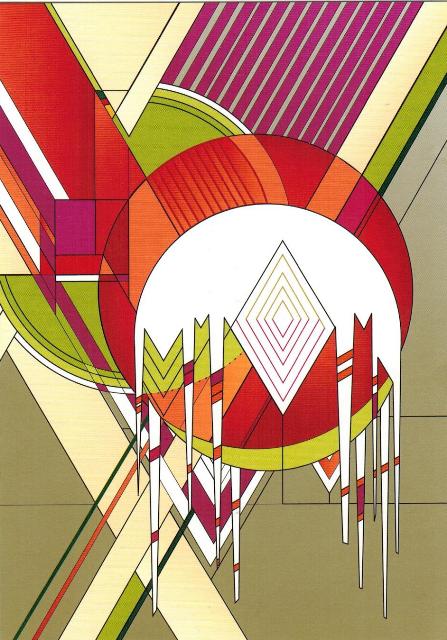
ZP_Frozen Spheres by Frank Lloyd Wright, 1927
Gharib Nawāz (born 1142?, died 1236)
“Make Way for the King!”
.
From spacelessness Love descends to lover’s heart;
So sweep yourself up for the King of the world
descends to this dust heap
and the soul becomes as flesh
when the Soul of soul plunges into the soul
– and why not?
If treasure is dug in ruins why not love in your heart?
Get out of the doorway!
The King of Love approaches the house:
.
All you nobodies – OUT!
The guardian of those who have no-one
approaches the house and
once the house is vacant of others
the mercy will descend…
.
A King is lurking in my closet
but the whole world cannot contain him.
Once he gets here both worlds will implode into dust
and atoms –
for he descends no where but
Nowhere.
.
What is the heart?
The hawk of
High Holy Heaven.
How can it bear to nest in the
Herebelow?
.
Mo’in*
is dust on the stoop…
Where else would you expect to find him?
.
*Mo’in is the poet’s pen-name.
. . .
Abbas Forughi Bastāmi (1798-1857)
“Lover’s Craft”
.
Again and again I polished my eye – now look:
it’s become such a mirror that with a single glance
I can make you fall in love with yourself. Now look,
look deep into this glass and be aware
of other worlds.
. Now like a drunken reveler
pass by the monastery and the mosque:
you will be worshiped as the niche for prayer
by Muslim and Christian alike.
Some night I’ll strip the veil from your face
and you’ll become Sun of the Kaaba,
Moon of the Church.
. If your braided tresses fell
In my hands I could forge a thousand chains for your feet;
if they gave me the Trees of Paradise on Judgement Day
I’d trade them both to ransom
one rare embrace.
.
In Love’s atelier my craftsmanship
reaches an unearthly beauty when
I contemplate your face.
. The whole world knows
I am a reprobate in love – but God forbid
I ruin your reputation as well, my love.
. . .
Faridoddin ’Attār (died around 1230)
“The Dullard Sage”
.
Lost in myself
…I reappeared
……I know not where
a drop that rose
…from the sea and fell
……and dissolved again;
a shadow
…that stretched itself out
……at dawn,
when the sun
…reached noon
……I disappeared.
I have no news
…of my coming
……or passing away –
the whole thing
…happened quicker
……than a breath;
ask no questions
…of the moth.
……In the candle flame
of his face
…I have forgotten
……all the answers.
In the way of love
…there must be knowledge
……and ignorance
so I have become
…both a dullard
……and a sage;
one must be
…an eye and yet
……not see
so I am blind
…and yet I still
……perceive.
Dust
…be on my head
……if I can say
where I
…in bewilderment
……have wandered:
’Attār
…watched his heart
……transcend both worlds
and under its shadow
…now is gone mad
……with love.
.
Translations from Persian into English:
© Peter Lamborn Wilson and Nasrollah Pourjavady
– in their anthology of Persian Sufi Poetry entitled “The Drunken Universe”
. . .
From the Authors’ Introduction:
“Of all the strands of thought, tradition, and belief that make up the Islamic universe, Sufism in its doctrinal aspect stands out as the most intact, the most purely Islamic: the central strand. Opponents of Sufism often charge it with having originated outside Islam, but a close study of the various schools of philosophy and theology, and a comparison with “primordial” Islam as revealed in the Qu’ran and hadith (authentic sayings of the Prophet Mohammad), will vindicate the Sufis’ claim of centrality, of strict adherence to the original purity of the Revelation. … Sufism – always insisting on a return to the sources of the Tradition – can be seen to have functioned at times as a positive and healthy reaction to the overly rational activity of the philosophers and theologians. For the Sufis, the road to spiritual knowledge – to Certainty – could never be confined to the process of rational or purely intellectual activity, without sapiential knowledge (zawq or “taste”) and the direct, immediate experience of the Heart…”
. . . . .
Un breve poema – “antes del Fin” / A brief poem – “before The End”
Posted: December 20, 2012 Filed under: English, Langston Hughes, Spanish Comments Off on Un breve poema – “antes del Fin” / A brief poem – “before The End”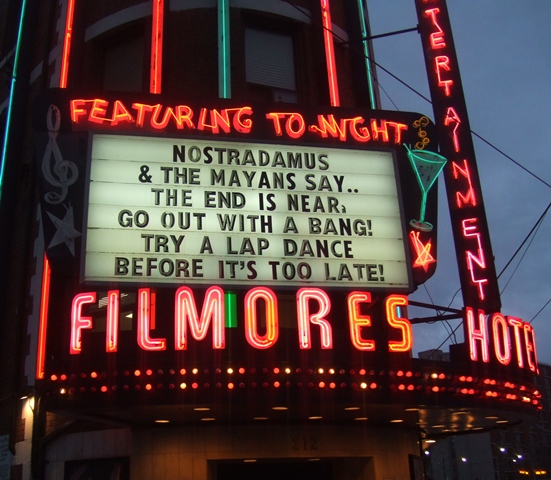
ZP_Dicen Nostradamus y los Mayas que Nos Acerca El Fin. Sal con un gran pum. Disfrútate con un baile erótico del regazo, antes de que esté demasiado tarde…Sunset, December 20th 2012_Marquee of a Striptease Tavern in Toronto, Canada_A light touch concerning the gravitas of 21.12.2012 !
A veces es el trabajo del Poeta impartirnos una lección para la Vida. Y quizás no nos queden bastante Tiempo hoy día para comprender esa lección – si tengan razón los comentarios recientes de unos intérpretes históricos- histéricos sobre la “profecía” maya – que es, en realidad, unas inscripciones en piedra –“ la cuenta larga”– que se tratan del fin de una época en el sistema-calendario de los mayas – y no del fin del mundo. Pero…SI mañana, el 21 de diciembre, aun sea El Fin – o si sea el primer día de un nuevo ciclo – todavía es agradable cuando nos aconseja El Poeta…Presentamos un breve poema por Langston Hughes…
.
“Consejo”
.
Mi gente, les digo a ustedes:
Son hechos puros y duros
el nacimiento y la muerte –
Pues, tomen el Amor
¡y tómenlo fuerte!
. . .
We present our readers with One Brief Poem – in case tomorrow is The End-Time and not just the start of the next epoch inscribed in the magnificent old Mayan stone calendar that has been much in the news of late…
.
Langston Hughes (1902-1967)
“Advice”
.
Folks, I’m telling you,
Birthing is hard
And dying is mean –
So get yourself
A little loving
In between.
. . . . .
金子 みすゞ Kaneko Misuzu: We’re all different, but we’re all good… / Tutti diversi, tutti ugualmente giusti…
Posted: December 19, 2012 Filed under: English, Italian, Japanese, Kaneko Misuzu Comments Off on 金子 みすゞ Kaneko Misuzu: We’re all different, but we’re all good… / Tutti diversi, tutti ugualmente giusti…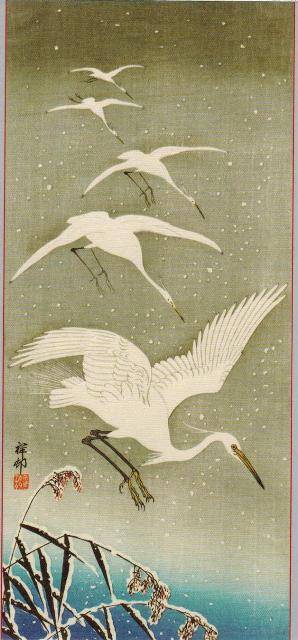
ZP_Five Egrets Descending in Snow_Japanese woodblock print by Ohara Koson,1878-1945
Kaneko Misuzu (Japanese poetess, 1903-1930)
“Me, the little bird, and the bell”
.
私が両手をひろげても、(watashi ga ryōte wo hirogete mo)
お空はちっとも飛べないが、(osora wa chitto mo tobenai ga)
飛べる小鳥は私のように、 (toberu kotori ha watashi yō ni)
地面を速く走れない。 (jimen wo hayaku hashirenai)
.
私が体をゆすっても、 (watashi ga karada wo yusutte mo)
きれいな音はでないけど、 (kirei na oto wa denai kedo)
あの鳴る鈴は私のように、 (anonaru suzu wa watashi no yō ni)
たくさんな唄は知らないよ。 (takusan na uta wa shiranai yo)
.
鈴と、小鳥と、それから私、 (suzu to kotori to sorekara watashi)
みんなちがって、みんないい。 (minna chigatte, minna ii)
. . .
Even if I stretch out my arms
I can’t fly up into the sky,
But the little bird who can fly
Cannot run fast along the ground like me.
.
Even if I shake my body,
No beautiful sound comes out,
But the ringing bell does not
Know many songs like me.
.
The bell, the little bird and, finally, me:
We’re all different, but we’re all good.
.
A big Thank-You to Doug for his translation from Japanese to English!
. . .
Kaneko Misuzu (Poetessa giapponese, 1903-1930)
“Io, l’uccellino e la campanella”
.
Per quanto io allarghi le braccia,
non potrò mai volare in cielo, ma
l’uccellino che può, come me
non saprà correre veloce sulla terra.
.
Per quanto io scuota il corpo,
non ne uscirà un bel suono, ma
quella campanella che risuona, come me
non saprà mai tante canzoni.
.
La campanella, l’uccellino ed io,
Tutti diversi, tutti ugualmente giusti.
.
Traduzione di Radicchio – Grazie!
. . .
Kaneko Misuzu
“Piled-Up Snow”
Two markedly-different translations from Japanese into English:
Special Thanks to Henry Stokeley and Cha
.
積もった雪
.
上の雪 寒かろな
冷たい月がさしていて
下の雪 重かろな
何百人ものせていて
中の雪 さみしかろうな
そらもじべたも見えないで
. . .
Above the snow it’s cold,
the icy moon shines from it.
Below the snow it’s heavy,
not a hundred men could lift it.
In the snow it’s so lonely,
neither the sky nor the bare earth are seen.
. . .
Top layer of snow – you must be shivering
under the frosty light of the moon.
Bottom layer – you must feel so heavy
under the weight of hundreds of human beings.
Middle layer – you must be lonely;
you can see neither sky nor earth.
. . .
Kaneko Misuzu
“To Love Everything”
(translated from Japanese by Alex Fyffe)
.
I wish I could love them,
Anything and everything.
.
Onions, tomatoes, fish,
I wish I could love them all.
.
Side dishes, and everything.
Because Mother made them.
.
I wish I could love them,
Anyone and everyone.
.
Doctors, and crows,
I wish I could love them all.
.
Everyone in the whole world
– Because God made them.
.
わたしはすきになりたいな、
何でもかんでもみいんな.
.
ねぎも、トマトも、おさかなも、
のこらずすきになりたいな.
.
うちのおかずは、みいんな。
おかあさまがおつくりになったもの.
.
わたしはすきになりたいな、
だれでもかれでもみいんな.
.
お医者さんでも、からすでも、
のこらずすきになりたいな.
.
世界のものはみイ んな、
神さまがおつくりになったもの.
. . . . .
Winter Poems: a letter from Sapporo, a nineteen-year-old’s suicide note, the metaphysics of a split-rail fence…
Posted: December 19, 2012 Filed under: English Comments Off on Winter Poems: a letter from Sapporo, a nineteen-year-old’s suicide note, the metaphysics of a split-rail fence…
ZP_Pheasant on a snowy bank_Anonymous, Japanese_ colour woodcut_around 1900
Shinji Watanabe
Three poems from his collection “Spell of a Bird”
.
“Letter from my Sister”
.
It’s almost winter in Sapporo;
the first snow this year has snowed for three days
and seems deep enough to cover the ground until next spring;
it’s past nine o’clock and the trees in the outside are dark
and white enough to scare me, for Hiroshi-san has not yet come
home and I’m afraid the dishes won’t taste good with a warm-up
once they are cold; Keisuke was hit with snowballs by his friends and
never stopped crying even after he went to bed; he has skipped
his supper; he will have to go to kindergarten next spring.
86-09-20 WATER 3,660 *154,886
86-09-25 TELEPHONE 5,360 *149,526
86-10-04 ELECTRICITY 6,210 *143,316
86-10-17 GAS 6,601 *136,715
.
I have nothing to do now in the kitchen and sit near Keisuke’s futon to see
him sleeping and I remember those days we lived near Maruyama Park and
enjoyed playing cards until late with coals burning in a red stove; our
faces seemed burning too and there was a lot of fun and we had a lot of
time and Hiroshi-san made us laugh with his jokes, though I now doubt that
it was really followed by a promising future.
I’m sorry,
but once fun, then a burden,
nothing would come from the burden and I hate thinking we shared the fun
those days only to bear a burden later.
To tell the truth, Hiroshi-san was
fired from the factory this summer and is still out of work and I feel
uneasy every time I buy a can of kerosene though it costs no more than half
of last winter’s price. No, it’s not the money, you know, as the life and
world is such and such, and I can manage anyway to live and eat and I have
some savings in the bank and he gets money from unemployment insurance,
though I know the fact that I actually manage may rather make our poverty
of the mind poorer and poorer.
To get back those cheerful days, we should
have been better losing such small savings; no, I ask myself, what’s that
to get them back, and never try, can’t try, just like the cold water from
the spout, you bet; next February Keisuke is going to be on for the second
operation, as he has been passed down to the disease beyond me and yet
through me, and his breathing in sleep gives me lots of torture, though I’m
sure I’ve known such a thing, but I almost gave up and got rid of him
twice: in pregnancy and in delivery and it was not at all for love’s sake;
I couldn’t accept the same deformity with me, but the third time would
never happen to me, because I couldn’t anyway ignore anything related to
me; all the things from a 1,000 yen bill to a life should be possessed by
someone or anyone as far as they are in the world, I know, and I see water
drops flow down on the whitely clouded windowpane and I hear an old
familiar song which comes from dark and far trees:
Sleep in sound and peace,
and you are a precious baby I love
yes, I love Keisuke
When you wake and cry, Nen-kororo,
I hate you, bad baby,
Sleep in sound and peace, Nen-kororo,
yes, I hate him, too.
Oh, it still snows…
I, the person who was called “you” by you, called back to you with what I
had in my hands, just as taking after what father and mother had done, for
a short space and time permitted to us as life, and we, in dreaming a
bright and quiet life, set a permanent family register and built a home
here.
No.116, Patient No.00-6628-0 PEDIATRICS O-41
86/8/1–86/8/14 Medications 6,500 Injections
2,260 Operations 1,860 Laboratory 4,930 Meals
& Hospitality 42,000 Papers 2,000 Total Charges
59,550 yen……. ……..
.
Now out of this window, father, mother, we, or white illusions, go upward
and fluctuate in pursuit of something and there joins the image of Keisuke;
perhaps it is that forest of ours, though I have never seen it, and it is
always under the snow and it passes every relationship of the world and
makes the ancient fire up to tell about the murmur of life to those who
would like to listen,
and I’d like to believe I may share a piece of that fire, yes,
I’d like to, for it might make me shine
like a tree covered with ice,
and then get me back into that forest
when my permitted space and time is over,
and I’d like to pray that with the mind and belief
I may sing that lullaby
to soothe and lull myself
and to pour the water into pots
and light the gas to cook.
. . .
“A Bird on an Invisible Branch”
.
A human being has a piece of life
so that it may die at the end.
That is not all; goes over to America,
to a warm down-filled jacket,
or buys a 75-cent coffee at Mac,
waiting for the AAA one cold night
when the car breaks down,
and I think not of the coldness or the broken car
but of a woman.
.
A human being can love
so that it has its own blessing.
That is not all; goes around with uneasy heart,
a letter from Japan; it happened on the same day
that someone threw her body into the winter sky
at Kodaira, the northern town of Tokyo;
she left no letter – actually, her parents burnt it.
.
Dear Father and Mother,
please excuse me for passing away earlier than you.
I don’t think you will understand, but I came to hate keeping my mind numb
with the medicine. The doctor regards me as nothing but a precious spot
for his chemical reaction. I can’t believe the intake of ‘amine’ saves my
life. What a terrible name tate manic-depressive is. I kept myself away
from that compound, and since then I’ve been clear in mind.
And a voice comes to me, and calls me.
I am the sky, according to the origin of its name, the
shadow of the clouds, the vanity of the vanity, the empty sky.
I was asked, Could I have you just as a piece of redemption?
So I will go to the sky. The blue sky, the sky at night, the sky with stars,
and the dimly lighted sky.
It’s my great pleasure to be accepted, just as a piece of redemption.
It’s not worth recording how I have lived for these nineteen years
without any special worries or burdens.
Everybody, everything will die.
The earth will die. The sun will also die.
After the sun’s death,
there will remain the sky:
cotton-like cloudy bright dark clear and blue.
Just think it’s my letter
whenever cloud, rain, snow and sleet come down to you,
for I cannot resurrect.
.
Father, don’t be angry; please return to the sky what belongs to the sky.
Mother, don’t be sad; please put my body into the fire,
Like I did with my letters and diary.
Thank you. It was a very short period but it seems to me
I had a pleasant time with you.
Good bye.
– Your daughter, Kaori
. . .
“Split Rail”
.
Do you know the beauty of a split rail in the field
which, with snow slightly and slantly on its
black body, almost falls into the white ground
to lose its original function as the boundary?
.
After enjoying its beauty for a while,
Uncle Frost would mend it with his neighbour
in the viewpoint of morality; though their footprints
couldn’t be the rabbit-like trails which make the scene
.
beautiful. And what would you do, who also stand and
smell like a human being? I’m not the owner of either
property divided by the split rail, I just wonder what colour
the split rail actually has, for a close look tells it’s not
.
black, brown, or snowburnt. The sunlight
makes it look like the animated back of the
ancient tree that died a buried death before
a human being happened to divide the earth.
.
It should be wood and yet seems and smells like
a piece of earth. I can’t help saying it’s the colour of
the post fence itself, or it’s a piece of the light
invisible and intangible with my human vision;
I wish I could appear not as a piece of the human being
but as another piece of the light, or a gift of the sun.
. . . . .
Lolo at ang magandang Parol: tula ni Pepito/Huseng Batute
Posted: December 19, 2012 Filed under: English, Huseng Batute (José Corazón de Jesús), Tagalog / Filipino, ZP Translator: Carmelo Gorospe | Tags: Filipino Christmas poems, Tula sa Pasko Comments Off on Lolo at ang magandang Parol: tula ni Pepito/Huseng Batute
ZP_Parol Painting by Rafael Luna
José Corazón de Jesús (Huseng Batute) 1896-1932
“Ang Magandang Parol” (1928)
.
Isang papel itong ginawa ng lolo
may pula, may asul, may buntot sa dulo;
sa tuwing darating ang masayang Pasko
ang parol na ito’y makikita ninyo.
.
Sa aming bintana doon nakasabit
kung hipan ng hangi’y tatagi-tagilid,
at parang tao ring bago na ang bihis
at sinasalubong ang Paskong malamig.
.
Kung kami’y tutungo doon sa simbahan
ang parol ang aming siyang tagatanglaw,
at kung gabi namang malabo ang buwan
sa tapat ng parol doon ang laruan.
.
Kung aking hudyatin tanang kalaguyo,
mga kapwa bata ng pahat kong kuro,
ang aming hudyatan ay mapaghuhulo:
“Sa tapat ng lolo tayo maglalaro.”
.
Kaya nang mamatay ang lolo kong yaon,
sa bawat paghihip ng amihang simoy,
iyang nakasabit na naiwang parol
nariyan ang diwa noong aming ingkong.
.
Nasa kanyang kulay ang magandang nasa,
nasa kanyang ilaw ang dakilang diwa,
parang sinasabi ng isang matanda:
“Kung wala man ako’y tanglawan ang bata.”
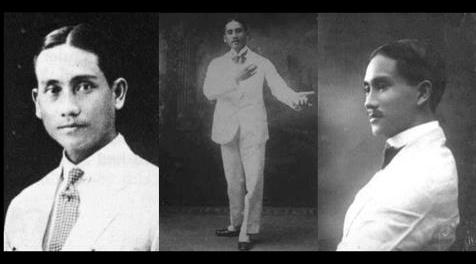
ZP_José Corazón de Jesús_Huseng Batute_1896-1932
“The Beautiful Parol (Christmas Lantern)”:
a translation/interpretation by Carmelo Gorospe, with Alexander Best
.
There was this one special kind of paper that Grandpa used,
and the Parol could be red or blue, and sometimes with a tail, too.
And now, every time Pasko (Christmas) comes around,
the Parol lantern can be found.
In every other window you’ll see one hanging,
and the wind blows it this way and that,
and each Parol is like a person with a new look that welcomes chilly Christmas!
On our way to church the Parol’s light was our guide in the darkness,
and when the moon might go behind a cloud, well,
the kids played beneath the Parol’s glow.
Whenever I give the sign to my friends, they remember, like all the kids did,
playing in front of Grandpa’s lantern light.
And, ever since he passed away…of course, each time a cool wind blows,
and the Parol sways,
it reminds me of him.
In Grandpa’s colours – such beautiful wishes.
In Grandpa’s light – such beautiful memories, as if saying:
“Though I’m no longer here, my Light will guide you, little ones!”
. . . . .
A Filipino Christmas: The Rooster’s Mass
Posted: December 19, 2012 Filed under: Cebuano, English | Tags: Filipino Christmas poems, Tula sa Pasko Comments Off on A Filipino Christmas: The Rooster’s Mass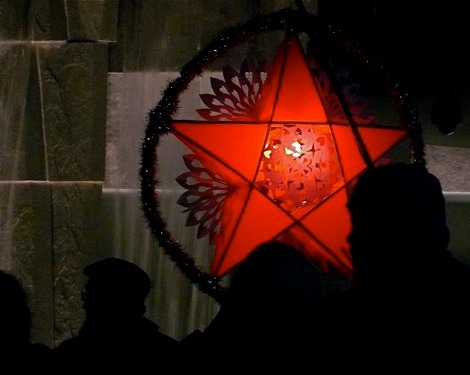
ZP_At the Parol Lantern Festival in San Francisco, California_December 2012
We wish to thank Noemi Lardizabal Dado for the following Simbang Gabi poem written by her sister.
.
Three thirty in the morning.
Wake up, he said. Let’s go.
.
Bells tolling
in the distance,
calling us.
.
Walking briskly
in the dark
With my chattering sisters
and brothers,
shivering,
I pulled my coat close to me
against the chilly air.
.
Four a.m.
Struggling to keep my eyes open
in a church
smelling of candles,
packed with people
praying fervently
in Cebuano.
.
This is torture, I thought. Let this be over soon.
Sacrifice, my father whispered. Preparing for Jesus’s birth.
.
The choir’s voices
swelled into song:
“Kasadya ning Taknaa…”
.
At the parish hall door,
Handing out brown bags
of pan de sal
my mother had baked
to a jostling crowd
of the poor outside
who smelled of sweat and dust.
.
Smiles from my neighbours inside,
Sipping steaming cups of tsokolate
Munching sweet bread
Amid red and green parols
swaying by the windows.
I sighed: Soon it will be Christmas.

ZP_December 2012_At the Parol Lantern Festival in San Francisco, California
Glossary:
Cebuano: an Austronesian language, second most widely spoken in the Philippines after Tagalog. It is one of the languages spoken by the Bisnaya ethnic group.
.
“Kasadya ning Taknaa”: “Oh, happy is this hour!” This is the first line of a Cebuano Christmas carol composed in 1933 by Vicente Rubi and Mariano Vestil. Our gratitude to Karlo Antonio G. David for his translation of this belovéd song:
Oh, happy is this hour!
In this place nearest to the Holy
where all that we witness
are faces brightened up and jolly.
Blessed indeed, how blessed
are the houses serenaded
with songs of noble sound and word,
and every Christmas day
will be full of bliss!
(Chorus):
With the New Year
is a new life to live!
Together with all our wishes and hopes,
Come let us sing them, oh come let us hum them
to fill our hearts with bliss!
. . .
Cebuano original:
“Kasadya ning Taknaa”:
Kasadya ning taknaa
Dapit sa kahimayaan
Mao’y atong makita
Ang panagway nga masanglagon
Bulahan ug bulahan
Ang tagbalay nga giawitan
Awit nga halangdonon ug sa tanang Pasko
Magmalipayon!
(Chorus):
Bag-ong tuig
Bag-ong kinabuhi
Duyog sa atong mga pagbati
Atong awiton, ug atong laylayon
Aron magmalipayon!
.
Pan de sal: literally, bread of salt, from the Spanish. A basic yet flavourful and filling Filipino bread
Tsokolate: hot chocolate
Parols: from the Spanish word farol meaning lantern or lamp. Parols are Filipino Christmas lanterns which used to be made of bamboo and rice paper and are now made of every material imaginable. They symbolize the Star of Bethlehem that guided the Three Wise Men to the newborn Jesus. Their broader meaning is that Light triumphs over Darkness.
. . . . .
 Zócalo Poets