Hari Malagayo Alluri: “eyes beat heart wide…”
Posted: July 11, 2012 Filed under: English, Hari Malagayo Alluri Comments Off on Hari Malagayo Alluri: “eyes beat heart wide…”
body body
eyes beat heart wide
n sine co-patience
blink rare breath laugh
un sin go pay shun
deep shared step speak open tongued rhythms
story tell in the pattern of a mischief
round each other’s oldest voices caress
in
syncopation
abi bellybuttons shoot
memory glances
raven city
rain follows snow follows shine hollows
clouds hollow graves into roots hollow
cracks into tar fallow talk hollows
dreams nightly migrating birds hallow
sky copper indigo follow trickster heart
conjure lion’s roar from spitting cobra’s belly
one language
used to hack
all the others
from my body
this pentongue
my balisong now
jai!
_____
The poet explains several special words:
abi – Nigerian pidgin, from Yoruba; final interrogative particle on a yes/no question
balisong – a.k.a. balisong batangas, butterfly knife, fan knife or veinte y nueve; a swing-bladed folding pocketknife used in Filipino martial arts and for self-defence.
jai – I use jai in the sense of “Long live” (Hindi). It can also be translated as “Up with,” “Hail” or “Victory”. Often it’s a part of call and response chants.
*
Hari Malagayo Alluri is a poet, activist, facilitator and filmmaker who migrated to SouthVancouver, Coast Salish Territories, at age 12. He will be at Surrey Muse on July 27th. Hari’s writing appears in several publications.
Cynthia Dewi Oka: Nomad Legends – Midwife and Moon’s Benediction
Posted: July 11, 2012 Filed under: Cynthia Dewi Oka, English Comments Off on Cynthia Dewi Oka: Nomad Legends – Midwife and Moon’s Benediction
nomad legend: Midwife
I am what remains. Here,
on this crop of volcanic rock. At the knees of the temple
where for thousands of years we worshipped
as the moon began her slow retreat
in deference to the gong, the jubilee of roosters –
our women with lotus lily towers on their heads,
our men with bronze curved daggers at their waists.
I still hear their children and recognize
each hungry wail, each budding tenor.
My hands were the first they knew,
the heat from my body preceded their mothers’ milk.
I was the one who rinsed their coats of blood
and breathed the story of this island and its specific stars
into the plaintive Os of their mouths.
In time, they forgot the ocean and learned to trust
paddy, clay, the gods. I began to assume
in their eyes the same madness perceived by their elders.
A madness feared, because no woman should
scratch letters to the drowned with a shark tooth
in cream colored sand. No woman should hunt
fish from her bed of rock, bare-handed, and eat them raw.
No woman should claim the sea is her mother,
the sea snake her husband. No matter.
When the babies were ready to cleave
the shell of their mothers, it was me they summoned.
See now how the land empties. How skin and slender
bones wash to sea. For moons I watch from the temple’s roof
skirmishes between soldiers and vultures
over moonstone anklets, ruby studded rings and abalone
still clinging to blue, salted flesh. At the cusp of daylight,
I fill my eyes with wine and sheathe my body
in seawater. The currents pound my eardrums like our warriors’ fists,
tiny fish make meals out of my calves, and time is measured
by the goldening ends of sea grass. This is the only place
where I do not smell, taste or think in blood.
My body cleaves tunnels through the satin depths,
clean and weightless. Ether.
The old people used to say that water snakes guarded the rock
cradle of our temple, that in fact, the rock was
the temple of greater creatures that came before us.
Pillars, courtyards, pagodas of copra were constructed
to house not the gods, but humans after we shed our hooves and horns.
According to some, we were once winged.
The men laughed at this story as they fondled their bows.
The women rubbed sandalwood oil into each other’s smooth backs.
This is before tips of bayonets split our children down their lengths.
This is before bows and backs were snapped alike.
I know what they did not know because the sea is my mother,
the sea snake my husband. This is why I leave my heart in the water.
The longer I stay, the closer I draw to their secrets.
The more I resemble salt. Within me, bones begin
to loosen. The bloom of my lungs acquires an echo.
I come up less and less for air.
On the seventy seventh year of the midwife’s submersion, at the moon’s zenith, it is said that new bodies crawled out of the waves. Their teeth were adamantine and their skin sequined. They spoke to each other in sign, for they had not yet invented a language for soil. They were not men and women. They were multiple, each with their own distinctive architecture. They practiced the art of disappearing, walking children home and dancing at street corners. Their dances could not be imitated for they moved in ways unknown to our imagination. When they looked at you, you heard the sea mother. It is said that they had solved the alchemy of bone to water.
_____
nomad legend: Moon’s benediction
[at rising]
bless the round belly, elephant tusk, sago
root straining dark moist earth, tongues
of aloe peeled open, their juice kneaded
into the crowns of old women, gypsum
powder, ash scrubbed into linen and skin
preparing them for touch, the flintlock
at rest with nomads and their fire
[in descent]
bless lightning, the unsung flute, proverbs
spelled in tobacco leaves, owl’s hoot
rippling east, its timbre grained in salt
from the palms of fishermen, a coastline
beaded in pearl, pith of a woman
listening for her name in the throng, iron
sphere, devil’s oar, snake’s teardrop.
_____
Cynthia Dewi Oka lives in Vancouver. She writes of these poems:
“Although they are in English, they incorporate elements, landscapes, concepts and re-imagined myths embedded in my native language, Bahasa Indonesia, and experiences of historical and contemporary displacement.”
Rogr Lee: “Half the world is waking from the shaking of the earth!”
Posted: July 11, 2012 Filed under: English, Rogr Lee Comments Off on Rogr Lee: “Half the world is waking from the shaking of the earth!”Rogr Lee
In Exile
At first, life without you
didn’t seem so bad
I could do what I want to
and keep your picture in my hand
But things have gone so crazy
in this world of extremes
-half the world is lost inside
a dream within a dream!
An’ that’s why I am so lonely
why I am in exile
why I am so disenchanted
by the human profile
why I always feel so heavy
why everything feels hostile
why the dam is breaking
why I am in exile
(Y’know I’ve come to see that)
life without you doesn’t offer much
except your face
in everything I see and touch!
An’ that’s why I am so lonely
why I am in exile
why I am so disenchanted
by the human profile
why I always feel so heavy
why everything feels hostile
why the dam is breaking
why I am in exile
So I live without you
and that doesn’t make much sense
but I do what I need to
to “keep the wolf behind the fence”
when there’s half the people sleeping
from the moment of their birth
and half the world is waking
from the shaking of the earth!
An’ that’s why I am so lonely
why I am in exile
why I am so disenchanted
by the human profile
why I always feel so heavy
why everything feels hostile
why the dam is breaking
why I am in exile…
(I’m so lonely
I’m in exile…)
© D. Roger Lee 2003
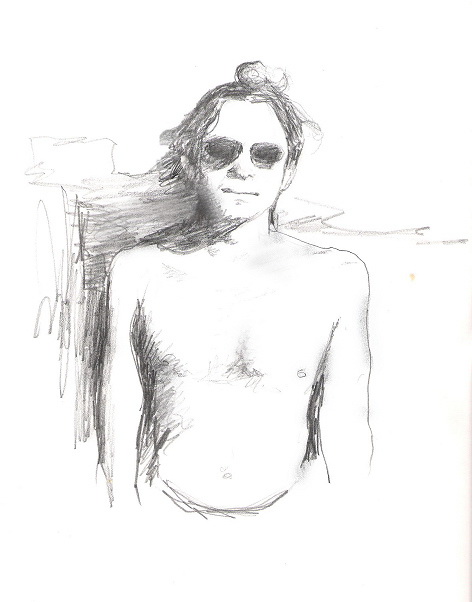
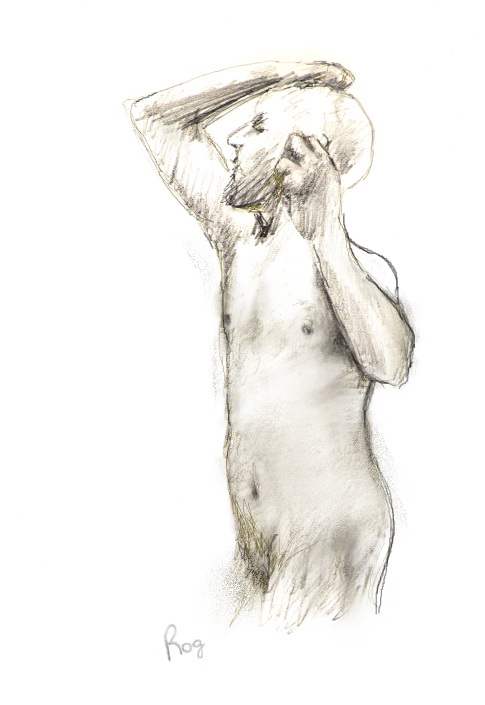
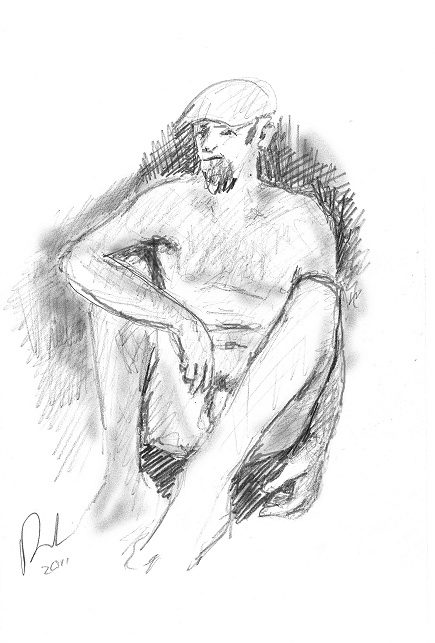
Keep some of you hidden
One error can set you back
Truth is different from the facts
One lover can set you free
One idea can shatter and bleed
And in the end
You’ll tell your friends
Everything as it isn’t
Keep some of you hidden
Keep some of you hidden
Keep some of you hidden
One day I will happen
Upon another stranger
There won’t be any reason
To fear over-exposure
One error can set you back
Truth is different from the facts
One lover can set you free
One idea can shatter and bleed
And in the end
You’ll tell your friends
Everything as it isn’t
Keep some of your heart hidden
Keep some of your heart hidden
Keep some of your heart hidden
© D. Roger Lee 201o
_____
Élève la voix
Building a life
Buidling a beast
Building ten times what you need
Power-building
Scrape the stars
Addicted to buildings
Addicted to cars
Build a temple
Try a new form
Élevez la voix
Levez les normes
Building your mansion
building on fault lines
Clear-cutting forests like there’s
No end in sight
Reaching far
Beyond his grasp
Man breaking every
Thing in his path.
Build a temple
Try a new form
Élevez la voix
Levez les normes
_____
French phrases:
Élève la voix – Raise your voice
Levez les normes – Raise the standards
© D. Roger Lee 2010
_____
Rogr Lee was born in B.C. and spent his 20s in Toronto’s acoustic music scene with various musicians and poets. He then moved to Vancouver where he started to explore painting and home recording, producing his 2nd and 3rd indie CDs. Recently Rogr found the love of his life and is planning a wonderful future with him – and some cats.
Sister Juana Inés de la Cruz: “Stupid, conceited Men…..” / “Hombres necios…..”
Posted: July 11, 2012 Filed under: English, Juana Inés de la Cruz, Spanish Comments Off on Sister Juana Inés de la Cruz: “Stupid, conceited Men…..” / “Hombres necios…..”
Sor Juana Inés de la Cruz
(1651-1695, Nueva España/México)
Hombres necios
Hombres necios que acusáis
a la mujer sin razón,
sin ver que sois la ocasión
de lo mismo que culpáis:
*
si con ansia sin igual
solicitáis su desdén,
¿por qué quereis que obren bien
si las incitáis al mal?
*
Combatís su resistencia
y luego, con gravedad,
decís que fue liviandad
lo que hizo la diligencia.
*
Parecer quiere el denuedo
de vuestro parecer loco,
al niño que pone el coco
y luego le tiene miedo.
*
Queréis, con presunción necia,
hallar a la que buscáis,
para pretendida, Thais,
y en la posesión, Lucrecia
*
¿Qué humor puede ser más raro
que el que, falto de consejo,
el mismo empaña el espejo
y siente que no esté claro?
*
Con el favor y el desdén
tenéis condición igual,
quejándoos, si os tratan mal,
burlándoos, si os quieren bien.
*
Opinión, ninguna gana:
pues la que más se recata,
si no os admite, es ingrata,
y si os admite, es liviana
*
Siempre tan necios andáis
que, con desigual nivel,
a una culpáis por crüel
y a otra por fácil culpáis.
*
¿Pues cómo ha de estar templada
la que vuestro amor pretende,
si la que es ingrata, ofende,
y la que es fácil, enfada?
*
Mas, entre el enfado y pena
que vuestro gusto refiere,
bien haya la que no os quiere
y quejaos en hora buena.
*
Dan vuestras amantes penas
a sus libertades alas,
y después de hacerlas malas
las queréis hallar muy buenas.
*
¿Cuál mayor culpa ha tenido
en una pasión errada:
la que cae de rogada
o el que ruega de caído?
*
¿O cuál es más de culpar,
aunque cualquiera mal haga:
la que peca por la paga
o el que paga por pecar?
*
Pues ¿para quée os espantáis
de la culpa que tenéis?
Queredlas cual las hacéis
o hacedlas cual las buscáis.
*
Dejad de solicitar,
y después, con más razón,
acusaréis la afición
de la que os fuere a rogar.
*
Bien con muchas armas fundo
que lidia vuestra arrogancia,
pues en promesa e instancia
juntáis diablo, carne y mundo.
_____
Sister Juana Inés de la Cruz
(1651-1695, New Spain/México)
Stupid, conceited men
Silly, you men – so very adept
at wrongly faulting womankind,
not seeing you’re alone to blame
for faults you plant in woman’s mind.
*
After you’ve won by urgent plea
the right to tarnish her good name,
you still expect her to behave–
you, that coaxed her into shame.
*
You batter her resistance down
and then, all righteousness, proclaim
that feminine frivolity,
not your persistence, is to blame.
*
When it comes to bravely posturing,
your witlessness must take the prize:
you’re the child that makes a bogeyman,
and then recoils in fear and cries.
*
Presumptuous beyond belief,
you’d have the woman you pursue
be Thais when you’re courting her,
Lucretia once she falls to you.
*
For plain default of common sense,
could any action be so queer
as oneself to cloud the mirror,
then complain that it’s not clear?
*
Whether you’re favored or disdained,
nothing can leave you satisfied.
You whimper if you’re turned away,
you sneer if you’ve been gratified.
*
With you, no woman can hope to score;
whichever way, she’s bound to lose;
spurning you, she’s ungrateful–
succumbing, you call her lewd.
*
Your folly is always the same:
you apply a single rule
to the one you accuse of looseness
and the one you brand as cruel.
*
What happy mean could there be
for the woman who catches your eye,
if, unresponsive, she offends,
yet whose complaisance you decry?
*
Still, whether it’s torment or anger–
and both ways you’ve yourselves to blame–
God bless the woman who won’t have you,
no matter how loud you complain.
*
It’s your persistent entreaties
that change her from timid to bold.
Having made her thereby naughty,
you would have her good as gold.
*
So where does the greater guilt lie
for a passion that should not be:
with the man who pleads out of baseness
or the woman debased by his plea?
*
Or which is more to be blamed–
though both will have cause for chagrin:
the woman who sins for money
or the man who pays money to sin?
*
So why are you men all so stunned
at the thought you’re all guilty alike?
Either like them for what you’ve made them
or make of them what you can like.
*
If you’d give up pursuing them,
you’d discover, without a doubt,
you’ve a stronger case to make
against those who seek you out.
*
I well know what powerful arms
you wield in pressing for evil:
your arrogance is allied
with the world, the flesh, and the devil.
Traducción del español al inglés / Translation from Spanish into English: Alan S. Trueblood
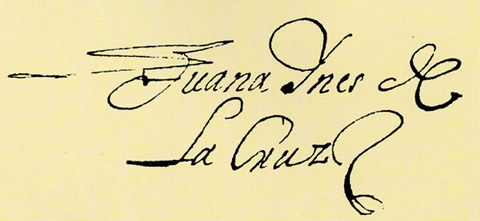
In his biography of Sister Juana Inés de la Cruz (1651-1695), Octavio Paz states that the self-taught scholar and nun of colonial New Spain (later called México) is the most important poet of the Americas up until the arrival of Walt Whitman and Emily Dickinson in the 19th century. We must include the Aztec “poet-king” Nezahualcóyotl (1402-1472) in a statement so broad, yet de la Cruz does have something unique: a prototypical “feminist” point of view.
Juana Inés de la Cruz lived in México City from the age of 16 onward, and died during a plague at the age of 43 – after tending to the stricken. The out-of-wedlock daughter of a Spanish captain and a Criolla woman, she was an avid reader from childhood, and though she begged to disguise herself as a boy so as to continue her studies “more openly, in the Capital”, still she was “found out” and barred entrance to the university. That didn’t stop her – she kept on educating herself – and she’d already had a good head start, sneaking ( – in colonial society women were strongly discouraged from becoming literate in all but religious devotional texts – ) her grandfather’s books to read from his hacienda library. By her mid-teens she could speak and write in Latin, as well as Náhuatl, the language of the Aztecs. Devout and a “Daughter of The Church” though she was, yet she challenged male hypocrisy in the poem featured here, Hombres Necios/Stupid, conceited Men. Written in the conventional rhyming-quatrain verse form of the 17th century, Sister Juana addresses all Men; the poet analyzes their attraction to, and efforts to attain, women who will have sex with them — women whom the men reject and judge utterly, afterwards.
Ann-Marie Scarlett: “La Vida” y “Quien yo soy” / “Life” and “Who I am”
Posted: July 10, 2012 Filed under: Ann-Marie Scarlett, English, Spanish Comments Off on Ann-Marie Scarlett: “La Vida” y “Quien yo soy” / “Life” and “Who I am”
Ann-Marie Scarlett
La Vida
Viviendo en un mundo sin paz,
De poco amor que no dura
¿Cuándo terminará la guerra?
Todo trabajando juntos
Y amándonos la una a la otra
En la Vida no hay límites
No hay satisfacción
Sino mucha distracción
Cavemos dentro de nosotras mismas
Buscando estar completas
Resultados, arrepentimientos,
Pensando en el tiempo
Cuando no lloraremos más
¿Habrá un tiempo de gozo puro
Un tiempo sin dolor?
¿O será siempre el desdén?
El Tiempo no espera a nadie
Y aún, solo el Tiempo lo dirá.
*
Life
Living in a world of no peace
Little love with no endurance
When will the war stop?
Everyone pulling together
And loving each other
With Life there are no boundaries
No satisfaction
But lots of distraction
Dig into ourselves
Looking for completeness
Results, regrets
Thinking of the time
When we’ll cry no more
Will there ever be a time of pure joy
A time with no pain
Or will it always be disdain
Time waits for no one
But still; only time will tell.
_____
Quien yo soy
Siempre estoy pensando en ese tiempo
Cuando yano estaré asustada
El tiempo cuando estaré liberada de mis miedos
El tiempo cuando no me preocuparé
El tiempo cuando diré:
Ésta es quien yo soy.
El tiempo cuando diré:
Me importa un bledo.
El tiempo cuando diré:
No necesito un hombre.
El tiempo cuando diga:
Ésta es quien yo soy.
El tiempo cuando no me sentiré tan sola
El tiempo cuando me sentiré bienvenida en casa
– el tiempo cuando diré:
Ésta es quien yo soy.
*
Who I am
I always think about the time
When I’ll be scared no more
The time I’ll be free from my fears
The time when I wouldn’t care
The time that I’ll say
This is who I am
The time I’ll say
I don’t give a damn
The time I’ll say
I don’t need a man
The time when I say
This is who I am
The time when I
Won’t feel so alone
The time when I’ll
Feel welcome at home
The time when I say
This is who I am.
* * * * *
Traducciones del inglés al español / Translations from English into Spanish:
Alexander Best and Lidia García Garay
La poesía lésbica mexicana: dos voces pioneras / Mexican lesbian poetry: voices of two pioneers
Posted: July 9, 2012 Filed under: English, Nancy Cárdenas, Rosamaría Roffiel, Spanish, ZP Translator: Alexander Best | Tags: Poesía lésbica mexicana Comments Off on La poesía lésbica mexicana: dos voces pioneras / Mexican lesbian poetry: voices of two pioneersNancy Cárdenas (Coahuila, 1934-1994)
*
Si habitamos en el Distrito Federal,
las pueblerinas románticas tenemos que
resignarnos:
la vida no transcurre junto a un estanque,
sino a un costado del Periférico.
Allí, Muñeca del Asfalto
– bajo la lluvia –
decidiste que esa noche dormirías conmigo.
*
If we dwell in México City,
we romantic ‘country bumpkins’ must
resign ourselves to:
Our Life not taking place next to a pond,
but on the side of The Periférico Highway.
There, Dolly of the Asphalt,
– beneath the rain –
you decided that that night you would sleep with me.
_ _ _ _ _
Entre tantas Liberacionistas que conozco,
sólo tú – de apariencia tan frágil –
has querido llevar a la cama
esos principios básicos de la teoría.
*
Among so many of the Liberationists I know,
only you – who appear so fragile –
have wanted to bring to bed
those basic principles of theory.
_ _ _ _ _
Soy peligrosa,
es cierto: siempre busco vengarme
de los dueños del capital, los burócratas,
los curas… y las mujeres que abusaron de mi cariño.
*
I’m dangerous,
that’s for certain: I’m always looking to avenge myself
on the owners of big money, the bureaucrats,
the priests… and the women who took advantage of my affection.
_ _ _ _ _
Dejemos
que el amor declare su santo nombre
en cada uno de nuestros tejidos, estratos emocionales
y apetencias más escondidas
antes de comprometernos por las dos leyes:
la tuya y la mía.
*
Let us allow
Love to declare its holy name
in the very fibre of us, in our emotional strata,
and in our most hidden appetites
before we commit ourselves to those two laws:
yours – and mine.
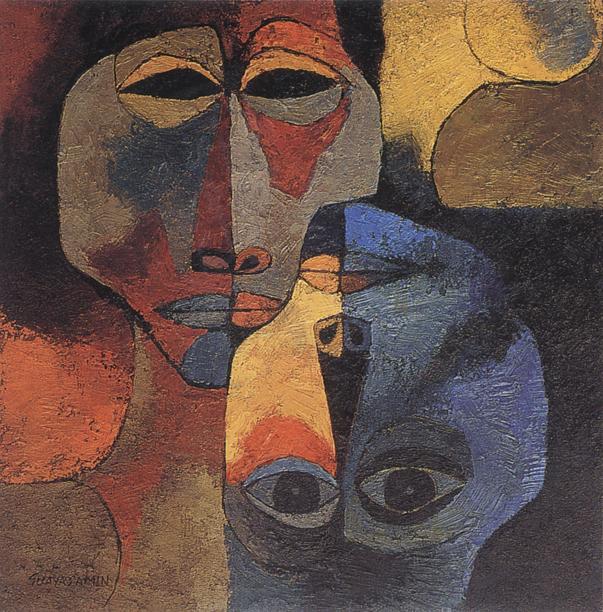
Rosamaría Roffiel (Veracruz, nace 1945)
La Suave Danza
Nos besamos
por el puro
absoluto
placer de besarnos
listones de lenguas
dientes como peces alados
festín de salivas
giros
valses
pájaros
*
tu boca ranura
cereza
grosella
mi lengua gaviota
cometa
sirena
se encuentran
se tocan
se enredan
*
marineras de un viaje
sin ida ni vuelta
*
tu boca es el mar
mi lengua – un barco de vela.
*
The Smooth Dance
We kiss each other
for the pure
absolute
pleasure of kissing each other
ribbons of tongues
teeth like winged fish
a feast of salivas,
revolvings
waltzes
birds
*
your mouth-slot
cherry
red currant
my seagull tongue
kite
they meet
they touch
they become entangled
*
sailors on a voyage
with no departure, no return
*
your mouth is the sea
my tongue – a sailboat.
_ _ _ _ _
Sin título
Hasta mi noche llegas
y te recuerdo fiera
celosa en mi caverna
y te recuerdo sirena
nadando entre mis pechos
y te recuerdo tierna
como paloma, tierna
y te recuerdo fuego
encendida de deseo
y te recuerdo plena,
antes del miedo.
*
Untitled
You arrive…to my night…
and I recall you, a wild animal,
protective, zealous, in my cave
and I recall you as a mermaid
swimming between my breasts
and I recall you tender
like a dove, tender,
and I recall you as a fire
lit by desire
and I recall you as fullness – complete –
without fear.
_____
Translations from Spanish into English / Traducciones del español al inglés: Alexander Best
La poesía gay mexicana: una muestra de Monterrey
Posted: July 9, 2012 Filed under: Alejandro del Bosque, Antonio García, Jorge Cantu de la Garza, Spanish, Xorge M. González, ZP Translator: Alexander Best | Tags: Poesía gay mexicana Comments Off on La poesía gay mexicana: una muestra de Monterrey 
Jorge Cantu de la Garza (1937-1998)
Antes de partir
De amor, amor, nunca he escrito un poema.
He de hacerlo ahora pues me dicen que la muerte se aproxima
y sé que Amor amorosamente me ha tocado
como la aurora, con uno de sus rosados dedos.
*
No es sólo del joven que, apenas salido de la adolescencia
comparte hoy sus días con quien esto escribe
de quien escribiré. Si hablo en singular
es porque todo el amor es uno
y de ello pongo a cualquier hombre por testigo.
*
Fui al pozo del limo con mi cántaro vacío
infinitas veces, como amanece.
Y siempre fue, como la primera vez,
la inauguración del Universo
con sus arreboles y huracanes
llenos de siempres, nuncas, vida mía.
Y luego había que partir, dolorosamente.
Recuerdo tantas despedidas.
*
Ven, amado, y contempla el ejército
de ángeles que te precede,
ven y mira cómo sobrevivieron
aunque ellos, igual que tú, que yo,
pensaron que el fin de nuestro amor
era el fin del mundo.
Toma ejemplo, amado, para que vivas
cuando yo te falte.
*
Cánceres, escorpiones, acuarios, sagitarios
nadando en la pecera de mis sueños,
como el joven obrero aquel, en Guayaquil,
que una noche me llevó a su cuarto de madera
donde bajo una débil bombilla, sobre la duela,
había una sábana por cama
y en la pared un clavo por guardarropa de su atuendo.
Qué limpia su pobreza, qué amorosa su hospitalidad,
tanto, que me avergoncé del hotel de lujo
a donde aquella noche yo regresaría cargado
de sucres que no necesitaba y que le di
– para que te compres una camisa que te recuerde al mexicano –
le dije para vencer su resistencia al pago que tranquilizara
mi conciencia por su pobreza inmerecida y mi opulencia,
también inmerecida.
*
O como aquel japonesito brasileño que una noche
de cachaza en Belo Horizonte me acompañara al hotel
y más tarde, por la mañana,
al aeropuerto, donde nos despedimos
como amantes de mucho más que unas cuantas horas, como amantes
verdaderos que se despiden llenos de promesas,
para siempre.
*
Géminis, virgos, aries, libras
de Los Angeles, de México, Caracas, Bogotá,
Lima, Río, Buenos Aires, Madrid, Sevilla o Monterrey,
apurados en la certeza que da la partida inminente,
la seducción irresistible de lo efímero,
la libertad irrenunciable del anonimato.
*
La barbarie en que creciste, amado,
no podré borrarla jamás de tu memoria;
los saltos de tu madre y sus golpes en el vientre
para que no nacieras me duelen más que a ti.
Después de nacido, te dicen, fuiste el mejor,
el bienamado. Y sin embargo,
quién sino yo con mis manos torpes
podría tranquilizar tus noches inquietas,
tus pesadillas de horror.
*
En cierto modo, nuestras infancias se parecen,
sólo que de la mía me separa un medio siglo
y he aprendido a olvidar – o casi.
*
Cómo te amo.
*
Sé que también tuviste por años un amor prohibido,
que no sabías que era amor ni que era prohibido.
Cómo te envidio.
Yo nunca tuve un hermano así.
_____
Xorge M. González (1952-1997)
Ritmo
Fueron los meses de beber Villaurrutia
con las voces del poder de los relojes
Tus iconos lamían la noche
la luna
del espejo ágil se alejaba
Aprendí la distancia
los bosques
la selva aún miedosa
dibujó un cuerpo
Dijo adiós
aquel 6 de diciembre de álamos.
_____
Estos cantos
desenvueltos entre estrellas
declinando días
por los montes que no dicen
y desgarran la mirada
esas nubes de letras
esos bosques antiguos
te dibujan
*
Pudiendo precisar la luna
en una cama sola
veo esas inmensidades
silenciosas ahora
Canto
otros ojos
otras manos
– éstas que juegan con el aliento
de los gestos
*
Entre una naranja y risas
– tan viejos como el amor –
las calles de la ciudad
por donde siempre he andado.
_____
Caminata
Me pusiste en la calle soledad
fui tus pasos y tu historia
fui los encuentros con las verdades de todo precio
Me pusiste en la calle soledad
y me encontré con mis hermanos.
_____
Aún se podrían guardar otras cosas
entre esas papeletas que algun vez dijeron
las cuerdas de tu guitarra
los platos cansados
los regalos de cumpleaños
que pasamos narrando soledades
poemas sin esperanza de ser leídos
La habitual plática de tus presentaciones
y otras noches no olvidadas
*
La traición de la rentera
– y de la piadosa amiga –
nos had pedido nuestra intimidad sola
de algunos miles de pesos
para dejarnos
– sin saberlo –
más juntos.
_____
Amargos pasos gritan la noche;
bailan en el abierto estómago,
llave del dolor
de la espera del amanecer
de besos y frutas y ojos;
beben los faunos.
*
Me desnudaron no sé ni día ni hora
bajé
con la misma soledad de Isthar
a beber los presagios de divinidades
telúricas.
*
No sé ni día ni hora
en mares de luz
aparecieron los rostros míos.
_____
Antonio García (nace 1956)
Des
nudo
estoy
en
el
umbral; ven,
tu cuerpo ansioso
de la ternura
y frenesí, de
la locura de
mis manos,
a tientas,
a ciegas te
traerá por el
camino sin reclamos.
“Ven”. Sólo otra vez,
yo te digo:
“Ven.
Aquí
espero.”
Lo sé
– y házle
como quieras
– vendrás
tu cuerpo a
compartir conmigo.
_____
Estatua en paraiso
Y los esperamos
se confundieron en el mismo instante
Luego vino Luego queso
Vino el beso
Vino el yeso y quedó tieso
descansando en la llanura amplia
de su vientre amado, de su vientre dueño
Petrificado
Esbozando una sonrisa quieta
desde el sueño-vuelo de su pedestal eterno
Esbozando una sonrisa quieta desde su alma
que pasaba aquel invierno.
_____
Cucaracha’s Inn
Cucaracha en
pared muerta envuelta
pobre
de mí y de ella no
hubo comida
está suspendida es pera
espera
su tiempo es pera
el tiempo es perra
y espera
tocar el cielo
y nuestros huesos.
Alejandro del Bosque (nace 1965)
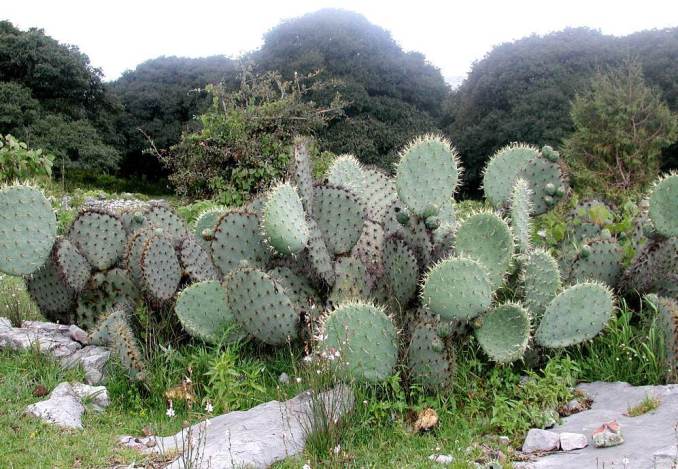
Los nopales
Desde su asiento
él observa la noche capada de estrellas,
copada de ambos.
A su lado yo dormito.
El sigue mirando sin saberse mirado.
La otra vez viajé solo.
El sol se desmayó en la carretera
durante varias horas,
y en el interior del autobús había frío.
El pequeño televisor, casi echado en mí,
proyectaba una película fastidiosa.
Afuera, algunos nopales parecían viejos discutiendo
con los brazos extendidos,
en la espera de asestar un golpe débil;
otros simulaban saludarse entre sí,
como preservando las buenas maneras.
El trayecto será largo.
El busca otra posición
Para estar menos incómodo.
_____
El Volante
Eluno espera a que llegue Elotro.
Elotro sabe que Eluno lo espera.
Eluno fuma los cigarros de Elotro.
Elotro los busca en la bolsa de su camisa.
Eluno mira hacia el camellón.
Elotro maldice a quien se pasó un rojo.
Eluno sonríe a quien le sonríe y cruza la calle.
Elotro recuerda que hay poca carne en el refri.
Eluno conversa animoso moviendo los hombros.
Elotro piensa en las ofertas del martes.
Eluno recibe una tarjeta y promote comunicarse.
Elotro marca y nadie contesta.
Eluno identifica la llamada y apaga el celular.
Elotro arroja el aparato al asiento trasero.
Eluno entra a una fonda y ordena comida corrida.
Elotro detiene su auto y recarga la cabeza en el volante.
_____
La peluca
A cierta hora del día
el metro es un reclusorio de hombres y mujeres separados,
pero Elella se escabulle
y viaja en el vagón de los varones.
Todos los obreros para mí nomás,
– va pensando Elella –
que lo quiere todo, no más, no menos.
La recibe un silbido de mira qué forro de vieja.
Ella se deja hacer.
Le pellizcan las nalgas.
Le aprietan las tetas.
Le muerden los labios.
Le embarran sudores.
Ellos se dejan hacer,
pero Elella necesita cambiar de estación.
Elella se va con un silbido de vuelve pronto mamacita,
acomodándose la rubia peluca,
ciñéndose la morada vida que se le va cayendo.
_____
El amado
Hombre mío
que estás tan lejos,
amado sea tu recuerdo,
ignorado sea tu desprecio;
olvida a quien me besa
como yo también olvido a quien te toca;
no me dejes,
que el dejarnos aún hiere,
y libérame de todo yo.
Alejandro del Bosque (born 1965)
The prickly-pear cactuses
From his seat
He observes the night caped by stars
By his side I snooze.
He continues gazing out not knowing that he’s being looked at
That other time I travelled solo.
The sun faded upon the highway
Over several hours,
And inside the bus it was cold.
The little TV, almost falling on me,
showing an annoying film.
Outside, some prickly-pear cactuses seemed like old people arguing
With arms extended,
In the hope of striking a feeble blow;
Others were pretending to greet one another,
As if maintaining the tradition of good manners.
The journey will be a long one.
He shifts his position
So he’s less uncomfortable.
*
The steering wheel
The One hopes that the Other arrives.
The Other knows that the One is waiting for him.
The One smokes the cigars of the Other.
The Other searches for them in the pocket of his shirt.
The One looks toward the traffic island.
The Other curses the guy who ran the red light.
The One smiles at someone who smiles back at him and crosses the street.
The Other remembers there’s not much meat in the fridge.
The One chats,his shoulders going up and down, excited.
The Other thinks about the Tuesday specials.
The One takes a business card and promises to get in touch.
The Other dials and nobody answers.
The One sees who’s calling and turns off his cell.
The Other throws the phone into the back seat.
The One goes into a greasy-spoon and orders food to go.
The Other stops the car and puts his head down on the steering wheel.
*
The wig
At a certain time of day
The subway trains (in México City) are a prison of men and of women
– separated (by gender),
But HimHer slips through
And travels in the male car.
“All the Regular Joes just for me,”
– HimHer goes in thinking –
Wanting it all – no more, no less.
Got whistled at:
“Look at her – what an ass she has.”
She lets them…
They grab her buttocks.
They squeeze her nipples.
They bite her lips.
They cover her with their sweat.
They let themselves do it…
But HimHer has to change stations.
HimHer, exiting the subway car, gets whistled at:
“Come back soon, mamacita.”
Adjusting the blonde wig,
Girding herself for this tough life that’s going down…
*
The belovéd
Man of mine,
You who are so far away,
Belovéd be the memory of you,
Ignored be your disdain;
Forget whoever kisses me
As I forget whoever touches you
Do not leave me,
Even as our breaking up still hurts,
And free me from all that is myself.
Traducciones del español al inglés / Translations from Spanish into English: Alexander Best
_____
Estos poemas son parte de una compilación © Arnulfo Vigil y Ernesto Castillo.
Los redactores escriben:
“Lo importante, a fin de cuentas, no es la sexualidad de un poeta
sino el tratamiento poético de la diversidad sexual.”
Konstantin Kavafis / Κωνσταντίνος Καβάφης: “I went into the brilliant night and drank strong wine, the way the Champions of Pleasure drink.”
Posted: July 1, 2012 Filed under: English, Greek, Konstantin Kavafis | Tags: Gay poets Comments Off on Konstantin Kavafis / Κωνσταντίνος Καβάφης: “I went into the brilliant night and drank strong wine, the way the Champions of Pleasure drink.”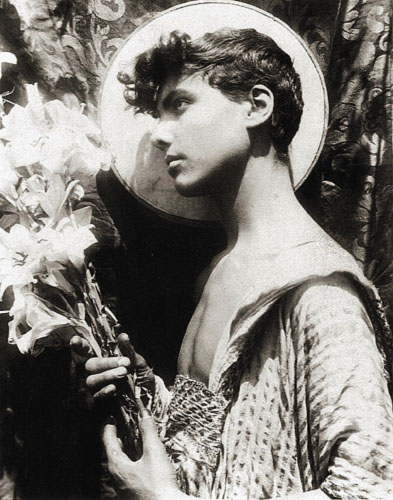
Konstantin Kavafis (Constantine Cavafy)
(1863-1933)
Walls
With no consideration, no pity, no shame,
they’ve built walls around me, thick and high.
And now I sit here feeling hopeless.
I can’t think of anything else: this fate gnaws my mind
– because I had so much to do outside.
When they were building the walls, how could I not have noticed!
But I never heard the builders, not a sound.
Imperceptibly they’ve closed me off from the outside world.
(1896)

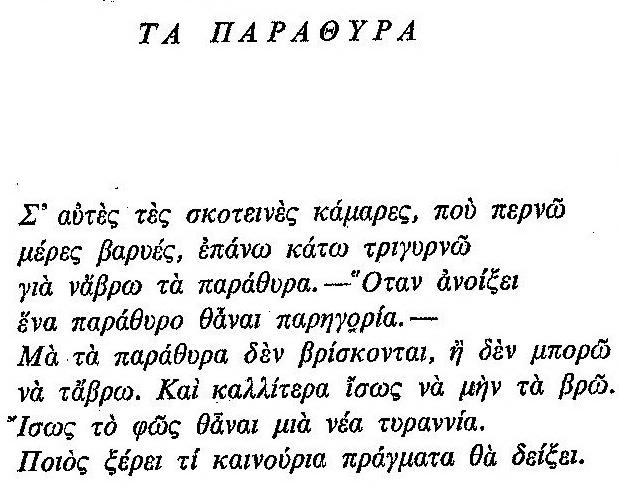
The Windows
In these dark rooms where I live out empty days,
I wander round and round
trying to find the windows.
It will be a great relief when a window opens.
But the windows aren’t there to be found
– or at least I can’t find them. And perhaps
it’s better if I don’t find them.
Perhaps the light will prove another tyranny.
Who knows what new things it will expose?
(1897)
I went
I didn’t restrain myself. I gave in completely and went,
went to those pleasures that were half real,
half wrought by my own mind,
went into the brilliant night
and drank strong wine,
the way the champions of pleasure drink.
(1905)
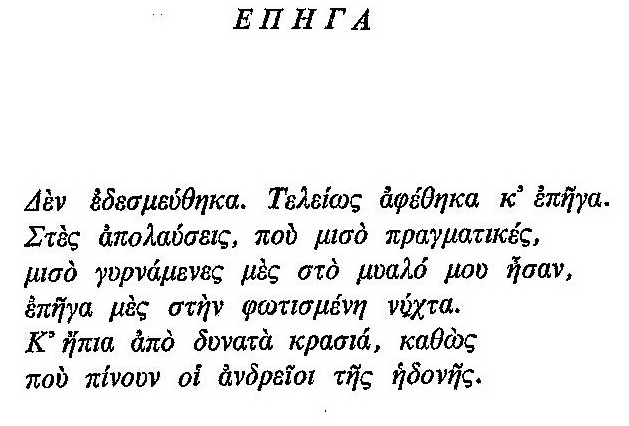
Comes to rest
It must have been one o’clock at night
or half past one.
A corner in a tavern,
behind the wooden partition:
except for the two of us the place completely empty.
A lamp barely lit gave it light.
The waiter was sleeping by the door.
*
No one could see us.
But anyway, we were already so worked up
we’d become incapable of caution.
*
Our clothes half opened – we weren’t wearing much:
it was a beautiful hot July.
*
Delight of flesh between
half-opened clothes;
quick baring of flesh – a vision
that has crossed twenty-six years
and now comes to rest in this poetry.
(1918)
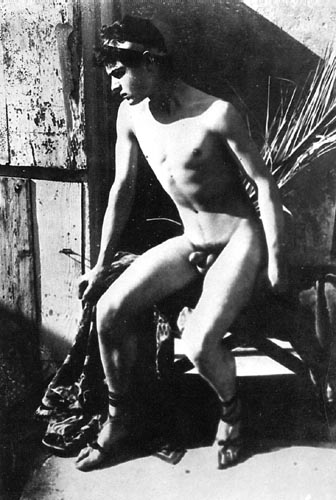
The afternoon sun
This room, how well I know it.
Now they’re renting it, and the one next to it,
as offices. The whole house has become
an office building for agents, businessmen, companies.
*
This room, how familiar it is.
*
The couch was here, near the door,
a Turkish carpet in front of it.
Close by, the shelf with two yellow vases.
On the right – no, opposite – a wardrobe with a mirror.
In the middle the table where he wrote,
and three big wicker chairs.
Beside the window the bed
where we made love so many times.
*
They must be still around somewhere, those old things.
*
Beside the window the bed;
the afternoon sun used to touch half of it.
*
…One afternoon at four o’clock we separated
for a week only…And then
– that week became forever.
(1918)
Before Time altered them
They were full of sadness at their parting.
They hadn’t wanted it: circumstances made it necessary.
The need to earn a living forced one of them
to go far away – New York or Canada.
The love they felt wasn’t, of course, what it had once been;
the attraction between them had gradually diminished,
the attraction had diminished a great deal.
But to be separated, that wasn’t what they wanted.
It was circumstances. Or maybe Fate
appeared as an artist and decided to part them now,
before their feeling died out completely, before Time altered them:
the one seeming to remain for the other always what he was,
the good-looking young man of twenty-four.
(1924)
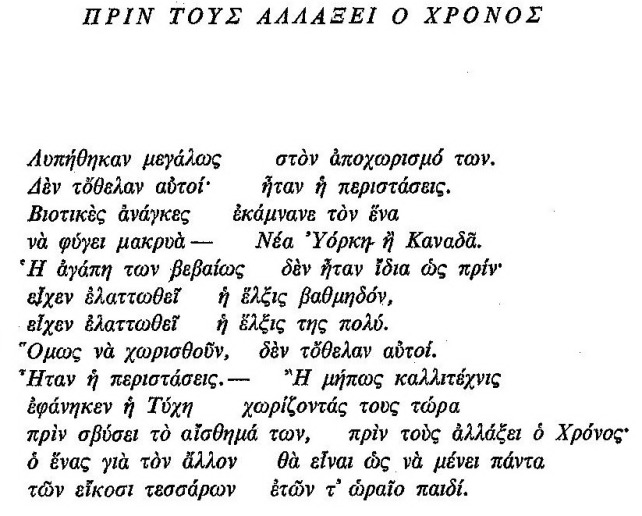
Translations from Greek into English © 1975 Edmund Keeley and Philip Sherrard
_____
Constantine Cavafy (Konstantin Kavafis), 1863-1933,
lived and died in the port city of Alexandria, Egypt.
His father had worked in Manchester, England, founding
an import-export firm for Egyptian cotton to the
textile industry. Between the ages of 9 and 16 Constantine
was educated in England – Victorian-era England – and
these years became important in the shaping of his poetic
sensibility (which would only emerge around the age of 40.)
Though he was fluent in English, when he began to write poetry
in earnest it was to be in his native Greek.
Cavafy never published any poems in his lifetime, rather he
had them printed privately then distributed them
– pamphlet-style – to friends and acquaintances.
His social circle was small and by all accounts he was not ashamed
of his homosexuality – but he did feel much guilt over
“auto-eroticism” – what we now call masturbation.
*
Cavafy’s early poems “Walls” and “The Windows” might
be read as the mental anxieties of a “closeted” homosexual –
yet there was no such thing in the 19th century as someone
who was “Out” anyway.
The poem “I went”, from 1905, seems to be a break-through of sorts,
Cavafy indicating – at least in the Truth that was his much-cherished
Art – Poetry – that he’s ready to write openly of his love for men.
The poems he wrote when he was in his 50s, such as “Comes to rest”,
“The afternoon sun” and “Before Time altered them”, show a mature
poet describing the universal beauty and sadness of Love – and he
does it describing sex, passion and loss between two men.
Reinaldo Arenas: “There’s just one place to live – the impossible.” / “Sólo hay un lugar para vivir – el imposible.”
Posted: July 1, 2012 Filed under: English, Reinaldo Arenas, Spanish | Tags: Gay poets Comments Off on Reinaldo Arenas: “There’s just one place to live – the impossible.” / “Sólo hay un lugar para vivir – el imposible.”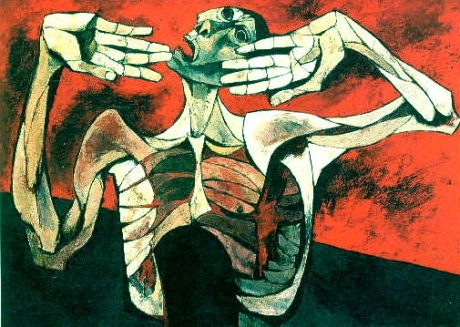
Reinaldo Arenas (Gay Cuban novelist and poet, 1943-1990)
Self-Epitaph
A bad poet in love with the moon,
he counted terror as his only fortune :
and it was enough because, being no saint,
he knew that life is risk or abstinence,
that every great ambition is great insanity
and the most sordid horror has its charm.
He lived for life’s sake, which means seeing death
as a daily occurrence on which we wager
a splendid body or our entire lot.
He knew the best things are those we abandon
— precisely because we are leaving.
The everyday becomes hateful,
there s just one place to live – the impossible.
He knew imprisonment offenses
typical of human baseness ;
but was always escorted by a certain stoicism
that helped him walk the tightrope
or enjoy the morning’s glory,
and when he tottered, a window would appear
for him to jump toward infinity.
He wanted no ceremony, speech, mourning or cry,
no sandy mound where his skeleton be laid to rest
(not even after death did he wish to live in peace).
He ordered that his ashes be scattered at sea
where they would be in constant flow.
He hasn’t lost the habit of dreaming :
he hopes some adolescent will plunge into his waters.
(New York, 1989)
_____
Reinaldo Arenas (Escritor y poeta gay cubano, 1943-1990)
Autoepitafio
Mal poeta enamorado de la luna,
no tuvo más fortuna que el espanto;
y fue suficiente pues como no era un santo
sabía que la vida es riesgo o abstinencia,
que toda gran ambición es gran demencia
y que el más sórdido horror tiene su encanto.
Vivió para vivir que es ver la muerte
como algo cotidiano a la que apostamos
un cuerpo espléndido o toda nuestra suerte.
Supo que lo mejor es aquello que dejamos
– precisamente porque nos marchamos – .
Todo lo cotidiano resulta aborrecible,
sólo hay un lugar para vivir, el imposible.
Conoció la prisión, el ostracismo,
el exilio, las múltiples ofensas
típicas de la vileza humana;
pero siempre lo escoltó cierto estoicismo
que le ayudó a caminar por cuerdas tensas
o a disfrutar del esplendor de la mañana.
Y cuando ya se bamboleaba surgía una ventana
por la cual se lanzaba al infinito.
No quiso ceremonia, discurso, duelo o grito,
ni un tumulo de arena donde reposase el esqueleto
(ni después de muerto quiso vivir quieto).
Ordenó que sus cenizas fueran lanzadas al mar
donde habrán de fluir constantemente.
No ha perdido la costumbre de soñar:
espera que en sus aguas se zambulla algún adolescente.
(Nueva York, 1989)
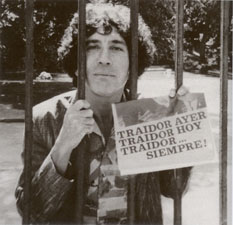
Reinaldo Arenas came into conflict with Fidel Castro’s government because of his openly-Gay lifestyle and because he managed to get several novels published abroad without official consent. He was jailed in 1973 for “ideological deviation”; he escaped and tried to flee Cuba on an inner-tube floating in the Caribbean Sea. The attempt failed and he was jailed again, this time at El Morro – the roughest prison in Cuba. He wrote letters for the loved ones of murderers and thereby gained some respect. Upon his release in 1976 the government forced him to renounce his work. In 1980 he came to the USA – one of many Cubans in the Mariel Boatlift. He settled in New York City where he mentored other exiled writers – but he was never happy, and he was Cuban till the end. Diagnosed with AIDS in 1987 he committed suicide in 1990, penning these words in a last letter (written for publication):
“Due to my delicate state of health and to the terrible depression it causes me not to be able to continue writing and struggling for the freedom of Cuba, I am ending my life. . . I want to encourage Cuban people out of the country as well as on the Island to continue fighting for freedom. . . Cuba will be free – I already am.”
António Botto: “O mais importante na vida é ser-se criador – criar beleza.” / “The most important thing in life is to create – to create beauty.”
Posted: July 1, 2012 Filed under: António Botto, English, Portuguese | Tags: Gay poets Comments Off on António Botto: “O mais importante na vida é ser-se criador – criar beleza.” / “The most important thing in life is to create – to create beauty.”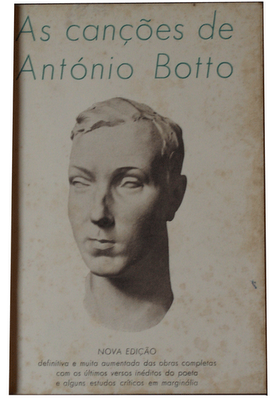
António Botto (Lisbon, Portugal, 1897-1959)
Selected poems from “Canções” (“Songs”)
In love –
Now don’t question me! –
There were always
Two kinds of men.
*
This is quite true
And greater than life’s self is.
No one down here can deny it
Or dismiss.
*
One kind of man
Looks on, without love or sin:
The other kind
Feels, grows passionate, comes in.
_____
No amor,
Não duvides amor meu –
Dois tipos de homem
Houve sempre.
*
E esta verdade
Que é maior que a própria vida,
Só por Ele – vê lá bem!,
Poderá ser desmentida.
*
– Um,
A contemplar se contenta;
E outro,
Apaixona-se, intervém…
_____
You’re wrong, I tell you again.
*
In love
The only lie we find out in the future
Is that which seems
The best truth now,
The truth that seems to fall in with our fates.
*
Love never really lies:
It simply exaggerates.
_____
Enganas-te, digo ainda.
*
No amor,
– Apenas, é mentira no futuro
Aquilo
Que nos parece uma verdade presente.
*
O amor não mente, nunca!
Exagera simplesmente.
_____
I’ve left off drinking, my friend.
Yes, I have set wine aside.
*
But if
You really want
To see me drunk –
This is between us, you see –,
Take slowly up to your mouth
The glass meant for me,
Then pass it over to me.
_____
Deixei de beber, amigo.
*
Sim, já desprezei o vinho.
*
Entanto,
Se tu afirmas que tens
O prazer de me ver ébrio,
– Que isto fique entre nós dois:
Aproxima da tua boca
A taça que me destinas,
E dá-ma depois.
_____
The most important thing in life
Is to create – to create beauty.
*
To do that
We must foresee it
Where our eyes cannot really see it.
*
I think that dreaming the impossible
Is like hearing the faint voice
Of something that wants to live
And calls to us from afar.
*
Yes, the most important thing in life
Is to create.
*
And we must move
Towards the impossible
With shut eyes, like faith or love.
_____
O mais importante na vida
É ser-se criador – criar beleza.
*
Para isso,
É necessário pressenti-la
Aonde os nossos olhos não a virem.
*
Eu creio que sonhar o impossível
É como que ouvir a voz de alguma coisa
Que pede existência e que nos chama de longe.
*
Sim, o mais importante na vida
É ser-se criador.
E para o impossível
Só devemos caminhar de olhos fechados
Como a fé e como o amor.
_____
Translations from the Portuguese: Fernando Pessoa
_____
António Botto published Canções (Songs) in
Lisbon in 1920. He was 23. And he began to rub shoulders
with the city’s intellectual élite during what was to be a short
period of bohemianism leading up to the military coup
of 1926 and the establishment of the Estado Novo (New State),
an authoritarian dictatorship.
A second edition of Canções was
printed in 1922 – and this time it created a critical furor
as “Literature of Sodom”. Botto made no secret of his
homosexuality – he flirted in public, and that took guts –
and many of his first-person-voice love poems are
frankly addressed to men. Though Fernando Pessoa – one
of Portugal’s heavyweights in the Modernist movement (and also
the translator into English of Botto’s poems) – defended Botto in
print, it was a defence of the aesthetic ideal of male beauty
– a Classical Greek (Hellenic) value that had influenced all
Mediterranean cultures – not a public endorsement of the fact that
Botto was writing about loving men. Botto was just too ahead of his time;
he was “pushing the boundaries”, as we call it now.
A conservative university-student league called verses such as
“Listen, my angel: what if I should kiss your skin,
what if I should kiss your mouth, which is all honey within?”
“disgraceful language” and Botto a “shameless”
author, pressuring the government to take action, which it did,
seizing and burning books by Botto as well as “Decadência” by Judith
Teixeira, a lesbian poet.
*
We thank University of Toronto professor Josiah Blackmore
for re-issuing the Songs of Botto; he is a poet too little known
in the English language.
 Zócalo Poets