“Earth Day” poems: Aqqaluk Lynge
Posted: April 22, 2012 Filed under: A FEW FAVOURITES / UNA MUESTRA DE FAVORITOS, Aqqaluk Lynge, English, Kalaallisut (Greenlandic) Comments Off on “Earth Day” poems: Aqqaluk Lynge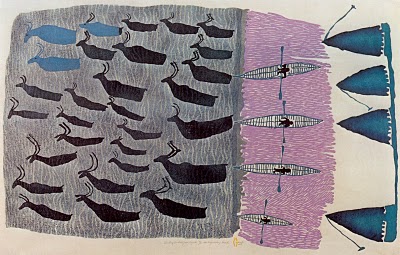
Aqqaluk Lynge is a Kalaallit (Greenland Inuit) poet who writes
in the Kalaallisut (Greenlandic) language – closely related to the Inuktitut
language of the Canadian Arctic.
The poems below were translated into English
by Ken Norris and Marianne Stenbaek, with the poet.
_____
A Life of Respect
In the old days
when we still lived our own lives
in our own country
We could hear
a faraway thunder –
the caribou approaching
two or three days in advance
*
Then we did not count the animals, but knew
that when the caribou herd arrived
it would be seven days
before all the animals crossed the river
We did not count them
We had no quotas
We knew only
that a child’s weeping
or a seagull’s cry
could frighten the animals away
*
Then we knew
that there is a balance
between the animals and us,
lives of mutual respect
*
Now it is as if we are under arrest
the wardens are everywhere
We are interrogated constantly.
In Your hungering after more riches and land
You make us suspect,
force us to justify our existence
*
On maps of the country
We must draw points and lines
to show we have been here –
and are here today,
here where the foxes run
and birds nest
and the fish spawn
*
You circumscribe everything
demand that we prove
We exist,
that We use the land that was always ours,
that We have a right to our ancestral lands
*
And now it is We who ask:
By what right are You here?
_____
Ataqqeqatigiittut
Qanga – ila qanga
nammineq inuugallaratta
uagut nammineq nunatsinni
Taamani tusartarpagut
avani qannguluk
ullut pingasut sioqqullugit
tuttorpaat ingerlaarnerat
*
Qanga – taamani
kisitsineq atunngilaq
nalunngittuarparpulli
ullut unnuallu arfineq-marluk
qaangiuppata
kuuk ikaareersimassagaat.
*
Pisassavut nalunngilavut
ilisimavarpullu malussarissup
tusassagaa meeqqap qiarpalua
naajannguulluunniit qarlorpalua
*
Qanga – taamani
suna tamarmi
naammattusaarineruvoq
ataqqeqatigiilluta
uumasut uagullu
*
Ullumikkulli tigusatut inuuvugut
sissuertut sumut pigaanni
qalliuniartut pasivaatigut
unnerluussatullu killisiorluta
*
Nuna assiliorpaat
uanngaanniit uunga titarlugu
aana killissaa
aana ilissi aana uagut
Tuttut uaniipput
aaku timmissat
aamma aaku aalisakkat
*
Suna tamaat killormut pivaat
uagutsinnullu uppernarsaqqullugu
apeqquserlugulu
ilumut inuusugut
nunalu tummaarigipput
*
Ataqqeqatigiittut aaku kisimik
uagut uumasullu.
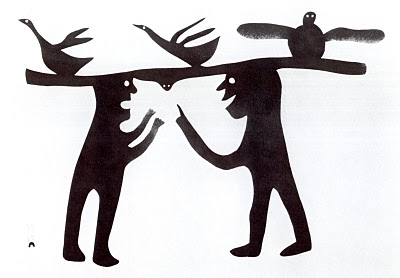
We listen to the Elders
I meet him on the land
goose-hunting
Today is Sunday, he says,
No-one is allowed to shoot
That’s what the Elders say
And we listen to the Elders…
sometimes.
*
A flock of geese is coming
fighting against the wind
He takes a rifle
and shoots at them
One falls to the ground
the others fly away
– Well, it is Sunday
*
A flock of ptarmigans
jumps in a circle around us
no cries are heard
They are afraid, the elder says,
the owls are out hunting
and the ptarmigans seek protection among Men
– so We don’t hunt Them,
that’s what the Elders say.
And We listen to the Elders…
sometimes.
_____
Utoqqartavut naalattarpavut
Nunap timaani naapippara nerlerniaq
– utoqqartatta oqaappaatigut
“Ullumi sapaat
taamaammat aallaaniassanngilagut”
Utoqqaammi oqartapata
naalattarpavut – ilaanni
*
Nerlerpaaluit assorlutik timmisut qulaappaatigut
aallaaniap timmiarsiunni kiviinnaqaa
ummiullugillu
seqqoqaaq
ataasersuaq nakkaqaaq
sinneri ingerlaannarput
– ullumi sapaat
*
Aqisserpalaaq tusiuppoq
eqqannguatsinnut mipput
kaavillutalu
Utoqqartarput pilerpoq
“Aqissit uppinnit piniarneqartillutik
inunnut qimaasaramik
Nujuillisaaraangata
aallaaiarneq ajorpavut”
Utoqqaammi oqarpata
naalaattarpavut – ilaanni
_____
“But the blooming words declare the storm with bravery”: Five 21st-century Iranian women poets
Posted: March 31, 2012 Filed under: A FEW FAVOURITES / UNA MUESTRA DE FAVORITOS, English, Farsi / Persian, Fereshteh Sari, Five 21st-century Iranian women poets, Nasrin Behjati, Nasrin Ranjbar Irani, Pegah Ahmadi, Sylvana Salmanpour Comments Off on “But the blooming words declare the storm with bravery”: Five 21st-century Iranian women poets
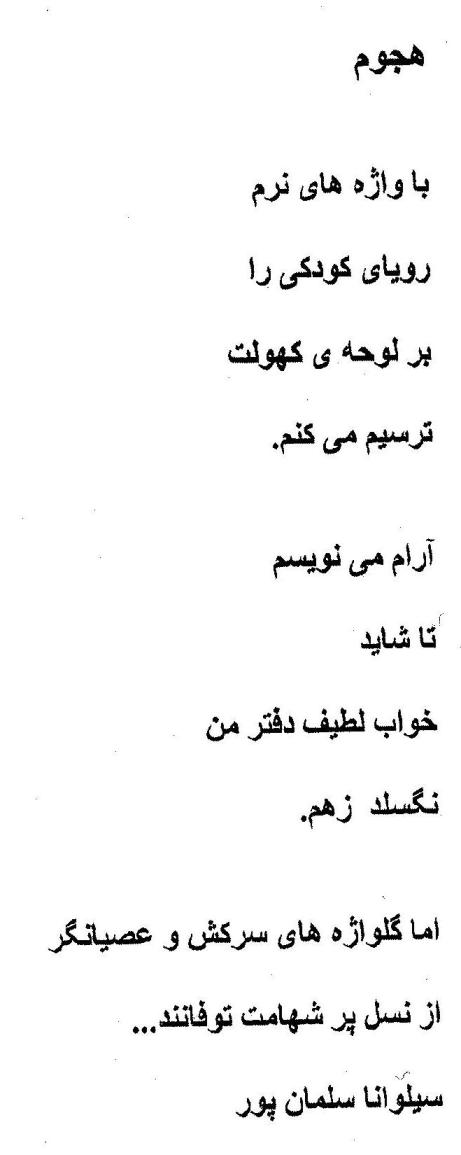
“A Rush” by Sylvana Salmanpour
With soft words
I draw a childhood dream
on a nascent memory.
I write in peace
so that the silky dream of the notebook
will not tear apart.
But the blooming words declare
the storm with bravery.
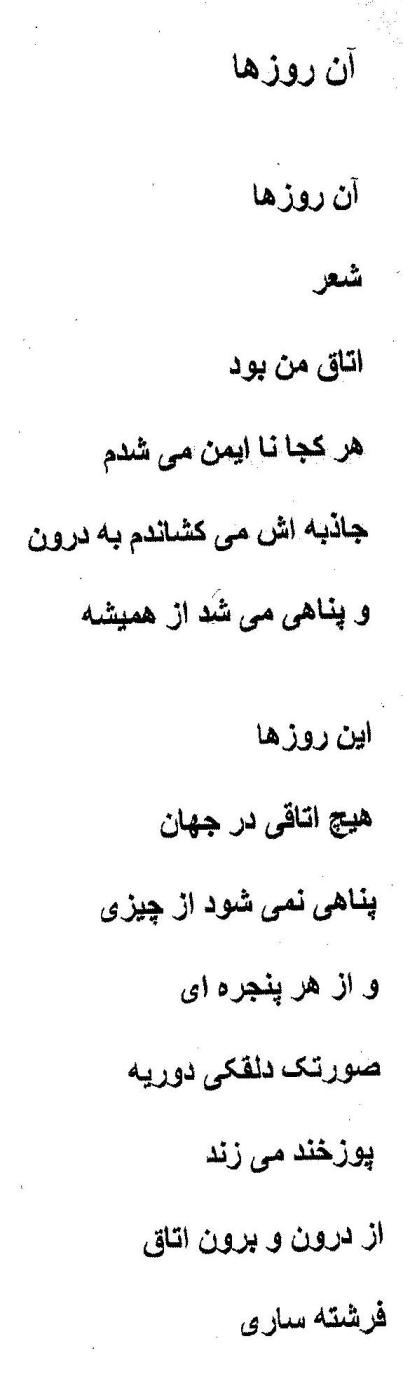
“Those Days” by Fereshteh Sari
Those days
Poetry
was my room
and wherever I felt unsafe
I gravitated into its eternal sanctuary.
These days
there aren’t any rooms
that can harbour me against the crowd
and behind every window
inside and outside every room
a two-faced clown sneers.
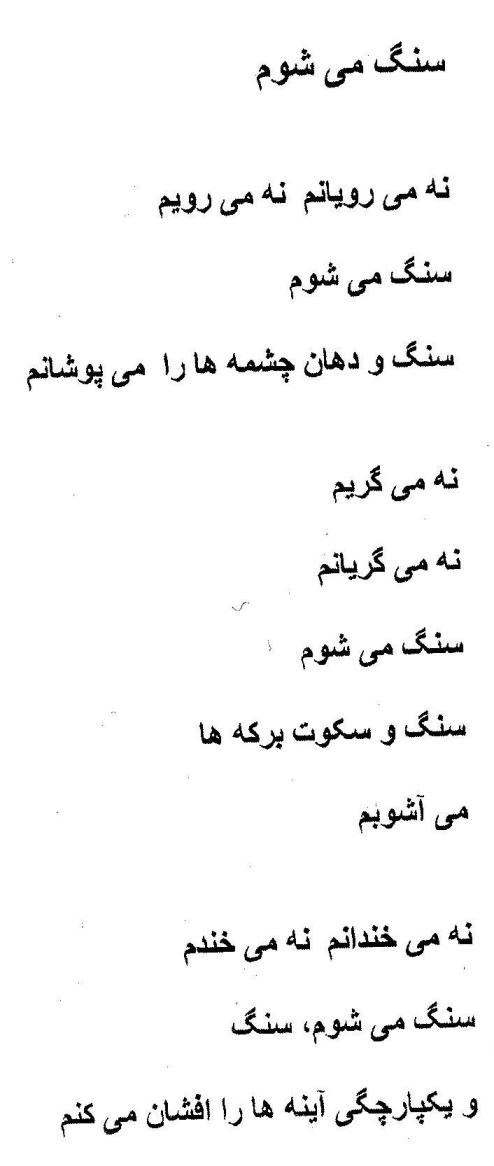
“The Stone I become” by Nasrin Ranjbar Irani
I do not grow or nurture
the stone, I become
the stone
I mask the spring’s mouth
I do not cry or distress others
The Rock, I become
The Rock
that intrudes into the peaceful pond
Neither do I laugh nor do I want others to laugh
The stone, I become
the stone and I shatter the mirrors.
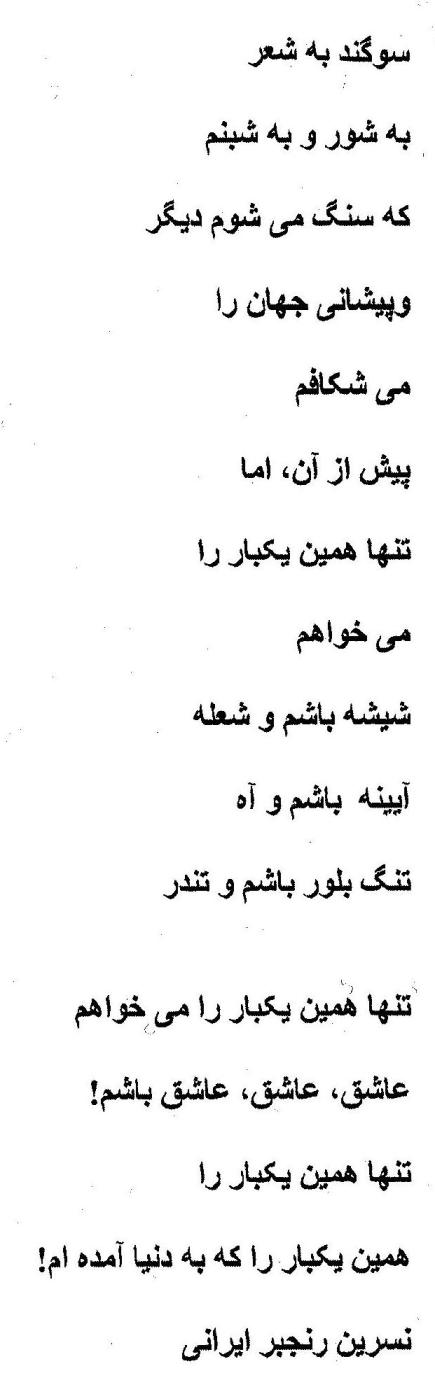
To poetry
I vow, to joy, to dew,
that I will be a stone again
an undeniable slash across the brow
But before these all
I want to be
the glass
the flame
the mirror
Ah! A crystal ball
and the spring rain…
Once and Only Once
To be in love, in love, in love
in this lifetime,
Once and Only Once!
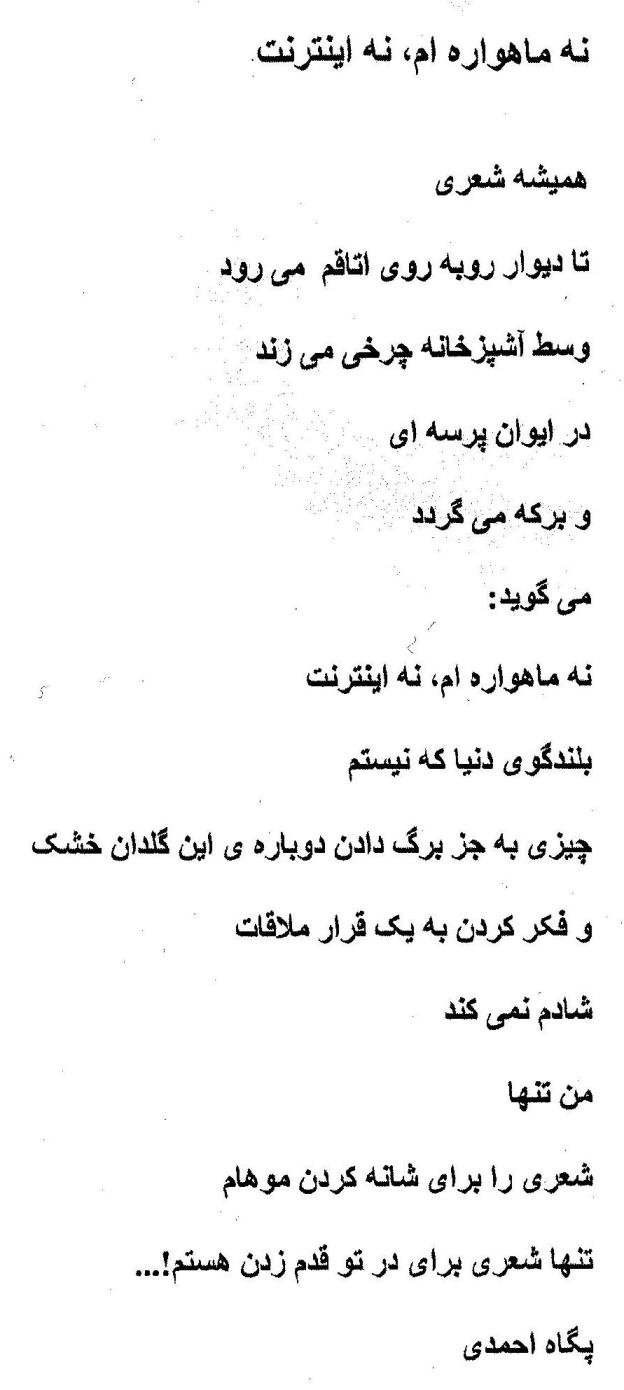
“Neither a Satellite nor the Internet” by Pegah Ahmadi
A poem ambles across the wall
forever and a day
In the heart of the kitchen it spins,
spins on the porch
And when it returns
It utters:
Neither a Satellite nor the Internet
I am not the universal Media
Nothing but a new leaf on this arid plant
Or the thought of a rendezvous
Makes me rejoice
I am only a poem to brush your hair
A poem to pass through you!
“A Day without You” by Nasrin Behjati
And I commenced my day
Without you or your name
I spilled you out of my tea
Out of my breakfast
From the kitchen
And I didn’t nurture the plants…
so that I could witness your rage,
Your name from autumn
The autumn from the field
And the field from the poems, I
removed
I heaved you out of my memories and
the seasons and I walked to the mirror
To cut short the locks you loved so,
Alas! In the mirror a sunflower reflected
Your unkind frame,
Outlined my face forevermore,
I had become you!
_____
The poems featured here from five Iranian women poets were translated
from Persian (Farsi) into English by Sheema Kalbasi.
Visit her literary site: http://www.sheemakalbasi.com
Poems for Saint Patrick’s Day: Love and The Poet / Poemas para el Día de San Patricio: Amor y El Poeta
Posted: March 17, 2012 Filed under: English, Poemas para el Día de San Patricio: Amor y el Poeta, Spanish, William Butler Yeats, ZP Translator: Alexander Best | Tags: Saint Patrick's Day Poems Comments Off on Poems for Saint Patrick’s Day: Love and The Poet / Poemas para el Día de San Patricio: Amor y El Poeta
William Butler Yeats (1865-1939)
“Memoria” (1919)
Una tenía la cara linda,
Y dos o tres eran encantadoras,
Pero cara y encanto fueron en vano
Porque la hierba de la sierra
Siempre conserva la forma
Donde se ha tendido la liebre del monte.
_____
“Canción de Muchacha” (1933)
Salí sola
Para cantar una canción o dos,
Se me antoja un hombre
Y usted sabe quien es.
*
Otro se apareció
que dependía de un bastón
Para estar de pié;
Me senté y lloré.
*
Y ésta fue toda mi canción
– cuando todo ha sido dicho
¿Vi a un anciano joven,
O a un joven anciano?
_____
“Canción para beber” (1910)
El vino entra vía la boca
Y el amor entra vía el ojo;
Es toda la verdad que sabremos
Antes de envejecer y morir.
Levanto el vaso a mi boca,
Te miro, y suspiro.
_____
“La Espuela” (1936)
Tu piensas que es horrible que lujuria y furia
Me adoran en la vejez…
No eran una peste cuando yo era joven;
¿Tengo algo más para espolearme cantar?
_____
“Un Voto Jurado en lo Más Profundo” (1919)
Habían otros – porque no cumpliste
Ese voto jurado en lo más profundo – que han sido amigos míos;
Pero siempre cuando miro a la muerte en la cara,
Cuando trepo a las cumbres de sueño,
O cuando me estremezco con el vino,
De súbito me encuentro con tu cara.
__________
William Butler Yeats (1865-1939)
“Memory” (1919)
One had a lovely face,
And two or three had charm,
But charm and face were in vain
Because the mountain grass
Cannot but keep the form
Where the mountain hare has lain.
_____
“Girl’s Song” (1933)
I went out alone
To sing a song or two,
My fancy on a man,
And you know who.
*
Another came in sight
That on a stick relied
To hold himself upright;
I sat and cried.
*
And that was all my song
– when everything is told,
Saw I an old man young
Or young man old?
_____
“Drinking Song” (1910)
Wine comes in at the mouth
And love comes in at the eye;
That’s all we shall know for truth
Before we grow old and die.
I lift the glass to my mouth,
I look at you, and I sigh.
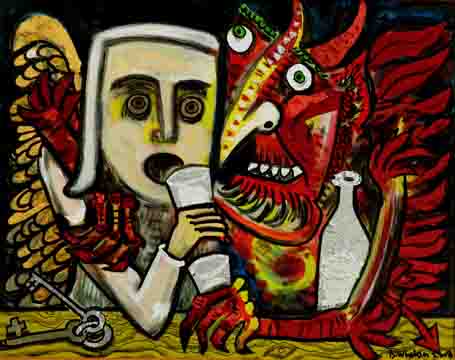
Poteen Drinkers by Brian Whelan_2011
“The Spur” (1936)
You think it horrible that lust and rage
Should dance attention upon my old age;
They were not such a plague when I was young;
What else have I to spur me into song?
_____
“A deep-sworn vow” (1919)
Others because you did not keep
That deep-sworn vow have been friends of mine;
Yet always when I look death in the face,
When I clamber to the heights of sleep,
Or when I grow excited with wine,
Suddenly I meet your face.
_____
Translation into Spanish /
Traducción en español: Alexander Best
Etta James: “Mi Fuerte Amante” / “Tough Lover”
Posted: February 28, 2012 Filed under: English: Black Canadian / American, Etta James, Spanish, Translator's Whimsy: Song Lyrics / Extravagancia del traductor: Letras de canciones traducidas por Alexander Best, ZP Translator: Lidia García Garay Comments Off on Etta James: “Mi Fuerte Amante” / “Tough Lover”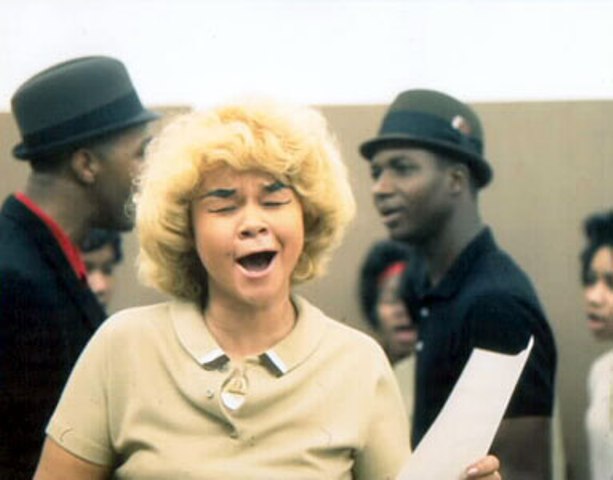
Etta James
“Mi Fuerte Amante” (1956)
Tengo un amante que me mueve tanto,
Sabe hacer ‘el rocanrol’,
Porque es fuerte – mi amante –
Es un amante vigoroso,
Amante recio,
Un amante fuerte – ¡eso es!
*
Cuando me besa,
Me emociona;
Cuando se sacude,
No me quedo quieta.
Es un amante vigoroso,
Amante recio,
Un amante fuerte – ¡aaah, sííí!
*
Las Siete Hermanas no lo pueden tener,
Estoy hablando acerca del Amor –
Y es veloz – él – como el viento.
Habla la gente que estoy enbrujada.
Pero no es el vudú – ¡es ese “twist”!
El Amante más grande de nuestra era,
Aún Don Juan no tiene ningun’esperanza.
Te hace reír,
Te hace llorar,
Se pone tan recio que
Pued’hacer a un’estatua de Venus resucitar.
Hace todo lo que quiera – aún:
Pisotear los zapatos de gamuza-azul de Jesse James.
Es un amante audaz,
y duro, y recio,
Un amante fuerte – ¡ajá, ajá!
*
¿Tienes amante que quieras amar?
¡Golpéale en la cabeza una vez – o dos!
Será tu amante vigoroso – ¡sí, sí! –
Un amante recio – ¡eso es!
Un amante fuerte – ¡aaah, sííí!
Glosario:
Las Siete Hermanas se llaman Las Pléyades – en la mitología griega.
Las dos más famosas – Electra y Maia – eran “Fuerzas de la Naturaleza”.
Jesse James era un forajido estadounidense de la era “Viejo Oeste”.
_____
Etta James (1938-2012)
escribió las letras y grabó esta canción
en 1956 – a la edad tierna de dieciocho años.
Su personalidad era fuerte y burlona pero pudo
cantar también la música íntima del Blues.
*
Traducción / interpretación en español: Lidia García Garay
_____
Etta James
“Tough Lover” (1956)
Well, I’ve got a lover that moves me so
He sho knows how to rock’n’roll
‘Cause he’s a tough lover – yeah, yeah
He’s a tough lover – wooooo
Tough Lover – yeah, yeah
Tough Lover – unh hunh!
*
When he kisses me
I get a thrill
But when he does that wiggle
I can’t keep still
‘Cause he’s a tough lover – yeah, yeah
He’s a tough lover – wooooo!
Tough Lover – yeah, yeah
Tough Lover – unh hunh!
*
The Seven Sisters have nothin’ on him
I’m talkin’ about love – and he’s fast as the wind
People all talk about he’s got me fixed
It ain’t hoodoo – it’s just that twist!
He’s the greatest lover ever come to pass
Don Juan ain’t got a half of a chance.
He can make you laugh
He can make you cry
He’s so tough he’ll make Venus come alive.
He can do anything that he wants to do –
Step on Jesse James’s blue-suede shoes
‘Cause he’s a tough lover – yeah, yeah
He’s a tough lover – wooooo!
Tough Lover – yeah, yeah
Tough Lover – unh hunh!
*
You got a lover
That you wanna love right?
Just pop him ’side the head
– Once or twice!
He’ll be a tough lover – yeah, yeah
He’ll be your tough lover – wooooo!
Tough lover – yeah, yeah
Tough lover – unh hunh!
_____
Etta James (1938-2012)
was a rock’n’roll “mama” even
at the tender age of 18, which is when she
wrote and recorded this song with her band,
The Peaches. Her vocal delivery was often
rough-and-tough in sound – but also full of
fun. The “wooooo’s” in her singing she
borrowed from Little Richard, with whom
she toured in the 1950s. By middle age she
was undisputedly the best living Blues singer
in The United States.
_____
Ataulfo Alves: “In a masquerade of Joy I hid my Sadness…”
Posted: February 20, 2012 Filed under: Ataulfo Alves, English, Portuguese, Translator's Whimsy: Song Lyrics / Extravagancia del traductor: Letras de canciones traducidas por Alexander Best, ZP Translator: Alexander Best | Tags: Black poets, Poetas negros Comments Off on Ataulfo Alves: “In a masquerade of Joy I hid my Sadness…”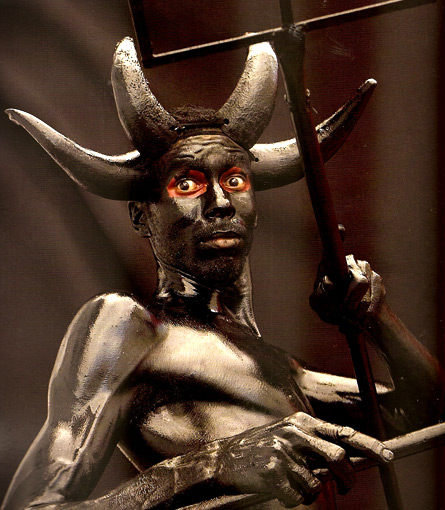
Ataulfo Alves (Sambista brasileiro, 1906-1969)
“Ilusão de carnaval”
.
Mascarado de alegria
Escondi minha tristeza
Terminada a folia
Sou mais triste com certeza
Ilusão de carnaval
Enganei somente a mim
Sem pensar que afinal
Carnaval também tem fim.
*
Ataulfo Alves
(Brazilian Samba composer, 1906-1969)
“Carnival Illusion”
.
In a masquerade of Joy
I hid my Sadness.
Revelry done,
More sad than ever
Am I…
.
You Illusion – oh Carnival !
I merely tricked myself
Without thinking that,
After all,
Carnival too comes to an end.
.
Translation from Portuguese:
Alexander Best

Djavan: “Face of the Indian” / “Cara de Índio”
Posted: February 19, 2012 Filed under: Djavan, English, Portuguese, Translator's Whimsy: Song Lyrics / Extravagancia del traductor: Letras de canciones traducidas por Alexander Best, ZP Translator: Alexander Best | Tags: Black poets Comments Off on Djavan: “Face of the Indian” / “Cara de Índio”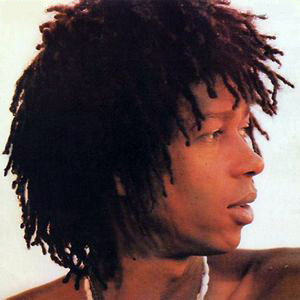
Letra da canção de
cantor e compositor afrobrasileiro
Djavan (nasce 1949)
“Cara de Índio”(1978)
Índio cara pálida,
cara de índio.
Índio cara pálida,
cara de índio.
Sua ação é válida, meu caro índio.
Sua ação é válida, válida ao índio.
Nessa terra tudo dá,
terra de índio.
Nessa terra tudo dá,
não para o índio.
Quando alguém puder plantar,
quem sabe índio.
Quando alguém puder plantar,
não é índio.
Índio quer se nomear,
nome de índio.
Índio quer se nomear,
duvido índio.
Isso pode demorar,
te cuida índio.
Isso pode demorar,
coisa de índio.
*
Índio sua pipoca,
tá pouca índio.
Índio quer pipoca,
te toca índio.
Se o índio se tocar,
touca de índio.
Se o índio toca,
não chove índio.
Se quer abrir a boca,
pra sorrir índio.
Se quer abrir a boca,
na toca índio.
*
A minha também tá pouca,
cota de índio.
Apesar da minha roupa,
também sou índio.
_____
Djavan
(Brazilian songwriter, born 1949)
“The Indian Face” (1978)
Indio pale-face
Indian face.
Pale-face Indio
Your action is just, my dear Indio.
Your action is valid, right for the Indian.
In that land everything grows
– the Indian’s land.
In that land everything grows
– but not for the Indian.
When someone can plant,
who knows? The Indio.
When someone inspires,
Isn’t it the Indio?
An Indian wants to call himself
an Indian name.
Indio wants to call himself himself
– I doubt it, Indio
– that might take time – take care,
That might take time,
The Indian thing.
*
Indio gets just
A little “popcorn”.
He wants “popcorn” too
– it’s your turn, Indio.
If the Indian touches his head
it doesn’t rain.
If he wants to open his mouth
– Smile, Indio.
If he wants to open his mouth,
Don’t touch him.
*
I also have little,
An Indian’s share.
Despite my clothes,
I’m an Indio, too.
_____
Jorge Ben Jor: Day of the Indian / Dia de Índio
Posted: February 19, 2012 Filed under: English, Jorge Ben Jor, Portuguese, Translator's Whimsy: Song Lyrics / Extravagancia del traductor: Letras de canciones traducidas por Alexander Best | Tags: Black poets Comments Off on Jorge Ben Jor: Day of the Indian / Dia de Índio_____
Jorge Ben Jor (nasce 1942)
“Curumin chama cunhãtã que eu vou contar
(Todo dia era Dia de Índio)” (1981)
Hey Hey Hey!
Hey Hey Hey!
Jês, Kariris, Karajás, Tukanos, Caraíbas,
Makus, Nambikwaras, Tupis, Bororós,
Guaranis, Kaiowa, Ñandeva, YemiKruia
Yanomá, Waurá, Kamayurá, Iawalapiti,
Txikão, Txu-Karramãe, Xokren, Xikrin,
Krahô, Ramkokamenkrá, Suyá !
*
Curumim chama cunhatã que eu vou contar
Cunhatã chama curumim que eu vou contar
Curumim, cunhatã
Cunhatã, curumim
*
Antes que os homens aqui pisassem
Nas ricas e férteis terraes brazilis
Que eram povoadas e amadas por milhões de índios
Reais donos felizes
Da terra do pau-brasil
Pois todo dia, toda hora, era dia de índio
Pois todo dia, toda hora, era dia de índio
*
Mas agora eles só têm um dia
O dia dezenove de abril…
Amantes da pureza e da natureza
Eles são de verdade incapazes
De maltratarem as fêmeas
Ou de poluir o rio, o céu e o mar
Protegendo o equilíbrio ecológico
Da terra, fauna e flora.
Pois na sua história, o índio
É o exemplo mais puro
Mais perfeito, mais belo
Junto da harmonia da fraternidade.
É da alegria,
Da alegria de viver
Da alegria de amar.
Mas no entanto agora
O seu canto de guerra
É um choro de uma raça inocente…
Que já foi muito contente
Pois antigamente
Todo dia, toda hora, era dia de índio.
*
Jês, Kariris, Karajás, Tukanos, Caraíbas,
Makus, Nambikwaras, Tupis, Bororós,
Guaranis, Kaiowa, Ñandeva, YemiKruia
Yanomá, Waurá, Kamayurá, Iawalapiti, Suyá,
Txikão, Txu-Karramãe, Xokren, Xikrin, Krahô,
Ramkokamenkrá, Suyá !
*
Todo dia, toda hora, era dia de índio…..
Curumim, cunhatã / Hey! Hey! Hey!
Hey! Hey! Hey! / Cunhatã, curumim…..
_____
Jorge Ben Jor
“Every day, every hour, was the Day of the Indian”
Hey Hey Hey!
Hey Hey Hey!
Jês, Kariris, Karajás, Tukanos, Caraíbas,
Makus, Nambikwaras, Tupis, Bororós,
Guaranis, Kaiowa, Ñandeva, YemiKruia
Yanomá, Waurá, Kamayurá, Iawalapiti,
Suyá, Txikão, Txu-Karramãe, Xokren, Xikrin,
Krahô, Ramkokamenkrá, Suyá !
*
Call: “Curumim cunhatã” – I’m going to tell it.
Cry: “Cunhatã curumim” is how I’m going to tell it.
Curumim, cunhatã
Cunhatã, curumim
*
Before people trod here
Upon this rich and fertile land of Brazil
It was populated and loved by millions of Indians,
Happy moneyless owners
Of this land of “Brazil-wood”.
Back then, every day, every hour, was the Day of the Indian.
But now they have only one day,
The 19th of April…
*
Lovers of purity, of nature,
They knew truth, incapable of
Mistreating Woman
Or of polluting river, sky and sea,
Protecting the ecological equilibrium
Of earth, flora and fauna.
And so, in history, the Indio
Is an exemplar most pure,
Perfect and beautiful.
Together in the harmony of humanity
He gives joy – joy of life, joy of love.
Now, though, theirs is a war song – and it’s
The cry of an innocent race…
In olden times they were most happy because
Every day, every hour, was the Day of the Indian.
*
Jês, Kariris, Karajás, Tukanos, Caraíbas,
Makus, Nambikwaras, Tupis, Bororós,
Guaranis, Kaiowa, Ñandeva, YemiKruia
Yanomá, Waurá, Kamayurá, Iawalapiti,
Txikão, Txu-Karramãe, Xokren, Xikrin,
Krahô, Ramkokamenkrá, Suyá !
*
Every day, every hour, was the Day of the Indian.
Curumim, cunhatã / Hey! Hey! Hey!
Hey! Hey! Hey! / Cunhatã, curumim…..
_____
Glossary:
Jês, Kariris, Karajás, Tukanos, Caraíbas, etc.,
– Ben gives us a list of names of the
Indian/Indigenous/Native Peoples of Brazil
The 19th of April – throughout Latin and South America,
this day – Dia Americano del Indio – draws attention to the
cultures, struggles and progress of Indigenous Peoples;
initiated in 1940 at Pátzcuaro, México, during the first
“Congreso Indigenista Interamericano”
/ InterAmerican Indigenous Congress
Poemas de Amor del idioma zapoteco
Posted: February 14, 2012 Filed under: English, Poemas de Amor del idioma zapoteco, Spanish, Victor Terán, Zapotec | Tags: Love poems, Poemas de Amor Comments Off on Poemas de Amor del idioma zapoteco
Victor Terán
(nace 1958, Juchitán, Oaxaca, México;
Idioma: Zapoteco Istmeño / Language:
Isthmus Zapotec)
Lu ti nagana
Lu ti neza
chupa ná’
nagu’xhugá
zuguaa’.
Tobi ri’
nadxii naa,
xtobi ca
nadxiee laa.
Nisaguié,
nisaguié,
gudiibixendxe
ladxiduá’.
Gubidxaguié’,
gubidxaguié’,
binduuba’ gu’xhu’
ndaani’ bizaluá’.
_____
Duda
Sobre un camino
Que se bifurca,
Confundido
Me hallo.
Ésta
Me ama,
Aquella la amo.
Lluvia,
Lluvia,
Lava con mucho esmero
El alma mía.
Sol en flor,
Sol en flor,
Barre el humo
De mis ojos.
_____
Indecision
Upon a road
which forks,
confused
I stand.
One woman
loves me,
another
I love.
Rain,
rain,
meticulously cleanse
my soul.
The blossoming sun,
the blossoming sun,
sweep the smoke
from my eyes.
_____ _____ _____
Biluxe
Biluxe
Ne ngasi nga laani.
Lu neza zadxaagalulu’
Ca ni bidxagalú cou’
Biá’ dxi
Gúcalu’ bandá’ xtibe;
Ti bi’cu’, ti bihui,
Ti binni.
Gasti’ zadxaa
Ne laaca ca bigose
Guxhuuna’ íquelu’
Gusiquichi ique badunguiiu
Bichaabe lii.
Ne laaca decheyoo
Bizucánelu’ laabe
Gusicabe guendarusiaanda’ xtibe.
Gasti’ zadxaa.
Lii siou’ nga zusácalu’
Guidxilayú ma qui gapa
Xiñee guireexieque,
Ma qui gapa xiñee
quiidxi guendanabani.
Ne zoyaalu’ guendanabani xtilu’,
Ladxido’lo zapapa
Bia’ qui guchendaxhiaasi layú,
Ne nalu’ ne ñeelu’
Zusiaandu’ laaca’,
Qui zánnalu paraa zuhuaalu’,
Ne nisi lulu’, nisi nalu’
Zaniibihuati guiá’ ne guete’.
_____
Se acabó
Se acabó
y eso es todo.
Sobre tus pasos encontrarás
las cosas mismas que hallaste
durante los días
que fuiste su sombre;
Un perro , un cerdo,
una persona.
Nada cambiará
y los mismos zanates
que te ensuciaron la cabeza
blanquearán la del joven
que tomó tu lugar.
Y detrás de la casa
donde se recostaban
ella asentará su olvido.
Nada cambiará,
sin embargo supondrás
que no tiene sentido ya
el movimiento de la tierra,
ya no existen motivos
para afferarse a la vida.
Y morderás tu hombría,
tu corazón vibrará
con las alas a punto de golpear la tierra,
y tus brazos y tus piernas
los pondrás en el olvido,
perdido en tu sitio
te verás moviendo tontamente
los ojos y los brazos de norte a sur.
_____
It’s Over
It’s over…
and that is all.
Along your pathway you will find
the same things you discovered
during the days when you were her shadow:
A dog, a pig,
A person.
Nothing will change…
And the same “zanates”(little crows)
that soiled your head
will whiten that of the young man
who took your place.
And behind the house
where you and she
used to lie,
she will lay down her memory.
Nothing will change…
However, you will think
that the earth’s movement
no longer makes any sense,
that there are no more reasons
to cling to life.
And you will swallow your manly pride;
your heart will pulsate,
its wings nearly striking the ground,
and your arms and legs
will be caste into oblivion…
Lost within your space,
you will find yourself
foolishly moving your eyes and arms
from north to south.
_____
Traducciones del zapoteco al español: el poeta
Translations from Zapotec into Spanish: the poet
Traducciones del español al inglés /
Translations from Spanish into English:
© Carlos Montemayor, Donald Frischmann, 2004

Poemas de Amor del idioma maya
Posted: February 14, 2012 Filed under: English, Gerardo Can Pat, Maya, Poemas de Amor del idioma maya, Spanish | Tags: Love poems, Poemas de Amor Comments Off on Poemas de Amor del idioma maya
Gerardo Can Pat (1957-1994,
Tibolón, Yucatán, México;
Idioma: Maya / Language: Maya)
Teech yeten teen
Wey yóok’olkaabe’ teech yéeten teen,
ka’atulo’on tyo’lal yaakunal núupo’on,
in yaakumech teche’a k’áaten,
yaakumabaa ka’ach to’on ka’atulo’on.
*
Teche’ mina’anech tin wiknal nejla’e’,
le yaakunale’ p’áat chen túun bejla’e’,
ba’ale’ tene’ leyli’ tin pa’tike’,
le yaabilaj ma’ táan dzikteno’.
*
Ka’atulo’on t-wayak’taj ya’ankach ba’alo’ob,
ti’ junp’éel lu’umkabil k-ti’al ka’atulo’on,
mix jach chichani’ mix jach nojochi’,
tu p’iis u ti’al k-yaakuntikbaa ka’achij.
*
Jaytéenak táan k-máan in lochmaj a kaal,
jaytéenak ta wa’ajten a yaakumajen,
le o’olal chan junp’éel ba’al in wojel,
teche’ mixbiik’in ken a tu’ubsilen.
*
Tin dzajtech u dzook ba’ax yaan tene’,
in yaakunal yéeten mis juntuusil,
ba’ale’ teche’ we’ek’ech men sajkil,
le o’olal bejla’e’ bey ma’ k’ajobae’.
*
Wa ti’ junp’éel k’iin ku suut a tuukule’,
wek’ a sajkilil ki’imakunta wóod,
tumen in sa’as tech’ mina’an mixba’al,
juntulili’on tu ka’atéen k’p’áatal.
_____
Tú y yo
En el mundo tú y yo
fuimos hechos inseparables por el amor.
Igual que tú, yo te amo,
juntos el amor nos hizo.
*
Juntos muchas cosas soñamos:
un mundo sólo para nosotros,
no grande ni pequeño,
exacto para este amor.
*
¡Cuántas veces caminamos, abrazándonos,
y tú diciendo que me amabas!
Sólo una cosa sé:
no has de olvidarme.
*
Te entregué lo que tenía:
mi amor sin un solo engaño.
Hoy el miedo te ha derrotado
y por eso parecemos desconocidos.
*
Pero si algún día tuvieras firme otra vez
el pensamiento
y vencieras este miedo, escucha:
no tengo nada que perdonarte,
otra vez seremos los dos uno solo.
_____
You and I
In this world, you and I
were made inseparable by love.
Just as you love me, I love you.
Love made us as one.
*
Together, we dreamed of many things:
a world just for us…
not large or small,
but just right for this love.
*
How many times we walked,
our arms around each other
– and you saying you loved me!
I know just one thing:
you will not forget me.
*
I gave you all that I had:
my love, without deceit.
Today fear has overcome you
and we are like strangers.
*
But if some day you were to
recover your reason
and overcome this fear, remember:
I have nothing to forgive you for;
we will again be as one.
_____
Taan a bin
In wojel ta bin, mixbik’in suunakech,
ma’alob xen ta beel, min tuklil in k’áastikech,
in dzíibolale’, ka’a anchak máax yaakuntikech,
wa le ka tuklil, le te’e ku binitiktech.
*
Ma’tuklil tyo’lal, wa kin p’áatal tin juunal,
kex mixmáak yaanten, ka’a páatak u náayskinwóol,
ma’ táan u páajtal, in k’at-óoltik u laak’ ba’al,
xi iktech ma’alobil x-ch’úupal ki’imakchak a wóol.
*
Kex túun yajtin wóol, tyo’lal tun tan a p’atken
ma’ tin tuklaje’, wa bey ken a beetiten,
tyo’lal óotzilen, lebeetik ma’ yakuntken,
wa túun ta bine’, mix u suut a wich ti’ ten.
*
In k’áat-óolale’, xi’iktech yéeten ya’ab utzil,
tumen tin wicho’obe’ táan u yalkab u ja’il,
tyo’lal mixbik’in bin suunaken in wilech,
tu xu’upul in wiik’, tu bin xan in kuxtalil.
*
Teche’ táan a bin. Tene’kin p’áatal.
_____
Te vas
Yo sé que te vas y no regresarás.
Si, prosigue tu camino, que no te detendré.
Ojalá haya quien te quiera,
si acaso eso te falta.
*
No pienses que si quedo solo
no tendré a nadie que me consuele.
¿Que más pudo desear para ti?
Que estés bien, que seas dichosa.
*
Me lastima que te alejes,
pues nunca pensé que esto hicieras.
Si por mi pobreza te vas,
ni siquiera a mirarme vuelvas.
*
Pero deseo que te vaya bien.
Corren lágrimas ahora en estos ojos
que nunca te volverán a ver.
Se me acaba el aire junto con mi vida.
*
Te vas, yo me quedo.
_____
You Are Leaving
I know that you are leaving and will not return.
Yes, follow your path, I won’t stop you.
I hope there will be someone to love you,
if that is what you need.
*
Don’t think that if I am left alone
I won’t have anyone to console me.
What more can I wish you
– but that you be well, be happy?
*
It hurts me that you are going away,
since I never thought you would.
If you are leaving because I’m poor,
don’t even look back.
*
But I hope things go well for you.
Tears now run from these eyes
that will never see you again.
My breath and my life are running out…
*
You are leaving, I am staying.
_____
Traducciones del maya al español y inglés:
Translations from Maya into Spanish and English:
© Carlos Montemayor, Donald Frischmann, 2004
Bob Marley: ¡Despierten y Vivan! / Wake Up and Live!
Posted: February 6, 2012 Filed under: Bob Marley, English, Spanish, Translator's Whimsy: Song Lyrics / Extravagancia del traductor: Letras de canciones traducidas por Alexander Best, ZP Translator: Alexander Best | Tags: Black poets Comments Off on Bob Marley: ¡Despierten y Vivan! / Wake Up and Live!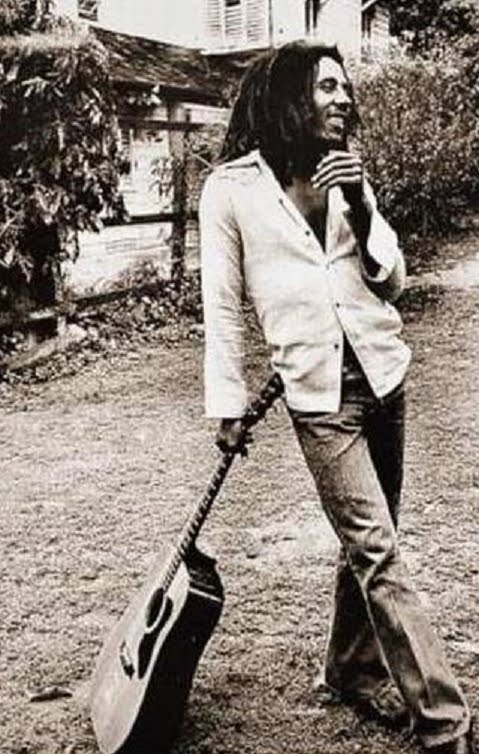
“Wake up and Live!”
Wake up and live, y’all,
Wake up and live,
Wake up and live now,
Wake up and live!
*
Me say: Life is one big road with lots of signs,
So when you riding through the ruts,
Don’t you complicate your mind.
Flee from hate, mischief and jealousy,
Don’t bury your thoughts
– put your vision to reality, yeah!
*
All together now:
Wake up and live, y’all,
Wake up and live,
Wake up and live now,
Wake up and live!
*
Rise, ye mighty people,
There’s work to be done.
So let’s do it, a little by little.
Rise from your sleepless slumber, yeah!
We’re more than sand on the seashore,
We’re more than numbers.
*
All together now:
Wake up and live, y’all,
Wake up and live,
Wake up and live now,
Wake up and live!
*
Woah, one-one cocoa full a basket,
When you use to live big today –
tomorrow you buried in a casket.
One-one cocoa full a basket, yeah,
When you use to live big today –
Tomorrow: buried in a casket!
*
All together now:
Wake up and live, y’all,
Wake up and live,
Wake up and live now,
Wake up and live!
_____
¡Despierten y Vivan!
Despierten y vivan, todos ustedes,
Despierta y vive,
Despierta y vive ahora,
Despierta y vive!
*
Digo: La vida es un camino grande con un montón de signos,
Así que cuando montas a caballo a través de los surcos,
no te complicas la mente.
Huid de odio, maldad y los celos –
No entierres los pensamientos,
ponga su visión en realidad, ¡sí!
*
Despierten y vivan, todos ustedes,
Despierta y vive,
Despierta y vive ahora,
Despierta y vive!
*
Aumenten, ustedes-los-poderosos,
Hay trabajo por hacer,
Así que vamos a hacerlo, poco a poco.
Aumente del sueño sin dormir, sí, sí,
Somos mucho más que arena en la orilla del mar,
Somos mucho más que unos números.
*
Todos juntos ahora:
Despierten y vivan, todos ustedes,
Despierta y vive,
Despierta y vive ahora,
¡Despierta y vive!
*
¿No lo ves? Una pila de cacao en una canasta,
Cuando estás viviendo “a lo grande” hoy día –
Mañana, ¡serás enterrado en un ataúd!
¿No lo ves? Una pila de cacao en una canasta,
Cuando estás viviendo “a lo grande” hoy día –
Mañana, ¡serás enterrado en un ataúd!
*
Todos juntos ahora:
Despierten y vivan, todos ustedes,
Despierta y vive,
Despierta y vive ahora,
¡Despierta y vive!
_____
Letras de una canción de 1979 – del poeta-músico
jamaicano Robert Nesta Marley a.k.a. Bob Marley
(6 febrero, 1945 – mayo 1981)
Traducción del inglés al español: Alexander Best
*
Song lyrics from 1979 by Jamaican poet and musician
Robert Nesta Marley a.k.a. Bob Marley
(February 6th, 1945 – May 1981)
Translation into Spanish: Alexander Best
_____
 Zócalo Poets