“Soledad” por Robert Hayden
Posted: September 26, 2011 Filed under: English, Robert Hayden, Spanish | Tags: Black poets Comments Off on “Soledad” por Robert Hayden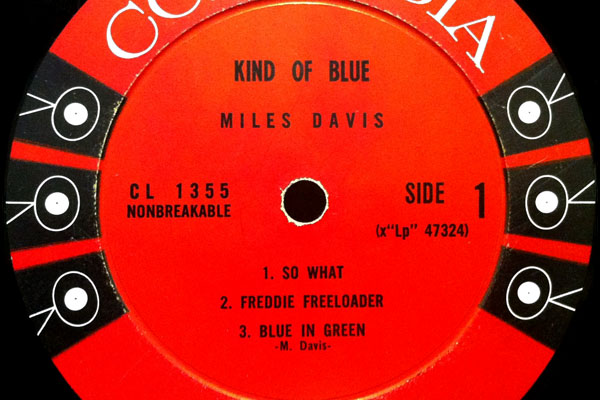
Robert Hayden
“Soledad”
.
Naked he lies in the blinded room,
chain-smoking, cradled by drugs, by jazz,
as never by any lover’s cradling flesh.
Miles Davis coolly blows for him,
oh pena negra *, sensual flamenco blues!
The redclay foxfire voice of Lady Day,
Lady of the pure black magnolias,
sobsings her sorrow and loss and fare ye well,
dryweeps the pain his treacherous jailors have
released him from for a while.
His fears and his unfinished self await him
down in the anywhere streets.
He hides on the dark side of the moon,
takes refuge in a stainedglass cell,
flees to a caulkless country of crystal.
Only the ghost of Lady Day
knows where he is, only the music, and he
swings those swings beyond
complete immortal now.
.
* pena negra – black sorrow/struggle
. . .
Robert Hayden
“Soledad”
.
Él, desnudo, está tendido en el cuarto con persianas,
fumando cigarillos, uno tras otro, acunado por la droga,
por el Jazz, como nunca por la piel de ningún amante.
Miles Davis* “toca” frescamente por él, ¡ay, pena negra, el
blues flamenco-sensual!
La voz arcilla-rojo – fuego-zorro, de Lady Day**,
Dama de las magnolias puras-negras,
solloza-canta su dolor y pérdida y
¡qué-será-será/hasta-luego!,
seca-llora la pena de cuál cosa
él está liberado por sus carceleros traicioneros.
Sus miedos y su ser incompleto
le esperan bajo en las calles de alguna parte.
Se esconde en el lado oscuro de la luna,
busca un refugio en una celda de cristal de colores,
huye a un país cristalino.
Solo sabe donde él está el espíritu de Lady Day,
solo sabe la música, y él
columpia el columpio,
danza el “swing”
más allá de
Ahora inmortal-total.
.
* Miles Davis: Trompetista negro-americano del jazz “cool”
** Lady Day: Billie Holiday – Cantante negra-americana del jazz, blues y pop
Traducción al español: Alexander Best
_____
Robert Hayden (1913-1980) was a Black-American poet
born in Detroit. His first book, Heart-Shape in the Dust,
from 1940, is based on life in the “Paradise Valley” slum.
In 1944 he joined Fisk College where he taught for more
than twenty years as professor of English, followed by
a decade at University of Michigan.
Hayden’s 1971 poem, “Soledad” (Loneliness, Solitude), is
about a friend – and drug addiction.
Frederick Ward – on Africville
Posted: September 25, 2011 Filed under: English: Black Canadian / American, Frederick Ward | Tags: Black poets Comments Off on Frederick Ward – on Africville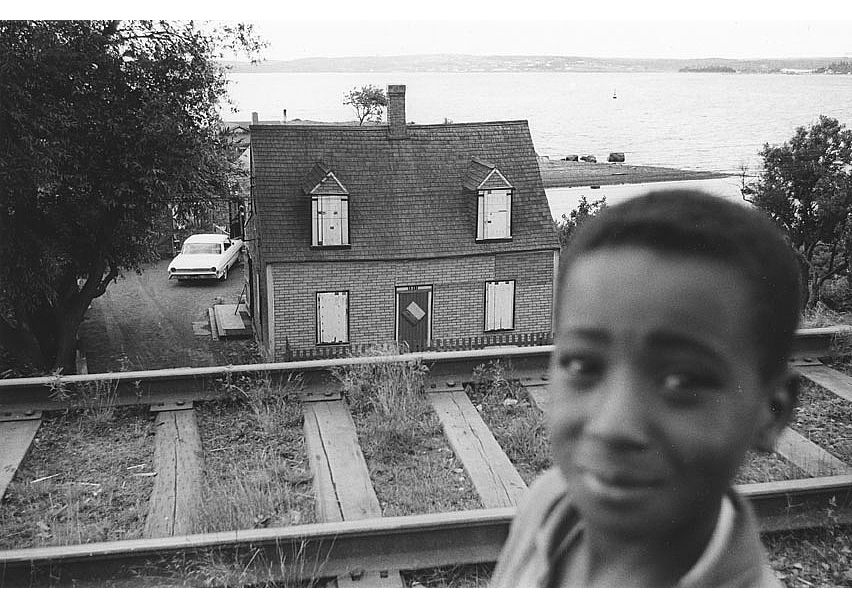
Dialogue # 3: Old Man (to the Squatter)
.
– Listen here, son. Did you think this were gonna work ?
Were you fool enough to think this were gonna work ?
They ain’t gonna let us put nothing up like that and
leave it. They don’t intend to let us git it back. You
ain’t a place. Africville is us. When we go to git a
job, what they ask us ? Where we from … and if we say
we from Africville, we are Africville ! And we don’t git
no job. It ain’t no place, son. It were their purpose to
git rid of us and you believed they done it – could do it !
You think they destroyed something. They ain’t. They
took away the place. But it come’d round, though. Now that
culture come’d round. They don’t just go out there and
find anybody to talk about Africville, they run find us,
show us off – them that’ll still talk, cause we Africville.
NOT – NO – SHACK – ON – NO – KNOLL.
That ain’t the purpose …fer
whilst your edifice is forgone destroyed, its splinters
will cry out: We still here ! Think on it, son. You effort
will infix hope in the heart of every peoples. Yet,
let’s see this thing clearer. If our folk see you in the
suit, we may git the idea we can wear it. The suit might
fall apart, but, son, it be of no notice. We need the
example. Now go back …and put you dwelling up again.
_____
Frederick Ward has been described as “the most
undeservedly unsung poet in all of English-Canadian
literature” (Arc Poetry Magazine).
Born in 1937 in Kansas City, Missouri, the Black-American Ward
came to Canada in 1970 – just passing through Halifax – and
ended up staying. There he me met Black Nova Scotians recently
turfed out of their old community – Africville – which was
bulldozed by the city to make way for a dumpsite. Their stories
became the basis of his 1974 novel, Riverlisp: Black Memories.
The poem above is from Ward’s 1983 poetry collection,
The Curing Berry.
Ward now lives in Montreal where he is a theatre teacher at
Dawson College.
_____
Photograph: Young boy with, in the background, Ralph Jones’ house boarded up for demolition
(Africville, Halifax, Nova Scotia, Canada – photo by Bob Brooks – year: 1965)


¡ Xoloitzcuintle soy !
Posted: September 16, 2011 Filed under: Alexander Best, English, Náhuatl Comments Off on ¡ Xoloitzcuintle soy !_____
¡ Xoloitzcuintle soy !
Xoloitzcuintle am I !
The Original Dog of The Americas
and
The Royal Dog of the Aztecs !
I am famed for my smooth skin, my energy,
a playful mind and affectionate nature.
I have lasted to this day…
*
No other animal has stood – sunburnt –
atop the temple of Teotihuacán.
I have quivered beside immense, reclining Chac-Mool,
when his belly-bowl was full of fresh blood.
I have splashed in Xochimilco with royal maidens;
I have floated in salty Zumpango with wrinkled old priests.
*
I have tried to snatch the gold pellets tossed by my Master
when He plays patolli; I have leapt for the ball
when it bounces off the buttocks of nobles engaged in
games of tlachtli.
*
I have licked the copal-xocotl from His divine ankles,
when Moctezuma emerged from His temazcal;
I have nuzzled His armpits inside His bed-chamber,
wearing my collar of quetzal plumes.
*
I have pricked my paws on metl thorns,
trying to sniff out chinicuiles to eat; singed them
while stealing tlaxcalli off the comal.
I have lapped up pulque from my Master’s cup
– wobbled then fell down; been bitten by nimble Coyote.
*
I have suckled pups at my own teats;
and my seed has reached the womb of
The Royal Bitch (La Perra Real).
*
¡ Soy Xoloitzcuintle !
For centuries I throve at the pinnacle.
I am the youthful spirit of the ancient world,
and though the centre has shifted,
neither do I dance at the periphery…
Escúchame – whoever you may be –
Let me teach you to live in the modern world…
_____
Glossary:
Italicized words are in the Náhuatl (Aztec) language:
Xoloitzcuintle – lean, hairless dog, native to Mexico
– in Aztec religion, a gift to mankind from the god Xolotl
to guide the dead on the journey to the AfterLife.
“Xolos” were much-loved companion dogs, but
some were raised separately and plumpened
to be served at Aztec banquets.
patolli – board game involving gambling, played by the
Aztecs and the Mayans
tlachtli – skilful ballgame played on a stone court where
players bounce a natural-rubber ball weighing at least
5 lbs. (invention of the Olmec people) off their hips or
rear-ends – it is still played in the 21st century
copal-xocotl – the plant ‘saponaria americana’, the
root of which provided a sudsy soap
temazcal – stone sauna bath, often the size of a small house
quetzal – forest bird of Central America and Mexico, with
iridescent green (or green-gold) feathers
chinicuiles – highly-nutritious edible caterpillars
(still eaten in Mexico) that infest metl plants
tlaxcalli – flat maize bread, a daily staple of the Aztecs and
Mayans, still eaten in Mexico and called by its Spanish
name, ” tortilla ”
metl (maguey or agave) – Mexican plant of the “succulent”
family, used in the making of both pulque and tequila
comal – clay earthenware griddle placed over an open fire
– in use to this day – there is also a cast-iron skillet-like
version for the modern kitchen
pulque – milk-like alcoholic drink derived from fermented
sap of the metl plant – a ritual beverage of the Aztec
nobility and later a popular drink of the Mexican masses
Grito (para México)
Posted: September 16, 2011 Filed under: Alexander Best, English, Spanish Comments Off on Grito (para México)_____
Grito (para México)
Del tingo al tango
ha pasado el tiempo del
trastorno, de la
trácala, de los
tiliches tilingos.
Ay, ay, ay, ay…¡Cantemos, no lloremos!
Ha pasado el tiempo del
miedo enojado, del
enojo temeroso – y del
odio (ese lagartijo guapísimo).
Ha hablado la lengua de las lágrimas
– ¡qué logro, esa lucidez del korazón! –
pero ha terminado también su tiempo.
¡Kantemos, no lloremos!
Saboréen todos los kolores:
del tomate, camote, mazorca de elote;
pulque con chile, canela para chocolate.
Y
Norteños chicharrones,
Indios con pelo pintado de güero,
Bonitas con chongos largos negros,
Chilangos kool,
Mujeres machas,
Bandoleros cachondos,
Gringos de ojos grises :
Los xocoyotes les miran a ustedes…
– entonces, ¡ sean sinceros, todos !
¡Kantemos, no lloremos!
Y pronto
podremos contemplar en nuestra cara,
por fin,
la prueba del tornasol – Esperanza.
A esta Vida digo:
¡ Viva, Viva, Viva !
_____
I Shout
(for México)
From pillar to post
there’s been the time of
disorder – confusion,
fraud – the bullshit artist
– silly junk.
Oh me, oh my…Let us sing – not cry !
There’s been the time of
angry fear,
fearful wrath – and
hate (that most handsome lizard).
The tongue of tears has spoken
– such an achievement, that clarity of heart ! –
but even its time has passed.
Let us sing – not cry !
Savour all the colours:
tomato, sweet potato, cobs of corn;
maguey-liquor with chile, cinnamon for cocoa.
And
sunburnt norteño hicks,
bleached-blond Natives,
pretty girls with long black braids,
hipsters from the Capital,
proud-hard-women,
horny-Heart-stealers,
grey-eyed gringos :
The youngest kids are watching…
– so, all of you be sincere !
Let us sing – not cry !
And soon
we’ll be able to behold on our face,
at last,
the litmus test – that sunflower Hope.
To this Life I say:
Long live you, Long live you, Long may you live !

Children’s Rhymes / Cánticos de la Niñez
Posted: September 9, 2011 Filed under: English, Spanish Comments Off on Children’s Rhymes / Cánticos de la Niñez
Doggy, doggy, who’s got your bone ?
Somebody stole it from your home.
Guess who ? Maybe You !
Maybe the Man in the Moon – with the Spoon !
Perrito mío, ¿dónde está tu hueso?
Alguien de tu casa se lo llevó.
¿Adivina quién? ¡Tal vez Tú!
¡Tal vez el Hombre por la Luna – con la Cuchara!
*
There was an old woman
lived under a hill,
and if she’s not gone,
she lives there still.
Una viejecita bajo la colina vivía,
Y si no se ha mudado, allí mora todavía.
*
Three wise men of Gotham
went to sea in a bowl
– if the bowl had been stronger
my song had been longer.
Tres hombres sabios de Gotham
se fueron a la mar en un plato
– si el plato hubiera sido más fuerte
mi canción se alargaría para rato.
*
Luna, luna, dame pan
Para mi perrito Capitán!
Si no me das – ¡vete al volcán!
Give bread to my doggy Captain, Moon-o!
Won’t give me none ? Go jump in a volcano !
*
Mi mamá es una Rosa,
Mi papá es un Clavel,
Yo soy un Botoncito,
Acabado de nacer.
My mummy is a Rose,
A Carnation is my dad,
And I’m the little Bud
That they just had !
*
Sticks and stones may break my bones
– but words will never hurt me.
Palos y piedras me pueden quebrar
– pero las palabras necias no me van a dañar.
*
For every Evil under the sun
there is a remedy – or there is none.
If there be one, try to find it
– if there be none, never mind it.
Para cada Mal bajo el sol
hay una cura – o no hay alguna.
Si la hay, trata de encontrarla
– si no, ya ni procura.
_____
By: Anonymous authors
Por: Autores anónimos, autoras anónimas
Traducciones del inglés al español por Lidia García Garay
Translations from Spanish into English by Alexander Best
_____
And here’s one more…
Y hay uno más…
Give us a place to stand – and a place to grow,
And call this land: ONTARIO – OH – OH !
A place to “stand” – a place to “go”,
ON – TARI – ARI – piss – pot – hole !
!Dennos un lugar para pararse – y un lugar para crecer,
Y llamen este país: ¡ONTARIO – O – O!
Un lugar para “pararse”, un lugar para “ir”,
¡ON – TARI – ARI – basinica – para – mear!
_ _ _ _ _
“A Place to Stand”
was the unofficial anthem of the
province of Ontario – during the
nation of Canada’s “Confederation” year
(1967).
Instantly, the lyrics were altered by
naughty little boys across the country…
*
“Un lugar para pararse”
fue el himno (no oficial) de la provincia de
Ontario – en el año del centenario de
la nación de Canada (1967).
Al instante, la canción era satirizado
por pilcates pícaros…
Armand Garnet Ruffo: “En el Lago de Titicaca”
Posted: September 9, 2011 Filed under: Armand Garnet Ruffo, English, Spanish, ZP Translator: Alexander Best Comments Off on Armand Garnet Ruffo: “En el Lago de Titicaca”
Armand Garnet Ruffo
“On Lake Titicaca”
.
Between Bolivia and Peru I forget who I am
and the guides continue to keep course. Here
the waves against the boat and the old man
braced against the tiller are important.
I turn and look directly
at him. Not a word parts his lips
and I think of the depth of the lake
the elixir of rhythm tradition.
We are out past the reed islands
past the fishermen
the birds
out among one another inside
a path deep and blue as a prayer.
The old man’s companion decked out in bright wool
cap and sweater fiddles with an old oily motor
he somehow keeps going. Like the old man
his Indian life is carved into his face
and defines his presence and like the old man he knows
he is taking me somewhere I have never been
past everything except ourselves
on this water under this sky.
. . .
Armand Garnet Ruffo
“En el Lago de Titicaca”
.
Entre Bolivia y el Perú olvido quien soy
y siguen manteniendo el rumbo los guías. Aquí
son importantes las ondas contra el barco y
el viejo hombre apoyado en la caña del timón.
Me vuelvo y miro directamente
a él. Ninguna palabra separa sus labios
y pienso en la profundidad del lago,
el elixir de la tradición del ritmo.
Estamos afuera y más allá de las islas de junco,
más allá de los pescadores,
los pájaros,
afuera entre uno y otro dentro de
una senda profunda y azúl como una oración.
El compañero del viejo hombre,
que está adornado con cachucha y chompa de lana de colores muy vivos,
juguetea con un motor antiguo y oleaginoso
y de algún modo continua en marcha. Como el viejo hombre,
su vida india está tallada en su cara
y define su presencia y como el viejo hombre él sabe también que
me está llevando adonde nunca he ido
más allá de todo salvo de nosotros mismos
sobre esta agua bajo de este cielo.
.
Traducción al español por Alexander Best
. . .
Armand Garnet Ruffo (born 1955) is Ojibwe, from Chapleau, Ontario.
A professor at Carleton University, he teaches creative writing and Native literature.
He has just completed a biography of Norval Morrisseau – “Man Changing into Thunderbird”.
The poem above is from his first collection, Opening In The Sky (Theytus Books, 1994).
. . . . .
Zócalo Poets – Toronto ! Meet Us in the Square !
Posted: August 31, 2011 Filed under: IMAGES Comments Off on Zócalo Poets – Toronto ! Meet Us in the Square !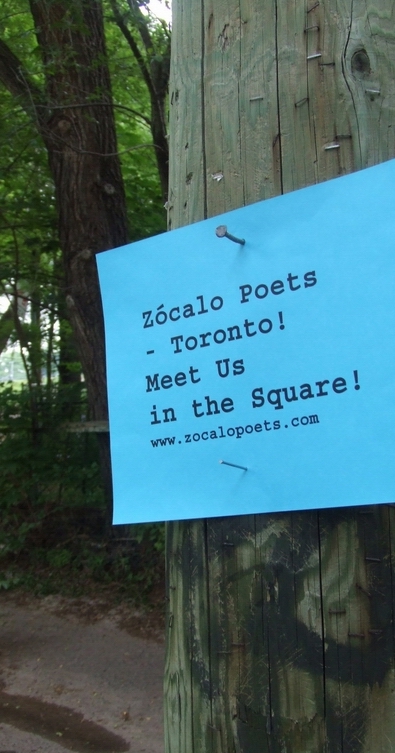
Dionne Brand: “ Hard against the Soul ”
Posted: August 31, 2011 Filed under: Dionne Brand, English | Tags: Black poets Comments Off on Dionne Brand: “ Hard against the Soul ”_____
I saw this woman once in another poem, sitting,
throwing water over her head on the rind of a country
beach as she turned toward her century. Seeing her
no part of me was comfortable with itself. I envied her,
so old and set aside, a certain habit washed from her
eyes. I must have recognized her. I know I watched
her along the rim of the surf promising myself, an old
woman is free. In my nerves something there
unraveling, and she was a place to go, believe me,
against gales of masculinity but in that then, she was
masculine, old woman, old bird squinting at the
water’s wing above her head, swearing under her
breath. I had a mind that she would be graceful in me
and she might have been if I had not heard you
laughing in another tense and lifted my head from her
dry charm.
*
You ripped the world open for me. Someone said this
is your first lover you will never want to leave her. My
lips cannot say old woman darkening anymore, she
is the peace of another life that didn’t happen and
couldn’t happen in my flesh and wasn’t peace but
flight into old woman, prayer, to the saints of my
ancestry, the gourd and bucket carrying women who
stroke their breast into stone shedding offspring and
smile. I know since that an old woman, darkening,
cuts herself away limb from limb, sucks herself white,
running, skin torn and raw like a ball of bright light,
flying, into old woman. I only know now that my
longing for this old woman was longing to leave the
prisoned gaze of men.
_____
Dionne Brand was born in Trinidad in 1953
and graduated from University of Toronto in 1975.
She is black, lesbian, feminist – three powerful things.
Toronto’s Poet Laureate, she is also the 2011 winner of
The Griffin Poetry Prize for her long poem Ossuaries.
The companion poems above are excerpted from
Brand’s series “Hard against the Soul”, part of
her collection, No Language is Neutral
© 1990, Dionne Brand.
Colleen Ella: “ Johnny ”
Posted: August 31, 2011 Filed under: English: Trinidadian Comments Off on Colleen Ella: “ Johnny ”



“Johnny”
Trinidadian Soca song from 1987,
composed by Pelham Goddard,
S. Bartholomew and R. Imamshah.
(As sung by the irrepressible Colleen Ella
with the band Taxi)
_____
Johnny, ah come inside at dis pahtee,
Ah pay meh money to get on wassy,
So why de Hell yuh holdin’ meh damn hand?
Ah mus’ be tell you: Ah lookin’ for man !
Boy, leh meh tell you flat: Ah ain’t a girl like dat,
Ah duz always be-have mehself.
But when ah hear music play,
Ah duz feel to “break a-way”,
Ah don’t intend to stay on de shelf !
*
Come, leh we go and dance,
And leh we live to prance,
We go wine dong dis fete,
Till ah soakin’ wet.
Ah’m a music lover,
Havin’ Soca fever,
There is music inside me – drivin’ meh crazy.
Go and dance,
And let me live to prance,
We go wine dong dis fete, John-neee !
*
Johnny, ah walkin’ home, wicked hard-hard,
Ah come to pahtee to get on real bad,
When you see ah drink up meh joy-juice,
Leh meh tell yuh, all Hell duz break loose.
Dis mood ah in right now, we go have a big big row,
Cuz yuh behavin’ like a little boy.
Like you doh know what to do,
It would seem as though you bound to,
You going tuh stop meh spreadin’ meh joy !
*
Come, leh we go and dance,
And leh we live to prance,
We go wine dong dis fete,
Till ah soakin’ wet.
Ah’m a music lover,
Havin’ Soca fever,
There is music inside me – drivin’ meh crazy.
Go and dance,
And let me live to prance,
We go wine dong dis fete, John-neee !
*
Johnny, ah getting’ drunk in dis pahtee,
Not a ol’ man like you could stop me,
Ah come tuh drink and “garden” meh whole head,
It’s dat what have meh actin’ so weird.
Ah comin’ here to dance,
Come on, give me a chance,
Cuz ah fed up hearin’ pop songs.
When you see ah in dis mood,
Ah doh even feel fuh food,
All ah want is Soca to get on dong !
*
Come, leh we go and dance,
And leh we live to prance,
We go wine dong dis fete,
Till ah soakin’ wet.
Ah’m a music lover,
Havin’ Soca fever,
There is music inside me – drivin’ meh crazy.
Go and dance,
And let me live to prance,
We go wine dong dis fete, John-neee !
*
Johnny, ah stayin’ inside de pahtee,
Cuz ah love de ban’ dey call “Taxi”,
Ah like de way dem fellas duz real jam,
Make meh feel to shake up meh bam-bam !
When ah come out to fete,
Any man ah could get,
Leh meh tell yuh quite frankly:
Neveh need no tampeh fuh tuh make me frien’ly,
Ah jus’ have tuh buss up on he !
*
Come, leh we go and dance,
And leh we live to prance,
We go wine dong dis fete,
Till ah soakin’ wet.
Ah’m a music lover,
Havin’ Soca fever,
There is music inside me – drivin’ meh crazy
Go and dance,
And let me live to prance,
We go wine dong dis fete, John-neee !
_____
Trinidadian glossary:
wassy – spirited and uninhibited
break a-way – to cut loose on the dancefloor, solo
leh we go – let’s go
wine dong dis fete – wind down this party/celebration,
stay right till the end (sunrise)
Ah doh – I don’t
tampeh – marijuana
buss up – go crazy on (in a good way), bust up
 Zócalo Poets