Daniel Chirom: Leonardo and The Last Supper
Posted: April 5, 2012 Filed under: Daniel Chirom, English, Spanish, ZP Translator: Alexander Best Comments Off on Daniel Chirom: Leonardo and The Last SupperDaniel Chirom (born 1955, Argentina)
Leonardo and The Last Supper
.
Under commission to Ludovico il Moro
I did “The Last Supper”, in careful detail, over a period of three years.
I made not a single mistake
– it was my intention that Christ and his apostles
would be disintegrating over time.
When perhaps the Supper is to be served again
another Ludovico will order me to re-do it
– at least until the wine runs out.
I trust in the eternal thirst of humankind.
. . .
Editor’s note:
Ludovico il Moro was Duke of Milan, and a patron of the arts.
In 1496 he commissioned Leonardo da Vinci to paint “The Last Supper”
on a wall inside a Dominican convent. Da Vinci did not use
traditional fresco techniques, rather he experimented.
His method, and the paints he used, have not stood the test of time;
the mural has had to be restored repeatedly.
.
Translation from Spanish into English: Alexander Best
. . .
Daniel Chirom (nace 1955, Argentina)
Leonardo y la última cena
.
Por encargo de Ludovico el Moro
deletreé durante tres años la Última Cena.
No cometí ningún error,
fue mi voluntad que Cristo y sus apóstoles
se fueran desintegrando con el tiempo.
Cuando la Cena sea nuevamente servida
otro Ludovico me encargará rehacerla
hasta que el vino vuelva a escasear.
Confío en la eterna sed del hombre.
. . .
Poème pour Dimanche des Rameaux: “L’Âne” / “The Donkey”: a poem for Palm Sunday
Posted: April 1, 2012 Filed under: English, French, G. K. Chesterton, ZP Translator: Lidia García Garay Comments Off on Poème pour Dimanche des Rameaux: “L’Âne” / “The Donkey”: a poem for Palm Sunday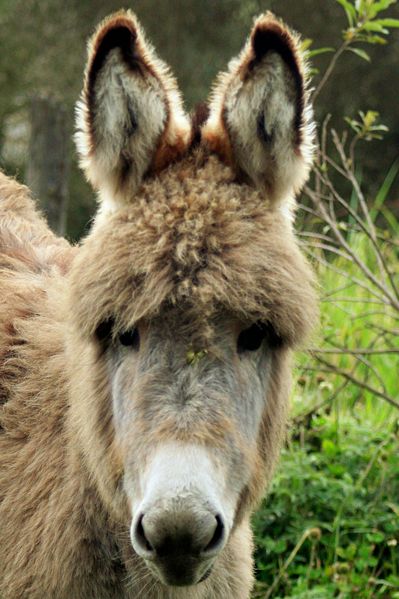
G. K. Chesterton
(1874-1936)
L’Âne
Quand les poissons volaeint et les fôrets marchaient
Et les figues poussaient sur les épines,
Lorsque la lune était sang
Á ce moment lá, je suis sûrement né.
Avec une tête monstrueuse et un braiement écouerant
Et les oreilles comme des ailes sans racines;
C’est la parodie marchante du Diable,
Sur ses quatre pattes.
Les brigands en loques de la terre,
D’ancienne volonté tordue;
M’affament, me fouettent; se moquent de moi: je suis muet,
Je garde mon secret en silence.
Imbéciles! Car j’ai aussi eu mon heure;
Une heure acharnée et douce;
Il y a eu un cri près de mes oreilles,
Et des rameaux devant mes pieds.
Traduction en français / Translation from English into French: Lidia García Garay
_____
G. K. Chesterton (1874-1936)
The Donkey
When fishes flew and forests walked
And figs grew upon thorn,
Some moment when the moon was blood
Then surely I was born.
With monstrous head and sickening cry
And ears like errant wings,
The devil’s walking parody
On all four-footed things.
The tattered outlaw of the earth,
Of ancient crooked will;
Starve, scourge, deride me: I am dumb,
I keep my secret still.
Fools! For I also had my hour;
One far fierce hour and sweet:
There was a shout about my ears,
And palms before my feet.
Poisson d’Avril / All Fools Day
Posted: April 1, 2012 Filed under: Boris Vian, French Comments Off on Poisson d’Avril / All Fools Day
Un poisson d’avril
Un poisson d’avril
est venu me raconter
qu’on lui avait pris
sa jolie corde à sauter.
*
C’était un cheval
qui l’emportait sur son coeur
le long du canal
où valsaient les remorqueurs.
*
Et alors – et alors –
un serpent – un serpent –
s’est offert comm’ remplaçant
Le poisson – le poisson
très content – très content –
est parti à travers champs.
*
Il sauta si haut
qu’il s’est envolé dans l’air
il sauta si haut
qu’il est retombé dans l’eau
Boris Vian
(1920-1959)
“But the blooming words declare the storm with bravery”: Five 21st-century Iranian women poets
Posted: March 31, 2012 Filed under: A FEW FAVOURITES / UNA MUESTRA DE FAVORITOS, English, Farsi / Persian, Fereshteh Sari, Five 21st-century Iranian women poets, Nasrin Behjati, Nasrin Ranjbar Irani, Pegah Ahmadi, Sylvana Salmanpour Comments Off on “But the blooming words declare the storm with bravery”: Five 21st-century Iranian women poets
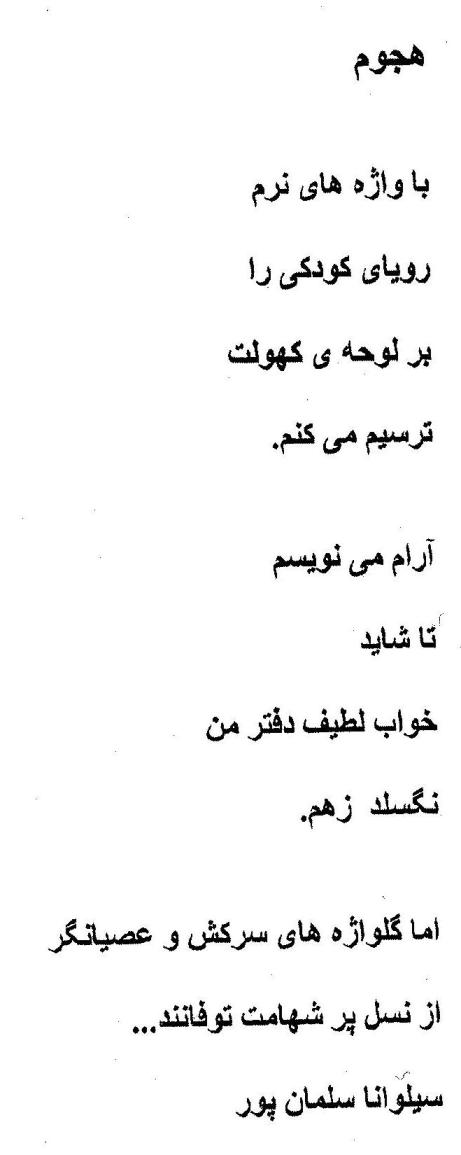
“A Rush” by Sylvana Salmanpour
With soft words
I draw a childhood dream
on a nascent memory.
I write in peace
so that the silky dream of the notebook
will not tear apart.
But the blooming words declare
the storm with bravery.
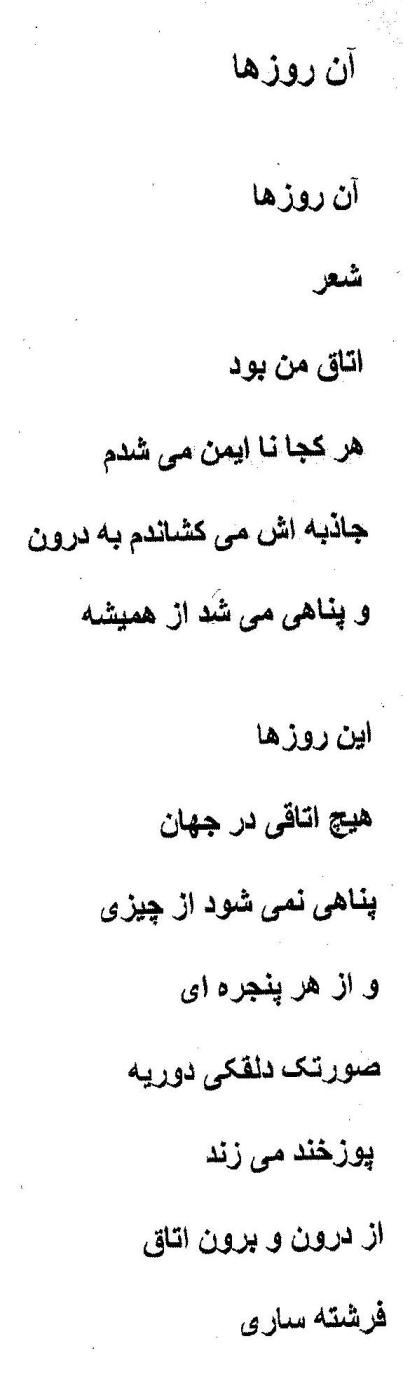
“Those Days” by Fereshteh Sari
Those days
Poetry
was my room
and wherever I felt unsafe
I gravitated into its eternal sanctuary.
These days
there aren’t any rooms
that can harbour me against the crowd
and behind every window
inside and outside every room
a two-faced clown sneers.
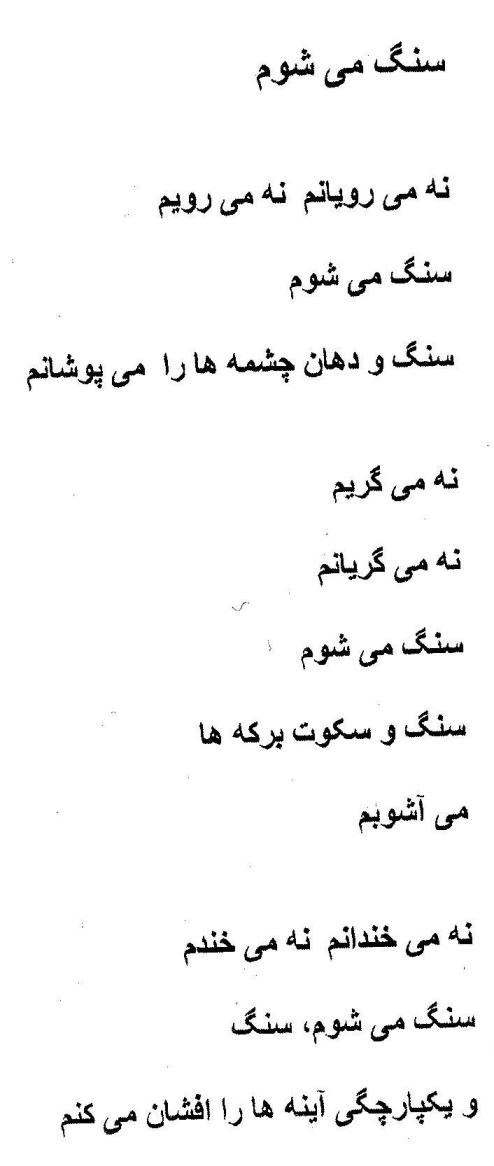
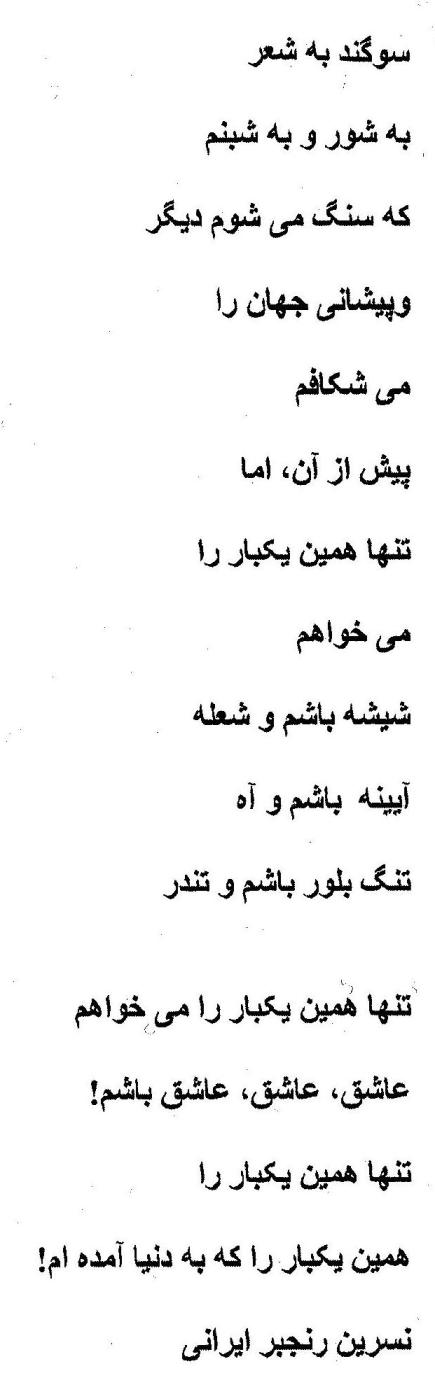
“The Stone I become” by Nasrin Ranjbar Irani
I do not grow or nurture
the stone, I become
the stone
I mask the spring’s mouth
I do not cry or distress others
The Rock, I become
The Rock
that intrudes into the peaceful pond
Neither do I laugh nor do I want others to laugh
The stone, I become
the stone and I shatter the mirrors.
To poetry
I vow, to joy, to dew,
that I will be a stone again
an undeniable slash across the brow
But before these all
I want to be
the glass
the flame
the mirror
Ah! A crystal ball
and the spring rain…
Once and Only Once
To be in love, in love, in love
in this lifetime,
Once and Only Once!
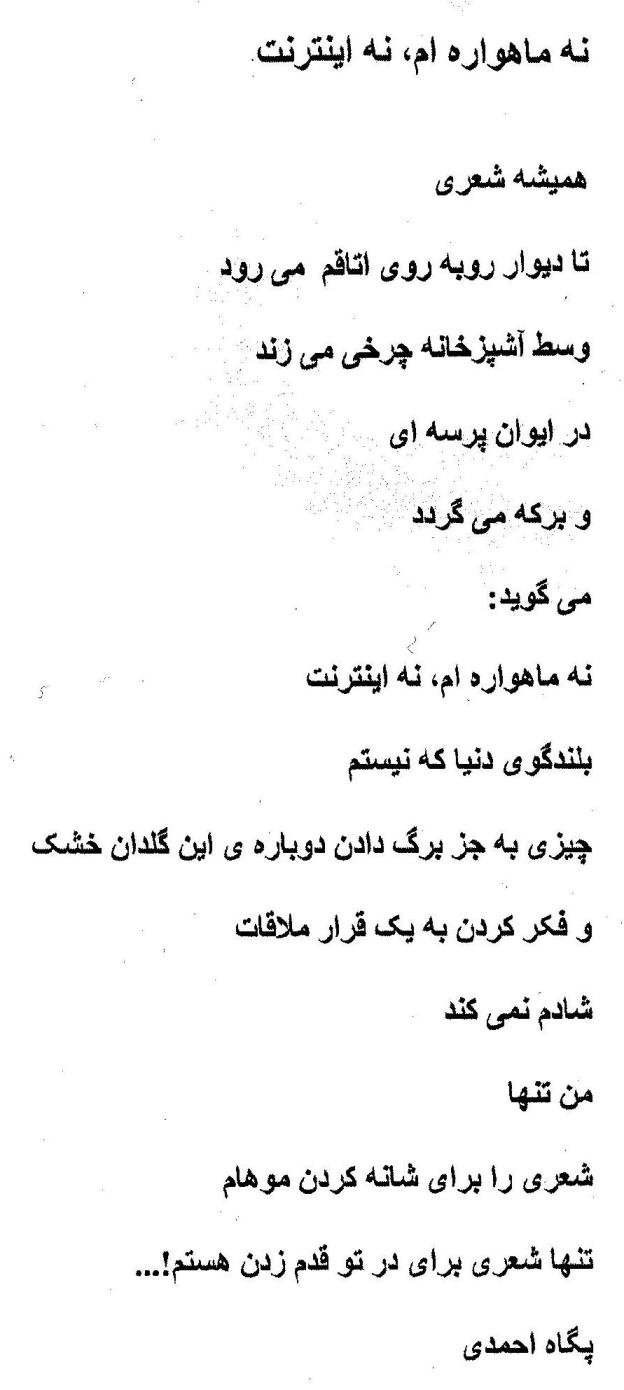
“Neither a Satellite nor the Internet” by Pegah Ahmadi
A poem ambles across the wall
forever and a day
In the heart of the kitchen it spins,
spins on the porch
And when it returns
It utters:
Neither a Satellite nor the Internet
I am not the universal Media
Nothing but a new leaf on this arid plant
Or the thought of a rendezvous
Makes me rejoice
I am only a poem to brush your hair
A poem to pass through you!
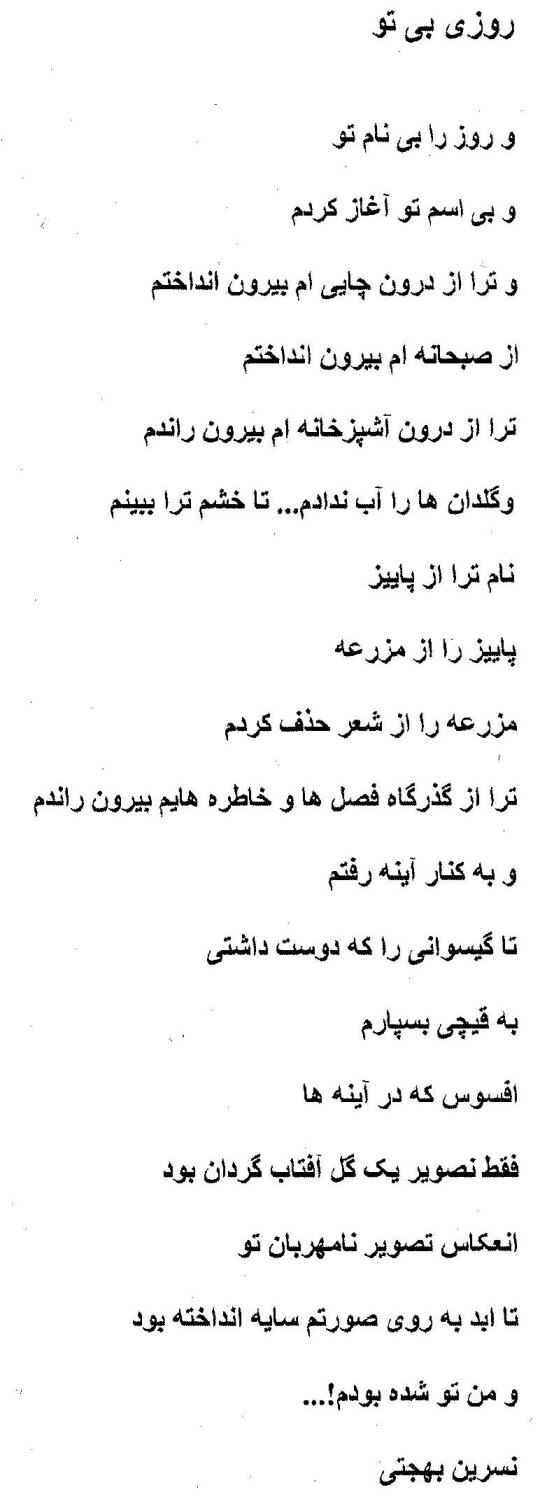
“A Day without You” by Nasrin Behjati
And I commenced my day
Without you or your name
I spilled you out of my tea
Out of my breakfast
From the kitchen
And I didn’t nurture the plants…
so that I could witness your rage,
Your name from autumn
The autumn from the field
And the field from the poems, I
removed
I heaved you out of my memories and
the seasons and I walked to the mirror
To cut short the locks you loved so,
Alas! In the mirror a sunflower reflected
Your unkind frame,
Outlined my face forevermore,
I had become you!
_____
The poems featured here from five Iranian women poets were translated
from Persian (Farsi) into English by Sheema Kalbasi.
Visit her literary site: http://www.sheemakalbasi.com
Quatrains that Question: 20th-century Iranian poets: Mohammad Mehdi Fulâdvand, Abdulhosayn Nosrat, Mohammad-Taqi Bahar
Posted: March 28, 2012 Filed under: Abdulhosayn Nosrat, English, Farsi / Persian, Mohammad Mehdi Fulâdvand, Mohammad-Taqi Bahar Comments Off on Quatrains that Question: 20th-century Iranian poets: Mohammad Mehdi Fulâdvand, Abdulhosayn Nosrat, Mohammad-Taqi Bahar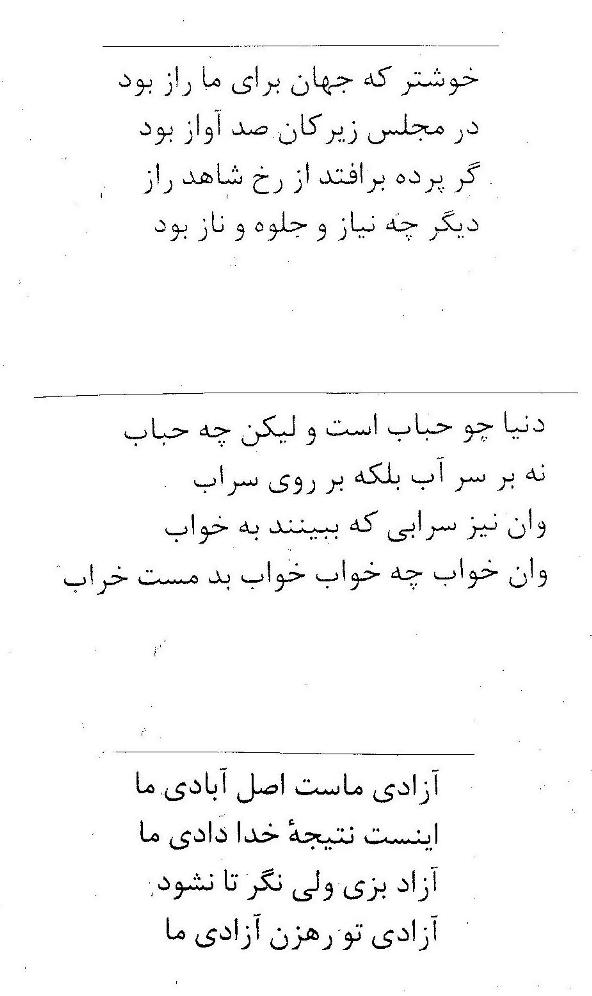
It is better that the world be a mystery for us,
Better that a hundred voices be in the assembly of the wise.
If the veil drops from the face of the mysterious Belovéd,
What more need will there be for supplication, glorification, and pride?
*
The world is like a bubble. What kind of bubble?
A bubble, not on water, but on the surface of a mirage.
A mirage which is seen in a dream.
A dream which is seen by someone who is dead-drunk.
*
Our freedom is the principle of our development,
Which is the purpose intended by God.
Live freely, but be careful not to allow
Your freedom to be the brigand* of others’ freedom.
_
*brigand = bandit, plunderer, robber
_____
Translations from Persian (Farsi) into English: © Reza Saberi
Isfahâni, Sabzvâri, Behizâd, Sarvi: رباعیات
Posted: March 28, 2012 Filed under: English, Farsi / Persian, Hamid Sabzvâri, Hushang Hekmati (Sarvi), Jalâl Behizâd, Saghir Isfahâni Comments Off on Isfahâni, Sabzvâri, Behizâd, Sarvi: رباعیات
I do not do anything except with a pure and sincere heart.
I do not care for anyone’s approval or disapproval.
Even if I am hurt by the whole world,
I want no one to be hurt by me.
*
If you wish to step onto the road of love,
You must first have the mind for love, then the heart for it.
Think not of the comforts and difficulties of love.
Take to the sea and ask not where the shore is.
*
O moon-like Sâqi*, give me wine in this month of fasting.
For fasting became forbidden to me now.
Let me break my fast – for my eyes saw the crescent moon
Of your eyebrow and the full moon of your face.
_
(*Sâqi – the cupbearer / wine-servant, in a tavern –
often a handsome youth; in Sufism, Sâqi is a spiritual master)
_
*
The spirit is intoxicated when it sees the belovéd’s face.
Any nonbeing becomes being – by his existence.
Alas, alas, this exhilarating wine of union
Goes from one hand to another in the feast of life.
*
I have drunk the water of life from my belovéd’s lip.
I have drunk the wine of spirit from the cup of unity.
I know neither disbelief nor belief.
I have tied belief and disbelief with the knot of love.
_____
20th-century Persian Rubáiyát (“Quatrains”) by Saghir Isfahâni (#1 and #3), Hamid Sabzvâri (#2),
Jalâl Behizâd (#4), Hushang Hekmati (Sarvi) (#5).
Translations from Persian (Farsi) into English: © Reza Saberi
Perfect Poems: the Mediaeval Rubáiyát of Omar Khayyám / عمر خیام
Posted: March 28, 2012 Filed under: English, Farsi / Persian, Omar Khayyám Comments Off on Perfect Poems: the Mediaeval Rubáiyát of Omar Khayyám / عمر خیام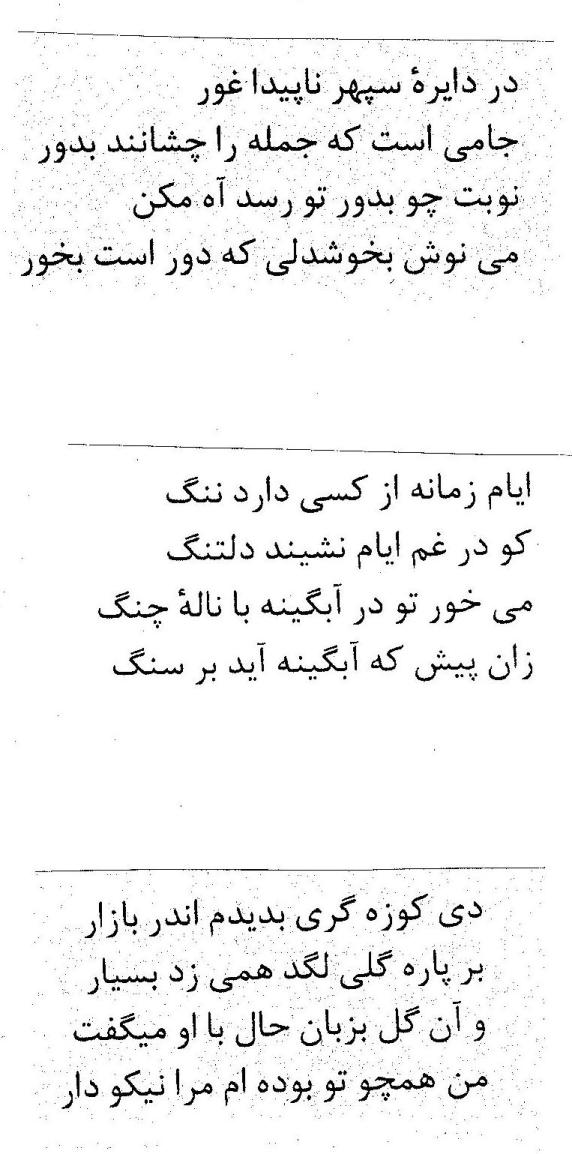
In the sphere of the sky, whose depth is invisible,
There is a cup from which everyone must drink in turn.
When your turn comes, do not sigh.
Drink it happily, for it is your turn to drink.
*
Time is ashamed of that person
Who sits lonely and grieves over days now past.
Drink wine from a glass to the sound of a harp
Before the glass smashes into a rock.
*
Yesterday I saw a jug-maker in the bazaar,
Who was treading a lump of clay, repeatedly,
While that clay told him in its own language:
“I used to be like you. Treat me kindly!”
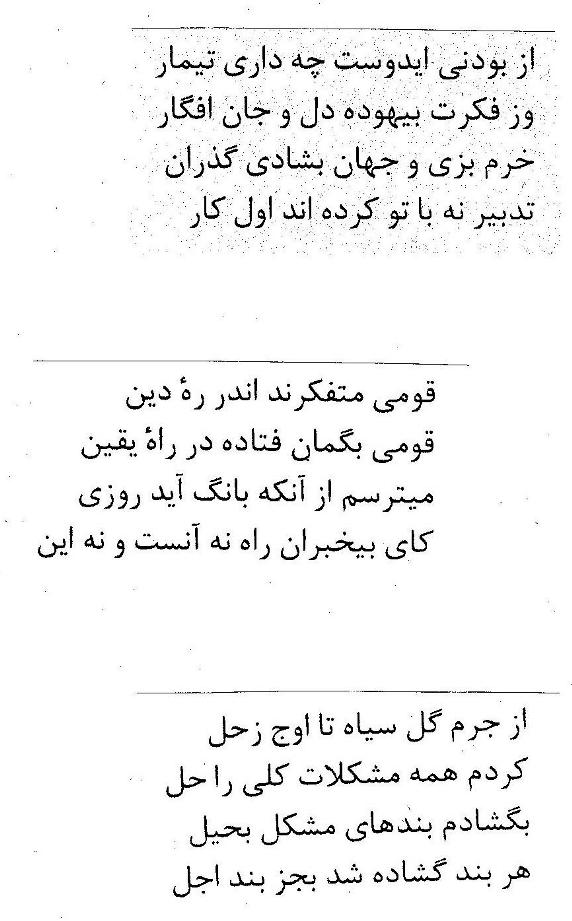
Why do you grieve over existence, my friend?
Why do you afflict your heart and soul with futile thoughts?
Live joyfully and spend your life happily in the world.
They did not consult you in the beginning anyway.
*
Some people are thoughtful about religion.
Others are suspicious of any conviction.
I am afraid one day a voice may call out:
” Oh ignorant ones, the way is neither this nor that. “
*
From the nadir of the black mud to the zenith of Saturn,
I have solved all the major problems of being.
I untied many difficult knots, using many tricks.
Every knot I’ve opened, except the knot of death.
_____
Omar Khayyám (1048-1131) was born in Nishapur, Persia (contemporary Iran),
and is considered to be among the greatest of all the world’s poets.
He composed a thousand rubáiyát (Persian-language quatrains) – brief poems in
four lines that touch upon Life’s big themes: the love for the Belovéd (be it human and
amorous, or be it the love of God (Allah); the meaning of Life; Spirituality;
the mystery of Death.
Khayyám was a profoundly mystical thinker – Sufi and Muslim –
an astronomer and mathemetician who was also a poet. People have interpreted
and mis-interpreted the meanings of his quatrains – 19th-century translator
Edmund FitzGerald most famously (yet beautifully) – but Khayyám’s voice – intelligent,
warm, vigorous, direct – speaks to all our human wonderings even now, 900 years
“down the road”. The contemporary translations here, from Persian(Farsi) into English,
have been done with a simple, pleasing clarity by Reza Saberi.
“An Acrostic to Benito Juárez” by Rubi / “Acróstico a Benito Juárez” por Rubi
Posted: March 21, 2012 Filed under: English, Spanish, ZP Translator: Alexander Best | Tags: Poema a Benito Juárez Comments Off on “An Acrostic to Benito Juárez” by Rubi / “Acróstico a Benito Juárez” por Rubi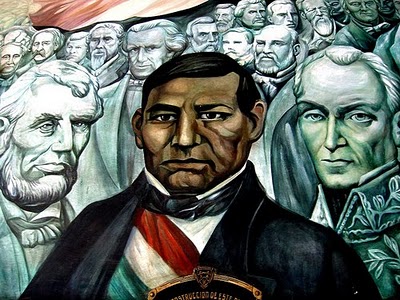
“Acróstico a Benito Juárez” por Rubi / “An Acrostic to Benito Juárez” by Rubi
B enito Juárez B enito Juárez:
E ra mexicano. E specially Mexican was he.
N acido en Oaxaca, N atal place? Oaxaca, and he was
I ndígeno – ¡seguro! I ndigenous – for sure!
T oda su infancia T ending sheep was the task
O vejas cuidaba. O f his childhood.
* *
J uárez político J uárez the Politician
U nió a los pobres, U nited with the poor, en-
A mó la justicia, A moured of justice,
R echazó a los franceses. R epelled the French.
E n conclusión él fue Ever known shall he be, the
Z apoteco valiente. Z apotec most brave.
_____
Hoy día – el 21 marzo – se celebra el natalicio del prócer mexicano – Benito Juárez .
Rubi…¡te agradecemos!
Benito Juárez (1806-1872) was President of México, serving five terms between 1858 and 1872.
Illiterate till the age of 12, by 1834 he was a lawyer, and by 1847 – governor of the state of Oaxaca.
As President he began nation-wide reforms, including the promotion of a civil society
– this included the curtailment of the powers of the dominant Catholic Church. He brought an end to
the Franco-Mexican War (“The Maximilian Affair”) of the 1860s, and his political movement,
La Reforma, though interrupted by the sometimes-regressive presidency of Porfirio Díaz, is
clearly viewed as the first push toward modernization of Mexico’s economy, politics, and society.
Today, March 21st, is Benito Juárez’ birth date.
Interpretación del poema en inglés / Poem interpretation into English from Spanish:
Alexander Best
Happy Persian New Year! / !سال نو مبارک
Posted: March 20, 2012 Filed under: Abbas Kiarostami, English, Farsi / Persian, Ishrat Qahramân Comments Off on Happy Persian New Year! / !سال نو مبارک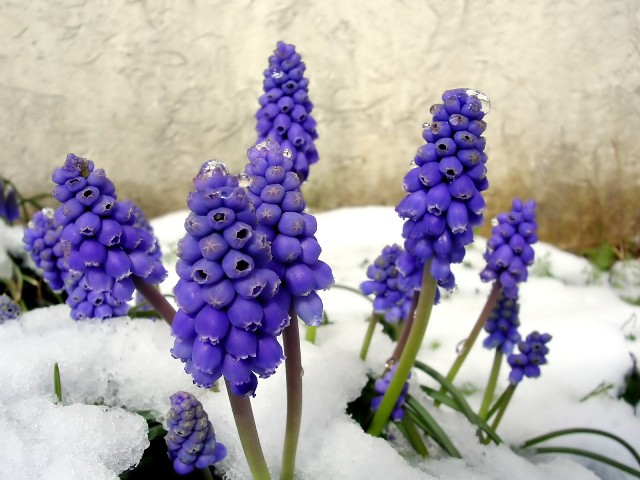
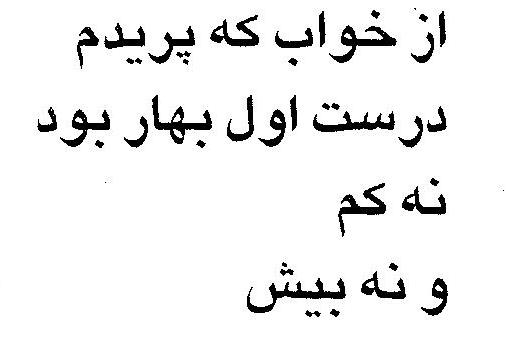
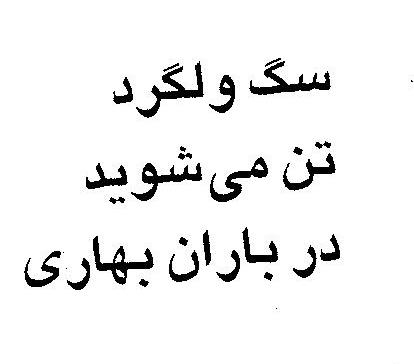
When I started up out of sleep
it was just the beginning of spring
– no more,
no less.
The stray dog
washes its body
in spring rain.
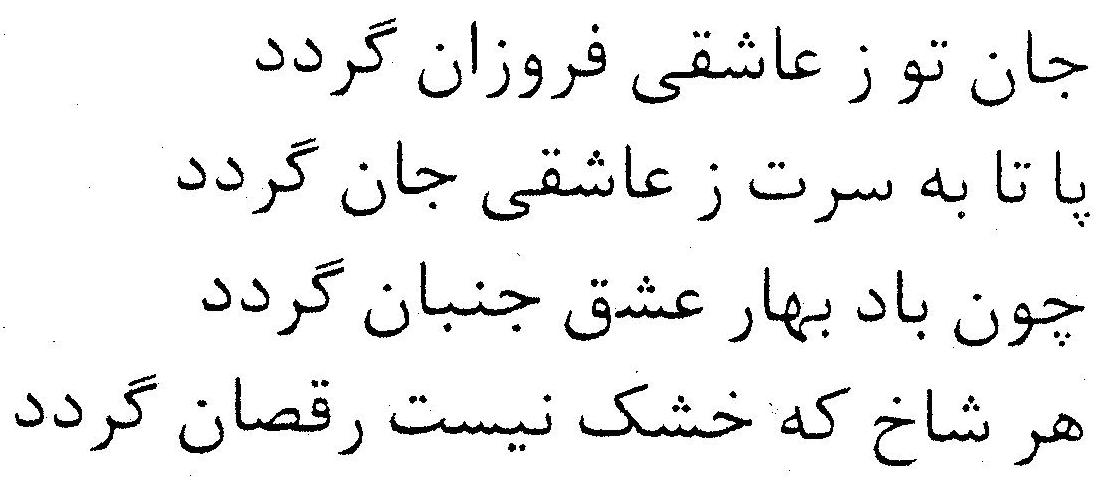
Your life will become radiant through love.
You will become spirit from head to toe through love.
When the spring wind of love comes into motion,
Any branch which is not dry – starts dancing !
Толстой, Майков, Фет, Пушкин, Дельвиг: Весна Pycckar! / Russian Spring!
Posted: March 20, 2012 Filed under: English, Russian Comments Off on Толстой, Майков, Фет, Пушкин, Дельвиг: Весна Pycckar! / Russian Spring!
Алексей Толстой / Count Aleksey Tolstoy (1817-1875)
Early-early Spring
The early-early spring it was,
new blades of grass peered forth,
rivulets ran, the air was warmly soft,
and the woods were of transparent green.
The shepherd’s horn at break of day
was yet unheard in the village;
the forest ferns still kept their fronds
in spikes of laces furléd.
*
Early-early spring it was –
white gleamed from the silver birch-trees –
– and then I beheld thine eyes to smile
from under lowered eyelids…
Was it in answer to my love
thine eyelashes did tremble – ?
O Life – woods – sunshine clear!
O Youth, O hopes high soaring!
And tears came to my eyes
As I adored thy features…
*
It was in early-early spring –
the silver birches gleamed –
in this morning of our life,
O happiness – and tears!
O Life – woods – and sunshine clear!
Fresh breath of silver birches!
_____
Аполлон Майков / Apollon Maykov (1821-1897)
Весна / Spring
Посвящается Коле Трескину
Уходи, зима седая!
Уж красавицы Весны
Колесница золотая
Мчится с горней вышины!
Старой спорить ли, тщедушной,
С ней – царицею цветов,
С целой армией воздушной
Благовонных ветерков!
А что шума, что гуденья,
Теплых ливней и лучей,
И чиликанья, и пенья!..
Уходи себе скорей!
У нее не лук, не стрелы,
Улыбнулась лишь – и ты,
Подобрав свой саван белый,
Поползла в овраг, в кусты!..
Да найдут и по оврагам!
Вон – уж пчел рои шумят,
И летит победным флагом
Пестрых бабочек отряд!
(1880)
_____
Афанaсий Фет / Afanasy Fet (1820-1892)
Vesna na dvore / Spring Has Come
What fresh, invigorating air!
No words can do it justice—none!
How loud, at noontide, runnels in the gulley
Spin their silvery skeins against the stones!
Birdsong trembles in the ether, fades;
Rye is greenly sprouting in the field—
And soft a gentle voice is singing:
“Another spring, and you alive to greet it!”
(1856)
_____
Александр Пушкин (1799-1837)
Ты и вы
Пустое вы сердечным ты
Она обмолвясь заменила,
И все счастливые мечты
В душе влюбленной возбудила.
Пред ней задумчиво стою,
Свести очей с нее нет силы;
И говорю ей: как вы милы!
И мыслю: как тебя люблю!
(1828)
Alexander Pushkin (1799-1837)
You and Thou
She used the hearty thou, by chance,
Instead of you, so stiff and formal,
Arousing happy dreams at once
Inside my loving heart and soul.
I’m standing speechless in a glow
Admiring her sincerely;
I tell her: you are charming, really!
I think inside: I love thee so!
(1828)
_____
Антон Дельвиг (1798-1831)
Романс
Прекрасный день, счастливый день:
И солнце, и любовь!
С нагих полей сбежала тень –
Светлеет сердце вновь.
Проснитесь, рощи и поля;
Пусть жизнью все кипит:
Она моя, она моя!
Мне сердце говорит.
Что, вьешься, ласточка, к окну,
Что, вольная, поешь?
Иль ты щебечешь про весну
И с ней любовь зовешь?
Но не ко мне,- и без тебя
В певце любовь горит:
Она моя, она моя!
Мне сердце говорит.
(1823)
Anton Delvig (1798-1831)
Romance
Oh what a lovely, happy day!
There’s love, the sun, the plain!
The shadows all have gone away
My heart is light again.
Wake up, you groves and fields, and see
That all is filled with life!
She’s mine! – my heart is telling me,
She’s mine, and all is live.
Why do you, little swallow cling
Onto to my windowpane?
Perchance, you sing about the spring
Inviting love again?
It’s not for me, as I can see,
The singer’s love, divine.
It is my heart who’s telling me:
She’s mine, oh yes she’s mine!
(1823)
Translations from Russian: Alec Vagapov
_____
 Zócalo Poets