Posted: February 14, 2013 Filed under: IMAGES | Tags: Vintage and contemporary Valentine's Day greeting cards Comments Off on

Vintage valentine_ French postcard, early 20th century_Friendship is a flower that never dies. Valentine cards were not ONLY about romantic love. One gave them to children, parents, friends and teachers.
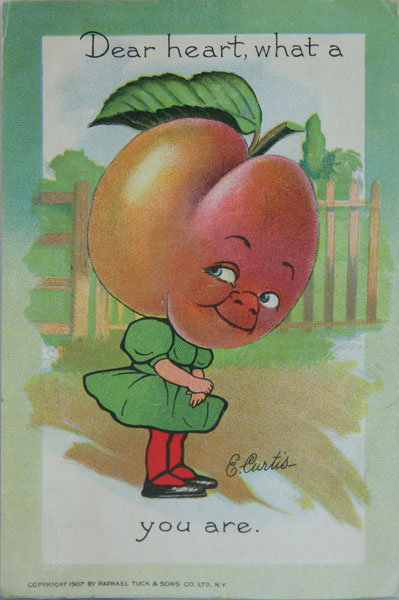
Vintage valentine from 1907_Dear Heart, What a Peach You Are.

Vintage valentine_Sometimes an anonymous Vinegar Valentine postcard was mailed out by ladies who wished to discourage a gentleman’s persistent attentions.

Vintage Vinegar Valentine_ 1950s
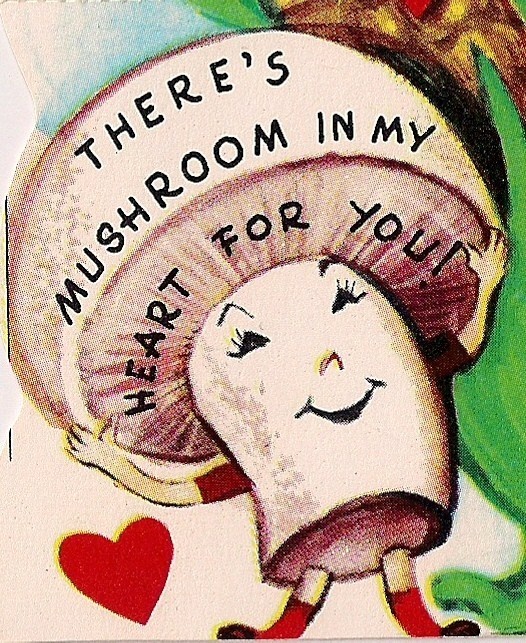
Vintage valentine_Word puns which sometimes succeed have been employed often in Valentine greetings.

Vintage valentine_More punning and colloquialism in this Valentine card from the 1950s
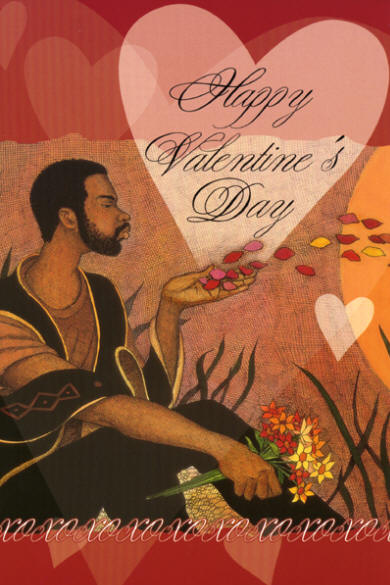
Contemporary Valentine card aimed at the Black American market

Love and Death are So Random_Valentine for the Emo and Goth kids

2013 Gringo hipster Valentine card made with papeles picados y tintos_ by Tasha Marks and Emily Evans
Benito de Jesús’ “Nuestro Juramento” (“Our Oath”) as sung by Julio Jaramillo
Posted: February 14, 2013 Filed under: Benito de Jesús, Translator's Whimsy: Song Lyrics / Extravagancia del traductor: Letras de canciones traducidas por Alexander Best, ZP Translator: Alexander Best | Tags: Poemas de Amor Comments Off on Benito de Jesús’ “Nuestro Juramento” (“Our Oath”) as sung by Julio Jaramillo
ZP_A vintage Valentine’s Day postcard_1930s?_Note the absence of cutesy sentimentality or smarmy earnestness. Depicted are The Wiles, The Game, of Love.
Anyone hearing the 1957 recording of “Our Oath” (“Nuestro Juramento”) by 22-year-old Julio Jaramillo – later known as “The Nightingale of The Americas” for his sweet high tenor – perhaps will be surprised to learn – once the words have been translated from Spanish into English – how extravagantly Romantic are the lyrics of the song. Benito de Jesús’ lyrics emphasize Death and Love together, and it’s easy to forget that the word Romantic (with a capital R) used to include both – though the saccharine cuteness of Valentine’s Day – with its boxes of chocolates and bouquets of a dozen red roses – has diluted in the public sphere the irrational intensity of that many-limbed emotion, Love. In fact, there is nothing more Romantic than the death of the belovéd. de Jesús’ outlandish – by contemporary standards – and absolutely un-ironic – verses, combined with the delicacy and sincerity of Jaramillo’s voice, make for a curiously disquieting yet moving popular love song.
. . .
Benito de Jesús (1912 – 2010, Puerto-Rican composer)
“Our Oath” (“Nuestro Juramento”)
as sung by Julio Jaramillo (1935 – 1978, Guayaquil, Equador)
Translation/Interpretation from Spanish: Alexander Best
.
“Our Oath”
.
Your sorrowful face
I just cannot look upon
– because it kills me.
.
Sweet darling,
the weeping that
from you spills forth,
with anguish fills my heart.
.
Wordlessly I suffer if sad you fall,
I wish that no doubt might
make you cry at all.
We have vowed to love each other
until the day we die…
And if the dead may love?
– well, after our death we’ll love each other
all the more, oh my!
.
If I die first, promise to let a weeping
that sprouts from sorrow
pour down upon my body dead,
so that your love for me
by everyone present will be read.
.
If you should die first, I promise to write
the story of our love,
full of feeling in my soul.
Yes, I shall write our story in blood
– the ink-blood of my heart –
so that our tale of love is told!
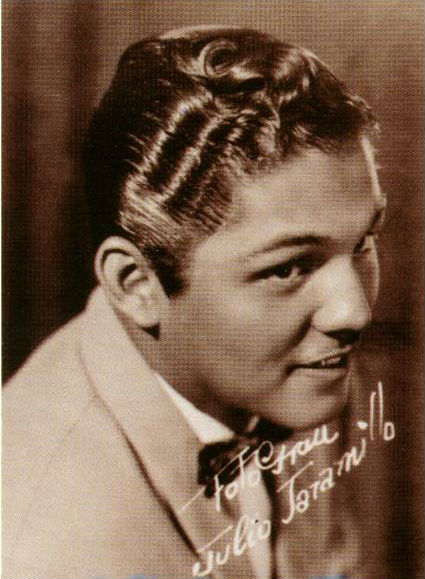
ZP_Julio Jaramillo in the 1950s
Después de su grabación en 1957, el bolero “Nuestro Juramento”, del compositor puertoriqueño Benito de Jesús, se convertió en icono de la música ecuatoriana. ¿Y por qué? A causa del tenor dulce de un cantante nacido en Guayaquil – Julio Jaramillo. En esta canción extravagante de Amor, Jaramillo – conocido más tarde como El Ruiseñor de América – canta con mucha ternura el tema, y la letra habla de una emoción fuerte que traspasa los límites de la vida. Merece la pena recordar en este Día de San Valentín que no es siempre precioso y meloso el Amor (como chocolates y ramos de rosas). El Amor incluye la eventualidad de un gran Hecho amenazador en el horizante – la Muerte.
. . .
Benito de Jesús (1912 – 2010, compositor puertoriqueño)
“Nuestro Juramento”
cantado por Julio Jaramillo (1935 – 1978, Guayaquil, Equador)
.
No puedo verte triste porque me mata
tu carita de pena, mi dulce amor.
Me duele tanto el llanto que tu derramas,
que se llena de angustia mi corazón.
.
Yo sufro lo indecible si tu entristeces,
no quiero que la duda te haga llorar.
Hemos jurado amarnos hasta la muerte
y si los muertos aman,
después de muertos amarnos más.
.
Si yo muero primero, es tu promesa,
sobre de mi cadaver dejar caer
todo el llanto que brote de tu tristeza
y que todos se enteren de tu querer.
.
Si tú mueres primero, yo te prometo,
escribiré la historia de nuestro amor
con toda el alma llena de sentimiento.
La escribiré con sangre,
con tinta sangre del corazón.
. . . . .
“Even amidst fierce flames the golden lotus can be planted”: Sylvia Plath and “Daddy” on Valentine’s Day
Posted: February 14, 2013 Filed under: English, Spanish, Sylvia Plath Comments Off on “Even amidst fierce flames the golden lotus can be planted”: Sylvia Plath and “Daddy” on Valentine’s Day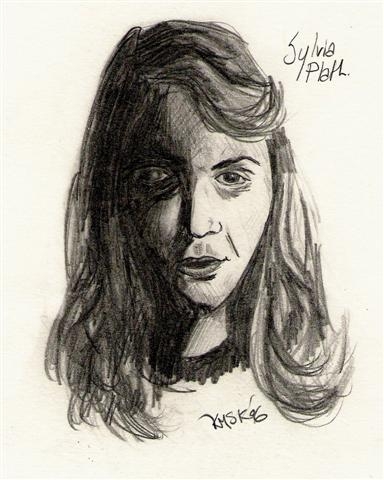
ZP_Portrait of Sylvia Plath_© IsMiseKate
“Even amidst fierce flames the golden lotus can be planted.”
(Inscription on Sylvia Plath’s headstone)
.
It’s fifty years since her suicide, February 11th, 1963, at the age of 30, and Boston, Massachusetts-born Sylvia Plath’s confessional poem “Daddy” remains powerful still. It’s easy to forget – now that we’ve experienced a generation of much soul-baring in society (and of really really private stuff) in tell-all autobiographies, Oprah Winfrey interviews, etc., that what Plath was doing here was rare in Anglo-American poetry – where decorum and a certain “cool” or at least emotionally-neutral treatment of the subject of the poem predominated. In its way “Daddy” is a kind of turbulent, definitely heart-felt Valentine letter from a daughter to a father. (And some scholars have suggested that the anger in the poem is also directed at Plath’s poet-husband, Ted Hughes, who was brazen about carrying on an affair when the couple had two infant children.) It was while staying at the Yaddo artists’ retreat in New York State in 1959 that Plath had learned “to be true to my own weirdnesses”. Yet a poem such as “Daddy” – drawn from such deeply personal material (the death of her German father, his emotional repression, her angry love for him) – would not come till just before the young poetess – depressed and suicide-prone from her early 20s onward – finally “did it”. Plath’s use of Holocaust imagery combined with nursery-rhyme poem-metre makes “Daddy” a jolting poem for any first-time reader.
. . .
La poetisa estadounidense Sylvia Plath se suicidó hace cincuenta años. Su poema “Papi” permanece como buen ejemplo de su poesía confesional. Casi es una carta apasionada, del amor y enojo, una carta de Valentín muy rara para su padre alemán que ya había muerto. (Y aunque Plath escriba de su padre como si fuera un Nazi – él no fue un Nazi.) En 1982 Plath fue la primera poeta en ganar el premio Pulitzer póstumo (por Poemas Completos, publicado después de su muerte).
.
Sylvia Plath (1932 – 11 de febrero, 1963)
“Papi”
.
Ya no, ya no,
ya no me sirves, zapato negro,
en el cual he vivido como un pie
durante treinta años, pobre y blanca,
sin atreverme apenas a respirar o hacer achís.
.
Papi: he tenido que matarte.
Te moriste antes de que me diera tiempo…
Pesado como el mármol, bolsa llena de Dios,
lívida estatua con un dedo del pie gris,
del tamaño de una foca de San Francisco.
.
Y la cabeza en el Atlántico extravagante
en que se vierte el verde legumbre sobre el azul
en aguas del hermoso Nauset.
Solía rezar para recuperarte.
Ach, du.
.
En la lengua alemana, en la localidad polaca
apisonada por el rodillo
de guerras y más guerras.
Pero el nombre del pueblo es corriente.
Mi amigo polaco
.
dice que hay una o dos docenas.
De modo que nunca supe distinguir dónde
pusiste tu pie, tus raíces:
nunca me pude dirigir a ti.
La lengua se me pegaba a la mandíbula.
.
Se me pegaba a un cepo de alambre de púas.
Ich, ich, ich, ich,
apenas lograba hablar:
Creía verte en todos los alemanes.
Y el lenguaje obsceno,
.
una locomotora, una locomotora
que me apartaba con desdén, como a un judío.
Judío que va hacia Dachau, Auschwitz, Belsen.
Empecé a hablar como los judíos.
Creo que podría ser judía yo misma.
.
Las nieves del Tirol, la clara cerveza de Viena,
no son ni muy puras ni muy auténticas.
Con mi abuela gitana y mi suerte rara
y mis naipes de Tarot, y mis naipes de Tarot,
podría ser algo judía.
Siempre te tuve miedo,
con tu Luftwaffe, tu jerga pomposa
y tu recortado bigote
y tus ojos arios, azul brillante.
Hombre-panzer, hombre-panzer: oh Tú…
.
No Dios, sino un esvástica
tan negra, que por ella no hay cielo que se abra paso.
Cada mujer adora a un fascista,
con la bota en la cara; el bruto,
el bruto corazón de un bruto como tú.
.
Estás de pie junto a la pizarra, papi,
en el retrato tuyo que tengo,
un hoyo en la barbilla en lugar de en el pie,
pero no por ello menos diablo, no menos
el hombre negro que
.
me partió de un mordisco el bonito corazón en dos.
Tenía yo diez años cuando te enterraron.
A los veinte traté de morir
para volver, volver, volver a ti.
Supuse que con los huesos bastaría.
Pero me sacaron de la tumba,
y me recompusieron con pegamento.
Y entonces supe lo que había que hacer.
.
Saqué de ti un modelo,
un hombre de negro con aire de Meinkampf,
.
e inclinación al potro y al garrote.
Y dije sí quiero, sí quiero.
De modo, papi, que por fin he terminado.
El teléfono negro está desconectado de raíz,
las voces no logran que críe lombrices.
.
Si ya he matado a un hombre, que sean dos:
el vampiro que dijo ser tú
y me estuvo bebiendo la sangre durante un año,
siete años, si quieres saberlo.
Ya puedes descansar, papi.
.
Hay una estaca en tu negro y grasiento corazón,
y a la gente del pueblo nunca le gustaste.
Bailan y patalean encima de ti.
Siempre supieron que eras tú.
Papi, papi, hijo de puta, estoy acabada.
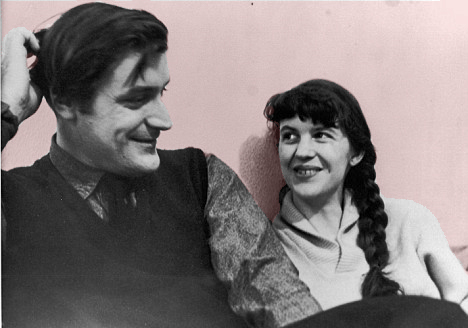
ZP_Sylvia Plath and Ted Hughes in 1956
Sylvia Plath (1932 – February 11th, 1963)
“Daddy”
.
You do not do, you do not do
Any more, black shoe
In which I have lived like a foot
For thirty years, poor and white,
Barely daring to breathe or A-choo.
.
Daddy, I have had to kill you.
You died before I had time—
Marble-heavy, a bag full of God,
Ghastly statue with one gray toe
Big as a Frisco seal
.
And a head in the freakish Atlantic
Where it pours bean green over blue
In the waters off the beautiful Nauset.
I used to pray to recover you.
Ach, du.
.
In the German tongue, in the Polish town
Scraped flat by the roller
Of wars, wars, wars.
But the name of the town is common.
My Polack friend
.
Says there are a dozen or two.
So I never could tell where you
Put your foot, your root,
I never could talk to you.
The tongue stuck in my jaw.
.
It stuck in a barb wire snare.
Ich, ich, ich, ich,
I could hardly speak.
I thought every German was you.
And the language obscene
.
An engine, an engine,
Chuffing me off like a Jew.
A Jew to Dachau, Auschwitz, Belsen.
I began to talk like a Jew.
I think I may well be a Jew.
.
The snows of the Tyrol, the clear beer of Vienna
Are not very pure or true.
With my gypsy ancestress and my weird luck
And my Taroc pack
I may be a bit of a Jew.
.
I have always been scared of you,
With your Luftwaffe, your gobbledygoo.
And your neat mustache
And your Aryan eye, bright blue.
Panzer-man, panzer-man, O You –
.
Not God but a swastika
So black no sky could squeak through.
Every woman adores a Fascist,
The boot in the face, the brute
Brute heart of a brute like you.
.
You stand at the blackboard, daddy,
In the picture I have of you,
A cleft in your chin instead of your foot
But no less a devil for that, no not
Any less the black man who
.
Bit my pretty red heart in two.
I was ten when they buried you.
At twenty I tried to die
And get back, back, back to you.
I thought even the bones would do.
.
But they pulled me out of the sack,
And they stuck me together with glue.
And then I knew what to do.
I made a model of you,
A man in black with a Meinkampf look
.
And a love of the rack and the screw.
And I said I do, I do.
So daddy, I’m finally through.
The black telephone’s off at the root,
The voices just can’t worm through.
.
If I’ve killed one man, I’ve killed two –
The vampire who said he was you
And drank my blood for a year,
Seven years, if you want to know.
Daddy, you can lie back now.
.
There’s a stake in your fat black heart
And the villagers never liked you.
They are dancing and stamping on you.
They always knew it was you.
Daddy, daddy, you bastard, I’m through.
. . . . .
George Elliott Clarke: “El Blues para X” / “Blues for X”
Posted: February 12, 2013 Filed under: English: Black Canadian / American, George Elliott Clarke, Spanish, ZP Translator: Alexander Best, ZP Translator: Lidia García Garay | Tags: Black History Month poems Comments Off on George Elliott Clarke: “El Blues para X” / “Blues for X”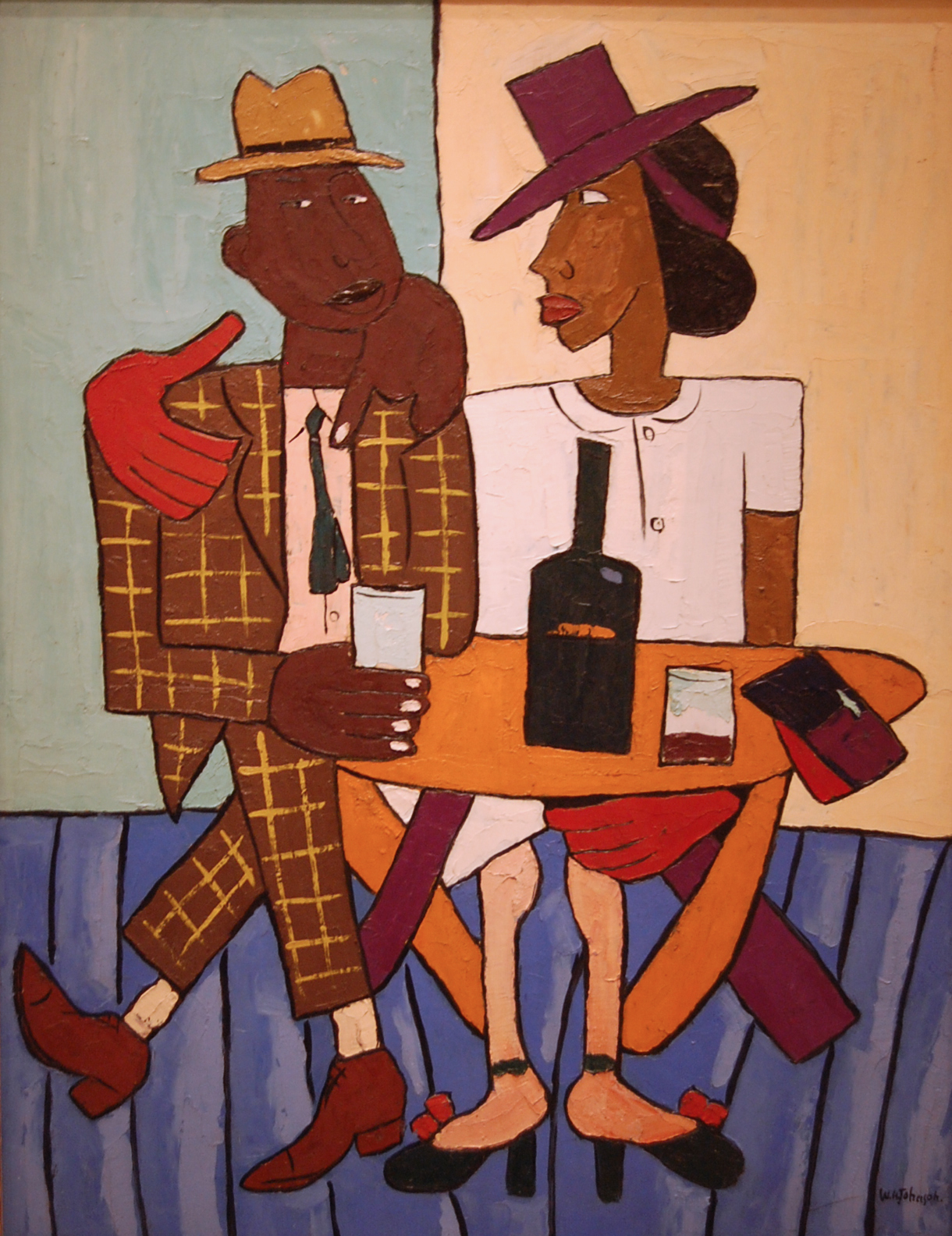
ZP_painting by William Henry Johnson, 1901 – 1970_Café_1940
George Elliott Clarke (born 1960)
“Blues for X”
.
Pretty boy, towel your tears,
And robe yourself in black.
Pretty boy, dry your tears,
You know I’m comin’ back.
I’m your slavish lover
And I’m slavish in the sack.
.
Call me: Sweet Potato,
Sweet Pea, or Sweety Pie,
There’s sugar on my lips
And honey in my thighs.
Jos’phine Baker bakes beans,
But I stew pigtails in rye.
.
My bones are guitar strings
And blues the chords you strum.
My bones are slender flutes
And blues the bars you hum.
You wanna stay my man ? –
Serve me whisky when I come !
. . .
George Elliott Clarke (nace 1960)
“El Blues para X”
.
Lindo chico, enjúgate las lágrimas,
Y vístete de negro.
Chico chicho – que no llores,
Volveré – tú sabes.
Soy tu amante-esclava
Y soy servil en la cama.
.
Llámame: “mi camote”,
“chícharo’zuc’rado” o “pastelito dulce”,
Hay azucar en mis labios
Y miel en mis muslos.
Jos’phine “Panadero” Baker cuece frijoles
Pero yo guiso colas-de-chancho en güisqui.
.
Son cuerdas de guitarra mis huesos
Y los acordes que rasgueas El Blues.
Los huesos son flautas esbeltas
Y El Blues – el compás que tarareas.
¿Quieres permanecer mi hombre?
!Sírveme güisqui cuándo me vengo!
. . .
George Elliott Clarke, el poeta laureado actual de la ciudad de Toronto, nació en este día, el 12 de febrero de 1960. Los temas de su poesía son los hechos y la mitología de su provincia natal – Nova Scotia, Canadá. Con la provincia al lado – New Brunswick – las dos forman lo que Señor Clarke dice como “Africadia” – la palabra África (de unos esclavos fugados de los Estados Unidos) + la palabra Acadia (la misma región canadiense en su época francesa, antes de la llegada de los británicos).
Señor Clarke es Profesor de la literatura canadiense y de la diáspora africana en la Universidad de Toronto.
El poema “El Blues para X” (1990) fue escrito en la voz de una mujer que está confiada en su sexualidad y honesta en sus deseos. El estilo del poema es, quizás, de “nuevo-Blues”. Mezcla algo de la habla clara de Langston Hughes con las palabras francas de Bessie Smith.
. . .
The City of Toronto’s current Poet Laureate, George Elliott Clarke (born February 12th, 1960, in Windsor Plains, Nova Scotia), has mythologized Black-Canadian history in what he calls Africadia – Africa + Acadia – the provinces of New Brunswick and Nova Scotia as lived by Black people for more than two centuries. Clarke received the Governor General’s Award in 2001 for his Execution Poems, based on the lives – and deaths – of two of his relatives, George and Rufus Hamilton. He wrote a libretto for his own play, Beatrice Chancy, and with a score by James Rolfe the opera premiered in Toronto in 1998 with Fredericton-born Measha Brueggergosman in the title role. Since 1999 Professor Clarke has taught Canadian and African Diasporic Literature at the University of Toronto. The poem “Blues for X” – from his 1990 poetry collection Whylah Falls – might be deemed a neo-Blues poem – harkening back to the plain-spoken Blues poems of Langston Hughes, but with a wake-up shot à la Bessie Smith (the last two verses).
.
Traducción en español / Translation into Spanish: Alexander Best, Lidia García Garay
“Blues for X” © George Elliott Clarke
“Orfeu Negro” and the origins of Samba + Wilson Batista’s “Kerchief around my neck” and Noel Rosa’s “Idle youth”
Posted: February 8, 2013 Filed under: English, Noel Rosa, Orfeu Negro and the origins of Samba + Wilson Batista's “Kerchief around my neck” and Noel Rosa's “Idle youth”, Portuguese, Wilson Batista | Tags: Black History Month photographs Comments Off on “Orfeu Negro” and the origins of Samba + Wilson Batista’s “Kerchief around my neck” and Noel Rosa’s “Idle youth”
ZP_poster for Orfeu Negro
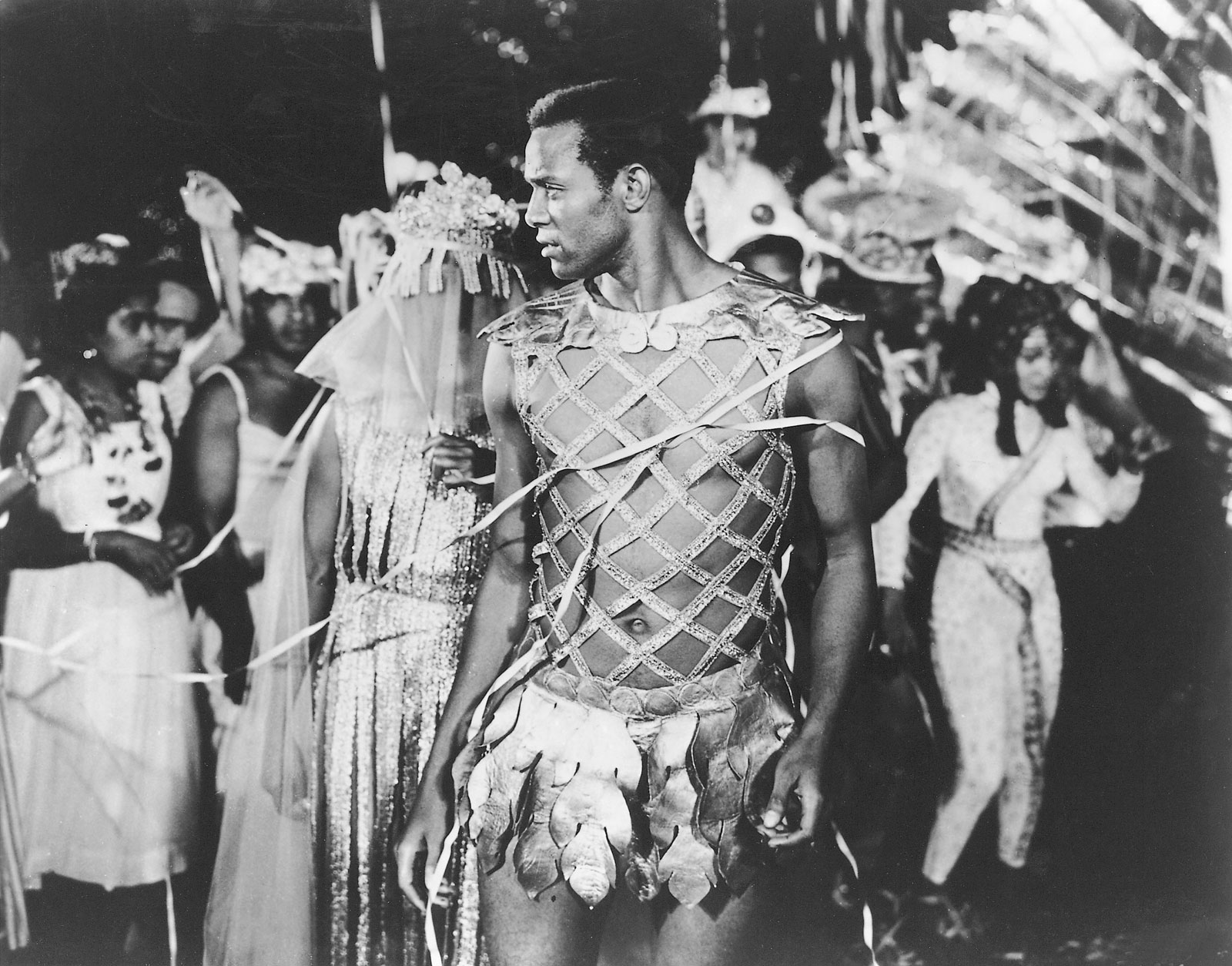
ZP_Breno Mello, 1931 – 2008, as Orpheus in the 1959 Marcel Camus film, Orfeu Negro_Mello was a soccer player whom Camus chanced to meet on the street in Rio de Janeiro. Camus decided to cast the non-actor as the lead in the film. Mello turned out to be exactly right for the role of the star-crossed Everyman enchanted by tricky Fate – his Love is stalked by Death.
- ZP_Marpessa Dawn, American-born actress of Black and Filipino heritage who played Eurydice opposite Breno Mello as Orpheus in the 1959 film Orfeu Negro. She is seen here in a photograph taken at the 1959 Cannes Film Festival. Dawn would later have a bizarre role as Mama Communa in the often-censored or banned 1974 Canadian film by European director Dusan Makavejev – Sweet Movie. A long way from her role in Orfeu Negro…yet she brought something of her beautiful wholesomeness even to the disturbing scenarios of Sweet Movie. Marpessa Dawn died in 2008 at the age of 74 in Paris.

ZP_a 1956 record album by Agostinho Dos Santos who sang the now internationally famous songs from the 1959 film Orfeu Negro_ A Felicidade and Manhã de Carnaval
Orfeu Negro (Black Orpheus), a 1959 film in Portuguese with subtitles, was directed by Marcel Camus in Rio de Janeiro, Brazil. Set at Carnaval time, it featured a mainly Black cast and told a modern Brazilian version of the Greek legend of Orpheus and Eurydice. The Morro da Babilônia “favela” (Babylon Hill “slum”) was used for filming many scenes. Orfeu Negro is a nearly perfect film. Exuberant and pensive, charming and mysterious, it is an engrossing story of doomed Lovers accompanied by the exquisitely-intimate singing of Agostinho Dos Santos of Luiz Bonfá’s songs in the then-nascent bossa nova style. And add to all that the “crazy Life force” pulse of Samba at night in the streets…
Samba – the word – is derived via Portuguese from the West-African Bantu word “semba”, which means “invoke the spirit of the ancestors”. Originating in Salvador da Bahia, Brazil, by the 1920s the Samba sound was emerging with usually a 2/4 tempo, the use of choruses with hand-claps plus declaratory verses, and much of it in batucada rhythm which included African-influenced percussion such as tamborim, repinique, cuica, pandeiro and reco-reco adding many layers to the music. The “voice” of the cavaquinho (which is like a ukulele) provided a pleasing contrast and a non-stop little wooden whistle, the apito, made the urgent breath of human beings palpable.
In the late 1920s in the Rio favela of Mangueira – among others – there began one of the earliest “samba schools”, initiating the transformation of Rio de Janeiro’s Carnaval (which had existed on and off since the 18th century but which was neither a large city-wide event nor one with a strong Black Brazilian influence). In the 21st century, of course, Carnaval in Rio de Janeiro has become the most massive festival in the world; in 2011, for example, close to 5 million people took part, with more than 400,000 of them being foreign visitors. But back in the 1920s…the original Mangueira cordões or cords (also known as blocos or blocks) consisted of groups of masked participants, all men, who were led down the street by a “teacher” blowing an apito whistle. Following them was a mobile orchestra of percussion. In the years that followed the Carnaval procession expanded to include 1. the participation of women 2. floats 3. a theme 4. a mestre-sala (master of ceremonies) and a porta-bandeira (flag-bearer).
Notable early composers and singers of Samba (sambistas) included Pixinguinha, Cartola, Ataulfo Alves and Jamelão among men and Clementina de Jesus, Carmelita Madriaga, Dona Ivone Lara and Jovelina Pérola Negra among women. But this is just the beginning of a long list…
The “fathers” of Samba were Rio musicians but the “mothers” of Samba were the Tias Baianas or the Aunties from Salvador da Bahia (a smaller though culturally rich city further up the Atlantic Coast). Hilária Batista de Almeida, also known as Tia Ciata (1854-1924), was born in Bahia but lived in Rio de Janeiro from the 1870s onward. Involved in persecuted “roots” rituals, she became a Mãe Pequena or Little Mother – Iyakekerê in the Yoruba language – one type of venerated priestess in the Afro-Brazilian religion, Candomblé. The Bahia African rhythms that were crucial to her ceremonies at Rua Visconde de Itaúna, number 177, were incorporated into their compositions by musicians such as Pixinguinha and Donga who were used to playing the maxixe (a 19th-century tango-like dance still popular in Rio in the early 20th century). That musical fusion was the birth of samba carioca – the early Samba sound of Rio. Pelo Telefone (“Over the Telephone”), from 1917, the humorous lyrics of which concern a gambling house (casa de jogo do bicho) and someone waiting for a telephone call tipping him off that the police are about to carry out a raid, is considered the first true Samba song.
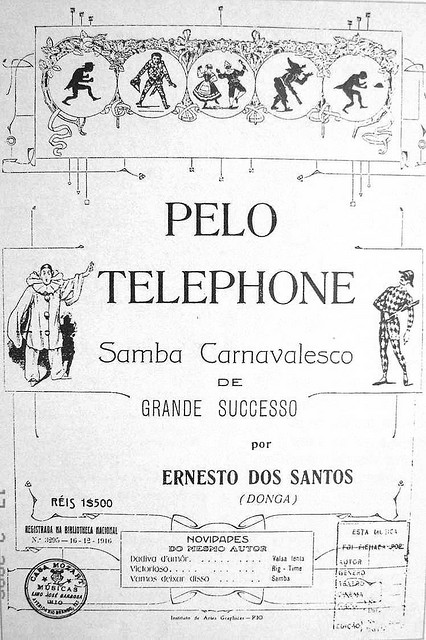
ZP_1917 sheet music for what is believed to be the earliest Samba carioca_Pelo Telefone
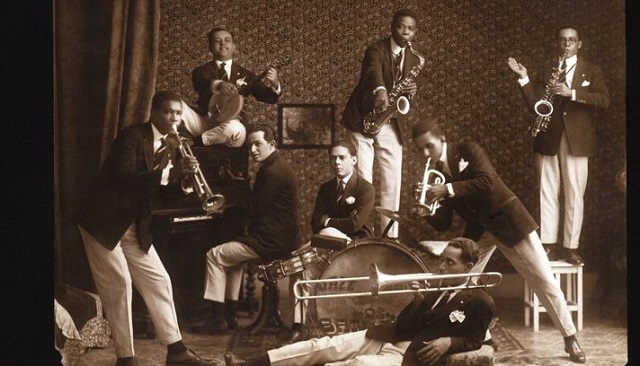
ZP_Os Oito Batutas_The Eight Batons or Eight Cool Guys_around 1920. These Rio musicians had played maxixes and choros for bourgeois theatre-goers in the lobby at intermissions. They began to add ragtime and foxtrot numbers, the latest American imports. But in their spare time, under the influence of the Afro-Brazilian Tias Baianas, they were already synthesizing a new music, the Samba carioca…
As in Trinidad with “rival” Calypsonians and in Mexico with musical “duels” between Cantantes de Ranchera, so in Brazil there were Samba compositions in which musicians responded to one another. It was during the 1930s that White Brazilian composers began to absorb the Samba and alter its lyrical content…and gradually the special sound of Rio’s favelas (via Bahia) became the national music of Brazil…We are grateful to Bryan McCann for the following translations of two vintage Samba lyrics from Portuguese into English.
.
Wilson Batista (Black sambista, 1913 – 1968)
“Kerchief around my neck” (1933)
.
My hat tilted to the side
Wood-soled shoe dragging
Kerchief around my neck
Razor in my pocket
I swagger around
I provoke and challenge
I am proud
To be such a vagabond
.
I know they talk
About this conduct of mine
I see those who work
Living in misery
I’m a vagabond
Because I had the inclination
I remember, as a child I wrote samba songs
(Don’t mess with me, I want to see who’s right… )
My hat tilted to the side
Wood-soled shoe dragging
Kerchief around my neck
Razor in my pocket
I swagger around
I provoke and challenge
I am proud
To be such a vagabond
.
And they play
And you sing
And I don’t give in!
. . .
Wilson Batista
“Lenço no pescoço”
.
Meu chapéu do lado
Tamanco arrastando
Lenço no pescoço
Navalha no bolso
Eu passo gingando
Provoco e desafio
Eu tenho orgulho
Em ser tão vadio
.
Sei que eles falam
Deste meu proceder
Eu vejo quem trabalha
Andar no miserê
Eu sou vadio
Porque tive inclinação
Eu me lembro, era criança
Tirava samba-canção
(Comigo não, eu quero ver quem tem razão…)
.
E eles tocam
E você canta
E eu não dou!
. . .
A response-Samba to Batista’s…
Noel Rosa (White sambista, 1910 – 1937)
“Idle Youth” (1933)
.
Stop dragging your wood-soled shoe
Because a wood-soled shoe was never a sandal
Take that kerchief off your neck
Buy dress shoes and a tie
Throw out that razor
It just gets in your way
With your hat cocked, you slipped up
I want you to escape from the police
Making a samba-song
I already gave you paper and a pencil
“Arrange” a love and a guitar
Malandro is a defeatist word
What it does is take away
All the value of sambistas
I propose, to the civilized people,
To call you not a malandro
But rather an idle youth.
.
Malandro in Brazil meant: rogue, scoundrel, street-wise swindler
. . .
Noel Rosa
“Rapaz folgado”
Deixa de arrastar o teu tamanco
Pois tamanco nunca foi sandália
E tira do pescoço o lenço branco
Compra sapato e gravata
Joga fora esta navalha que te atrapalha
Com chapéu do lado deste rata
Da polícia quero que escapes
Fazendo um samba-canção
Já te dei papel e lápis
Arranja um amor e um violão
Malandro é palavra derrotista
Que só serve pra tirar
Todo o valor do sambista
Proponho ao povo civilizado
Não te chamar de malandro
E sim de rapaz folgado.

ZP_Carnaval in Rio de Janeiro_a 1950s glamour photograph of professional revelers
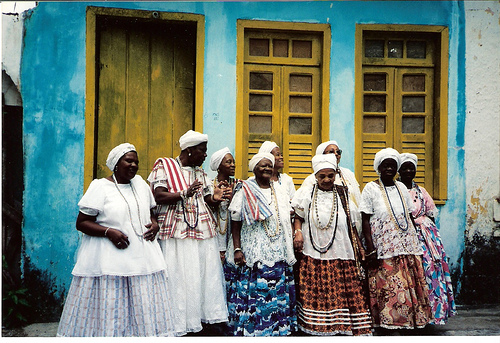
ZP_Irmandade da Boa Morte_Sisterhood of the Good Death_women devotees of Candomblé in contemporary Bahia_photo by Jill Ann Siegel
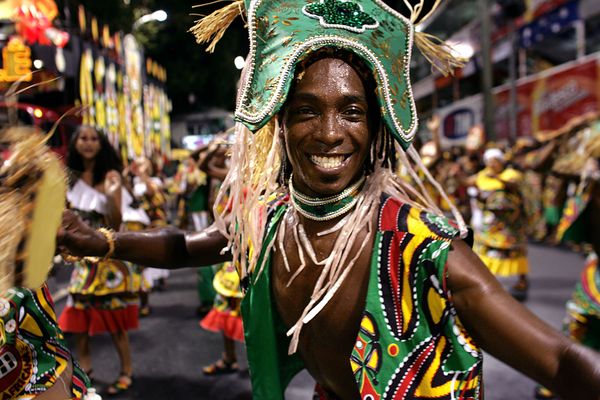
ZP_Carnaval in Salvador da Bahia, Brazil_photo by David Turnley
For those who observe Lent…just a reminder: next week, February 13th, is Ash Wednesday.
–But up until then … … !
And so, tonight, Friday February 8th, the mayor of Rio will hand over “the keys to the city” to Rei Momo, King Momo (from the Greek Momus – the god of satire and mockery) a.k.a. The Lord of Misrule and Revelry. A symbolic act signifying that the largest party in the world is about to begin. Enjoy!
. . . . .
“Mind is your only ruler – sovereign”: Marcus Garvey and Bob Marley: “Emancípense de la esclavitud mental; nadie más que nosotros puede liberar nuestras mentes.”
Posted: February 6, 2013 Filed under: Bob Marley, Emancípense de la esclavitud mental: Marcus Garvey + Bob Marley y su Canción de Redención, English, Spanish | Tags: Black History Month poems Comments Off on “Mind is your only ruler – sovereign”: Marcus Garvey and Bob Marley: “Emancípense de la esclavitud mental; nadie más que nosotros puede liberar nuestras mentes.”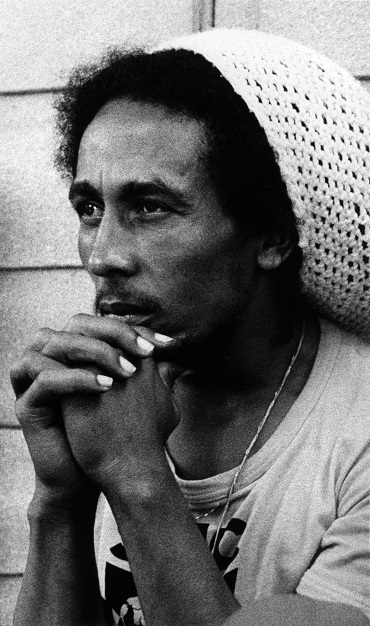
ZP_Bob Marley, 1945 – 1981
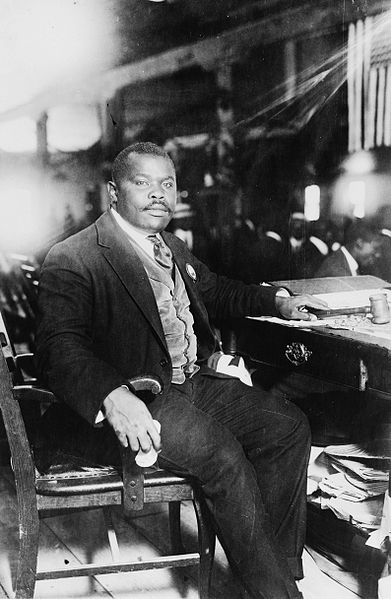
ZP_Marcus Garvey, 1887 – 1940_Jamaican orator, Black Nationalist and promoter of Pan-Africanism in the Diaspora
“Redemption Song”, from Bob Marley and The Wailers final studio album (1980), was unlike anything Marley had recorded previously. There is no reggae in in it, rather it is a kind of folksong / spiritual and just him singing with an acoustic guitar. The exhortation to “emancipate yourselves from mental slavery, none but ourselves can free our minds” was taken directly from a famous speech that fellow Jamaican and Pan-Africanist Marcus Garvey gave in Nova Scotia, Canada, in 1937. Garvey published the speech in his Black Man magazine. He had said: “We are going to emancipate ourselves from mental slavery because whilst others might free the body, none but ourselves can free the mind. Mind is your only ruler, sovereign. The man who is not able to develop and use his mind is bound to be the slave of the other man who uses his mind…” Bob Marley was born on this day, February 6th, in 1945. He developed cancer in 1977 but for three years did not seek treatment because of his Rastafarian beliefs; was the illness perhaps Jah’s will? He died in 1981, at the age of 36.
At Marley’s funeral Jamaican Prime Minister Edward Seaga eulogized him thus: “His voice was an omnipresent cry in our electronic world. His sharp features, majestic looks, and prancing style a vivid etching on the landscape of our minds. Bob Marley was never seen. He was “an experience” – which left an indelible imprint with each encounter. Such a man cannot be erased from the mind. He is part of the collective consciousness of the nation.”
.
Robert Nesta ‘Bob’ Marley
“Redemption Song”
.
Old pirates, yes, they rob I;
Sold I to the merchant ships,
Minutes after they took I
From the bottomless pit.
But my hand was made strong
By the hand of the Almighty.
We forward in this generation
Triumphantly.
Won’t you help to sing
These songs of freedom?
‘Cause all I ever have:
Redemption songs,
Redemption songs.
.
Emancipate yourselves from mental slavery;
None but ourselves can free our minds.
Have no fear for atomic energy,
‘Cause none of them can stop the time.
How long shall they kill our prophets,
While we stand aside and look?
Ooo,
Some say it’s just a part of it:
We’ve got to fulfil The Book.
.
Won’t you help to sing
These songs of freedom?
‘Cause all I ever have:
Redemption songs,
Redemption songs,
Redemption songs.
.
Emancipate yourselves from mental slavery;
None but ourselves can free our minds.
Woah, have no fear for atomic energy,
‘Cause none of them can stop the time.
How long shall they kill our prophets,
While we stand aside and look?
Yes, some say it’s just a part of it:
We’ve got to fulfil The Book.
Won’t you help to sing
These songs of freedom?
‘Cause all I ever had:
Redemption songs,
Yes, all I ever had:
Redemption songs:
These songs of freedom,
Songs of freedom.
. . .
Canción de Redención, del disco final (1980) grabado por Bob Marley y “Los hombres plañideros”, es algo diferente: una canción folklórica muy íntima – con solamente una voz y una guitarra acústica – y no es canción de reggae. Cuando Marley cantó este “canto” que es también una exhortación, ya sufría del cáncer, y ahora, en el año 2013 – más de tres décadas después de su muerte – las letras de Redención parecen como buen consejo para vivir con dignidad en el mundo actual.
Las palabras Emancípense de la esclavitud mental – nadie más que nosotros puede liberar nuestras mentes son pasajes de una declaración famosa del activista jamaiquino Negro-Nacionalista Marcus Garvey (1887-1940). En Jamaica la gente cree que la religión rastafari (la fe de Bob Marley) es en parte consecuencia de las ideas de Garvey; él anunció la llegada de un rey, el emperador Haile Selassie de Etiopía. En hecho, Garvey aseguró a sus seguidores: “Miren a Africa cuando un rey negro sea coronado – éso significa que la liberación está cerca”.
Pero “la llegada de un rey” no resuelve todo el misterio irónico de la Vida – como la muerte de un hombre casi joven – y de gran don.
Edward Seaga, el primer ministro de Jamaica, pronunció el elogio al funeral de Bob Marley. Dijo: “Su voz fue un grito omnipresente en nuestro mundo electrónico. Sus rasgos afilados, su aspecto majestuoso y su forma de moverse se han grabado intensamente en el paisaje de nuestra mente. Bob Marley nunca fue visto. Fue “una experiencia” que dejó una huella indeleble en cada encuentro. Un hombre así no se puede borrar de la mente. Él es parte de la conciencia colectiva de la nación.”
.
Robert Nesta ‘Bob’ Marley (6 de febrero, 1945 – 1981)
“Canción de Redención”
.
Viejos piratas, sí, que me roban a yo;
Vendido yo a los buques mercantes,
Minutos después de que tomé a yo
Desde el pozo sin fondo.
Pero mi mano fue hecha fuerte
Por la mano del Todopoderoso.
Avanzamos adelante en esta generación
– Triunfante.
¿No le gustaría ayudar a cantar
Estas canciones de libertad?
Porque todo lo que tengo – alguna vez:
Las canciones de redención,
Canciones de la redención.
.
Emancípense de la esclavitud mental;
Nadie más que nosotros puede liberar nuestras mentes.
No tenga miedo de la energía atómica,
Ninguno de ellos puede parar el tiempo.
¿Por cuánto tiempo van a matar a nuestros profetas,
A pesar de que un lado para mirar?
Ooo,
Algunos dicen que es sólo una parte de todo:
Tenemos que cumplir con El Libro.
.
¿No le gustaría ayudar a cantar
Estas canciones de libertad?
Porque todo lo que tengo – alguna vez:
Las canciones de redención,
Canciones de redención,
Canciones de la redención.
.
Emancípense de la esclavitud mental;
Nadie más que nosotros puede liberar nuestras mentes.
Ay,
No tenga miedo de la energía atómica,
Ninguno de ellos puede parar el tiempo..
¿Por cuánto tiempo van a matar a nuestros profetas,
A pesar de que un lado para mirar?
Sí, algunos dicen que es sólo una parte de todo:
Tenemos para cumplir con El Libro.
¿Usted, no va a tener que cantar
Estas canciones de libertad?
Porque todo lo que tuve – alguna vez:
Las canciones de redención.
Todo lo que yo tuve – alguna vez:
Canciones de redención, ah sí –
Estas canciones de libertad,
Canciones de la libertad.
. . . . .
“Viva y no pare” / “Live and don’t hold back”: Nicolás Guillén + el Yoruba de Cuba / the Yoruba from Cuba
Posted: February 5, 2013 Filed under: English, Nicolás Guillén, Nicolás Guillén + el Yoruba de Cuba / the Yoruba from Cuba, Spanish, ZP Translator: Alexander Best | Tags: Black History Month poems Comments Off on “Viva y no pare” / “Live and don’t hold back”: Nicolás Guillén + el Yoruba de Cuba / the Yoruba from Cuba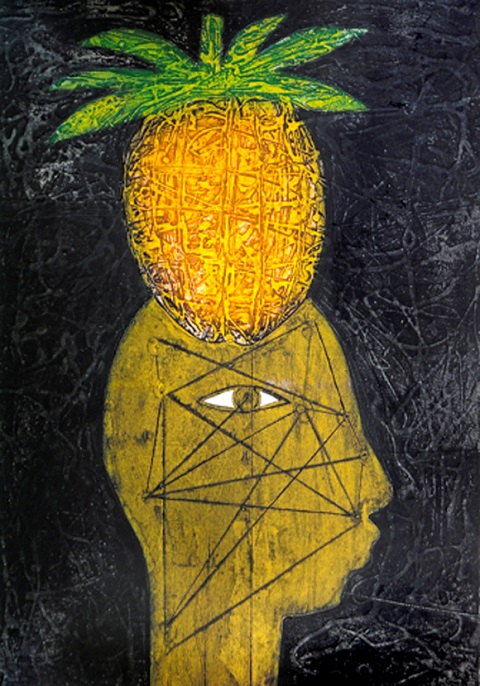
Z|P_Cabeza de piña por Eduardo Roca alias Choco_pintor cubano
Nicolás Guillén (Cuba, 1902-1989)
A poem from “ ‘Son’ Motifs ” (1930)
“Go get some dough”
.
Get some silver,
go get some dough for us!
Cuz I’m not goin one step more:
we’re down to just rice and crackers,
that’s it.
Yeah, I know how things are,
but hey, my Guy – a person’s gotta eat:
so get some money,
go get it,
else I’m gonna beat it.
Then they’ll call me a ‘no good’ woman
and won’t want nothin’ to do with me. But
Love with Hunger? Hell no!
.
There’s so many pretty new shoes out there, dammit!
So many wristwatches, compadre!
Hell – so many luxuries we might have, my Man!
.
Translation from Spanish: Alexander Best
.
Note: ‘Son’ (meaning Sound) was the traditional Cuban music style of the early twentieth century.
It combined Spanish song and guitars with African percussion of Bantu origin. ‘Son’ was the basis upon which Salsa developed.
. . .
Del poemario “Motivos de Son” (1930)
“Búcate plata”
.
Búcate plata,
búcate plata,
poqque no doy un paso má;
etoy a arró con galleta,
na má.
Yo bien sé como etá to,
pero biejo, hay que comé:
búcate plata,
búcate plata,
poqque me boy a corré.
Depué dirán que soy mala,
y no me quedrán tratá,
pero amó con hambre, biejo.
¡qué ba!
con tanto sapato nuevo,
¡qué ba!
Con tanto reló, compadre,
¡qué ba!
Con tanto lujo, mi negro,
¡qué ba!
. . .
A poem from Sóngoro cosongo: mulatto poems (1931)
“Cane”
.
The black man
together with the plantation.
The yankee
on the plantation.
The earth
beneath the plantation.
Our blood
drains out of us!
. . .
Un poema del poemario Sóngoro cosongo: poemas mulatos (1931)
“Caña”
.
El negro
junto al cañaveral.
El yanqui
sobre el cañaveral.
La tierra
bajo el cañaveral.
¡Sangre
que se nos va!
. . .
Two poems from “West Indies, Ltd.” (1934):
“Guadaloupe, W. I., Pointe-à-Pitre”
.
The black men, working
near the steamboat. The arabs, selling,
the french, strolling, having a rest
– and the sun, burning.
.
In the harbour the sea
lies down. The air toasts
the palm trees… I scream: Guadaloupe!
but nobody answers.
.
The steamboat leaves, labouring through
the impassive waters with a foaming roar.
There the black men stay, still working,
and the arabs, selling,
and the french, strolling, having a rest
– and the sun, burning…
. . .
“Guadalupe, W. I., Pointe-à-Pitre” (1934)
.
Los negros, trabajando
junto al vapor. Los árabes, vendiendo,
los franceses, paseando y descansando
– y el sol, ardiendo.
En el puerto se acuesta
el mar. El aire tuesta
las palmeras… Yo grito: ¡Guadalupe!
pero nadie contesta.
.
Parte el vapor, arando
las aguas impasibles con espumoso estruendo.
Allá quedan los negros trabajando,
los árabes vendiendo,
los franceses, paseando y descansando
– y el sol, ardiendo…
. . .
“Riddles”
.
The teeth, filled with the morning,
and the hair, filled with the night.
Who is it? It’s him, or it’s not him?
— Black man.
.
Though she being woman and not beautiful,
you’ll do what she orders you.
Who is it? It’s him, or it’s not him?
— Hunger.
.
Slave of the slaves,
and towards the masters, tyrant.
Who is it? It’s him, or it’s not him?
— Sugar cane.
.
Noise of a hand
that never ignores the other.
Who is it? It’s him, or it’s not him?
— Almsgiving.
.
A man who is crying
going on with the laugh he learned.
Who is it? It’s him, or it’s not him?
— Me.
. . .
“Adivinanzas”
.
En los dientes, la mañana,
y la noche en el pellejo.
¿Quién será, quién no será?
— El negro.
.
Con ser hembra y no ser bella,
harás lo que ella te mande.
¿Quién será, quién no será?
— El hambre.
.
Esclava de los esclavos,
y con los dueños, tirana.
¿Quién será, quién no será?
— La caña.
.
Escándalo de una mano
que nunca ignora a la otra.
¿Quién será, quién no será?
— La limosna.
.
Un hombre que está llorando
con la risa que aprendió.
¿Quién será, quién no será?
— Yo.
. . .
Poem from “Cantos para soldados y sones para turistas (1937)
“Execution”
.
They are going to execute
a man whose arms are tied.
There are four soldiers
for the shooting.
Four silent
soldiers,
fastened up,
like the fastened-up man they’re going to kill.
— Can you escape?
— I can’t run!
— They’re gonna shoot!
— What’re we gonna do?
— Maybe the rifles aren’t loaded…
— They got six bullets of fierce lead!
— Perhaps these soldiers don’t shoot!
— You’re a fool – through and through!
.
They fired.
(How was it they could shoot?)
They killed.
(How was it they could kill?)
They were four silent
soldiers,
and an official señor
made a signal to them, lowering his saber.
Four soldiers they were,
and tied,
like the man they were to kill.

ZP_En la mira (In the cross-hairs)_Eduardo Roca (Choco)_pintor cubano
“Fusilamiento”
.
Van a fusilar
a un hombre que tiene los brazos atados.
Hay cuatro soldados
para disparar.
Son cuatro soldados
callados,
que están amarrados,
lo mismo que el hombre amarrado que van a matar.
—¿Puedes escapar?
—¡No puedo correr!
—¡Ya van a tirar!
—¡Qué vamos a hacer!
—Quizá los rifles no estén cargados…
—¡Seis balas tienen de fiero plomo!
—¡Quizá no tiren esos soldados!
—¡Eres un tonto de tomo y lomo!
.
Tiraron.
(¿Cómo fue que pudieron tirar?)
Mataron.
(¿Cómo fue que pudieron matar?)
Eran cuatro soldados
callados,
y les hizo una seña, bajando su sable,
un señor oficial;
eran cuatro soldados
atados,
lo mismo que el hombre que fueron los cuatro a
matar.
. . .
“Bourgeois”
.
The vanquished bourgeois – they don’t make me sad.
And when I think they are going to make me sad,
I just really grit my teeth, really shut my eyes.
.
I think about my long days with neither shoes and roses,
I think about my long days with neither sombrero nor
clouds,
I think about my long days without a shirt – or dreams,
I think about my long days with my prohibited skin,
I think about my long days And
.
You cannot come in, please – this is a club.
The payroll is full.
There’s no room in this hotel.
The señor has stepped out.
Looking for a girl.
Fraud in the elections.
A big dance for blind folks.
.
The first price fell to Santa Clara.
A “Tómbola” lottery for orphans.
The gentleman is in Paris.
Madam the marchioness doesn’t receive people.
Finally And
.
Given that I recall everything and
the way I recall everything,
what the hell are you asking me to do?
In addition, ask them,
I’m sure they too
recall all.
. . .
“Burgueses”
.
No me dan pena los burgueses vencidos.
Y cuando pienso que van a dar me pena,
aprieto bien los dientes, y cierro bien los ojos.
.
Pienso en mis largos días sin zapatos ni rosas,
pienso en mis largos días sin sombrero ni nubes,
pienso en mis largos días sin camisa ni sueños,
pienso en mis largos días con mi piel prohibida,
pienso en mis largos días Y
.
No pase, por favor, esto es un club.
La nómina está llena.
No hay pieza en el hotel.
El señor ha salido.
.
Se busca una muchacha.
Fraude en las elecciones.
Gran baile para ciegos.
.
Cayó el premio mayor en Santa Clara.
Tómbola para huérfanos.
El caballero está en París.
La señora marquesa no recibe.
En fin Y
Que todo lo recuerdo y como todo lo
recuerdo,
¿qué carajo me pide usted que haga?
Además, pregúnteles,
estoy seguro de que también
recuerdan ellos.
. . .
“The Black Sea”
.
The purple night dreams
over the sea;
voices of fishermen,
wet with the sea;
the moon makes its exit,
dripping all over the sea.
.
The black sea.
Throughout the night, a sound,
flows into the bay;
throughout the night, a sound.
.
The boats see it happen,
throughout the night, this sound,
igniting the chilly water.
Throughout the night, a sound,
Inside the night, this sound,
Across the night – a sound.
.
The black sea.
Ohhh, my mulatto woman of fine, fine gold,
I sigh, oh my mixed woman who is like gold and silver together,
with her red poppy and her orange blossom.
At the foot of the sea.
At the foot of the sea, the hungry, masculine sea.
.
Translation from Spanish: Alexander Best
. . .
“El Negro Mar”
.
La noche morada sueña
sobre el mar;
la voz de los pescadores
mojada en el mar;
sale la luna chorreando
del mar.
El negro mar.
Por entre la noche un son,
desemboca en la bahía;
por entre la noche un son.
Los barcos lo ven pasar,
por entre la noche un son,
encendiendo el agua fría.
Por entre la noche un son,
por entre la noche un son,
por entre la noche un son. . .
El negro mar.
Ay, mi mulata de oro fino,
ay, mi mulata
de oro y plata,
con su amapola y su azahar,
al pie del mar hambriento y masculino,
al pie del mar.
. . .
“Son” Number 6
.
I’m Yoruba, crying out Yoruba
Lucumí.
Since I’m Yoruba from Cuba,
I want my lament of Yoruba to touch Cuba
the joyful weeping Yoruba
that comes out of me.
.
I’m Yoruba,
I keep singing
and crying.
When I’m not Yoruba then
I am Congo, Mandinga or Carabalí.
Listen my friends, to my ‘son’ which begins like this:
.
Here is the riddle
of all my hopes:
what’s mine is yours,
what’s yours is mine;
all the blood
shaping a river.
.
The silk-cotton tree, tree with its crown;
father, the father with his son;
the tortoise in its shell.
Let the heart-warming ‘son’ break out,
and our people dance,
heart close to heart,
glasses clinking together
water on water with rum!
.
I’m Yoruba, I’m Lucumí,
Mandinga, Congo, Carabalí.
Listen my friends, to the ‘son’ that goes like this:
.
We’ve come together from far away,
young ones and old,
Blacks and Whites, moving together;
one is a leader, the other a follower,
all moving together;
San Berenito and one who’s obeying
all moving together;
Blacks and Whites from far away,
all moving together;
Santa María and one who’s obeying
all moving together;
all pulling together, Santa María,
San Berenito, all pulling together,
all moving together, San Berenito,
San Berenito, Santa María.
Santa María, San Berenito,
everyone pulling together!
.
I’m Yoruba, I’m Lucumí
Mandinga, Congo, Carabalí.
Listen my friends, to my ‘son’ which ends like this:
.
Come out Mulatto,
walk on free,
tell the White man he can’t leave…
Nobody breaks away from here;
look and don’t stop,
listen and don’t wait
drink and don’t stop,
eat and don’t wait,
live and don’t hold back
our people’s ‘son’ will never end!
.
Translation from Spanish: Salvador Ortiz-Carboneres
. . .
“Son número 6”
.
Yoruba soy, lloro en yoruba
lucumí.
Como soy un yoruba de Cuba,
quiero que hasta Cuba suba mi llanto yoruba;
que suba el alegre llanto yoruba
que sale de mí.
.
Yoruba soy,
cantando voy,
llorando estoy,
y cuando no soy yoruba,
soy congo, mandinga, carabalí.
Atiendan amigos, mi son, que empieza así:
.
Adivinanza
de la esperanza:
lo mío es tuyo
lo tuyo es mío;
toda la sangre
formando un río.
.
La ceiba ceiba con su penacho;
el padre padre con su muchacho;
la jicotea en su carapacho.
.
¡Que rompa el son caliente,
y que lo baile la gente,
pecho con pecho,
vaso con vaso,
y agua con agua con aguardiente!
.
Yoruba soy, soy lucumí,
mandinga, congo, carabalí.
Atiendan, amigos, mi son, que sigue así:
.
Estamos juntos desde muy lejos,
jóvenes, viejos,
negros y blancos, todo mezclado;
uno mandando y otro mandado,
todo mezclado;
San Berenito y otro mandado,
todo mezclado;
negros y blancos desde muy lejos,
todo mezclado;
Santa María y uno mandado,
todo mezclado;
todo mezclado, Santa María,
San Berenito, todo mezclado,
todo mezclado, San Berenito,
San Berenito, Santa María,
Santa María, San Berenito
todo mezclado!
.
Yoruba soy, soy lucumí,
mandinga, congo, carabalí.
Atiendan, amigos, mi son, que acaba así:
.
Salga el mulato,
suelte el zapato,
díganle al blanco que no se va:
de aquí no hay nadie que se separe;
mire y no pare,
oiga y no pare,
beba y no pare,
viva y no pare,
que el son de todos no va a parar!
. . . . .
“They now gonna make us shut up”: The Black Nationalist / Third-World Socialist poetry of Amiri Baraka
Posted: February 1, 2013 Filed under: Amiri Baraka, English, English: Black Canadian / American | Tags: Black History Month poems Comments Off on “They now gonna make us shut up”: The Black Nationalist / Third-World Socialist poetry of Amiri Baraka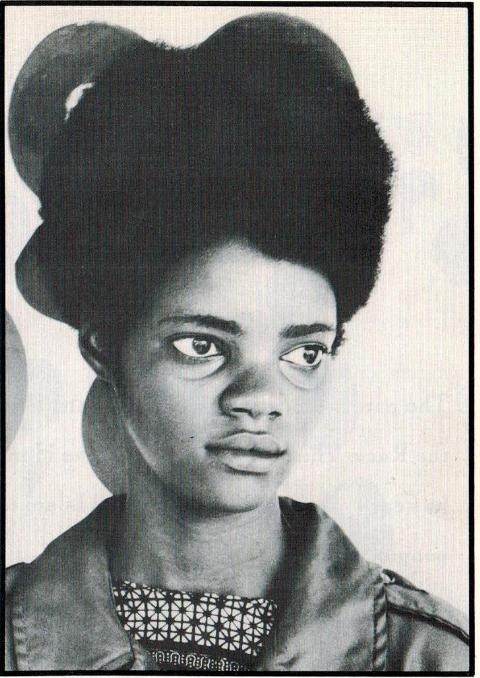
ZP_photograph by Fundi_Billy Abernathy_from the 1970 Imamu Amiri Baraka book In Our Terribleness_I love you black perfect woman. Your spirit will rule the twenty first century. This is why we ourselves speed to grace…
Amiri Baraka (born Everett LeRoi Jones, 1934)
“Numbers, Letters” (written in 1965)
.
If you’re not home, where
are you? Where’d you go? What
were you doing when gone? When
you come back, better make it good.
What was you doing down there, freakin’ off
with white women, hangin’ out
with Queens, say it straight to be
understood straight, put it flat and real
in the street where the sun comes and the
moon comes and the cold wind in winter
waters your eyes. Say what you mean, dig
it out put it down, and be strong
about it.
.
I cant say who I am
unless you agree I’m real
.
I cant be anything I’m not
except these words pretend
to life not yet explained,
so here’s some feeling for you
see how you like it, what it
reveals, and that’s Me.
.
Unless you agree I’m real
that I can feel
whatever beats hardest
a our black souls
I am real, and I can’t say who
I am. Ask me if I know, I’ll say
yes, I might say no. Still, ask.
I’m Everett LeRoi Jones, 30 yrs old.
.
A black nigger in the universe. A long breath singer,
wouldbe dancer, strong from years of fantasy
and study. All this time then, for what’s happening
now. All that spilling of white ether, clocks in ghostheads
lips drying and rewet, eyes opening and shut, mouths churning.
.
I am a meditative man, And when I say something it’s all of me
saying, and all the things that make me, have formed me, coloured me
this brilliant reddish night. I will say nothing that I feel is
lie, or unproven by the same ghostclocks, by the same riders
Always move so fast with the word slung over their backs or
in saddlebags, charging down Chinese roads. I carry some words,
some feeling, some life in me. My heart is large as my mind
this is a messenger calling, over here, over here, open your eyes
and your ears and your souls; today is the history we must learn
to desire. There is no guilt in love.
.
(from “Black Magic”, published 1969)
. . .
“Black Art”
.
Poems are bullshit unless they are
teeth or trees or lemons piled
on a step. Or black ladies dying
of men leaving nickel hearts
beating them down. Fuck poems
and they are useful, wd they shoot
come at you, love what you are,
breathe like wrestlers, or shudder
strangely after pissing. We want live
words of the hips world live flesh &
coursing blood. Hearts Brains
Souls splintering fire. We want poems
like fists beating niggers out of Jocks
or dagger poems in the slimy bellies
of the owner-jews. Black poems to
smear on girdlemamma mulatto bitches
whose brains are red jelly stuck
between ’lizabeth taylor’s toes. Stinking
Whores! We want “poems that kill”.
Assassin poems, Poems that shoot
guns. Poems that wrestle cops into alleys
and take their weapons leaving them dead
with tongues pulled out and sent to Ireland. Knockoff
poems for dope selling wops or slick halfwhite
politicians Airplane poems, rrrrrrrrrrrrrrrrrr
rrrrrrrrrrrrrrrr…tuhtuhtuhtuhtuhtuhtuhtuhtuh
…rrrrrrrrrrrrrrrr…Setting fire and death to
whities ass. Look at the Liberal
Spokesman for the jews clutch his throat
& puke himself into eternity…rrrrrrr
There’s a negroleader pinned to
a bar stool in Sardi’s eyeballs melting
in hot flame Another negroleader
on the steps of the white house one
kneeling between the sheriff’s thighs
negotiating cooly for his people.
Agggh … stumbles across the room …
Put it on him, poem. Strip him naked
to the world! Another bad poem cracking
steel knuckles in a jewlady’s mouth
Poem scream poison gas on beasts in green berets
Clean out the world for virtue and love,
Let there be no love poems written
until love can exist freely and
cleanly. Let Black People understand
that they are the lovers and the sons
of lovers and warriors and sons
of warriors Are poems & poets &
all the loveliness here in the world
.
We want a black poem. And a
Black World.
Let the world be a Black Poem
And Let All Black People Speak This Poem
silently
Or LOUD
.
(from “Black Magic”, published 1969)

ZP_from page 1 of In Our Terribleness_Some elements and meaning in black style_by Imamu Amiri Baraka_with Fundi_1970
“J. said, “Our whole universe is generated by a rhythm””
.
Is Dualism, the shadow inserted
for the northern trip, as the northern
trip, minstrels of the farther land,
the sun, in one place, ourselves, somewhere
else. The Universe
is the rhythm
there is no on looker, no outside
no other than the real, the universe
is rhythm, and whatever is only is as
swinging. All that is is funky, the bubbles
in the monsters brain, are hitting it too,
but the circles look like
swastikas, the square is thus
explained, but the nazis had dances, and even some of the
victims would tell you that.
.
There is no such thing as “our
universe”, only degrees of the swinging, what
does not swing is nothing, and nothing swings
when it wants to. The desire alone is funky
and it is this heat Louis Armstrong scatted in.
.
What is not funky is psychological, metaphysical
is the religion of squares, pretending no one
is anywhere.
Everything gets hot, it is hot now, nothing cold exists
and cold, is the theoretical line the pretended boundary
where your eye and your hand disappear into desire.
.
Dualism is a quiet camp near the outer edge of the forest.
There the inmates worship money and violence. they are
learning right now to sing, let us join them for a moment
and listen. Do not laugh, whatever you do.
.
(from “Funk Lore” – New Poems, 1984-1995)
. . .
“Brother Okot”
.
Our people say
death lives
in the West
(Any one
can see
plainly, each evening
where the sun
goes to die)
.
So Okot
is now in the West
.
Here w/ us
in hell
.
I have heard
his songs
felt the earth
drum his
dance
his wide ness
& Sky self
.
Ocoli Singer
Ocoli Fighter
.
Brother Okot
now here w/ us
in the place
.
Where even the Sun
dies.
.
Editor’s note:
Okot p’Bitek (1931-1982) was a Ugandan poet, author of the epic poem “Song of Lawino”,
written in the Acholi language. (Acholi = Ocoli).
One of Okot p’Bitek’s daughters, Juliane Okot Bitek, is a poet whose work was featured by
Zócalo Poets in February 2012.
. . .
“Syncretism”
.
BAD NEWS SAY
KILL
DRUM
But Drum
no
die
just
act slick
drum turn
mouth
tongue
drum go voice
be hand
on over
hauls
dont die
how some ever
drum turn slick
never
no drum
never
never
die
be a piano
a fiddle
a nigger tap
fellah
drum’ll
yodel
if it need to
Thing say Kill drum
but drum
dont die/dont even
disappear
& drum cant die
& wdn’t
no way!
.
(from “Funk Lore” – New Poems, 1984-1995)
. . .
“Bad People”
.
We want to be happy
neglecting
to check
the definition
.
We want to love
& be loved
but
What does that
mean?
.
Then you, backed up against
yr real life
.
claim you want
only
to be correct.
.
Imagine the jeers,
the cat calls
the universal dis
.
such ignorance
justifiably
creates.
.
(from “Funk Lore” – New Poems, 1984-1995)
. . . . .
ZP Editor’s note:
“They now gonna make us shut up” is the opening line of Baraka’s 1969 poem “The People Burning”.
.
Editor Paul Vangelisti wrote in a 1995 foreword to an Amiri Baraka anthology that the poet “remains difficult to approach” – that is, for readers trying to place his ‘opus’ – since the U.S. literary establishment is “positioned somewhere between Anglo-American academicism and the Entertainment industry.” Baraka cannot be fitted neatly anywhere – though he has been compared to Ezra Pound for “making poetry and politics reciprocal forms of action” (M.L. Rosenthal, 1973).
Imamu Amiri Baraka (Arabic for Spiritual Leader-Blesséd-Prince) was born Everett LeRoi Jones in Newark, New Jersey, and was one of the “urgent new voices” – black voices – of the 1960s. Like a number of U.S. cities with Black citizens who were barred from “getting ahead” and who felt fed up with a normalized police brutality, Newark experienced what were then called “race riots”, in July 1967, leaving 26 people dead. Over the decades Baraka has stuck by his city, continuing to live there through thick and thin.
.
The poet had often signed his poems “Roi”, up until 1966, at which time he took his Muslim name. After the assassination of Malcolm X Baraka became more forceful in his poetry – promoting a Black Nationalist culture – and trying to give poetic shape to Anger. But in the 1970s he distanced himself from Black Nationalism, finding in it “certain dead ends theoretically and ideologically”, and he gravitated toward Third-World Liberation movements involving Marxism.
.
Baraka has been brought to task over the years for sexism, anti-Semitism, and homophobia in his writing (from the 1960s especially) – but he was, in his poetic passion, giving expression to his full self – his ugly thoughts as well as his ideas and yearnings. In that sense Baraka was ordinary not special – yet he was egocentric enough to want to ‘say it all’.
About the criticisms against the “prejudices” evident in his work he has said:
“The anger was part of the mindset created by, first, the assassination of John Kennedy, followed by the assassination of Patrice Lumumba, followed by the assassination of Malcolm X – amidst the lynching, and national oppression. A few years later, the assassination of Martin Luther King and Robert Kennedy. What changed my mind was that I became a Marxist, after recognizing classes within the Black community…..”
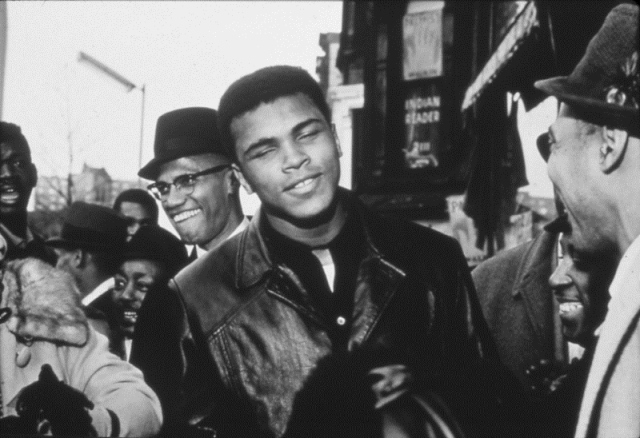
ZP_Muhammad Ali with Malcolm X in the background_1964 photograph by Robert L. Haggins
Baraka’s poetry from the 1990s took as its template Blues and Jazz structures and he penned poems that in their own weird ways honoured Ma Rainey, Bessie Smith, Duke Ellington, Charlie Parker, John Coltrane, Thelonius Monk and Sun Ra. There was also polemic and vitriol, sometimes downright pessimistic, in poems about Clarence Thomas and Spike Lee. Still “making poetry and politics reciprocal forms of action”, as Rosenthal had described Baraka in the early 1970s, it came as no surprise when the poet wrote an inflammatory poem, “Somebody Blew Up America”, about the September 11th, 2001, World Trade Center attack.
. . . . .
All poems © Amiri Baraka
Amiri Baraka and Langston Hughes: “Throw jesus out yr mind” / “Goodbye, Christ”
Posted: February 1, 2013 Filed under: Amiri Baraka, English, English: Black Canadian / American, Langston Hughes | Tags: Black History Month poems Comments Off on Amiri Baraka and Langston Hughes: “Throw jesus out yr mind” / “Goodbye, Christ”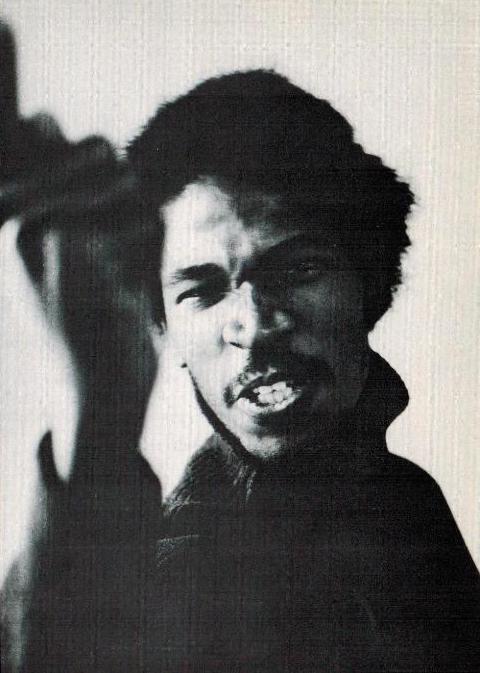
ZP_photograph by Fundi_Billy Abernathy_from the 1970 Imamu Amiri Baraka book In Our Terribleness
Amiri Baraka (born 1934, Newark, New Jersey, U.S.A.)
“When We’ll Worship Jesus”
(written after 1970, published in Baraka’s poetry collection “Hard Facts”, 1975)
.
We’ll worship Jesus
When Jesus do
Something
When jesus blow up
the white house
or blast nixon down
when jesus turn out congress
or bust general motors to
yard bird motors
jesus we’ll worship jesus
when jesus get down
when jesus get out his yellow lincoln
w/the built in cross stain glass
window & box w/black peoples
enemies we’ll worship jesus when
he get bad enough to at least scare
somebody – cops not afraid
of jesus
pushers not afraid
of jesus, capitalists racists
imperialists not afraid
of jesus shit they makin money
off jesus
we’ll worship jesus when mao
do, when toure does
when the cross replaces Nkrumah’s
star
Jesus need to hurt some a our
enemies, then we’ll check him
out, all that screaming and hollering
& wallering and moaning talkin bout
jesus, jesus, in a red
check velvet vine + 8 in.heels
jesus pinky finger
got a goose egg ruby
which actual bleeds
jesus at the Apollo
doin splits and helpin
nixon trick niggers
jesus w/his one eyed self
tongue kissing johnny carson
up the behind
jesus need to be busted
jesus need to be thrown down and whipped
till something better happen
jesus aint did nothin for us
but kept us turned toward the
sky (him and his boy allah
too, need to be checkd out!)
we’ll worship jesus when he get a boat load of ak-47s
and some dynamite
and blow up abernathy robotin
for gulf
jesus need to be busted
we ain’t gonna worship nobody
but niggers getting up off
the ground
not gon worship jesus
unless he just a tricked up
nigger somebody named
outside his race
need to worship yo self fo
you worship jesus
need to bust jesus ( + check
out his spooky brother
allah while you heavy
on the case
cause we ain gon worship jesus
we aint gon worship
jesus
not till he do something
not till he help us
not till the world get changed
and he ain, jesus ain, he cant change the world
we can change the world
we can struggle against the forces of backwardness, we can
change the world
we can struggle against our selves, our slowness, our connection
with
the oppressor, the very cultural aggression which binds us to
our enemies
as their slaves.
we can change the world
we aint gonna worship jesus cause jesus dont exist
xcept in song and story except in ritual and dance, except in
slum stained
tears or trillion dollar opulence stretching back in history, the
history
of the oppression of the human mind
we worship the strength in us
we worship our selves
we worship the light in us
we worship the warmth in us
we worship the world
we worship the love in us
we worship our selves
we worship nature
We worship ourselves
we worship the life in us, and science, and knowledge, and
transformation
of the visible world
but we aint gonna worship no jesus
we aint gonna legitimize the witches and devils and spooks and
hobgoblins
the sensuous lies of the rulers to keep us chained to fantasy and
illusion
sing about life, not jesus
sing about revolution, not no jesus
stop singing about jesus,
sing about creation, our creation, the life of the world and
fantastic
nature how we struggle to transform it, but dont victimize our
selves by
distorting the world
stop moanin about jesus, stop sweatin and crying and stompin
and dyin for jesus
unless thats the name of the army we building to force the land
finally to
change hands. And lets not call that jesus, get a quick
consensus, on that,
lets damn sure not call that black fire muscle
no invisible psychic dungeon
no gentle vision strait jacket, lets call that peoples army, or
wapenduzi or
simba
wachanga, but we not gon call it jesus, and not gon worship
jesus, throw
jesus out yr mind. Build the new world out of reality, and new
vision
we come to find out what there is of the world
to understand what there is here in the world!
to visualize change, and force it.
we worship revolution
. . . . .
Langston Hughes (1902-1967)
“Goodbye, Christ” (published in “The Negro Worker” Socialist journal, Nov.-Dec. 1932)
.
Listen, Christ,
You did alright in your day, I reckon –
But that day’s gone now.
They ghosted you up a swell story, too,
Called it Bible –
But it’s dead now.
The popes and the preachers’ve
Made too much money from it.
They’ve sold you too many
.
Kings, generals, robbers, and killers –
Even to the Tzar and the Cossacks,
Even to Rockefeller’s Church,
Even to “The Saturday Evening Post”.
You ain’t no good no more.
They’ve pawned you
Till you’ve done wore out.
.
Goodbye,
Christ Jesus Lord God Jehova,
Beat it on away from here now.
Make way for a new guy with no religion at all –
a real guy named
Marx Communist Lenin Peasant Stalin Worker ME –
I said, ME!
.
Go ahead on now,
You’re getting in the way of things, Lord.
And please take Saint Gandhi with you when you go,
And Saint Pope Pius,
And Saint Aimee McPherson,
And big black Saint Becton
Of the Consecrated Dime.
And step on the gas, Christ!
Move!
.
Don’t be so slow about movin’!
The world is mine from now on –
And nobody’s gonna sell ME
To a king, or a general,
Or a millionaire.
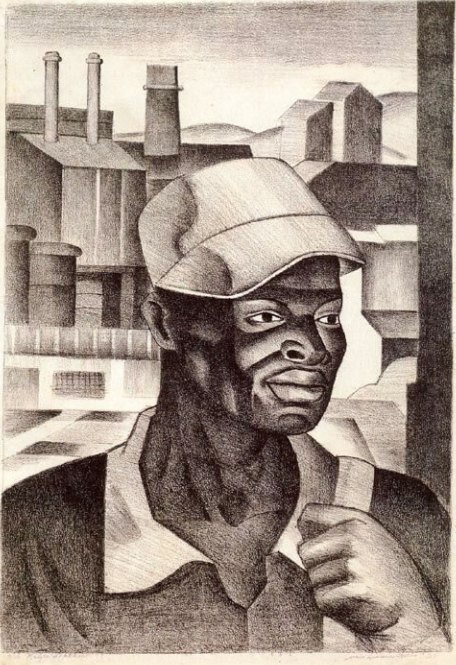
ZP_Negro Worker_1938 lithograph by James Lescesne Wells
Langston Hughes
“A Christian Country” (Feb. 1931)
.
God slumbers in a back alley
With a gin bottle in His hand.
Come on, God, get up and fight
Like a man.
. . .
Langston Hughes
“Tired” (Feb. 1931)
.
I am so tired of waiting,
Aren’t you?
For the world to become good
And beautiful and kind.
Let us take a knife
And cut the world in two –
And see what worms are eating
At the rind.
. . .
Langston Hughes
“Bitter Brew” (1967, published posthumously)
.
Whittle me down
To a strong thin reed
With a piercing tip
To match my need.
.
Spin me out
To a tensile wire
To derrick the stones
Of my problems higher.
.
Then simmer me slow
In the freedom cup
Till only an essence
Is left to sup.
.
May that essence be
The black poison of me
To give the white bellies
The third degree.
.
Concocted by history
Brewed by fate –
A bitter concentrate
Of hate.
. . . . .
It may seem curious to place Langston Hughes on the same page with Amiri Baraka yet these two strikingly different poets do intersect. Both wrote passionate and angry poems about Jesus Christ – about belief in Jesus Christ – during periods when each was exploring elements of one of those other great world religions: Socialism/Communism.
.
Though the life lived by Hughes appears to have been more conservative and/or Bohemian-Establishment than Baraka’s, Hughes’ conventional rhyming verse poetry shows real guts. The poem “Goodbye, Christ” haunted Hughes, being re-printed and circulated by zealously orthodox American Christians , becoming a thorn that pierced Hughes’ side from 1940 onward when the FBI put the poet under surveillance for alleged Communist activity. He was denounced as a communist by a U.S. senator in 1948 and was subpoena’d in 1953 to appear before Senator Joseph McCarthy’s subcommittee on subversive “un-American” activities. It “exonerated” him because it couldn’t link him to anyone juicy to nail. Though Hughes had been involved in Leftist politics – his “turning” came after a trip to Haiti in 1931 (followed by visits to Moscow in 1932-33 and Spain in 1937) – he was never a member of any Socialist or Communist party organization.
.
We have included what is believed to be one of the last poems Langston Hughes wrote before he died in 1967: “Bitter Brew”. In miniature it quick-sketches the emotional and psychological geography for the new-angry Black America that an up-and-coming LeRoi Jones/Amiri Baraka would map out in greater detail…
. . . . .
Langston Hughes: “Montage of a Dream Deferred”
Posted: February 1, 2013 Filed under: English, English: Black Canadian / American, Langston Hughes | Tags: Black History Month poems Comments Off on Langston Hughes: “Montage of a Dream Deferred”
Langston Hughes (born February 1st 1902, died 1967)
“Montage of a Dream Deferred” (1951): a selection of poems
.
“Children’s Rhymes”
.
When I was a chile we used to play,
“One – two – buckle my shoe!”
and things like that. But now, Lord,
listen at them little varmints!
.
By what sends
the white kids
I ain’t sent:
I know I can’t
be President.
.
There is two thousand children
In this block, I do believe!
.
What don’t bug
them white kids
sure bugs me:
We knows everybody
ain’t free!
.
Some of these young ones is cert’ly bad –
One batted a hard ball right through my window
And my gold fish et the glass.
.
What’s written down
for white folks
ain’t for us a-tall:
“Liberty And Justice –
Huh – For All.”
.
Oop-pop-a-da!
Skee! Daddle-de-do!
Be-bop!
.
Salt’ peanuts!
.
De-dop!
. . .
“Necessity”
.
Work?
I don’t have to work.
I don’t have to do nothing
but eat, drink, stay black, and die.
This little old furnished room’s
so small I can’t whip a cat
without getting fur in my mouth
and my landlady’s so old
her features is all run together
and God knows she sure can overcharge –
which is why I reckon I does
have to work after all.
. . .
“Question (2)”
.
Said the lady, Can you do
what my other man can’t do –
that is
love me, daddy –
and feed me, too?
.
Figurine
.
De-dop!
. . .
“Easy Boogie”
.
Down in the bass
That steady beat
Walking walking walking
Like marching feet.
.
Down in the bass
That easy roll,
Rolling like I like it
In my soul.
.
Riffs, smears, breaks.
.
Hey, Lawdy, Mama!
Do you hear what I said?
Easy like I rock it
In my bed!
. . .
“What? So Soon!”
.
I believe my old lady’s
pregnant again!
Fate must have
some kind of trickeration
to populate the
cllud nation!
Comment against Lamp Post
You call it fate?
Figurette
De-daddle-dy!
De-dop!
. . .
“Tomorrow”
.
Tomorrow may be
a thousand years off:
TWO DIMES AND A NICKEL ONLY
Says this particular
cigarette machine.
.
Others take a quarter straight.
.
Some dawns
wait.
. . .
“Café: 3 a.m.”
.
Detectives from the vice squad
with weary sadistic eyes
spotting fairies.
Degenerates,
some folks say.
.
But God, Nature,
or somebody
made them that way.
Police lady or Lesbian
over there?
Where?
. . .
“125th Street”
.
Face like a chocolate bar
full of nuts and sweet.
.
Face like a jack-o’-lantern,
candle inside.
.
Face like a slice of melon,
grin that wide.
. . .
“Up-Beat”
.
In the gutter
boys who try
might meet girls
on the fly
as out of the gutter
girls who will
may meet boys
copping a thrill
while from the gutter
both can rise:
But it requires
Plenty eyes.

“Mystery”
.
When a chile gets to be thirteen
and ain’t seen Christ yet,
she needs to set on de moaner’s bench
night and day.
.
Jesus, lover of my soul!
.
Hail, Mary, mother of God!
.
Let me to thy bosom fly!
.
Amen! Hallelujah!
.
Swing low, sweet chariot,
Coming for to carry me home.
.
Sunday morning where the rhythm flows,
How old nobody knows –
yet old as mystery,
older than creed,
basic and wondering
and lost as my need.
.
Eli, eli!
Te deum!
Mahomet!
Christ!
.
Father Bishop, Effendi, Mother Horne,
Father Divine, a Rabbi black
as black was born,
a jack-leg preacher, a Ph.D.
.
The mystery
and the darkness
and the song
and me.
. . .
“Nightmare Boogie”
.
I had a dream
and I could see
a million faces
black as me!
A nightmare dream:
Quicker than light
All them faces
Turned dead white!
Boogie-woogie,
Rolling bass,
Whirling treble
Of cat-gut lace.
. . .
“Blues at Dawn”
.
I don’t dare start thinking in the morning.
I don’t dare start thinking in the morning.
If I thought thoughts in bed,
Them thoughts would bust my head –
So I don’t dare start thinking in the morning.
.
I don’t dare remember in the morning
Don’t dare remember in the morning.
If I recall the day before,
I wouldn’t get up no more –
So I don’t dare remember in the morning.
. . .
“Neighbour”
.
Down home
he sets on a stoop
and watches the sun go by.
In Harlem
when his work is done
he sets in a bar with a beer.
He looks taller than he is
and younger than he ain’t.
He looks darker than he is, too.
And he’s smarter than he looks,
He ain’t smart.
That cat’s a fool.
Naw, he ain’t neither.
He’s a good man,
except that he talks too much.
In fact, he’s a great cat.
But when he drinks,
he drinks fast.
Sometimes
he don’t drink.
True,
he just
lets his glass
set there.
. . .
“Subway Rush Hour”
.
Mingled
breath and smell
so close
mingled
black and white
so near
no room for fear.
. . .
“Brothers”
.
We’re related – you and I,
You from the West Indies,
I from Kentucky.
.
Kinsmen – you and I,
You from Africa,
I from U.S.A.
.
Brothers – you and I.
. . .
“Sliver”
.
Cheap little rhymes
A cheap little tune
Are sometimes as dangerous
As a sliver of the moon.
A cheap little tune
To cheap little rhymes
Can cut a man’s
Throat sometimes.
. . .
“Hope (2)”
.
He rose up on his dying bed
and asked for fish.
His wife looked it up in her dream book
and played it.
. . .
“Harlem (2)”
.
What happens to a dream deferred?
.
Does it dry up
like a raisin in the sun?
Or fester like a sore –
and then run?
Does it stink like rotten meat?
Or crust and sugar over –
like a syrupy sweet?
.
Maybe it just sags
like a heavy load.
.
Or does it explode?
. . .
“Letter”
.
Dear Mama,
Time I pay rent and get my food
and laundry I don’t have much left
but here is five dollars for you
to show you I still appreciates you.
My girl-friend send her love and say
she hopes to lay eyes on you sometime in life.
Mama, it has been raining cats and dogs up
here. Well, that is all so I will close.
You son baby
Respectably as ever,
Joe
. . .
“Motto”
.
I play it cool
And dig all jive.
That’s the reason
I stay alive.
.
My motto,
As I live and learn,
Is:
Dig And Be Dug
In Return.
. . . . .
From Hughes’ introduction to his 1951 collection “Montage of a Dream Deferred”:
“In terms of current Afro-American popular music and the sources from which it has progressed – jazz, ragtime, swing, blues, boogie-woogie, and be-bop – this poem on contemporary Harlem, like be-bop, is marked by conflicting changes, sudden nuances, sharp and impudent interjections, broken rhythms, and passages sometimes in the manner of the jam session, sometimes the popular song, punctuated by the riffs, runs, breaks, and distortions of the music of a community in transition.”

Editor’s note:
Langston Hughes’ poems “Theme for English B” and “Advice” – both of which were included in his publication of “Montage of a Dream Deferred” – are featured in separate Hughes’ posts on Zócalo Poets.
. . . . .
“Montage of a Dream Deferred”- from The Collected Poems of Langston Hughes, edited by Arnold Rampersad, with David Roessel, 1994
All poems © The Estate of Langston Hughes
 Zócalo Poets