Les Tendresses pour Yonge Street ( Tokens of Affection for Yonge Street )
Posted: March 10, 2013 Filed under: Alexander Best, English Comments Off on Les Tendresses pour Yonge Street ( Tokens of Affection for Yonge Street )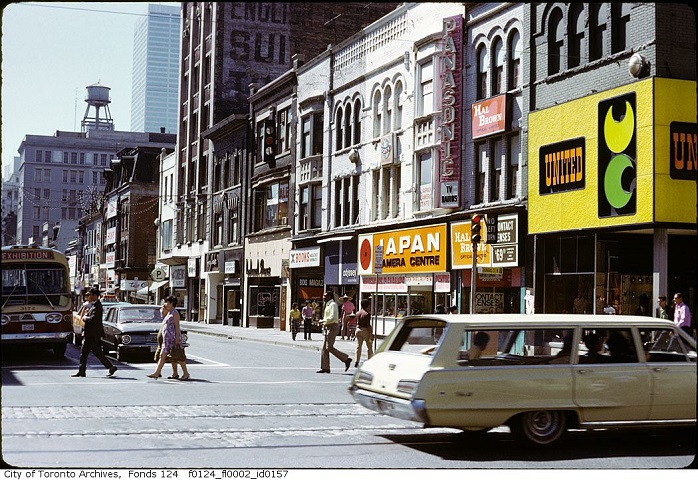
ZP_Corner of Yonge and Dundas, Toronto, 1972, looking south_The buildings on the right side were all demolished to make way for construction of The Eaton Centre which opened in 1977.
Alexander Best
LES TENDRESSES POUR YONGE STREET #1
( TOKENS OF AFFECTION FOR YONGE STREET…..)
.
Playoffs had begun; things were looking up for The Leafs…
Ten young guys, walking south to Carlton Street. Jock-ish
In their jerseys, ballcaps, space-age sneakers.
Cases of beer: treasure borne on shoulders and heads.
.
The creature of them halted in front of a shop-window: leopard-bikinis and
Lacey things. Big noise from the boys, sports-monkey-like.
.
Two teenage girls appeared on the sidewalk, slowing down, unsure.
(Awkward experiment: elegant hair, in the style of Marie-Antoinette, combined
with denim ensembles, ‘racing stripes’ down the sides of their pant-legs.)
.
The guys turned from window-display toward the girls, emitting a lusty
Oh Yeah!
One of the girls (shy one) couldn’t help but grin, showing
Microchip-circuitry of railroad-tracks; her mouth was a mess. The boys
Paused — taking in this ruination of her face — glanced among themselves,
Then voiced an even huge-r Oh Yeeaahhh of instinctual approval.
.
Girl’s friend rummaged for an itzy-bitzy disposable camera, held it out, simply
Aimed it at the mass of boys, and clicked.
Females, a-giggle, clumped north in their trendy ‘big-foot’ shoes. The
Manimal continued its way down the street.
. . .
LES TENDRESSES POUR YONGE STREET #2
“Homo sum, humani nihil a me alienum puto.” / “I am a human being, I consider nothing that is human alien to me.”
(Publius Terentius Afer a.k.a. Terence – Roman playwright, 195–159 BCE)
.
I waited for the streetcar, in Monday’s midnight mist.
Cabbie pulled up, East-African guy, insisted I get in.
No money, I told him. Shift was over, he said. “You and I, we go in the
Same direction,” he assured me. Small as a boy, he was confident like a man.
.
Inside the car, passing the famous hockey-arena…
“Do you know this is a ‘gay area’ where you are standing on the corner?”
“Oh, really?” my mild response.
.
Left hand on the steering-wheel, he extended his right and placed the tips of his
Slim fingers on the vulnerable spot where my neck joins my breastbone.
“Let me see you” — his tone was oddly reverential.
.
I unbuttoned my shirt. He ran his hand over my chest and stomach.
“Ah,” he said gravely, “I am touching you, beautiful forest!”
The car skirted a grove of highrise apartment blocks, swinging onto the bridge that
Leads to a more sky-wide part of the city.
.
He patted my zipper: “Show me this one.”
He held my sex; it changed size. Chain of lights moved north, another south, on the
Riverside-highway below us. He considered me, in the palm of his hand:
“Alabaster plus two jewels,” he said. “ — but not so hard!” he added, joy flashing in his
Eyes. Our road lay arrow-straight, and luck – the traffic was serene.
.
I began to touch him, at the navel-gap in his shirt.
“No. This cannot. I am married.” — he spoke in a hush.
“Maybe I’m married, too,” I said. “You are wearing no ring,” he observed.
“True.” And I touched him again.
.
“Please do not,” he said firmly. Then, with a radiant smile showing teeth of
Stained ivory: “You will make us an accident…We must not have such a
Tragic romance!”
He refreshed me with these words. The car smelled of fake pine; radio-voice
Rhapsodized about a computer.
.
He caressed my thigh with his free hand. I told him my name; he, his; the
Bible came into it. When I was let out, he tapped a
Farewell-flourish on the car-horn.
.
A poet wrote: “It is only the sacred things that are worth touching.”
Thank you, stranger of the City, for revealing my body as sacred again.
In touching it you touched my soul.
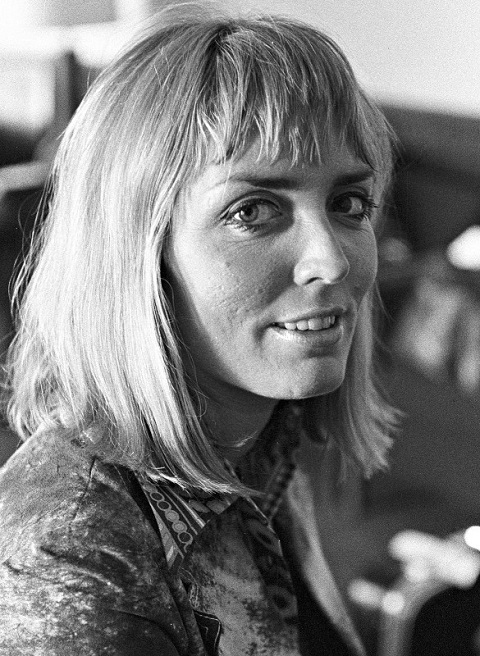
ZP_Xaviera Hollander, the so-called Happy Hooker_She lived in Toronto during the mid-1970s and her liberated, guilt-free approach to sex was exactly what Toronto the Good needed_The Yonge Street Strip, mainly between Gerrard and Dundas, was the most honest zone in the city – a place of risqué fun and sleaze. Some of those qualities of random adventure and weird spontaneity still existed on the Yonge Street of the late 1990s – and the poet hopes he has captured a little of that in these three poems…
LES TENDRESSES POUR YONGE STREET #3
.
It was along by the Zanzibar Tavern…
Delivery van struck a man. Soft-hard sound, and he
Flipped through the air as if juggled.
.
Magnificent. People spun ’round.
He wasn’t out-cold; dusted himself off, embarrassed.
He began to walk; straightaway teetered, fell
Crumpled against a newspaper box.
Blood on his neck; humanity gawked.
.
An efficient person called the hospital on his pocket-phone.
The van-driver was sorry, impatient.
.
An old man and woman — he reedy, she petite — approached the
Injured one: “What is your name, dear?” said the woman, bending.
“What is my name? — What is my name?!?”
“Don’t, now…you’ve had a shock,” she said.
.
The man’s accent was distinctive; words in the shape of fear.
He’d’ve hailed from a dozen lands — to be precise.
.
The woman gestured for her mate to lean down with his good ear:
“He can stay with us…The children are gone — they needn’t know.”
Her husband’s eyebrows went up; held themselves aloft; settled down.
“Yes…I don’t see why not.”
.
The nameless fellow was arranged into the ambulance by two delicate,
Burly attendants. The couple was helped in next; one guy taking the
Old lady’s patent-leather handbag, the other the
Old gentleman’s cane.
.
(1999 – 2000)
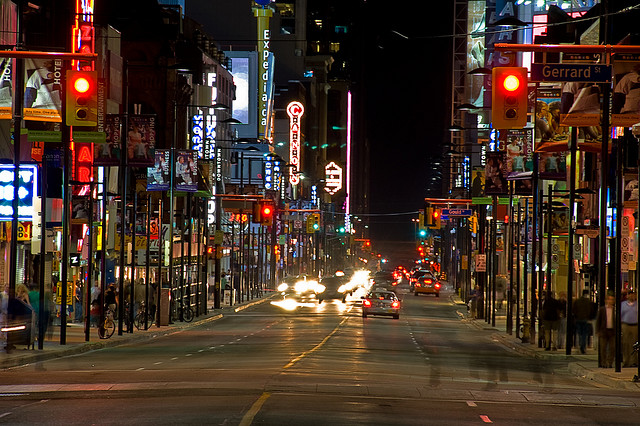
ZP_Yonge Street, Toronto, in the 21st century_Looking south from the corner of Yonge and Gerrard
Alexander Best: “The Soul in darkness”: 12 poems
Posted: March 10, 2013 Filed under: Alexander Best, English Comments Off on Alexander Best: “The Soul in darkness”: 12 poems
Alexander Best
“The Soul in darkness”
.
He’s destroyed his health — that much is plain.
A cough that never really leaves,
those hollows under his eyes.
Oh, it wasn’t any one thing he did…
but it all adds up.
.
Many of his habits were simple.
Taking his tea and a smoke by the window
while the sun rose, after a night of prowling.
He’d bring coffee to homeless guys with
winning, tooth-fractured smiles.
He’d talk to cats in the laneways; crouched down,
scratched them under their chins.
When money was scarce, still he managed
to buy drinks for charming strangers whose charm vanished
once they asked if he could lend them sixty bucks…
.
It was no one thing, true,
yet it all added up.
Life diminished him,
no matter what.
. . .
Each day brought some small joy or other.
What people called boredom
he called freedom to roam.
He listened to the water rush along the gutter toward the grate
— it was full of energy and romance.
At night when it rained,
he heard the wet wheels of traffic going this way or that
while he lay in his bed.
The city-hall tower was many blocks away,
but once in a while he heard the bell striking the hour,
and it pleased him.
He thought to himself:
this must be what it’s like to live forever.
. . .
They started out as friends.
Nearly always, it was good times.
Each trusted him whom he didn’t know.
By the end, they’d hurt one another a lot.
Accidental hurts? It was hard to tell
— but they hit their mark.
By the time it was really over, they’d become strangers
of the type that make up the faceless throng.
. . .
The number of times I’ve looked on people with desire.
Turning a corner. In a streetcar, an elevator.
At the cinema, courthouse.
In a glance, I’ve given myself to hundreds, and
I’ve taken thousands.
. . .
A beggar asked for change. I rummaged in my pockets.
He took a good look at me, in my old wool greatcoat;
declared: A blank cheque’ll do.
I smiled, gave him a two-dollar coin.
Noisily my awful boots squish-squished as I
strode up the street.
We both chuckled.
. . .
Nothing is clear to me.
Even the cloudless sky.
Every wall is a mirror.
So many years have passed that
some things are easier — time is thoughtful.
But nothing is clear.
. . .
The thought of living without him was unbearable.
And yet, that’s just what they’d been doing, for years.
Out of solitude came a knowledge he felt with his whole body:
their love was for all time.
Everywhere he went, he walked with a light step.
. . .
I waited. On the bench
by the massive oak tree.
Noone came.
I stayed too long,
my feet were like lead going home.
But memory calls.
I must go back.
. . .
The one dearest to him was ill.
Said his head throbbed, like it was his heart
— a loud beating,
outside his body.
He knew what that was like.
. . .
He went out on a limb — the old oak tree.
He sighed. Looked at the rope held coiled in his hand.
A nighthawk squawked.
That’s the wisdom I needed, he whispered aloud.
He lowered himself to the ground, with care
— didn’t want to sprain an ankle.
. . .
In the darkness of his room,
one after another, he strikes wooden matches,
leans each one against the inside of a small copper pot.
They spark, then swell to a crisp. And he says to himself:
Lovely they are, their whole life long.
. . .
Meal done, now’s the hour; some light in the sky still,
and man-made glows begin to warm each room.
Ahh,
spirit’s gone to my belly
— words don’t come…and that’s that.
.
Poem, shall we lie down, you and I?
And write ourselves tomorrow?
. . .
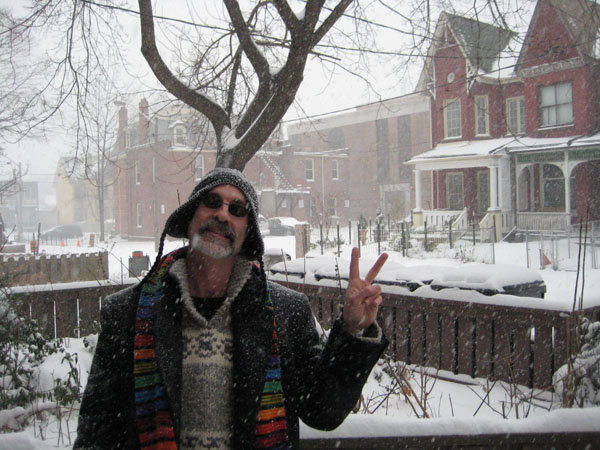
The poet in 2008
Editor’s note:
I wrote these poems in 2003 during the years when I went from one temporary job to the next, and was numb from emotional distress in my personal life. I seemed only to “camp” wherever I was living; I moved nine times between 1999 to 2010. Putting furniture out on the street, I would find what I needed for my next room on another curb. Everyone has crises in his or her life and we respond variously – with adequate action or with the inertia and blah mechanisms of Depression. I believe that this sequence of poems reflects – in its pensive, wistful, and “world-weary” tone – the influence of Constantine Cavafy (Konstantin Kavafis) whose poems in translation I was discovering at the time. These poems wrote themselves; my pen moved across the page of its own accord. The gift of composing Poetry has meant my survival; I am most grateful for that.
. . . . .
Poemas para El Día Internacional de la Mujer: una poetisa anishinaabe que deseamos honrar: Joanna Shawana / Poems for International Women’s Day: an Anishinaabe poet we wish to honour: Joanna Shawana
Posted: March 8, 2013 Filed under: English, Joanna Shawana, Joanna Shawana: poetisa anishinaabe/Anishinaabe poet, Spanish, ZP Translator: Alexander Best | Tags: Poemas para El Día Internacional de la Mujer, Poems for International Women's Day Comments Off on Poemas para El Día Internacional de la Mujer: una poetisa anishinaabe que deseamos honrar: Joanna Shawana / Poems for International Women’s Day: an Anishinaabe poet we wish to honour: Joanna Shawana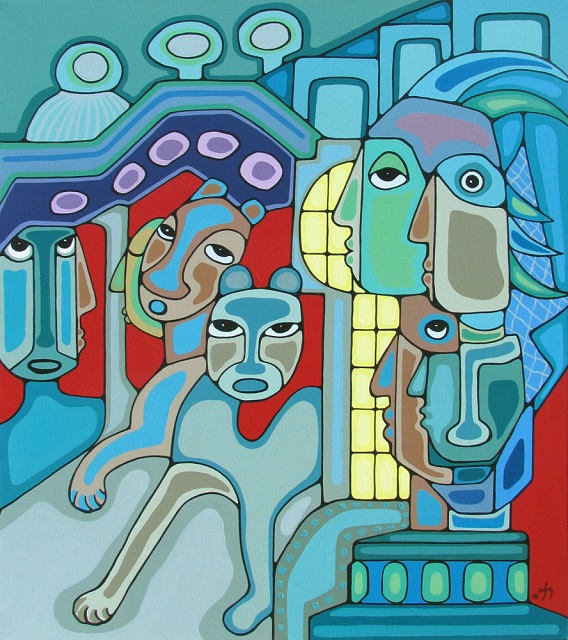
ZP_Manitoulin Island artist Daphne Odjig_Echoes of the Past_Daphne Odjig_Pintora indígena de la Isla de Manitoulin_Ecos del Pasado
Joanna Shawana / Niimkiigiihikgad-Kwe
(Anishinaabe poet from Wikwemikong, of the Ojibwe-Odawa First Nations Peoples, Mnidoo Mnis/Manitoulin Island, Ontario)
“Grandmother Moon”
.
During this cold dark night
Grandmother Moon sits high
Above the sky
.
Our Grandmother
Surrounded with stars
Emphasizing the life of the universe
.
As the night comes to end
Our Grandmother Moon slowly fades
Over the horizon
.
To greet Grandfather Sun
To greet him
As the new day begins
.
Grandmother Moon will rise again
She will shine and guide me on my path
As I walk on this journey.
. . .
Joanna Shawana / Niimkiigiihikgad-Kwe
(Poetisa anishinaabe de Wikwemikong, Mnidoo Mnis/Isla de Manitoulin, Ontario, Canadá)
“La Luna – Mi Abuela”
.
Durante esta noche fría y oscura
La Luna Mi Abuela se sienta
Alta en el cielo
.
Nuestra Abuela
Está rodeada de estrellas
Que hacen hincapié en la vida del universo
.
Como cierra la noche
Lentamente Nuestra Abuela La Luna destiñe
Encima del horizonte
.
Para dar la bienvenida al Abuelo El Sol
Para saludarle
Como comienza el nuevo día
.
Ella saldrá de nuevo, La Luna-Abuela,
Brillará y me guiará en mi camino
Como ando en este paso.
. . .
“All I Ask”
.
My fellow woman
My sisters
I am weak
I am hurt
All I ask of you is
Please
Hear what I have to say
Hear what I have to share
I am not here
To be looked down
I am not here
To be judged
For what had happened to me
All I ask of you is
Please
Hear what I have to share
My fellow women
My sisters
Listen to my words
See the pain in my eyes
All I ask of you is
Please
Hear what I have to say
Hear what I have to share
Help me
To get through my pain
Help me
To understand what is happening
Help me
To be a better person
So please
Hear what I have to say
Hear what I have to share.
. . .
“Todo lo que te pido…”
.
Mi compañera
Mis hermanas
Soy débil
Estoy dolida
Todo lo que te pido es
Por favor, escucha lo que tengo que decir
Escucha lo que tengo que compartirte
No estoy aquí
Para ser mirada por ustedes por encima del hombro
No estoy aquí
Para ser juzgada de
Lo que me había pasado
Todo lo que les pido es
Por favor, escuchen lo que tengo que compartirles,
Mis compañeras, mis hermanas,
Escuchen mis palabras
Vean el dolor en mis ojos
Todo lo que les pido es
Por favor,
Escuchen lo que tengo que decir
Escuchen lo que tengo que compartirles
Ayúdame a
Superar mi sufrimiento
Ayúdenme a
Comprender lo que pasa
Ayúdenme a
Ser una mejor persona
– Entonces,
Por favor,
Escucha lo que tengo que decirte,
Escuchen lo que tengo que compartir con ustedes…
. . .
“Hidden”
.
Hidden secrets
Hidden feelings
Hidden thoughts
.
Why do people need to hide
Their secrets
Their feelings and thoughts?
.
What are people afraid of?
Afraid of their own secrets
Afraid of their own feelings and thoughts
.
How can one person reveal?
To reveal their secrets
To reveal their feelings and thoughts
.
There is no reason to hide their secrets
There is no reason to hide their feelings
There is no reason to hide their thoughts.
. . .
“Escondido”
.
Secretos escondidos
Sentimientos escondidos
Pensamientos escondidos
.
¿Por qué la gente necesita ocultar algo?
Ocultar sus secretos, sus sentimientos y sus pensamientos
.
¿De qué tiene miedo la gente?
Tiene miedo de sus propios secretos,
Tiene miedo de sus corazonadas y sus ideas
.
¿Cómo revele una persona?
A revelar sus secretos
A revelar sus pensamientos
.
No hay razón para ser una tumba
No hay razón para engañarse a sí mismo sus sentimientos
No hay razón para esconder sus pensamientos.
. . .
“Wandering Spirit”
.
This wandering spirit of mine
Wanders off to the world of the unknown
The unknown of today and tomorrow
.
This wandering spirit of mine
Waits to hear your voice
Waits to listen for what will be said
.
This wandering spirit of mine
– Help me to discover the unknown
– Help me to understand
What the unknown needs to offer
.
Help this wandering spirit
That wanders off to the world of the unknown
That wonders what the future holds
.
This wandering spirit of mine
– Help me find peace and harmony
– Help me find tranquillity in life.
. . .
“Espíritu vagabundo”
.
Mi espíritu vagabundo
Se aleja al mundo de lo desconocido
Lo desconocido de hoy, de mañana
.
Este espíritu mío errante
Está aguardando tu voz
Está aguardando por lo que diremos
.
Espíritu mío, espíritu vagabundo
– Ayúdame a descubrir lo desconocido
– Ayúdame a entender
Lo que lo desconocido necesita ofrecerme
.
Ayúda a este espíritu errante
Que se aleja al mundo de lo desconocido
Y que se pregunta lo que va a contener el futuro
.
Este espíritu mío, mi espíritu andante
– Ayúdame a encontrar la paz y la armonía
– Ayúdame a encontrar la tranquilidad en la vida.
“Walk with Me”
.
Come and walk with me
On this path
Which I am walking on
.
We might slip and fall
To the cycle
That we once lived in
.
Let us
Help each other to understand
What we have been through
.
Let us walk together
Come and hold my hand
Hold it tight and never let go
.
Come and walk with me
Let us find what our future holds for us
Let us walk together on this path.
. . .
“Camina conmigo”
.
Ven – camina conmigo
A lo largo de este camino
Donde estoy caminando
.
Resbalemos y caigamos
Al ciclo
Que estaba nuestra vida
.
Ayudémonos a comprender,
La una a la otra,
Lo que salimos adelante, lo que sobrevivimos
.
Caminemos juntos,
Ven – toma mi mano –
Agárrate bien – nunca suéltame la mano
.
Ven – camina conmigo
Busquemos lo que habrá para nosotros en el futuro
Caminemos juntos en este camino.
. . .
Joanna Shawana moved down to Toronto in 1988. She began writing in 1994. A single parent, and now a grandmother, she has worked for an agency providing services to Native people in the city – Anishnawbe Health Toronto. Her bio. from her book of poems Voice of an Eagle states: A Catholic upbringing clashed with Native heritage teachings, which confused her path. However, through the years she gained more knowledge from her Native elders and began to clearly understand what it meant to be Nishnawbe Kwe (Native Woman). Thus, her journey in stabilizing her identity began… Joanna writes: ” When I look back and see what I have left behind, inside I cry for the little girl who witnessed that life, the teenager who was abused, and the woman who almost gave in, but I know now that my inner strength will never allow me to leave my path. Healing is a continuous part of life and it will be so until the day comes that the Creators call me. So as you travel along your path, remember – do not give in or give up! ”
.
Joanna Shawana fue víctima de mucho maltrato durante su juventud, también como una mujer joven. Desde 1988 ha vivido en la ciudad de Toronto donde trabaja con la agencia indígena Fortaleza de Anishnawbe Toronto. Dice: ” La curación es una parte continua de la vida y ésa será hasta que el día que me llamarán los Creadores. Entonces, mientras viajas en tu camino, recuerda – ¡no te des por vencido y no dejes de intentar! ”
.
Translations into Spanish / Traducciones en español: Alexander Best
. . . . .
Ngày Quốc tế Phụ nữ : Thơ Việt Nam / Poems for International Women’s Day : Vietnamese Voices : “I have crushed my dreams and turned them into a life…”
Posted: March 8, 2013 Filed under: English, Ngày Quốc tế Phụ nữ : Thơ Việt Nam / Poems for International Women's Day : Vietnamese Voices, Vietnamese | Tags: Poems for International Women's Day Comments Off on Ngày Quốc tế Phụ nữ : Thơ Việt Nam / Poems for International Women’s Day : Vietnamese Voices : “I have crushed my dreams and turned them into a life…”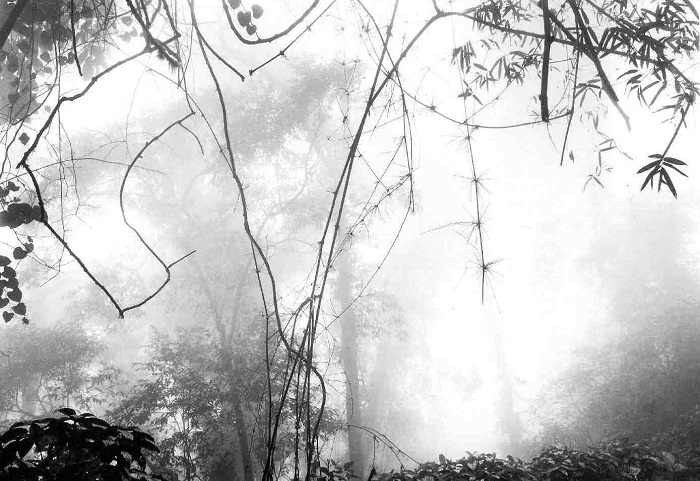
Untitled_photograph © photographer An-My Lê, born 1960
Dieu Nhan (Buddhist nun, 1041-1113)
“Birth, Old Age, Sickness, Death”
.
Birth, old age, sickness, death
Are commonplace and natural.
Should we seek relief from one,
Another will surely consume us.
Blind are those praying to Buddha,
Duped are those praying in Zen.
Pray not in Zen or to Buddha,
Speak not. Linger with silence.
.
(translation: Huu Ngoc, Lady Borton)

Dam Phuong (1881-1947)
“Flood Relief” (around 1928)
.
Harsh winds and the relentless rains drown
Districts that were once Thanh Hoa towns,
Swirling them down river, the water brown.
Warn the world: Silence is a stand,
.
Silence without opening your heart and hand.
Labourers reach out in crises of need,
Women with their gentleness take a lead,
Only then do the palace chiefs heed.
.
From this time on, we understand “kindness”,
Everyone joining in to ease public distress,
Those from humble trades with help appear,
Women draw on friends far and near.
.
(translation: Lady Borton)

Mong Tuyet (1914-2007)
“The price of rice in Tràng An” (1945)
(for Van Muoi, clerk at a flower shop in Tri Duc Garden)
.
I hear the price of rice in Trang An is high.
Starving for food, thirsting for life-saving rain,
Our friends and family in the centre and the north
Are desperately hoping rice will be sent from Dong Nai.
.
Grief dazes our nation’s artists.
You encouraged me to study poetry,
You want to release the ink of my poetic spirit.
Lost in a literary forest, I was building a road out.
.
I carried your books back home.
The people awaiting rice are in agony.
Sister, with my poor skills, how can I help?
You’d answer:
“I’ll sell literature, you sell flowers.”
.
(translation: Xuan Oanh, Lady Borton)
Tràng An is an old name for the city of HaNoi.
An important railway route and main road lay destroyed at the end of WWII,
hence rice did not reach enough people.
In Viet Nam, two million people had died of starvation by the end of the war.
.

Tran Thi My Hanh (born 1945)
“The road repair team at Jade Beauty Mountain” (1968)
.
Jade Beauty Mountain at Van River
Deserted at mid-day, buzzes with heat.
The mountain looks like a beautiful girl
Reclining, her eyes searching the azure sky.
.
Clouds like friends surround the Beauty.
Below are women workers from a road team,
Their youth and strength breaking a new trail,
Their hands skilled with hoes and quick with guns.
.
Pity the road circling the mountain,
Bomb craters slashing into bomb craters,
Olive trees, oak trees blackened with resin,
The birds scattered, ripped from their flocks,
Every rock on Beauty Mountain cringing in pain,
The earth tumbling down into the lowland paddies,
Night after night as the Beauty Mountain lies awake.
The women repairing the road are uneasy;
With torches, they search their way forward.
For them, a bite of dried bread is a delicious treat.
.
The green jackets that arrived yesterday
Were completely mended today (it was nothing).
Despite beating sun, pouring rain and bitter smoke,
The chop chop of hoes lifts skyward until after midnight.
.
The battlefield is here – The Front is here,
We fight the enemy for every inch of this road,
We shovel, shovel rock that smells of the mountain,
Our blood and sweat blending with the mountain’s basalt.
.
I hear the startling horns of passing trucks,
Feel my blood and the road’s blood pulse as one.
We, women with hearts as pure and dazzling as jade,
Stretch in a silhouette along the ridge of Beauty Mountain.
.
(translation: Lady Borton)
Jade Beauty Mountain is in northern Viet Nam’s Red River Delta. Route 1 is nearby,
and this major north-south road served as supply route during the U.S.–VietNam War.
Route 1 was bombed often by American planes.


Ha Phuong (born 1950)
“A meal by a stream” (1971)
.
A platoon of twelve
Four mess kits of cold rice
A packet of jerky
Wild vegetables from the forest
A minute to rest by a stream.
The fire hisses, as if urging the soup to boil –
.
With no dining table,
Some stand, some sit.
The steep mountain pass has quickened our hunger,
We hastily spread a leaf to make a small tray;
A mouthful of dry rice
When you’re hungry is delectable.
.
Jokes, teasing, the crisp sound of laughter,
A mess kit of cold rice, a few minutes’ pause.
“There’s still salt. The rice is tasty…”
The sound of laughter
The sound of laughter spreads.
.
Our unit’s meal is strangely joyful:
We’re far from our parents
But share the love of comrades.
On the Trail these days as we fight the Americans,
Our forest meals are delicious feasts.
.
(translation: Lady Borton)
Thuy Bac (1937-1996)
“Thread of Longing, Thread of Love” (1977)
.
Truong Son East
Truong Son West
.
On one side, sun burns
On the other, rain circles
.
I extend my hand
I open my hand
.
Impossible
To cover you
.
Pull this thread of love
To splice a roof
.
Pull this thread of longing
To weave a blue dome
.
Bend the Eastern Range
To cover you from the rain
.
Bend the Western Range
To spread a cool shadow
.
Canopy the sky with love
Of purest blue
.
I bend everything
Toward you.
.
(translation: Le Phuong, Wendy Erd)
The Ho Chi Minh Trail – a series of old mountain paths used for supply routes
by the North VietNamese during the U.S.–VietNam War –
passed through Truong Son (the Long Mountains).
.
Doan Ngoc Thu (born 1967)
“The city in the afternoon rain” (1992)

The city in the afternoon rain:
A beggar sits singing
A song from the war.
.
The city in the afternoon rain:
Roaming children
Vie for the bubbles they blow
And for fallen almonds.
.
The city in the afternoon rain:
Near a small roadside inn,
Cigarette ashes eddy with a burnt match
And a return ticket filled with nostalgia.
.
The city in the afternoon rain:
Suddenly I run into you,
You’re just as before – proud and harsh.
You step silently through the rain
To the beggar’s side
And weep –
At the song echoing the time of war.
.
(translation: Xuan Oanh, Lady Borton)
The war referred to is the U.S.–VietNam War.
. . .
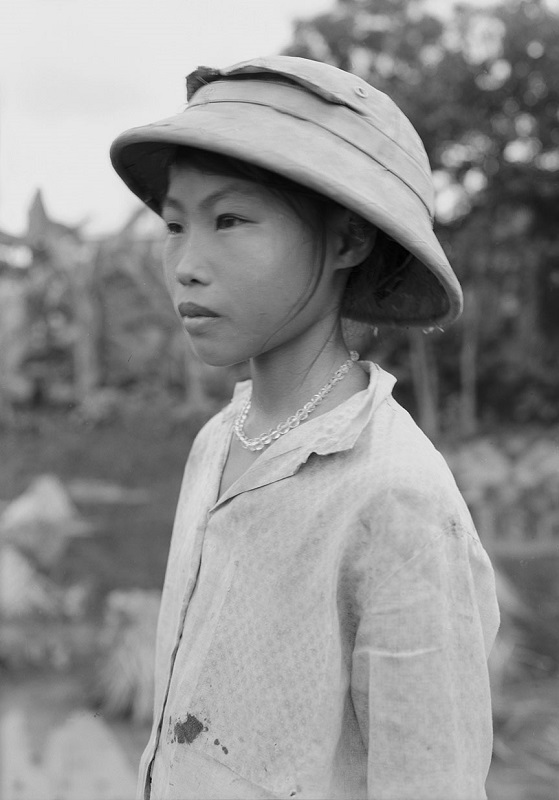
Untitled, Nam Ha, 1994 © An-My Lê
. . .
Tran Mong Tu (born 1943)
“Lonely Cat” (1980)
.
The cat sprawls in the yard
Lonely, playing with sunlight.
Inside the window
Lonely, I’m watching him.
.
On grass green as jade,
Alone, his white back spins.
Sun shimmers down, drop by drop
The cat turns round my sadness.
.
I see myself in the glass,
A dim shadow, its outline vague:
The gate to marriage shut tight,
Imprisoning me so gently.
.
The cat has his corner of grass,
I, my dim pane.
We two, so small.
Our loneliness uncontained.
.
Dear cat in the sun,
Assuage my sadness.
My ancient homeland, my former lover,
Still soak my soul.
.
(translation: Le Phuong, Wendy Erd)

Tran Thi Khanh Hoi (born 1957)
“The Pregnant Woman” (1990)

She came to me,
Her eyes like the waves of a river in flood,
Her voice choking
At its source, then gushing like a waterfall,
Her breasts throbbing with milk about to flow,
Her unborn child kicking at my side.
In a few days, birth will release
The child’s hands and feet, its wails and cries,
But right now the mother sits waiting in weariness,
Like an arid field as the rising flood approaches its limit.
.
Angry at her husband, who won’t stop drinking,
She’s been pregnant throughout a season of hard labour.
Fears about her ill-treated baby
Have aged her,
Have left her fearful
Of the wealthy screaming for the money owed them,
Unmoved by the pain of a worried
Woman who is pregnant.
.
She came to me,
Seeking consolation, protection, sympathy.
What could I say when we can’t stop the inevitable?
The time is soon for this pregnant woman.
I swim through waves of silt from the flood,
Tonight –
.
(translation: Xuan Oanh, Lady Borton)
. . .
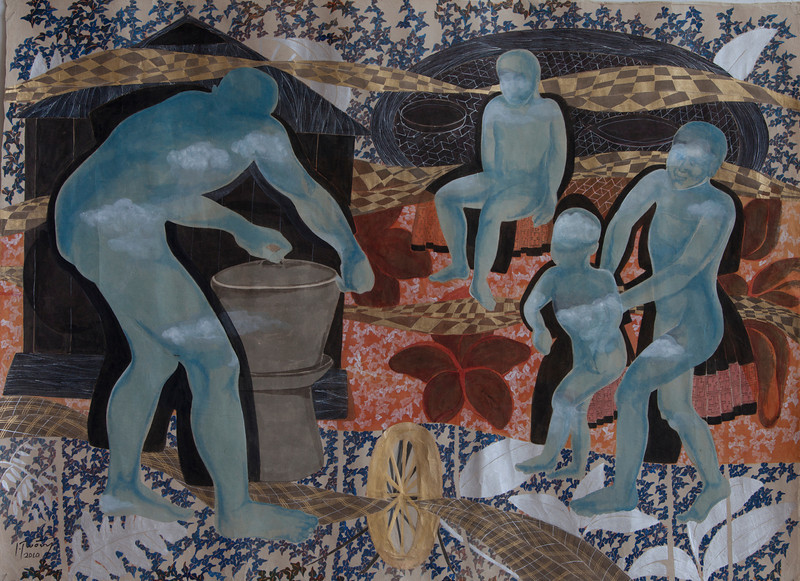
Men and Joy of Cooking, 2010 © Dinh Thi Tham Poong, born 1970
. . .
Huong Nghiem (born 1945)
“I don’t know” (1991)
.
Thinking of
The endless Universe,
I am suddenly aware:
The sun is very small.
Thinking of
Endless love,
I realize:
I am limited by you.
Instead of letting my own ego expand,
I am absorbed
In scrubbing
Your shirt collar clean.
But to what end
I don’t know.
.
(translation: Nguyen Quang Thieu, Lady Borton)
Le Thu (born 1940)
“My Poem” (1990)
.
I want you to be the ocean
Never ending, forever strange.
But I fear your heart may run too deep
For me to reach its limits.
.
I want you to be a river
Depositing rich soil on its banks.
But I fear the river’s length;
When does flowing water return?
.
I want to hear your words in a vow
To be sure you are mine forever.
But I fear flying high unfettered;
Yet how can I bind your wings?
.
I want you to be the moon,
Full on the fifteenth of the lunar month,
But I fear the next days’ waning;
Would our love also fade with the season?
.
So! You should be a poem
Gently entering my heart.
Then, our love forever young
Can be compassionate and complete!
.
(translation: Xuan Oanh, Lady Borton)

Nguyen Bao Chan (born 1969)
“For my father” (1995)
.
Looking at your hands
I see the lines
Splitting into the future and an exhausting past
I see also the sky of my youth,
How I drifted in dreams, following the moon and stars.
Father,
Time has rushed on
I have crushed my dreams and turned them into a life
I have held the broken pieces of your life in these frail hands
I have ground the shards to bluntness, ground them some more,
In order to live, love, and protect myself.
If ever I’m inattentive to you, broken
And reduced to pieces,
I know you will pick up the shards
Even though they cut your hands and give you pain.
.
(translation: Lady Borton)

Y Nhi (born 1944)
“Longing” (1998)

To leave
like a boat pulling away from a dock at dawn
while waves touch the sandbar, saying goodbye
.
Like a still-green leaf torn from a branch
leaving only a slight break in the wood
.
Like a deep purple orchid
gradually fading and
then one day closing off like an old cocoon
.
To leave
like a radiant china vase displayed on a brightly lit shelf,
as the vase starts to crack
.
Like a lovely poem ripped from a newspaper
first sad
then elated
as it flies off like a butterfly in late summer
.
Like an engagement ring
slipping off a finger
and hiding itself among pebbles
.
To leave
like a woman walking away from her love.
.
(translation: Thuy Dinh, Martha Collins)
. . .
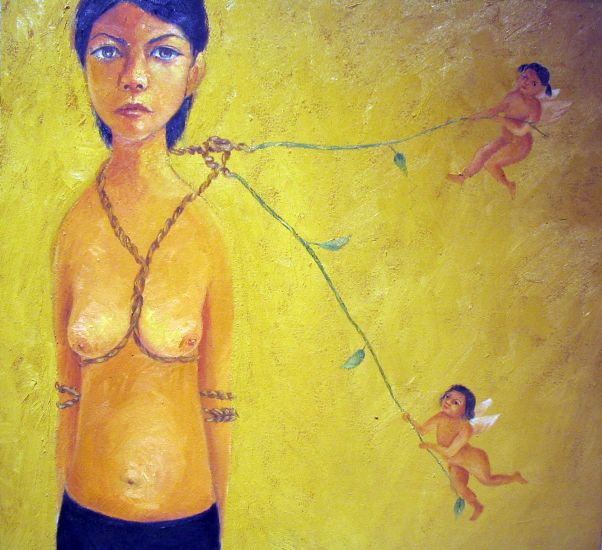
My Angel 1_2007 © Nguyen Thi Chau Giang, born 1975
. . .
Lam Thi My Da (born 1949)
“I return to myself” (2004)
.
Free the moon for its fullness,
Free the clouds for the wind,
Free the colour green for the grass.
I return to myself.
.
Free the gentle girls
To be unaffected;
Free people from suffering,
From competing for fame,
Free them all, free them all.
I return to myself.
.
Free teenage girls
From hiding away,
Free grey hair
To be white forever.
.
Everyone carries a smile
To chase away tears.
Joy has colours,
Sorrow is transparent.
I return to myself.
.
Poetry is the scarlet of blood
Seeping into the voice.
Life has untold blessings and disasters;
We sow, then unexpectedly reap.
.
The weary can never rest,
The pained can no longer cry,
The silent ones are like shadows.
I return to myself.
.
Luckily, a small child
Remains inside the soul,
Her gaze fresh,
Shimmering at the roots,
Her heart still naive.
I return to myself.
.
(translation: Xuan Oanh, Lady Borton)

. . . . .
All of the above translations from Vietnamese into English are the copyright © of the following translators:
Huu Ngoc, Lady Borton, Le Phuong, Martha Collins, Nguyen Quang Thieu, Thuy Dinh, Wendy Erd, and Xuan Oanh.
This compilation of poems is the copyright © of editors Nguyen Thi Minh Ha, Nguyen Thi Thanh Binh, and Lady Borton.
. . . . .
कबीर “The Songs of Kabir”: translations by Rabindranath Tagore and Robert Bly
Posted: February 28, 2013 Filed under: English, Kabir Comments Off on कबीर “The Songs of Kabir”: translations by Rabindranath Tagore and Robert Bly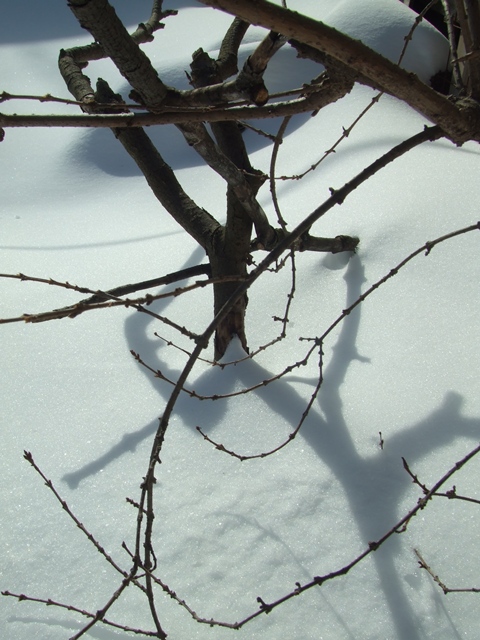
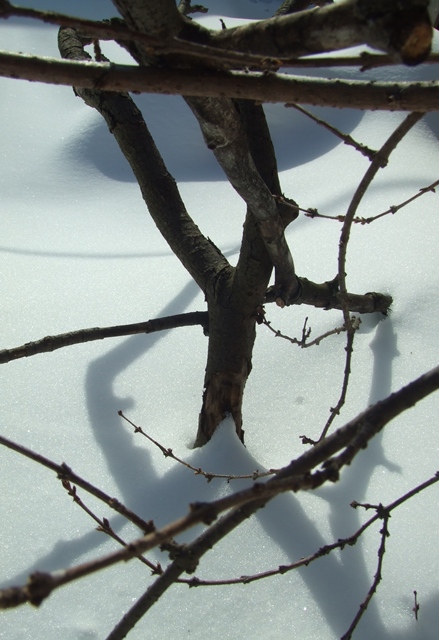
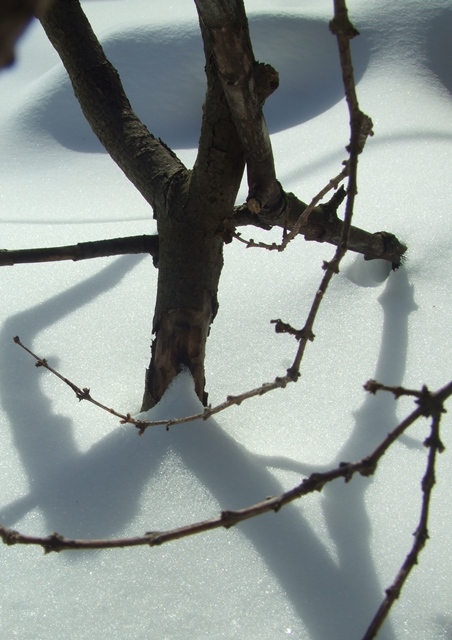
Naturaleza muerta del invierno, febrero de 2013, Toronto_Winter still life, February 2013, Toronto
“The Kabir Book: Forty-Four of the Ecstatic Poems of Kabir” (1977) – versions by Robert Bly, based on Rabindranath Tagore’s “The Songs of Kabir” (1915).
.
“The Songs of Kabir” (published in 1915) translated by Rabindranath Tagore, assisted by Evelyn Underhill, from Bengali versions of the original Kabir Hindi-language poems.
.
In the selection that follows, Bly’s versions of Kabir are first, followed by Tagore’s. The first-verse quotations – which appear between the Bly and the Tagore – and each with a Roman numeral then a number, refer to Tagore’s source for his Kabir poems – that is, Santiniketana: Kabir by Sri Kshitimohan Sen, in 4 parts, Brahmacharyasrama, Bolpur, published in 1910-1911.
. . .
Friend, hope for the Guest while you are alive.
Jump into experience while you are alive.
Think…and think…while you are alive.
What you call “salvation” belongs to the time before death.
.
If you don’t break your ropes while you’re alive,
do you think
ghosts will do it after?
.
The idea that the soul will join with the ecstatic
just because the body is rotten –
that is all fantasy.
What is found now is found then.
If you find nothing now,
you will simply end up with an apartment in the City of Death.
If you make love with the divine now, in the next life
you will have the face of satisfied desire.
.
So plunge into the truth, find out who the Teacher is,
believe in the Great Sound!
Kabir says this:
When the Guest is being searched for,
it is the intensity of the longing for the Guest that
does all the work.
Look at me, and you will see a slave of that intensity.
.
I. 57. sâdho bhâî, jîval hî karo âs’â
.
O Friend! hope for Him whilst you live, know whilst you live,
understand whilst you live: for in life deliverance abides.
If your bonds be not broken whilst living, what hope of deliverance in death?
It is but an empty dream, that the soul shall have union with Him
because it has passed from the body:
If He is found now, He is found then,
If not, we do but go to dwell in the City of Death.
If you have union now, you shall have it hereafter.
Bathe in the truth, know the true Guru, have faith in the true Name!
Kabîr says: “It is the Spirit of the quest which helps;
I am the slave of this Spirit of the quest.”
. . .
Friend, please tell me what I can do about this world I hold to,
and keep spinning out!
I gave up sewn clothes, and wore a robe,
but I noticed one day the cloth was well woven.
So I bought some burlap, but I still
throw it elegantly over my shoulder.
I pulled back my sexual longings,
and now I discover that I’m angry a lot.
I gave up rage, and now I notice
that I am greedy all day.
I worked hard at dissolving my greed,
and now I am proud of myself.
When the mind wants to break its link with the world
it still holds on to one thing.
Kabir says:
Listen, my friend,
there are very few that find the path!
.
I. 63. avadhû, mâyâ tajî na jây
.
Tell me, Brother, how can I renounce Maya?
When I gave up the tying of ribbons, still I tied my garment about me:
When I gave up tying my garment, still I covered my body in its folds.
So, when I give up passion, I see that anger remains;
And when I renounce anger, greed is with me still;
And when greed is vanquished, pride and vainglory remain;
When the mind is detached and casts Maya away, still it clings to the letter.
Kabîr says,
“Listen to me, dear Sadhu! the true path is rarely found.”
. . .
I played for ten years with the girls my own age,
but now I am suddenly in fear.
I am on the way up some stairs – they are high.
Yet I have to give up my fears
if I want to take part in this love.
.
I have to let go the protective clothes
and meet him with the whole length of my body.
My eyes will have to be the love-candles this time.
Kabir says:
Men and women in love will understand this poem.
If what you feel for the Holy One is not desire,
then what’s the use of dressing with such care,
and spending so much time making your eyelids dark?
.
I. 131. nis’ din khelat rahî sakhiyân sang
.
I played day and night with my comrades, and now I am greatly afraid.
So high is my Lord’s palace, my heart trembles to mount its stairs:
yet I must not be shy, if I would enjoy His love.
My heart must cleave to my Lover; I must withdraw my veil,
and meet Him with all my body:
Mine eyes must perform the ceremony of the lamps of love.
Kabîr says:
“Listen to me, friend: he understands who loves.
If you feel not love’s longing for your Beloved One,
it is vain to adorn your body, vain to put unguent on your eyelids.”
. . .
I have been thinking of the difference
between water
and the waves on it.
Rising, water’s still water, falling back,
it is water, will you give me a hint
how to tell them apart?
.
Because someone has made up the word
“wave”, do I have to distinguish it
from water?
.
There is a Secret One inside us;
the planets in all the galaxies
pass through his hands like beads.
.
That is a string of beads one should look at with
luminous eyes.
.
II. 56. dariyâ kî lahar dariyâo hai jî
.
The river and its waves are one
surf: where is the difference between the river and its waves?
When the wave rises, it is the water; and when it falls, it is the same water again.
Tell me, Sir, where is the distinction?
Because it has been named as wave, shall it no longer be considered as water?
.
Within the Supreme Brahma, the worlds are being told like beads:
Look upon that rosary with the eyes of wisdom.
. . .
What has death and a thick body dances before
what has no thick body and no death.
The trumpet says: “I am you.”
The spiritual master arrives and bows down to the
beginning student.
Try to live to see this!
.
II. 85. nirgun âge sargun nâcai
.
Before the Unconditioned, the Conditioned dances:
“Thou and I are one!” this trumpet proclaims.
The Guru comes, and bows down before the disciple:
This is the greatest of wonders.
. . .
Why should I flail about with words, when love
has made the space inside me full of light?
I know the diamond is wrapped in this cloth, so why
should I open it all the time and look?
When the pan was empty, it flew up; now that it’s
full, why bother weighing it?
.
The swan has flown to the mountain lake!
Why bother with ditches and holes anymore?
The Holy One lives inside you –
why open your other eyes at all?
.
Kabir will tell you the truth: Listen, brother!
The Guest, who makes my eyes so bright,
has made love with me.
.
II. 105. man mast huâ tab kyon bole
.
Where is the need of words, when love has made drunken the heart?
I have wrapped the diamond in my cloak; why open it again and again?
When its load was light, the pan of the balance went up: now it is full,
where is the need for weighing?
The swan has taken its flight to the lake beyond the mountains;
why should it search for the pools and ditches anymore?
Your Lord dwells within you: why need your outward eyes be opened?
Kabîr says: “Listen, my brother! my Lord, who ravishes my eyes,
has united Himself with me.”
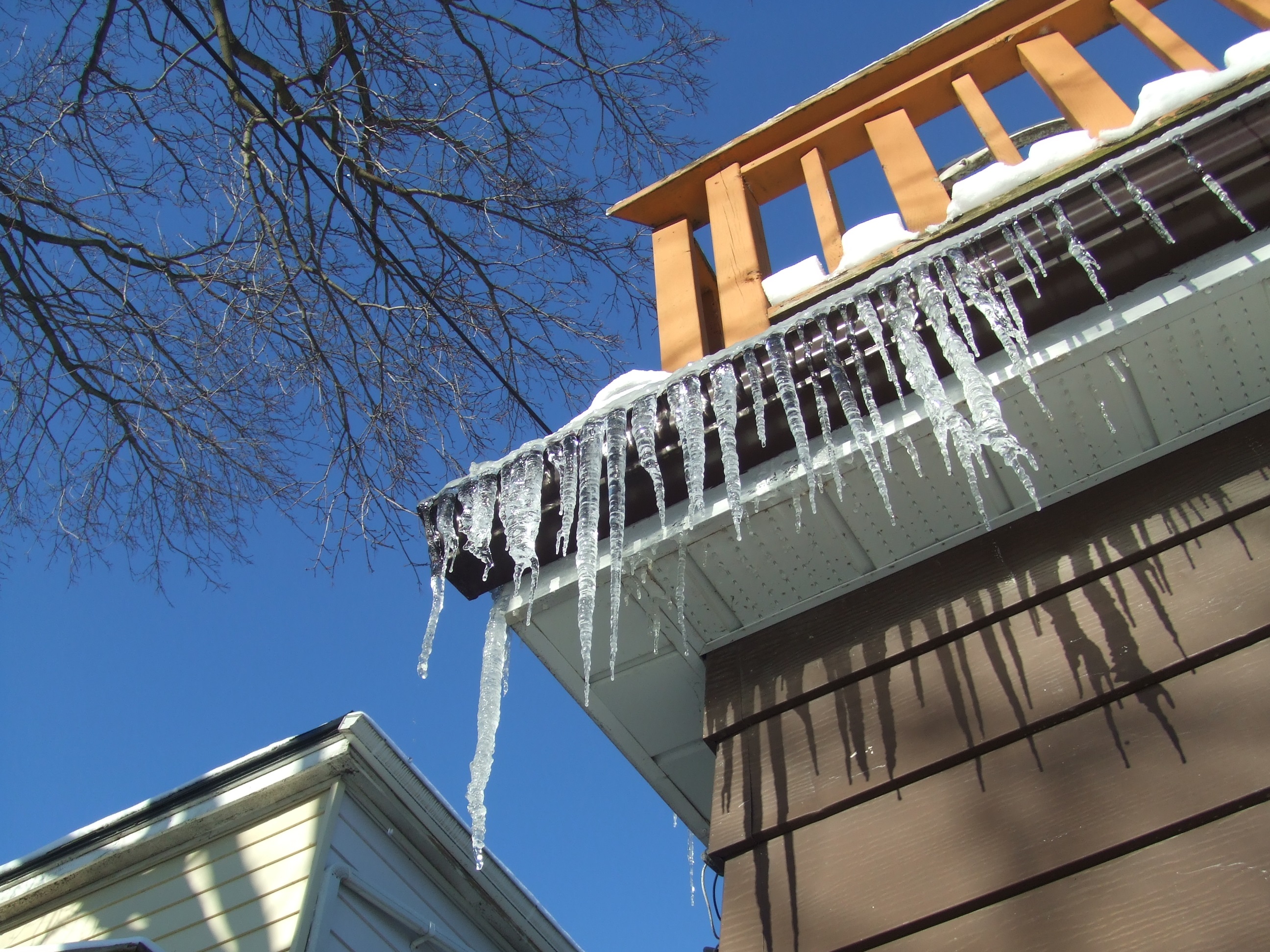
Cuando se forman carámbanos en el tejaroz llega pronto la Primavera. When icicles form at the eaves Spring can’t be far off…Toronto, February 28th, 2013
Friend, wake up!
Why do you go on sleeping?
The night is over – do you want to lose the day the same way?
Other women who managed to get up early have
already found an elephant or a jewel…
So much was lost already while you slept…
And that was so unnecessary!
.
The one who loves you understood, but you did not.
You forgot to make a place in your bed next to you.
Instead you spent your life playing.
In your twenties you did not grow
because you did not know who your Lord was.
Wake up! Wake up!
There’s no-one in your bed –
He left you during the long night.
.
Kabir says: The only woman awake is the woman who has heard the flute!
.
II. 126. jâg piyârî, ab kân sowai
.
O Friend, awake, and sleep no more!
The night is over and gone, would you lose your day also?
Others, who have wakened, have received jewels;
O foolish woman! you have lost all whilst you slept.
Your lover is wise, and you are foolish, O woman!
You never prepared the bed of your husband:
O mad one! you passed your time in silly play.
Your youth was passed in vain, for you did not know your Lord;
Wake, wake! See! your bed is empty: He left you in the night.
Kabîr says:
“Only she wakes, whose heart is pierced with the arrow of His music.”
. . .
Knowing nothing shuts the iron gates; the new love opens them.
The sound of the gates opening wakes the beautiful woman asleep.
Kabir says:
Fantastic! Don’t let a chance like this go by!
.
I. 50. bhram kâ tâlâ lagâ mahal re
.
The lock of error shuts the gate, open it with the key of love:
Thus, by opening the door, thou shalt wake the Belovéd.
Kabîr says:
“O brother! do not pass by such good fortune as this.”
. . .
There is nothing but water in the holy pools.
I know – I have been swimming in them.
All the gods sculpted of wood or ivory can’t say a word.
I know – I have been crying out to them.
The Sacred Books of the East are nothing but words.
I looked through their covers one day sideways.
What Kabir talks of is only what he has lived through.
If you have not lived through something – it is not true.
.
I. 79. tîrath men to sab pânî hai
.
There is nothing but water at the holy bathing places;
and I know that they are useless,
for I have bathed in them.
The images are all lifeless, they cannot speak; I know,
for I have cried aloud to them.
The Purana and the Koran are mere words;
lifting up the curtain, I have seen.
Kabîr gives utterance to the words of experience;
and he knows very well that all other things are untrue.
. . .
When my friend is away from me, I am depressed;
nothing in the daylight delights me,
sleep at night gives no rest –
who can I tell about this?
.
The night is dark, and long…hours go by…
because I am alone, I sit up suddenly,
fear goes through me…
.
Kabir says:
Listen, my friend,
there is one thing in the world that satisfies,
and that is a meeting with the Guest.
.
I. 130. sâîn vin dard kareje hoy
.
When I am parted from my Belovéd, my heart is full of misery:
I have no comfort in the day, I have no sleep in the night.
To whom shall I tell my sorrow?
The night is dark; the hours slip by.
Because my Lord is absent, I start up and tremble with fear.
Kabîr says: “Listen, my friend! there is no other satisfaction,
save in the encounter with the Belovéd.”
. . .
The spiritual athlete often changes the colour of his clothes,
and his mind remains grey and loveless.
.
He sits inside a shrine room all day,
so that the Guest has to go outdoors and praise the rocks.
.
Or he drills holes in his ears, his beard grows enormous and matted –
people mistake him for a goat…
He goes out into wilderness areas, strangles his impulses,
and makes himself neither male nor female…
.
He shaves his skull, puts his robe in an orange vat,
reads the Bhagavad-Gita –
and becomes a terrific talker.
.
Kabir says:
Actually, you are going in a hearse to the country of death –
bound hand and foot!
.
I. 20. man na rangâye
.
The Yogi dyes his garments, instead of dyeing his mind in the colours of love:
He sits within the temple of the Lord, leaving Brahma to worship a stone.
He pierces holes in his ears, he has a great beard and matted locks, he looks like a goat:
He goes forth into the wilderness, killing all his desires, and turns himself into an eunuch:
He shaves his head and dyes his garments; he reads the Gîtâ and becomes a mighty talker.
Kabîr says: “You are going to the doors of death, bound hand and foot!”
. . .
I don’t know what sort of a God we have been talking about.
.
The caller calls in a loud voice to the Holy One at dusk.
Why? Surely the Holy One is not deaf.
He hears the delicate anklets that ring on the feet of
an insect as it walks.
.
Go over and over your beads, paint weird designs on your forehead,
wear your hair matted, long, and ostentatious,
but when deep inside you there is a loaded gun,
how can you have God?
.
I. 9. nâ jâne sâhab kaisâ hai
.
I do not know what manner of God is mine.
The Mullah cries aloud to Him: and why? Is your Lord deaf? The
subtle anklets that ring on the feet of an insect when it moves
are heard of Him.
Tell your beads, paint your forehead with the mark of your God,
and wear matted locks long and showy: but a deadly weapon is in
your heart, and how shall you have God?
. . .
The Holy One disguised as an old person in a cheap hotel
goes out to ask for carfare.
But I never seem to catch sight of him.
If I did, what would I ask him for?
He has already experienced what is missing in my life.
Kabir says:
I belong to this old person.
Now let the events about to come – come!
.
III. 89. mor phakîrwâ mângi jây
.
The Beggar goes a-begging, but
I could not even catch sight of Him:
And what shall I beg of the Beggar He gives without my asking.
Kabîr says: “I am His own: now let that befall which may befall!”
. . .
The Guest is inside you, and also inside me;
you know the sprout is hidden inside the seed.
We are all struggling; none of us has gone far.
Let your arrogance go, and look around inside.
.
The blue sky opens out farther and farther,
the daily sense of failure goes away,
the damage I have done to myself fades,
a million suns come forward with light,
when I sit firmly in that world.
.
I hear bells ringing that no-one has shaken,
inside “love” there is more joy than we know of,
rain pours down, although the sky is clear of clouds,
there are whole rivers of light.
The universe is shot through in all parts by a single sort of love.
how hard it is to feel that joy in all our four bodies!
.
Those who hope to be reasonable about it fail.
The arrogance of reason has separated us from that love.
With the word “reason” you already feel miles away.
.
How lucky Kabir is, that surrounded by all this joy
he sings inside his own little boat.
His poems amount to one soul meeting another.
These songs are about forgetting dying and loss.
They rise above both coming in and going out.
.
II. 90. sâhab ham men, sâhab tum men
.
The Lord is in me, the Lord is in you, as life is in every seed.
O servant! put false pride away, and seek for Him within you.
A million suns are ablaze with light,
The sea of blue spreads in the sky,
The fever of life is stilled, and all stains are washed away;
when I sit in the midst of that world.
Hark to the unstruck bells and drums! Take your delight in love!
Rains pour down without water, and the rivers are streams of light.
One Love it is that pervades the whole world, few there are who
know it fully:
They are blind who hope to see it by the light of reason, that
reason which is the cause of separation–
The House of Reason is very far away!
How blessed is Kabîr, that amidst this great joy he sings within
his own vessel.
It is the music of the meeting of soul with soul;
It is the music of the forgetting of sorrows;
It is the music that transcends all coming in and all going
forth.
. . .
The small ruby everyone wants has fallen out on the road.
Some think it is east of us, others – west of us.
Some say, “among primitive earth rocks:, others – “in the deep waters.”
Kabir’s instinct told him it was inside, and what it was worth,
And he wrapped it up carefully in his heart cloth.
.
III. 26. tor hîrâ hirâilwâ kîcad men
.
The jewel is lost in the mud, and all are seeking for it;
Some look for it in the east, and some in the west;
some in the water and some amongst stones.
But the servant Kabîr has appraised it at its true value,
and has wrapped it with care in the end of the mantle of his heart.
. . . . . . . . . .
What to do on the coldest day in February? Toboggan, of course!
Posted: February 20, 2013 Filed under: IMAGES Comments Off on What to do on the coldest day in February? Toboggan, of course!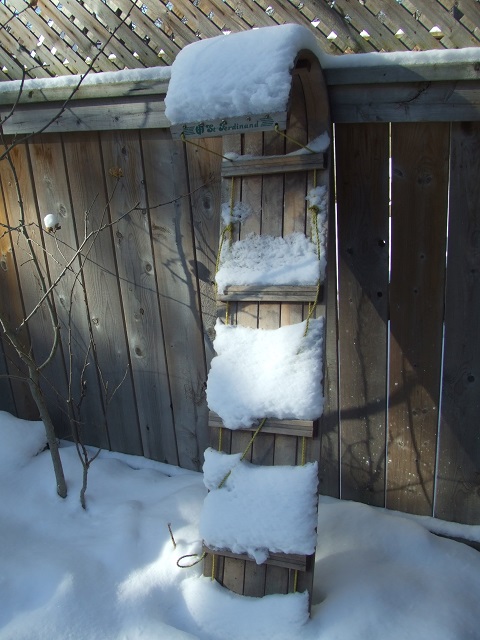
What to do on the coldest day in February? Go tobogganing, of course!
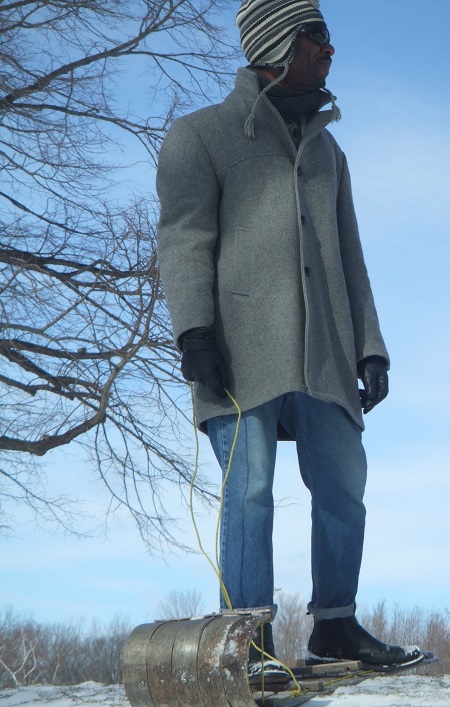
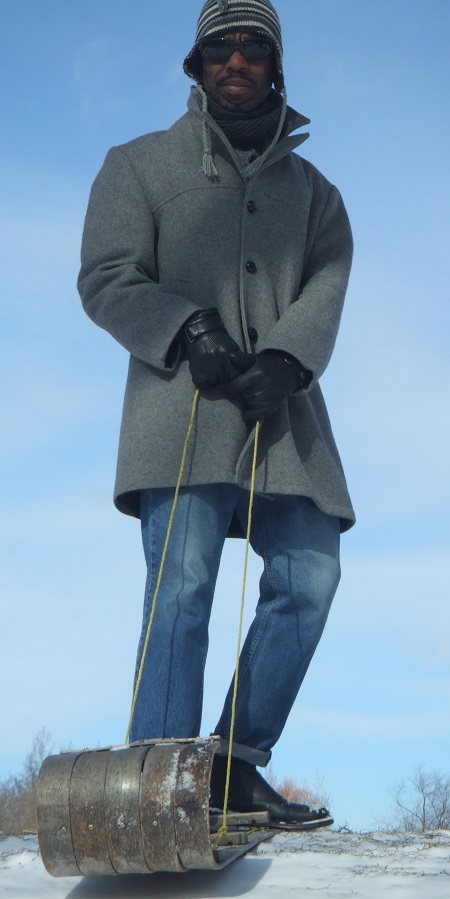
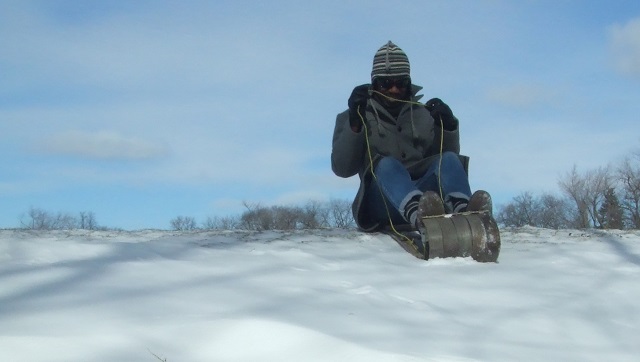
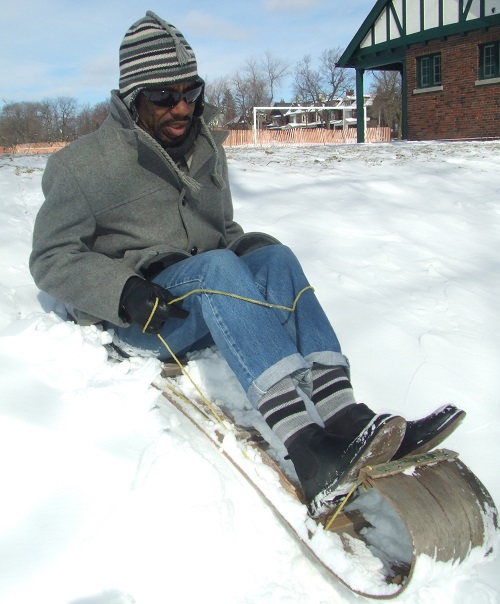
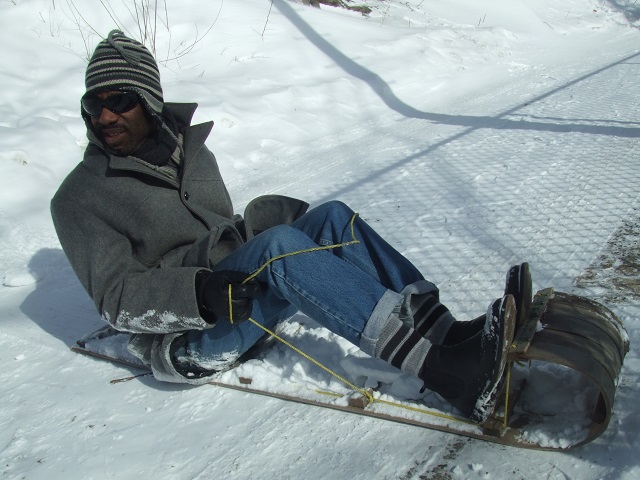
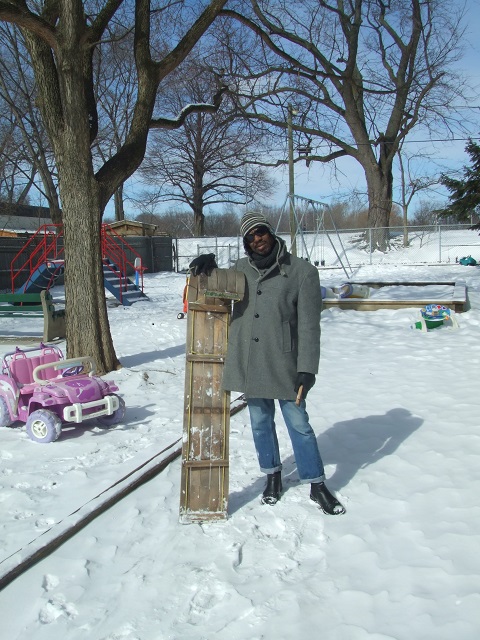
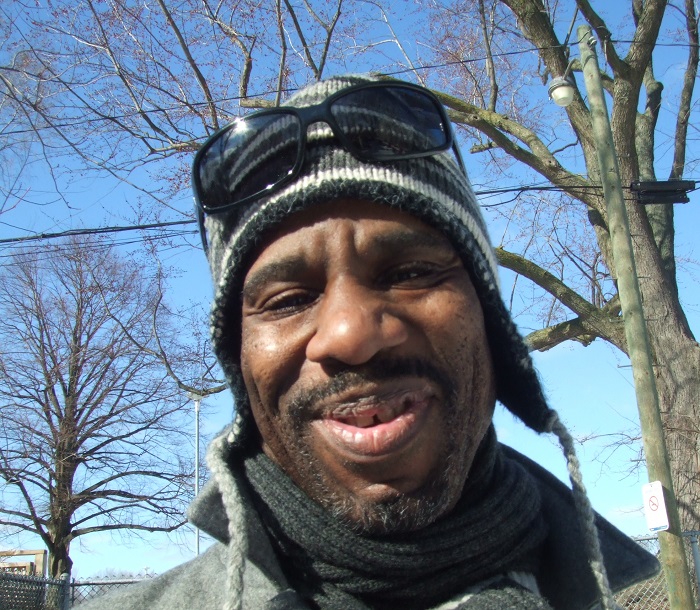
That was fun…I think? Well, at least it got me out of the house!
Poemas de amor en el idioma quechua: Ariruma Kowii y algunos versos “para construir el futuro”
Posted: February 14, 2013 Filed under: Ariruma Kowii, Poemas de amor en el idioma quechua: Ariruma Kowii, Quechua, Spanish | Tags: Poemas de Amor Comments Off on Poemas de amor en el idioma quechua: Ariruma Kowii y algunos versos “para construir el futuro”Ariruma Kowii
(Poeta quechua, nace 1961, Otavalo, Imbabura, Ecuador)
Algunos versos de su obra “TSAITSIK: poemas para construir el futuro” (1993)
“Canción de Amor” (Poema 12)
.
Kay kausay
mana alli kajta
nijujta
ninanta allikachini
chaimanta kanta juyani.
.
Lo que más amo de tí
es tu forma de decir
que las cosas
que vivimos
en la actualidad
están mal.
.
Watashka, tukuchishka
runakunata, mashkajujta
tapujujta rikushpa
maypipash maskakuimanta
kanta juyani.
.
Lo que más amo de tí
es tu forma de indagar
cuántos presos
cuántas sentencias
se han dado
aquí y allá.
.
Willaykunata
takurinakunata
kishpichijkunata
sumaj alli killkaymanta
kanta juyani.
.
Lo que más amo de tí
es tu forma de escribir
las denuncias
las consignas
que ayudan
a protestar.
.
Llajtapaj kaparishna
ñukataka juyanimi
ninki
shina kashkamanta
kanta juyani.
.
Lo que más amo de tí
es tu forma de decir
que me amas
como el grito fuerte
del pueblo, cuando sale
a combatir.
.
Watay wasipi kajpipash
kanpaj juyaika
kishpirij kausaishina
punchashna kuyurin
kurajiwanmi kuyurin
chaimanta kanta juyani.
.
Lo que más amo de tí
es tu franca libertad
que se agita con valor
tras las rejas
que nos priva
de nuestro amor.
. . .
“Poema 18”
.
Kan rijpika
pishi wairapaj shimikunata ninka
pishi kachisha, wakisha, tuashi ninka?
.
Si tú te vas y me dejas
quién bautizará al viento de la manana kachisha?
quién bautizará al viento de la tarde waskisha?
quién bautizará al viento de la noche tuashi?
.
Kan rijpika
pishi pachata jarkanka
pishi kanpaj samaita
fuyutashna kacharinka
ima pachashi kanpaj
churajunakunata kuntin
churajunka?
.
Si tú te vas y me dejas
qué voz, qué caricia detendrá
el tiempo?
Qué neblina volverá a emanar
tu aroma?
Qué momento volverá a vestir
con tus encantos?
.
Kan rijpika
kirupaj llantu llakilla
sakirinka
urpikunapaj tazinpash
chushaj sakirinka
pishkukunaspash
ñana kutin tikramunkach.
.
Si tú te vas y me dejas
la sombra del árbol que nos protegía
no volverá a ser feliz
el hogar de los gorriones quedará
abandonado
ni una alondra volverá a reposar
en su cálido seno.
.
Kan rijpika
tutapaj fuyu
ñukapaj shunkuta chiriyachinka
paipaj makipi
kalajyachinka
tukurij juyaykunata
wañujujta rikunkami.
.
Si tú te vas y me dejas
el soplo apresurado de la noche
helará el fuego de mis venas
me ahogará en sus brazos
su carcajada será
el último testigo que observe
el desvanecimiento
de mis sentimientos.
.
Kan rijpilca
Tukuillami Tukuillami
Shuj Tukunka
Tukuilla, ñuka lla kiwanmi
Wacharinko.
.
Si tú te vas y me dejas
todas las cosas tendrán que cambiar.
su forma, su contenido, todo!
Ellas volverán a nacer
a imagen y semejanza
de la tristeza mia!
. . .
“Poema 25”
.
Ayer
saber que estabas conmigo
era muy hermoso
a ratos
no importaba que te encontraras
lejos
el tiempo, la distancia
estaba repleta de tí,
de aquel:
solo tú me haces sonrojar
que exagerado eres…déjame
Te prometo que, veras!
me encanta…!
de aquella manera tan peculiar
de reposar tu cabeza sobre mi pecho
de tus miradas de golondrina
rehuyendo la impenetrable vegetación
de mis pupilas
del suave murmullo de tu piel
habitando como diosa en la mía!
.
Ñukanchij juyaika
apunchijkunapaj
muskuishinami karka
tantanajushpa
rimarishpa
makipurarishpa
kausaj karkanchij
kan, ñuka
ishkantij shujllashna
tukurkanchij
shujllakashpa sinchi
na sinchi kausaykunata
allichishpa ñaupaman
katinajurkanchij
ñaupamanllaj
katinajurkanchij.
.
Ayer
saber que estabas conmigo
era muy hermoso
a ratos
no importaba que te encontraras
lejos
porque tú
igual que las palabras o el silencio
estabas en todas partes conmigo:
despertando la curiosidad, el murmullo
sorprendido de los tuyos
y los míos
despertando en ellos
siglos
de interrogaciones
que no distraían nuestra atención
nada, nada importaba
Ssguíamos tú y yo
sumergiendo nuestras manos
construyendo nidos
que ansiaban despertar en cielos diferentes
hilvanando cercanos planetas
con el cálido amor de tus adentros
atrayendo vertientes que inunden
la fuente engendrada por nuestros encuentros.
.
Kan, ñukawan
ishkantij
shujllashna kashpa
mana alli yuyaikunata
fakishpa
chaupita yallishpa
mushuj pachamamapi
kausankapaj
rinata yacharkanchij
chai mushuj pacha
mamapika
inti taita, pura mamapash
kushilla chaskinata yacharka
ñawi, ñawi rikushpa
paikunaka
shinami ninata yacharka:
.
Juyaika sumaj allimi
juyaika kallari
tukuri, kausaymi kan
chaimanta kankunaka
juyaita
allitapacha wakaichinami
kankichij
shina kachun
tukui shunkuwan
juyanami kankichij.
.
Tornando lo complejo
en una sutil escaramuza
que caía vencida por un beso
tuyo
todo!
Todo era sencillo y diferente
tú y yo éramos sagrados
y en esta unidad quisimos ser
los cómplices más fieles para sostener
la vida!
Y no fue
possible.
.
Juyaika
ishkantipi juntarirka
chaimanta karu
karupi kajpipash
shunkuka kushilla
yariaj, yariaj
kausanata yacharka
chai jawa
llakika
ñukanchijpaman
chayamurka
ñukanchij juyaita
fitinkapaj
chayamushka.
.
Amor!
Qué red ha emboscado
el tíbio hogar de tus caricias?
Qué tarde ha logrado empozar
la lozanía de tu aurora
en la aguzada noche?
Por qué
si tú me amas
dejas caer el velo de la tarde
para que nos separe?
Diluyes nuestro calor
para que se desborde
podas tus suspiros y los míos
para matar su aroma?
.
Amor!
Hoy tu recuerdo llega a mí
como el abrazo solidario
de una amiga o un amigo.
.
Ahora el mañana
será menos hermoso que ayer
porque tú
ya has partido!
Mañana
tal vez yo vuelva
a buscar
mis huellas
para seguir como un río encabritado
tras la vida…!
.
Urpiku
imanishpataj
ñukanchijpaj juyaita
fitichun sakishkanki
ima nishpa
ñukanchijpaj
juyarina pujyuta
tujyachun sakishkanki,
shamui rikui
kanpaj shunkuwan
takari
ñukanchijpaj juyaita
nanaymanta
kasilla sakirishka
ñana kuyurinchu
chinkashkashna
rikuitallami
rikujun.
.
Urpiku
kayaka ñana
kaynashna kankachu
kayaka
chushaj puncha
jayaj, jayaj
punchami kanka
ñuka kausaypash
chaki, maki
yuyai, illajshnallaj
allimanta, allimanta
Kaiman chayman rijun
kayachari, ñuka
kausayka
kausayta katishpa
akapanashna
kutin kutin
llujshinkami.
. . . . .
Todos los poemas © Ariruma Kowii
Sunqupa Harawinkuna / Poemas de amor en la lengua quechua – de un poemario por Lily Flores Palomino / K’ancharina
Posted: February 14, 2013 Filed under: Lily Flores Palomino / K'ancharina, Poemas de amor en la lengua quechua: Lily Flores Palomino, Quechua, Spanish | Tags: Poemas de Amor Comments Off on Sunqupa Harawinkuna / Poemas de amor en la lengua quechua – de un poemario por Lily Flores Palomino / K’ancharina
Lily Flores ( nace 1937, Abancay, Apurimac, Perú )
La primera poetisa que escribó junto en quechua y español, dijo La Sra. Flores Palomino/K’ancharina en el año 2009:
“Sigo escribiendo en idioma incaico – mi pluma es pionera e inagotable en quechua.”
.
Dos poemas de amor – del poemario “Troj de poemas queshua-castellano” (1971):
“Khuyay”
.
Taki hina kusi, ratu pasaj
t’ika hina, hajchirimuj mana tupaykuna
samp’a weqe hina, tuyturimuj
tukuy atij, hatun Apu hina.
.
Khuyayaqa muspha muspha kausaymi,
rijchasqapas puñasqapas mosqoqakuymi
khuyayaqa asirikuspa wañuymi
manachayqa, killkakunawan tipasqapas wañuytajmi.
.
Khuyayqa takin, hajchirimuj t’ikapiwan
hinallatajmi, sumaj qapaj ancha kusipas
phajchirimuspa tukukuypas khuyayllatajmi
hinallatajmi ñakarispa wañuypas.
.
Khuyayqa apukunatapas umanchaymi
llullulla sumaj q’apariytajmi
ancha nanachikuypas waspirichiymi
wañuypas, sami kaypas, khuyayllatajmi.
. . .
“Amar”
.
Alegre y fugaz cual canto
radiante y sensible como flor,
frágil y quebrantoso cual llanto
poderoso y supremo como Dios.
.
Amar, es vivir delirante
soñar despierto o dormido,
amar, es morir sonriente
o es morir enclavado.
.
Canto, flor radiante es amar,
perfumes y aleluya lo es también,
fragmentarse y morir es amar,
Calvario y muerte lo es también.
.
Amar es bendecir a Dios
lo es, bálsamo de ternura,
amar, es blasfemia a Dios
o es vapor de amargura,
Gloria o muerte es amar.
. . .
”Munakusqaymi Kanki”
.
Llakiy thanichij
purisqaypi samarinay
waqayniypas thanichij
qaritaj kachi yakutaj.
.
Allin wiraqocha munasqaymi kanki
mana qantaqa, manan pitatas munaymanchu.
.
Yachanin qampa kasqayta
sumajllata llamiyuwajtiki
llanllalla wayrapa ch’allaynikiwan
t’ijrakamuyniki khipuchawajtin
allin qaripa marq’anampas kanman hina.
.
Ñoqataj khuyakuyniywan kutirichiyki
ancha samiraj, qanman qokuspa
phiña phiñaña, churakujtinkupas
uquykipi kay, warmiman rijchajkuna
.
Munakusqaymi kanki, tayta qocha
suyawasqayki hinallapuni suyaykuwanki
ruphapakuyniy thanichiwanaykipaj
qan rayku shayna kasqayta
mancharikuna anqash, ñoqa munakusqay.
“Eres mi Amado”
.
Consuelo de mis penas
refugio en mi andanza
sociego de mi lamento
hombre y salada agua.
.
Arrogante señor, eres mi amante,
no puedo a nadie amar que no seas tú.
.
Siento ser tuya
cuando me dejo acariciar
con tu fresca y suave brisa
cuando tus olas me envuelven
cual brazos fuertes de un gran varón.
.
Yo con ternura te correspondo
cuando feliz me doy a tí
aunque celosas puedan estar
todas las musas que guardas tú.
.
Eres mi amado, inmenso mar.
Espérame siempre como lo haces
para refrescar mi febril estado
sentido por tí
– monstruo azul, amante mío.
. . . . .
Sunqupa Harawinkuna / Poemas del Corazón en el idioma quechua por Kusi Paukar
Posted: February 14, 2013 Filed under: Kusi Paukar, Quechua, Spanish, Sunqupa Harawinkuna por Kusi Paukar | Tags: Poemas de Amor Comments Off on Sunqupa Harawinkuna / Poemas del Corazón en el idioma quechua por Kusi PaukarKusi Paukar (César Augusto Guardia Mayorga)
Sonqup Jarawiinin / El Cantar del Corazón
Sunqupa Harawinkuna / Poemas del Corazón
Lima, Perú, 1961
Traducciones del idioma quechua: Jesús Lara
“Waylluy”
.
¿Imaraq kay waylluy?
Qawaspa mana qawaq,
Munaspa mana munaq,
Maskaspa mana maskaq,
Waylluqtukuspa cheqnichikuq,
Cheqniqtukuspa waylluchikuq
Kay waylluy kasqanta,
Sonqullaymi yachan.
.
“Amor”
.
¿Qué será el amor?
Que mirando no mira,
Que queriendo no quiere,
Que buscando no busca;
Que simulando amar despierta odio,
Que fingiendo odio hace querer
Lo que es el amor,
Sólo mi corazón lo sabe.
. . .
“Qampaq”
.
Umaypim yuyayniiki
Patpatichkan,
Pillpintup rapran jina
Mana samaq.
.
Rinriipim sutiiki
Tuta punchau
Sirwan,
Mana wayrap apasqan
Mana pip uyarisqan.
.
Sonquypim waylluyniiki
Kausan,
Arwi arwi yura jina
Arwiwaspa.
.
Llakispa, asiq tukuni,
Mana pipas llakisqayta
Musianampaq.
Qamllam, sonquypi yachanki,
Imay kusikusqayta,
Jaykaq llakikusqayta,
Cheqampi.
.
“Para Ti”
.
En mi mente
Palpita tu recuerdo,
Como alas de mariposa,
Sin descanso.
.
En mis oídos
Vibra tu nombre
Noche y dia,
Sin que nadie lo oiga,
Sin que se lo lleve el viento.
.
En mi corazón
Vive tu amor,
Aprisionándome
Como enredadera.
.
Sufriendo, simulo reír
Para que nadie
Sospeche siquiera
Que sufro.
Sólo tú sabes en mi corazón
¡Cuándo me alegro en verdad,
Cuándo en verdad sufro!
. . .
“Ama Tapukuychu”
.
Warmita, waytata jina qawaspa,
Manaña puñuyta atipaspa,
¿Imapaqtaq tapukunki
Ima onquy kasqanta?
.
Waylluymi mismichkasunki,
Mana musiasqayki;
Kuyaymi arwichkasunki,
Mana yachasqayki.
.
Ama jampita yanqa maskaychu.
Sonquillampi kausay,
Ñawillampi qawakuy,
Makillampi kay.
Waylluy onquyqa,
Waylluyllawanmi jampikun.
.
“No Preguntes”
.
Cuando mires a la mujer
Como a una flor;
Cuando ya no concilies el sueño,
¿Para qué preguntas
Qué enfermedad sufres?
.
Te está rezumando el amor,
Sin que lo sospeches siquiera;
Te está enredando el cariño
Sin que tú lo sepas.
.
No busques remedio en vano.
Vive en su corazón,
Mírate en sus ojos,
Ponte en sus manos;
Que la enfermedad del amor
Sólo con amor se cura.
. . .
“Walka”
.
Walkam sutin karqa
Ñoqallay kuyachkaptii.
Tuta jina ñawinpas,
Chukchampas tutay tuta.
.
Walkam suntin karqa
Ñoqallay waylluchkaptii.
Yuraq sisa kirumpas,
Qantu qantu siminpas.
.
Walkam sutin karqa
Ñoqallata kuyawachkaptin.
Waqaptimpas
Sacha kuna sullakuq,
Asiptimpas
Pukiukuna asikuq.
.
Walkam sutin karqa
Ñoqallay kuyachkaptii,
Ñoqallata kuyawachkaptin.
Imaraq kunan sutin
Walka sutiyoq warmi.
.
Sutillanñam simiipi,
Ñawillanñam ñawiipi.
Walka sutiyoq urpi.
Imaraq kunan sutin.
.
“Walka”
.
Su nombre era Walka
Cuando yo, solo, la quería.
Como la noche eran sus ojos,
Sus cabellos, más que la noche.
.
Walka era su nombre
Cuando yo, solo, la amaba.
Sus dientes eran como níveas flores,
Sus labios, como las cantutas.
.
Era su nombre Walka
Cuando ella sólo me quería a mí.
Cuando lloraba
De rocíos se cubrían los árboles,
Cuando reía,
Reían también las fuentes.
.
Walka era su nombre
Cuando yo, solo, la quería,
Cuando ella sólo me quería a mí.
¿Qué se llamará ahora
La mujer que se llamaba Walka?
.
Ya sólo su nombre está en mis labios,
Ya sólo sus ojos están en mis ojos.
Paloma: Walka era tu nombre.
¿Qué te llamarás ahora?
. . .
“Kuyaspa”
.
Sonquymi kirisqa kachkan
Ñawiikipa kanchayninwan,
Onquyñam kuyayniiqa,
Wañuymanchus jinam apawanqa.
.
Chisi tuta nuspaspa
Sutiikita oqarisqani
Mana pip uyarisqan,
Ichapas wayra uyarirqa,
¿Maytaraq, yanallay,
Sutiikita wayra aparqa?
.
Ichapas qam kaqpi muyuykachaspa
Llakillayta willasurqanki,
Qamtaq mancharikuspa,
Ayqereqanki.
.
“Quieriendo”
.
Mi corazón está herido
Con la luz de tus ojos,
Ya mi amor es una enfermedad
Que tal vez me lleve a la muerte.
.
Anoche delirando,
Pronuncié tu nombre
Sin que nadie lo oyese.
Acaso lo oyó el viento.
¿A dónde llevaría
Tu nombre el viento,
Amada mía?
.
Quién sabe
Si dando vueltas
En torno tuyo,
Te contó mis penas,
Y tú te asustaste
Y te fuiste.
. . .
“¡Imanaykusaqtaq!”
.
Imanaykusaqtaq kunanqa,
Llakiimi kichka jina
Sonquyta nanachichkan.
.
Imanaykusaqtaq kunanqa,
Yuyayniikim tuta jina
Punchauniita tutayachichkan.
.
Imanaykusaqtaq kunanqa,
Waqayta munaspapas
Weqellaymi mana lloqsinchu.
.
Imanaykusaqtaq kunanqa,
Kayta wakta qawaptiipas,
Manam imatapas rikunichu.
.
Sonqullaymi sapampi,
Imapaqraq pipas maypas,
Mana kuyananta kuyan,
Nispa niwan.
.
“¿Qué voy hacer?
.
¿Qué voy hacer ahora?
Mi pena como una espina
Está hincando mi corazón!
.
¿Qué voy hacer ahora?
¡Tu recuerdo como la noche
Está oscureciendo mi día!
.
¿Qué voy hacer ahora?
¡Hasta cuando quiero llorar
No asoman las lágrimas!
.
¿Qué voy hacer ahora?
¡Hasta cuando quiero mirar
No miro nada!
.
Solo mi corazón en su soledad
Se pregunta a sí mismo:
¿Para qué se amará
Lo que no se debe amar?
. . .
“Auqaypaq”
.
Yuyayniipim yuyayniiki
Patpatichkan,
Tutayaq punchaupi
Urpi patpatichkaq jina.
.
Puchqu yaku jina
Yuyayniiki,
Kausayniita puchquyachichkan
Mana qampa yachasqayki.
.
Musiaspaqa, yachaspaqa,
Warmi sonquyki,
Warmipa kaspapas,
Sinchitachari Llakikunman.
.
Maypiraq, chaypnaq qamqa,
Asikuspa, kusikuspa,
Llakiita mana yachaspa,
Qonqayta munawaspa,
Qonqawaytaña qallaykunki.
.
Mana kuyana auqa,
Manaña kuyayta tarispa,
Manaña sonquyoq,
Pitaraq wayllunki,
Piñaraq kuyasunki.
.
Sapallaykina rikukuspa,
Weqellaykita umikunki,
Sonquykitaq qaparispa,
Waqaya kunan
Nispa nisunki.
.
Mana kuyana auqa,
Manaña sonquyoq,
¿Pitaraq wayllunki?
¿Piñaraq kuyasunki?
.
“Para mi Adversaria”
.
En mi memoria
Tu recuerdo está latiendo
Como aleteo de paloma
En día que anochece.
.
Como agua amarga,
Tu recuerdo
Está amargando mi vida
Sin que tú lo sepas.
.
Si lo supieras,
Si sospecharas siquiera,
Tu corazón de mujer,
Siendo de mujer,
¡Cómo sufriría!
.
¿Dónde estarás tú,
Riendo y gozando
Sin saber mi pena?
Cuando se quiere olvidar,
Ya empieza el olvido.
.
Indigna de ser amada,
Ya sin encontrar cariño,
Ya sin corazón,
¿A quién amarás?
¿Quién te amará?
.
Al verte ya sola
Beberás tus lágrimas,
I el corazón te dirá a gritos:
¡Ahora sólo te resta llorar!
.
Indigna de ser amada,
Ya sin corazón,
¿A quién amarás?
¿Quién te amará?
. . .
“Pituchakuy”
.
Ay ruruchay rurucha,
Ñawi rurucha.
Warmi kasqanta yachachkaspa
Qawarqanki.
.
Ay ruruchay rurucha,
Sonqu rurucha.
Kuyay kasqanta yachachkaspa
Kuyarqanki.
.
Waqayari ñawi,
Llakiyari sonqu,
Chay mana qawana qawasqaykimanta,
Chay mana kuyana kuyasqaykimanta.

“Arrepentimiento”
.
¡Ay! niña de mis ojos.
¡Ay! pupila mía.
Sabiendo que era mujer
La miraste.
.
¡Ay! corazón mío,
Corazón,
Sabiendo lo que es amor,
La amaste.
.
Llora, pues, pupila mía
Por haber mirado
A quien no debiste mirar;
Sufre, pues, corazón,
Por haber amado
A quien no debiste amar.
. . .
“Kaynay”
.
Waylluy, sonquykipi kaptinqa,
Jarawii;
Llaki qasquykita kiriptinqa,
Jarawii, takii, machay;
Auqanayki kaptinqa,
Qari jina kallpachakuspa,
Wajujuy, jayllii.
Cheqnii atisuptiikiqa,
Upallalla kausay,
Ama sonquykita rikchachiichu,
Ama kausayta qanrachaychu.
.
“Has así”
.
Canta,
Si el amor está en tu corazón;
Canta, baila, embriágate,
Si la pena hiere tu pecho.
Si tienes que luchar,
Cobra fuerzas varoniles
Y entona conciones triunfales.
Pero si el odio te domina,
No despiertes a tu corazón,
Vive en silencio,
No ensucies la vida.
. . . . .
Poemas de amor en la lengua quechua – Juan Wallparrimachi, José David Berríos, y unos poetas bolivianos anónimos
Posted: February 14, 2013 Filed under: José David Berríos, Juan Wallparrimachi, Poemas de amor quechua: Juan Wallparrimachi + José David Berríos + unos poetas bolivianos anónimos, Quechua, Spanish | Tags: Poemas de Amor Comments Off on Poemas de amor en la lengua quechua – Juan Wallparrimachi, José David Berríos, y unos poetas bolivianos anónimos
Poemas de amor quechua – del siglo IXX: Juan Wallparrimachi, José David Berríos, y unos poetas bolivianos anónimos
.
“Urpi”
.
Munakusqay urpi,
uyaririllaway,
sunquyta paqumaq
munakapullaway.
.
Waqcha ch’ujllitayman
pusakapusqayki,
chaypi wayllususpa
munakamusqayki.
.
Uj wik’uñita
chakupamusqayki,
amapolitaswan
t’ikanchapusqayki.
.
Uj ch’aynitutapis
jap’imullasaqtaq,
misk’I takiyninwan
kusichisunanpaq.
.
Uj ovejitata
jip’ikapusqayki,
panti millmitaswan
chinuykapusqayki.
.
Nuqamin tarpusaq
quyllu papitasta,
qanri misk’ikunki
clavel t’ikitasta.
.
Nuqamari risaq
qaqa patitasta,
apakamusqayki
phasakanitasta.
.
Jakulla ripusun,
urpi munakusaqay,
qanmin yanay kanki
wiñay wayllukusqay.
.
Munanakuspalla
khuska kawsakusun,
t’ikasta rikhuspa
aswan munakusun.
. . .
“Paloma”
.
Mi querida palomita,
escúchame, por favor,
a mi corazón aprisionado
quiéremelo nomás.
.
A mi pobre chocita
te estoy llevando,
allí tiernamente
bien te amaré.
.
Una vicuñita
cazaré para tí
y con amapolitas
te adornaré.
.
También un jilguerito
cogeré para tí,
para que con su dulce trino
te haga alegrar.
.
Una ovejita
te la encerraré,
con su lana suave
bien te arrumaré.
.
También sembraré
papita quyllu,
con florecitas de clavel
tú te perfumarás.
.
Pronto voy a ir
a la punta de la peña
y te traeré
fruto de ulala.
.
Vamos ya, vámonos,
mi querida paloma,
tú serás mi pareja
y te mimaré para siempre.
.
Queriéndonos nomás
viviremos juntos,
mirando las flores
nos amaremos más.
. . .
“K’ita Urpi”
.
Imallataq kay munakuy,
k’ita urpillay,
chiquititan chhika sinchi,
mana khuyana,
ancha yachayniyuqtapis
k’ita urpillay,
muspa muspaspa purichin,
mana khuyana.
.
K’ita urpillay,
mana khuyana,
pacha k’anchiyanna
ripukunallay.
.
Kayraq phawaq waqyanaq
k’ita urpillay.
ñanniykita rikhuchiway,
mana khuyana,
mana pipis musyasqallan,
k’ita urpillay,
kay chhikimanta qhispisaq,
mana khuyana.
. . .
“La paloma agreste”
.
¿Qué viene a ser el amor,
palomita agreste,
tan pequeño y esforzado,
desamorada,
que al sabio más estendido,
palomita agreste,
le hace andar desatinado,
desamorada?
.
Palomita agreste,
desamorada,
amanece el día
en que yo me vaya.
.
Alegre golondrina,
palomita agreste,
enséñame tu camino,
desamorada,
para irme sin que me sientan,
palomita agreste,
y salvarme de mi destino,
desamorada.
. . .
Tres poemas de Juan Wallparrimachi (1793-1814)
“Imaynallatan atiyman”
.
Imaynallatan atiyman
yana ch’hillu chujchaykita
quri ñaqch’awan ñaqch’aspa
kunkaykipi pujllachiyta?
.
Imaynallatan atiyman
ch’aska quyllur ñawiykita
ñawsa kayniyta kichaspa
sunqullaypi k’anchachiyta?
.
Imaynallatan atiyman
puka mullu simiykita
samayniykita umispa
astawanraq phanchachiyta?
.
Imaynallatan atiyman
rit’I sansaq makiykita
jamanq’ayta p’inqachispa
astawanraq sansachiyta?
.
Imaynallatan atiyman
chay sumaq puriyniykita
sapa thaskiypi t’ikata
astawanraq mut’uchiyta?
.
Kay tukuyta atispanari
atiymantaq sunquykita
sunquy chawpipi mallkispa
wiñaypaq phallallachiyta.
. . .
Tres poemas del Soldado-Poeta Juan Wallparrimachi (Macha, Potosí, 1793-1814)
(Traducciones por Jesús Lara)
“¿Cómo pudiera hacer?”
.
¿Cómo pudiera hacer
para peinar con peine de oro
tu negra y encantada cabellera
y ver como ella ondula al redor de tu cuello?
.
¿Cómo pudiera hacer
para que los luceros de tus ojos,
abriendo el caos de mi cegüedad,
sólo brillaran en mi corazón?
.
¿Cómo pudiera hacer
para beber tu aliento y conseguir
que el rojo coral de tus labios
se volviera más bello todavía?
.
¿Cómo pudiera hacer
para que la pureza de tu mano
avergonzando a la azucena
reverberara todavía más?
.
¿Cómo pudiera hacer
para que el ritmo de tu andar
en cada paso fuera derramando
más flores que las que hoy le veo derramar?
.
Y si me fuera dado hacer todo esto,
ya podría plantar tu corazón
dentro del mío, como un árbol,
para verlo
eternamente verdecer.
. . .
“Chay ñawiyki”
.
Chay quyllur ñawiyki uj tuta
llakiyniypi urmaykamurqan.
sunquypi pakaykuq rijtiy
ruruq urpiman tukurqan.
.
Ch’ikikuq muyuq wayrari
qhichuwarqan makiymanta,
ñawiy chakiytan wataspa
mana rinaypaq qhipanta.
.
Ñanpi tukuypa sarusqan,
intiq paraqpa waqtasqan,
ruruq urpinpi yuyaspa
sapallan sunquy mullphasqan.
. . .
“Esos tus ojos”
.
Como una estrella tu pupila
cayó una noche en mi congoja.
Caundo a esconderla fui en mi pecho
se convirtió en tierna paloma.
.
Luego, envidioso torbellino
me la arrebató de las manos,
para evitar que la siguiera
dejome ciego y amarrado.
.
Encarnecido en el camino,
flagelado por lluvia y sol,
pensando en su tierna paloma
se carcome mi corazón.
. . .
“Munarikuway”
.
Qanllapin sunquy,
qantan rikuyki
musquyniypipas.
Qanpin yuyani,
qantan mask’ayki
rijch’ayniypipas.
.
Inti jinamin
ñawiykikuna
ñuqapaq k’anchan.
Ñawraq t’ikari
uyaykipinin
ñuqapaq phanchan.
.
Chay ñawillayki
k’anchaynillanwan
kawsachiwantaq.
Phanchaq simiyki
asikuyninwan
kusichiwantaq.
.
Munakullaway,
irpa urpilla,
mana manchaspa.
Ñuqa qanrayku
wañuy yachasaq
qanta munaspa.
. . .
“Ámame”
.
Sólo en ti está mi corazón
y cuando sueño
no veo a nadie sino a ti.
Sólo en ti pienso
y a ti también te busco
si estoy despierto.
.
Igual que el sol
fulguran para mí
tus ojos.
En tu faz se abren,
para regalo mío,
todas las flores.
.
La lumbre sola
de tus pupilas
me da la vida.
Y tu boca florida
con su sonrisa
me hace dichoso.
.
Ven y ámame,
tierna paloma,
no temas nada.
Pese al destino,
yo te amaré
hasta la muerte.
. . .
“Cochabambamanta arawis”
.
Q’ara panpa sunquykipi
manayniyta tarpurqani,
tipiyniyta uqhariq rispa
khishkaman taripurqani.
.
Uj thapapi uywasqa urpi
lijran pura sawnanasqa,
imaynata qunqawanki
si sunquy qanwan yachasqa?
.
Sayk’usqa monteq chawpinpi
llak’isqa samarikuni
nuqaypa llanthullaywantaq
urpiywan pantachikuni.
.
Munakuyki niwarqanki,
maytaq chay munakuyniyki,
qaqapichu, urqupichu,
mayqin runaq llaqtanpichu?
.
Sunquytachus qhawaykuwaq
yawar qhuchapi wayt’asqan
khiskasmanta jarap’asqa
ayrun ayrunta waqasqan.
.
Nuqa mayu rumi kani
qaqamanta k’aqtikamuq,
sinchiq wayraq rumichisqan
punkuykiman k’umuykamuq.
.
Rikuy pitan munasqani
mana sunqunta yachaspa
nuqallataq mask’akuni
jik’un ji’unta waqaspa.
.
Chujchaykita kachaykamuy
chujchaykipi sipikusaq,
t’inpiykipi wañupusaq,
sunquykipi p’anpakusaq.
.
Para yakuchu kasqani
wayq’un wayq’un purinaypaq?
mamaychu, tataychu kasqa
mana qunqay atinaypaq?
. . .
“De Cochabamba, Coplas amorosas”
.
En el desierto de tu corazón
sembré un día mi amor
y al ir a recoger la cosecha
solamente espinas hallé.
.
Un solo nido tuvimos,
ala con ala dormimos,
¿cómo quieres olvidarme
si mi corazón es tuyo?
.
Cansado, en pleno monte
descanso de mis penas
y mi propria sombre
me hace confundir con mi paloma.
.
Me dijiste que me amabas,
¿dónde está ese tu amor?
en el monte, en las rocas
o en algún país lejano?
.
Si vieras mi corazón
nadando en un lago de sangre,
enmarañado entre espinas
está llorando sin consuelo.
.
Yo soy guijarro del río
desprendido del barranco
que endurecido por el viento
vino a dar a tu puerta.
.
Miren a quién estoy queriendo
sin conocer su corazón,
yo mismo la busco
llorando sin consolación.
.
Entrégame tu cabello,
con él me voy a ahorcar,
en tu regazo voy a morir,
en tu corazón me voy a enterrar.
.
¿Soy agua de lluvia acaso
para errar por las quebradas?
¿Mi padre o mi madre es ella
Que no la pueda olvidar?

José David Berríos (Potosí, Bolivia, 1849-1912)
“Yuyarikuway”
.
Maypachachus lliphipispa
k’anchaq inti kutimunqa
k’illmi tutata ayqichispa,
yuyarikuway.
.
Maypachchus uraniqta
sayk’usqaña wasaykunqa
lawraq phuyu chawpillanpi,
yuyarikuway.
.
Maypachachus uyarinki
urpi sapan rikhukuspa
sach’a chawpipi waqaqta,
yuyarikuway.
.
Janaq pacha chawpimanta
llunp’aq killata rikuspa
tutata sut’iyachiqta,
yuyarikuway.
.
Ñuqaqa paqarimuypi
ch’isiyaypi llakikuspa
qanllawan muspaykachani…
Yuyarikuway.
.
Kay kawsayniy tukukuqtin
chikaykuqtiy jallp’a ukhuman
phutiy phutiyta waqaspa,
yuyarikuway.
.
Chay waqayniyki qarpaqtin
chiri ushpayta phanchimunqa
sunquymanta yuyay t’ika…
Yuyarikuway.
. . .
José David Berríos (Potosí, Bolivia, 1849-1912)
“Acuerdate de mi”
.
Cuando el sol resplandeciente
venga otra vez ahuyentando
a la tenebrosa noche,
acuérdate de mí.
.
Cuando cansado se abisme
tras la línea del poniente
envuelto en ardientes nubes,
acuérdate de mí.
.
Cuando escuches que solloza
su soledad lamentando
la paloma entre los árboles,
acuérdate de mí.
.
Al clarear la mañana
y al anochecer penando
yo sólo sueño contigo…
Acuérdate de mí.
.
Cuando mi vida se acabe
y a la sepultura baje,
en tu tristeza llorando,
acuérdate de mí.
.
Por tus lágrimas regada
brotará de mis cenizas
la tierna flor del recuerdo…
Acuérdate de mí.
. . . . .
 Zócalo Poets