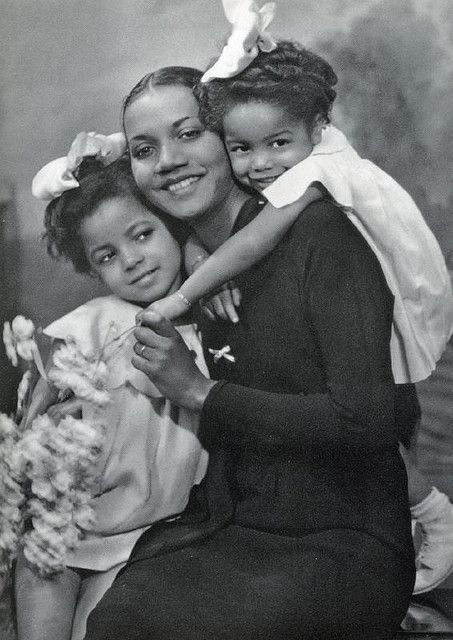
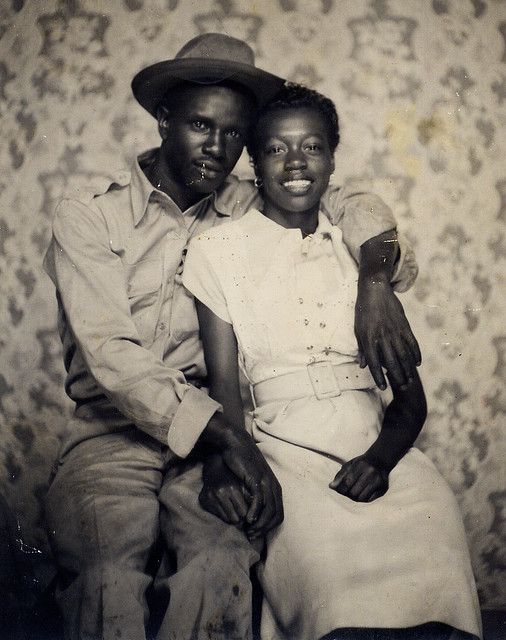
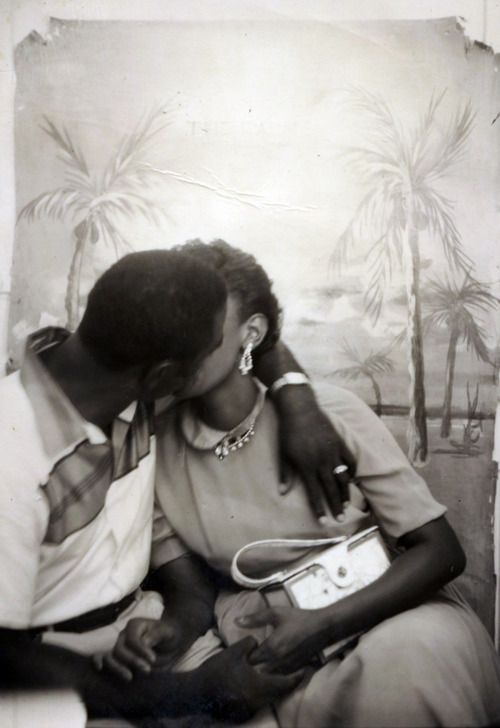
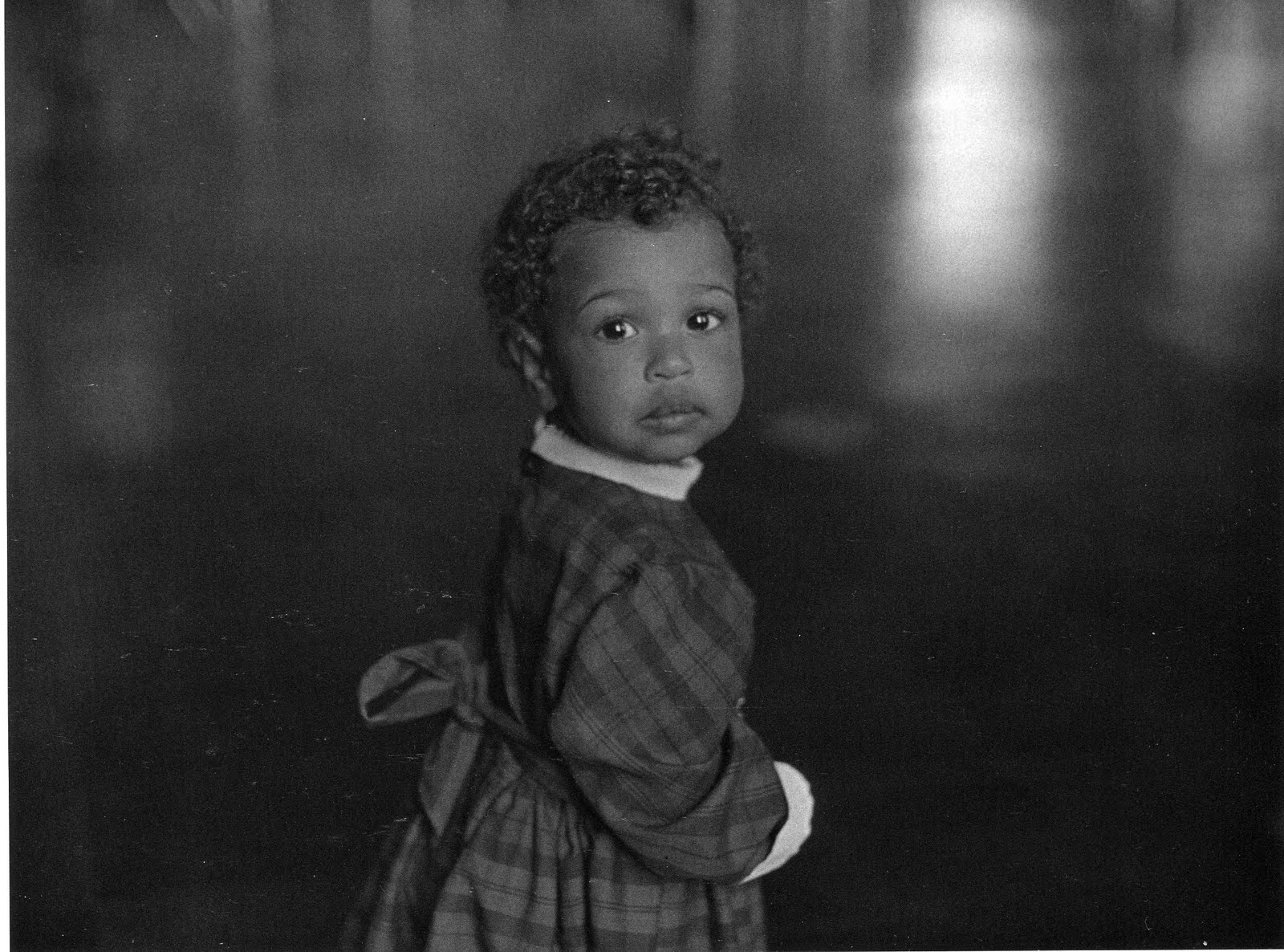
Black History Month: “Won’t You Be My Valentine?”
Posted: February 14, 2016 Filed under: IMAGES | Tags: Black History Month: Won't You Be My Valentine? Comments Off on Black History Month: “Won’t You Be My Valentine?”

Black History Month: Thomas Washington Talley’s “Negro Folk Rhymes –– Wise and Otherwise” (1922)
Posted: February 14, 2016 Filed under: English, English: Nineteenth-century Black-American Southern Dialect | Tags: Black History Month poems Comments Off on Black History Month: Thomas Washington Talley’s “Negro Folk Rhymes –– Wise and Otherwise” (1922)
Selections from: Thomas Washington Talley’s “Negro Folk Rhymes –– Wise and Otherwise” (1922)
. . .
Love is just a Thing of Fancy
.
Love is jes a thing o’ fancy,
Beauty’s jes a blossom;
If you wants to git yo’ finger bit,
Stick it at a ‘possum.
.
Beauty, it’s jes skin deep;
Ugly, it’s to de bone.
Beauty, it’ll jes fade ‘way;
But Ugly’ll hold ‘er own.
. . .
Joe and Malinda Jane
.
Ole Joe jes swore upon ‘is life
He’d make Merlindy Jane ‘is wife.
W’en she hear ‘im up ‘is love an’ tell,
She jumped in a bar’l o’ mussel shell.
She scrape ‘er back till de skin come off.
Nex’ day she die wid de Whoopin’ Cough.
. . .
I love Somebody
.
I loves somebody, yes I do;
An’ I wants somebody to love me too.
Wid my chyart an’ oxes stan’in ‘roun’,
Her pretty liddle foot needn’ tetch de groun’.
.
I loves somebody, yes I do,
Dat randsome, handsome, Stickamastew.
Wid her reddingoat an’ waterfall,
She’s de pretty liddle gal dat beats ’em all.
. . .
Likes and Dislikes
.
I sho’ loves Miss Donie! Oh yes, I do!
She’s neat in de waist,
Lak a needle in de case;
An’ she suits my taste.
I’se gwineter run wid Mollie Roalin’! Oh yes, I will!
She’s pretty an’ nice
Lak a bottle full o’ spice,
But she’s done drap me twice.
.
I don’t lak Miss Jane! Oh no, I don’t.
She’s fat an’ stout,
Got her mouf sticked out,
An’ she laks to pout.
. . .
Sugar Loaf Tea
.
Bring through yo’ Sugar-lo’ tea, bring through yo’ Canday,
All I want is to wheel, an’ tu’n, an’ bow to my Love so handy.
.
You tu’n here on Sugar-lo’ tea, I’ll turn there on Candy.
All I want is to wheel, an tu’n, an’ bow to my Love so handy.
.
Some gits drunk on Sugar-lo’ tea, some gits drunk on Candy,
But all I wants is to wheel, an’ tu’n, an’ bow to my Love so handy.
. . .
Kissing Song
.
A sleish o’ bread an’ butter fried,
Is good enough fer yo’ sweet Bride.
Now choose yo’ Lover, w’ile we sing,
An’ call ‘er nex’ onto de ring.
.
“Oh, my Love, how I loves you!
Nothin’ ‘s in dis worl’ above you.
Dis right han’, fersake it never.
Dis heart, you mus’ keep forever.
One sweet kiss I now takes from you;
Caze I’se gwine away to leave you.”
. . .
Kneel on this Carpet
.
Jes choose yo’ Eas’; jes choose yo’ Wes’.
Now choose de one you loves de bes’.
If she hain’t here to take ‘er part
Choose some one else wid all yo’ heart.
.
Down on dis chyarpet you mus’ kneel,
Shore as de grass grows in de fiel’.
Salute yo’ Bride, an’ kiss her sweet,
An’ den rise up upon yo’ feet.
. . .
Sweet Pinks and Roses
.
Sweet pinks an’ roses, strawbeers on de vines,
Call in de one you loves, an’ kiss ‘er if you minds.
Here sets a pretty gal,
Here sets a pretty boy;
Cheeks painted rosy, an’ deir eyes battin’ black.
You kiss dat pretty gal, an’ I’ll stan’ back.
. . .
You love your Girl
.
You loves yo’ gal?
Well, I loves mine.
Yo’ gal hain’t common?
Well, my gal’s fine.
.
I loves my gal,
She hain’t no goose –
Blacker ‘an blackberries,
Sweeter ‘an juice.
. . .
Down in the Lonesome Garden
.
Hain’t no use to weep, hain’t no use to moan;
Down in a lonesome gyardin.
You cain’t git no meat widout pickin’ up a bone,
Down in a lonesome gyardin.
.
Look at dat gal! How she puts on airs,
Down in de lonesome gyardin!
But whar did she git dem closes she w’ars,
Down in de lonesome gyardin?
.
It hain’t gwineter rain, an’ it hain’t gwineter snow;
Down in my lonesome gyardin.
You hain’t gwineter eat in my kitchen doo’,
Nor down in my lonesome gyardin.
. . .
A Wind-Bag
.
A Nigger come a-struttin’ up to me las’ night;
In his han’ wus a walkin’ cane,
He tipped his hat an’ give a low bow;
“Howdy-doo! Miss Lize Jane!”
.
But I didn’t ax him how he done,
Which make a hint good pinned,
Dat I’d druther have a paper bag,
When it’s sumpin’ to be filled up wid wind.
. . .
Why look at Me?
.
What’s you lookin’ at me for?
I didn’ come here to stay.
I wants dis bug put in yo’ years,
An’ den I’se gwine away.
.
I’se got milk up in my bucket,
I’se got butter up in my bowl;
But I hain’t got no Sweetheart
Fer to save my soul.
. . .
A Short Letter
.
She writ me a letter
As long as my eye.
An’ she say in dat letter:
“My Honey –– Good-by!
. . .
A Request to Sell
.
Gwineter ax my daddy to sell ole Rose,
So’s I can git me some new clo’s.
Gwineter ax my daddy to sell ole Nat,
So’s I can git a bran’ new hat.
Gwineter ax my daddy to sell ole Bruise,
Den I can git some Brogran shoes.
Now, I’se gwineter fix myse’f “jes so”,
An’ take myse’f down to Big Shiloh.
I’se gwine right down to Big Shiloh
To take dat t’other Nigger’s beau.
. . .
Coffee grows on White Folks’ Trees
.
Coffee grows on w’ite folks’ trees,
But de Nigger can git dat w’en he please.
De w’ite folks loves deir milk an’ brandy,
But dat black gal’s sweeter dan ‘lasses candy.
.
Coffee grows on w’ite folks’ trees,
An’ dere’s a river dat runs wid milk an’ brandy.
De rocks is broke an’ filled wid gold,
So dat yaller gal loves dat high-hat dandy.
. . .
Kept Busy
.
Jes as soon as de sun go down,
My True-love’s on my min’.
An’ jes as soon as de daylight breaks
De white folks is got me a gwine.
.
She’s de sweetes’ thing in town;
An’ when I sees dat Nig,
She make my heart go “pitty-pat”,
An’ my head go “whirly-gig.”
. . .
Pretty little Pink
.
My pretty liddle Pink,
I once did think,
Dat we-uns sho’ would marry;
But I’se done give up,
Hain’t got no hope,
I hain’t got no time to tarry.
I’ll drink coffee dat flows,
From oaks dat grows,
‘Long de river dat flows wid brandy.
. . .
A bitter Lovers’ Quarrel – side One
.
You nasty dog! You dirty hog!
You thinks somebody loves you.
I tells you dis to let you know
I thinks myse’f above you.
. . .
Do I Love You?
.
Does I love you wid all my heart?
––I loves you wid my liver;
An’ if I had you in my mouf,
I’d spit you in de river.
. . .
She hugged Me and kissed Me
.
I see’d her in de Springtime,
I see’d her in de Fall,
I see’d her in de Cotton patch,
A cameing from de Ball.
.
She hug me, an’ she kiss me,
She wrung my han’ an’ cried.
She said I wus de sweetes’ thing
Dat ever lived or died.
.
She hug me an’ she kiss me.
Oh Heaben! De touch o’ her han’!
She said I wus de puttiest thing
In de shape o’ mortal man.
.
I told her dat I love her,
Dat my love wus bed-cord strong;
Den I axed her w’en she’d have me,
An’ she jues say “Go long!”
. . .
You have made Me weep
.
You’se made me weep,
you’se made me mourn,
you’se made me tears an’ sorrow.
So far’ you well, my pretty liddle gal,
I’se gwine away to-morrow.
. . .
Me and my Lover
.
Me an’ my Lover, we fall out.
How d’you reckon de fuss begun?
She laked licker, an’ I laked fun,
An’ dat wus de way de fuss begun.
.
Me an’ my Lover, we fall out.
W’at d’you reckon de fuss wus ’bout?
She loved bitters, an’ I loved kraut,
An’ dat wus w’at de fuss wus ’bout.
.
Me an’ my Lover git clean ‘part.
How d’you reckon dat big fuss start?
She’s got a gizzard, an’ I’se got a heart,
An’ dat’s de way dat big fuss start.
. . .
I wish I was an Apple
.
Oh:
I wish I wus an apple,
An’ my Sallie wus anudder.
What a pretty match we’d be,
Hangin’ on a tree togedder!
.
But:
If I wus an apple,
An’ my Sallie wus anudder;
We’d grow up high, close to de sky,
Whar de Niggers couldn’ git ‘er.
.
We’d grow up close to de sun
An’ smile up dar above;
Den we’d fall down ‘way in de groun’
To sleep an’ dream ’bout love.
.
And:
W’en we git through a dreamin’,
We’d bofe in Heaben wake.
No Nigger shouldn’t git my gal
W’en ‘is time come to bake.
. . .
Invited to take the Escort’s Arm
.
Miss, does you lak strawberries?
Den hang on de vine.
.
Miss, does you lak chicken?
Den have a wing dis time.
. . .
Sparking or Courting
.
I’se heaps older dan three.
I’se heaps thicker dan barks;
An’ de older I gits,
De mo’ harder I sparks.
.
I sparks fast an’ hard,
For I’se feared I mought fail.
Dough I’se gittin’ ole,
I don’t co’t lak no snail.
. . .
A clandestine Letter
.
Kind Miss,
If I sent you a letter,
By de crickets,
Through de thickets,
How’d you answer better?
.
Kind Suh,
I’d sen’ you a letter,
By de mole,
Not to be tol’;
Fer dat’s mo’ secretter.
. . .
Antebellum Marriage Proposal
(A proposal of marriage with the answer deferred)
.
He:
De ocean, it’s wide; de sea, it’s deep.
Yes, in yo’ arms I begs to sleep,
Not fer one time, not fer three;
But long as we-uns can agree.
.
She:
Please gimme time, Suh, to “reponder”;
Please gimme time to “gargalize”;
Den ‘haps I’ll tu’n to “cattlegog”,
An’ answer up ‘greeable fer a s’prise.
. . .
Courtship
(A proposal of marriage with its acceptance)
.
Kind Miss,
I’se on de stage o’ action,
Pleadin’ hard fer satisfaction,
Pleadin’ ‘fore de time-thief late;
Darfore, Ma’m, now, “cravenate”.*
.
If I brung to you a gyarment;
To be cut widout scissors,
An’ to be sewed widout thread;
How (I ax you) would you make it,
Widout de needle sewin’
An’ widout de cloth spread?
.
Kind Suh,
I’d make dat gyarment
Wid love from my heart,
Wid tears on yo’ head;
We never would part.
. . .
Presenting a Hat to Phoebe
.
Sister Phoebe,
Happy wus we,
W’en we sot under dat Juniper tree.
Take dis hat it’ll keep yo’ head warm.
Take dis kiss, it’ll do you no harm.
Sister Phoebe,
De hours, dey’re few;
But dis hat’ll say I’se thinkin’ ’bout you.
Sugar, it’s sugar; an’ salt, it’s salt;
If you don’t love me, it’s sho’ yo’ own fault.
. . .
Wooing
.
W’at is dat a wukin
At yo’ han’bill on de wall,
So’s yo’ sperit, it cain’t res’,
An’ a gemmun’s heat, it call?
.
Is you lookin’ fer sweeter berries
Growin’ on a higher bush?
An’ does my combersation suit?
If not, w’at does you wush?
. . .
When I go to marry
.
W’en I goes to marry,
I wants a gal wid money.
I wants a pretty black-eyed gal
To kiss an’ call me “Honey”.
.
Well, w’en I goes to marry,
I don’t wanter git no riches.
I wants a man ’bout four foot high,
So’s I can w’ar de britches.
. . .
Good-by, Wife!
.
I had a liddle wife,
An’ I didn’ want to kill ‘er;
So I tuck ‘er by de heels,
An’ I throwed ‘er in de river.
“Good-by, Wife! Good-by, Honey!
Hadn’t been fer you,
I’d a had a liddle money.”
.
My liddle fussy wife
Up an’ say she mus’ have scissors;
An’ druther dan to fight,
I’d a throwed ‘er in three rivers.
But she crossed dem fingers, w’en she go down,
An’ a liddle bit later
She walk out on de groun’.
. . .
My Baby
.
I’se de daddy of dis liddle black baby.
He’s his mammy’s onliest sweetes liddle Coon.
Got de look on de forehead lak his daddy,
Pretty eyes jes as big as de moon.
.
I’se de daddy of dis liddle black baby.
Yes, his mammy keep de “Sugar” rollin’ over.
She feed him wid a tin cup an’ a spoon;
An’ he kick lak a pony eatin’ clover.
. . .
My Folks and your Folks
.
If you an’ yo’ folks
Likes me an’ my folks
Lak me an’ my folks
Likes you an’ yo’ folks;
You’s never seed folks
Since folks ‘as been folks
Like you an’ yo’ folks
Lake me an’ my folks.
. . .
Fed from the Tree of Knowledge
.
I nebber starts to break my colt,
Till he’s ole enough to trabble.
I nebber digs my taters up
W’en dey’s only right to grabble.
So w’en you sees me risin’ up
To structify in meetin’,
You can know I’se climbed de Knowledge Tree
An’ done some apple eatin’.
. . .
The Tongue
.
Got a tongue dat jes run when it walk?
It cain’t talk.
Got a tongue dat can hush when it talk?
––It cain’t squawk.
. . .
Don’t tell All You know
.
Keep dis in min’, an’ all ‘ll go right;
As on yo’ way you goes;
Be shore you knows ’bout all you tells,
But don’t tell all you knows.
. . .
Thomas Washington Talley (1870 – 1952) taught chemistry and biology at Fisk University in Nashville, Tennessee. He also sang with the New Fisk Jubilee Singers and conducted the Fisk choir for several seasons. But mainly, today, he is known as a seminal scholar of African-American rhymes and folksongs. Some of the rhymes he compiled dated as far back as the mid-19th-century – the final decades of slavery. In middle age Talley had begun to search out and collect rural black folk songs, many of which were disappearing with the gradual demise of the older generation. Professor Talley compiled several hundred rhymes and songs, and in 1922 published his anthology: Negro Folk Rhymes (Wise and Otherwise).
Negro Folk Rhymes is divided into sections: nursery rhymes, child’s-play call&response rhymes, dance rhymes, “wise sayings” and so forth. But it being Valentine’s Day today, we have chosen our selection from the Love, Courtship, and Marriage chapters of Talley’s volume!
. . . . .
Sexploitation, Politics, Anger, God, and Happiness: Poems by Gerald Kithinji (Kenya, 1976)
Posted: February 11, 2016 Filed under: English, Gerald Kithinji | Tags: African poets: Kenya, Black History Month poems Comments Off on Sexploitation, Politics, Anger, God, and Happiness: Poems by Gerald Kithinji (Kenya, 1976)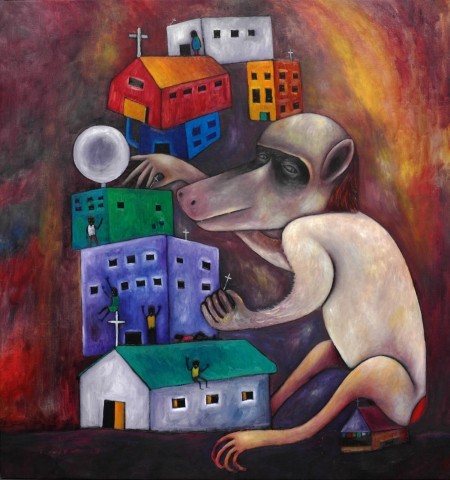 Gerald Kithinji (Kenya)
Selections from Whispers at Dawn
. . .
Magic Woman
.
I am the black magic woman
I feed from the dartboard
served by the wine drunkards
.
I am the female equivocator
I provoke the male prostitutes
by a lisp of “guinness is good for you!”
.
I am the adding machine
computing your poverty
by a controlled throw of the dart
.
I am the ‘mother-in-law’
sucking your slumberous prick
for want of a longer trip
.
I am the ever-thirsty sleuth
whose eternal furnace
consumes your holy waters
.
If in any reasonable doubt
follow that last stagger
to the edge of the moonlight
– to the last tango away from the dartboard.
. . .
Sexploitation
.
The talk took a comic turn
adding dry wood to the fire
lit by the sex debate
– or was it the women’s lib
.
Yes; I think it was that lost battle
now come from the mists of antiquity
through currents of a missionary zeal
to plague the human race
.
They were not ‘fiddlers on the roof’
nor sexperienced population exploders
but just college infuriates
that must have sexquality – or die!
.
“What men can do
that women can do
what men can do
let women do”
.
The lioness roamed the jungle
the zebras rubbed noses
and the birds on the equality twig sung:
“were I an ilk with all her ilk”
.
And the lights dimmed
leaving only the fireglow
leaving the sons of strife
in clouds of misty speculation
.
The wind carried no pollen
the flowers refused to bloom
the world stood still
in the wake of a woman’s protest
.
The world of merit
shed a light on sexpression
but the question persisted
“what if they played hard to get?”
. . .
In Praise of Work
.
The possibility is there
that I might write
with the poet’s inbuilt inspiration
what comrade time
has reason to portend
.
Of our aims
I might write
or even our dreams
.
But our destinations?
Even the Pope’s edict…
hist–
I pledge my doubt
.
Of greater moment
is our faith
in the plough.
.
Hail plough!
Hail abundance!
. . .
A Pause
.
On that hot afternoon
even the creatures of heaven
could feel the heat in hell
and paused awhile
to let it pass
.
But as for me, a wayward son
doomed to labour and toil
there was no pause, no rest
but an eternal longing
an eternal thirst
.
Had I not been sleepy
I might have witnessed
the comings and goings
of the multitudes
I might have lived!
.
Hey, birds on the twig
what became of your nests
and your thousand promises
of a thousand nestlings?
I might have witnessed!
.
Looking back on that day
I see the present through a crack
and I know I have arrived
at the edge of my sanity
at the top of the precipice
.
Will the heat now abate
and let me fondle the coolness
of the moonlit evening
and let me lick the honey
on my latest fount!
. . .
I have come to take away my Love
.
I have been thinking about you
all night long;
and re-thinking, asking myself
which is the mid-point
between now and eternity.
.
And in that one night
I lived three centuries into the past
and three others into the future
(into the ‘dim regions
whence my fathers came’
and into a void
far from my native clime)
.
And in that one night, too,
I peered deep into your heart
and saw seated there
(as on a pile of loot!)
cupid – silently beckoning…
.
Ha-ha-ha I have come
to take away my love!
and you whose faces I see
remain invisible to Wanja.
.
I tried to write in rhyme
of nights I’ve spent awake
weaning my infant love
humming a silent lullaby.
.
I took my ball-point pen
and jotted down your name
in the space of an hour an’ a half
begging the letters to come.
.
Every letter I wrote spelt love
and every pause, a prayer
that those that love
should rhyme in love.
Politics
.
Listen to the deafening silence
of the politician
Behold the benevolence
of this native tyrant
.
Listen to the transcendental claptrap
of the lonely pauper
Endure the ordeal of change
and the quintessential shock
.
Beyond freedom and dignity
aspiration and accomplishment
and remember your kinsmen
dancing on a volcano.
. . .
My Ballot Paper
.
I have long waited
this sunny day
to chide myself
.
Should I cast for this clown
who with dripping mouth
sang his electorate his ambitions?
.
Or this home-made angel
who with wings of kites
would myrrh his disciples?
.
And then again I wonder
should the heavens rock
who will restrain the storm?
.
So I take the little ballot
and with raging words
in verse expend my anguish.
. . .
The Candidates
.
They promised us
all manner of pleasant solace
as this manifesto witnesseth;
and to show our reliance
we implored them to denounce
older forms of dishonesty
with charity appreciable by view.
.
They and each of them
and all their ilk
swore to buy our support
in gross and in detail
and so on and so forth
mutatis mutandis
per omnia saecula saeculorum!!
.
But we were lowly natives
and matched with local casuistry
and various verbal falsehoods
what code of necromancy
would misfortunes forestall!
.
Nefarious candidates
the time has come:
purge your consciences!
Power
.
I hate your wife – capitalism
I hate your daughter – socialism
I also detest their suitors –
fascism, militarism, nazism
and even communism!
.
I clung, yes, clung
to that alien stupor
sapped that suave subastral quintessence
that makes us
cry…
and seldom
laugh.
.
And I woke up
rabid
as familiars quirked,
“He will bite them,
these racists.”
Not my Continent
.
Do not deride me
Do not mistake my identity
Do not kill my image
.
You ask me to drive you
to the cocktail in a Benz
You ask me to fly you to Addis
.
My friend, you’ve got me wrong
Put the cart before the horse
Want me to run before I can walk
.
If you want me you take me as I am
Not fragments of my torn mouldings
Not imitations of my constitution
.
Or else leave me alone
I have admirers enough
I have my continent to defend
.
Would you I sold my self
to the fullest coffer
Would you gnaw at my existence
.
I will not ration my inherited pride
I will not solicit your return
I will not wail your departure
.
Take your gifts away
They smack of blackmail
They smell of betrayal
.
I want nothing from you
And nothing will I take
Save this: Leave my continent!
. . .
Anger!
.
And anger
is a friend
that the oppressed
must seize –
a purgative drug
to cleanse and preserve
the knowledge
and indignation
with which they affront
agglutinated
the excesses of apartheid.
.
Come, behold the scars
that those who angered
seized, arms outstretched
their spears flaming!
.
And you who dither
de-ice your souls
with flames of anger:
and unreason
will succumb
to reason.
.
Hail, vanguard
of our freedom. Hail!
. . .
The Palm Tree
.
We had fought and won
the internecine war;
The foreigners had demarcated
their spoils on our land:
but our spirit of struggle
our thirst for freedom –
kept burning within our hearts.
.
Our vow and determination
to recapture our terre
to tender our palm tree –
this, too, kept burning
with rage and vengeance.
Our thoughts no longer hazy
Our deeds no longer wavy:
but studied and firm
our men advanced sure of foot.
.
Vengeance is ours
(and not the Lord’s!)
For we know, liberated,
even here
all manner of genius
may grow…
turning pages of transformation
from centuries of silent mutation
to an eternity of unqualified progress.
.
Where the wheels of oppression
have finally ground to a halt
There shall be found
the masses that struggle!
. . .
A Dream
.
None dare call it a dream
to be born and to die
to walk to the market
with a bag empty
and back home
with the bag full
to take cattle to the river
to take calves to the slaughter
.
None dare call it wisdom
to laugh and to cry
to mourn and to sigh
to be able to reap
what one has sown
to slaughter the ram
to feed their offspring
.
They die in the evening
they rise in the morning
they live in the day
.
Each life confirms a death
each death promises a life
and I watch these at my window
. . .
A God
.
While you are catholic
And I am protestant
We shall remain slaves
.
Let us shed christianity
And together
Cultivate the African God
.
Let us learn the creed
That says
Black is Beautiful…
And believe it.
. . .
Happiness
.
Friends
if ever you be happy
let it be
for things done
dreams come true
possibilities realised
.
Let it be
for aspirations attained
ambitions accomplished
extremities fathomed
.
Let it be
for misfortunes overcome
wrongs righted
life well spent
.
But above all else
let it be
for love bestowed
extended
assured
.
For these
dear friends
we longed
and lived
to miss.
. . .
The Dreamers
.
Let us dream
dream our dream
seated
lying here
naked
loving here
Our hearts naked
stripped bare
telling tales
dreaming our naked truth.
.
Our nakedness
loving
My ego
dreaming
Perhaps boozing
oozing with hatred
with love
dreams
with child.
.
A sore on foot
on breast
on lip
Like dream – love dream
bending, lame…
bleeding
like nose
like tick.
.
Blood
thick blood
sticky, haunting –
like ghost
like dream
like fairies
dreaming
loving
hating…
living.
. . .
Shade
.
Let’s rest here
under this shade
of ignorance
it is so cool
and so empty
there is only you
and me
and our host
.
Come, let’s quick
to the shade
lest, exposed,
we become wise
and waste ourselves
on things philosophic
psychologic, pathologic…
.
There, under the shade,
there is no literature
no law, nor art
no science of deceit
no poetry, music or life:
just ignorance and ourselves
.
Just ignorance and ourselves
just ignorance
ignorance
.
I came out here
to record nature
but found nature
had herself recorded
in greater detail
and better form:
‘Nature has done her part –
Do thou but thine!’
. . .
The above poems from Whispers at Dawn were composed while Gerald Kithinji attended university, and were published in 1976 by East African Literature Bureau (Dar es Salaam / Kampala / Nairobi). The poet’s Dedication at that time read as follows:
Dedicated to those whose imagination fired my own; whose beauties yearned for recognition; whose hearts overflowed with warmth; whose interest laid bare my secrets; whose magic still conjures my dreams.
. . .
Gerald Kithinji grew up along the eastern slopes of Mt. Kenya, about 250 kilometres from Nairobi. He speaks Kimeru (his natal Kenyan language), and has expanded his reading to include books in French and Portuguese. He has continued to write over the past several decades, but he concentrates now on collections of short stories. Recent titles (2014 and 2015) have included: Hear Me Angry God, Kiss the Handcuffs, Pastor X, Set Her Free, and Masai Mara Adventures with Olê Ntutu. He writes adult fiction as well as children’s books.
In a February 2015 interview Mr. Kithinji was asked What inspires you to get out of bed each day? And his reply: Unfinished business – and that means writing.
. . .
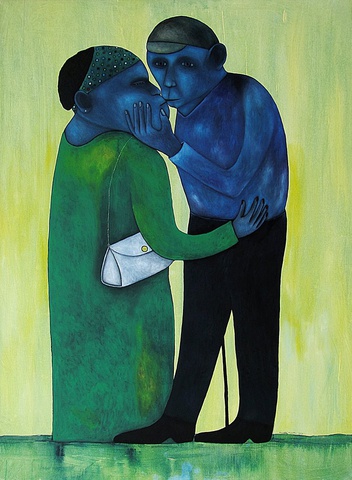
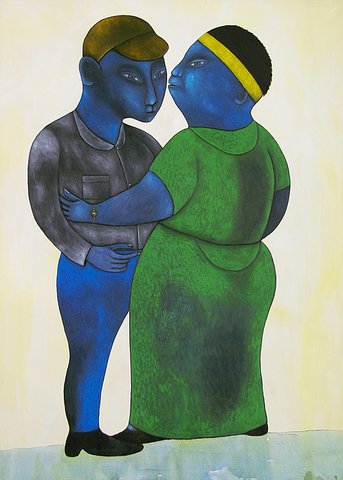
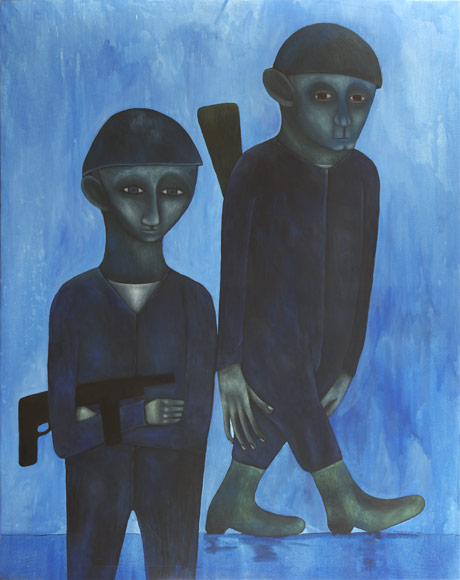
Images: Richard Kimathi (born 1971, Kenya): recent works in mixed media on canvas: “Churches in Africa”, “The Kiss”, “The Couple: Motherly Love”, and “Soldiers in Pyjamas”.
. . . . .
Marcus Bruce Christian: “I am New Orleans” and “The Masquerader”
Posted: February 9, 2016 Filed under: English, English: Black Canadian / American, English: Nineteenth-century Black-American Southern Dialect, French, Marcus Bruce Christian | Tags: Black History Month poems Comments Off on Marcus Bruce Christian: “I am New Orleans” and “The Masquerader”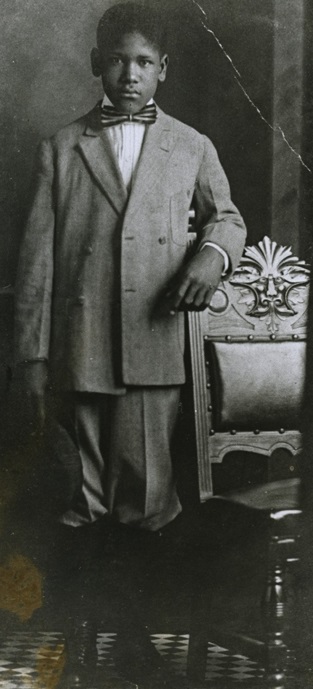
Marcus Bruce Christian as a boy_probably around 1912
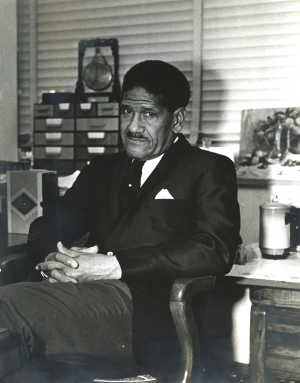
Marcus Bruce Christian in the 1960s
Marcus Bruce Christian
(1900 – 1976, Louisiana poet, historian and folklorist)
. . .
I am New Orleans: A Poem (excerpts)
.
I have known
Many people –
Many voices –
Many languages.
I have heard the soft cries of the African,
Jargoning an European tongue:
“Belles des figures!”
“Bon petit calas! Tout chauds, chère, tout chauds!”
“Pralines – pistaches! Pralines – pecanes!”
“Ah got duh nice yahlah bananas, lady!”
“Bla-a-a-a-a-ack ber-r-r-r-r-r-e-e-e-e-z!”
“Peenotsa! Peenotsa! Cuma gitta fromee!”
.
“Ah wanna qua’tee red beans,
Ena qua’tee rice,
Ena piece uh salt meat –
Tuh makkit tas’e nice:
En hurry up, Mr. Groceryman,
En put dat lan-yap in mah han’!”
.
“Papa Bonnibee, beat dem hot licks out! –
Ah sed, Poppa Stoppa, let dat jazz cum out!
En efyuh donh feet it,
‘Tain’t no use tellin’ yuh
Jess what it’s all about!
Now, gimme sum High Cs on dat horn ‘n’ let dem
Saints go marching in!”
Way Down Yonder In New Orleans…
Take it away, Mister Charlie!”
. . .
I am New Orleans,
A perpetual Mardi Gras
Of wild Indians, clowns, lords and ladies,
Bourbon Street Jezebels, Baby Dolls, and Fat Cats;
Peanut-vendors, flower-sellers, organ-grinders,
chimney-sweepers, and fortune-tellers.
And then, at the end, bone-rattling skeletons
and flying ghosts.
I am New Orleans –
A city that is a part of, and yet apart from all,
America;
A collection of contradictory environments;
A conglomeration of bloods and races and classes
and colours;
Side-by-side, the New tickling the ribs of the Old;
Cheek-by-jowl, the Ludicrous making faces at the Sublime.
. . .
The Masquerader
.
Here, as a guest esteemed,
I do not hide;
None would dare laugh at me –
None dare deride.
.
For I am white now –
Far whiter than you;
How did I get that way?
Ah! if you knew!
.
You have been very nice!
Took me to tea,
Took me to dinners –
And made love to me.
.
You have been very kind –
Begged for a date –
Me — in whose veins there flows
Blood that you hate.
.
I, who am cherished
And part of your joy –
I am more alien than
Those you employ.
.
You say I am a dream?
Dreams do not last.
When I am lost to you,
Whisper, “She passed.”
. . .
Resolution
.
I shall take your image
From out of my heart
And sweep your tracks
From its floor,
Forgetting
Dead yesterdays
And you.
Step by step,
As you walk away,
I go behind you
Sweeping . . .
Sweeping . . .
. . .
Inconvenient Love
.
Love is an inconvenient thing –
Out of nowhere it slips,
And grows into something that saves or slays,
Or something that binds or grips;
And it sets a seal upon one’s lips.
.
Love has its own peculiar way –
Knowing its own blind art;
Bending strong souls like reeds to the wind,
And then – when it does depart –
Stamping in frantic and frenzied pain
A signet upon one’s heart.
. . .
Bachelor’s Apartment
.
The curtains from Daphne,
The curtains from Chloe;
The doilies from Helen;
The pillows from Flo;
The towels from Myrtle,
The teapot from Rose;
The book-ends from Marion –
Anything goes!
.
The comb-set from Muriel,
The lampshade from Delia;
The picture from Mabel,
The vases from Celia;
From Bertha – the candlesticks;
.
Those women left things
In my heart and my home!
. . .
The Craftsman
.
I ply with all the cunning of my art
This little thing, and with consummate care
I fashion it—so that when I depart,
Those who come after me shall find it fair
And beautiful. It must be free of flaws—
Pointing no labourings of weary hands;
And there must be no flouting of the laws
Of beauty—as the artist understands.
.
Through passion, yearnings infinite—yet dumb—
I lift you from the depths of my own mind
And gild you with my soul’s white heat to plumb
The souls of future men. I leave behind
This thing that in return this solace gives:
“He who creates true beauty ever lives.”
. . .
After the Years…
.
After the years have carted away
The grief and the shame;
After the years have carted away
The crime and the lust;
After the years have carted away
The faith and the trust:
After the years have carted them all
I claim
–The humblest claim–
Oblivion in the dust.
. . .
The Dreamer
(for Arturo Toscanini)
.
I am the dreamer – one whose dream
Is a diaphanous strange thing;
I top the crags, I bridge the stream,
I make the dead page glow and sing.
.
I plumb the depths, I count the stars,
I strain the sinews of my soul
To break through earth’s material bars
And seek perfection at its goal.
.
For I he who never halts –
I never say, “This task is done.”
I climb through subterranean vaults
To tilt my lance against the sun.
.
I am the essence of all art –
Javelins of gold from darkness hurled
Into the light – I break my heart
To set my dream against the world.
. . .
Source for the above poems:
I Am New Orleans & Other Poems By Marcus B. Christian, edited by Rudolph Lewis & Amin Sharif
. . .
ZP Editor’s note:
Tuesday, February 9th (Mardi Gras, 2016):
Wishing to feature Black History Month poems for Mardi Gras in New Orleans, we chanced upon a poet too little known: Marcus Bruce Christian. Themes of love and loss, love across “the colour line”, labour and economic struggle, and the spirit of place (I am New Orleans: A Poem) run throughout Christian’s close to 2000 poems. Our Special Thanks to editor Rudolph Lewis of Chicken Bones: A Journal, for introducing us to this fine poet from the past!
. . . . .
Lord Shorty’s “Endless Vibrations” (1974)
Posted: February 8, 2016 Filed under: English, English: Trinidadian Comments Off on Lord Shorty’s “Endless Vibrations” (1974)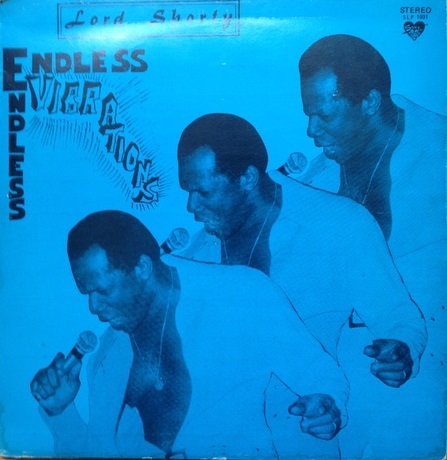 Garfield Blackman
(“Lord Shorty”, later “Ras Shorty”, 1941 – 2000)
Endless Vibrations (1974)
.
(Hey!)
(Hit the horns!)
(Sexy.)
.
Change the accent of Carnival
to a groovy, groovy Bacchanal.
Wailing, expressing – de old feeling do needs changing.
Wake up, people, examine your minds –
get with it, get with it, the change of the times.
It’s a new generation, endless vibrations
– right on, right on, right on, right on!
.
Lay lay lay lay lay lay lay lay lay (Hey!)
Lay lay lay lay lay lay lay lay lay – (Hit the horns!)
.
Come baby, oh baby, dance with me.
Come baby, oh baby, rock with me.
Wine! It’s Carnival time! Make Bacchanal!
(Groovy.)
.
Change your musical structure, make it super sweeter.
J’ouvert morning, when we wailing, bring on this funky feeling.
Uptight, uptight, feeling so fine
– come on, come on, come on, let the music take your mind.
Get with the feeling, it’s so exciting
– right on, right on, right on, right on!
.
Lay lay lay lay lay lay lay lay lay (Hey!)
Lay lay lay lay lay lay lay lay lay – (Hit the horns!)
.
Come baby, oh baby, jump with me.
Come baby, oh baby, rock with me.
Wine! It’s Carnival time! Make Bacchanal!
(Right on.)
.
A new musical expression to ease today’s frustration.
Move it, come on, groove it.
Endlessly let me feel it.
Come on, people, check out de scene.
Take a side, take a side, de music is mean.
Can you dig it, brudduh? Get it all together?
Right on, right on, right on, right on!
.
Lay lay lay lay lay lay lay lay lay (Hey!)
Lay lay lay lay lay lay lay lay lay – (Hit the horns!)
Wine! It’s Carnival time! Make Bacchanal!
.
Fêtin’ Carnival Sunday night, don’t dig no blues, don’t dig no fight.
Eh, we winin’, lord we prancin’.
Rock your baby, rock your baby, kungfu fightin’.
Music so bad, fuss your hip,
rock your boat, rock your boat, rock your ship.
It’s really outta sight, makes you feel like dynamite
– right on, right on, right on, right on!
.
Lay lay lay lay lay lay lay lay lay (Hey!)
Lay lay lay lay lay lay lay lay lay – (Hit the horns!)
.
Come baby, oh baby, jump with me.
Come baby, oh baby, rock with me.
Wine! It’s Carnival time! Make Bacchanal!
. . .
“Lord Shorty”, born Garfield Blackman in Lengua Village, Princess Town, Trinidad, is credited as one of the innovative calypsonians who modernized the music, picking up the tempo and adding more propulsive rhythms and instrumental arrangements – giving us Soca. During the same period (the mid-1970s) he also experimented with fusing Calypso and Indian music in Om Shanti Om. Though the song lyrics above (Endless Vibrations) may seem dated to us now – with their Hippy-&-Black-American-‘speak’ mixed in with the Trini – the overall sound of this song was fresh and inventive in its day.
A musical blast from the past on this Monday–J’ouvert–of Carnival 2016!
Another innovator from the 1970s: The Mighty Shadow
. . . . .
Kaiso to Soca: a brief history of Calypso music
Posted: February 8, 2016 Filed under: English | Tags: Black History Month: Calypso music Comments Off on Kaiso to Soca: a brief history of Calypso music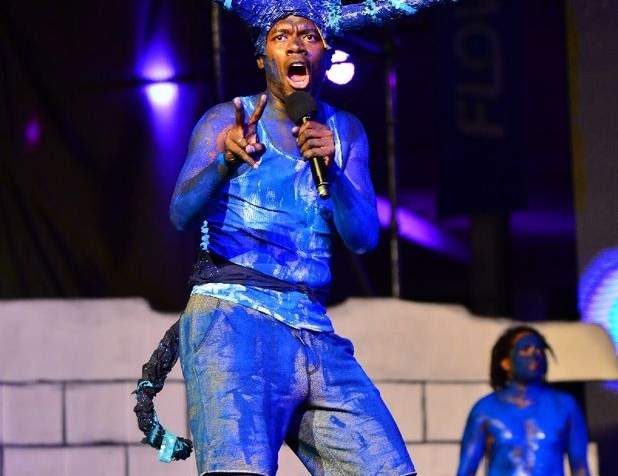
Devon Seale, the 2016 Trinidad Carnival Calypso Monarch, seen performing on Dimanche Gras, February 7th, 2016_photograph by Stephan Doobay for Trinidad Express
CALYPSO: a Brief History
by Philip W. Scher
. . .
CALYPSO is a style of Caribbean music associated with the nation of Trinidad, and is linked to the annual celebration of the pre-Lenten Carnival. The music, as well as the name itself, has a myriad of roots, and although there is no general agreement as to the origin of the term, there are references in Trinidadian newspapers of the nineteenth century to cariso and kaiso, both song forms characterized by the performance of extemporaneous, satirical lyrics. The term kaiso, which was shouted to encourage or praise successful singers, is considered a possible source for the word calypso, and indeed is still used instead of calypso. The cariso is only one of many song forms to emerge from the colonial era in Trinidad. Creole slaves and free Africans contributed a variety of songs and dances, including the bel air (derived from both African and French sources), the juba, the bamboula, the calinda (both a martial art and a song style), and the lavway (a road chant performed during Carnival processions). Combined with these forms were British ballads, French folk songs, Venezuelan string music, and other types of Creole West-Indian songs. As new musical forms were created or introduced to the island—American jazz, Venezuelan paseos, and ultimately such diverse forms as Hindi film music, reggae and dancehall, soul, and rhythm and blues—they were incorporated into Calypso.
.
Trinidad was “opened” by Spain to French colonists first in the later part of the eighteenth century. The French dominated the cultural life of the island up to and even beyond the English conquest in 1797. The French imported their pre-Lenten festival of Carnival, and much of the earliest carnival music was sung in Creole or Patois. During the nineteenth century, English culture, language, and religion increased in importance and influence, and many of the folk musical styles gradually changed from French Creole to English. As the English extended their hegemony over the island, they also embarked on a mission of reforming Carnival. By the 1880s unruly masqueraders and riots against police repression resulted in a massive campaign to control and channel the public celebration into a more structured event. By the early 1900s calypso music, marked lyrically now by social satire, political commentary, humour and sexual innuendo, was largely being performed in “calypso tents,” temporary venues in which calypsonians competed against each other for prizes offered by private sponsors.
.
The first calypso recordings were made in 1914, and by the 1920s and 1930s Trinidad’s finest calypso singers, such as Attila the Hun, Roaring Lion, and Lord Invader, were regularly recording and performing in the U.S.A. “Rum and Coca-Cola”, recorded by the Andrews Sisters in 1944, was a sanitized re-interpretation of a Lord Invader song. It became an American hit, and also spawned a landmark lawsuit by Lord Invader against the American actor Morey Amsterdam, who illegally copyrighted the lyrics. Invader won the suit.
.
Although they faced routine censorship by the British colonial authorities, calypsonians of this period displayed enormous creativity in circumventing restrictions to create songs rife with double-entendre, inside jokes, and subtle parody. Audiences relied on clever calypsonians for insight into the ironies of colonial rule, the hypocrisy of the ruling classes, and the meaning of certain scandals and outrages. Savvy politicians could often “take the temperature” of the public based on the attitudes of their calypsonians.
.
From its earliest days, Calypso music served as a forum for the expression of social and political views within the Caribbean. Remarkably, the criticism mounted by calypsonians was not limited to broad appeals against inequality, racism, poverty, and oppression, but tackled precise laws, domestic policy, proposed legislation, foreign policy, labour relations, actions by public figures, and even speeches given by notable persons. Thus, in addition to humorous rivalries between singers, songs about the beauty of the land, and compositions with a ribald flavour, calypsos were composed with such titles as “Prison Improvement,” “Shop Closing Ordinance,” “The Commissioner’s Report,” “The European Situation,” “Devaluation,” “Slum Clearance,” “Reply to the Ministry,” etcetera.
.
The arrival of indentured labourers from South Asia from the mid-nineteenth century until 1917 changed the ethnic makeup of Trinidad. Competition for work and land created tensions between the island’s Black populace and South Asians that ultimately manifested in political divisions being drawn along ethnic lines. The presence of Indians in Trinidad was closely followed by calypsonians. Initially, many calypsos dealing with Indians discussed “strange” customs, delicious food, and beautiful women. Creole calypsonians often commented in song on how they fell in love with an Indian girl or how they were able to participate in an Indian feast. As political tensions heated up during the 1950s, however, calypsos became more pointedly political. By 1961 the calypsonian Striker, registering his dismay at the deep ethnic division present in local politics, remarked in song that “Negro can’t get a vote from Indian.” Today there are a number of noted Indian calypsonians, both men and women, as well as Black musicians performing in the Indian-influenced genre of chutney soca. Yet tensions between the two communities have been played out musically over the airways and in the calypso tents of Trinidad.
.
Though rebelliousness and resistance could characterize calypso, still there was a strong dose of pro-British patriotism during the two World Wars of the twentieth century. Calypsonians recorded achievements of the British Empire and the royal family, along with all their other social/political and lyrical commentaries. And compositions in favour of the Empire co-existed alongside songs detailing the oppressive conditions under which the populaces of the Empire laboured.
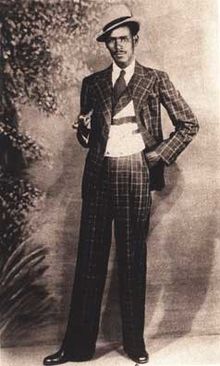
Rafael de Leon a.k.a. Roaring Lion_1908 to 1999_pictured here in the 1930s
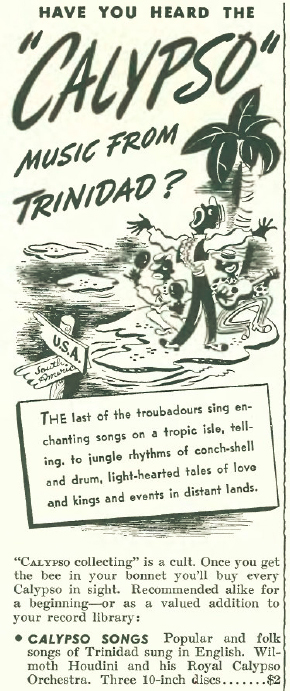
1939 ad. from NYC for calypsos on records_featuring Wilmoth Houdini
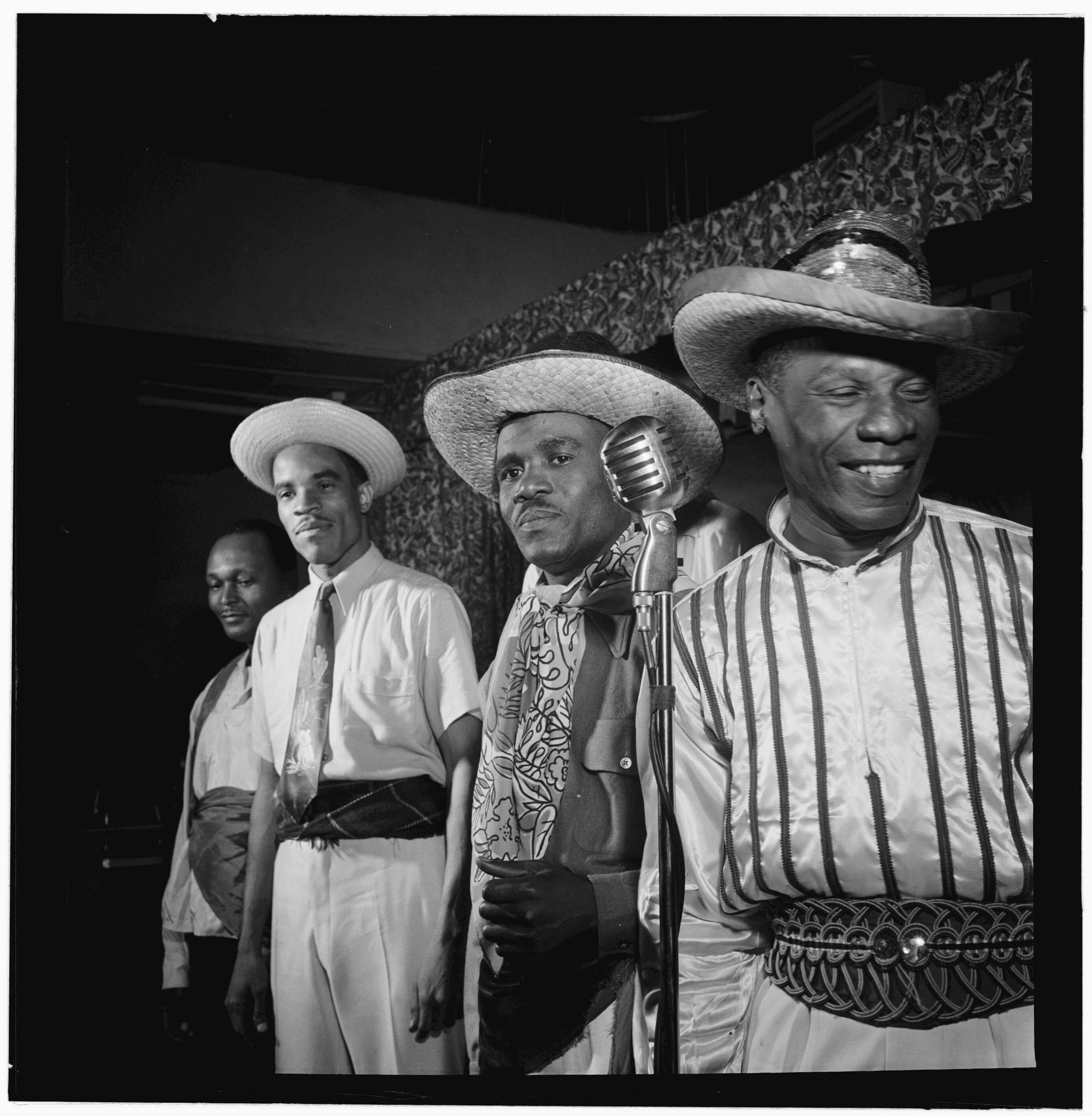
1947 photograph by William P. Gottlieb_probably at the Renaissance ballroom in Harlem_Calypsonians from Trinidad that included Lord Invader, Macbeth the Great, the Duke of Iron, and the Count of Monte Cristo
1956 was a turning point in Calypso…
The Mighty Sparrow penned “Jean and Dinah,” a song about the sudden availability and desperation of prostitutes in Port of Spain after the departure of the free-spending American sailors stationed in Trinidad during World War II. “Jean and Dinah” became an international hit, and won the calypso “crown” for Sparrow – yet it is even more important as a testimony to a sense of cultural and political confidence then being experienced across the Caribbean as Independence movements were gathering steam.
.
As Trinidad, Jamaica, Barbados, and other English-speaking islands continued their drive toward independence from the United Kingdom, folk idioms such as calypso, Carnival, Pan (steel band), the musical form ska, and even sports such as cricket, began to take on a nationalist tone. Nation-building calypsos, as they are sometimes called, emerged to praise the efforts of certain political parties and politicians and to encourage proper behaviour and decorum among the people.
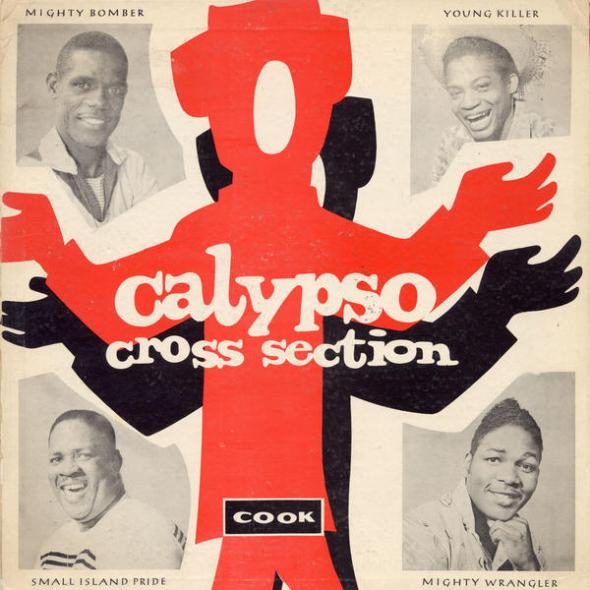
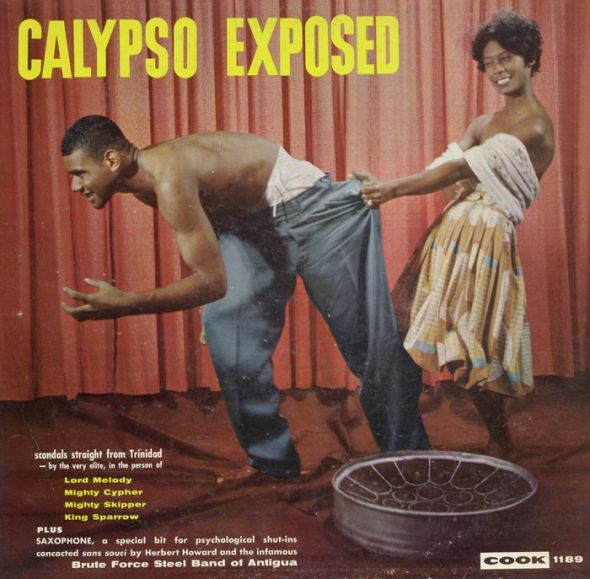
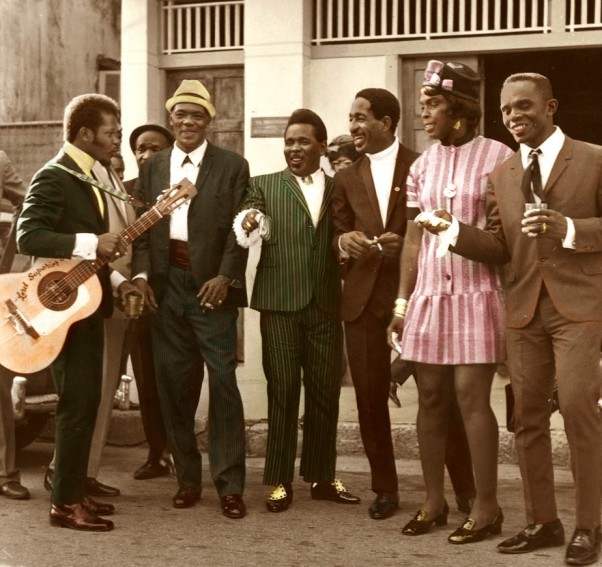
Lord Superior and Lord Blakie__plus Friends
The 1960s brought to the Caribbean not only Independence but the Black Power movement. Calypso reflected this new cultural consciousness lyrically; it also reflected the cultural source from which it came—the United States. One of the most important figures to emerge at this time was the Mighty Chalkdust, a teacher and calypsonian who has, under his given name, Hollis Liverpool, researched and published widely on Calypso, Carnival, and Trinidadian culture in general.
.
Traditionally accompanied by acoustic music, Calypso increasingly came to incorporate electronic instrumentation and the influence of North-American musical styles such as rhythm and blues and soul. Alongside Black Power came the women’s liberation movement and increasing (though still small) numbers of women singers. Indeed, women as calypsonians are not given nearly the attention they deserve in the literature. Although largely excluded from the ranks of early recorded calypsonians, and often derided in songs such as “Jean and Dinah,” women have been instrumental in the development of Trinidadian music as chantwells (praise singers for stickfighters and singers of road marches) and in religious music. In the 1960s, attitudes toward women calypsonians began to change, and it was, perhaps ironically, the Mighty Sparrow who gave the then-unknown singer Calypso Rose her start. Along with Singing Francine and Denyse Plummer, Rose has become one of the most popular calypsonians of all time.
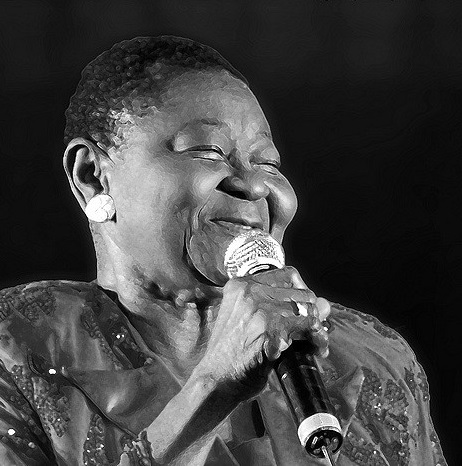
Calypso Rose_born 1940 in Tobago_painted photograph copyright Jean Pierre Jeannin_2009
With the rise of outside influences from North America came further influences from diverse musical sources, including Jamaican reggae and (due to the presence of a large and thriving Indian population) Hindi film music. The result has been the development of new musical forms, such as soca, chutney soca, rapso, and so forth.
Born in 1941, Garfield Blackman, later known as Lord Shorty (and, finally, Ras Shorty), would become the “creator” of soca music. Concerned that calypso was declining in relation to reggae, Shorty experimented in combining Indian instruments such as the dholak, tabla, and dhantal with traditional calypso instrumentation. The result was a new musical hybrid that he called solka. With his 1974 album Endless Vibrations and the single “Shanti Om,” Shorty sparked a revolution in Caribbean music. Initially the term solka referred to an attempt to recapture the “soul of calypso,” which he felt was one of inclusion, common struggle, and resistance to oppression. Shorty hoped that the “Indianization” of calypso would bring together the musical traditions of Trinidad and Tobago’s two major ethnic groups, the descendants of African slaves and of indentured labourers from India. The name was later changed to soca, and it is routinely if erroneously explained as a fusion of soul and calypso.
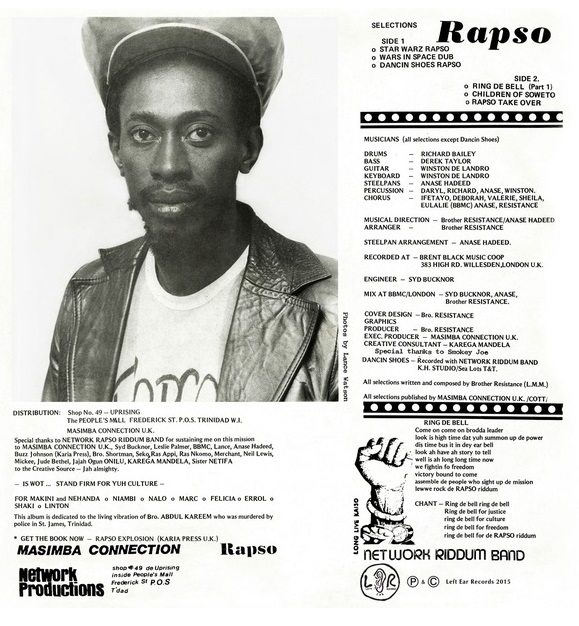
Roy Lewis a.k.a. Brother Resistance_Rapso practitioner from Trinidad
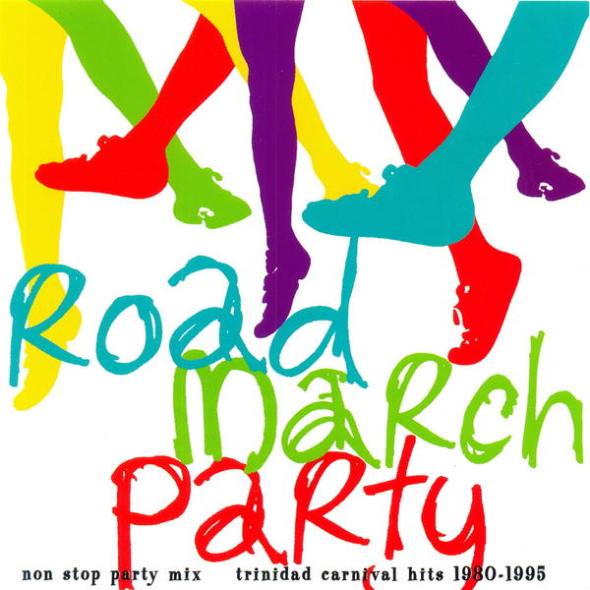 In the 1980s soca was to have its first international hit…
A singer from Montserrat – Alphonsus Celestine Edmund Cassell – better known as Arrow – recorded “Hot Hot Hot” in 1982 and the musical genre soca became known far and wide. The globalization of the music industry has meant that soca too has evolved, incorporating many influences, and branching out into ragga soca and chutney soca. But along with its increasing popularity soca has been regarded by critics within the Caribbean region as showing a reluctance to be anything more than just “party music.” The political and social commentary once so central to calypso has had to find new expression in other Caribbean musical genres. In Trinidad this mantle has largely been taken up by rapso. Rapso is a unique style of street poetry from Trinidad and Tobago that originated in the 1970s – though it was not named rapso until the 1980s – by Brother Resistance. Often credited to Lancelot Layne, rapso was created in a spirit of political protest and social justice. Layne’s 1970 hit “Blow Away” is considered to be the first rapso recording.
. . .
.
[The above essay – A Brief History of Calypso Music by Philip W. Scher – has been edited for length. It was originally published via the International Encyclopedia of the Social Sciences, © 2008 Thomas Gale ]
. . . . .
Robert Nesta “Bob” Marley: “Chanson de Rédemption”
Posted: February 6, 2016 Filed under: Bob Marley, English, French Comments Off on Robert Nesta “Bob” Marley: “Chanson de Rédemption”
Quatre enfants de Bob Marley_1980
Robert Nesta “Bob” Marley (6 février, 1945 – 11 mai, 1981)
Chanson de Rédemption (1980)
.
Vieux pirates, oui – ils m’ont volés
et vendus aux bateaux d’esclaves,
quelques minutes après qu’ils m’aient attrapé
du puits sans fond.
Mais par la main du Tout-Puissant
nous avançons dans cette génération – triomphante.
.
Voudrais-tu m’aider à chanter ces chansons de liberté?
Parce que tout ce que j’avais
– c’est des chansons de rédemption,
des chansons de rédemption.
.
Emancipez-vous de l’esclavage mental;
personne d’autres que nous-mêmes ne peut libérer nos esprits.
N’ayons pas peur pour l’énergie atomique,
car personne ne peut arrêter le temps.
Combien de temps encore tueront-ils nos prophètes
pendant que nous nous tenons à part et regardons?
Oui, il y a certains qui disent que c’est juste un passage,
et nous devons accomplir la Prophétie.
Ne voudrais-tu pas m’aider à chanter ces chansons de liberté?
Parce que tout ce que j’avais
– c’est des chansons de rédemption,
des chansons de rédemption
– ces chansons de liberté, chansons de liberté!
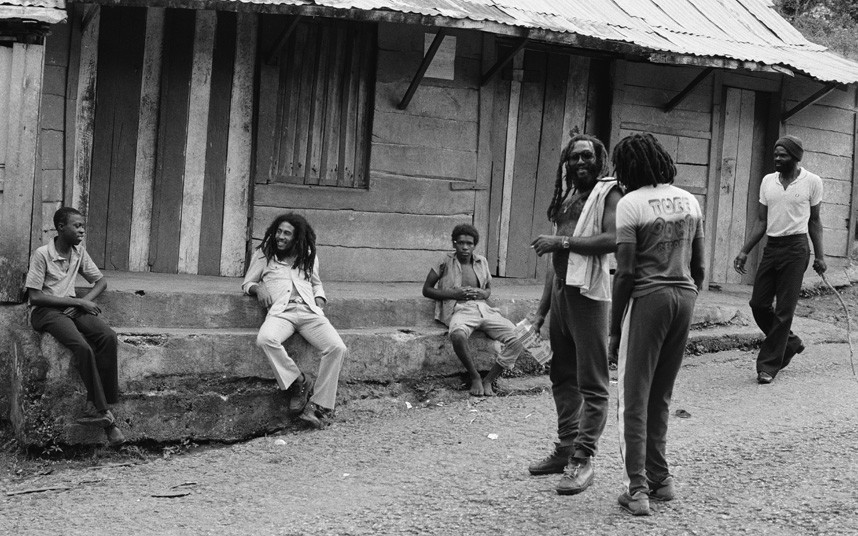
Bob Marley visitant le village de sa naissance, Nine Mile, dans la paroisse de Saint Ann, Jamaïque
Redemption Song (1980)
.
Old pirates, yes they rob I
– sold I to the merchant ships;
minutes after they took I
from the bottom-less pit.
But my hand was made strong
by the hand of the Almighty;
we forward in this generation
– triumphantly.
.
Won’t you help to sing these songs of freedom?
’cause all I ever had: redemption songs, redemption songs.
.
Emancipate yourself from the mental slavery;
none but ourselves can free our minds.
Have no fear for atomic energy,
’cause none o’ them can stop the time.
How long shall they kill our prophets
while we stand aside and look? (ouuuu!)
Some say it’s just a part of it;
we’ve got to fulfill the Book.
Won’t you help to sing these songs of freedom?
’cause all I ever had: redemption songs, redemption songs…
.
Emancipate yourselves from mental slavery;
None but ourselves can free our mind.
Woah! have no fear for atomic energy,
’cause none o’ them can stop the time.
How long shall they kill our prophets
while we stand aside and look?
Yes, some say it’s just a part of it;
we’ve got to fulfill the Book.
Won’t you help to sing these songs of freedom?
’cause all I ever had: redemption songs.
All I ever had: redemption songs.
(These songs of freedom, songs of freedom!)
. . . . .
Du Cake-Walk au Patinage artistique sur la glace: une Énergie qui danse!
Posted: February 3, 2016 Filed under: A FEW FAVOURITES / UNA MUESTRA DE FAVORITOS, Du Cake-Walk au Patinage artistique sur la glace..., French | Tags: Le mois de l'histoire des noirs Comments Off on Du Cake-Walk au Patinage artistique sur la glace: une Énergie qui danse!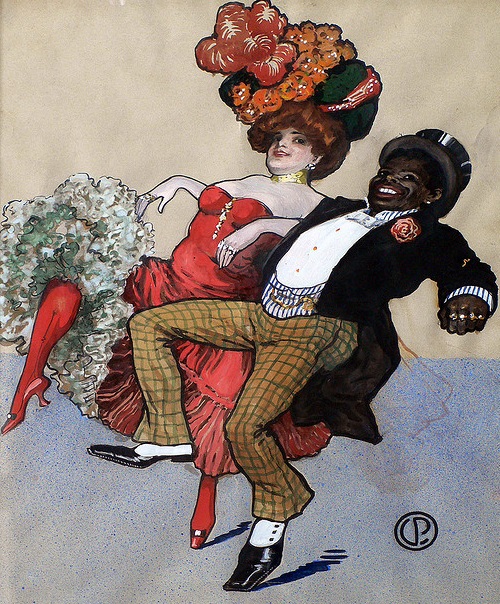 “Chocolat”, le clown nègre: son vrai nom était Rafael Padilla, esclave né à Cuba vers 1868, devenu célèbre au Cirque de Paris à partir de 1886. Il forma un duo avec Footit, le clown blanc, qui les propulsa jusqu’à la scène des Folies-Bergère. Padilla a été peint par Toulouse-Lautrec en 1896 qui le montre dansant dans un cabaret de Montmartre.
Chocolat avec La Goulue…
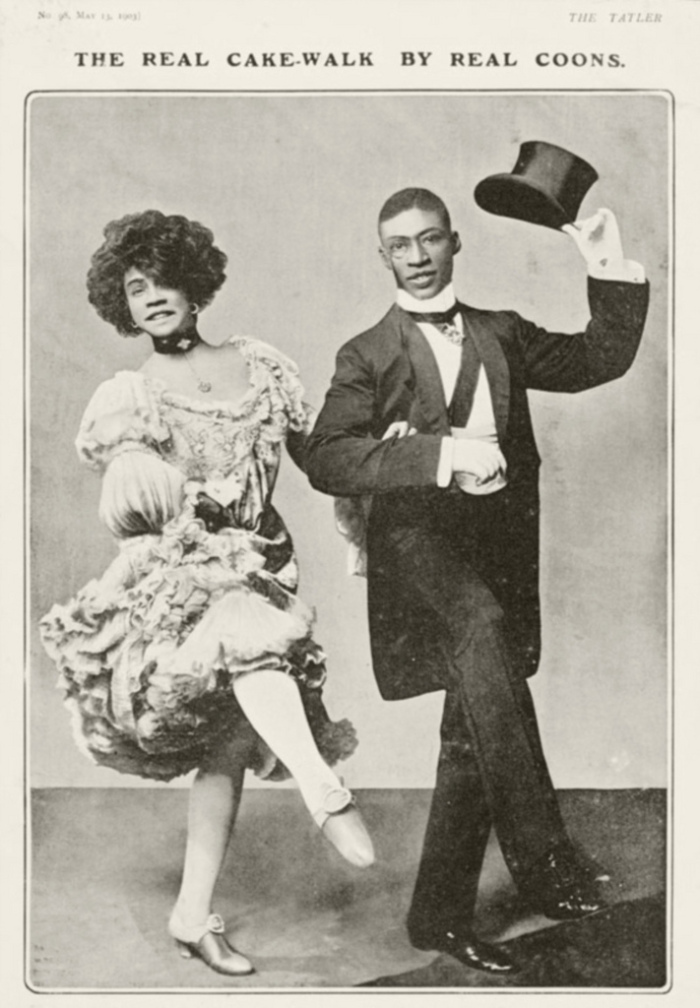 Le vrai Cake-Walk dansés par les vrais Ratons Laveurs (un terme raciste de la fin du siècle): les acteurs de vaudeville Aida Overton Walker et son épouse George Walker
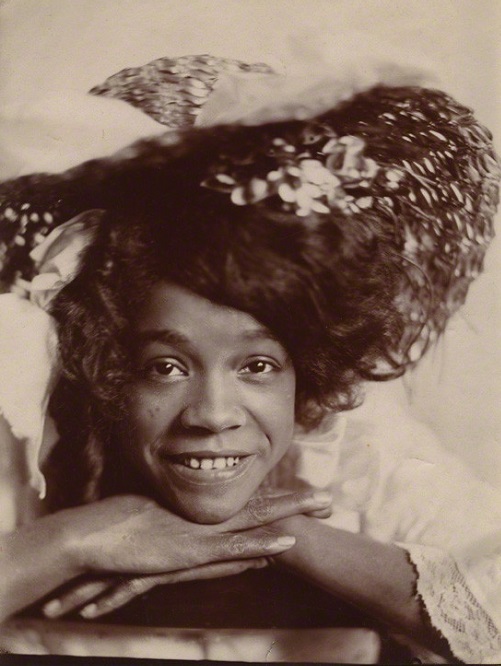
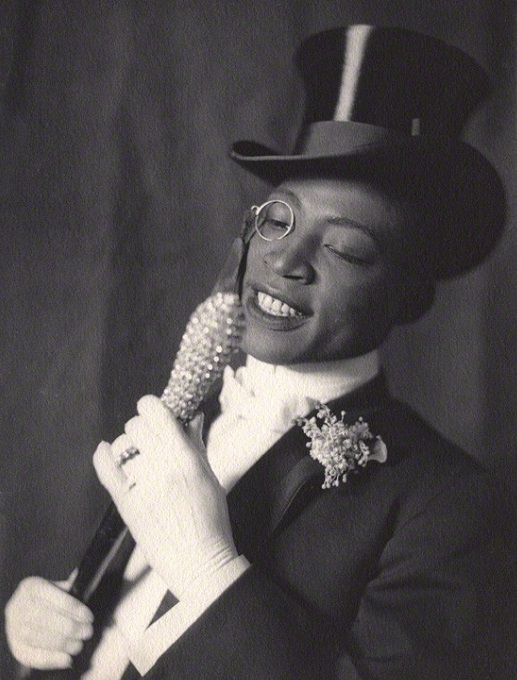 Les Walker photographiés dans la comédie musicale “In Dahomey”_Londres, 1903
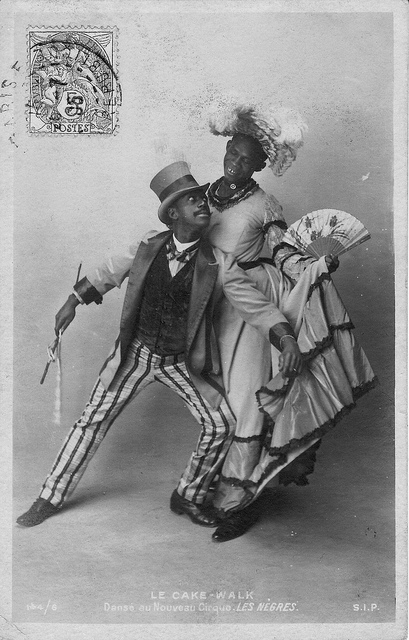 Deux hommes font Le Cake Walk, et l’un “joue” à la femme.
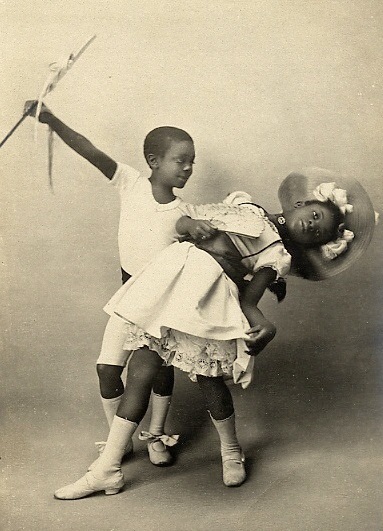
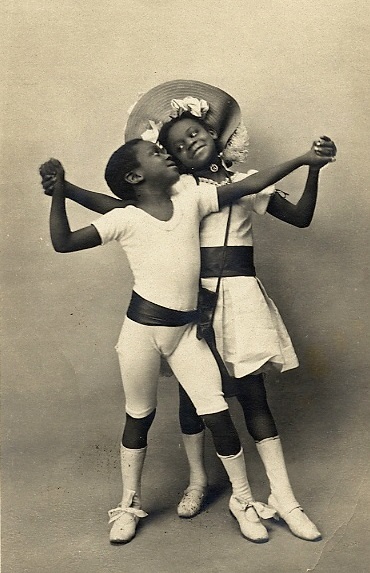 Rudy and Fredy Walker_Les Enfants Nègres de 1903_Le Cake Walk dansé au Nouveau Cirque de Paris
 …..
…..
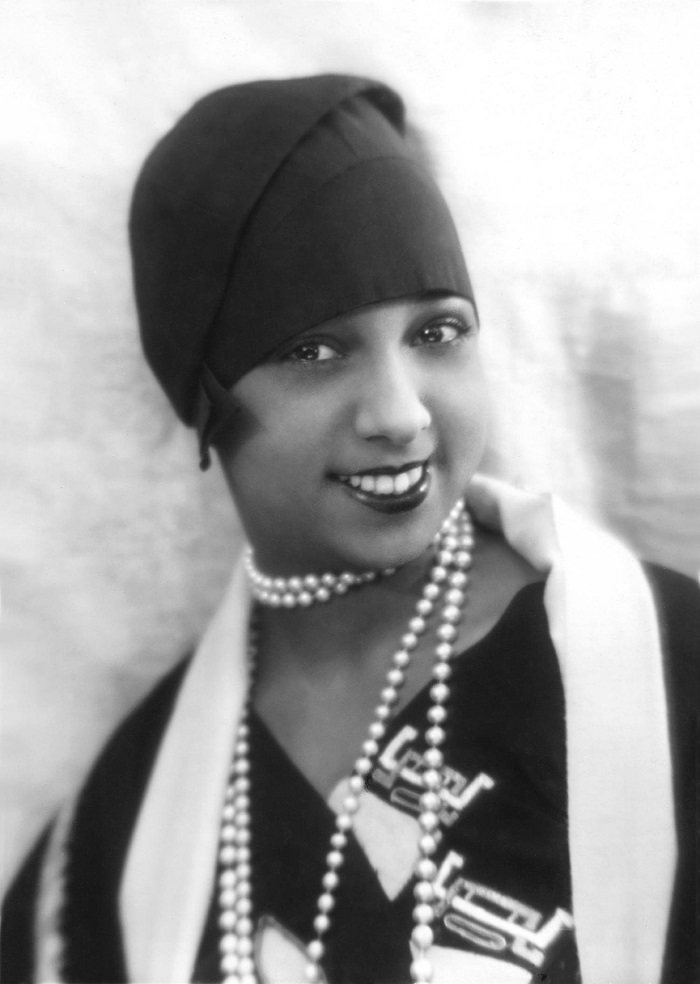 Josephine Baker était l’Américaine exotique qui se transforma à la première star noire – à cause de ses danses fraises et originales.
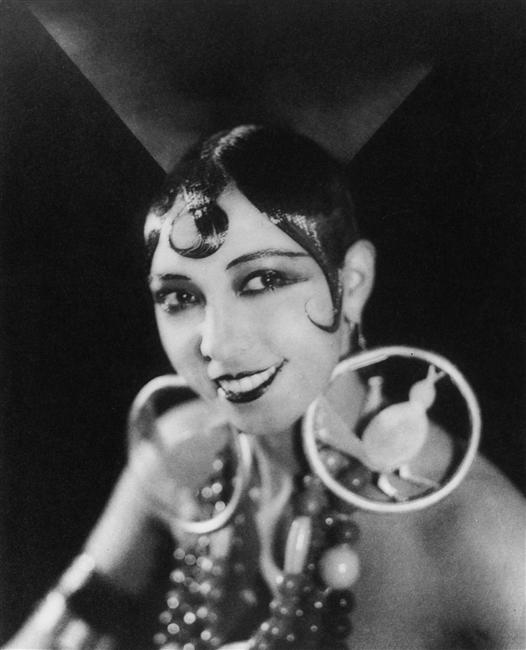 La danseuse la plus libre et ingénieuse des années 20: Josephine Baker_photo par Wolf von Gudenberg (Berlin, 1925)
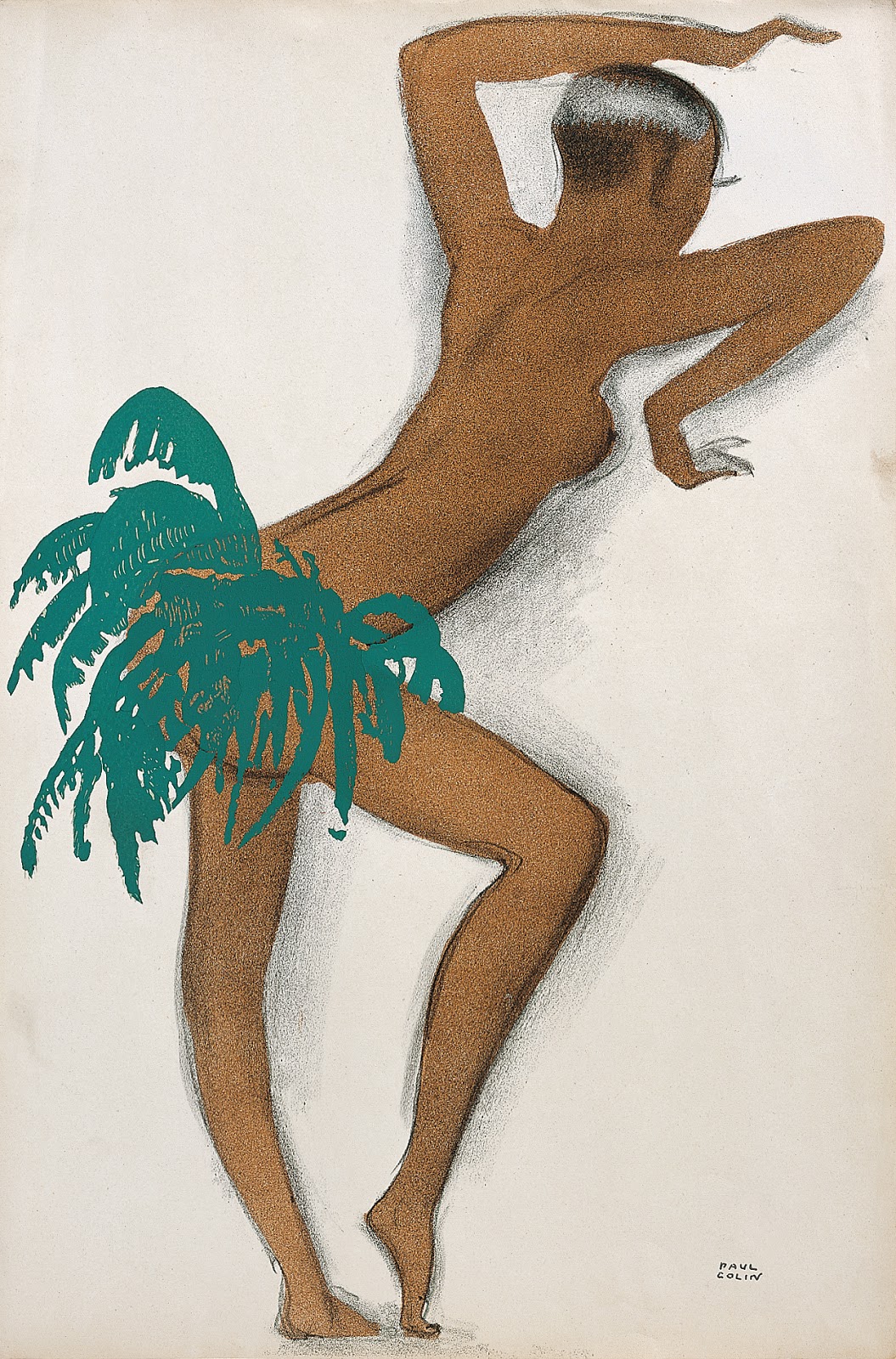 Josephine Baker: du livre Le Tumulte Noir (1927)_illustration par Paul Colin
 Danseuses de vaudeville_Washington, D.C., 1930
 Les années du Swing à Harlem
 Frankie Manning, l’inventeur de la danse “Lindy Hop”, et sa partenaire
 Les Frères Nicholas: Danseurs de claquettes des années 30 et 40: Hommes audaces, athléthiques et élégants! (photographie du film “Stormy Weather”, 1943)
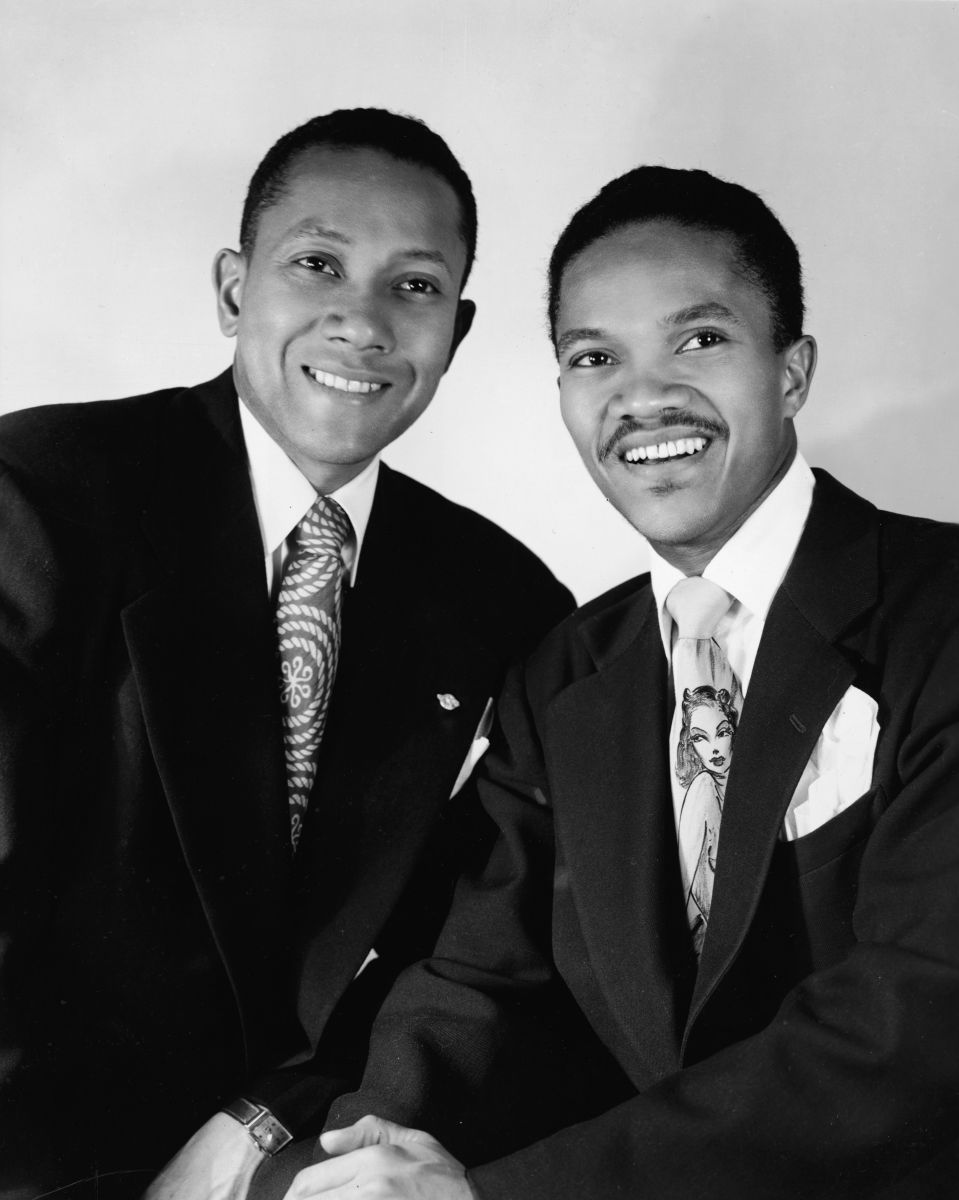 Les Frères Nicholas: Fayard (né 1914) et Harold (né 1921)
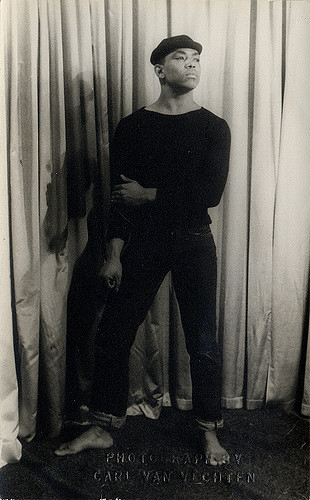 Alvin Ailey (1931-1989), fondateur et choréographe du Alvin Ailey American Dance Theater_photographie de 1955 (Carl Van Vechten)
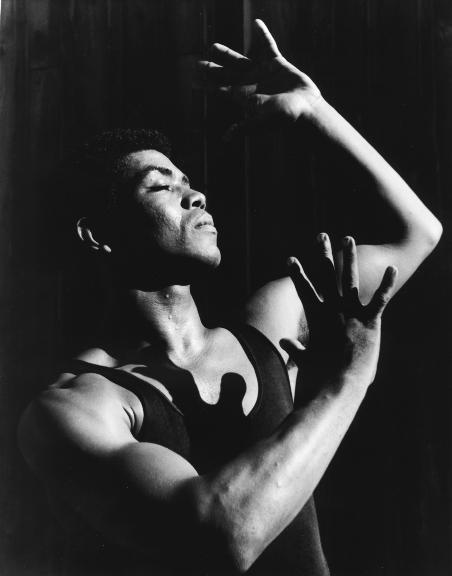 Le jeune Alvin Ailey
 Danielle Gee et Leonard Meek de la troupe Alvin Ailey_1995
 James Brown “fait le zouave” avec un de ses mouvements / pas de danse caractéristiques
 Couverture de l’album Avance avec ton Bon Pied (1972)
 Le patin à roulettes au roller-discothèque — la fureur heureuse de l’ère de la musique disco et funk
 …..
…..
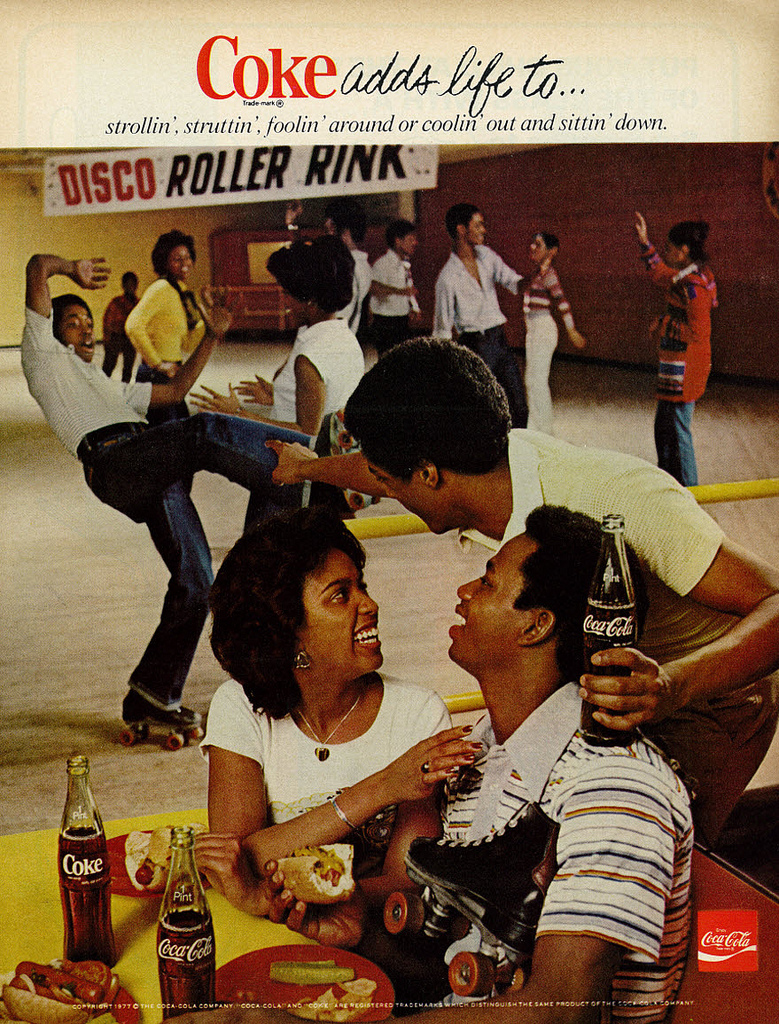 Publicité pour Coca-Cola dans un magazine américain de 1977
 Michael Jackson (1958-2009), un danseur inventif et excentrique, célébré pour sa “Moon Walk” (photographie © 1983, Jim McCrary/Redferns)

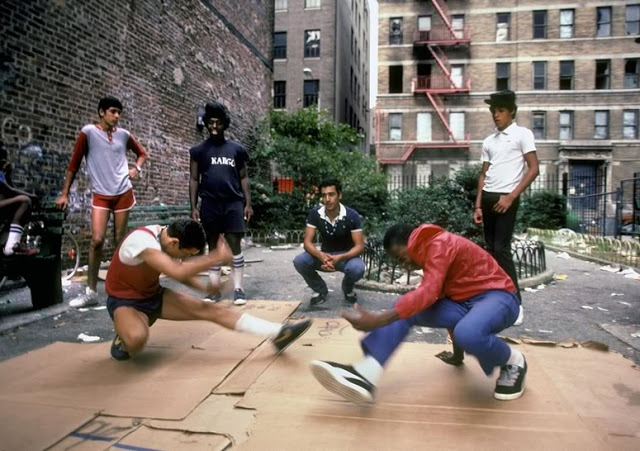 Des jeunes B-boyz ou “breakdanseurs” New-Yorkais des années 80_photographies © Martha Cooper

 Surya Varuna Claudine Bonaly (née 1973), la patineuse artistique française-américaine

 Yannick Bonheur (né 1982) et Vanessa James (née 1987)_le premier couple noir de l’histoire des jeux olympiques en patinage artistique_Vancouver, Canada_février de 2010_ (photo par Ivan Sekretarev)
 Savion Glover_danseur de claquettes de la nouvelle génération_photo © Lois Greenfield, 2012

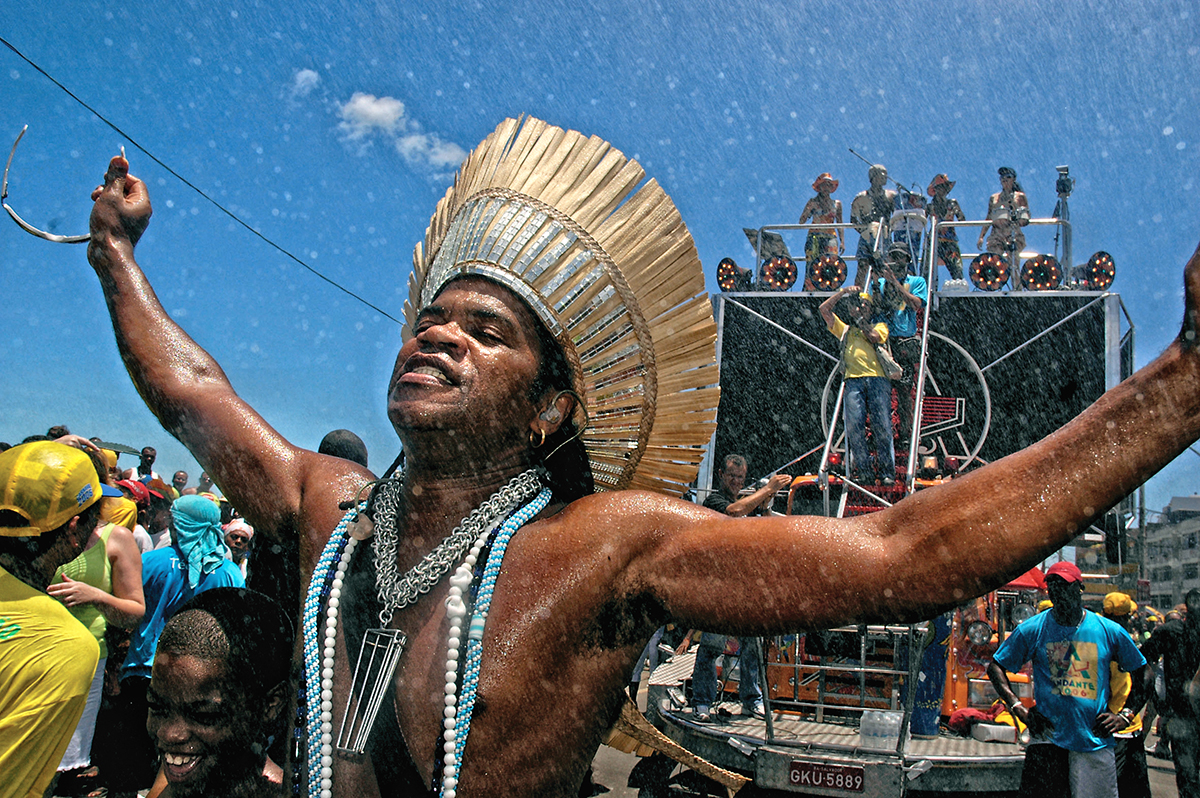 Le Carnaval au Brésil_Salvador da Bahia, 2012_Des racines africaines les gens cultivèrent une fête de la Danse et Musique – pour Tout le Monde!
Claude McKay: selected poems from “Harlem Shadows” (1922)
Posted: February 2, 2016 Filed under: Claude McKay, English | Tags: Black History Month poems Comments Off on Claude McKay: selected poems from “Harlem Shadows” (1922)
Claude McKay
(1889-1948, Jamaica / New York / Chicago)

Selected poems from Harlem Shadows (1922)
.
America
.
Although she feeds me bread of bitterness,
And sinks into my throat her tiger’s tooth,
Stealing my breath of life, I will confess
I love this cultured hell that tests my youth!
Her vigour flows like tides into my blood,
Giving me strength erect against her hate.
Her bigness sweeps my being like a flood.
Yet as a rebel fronts a king in state,
I stand within her walls with not a shred
Of terror, malice, not a word of jeer.
Darkly I gaze into the days ahead,
And see her might and granite wonders there,
Beneath the touch of Time’s unerring hand,
Like priceless treasures sinking in the sand.
. . .
Home Thoughts
.
Oh something just now must be happening there!
That suddenly and quiveringly here,
Amid the city’s noises, I must think
Of mangoes leaning o’er the river’s brink,
And dexterous Davie climbing high above,
The gold fruits ebon-speckled to remove,
And toss them quickly in the tangled mass
Of wis-wis twisted round the guinea grass ;
And Cyril coming through the bramble-track
A prize bunch of bananas on his back;
And Georgie —none could ever dive like him—
Throwing his scanty clothes off for a swim;
And schoolboys, from Bridge-tunnel going home,
Watching the waters downward dash and foam.
This is no daytime dream , there’s something in it,
Oh something’s happening there this very minute!
. . .
On Broadway
.
About me young and careless feet
Linger along the garish street;
Above, a hundred shouting signs
Shed down their bright fantastic glow
Upon the merry crowd and lines
Of moving carriages below.
Oh wonderful is Broadway—only
My heart, my heart is lonely.
Desire naked, linked with Passion,
Goes strutting by in brazen fashion;
From playhouse, cabaret and inn
The rainbow lights of Broadway blaze
All gay without, all glad within;
As in a dream I stand and gaze
At Broadway, shining Broadway—only
My heart, my heart is lonely.

Times Square in Manhattan_photograph from 1922
The Barrier
.
I must not gaze at them although
Your eyes are dawning day;
I must not watch you as you go
Your sun-illumined way;
I hear but I must never heed
The fascinating note,
Which, fluting like a river reed ,
Comes from your trembling throat;
I must not see upon your face
Love’s softly glowing spark;
For there’s the barrier of race,
You’re fair and I am dark.
. . .
The City’s Love
.
For one brief golden moment rare like wine,
The gracious city swept across the line;
Oblivious of the colour of my skin,
Forgetting that I was an alien guest,
She bent to me, my hostile heart to win,
Caught me in passion to her pillowy breast;
The great, proud city, seized with a strange love,
Bowed down for one flame hour my pride to prove.
. . .
When I Have Passed Away
.
When I have passed away and am forgotten,
And no one living can recall my face,
When under alien sod my bones lie rotten
With not a tree or stone to mark the place;
Perchance a pensive youth, with passion burning,
For olden verse that smacks of love and wine,
The musty pages of old volumes turning,
May light upon a little song of mine,
And he may softly hum the tune and wonder
Who wrote the verses in the long ago;
Or he may sit him down awhile to ponder
Upon the simple words that touch him so.
. . .
On the Road
.
Roar of the rushing train fearfully rocking,
Impatient people jammed in line for food,
The rasping noise of cars together knocking,
And worried waiters, some in ugly mood,
Crowding into the choking pantry hole
To call out dishes for each angry glutton
Exasperated grown beyond control,
From waiting for his soup or fish or mutton.
At last the station’s reached, the engine stops;
For bags and wraps the red-caps circle round;
From off the step the passenger lightly hops,
And seeks his cab or tram-car homeward bound:
The waiters pass out weary, listless, glum,
To spend their tips on harlots, cards and rum.
. . .
The Harlem Dancer
.
Applauding youths laughed with young prostitutes
And watched her perfect, half-clothed body sway;
Her voice was like the sound of blended flutes
Blown by black players upon a picnic day.
She sang and danced on, gracefully and calm,
The light gauze hanging loose about her form;
To me she seemed a proudly-swaying palm
Grown lovelier for passing through a storm.
Upon her swarthy neck black shiny curls
Luxuriant fell; and tossing coins in praise,
The wine-flushed, bold-eyed boys, and even the girls,
Devoured her shape with eager, passionate gaze;
But looking at her falsely-smiling face,
I knew her self was not in that strange place.
. . .
Outcast
.
For the dim regions whence my fathers came
My spirit, bondaged by the body, longs.
Words felt, but never heard, my lips would frame;
My soul would sing forgotten jungle songs.
I would go back to darkness and to peace,
But the great western world holds me in fee,
And I may never hope for full release
While to its alien gods I bend my knee.
Something in me is lost, forever lost,
Some vital thing has gone out of my heart,
And I must walk the way of life a ghost
Among the sons of earth, a thing apart;
For I was born, far from my native clime,
Under the white man’s menace, out of time.
. . .
I Know My Soul
.
I plucked my soul out of its secret place,
And held it to the mirror of my eye,
To see it like a star against the sky,
A twitching body quivering in space,
A spark of passion shining on my face.
And I explored it to determine why
This awful key to my infinity
Conspires to rob me of sweet joy and grace.
And if the sign may not be fully read,
If I can comprehend but not control,
I need not gloom my days with futile dread,
Because I see a part and not the whole.
Contemplating the strange, I’m comforted
By this narcotic thought: I know my soul.
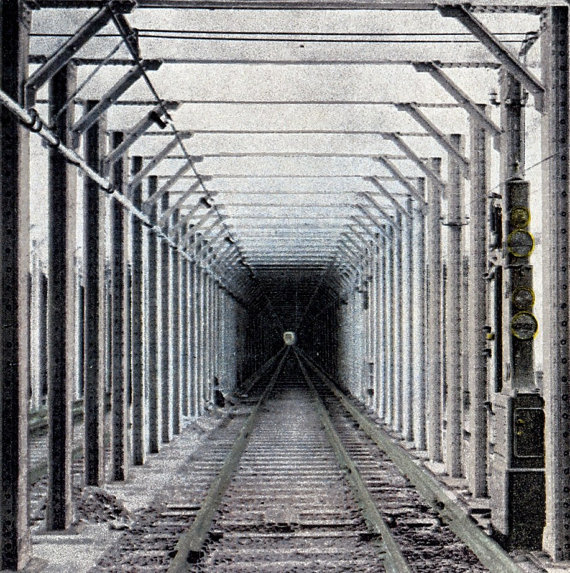

Subway Wind
.
Far down, down through the city’s great, gaunt gut
The gray train rushing bears the weary wind;
In the packed cars the fans the crowd’s breath cut,
Leaving the sick and heavy air behind.
And pale-cheeked children seek the upper door
To give their summer jackets to the breeze;
Their laugh is swallowed in the deafening roar
Of captive wind that moans for fields and seas;
Seas cooling warm where native schooners drift
Through sleepy waters, while gulls wheel and sweep,
Waiting for windy waves the keels to lift
Lightly among the islands of the deep;
Islands of lofty palm trees blooming white
That lend their perfume to the tropic sea,
Where fields lie idle in the dew drenched night,
And the Trades float above them fresh and free.
. . .
Poetry
.
Sometimes I tremble like a storm-swept flower,
And seek to hide my tortured soul from thee.
Bowing my head in deep humility
Before the silent thunder of thy power.
Sometimes I flee before thy blazing light,
As from the specter of pursuing death;
Intimidated lest thy mighty breath,
Windways, will sweep me into utter night.
For oh, I fear they will be swallowed up—
The loves which are to me of vital worth,
My passion and my pleasure in the earth—
And lost forever in thy magic cup!
I fear, I fear my truly human heart
Will perish on the altar-stone of art!
. . .

A Prayer
.
‘Mid the discordant noises of the day I hear thee calling;
I stumble as I fare along Earth’s way; keep me from falling.
Mine eyes are open but they cannot see for gloom of night;
I can no more than lift my heart to thee for inward light.
The wild and fiery passion of my youth consumes my soul;
In agony I turn to thee for truth and self-control.
For Passion and all the pleasures it can give will die the death;
But this of me eternally must live, thy borrowed breath.
‘Mid the discordant noises of the day I hear thee calling;
I stumble as I fare along Earth’s way; keep me from falling.
. . .
Rest in Peace
.
No more for you the city’s thorny ways,
The ugly corners of the Negro belt;
The miseries and pains of these harsh days
By you will never, never again be felt.
No more, if still you wander, will you meet
With nights of unabating bitterness;
They cannot reach you in your safe retreat,
The city’s hate, the city’s prejudice!
‘Twas sudden—but your menial task is done,
The dawn now breaks on you, the dark is over,
The sea is crossed, the longed-for port is won;
Farewell, oh, fare you well! my friend and lover.
. . .
Flirtation
.
Upon thy purple mat thy body bare
Is fine and limber like a tender tree.
The motion of thy supple form is rare,
Like a lithe panther lolling languidly,
Toying and turning slowly in her lair.
Oh, I would never ask for more of thee,
Thou art so clean in passion and so fair.
Enough! if thou wilt ask no more of me!
. . .
Polarity
.
Nay, why reproach each other, be unkind,
For there’s no plane on which we two may meet?
Let’s both forgive, forget, for both were blind,
And life is of a day, and time is fleet.
And I am fire, swift to flame and burn,
Melting with elements high overhead,
While you are water in an earthly urn,
All pure, but heavy, and of hue like lead.
. . .
Author’s Word: from the first edition (1922) of Claude McKay’s Harlem Shadows:
.
In putting ideas and feelings into poetry, I have tried in each case to use the medium most adaptable to the specific purpose. I own allegiance to no master. I have never found it possible to accept in entirety any one poet. But I have loved and joyed in what I consider the finest in the poets of all ages.
.
The speech of my childhood and early youth was the Jamaica Negro dialect, the native variant of English, which still preserves a few words of African origin, and which is more difficult of understanding than the American Negro dialect. But the language we wrote and read in school was England’s English. Our text books then, before the advent of the American and Jamaican readers and our teachers, too, were all English-made. The native teachers of the elementary schools were tutored by men and women of British import. I quite remember making up verses in the dialect and in English for our moonlight ring dances and for our school parties. Of our purely native songs the jammas (field and road), shay-shays (yard and booth), wakes (post-mortem), Anancy tales (transplanted African folk lore), and revivals (religious) are all singularly punctuated by metre and rhyme. And nearly all my own poetic thought has always run naturally into these regular forms.
.
Consequently, although very conscious of the new criticisms and trends in poetry, to which I am keenly responsive and receptive, I have adhered to such of the older traditions as I find adequate for my most lawless and revolutionary passions and moods. I have not used patterns, images and words that would stamp me a classicist nor a modernist. My intellect is not scientific enough to range me on the side of either; nor is my knowledge wide enough for me to specialize in any school.
.
I have never studied poetics; but the forms I have used I am convinced are the ones I can work in with the highest degree of spontaneity and freedom.
.
I have chosen my melodies and rhythms by instinct, and I have favoured words and figures which flow smoothly and harmoniously into my compositions. And in all my moods I have striven to achieve directness, truthfulness and naturalness of expression instead of an enameled originality. I have not hesitated to use words which are old, and in some circles considered poetically overworked and dead, when I thought I could make them glow alive by new manipulation. Nor have I stinted my senses of the pleasure of using the decorative metaphor where it is more truly and vividly beautiful than the exact phrase. But for me there is more quiet delight in “The golden moon of heaven” than in “The terra-cotta disc of cloud-land.”
.
Finally, while I have welcomed criticism, friendly and unfriendly, and listened with willing attention to many varying opinions concerning other poems and my own, I have always, in the summing up, fallen back on my own ear and taste as the arbiter.
.
CLAUDE McKAY
. . .
Our Special Thanks to: Chris Forster and Roopika Risam of Harlemshadows.org.
. . . . .
Claude McKay: “Songs of Jamaica” (poems)
Posted: February 2, 2016 Filed under: Claude McKay, Claude McKay: Songs of Jamaica, English, English: Jamaican Patois | Tags: Black History Month poems Comments Off on Claude McKay: “Songs of Jamaica” (poems)
Claude McKay (1889-1948)
Poems from Songs of Jamaica (published in 1912)
. . .
Quashie to Buccra
.
You tas’e petater an’ you say it sweet,
But you no know how hard we wuk fe it;
You want a basketful fe quattiewut,
‘Cause you no know how ‘tiff de bush fe cut.
.
De cowitch under which we hab fe ‘toop,
De shamar lyin’ t’ick like pumpkin soup,
Is killin’ somet’ing for a naygur man;
Much less de cutlass workin’ in we han’.
.
De sun hot like when fire ketch a town;
Shade-tree look temptin’, yet we caan’ lie down,
Aldough we wouldn’ eben ef we could,
Causen we job must finish soon an’ good.
.
De bush cut done, de bank dem we deh dig,
But dem caan’ ‘tan’ sake o’ we naybor pig;
For so we moul’ it up he root it do’n,
An’ we caan’ ‘peak sake o’ we naybor tongue.
.
Aldough de vine is little, it can bear;
It wantin’ not’in but a little care:
You see petater tear up groun’, you run,
You laughin’, sir, you must be t’ink a fun.
.
De fiel’ pretty? It couldn’t less ‘an dat,
We wuk de bes’, an’ den de lan’ is fat;
We dig de row dem eben in a line,
An’ keep it clean – den so it mus’ look fine.
.
You tas’e petater an’ you say it sweet,
But you no know how hard we wuk fe it:
Yet still de hardship always melt away
Wheneber it come roun’ to reapin’ day.
. . .
Buccra = white man
petater = sweet potato
quattiewut = quattieworth: quattie is a quarter of sixpence.
cowitch = the Macuna pruriens climbing bean
shamar = Shamebush, a prickly sensitive plant (Mimosa pudica)
. . .
Me Bannabees
.
Run ober mango trees,
‘Pread chock to kitchen doo’,
Watch de blue bannabees,
Look how it ben’ down low!
.
De blossom draw de bees
Same how de soup draw man;
Some call it “broke-pot” peas,
It caan’ bruk we bu’n-pan.
.
Wha’ sweet so when it t’ick?
Though some calll it goat-tud,
Me all me finger lick,
An’ yet no chew me cud.
.
A mumma plant de root
One day jes’ out o’ fun;
But now look ‘pon de fruit,
See wha’ de “mek fun” done.
.
I jam de ‘tick dem ‘traight
Soon as it ‘tart fe ‘pread,
An begin count de date
Fe when de pod fe shed.
.
Me watch de vine dem grow,
S’er t’row dung a de root:
Crop time look fe me slow,
De bud tek long fe shoot.
.
But so de day did come,
I ‘crub de bu’n-pan bright,
An’ tu’n down ‘pon it from
De marnin’ till de night.
.
An’ Lard!me belly swell,
No ’cause de peas no good,
But me be’n tek a ‘pell
Mo’ dan a giant would.
.
Yet eben after dat
Me nyam it wid a will,
‘Causen it mek me fat;
So I wi’ lub it still.
.
Caan’ talk about gungu,
Fe me it is no peas;
Cockstone might do fe you,
Me want me bannabees.
. . .
Bannabees = Bonavist, a climbing bean or pea
Me nyam = I ate
gungu = Congo peas
Cockstone = red peas, the beans of America
. . .
King Banana
.
Green mancha mek fe naygur man;
Wha’ sweet so when it roas’?
Some boil it in a big black pan,
It sweeter in a toas’.
.
A buccra fancy when it ripe,
Dem use it ebery day;
It scarcely give dem belly-gripe,
Dem eat it diffran’ way.
.
Out yonder see somoke a rise,
An’ see de fire wicket;
Deh go’p to heaben wid de nize
Of hundred t’ousan cricket.
.
De black moul’ lie do’n quite prepare’
Fe feel de hoe an’ rake;
De fire bu’n, and it tek care
Fe mek de wo’m dem wake.
.
Wha’ lef” fe buccra teach again
Dis time about plantation?
Dere’s not’in dat can beat de plain
Good ole-time cultibation.
.
Banana dem fat all de same
From bunches big an’ ‘trong;
Pure nine-han’ bunch a car’ de fame, –
Ole met’od all along.
.
De cuttin’ done same ole-time way,
We wrap dem in a trash,
An’ pack dem neatly in a dray
So tight dat dem can’t mash.
.
We re’ch: banana finish sell;
Den we ‘tart back fe home:
Some hab money in t’read-bag well,
Some spen’ all in a rum.
.
Green mancha mek fe naygur man,
It mek fe him all way;
Our islan’ is banana lan’,
Banana car’ de sway.
. . .
mancha = “Martinique”, the best variety of banana in Jamaica
. . .
The Biter Bit
[“Ole woman a swea’ fe eat calalu: calalu a swea’ fe wuk him gut.” Jamaican proverb]
.
Corn an’ peas growin’ t’ick an’ fas’
Wid nice blade peepin’ t’rough de grass;
An’ ratta from dem hole a peep,
T’ink all de corn dem gwin’ go reap.
.
Ole woman sit by kitchen doo’
Is watchin’ calalu a grow,
An’ all de time a t’inking dat
She gwin’ go nyam dem when dem fat.
.
But calalu, grow’n’ by de hut,
Is swearin’ too fe wuk him gut;
While she, like some, t’ink all is right
When dey are in some corner tight.
.
Peas time come roun’ – de corn is lef”;
An’ ratta now deh train himse’f
Upon de cornstalk dem a’ night
Fe when it fit to get him bite.
.
De corn-piece lie do’n all in blue,
An’ all de beard dem floatin’ too
Amongst de yellow grain so gay,
Dat you would watch dem a whole day.
.
An’ ratta look at ebery one,
Swea’in’ dat dem not gwin’ lef’ none;
But Quaco know a t’ing or two,
An’ swear say dat dem won’t go so.
.
So him go get a little meal
An’ somet’ing good fe those dat steal,
An’ mix dem up an’ ‘pread dem out
For people possess fas’ fas’ mout’.
.
Now ratta, comin’ from dem nes’,
See it an’ say “Dis food is bes’;”
Dem nyam an’ stop, an’ nyam again,
An’ soon lie do’n, rollin’ in pain.
. . .
calalu = “spinach” (could be Amaranthus viridis or Xanthosoma or dasheen leaves)
blue = the blueish leaf of the maize
. . .
Taken Aback
.
Let me go, Joe, for I want go home:
Can’t stan’ wid you,
For Pa might go come;
An’ if him only hab him rum,
I don’t know whateber I’ll do.
.
I must go now, for it’s gettin’ night
I am afraid,
An’ ’tis not moonlight:
Give me de last hug, an’ do it tight;
Me Pa gwin’ go knock off me head.
.
No, Joe, don’t come! – you will keep me late,
An’ Pa might be
In him sober state;
Him might get vex’ an’ lock up de gate,
Den what will becomin’ of me?
.
Go wid you, Joe? – you don’t lub me den!
I shame o’ you –
Gals caan’ trust you men!
An’ I b’en tekin’ you fe me frien’;
Good-night, Joe, you’ve proven untrue.
. . .
Ione
.
Say if you lub me, do tell me truly,
Ione, Ione;
For, O me dearie, not’in’ can part we,
Ione, Ione.
.
Under de bamboo, where de fox-tail grew,
Ione, Ione,
While de cool breeze blew – sweet, I did pledge you,
Ione, Ione.
.
Where calalu grows, an’ yonder brook flows,
Ione, Ione,
I held a dog-rose under your li’l nose,
Ione, Ione.
.
There where de lee stream plays wid de sunbeam,
Ione, Ione,
True be’n de love-gleam as a sweet day-dream,
Ione, Ione.
.
Watchin’ de bucktoe under de shadow,
Ione, Ione,
Of a pear-tree low dat in de stream grow,
Ione, Ione,
.
Mek me t’ink how when we were lee children,
Ione, Ione,
We used to fishen in old Carew Pen,
Ione, Ione.
.
Like tiny meshes, curl your black tresses,
Ione, Ione,
An’ my caresses tek widout blushes,
Ione, Ione.
.
Kiss me, my airy winsome lee fairy,
Ione, Ione;
Are you now weary, little canary,
Ione, Ione?
.
Then we will go, pet, as it is sunset,
Ione, Ione;
Tek dis sweet vi’let, we will be one yet,
Ione, Ione.
. . .
bucktoe = a small crawfish
Pen = the Jamaican equivalent for ranche
. . .
My Pretty Dan
.
I have a póliceman down at de Bay,
An’ he is true to me though far away.
.
I love my pólice, and he loves me too,
An’ he has promised he’ll be ever true.
.
My little bobby is a darlin’ one,
An’ he’s de prettiest you could set eyes ‘pon.
.
When he be’n station’ up de countryside,
Fus’ time I shun him sake o’ foolish pride.
.
But as I watched him patrolling his beat,
I got to find out he was nice an’ neat.
.
More still I foun’ out he was extra kin’,
An’ dat his precious heart was wholly mine.
.
Den I became his own true sweetheart,
An’ while life last we’re hopin’ not fe part.
.
He wears a truncheon an’ a handcuff case,
An’ pretty cap to match his pretty face.
.
Dear lilly p’liceman stationed down de sout’,
I feel your kisses rainin’ on my mout’.
.
I could not give against a póliceman;
For if I do, how could I lub my Dan?
.
Prettiest of naygur is my dear police,
We’ll lub foreber, an’ our lub won’t cease.
.
I have a póliceman down at de Bay,
An’ he is true to me though far away.
. . .
A Midnight Woman to the Bobby
.
No palm me up, you dutty brute,
You’ jam mout’ mash like ripe bread-fruit;
You fas’n now, but wait lee ya,
I’ll see you grunt under de law.
.
You t’ink you wise, but we wi’ see;
You not de fus’ one fas’ wid me;
I’ll lib fe see dem tu’n you out,
As sure as you got dat mash’ mout’.
.
I born right do’n beneat’ de clack
(You ugly brute, you tu’n you’ back?)
Don’t t’ink dat I’m a come-aroun’,
I born right ‘way in ‘panish Town.
.
Care how you try, you caan’ do mo’
Dan many dat was hyah befo’;
Yet whe’ dey all o’ dem te-day?
De buccra dem no kick dem ‘way?
.
Ko ‘pon you’ jam samplatta nose:
‘Cos you wear Mis’r Koshaw clo’es
You t’ink say you’s de only man,
Yet fus’ time ko how you be’n ‘tan’.
.
You big an’ ugly ole tu’n-foot
Be’n neber know fe wear a boot;
An’ chigger nyam you’ tumpa toe,
Till nit full i’ like herrin’ roe.
.
You come from mountain naked-‘kin,
An’ Lard a mussy! you be’n thin,
For all de bread-fruit dem be’n done,
Bein’ ‘poil’ up by de tearin’ sun:
.
De coco couldn’ bear at all,
For, Lard! de groun’ was pure white-marl;
An’ t’rough de rain part o’ de year
De mango tree dem couldn’ bear.
.
An’ when de pinch o’ time you feel
A ‘pur you a you’ chigger heel,
You lef’ you’ district, big an’ coarse,
An’ come join buccra Pólice Force.
.
An’ now you don’t wait fe you’ glass,
But trouble me wid you’ jam fas’;
But wait, me frien’, you’ day wi’ come,
I’ll see you go same lak a some.
.
Say wha’? – ‘res’ me? – you go to hell!
You t’ink Judge don’t know unno well?
You t’ink him gwin’ go sentance me
Widout a soul fe witness i’?
. . .
beneat’ de clack = the clock on the public buildings at Spanish Town
come-aroun’ = day-labourer, man or woman, in Kingston streets and wharves, famous for the heavy weight he or she can carry
samplatta = a piece of leather cut somewhat larger than the size of the foot, and tied sandal-wise to it: said of anything that is flat and broad.
Mis’r Koshaw clo’es = Mister Kershaw’s clothes i.e. police uniform. Col. Kershaw was Inspector-General of Police in 1911, (when this poem was written.)
An’ chigger nyam you’ tumpa toe, etc. = And chigoes (burrowing fleas) had eaten your maimed toe, and nits (young chigoes) had filled it.
Lard a mussy! = Lord have mercy!
unno (or onnoo) = an African word meaning “you” collectively

Mother Dear
.
“HUSBAN’, I am goin’ –
Though de brooklet is a-flowin’,
An’ de coolin’ breeze is blowin’
Softly by;
Hark, how strange de cow is mooin’,
An’ our Jennie’s pigeons cooin’,
While I feel de water growin’,
Climbing high.
.
“Akee trees are laden,
But de yellow leaves are fadin’
Like a young an’ bloomin’ maiden
Fallen low;
In de pond de ducks are wakin’
While my body longs for Eden,
An’ my weary breat’ is gledin’
‘Way from you.
.
“See dem John-crows flyin’!
‘Tis a sign dat I am dyin’;
Oh, I’m wishful to be lyin’
All alone:
Fait’ful husban’, don’t go cryin’,
Life is one long self-denyin’
All-surrenderin’ an’ sighin’
Livin’ moan.”
. . .

“WIFE, de parson’s prayin’,
Won’t you listen what he’s sayin’,
Spend de endin’ of your day in
Christ our Lord?”
. . .
.
But de sound of horses neighin’,
Baain’ goats an’ donkeys brayin’,
Twitt’rin’ birds an’ children playin’
Was all she heard.
.
Things she had been rearin’,
Only those could claim her hearin’,
When de end we had been fearin’
Now had come:
Now her last pain she is bearin’,
Now de final scene is nearin’,
An’ her vacant eyes are starin’
On her home.
.
Oh! it was heart-rendin’
As we watched de loved life endin’,
Dat sweet sainted spirit bendin’
To de death:
Gone all further hope of mendin’,
With de angel Death attendin’,
An’ his slayin’ spirit blendin’
With her breath.
. . .
Akee = Cupania sapida, bearing beautiful red fruits
John-crows = Turkey-buzzards
. . .
Dat Dirty Rum
.
If you must drink it, do not come
An’ chat up in my face;
I hate to see de dirty rum,
Much more to know de tas’e.
.
What you find dere to care about
I never understan’;
It only dutty up you mout’,
An’ mek you less a man.
.
I see it throw you ‘pon de grass
An ‘met you want no food,
While people scorn you as dey pass
An’ see you vomit blood.
.
De fust beginnin’ of it all,
You stood up calm an’ cool,
An’ put you’ back agains’ de wall
An’ cuss our teacher fool.
.
You cuss me too de se’fsame day
Because a say you wrong,
An’ pawn you’ books an’ went away
Widout anedder song.
.
Your parents’ hearts within dem sink,
When to your yout’ful lip
Dey watch you raise de glass to drink,
An’ shameless tek each sip.
.
I see you in de dancing-booth,
But all your joy is vain,
For on your fresh an’ glowin’ youth
Is stamped dat ugly stain.
.
Dat ugly stain of drink, my frien’,
Has cost you your best girl,
An’ med you fool ‘mongst better me
When your brain’s in a whirl.
.
You may smoke just a bit indeed,
I like de “white seal” well;
Aldough I do not use de weed,
I’m fond o’ de nice smell.
.
But wait until you’re growin’ old
An’ gettin’ weak an’ bent,
An’ feel your blood a-gettin’ cold
‘Fo you tek stimulent.
.
Then it may mek you stronger feel
While on your livin’ groun’;
But ole Time, creepin’ on your heel,
Soon, soon will pull you down:
.
Soon, soon will pull you down, my frien’,
De rum will help her too;
An’ you’ll give way to better men,
De best day you can do.
. . .
“white seal” = the name of a brand of cigarettes
. . .
Killin’ Nanny
.
Two little pickny is watchin’,
While a goat is led to deat’;
Dey are little ones of two years,
An’ know naught of badness yet.
.
De goat is bawlin’ fe mussy,
An’ de children watch de sight
As de butcher re’ch his sharp knife,
An’ ‘tab wid all his might.
.
Dey see de red blood flowin’;
An’ one chil’ trimble an’ hide
His face in de mudder’s bosom,
While t’udder look on wide-eyed.
.
De tears is fallin’ down hotly
From him on de mudder’s knee;
De udder wid joy is starin’,
An’ clappin’ his han’s wid glee.
.
When dey had forgotten Nanny,
Grown men I see dem again;
An’ de forehead of de laugher
Was brand wid de mark of Cain.

 Zócalo Poets