Dylan Thomas: Amor en El Manicomio / Love in The Asylum
Posted: July 15, 2014 Filed under: Dylan Thomas, English, Spanish Comments Off on Dylan Thomas: Amor en El Manicomio / Love in The Asylum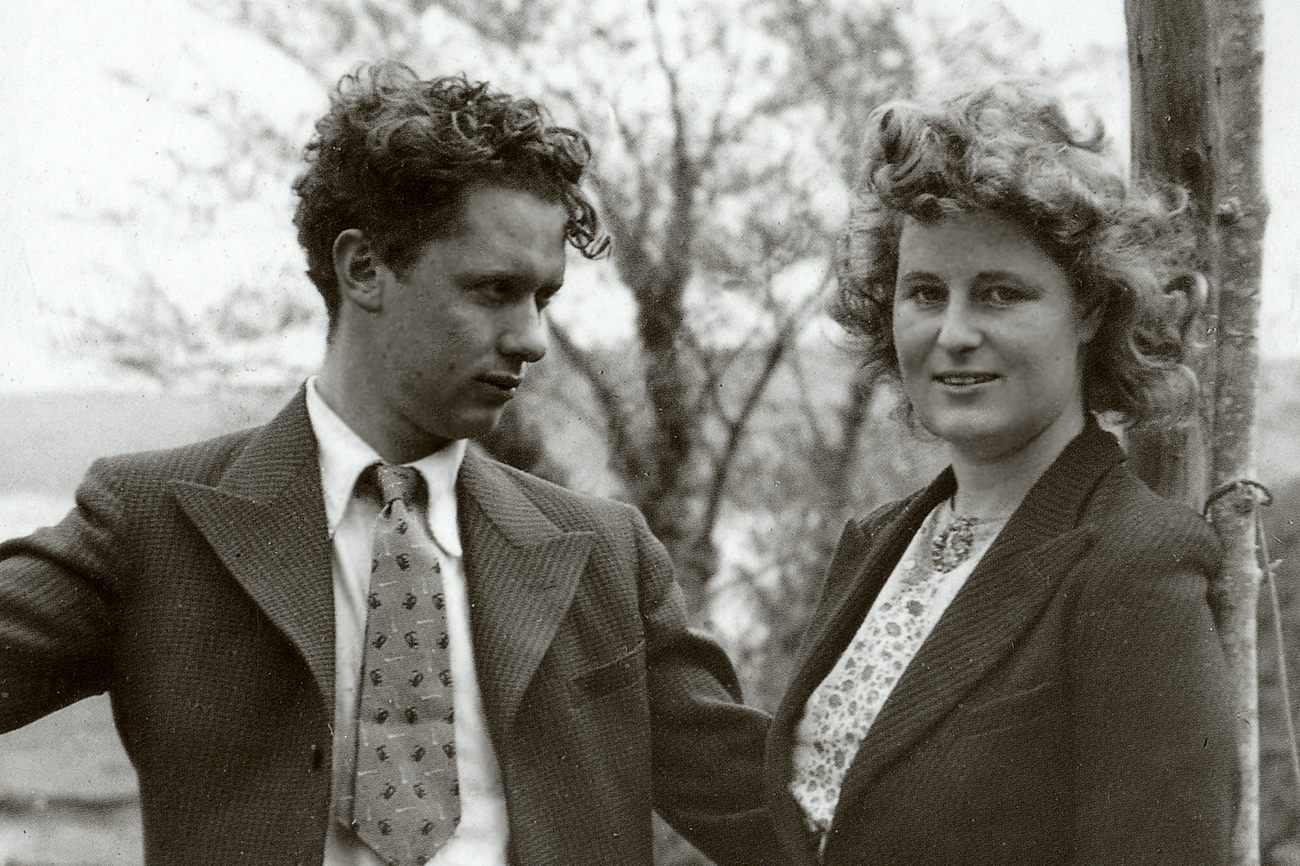
Dylan y Caitlin Thomas
Dylan Thomas (Poeta galés, 1914-1953)
Amor en El Manicomio
.
Una extraña ha venido
a compartir mi cuarto en esta casa que anda mal de la cabeza,
una muchacha loca como los pájaros
traba la puerta de la noche con sus brazos, sus plumas.
Ceñida en la revuelta cama
alucina con nubes penetrantes esta casa a prueba de cielos
hasta alucina con sus pasos este cuarto de pesadilla.
libre como los muertos
o cabalga los océanos imaginarios del pabellón de hombres.
Ha llegado posesa
la que admite la alucinante luz a través del muro saltarín,
posesa por los cielos
ella duerme en el canal estrecho, hasta camina el polvo
hasta desvaría a gusto
sobre las mesas del manicomio adelgazadas por mis lágrimas.
Y tomado por la luz de sus brazos, al fin, mi Dios, al fin
puedo yo de verdad
soportar la primera visión que incendia las estrellas.
.
Versión de Elizabeth Azcona Cranwell
. . .
Dylan Thomas (Welsh poet, 1914-1953)
Love in The Asylum
.
A stranger has come
To share my room in the house not right in the head,
A girl mad as birds
Bolting the night of the door with her arm her plume.
Strait in the mazed bed
She deludes the heaven-proof house with entering clouds
Yet she deludes with walking the nightmarish room,
At large as the dead,
Or rides the imagined oceans of the male wards.
She has come possessed
Who admits the delusive light through the bouncing wall,
Possessed by the skies
She sleeps in the narrow trough yet she walks the dust
Yet raves at her will
On the madhouse boards worn thin by my walking tears.
And taken by light in her arms at long and dear last
I may without fail
Suffer the first vision that set fire to the stars.
. . . . .
In Search of Dylan Thomas: Andre Bagoo in Wales
Posted: July 12, 2014 Filed under: 7 GUEST EDITORS, Andre Bagoo, English Comments Off on In Search of Dylan Thomas: Andre Bagoo in Wales
Andre Bagoo in Laugharne_photograph by Ann Marie Goodwin
And all your deeds and words,
Each truth, each lie,
Die in unjudging love.
Dylan Thomas, ‘This Side of the Truth’
SUNDAY
WE ARE in the strangest town in Wales.
It is a Sunday afternoon and we walk through the lych-gate and up the long asphalt path leading to the church. Where is his grave?
The path forks. To the left, a graveyard and St Martin’s. To the right, another graveyard, added more recently. The sun is setting.
St Martin’s Church has a service every Sunday at 6 pm. We hesitate at the entrance. Is a service going on? Will we interrupt the worshippers inside? From behind the thick 13th century walls, we can hear the faint sound of an organ. Are those voices? The wind.
We walk in. A small group of old ladies—and one or two men—are huddled together in the sacristy at the far end. There are shields and flags and statues. The stained glass makes everything a kaleidoscope. On one wall near the back (where we stay, looking on respectfully) is a plaque in honour of him, bearing two of his verses: “Time held me green and dying / Though I sang in my chains like the sea”. The light seems dazzled by these words, throwing long shadows on the rough stone walls.
Everyone in the church is kind, weirdly so.
“What took you so long? You should have come inside sooner,” one lady says.
“Here for Dylan Thomas, are you?” the rector adds, greeting us after the service and shaking our hands warmly.
Outside, we search among the graves and give up trying. It is quiet, the light is dying. We are tired after travelling for half a day. We will come again, we say, later in the week.
. . .
In the bar of Brown’s—the guesthouse/pub where Dylan Thomas spent most of his time drinking—the young bartender struggles to explain it. A sign on the wall advertises Laugharne as “the strangest town in Wales”.
“You’ll understand after a while,” he says, pouring a pint. “People here are really, really nice.” He says we are lucky the town is dead, because hundreds – if not thousands – of tourists will come for the Dylan Thomas centenary later this year. Our bartender is the youngest man we see all week.
A couple from a rival guesthouse a few blocks down on King Street stop in for drinks. They stare at us.
“You’re both so beautiful,” Janet says, eyeing my hamburger. Her husband, Peter, whispers into my ears that he has a hearing problem. She tells us a story about how she met Peter, who is her second husband. After her first marriage she was single for 17 years, she says, proudly. Then, she met Peter through an advertisement in the newspapers. She gives us a card for their inn, and says they have better rates. She never mentions her first husband’s name.
“She could get away with murder,” Peter jokes before they leave. I take a picture of them – just in case. That night in bed, I think of the town’s famous clock tower, standing black and white against the sky, just two blocks away.
MONDAY
Dylan Thomas was born in Swansea one hundred years ago, in 1914. He worked briefly as a reporter before his first published poem (‘And Death Shall Have No Dominion’) appeared in 1933. He skyrocketed. His stentorian voice and beautiful language made him particularly popular over the wireless; his most famous work – Under Milk Wood – was, in fact, written for radio.
Thomas spent two major periods of his relatively brief life at Laugharne. He lived there when he first married. Then, after living in several different places (London, Oxfordshire, Iran) he returned, settling with his family in a boathouse overlooking the estuary at the mouth of the River Tâf. Near the end of his life, he developed a routine at Laugharne, right up until his trip to New York in October 1953. (It was there, after a night of heavy drinking, that he died at St Vincent’s Hospital.) He made his third, and final, voyage to Laugharne, where he was buried at St Martin’s graveyard. Thomas was 39.

Dylan Thomas’ grave at St.Martin’s, Laugharne, Wales_photo by Andre Bagoo
Today, the grave looks fresh, covered with yellow, red and purple flowers. A simple white cross marks the spot where the poet who was once Wales’ most famous son is buried. “In Memory of Dylan Thomas,” it says. His wife Caitlin, who had a tempestuous relationship with him and who had not been with him in New York, would, years later, have the last word. She was buried in the same plot, and the other side of the slender white cross carries her name. There is no poetry at the grave.
TUESDAY
When you travel, nothing is as it seems. Everything has something of the air of the unreal. Each city, town, inhabitant, each landscape – becomes a mirage. But to the persons who live there, you are the one who is out of place. You are the apparition.
THURSDAY
It seems every single thing in Laugharne is connected to Dylan Thomas. Or if it is not, it fast becomes so. The entire town is a memorial to him; a living and breathing tomb. It is a monument comprising: pubs, book-shops, a clock-tower, ruins of a gothic castle, and St John’s Hill.
And all of this can be found in Thomas’ poetry.
But how much of a poet’s life and circumstance do we need to know? Do we need the back-story in order to enjoy each poem? Is it not better the less we know? Must we see the writing-shed, learn of the love affairs in New York, visit the favourite drinking haunts, the neighbours, the aunties? Of poetry Thomas once said:
All that matters about poetry is the enjoyment of it, however tragic it may be. All that matters is the eternal movement behind it, the vast undercurrent of human grief, folly, pretension, exaltation or ignorance, however unlofty the intention of the poem.
You can tear a poem apart to see what makes it technically tick, and say to yourself, when the works are laid out before you, the vowels, the consonants, the rhymes or rhythms, ‘Yes, this is it. This is why the poem moves me so. It is because of the craftsmanship.’ But you’re back again where you began. You’re back with the mystery of having been moved by words. The best craftsmanship always leaves holes and gaps in the works of the poem so that something that is not in the poem can creep, crawl, flash or thunder in.
I use everything and anything to make my poems work and move in the directions I want them to: old tricks, new tricks, puns, portmanteau-words, paradox, allusion, paranomasia, paragram, catachresis, slang, assonantal rhymes, vowel rhymes, sprung rhythm. Every device there is in language is there to be used if you will. Poets have got to enjoy themselves sometimes, and in the twistings and convolutions of words, the inventions and contrivances, are all part of the joy that is part of the painful, voluntary work.
With Thomas, there is a focus on what is not in focus: on crafting effects and experiences within the poem which hint at deeper ebbs. In addition to the devices he lists, there is also careful attention to form and an overriding sense of rhythm which propels the poetry, giving it a zealous, almost evangelical energy.
Many of his poems reflect these qualities, including some of his best-known, such as: ‘And Death Shall Have No Dominion’, ‘Poem in October’, ‘Fern Hill’, and ‘Do Not Go Gentle Into That Good Night’. A good example is also his poem ‘Twenty-four years’:
Twenty-four years remind the tears of my eyes.
(Bury the dead for fear that they walk to the grave in labour.)
In the groin of the natural doorway I crouched like a tailor
Sewing a shroud for a journey
By the light of the meat-eating sun.
Dressed to die, the sensual strut begun,
With my red veins full of money,
In the final direction of the elementary town
I advance for as long as forever is.
Thomas deploys rhyme, alliteration, paragram, memorable and unexpected imagery (“meat-eating sun”; “red veins full of money”) all to commemorate a moment; a feeling. The opening line startles, inverting the normal cause and effect relationship we associate with the provocation of tears – it bathes the poem in ambiguity. The poem is, for me, an act of grief, and seeks to point to a life force able to overcome it (“bury the dead for fear that they walk”). Ultimately, this is a snapshot as meaningful or as meaningless as life itself, grieved for or celebrated.
But if for Thomas poetry’s enjoyment is conditional upon a kind of cultivated mystery to the text, how useful is it to scour over the biographical details of Thomas’ undoubtedly tumultuous life? While Laugharne was central to his persona, is Laugharne central to the poetry? The whole point of poetry, according to Thomas, was its experience. Would he advocate that school of thought which states the reader need not get distracted or bogged down by the details of the poet’s personal life?
FRIDAY
The Dylan Thomas Walk is approximately two miles in length and takes you uphill around the shoulder of St John’s Hill, which overlooks Laugharne. Along the walk, we see views of the marshy Tâf estuary, which fans open like a sponge at low-tide; of Thomas’ boathouse; the Gower; north Devon; Caldey Island and Tenby. If you’re keen you can download an app specially made for the walk (https://itunes.apple.com/gb/app/dylan-thomas-100-birthday/id571021072?mt=8&ign-mpt=uo%3D4).
This “walk” was opened in 1856 by the Laugharne Corporation to enable cocklers to access by foot the valuable cockle beds on the upper and lower estuary marshes, when the dangerous high tides below would prevent access along the old cart road. Today, the path has been turned into a walk commemorating Thomas’s poem, ‘Poem in October’, which is ostensibly an occasional poem written by Thomas to mark what was his 30th birthday on October 24, 1944.

The Dylan Thomas Walk_Last verse of the poet’s “Poem in October”_photo by Andre Bagoo
Reading ‘Poem in October’ today it remains as vital and alive as it must have been in 1944. Thomas was writing during World War II and perhaps this context alone gives the poem a certain charge. His retreat to the Laugharne landscape allows a perspective and distance. The marsh environment comes to mirror the processes not only of war, but of economy and society generally. But reading the poem on the page is nothing like reading the poem along the specially-designed walk which now exists. At several spots, stations have been made bearing sections of the poem relating to the landscape, as well as old, faded maps and drawings of the view. Only by taking the Dylan Thomas Walk can you fully appreciate what he meant when he wrote:
My birthday began with the water-
Birds and the birds of the winged trees flying my name
Above the farms and the white horses
And I rose
In rainy autumn
And walked abroad in a shower of all my days.
High tide and the heron dived when I took the road
Over the border
And the gates
Of the town closed as the town awoke….
Pale rain over the dwindling harbour
And over the sea wet church the size of a snail
With its horns through mist and the castle
Brown as owls
But all the gardens
Of spring and summer were blooming in the tall tales
Beyond the border and under the lark full cloud.
There could I marvel
My birthday
Away but the weather turned around.
If we admit the landscape is in the poem, is the life not there too? Is the poem – even when stony, mysterious, obscure – not an artifact of a life, however shrouded in mystery? And if the life is there, can learning about the poet enrich our appreciation of what he sets out? For me, ‘Poem in October’ is a richer experience having been to Laugharne. Reading a poem is like reading a poet and, in turn, everything that has touched him. In this way, the reader and poet converge and something universal sparks between them. This is not to say this is compulsory to the enjoyment of a poem, or to advocate the limited readings so often lazily slapped onto poems when people find out about the lives of the poet, but rather to acknowledge that sometimes more information can reveal and deepen mystery simultaneously. Sometimes, the more you know, the less you know. And the more we know of a poet, the more possibilities are inherent in the text the poet leaves behind, even if the poem, like the poet, remains unknowable.
. . . . .
Women Out and About Together: SlutWalks, Blame Games, and Reclaiming Names
Posted: July 12, 2014 Filed under: IMAGES | Tags: SlutWalk Toronto July 12th 2014 Comments Off on Women Out and About Together: SlutWalks, Blame Games, and Reclaiming Names By now you may have heard about how SlutWalk Toronto got started, and how a small group of people in our city kicked off what became a global movement by challenging harmful, victim-blaming language. Three years later, we’re still focused because victim-blaming remains a problem – one that validates the actions of perpetrators of sexual violence and upholds many forms of systemic violence.

The first SlutWalk rally in Toronto in 2011 lit the spark for grassroots action in scores of countries worldwide where organizers have rallied communities for marches against victim-blaming. Some of these marches have been called SlutWalks, others have taken locally-driven names; all have been a part of international, collective action against victim-blaming in support of survivors of sexual violence.
SlutWalk Toronto continues because survivors of sexual violence deserve our support – not our scrutiny.
SlutWalk’s allies include, among others: Blowing the Whistle on Sexual Assault on Campus, Centre for Police Acountability, Good for Her, Toronto Rape Crisis Centre, YWCA Toronto – and loving men!
Join fearless women in our ongoing efforts!
From the SlutWalkToronto website:
We do not require participants to want to reclaim “slut” or any other slurs that have been used against them, nor do we require any particular dress code. We ask only that you come to support an end to victim-blaming and rape culture. Regardless of the victim’s ability, age, attire, gender, housing situation, immigration status, income, intoxication, job, race, or relationship with the abuser, the only person ever responsible for sexual violence is the perpetrator.

Why use the word Slut in this provocative way? Click on the link and read the FAQs:
http://www.slutwalktoronto.com/about/faqs
Zócalo Poets featured SlutWalk Toronto in 2012. Click on the link to read background details + poems!
https://zocalopoets.com/category/poets/karla-baez/
. . . . .
Mildred K. Barya: On “Donal Og” and How We Remember
Posted: July 8, 2014 Filed under: 7 GUEST EDITORS, English, Mildred K. Barya Comments Off on Mildred K. Barya: On “Donal Og” and How We Remember
“Donal Og”
It is late last night the dog was speaking of you;
the snipe was speaking of you in her deep marsh.
It is you are the lonely bird through the woods;
and that you may be without a mate until you find me.
You promised me, and you said a lie to me,
that you would be before me where the sheep are flocked;
I gave a whistle and three hundred cries to you,
and I found nothing there but a bleating lamb.
You promised me a thing that was hard for you,
a ship of gold under a silver mast;
twelve towns with a market in all of them,
and a fine white court by the side of the sea.
You promised me a thing that is not possible,
that you would give me gloves of the skin of a fish;
that you would give me shoes of the skin of a bird;
and a suit of the dearest silk in Ireland.
When I go by myself to the Well of Loneliness,
I sit down and I go through my trouble;
when I see the world and do not see my boy,
he that has an amber shade in his hair.
It was on that Sunday I gave my love to you;
the Sunday that is last before Easter Sunday.
And myself on my knees reading the Passion;
and my two eyes giving love to you for ever.
My mother said to me not to be talking with you today,
or tomorrow, or on the Sunday;
it was a bad time she took for telling me that;
it was shutting the door after the house was robbed.
My heart is as black as the blackness of the sloe,
or as the black coal that is on the smith’s forge;
or as the sole of a shoe left in white halls;
it was you that put that darkness over my life.
You have taken the east from me; you have taken the west from me;
you have taken what is before me and what is behind me;
you have taken the moon, you have taken the sun from me;
and my fear is great that you have taken God from me!
How We Remember
The last stanza of this old ballad translated from an anonymous 8th century Irish poem by Lady Augusta Gregory, has been ringing in my head, all the time thinking it was a song I may have heard over the radio, at the mall, or another poem I read some time ago but whose particular source or author I could not recall. Its strong declaration and overwhelming fear of loss kept me looking:
You have taken the east from me; you have taken the west from me;
you have taken what is before me and what is behind me;
you have taken the moon, you have taken the sun from me;
and my fear is great that you have taken God from me!
So I started to reread both familiar and new poems I’d just encountered to see if that’s where the lines were from. I also looked up popular love songs because of the energy and lyricism in the lamenting voice. I even read the Psalms and the book of Job, since I recognized the incantatory tone and hymnal-like repetition. I was amazed at my process in actively trying to remember, and the urge to experiment with various sources. I found myself thinking deeply about the steps we take in remembering things that happened a long time ago but come back to us in fragments or phrases. How do we unravel the whole? Could that be the real reason we take pictures, for instance? To help associate images/symbols with words/stories or events; to have the albums to go to when we need to bring back lives and whole scenes; not just to celebrate the moments when the pictures are being taken, but to have something that aids memory in future, as a point of reference and remembrance?
Anyway, my appeal to memory to rearrange itself and bring me the whole led me to Antonio Machado’s short poem, “Lord, You Have Ripped Away,” which has an almost similar rhythm, plea and echo to Donal Og. So I thought, even if it wasn’t what I was looking for, I liked that I had stumbled on it. And so I’ll share it.
Lord, you have ripped away from me what I loved most.
One more time, O God, hear me cry out inside.
“Your will be done,” it was done, and mine not.
My heart and the sea are together, Lord, and alone.
Antonio Machado, a native of Spain, lived from 1875 to 1939. While Machado’s poem is said to be about the death of his young wife whom he loved very much, Donal Og addresses a lover who goes away and never returns. The voice in the two poems cries out to be heard, to share the anguish of those left behind.
I had given up looking for the lines of Donal Og’s last stanza when I started to file and clean my work station, only to find the poem beneath a pile of papers on my table. I now knew why the lines were haunting me. Months ago I had wanted to write a piece for Zócalo Poets featuring the poem but the piece wouldn’t happen. I read and printed a copy thinking that if I kept looking at it on my table something wonderfully magical would be triggered. Nothing. Eventually, other poems and papers piled on top and that’s how the poem was forgotten. I think that tells you more about my organized mess and belief in random resourcefulness.
I will not go into details about the poem’s timelessness or what it has in common with modern-day songs and ballads, how it handles love, betrayal, broken promises, responsibility or translation, but rather how, when we have forgotten about its existence, it will have its own way of nudging us back to itself, to marvel at its sacred and secular emotional position, neatly brought out in stanza six:
It was on that Sunday I gave my love to you;
the Sunday that is last before Easter Sunday.
And myself on my knees reading the Passion;
and my two eyes giving love to you for ever.
Lastly, because I listened to a couple of songs while I was searching for Donal Og without knowing that’s what I was looking for, I came across Leonard Cohen’s The Darkness song, first stanza:
I caught the darkness
It was drinking from your cup
I caught the darkness
Drinking from your cup
I said, “Is this contagious?”
You said, “Just drink it up…”
And it made stanza eight of the poem remarkably significant, not just in the similes but the compounding of blackness and darkness:
My heart is as black as the blackness of the sloe,
or as the black coal that is on the smith’s forge;
or as the sole of a shoe left in white halls;
it was you that put that darkness over my life.
I think the experience of acknowledging and letting out the darkness in music, poetry, stories and so on, helps the heart to transform and go on, even in profoundly devastating situations. The cry from the writer, reader, singer, or audience becomes the light that keeps beating. If nothing else, this simple act of the experience of letting out could be the greatest gift of creative works to humankind and animals.
Enjoy the reading and the letting out.
Mildred K. Barya
. . .
Jorge Luis Borges: “Tejas” / “Texas”
Posted: July 8, 2014 Filed under: English, Jorge Luis Borges, Spanish Comments Off on Jorge Luis Borges: “Tejas” / “Texas”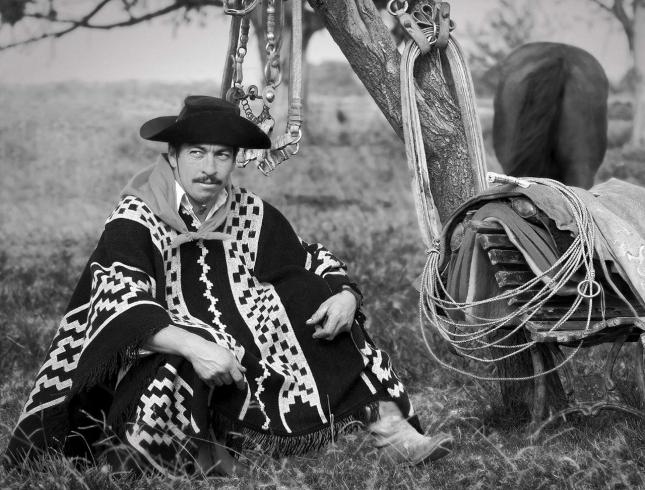
Foto romántica de un gaucho argentino estereotípico_Casi es una versión sudamericana del vaquero tejano. A romantic, stereotypical photograph of an Argentinian “gaucho”, the South-American counterpart to the Texas Cowboy.
Jorge Luis Borges
“Tejas”
.
Aquí también. Aquí, como en el otro
confín del continente, el infinito
campo en que muere solitario el grito;
aquí también el indio, el lazo, el potro.
Aquí también el pájaro secreto
que sobre los fragores de la historia
canta para una tarde y su memoria;
aquí también el místico alfabeto
de los astros, que hoy dictan a mi cálamo
nombres que el incesante laberinto
de los días no arrastra: San Jacinto
y esas otras Termópilas, el Álamo.
Aquí también esa desconocida
y ansiosa y breve cosa que es la vida.
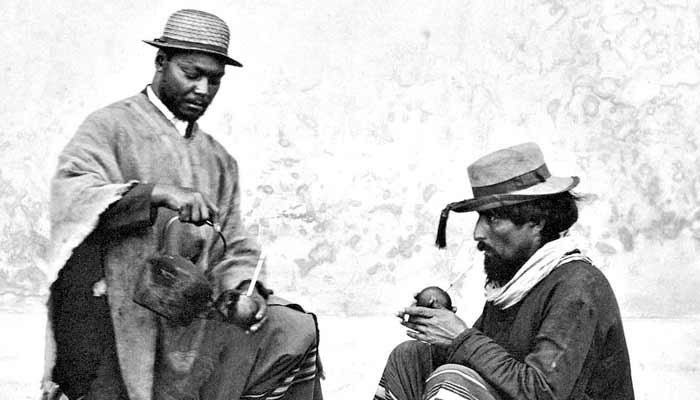
Dos gauchos de La Triple Frontera entre Argentina, Paraguay y Brasil_Bebiendo yerba mate_Vintage photograph of two “gauchos” drinking “yerba mate”
Jorge Luis Borges
(1899-1986, born Buenos Aires, Argentina)
“Texas”
.
And so it is here too. Here too, as at
the Americas’ other edge: the measureless
plain where a cry dies unattended. Yes,
here too, the Indian, mustang, lariat.
Here too the secret bird that ever yet
over the clamourings of history
sings for an evening and its memory;
here too the stars with mystic alphabet
that dictate to my writing hand below
such names, today, as the unceasing maze
of days and turning days does not displace,
as San Jacinto and the Alamo,
and such Thermopylaes. Here, too, is rife
with that brief unknown anxious thing called life.
. . .
Translation from the Spanish: A.Z. Foreman
Visit his site: http://poemsintranslation.blogspot.ca/
. . . . .
Alicia Claudia González Maveroff: Time / Tiempo
Posted: July 7, 2014 Filed under: Alicia Claudia González Maveroff, English, Spanish, ZP Translator: Alexander Best Comments Off on Alicia Claudia González Maveroff: Time / Tiempo
Alicia Claudia González Maveroff
Time
.
And Time passes by,
and that which one didn’t make happen
or say in the moment
can no longer be expressed,
for already its time has come and gone – and is lost.
.
And so, in this way you come to understand
that it’s not enough to just let Time slip by:
to lose opportunities;
to live without saying what it is one feels,
to live without allowing oneself happiness in its time.
.
You take the chance then to speak so as to
not lose any more Time.
And you know what? It’s not difficult to do this
– looking yourself in the eyes –
because it isn’t human frailty to describe your feelings.
.
There will be many more times when one says nothing,
as if it – what one longed to say – were not certain…
And Life passes by,
the same as I told you
Time passes by.
.
And one day, without your realizing it,
you will come and you won’t find me,
and that which you
couldn’t find the words for / didn’t know how to say,
well – you’ll’ve run out of Time…
Buenos Aires, 22/06/14
. . .
Alicia Claudia González Maveroff
Tiempo
.
Y el tiempo pasa
y lo que no se hizo
o dijo en su momento,
no puede ya expresarse,
pues ya perdió
su tiempo.
Y así comprendes
que no es adecuado
dejar pasar
el tiempo,
perder las oportunidades,
vivir sin permitirse decir
lo que se siente y ser feliz
a tiempo.
Y te arriesgas entonces
a hablar, a no perder
más tiempo.
Sabes, no es difícil hacerlo,
mirándose a los ojos.
Que no es fragilidad
describir sentimientos.
Más muchas veces,
no se dice nada, como si esto
no fuera cierto…
Y entonces la vida pasa,
como te cuento pasa
el tiempo.
Y un día sin saberlo,
vienes y no me encuentras,
y aquello que no se pudo
o no se supo decir,
ya no tiene
más tiempo…
Buenos Aires, 22/06/14
. . .
English interpretation from the original Spanish: Alexander Best
. . . . .
Vinícius de Moraes: Fidelidade, Separação, Intimidade: Three Sonnets
Posted: July 7, 2014 Filed under: English, Portuguese, Vinícius de Moraes Comments Off on Vinícius de Moraes: Fidelidade, Separação, Intimidade: Three Sonnets
Ipanema Beach in Rio, at sunset_vintage colour photograph from the 1960s
Vinícius de Moraes
(lyricist and poet, Rio de Janeiro, 1913-1980)
.
Sonnet on Fidelity
.
Above all, to my love I’ll be attentive
First, and always with such ardour, so much
That even when confronted by this great
Enchantment my thoughts ascend to more delight.
.
I want to live it through in each vain moment
And in its honour I must spread my song
And laugh with my delight and shed my tears
When she is sad or when she is contented.
.
And thus, when afterward comes looking for me
Who knows what death, anxiety of the living,
Who knows what loneliness, end of the loving,
.
I could say to myself of the love I had:
Let it not be immortal, since it is a flame
But let it be infinite – while it lasts.
. . .
Sonnet on Separation
.
Suddenly, laughter became sobbing
Silent and white like the mist
And united mouths became foam
And upturned hands became astonished.
.
Suddenly, the calm became the wind
That extinguished the last flame in the eyes
And passion became foreboding
And the still moment became drama.
.
Suddenly, no more than suddenly,
He who’d become a lover became sad
And he who’d become content became lonely.
.
The near became the distant friend
Life became a vagrant venture
– suddenly, no more than suddenly.
. . .
Sonnet on Intimacy
.
Farm afternoons, there’s much too much blue air.
I go out sometimes, follow the pasture track,
Chewing a blade of sticky grass, chest bare,
In threadbare pyjamas of three summers back,
.
To the little rivulets in the river-bed
For a drink of water, cold and musical,
And if I spot in the brush a glow of red,
A raspberry, spit its blood at the corral.
.
The smell of cow manure is delicious.
The cattle look at me unenviously
And when there comes a sudden stream and hiss
.
Accompanied by a look not unmalicious,
All of us, animals, unemotionally
Partake together of a pleasant piss.
. . .
Translations from Portuguese into English:
Ashley Brown (Fidelity, Separation) and Elizabeth Bishop (Intimacy)
. . .
Soneto de Fidelidade
.
De tudo, ao meu amor serei atento
Antes, e com tal zêlo, e sempre, e tanto
Que mesmo em face do maior encanto
Dêle se encante mais meu pensamento.
.
Quero vivê-lo em cada vão momento
E em seu louvor hei de espalhar meu canto
E rir meu riso e derramar meu pranto
Ao seu pesar ou seu contentamento.
.
E assim, quando mais tarde me procure
Quem sabe a morte, angústia de quem vive,
Quem sabe a solidão, fim de quem ama
.
Eu possa me dizer do amor (que tive):
Que não seja imortal, pôsto que é chama
Mas que seja infinito enquanto dure.
. . .
Soneto de Separação
.
De repente do riso fez-se o pranto
Silencioso e branco como a bruma
E das bocas unidas fez-se a espuma
E das mãos espalmadas fez-se o espanto.
.
De repente da calma fez-se o vento
Que dos olhos desfez a última chama
E da paixão fez-se o pressentimento
E do momento imóvel fez-se o drama.
.
De repente, não mais que de repente,
Fez-se de triste o que se fez amante
E de sozinho o que se fez contente.
.
Fez-se do amigo próximo o distante
Fez-se da vida uma aventura errante
De repente, não mais que de repente.
. . .
Soneto de Intimidade
.
Nas tardes da fazenda ha muito azul demais.
Eu saio as vezes, sigo pelo pasto, agora
Mastigando um capim, o peito nu de fora
No pijama irreal de ha três anos atrás.
.
Desço o rio no vau dos pequenos canais
Para ir beber na fonte a agua fria e sonora
E se encontro no mato o rubro de uma aurora
Vou cuspindo-lhe o sangue em torno dos currais.
.
Fico ali respirando o cheiro bom do estrume
Entre as vacas e os bois que me olham sem ciume
E quando por acaso uma mijada ferve
.
Seguida de um olhar não sem malícia e verve
Nos todos, animais, sem comoção nenhuma
Mijamos em comum numa festa de espuma.
. . .
These three sonnets were written in the late 1930s, when de Moraes was in his mid twenties. The poet would later become famous as the lyricist for the 1962 international bossa-nova hit song, A Garota de Ipanema (The Girl from Ipanema).
. . . . .
Ramadan Mubarek, My Gay Brothers and Sisters!
Posted: July 3, 2014 Filed under: IMAGES Comments Off on Ramadan Mubarek, My Gay Brothers and Sisters!
A young man who combines his Faith with High Self-Esteem – a winning combination. The first day of the holy Islamic month of Ramadan and Toronto’s World Pride Parade fell on the same day this year, Sunday, June 29th.
. . .
Love is a place
*
love is a place
& through this place of
love
move
(with brightness of peace)
all places
*
yes is a world
& in this world of
yes live
(skillfully curled)
all worlds
– E. E. Cummings
. . .

 Zócalo Poets