Children’s Rhymes / Cánticos de la Niñez
Posted: September 9, 2011 Filed under: English, Spanish Comments Off on Children’s Rhymes / Cánticos de la Niñez
Doggy, doggy, who’s got your bone ?
Somebody stole it from your home.
Guess who ? Maybe You !
Maybe the Man in the Moon – with the Spoon !
Perrito mío, ¿dónde está tu hueso?
Alguien de tu casa se lo llevó.
¿Adivina quién? ¡Tal vez Tú!
¡Tal vez el Hombre por la Luna – con la Cuchara!
*
There was an old woman
lived under a hill,
and if she’s not gone,
she lives there still.
Una viejecita bajo la colina vivía,
Y si no se ha mudado, allí mora todavía.
*
Three wise men of Gotham
went to sea in a bowl
– if the bowl had been stronger
my song had been longer.
Tres hombres sabios de Gotham
se fueron a la mar en un plato
– si el plato hubiera sido más fuerte
mi canción se alargaría para rato.
*
Luna, luna, dame pan
Para mi perrito Capitán!
Si no me das – ¡vete al volcán!
Give bread to my doggy Captain, Moon-o!
Won’t give me none ? Go jump in a volcano !
*
Mi mamá es una Rosa,
Mi papá es un Clavel,
Yo soy un Botoncito,
Acabado de nacer.
My mummy is a Rose,
A Carnation is my dad,
And I’m the little Bud
That they just had !
*
Sticks and stones may break my bones
– but words will never hurt me.
Palos y piedras me pueden quebrar
– pero las palabras necias no me van a dañar.
*
For every Evil under the sun
there is a remedy – or there is none.
If there be one, try to find it
– if there be none, never mind it.
Para cada Mal bajo el sol
hay una cura – o no hay alguna.
Si la hay, trata de encontrarla
– si no, ya ni procura.
_____
By: Anonymous authors
Por: Autores anónimos, autoras anónimas
Traducciones del inglés al español por Lidia García Garay
Translations from Spanish into English by Alexander Best
_____
And here’s one more…
Y hay uno más…
Give us a place to stand – and a place to grow,
And call this land: ONTARIO – OH – OH !
A place to “stand” – a place to “go”,
ON – TARI – ARI – piss – pot – hole !
!Dennos un lugar para pararse – y un lugar para crecer,
Y llamen este país: ¡ONTARIO – O – O!
Un lugar para “pararse”, un lugar para “ir”,
¡ON – TARI – ARI – basinica – para – mear!
_ _ _ _ _
“A Place to Stand”
was the unofficial anthem of the
province of Ontario – during the
nation of Canada’s “Confederation” year
(1967).
Instantly, the lyrics were altered by
naughty little boys across the country…
*
“Un lugar para pararse”
fue el himno (no oficial) de la provincia de
Ontario – en el año del centenario de
la nación de Canada (1967).
Al instante, la canción era satirizado
por pilcates pícaros…
Armand Garnet Ruffo: “En el Lago de Titicaca”
Posted: September 9, 2011 Filed under: Armand Garnet Ruffo, English, Spanish, ZP Translator: Alexander Best Comments Off on Armand Garnet Ruffo: “En el Lago de Titicaca”
Armand Garnet Ruffo
“On Lake Titicaca”
.
Between Bolivia and Peru I forget who I am
and the guides continue to keep course. Here
the waves against the boat and the old man
braced against the tiller are important.
I turn and look directly
at him. Not a word parts his lips
and I think of the depth of the lake
the elixir of rhythm tradition.
We are out past the reed islands
past the fishermen
the birds
out among one another inside
a path deep and blue as a prayer.
The old man’s companion decked out in bright wool
cap and sweater fiddles with an old oily motor
he somehow keeps going. Like the old man
his Indian life is carved into his face
and defines his presence and like the old man he knows
he is taking me somewhere I have never been
past everything except ourselves
on this water under this sky.
. . .
Armand Garnet Ruffo
“En el Lago de Titicaca”
.
Entre Bolivia y el Perú olvido quien soy
y siguen manteniendo el rumbo los guías. Aquí
son importantes las ondas contra el barco y
el viejo hombre apoyado en la caña del timón.
Me vuelvo y miro directamente
a él. Ninguna palabra separa sus labios
y pienso en la profundidad del lago,
el elixir de la tradición del ritmo.
Estamos afuera y más allá de las islas de junco,
más allá de los pescadores,
los pájaros,
afuera entre uno y otro dentro de
una senda profunda y azúl como una oración.
El compañero del viejo hombre,
que está adornado con cachucha y chompa de lana de colores muy vivos,
juguetea con un motor antiguo y oleaginoso
y de algún modo continua en marcha. Como el viejo hombre,
su vida india está tallada en su cara
y define su presencia y como el viejo hombre él sabe también que
me está llevando adonde nunca he ido
más allá de todo salvo de nosotros mismos
sobre esta agua bajo de este cielo.
.
Traducción al español por Alexander Best
. . .
Armand Garnet Ruffo (born 1955) is Ojibwe, from Chapleau, Ontario.
A professor at Carleton University, he teaches creative writing and Native literature.
He has just completed a biography of Norval Morrisseau – “Man Changing into Thunderbird”.
The poem above is from his first collection, Opening In The Sky (Theytus Books, 1994).
. . . . .
Dionne Brand: “ Hard against the Soul ”
Posted: August 31, 2011 Filed under: Dionne Brand, English | Tags: Black poets Comments Off on Dionne Brand: “ Hard against the Soul ”_____
I saw this woman once in another poem, sitting,
throwing water over her head on the rind of a country
beach as she turned toward her century. Seeing her
no part of me was comfortable with itself. I envied her,
so old and set aside, a certain habit washed from her
eyes. I must have recognized her. I know I watched
her along the rim of the surf promising myself, an old
woman is free. In my nerves something there
unraveling, and she was a place to go, believe me,
against gales of masculinity but in that then, she was
masculine, old woman, old bird squinting at the
water’s wing above her head, swearing under her
breath. I had a mind that she would be graceful in me
and she might have been if I had not heard you
laughing in another tense and lifted my head from her
dry charm.
*
You ripped the world open for me. Someone said this
is your first lover you will never want to leave her. My
lips cannot say old woman darkening anymore, she
is the peace of another life that didn’t happen and
couldn’t happen in my flesh and wasn’t peace but
flight into old woman, prayer, to the saints of my
ancestry, the gourd and bucket carrying women who
stroke their breast into stone shedding offspring and
smile. I know since that an old woman, darkening,
cuts herself away limb from limb, sucks herself white,
running, skin torn and raw like a ball of bright light,
flying, into old woman. I only know now that my
longing for this old woman was longing to leave the
prisoned gaze of men.
_____
Dionne Brand was born in Trinidad in 1953
and graduated from University of Toronto in 1975.
She is black, lesbian, feminist – three powerful things.
Toronto’s Poet Laureate, she is also the 2011 winner of
The Griffin Poetry Prize for her long poem Ossuaries.
The companion poems above are excerpted from
Brand’s series “Hard against the Soul”, part of
her collection, No Language is Neutral
© 1990, Dionne Brand.
Ghazal: The Ladder of Night
Posted: August 27, 2011 Filed under: Alexander Best, English Comments Off on Ghazal: The Ladder of Night
Alexander Best
” The Ladder of Night “
.
You threw me down a well, wall’s drawn in dung – I trust you.
I’ve hung a skull, it yawns to drown the bell – I trust you.
I’m elbowing this dark that swims below…it’s lovely.
I drip with singing, one good lung, till dawn – I trust you.
& tears my ale, I’m falling underground…and dreaming.
Way up’s the grate, mid-day’s a yellow wail – I trust you.
I’m bellowing, I’ve brawn to scale our strife…in octaves.
Await, new skill, my beaded brow is strung – I trust you.
Awake I’m dreaming life, my night’s a ladder…of strong rung.
The well was great, my will is even greater – I trust you.
.
(2003)
_____
Photograph: Fernando Ayuso Palacios: Ceramic tile mosaic, Tehran, Iran
Federico García Lorca: Ghazal of the Terrible Presence
Posted: August 27, 2011 Filed under: English, Federico García Lorca, Spanish Comments Off on Federico García Lorca: Ghazal of the Terrible Presence
Federico García Lorca (1898-1936)
Translation by A.Z. Foreman
.
I would have the water reft from its bed,
I would have the wind bereft of its dell,
The eyes of the night cleft down from its brow
And my heart bereft of the golden flower;
The huge leaves hear what the oxen say
And the earthworm dies of overshade ;
The teeth that hang in the skullmouth glint
And a gush of yellow flood out the silk.
I can see the wounded night in its duel
Writhing against the impending noon.
I resist a green sunset of venomed skies
And the ruined arch of suffering time.
But don’t shine your immaculate nude at me
Like a black cactus opening out in the reeds.
Leave me with my dark planets, let me ache
But don’t you dare teach me the cool of your waist!
*
El poema original en español:
“Gacela de la Terrible Presencia”
.
Yo quiero que el agua se quede sin cauce,
yo quiero que el viento se quede sin valles.
quiero que la noche se quede sin ojos
y mi corazón sin flor del oro;
que los bueyes hablen con las grandes hojas
y que la lombriz se muera de sombra;
que brillen los dientes de la calavera
y los amarillos inunden la seda.
puedo ver el duelo de la noche herida
luchando enroscada con el mediodía.
resiste un ocaso de verde veneno
y el arco roto donde sufre el tiempo.
pero no ilumines tu limpio desnudo
como un negro cactus abierto en los juncos.
déjame en un ansia de oscuros planetas,
¡ pero no me enseñes tu cintura fresca !
*
We are grateful to A.Z. Foreman for his translation.
Visit his site: poemsintranslation.blogspot.com
The Translator’s Own Poem…
Posted: August 27, 2011 Filed under: A.Z. Foreman, English Comments Off on The Translator’s Own Poem….
A.Z. Foreman
“Beyond Constraints”
.
Language will not be held behind the latches
Of culturedly thick skulls. Beyond intent
Humankind’s tectonic mindscape drives its course
Through times. Your language is a continent
Churned on the planet, changed by all it touches,
Forming a fissure in schismatic rock
Where the least hotspot’s sheer vocalic force
Shifts the sea’s stress. We might as well just talk
And savor it. The mountain will not move
Back to this moment, and the things you love
In this year’s dictionary will be no
Heirloom for great grandchildren anymore
Than plants that burgeoned on the ocean floor
In your backyard a billion years ago.
. . .
A.Z. Foreman is a Linguistics student who is
mad for the art of translation.
Visit his site: http://www.poemsintranslation.blogspot.com
The Old Empire’s Language, 1: Lee Maracle
Posted: August 21, 2011 Filed under: English, Lee Maracle Comments Off on The Old Empire’s Language, 1: Lee Maracle_____
Lee Maracle
“The Language Leaked from my Lips”
The language leaked from my lips in letters too short and too young
to help me understand that remembering had some significance.
The language you gave me failed me, failed to assist me in those
moments when invasion fell upon my private self.
Now my language, so richly textured with instruction, is stripped of
emotion’s unraveling expression of possibility.
This possibility’s poesy, story, hopeful imagination, died in the dark
on the floor in the puddle of my leaked letters.
My lips emptied of light cannot imagine dark whose actuality was my
pathway to future dreamworld carving.
My forever light precludes dreaming in the dark, the starkness of
constant light burns holes through the curtain of hope outside my word puddle.
Letters dance lonely in the stark light at the edge of this pool. Their
death throes mourn my dead dark night.
I crawl about collecting letters, rearranging them, playing with
meaning, grabbing whatever I can from wherever they appear.
These letters feel foreign, scrape at the meaning in my mind, tear at
the yearing of my soul and dance just out of reach of my heart.
_____
Lee Maracle (born 1950) is a member of the Stó:Lō First Nation of British Columbia.
Her literary career began 40 years ago – the poem above is from a basket of poems called
“Turbulent Storm”, part of her collection Bent Box (© 2000, Lee Maracle).
She is also an orator and teacher.
M. NourbeSe Philip: “Meditations on the Declension of Beauty by the Girl with the Flying Cheek-bones”
Posted: August 21, 2011 Filed under: English, M. NourbeSe Philip, Spanish | Tags: Black poets Comments Off on M. NourbeSe Philip: “Meditations on the Declension of Beauty by the Girl with the Flying Cheek-bones”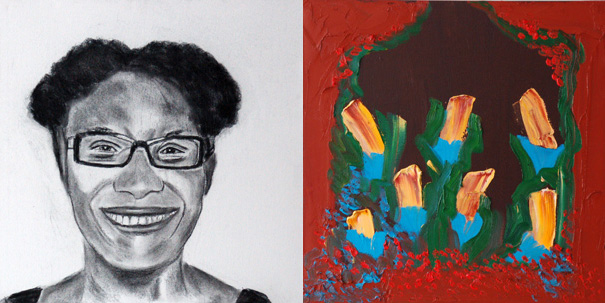 ZP_M. NourbeSe Philip_by Robin Pacific
M. NourbeSe Philip
.
“Meditations on the Declension of Beauty
by the Girl with the Flying Cheek-bones”
.
If not If not If
Not
If not in yours
_____ In whose
In whose language
Am I
If not in yours
_____ In whose
In whose language
Am I I am
_____ If not in yours
In whose
_____ Am I
(if not in yours)
_____ I am yours
In whose language
_____ Am I not
Am I not I am yours
If not in yours
If not in yours
_____ In whose
In whose language
_____ Am I …
Girl with the flying cheek-bones:
She is
I am
Woman with the behind that drives men mad
And if not in yours
Where is the woman with a nose broad
As her strength
If not in yours
In whose language
Is the man with the full-moon lips
Carrying the midnight of colour
Split by the stars – a smile
If not in yours
_____ In whose
In whose language
_____ Am I
_____ Am I not
_____ Am I I am yours
_____ Am I not I am yours
_____ Am I I am
If not in yours
_____ In whose
In whose language
_____ Am I
If not in yours
_____ Beautiful
. . .
This poem is taken from Marlene Nourbese Philip’s poetry collection,
She Tries Her Tongue – Her Silence Softly Breaks (© 1989, M. NourbeSe Philip).
In the preface she writes: ” In the absence of any other language by which the past
may be repossessed, reclaimed and its most painful aspects transcended,
English in its broadest spectrum must be made to do the job. ”
” Broadest spectrum ” includes the richly creative Caribbean dialects. And:
” The language as we know it has to be dislocated and acted upon – even destroyed –
so that it begins to serve our purposes. It is our only language, and while it is
our mother tongue, ours is also a father tongue. ”
Philip, born in Trinidad in 1947, has lived in Toronto for decades where she has been
essayist, poet and antiracism activist.
. . .
The following is a translation of the poem into Spanish:
“Meditaciones sobre la Declinación de la Belleza
por la Muchacha de los Pómulos altos”
.
Si no Si no Si
No
¿Si no en el lenguaje de usted
– en su lenguaje –
entonces, en lo de quién?
Soy yo
Si no en suyo
En lo de quién
En el lenguaje de quién
Soy yo Soy
Si no en suyo
En lo de quién
Soy yo
(si no en suyo)
Soy suya
En el lenguaje de quién
No soy
No soy, Soy suya
Si no en suyo
Si no en suyo
En lo de quién
En el lenguaje de quién
Soy…
La Muchacha de pómulos altos:
Ella es
Yo soy
Mujer del trasero que vuelve locos a los hombres
Y si no en suyo
¿Dónde está la Mujer de nariz ancha
– ancha como su fuerza?
Si no en suyo
En el lenguaje de quién
¿Está el Hombre de labios como la luna llena
Llevando la medianoche de Color
Reventada por las estrellas – una sonrisa?
En lo de quién
En el lenguaje de quién
Soy
No soy
Soy Soy suya
Soy Soy
Si no en suyo
En lo de quién
En el lenguaje de quién
Soy
Si no en suyo
Bella
. . .
Traducción del inglés al español /
Translation from English into Spanish: Alexander Best
The Old Empire’s Language, 2: Jun Tiburcio
Posted: August 20, 2011 Filed under: English, French, Jun Tiburcio, Spanish, Tutunakú, ZP Translator: Alexander Best, ZP Translator: Lidia García Garay Comments Off on The Old Empire’s Language, 2: Jun Tiburcio
“Taskulanatlon”
.
Kakuwinin katlawalh chichini xatutunaku,
kaj matsiswanimakgólh tama luwanan.
Kakisikulanatlawa xa tutunaku kintlatikan,
tama luwanan ka ki lakgapalamakgólh.
Kakimakgalhtokge xa tutunaku,
tama tatsokgni xa luwan ka akgsaninan.
Kakintlini xa tutunaku,
akan tliy luwan ka lixkan kiwaniy.
Kakixakgatli xa tutunaku,
ntama xtachuwinkan luwanan kimatasiy.
_____
“Bendiciones”
.
Bendíceme en totonaco, Dios mío,
porque en español me maldicen.
Illumíname con el sol totonaco,
porque me opacan en español.
Dame sabiduría totonaca, Dios mío,
porque en español me llaman tonto.
Dame letras en totonaco,
porque las letras españoles mienten.
Cántame en totonaco,
porque en español me ofenden.
Háblame en totonaco,
porque en español me gritan.
_____
“Blessings”
.
Bless me in Tutunaku, my God,
because in Spanish they say bad things about me.
Illuminate me with the Tutunaku sun,
because the Spanish sun makes me dull and hazy.
Give me Tutunaku wisdom, my God,
because in Spanish they call me stupid.
Give me the Tutunaku alphabet,
because Spanish letters lie.
Sing to me in Tutunaku,
because the sound of Spanish offends me.
Speak to me in Tutunaku,
because in Spanish they always shout at me.
_____
“Bénédictions”
.
Bénis-moi, mon Dieu,
parce qu’ils me maudissent en espagnol.
Illumine-moi avec le soleil totonaque
parce qu’ils m’assombrent en espagnol.
Donne-moi la sagesse totonaque, mon Dieu,
parce qu’en espagnol ils m’appellent bête.
Donne-moi des lettres en totonaque,
parce que les lettres en espagnol mentent.
Chante-moi en totonaque,
parce qu’ils m’offensent en espagnol.
Parle-moi en totonaque,
parce qu’ils me hurlent en espagnol.
__________
Jun Tiburcio (nació en 1960) es un poeta del lenguaje totonaco (tutunaku), y
su pueblo de familia es Chumatlán, Estado de Veracruz, México.
“Bendiciones” contiene el poder del enojo en forma de palabras de un ritual religioso.
*
Jun Tiburcio (born 1960) is an indigenous poet from the town of Chumatlán, in the
State of Veracruz, México. He writes in his native language of Tutunaku.
“Blessings” contains all of anger’s power using the word-forms of religious ritual.
*
Traducción al español por el poeta
Spanish translation by the poet himself
*
Translation from Spanish into French by Lidia García Garay
Translation from Spanish into English by Alexander Best
Natalio Hernández: Náhuatl poems / Poemas en náhuatl / In xochitl in cuicatl
Posted: August 17, 2011 Filed under: English, Natalio Hernández, Náhuatl, Spanish, ZP Translator: Alexander Best Comments Off on Natalio Hernández: Náhuatl poems / Poemas en náhuatl / In xochitl in cuicatlNatalio Hernández
Poemas de su poemario Yancuic Anahuac Cuicatl / Canto Nuevo de Anahuac (1994):
De la sección “Xochicoscatl / Collar de Flores”:
Amo ninequi nimiquis
Amo ninequi nimiquis
ninequi niquitas yanquic tonati
ihuan yancuic tlanextli.
Amo ninequi nimiquis
ninequi nicactehuas yancuic xochicuicatl
yancuic masehualcuicatl.
Amo ninequi nimiquis
ninequi niquipohuas
yancuic masehualamoxme,
ninequi niquitztehuas
yancuic tlalamiquilistli.
Amo ninequi nimiquis
ninequi sampa nimoyolchicahuas
ocsepa cuali nimonelhuayotis
amo quema ninequi nitlacatehuas.
_____
No quiero morir
No quiero morir,
quiero ser participe del nuevo dia
y del nuevo amanecer.
No quiero morir,
quiero disfrutar los nuevos cantos floridos,
los nuevos cantos del pueblo.
No quiero morir,
anehelo leer los nuevos libros
y admirar el surgimiento
de la nueva sabiduria.
No quiero morir,
quiero que sea vigorosa mi propia vida,
ansio recuperar mis raices:
no deseo abandonar mi vida en la tierra.
_____
I don’t want to die
I don’t want to die,
I want to be a part of the new day,
the new dawn.
I don’t want to die,
I want to enjoy the new flowery songs,
the chants of the people.
I don’t want to die,
I long to read the new books
and to admire the rise of a new wisdom.
I don’t want to die,
I want that I might be vigorous in my own life,
I’m eager to recover my roots:
I do not wish to give up my life on this earth.
_____
Toselti matinemican
Quemantica nimachilia
tehuan timasehualme tichia
se tlacatl tlen nochi hueli
ihuan nochi quimatl:
yehuatl huelis tech maquixtis.
Inin tlacatl tlen nochi hueli
ihuan nochi quimati
amo queman asis:
ipampa tohuan itztoc,
tohuaya nemi,
pehuaya tlachia,
nohua cochtoc.
_____
Caminemos solos
A veces pienso que los indios
esperamos a un hombre
que todo lo pueda,
que todo lo sepa,
que ayude a resolver
todos nuestros problemas.
Pero ese hombre que todo lo puede
que todo lo sabe,
nunca llegará:
porque vive en nosotros,
se encuentra en nosotros,
camina con nosotros.
Empieza a despertar, aún duerme.
_____
Let’s go solo
At times I think us Native people
are hoping for a man
who could do all
and know all,
who could solve
our every problem.
But that do-all know-all man,
he’ll never arrive:
because he lives inside us,
one finds him inside us,
and he walks within us.
Even though he sleeps, he’s starting to awake.
_____
Axtosel tinemi
Axcana toselti tiztoque
tohuaya nemi toteotzitzin
tech chicahualia yaotecame
tech tlalamictia huehuetlacame.
Tinequi chicahuac timonelhuayotise
tinequi timoyolchicahuase
tinequi tinextise totlalamiquilis.
Ohuitoc ni tequitl
ohuitoc ni ohtli: yancuic ohtli
ihuan yancuic tlanextli.
Xihualaca, xihualaca, xihualaca
xihualaca nochi xiseliqui:
yancuic tonati ihuan yancuic tlanextli.
_____
No estamos solos
No estamos solos
los Dioses caminan con nosotros
los guerreros nos fortalecen
recibimos consejos de los ancianos.
Queremos fortalecer nuestras raíces
deseamos fortalecer nuestros corazones
y difundir nuestra sabiduría.
Resulta difícil el trabajo
largo y penoso el camino:
camino nuevo, nuevo amanecer.
Vengan, vengan, vengan
vengan todos a recibir:
el nuevo sol y el nuevo amanecer.

De la sección “In Ahuehuetl / El Ahuehuete”:
Nisentlachixtos
Niyectlachixtos nochi tzictzin cahuitl
niyectlachixtos se xihuilpilli,
niyectlachixtos mica xihuilpilli.
*
Niyolpaquis ica se ihuan se tlahtolli
ihuan xochitzitzin,
nimoyolcuis ipan yancuix tlanextli
ihuan nochi teotlac.
*
Queman nitequichihuas
nimoyolnenemilis tlen axcan,
tlen mostla ihuan huiptla tonemilis:
nichihuas se ohtli,
se ohtli tlen nehuatl nonemilis.
_____
Viviré
Viviré cada segundo de mi vida,
viviré un siglo,
viviré muchos siglos.
*
Disfrutaré de la palabra
y cada una de las flores;
me recrearé en el amanecer
y en cada atardecer.
*
Trabajaré pensando en el hoy,
en el mañana y pasado mañana;
trazaré un camino:
mi camino, mi propio destino.
_____
Cactli cahuitl
(Teotihuacan icuic)
Sintli yolli
sintli xochiohua
sintli chicahuia
sintli huaqui.
*
Nochi yolihui
nochi xochiohua
nochi chicahuia
nochi ixpolihui.
*
Toyolo yolihui
toyolo xochiohua
toyolo chicahuia
toyolo miqui.
*
Toaltepeme yolihui
toaltepeme xochiohua
toaltepeme chicahuia
toaltepeme ixpolihui.
*
Nochi yolihui
nochi ixpolihui;
ihuan iquino ocsepa
yolli ihuan ixpolihui.
_____
Tiempo cero
(Canto a Teotihuacan)
El maíz nace
el maíz florece
el maíz madura
el maíz se seca.
*
Todo nace
todo florece
todo madura
todo fenece.
*
Nuestro corazón nace
nuestro corazón florece
nuestro corazón madura
nuestro corazón muere.
*
Nuestras ciudades nacen
nuestras ciudades florecen
nuestras ciudades maduran
nuestras ciudades envejecen.
*
Todo nace
todo desaparece;
y todo vuelve a nacer
para volver a florecer.
_____
Ilhuicac xochitlahtolli
(Tocoltzitzin Toltecame incuic)
Amo queman titlamomatise tlahlamiquilistli,
ihuan amo queman ticasicamatise Toltecayotl;
nochipa oncas yancuic tlalamiquilistli
ihuan huehuetlamatilistli ipan tonemilis.
*
Cactli cahuitl ihuan Sencahuitl tlayeyecolli…
_____
Poema sin fin
(Canto a los abuelos Toltecas)
Jamás agotaremos el conocimiento
ni alcanzaremos la perfección.
Siempre habrá algo nuevo
o algo viejo
que aprender en la vida
*
Sin tiempo y para todo tiempo…
_____
Natalio Hernández nació en 1947. Es Nahua del Estado deVeracruz, México.
Escribe poemas en la lengua náhuatl, con sus propias traducciones en español.
En 2011 en México todavía hablan Náhuatl (el lenguaje de los Aztecas)
un millón y medio de personas.
(Traducción del español al inglés por Alexander Best)
_____
Natalio Hernández (Natalio Hernández Xocoyotzin) was born in 1947.
He is a Nahua from the State of Veracruz, México, and writes in Náhuatl
and Spanish. In 2011 Náhuatl (the language of the Aztecs) is still spoken by
a million and a half Mexicans.
(Translations from Spanish into English by Alexander Best)
 Zócalo Poets