Poems for International Workers’ Day / May Day 2012: “We hurl the bright bomb of the sun, the moon like a hand grenade.”
Posted: May 1, 2012 Filed under: English, Milton Acorn Comments Off on Poems for International Workers’ Day / May Day 2012: “We hurl the bright bomb of the sun, the moon like a hand grenade.”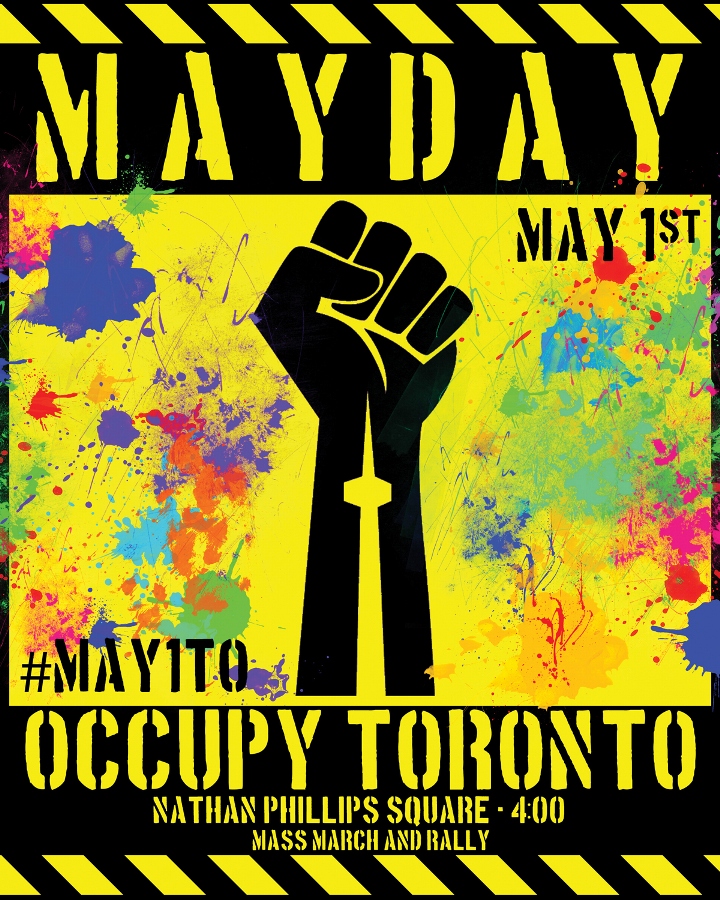
Alfred Hayes
Into the streets May First! (1934)
Into the streets May First!
Into the roaring Square!
Shake the midtown towers!
Shatter the downtown air!
Come with a storm of banners,
Come with an earthquake tread,
Bells, hurl out of your belfries,
Red flag, leap out your red!
Out of the shops and factories,
Up with the sickle and hammer,
Comrades, these are our tools,
A song and a banner!
Roll song, from the sea of our hearts,
Banner, leap and be free;
Song and banner together,
Down with the bourgeoisie!
Sweep the big city, march forward,
The day is a barricade;
We hurl the bright bomb of the sun,
The moon like a hand grenade.
Pour forth like a second flood!
Thunder the alps of the air!
Subways are roaring our millions –
Comrades, into the square!
*
International Workers’ Day (May Day) is back in earnest – though in some nations the voices have always been there, only elbowed out by the slickness of advertising and the ruthless editing of media in an all-round cacophony of contemporary life. Here in Toronto the Occupy Movement has joined forces with No One is Illegal to draw attention to the economic vulnerability of refugees and “hidden” immigrants. Though few of Toronto’s 2012 marchers will cry: “Up with the hammer and sickle!” as does the inspirational voice in the above poem (set in Depression-dreary New York City) by British-American writer Alfred Hayes (1911-1985), surely the same energy and enthusiasm will be felt.
_____
Milton Acorn
Demonstration on a Sunny Afternoon (1970)
These days not even death seems so certain;
But, considering the system, I’ve lived too long anyway.
For the young it should be more serious, but oddly
enough it’s not
(an odd whimsy, considering this isn’t
the Viet Nam jungle, or the streets of the USA;
death is remote – but I’m convinced
it won’t be always)
Nevertheless, to think of Crazy Horse
putting Crooke to flight on the Rosebud;
two weeks later eating up Custer,
waving his war-club, shouting:
“Come on, Dakotas…It’s a good day to die!”
It steadies my nerves…makes
a confrontation even pleasant…
*
In this poem from 1970 Milton Acorn (1923-1986) muses on the
zeitgeist of 1960s USA – the spirit of rebellion and protest
(rebellion and protest are not the same thing).
He speaks from a Canadian perspective in that era;
social unrest and political agitation were more muted here,
save for the FLQ Crisis and, later, in 1976, the victory of the Parti Québécois.
A sensitive tough guy and a boozer, Acorn fills the poem with a combination
of idealism, pessimism and humour – uniquely his.
He described himself thus:
“I am a Revolutionary Poet. Not revolutionary in my poetry but revolutionary in my politics.”
_____
Rose Pastor Stokes
Paterson (1913)
Our folded hands again are at the loom.
The air
Is ominous with peace.
But what we weave you see not through the gloom.
‘Tis terrible with doom.
Beware!
You dream that we are weaving what you will?
Take care!
Our fingers do not cease:
We’ve starved–and lost; but we are weavers
still;
And Hunger’s in the mill!…
And Hunger moves the Shuttle forth and back.
Take care!
The product grows and grows …
A shroud it is; a shroud of ghastly black.
We’ve never let you lack!
Beware!
The Warp and Woof of Misery and Defeat…
Take care!–
See how the Shuttle goes!
Our bruised hearts with bitter hopes now beat:
The Shuttle’s sure–and fleet!….
*
Several thousand Paterson, New Jersey, textile mill workers went on strike for six months in 1913. They were demanding a shorter work day – 8 hours instead of 12 – and an end to the use of child labour. Many women were involved and more than 1800 silk-weavers were arrested during the strike, which, though failing to produce any immediate results, put workers’ rights front and centre as a matter for public and political action in the USA.
In her poem, Rose Pastor Stokes (1879-1933) imagines the weavers back at their looms after the failed strike…
“Picasso’s sure a weird one!”: a poem and some pictures / “¡Este Picasso es un caso!”: un poema y unas pinturas
Posted: May 1, 2012 Filed under: Carlos Reviejo, English, Spanish, ZP Translator: Alexander Best Comments Off on “Picasso’s sure a weird one!”: a poem and some pictures / “¡Este Picasso es un caso!”: un poema y unas pinturas
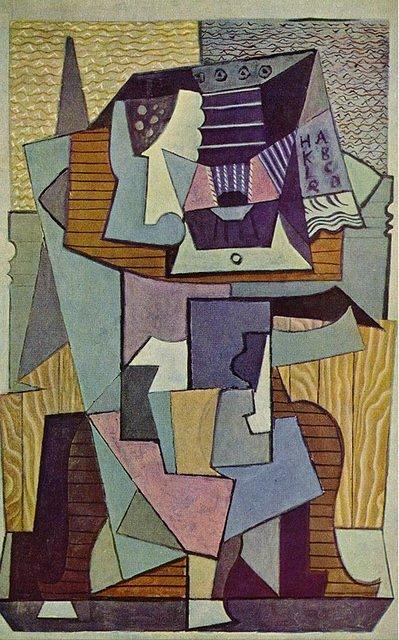
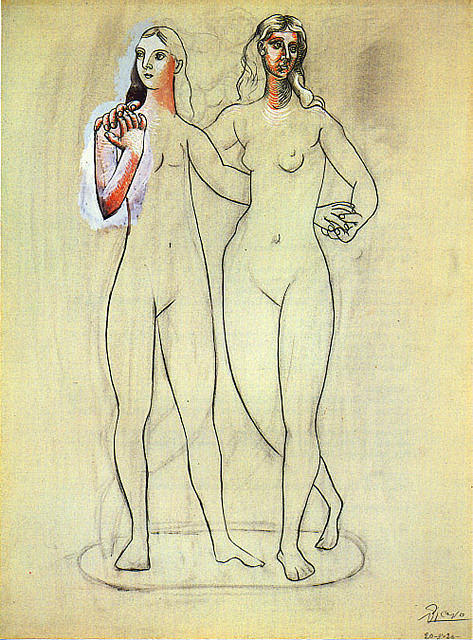
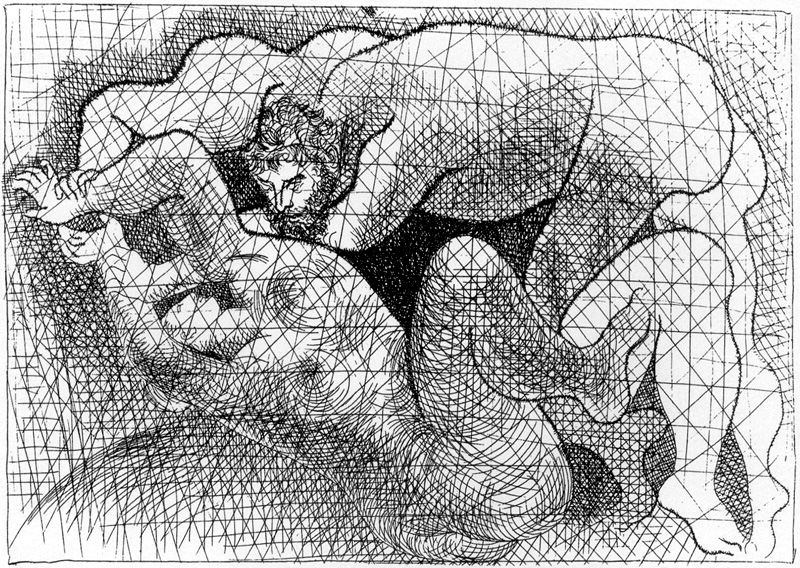
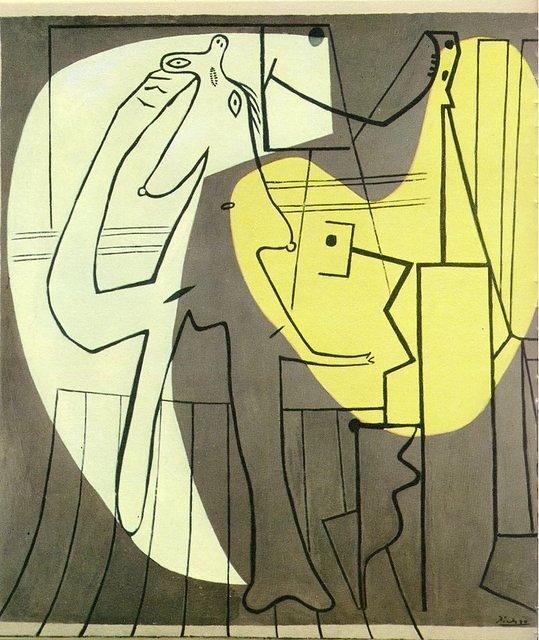
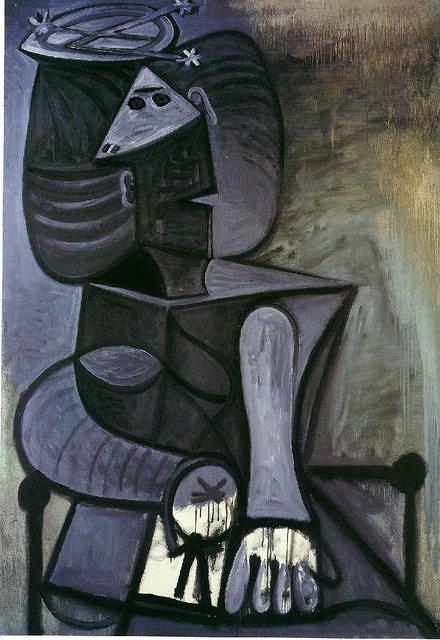
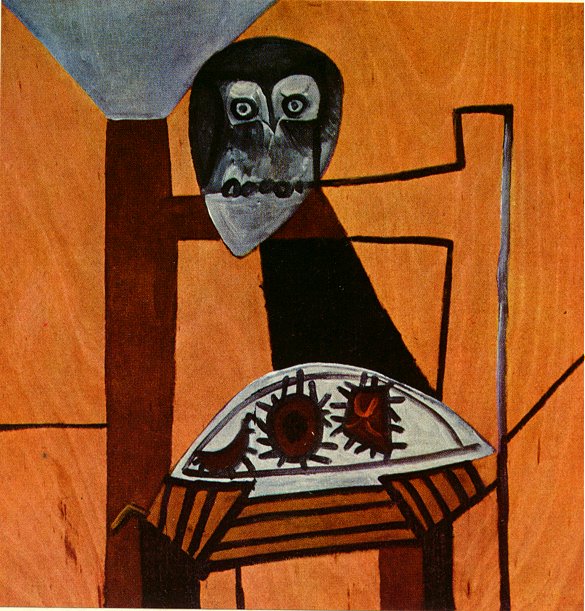
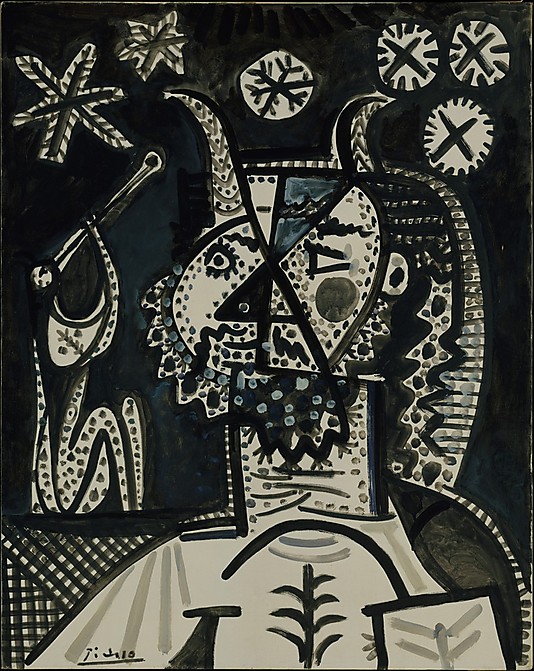
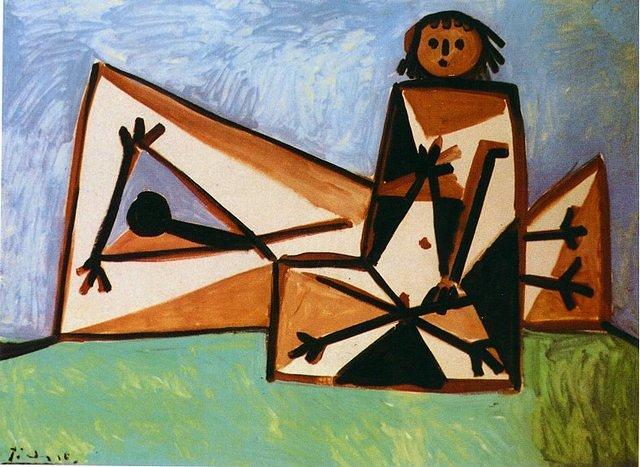
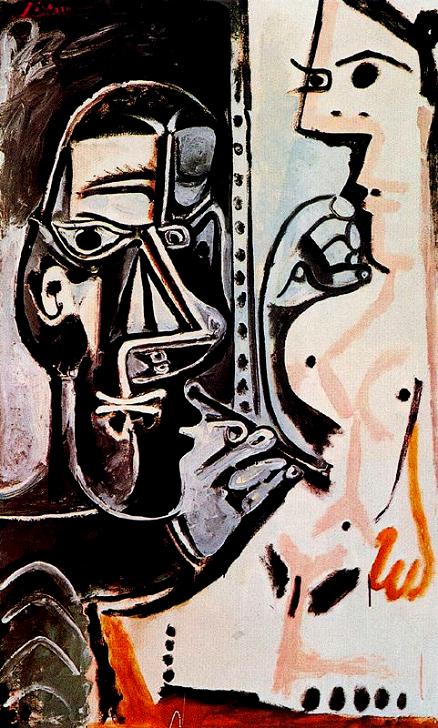
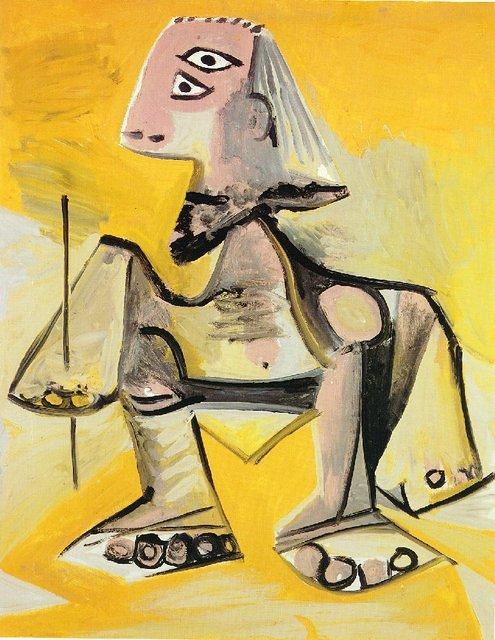
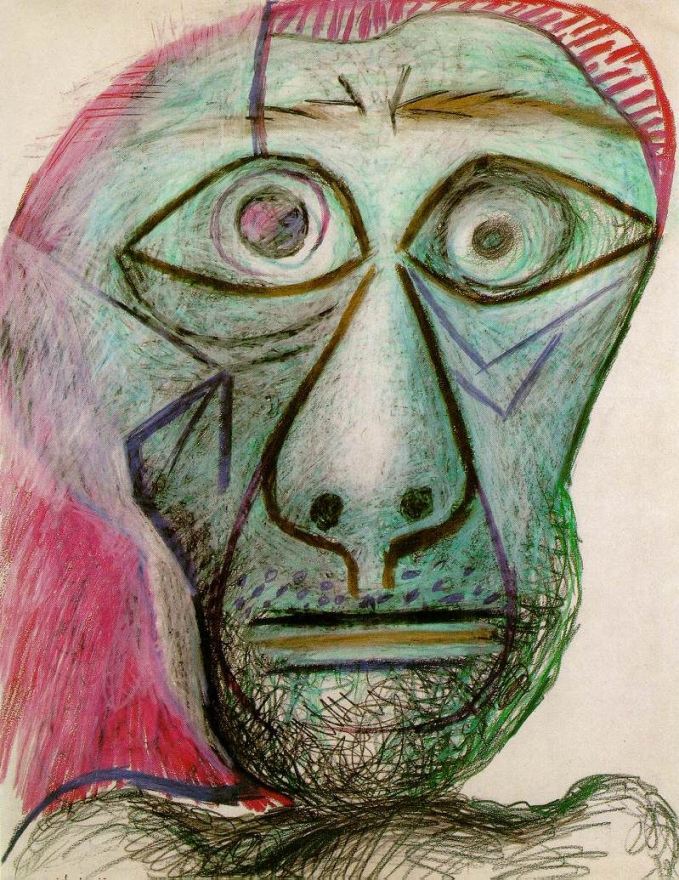
May 1st 2012 sees an awesome Picasso exhibition from Le Musée National Picasso in Paris opening here in Toronto, Canada…
Pablo Picasso (1881-1973) was born in Málaga, Spain, and by the end of his teens was already an energetic and talented imitator of all the “fin-de-siècle” painting styles then current in Europe.
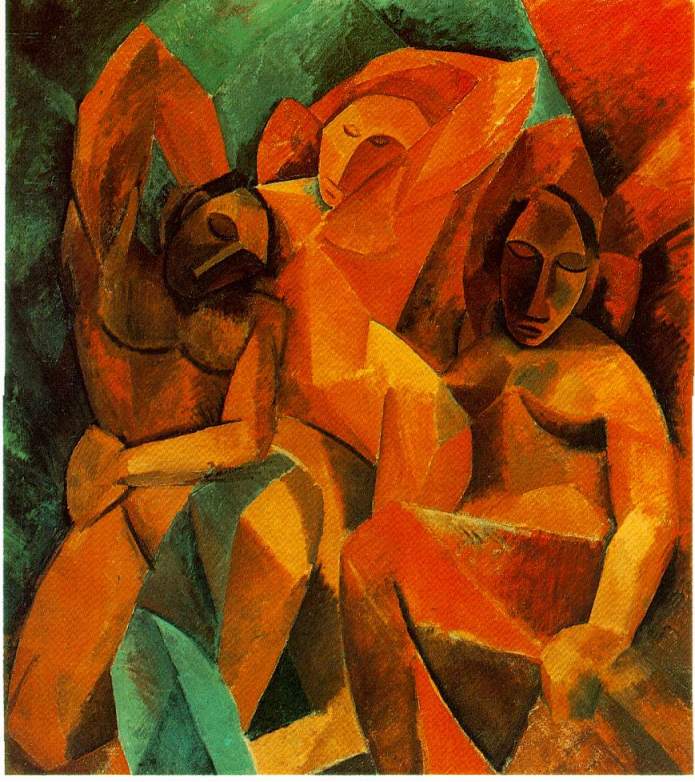
He made his first trip to Paris in 1900, and moved to the city – the centre of the art world – in 1902. It was the right place at the right time. Two crucial events occurred when he was in his mid-twenties. First – he met Gertrude Stein – a wealthy young American art collector who bought his paintings and championed him to everyone in her circle. And second – Picasso visited the Musée d’Ethnographie du Trocadéro where he saw masks and sculpture from Oceania and Africa. Highly stylized, these “primitive” artworks, unlike anything else Picasso had ever seen, were to make a forceful impression on his restless artistic sensibilities. The innovative effect of his “quick study” of Oceanic and African art was soon seen in his 1907 painting, “Les Demoiselles d’Avignon”. In this one canvas Picasso broke with 19th-century European art traditions and, along with a handful of his contemporaries, brought Western painting into the 20th century.
And yet – time and again – he would return to a theme straight out of the Classical Academies – that is: The Artist and The Model, or, for Picasso, The Artist and His Model.
Picasso’s lust and egomania are well documented in their vigour and even ugliness. Yet in his prolific artwork, spanning 75 years, he shows his undeniable energy for Life – all of Life…the subtle, the tender, the brutal and raw.
Famously, as an old man, he stated: “When I was young I could draw like Raphael, but it has taken me my whole life to learn to draw like a child.”
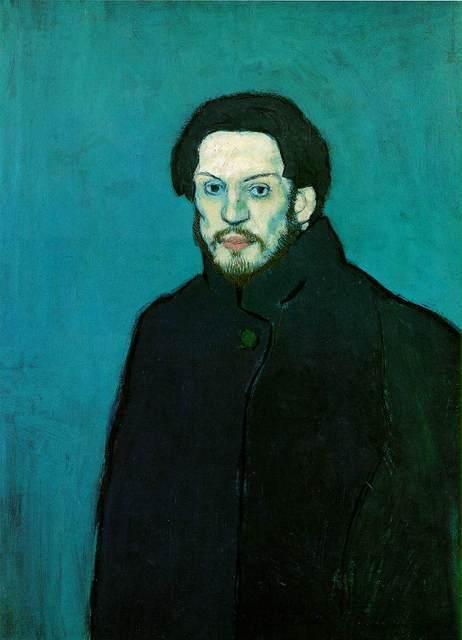
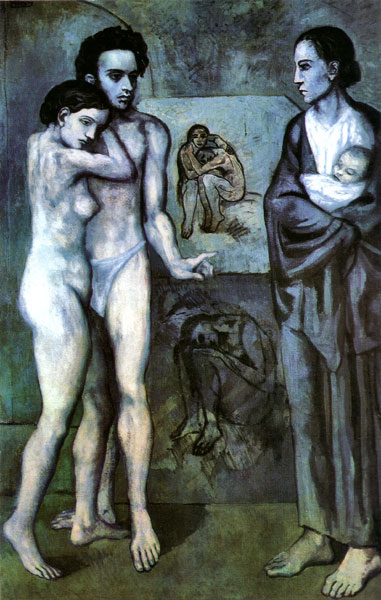
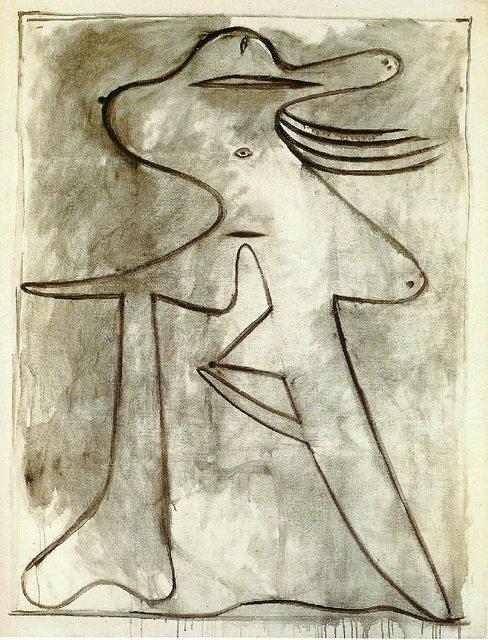
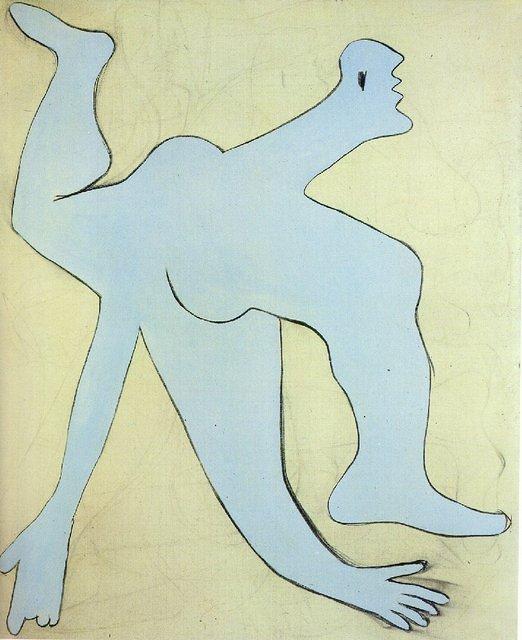
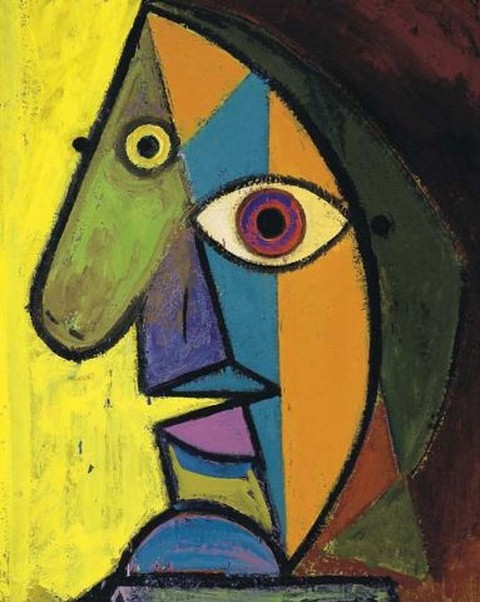
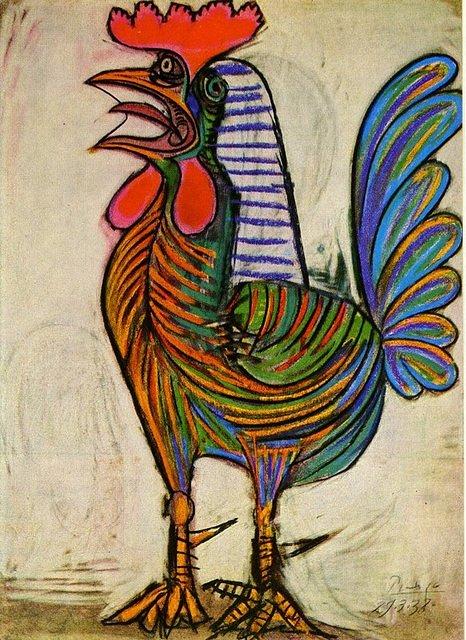
We feature here a light-hearted poem by Spanish children’s writer, Carlos Reviejo (born 1942), entitled “¡Este Picasso es un caso!” (Picasso’s sure a weird one!) – along with a selection of Pablo Picasso’s paintings and prints.
_____
Carlos Reviejo
“¡Este Picasso es un caso!”
¡Qué divertido es Picasso!
Es pintor rompecabezas
que al cuerpo rompe en mil piezas
y pone el rostro en los pies.
¡Todo lo pinta al revés!
¡Este Picasso es un caso!
Es un puro disparate.
No es que te hiera o te mate,
pero en lugar de dos cejas
él te pone dos orejas.
¡Vaya caso el de Picasso!
Te deja que es una pena: te trastoca y desordena,
te pone pies en las manos
y en vez de dedos, gusanos.
¡Si es que Picasso es un caso!
En la boca pone un ojo,
y te lo pinta de rojo.
Si se trata de un bigote,
te lo pondrá en el cogote.
¡Menudo caso es Picasso!
¿Eso es hombre o bicicleta?
¡Si es que ya nada respeta….!
Esos ojos que tú dices,
no son ojos…¡son narices!
¿No es un caso este Picasso?
Todo lo tuerce y disloca:
las piernas, brazos y boca.
No es verdad lo que tu ves.
¡Él pinta el mundo al revés!
¡Qué Picasso es este caso!
_____
Carlos Reviejo
“Picasso’s sure a weird one!”
A funny one, that Picasso!
A puzzling painter
who breaks a body into a thousand pieces
and puts the face where the feet should be.
He paints everything upside-down!
This Picasso’s a nutty one,
100% crazy!
It’s not that he might wound or kill you,
no, but in place of your eyebrows
he gives you ears.
A pity how he leaves you:
altered, a mess –
feet for hands
and worms for fingers.
Yes, Picasso’s a weird one!
In your mouth he puts an eye
and he paints it red.
When it’s all about the mustache,
well, he’ll place it on your neck.
What a case, that Picasso!
Here – is this a man…or a bicycle?
True, he respects nothing!
These eyes you said were eyes – ?
They’re noses!
Picasso’s a real head-case, isn’t he?
He twists and dislocates everything:
legs, arms, and mouth.
What you see is not for real.
He paints our world upside-down!
Yes, Picasso’s sure a weird one!
_
Spanish-to-English translation/interpretation: Alexander Best
_____
Jay Bernard: 2 Bold Poems
Posted: April 29, 2012 Filed under: English, Jay Bernard Comments Off on Jay Bernard: 2 Bold Poems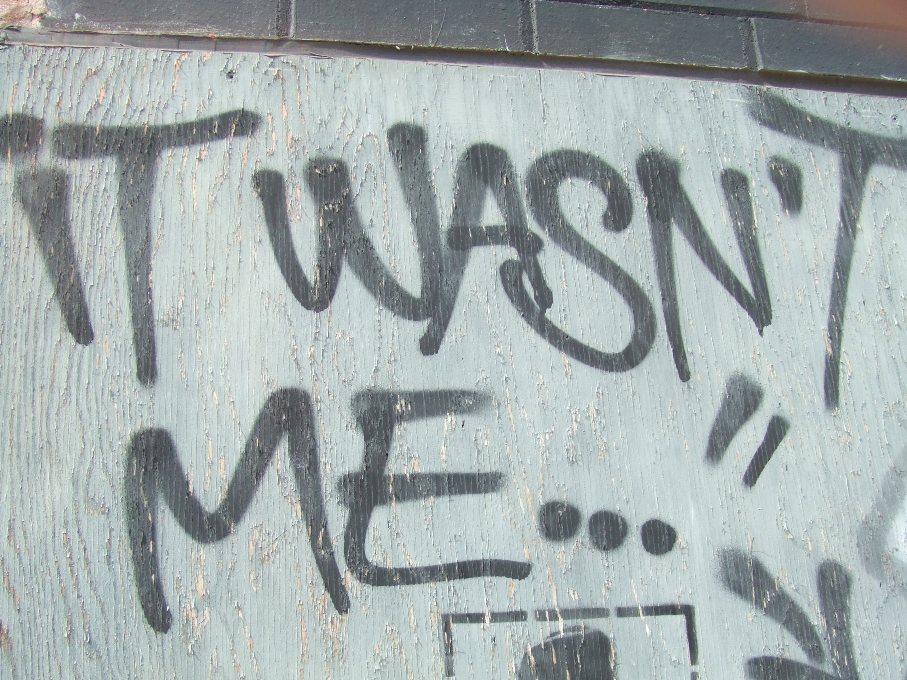
Jay Bernard
(born 1988, London, England)
At last we are alone
.
At last we are alone
And I can tell you how it felt
To stand in front of a blank wall
And spray ‘NF’ in white letters
So big they shone against the gloom.
.
I’m amongst the crowd watching
It being scrubbed from the school wall.
It’s eight a.m. The low clouds are yellow
With rain. Two men in council overalls
Are blasting the thin, erect letters
That salute the dark morning.
My classmates are nervous.
The head teacher, unaware, calls me a thug.
.
I am a thug. I lie down in the soft grass
After school and rub my bald head.
I call myself Tom. I am Tom from 1980:
I am from a story my father told me –
I am Tom who sees my father
And chases him down the street.
_____
109
.
A wet afternoon shrunk to a red bus
Slurring past a vast estate. Scratched windows.
Tinny hits leaking from an earphone.
A chicken bone slides back and forth
In the aisle.
.
We come to the superstore that draws breath
From everything around it; the one pound shop
With its leaning towers of garish tack.
I honestly don’t know which I prefer:
The bored employee or the pot bellied shop owner;
The girl with orbits dangling from her ears or the girl
With the peculiar god, bangled and painted in a
Procession of relatives –
.
And I don’t know if I can talk:
My eyes are English spectacles and everywhere
I see decay; I see cheap shoes; I see fast food; I see women
With fake hair and plastic gems on their toenails.
I see pierced children. I see bags in the trees and animal entrails
On the road. I see damp take-away boxes. I smell weed.
I hear a girl call her son a dickhead when he cries.
And who am I to judge?
And if I don’t, who will?
.
And who knows the depth of my hypocrisy
When I cross the road,
When I change seat,
When I move to another carriage,
To avoid the sound and the smell?
.
One night a boy comes upstairs
And begins playing music from his phone.
I ask him to stop and he ignores me.
I ask him again and he stares.
When we are alone, I take a sword from my bag
And cut upwards from the navel to the chops.
I draw him and set alight each quarter.
__________
We asked Jay Bernard to tell us about these poems…
At last we are alone
My dad moved to the UK in 1970 when he was ten. He hated it, not least because he was regularly the target of racial abuse. It was so frequent, in fact, that he and his other black friends had come to anticipate it whenever they saw groups of white boys. One afternoon, he was walking home with a friend when they came across just that – a group of schoolboys who had spotted them coming down the road. My dad noticed that they were looking and said to his friend, “shall we keep going?” When there was no response, he turned, and saw that his friend was already running for his life. This poem is not a re-telling of that story, but it came out of thinking about it. I ended up writing from the perspective of a black girl who graffities her school with racist slogans and imagines being a white fascist. Being the perceived victim of a particular ideology does not stop someone from fantasizing about the associated power. In this case, the power to instil fear, to mess with others and to get away with it.
*
When I was young, around seven or eight, I was conflicted because on the one hand, I recognized my position as a member of a marginalized group (endlessly re-enforced by tales of butchery, injustice and poverty); on the other, I did things like write “FUCK” and “BITCH” across the toilet walls (I could never bring myself to write racist things). Then I’d report it to the teacher, who was always white, and with whom I felt some solidarity. They never once suspected it was me. In fact, there were a few Soviet-style interrogations and innocent children were sent to the gulag. I feel terrible about that now, but it was an insightful childhood. I was always aware that I had limited power, so I played with what I had, and this surfaces again in “At last we are alone”; at last, I can talk about this.
109
This is based on a true story. I once asked a boy to stop playing music out loud on his phone and he essentially said he’d stab me if I didn’t go away. As far as I’m concerned, this poem is unfinished. I think the rhythm is off, the part about ‘my eyes are English spectacles’ and ‘if I don’t judge, who will?’ comes off badly. I always feel strange reading it in public, because it doesn’t fully express the ambiguity of my feelings about Croydon (which is where the incident happened and where I’m from). I regularly berate myself for being ‘judgmental’ when I feel something approaching hatred for people whose raison d’être is to make everyone else’s life miserable; I say, “no, no, it’s society; it’s class; it’s race. You have to forgive.” Which I do, most of the time, but increasingly I feel this approach means that people get away with all kinds of bullshit in public. It’s analogous to those old chestnuts: how do you deal with the freedom of people who are anti-freedom? How do you deal non-violently with people who are violent? How can you be both polite and effective in getting someone else to stop their aggressive impoliteness? Since these questions are not going to be answered any time soon, I wrote a violent, angry poem. I continue to be mild mannered and soft spoken to people who spit on buses, swear loudly, smash shit up or play their music. If they read my poems, I’m sure they’d laugh at my repression.
_____
Jay Bernard is from London and is currently the writer in residence at The Arts House and the National University of Singapore. She has performed all over the UK and internationally, and her first book “Your Sign is Cuckoo, Girl” (Tall Lighthouse) was PBS pamphlet choice for summer 2008. She is currently working on her second, to be published this year by Math Paper Press, Singapore. Visit her site: http://www.brrnrrd.wordpress.com
“Earth Day” poems: Aqqaluk Lynge
Posted: April 22, 2012 Filed under: A FEW FAVOURITES / UNA MUESTRA DE FAVORITOS, Aqqaluk Lynge, English, Kalaallisut (Greenlandic) Comments Off on “Earth Day” poems: Aqqaluk Lynge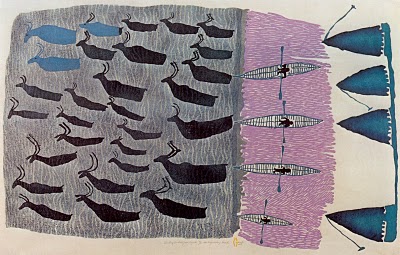
Aqqaluk Lynge is a Kalaallit (Greenland Inuit) poet who writes
in the Kalaallisut (Greenlandic) language – closely related to the Inuktitut
language of the Canadian Arctic.
The poems below were translated into English
by Ken Norris and Marianne Stenbaek, with the poet.
_____
A Life of Respect
In the old days
when we still lived our own lives
in our own country
We could hear
a faraway thunder –
the caribou approaching
two or three days in advance
*
Then we did not count the animals, but knew
that when the caribou herd arrived
it would be seven days
before all the animals crossed the river
We did not count them
We had no quotas
We knew only
that a child’s weeping
or a seagull’s cry
could frighten the animals away
*
Then we knew
that there is a balance
between the animals and us,
lives of mutual respect
*
Now it is as if we are under arrest
the wardens are everywhere
We are interrogated constantly.
In Your hungering after more riches and land
You make us suspect,
force us to justify our existence
*
On maps of the country
We must draw points and lines
to show we have been here –
and are here today,
here where the foxes run
and birds nest
and the fish spawn
*
You circumscribe everything
demand that we prove
We exist,
that We use the land that was always ours,
that We have a right to our ancestral lands
*
And now it is We who ask:
By what right are You here?
_____
Ataqqeqatigiittut
Qanga – ila qanga
nammineq inuugallaratta
uagut nammineq nunatsinni
Taamani tusartarpagut
avani qannguluk
ullut pingasut sioqqullugit
tuttorpaat ingerlaarnerat
*
Qanga – taamani
kisitsineq atunngilaq
nalunngittuarparpulli
ullut unnuallu arfineq-marluk
qaangiuppata
kuuk ikaareersimassagaat.
*
Pisassavut nalunngilavut
ilisimavarpullu malussarissup
tusassagaa meeqqap qiarpalua
naajannguulluunniit qarlorpalua
*
Qanga – taamani
suna tamarmi
naammattusaarineruvoq
ataqqeqatigiilluta
uumasut uagullu
*
Ullumikkulli tigusatut inuuvugut
sissuertut sumut pigaanni
qalliuniartut pasivaatigut
unnerluussatullu killisiorluta
*
Nuna assiliorpaat
uanngaanniit uunga titarlugu
aana killissaa
aana ilissi aana uagut
Tuttut uaniipput
aaku timmissat
aamma aaku aalisakkat
*
Suna tamaat killormut pivaat
uagutsinnullu uppernarsaqqullugu
apeqquserlugulu
ilumut inuusugut
nunalu tummaarigipput
*
Ataqqeqatigiittut aaku kisimik
uagut uumasullu.
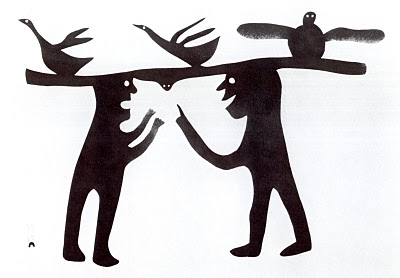
We listen to the Elders
I meet him on the land
goose-hunting
Today is Sunday, he says,
No-one is allowed to shoot
That’s what the Elders say
And we listen to the Elders…
sometimes.
*
A flock of geese is coming
fighting against the wind
He takes a rifle
and shoots at them
One falls to the ground
the others fly away
– Well, it is Sunday
*
A flock of ptarmigans
jumps in a circle around us
no cries are heard
They are afraid, the elder says,
the owls are out hunting
and the ptarmigans seek protection among Men
– so We don’t hunt Them,
that’s what the Elders say.
And We listen to the Elders…
sometimes.
_____
Utoqqartavut naalattarpavut
Nunap timaani naapippara nerlerniaq
– utoqqartatta oqaappaatigut
“Ullumi sapaat
taamaammat aallaaniassanngilagut”
Utoqqaammi oqartapata
naalattarpavut – ilaanni
*
Nerlerpaaluit assorlutik timmisut qulaappaatigut
aallaaniap timmiarsiunni kiviinnaqaa
ummiullugillu
seqqoqaaq
ataasersuaq nakkaqaaq
sinneri ingerlaannarput
– ullumi sapaat
*
Aqisserpalaaq tusiuppoq
eqqannguatsinnut mipput
kaavillutalu
Utoqqartarput pilerpoq
“Aqissit uppinnit piniarneqartillutik
inunnut qimaasaramik
Nujuillisaaraangata
aallaaiarneq ajorpavut”
Utoqqaammi oqarpata
naalaattarpavut – ilaanni
_____
“Earth Day” poems: Japanese poets on Nature – and Human Nature
Posted: April 22, 2012 Filed under: English Comments Off on “Earth Day” poems: Japanese poets on Nature – and Human Nature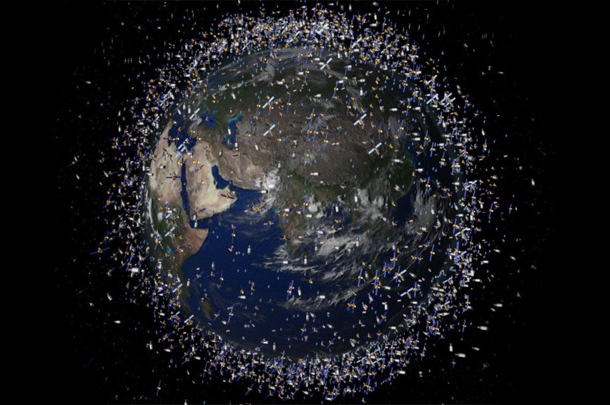
NASA photo: Planet Earth and its ‘near-Space’ debris
Dobashi Jiju
(1909-1993, Yamanashi, Japan)
The Endearing Sea
.
As I lived far away from the sea,
it gradually passed more out of my mind every day,
like its distance.
After days and days,
it became like a dot, no longer looking like a sea.
I felt compelled to go the movies
to see the sea
on the screen.
*
But when I slept at night,
the sea came to me, pushing down my chest
and raising clear blue waves.
I just slept, even in the daytime,
freely.
Then
the sea kept mounting big waves
on my chest,
covering me with spray from a storm.
And sometimes it washed up beautiful white bones,
which had sunk to its bottom,
up around my ribs.
_____
Aida Tsunao
(1914-1990, Tokyo, Japan)
The Wild Duck
.
Did the wild duck say,
“Don’t ever become a wild duck,”
at that time ?
No.
We plucked the bird,
burned off its hair,
broiled its meat and devoured it,
and, licking our lips,
we began to leave the edge of the marsh
where an evening mist was hanging,
when we heard a voice:
“You could still chew
on my bones.”
*
We looked back
and saw the laughter of the wild duck
and its backbone gleaming.
_____
Ishihara Yoshiro
(1919-1980, Hiroshima, Japan)
River
.
There is the mouth of the river.
That is where the river ends.
That is where the sea begins.
The river made sure of that place
and overflowed
and ran over it.
Riding over that place,
the river also produced the fertile riverbed.
It has defined its banks
with two streaks of intention
which cannot mix with the sea,
while the river itself keeps flowing
into the sea,
farther than the sea,
and more slowly than the sea.
_____
So Sakon
(1919-2006, Fukuoka, Japan)
The Earth
.
The rocket was blasting away.
Green apples were swaying.
The void was blowing up reality.
Through the silver sky a snake went flowing by.
The rocket was blasting.
While blasting, it stayed motionless.
Stars were scattering over the ground.
Jewels were dreaming with their eyes closed.
The Earth fell in the garden of a future morning.
The rocket, unable to fly, kept blasting.
_____
Translations from Japanese into English:
Naoshi Koriyama and Edward Lueders
Milton Acorn: “Live with me on Earth under the invisible daylight moon” and “On Speaking Ojibway”
Posted: April 22, 2012 Filed under: English, Milton Acorn Comments Off on Milton Acorn: “Live with me on Earth under the invisible daylight moon” and “On Speaking Ojibway”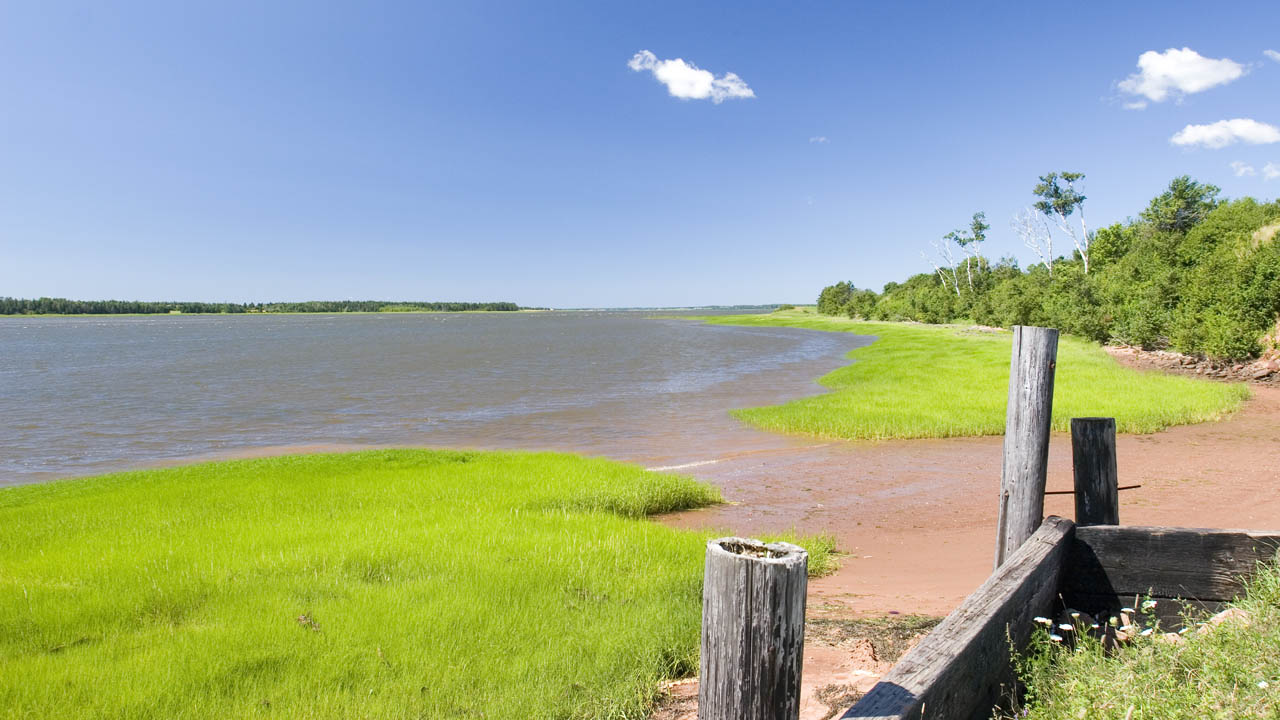
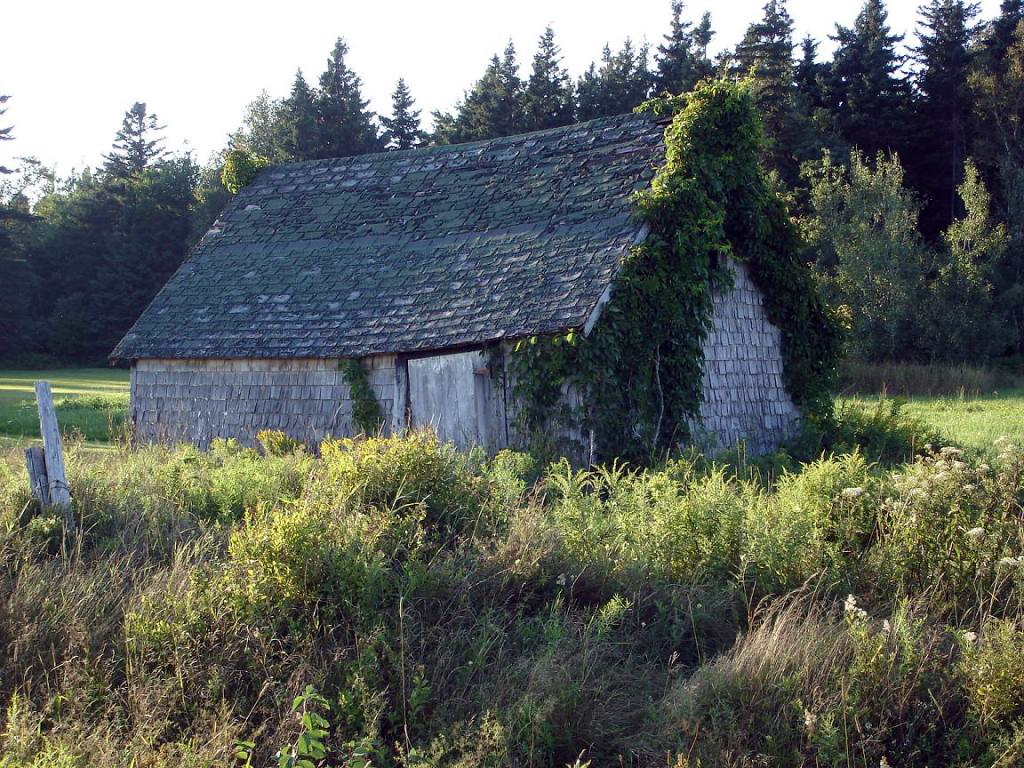
Hillsborough River near Charlottetown, Prince Edward Island_photo by Terry Danks
Milton Acorn
(1923-1986, Prince Edward Island, Canada)
“Live with me on Earth under the invisible daylight moon”
.
Live with me on Earth among red berries and the bluebirds
And leafy young twigs whispering
Within such little spaces, between such floors of green, such
figures in the clouds
That two of us could fill our lives with delicate wanting:
*
Where stars past the spruce copse mingle with fireflies
Or the dayscape flings a thousand tonnes of light back at the
Sun —
Be any one of the colours of an Earth lover;
Walk with me and sometimes cover your shadow with mine.
On Speaking Ojibway
.
In speaking Ojibway you’ve got to watch the clouds
turning, twisting, raising their heads
to look at each other and you.
You’ve got to have their thoughts for them
and thoughts there’ll be which would never
exist had there been no clouds.
*
Best speak in the woods beside a lake
getting in time with the watersounds.
Let vibrations of waves sing right through you
and always be alert for the next word
which will be yours but also the water’s.
*
No beast or bird gives a call
Which can’t be translated into Ojibway.
Therefore be sure Ojibway lives.
There’s no bending or breaking in the wind,
no egg hatching, no seed spring
that isn’t part of Ojibway.
Therefore be sure Ojibway lives.
*
The stars at night, their winking signals;
the dawn long coming; the first
thin cut of the sun at the horizon.
Words always steeped in memory
and a hope that makes sure
by action that it’s more than hope,
That’s Ojibway – which you can speak in any language.
. . . . .
El Día del Indio Americano: Norval Morrisseau
Posted: April 19, 2012 Filed under: IMAGES Comments Off on El Día del Indio Americano: Norval Morrisseau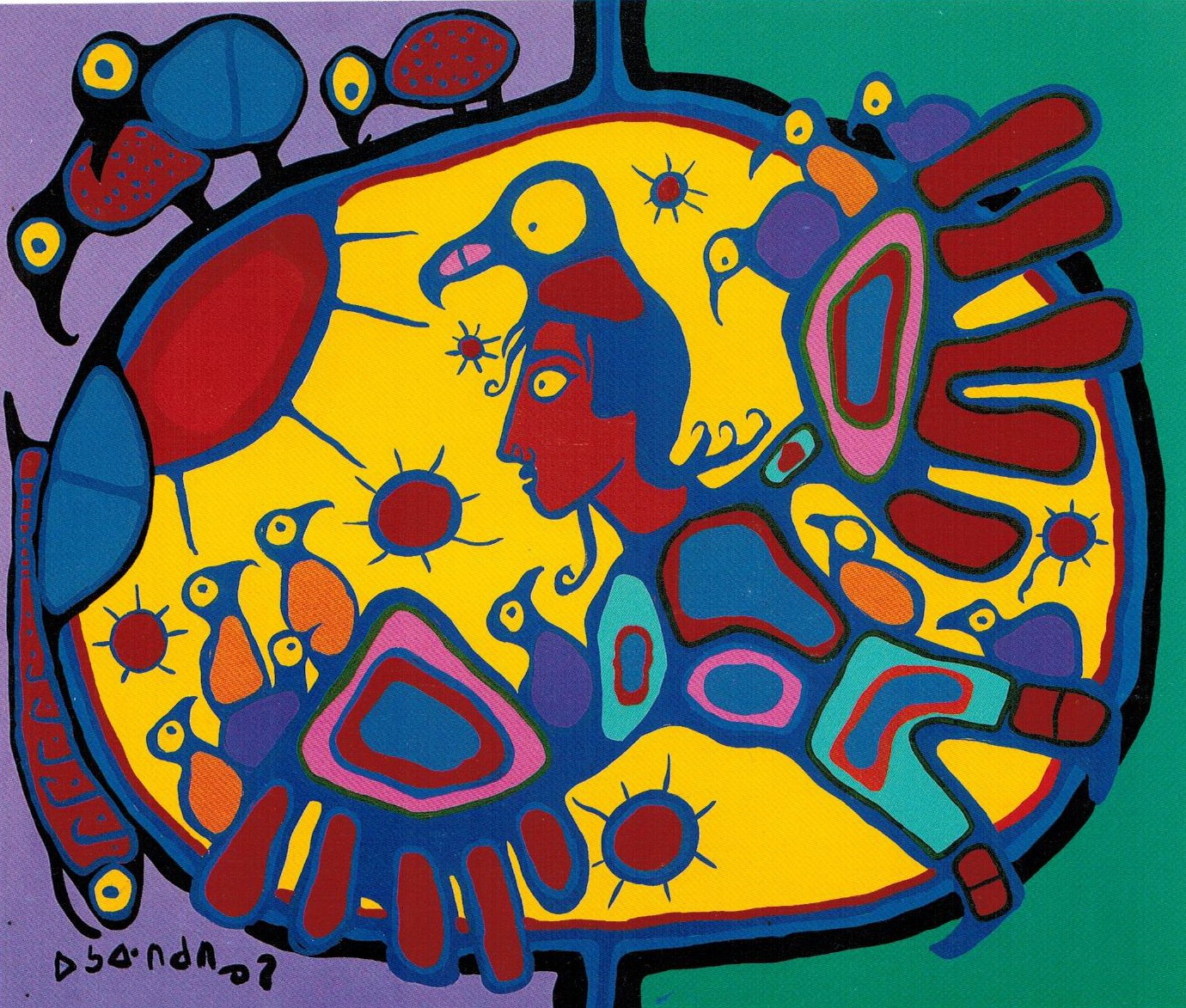
El Día del Indio Americano: un homenaje al Pueblo Maya
Posted: April 19, 2012 Filed under: English, Juan Felipe Herrera, Spanish Comments Off on El Día del Indio Americano: un homenaje al Pueblo MayaDos poemas por Juan Felipe Herrera / Two poems by Juan Felipe Herrera
de un homenaje al Pueblo Maya / from an homage to the Mayan People
_____
Morning opens like the grasses
of my pueblo, leaves of corn and orange squash.
The dreams of the wounded
rise to caress her, they weave yellow crosses,
woolen suns, rivers of lances.
It rains on the streets,
maids scurry to the market.
Their laughter and jokes, their heavy dresses.
The twittering kiosk lets go of its copper
and city life begins. Once more
another river happens. Flows down my braids
all the way to my heart.
My mother Pascuala’s hands
weave onto mine. At times the wounds
close and what is left is only
the act of being reborn.
_____
La mañana se abre como las pastos
de mi pueblo, hojas de maíz y anaranjada calabaza.
Los sueños de los heridos
suben a acariciarla, tejen cruces amarillas
soles de lana, ríos de lanzas.
Llueve en las calles,
las criadas se apreseran al mercado.
Sus risas y sus chistes, sus enaguas pesadas.
El quiosco cantarín suelta su cobre
y empieza la vida en la ciudad. Una vez más,
otro río nace. Desciende por mis trenzas
hasta mi corazón.
Las manos de mi madre Pascuala
se tejen en las mías. A veces las heridas
se cierran y queda solamente
el acto de renacer.
_____
The pueblo’s triumph will rise from a torn branch,
in a landscape of a wounded mare and a ruined cornfield.
It will be in your sisters, their instruments transformed
across the world. In the international pollen
the mountain’s sudden conversion
into birds and serpents and women and hard thunder.
.
* pueblo means village – also people
_____
El triunfo del pueblo emanará de una rama rota,
en un paisaje de yegua herida y un maizal trastornado.
Estará en tus hermanas, sus instrumentos renovados
a través del mundo, en el polen internacional
las montañas que de repente se convierten
en aves y serpientes y mujeres y relámpagos duros.
_____
Juan Felipe Herrera was born in 1948 in California
to parents who were migrant farm-workers.
A Chicano poet, he has been writing for 40 years,
freely combining Spanish and English.
He has been described as “a factory of hybridity”
and “an eclectic virtuoso”.
_
In these two poems Herrera speaks in the voices
of a Mayan mother, Pascuala (“The pueblo’s triumph…”) and her
daughter Makal (“Morning opens…”)
Herrera’s poem-story, Thunderweavers/Tejedoras de rayos (2000),
is an homage to the Mayan people of Acteal, Chiapas, México,
where paramilitaries massacred townsfolk in 1997.
El Día del Indio Americano: unos poemas en guaraní y una reflexión sobre el lenguaje paraguayo
Posted: April 19, 2012 Filed under: Feliciano Acosta Alcaraz, Guaraní, Spanish Comments Off on El Día del Indio Americano: unos poemas en guaraní y una reflexión sobre el lenguaje paraguayo_____
Feliciano Acosta Alcaraz
(nace 1943, Paraguay)
OKÁI YVYTU
Pytä yvytu rembe’y,
okái yvytu
ha hendy.
Ikü hakuvópe
oheréi kapi’i
ha omosununu.
Ka’aguy rovykä
omocha’ï
ha omyendy avei.
Hendypa yvytu,
kapi’i ha
ka’aguy.
Okái che retä
Ha ipyahë ryapu
Tatatïre ojupi.
Okái,
okaihágui
okaive
che retä.
_
Arde el Viento
Escarlata se ha vuelto,
la orilla del viento
se quema el viento y arde.
Con su tórrida lengua
lame la hierba
y la inflama.
Arruga
los árboles del bosque
y los enciende a su paso.
Arden el viento,
las hierbas y
el monte.
Mi tierra se incendia
y su gemido
se levanta en humo.
Se calcina,
más
y más
mi tierra.
_
KO’ËJU
Ko’ëju,
ko’ëju.
Mamóiko
reime.
Ipohýi,
ipohyive
ko pytü.
Hetáma
osyry
jukyry.
Ñembyahýi
opáy
ha okevy
ogami
kapi’i
pepo
guýpe.
Yvytu.
Ejúna pya’e
yvytu,
rehasávo
ehetünte
jepe
oipoväva
angata
ko’ëju
ra’ärövo
oikovéva
rova.
_
Albor
Albor,
albor.
¿Dónde
estás?
Es pesada
muy pesada
la noche.
Ya ha corrido
tanto
el sudor.
El hambre
despierta
y dormita
bajo
las alas
humildes
del techo.
Viento.
Acude con prisa
viento,
y besa
a tu paso
el rostro
del que teje
la angustia,
del que vive
esperando
el albor.
_
JEHEKA
Aguyguy, aheka
pe yvy.
Mamópoku oime.
Ysyry ruguaitépe
apovyvy
jahechápa ajuhu.
Ysoindy rata pirirípe
añemi
aheka
ha mamópa ajuhu.
Añapymi ynambu
perere ryapu ryrýipe
aheka.
Che ári opa kuarahy,
ha aheka ahekavérö aheka
ha mamópa ajuhu.
Itakuruvi che pire ombo’i.
Che py huguy syry tyky.
Mamópoku oime
pe yvy,
yvy maräne’ÿ.
Tatatïme poku
oime
reñemi.
_
Búsqueda
Deambulo buscando
esa tierra.
¿Dónde estará?
El fondo del río
hurgo
haber si lo encuentro.
En el chisporroteo de la luz de la luciérnaga
me agazapo también,
buscando
y jamás la encontré.
En el temblor
del aleteo de la perdiz me sumergí
buscándola.
El sol cae implacable sobre mí,
y la busco
y la sigo buscando
y jamás la encontré.
Los cantos rodados trizan mi piel
Mis pies sangran a borbotones.
Dónde estará
esa tierra,
la tierra sin mal.
¿Será que la niebla,
la cubre.
_
ÑE’Ẽ RYRÝI
Che ahy’ópe
oryrýi
che ñe’ẽ.
Che ñe’ẽ
osẽséva
ombokua
yvytu.
Che ruguy
opupu,
osapukái
mboraihúpe
guarã
oipota
piro’y.
Che ahy’ópe
oryrýi
che ñe’ẽ.
Che ñe’ẽ
osẽséva
ombokua
yvytu.
Ha katu
iporãve
che ahy’ópe omano.
_
Temblorosa Palabra
En mi garganta
tiembla
mi palabra.
Mi palabra
que quiere salir
a perforar
el viento.
Mi sangre
bulle,
grita
porque
quiere
alivio
para el pobre.
En mi garganta
tiembla
mi palabra.
Mi palabra,
que quiere salir
a perforar
el viento.
Y bien puede ser
que en mi misma garganta
se muera.
_____
Nota de redactor:
La nación de Paraguay es única.
La gente es en su mayoría mestiza y bilingüe; habla dos lenguajes oficiales:
el español y el idioma indígeno “guaraní”. Aunque habla guaraní,
la mayoría no se ve como indígena. Existen en Paraguay un mestizaje cultural
sin igual; la hispanización de los paraguayos es real pero hablan – y utilizan – el guaraní
el noventa por ciento de la población – un caso singular en el mundo actual.
Hay ocho millones de hablantes de guaraní, cifra que incluye a muchos argentinos y
brasileños de quien el guaraní es su lengua maternal.
Un idioma aislado ha prosperado mientras otros han desaparecido.
Estos hechos suscitan numerosas preguntas y nos dan mucho en que pensar en este día,
el 19 de abril – el Día del Indio Americano.
_____
Traducción de poemas del guaraní al español:
El poeta – y Ruben Bareiro Saguier y Carlos Villagra Marsal
 Zócalo Poets