A poem for Remembrance Day: “What our dead can do” (translation from the Polish)
Posted: November 11, 2014 Filed under: English | Tags: Remembrance Day poems Comments Off on A poem for Remembrance Day: “What our dead can do” (translation from the Polish)Zbigniew Herbert (Poland, 1924-1998)
What our dead can do
.
Jan came this morning
—I dreamt of my father
he says
he was riding in an oak coffin
I walked next to the hearse
and father turned to me:
you dressed me nicely
and the funeral is very beautiful
at this time of year so many flowers
it must have cost a lot
don’t worry about it father
—I say—let people see
we loved you
that we spared nothing
six men in black livery
walk nicely at our sides
father thought for a while
and said—the key to the desk
is in the silver inkwell
there is still some money
in the second drawer on the left
with this money—I say—
we will buy you a gravestone
a large one of black marble
it isn’t necessary—says father—
better give it to the poor
six men in black livery
walk nicely at our sides
they carry burning lanterns
again he seemed to be thinking
—take care of the flowers in the garden
cover them for the winter
I don’t want them to be wasted
you are the oldest—he says—
from a little felt bag behind the painting
take out the cuff links with real pearls
let them bring you luck
my mother gave them to me
when I finished high school
then he didn’t say anything
he must have entered a deeper sleep
this is how our dead
look after us
they warn us through dreams
bring back lost money
hunt for jobs
whisper the numbers of lottery tickets
or when they can’t do this
knock with their fingers on the windows
and out of gratitude
we imagine immortality for them
snug as the burrow of a mouse.
. . .
from the collection Elegia na odejście (Elegy for the Departure), published in 1990
Translation from Polish into English © 1999, John and Bogdana Carpenter
. . . . .
Zbigniew Herbert: Report from the Besieged City / Raport z oblężonego Miasta
Posted: November 11, 2014 Filed under: English, Polish | Tags: Remembrance Day poems Comments Off on Zbigniew Herbert: Report from the Besieged City / Raport z oblężonego Miasta
Zbigniew Herbert (Poland, 1924-1998)
Report from the Besieged City
.
Too old to carry arms and fight like the others –
they graciously gave me the inferior role of chronicler
I record – I don’t know for whom – the history of the siege
I am supposed to be exact but I don’t know when the invasion began
two hundred years ago in December in September perhaps yesterday at dawn
everyone here suffers from a loss of the sense of time
all we have left is the place the attachment to the place
we still rule over the ruins of temples spectres of gardens and houses
if we lose the ruins nothing will be left
I write as I can in the rhythm of interminable weeks
monday: empty storehouses a rat became the unit of currency
tuesday: the mayor murdered by unknown assailants
wednesday: negotiations for a cease-fire the enemy has imprisoned our messengers
we don’t know where they are held that is the place of torture
thursday: after a stormy meeting a majority of voices rejected
the motion of the spice merchants for unconditional surrender
friday: the beginning of the plague saturday: our invincible defender
N.N. committed suicide sunday: no more water we drove back
an attack at the eastern gate called the Gate of the Alliance
all of this is monotonous I know it can’t move anyone
I avoid any commentary I keep a tight hold on my emotions I write about the facts
only they it seems are appreciated in foreign markets
yet with a certain pride I would like to inform the world
that thanks to the war we have raised a new species of children
our children don’t like fairy tales they play at killing
awake and asleep they dream of soup of bread and bones
just like dogs and cats
in the evening I like to wander near the outposts of the city
along the frontier of our uncertain freedom.
I look at the swarms of soldiers below their lights
I listen to the noise of drums barbarian shrieks
truly it is inconceivable the City is still defending itself
the siege has lasted a long time the enemies must take turns
nothing unites them except the desire for our extermination
Goths the Tartars Swedes troops of the Emperor regiments of the Transfiguration
who can count them
the colours of their banners change like the forest on the horizon
from delicate bird’s yellow in spring through green through red to winter’s black
and so in the evening released from facts I can think
about distant ancient matters for example our
friends beyond the sea I know they sincerely sympathize
they send us flour lard sacks of comfort and good advice
they don’t even know their fathers betrayed us
our former allies at the time of the second Apocalypse
their sons are blameless they deserve our gratitude therefore we are grateful
they have not experienced a siege as long as eternity
those struck by misfortune are always alone
the defenders of the Dalai Lama the Kurds the Afghan mountaineers
now as I write these words the advocates of conciliation
have won the upper hand over the party of inflexibles
a normal hesitation of moods fate still hangs in the balance
cemeteries grow larger the number of defenders is smaller
yet the defence continues it will continue to the end
and if the City falls but a single man escapes
he will carry the City within himself on the roads of exile
he will be the City
we look in the face of hunger the face of fire face of death
worst of all – the face of betrayal
and only our dreams have not been humiliated.
. . .
from Raport z oblężonego Miasta i inne wiersze (Report from the Besieged City and Other Poems), published in 1982, English translation © 1983, John and Bogdana Carpenter
. . .
Here is the poem in its original Polish:
Raport z oblężonego Miasta
Zbyt stary żeby nosić broń i walczyć jak inni –
wyznaczono mi z łaski poślednią rolę kronikarza
zapisuję – nie wiadomo dla kogo – dzieje oblężenia
mam być dokładny lecz nie wiem kiedy zaczął się najazd
przed dwustu laty w grudniu wrześniu może wczoraj o świcie
wszyscy chorują tutaj na zanik poczucia czasu
pozostało nam tylko miejsce przywiązanie do miejsca
jeszcze dzierżymy ruiny świątyń widma ogrodów i domów
jeśli stracimy ruiny nie pozostanie nic
piszę tak jak potrafię w rytmie nieskończonych tygodni
poniedziałek: magazyny puste jednostką obiegową stał się szczur
wtorek: burmistrz zamordowany przez niewiadomych sprawców
środa: rozmowy o zawieszeniu broni nieprzyjaciel internował posłów
nie znamy ich miejsca pobytu to znaczy miejsca kaźni
czwartek: po burzliwym zebraniu odrzucono większością głosów
wniosek kupców korzennych o bezwarunkowej kapitulacji
piątek: początek dżumy sobota: popełnił samobójstwo
N. N. niezłomny obrońca niedziela: nie ma wody odparliśmy
szturm przy bramie wschodniej zwanej Bramą Przymierza
wiem monotonne to wszystko nikogo nie zdoła poruszyć
unikam komentarzy emocje trzymam w karbach piszę o faktach
podobno tylko one cenione są na obcych rynkach
ale z niejaką dumą pragnę donieść światu
że wyhodowaliśmy dzięki wojnie nową odmianę dzieci
nasze dzieci nie lubią bajek bawią się w zabijanie
na jawie i we śnie marzą o zupie chlebie i kości
zupełnie jak psy i koty
wieczorem lubię wędrować po rubieżach Miasta
wzdłuż granic naszej niepewnej wolności
patrzę z góry na mrowie wojsk ich światła
słucham hałasu bębnów barbarzyńskich wrzasków
doprawdy niepojęte że Miasto jeszcze się broni
oblężenie trwa długo wrogowie muszą się zmieniać
nic ich nie łączy poza pragnieniem naszej zagłady
Goci Tatarzy Szwedzi hufce Cesarza pułki Przemienienia Pańskiego
kto ich policzy
kolory sztandarów zmieniają się jak las na horyzoncie
od delikatnej ptasiej żółci na wiosnę przez zieleń czerwień do zimowej czerni
tedy wieczorem uwolniony od faktów mogę pomyśleć
o sprawach dawnych dalekich na przykład o naszych
sprzymierzeńcach za morzem wiem współczują szczerze
ślą mąkę worki otuchy tłuszcz i dobre rady
nie wiedzą nawet że nas zdradzili ich ojcowie
nasi byli alianci z czasów drugiej Apokalipsy
synowie są bez winy zasługują na wdzięczność więc jesteśmy wdzięczni
nie przeżyli długiego jak wieczność oblężenia
ci których dotknęło nieszczęście są zawsze samotni
obrońcy Dalajlamy Kurdowie afgańscy górale
teraz kiedy piszę te słowa zwolennicy ugody
zdobyli pewną przewagę nad stronnictwem niezłomnych
zwykłe wahanie nastrojów losy jeszcze się ważą
cmentarze rosną maleje liczba obrońców
ale obrona trwa i będzie trwała do końca
i jeśli Miasto padnie a ocaleje jeden
on będzie niósł Miasto w sobie po drogach wygnania
on będzie Miasto
patrzymy w twarz głodu twarz ognia twarz śmierci
najgorszą ze wszystkich – twarz zdrady
i tylko sny nasze nie zostały upokorzone
. . . . .
Election Day poems: “Democracy” X 3
Posted: November 4, 2014 Filed under: English | Tags: Election Day poems Comments Off on Election Day poems: “Democracy” X 3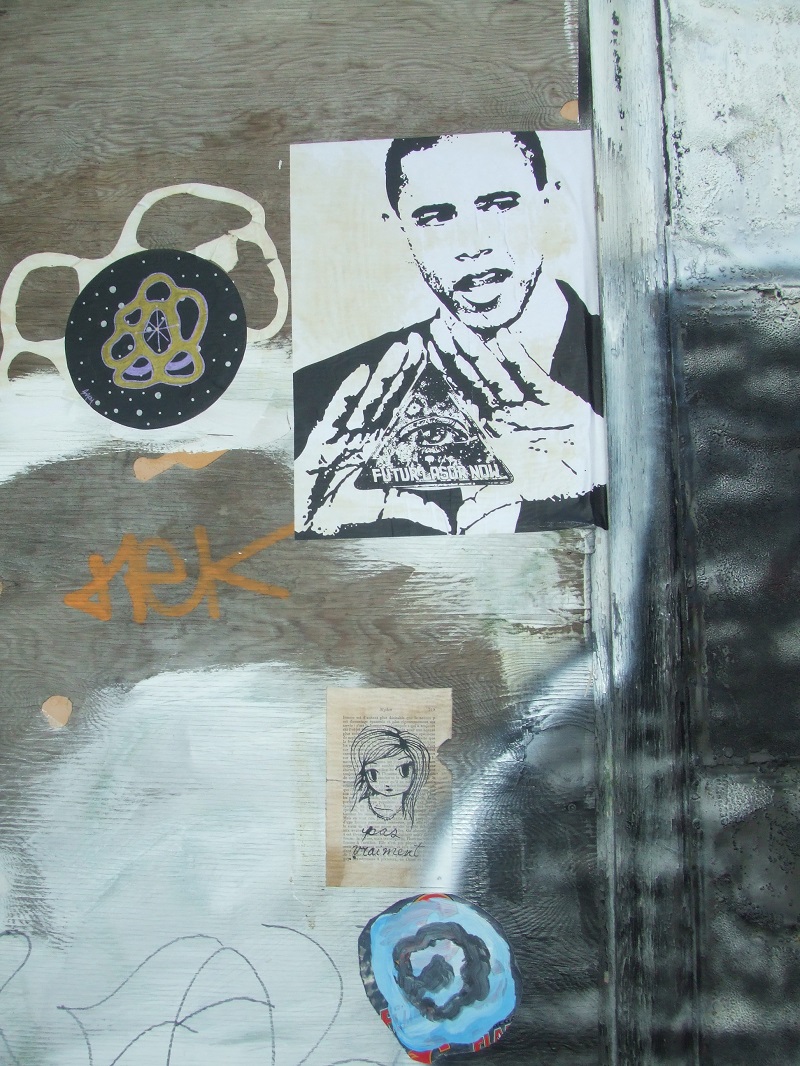
Today, the first Tuesday after the first Monday in November, is traditionally “Election Day” in the U.S.A. Following, some poems to ponder…
Langston Hughes
(1902-1967)
Democracy
(1949)
.
Democracy will not come
Today, this year
Nor ever
Through compromise and fear.
I have as much right
As the other fellow has
To stand
On my two feet
And own the land.
I tire so of hearing people say,
Let things take their course.
Tomorrow is another day.
I do not need my freedom when I’m dead.
I cannot live on tomorrow’s bread.
Freedom
Is a strong seed
Planted
In a great need.
I live here, too.
I want freedom
Just as you.
……….
Dorianne Laux (born 1952, Augusta, Maine, U.S.A.)
Democracy
.
When you’re cold—November, the streets icy and everyone you pass
homeless, Goodwill coats and Hefty bags torn up to make ponchos—
someone is always at the pay phone, hunched over the receiver
spewing winter’s germs, swollen lipped, face chapped, making the last
tired connection of the day. You keep walking to keep the cold
at bay, too cold to wait for the bus, too depressing the thought
of entering that blue light, the chilled eyes watching you decide
which seat to take: the man with one leg, his crutches bumping
the smudged window glass, the woman with her purse clutched
to her breasts like a dead child, the boy, pimpled, morose, his head
shorn, a swastika carved into the stubble, staring you down.
So you walk into the cold you know: the wind, indifferent blade,
familiar, the gold leaves heaped along the gutters. You have
a home, a house with gas heat, a toilet that flushes. You have
a credit card, cash. You could take a taxi if one would show up.
You can feel it now: why people become Republicans: Get that dog
off the street. Remove that spit and graffiti. Arrest those people huddled
on the steps of the church. If it weren’t for them you could believe in god,
in freedom, the bus would appear and open its doors, the driver dressed
in his tan uniform, pants legs creased, dapper hat: Hello Miss, watch
your step now. But you’re not a Republican. You’re only tired, hungry,
you want out of the cold. So you give up, walk back, step into line behind
the grubby vet who hides a bag of wine under his pea coat, holds out
his grimy 85 cents, takes each step slow as he pleases, releases his coins
into the box and waits as they chink down the chute, stakes out a seat
in the back and eases his body into the stained vinyl to dream
as the chips of shrapnel in his knee warm up and his good leg
flops into the aisle. And you’ll doze off, too, in a while, next to the girl
who can’t sit still, who listens to her Walkman and taps her boots
to a rhythm you can’t hear, but you can see it—when she bops
her head and her hands do a jive in the air—you can feel it
as the bus rolls on, stopping at each red light in a long wheeze,
jerking and idling, rumbling up and lurching off again.
*
from: Facts About The Moon, copyright © 2007, Dorianne Laux
……….
Leonard Cohen
(Songwriter/singer, born 1934, Montreal, Canada)
Democracy
.
It’s coming through a hole in the air,
from those nights in Tiananmen Square.
It’s coming from the feel
that this ain’t exactly real,
or it’s real, but it ain’t exactly there.
From the wars against disorder,
from the sirens night and day,
from the fires of the homeless,
from the ashes of the gay:
Democracy is coming to the U.S.A.
.
It’s coming through a crack in the wall;
on a visionary flood of alcohol;
from the staggering account
of the Sermon on the Mount
which I don’t pretend to understand at all.
It’s coming from the silence
on the dock of the bay,
from the brave, the bold, the battered
heart of Chevrolet:
Democracy is coming to the U.S.A.
.
It’s coming from the sorrow in the street,
the holy places where the races meet;
from the homicidal bitchin’
that goes down in every kitchen
to determine who will serve and who will eat.
From the wells of disappointment
where the women kneel to pray
for the grace of God in the desert here
and the desert far away:
Democracy is coming to the U.S.A.
.
Sail on, sail on
O mighty Ship of State!
To the Shores of Need
Past the Reefs of Greed
Through the Squalls of Hate
Sail on, sail on, sail on, sail on.
.
It’s coming to America first,
the cradle of the best and of the worst.
It’s here they got the range
and the machinery for change
and it’s here they got the spiritual thirst.
It’s here the family’s broken
and it’s here the lonely say
that the heart has got to open
in a fundamental way:
Democracy is coming to the U.S.A.
.
It’s coming from the women and the men.
O baby, we’ll be making love again.
We’ll be going down so deep
the river’s going to weep,
and the mountain’s going to shout Amen!
It’s coming like the tidal flood
beneath the lunar sway,
imperial, mysterious,
in amorous array:
Democracy is coming to the U.S.A.
Sail on, sail on …
.
I’m sentimental, if you know what I mean
I love the country but I can’t stand the scene.
And I’m neither left or right
I’m just staying home tonight,
getting lost in that hopeless little screen.
But I’m stubborn as those garbage bags
that Time cannot decay,
I’m junk but I’m still holding up this little wild bouquet:
Democracy is coming to the U.S.A.
……….
José Guadalupe Posada: the ‘calaveras’ of a Mexican master of social reportage and satire
Posted: November 2, 2014 Filed under: Alexander Best, IMAGES, Retratos por José Guadalupe Posada | Tags: Day of the Dead (Mexico) Comments Off on José Guadalupe Posada: the ‘calaveras’ of a Mexican master of social reportage and satire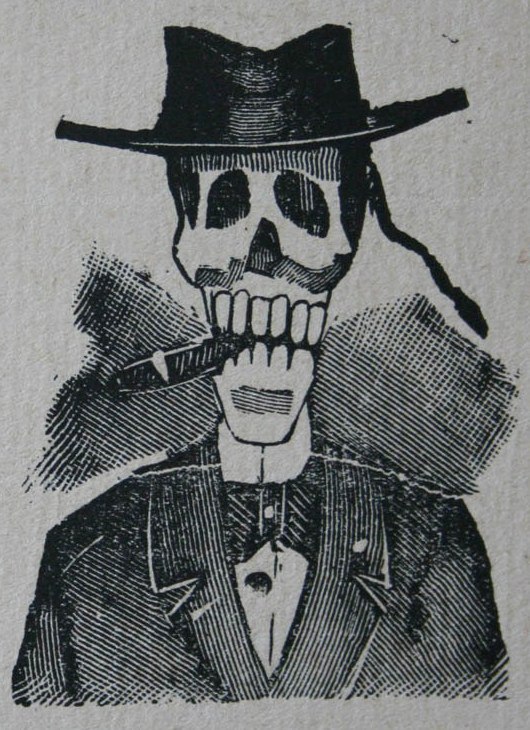
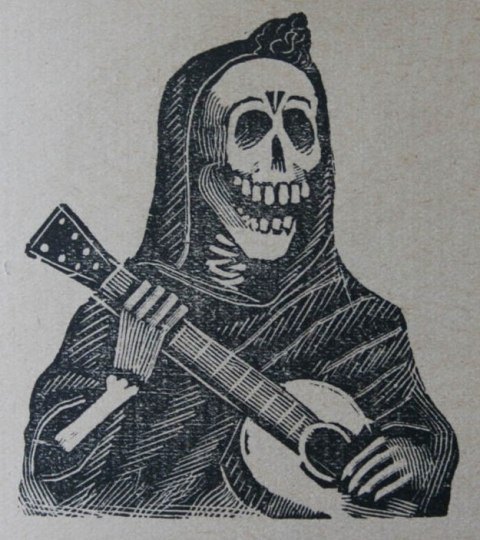
The etchings of José Guadalupe Posada (1852-1913) demonstrated a worldview that was, and often still is, profoundly Mexican. A commercial illustrator who also printed political broadsides, Posada invented the ‘calavera’ portrait. Calavera means skull, and by extension, skeleton. Aspects of the nation’s Indigenous heritage (skulls and death-goddesses were central to Aztec and Maya cultures) plus its Spanish cultural inheritance (death-oriented monastic orders, the ‘dance of death’ and ‘memento mori’ traditions) combine in Posada’s rustic yet sophisticated prints to give us the flavour of the average Mexican’s stoical yet humorous appreciation of Death.
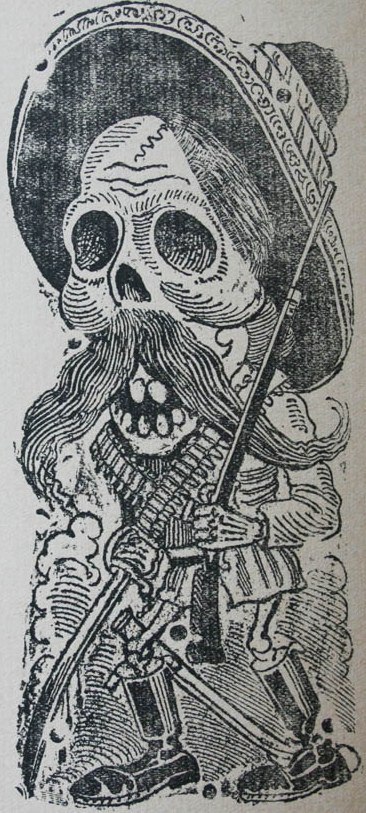
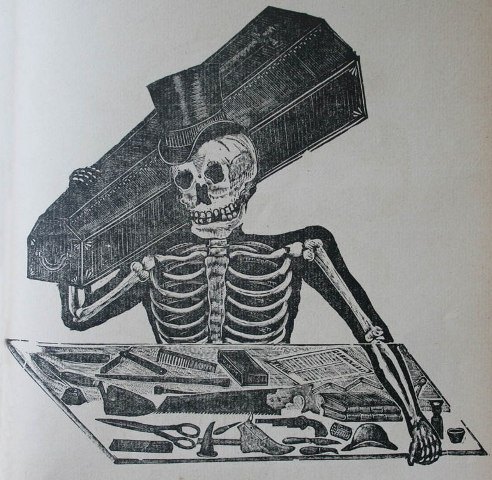
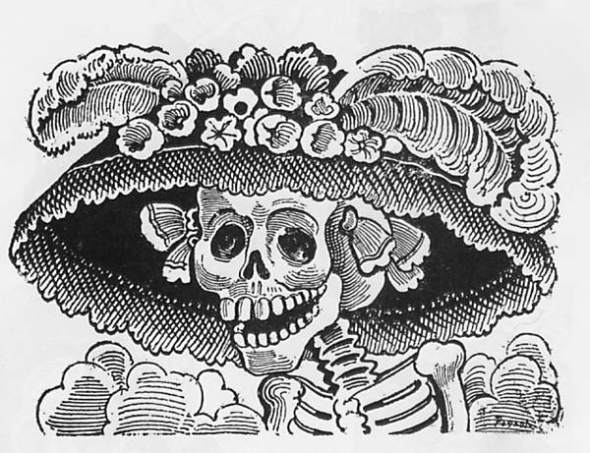
La Catrina_zinc etching by J.G. Posada
……….
A Sincere Tale for The Day of The Dead :
“ Lady Catrina goes for a stroll / Doña Catrina da un paseo ”
*
“¡ Santa Mictecacihuatl !
These Mandible Bone-nix (Manolo Blahniks) weren’t meant for
The Long Haul – certainly not worth the silver I shelled out for ’em ! ”
Thus spoke that elegant skeleton known as La Catrina.
And she clunked herself down at the stone curb, kicking off the
jade-encrusted, ocelot-fur-trimmed high-heel shoes.
“ Well, I haven’t been ‘bone-foot’ like this since I was an escuincle. ”
She chuckled to herself as she began rummaging through her Juicy handbag.
Extracting a shard of mirror, she held it up to her face – a calavera
with teardrop earrings grinned back at her. ¡Hola, Preciosa!
she said to herself with quiet pride. She adjusted her necklace of
cempasúchil blossoms and smoothed her yellow-white-red-and-black
designer-huipil.
*
Just then a lad and lassie crossed her path…
“ Yoo-hoo, Young Man, Young Woman !
Be dears, would you both, and escort an old dame
across La Plaza de la Existencia ! My feet are simply
worn down to the bone ! ”
*
“ Certainly, madam – but we’re new here…
Where is La Plaza de la Existencia ? ”
*
“ We’re just at the edge of it – El Zócalo ! ”
And La Catrina gestured beyond them where an
immense public square stretched far and wide.
She clasped their hands – the Young Man on her left,
the Young Woman on her right – and the trio set out
across a sea of cobbles…
*
By the time they reached the distant side of the Plaza the
Young Man and Young Woman had shared much with the
calaca vivaz – their hopes, fears, sadness and joy – their Lives.
*
The Woman by now had grown a long, luxurious
silver braid and The Man a thick, salt-and-pepper
beard. Both knew they’d lived fully – and were satisfied.
But my… – they were tired !
*
In the company of the strange and gregarious Catrina 5 minutes
to cross The Zócalo had taken 50 years…
*
“ Doña Catrina, here we are at your destination – will you be
alright now ? ”
*
“ Never felt better, Kids ! I always enjoy charming company
on a journey ! ” And she winked at them, even though she had
no eyeballs – just sockets. “ Join me for a caffè-latte? Or a café-pulque,
if you’re lactose-intolerant ! ”
*
“Thank you, no,” said the Man and Woman, in unison.
And both laughed heartily, breathed deeply, and sat down
at the curb.
*
When they looked up, Doña Catrina had clattered gaily out of sight.
And before their eyes the vast Zócalo became peopled with
scenes from their Lives.
The Man and Woman smiled, then sighed contentedly. And, side by side, they leaned closer together – and died.
* finis *
Alexander Best – November 2nd, 2011
……….
Glossary:
Mictecacihuatl – Aztec goddess of the AfterLife, and Keeper of The Bones
La Catrina – from La Calavera Catrina (The Elegant Lady-Skull),
a famous zinc etching by Mexican political cartoonist and print-maker
Jose Guadalupe Posada (1852-1913). Posada’s “calavera” prints depict
society from top to bottom – even the upper-class woman of wealth –
La Catrina – must embrace Death, just like everyone else…
She has since become a “character”,
invented and re-invented, for The Day of The Dead (Nov.2nd).
escuincle – little kid or street urchin
calavera – skull
¡Hola, Preciosa! – Hello, Gorgeous!
cempasúchil – marigold (the Day of The Dead flower)
huipil – blouse or dress, Mayan-style
El Zócalo – the main public square (plaza mayor) in Mexico City,
largest in The Americas
calaca vivaz – lively skeleton
pulque – a Mexican drink make from fermented
agave or maguey – looks somewhat like milk
……….
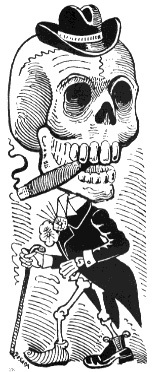
¡Chaucito, chavos! Ciao, kiddies!
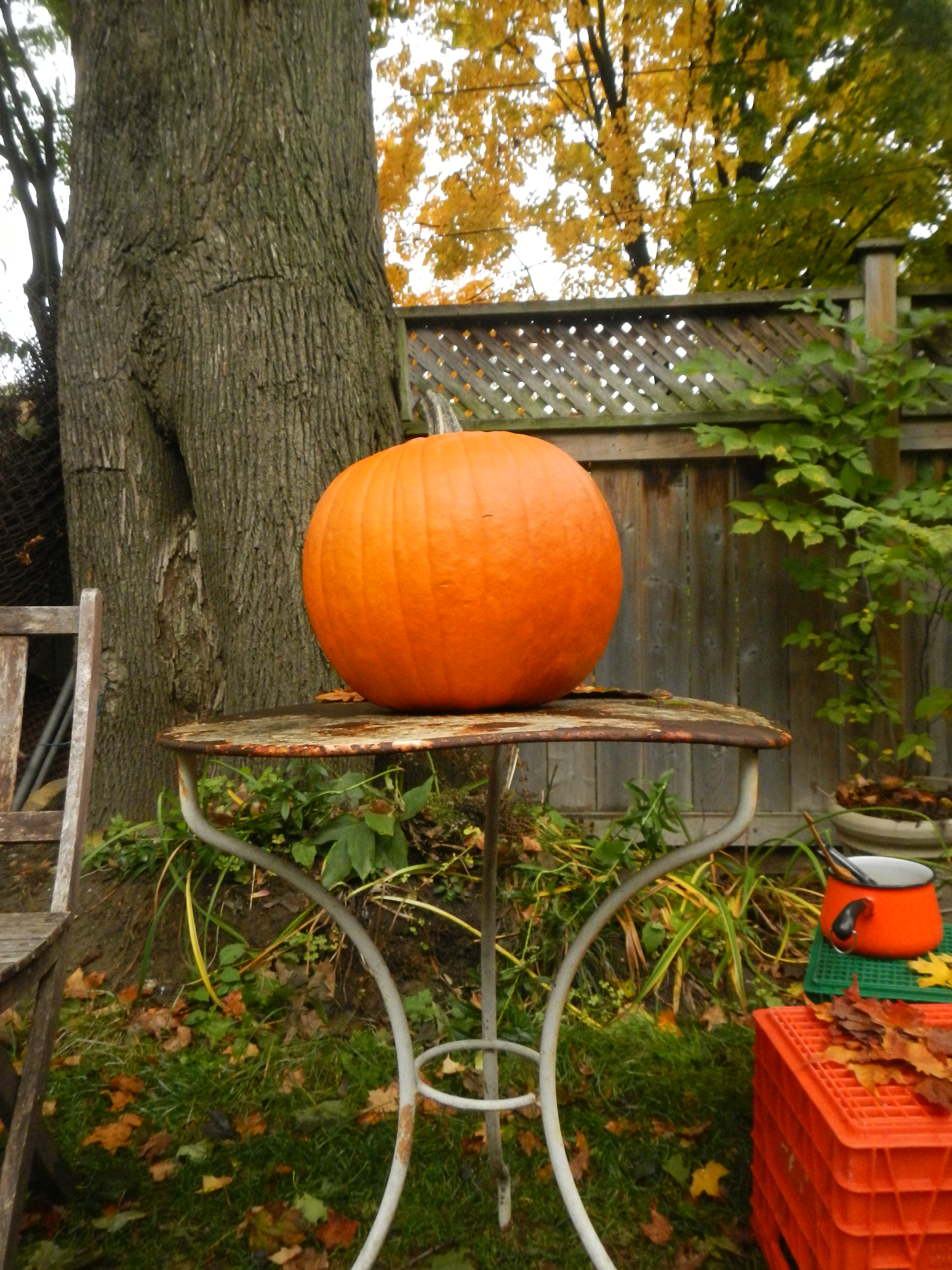
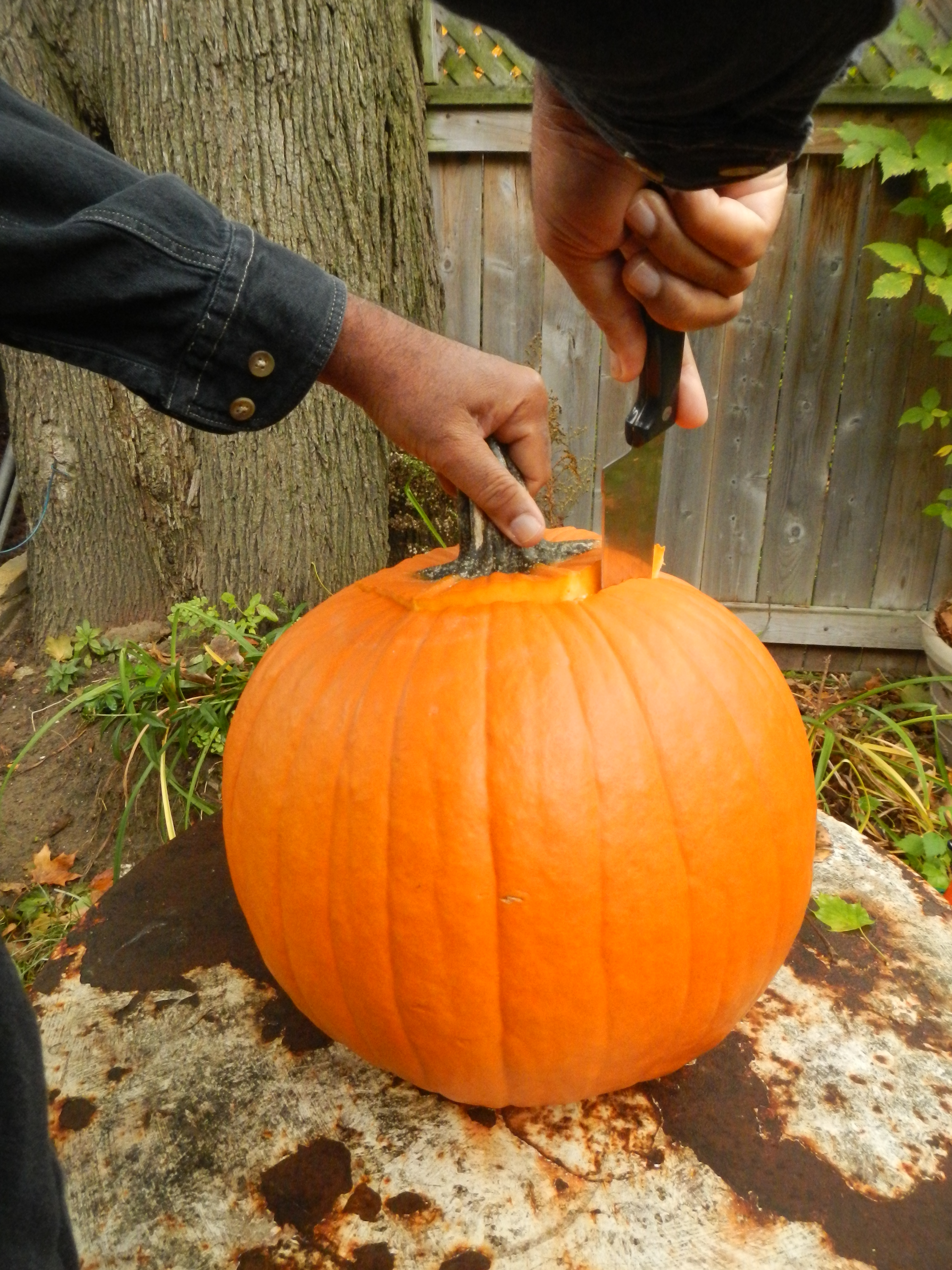
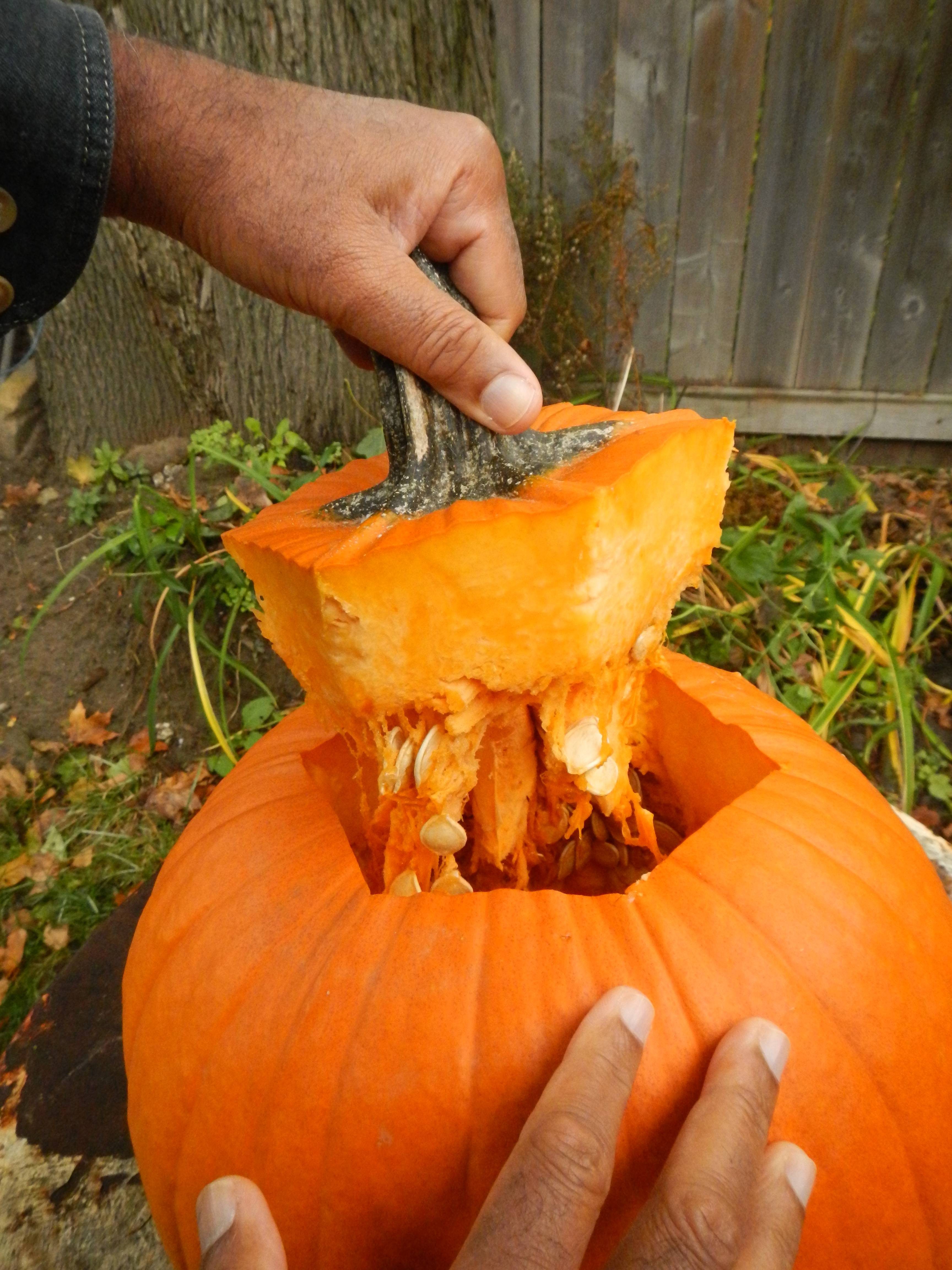
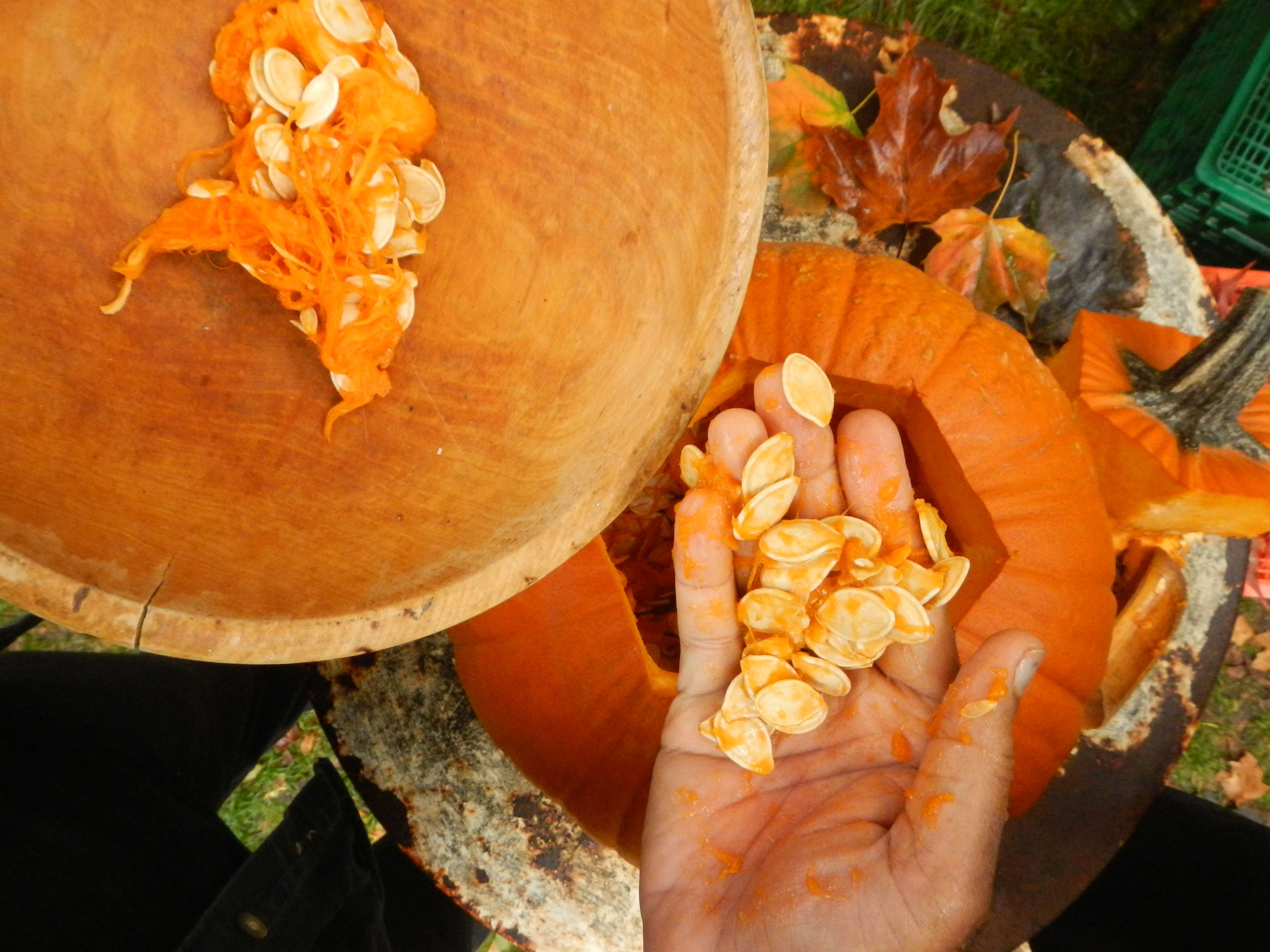
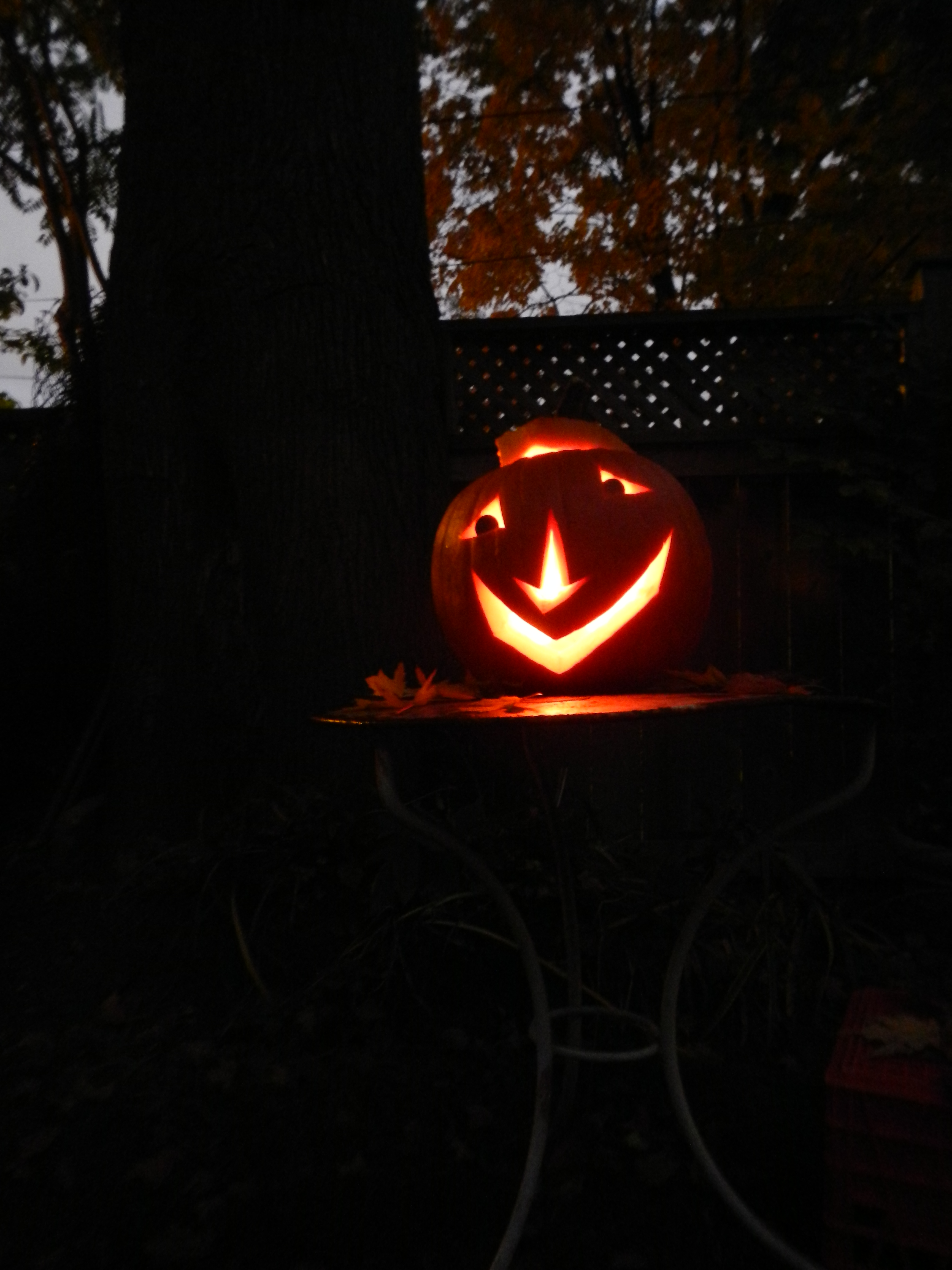
Cuento anaranjado: tallando una calabaza de Hallowe’en… / Orange Story: carving a Jack-o’-Lantern…
Posted: October 31, 2014 Filed under: Cuento anaranjado: tallando una calabaza de Hallowe'en..., IMAGES Comments Off on Cuento anaranjado: tallando una calabaza de Hallowe’en… / Orange Story: carving a Jack-o’-Lantern…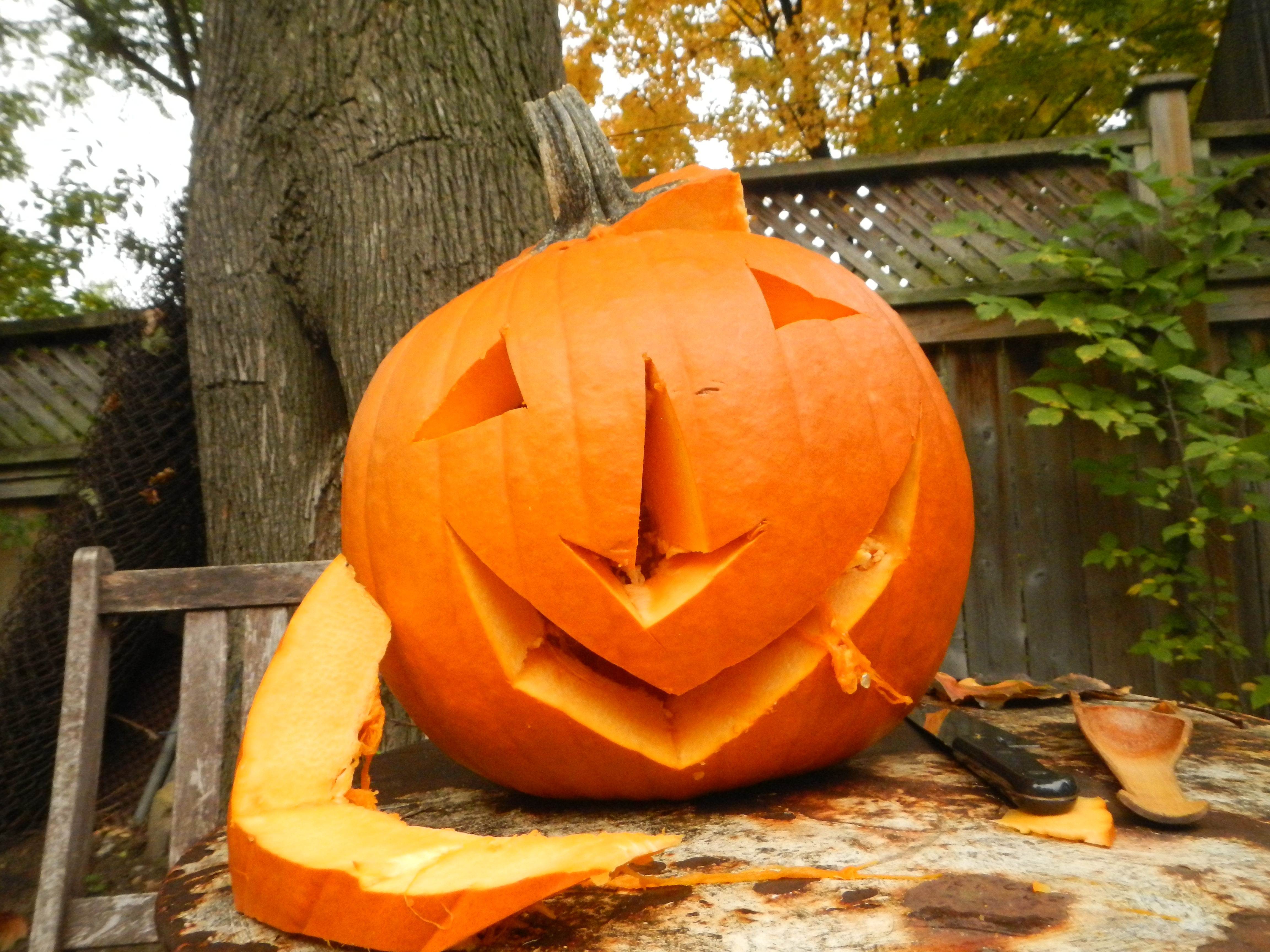
Cuento anaranjado: tallando una calabaza de Hallowe’en…
.
Desde mi niñez me he sentido atraído por la calabaza de Hallowe’en.
Así pues…puedo ser un artista retratista que blande una navaja – o un puñal – y todo también trata del color naranja, eso de la paleta otoñal de hojas volteando: naranja, amarillo, y rojo. Son mis tres colores favoritos, en hecho, porque soy daltónico; pero puedo ver con exactitud este “trío” vívido.
Hallowe’en es una noche mágica, repleta de ideas y de sentimientos (alboroto, miedo, entusiasmo) de la emoción universal, y que creció concretamente de la festividad celta de Samhain (la palabra noviembre en gaélico irlandés.) También esta fecha del 31 de octubre acontece al borde de la transición en Canadá al tiempo de invierno; lo usual es que llega nuestra primera escarcha-“matanza”. ¡Y el acto de tallar una calabaza existe al centro de lo todo!
. . .
Orange Story: carving a Jack-o’-Lantern…
.
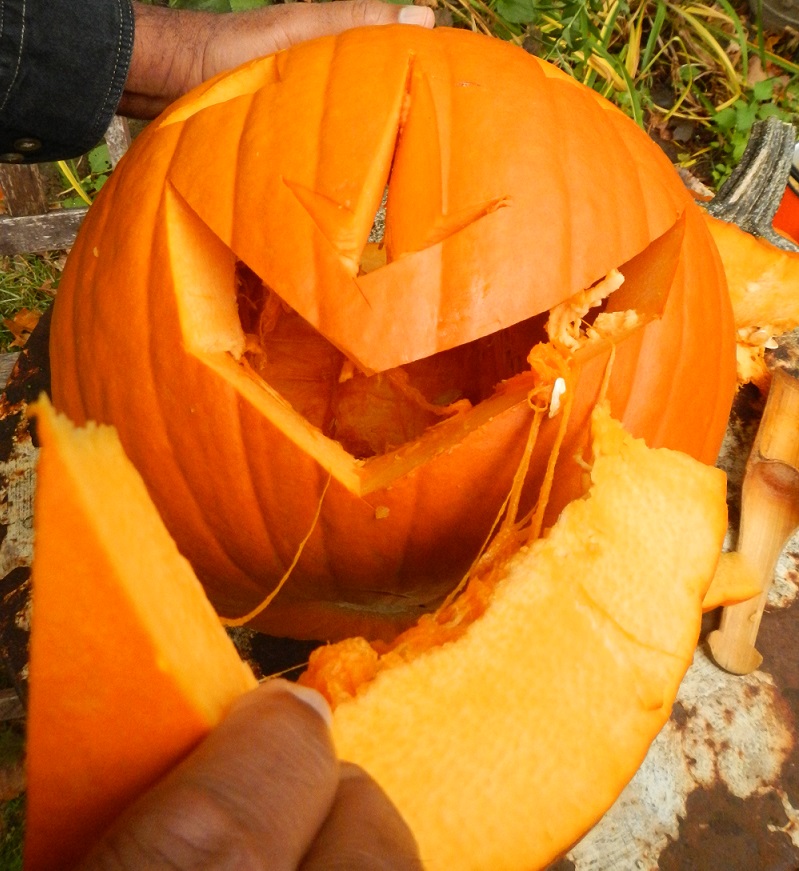
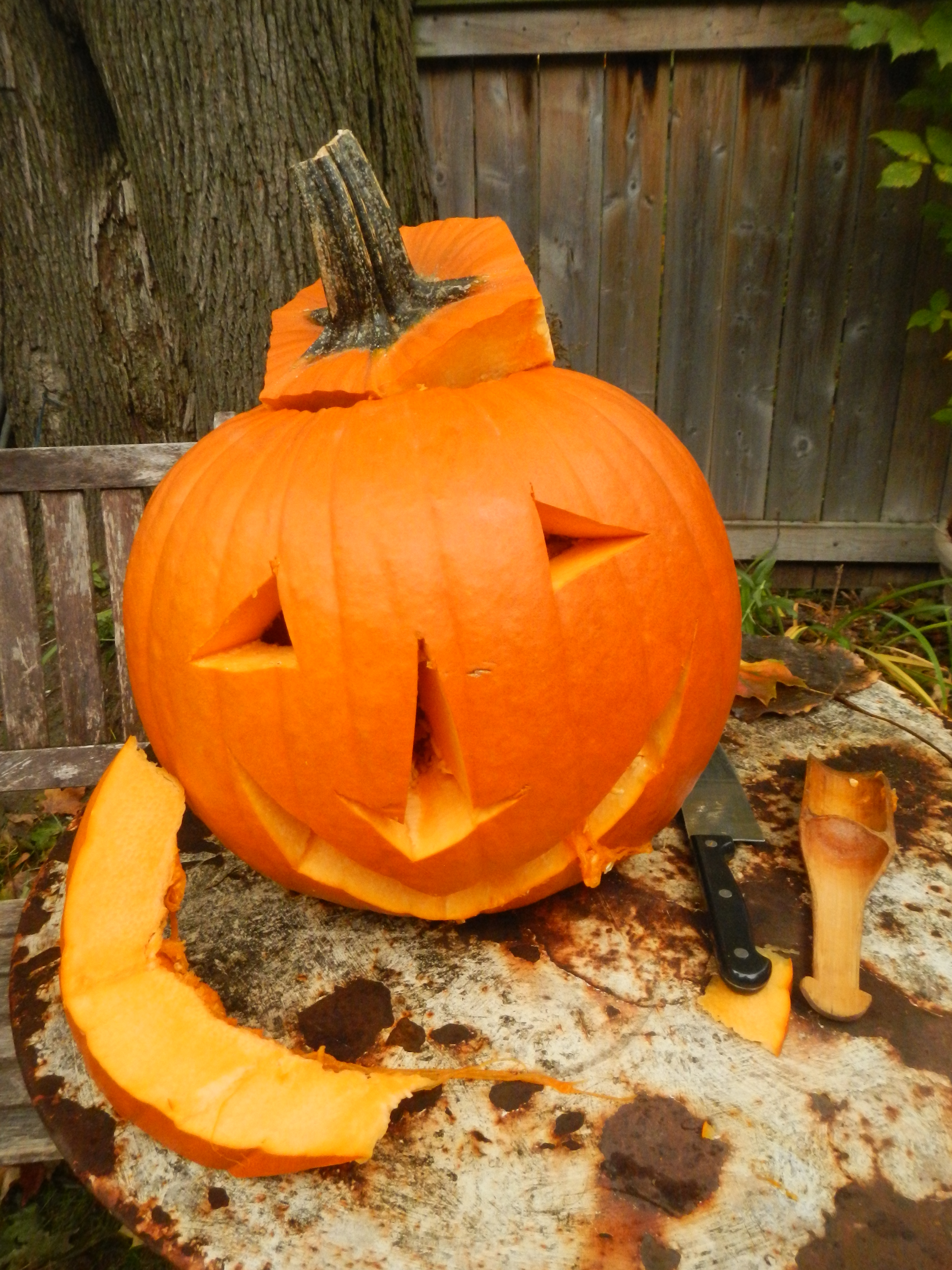
Since childhood I have loved pumpkins – all of them: mini ones, oddly shaped ones, big overgrown ones. And, living in Ontario, we’ve got some of the best, for they’re native to the place, an Amerindian food staple, and a gift to our culture. To carve a pumpkin for Hallowe’en is to express – swiftly and simply – one’s innate artistry and specific personality. What’s not to love, therefore?
.
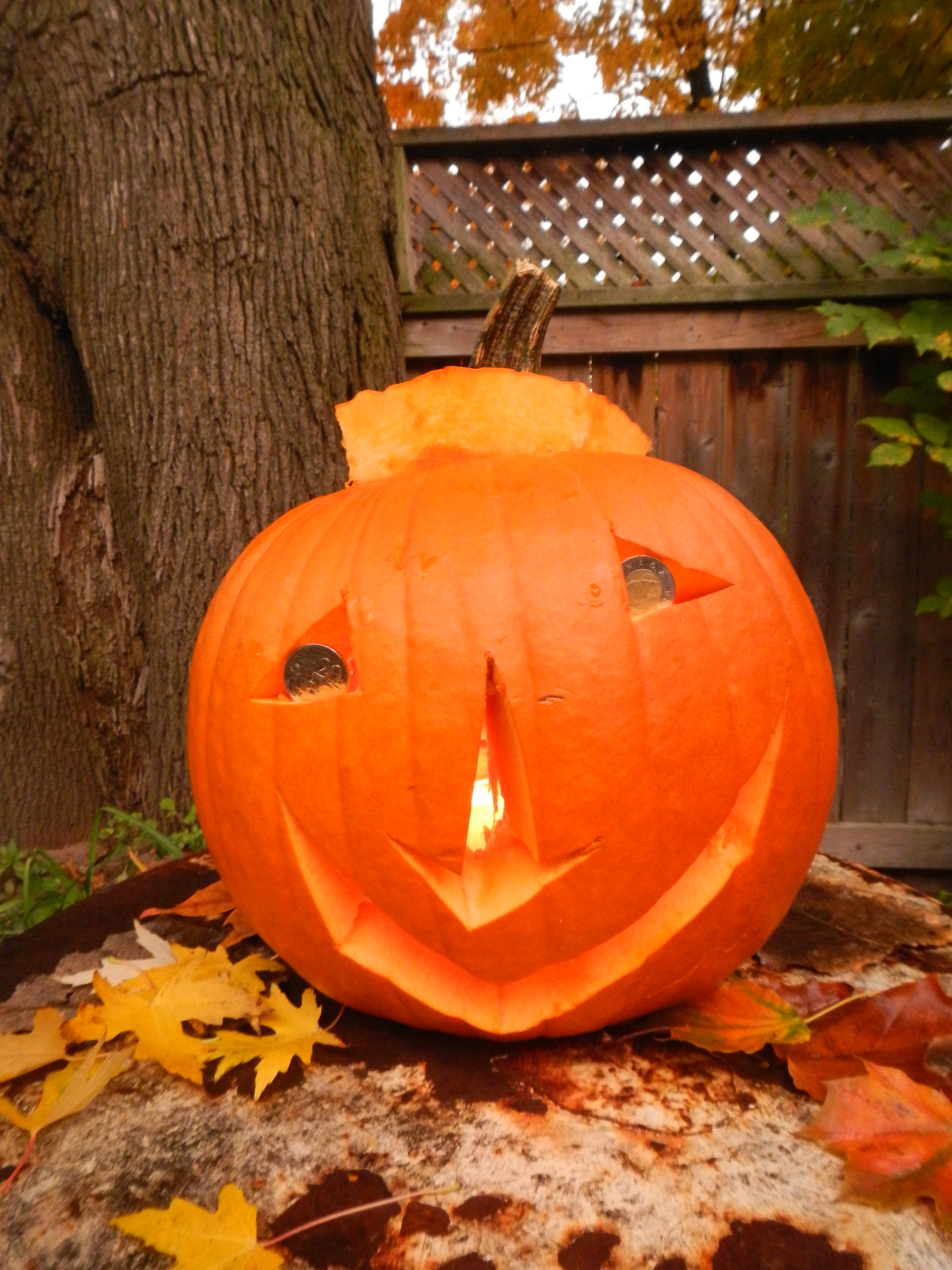
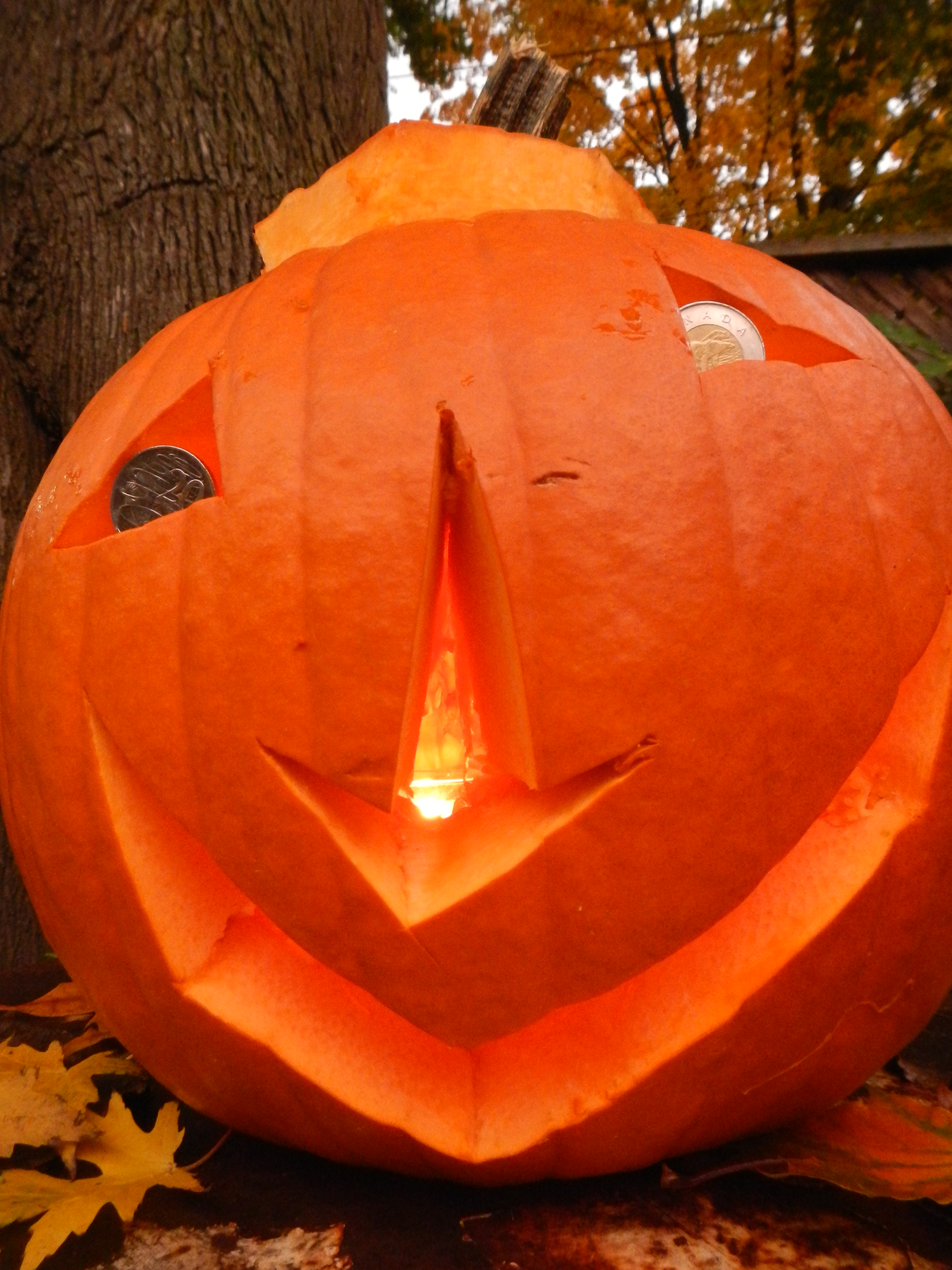
The origin of Jack-o’-Lantern carving is in Ireland, and the pre-Christian festival of Samhain. Samhain (which is the Gaelic word for November) hinges on the end of the harvest / Celtic old year, and the beginning of Winter / Celtic new year. For a few hours all Spirits, including our ancestors, may run free, back and forth between “this” world and the “other”). In old Eire it was the dependable turnip that was hollowed out, and a candle placed within. Positioned at a cottage threshold, or upon a window ledge, the glowing turnip “face” would announce to roving Spirits – some of which might’ve meant harm – that this was a house protected and not to be tampered with. Sometimes coins were inserted as “lucky eyes”, in case any malevolent invisible-now-visible Beings of Samhain needed to steal something away: better they take two pieces of silver than to carry off a calf or sicken to death the smallest child.
Irish immigrants of the nineteenth century to the U.S.A. adapted the far-superior Native-American Pumpkin to their lucky “face” lantern, and gradually the secular Hallowe’en that we now know evolved. The Church too was involved: All Souls’ Day (November 1st) was, in fact, created specifically to counter-act the powerful “pagan” traditions associated with Samhain. And this was already happening in Europe and the British Isles before the Irish-American immigrant “wave” of a 150 years ago.
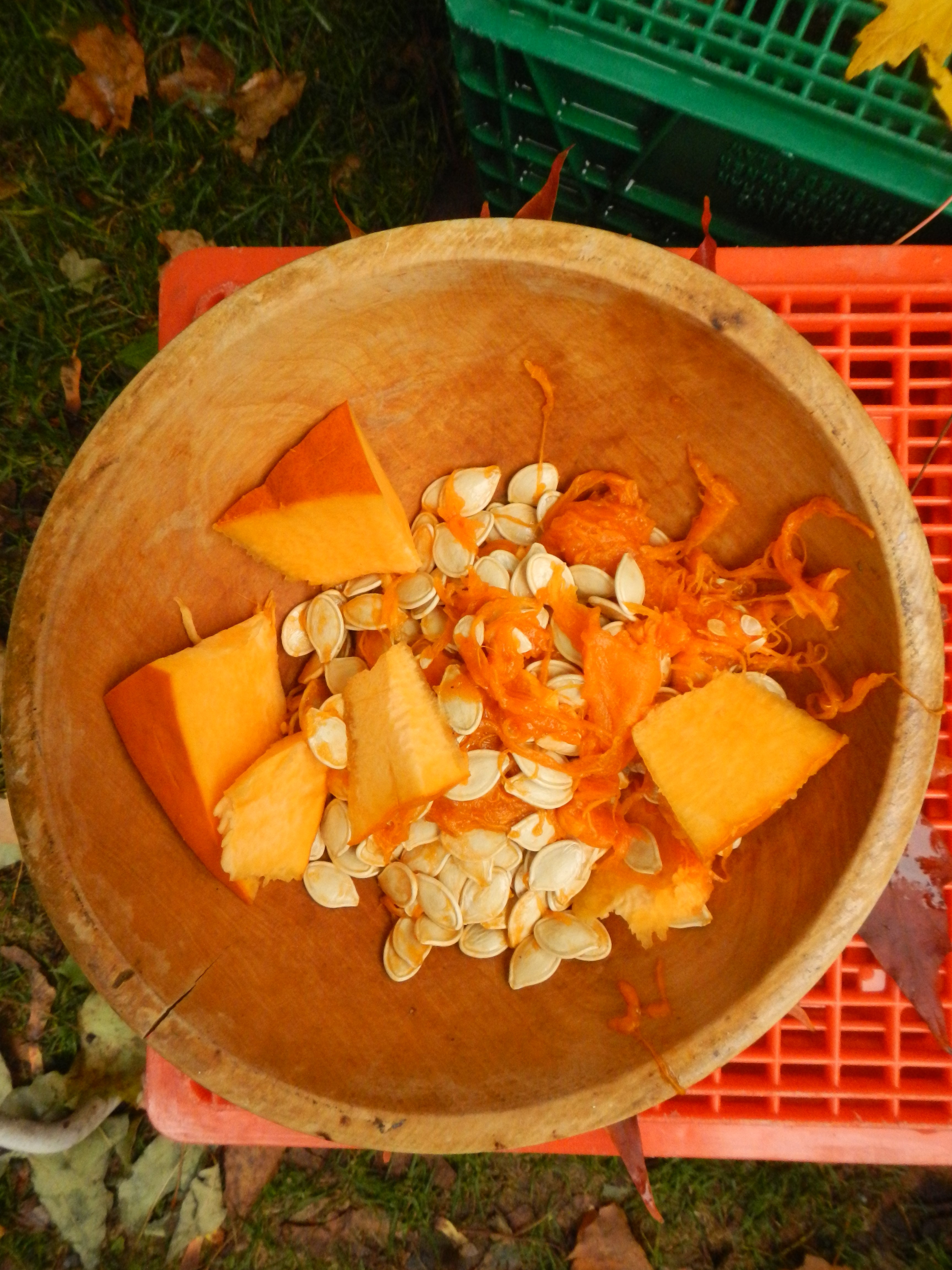
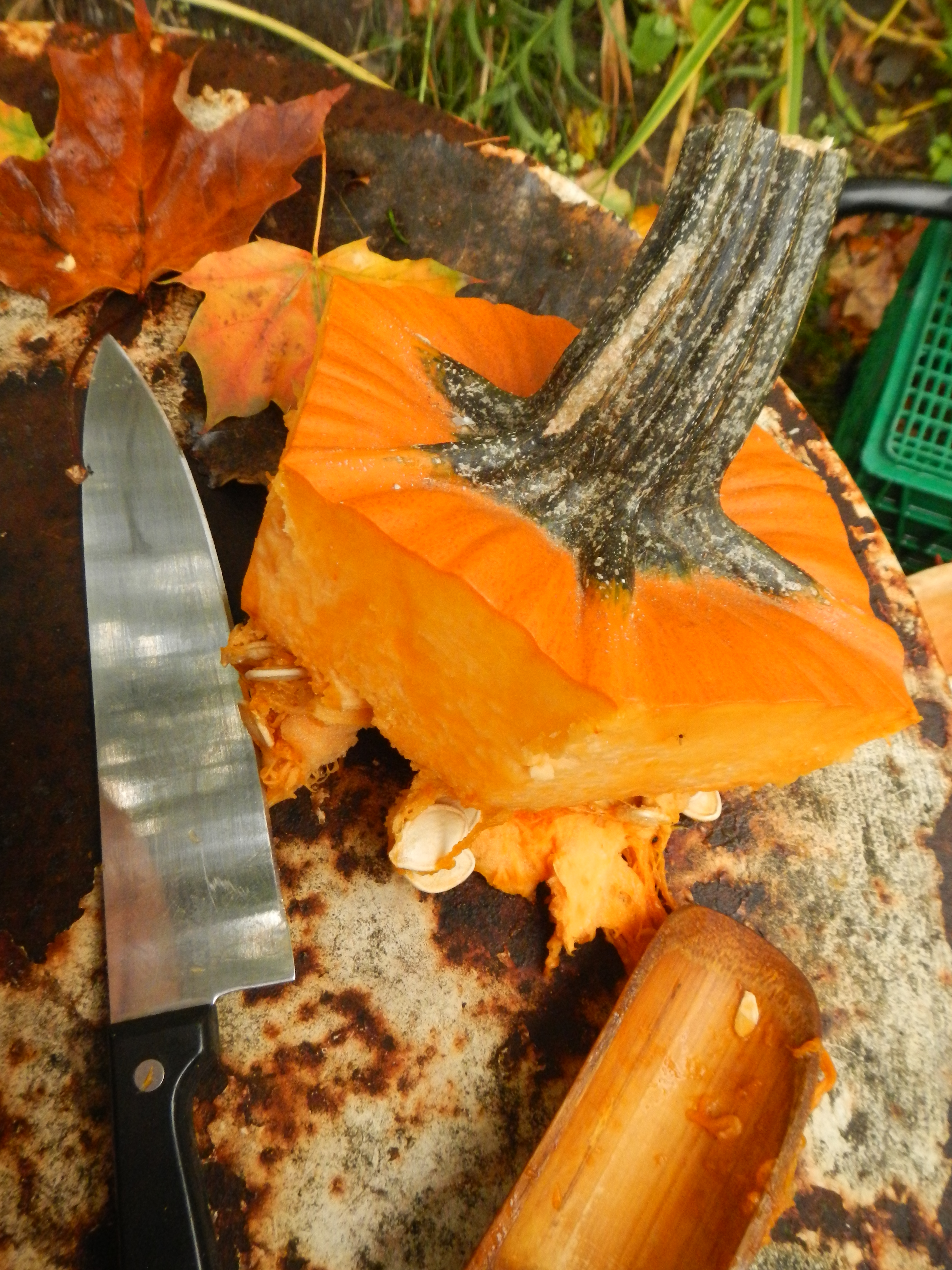
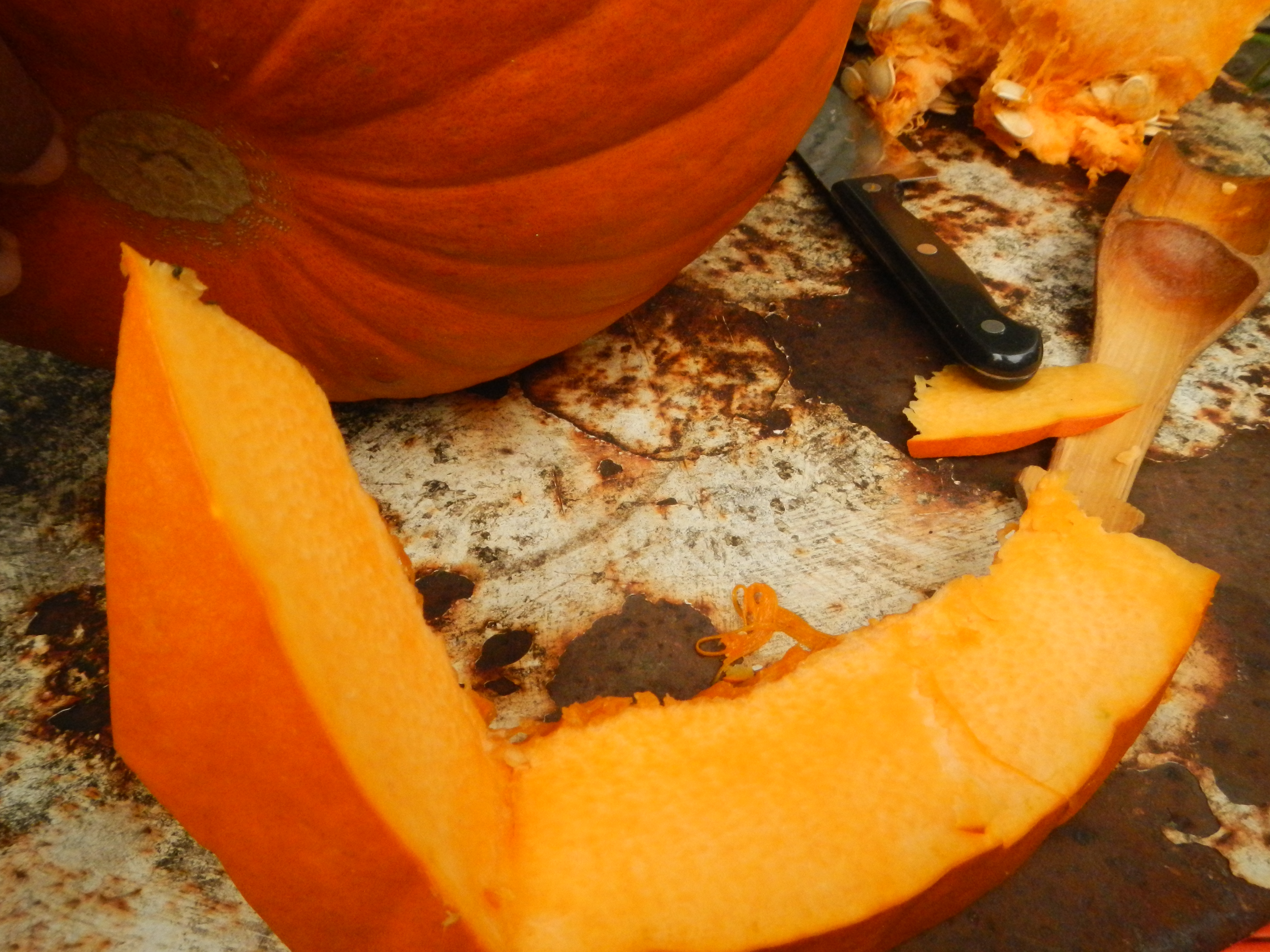
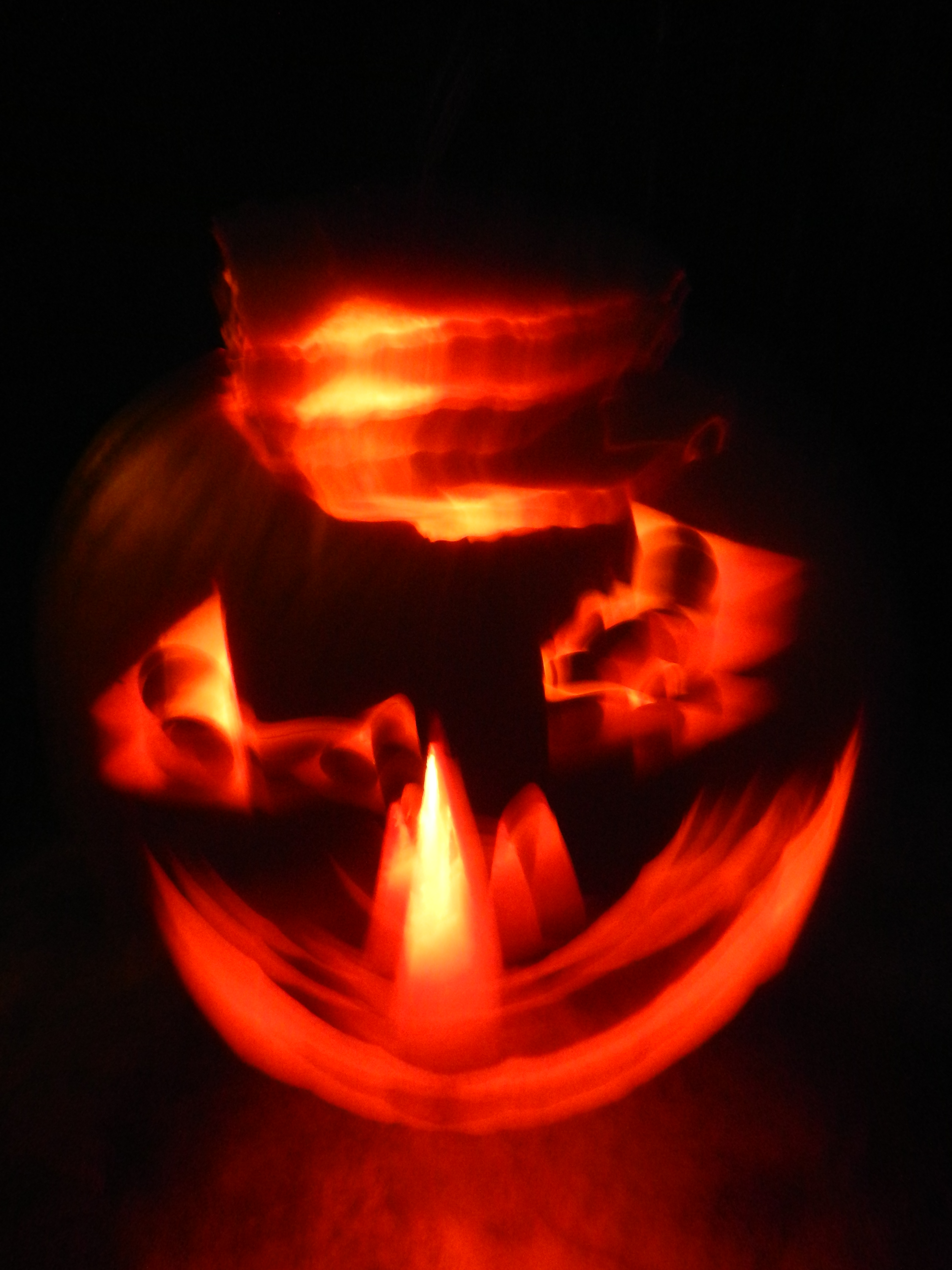
At any rate, carving a pumpkin is as much fun today as it was decades ago, when I was a kid!




Poemas: “Víspera de la Noche de Todos los Santos” / “Sin Invitación”
Posted: October 31, 2014 Filed under: English, Spanish, ZP Translator: Alexander Best | Tags: Hallowe'en Comments Off on Poemas: “Víspera de la Noche de Todos los Santos” / “Sin Invitación”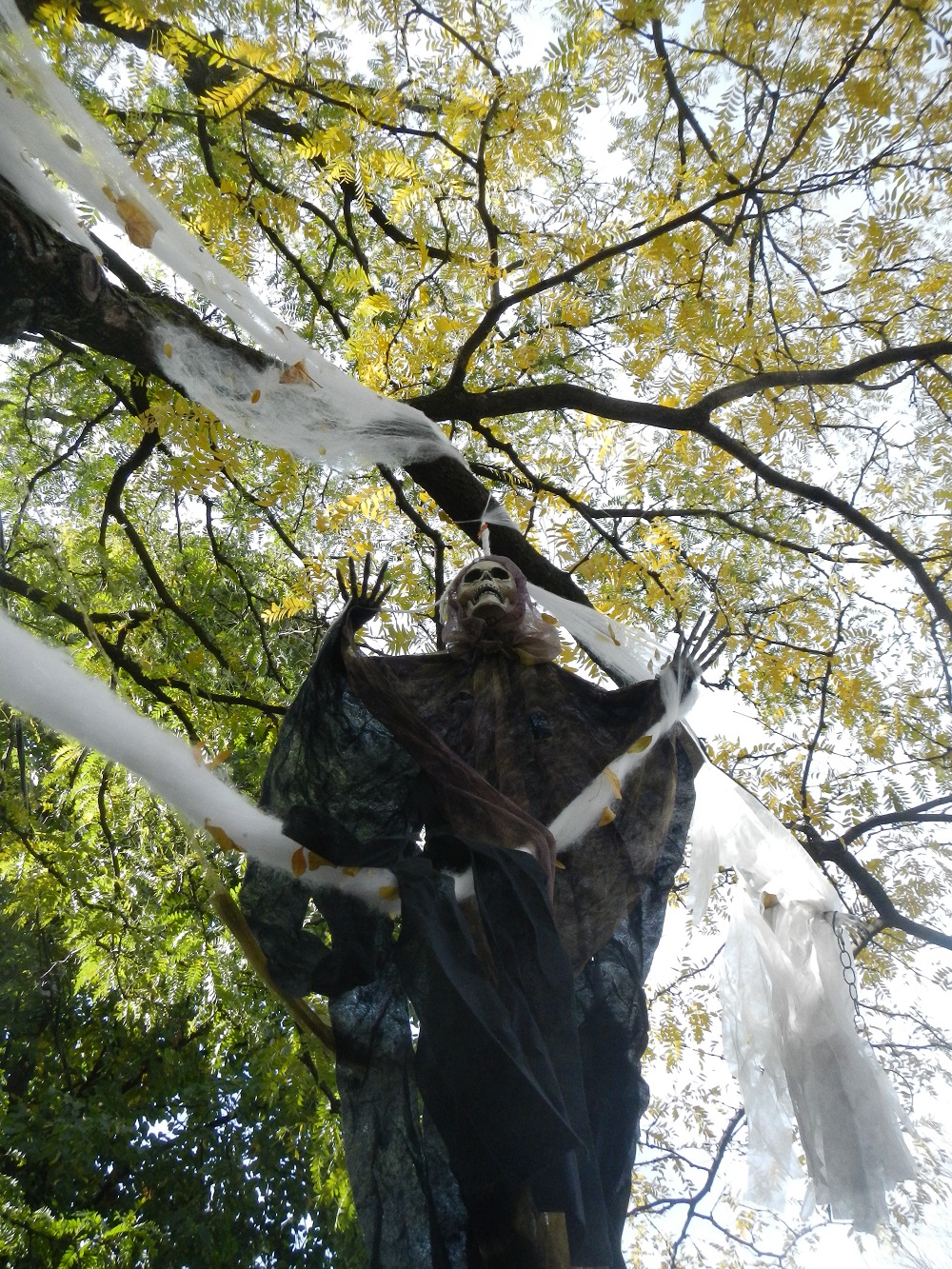
. . .
Hortense Flexner King (1885-1973)
All Souls’ Night, 1917
.
You heap the logs and try to fill
The little room with words and cheer,
But silent feet are on the hill,
Across the window veiled eyes peer.
The hosts of lovers, young in death,
Go seeking down the world to-night,
Remembering faces, warmth and breath—
And they shall seek till it is light.
Then let the white-flaked logs burn low,
Lest those who drift before the storm
See gladness on our hearth and know
There is no flame can make them warm.
. . .
Víspera de la Noche de Todos los Santos, 1917
.
Amontañas los leños, intentando llenar
el cuartucho con palabras, con ánimo alegre,
pero los pies silenciados están por la colina,
y a través de la ventana están mirando unos ojos velados.
La hueste de amantes, joven en su muerte,
va a buscar en todas partes esta noche,
recordando las caras, el calor y la exhalación
– y van a buscar hasta la luz del alba.
Pues, deja incendiarse los leños cubiertos de ceniza,
en case de ellos se inclinan hacia el ventarrón
vean la alegría de nuestro hogar, y sepan que
no hay una llama que puede calentarles.
. . .
Ray Armantrout (born 1947)
Unbidden
.
The ghosts swarm.
They speak as one
person. Each
loves you. Each
has left something
undone.
Did the palo verde
blush yellow
all at once?
Today’s edges
are so sharp
they might cut
anything that moved.
The way a lost
word
will come back,
You’re not interested
in it now,
only
in knowing
where it’s been.
. . .
Ray Armantrout (nace 1947)
Sin Invitación
.
Las fantasmas se mueven en manada.
Hablan como una sola persona.
Cada una te ama.
Y cada uno ha dejado algo sin hacer.
¿Se puso colorado – se puso amarillento, de golpe – el palo verde?
Los filos de hoy son tan puntiagudos;
corten alguna cosa que desplaza.
Así como
la palabra perdida
vuelve a la memoria.
No te interese ahora
esa palabra
sino donde estuviera.
. . .
https://zocalopoets.com/2011/10/31/halloween-a-haunting-in-the-hood/
. . . . .
Claribel Alegría: And I dreamt that I was a tree / I love to handle leaves / A Letter to “Time” / Autumn
Posted: October 28, 2014 Filed under: Claribel Alegría, Claribel Alegría: And I dreamt that I was a tree, English, Spanish, ZP Translator: Alexander Best Comments Off on Claribel Alegría: And I dreamt that I was a tree / I love to handle leaves / A Letter to “Time” / Autumn
Claribel Alegría (Nicaragua / El Salvador, nacido 1924)
Y soñe que era un árbol – a Carole
(1981)
.
Y soñe que era un árbol
y que todas mis ramas
se cubrían de hojas
y me amaban los pájaros
y me amaban también
los forasteros
que buscaban mi sombra
y yo también amaba
mi follaje
y el viento me amaba
y los milanos
pero un día
empezaron las hojas
a pesarme
a cubrirme las tardes
a opacarme la luz
de las estrellas.
Toda mi savia
se diluía
en el bello ropaje
verdinegro
y oía quejarse a mi raíz
y padecía el tronco
y empecé a despojarme
a sacudirme
era preciso despojarse
de todo ese derroche
de hojas verdes.
Empecé a sacudirme
y las hojas caían.
Otra vez con más fuerza
y junto con las hojas que importaban apenas
caía una que yo amaba:
un hermano
un amigo
y cayeron también
sobre la tierra
todas mis ilusiones
más queridas
y cayeron mis dioses
y cayeron mis duendes
se iban encogiendo
se arrugaban
se volvían de pronto
amarillentos.
Apenas unas hojas
me quedaron:
cuatro o cinco
a lo sumo
quizá menos
y volví a sacudirme
con más saña
y esas no cayeron
como hélices de acero
resistían.
. . .
Claribel Alegría (Nicaragua / El Salvador, born 1924)
And I dreamt that I was a tree – To Carole
(1981)
.
And I dreamt that I was a tree
and all my branches – leafy –
were belovéd of the birds
– and of strangers seeking my shade.
And I too loved my canopy,
as did the wind – and the hawks.
But there came the day when
my leaves weighed heavily upon me,
they blocked out my afternoons
and the light of the stars.
My sap became diluted by
my gorgeous dark-green robe;
my roots were heard groaning
and the trunk of me, how it suffered;
and I began to dis-robe myself,
to shake loose;
I needed to be free of
that profusion of green leaves.
I really shook; and the leaves fell.
Again, more fiercely,
and more leaves fell – along with a certain one I loved:
a brother? friend?
And then there fell right to the ground all the illusions
most dear to me.
My gods fell, my charms, my animating spirits.
Dried up, wrinkled, completely yellowed.
I had hardly any leaves left, four or five at the very most;
and I shook again, in total fury.
The last of these leaves, no, they wouldn’t fall;
like steel helixes they clung to me.
. . .
Carta al Tiempo (1982)
.
Estimado señor:
Esta carta la escribo en mi cumpleaños.
Recibí su regalo. No me gusta.
Siempre y siempre lo mismo.
Cuando niña, impaciente lo esperaba;
me vestía de fiesta
y salía a la calle a pregonarlo.
No sea usted tenaz.
Todavía lo veo
jugando al ajedrez con el abuelo.
Fue perdiendo su brillo.
Y usted insistía
y no respetaba la humildad
de su carácter dulce,
y sus zapatos.
Después me cortejaba.
Era yo adolescente
y usted con ese rostro que no cambia.
Amigo de mi padre
para ganarme a mí.
Pobrecito del abuelo.
En su lecho de muerte
estaba usted presente,
esperando el final.
Un aire insospechado
flotaba entre los muebles.
Parecían mas blancas las paredes.
Y había alguién más,
usted le hacía señas.
Él le cerró los ojos al abuelo
y se detuvo un rato a contemplarme.
Le prohibo que vuelva.
Cada vez que lo veo
me recorre las vértebras el frío.
No me persiga más,
se lo suplico.
Hace años que amo a otro
y ya no me interesan sus ofrendas.
¿Por qué me espera siempre en las vitrinas,
en la boca del sueño,
bajo el cielo indeciso del domingo?
Sabe a cuarto cerrado su saludo.
Lo he visto el otro día con los niños.
Reconocí su traje:
el mismo tweed de entonces
cuando era yo estudiante
y usted amigo de mi padre.
Su ridículo traje de entretiempo.
No vuelva,
le repito.
No se detenga más en mi jardín.
Se asustarán los niños
y las hojas se caen:
las he visto.
¿De qué sirve todo esto?
Se va a reír un rato
con esa risa eterna
y seguirá sabiéndome al encuentro.
Los niños,
mi rostro,
las hojas,
todo extraviado en sus pupilas.
Ganará sin remedio.
Al comenzar mi carta lo sabía.
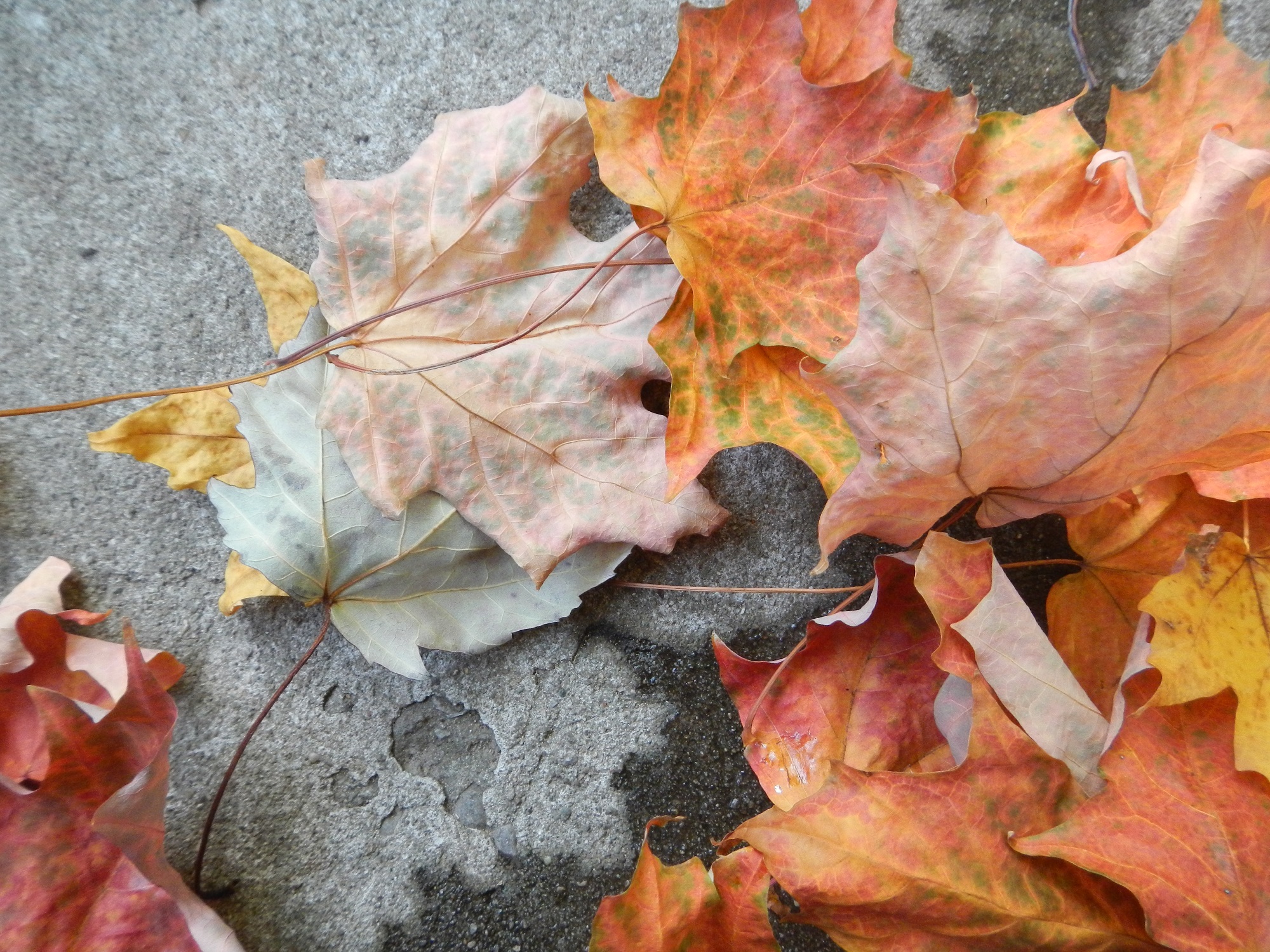
A Letter to “Time” (1982)
.
Dear Sir:
I am writing this letter to you on my birthday.
I received your gift – and I don’t like it.
Always, always it’s the same thing.
When I was a girl, impatiently I waited;
got all dressed up, and went out into the street
to proclaim it.
Don’t be stubborn.
I can still picture you playing chess with my grandfather,
and at first your appearances were few and far between,
but soon they were daily and
grandfather’s voice lost its sparkle.
And you insisted on such visits, without any respect for
the humbleness of his gentle soul – or his shoes.
Later on, you attempted to court me.
Of course I was still young – and you with your unchanging face:
a friend of my dad’s with an eye trained on me.
Oh, poor Grand-dad…And didn’t you hang around his deathbed
till the end came!
The very walls seemed to fade out, and there was a kind of
unpinpointable something or other floating among the rooms.
You were that someone who was making signs and wonders,
and Dad closed Grand-dad’s eyes – then paused to contemplate me.
I forbid you to return…
Every time I see you my spine goes stiff – stop pursuing me, I beg you.
It’s been years since I loved anyone else
but your gifts no longer interest me.
Why are you waiting for me, in shop windows,
in the mouth of my dreams,
beneath a vague Sunday sky?
Your greeting reminds me of the air in shut-up rooms.
The other day I saw you with some kids;
I recognized that tweed suit, from when I was a student and
you were my father’s friend – that ridiculous Autumn tweed suit!
I repeat: Don’t come back, don’t hang around my garden;
you’ll scare the children and the leaves will all drop (I’ve seen it happen.)
What’s the use in all of this?
You’ll laugh a little, with that forever-laugh of yours,
and you’ll keep popping up.
The kids, my face, the falling leaves…
we all go lost or missing – in your eyes.
There’s no remedy for any of this: you’ll win.
I knew that from the moment I put pencil to paper.
. . .
Otoño (1981)
.
Has entrado al otoño
me dijiste
y me sentí temblar
hoja encendida
que se aferra a su tallo
que se obstina
que es párpado amarillo
y luz de vela
danza de vida
y muerte
claridad suspendida
en el eterno instante
del presente.
. . .
Autumn (1981)
.
You told me:
You’ve entered your Autumn.
And I shudder,
a leaf aflame that clings to its stem,
obstinate,
a yellow eyelid,
the light of a candle,
a dance of both life and death,
Open-ness hanging
in that eternal instant of the present.
. . .
Me gusta palpar hojas (1997)
.
Más que libros
revistas
y periódicos
más que móviles labios
que repiten los libros,
las revistas,
los desastres,
me gusta palpar hojas
y sentir su frescura,
ver el mundo
a través de su luz tamizada
a través de sus verdes
y escuchar mi silencio
que madura
y titila en mis labios
y se rompe en mi lengua
y escuchar a la tierra
que respira
y la tierra es mi cuerpo
y yo soy el cuerpo
de la tierra
Claribel.
. . .
I love to handle leaves (1997)
.
More than books,
more than magazines or newspapers,
more even than moving lips that recite from books, magazines, disasters…
how I love to handle leaves
– to feel their freshness,
to see the world through their filtered light,
through their green-ness;
and to hear my own silence
maturing – a-twinkling – upon my lips,
breaking against my tongue;
and to listen to the earth breathing.
And the earth is my body,
and I am the body of a land called
Claribel.
. . .
Translations from Spanish to English: Alexander Best
. . . . .
नया साल मुबारक हो Poema para Diwali
Posted: October 23, 2014 Filed under: Alexander Best, Spanish Comments Off on नया साल मुबारक हो Poema para Diwali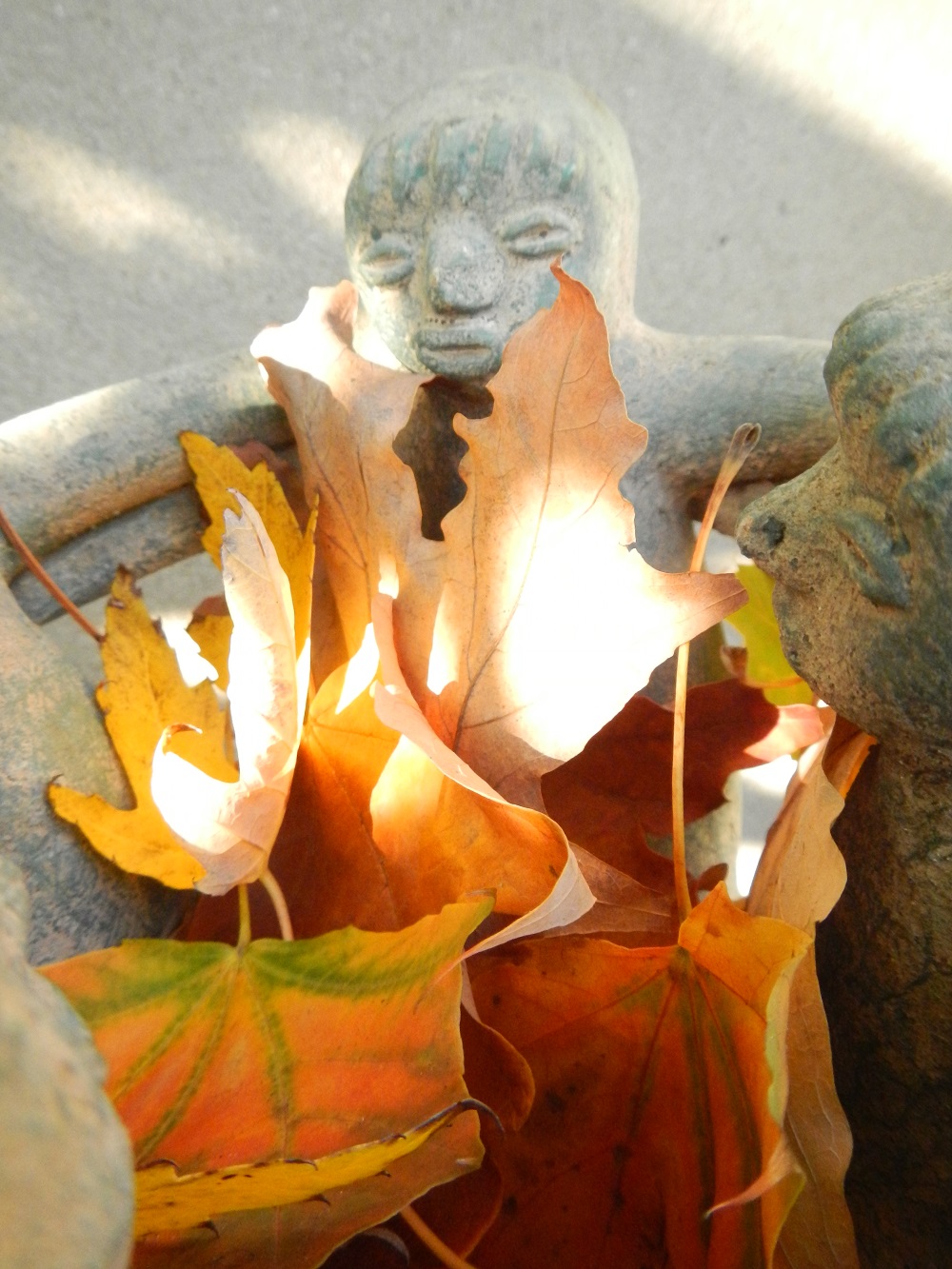
Poema para Diwali
.
Abran las ventanas, abran las puertas
– ¡llega Diwali est’anochecer!
Ignorancia –¡esfúmate! – ¡Comprensión nacerá!
Ofrezcan gran Luz con lámparas de aceite,
y entonen el mantra que Laksmí entre.
Ganesha, también, veneramos este día,
y la exaltada Kali con su intensa manera.
Se desmaterializa Desesperanza y Esperanza se consolida;
y triunfa Bondad, no Mal.
Niños lanzan sus barcos-papel y flotan llamas en arroyos y charcos,
pues explotan petardos – un gozo ‘chamaco’ –
y todo que pasa celebra La Luz
esta noche de luna nueva.
Mis compañeras se apuntan Diwali
– aquí en Toronto, Canadá.
Merle y Kasturie; Suba, Nanthini
– de Trinidad y de Sri Lanka.
Mezclando comida, familia, amigos y diversión,
El Diwali – como Cinco de Mayo – es la fecha de reunión.
. . . . .
https://zocalopoets.com/category/poems/hindi/
Feuilles d’Automne: Poésie / Autumn Leaves: French poems in translation
Posted: October 22, 2014 Filed under: English, French, ZP Translator: Alexander Best Comments Off on Feuilles d’Automne: Poésie / Autumn Leaves: French poems in translation
Louis Codet (1876-1914)
Papillons roux
.
Deux petits papillons roux
tourbillonnent, tourbillonnent
Deux petits papillons roux
tourbillonnent dans l’air doux
et tombe la feuille d’automne.
. . .
Red-headed butterflies
.
Two little redheaded butterflies, twisting and turning, swirling and whirling,
Two little redheaded butterflies, fluttering in the soft-sweet air
– and the leaves of Autumn fall.
. . .
Anne-Marie Chapouton (1939-2000)
Il pleut
.
Il pleut
Des feuilles jaunes,
Il pleut
Des feuilles rouges.
L’été va s’endormir,
Et l’hiver
Va venir
Sur la pointe
De ses souliers
Gelés.
. . .
It’s raining…
.
It’s raining yellow leaves,
it’s raining red.
Summer’s going to sleep now,
and Winter will come,
tiptoe-ing in frozen slippers.
. . .
Samivel (1907-1992)
Quand automne en saison revient
.
Quand automne en saison revient,
La forêt met sa robe rousse
Et les glands tombent sur la mousse
Où dansent en rond les lapins.
Les souris font de grands festins
Pendant que les champignons poussent.
Ah ! que la vie est douce, douce
Quand automne en saison revient.
. . .
When Autumn returns – in season…
.
When Autumn returns, in season,
The woods don a robe of red,
and acorns fall upon the moss
where rabbits dance ’round and around.
And mice make a great feast
as mushrooms push forth – and up.
Ah, how sweet life is
– when Autumn returns, in season!
. . .
Luce Fillol (née 1918…)
Feuille rousse, feuille folle
.
Feuille rousse, feuille folle
Tourne, tourne, tourne et vole !
Tu voltiges au vent léger
Comme un oiseau apeuré.
Feuille rousse, feuille folle !
Sur le chemin de l’école,
J’ai rempli tout mon panier
Des jolies feuilles du sentier.
Feuille rousse, feuille folle !
Dans le vent qui vole, vole,
J’ai cueilli pour mon cahier
La feuille rousse qui dansait.
. . .
Red leaf, crazy leaf
.
Red leaf, crazy leaf,
Turn, turn, turn and fly!
You flutter about in the slightest wind
like a skittish bird.
Red, crazy leaf – on the path to school,
I have filled my basket with pretty fallen leaves.
Red leaf, crazy – and a wind that flies!
I have gathered up to “press” in my notebook
those red-red dancing leaves.
. . .
Théophile Gautier (1811-1872)
La graine
.
Au clair de l’automne
Mon ami Pierrot ,
La petite feuille est morte ;
Ouvrez-lui la porte ;
Au clair de la laine
Est rangée sa graine.
Chut !
Fermez bien vos mains
Comme une boîte à bijoux ;
Il va pleuvoir jusqu’aux mois doux.
. . .
The Seed
.
In the clear light of Autumn
here’s my pal Pierrot,
and the little leaves are now dead;
Pierrot opens the door;
tidies up the seeds.
Hush!
Clasp shut your hands, like a jewel box;
the rain will come soon – and stay – until the sweet months return.
. . .
Raymond Richard
Le bel automne est revenu
.
À pas menus, menus,
Le bel automne est revenu
Dans le brouillard, sans qu’on s’en doute,
Il est venu par la grand’route
Habillé d’or et de carmin.
Et tout le long de son chemin,
Le vent bondit, les pommes roulent,
Il pleut des noix, les feuilles croulent.
Ne l’avez-vous pas reconnu ?
Le bel automne est revenu.
. . .
Beautiful Autumn’s back
.
On slender feet, with the slightest of steps,
comes Autumn, back again.
In a fog, yet there’s no doubt,
He came by the great wide highway.
Dressed in gold and crimson he is,
and the whole length of his path
are leaping winds and apples a-tumbling,
nuts raining down and leaves a-drooping.
Hey, haven’t you noticed?
Beautiful Autumn’s back!

Lucie Delarue-Mardrus (1874-1945)
L’automne
.
On voit tout le temps, en automne,
Quelque chose qui vous étonne,
C’est une branche, tout à coup,
Qui s’effeuille dans votre cou.
C’est un petit arbre tout rouge,
Un, d’une autre couleur encor,
Et puis, partout, ces feuilles d’or
Qui tombent sans que rien ne bouge.
Nous aimons bien cette saison,
Mais la nuit si tôt va descendre !
Retournons vite à la maison
Rôtir nos marrons dans la cendre.
. . .
Autumn
.
One sees it, every time in Autumn,
something that amazes:
like a branch that all of a sudden
lands on your tail. Or
a little red tree, and others of another colour,
whose leaves of gold fall while all else is still.
How we love this season,
yet Night comes straightaway;
Quick, get home and turn those roasting chestnuts in the coals!
. . .
Maurice Rollinat (1846-1903)
Paysage d’octobre
.
Les nuages sont revenus,
Et la treille qu’on a saignée
Tord ses longs bras maigres et nus
Sur la muraille renfrognée.
La brume a terni les blancheurs
Et cassé les fils de la vierge ;
Et le vol des martins-pêcheurs
Ne frissonne plus sur la berge.
Les arbres se sont rabougris,
La chaumière ferme sa porte,
Et le joli papillon gris
A fait place à la feuille morte.
Plus de nénuphars sur l’étang ;
L’herbe languit, l’insecte râle,
Et l’hirondelle, en sanglotant,
Disparaît à l’horizon pâle.
. . .
October landscape
.
Clouds have returned…
and the climbing vine that bled
now reaches its skinny naked arms
all over the scowling wall.
Mist has tarnished the purity of – has broken –
the children of the virgin.
And the flight of the kingfishers
no longer quivers the riverbank.
Trees get stunted and the cottage shuts its doors;
the pretty grey butterfly
touches down upon a dead leaf.
There are more waterlilies in the pond;
the grass languishes and insects gasp.
And the purple martin, sobbing,
vanishes into a washed-out horizon…
. . .
Paul Verlaine (1844-1896)
Chanson d’automne
.
Les sanglots longs
Des violons
De l’automne
Blessent mon coeur
D’une langueur
Monotone.
Tout suffocant
Et blême, quand
Sonne l’heure
Je me souviens
Des jours anciens
Et je pleure.
Et je m’en vais
Au vent mauvais
Qui m’emporte
Deçà, delà,
Pareil à la
Feuille morte.
. . .
Song of Autumn
.
The long sob of Autumn’s violins wounds me to the core
with a monotonous inertia.
Everything’s drab, suffocating.
The clock strikes, I remember days of yore
– and I cry.
And here I come, wrapped in a malicious wind
that carries me this way, that way, and beyond
– just like a dead leaf.
.
Traductions en anglais: Alexander Best
. . . . .
Jorge Luis Borges: “Eternity” / “Eternidad” / “Ewigkeit”
Posted: October 15, 2014 Filed under: English, Jorge Luis Borges, Spanish Comments Off on Jorge Luis Borges: “Eternity” / “Eternidad” / “Ewigkeit”
Jorge Luis Borges (1899-1986, Argentina)
Ewigkeit (“Eternity”)
.
Let Spanish verse turn on my tongue, affirm
Once more in me what it has always said
Since Seneca in Latin: that true dread
Sentence that all is fodder for the worm.
Let it turn back with song to hail pale ash,
The calends of death, and the victory
Of that word-ruler queen whose footfalls smash
The banners of our empty vanity.
Not that. I’ll cravenly deny not one
Thing that has blessed my clay. I know of all
Things, one does not exist: oblivion.
That in eternity beyond recall
The precious things I’ve lost stay burning on:
That forge, that risen moon, that evening-fall.
. . .
Jorge Luis Borges
Ewigkeit (“Eternidad”)
.
Torne en mi boca el verso castellano
a decir lo que siempre está diciendo
desde el latín de Séneca: el horrendo
dictamen de que todo es del gusano.
Torne a cantar la pálida ceniza,
los fastos de la muerte y la victoria
de esa reina retórica que pisa
los estandartes de la vanagloria.
No así. Lo que mi barro ha bendecido
no lo voy a negar como un cobarde.
Sé que una cosa no hay. Es el olvido;
sé que en la eternidad perdura y arde
lo mucho y lo precioso que he perdido:
esa fragua, esa luna y esa tarde.
. . .
Ewigkeit es Eternidad en alemán.
Ewigkeit means Eternity in German.
. . .
Visit translator A.Z. Foreman’s Poems Found In Translation site:
http://poemsintranslation.blogspot.ca/
 Zócalo Poets