Contemporary Chinese poets: 1
Posted: January 23, 2012 Filed under: English Comments Off on Contemporary Chinese poets: 1I demand that the whole of mankind have the right to vote for
I demand an increase in birth control, the encouragement of
I demand the revision of constitutional law, deleting
I demand a ban on mahjong and KTV, the detainment of those who
I demand the abolition of art and of changing one’s life;
I demand that salt be rubbed in wounds, that wine be poisoned, that a
I demand the erection of two amps the size of buildings and the
I demand that you and I be together, never to be separated;
I demand memories, black flowers, stars that shine above bicycles
I demand the release of imprisoned words like
I demand demands, forbidden forbiddenments, annulled annulments,
I demand loud singing at the gates of hell and sleeping on the bus;
I demand that we maintain quiet . . .
_____
Born in Lanzhou in 1973, Yan Jun is a poet who’s also
a musician, giving live “hypnotic noise” concerts.
For him, writing poetry is a political act – witness
his list of “demands” in the poem above…
_____
© 2008, Yan Jun
Translation from Chinese: © 2011, Ao Wang and Eleanor Goodman
Special Thanks to PIW
_____
Contemporary Chinese poets: 2
Posted: January 23, 2012 Filed under: Chinese (Mandarin), English Comments Off on Contemporary Chinese poets: 2_____
Zhang Zao (1962-2010)
The Chairs Sit out in the Winter . . .
The chairs sit out in the winter, all in all
three of them—coldness being muscle—
spaced out in a line,
terrified of logic. Among angels,
there are not three who could
sit themselves down in them, waiting for
the barber who skates across a river of ice, though
ahead is still a large mirror,
magpies tidying away small coins.
The wind’s weaving loom weaves the surroundings.
The Void is Lord, remote
he stands on the outskirts, exhaling warm air,
features painted heavily, counting the chairs:
without touching it, he could eliminate
that middle position,
if he were to transplant that chair on the left
all the way to the farthest right, forever—
Such an assassin at the heart of
the universe. Suddenly,
in among the three chairs, that unwarranted
fourth chair, the one and only,
also sits out in the winter. Just as it was that winter . . .
. . . I love you.
_____

Elegy
a letter opens, someone says:
the weather’s turned cold
another letter opens
it’s empty, empty
but heavier than the world
a letter opens
someone says: he sings at the tops of his lungs from the mountain
someone says: no, even if the potato died
the inertia living inside it
would still bring forth tiny hands
another letter opens
you sleep soundly as a tangerine
but someone, after peeling you of your nakedness, says:
he has touched another you
another letter opens
they’re all laughing out loud
everything around them guffaws endlessly
a letter opens
a cloud-natural, river-smooth style on the rampage outdoors
a letter opens
I chew over certain darknesses
another letter opens
a bright moon hung in the sky
after another letter opens, it shouts:
death is real.
© Estate of Zhang Zao
Translations: © 2003, Simon Patton
Special Thanks to PIW
_____
After Mao Zedong’s death in 1976 Chinese poetry began to shift away from
the oratorical and inspirational toward the private – and the obscure.
From Hunan province, Zhang Zao went in his own direction, mixing
Western and Chinese worldviews, and distributed his poems via photocopies.
He lived abroad for a number of years and taught himself several languages –
something that both widened and strengthened his Chinese-language poetry.

A “Chile” Winter / un Invierno chileno: Jorge Teillier
Posted: January 18, 2012 Filed under: English, Jorge Teillier, Spanish Comments Off on A “Chile” Winter / un Invierno chileno: Jorge Teillier_____
Poems by Jorge Teillier / Poemas por Jorge Teillier
(Chilean poet, 1935-1996 / Poeta chileno, 1935-1996)
Translation from Spanish into English © Carolyne Wright
*
Bridge in the South
Yesterday I remembered a clear winter day. I remembered
A bridge over the river, a river stealing blue from the sky.
My love was less than nothing on that bridge. An orange
sinking into the waters, a voice that doesn’t know whom it calls,
a gull whose gleam was undone among the pines.
*
Yesterday I remembered that no one is anyone on a bridge
when winter dreams with another season’s clarity,
and one wants to be a leaf motionless in the dream of winter,
and love is less than an orange losing itself in the waters,
less than a gull whose light goes out among the pines.
_____
Puente en el sur
Ayer he recordado un día de claro invierno. He recordado
un puente sobre el río, un río robándole azul al cielo.
Mi amor era menos que nada en ese puente. Una naranja
hundiéndose en las aguas, una voz que no sabe a quién llama,
una gaviota cuyo brillo se deshizo entre los pinos.
*
Ayer he recordado que no se es nadie sobre un puente
Cuando el invierno sueña con la claridad de otra estación,
y se quiere ser una hoja inmóvil en el sueño del invierno,
y el amor es menos que una naranja perdiéndose en las aguas,
menos que una gaviota cuya luz se extingue entre los pinos.
_____
Winter Poem
Winter brings white horses that slip on the ice.
They’ve lit fires to defend the orchards
from the white witch of the frost.
Among clouds of white smoke, the caretaker stirs himself.
The chill-numbed dog growls from his kennel at the drifting icefloe
of the moon.
*
Tonight they’ll forgive the boy for sleeping late.
In the house his parents are having a party.
But he opens the windows
to see the masked horsemen
who wait for him in the forest,
and he knows his fate will be to love the humble smell of footpaths in the night.
*
Winter brings moonshine for machinist and fire-stoker.
A lost star reels like a buoy.
Songs of intoxicated soldiers
returning late to their barracks.
*
In the house the party has begun.
But the boy knows the party’s somewhere else,
and he looks through the window for the strangers
he’ll spend his whole life trying to meet.
_____
Poema de invierno
El invierno trae caballos blancos que resbalan en la helada.
Han encendido fuego para defender los huertos
de la bruja blanca de la helada.
Entre la blanca humareda se agita el cuidador.
El perro entumecido amenaza desde su caseta al témpano flotante
de la luna.
*
Esta noche al niño se le perdonará que duerma tarde.
En la casa los padres están de fiesta.
Pero él abre las ventanas
para ver a los enmascarados jinetes
que lo esperan en el bosque y sabe que su destino
será amar el olor humilde de los senderos nocturnos.
*
El invierno trae aguardiente para el maquinista y el fogonero.
Una estrella perdida tambalea como baliza.
Cantos de soldados ebrios
que vuelven tarde a sus cuarteles.
*
En la casa ha empezado la fiesta.
Pero el niño sabe que la fiesta está en otra parte,
y mira por la ventana buscando a los desconocidos
que pasará toda la vida tratando de encontrar.
______
Editor’s note:
Winter in Chile is during June and July – but we are posting
Teillier’s poems during the Canadian winter: January.

Meena Kandasamy: Reverence :: Nuisance + Becoming a Brahmin
Posted: January 17, 2012 Filed under: English, Meena Kandaswamy Comments Off on Meena Kandasamy: Reverence :: Nuisance + Becoming a Brahmin_____
Meena Kandasamy:
Reverence :: Nuisance
.
On walls of reception counters
and staircases of offices, hospitals, firms
and other ‘secular’ institutions –
pictures of Hindu Gods are painted…
so that casual people walking in (or up or down)
fear to spit on the adorned walls.
But still looking around or climbing:
you can always find the work done
an irregular red border underlining the walls
owing so much to betel juice and spit.
And on cheap roadside compound walls
that don’t bear ‘Stick No Bills’ messages or
cinema and political posters — the Gods once again
are advertised. And captioned with legends that read
‘Do Not Urinate’. And yet, the Gods are covered with
layers of smelly urine – they don’t retaliate.
Tolerance is a very holy concept.
Or like someone said,
the Caste Gods deserve
the treatment they get.
_____
Becoming a Brahmin
.
Algorithm for converting a Shudra* into a Brahmin**:
Begin.
Step 1: Take a beautiful Shudra girl.
Step 2: Make her marry a Brahmin.
Step 3: Let her give birth to his female child.
Step 4: Let this child marry a Brahmin.
Step 5: Repeat steps 3-4 six times.
Step 6: Display the end product. It is a Brahmin.
End.
Algorithm advocated by Father of the Nation at Tirupur:
Documented by Periyar on 20-09-1947.
Algorithm for converting a pariah into a Brahmin:
Awaiting another Father of the Nation
to produce this algorithm.
Inconvenience caused due to inadvertent delay
is sincerely regretted.
.
* Shudra: the fourth and lowest caste of India – “serving” the three above it
** Brahmin: the first and highest caste of India
.
Both poems © 2006, Meena Kandasamy
_____
Meena Kandasamy, born in Chennai in 1984, writes poems that
are a literary discovery of being a woman – and Tamil in India –
and about low-caste and even outcaste-ness.
Being a Poet is glamourized – often – all around the world.
But Kandasamy is not interested in praise or literary garlands
– she feels a responsibility to ensure that language is not always
at the mercy of those who would oppress others.
_____
Mona Zote: An Impression of Being Alive
Posted: January 17, 2012 Filed under: English, Mona Zote Comments Off on Mona Zote: An Impression of Being Alive.
and careen, shed skin, refill, crest and yaw,
corrected our taste for oranges
packed by other hands from other places, bought
tokens of summer and the coming happiness —
we paused at the Korean romances: A Tale of a Prince,
Over The Rainbow, Tree of Heaven.
who went mad for a girl.
No prince arrived with a piece of fax.
You said: Plainly, it’s all money and for-
nication, just like everywhere else. We smiled
at the notion of moon bases and hummed a tune
from the movie we figured
we were still living in.
among bright open windows while the shopgirls cheered on,
and the pavement singers, and those women
fingering black laces in Foreign Lane
and we lived in and out of restaurants, smoking nonstop,
not thinking or speaking, our nerves
shattered by the urge to depart. All day
we have waited and waited
under heaven’s wide and lovely tree
for princes, advisors,
even some flannel postman to come and say
that the ship’s sailed, the bus
has left, all families look for us.
Have we said too much? Or not enough –
to its usual brilliant bedtime, the astronauts gone, the rain
now cadencing in our heads. The restaurant must close.
We have learned nothing. You wisely add: Really,
there was nothing to learn.
Louis Riel et Marilyn Dumont: poèmes à Sir John A. Macdonald
Posted: January 11, 2012 Filed under: English, French, Louis Riel, Marilyn Dumont Comments Off on Louis Riel et Marilyn Dumont: poèmes à Sir John A. Macdonald
Louis Riel
“Sir John A. Macdonald gouverne avec l’orgueil”
.
Sir John A. Macdonald gouverne avec l’orgueil
Les provinces de la Puissance
Et sa mauvaise foi vent prolonger mon deuil
Afin que son pays l’applaudisse et l’encense.
.
Au lieu de la paix qu’il me doit
Au lieu de respecter d’une manière exacte
Notre Pacte
Et mon droit,
Depuis bientôt dix ans, Sir John me fait la guerre.
Un homme sans parole est un homme vulgaire.
Fort et faible d’esprit, moi je le montre au doigt…
Je ne souhaite pas, Sir John, que votre mort
Soit pleine de tourments. Mais ce que je désire
C’est que vous connaissiez et souffriez le remord :
Parce que vous m’avez mangé, comme un vampire.
.
L’horizon, tout le ciel m’apparaissait vermeil.
Vous avez accablé de soucis mon jeune âge.
Et vous êtes sur moi comme un épais nuage
Qui dérobe à mes yeux la clarté du soleil.
.
J’espère voir la fin de vos pensées altières.
Vous avez fait le mal : et c’est ce qui détruit.
Vous tomberez peut-être avec le même bruit
Qu’on entend l’Ottawa bondir dans les Chaudières.
.
Vos moyens d’action, John, ne sont pas les miens.
Mes amis ont souffert de ma grande folie.
Ils s’en consoleront : car elle fut jolie.
Vous n’effacerez pas mon passé, car j’ y tiens.
.
Vous, vous serez connu pour le hardi mensonge.
C’est à vous que j’en veux pour ma proscription.
Je fais mon temps d’exil : et je mange mon ronge.
Et je suis, malgré vous, chef de ma nation.
.
Je n’abandonne pas mon plan : je l’étudie.
Et je l’ai travaillé d’une façon hardie.
J’ai trouvé ce qu je voulais.
Je vous connais à fond maintenant, peuple anglais.
. . .
An English translation by Paul Savoie:
“Sir John A. Macdonald governs with “pride””
.
Sir John A., shackled by pride’s endless chain,
Governs the Dominion’s vast domain,
And through perfidy prolongs my agony
To gain his kind’s approval, vain glory.
.
Disrespecting his commitments,
He does not heed the terms, fair and precise,
Of our Agreement
And my stated rights.
Nearly ten years I have endured torment.
A man who reneges on his word is base.
Let my accusing finger state my case…
.
Sir John, I do not wish upon you death
Riddled with pain and horror but instead
Days of dull remorse and daily regret
You, foul vampire, who have left me for dead.
The sky above once appeared ruby red
As did the horizon. Your actions soured
My youth and hid the sun. The day’s colours
From my famished eyes are cruelly bled.
To your own arrogance you must demur
Lest your actions wreak greater destruction.
Or, as in the Chaudieres rapids clamour,
Prepare your fall in swift swirling motion.
.
Your methods, John, are not the same as mine.
My friends have paid a price for my excess
Which, as a comfort, they may find sublime.
I will not let you rob me of my past.
You will be the seen prevaricator
And on you history will lay the blame.
I pine away in exile but remain
In spite of you my nation’s true leader.
I ponder now. I don’t relinquish
My plan. I fine-tune it and turn it plain.
My efforts have not been in vain
For I have seen the hearts of the English.
_____
Sir John A. Macdonald became, in 1867, the first prime minister
of a newly united “Canada” – which had been up till that time
a loose arrangement of British and French colonies.
He was born on January 11th, 1815, in Scotland, and
came to Canada as a boy, settling with his family in
Kingston, Ontario, where, after becoming a lawyer,
he then entered into politics.
The big achievements of his political career were
the uniting of the vast and distant colonies into
one new nation – plus the completion in 1885 of a
transcontinental railroad – the Canadian Pacific
Railroad – from the East all the way to the Pacific Ocean.
*
Louis Riel (1844-1885) was born in the Red River Colony,
(later Manitoba) and was the charismatic leader of what
was an unrecognized new nation of mixed-race people,
The Métis (French and Native).
After an unsuccessful attempt to assert his leadership
versus Ottawa in “Manitoba” – the Red River Rebellion of 1870 –
Riel went into exile in Montana, south of the border.
It was there that he wrote his intense poem in French:
“Sir John A. Macdonald gouverne avec l’orgueil”.
*
Riel returned to Canada, and in The NorthWest Rebellion
of 1885 he galvanized The Métis to assert land rights in
what would become the province of Saskatchewan.
Macdonald hanged Riel for high treason after the
Rebellion was driven down by government troops.
The legacy of this event is complex –
Riel was deemed mad by the mainly Protestant
English and an Ottawa that saw in his charisma
a passionate, dangerous rival. In Québec Riel
has been viewed as a visionary francophone folk hero.
Increasingly, in our time, he is regarded
as a thwarter of simplistic ideologies of race and
culture. Louis Riel is, in his unique way, a great Canadian
– though he goes unrecognized as such.
_____
Marilyn Dumont, born in 1955, is a Canadian poet
of Cree/Métis descent. The poem below,
“Letter to Sir John A. Macdonald”, was written in 1993.
Astutely, she points out how the completion of
the Canadian Pacific Railroad permitted the rapid
movement of new white settlers out West to
the very land Riel claimed for his people.
1885 was a crucial year, when both the
NorthWest Rebellion and The Last Spike
were “driven down”…
*
Marilyn Dumont
Letter to Sir John A. Macdonald
.
Dear John:
I’m still here and halfbreed,
after all these years.
You’re dead, funny thing,
that railway you wanted so badly,
there was talk a year ago
of shutting it down
and part of it was shut down,
the “dayliner”, at least,
‘ from sea to shining sea ‘,
and you know, John,
after all that shuffling us around to suit the settlers,
we’re still here and Métis .
We’re still here
after Meech Lake and
one no-good-for-nothing-Indian
holdin’ up the train,
stalling the ” Cabin syllables / Nouns of settlement
/ …steel syntax [and] / The long sentence of its exploitation ”
and John, that goddamned railroad never made this a great nation,
’cause the railway shut down
and this country is still quarreling over unity,
and Riel is dead
but he just keeps coming back
in all the Bill Wilsons yet to speak out of turn or favour
because you know as well as I
that we were railroaded
by some steel tracks that didn’t last
and some settlers who wouldn’t settle
and it’s funny – we’re still here and callin’ ourselves halfbreed.
. . . . .
Photograph: Louis Riel and his Council, 1870
Mao Zedong: a January 9th poem…
Posted: January 9, 2012 Filed under: Chinese (Mandarin), English, Mao Zedong Comments Off on Mao Zedong: a January 9th poem…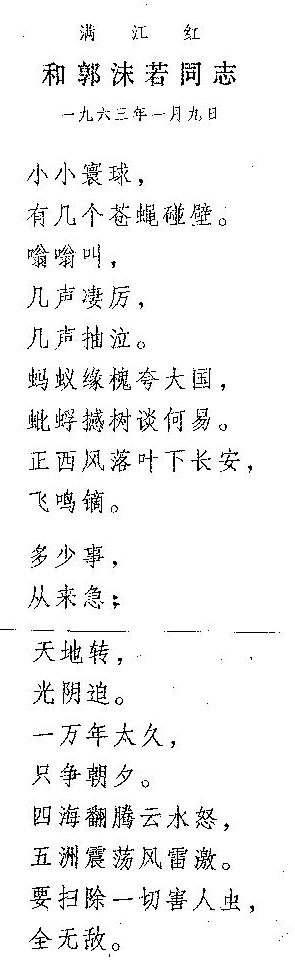
Mao Zedong (Mao Tse-tung)
A poem written January 9th, 1963
Reply to Comrade Guo Moruo
(to the tune of Man Jiang Hong)
On this tiny globe
A few flies dash themselves against the wall,
Humming without cease,
Sometimes shrilling,
Sometimes moaning.
Ants on the locust tree assume a great-nation swagger,
And mayflies lightly plot to topple the giant tree.
The west wind scatters leaves over Chang’an,
And the arrows are flying, twanging.
So many deeds cry out to be done,
And always urgently:
The world rolls on,
Time presses.
Ten thousand years are too long,
Seize the day, seize the hour !
The Four Seas are rising, clouds and waters raging,
The Five Continents are rocking, wind and thunder roaring.
Our force is irresistible,
Away with all the pests !
_____
 Zócalo Poets