Grito de Dolor, de Dignidad, de Orgullo: Cuauhtemoctzin, Anáhuac Huei Tlahtohuani: Su Último Mandato
Posted: September 15, 2012 Filed under: English, Náhuatl, Spanish, ZP Translator: Alexander Best | Tags: Poemas para el Día de la Independencia de México Comments Off on Grito de Dolor, de Dignidad, de Orgullo: Cuauhtemoctzin, Anáhuac Huei Tlahtohuani: Su Último Mandato
Cuauhtémoc (1496-1525) fue el último “tlatoani” mexica de México-Tenochtitlan.
Reinó durante la toma de Tenochtitlan por Hernán Cortés y sus soldados.
.
Tlatzacan Cuauhtemoctzintli Itenahuatil
.
Totonaltzin ye omotlatihzinoh,
totonaltzin ye omixpoliuhtzinoh,
ihuan centlayohuayan otechcahuilih.
.
Mach tictomachiliah occeppa mohualhuiliz,
ma occeppa moquizaltiz
ihuan yancuican techmotlahuililiquiuh.
.
In oquic ompa mictlanzinco momanilticaz
.
ma zan iciuhca titocentlalihtzinocan,
ma titonechicohtzinocan
ihuan toyolnepantlahtzinco ma tictotlatilican
mochi in toyollotzin quimotlazohtilia
ihuan ticmachiliah totlaqui:
topan yuhquin huei chalchihuitzintli.
.
Ma tiquinpohpolhuican in toteocalhuan,
in tocalmecahuan, in totlachcohuan,
in totelpochcalhuan, in tocuicacalhuan;
ma mocelcahuican in toohuihuan
ihuan tochantzitzinhuan ma techpielican
.
Quin ihcuac moquizaltiz in yancuic totonaltzin,
in tetahzitzintin ihuan in tenantzitzintin
ma aic xicmilcahuilican
quimilhuitizqueh in intelpochtzitzinhuan
ihuan ma quinmachtilican inpilhuantzitzinhuan
in oquic nemitizqueh,
huel quenin cualli moyetzinoticatca
quin axcan Totlazohanahuac
in campa techmocuitlahuiqueh toteotzitzinhuan,
intlanequiliz ihuan intlaelehuiliz,
ihuan zan ye no ipampa toquinmahuiliz
ihuan toquinpololiz
oquinceliliqueh in tiachcatzitzihuan,
ihuan tlen in totahtzitzihuan,
ahhuic yolecayopan,
oquinximachtiliqueh toyelizpan.
.
Axcan tehhuantzitzin tiquintotequimaquiliah
in topilhuan:
¡Macamo quicalhuilican, ma quinnonotzacan
inpilhuan huel quenin moyetzinotiyez
in imahcoquizaliz,
quenin occeppa moehualtiz in totohaltzin;
ihuan huel quenin mochicahuilihtzinoz
huel quenin moquitzontiliz hueyica
inehtotiliztzin inin
totlazohtlalnantzin Anáhuac!
” CUAUHTEMOCTZIN,
Anáhuac Huei Tlahtohuani ”
.
“El Último Mandato del Venerable Cuauhtémoc”
Nuestra sagrada energía ya tuvo a bien ocultarse,
nuestro venerable sol ya dignamente desapareció su rostro,
y en total obscuridad se dignó dejarnos.
.
Ciertamente sabemos que otra vez se dignará volver,
que otra vez tendrá a bien salir
y nuevamente vendrá dignamente a alumbrarnos.
.
En tanto que allá entre los muertos tenga a bien permanecer.
.
Muy rápido reunámonos,
congreguémonos
y en medio de nuestro corazón escondamos
todo el nuestro corazón se honra amando
y sabemos nuestra riqueza
en nosotros como gran esmeralda.
.
Hagamos desaparecer los nuestros lugares sagrados,
los nuestros Calmécac los nuestros juegos de pelota,
los nuestros Telpochcalli, las nuestras casas de canto;
que solos se queden los nuestros caminos
y nuestros hogares que nos preserven.
.
Hasta cuando se digne salir el nuevo nuestro Sol,
los venerados padres y las veneradas madres
que nunca se olviden de
decirles a los sus jóvenes
y que les enseñen a sus hijos
mientras se dignen vivir,
precisamente cuán buena ha sido
hasta ahora nuestra amada Anáhuac
donde nos cuidan nuestros venerados difuntos,
su voluntad y sus deseo,
y solo también por causa de nuestro respeto por ellos
y nuestra humildad ante ellos
que recibieron nuestros venerados antecesores
y que los nuestros venerados padres,
a un lado y otro en las venas de nuestro corazón,
los hicieron conocer en nuestro ser.
.
Ahora nosotros entregamos la tarea a
los nuestros hijos
Que no olviden, que les informen
a sus hijos intensamente como será
su elevación,
como nuevamente se levantará el nuestro venerable Sol
y precisamente como mostrará dignamente su fuerza
precisamente como tendrá a bien completar grandiosamente
su digna promesa esta
nuestra venerada y amada tierra madre Anáhuac!
.
“The Final Mandate of the most Venerable Cuauhtémoc”
Our sacred energy has already had to hide itself away,
Worthily, the face of our venerable Sun has disappeared
And in total darkness deigned to leave us.
.
Most certainly we know that once again he will condescend to return to us,
That again he will have to come out
And anew to shine worthily upon us.
.
Even while there among the dead he might well have to remain.
.
Most quickly now, let us gather,
Let us congregate
And in the middle of our heart let us hide,
All our heart is honoured in loving
And we know there are riches
Inside us like an enormous emerald.
.
Let us make our sacred places disappear,
Our Calmécac, our ball-games,
Our Telpochcalli, our song-houses;
That all that might remain be our roads
And our homes that we might preserve.
.
Until he our new Sun may deign to come out,
The venerable fathers and mothers
Who never may forget
To tell of themselves to the young
And who may teach the children
While they deign to still live,
Precisely when it has been
Up til now our belovéd Anáhuac
Where our venerated deceased ones care for us,
Their will, their desire,
And also only by reason of our respect for them
And our humbleness before them
Who received our venerable antecedents
And our venerated parents,
From one side to the other in the veins of our heart,
They made themselves known in our being.
.
Now we present to our children the task that
They not forget, that they might tell their children
Intensely as is fitting to their age and rank
As newly he will rise – our venerable Sun,
And precisely as he will show worthily his strength
He will have to truly and grandly complete
His worthy promise in
This our venerated, our belovéd, our earth-mother Anáhuac!
.
Translation from Spanish to English: Alexander Best
Poemas de América Central de las décadas de los 70 y 80, poemas para ayudarnos a recordar, poemas que nos hagan pensar… / Poems for the sake of El Salvador, Guatemala, Honduras, Nicaragua – poems to help us remember – poems to make us think…
Posted: September 15, 2012 Filed under: Daisy Zamora, English, José Luis Villatoro, Lil Milagro Ramírez, Roberto Sosa, Spanish Comments Off on Poemas de América Central de las décadas de los 70 y 80, poemas para ayudarnos a recordar, poemas que nos hagan pensar… / Poems for the sake of El Salvador, Guatemala, Honduras, Nicaragua – poems to help us remember – poems to make us think…
En este día – el 15 de septiembre…Poemas de América Central de las décadas de los 70 y 80 – tiempos de guerra civil, de lucha popular, de revolución…
Poems we post this 15th of September 2012 for the sake of Independence Days in El Salvador, Guatemala, Honduras, Nicaragua – poems from the 1970s and 1980s, decades of civil war, The People’s struggle, revolution…
.
Lil Milagro Ramírez (El Salvador)
“Despertar”
Yo era mansa y pacífica
Era una flor,
Pero la mansedumbre no es un muro
Que cubre la miseria.
Y vi las injusticias
Y ante los ojos asombrados,
Estallaron las huelgas y las rebeldías
Del hombre proletario.
.
Y en vez de absurdas lástimas,
De hipocresías compasivas,
Brotó mi indignación
Y me sentí fraternalmente unida a mis hermanos,
Y toda huelga me dolía,
Y cada grito me golpeaba
No sólo en la cabeza o los oídos
Sino en el corazón.
Cayó mi blanca mansedumbre,
Muerta a los pies del hambre,
Me desnude llorando de sus velas
Y un nuevo traje me ciñó las carnes.
Primavera de lucha son ahora mis brazos,
Mi enrojecida sangre es de protesta,
Mi cuerpo es verde olivo
Y un incendiario fuego me consume
…y sin embargo,
Sigo siendo como antes,
Amante de la paz,
Quiero luchar por ella desesperadamente,
Porque desde el principio
Yo soñé con la paz.
.
“Awakening”
I was gentle and peaceful,
A flower.
But gentleness isn’t a wall
That hides misery –
And I saw injustice,
And strikes and rebellions
By ordinary people
Exploded before my astonished eyes.
.
And instead of absurd pity
And sympathetic hypocrisy
My indignation burst forth
And I felt myself united with my sisters and brothers,
And every strike hurt me,
And every cry struck me
Not only in my head or ears
But in my heart.
My white gentleness fell,
Dead at the feet of hunger,
I undressed myself, weeping at its veils
And new clothing clung to my flesh.
My arms now in the springtime of struggle,
My red-hot blood protesting,
My body olive-green,
An incendiary passion consumes me
… and nevertheless
I keep feeling as before,
A lover of Peace,
I want to fight for it – desperately –
Because from the beginning
I have dreamt of Peace.
.
José Luis Villatoro (Guatemala)
“Elegía por el Joven Cadáver”
¿De quién es este joven
Cadáver que nos mira?
.
La calle tuvo antenas asesinas.
.
Sobre limpias baldosas
Su nombre perforaron,
Agujerearon su risa sospechosa.
.
Alguien anduvo cerca de sus labios
Y le hizo pedazos de sangre la palabra.
.
Amor, ¿como explicarte éste cadáver
Sin lastimar el fruto de tu vientre?
Será llegar sin cauce hasta el océano
Y llorar en la isla que le duele.
.
Hay un cadáver nuevo y vehemente
Con los ojos abiertos para siempre.
.
Amor, ¿como explicarte la mañana
Si apenas la tocamos con los dedos?
.
“Elegy for the Young Corpse”
Who is this young corpse
That looks at us?
.
The street had murderous antennae.
.
On clean cobblestones
They perforated his name,
They pierced his suspicious laugh.
.
Someone went near his lips
And turned his word into bloody pieces.
.
My love, how do I explain this corpse to you
Without wounding the fruit of your womb?
It will arrive at the ocean, rampant,
And weep on the island of its pain.
.
It’s a new and passionate corpse
With its eyes open forever.
.
My love, how do I explain the morning to you,
If we barely touch it with our fingers?
.
Roberto Sosa (Honduras)
“Dibujo a pulso”
A como dé lugar pudren al hombre en vida,
Le dibujan a pulso
Las amplias palideces de los asesinados
Y le encierran en el infinito.
.
Por eso
He decidido dulcemente
Mortalmente
Construir
Con todas mis canciones
Un puente interminable hacia la dignidad,
para que pasen,
Uno por uno,
Los hombres himillados de la Tierra.
.
“Freehand Sketch”
They use everything they’ve got to putrify a man alive,
Sketch in a flash
The ample pallor of the murdered
And lock him up in infinity.
.
And so,
Sweetly
Fatally
I have decided to construct
With all my songs
An endless bridge to dignity
So that,
One by one,
The humiliated of the Earth may pass.
.
Daisy Zamora (Nicaragua)
“Cuando regresemos”
Cuando regresemos a nuestra antigua tierra
Que nunca conocimos
Y platiquemos de todas esas cosas
Que nunca han sucedido
.
Caminaremos llevando de la mano niños
Que nunca han existido
.
Escucharemos sus voces y viviremos
Esa vida de la que tanto hablamos
Y nunca hemos vivido.
.
“When we return”
When we return to our ancient land
That we never knew
And we talk of all those things
That never happened
.
We will walk holding children by the hand
Who have never existed
.
We’ll listen to their voices and
Live that life we spoke of so often
And have never lived.
. . . . .
Traducciones del español al inglés / Translations from Spanish into English:
Barbara Paschke, Tony Ryan, David Volpendesta, Magaly Fernández
Five Poets from Trinidad and Tobago – with an introduction by Andre Bagoo
Posted: August 31, 2012 Filed under: 7 GUEST EDITORS, Andre Bagoo, Colin Robinson, Danielle Boodoo-Fortune, English, Mervyn Taylor, Nicholas Laughlin, Vahni Capildeo | Tags: Poets from Trinidad and Tobago Comments Off on Five Poets from Trinidad and Tobago – with an introduction by Andre Bagoo
Five poets from Trinidad and Tobago
THE WORLD meets in Trinidad and Tobago. Here is a Caribbean country open to the possibilities of permeable boundaries, enriched by cultural diversity and charged with the energy needed to drive a special art.
Today, as the former British colony marks its 50th anniversary as an independent nation, we take a look at the work of five contemporary Trinidad-born poets in a series of posts which you will see below.
Most of these poets live in Trinidad, others divide their time between Trinidad and homes in the United Kingdom or the United States. All share a remarkable vantage point; all have been influenced by a rich Caribbean literary tradition which predates independence. Here are travellers: between time, space, dimensions, selves, journeying to and from Shakespeare’s undiscovered country. They create richly-coloured gems, sparkling like the light bouncing off the floor of a cold, golden sea, and sharp as a diamond blade.
The first post features Mervyn Taylor, the Trinidad-born poet who also lives in New York. His poem ‘The Mentor’ – which features the persona of a poet “dancing his / mischievous meaning, / tieless, sparkling with / metaphor” – seeks reason but finds the crackling of bones. The poem is an audacious distillation of the challenges facing Trinidad, which may also reflect the challenges of the poet and the individual seeking freedom.
Then, as Queen Elizabeth celebrates her Jubilee year, the Oxford-based poet Vahni Capildeo takes us to London’s Hyde Park only to make us discover that we have never left the bottom of the Atlantic Ocean, “Opalescent, Crystalline, Amethyst. And Dark”. By the time she is done with us we are unsure what ground we walk on and feel walking on water to be a natural state.
In another post we feature the quietly disquieting work of Danielle Boodoo-Fortune, a poet and artist who lives in Sangre Grande, a town in the north-east of Trinidad.
There are also posts by Colin Robinson, whose poetry shows us the sublime in unexpected places, and Nicholas Laughlin, the editor behind the Caribbean Review of Books, whose own work is a tour de force of mood, sound and language – dissecting ideas of alienation like an anthropologist might but with unexpected lyricism. Both are poets living in Diego Martin, the suburb nestled in the cool mountains of northwest Trinidad which was only this month ravaged by flood.
These poems are not intended as any sort of programmatic depiction of anything. They are grouped here to speak, whether in harmony or dissonance, of feelings, ideas and impressions. They are an unauthorised biography which the subject might secretly relish.
Each post is accompanied by an image from the Trinidadian graphic artist Rodell Warner (rodellwarner.com) who manages to capture a mood and tone that say things about the work, but also about Trinidad and Tobago and its vitality.
—Andre Bagoo
.
ABOUT TODAY’S GUEST EDITOR
Andre Bagoo is a poet and journalist from Trinidad. His first book of poems, Trick Vessels, was published by Shearsman Books (UK) in March 2012. His poetry has appeared in Boston Review, Caribbean Review of Books, The Caribbean Writer, tongues of the ocean and elsewhere. One of his poems, ‘Carnival Monday in Trinidad’, was featured at Zócalo Poets earlier this year. He is Zócalo Poets’ guest editor today, the 50th anniversary of Trinidad and Tobago Independence.
Mervyn Taylor: The Mentor
Posted: August 31, 2012 Filed under: 7 GUEST EDITORS, Andre Bagoo, English, Mervyn Taylor | Tags: Poets from Trinidad and Tobago Comments Off on Mervyn Taylor: The Mentor
Mervyn Taylor
The Mentor
I.
In this dream there were
cows in every field,
breaths rising to create
clouds floating above
an island so green,
it seemed made of gases.
And out of this arose the
poet, in a grey suit,
as spry as I’ve ever
seen him, dancing his
mischievous meaning,
tieless, sparkling with
metaphor, asking his trick
question- are you going
with me, are we going
to look for reasons?
In this place I answered,
no one should ever starve,
or complain about things
other than an open gate
through which a stray might
wander lost and unmarked,
ending in dispute settled now
in such devious ways.
II.
You might remember Lena.
In the dream she too
was present, wearing
a hat like a teakettle cover,
remarking those boys who
now live where she grew up,
tattoos marking their bodies,
and a young girl hosting
a perfume sale every Friday,
advertised under
a Digicel sign and one
for computer repairs.
It is rumored this is the
house a mental outpatient
was looking for, when he
smashed the gate
at a wrong address,
took a wheelbarrow handle
and beat a bedridden
90 yr. old to death, those
who harbored the fugitive
he was seeking crouching
next door, saying
not a word, their weapons
like marshmallows in their
pockets, hands over their
ears, blocking the sound of
breaking bones, and screams.
III.
Cows crop the grass,
brown and white backs
seen from above, the land
in undulating waves below.
Out of the few houses,
people in black follow
funerals, fathers refusing
to accept each other’s
apologies, watching their sons
lowered, earth tamped,
they remain, conversing
with the dead. Ah, the poet
smiles his ineffable smile,
those adverbs he warned
against, they shuffle up.
What will we do with them,
now that he is going, trailing
long verses, joining the islands
like cans behind a wedding,
bells pealing in chapels
whose stone walls he worked
hard to capture, inside the
host on Sunday morning,
blood in silver chalices,
the priest’s voice intoning
from memory- sunlight,
stained glass, sin, all in
four-by-four refrain.
IV.
This is where they’ve
chosen to reenact the story
of sacrifice, with animals,
gold and greed,
where the washing of hands
goes on every day, governors
and guards swearing
each other away, poets
in corners swearing out
long poems like warrants,
lists of charges read aloud
in a difficult language,
the one in grey asking,
are you going with me, are
we going to understand
what it is we do, and why?
. . .
ABOUT THE POET
Mervyn Taylor is a Trinidad-born poet who divides his time between Brooklyn and his native island. He has taught in the New York City public school system, at Bronx Community College and The New School, and is the author of four books of poetry, namely, An Island of His Own (1992), The Goat (1999), Gone Away (2006), and No Back Door (2010, Shearsman Books). He can be heard on an audio collection, Road Clear, accompanied by bassist David Williams.
Vahni Capildeo: Water / Ice Cream in Hyde Park with Nikki
Posted: August 31, 2012 Filed under: 7 GUEST EDITORS, Andre Bagoo, English, Vahni Capildeo | Tags: Poets from Trinidad and Tobago Comments Off on Vahni Capildeo: Water / Ice Cream in Hyde Park with Nikki
Vahni Capildeo
Water
.
I. Cold Hands
There is a moment when
the water seems as if it might be warm.
Quick
wash your face
in the illusion
.
II. The Atlantic. Like
Putting a handspan square of glass
flat on the sea, thinking I see
something. That’s the sky.
Calling the colour roaring grey
heard in December, when the tide
discourages. That’s a lie
.
III. Opalescent, Crystalline, Amethyst. And Dark
The sea is.
In my mind I never left you.
The sea
is.
Place-holder, holder of a place:
The sea
Who can hold to this? A causeway.
is.
Essential ground for memory.
Twig-runes dust the shore with bird-tracks.
And the wind
.
IV. Changes
Swans and rain and swans in rain
Swans and rain
Swans again
. . .
Ice Cream In Hyde Park With Nikki
Time flies / she’s a dancer / seagulls & eagles
we’re watching walkers’ & cyclists’ ankles
straight up & down as posts! / larks & starlings
they ain’t / that’s Time / stopping & starting
singlescoop chocolatemint slipup
delicious / xylophonic strip / perfume-smelling forearms
vintage gardenia topnote soprano orangeblossom
she swoops / she sings / Time high-steppng
to her Lambretta scooter!
New York, hold your sidewalk breath
.
[From Utter (completed 2011; revised 2012. Forthcoming.
‘Water’ is taken from ‘December’, in the 14-month ‘Winter to Winter’ calendar,
Undraining Sea (Norwich: Egg Box, 2009)]
. . .
ABOUT THE POET
Vahni Capildeo (b. Trinidad, 1973) went to the UK as a student in 1991, completing her BA (Hons) (First Class) in English Language and Literature in 1995 at Christ Church, University of Oxford. A Rhodes Scholarship (1996-99) enabled her to pursue a doctorate in Old Norse at the same institution. After a Research Fellowship at Girton College, Cambridge, Capildeo worked for the Oxford English Dictionary on Etymology and quotational research.
Capildeo’s three poetry collections are: Dark & Unaccustomed Words (2012); Undraining Sea(Egg Box, 2009); and No Traveller Returns (Salt, 2003). Her poetry and prose have been widely anthologized, most recently in The Best British Poetry 2012 (Salt, forthcoming). She has been Highly Commended for the Forward Prize (individual poem category, 2009); shortlisted for the Guyana International Prize for Literature (2011).
Colin Robinson: Indivisible
Posted: August 31, 2012 Filed under: 7 GUEST EDITORS, Andre Bagoo, Colin Robinson, English | Tags: Poets from Trinidad and Tobago Comments Off on Colin Robinson: Indivisible
Colin Robinson
Indivisible*
.
He’s very well rounded
Like his lover like(s) me
An engineer, I have to pry it out
He jokes, I’m 569 years old
Dog years, I ask, what to divide by
Google it’s a prime number
We are linked online
By another man
He too does not remember
We chat routinely about random things
BRB
I cam a quickie with a mewling chubby boy
Fantasy is cute in ways reality doesn’t match up to LOL
I type, I never had a good imagination, he IMs back
How Mills & Boons are a good lesson in writing
To make a kiss last four pages
I ask what tongue you grew up speaking
I had to allow my language to fall on all ears
Today we move to a higher order
Talk fetishes, we like the same things
But my numeracy gets the better of me once again
As I calculate the probability
That in any triangulation
Two times out of three
There will be a remainder
Either two or one.
.
*for Shadath
. . .
ABOUT THE POET
Colin Robinson is executive director of CAISO, the Coalition Advocating for the Inclusion of Sexual Orientation. His poetry has appeared in many places, including Caribbean Erotic, an anthology published by Peepal Tree Press in 2010. He moves between the West Indies and the USA. He was NY field producer for Tongues Untied, led Studio Museum in Harlem’s first three creative responses to World AIDS Day and co-edited Other Countries: Black Gay Voices and Think Again.
Danielle Boodoo-Fortune: Morning Song for a Second Son
Posted: August 31, 2012 Filed under: 7 GUEST EDITORS, Andre Bagoo, Danielle Boodoo-Fortune, English | Tags: Poets from Trinidad and Tobago Comments Off on Danielle Boodoo-Fortune: Morning Song for a Second Son
Danielle Boodoo-Fortune
Morning Song for a Second Son
.
Second son, how I fear my own singing.
Each word sounds like regret,
like the rasp of torn laughter
sputtering from the kettle
of your prodigal’s tongue.
Lord knows, I cannot bear the sound.
The house sits deep in darkness,
tarsals click against tile as
you measure the breadth
of another’s shadow.
Son, of all the things I’ve made,
you are the truest, and the one
most unknown to me.
Each tic in your jaw is an ocean
of hurt I cannot cross
How I wish I could sing for you.
. . .
ABOUT THE POET
Danielle Boodoo-Fortune is a Trinidadian poet and artist. Her work has been featured in The Caribbean Writer, Bim: Arts for the 21st Century, Tongues of the Ocean, Anthurium: A Caribbean Studies Journal, Small Axe Literary Salon, and Poui: Cave Hill Journal of Creative Writing. Her art has been featured at Trinidad’s Erotic Art Week 2011, and the WoMA (Women Make Art) exhibition, in Grenada, 2012. Her art has also been featured in St. Somewhere Journal, Firestorm Literary Journal, Splash of Red Literary Arts Magazine, and on the cover of Blackberry: A Magazine. She was awarded the Charlotte and Isidor Paiewonsky Prize for first time publication in 2009, nominated for a Pushcart Prize in 2010, and shortlisted for the Small Axe Poetry Prize in 2009 and 2011.
Nicholas Laughlin: Self-Portrait in the Neotropics
Posted: August 31, 2012 Filed under: 7 GUEST EDITORS, Andre Bagoo, English, Nicholas Laughlin | Tags: Poets from Trinidad and Tobago Comments Off on Nicholas Laughlin: Self-Portrait in the Neotropics
Nicholas Laughlin
Self-Portrait in the Neotropics
.
Eleven of the strange years of my life.
Months on end I lived on tapioca,
I lived on mud and permanganate broth,
and river water red as rum,
bivouacked with rainflies
and fire ants and sundry native guides.
The parrots already knew some French.
Nous sommes les seuls français ici.
Call it sunstroke, le coup de bambou.
I came all this way with half a plan,
an extra handkerchief, and Humboldt (abridged).
Here I lack only the things I do not have.
*
Eleven years of untimely weather,
earthquakes and fireflies and mud.
The colonel writes his complaints to the general.
The general writes his complaints to the emperor.
The emperor writes to Jesus Christ,
who damns us all.
Nous sommes les seuls français left in the world.
I came all this bloody way
to sit in a cheap café with bandaged hands.
I translate detective novels, Dr. Janvier.
It keeps me in dinero, out of trouble.
I miss only the friends I do not have.
.
[From The Strange Years of My Life,
a sequence first published at Almost Island,
which you can read at: almostisland.com (see winter 2011/poetry)]
. . .
ABOUT THE AUTHOR
Nicholas Laughlin is the editor of The Caribbean Review of Books and the arts and travel magazine Caribbean Beat; programme director of the NGC Bocas Lit Fest, an annual literary festival based in Trinidad and Tobago; and co-director of the contemporary art centre Alice Yard.
Macuilxochitzin / Macuilxóchitl: poetisa mexica del siglo XV
Posted: August 29, 2012 Filed under: Macuilxochitzin, Náhuatl, Spanish | Tags: Canto de Macuilxochitzin Comments Off on Macuilxochitzin / Macuilxóchitl: poetisa mexica del siglo XV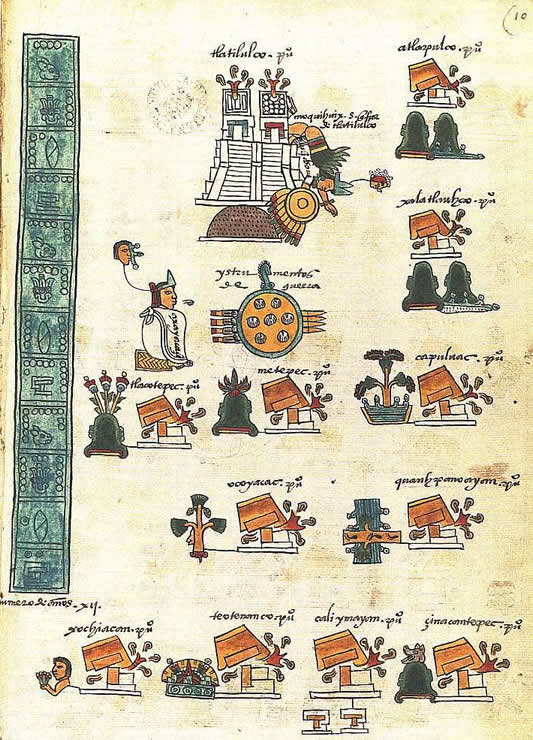
Canto de Macuilxochitzin
.
Elevo mis cantos,
Yo, Macuilxóchitl,
con ellos alegro al “Dador de la Vida”,
¡comience la danza!
.
¿Adonde de algún modo se existe,
a la casa de Él
se llevan los cantos?
¿O sólo aquí
están vuestras flores?,
¡comience la danza!
.
El matlatzinca
es tu merecimiento de gentes, señor Itzcóatl:
¡Axayacatzin, tú conquistaste
la ciudad de Tlacotépec!
Allá fueron a hacer giros tus flores,
tus mariposas.
Con ésto has causado alegría.
El matlatzinca
está en Toluca, en Tlacotépec.
.
Lentamente hace ofrenda
de flores y plumas
al “Dador de la Vida”.
Pone los escudos de las águilas
en los brazos de los hombres,
allá donde arde la guerra,
en el interior de la llanura.
Como nuestros cantos,
como nuestras flores,
así, tú, el guerrero de cabeza rapada,
das alegría al “Dador de la Vida”.
Las flores del águila
quedan en tus manos,
señor Axayácatl.
Con flores divinas,
con flores de guerra
queda cubierto,
con ellas se embriaga
el que está a nuestro lado.
.
Sobre nosotros se abren
las flores de guerra,
en Ehcatépec, en México,
con ellas se embriaga el que está a nuestro lado.
Se han mostrado atrevidos
los príncipes,
los de Acolhuacan,
vosotros los tecpanecas.
Por todas partes Axayácatl
hizo conquistas,
en Matlatzinco, en Malinalco,
en Ocuillan, en Tequaloya, en Xocotitlan.
Por aquí vino a salir.
Allá en Xiquipilco a Axayácatl
lo hirió en la pierna un otomí,
su nombre era Tlílatl.
.
Se fue éste a buscar a sus mujeres,
Les dijo:
“Preparadle un braguero, una capa,
se los daréis, vosotras que sois valientes.”
Axayácatl exclamó:
“¡Que venga el otomí
que me ha herido en la pierna!”
El otomí tuvo miedo,
dijo:
“¡En verdad me matarán!”
Trajo entonces un grueso madero
y la piel de un venado,
con ésto hizo reverencia a Axayácatl.
Estaba lleno de miedo el otomí.
Pero entonces sus mujeres
por él hicieron súplica a Axayácatl.
. . .
Traducción del náhuatl al español:
Miguel León-Portilla, 2003
. . .
En náhuatl:
Macuilxochitzin Icuic
.
A nonpehua noncuica,
ni Macuilxochitl,
zan noconahuiltia o a in ipalnemoa,
yn maconnetotilo – ohuaya, ohuaya!
.
Quenonamican,
can o ye ichan
im a itquihua in cuicatl?
Ic zanio nican
y izca anmoxochiuh?
In ma onnetotilo – ohuaya, ohuaya!
.
Temomacehual matlatzincatl,
Itzcohuatzin:
In Axayacatzin ticmomoyahuaco
in altepetl in Tlacotepec – a ohuaya!
O ylacatziuh ya ommoxochiuyh,
mopapaloouh.
Ic toconahuiltia.
In matlatzincatl, in Toloca, in Tlacotepec – a ohuaya.
.
Ayaxca ocontemaca
in xochitlaihuitla
ypalnemoa – ohuaya.
In quauhichimalli in temac,
ye quimana – ohuican ouihua,
yan tlachinolli itic,
yxtlahuatl itic – ohuaya, ohuaya.
In neneuhqui in tocuic,
neneuhqui in toxochiuh,
can tiquaochpan,
in toconahuiltia ypalnemoa – ohuaya, ohuaya.
In quauhxochitl
in momac ommani,
Axayacatzin.
In teoaxochitl,
in tlachinolxochitl ic,
yzhuayotimani,
yca yhuintihua
in tonahuac onoca – ohuaya, ohuaya.
.
Topan cueponi – a
yaoxochitl – a,
in Ehecatepec, in Mexico – ye ohoye
ye huiloya yca yhuintihua
in tonahuac onoc.
.
Za ye netlapalolo
in tepilhuan,
in acolihuaque,
an antepaneca – ohuaya, ohuaya.
.
In otepeuh Axayaca
nohuian,
Matlatzinco, Malinalco,
Ocuillan, Tequaloya, Xohcotitlan.
Nican ohualquizaco.
Xiquipilco oncan
oquimetzhuitec ce otomitl,
ytoca Tlilatl.
.
Auh yn oahcico,
quimilhui ycihuahuan:
– Xitlacencahuacan in maxtlatl, in tilmatli,
anquimacazque amoquichui.
Oquinenotzallan:
– Ma huallauh yn otomitl,
yn onechmetzhuitec!
Momauhtihtica yn otomitl,
quittoa:
– Anca ye nechmictizque!
Quihualhuica in huepantli,
in tlaxipehualli in mazatl,
ic quitlapaloco in Axaya.
Momauhtitihuitz.
Auh zan oquitlauhtique yn icihuahuan Axayaca.
_____
La princesa Macuilxochitzin/Macuilxóchitl nació en México-Tenochtitlan hacia 1435 y vivió la buena parte del siglo XV. Fue hija de Tlacaélel, un consejero de los reyes aztecas. Desde pequeña recibió la mejor educación; también escuchó de la boca de su madre los antiguos consejos de los mexicas. Y, por supuesto, ella conocía los artes del bordado y del telar.
Este poema – El Canto de Macuilxochitzin – trata de una conquista mexica del año 1476. Era la intención de la poetisa dar gracias al “Dador de la Vida” y preservar el cuento de la victoria de su pueblo.
El original se incluye en la colección de la BNM (Biblioteca Nacional de México).
Nurun Nahar’s “Mankind who – You, for such” – an inspirational Bengali poem for Eid-ul-Fitr 2012
Posted: August 19, 2012 Filed under: 7 GUEST EDITORS, Bengali (Bangla), English, Laboni Islam, Nurun Nahar | Tags: Poems for Eid-ul-Fitr Comments Off on Nurun Nahar’s “Mankind who – You, for such” – an inspirational Bengali poem for Eid-ul-Fitr 2012


Nurun Nahar (1924-1992) was born in Tangail, Bangladesh. She wrote this poem in her youth. Artist, writer, and mother of five, she could crochet blankets in her sleep. Translation by Syeda Parvin Shirin, her only daughter. Photo by Laboni Islam, one of Nurun’s many grand-daughters.
 Zócalo Poets